Hugh Mulleneux Walmsley (continued 2)
Reading edition
The dead deep silence weighed upon him, the strange motions of the bush made him nervous. Again the rifle was raised, when a loud trampling noise was heard, as with their heads down and their spiral horns glittering in the sun, the troop of gnus came on at top speed. A more ferocious-looking lot could hardly be imagined, as they headed dead down the valley. Still the hunter’s attention was divided, and more engrossed with the bush than with the game. The gnus rapidly neared it, urged on by the shouts of Noti, while Luji’s voice was plainly to be heard far away in rear. They were close to it; about to pass in safety, when a piercing yell rang from the bush, and a bright spear glancing in the sunshine struck the leading gnu, while Masheesh, casting his leafy covering, sprang to his feet. The report of the soldier’s rifle followed, and one of the herd rolled heavily forward, breaking its horns in the impetus of the fall. The animal struck by the spear halted at once, stamping violently with its forefoot, and lowering its head for the charge. The savage stood awaiting it, his knobstick in his left hand, the long glittering dagger in his right, tall, erect, and fearless, the very picture of a dusky brave. With an angry snort the bull rushed on, but the savage stepped lightly aside, and the steel sank deep into the flesh near the spine. Again the gnu turned to charge, for a moment hesitating, as it lowered its shaggy head, but at that instant a ball from the deadly English rifle struck right between the eyes, and it fell heavily close to Masheesh, the blood gushing from its mouth. It was a much larger one than that first killed, when measured proving fully seven feet four inches from the top of the nose to the base of the tail. The horns were one foot ten inches in length, and the animal stood at least four feet in height at the shoulder. The hoof, as Captain Hughes and the delighted Masheesh stood beside the carcass, seemed too large for the legs, and the knee joints were covered with a hard substance like those of a tame ox. In fact the animal seemed to resemble much the half-wild oxen of India, and, before it charged, the wounded gnu pawed with the forefoot, tossing its head exactly as a wild bull would have done. Hughes now learned that the natives regularly hunt the antelope and zebra in the way Masheesh had done that day, whole herds feeding carelessly up to the supposed bush, but on this occasion the concealed man had run unconsciously a terrible risk.
The sun was sinking towards the west—telling that it was time to strike the river, by whose banks the rest of the party had outspanned; so leaving Luji, Noti, and one of the Kaffirs to cut up and bring in the meat, the two stepped out for the Limpopo. Any fatigue, any privation Masheesh would endure, but even such manual labour as that of cutting up the carcasses of the slain he utterly disdained. It was sunset when the camp was at last reached, and there a messenger from Mozelkatse was found.
“It would appear,” said the missionary, who was busy preparing some skins of birds he had shot, “that a strong party of the Matabeles have joined their king.”
“Well, all I can say is, a good wash and something to eat are of more importance to me just now than all the kings in the world. You don’t know how tired I am, and then nothing to eat besides.”
“Look at Masheesh, whom you called an uneducated savage this morning,” replied Wyzinski, pointing towards the individual named, who after a drink of water had quietly seated himself, not even noticing the runner of his people, and was smoking, varying the amusement with an occasional pinch of snuff, and waiting calmly until some meat should be cooked by some one, he cared not by whom, provided he had nothing to do with it.
“Well, I suppose you don’t want me to smoke and take snuff as proofs of civilisation.”
“You have heard of the man, have you not, who thanked God he had at least reached a civilised country on seeing a gibbet? However,” continued Wyzinski, “yonder runner brings us an invitation from Mozelkatse, to join a great hunt in which the tribe is taking part on the banks of the Limpopo.”
“That will be worth seeing. And when is it to take place?” asked Hughes, forgetting hunger and fatigue.
“To-morrow.”
“Accept it, by all manner of means.”
Masheesh was interrupted in the tobacco-smoking process. The runner, who since his arrival in camp, had been gorging himself with meat, was sent back; great steaks and collops of venison cut from the hartebeest were grilling on the clear wood fire, and soon the howling of the hyenas, as they tore the bones of what had been left behind of the two gnus, as not worth bringing away, were the only sounds which disturbed the quiet of the little camp on the banks of the Limpopo.
Early morning saw the whole party afoot.
“Had we not better send Luji back to the tent?” said Hughes, as the morning light becoming clearer, they looked back from the crest of a rise, and saw it shining in the early sunbeams.
“We shall need him as an interpreter, perhaps. I can just manage, and that is all, to be understood,” replied Wyzinski; “everything is safe. Noti will keep a look-out.”
“See, there are a lot of Matabeles,” exclaimed Hughes. “They are quite naked, and have bows and arrows.”
“And there are more. Look in what numbers they are turning out! Yonder fellows have flint musquets: where did they get them, Luji?” asked the missionary.
“The Portuguese on the Zambesi—him sell, Master,” was the answer.
And now detachment after detachment came on, spreading out across the country, like infantry skirmishers, some carrying only spears, others bows and arrows, and a few, a very few, musquets, but always in line: shouting, yelling, and driving everything before them. Soon the antelope came bounding past, endeavouring to escape, but were driven back again, as the long line of savages, throwing forward the two flanks, enclosed them in a crescent miles in length, and drove them back on the river. Herds of koodoos, eland, and hartebeest came scouring along, attempting to break through in vain, while the painted zebra, the graceful leche, with its long tapering horns, were remorselessly driven back by the yells and shouts of the Matabele.
“I suppose we must find Mozelkatse. Tell Masheesh of our wish, Luji,” said the missionary. He alone of the whole party was mounted, being weak from the effects of fever, and as he spoke, they topped the crest of one of the green ridges so common to the undulating plains bordering the Limpopo, and on passing it the whole party were stopped by the presence, right in their path, of a huge rhinoceros.
He was quietly standing under a tree, apparently studying the landscape, and not seeming to think of the distant noise. At the foot of the tree rose one of those curious structures, the nest of the African ant, while a strange little animal, covered with thickly-plated scales of a yellowish tint, the under part of the belly only being undefended, was busy feeding on the ant-hill. In length the ant-eater was not more than three feet, and it was engaged shooting out its tongue into the heap, which tongue, being covered with some glutinous substance, always returned black with ants. The spot was comparatively quiet, for the time at least, and the rhinoceros did not seem in the least alarmed. He was a huge, heavy, massive creature, of a pale brown colour, carrying two horns, one very long and pointed, the second short, strong, but blunt. The longer one rose just above the tip of the nose, and seemed a most dangerous arm. Above the shoulders was a kind of hump. An uglier brute certainly could not have barred the path which ran towards the river; but the moohoohoo would have been perhaps inoffensive had not Masheesh, confiding, doubtless, in the power of the English rifle, crept towards him, throwing his spear. The weapon struck fairly and well, but glanced from the tough hide as though it had been hurled against a brick wall, and being made of the soft native iron, it literally curled up with the force of the blow. Having thrown his spear, which elicited only a wrathful grunt from the animal, Masheesh bolted, just as the huge mass put itself in motion, advancing straight up the path. Luji and the rest disappeared among the reeds and bushes, but Captain Hughes had just time to fire, the ball glancing from the mailed coat like a child’s marble.
“Look out!” shouted the missionary; but it was too late, and the next moment the unlucky soldier was lying on the ground, with the enormous bulk of the rhinoceros standing over him.
“Lie still, for God’s sake,” cried Wyzinski, as he unslung the heavy rifle, seeing that the animal did not strike at the fallen man. He was just in the act of raising it to his shoulder, when, attracted by the horse, the moohoohoo suddenly charged, the long pointed horn literally burying itself in the pony’s flank, just behind the rider’s leg, the rifle harmlessly exploding as horse and rider rolled over. Not pausing for a second blow, the enraged brute drove on, eventually shambling through the line of natives, who opened their ranks gladly to let him pass.
Rising unwounded, but sorely shaken, Hughes extricated the missionary.
“Are you hurt, Wyzinski?” he asked, anxiously.
“Not a bit,” was the reply; “but look at the poor grey.”
“He is past saving,” answered Hughes; and it was evident it was so, for so frightfully had the sharp horn done its work, that the entrails were hanging out, and the animal fast bleeding to death.
Placing his revolver to the pony’s head, the report rang out; a few convulsive movements, and the carcase of the horse lay still.
“Where is Masheesh?” enquired Hughes, as he returned the smoking weapon to his belt. “If it had not been for his nonsense, that pistol-shot would have been saved.”
Wyzinski had seated himself on the grass, for the whole thing had passed so quickly, that it was difficult to realise the danger.
Slowly stalking out of the bushes, Masheesh, as though nothing had happened, gravely walked to the foot of the tree, took up the ant-eater which, alarmed at the noise, had rolled itself up like a hedgehog, and brought it to where the missionary was seated.
“What on earth does he want with that hedgehog?” asked Hughes. The Matabele, speaking quickly, and in an excited voice, looked up at the missionary as he did so, pointing to the little animal.
“He says it is a great prize,” returned the other, “and consoles him for the loss of his spear. It appears that these ant-eaters are scarce, and the possession of one guarantees its owner against loss or sickness among his cattle.”
“The loss of his cattle! He nearly lost our lives for us, confound him,” replied Hughes, with some show of humour. “He don’t seem to think of that.”
“A native never does, it is not in their nature, and life is held very cheap. Look at yonder group moving over the plain in a line with that stunted acacia. The king Mozelkatse must be among them.”
“Can you walk, do you think, Wyzinski?”
“Oh, yes. I’m a good deal shaken, but that will wear away. Let us join the king.”
The rifles were loaded, and the whole party moved off once more, leaving the carcase of the grey pony lying in a pool of blood where it had fallen, to become a prey to the jackals and hyenas, those scavengers of the African plains.
Mozelkatse, in a state of nudity nearly as complete as that of his subjects, was in high good humour, and welcomed them warmly. The hunt, he told them, promised well, and a vast number of deer of all kinds were hemmed in between the horns of the living crescent. He motioned them to take their places by the side of the trap, or barricade, into which the herds were to be forced. Masheesh temporarily left them to place his prize, the ant-eater, in safety; and as the line of beaters was still far distant, there was ample time to examine the stockade.
The whole was something like a lobster-trap without a top, or like one of the salmon weirs to be found running out into the sea on the Welsh coast. It was made of stout branches driven deeply into the ground, with lighter ones interlaced horizontally between the upright poles. The opening was at least fifty paces in breadth, gradually narrowing, and as the horns of the living crescent drew inwards, it was the only outlet for the frightened game. It led to a deep square pit, which must have taken the tribe long to dig, whose sides were quite smooth and perfectly steep. Once in it, the deer could not get out, and towards this all the game was being driven. The process was a slow one, and it was afternoon before the long line of the Matabele approached. It was a curious sight. The shouts, screams, and yells of the men as they drove before them antelopes of all kinds, and then the excitement of those near the trap, as herd after herd would come down, find the barricade, and, suspecting danger, turn back. At first the different animals kept to themselves, but as the circle narrowed, quaggas, zebras, antelope of various forms would become mixed together, while the Matabele would rush among them, brandishing their long spears, and frantically striking their ox-hide shields, shrieking, howling, and spearing right and left, until the affrighted wretches, surrounded on every side by the yelling savages, took the only outlet left them, and dashing madly down the path between the stockades, leaped wildly into the pit, falling pell mell in. On they came, quaggas, koodoos, springbok, hartebeest, the shouting and spearing becoming wilder. Hundreds turned, and forced their way through the ever narrowing circle of yelling Matabele, the spears sticking in their bloody hides, while fuller and fuller became the pit, until it was heaped with the dead, dying, and maimed. There was the ferocious-looking gnu, the painted hide of the zebra, the graceful-limbed springbok, the long spiral horned leche, all heaped together in one boiling, seething mass of pain and suffering, the Matabele above, with savage cries, spearing those who in their agony tried to climb the sides of the pit, while still the yelling savages continued driving herd after herd, until, like the fire worshippers’ trap, in Moore’s beautiful poem, the pit was full and would hold no more. There was high feasting in the Matabele camp that night, for the hunt had been most successful, and the slaughter immense; but it was with feelings of pleasure the travellers had a farewell interview with Mozelkatse, and then passing among the dancing, singing savages, took their way across the plain, lighted by a brilliant moon, to their quiet camp by the side of the Limpopo.
A Narrow Escape.
Two days after the Matabele hunt the vast plains were once more silent, Mozelkatse, at the head of his gorged hunters, having left Zoutpansburgh for his own kraal, and the party of which the white men were the chiefs, having resumed their march northward. The waggon and horses had not yet been sent back, but the onward march was slow and tedious, and passing through the country of the Batonga, it took five days’ toilsome march before the tent was pitched on a bend of the Suave river. The weather had gradually increased in heat, the native kraals were few and small, and what was worse, the natives themselves seemed more and more unsociable, if not actually unfriendly.
The white man appeared known among them, but as the distance from the English frontier daily increased, this knowledge seemed only drawn from that of the Portuguese traders on the Zambesi, a degenerate race, who were looked down upon by the blacks. The plains swarmed with game of every kind, and fruits of different sorts were to be found near the rivers; but as the little party advanced, the forest-land became more frequent and more dense. The tall palmyra and the stately moshanna trees grew luxuriantly. Squirrels of various sorts haunted the groves and thickets, more particularly one species of a pale yellow colour, touched up with black, about eight inches long in the body, and being remarkable for its magnificent tail, also pale yellow, barred with black, and fully as long as the body. This beautiful little animal seemed to look for its food among the stones, and was quite fearless. The pitfalls dug by the natives were so artfully concealed as to be very annoying, and even dangerous. On one occasion a Kaffir fell into one, and was released with some difficulty. One was found close to the banks of the Suave river, and into it a splendid panther had fallen. It must have been days since it had been there, for the sides of the pit were scored with its claws: however, a pistol-shot killed it, and its skin was a most beautiful one. The mosquitos and the soldier ants were another source of trouble; and what with the heat, and the too constant meat diet, sores attacked the whole party, breaking out on all parts of the body.
Night had closed round the little camp on the Suave river; the day had been hot and sultry, and the route had lain over plains covered with wild cotton, and among groves of trees closely resembling the orange, but at that time of the year not bearing fruit. Masheesh, who had been a day’s journey to the eastward of north, in order to strike a large native kraal and obtain information, had just rejoined the camp, but his tidings were of a very mixed description. The tent was pitched under the spreading branches of a mashonga tree. A huge fire was lighted; a good supper had closed the fatigues of the day, and the men were fast asleep round the blaze, having gorged themselves with eland meat Captain Hughes was engaged sponging out a rifle, and near him, in the full blaze of the fire, Luji was skinning a small animal shot that day. It was a beautiful little creature of the squirrel tribe, about a foot long, of a bright yellowish red, barred here and there with black. The tail was at least three inches longer than the animal itself, and glossy black at the end. Wyzinski was earnestly studying a piece of broken stone, on which appeared some rude and defaced carvings; while, squatted on the ground, looking up into the missionary’s face, quite naked and his head ornamented with the waving ostrich plume, the firelight danced over Hasheesh’s black face and quick intelligent eyes.
“The Batonga tell,” said he, “of a range of mountains to the northward and eastward, called ‘Gorongoza.’”
“It is not the place we seek. Gorongoza is known to the Portuguese.”
“The white chief seeks the broken stone huts,” replied Masheesh, “and the Batonga tell of graves marked by stones lying on the mountain range of Gorongoza.”
“And do not they know of others?” asked the missionary.
“Yes,” replied the chief; “far to the eastward. Near the mouth of the river lie ruins, looking over the big water; it is from these that the stone which my father holds in his hand came.”
Wyzinski stooped over the fire and carefully examined the fragment. That it had been carved was evident, but it was so broken and defaced that he could make nothing of it. The chief continued—
“These ruins by the big water the Batonga call ‘Sofala,’ but to the northward and westward lies a large kraal. It is some days’ journey from Sofala and Gorongoza. Near Manica lie great forests of strange trees, and among those trees lie broken stone huts. In the mountains are caves, where the leopards and the lions hide. The white chief may leave his life there, but he will not see them. The broken huts are sacred, and if the stranger saw them no rain would fall in the country for three years.”
The voices of the speakers as they conversed eagerly together, with the wail of the jackals and hyenas, the barking of the foxes, the snort of the hippopotami on the river bank, broke the silence of the starlight night. The blaze occasionally flared up, and then died away, lighting up all to within a certain radius.
Luji was just finishing his squirrel, and Hughes had put his rifle together and was trying the lock, when a tremendous roar, apparently close to, startled all, and the flickering blaze of the firelight danced for an instant on the dark hide of a lion, as he dashed past, the next moment passing through the midst of the astonished group, bearing with him the carcass of an eland that day shot.
The night was dark, the country unknown; dense thickets existed on the banks of the river,—and so heaping fresh wood on the fire, the whole camp was soon fast asleep, the task of following up the spoor of the lion being deferred till the next morning.
The day’s march it was determined should be a short one, for Masheesh, who was down on the river side before daylight, had fallen on the remains of the eland some way off, just where the Suave discharged its meagre waters into another and larger stream, “It would seem,” said Hughes, when relating the matter to Wyzinski, “that the lion must have been actuated by a spirit of fun, for he certainly was not hungry. The greater part of the eland lies in the brush near the river side.”
“We will move on a few miles, and camp on the mountain slope,” replied the missionary. “The lion is sure to return for the remains of the eland. You have but to watch for him; and if you don’t, the chances are he follows the camp and pays us another visit.”
“More than that,” returned the soldier, “the grass is very much trampled near the pool formed by the junction of the two rivers. Many wild animals must frequent it, and perhaps elephants; but first we must replace the stolen meat,” he continued, shouldering his rifle and moving off, followed by the others across the plain, for eland were very numerous at the foot of the mountain range. Bounding along in single file, led by some old antelope, they looked very pretty, the herds made up into parties of from six to ten, having many young ones among them.
The colour of the males is a rusty yellow, with a brownish tinge here and there, giving place to reddish tufts of hair running down the face. The head small in proportion to the body, which is heavily and powerfully built. The eyes full, large, and soft, and the horns sloping backwards and twisted spirally. Taught by former experience, the hunter lay concealed behind the rocks. Masheesh, Luji, and Noti making a long circuit, came upon the rear of the eland, who were quietly grazing like tame deer in a park. The old buck, who generally led the herd, would soon take the alarm, and, raising his head, gaze around. Uttering a whistling cry, the rest would gather round him, as they moved away in single file for the hill-side. The alarm would spread, and at one moment there could not have been less than a hundred and fifty eland moving near them across the plain. Still the hunter’s rifle was not heard, for the deer had taken a wrong direction. At length, a troop of ten headed straight for the rock where Captain Hughes lay; the loud report of his rifle rang out, still more startling the flying antelope, while a deer, bounding several feet into the air, fell stone dead, shot through the heart. The eland was a female, easily distinguished as such from the very great difference of colour, being of a light pale yellow, with a splendid pair of spirally-twisted horns. Without moving, the hunter waited, hoping that some of the herds, now wildly scouring the plain, would come within shot. Trotting jauntily along, his little feet hardly seeming to touch the ground, a young eland came to the side of the dead mother. It was of a different colour to the female. Of a pale orange tint, the horns were short, and not twisted. There were many mouths to feed in camp, and the child eland was three parts grown. Again the sharp crack of the rifle was heard ringing across the plain, and the young antelope fell dead close to the mother, just as a herd of seven came bounding along at top speed within fifteen paces of the ambush. Seizing a spare rifle, the hunter sighted the leader of the troop, and a third sharp report woke up the echoes of the rocks. His foreleg broken, the eland still galloped on, his speed much diminished but yet considerable. Dashing after them came Masheesh, his long straight spear in his hand, his ostrich plume streaming backwards in the wind, his limbs naked save the usual ox hide round the waist. Singling out the wounded buck, the Matabele brave followed it. Its foreleg hanging useless, still the antelope struggled on, bidding fair to get away, but Noti headed it, and the animal came struggling along, in a direction which would lead it to within ten paces of the savage chief. Poising the long bright assegai, Masheesh stood for a moment motionless, while a gleam of light seemed to traverse the air, and the antelope fell heavily forward. The next, Masheesh bent over the struggling deer, the sharp curved knife flashed across the throat, a stream of blood followed, a few convulsive efforts, and all was still. This was a noble buck, measuring nine feet from the horns to the base of the tail, while the length of the horns was fully three, the deer standing nine feet high measured at the shoulder.
Sending the eland meat to camp, the hunters took their way to the river bank, searching for the spoor of the lion. Right opposite the spot where the remains of the deer lay, the river running between, a deep hole was dug, so deep that only the head and neck of a man standing in it would appear above the level ground. Between it and the remains of the deer, the stream formed a kind of pool. To the right ran the chain of mountains, while in front the plain was clear, the water a little lower down, pouring over a ledge of rock, so as to form a miniature cataract. Heavy timber grew right down to the river’s edge, the branches of some of the trees dipping into the water. The hole was dug at the foot of a tree, and all round it grew long, rank grass, and tangled brushwood, save where it was cleared away in front.
About nine o’clock that night, Captain Hughes, accompanied by Luji, who carried a spare rifle, took his way down to the river.
“I climb in tree?” asked Luji. “Master hid away in hole?” His English was plain enough, but not very grammatical.
“No, thank you, Luji,” replied the soldier, laughing; “remember the lioness of Zoutpansburgh.”
“Three lions there,” replied the other; “and Luji not know missionary in tree.”
“Well, well, just you bundle off to camp, Luji, and go to sleep. If I am not back directly after daybreak, send to look for me.”
“Luji come himself,” said the man, with the air of a hero. “Good-night, master.”
“Good-night, Luji.”
The cracking of the brush was heard, then a monotonous chaunt, as the careless fellow took his way back to camp. Both sounds died away in the distance, and the hunter felt himself alone, dependent only on himself, in the middle of the African plain. The moon was in her second quarter, but would not rise before eleven o’clock, and the darkness grew dense. The silence of the day was gradually broken into, the jackals and hyenas began their nightly music, and the watcher, though he could see nothing, became aware that animals of some kind were splashing and drinking in the water close to him. He strained his eyes, but could not make out anything. Soon the jackals scented the carrion, their peculiar wailing cry coming nearer and nearer. Time wore on, the position in the cramped-up hole, without the possibility of seeing anything, was an irksome one, and the hunter, after the fatigues of the day, felt sleep creeping over him.
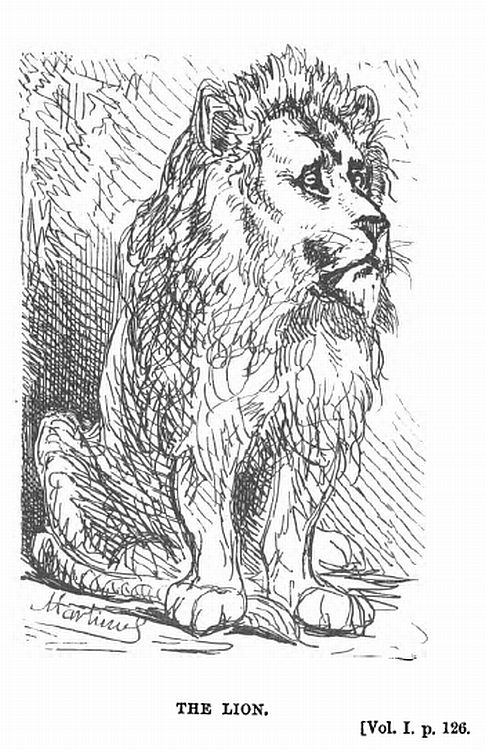
He heard the jackals quarrelling and snarling over the carrion; he heard the sound of the water as it flowed, falling over the neighbouring ledge, with a continued monotonous noise; he was with the 150th, telling many a tale of African adventure; in a word, he had fallen asleep, when a soft, cold, hairy hand was laid on the back of his neck, and a thrill of horror passed through his frame, as he saw two large eyes looking through the darkness into his. At this moment the lion roared on the mountain-side, and the jackals heard it, for they left the carrion, giving a long mournful howl as they scurried away, and, taking up a position about half a mile off, filled the air with their plaintive music. Slowly the upper limb of the moon rose above the mountains, when again the cold, hairy touch was felt by the watcher, followed by a twitch at the fur cap he wore, and now by the feeble light he could distinguish an enormous monkey. It did not seem to have the slightest fear, but clutched at the sealskin cap, clashing its long teeth together, and grimacing hideously. Again the lion roared, this time much nearer, as taking up a broken branch, the hunter struck at the troublesome baboon, who, chattering with fear, dashed into the tangled brush. The lion was evidently coming up very cautiously, but presently the snapping sound of breaking branches was heard, as the animal forced its way onwards. Raising his head to see that the rifles were in position, the startled hunter received the soft, warm breeze right in his face, becoming at once aware that the wind had changed, and was bearing the scent straight down on the lion, who was advancing up the wind, perfectly aware of the presence of some enemy, while the brushwood on that side extended for miles, right up to the mouth of the pit. Another roar, this time close to. What would the ambushed man have given had even Luji been within range? The perspiration rolled down his face as he prepared to get out and meet the “lord of the mountain” on the open. It was too late, for a heavy bank of clouds rose, overshadowing the moon, and the hoarse mutterings of distant thunder came on his ear. The cracking of the brushwood, too, sounded close to the mouth of the pit, as making himself as small as possible, the unfortunate hunter crouched down at the bottom of the hole, and, a cocked revolver in his hand, prepared to meet his fate. A thrill of disgust shook him, for, with a shrill cry, the baboon, startled by the lion’s approach, leaped into the pit, alighting on the hunter’s back, clasping him round the neck. It seemed to him like a horrible nightmare, the long wail of the jackals taking the place of the cry of the fabled Banshee over the living dead. To add to the terror of the situation, the thunder was heard, peal on peal, and the lightning flashed, while the heavy rain-drops spattered on the leaves. He heard, too, the brushwood part, and a deep, hoarse growl told him the lion was looking into the ambush; he fancied he could feel his breath; and then came a shriek of pain from the baboon, as his teeth met in the back of his neck. Lying down at the mouth of the hole, like a huge Newfoundland dog, the lion had reached down with his powerful paw, endeavouring to get at the monkey. In this he had so nearly succeeded, that his long claws had scored the creature’s back, and its warm blood was pouring down the hunter’s neck. A second time the lion made the attempt, when, with a scream of agony, using the recumbent figure for its spring, the baboon leaped out of the pit. The lion was nearly as active, as, with a fierce growl and a tremendous bound, it also cleared the mouth of the hole. The hunter was saved. Covered with blood, stained with dirt, and sorely frightened, Captain Hughes arose just in time to see the animal, chattering with delight, swing himself from branch to branch of a mowanna tree. The lion having unearthed one, had not suspected the existence of another animal in the same place, and, roaring once more loudly, it took its way towards the carrion, where it began tearing and rending the flesh, the wounded ape, now in safety, moaning bitterly, as the clouds cleared away slowly to the southward, the storm passing along the mountain range. At length the lion rose, and, with a low growl as he passed the tree where the noisy baboon was seated, walked down to the river to drink. He was a very large one, his mane and tail being unusually dark. Slowly and deliberately the magnificent animal walked into the pool. The report of the heavy rifle rang out, the ball striking him right between the eyes, as he stooped his head to drink. With a wild convulsive bound, the lion cleared the stream, falling heavily into the brushwood beyond. Sounds somewhat between a moan of pain and a growl of rage followed, one or two heavy sobs, the breaking of the brushwood, as the huge carcass fell over on its side, and then, save the cry of the jackals and hyenas, the moaning of the ape, and the distant rattle of the thunder, all was still.
The First Elephant.
Nearly an hour passed, and the watcher, tired, wet, and worn out, was thinking of the snug fire on the mountain-side, and the tent pitched near it; for certainly he had passed through quite sufficient danger and emotion for one night at least, when several spotted hyenas came down to drink. Some wild boar followed, and it was a strong temptation to the hunter to fire, when a desperate fight took place between two old boars close to him. The storm had quite passed away, cooling the heated air in its passage; the moon and stars were shining brightly, and soon bounding over the plain, with their peculiarly dancing motion, came a herd of springbok. Moving along at a great pace, springing from the ground into the air, and hardly seeming to touch the earth again for the next bound, on came the graceful antelope euchore. Even in the day time the motions of this animal are so quick, that the eye cannot follow its bounds in their details, only realising the pace as a whole, but in the clear, silvery moonlight, they seemed like a troop of fairy elves, to the tired watcher, as they came dancing along over the African plain. Dashing fearlessly into the water, the herd began to drink, with one exception. An old buck, from whose gait the inference might have been drawn that he had been previously wounded, stood sentinel on the bank. There was meat and to spare in the camp, so the hunter only watched the beautiful animals. The sentinel seemed to suspect danger, and was fidgety and impatient. Was it possible he knew of the ambush? Captain Hughes asked himself; and yet from his motions he could not but conclude he did, when all at once a dark object sprang from the bush, and the sentinel springbok was in a moment rolling on the ground, while the rest of the herd were bounding madly over the plain in hurried flight. For a few seconds, there seemed to be one rolling, writhing mass on the bank; then the antelope lay still, and a panther, with its beautiful spotted skin, walked down to the river. Before reaching the water, the animal stopped and began licking and polishing its hide, disarranged in the combat. Again the sharp report of the rifle was heard, and the panther, with a convulsive bound, sprang into the bush, which it could be heard tearing with its powerful jaws and claws in the death agony. Soon all was again still, as scrambling out of the pit, the hunter crossed the river, and advanced cautiously towards the carcass of the springbok, finding it still quivering with muscular excitement, but quite dead. Holding his rifle at full cock, slowly and deliberately he approached the bush. The moonlight streamed over the painted hide of a large panther, lying quite dead.
Leaving the carcass untouched, Captain Hughes managed to drag the deer on one side, covering it in the thick undergrowth, and then once more crossing the river determined never again to leave the brush growing close to the mouth of his hiding-place. That which had been the sentinel springbok’s fate had certainly been his, if the panther had come that side of the river.
The report of the rifle had doubtless frightened the deer around, for fully two hours passed without anything coming to the water. The time seemed very long, and the effect of the unusual excitement passing away, the hunter again became drowsy. The position was a cramped one; the first part of the night, before the thunderstorm had cooled the air, had been hot and sultry; the breeze, heavily laden with the scent of the flowers of the mobala trees, again came in hot puffs, bringing with it the cry of the jackal and the hyena, and the other thousand noises of animal life which so distinguish night from day among the wild plains of Southern Africa. Still nearer to the watcher was to be heard the fall of the water over its ledge of rock, the moaning of the wounded ape, and once or twice, and that very distant, the roar of a lion. Spread out in the moonlight lay the plain, stretching away towards the eastern coast, watered by a small river, while to the right rose the chain of mountain land in which the river took its rise, and whose slopes were dotted here and there by what seemed large black patches of forest, principally composed of trees exactly resembling the cedar. From one of these patches there came every now and then the sound of the splintering of wood, just as though a workman were felling timber. This noise was quite inexplicable; and the baboon, too, was annoying, for not only did it keep up its moaning, but would break off pieces of the branches, and throw them at the hunter, generally with a certain aim. The time wore wearily on, and Captain Hughes had just dozed off, when his attention was suddenly roused by a noise like the bleating of a sheep. No animal of any kind was in sight, and yet there it was, the low, plaintive bleating of a sheep. It seemed to come from the bush, and presently, out of it, came the beautiful painted body of a large snake, some fourteen feet in length, gliding along with a gentle, sinuous motion, and uttering from time to time the strange bleat. Gaining the foot of the tree where the baboon was, it wound itself round the trunk, and crept slowly up it. The moment the monkey caught sight of it dragging its shining length upwards, it evinced a deadly fear. Slowly, but surely, the nogaputsane neared its prey, while the unlucky animal chattering and crying, seemed unable to escape. Moved by its distress, the hunter raised his rifle, but just as he was about to fire the baboon jumped from the tree, and leaping across the stream, seized one of the branches of a young mimosa, swinging himself into it chattering with fright. The large snake paused for a few minutes to look about it, soon slowly descending, and then starting in pursuit, the nogaputsane came to the river, which it did not like, and returned into the bush.
Time wore on; the interest of the night seemed past, and morning could not be far off. Fairly tired out, the soldier began making his arrangements for a return to camp, when he was stopped by seeing, or thinking he saw, a black mass moving among the shadows on the hill-side, where the sound of the splintering wood was heard. The cause of the noise was now made evident, for moving along slowly, the watcher saw for the first time the huge bulk of the African wild elephant. It was advancing towards the river. Suddenly it stopped, and for a few moments the hunter’s heart beat quickly, thinking the chance lost, when, trotting along in a lumbering fashion, there came from out of the shade of the cedar and mashunga forests a second, but this time a young elephant. On they came, right for the river, opposite the hiding-place, the young one stopping from time to time, and then coming on at a trot to rejoin its mother. They neared the river, the old elephant evidently carefully examining every yard of ground before putting her huge foot down. They passed under the tree where the baboon was hid, and the spirit of mischief seemed to wake up in the wounded animal, notwithstanding all that had happened to him that night. Breaking off a large bough, jabbering loudly, and making the most diabolical faces, it took aim at the young elephant, the wood hitting it a smart blow on the trunk. The mother stopped dead, uttering a strange trumpeting sound, then circling her trunk round the stem of the young tree, began to shake it violently. The monkey, active as he was, nearly came to the ground, holding on with difficulty, and crying loudly. Then the cracking of the stem was heard, just as the baboon, loosing its hold, dropped on the ground, and with one wild spring clambered into another tree, and swung himself from branch to branch, jabbering and whining with fear.
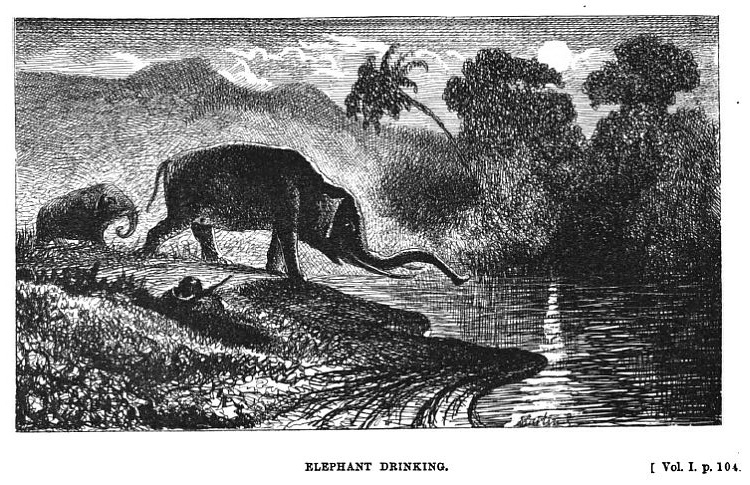
Casting the sapling from it, the elephant, as if satisfied with the lesson it had given, came down to drink. Coming to the spot where the panther and springbok had struggled, and where the grass and reeds were beaten down, the animal halted, evidently suspecting one of the native traps, and kneeling down on the edge it struck the ground all round with its trunk. It was now within thirty paces, but still the hunter’s rifle remained silent. Hoping to meet with an elephant, the heavier rifle was loaded accordingly, the right-hand barrel with the usual ball, but the left carrying one of Devisme’s explosive cartridges. Not able to detect anything wrong in the trampled ground, still the cautious creature would not tread on it, but circling round, broke her way through the bush, coming, as she did so, on the carcass of the dead panther. This she examined very carefully, turning it over with her trunk, and it was only when she had fully satisfied herself that it was dead, that she called her little one to her side. Standing in the bed of the stream, the two sucked in vast volumes of water, discharging it into their mouths, and having satisfied their thirst, the old one began spouting the water over the back of its young. Ever ready to fire, the hunter watched them, for a quarter of an hour; but now the increasing coldness of the morning warned him that dawn was at hand. The heavier rifle had not yet been used. Taking a deliberate aim, he fired. For a moment the huge mass stood firm and unmoved; the next, turning, the elephant crashed through the bush towards the forest, the young one remaining standing in the river, as though wondering what all the noise was about. Covering him with the second barrel, and dreadfully vexed at his failure, Captain Hughes was about to fire, when the larger elephant, missing its young, stopped, and began calling it. Quickly changing his aim, the report of the rifle rang out, the explosive ball striking the elephant behind the shoulder, and taking an upward direction. Moving heavily forward, the enormous bulk of the animal seemed to waver, and sway from side to side. Once it fell on its knees, recovered itself, and then gained the forest, disappearing with her young under the trees, the crash of breaking wood making itself heard once, and then all was still. The cries of the jackals and hyenas gradually ceased, the air became colder and colder as the dawn appeared, the light of the moon paled, and the noise of the falling water, with the occasional croak of a frog along the river bank, were soon the only sounds disturbing the stillness of the African plain, as, covered with the blood of the wounded baboon, soiled with wet and sand, his limbs stiff with cold and watching, as well as worn out with excitement, the weary hunter took his way up the mountain slopes, to where he knew he should find the camp.
The Ruins at Sofala.
Long before the tired hunter woke, a party headed by the missionary had brought in the carcass of the lion, as well as those of the springbok and panther, and strange to say, the baboon had followed them, refusing to be driven away. It was in vain to pelt it with sticks and stones, for dashing away into the bush it would climb a tree, making the most hideous grimaces, chattering and crying, but the moment all was quiet, back it would come again. Worn out with fatigue and watching, the soldier had slept late, and the sun was high in the heavens when he awoke.
Looking about him, roused by the noise, he was just in time to save the baboon’s life. Luji had been engaged for some time pelting it with sticks and stones, but the agile brute was too much for him. Masheesh stood in the act of poising his assegai, when Hughes stopped him.
“The monkey saved my life, Wyzinski,” said he; “and besides, it would be hard to kill the creature which evidently trusts in us.”
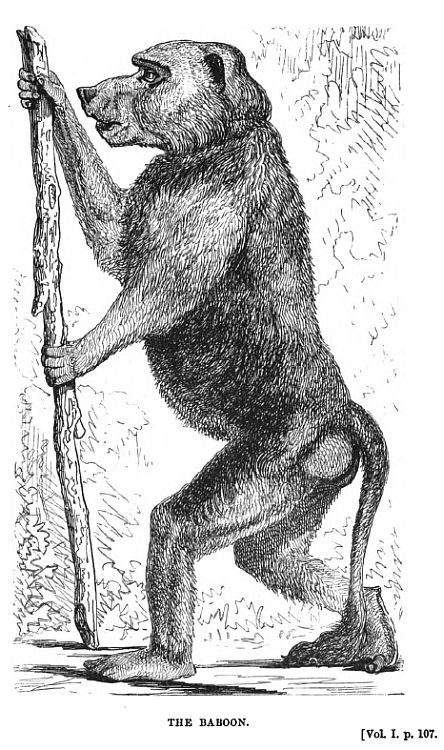
“Trusts in you, it would appear,” replied the other; for at this moment, as if recognising Hughes, it came towards him, showing the wounds on its back, and holding out its bloody hands.
“Fetch me the arnica and some water, Luji; we will soon put those scratches to rights, though they are caused by the lion’s claws.”
“The lion’s claws!” asked the missionary; “why, what had the monkey and lion in common?”
“I’ll tell you when I have had a good wash, and some breakfast,” replied the other.
The baboon was soon caught, and his back freely bathed with the arnica water, when the intense smarting, and the grotesque grimaces and loud chattering consequent on it, caused shouts of laughter.
A good wash in the river, a hearty meal of eland meat, with a dessert of the mobala fruit, strongly resembling in flavour the English strawberry, and then the hunter told his tale. The news as to the wounded elephant soon spread through the little camp, and every one, from the missionary downwards, was eager to follow up the spoor.
They soon found it, leading from the trampled river bank up the slope, and entering the wood, they at once came upon the animal itself, lying quite dead on its side; a young tree having been borne down by the heavy weight, had broken short off and lay under it. Standing near was the young elephant, waiting for its dead mother to wake, and on the approach of the party it struck the carcass several times with its trunk, and failing to rouse it, trotted away in a lumbering fashion, its trunk raised in the air, then turned to look. Like the baboon, it showed no fear, barely refusing to be caught. The men were set to work to cut out the tusks, but being unpractised hands, it took them all day to do it. The best parts of the meat were brought into camp, and then the jackals and hyenas assembled in large numbers, holding high carnival, while the tusks, together with the panther and lion skins, remained as a memento of the night. For two days the party halted on this spot, and each night the one or other watched the pool, with varying success, but not seeing any more elephants, and only hearing the lions in the distance.
Still travelling northwards, they pushed on through a fertile country, which gradually became more and more of forest. Elephants were often seen, but it was useless to encumber their march by carrying the tusks, and Wyzinski’s sole purpose seemed to be the finding of the supposed ruins. Giraffe, buffalo, antelope of all kinds, quaggas, and zebra, were plentiful, while an occasional lion was seen. The hippopotami and rhinoceros were often met with on the river banks.
The natives, who appeared from time to time, yet bore the stamp of the Zulu race, but were not friendly, though guilty of no overt act of enmity. They were men of good stature, well formed, and clean limbed; their woolly hair often surmounted with plumes of ostrich feathers. They were well armed. Vast forests of what appeared to be magnificent cedars, impeded their way. The natives, both men and women, were nearly naked, the latter particularly showing great fear of the white men, so much so as to leave their huts on the approach of the party, carrying with them their children. In some of the huts slabs of stone were seen, evidently having been fashioned by hand, and used in the construction of some building, but no information could be gathered. Gold was known, and its value appreciated among these tribes. The men, fully armed, would venture into the camp, bringing with them quills filled with gold, sealed at both ends, and offering them for sale, evidently fancying the white men traders, and asking for calico and beads in return. The young elephant actually followed the party for three days, and on the fourth was found dead close to camp, evidently from its inability to supply itself with the food its mother alone could give. The hippopotami were numerous on the rivers, and unlike those more to the south, they showed little fear of man. Shaped like a huge pig, the head massive, and the eyes placed very high in the forehead, these ponderous animals, whose carcass of a brownish-red looks like a great barrel, have thick hanging lips, and such short stumpy legs, that the belly nearly touches the ground. All day long they might be seen feeding on the sweet grasses; and on the approach of strangers would slide off the bank into the water, gradually subsiding until the whole disappeared, and then rising again slowly for air. On the Quissanga river they were very numerous. Heavy and lumbering looking, none would give these animals credit for the intelligence they really possess, and yet they will only feed on the sweetest grasses, and are nearly as cautious and cunning as the elephant, in avoiding the traps and pitfalls of the natives. They display a strong and peculiar affection for their young, and though quiet and peaceable enough, will fight for them.
“See, Wyzinski,” said Hughes one evening, as with their rifles in their hands the two were walking up the banks of the Quissanga river, “look at that unwieldy young hippopotamus feeding alone. I’ll give it a start.”
“Take care what you are doing,” replied the missionary, who was busy watching some birds building near the stream.
“Never fear for me,” exclaimed the soldier, bent on the fun of cutting off the lumbering young animal from the water.
Besting his rifle against a tree, Hughes ran to intercept it, which he easily did, for the ugly little brute did not see him until he was quite close to it, and then it seemed to lose its head, waddling away towards the bush, its pursuer shouting and laughing behind. A loud call from the missionary caused Hughes to turn, and he at once saw that the situation of matters was reversed. Right up the bank came a very large female hippopotamus, in pursuit of him. Unarmed, there was nothing for it but to use his legs, and this he did; but the hippopotamus diverged, and so the pursuer pursued must cross the line of its advance, for the bush was too thick to be entered.
It was a question of speed, as the great animal came on, its enormous mouth wide open and menacing. Slow as its motion appeared, the animal would have cut off the man, but just as they neared one another, a ball from Wyzinski’s rifle struck it in the open mouth. The hippopotamus stopped as the breathless soldier dashed by, and seized his rifle, when a ball hit it right in the eye, and it fell dead.
This animal measured eleven feet six inches in length, add in girth ten feet five inches. No one of the party ever after this attempted any trifling with the hippopotami.
The baboon had grown very tame, and had taken a great fancy to Luji. The two lived together, and seemed inseparable, and whenever it became tired on the march, it would take its place on his shoulders. It was always in mischief. Seated the same night, after the adventure with the hippopotamus, round the camp fire, near the banks of the Quissanga river, Wyzinski was laughing at the morning’s adventure.
“I hadn’t a notion you could run so fast, Hughes,” he continued.
“Hadn’t you,” replied the soldier, not half liking the missionary’s quiet way of chaffing.
“No, indeed I hadn’t,” answered the other. “I see now why they gave you the Light Company in the gallant 150th.”
Luji’s wide mouth was opened to the fullest possible extent.
“Master no like Quissango hippopotamus? Luji no like Zoutpansburgh lion!”
“I’ll tell you what, Wyzinski,” answered Hughes, “I may live to see you run just as fast yet.”
A cry from Masheesh, at this moment, drew attention for the time from the subject. The baboon darted out of the small tent holding something he had stolen. Luji, with a loud shout, dashed after him. Away went the two round and round, the monkey chattering and screaming, but still firmly grasping the object, which proved to be the captain’s powder-flask.
“You should try your hand, Hughes,” drily remarked the missionary. “Your pace beat that this morning.”
Hardly were the words spoken when, with a scream of delight, the baboon vaulted right over the stooping missionary, using his shoulders for the spring, and alighting close to the fire, dropped the flask just into the centre of the blaze, and then bounding off a few paces, stood jabbering and grimacing.
The tent was only a few yards away.
“Run, Wyzinski,” shouted the soldier, “all our powder is in the tent.” The whole thing was done in a second, and the soldier and missionary scudding down the slope at a tremendous pace the next. Losing his footing, away went Wyzinski, rolling among the stones and bushes, just as the explosion took place.
Luckily, there was little powder in the flask, but the burning embers were blown right and left, and the tent struck by them. The baboon was dreadfully singed, and awfully frightened, and not a beauty before, became literally hideous; but no further harm was done.
“You had better exchange your robes against a subaltern’s epaulettes in the Light Company of the 150th Regiment,” laughed Hughes.
“I’ll think of it,” replied the missionary; “but, Hughes, will you give me a certificate?”
“Most certainly. I can’t hold a candle to you at running away, Wyzinski,” for the soldier thought he had the best of it now.
“Oh, I didn’t mean that sort of a certificate. Will you certify there are no monkeys in your Light Company?” remarked the missionary.
“Good-night, Wyzinski,” was the only answer vouchsafed; and they both turned in laughing.
Passing Quissanga and Goanha, the little caravan kept steadily on to the northward, making short marches daily, until a period of three weeks had elapsed since they had outspanned from the banks of the Limpopo. Their camp was pitched at the foot of the spur of the Nyamonga mountain range called Gorongoza. It was a pleasant spot, and here they determined to rest a while. Several streams of bright, clear, cold water burst from the mountains, and, after wandering about for some distance, threw themselves into a river, which ran away towards the sea. Forests of the cedar-trees clothed the mountain-sides, and to these Wyzinski pointed triumphantly, asserting that they must now be close to the ruins, “There they are,” would he say; “and though there may exist a marked difference between them and the far-famed cedar of Lebanon, though they may have degenerated since the days when Pharaoh Necho’s seamen lived under their shade, yet in those cedar groves lie the fallen ruins of the old cities of Zulu land, and there is enough timber to supply the world.”
“I wonder what we should do without the custard-apples?” said Hughes, the evening of the day when they arrived at Gorongoza.
“But why call it custard-apple, Hughes?”
“Because it is exactly like the custard-apple of the Madras Presidency, black, rough, and repulsive-looking outside, and a white, delicious custard inside, cool as if iced. It grows plentifully, like blackberries, up-country there.”
“Well, I almost prefer the mobala fruit. Under the tropical sun, which, by the way, has tanned you to a mahogany colour, Hughes, it reminds one of the strawberries of England. I shall open a campaign against the wild duck. There seems lots of them.”
“Here comes the Matabele chief; what has he got? Eggs, ducks’ eggs, as I am a sinner. Won’t that be a treat after weeks of venison diet?”
The chief gravely stalked up to the two, and placing his eggs on the ground, squatted down, and looking the missionary full in the face, pointed down the course of the river, merely uttering the word “Sofala,” then changing the direction of his finger, pointed to the north-west, letting fall the dreaded word, “Tetsé.”
The two Europeans looked at each other. A volume could not have better expressed his meaning. Down the stream lay the ruins which had been formerly mentioned. Right in their onward path was the dreaded tetse-fly, sure death to cattle.
“Let us hold a council of war, Wyzinski,” said Hughes, after the two had looked at each other in dead silence. “Here, Luji, come here. We are going to have a palaver.”
“Masheesh, must we send back the waggon?”
The Matabele chief spoke volubly, frequently using the word “Tati,” and then pointing to the river which was running near them, calling it sometimes the Sabe, sometimes the Ouro.
“Do you hear?” asked Wyzinski, eagerly. “The Thati and the Ramaquotan rivers run into the Limpopo, and this river he calls the Ouro, or golden river.”
“Who owns the land, Luji?” asked Hughes.
“Mozelkatse once owned it, master. Now it is the country of Machin, the Batonga, and the Banyai.”
“Can Masheesh procure a canoe? and can we go down the river?” were the next questions.
Both were answered satisfactorily. The Batonga were a friendly people, like the Bechuanas, and feared the Matabele Kaffirs, whose chief, Mozelkatse, had more than once punished them; and after a long talk, it was determined to send back the waggons and horses to the nearest mission, that at Santa Lucia Bay, and go down the river to the sea, before breaking up the camp at Gorongoza.
“It is hard to send back our waggon,” exclaimed Hughes, during a pause in the work of packing.
“We should but have to leave it and all it contains on the way, if we met with the tetse-fly. Its sting is sure death to cattle.”
“And does it harm man?” inquired Hughes.
“Singular to say it does not and I do not believe in its existence so near this coast-line; still it’s no use running the risk.”
“We then resolve to strike the Zambesi, somewhere near Tête or Senna?”
“Yes, passing through the kingdom of this same chief, Machin, who seems to be almost a rival to Mozelkatse.”
It was with feelings of great regret the two saw the waggon with its great tilt, lumbering away an hour or two before sunset, under the charge of the missionary’s men, and bound for the station of Saint Lucia Bay,—it had been their home so long, that the cattle and horses seemed to them as friends. It was hard to part with them. The ground was strewed with packages, which were to be made up in the most commodious form for carrying, and the party was reduced to its original number of seven, with the addition of the Matabele and the two Europeans. A smaller tent had been fashioned by Noti and Luji, out of some spare canvas, easily carried, and it was now pitched by the river side, under the thick shade of a group of trees. Just as the last rays of the sun were gilding the river with gold, making it, indeed, look like the Gold River, Masheesh dropped down it in a canoe, and sunrise saw them on their way to Sofala. The crew of the boat consisted of the missionary, Captain Hughes, Masheesh, and the powerful Kaffir, Noti; Luji being left in charge of the camp at Gorongoza. Floating down the river in a comfortable canoe, between banks whose verdure was most luxuriant, was a pleasant change after the days of toilsome march. The palmyra, the wild date, mohanno, mowanna, and many other tropical trees grew in rich luxuriance, while the thick tangled undergrowth, mixed up with a host of creeping cane-like plants, rendered it impossible to penetrate the forest-land. Long reeds of various kinds hung over the banks, and beautiful water-lilies of gigantic size floated on the water. Wherever a break occurred among the trees, grew grass, or fields of wild maize or wild cotton were to be seen, and now and then the water antelope would dash into the stream and swim across. The party trusted to their rifles for food, and one of these antelopes coming well within range, Wyzinski fired, wounding the animal severely just as he reached the shore. The canoe dashed on to overtake it, which would easily have been done, for the deer was unable to climb the steep bank, and twice failed in the attempt, falling back into the water, when a huge alligator rose, showing his long shovel-shaped snout above the river. A ball struck the alligator, but without penetrating its mail. The deer struggled wildly for a moment, several other dark log-like forms showed on the bank, and the antelope disappeared, the water bubbling crimson for a moment; the next the canoe moved gently over the reddened river, and all was still.
A second deer swam the stream, and this time it was different.
“Let him go, Wyzinski,” whispered Hughes; “the alligators won’t touch him while he is swimming.”
“Take the shot yourself; see, he nears the bank.”
The report of the rifle rang out just as the deer scrambled up it, startling whole flocks of wild duck out of the reeds and rushes. The antelope, with a broken leg, fell, but quickly struggling up again, would have escaped into the bush, when a second ball from Wyzinski’s rifle stopped it. The deer proved to be a fine buck, of an ashy grey, with long horns like a goat, of a yellowish brown colour. The horns at first when starting from the head trended directly backwards, and then curved forwards, the tips being very pointed. The legs were remarkably short for a deer, and it could not be very swift on land, for, added to the shortness of limb, the girth round the carcass was very large. The dead buck measured nearly eleven feet in length, and ten in circumference.
“What a beautiful spot!” remarked Hughes, towards three o’clock in the afternoon. “The green bank slopes down to the water’s edge, and the turf, dotted with its clumps of palmyra, acacia, and date-trees, looks for all the world like a gentleman’s park. Behind rises the forest, where we can suppose the baronial hall to lie, and in the distance the lofty range of the Nyamonga mountains. We only want the lodge gates to complete the picture.”
“You are a bad auctioneer, Hughes,” laughed his comrade; “you have omitted the greatest charm. I mean the river, with its beautiful reeds waving in the breeze, its magnificent water-lilies, and the flocks of wild duck floating in and out.”
“Some of them are really very beautiful, and I never saw any like them. Look at that lot sailing away before us, their necks, backs, and throats a beautiful orange, while the head is glossy black. They must be splendid divers, and what a rate they go at.”
“I never saw ducks before,” replied the more scientific missionary, “possessing the power of partially submerging themselves; only the head and top of the back is above water as they paddle along. Steer the canoe in shore, there are quantities of wild duck there.”
“But not the same sort; see, the head is brown, beautifully pencilled with black,” said Hughes, as they all ceased rowing, and the boat, left to the current, glided among the broad leaves of the water-lilies, “the body and wings the same, while a deep yellow ring runs round the neck. There they go,” he continued, “spattering along the water, just like water-hens, and then diving.”
Floating slowly on, the canoe entered a little bay, where a quantity of drift wood had accumulated. “Only look, Hughes; why there are hundreds of them feeding apparently on insects found on the floating wood,” cried Wyzinski.
“Again another species, for these are of a brownish-red, intermixed with dirty white. What say you to landing in our park, taking possession, and having our dinner there?”
“Agreed; but first of all I must have that bird; I never saw one like it,” replied the missionary. Strange birds of brilliant plumage were flying about; among others, a small one, which hovered over the water like a hawk, espying its finny prey doubtless from its dizzy height; and then, apparently shutting its wings, would drop or dart into the river, like a stone, making the water splash around. A shot gun had been placed in the boat, and the missionary wounded one of these birds. For fully ten minutes the canoe chased it, the bird diving and remaining so long under water that it was almost impossible to tell where it would rise, and eventually it got away.
The day was hot, although a cool breeze was blowing on the river, bending down the long reeds on the banks, as heated with their long chase, and laughing at their failure, the boat was forced through the drift wood into the little bay, and eventually made fast by a rope to the trunk of a tree.
“Here, Noti, help me to haul out the carcass of the water-buck, and we’ll make a fire under yonder clump,” shouted Hughes as he leaped ashore.
The fire was soon blazing merrily, and great collops of venison roasting before it. The monkeys came grinning and chattering among the branches, looking at the intruders, and occasionally pelting pieces of bark at them; strange birds of bright plumage circled round them, and whole flocks of ducks went winding about among the leaves of the water-lilies before their eyes.
Seated under the shade of a splendid tree, the bright knives were soon at work, and a hearty meal made, washed down by clear cool water from the springs of Gorongoza.
“What do you say to making an hour or two of halt here, Wyzinski?” said Hughes, with his mouth full of venison meat. “It’s a sweet spot, and we could pull gently down the river in the cool of the night.”
“I should like very much to secure some specimens of the strange birds I see here,” replied the missionary, “and the moon rises early.”
“Well, then, take Noti with you, and Masheesh and I will be boat-keepers. I shall have a sleep.”
Taking a short gun, and calling to Noti to fetch his rifle and follow him, Wyzinski strolled away leisurely into the bush, having first taken the bearings of the place by means of a small pocket compass he always carried.
Covering up the remains of the buck with green branches to keep it fresh, Hughes took a good pull at the gourd of water, and then lay down, Masheesh strolling towards the boat. The mosquitos were too troublesome, however, so he rose, joined the Matabele in pushing off the canoe, anchored her by means of a rope and stone, lay down, and was soon fast asleep at the bottom of the boat. Half awake at first, the faint report of Wyzinski’s gun came now and then upon his ear, but at last sleep prevailed. The sun was low, and his beams slanting over the forest-land, when, aroused by Masheesh shaking the branches with which he had covered him, Captain Hughes awoke. It is a peculiarity common to those who lead a life of danger and adventure, that the moment of awakening at once restores all their faculties. They begin, as it were, where they left off. Such was the case in the present instance, for one look at the Matabele’s face at once told Hughes that something was wrong. Carefully raising himself in the light canoe, a glance showed the danger. There, on the beautiful green patch where the party had eaten their meal, three splendid lions were walking to and fro, rolling on the grass, growling and playing, and a lioness with one cub had shown herself and retired previously. It was a splendid sight to watch these magnificent animals at their gambols; but what of Wyzinski, what of Noti, the one armed with a shot gun, the other with a rifle he only half understood, and what was worse, both utterly unconscious of the presence of the owners of the land. Presently one of the old lions stopped for a moment, snuffing like a dog with his nose in the air, and then walking deliberately to the travellers’ impromptu, larder, drew forth the remains of the water-buck. A second at once seized it, the third came up, and a tremendous mêlée ensued, during which the body of the deer was riven into pieces, and lions and carrion seemed rolling about in one heap. Motioning to the Matabele, and with his help gently lifting the anchor clear of the ground, the boat was suffered to drop down the stream, its occupants using their hands as paddles on the off side. By this means it arrived within fifteen paces of the bank, where the lions were now feeding quietly, when the stone was again dropped, and the canoe swung head to stream. They, thinking it to be an alligator, had not taken the slightest notice of the boat, and went on feeding, tearing and riving the flesh, but stopping now and then to growl savagely at each other. Just then, Hughes caught a faint report, and the noise of the shot gun being even at that distance easily distinguished from the sharper crack of the rifle, it told him that the missionary was as yet safe and far away, the report coming to his ears only as a distant echo.
Thinking it better to leave the animals to feed, he and Masheesh watched them. Half an hour passed, the flesh being nearly gone, and a few of the larger bones only remaining. The ducks were sailing about the canoe, the birds gliding here and there; but sunset was approaching, and it became absolutely necessary to get rid of them. Leaning his rifle across the slight gunwale, Hughes took a steady aim. Just in front of him sat a great lion, with the last remnants of the buck’s forequarters flung over his paws, crunching at the bones. The report rang out, startling the whole crew, but whether from nervousness, or from some motion of the boat, he knew not, the shot missed; the startled animals, after gazing for a moment, trotted deliberately off, Hughes firing another barrel after them. One of them turned at the second shot, growling fiercely, then the whole disappeared in the cover, while the ring of the shot gun was heard about a mile away, replying to that from the river. The report came from a direction exactly opposite to that in which the lions had disappeared. A quarter of an hour later the long plaintive cry of the Australian bushranger was heard and replied to, and then Wyzinski made his appearance, breaking his way through the bush, his dress torn, and about thirty different kinds of birds dangling round his waist. To his great surprise, Hughes rushed forward and shook him by the hand.
“Why, what’s the matter?” he asked.
“Matter enough; have you seen any lions?”
“I have not seen anything except these birds, some snakes, and a great many different kinds of monkeys, some of them very large.”
“Where’s Noti?” was the next question, “I’m sure I don’t know,” replied the missionary. “He left me to follow a caracal.”
“Did you hear any lions about?”
“No, nor was I likely; that beast does not ramble during the day. I saw great quantities of monkeys, I repeat.”
Hughes told his tale, and the full danger of Noti’s situation was realised. Night, too, was now falling. The three set to work to collect brushwood, and the shot gun soon procured them some ducks for supper. A roaring fire was lighted, and enough wood got together to keep it up. All night long the lions were heard roaring, the cry of the jackals and hyenas showed that they too were very numerous, and several large snakes, one of them more than eight feet long, came within the light of the fire. The bush swarmed with monkeys, and when the moon rose, silvering the river with her light two lions were seen to cross the open. Still there were no tidings of the missing Noti. The three men watched by turns all night in the canoe, one of them landing from time to time to keep up the fire. Wyzinski’s Australian bush cry rang out at times on the still air of the African night. It was since the affair of the lioness of Zoutpansburgh perfectly well-known to all in camp, but no responsive shout came back, though the night was so still that the watchers often thought they could distinguish the roar of the far distant surf. Morning dawned on the anxious men, the birds woke up and began skimming about, the ducks sailed out from among the reeds and water-lilies, and still no signs of Noti.
“I fear we have lost one of our number,” observed the missionary, as he let fly into a flock of duck, knocking over four. “Let us ask Masheesh to pluck and cook those, and you and I go in search of poor Noti.”
“Agreed,” replied the soldier, who was standing in the water of a small pool, having a good wash. A loud cry from Masheesh, who had just secured the fourth duck, was heard, when a figure was seen staggering out of the wood, into the open. It was Noti, who came on, his gun raised above his head, reeling like a drunken man, and before he had traversed half the space, falling heavily on his face to the ground.
Rising, the black stumbled forward a few paces and again fell heavily. Lifting him gently, the three carried the poor fellow to the canoe, placed him in it, washed the clotted gore from his face, breast, and left side, covering him with branches.
Attracted by the blood, the flow of which it was impossible to stop, the flies came round in myriads, and it was deemed best to paddle down the river, Masheesh tending the dying man, for such he evidently was.
An hour afterwards, Noti was no more; but just before he breathed his last, consciousness returned, and he was able to tell his tale.
He had lost his way following the caracal, had wandered about he knew not where. Had heard the shots fired at the lions, and one of the animals passing not far from him, he had climbed into a tree, knowing he would not be deserted. All night long they had roamed about him, one apparently wounded lying down under the tree where he lay concealed. Towards morning it got up and walked into the bush.
Guided by the Australian bush cry, which he had heard perfectly, Noti had come down from his tree. Trembling with fear, the black moved cautiously on, and suddenly found himself face to face with the wounded lion, who instantly sprang upon him. The rifle exploded, but how, the poor frightened wretch never knew, for beast and man were rolling on the ground together, and doubtless startled by the report, similar to that which preceded his wound, the lion bounded away, leaving the mangled insensible Noti on the ground. Its claws had dreadfully disfigured his face, and the powerful jaws had crushed in the ribs of the right side. The whole had passed in a few seconds, and now at the bottom of the boat lay the corpse of poor Noti.
About one o’clock that day the bar was reached, and the three gazed upon the long blue line of ocean, with its restless waves, tipped with foam. “I had no idea the river was so marshy at its mouth, nor that we should find a bar,” said Hughes.
“There is almost invariably one at the mouth of African rivers; and look at the herons fishing. There are quantities of these birds, and they seem smaller than any I have seen before. What a beautiful dark purple; and the throat, too, streaked with purple lines, only they have no tail,” said Wyzinski. “And the birds’ nests, only see what a number of them; they actually overhang the water, seeming to all but touch the river.”
“That is almost always the case where snakes abound,” replied the missionary. “The birds know that water is their best protector from these reptiles; and these are the nest builders, those bright yellow birds scarce seven inches long. How active they are.”
In truth the river abounded with life. There were hawks and eagles soaring near, birds of beautiful colours darting to and fro. The kingfisher, with its heavy scarlet bill, and its wings of bright blue, came dashing past, while another and even more beautiful bird kept crossing before the canoe as if accompanying it, its head a bright green colour, with wings of purple and green mixed, and long dark purple tail.
“Well, I am not sorry to see the blue waves once more, and to hear the scream of the gulls and Mother Carey’s chickens,” exclaimed Hughes, as they stepped on shore, and hauled the canoe up bodily on the bank.
“Look yonder, under the palm and date-trees, are some Kaffir huts. Let us see what they are,” said Wyzinski.
Telling Masheesh to stop by the boat, which yet contained the body of the dead Noti, the two took their way to the kraal. There were about twenty huts, and the tribe seemed very poor. The first group they came to was composed of women.
“There, Hughes,” said the missionary, “that smacks of Egyptian customs, anyway.”
“What does?” inquired the other. “I see nothing but some women grinding maize.”
“Just so, but look at the mode of doing it. The old Egyptian hieroglyphics exactly reproduce it.”
This was indeed the case, but the chief of the tribe now advanced to meet them. He was a tall long-limbed man of a deep brown tint, with grey hair and regular features—not in any one respect resembling the Kaffirs, except as to dress, or rather the want of it.
“Well, that is strange,” remarked Hughes. “If I was in India, I should say I saw an Arab. Speak to him, Wyzinski.”
The missionary, using the Zulu dialect, asked his name.
“Achmet Ben Arif,” replied the man. “It is the first time for many years the trader has reached the ruins of Sofala.”
“Ruins!” exclaimed Wyzinski, at once mounting his favourite hobby, “where are they?”
The Arab, for such in effect he was, together with all his tribe, raised his hand, pointing to a spot a few hundred yards distant, where mounds and fragments of fallen masonry were visible.
The missionary was moving away before the chief had done speaking, eager to reach the ruins.
“But how,” asked Hughes, speaking his own tongue, which he had acquired in India, “how comes an Arab tribe settled here?”
“We know not,” replied the chief. “For ages have our fathers lived here, near the ruins of the white man’s fort.”
“And yet you have preserved the Arab language, and the Arab blood.”
“Pure and unchanged, our customs, language and tradition remain as they were; the dress of our people alone is altered. And instead of the bournous of our fathers, we wear skins like the Kaffir. It is our destiny. We have gold if the white chiefs will trade.”
“We are not traders, chief. But what are the ruins yonder? Who built them?”
“The fathers of your own people; the white traders of Tété and the Zambesi.”
These, then, were the ruins of the Portuguese fort of Sofala, consequently the river the party had descended, which Masheesh called the Golden River, was once the means of extensive trade with the interior. Leaving the chief, Hughes joined the missionary, communicating to him the result of his conversation. The ruins of a large stone fort were crumbling away before them, the masses of fallen masonry gradually disappearing before the slow but steady action of time, besides being partially buried in the sand drifted up before the winter gales. The Arab chief followed them, after having spoken to the men near him, several of whom started off in different directions, two sauntering lazily down to the boat. The old man seemed puzzled as to what interest could attach to the ruins.
“The stones,” said he, raising his hand as he spoke, and pointing over the ocean, whose waves were rolling in thunder on the bar,—“the stones came from over the big water to build the white man’s fort.”
“That’s nonsense,” exclaimed the missionary, speaking in English, and wandering from mound to mound. “They were taken from some ruins in the interior, and it is those we seek. The mined cities of Zulu land.”
“How firmly you have got that into your head, Wyzinski,” replied his companion.
“Into my head. Do you not see, do you not remember what Masheesh told us this morning?” returned the missionary in an excited tone. “Away yonder to the north and west, running through a territory disputed between Mozelkatse and Machin, are the rivers Thati and Ramaquotan. There lie the gold fields of Solomon somewhere in that neighbourhood; the ruined cities of the mighty old Egyptians, the ancient gold diggers, crumble into dust.”
“You are crazy on the subject, Wyzinski. What has an old Portuguese fort to do with all this?” replied Hughes, seriously.
“You are blind, Hughes, or will not see,” returned the other, in a sharp tone. “Did not Masheesh call yonder river the Golden River—and why?”
“Because gold may have been found in its banks, or on its bar. The thing is simple enough, Wyzinski.”
“It is you that are simple,” said the excited man. “The river brought down the boats with their cargo of gold, dug near the sources of the Limpopo. The Sofala of the Portuguese is the Ophir of Solomon. Here the ships of Tarshish came, and from that trade in gold the river took, and still keeps its name—the Golden River.”
There was nothing for it but to accept the dogma. The Arab chief looked on in grave silence, but no further information could be extracted from him, and except the direct visual evidence that a strong stone fort had existed here, which was known to have been Portuguese, nothing could be discovered. The ruins were nearly buried in sand, but there they still remain on the shores of South Africa, the fort of Sofala being well-known to all the traders on the coast, and the high headland near them being a much-used landmark for mariners. The moon rose, and Masheesh having borrowed a hoe, the whole party set to work to bury their dead. They took it in turns, the Matabele chief at first objecting, but ultimately taking his spell at it. Wyzinski was in the hole, working vigorously and silently, the regular roll of the ocean on the bar being the only sound heard. Masheesh was squatted by the open grave, his knees drawn up and his elbows resting on them, the palms of his hands supporting his head. Hughes stood gazing over the broad expanse of the Indian Ocean, with his forage-cap in his hand, the cool sea breeze playing amidst the heavy masses of dark hair which waved uncared for over his sun-burnt forehead. Suddenly the vigorous strokes of the hoe ceased, its sharp broad edge had struck something, and the missionary stooping lifted that something, tossed it on the bank, and jumped out of the grave. A piece of massive masonry overshadowed the spot casting a long dark shadow over the Kaffir’s resting-place among the ruins of Sofala, as snatching up what looked like a mere stone, Wyzinski stepped into the moonlight and began rubbing away the sand and dust from what proved to be a bar of pure gold, evidently smelted and worked into its present shape. It was a curious sight, the moon shining brightly on the ruined masses of masonry, streaming over the rolling ocean waves, lighting up the date and palmyra trees, with their long fan-like leaves, and showing the group eagerly bending over the gold, while stiff and stark beside them lay the dead body of the Kaffir, Noti. Then came a warning cry from the Matabele warrior, and the next moment a line of dusky savages, armed with their assegais and war-clubs, swept round them.
It was a peculiarity of the missionary’s never to lose the quiet calmness of his manner, under any circumstances, however trying. The greater the danger the more quiet, cool, and methodical he seemed to become. Unarmed, for their rifles were in the canoe, and consequently utterly defenceless, the whole party stood among the ruins of Sofala, surrounded by the warriors of the Arab tribe, while Wyzinski, as if nothing more than ordinary had happened, seated himself on a ruined slab, more accurately to examine the bar of gold.
The old chief Achmet advanced, and using the Arab tongue, addressed the soldier, who felt none of the stern coolness of the missionary.
“I thought the white men were not merchants, and refused gold,” the old man remarked. “They are then thieves who rob, and not fair traders who barter.”
“We found the gold by chance, chief.”
The Arab laughed. “The white men came down the river by chance, to the very spot where we find from time to time the gold buried; by chance they dig for it and find it. Let them not laugh at an old man, whose grey hairs will not bear it. Mashallah, let them give back the gold, or my children take it.”
“You are welcome, chief,” replied the soldier, taking the bar from Wyzinski, who seemed sunk in reverie, and giving it to Achmet. “And now withdraw your warriors, and let us finish what we are about.”
“Are the white men murderers as well as gold seekers?” asked Achmet Ben Arif, pointing to the dead body which lay dark and motionless in the moonlight.
“Look for yourself, chief. The wounds will tell their own tale,” answered the other.
The old man bent over the corpse, putting his hand on the torn face, and feeling the broken ribs. His fingers followed the wounds for several minutes, then rising, “It is a lion which has done this,” he said.
“It is, chief,” and Hughes told how the death had occurred.
Achmet turned to his warriors, spoke a few words with them, when they retired, vanishing among the trees as silently as they had appeared, the old chief alone remaining.
“And you say,” asked Wyzinski, “that you often find worked and smelted gold here?”
“Yes,” replied the chief, “often.”
“It is Portuguese, and wherever they have drawn it from is the country we seek, the ancient Ophir of Solomon. There can be no doubt of that.”
“Let the white men bury their dead,” answered Achmet; “and let them seek Machin, chief of Manica, and the Makoapa.”
And so poor Noti was lowered into his grave, and the missionary breathed the white man’s prayer over the Kaffir resting-place, among the crumbling ruins of Sofala. Heavy stones were rolled over the spot to baulk the jackals of their prey, and the old chief stood calmly by, finally escorting the party to their canoe. All that night and the following they toiled up the stream, resting during the day, bearing the roar of the lion occasionally, and often startled by the plop of the alligators, as they slid off the bank into the water. The afternoon of the third day only, the camp at Gorongoza was reached, their numbers reduced by one.
Gorongoza.
“I think,” said Hughes, as the two sat outside the small tent, pitched by the side of the stream, the morning after their return from Sofala,—“I think we had better remain here for a time.”
“I agree with you; and as there is no one to say us No, let it be decided in the affirmative. There are large quantities of wild ducks, and our fellows are so expert in finding their eggs, that the great change to men who have lived so long on nothing but venison must be beneficial.”
“We have plenty of fruit, too, and the ground-nuts are not to be despised. These cool streams, which seem to take their rise in yonder mountains, are another inducement. Our lines are at present cast in pleasant places, and what lies beyond seems uncertain. Let us profit by the present.”
“I want to go over all our baggage, and put our fellows in light marching order. To look at our little camp now, without waggon or horses, without cattle, and our numbers so reduced, we seem to resemble one of the parties so well painted by Cooper in his Indian tales. Who are those fellows?”
A party of natives were seen approaching, among whom was the Matabele chief. They were almost naked, but came on with a most assured air, squatting down in a half circle before the tent, and employing all their powers in staring stolidly at the strangers.
“Here, Luji,” shouted Hughes, who was carefully loading his rifle, “just see what these fellows want, will you?”
“Want calico, master,” said Luji, after a great amount of talk, “give gold.”
The Macomb, for such they were, produced from their waist-belts quills closed at each end, which contained gold. Some of the grains were of large size, and one of the natives showed a small lump of the yellow metal. It was quite evident that they knew where to procure it.
“Does not all this go to prove my theory, Hughes; and are we not approaching a gold country?”
“Tell them we are not traders, Luji. That we have not any calico; but ask if there is any large game about.”
The scantily-dressed natives squatted on, looking fixedly at the Europeans, and evidently not believing the assertion. At length one of their number, touching a large piece of canvas, which had been thrown on one side after fashioning the small tent, spoke volubly, often pointing to the mountain. “The Macomb show master caracal for this,” said Luji, laughing.
“What’s a caracal, Wyzinski?” asked Hughes. “Oh, these people call the leopard by that name; but the real caracal is the lynx or wild cat,” answered the missionary.
“Ask him where his caracal is, Luji?” said Hughes. The native pointed to a ledge of rock, high up the mountain-side.
“Well, tell him he shall have it, Luji, if he shows me the leopard. I’ll leave you to the baggage department, Wyzinski, and see whether I can get the caracal’s skin. Take the canvas, Luji, and come along. Tell him you will give it him if I get a shot at the leopard.”
Shouldering his rifle, Hughes moved on, beckoning to the native and Luji to follow him. The former rose and obeyed, while his comrades remained squatted before the tent, steadfastly gazing at Wyzinski, their eyes following his every movement, and so they remained stolidly staring for hours, before they took their departure.
Wending his way among the men, who were busily employed plucking wild ducks, and preparing them for the mid-day dinner, pounding up the manioc flour to make cakes, or looking to the fires, Hughes took his way towards the mountain, the native guide and Luji following. Hardly had they left the outskirts of the camp, when the monkey came bounding after them.
“Let him alone, Luji; you can’t drive him away,” said Hughes, as with a leap the mischievous brute ensconced himself on the man’s shoulders, the Macombé looking at the scene in great astonishment.
Toiling up the face of the hill-side, they reached at last the ledge of rock. It would have been very hazardous to face the leopard with so small a footing; besides, the animal, of course, had a refuge there. Making a wide circuit, the party, accompanied by the monkey, gained a height immediately above the ledge. Posting Luji at a spot where he judged he might prove useful in case the leopard bolted and the Hottentot did not, Captain Hughes, lying flat on his face, leaned over the edge of the precipitous rock, and looked down on to the ledge. It was a very awkward position, and when far enough over to enable the hunter to fire, he found himself nearly overbalanced.
The ledge was empty, but after watching for an hour, and when nearly wearied out, the leopard at last came out of his cave, and began walking up and down the narrow space.
Just as the animal, in one of his turns, arrived under him, the hunter fired. The ball struck obliquely, where the spine joins with the head, and, slanting off, lodged in the brain, death being instantaneous, but the hunter was nearly overbalanced. Just as he struggled to his knees, the baboon, with a tremendous spring, lighted right on his shoulders. The sudden shock destroyed the balance, and clutching at the bushes, which gave way slowly, one by one, Hughes went over the precipice.