Hugh Mulleneux Walmsley (continued 3)
Reading edition
They luckily saved him, but, bruised and shaken, he fell on the ledge, close to the dead leopard, the lock of the rifle being broken in the fall. Looking up, he saw the monkey, peering over, and grimacing, for so nimble was it, that it had not shared the fall. Shaking his fist, in return for which he received a shower of stones and dirt, Hughes moved cautiously along the ledge. The leopard was quite dead. A cave lay a little further on, and as he entered it, he was almost driven back by the close smell of decaying flesh. It was heaped with bones, and remains of deer, and must have been used for many years.
The leopard was a male, and the female might be near. Advancing cautiously, his rifle, only one barrel of which was available, in his hand, Hughes was astonished by the great extent of the cavern. To the right, it soon became black as night, and the sound of falling water was to be heard. This might explain the extreme coldness and clearness of the streams of Gorongoza, for doubtless they took their rise in the heart of these mountains, flowing perhaps for miles in darkness among the caverns. The roof was covered with beautiful white stalactites, but the eye could not penetrate the thick darkness in this direction. To the left a kind of corridor led towards an opening giving on the mountain-side, and towards this Hughes turned, glad to get away from the fetid exhalations of the cavern. Two hedgehogs were travelling in the same direction, the quills of which were very curious, being differently coloured, some white, others black, and some brown, the body, where it could be seen, entirely black. The animals rolled themselves up securely, looking just like parti-coloured balls. Emerging into daylight, and stepping from ledge to ledge, Hughes gained the mountain-side, hearing from time to time Luji’s shouts, as the man searched for him, then crossing a deep cut, he gained another spur of the Nyamonga range, higher far than the hill of Gorongoza.
Shading his eyes with his hand, Captain Hughes paused breathless on the mountain-height. The whole country lay spread like a map before him. Far away to the east lay the face of a friend, for the blue line of the ocean was distinctly visible. The mountain range on which he stood ran nearly north and south, while the beautifully wooded plain, across which the party had travelled, was mapped out before his gaze, with Quissanga, Madanda, and the country of the Batonga plainly visible, the rivers looking like silvery threads, and the vast forests like inky spots, on the sunlit plain. To the north, stretched at the foot of the mountains, lay the plains they were yet to traverse, the unknown land of promise. It looked one dense forest, broken at rare intervals with open, and intersected by two rivers, one appearing a considerable sheet of water, while in the far distance, a range of lofty mountains loomed, dim, blue, and ghostlike in their outline.
A deep interest attached itself to the scene, for between him and those mountains the Zambesi must run, and somewhere among the forests must lie the ruined cities of Zulu land, if indeed they existed at all, save in the excited imagination of the missionary. An hour had gone by and still Hughes stood gazing over the scene, when a shout came ringing up the hill-side, and soon a dark speck was seen jumping from ledge to ledge. Recognising his comrade, Hughes answered the cry.
“I was anxious about you,” said Wyzinski, as he stood breathless and panting on the summit. “The whole camp is out in search of you; Luji brought in a report that you had pitched over the cliff.”
“And so I did, thanks to his demon of a monkey.”
“Yes; we found the dead leopard, and when searching, I thought I saw something like a human outline on the mountain.”
“Now, Wyzinski,” asked his comrade, as he leaned on his rifle, “where runs the Zambesi? for I suppose it is between us and yonder mountains.”
“Follow the coast-line,” returned the other. “There lies Sofala, and some forty or fifty miles more to the north the Zambesi must empty itself into the sea at Quillimane.”
“Livingstone came as far south as that, and as far north from the Cape as the Limpopo.”
“He did: but instead of travelling further north as we have done, he turned to the westward, visiting the Bechuanas and Mozelkatse’s country; but see, what on earth can that be?”
The missionary pointed to a kind of cairn on the mountain-side. Beside it lay six slabs of stone, and that they were the work of the white man was evident. Cracked, blackened, and defaced, there was no mistake, the stones were worked into flat slabs, but whose were the hands that fashioned them?
“There seems to be an inscription,” said Wyzinski, as he stooped over them. “I feel deep marks in the stone, but the earth has given way beneath them, and creeping plants have grown over them. All these three are cracked and broken.”
“Here are three out of the six in a better state,” said Hughes. “We can cut away the undergrowth.”
“If we can get at one only that will be sufficient,” said Wyzinski, eagerly, as the two cut away at the masses of weed with their knives. “Should there be any inscription, we may gain some knowledge to guide our future course.”
It took a long time and much labour to clear away the undergrowth, and then but to meet with disappointment.
“The different wandering tribes who have camped here have used the slabs as fire-places,” observed Wyzinski, sighing. “We must have water, and how can we get it here.”
“Oh, easily,” replied Hughes, whose experience of Indian life came to his aid. “With a buffalo hide we can make a bag which will hold water, and can be carried on a man’s back. We call them bheasties in Madras.”
“The black grime and the dirt of ages seems encrusted on the slabs of Gorongoza,” remarked the missionary. “I can feel that there is an inscription, but I can’t make it out. The dirt has become like stone, and will want long softening, before we can scoop it out.”
“It seems to me, as far as fingers can tell, that the cuttings are of European form. This would go against your theory, Wyzinski.”
“We will see that to-morrow,” was the reply, as rising and shutting their knives the two took their way down to the plain, speculating moodily on the probable history of the slabs of Gorongoza.
The night set in wild and stormy, the thunder echoing among the mountains, and the rain falling in torrents, but when morning dawned, waking up the wild ducks among the long reeds, and bringing them out on the clear waters of the Golden River, rousing up the parrots and the monkeys in the neighbouring groves, and hushing the cries of the jackals on the plains, the air was cool and pleasant.
Clothes hung on the branches near, drying in the sunshine; rifles and guns were being cleaned, the fires were lighted, and the never ceasing process of cooking was going on. Luji and one of the Kaffirs were drawing the sides of a buffalo hide together by means of a string, so as to carry water, working under Hughes’s direction. The missionary was busy with a small tool-chest, carefully selecting the objects which would aid in the proposed search. The leopard’s skin, stretched on two sticks, was drying in the morning sunshine, and the baboon dodging here and there, doing all the mischief possible, and stealing everything it could lay its hands upon.
Seizing on a wild duck, just ready for the fire, the incorrigible ape bounded off with it, pursued by one of the Kaffirs. The monkey gained the neighbouring grove, and plunged in, followed by its pursuer. The next moment the animal dashed back, having dropped the bird, evidently terribly alarmed, and chattering its teeth, took refuge with Luji.
“There is something in the bush, Luji,” said Hughes, snatching up his rifle. “Wyzinski, look out, there is something wrong yonder.”
The Kaffir, who had pursued the ape, had halted, and was staring fixedly in the direction of the wood.
“There’s the solution of the mystery,” returned the missionary, calmly, continuing his work as though nothing had happened, while one by one in Indian file, some fifty men, fully armed, and evidently belonging to a tribe not yet met with, stepped out of the wood and advanced towards the little camp. Halting about thirty paces distant, the party squatted on the ground, holding their long assegais in their hands, and having their shields in readiness apparently for attack.
“Do you observe,” remarked the missionary, raising his head from his work, “those men have none of the length of limb of the Zulu race, but are, on the contrary, small of stature and villainously ugly? There is the chief advancing towards us.”
“Well, he is certainly a curious object,” replied the soldier, leaning on his rifle. “I never saw a man with so low a forehead, so prominent cheek-bones, or so flat a nose. For all covering a piece of hide round the loins, and what on earth has he on his face? They look like button mushrooms growing out of the flesh. Pah! it’s enough to make one sick.”
Low of stature, very black, and having the peculiarities named by Hughes, the chief’s natural ugliness was greatly heightened by a row of gold buttons, let into the flesh, from the point of the nose to the roots of the hair.
With a firm step and upright bearing, this hideous object advanced into the camp. Masheesh joined the group, and while the dusky braves, with their assegais and shields, remained calmly looking on, a long parley took place before the tent.
The chief of this man’s tribe had his kraal near Manica, and was a dependant of the great Machin himself, a rival of Mozelkatse. To him the Arab, Achmet Ben Arif, had sent a runner, telling of what bad passed at Sofala, and also of the travellers’ objects in thus seeking the interior. The chief invited the whole party to his kraal at Busi, and under the circumstances, with fifty lance-heads glittering in the sunshine, to enforce the proffered hospitality, it was difficult to say No.
“The direction, too,” said the missionary, “is exactly that we wish to take; and if even we could help ourselves, which we can’t, it will be better to go.”
“Then we must leave the mysterious slabs on the top of yonder mountain, with their tales untold.”
“Our first object,” replied the missionary, “is to discover the ruined cities of Zulu land; we can return any time to Gorongoza; and who so likely to aid our search as this chief of Manica.”
“If he is anything like his envoy, I don’t care much to see him, for a more villainous lot I never met.”
“Tell him we will break ground at daylight to-morrow, Matabele,” said Wyzinski, and the interview ended. The armed men lounged lazily about the camp, the baggage was put in order, the slabs of Gorongoza were left behind, and the next day, having followed a northerly direction, with some westing in it, the Mahongo river was passed. With so strong a party it was easy to drive the antelope, so hartebeest and eland meat was plentiful in the camp. The route sometimes led through thick forests, which the travellers would have had some difficulty in threading unguided, and it was only on the tenth day after quitting Gorongoza the party reached the kraal, to find the chief absent, having been called to Manica on a great hunting expedition. Wyzinski wished to proceed to Manica, but they found themselves virtually prisoners though their arms were left, and a hut was assigned to the white men, Luji remaining with them. The baboon gradually gained a great reputation, and the Hottentot was looked upon as the “charmer” of the party, a reputation which pleased his childish nature, and which he added to by teaching the monkey all kind of tricks, and never moving about without it. He was in consequence regarded with some awe, and the baboon, supposed also to possess the secret of “charms,” was always respected.
The place itself was curious enough. Three conical hills rose in the plain, the top of one of them being as it were shaved off, most probably by the action of time. This flat and rather inaccessible ground was the residence of the chief, and here too was the usual stockade, where the councils of the tribe were held. At the foot of this hill lay the huts of the kraal, one of which, detached from the rest, was given to the white men. In form it resembled exactly the dome-shaped tent of a subaltern in India, a pole also running up the centre, the whole being made of wood, covered with bark, and having, instead of a door, a small opening constructed like a narrow passage. Skins served as a bed, and the furniture consisted of a large earthen vase made to contain the maize or manioc flour; the cowrie baskets and knapsacks having also been deposited inside. A large tree overshadowed the bark hut, and under it the greater part of the day was spent, and all cooking was carried on, the natives themselves evidently living almost wholly in the open air, and only retiring to their huts during bad weather. The women of this tribe were fully as repulsive as the men, and they too wore the curious buttons, sometimes of brass, sometimes of copper, but always in rows as high as the cheek bone, and occasionally one or two in the chin, the buttons being let into the flesh when young, and thus grown in. One strange peculiarity which struck the Europeans forcibly was that among the women, a slit was made in the skin on each side the hip. The youngest child is carried on the parent’s back, and this slit serves it as a stirrup, so that with one arm round the mother’s neck, the child is carried easily and safely, the mother having the free use of her hands. This is the more necessary, as much of the labour is done by the women, the maize or manioc being all ground up by them, the instruments used and the mode of using them being exactly that shown forth in the old Egyptian symbolical sculpture. Among the males the Jewish custom of circumcision prevailed, and these were two points which struck Wyzinski particularly. The tribe was not indigenous, but under the control of Machin, chief of Manica, and was made up of a mixed race, being partly of the blood of the Makoapa, who owned Knobneusen as their chief, partly of that of a fierce and treacherous race called Banyai.
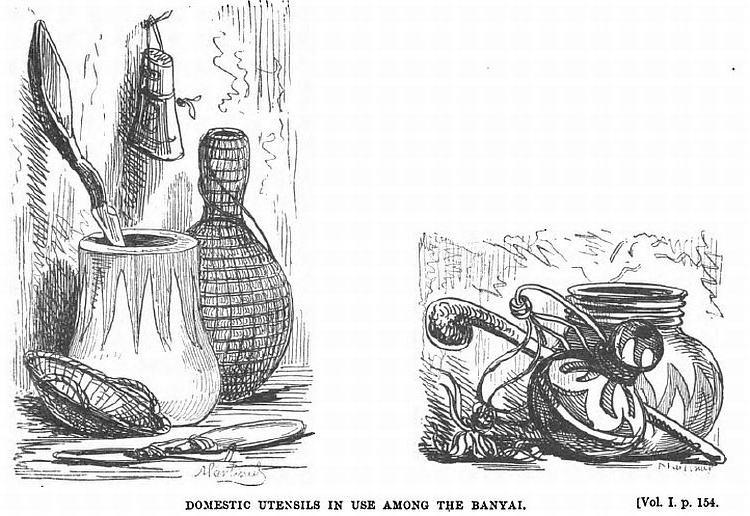
This native kraal of Busi is pleasantly situated. To the northward, far away in the distance, a lofty hill called “Morumbala,” near whose base flows the “Zambesi,” while to the southward the mountains of Nyamonga and Gorongoza stretch away into the horizon. Thick forests of trees, many of them of tropical growth, sweep around, while the plains are rich in luxuriant vegetation. The cedar, the ebony palmyra, mohonono, mashuka, acacia, mashanga, and the dwarf custard-apple, grow abundantly, while a bright red bean, called the mosika, together with maize, is much cultivated. Iron is found and worked on the hill-sides, after a very homely fashion, while coal actually crops up out of the ground, and is picked out by the women, who use only a hoe.
The copper and brass ornaments are procured, in the way of trade, from the Portuguese of the Zambesi; but gold is plentiful and its value known, the women washing it out of the ground in quantities, sometimes even finding it in pure nuggets. All this seemed strongly to confirm the missionary’s firm belief that in this neighbourhood was once found and exported gold, cedar, and other riches. Elephants were numerous in the forests, and the ivory was sold to the Portuguese. It was to a grand elephant hunt the head of the tribe had been called, and, with the exception of the brave and his escort of fifty warriors who had accompanied the white men, none but the women remained in the kraal.
A week passed by, and at its expiration the shouts of the men, and the shrill screams of the women, heralded the return of the head warrior Umhleswa, and told that the hunt had been a successful one.
The Ruined Cities of Zulu Land.
The morning after the chief’s arrival there was a great commotion in the kraal. Men ran to and fro, there was shouting and much talking, and at last, followed by his warriors, the chief Umhleswa came down from the council enclosure, and taking his way among the huts, halted at the entrance of that which had been assigned to the white men. Umhleswa found them seated under the tree which overshadowed their home, and, whatever he might think of them, his own appearance was in no way prepossessing. Under the middle height, his legs were curved, or bowed, his forehead low and retreating, the part of the head behind the ears being very massive. The ears themselves were enormous, and the mouth very large; the nose flattened, and the lips thick. He wore the usual set of small buttons let into the flesh, but they were of virgin gold; and a panther skin was attached by a golden clasp round the waist, falling like a Highland kilt. A number of small objects of glass, beads, and ivory hung down from his waist, making a rattle as he walked. Bound his ankles, wrists, and the fleshy part of the arm were circles of copper. He carried no arms, but held in his hand a stick, also of gold, about a foot long, and his teeth were filed, giving an appearance of savage ferocity to his repulsive face. The white men rose, and some additional skins being brought, the three chiefs, Umhleswa, the missionary, and the soldier, seated themselves, the warriors squatting in a circle around.
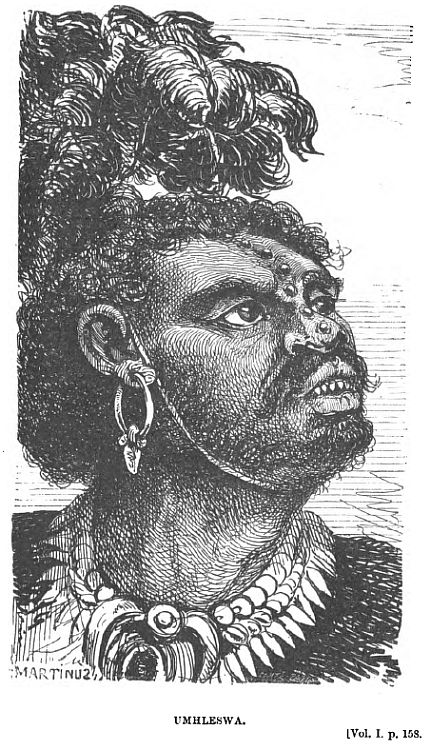
“The white chiefs are not traders, but like gold,” said the savage, after a prolonged stare. “They seek some fallen huts, formerly made by their white fathers?” asked he, speaking in the Zulu tongue.
“Achmet Ben Arif spoke truly when he told you so, Umhleswa,” was the reply.
“The white chiefs saw the fallen house at Sofala. In the mountains at Gorongoza are caves; the traders of the Zambesi built the house, the worshippers of the white man’s God lived at Gorongoza. There are no other remains of them.”
“And the stone tablets on the mountain?” eagerly asked the missionary.
The lips of the savage parted, showing the sharp filed teeth. “They are the graves of those who served the white man’s god.”
“And no other ruined huts are here?”
“None. Let the white chiefs hunt with my warriors, they are welcome; the elephant and the rhinoceros are in plenty. The Zambesi is not far distant, when they are tired of the hunt.”
The missionary was terribly disappointed, for the chief’s face bore on it a look of truthfulness. There was no reason for doubting him, and he did not do so.
“Umhleswa would see the chiefs hunt himself. Cattle were carried away from his kraal last night. The robbers were three in number, and are panthers. My scouts are out on the spoor: will the white men join my braves this day?”
“Willingly,” replied the missionary, who at once explained what had passed to the soldier. Tired of a week’s inactivity, the latter was enchanted at the chance. The rifles and ammunition were soon ready. One of the scouts came in with his report that the spoor had been followed into a neighbouring wood, and that the three panthers had not left it. The party consisted of the Europeans and the Matabele chief, together with Umhleswa and about thirty of his tribe. The men were armed with spears, some carrying bows and arrows, the chief alone having an old Spanish long-barrelled fowling piece, damascened with gold.
About four miles of plain lay stretched between the Amatonga village and the forest line, and it was to this the whole troop of noisy savages, headed by their chief and the two white men, took their way in a body. The forest-land, broken at intervals by patches of plain watered by a small stream, stretched away to the mountains, and once it was reached, Umhleswa made his arrangements. All the men armed with assegais were told off as beaters, and advancing in a long line they carried the bush before them. The rest, armed with bows and arrows, were stationed in small groups at the further extremity of the thick cover. Several patches of bush had thus been beaten out, and no game was found.
“What immense numbers of parrots these woods contain,” said Hughes.
“And how slowly and well these savages beat. I should not like to face a panther with nothing but an assegai,” replied Wyzinski.
The two were standing close to the chief as the missionary spoke, a strong party of the bowmen near, when a tremendous uproar took place among the spearmen, a shrill, piercing scream sounding high above the clamour.
“The panther has struck down one of my braves,” exclaimed the Amatonga chief, listening eagerly.
The clamour became louder and louder, seeming to recede.
“Look out, Hughes, they are doubling back, and, if they don’t succeed, must break out.”
Hardly had the words been uttered, when three panthers dashed out from the cover, about twenty paces only from where Umhleswa stood. They looked beautiful but dangerous, as they crouched for a few moments on their bellies in the sand, the bright sun streaming over their painted hides, the end of the tail moving slowly to and fro, and showing their white teeth; then rising, the three, evidently male and female, with their young one a little behind them, came slowly forward, ever crouching for the spring and snarling savagely.
“Are you ready, Wyzinski?” said Hughes, in a low hoarse tone; “take the female—it is nearest to you.”
The men with the bows had disappeared; not so Umhleswa, who stood his ground firmly.
“Take the young one, chief,” whispered the missionary to the Amatonga.
Both the rifles united in one common report, the Spanish piece ringing out a second later. The male panther sprang into the air and fell, nearly at the feet of the little party, quite dead. The female, badly wounded, broke away towards the mountains, while the young one made his spring, striking down the Amatonga chief, and, dashing through a party of the assegai men, again sought shelter in the bush. The fore-arm of the female panther was broken, but it ultimately gained the mountains, with a party of some dozen men after it, yelling, shouting, and discharging their arrows at impossible distances. The poor fellow who had been struck down in the bush was dead, and his body was laid beside the carcass of the leopard. Umhleswa was a good deal hurt; the blow having struck his head, but the animal being young, weak, and frightened, had inflicted only a scalp wound; nevertheless, the chief was stunned, and it was an hour before he recovered consciousness.
For the first time since their arrival among the Amatongas the white men were left to their own device. The confusion was very great, and all assembled round their unconscious chief. A litter was constructed, and they started for the kraal, the whole party of savages accompanying it.
The two Europeans, having once more loaded their rifles, stood watching the retiring and discomfited savages.
“We ought to have that second tiger, Wyzinski; you fired too low,” at last observed Hughes.
“I suppose I did, confused doubtless by the three leaping animals. I am sorry for it. Umhleswa missed his, and it is humiliating that I only wounded mine.”
“Well, what say you, shall we follow the spoor; it will lead us to yonder mountains, where we shall in all probability find the wounded panther?”
“What if we were to follow the young one?”
“No, it would lead us into the forest, and besides it is unwounded. The Amatonga chief missed, and his braves ran away; let us bring in the female; and besides that, now that the hope of finding your cherished ruins has vanished, we have nothing to do but look for sport. The more reason we should not lose this chance.”
The missionary stood leaning on his rifle, and he slowly shook his head as he answered—
“My faith in the existence of those ruins is unshaken; but there was a look of truth in the face of the savage when he assured us none such existed here. Well, we will go to Manica, and perhaps Machin, who is represented as a powerful chief, may throw some light on that.”
“Ay, but how will you get over the sacred nature of the ruins if they do exist?”
“By bribery; depend upon it, nothing succeeds better with the virtuous Amatonga.”
“Well, good-bye to the ruins at present; and whether Solomon knew the land or not, or whether Ophir be here of elsewhere, our object is the skin of the panther.”
Their rifles at the trail, the two hunters moved forward towards the mountains, from which they were separated by several belts of forest, guided by the gouts of blood which the wounded animal had left. These tracks led at first across the open. Here there could be no mistake, for the bowmen had followed the animal for some distance, shouting and firing off their arrows, but the two hunters soon struck into the brush once more, and still guided by the spots of blood, pressed on cautiously but quickly. Hardly a word was spoken as they forced their way onward, the yells and shouts of the Amatongas dying away; and, with the exception of the breaking of the branches, and the sound of running water in the bed of the stream, all was still. After heavy rains this river must be a considerable one, but at that moment it was small, so the hunters followed, so far as was practicable, its course, the wounded panther having done the same. After having proceeded thus some two miles in the brush, sometimes stumbling over the boulders of stone, sometimes with difficulty forcing a pathway among the trees and bushes, the river turned suddenly to the right, and as suddenly the forest ceased.
The missionary halted, and looked about him anxiously.
“What’s the matter?” asked Hughes in a low tone, cocking his rifle as he spoke.
“See,” answered the other, “the stream has been dammed up here, and there are evident traces of masonry. This is strange.”
“We are close to the end of this belt of forest-land, and shall soon solve the mystery, if there be one.”
“There is a considerable sheet of water here, and why should it exist? Can we be near some large kraal?”
Slowly the two moved forward, and as they did so the trees became gradually further apart, the banks of the stream seemed quite clear, even from brushwood. A sharp bend led to the right, and there before them, tumbled here and there among the mighty trees, looking like masses of rock, lay scattered far as the eye could reach, following the bend of the river, fallen masonry.
Both stopped dead in utter astonishment, looking like men at once frightened and bewildered, the missionary’s usually calm and impassive countenance growing one moment deadly, pale, the next flushing a deep crimson. So great was the shock, so totally unexpected the event—for he had perfectly believed in what the Amatonga had said—that the tears stood in his eyes.
Here, then, was a confirmation of all his theories. Here the vast ruins among the gold fields of king Solomon; here the source of the Sabe, or Golden River, down whose stream the boats of bygone days floated gold, cedar-wood, and precious stones. An Englishman’s first impulse at once seized on Hughes, and, yielding to it, the two exchanged a vigorous shake of the hand.
“What could induce Umhleswa to tell us such an untruth?” were the first words which broke from the missionary’s lips.
“Because the ruins are sacred, and these people believe no rain will fall for three years if they be molested,” was the reply. A sense of the danger now stole upon the missionary’s mind as his comrade spoke.
“Hughes, I shall go on; but I have no right and no wish to endanger your life. Leave the adventure to me; return to camp while there is yet time.”
The soldier’s face flushed to the roots of his hair, and he made no reply, simply grasping his rifle and moving forward.
“Stay,” urged the missionary, laying his hand on the other’s shoulder, “I meant no unkindness. As a matter of simple prudence you ought to return. If harm happened to one of us, it would not matter as far as the world is concerned; if to both, this secret would be lost with us.”
“Don’t talk nonsense,” replied Hughes, firmly, “but come along. We are comrades in danger as in all else. What one shares, the other does too. This must have been once a vast pile.”
“Gold, cedars, and now the ruins; we have found all,” muttered the missionary, as, yielding the point, he strode onward, once more sinking into reverie.
There rose right in front of them two massive ruins of pyramidical form, which must at one time have been of great height. Even now, broken and fallen as they were, the solid bases only remaining, they were noble and imposing. Part had come tumbling down, in one jumbled mass, into the bed of the river, while the dwarf acacia and palm were shooting up among the stones, breaking and disjointing them. The two gazed long and silently at these vast mounds, the very memory of whose builders had passed away.
Awe-struck and surprised, they sat down by the stream, and, without exchanging a word, drank of the clear water. Their clothes torn, hands and faces bleeding from the exertions made in forcing their way through the bush, their skin tanned to a deep mahogany colour, there they stood at last among the ruined cities of a lost race. By the banks of the stream the pomegranate, the plantain, and the mango, were growing in wild luxuriance—trees not known in the land, consequently imported.
Overshadowing the fallen blocks of stone, the date-tree and palmyra waved their fan-like leaves. Dense masses of powerful creepers crept up the ruins, rending the solid masonry; and the seeds of the trees dropping year by year had produced a rapid undergrowth, those which had once been valuable fruit-trees having degenerated into wild ones. Chaos had, in a word, re-appeared where once trade and prosperity, order and regularity reigned.
“Let us gather some of the custard-apples, and climb yonder ruin,” said the missionary, speaking for the first time.
It was no easy task; for the accumulation of fallen masonry, and the dense growth of the brush, rendered it often necessary for the onward path to be cleared by the use of the knife. The whole mass appeared at one time to have been encircled by a wall, now fallen, the entrances to which could be distinctly traced, and this confirmed the report which, had been gathered by the missionaries of Santa Lucia Bay.
Slowly the two forced their way towards the vast ruined mound they were striving to gain, often stumbling and falling among the loose stones and treacherous creepers.
A crowd of half-fallen passages led away to right and left, terminating in what appeared to be a court-yard, in which were the remains of pillars of stone.
“There has once been carved work on these pillars, Hughes,” said the missionary, as they paused, breathless with their exertions, before a mighty column. “The action of ages has worn it away.”
“And what is more singular,” replied Hughes, who now seemed as much interested in the ruins as his comrade, “no mortar of any kind appears to have been used, the massive stones fitting into one another exactly.”
“This temple or palace has stood upon a kind of platform of masonry,” remarked the missionary, “with broad steps leading up to it. What a commanding object it must then have been.”
“The difficulty will be to climb what was once the flight of steps,” said Hughes. “I don’t see how we can manage it.”
Slinging their rifles behind them, and after many failures, the two helping each other from time to time, and taking advantage of every projection, stood at last on the raised platform on which the building had rested. Below them ran a maze of crumbled galleries and court-yards: and wherever the eye could penetrate, mounds of fallen masonry cropped up amidst the dense forest growth.
The vast ruin itself was now a shapeless mass, being utterly broken and defaced. The top of the mound was overgrown by bush, interlaced with creeping plants, and, as using their knives, the two cut their way onward, the light of day penetrated feebly into a ruined chamber of vast size. A dead silence reigned therein, and as they paused at the entrance and looked back on the scene which lay below, perhaps the first Europeans who had stood on that weird spot for many ages, the missionary could not but feel dispirited.
“The day-dream of my life realised. I stand among the ruins of the cities of old; but where they begin, or where they end I know not. The forest has re-asserted her old rights, torn from her by the hand of civilisation,” he remarked.
“Look where you will there is nothing to be seen but broken mounds and tottering walls; it would require a brigade of men and years of work to clear these ruins,” replied Hughes.
“Yes, the extent of them is a mystery at present. We can but affirm their existence. What a deep dead silence hangs over the spot. Let us go on.”
They penetrated the ruined chamber, but hardly had they put their feet across the threshold, when bats in vast numbers came sweeping along, raising, as they did so, a fine dust, which was nearly blinding. The ruins seemed their home, and there they lived, bred, and died in countless numbers. Some were of a sickly-looking greenish colour, and of heavy and lumbering flight, often striking against the two explorers as they came along.
At one moment the missionary was surrounded by these tenants of the ruined palace, these winged things which had taken for themselves the abodes of the Pharaohs of old. He struck out in self-defence and killed several, measuring one for curiosity. Its length was only between five and six inches, but when the wings were spread it was at least nineteen from tip to tip. Their numbers seemed to increase, for troops of others, of a dull brownish-red colour, joined their loathsome companions, and then a third species of a chestnut brown, mingled with dingy white, came trooping along. What the building had been it was impossible to tell; but it must have once seemed a mighty pile standing on its platform of stonework, with a flight of broad steps leading to it. These steps had disappeared; but remains of them could be noticed, and from the elevation where the two stood the line which had once been the wall of the town could be traced here and there. There were not any remains of a purely Egyptian character, save a worn arabesque representing the process of maize-grinding; but this was to be seen daily practised among the tribes, and therefore proved nothing, for it remained an open question whether the natives had taken it from the sculptor, or whether he had imitated the natives. Here and there were remains of carvings representing serpents, birds, and beasts of uncouth form, leading to the belief that the building had once been a temple. Passing along, nearly blinded by the fine dust, their knives cut them a way out, and the breeze and sunshine seemed doubly welcome after the dank, confined air of the old ruin. Huge lizards glided away among the broken stones as they emerged from the corridor—for such it seemed—and monkeys were to be seen darting away among the trees as they let themselves down from the platform. These animals had not any tails, resembling those found among the Atlas mountains; while the jackal and hyena, surprised at the sight of human beings in this solitary spot, sneaked away among the masses of fallen masonry, snarling as they looked back. Near the stream the spoor of the elephant was distinctly visible, and it was evident this was one of their favourite feeding grounds, for the banks were strewed with the broken branches of the mashuka-trees, and the débris of the plantains. The tamarind-trees and palmyra grew luxuriantly, and for hours the two wandered among the ruins or, seated on the fallen heaps, lost themselves in conjectures on the past, “It is impossible,” at last said Wyzinski, seating himself, fairly wearied out, “for us to explore further these relics of the past. We can but tell of their existence, I repeat.”
“The axe, or fire—perhaps both—would be necessary before even their extent could be known,” replied Hughes. “Look at that mass of masonry, thickly hedged round with date, camel thorn, and white mimosa. Mark the thick undergrowth and the strange creeping vine-like shrubs running along the ground, and festooning themselves to the trees, and the difficulty will be realised.”
“There seem to me to be caves cut in yonder mountain-side: let us go there.”
In rear of the ruins rose the slopes of the Malopopo hills, and leading in that direction was a kind of passage through a lower range, the river flowing in the middle. On each side rose the rocks, scarped down towards the bed of the stream, from which coal was cropping out. The summits of the hills were worn and rounded by the action of time, and here and there clumps of trees were growing on the river banks. It was up this cut the two advanced, Hughes leading. Stopping as he turned a shoulder of the rock, the missionary joined him. Seven rhinoceroses were sleeping quietly by the water side under the trees, the boughs of which were literally bending under the mass of nests made by the same bright yellow bird which had been seen so numerous on the Sofala river.
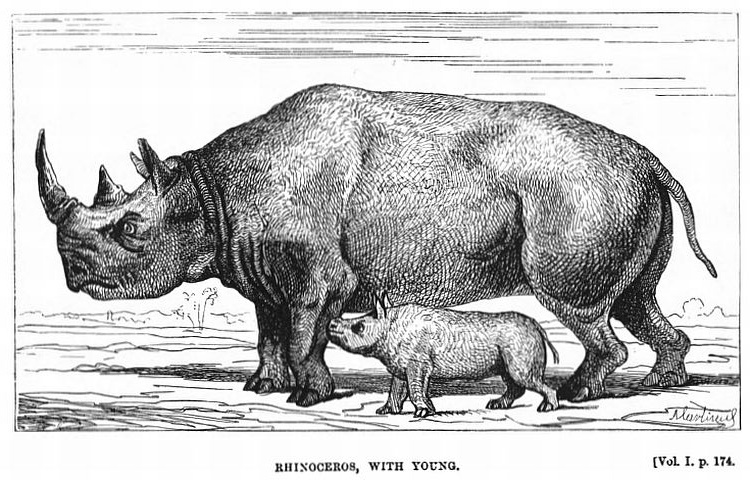
The animals were totally different from any other that had been seen.
“They have a perfectly smooth skin,” remarked Hughes.
“Yes, and are of a pale yellow colour instead of brown, like the one which treated me so unceremoniously in the country of the Matabele. Both the horns too are pointed, and both long.”
“We had better look out. See they have awoke, and are getting into line ready to charge us.”
In fact the brutes seemed very savage, and so soon as they perceived the intruders on their solitude, they charged down the glen. Scrambling up a rock, the danger was easily avoided. The herd passed on except one old cow with its young one, who halted after having gone some twenty yards, and turning deliberately round returned, gazing with apparently great curiosity at the white men. It was impossible to pass; and there stood the great lumbering animal fairly mounting guard over the two who, perched on the rock, were only wishful to be left alone.
There was nothing for it, however, but to get rid of the troublesome visitor; so, leaning the rifles on the flat rock on which they were lying, by agreement both aimed for the centre of the forehead. The two reports seemed as one, as for a moment the rhinoceros stood firmly, and then fell over into the river, dyeing the water with blood. It was a great size, measuring close upon twelve feet in length, and ten in girth, while the horns were so nearly matched that there was not a quarter of an inch difference between them. The openings of several caves were to be seen, and near one there appeared to have been some fight lately, for blood, evidently quite fresh, was lying about.
To this cave the two climbed, entering very cautiously. Chance had again favoured them, for there lay the leopard quite dead. Bones of different kinds were heaped about, showing that for a time at least it had been the abode of wild animals. It was about twenty feet high, and there were some curious carvings on the walls, the entrance having evidently been scarped down by the hand of man. Close to the doorway were two colossal carvings, as if to guard the mouth of the cave. Each represented the figure of a nearly naked warrior, having a covering only round the loins; and each held in his hand two spears, and not having any shield—in this widely differing from the present race. The faces of these figures seemed of an Arab type. There was no trace of door, but some broken remains would seem to indicate that the entrance had once been walled up, while close by lay a slab of stone bearing a tracing on it of the figure of the African elephant. There were many similar caverns here and there in the mountain-side.
“The sun is sinking, Wyzinski,” said Hughes, “It will be impossible to retrace our way in the darkness, and the moon does not rise until eleven o’clock; we had better stay where we are.”
“I am tired out,” replied the missionary. “I don’t doubt but that these caverns have once been the graves of the dead belonging to yonder city. This may well serve for ours, only we must contrive a fire.”
“Yes, or we may have the young leopard back, if Umhleswa’s Spanish rifle has not done for him. We have still half an hour of daylight: the branches dragged down by the elephants lie in heaps down yonder, and are dry.”
The half hour sufficed, a fire was lit at the entrance of the cave on the ledge outside, and the missionary, lying down, was soon buried in sleep.
The day had been very hot, and what with the excitement, fatigue, and want of nourishment, the two were tired out. Still Hughes determined to watch, as heaping wood on the fire, he placed his rifle on his knees, and leaned back in a sitting posture against the rock. Night came on; the cries of the animals began to be heard, and the jackals soon found out the carcass of the rhinoceros. The stars were very brilliant, and the soldier sat thinking of the past, and peopling in imagination those fantastic masses of fallen ruin which had once at that hour rang with bustle and merriment. The wind came in hot puffs, making the date and palmyra leaves rustle as they waved to and fro; the noise of the stream breaking over the fallen masonry was very monotonous, and soon the sentry found himself dozing. He rose, heaped fresh wood on the fire, looked out from the ledge into the night, listened to the cracking of the branches, which told him that elephants were not far off, and then again sat down.
The moon rose, silvering with its beams the finely-cut leaves of the tall palmyra and the broken ruins, shining on the human figure at the entrance of the cave, and gleaming on the bright barrel and lock of the English rifle; but the soldier slept on his post; the jackals fought over the carrion, the fire burned lower and lower, and finally went out. Day was dawning, when a loud shout close to the mouth of the cavern woke both the soldier and the missionary, but only to find themselves surrounded by a band of the Amatonga warriors fully armed, while the savage eyes and filed teeth of their chief Umhleswa, seemed to give a more vindictive expression than ever to his repulsive face.
Umhleswa’s Bargain.
The following day the whole kraal was in commotion, Umhleswa summoning the braves of the tribe around him in council, the white men not being deprived of their arms, but very closely watched. The assembly was a noisy one. On the one hand the native superstitions invested the ruins with a sacred character, and the Amatonga chief had been placed where he was to prevent any access to them by Europeans. There could not be a doubt that the whole tribe had been guilty of negligence, their chief included, and that they were responsible to the king of Manica for what had happened. On the other, Masheesh, as the representative of his chief, loudly proclaimed the white men to be under Mozelkatse’s protection, and demanded their safety, threatening a dire revenge if anything happened to them. The anger of so powerful and fierce a chief as Mozelkatse was to be dreaded. Umhleswa, too, was an ambitious man, and was not contented with his position as chief of a petty tribe. He coveted firearms, and these he could only obtain from the whites. Without those arms he could do nothing, and the way to procure them was certainly not by putting to death the first white men who came among them. Umhleswa was cruel, vindictive, and unscrupulous, and he had, without hesitation, told the white men a deliberate untruth to hinder their seeking for the sacred ruins. His chance wound and subsequent insensibility upset his calculations; still he was very much averse to shedding their blood.
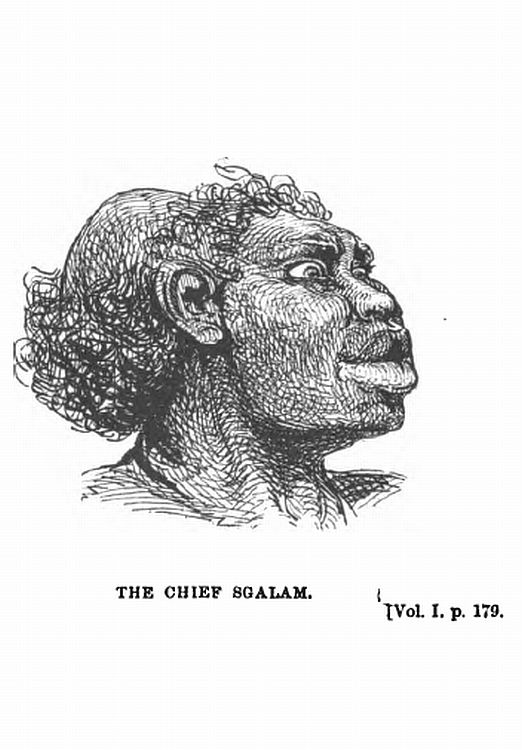
There was, however, a warrior of the tribe second only to himself in power—a man of another stamp, and famed for personal courage and deeds of daring. Between Sgalam and Umhleswa there had always been rivalry, and, on this occasion, the Amatonga brave took an entirely different view of the whole matter, openly blaming Umhleswa’s conduct, and demanding the death of the white men as the only means of securing the safety of the tribe.
The result was long doubtful, and what between the chief’s arguments and Masheesh’s threats, the balance seemed in favour of clemency. The council was noisy, and divided in opinion. Umhleswa had just been showing in eloquent words the injustice of dooming to death men who had acted from ignorance, pointing out that they could not have known the sacred nature of the place they had invaded; and he seemed to be carrying with him the feelings of the tribe as they all squatted round in the inclosure on the hill-top, when Sgalam, roused to a last effort, strode straight up to Luji, who was listening open-mouthed, and laying his hand on the man’s shoulder, “Here is one of their head-men,” he said, with violence; “ask him if the white chiefs were not warned, ay, even in Mozelkatse’s camp. Should they go free, Sgalam himself will denounce the folly in the council inclosure of Manica.”
The baboon, seeing a hand laid on Luji, and doubtless thinking harm was meant him, at once flew at the orator, making his teeth meet in the man’s arm, and chattering wildly.
The powerful savage, with one blow, dashed the animal to the ground, Luji, who was fairly roused, being in a great rage, threatening the chief with the white men’s vengeance. A scene of confusion ensued, but Sgalam’s eloquence decided the matter, and the verdict was death; the council breaking up without fixing when and in what manner the punishment was to be inflicted.
In the interior of the hut assigned to the Europeans that night, all was quiet, and the two occupants were sound asleep. There was no door, but only a narrow entrance, across which a naked savage was sleeping, several others being thrown here and there outside, also fast asleep. Midnight was long passed, when a noise was heard near the opening, and the moonlight was for a moment obscured by two bodies passing. Calling to Wyzinski, the soldier, who slept lightly, seized his pistols, but the voice of Masheesh was heard, speaking in low tones, as he stepped over the body of the sleeping sentry, followed by the second figure. It was not dark, the moon shining brightly outside, and Umhleswa’s face and form was not one to be easily mistaken. He was naked save at the waist, his body smeared with oil, but wearing no distinctive mark of any kind, while his broad, flat nose, high cheek-bones, receding forehead, sharp filed teeth, and shining body, gave him even a more repulsive look than usual in the faint moonlight. Outside all was quiet save the usual cries of the jackals and hyenas hovering round the kraal, and the heavy breathing of the sleeping guard.
Seating himself on some skins, while Masheesh squatted down near the entrance, Umhleswa spoke.
“Have the white chiefs no fear of death,” he asked, “that they sleep soundly?”
“No,” replied the missionary, using the Zulu dialect; “we do not believe in it at your hands. We were travelling through the land, our safety insured by Mozelkatse’s word. You sent for us and we came, consequently besides the safeguard of the king of the Matabele we have yours.”
“If Mozelkatse’s word be scorned,” added the Matabele brave, “the land between the Suave and the Zambesi shall be dyed red with Amatonga blood, and the assegai of Masheesh shall find the heart of their chief. The country shall be desert, and the tribe live only in the remembrance of the past.”
“I have not come to the dwelling of the white men to hear this,” replied Umhleswa, scornfully. “Will they promise, by their God, not to go near the fallen huts if set free?”
Both hesitated, for the desire to explore those ruins was strong in their minds, and both were willing to risk life to do so.
“We will make Umhleswa rich with presents, we will hunt for him the elephant and the rhinoceros, if he will not only allow us to see the ruined huts, but aid us with his men to lay them bare.”
The dark eyes of the savage glistened at the thought of the presents, and he mused for several minutes, the silence being so deep that the breathing of the sleeping men could be distinctly heard outside. He spoke at last, but slowly—
“It may not be; send Umhleswa arms for his tribe; make him powerful enough not to heed the anger of the chief of Manica, and the fallen huts are the white men’s. Do they know that death has been pronounced against them, and do they know the kind of death they must meet?”
“It matters not what,” replied the missionary; “we have faced it too often to fear it in any form.”
“Death!” hissed out the savage, his eyes gleaming, and his white teeth shown in the half light, “by fire,—slow, but sure death. Will the white chiefs promise?”
“We promise,” replied the missionary.
“Will they pay a ransom?” continued the savage.
“We have nothing to give; but we will return with presents.”
The chief pointed to the rifles and pistols.
“Umhleswa would gladly have these, and when the white men return with more, he will take them also.”
“They shall be yours, chief, when we cross the frontier, not before.”
“Will the God of the white man send rain when his children ask for it?” he inquired.
“If in his great power and infinite knowledge he thinks it is necessary,” replied the missionary, a little jesuitically.
“Then,” continued Umhleswa, “it is agreed. The white men promise not to hanker after the fallen houses, but to cross the frontier near the Zambesi, to give each a rifle, also that when they return they will bring a rich present for Umhleswa, giving him the means to resist the chief of Manica, and to laugh at his anger.”
“It is agreed,” replied the missionary.
“The white man speaking our language answers for his brother?” asked the savage.
“He shall answer for himself,” replied the missionary.
Turning to the soldier, Wyzinski explained the terms of the bargain, pointing out that they were completely in the chief’s power, and that he himself was fully determined to organise a party, and return to the ruins, in which case the protection of the savage would be valuable.
At the other end of the hut a violent discussion was going on between the Matabele brave and the Amatonga warrior, the former declaring that the white men must be brought back to Mozelkatse’s country, the other remaining quite unmoved.
Hughes at once saw the truth of Wyzinski’s explanation, and though he did not like to part with an old friend, made up his mind to do so, the more readily because he saw that Umhleswa could equally be in possession of the rifles by killing the whole party. He therefore rose, crossed to where the chief sat, and gave his hand in token of ratification.
“Good,” said Umhleswa, rising; “and now let the white men sleep in peace.” Stepping over the figures of his recumbent braves, the chief took his way in the moonlight, through the huts, even the dogs remaining silent as he passed.
It was nearly dawn, and Masheesh having thrown himself down on the ground to sleep, the two white men, greatly relieved, sat discussing their future prospects. The freshness of the coming day had made itself felt already, the moonlight was growing more and more feeble, and still they sat talking of many things.
“We shall have plenty left to send the Matabele back a rich man,” said the missionary.
“And as for Luji, I left his full pay and a handsome ‘Bucksheesh’ with my relative on the Umvoti,” answered Hughes.
“We shall be certain of a good reception from the Portuguese at Tête or Senna on the Zambesi, and are sure to find some coasting vessel at Quillimane, bound for Table Bay.”
“And we shall have traversed Eastern Africa from the Limpopo northwards to the Zambesi; but, see, day is breaking; I long for the fresh air of morning after stilling all night here.”
Taking up his rifle, Hughes walked to the entrance, stooped, and went out, stepping over the prostrate bodies of the guard. Day was just breaking, and with it the Amatonga kraal was waking into life. Luji was fast asleep under the tree, and on a branch above him, sat the baboon, looking upwards, and making hideous faces. It was evident there was something concealed in the tree, which wanted to pass the monkey, and which the latter would not allow. Watching them, Hughes soon saw a head, garnished with two great eyes, peeping out of the foliage. Waiting an opportunity, he fired, the village ringing with the report which sounded very loud on the quiet morning air. The guards at the entrance of the hut, startled out of all propriety, jumped to their feet, forgetting their duty, and scuttled off. A howl of terror from Luji rang out, the caracal, dropping from branch to branch, plumped heavily on the half-awakened Hottentot, while the baboon dashed after it, chattering with delight. The animal was a large one, and resembled a very big and beautifully marked cat, striped like a small tiger, the ears being black, pointed, and tipped with tufts of hair.
Taking it by the tail, and laughing at the alarm he had caused, Hughes walked towards the entrance of the hut, where, attracted by the report, the missionary and Masheesh stood.
Just as he reached it, a long, loud, wailing cry rang out from the very centre of the kraal. For a moment all was silent, and then once more it was heard. There was an unusual bustle, the savages, male and female, seeming much excited. Soon many other voices chimed in, and it became evident that something had happened to cause sorrow and lamentation in the tribe. Masheesh had already gone, and breakfast was to the two white men of more importance than anything that could affect their hosts, the Amatongas.
The Dead Chief.
The sun had risen in all its splendour, the smoke from the many fires curling spirally up into the air, for there was hardly the faintest breeze. Every thing betokened the heat of an African day. Under the shadow of their tree sat the two Europeans, their rifles leaning against its trunk. Luji was near, playing with the baboon, which was chattering and making hideous faces; the missionary busily employed taking notes of the journey, and Hughes skinning carefully the caracal he had that morning shot. Things seemed to have quieted down in the kraal, and the excitement to have partially at least died away. Not knowing whether they were to consider themselves prisoners or not, though the guard had not resumed their post, and thinking if they left the camp the act might be wrongly construed by Umhleswa, the white men remained where they were.
“What is the matter with the Matabele?” asked Hughes, as he raised his eyes and saw Masheesh coming down among the huts in a manner very different from his usual stately pace.
“We shall soon know the cause; see how the muscles of his black face are working, and listen to the shouts of the Amatongas behind him. Well, Masheesh, what’s wrong?” asked Wyzinski, looking at him, with his pencil and note book in his hand.
“Sgalam is dead!” replied the Matabele, in an excited tone.
“And who the deuce is Sgalam?” asked the missionary, calmly bending his head once more over his work.
“The chief who spoke so bitterly against the white men; he who threatened to denounce Umhleswa if they were not put to death; refusing to hear the words of Mozelkatse, and who was threatened by Luji with death.”
“Well, a chief has departed from among his people, and the Amatonga have lost a brave; but what then?”
“The evil eye has done it. The white men have bewitched their enemy, and he is dead.”
The full danger of the situation dawned on the missionary’s mind as Masheesh said this, and turning to Hughes, he told what had passed. The latter only laughed.
“Since we have been in Africa,” he replied, “I have not seen one instance of violence or bloodthirstiness. A more gentle race I never met with. Why it is the custom even among the warriors who have shed blood in battle, to consider themselves unclean, and a native who has so much as touched a dead body is thought so. What is there to fear?”
“The whole native population of South Africa is superstitious, and these Amatongas are a low caste tribe, more superstitious than most. You heard Umhleswa ask about the rain?”
“Yes, I know he did.”
“Well, not only have they their rain makers, but their sorcerers; and they believe firmly in witches, ghouls, the evil eye, and vampires. They will kill all their cattle on the order of one of these sorcerers, and starve by hundreds.”
“Well, if that is the case, it certainly is enough to excite them, that the very man who was the most bitter against us should die thus suddenly. It is a very strange circumstance that Luji should have denounced him.”
While they were talking the shouting and yelling seemed to approach rapidly, and now a band of Amatonga, their naked bodies smeared with paint, came rushing down from among the huts. In a moment more than a hundred yelling savages surrounded the tree, shouting, screaming, and brandishing their assegais. The rifles could do nothing against such a number.
“Our only hope is in Umhleswa,” whispered the missionary, as he bent his calm face over his note book, apparently unconcerned. They were a terrible looking set, those dark-skinned Amatongas, and the two Europeans felt themselves completely in their power.
Hideously ugly, with their enormous mouths, woolly hair, and receding foreheads, they had still further disfigured themselves with paint Masheesh did all a man could do to quiet them, but it was no use; the white men were seized, separated, and their rifles taken from them, their hands being firmly tied together. Luji shared their fate, and the monkey very much frightened, jumped to his usual place on his shoulders, jabbering and grimacing. Several blows with the wood of the assegais were given, and thus ill-treated, with the whole band of yelling savages around them, the captives were driven up the centre of the Amatonga village.
The change in their situation had indeed been a sudden and dangerous one. Relying on the promise of the chief, all anxiety had been dismissed from their minds, and the future had seemed bright and fair before them. A few minutes later, they found themselves bound prisoners, and on their way to the hut of the dead man.
They reached the entrance, where on the threshold sat the wife of the dead chief, rocking herself to and fro, and uttering a succession of wailing cries. Suddenly starting up as the captives approached, she spoke quickly to the braves around her, gesticulating and screaming.
She was urging her people to sacrifice the murderers of her husband, as an expiatory offering on the chief’s grave. This much the missionary could understand, as he bent his calm, clear eye on the excited countenance of the frantic woman. The quiet glance seemed only to enrage her more, as shaking her long skinny fingers in his face, she turned and dashed into the death-chamber.
Jostled violently along, the two prisoners found themselves standing in the hut close together.
“We are lost, Hughes,” said the missionary, in low, hoarse tones.
“The chief may save us,” replied his comrade. “There is yet hope.”
Inside the women were chaunting, in loud drawling tone, the good qualities of the deceased, telling of his virtues in peace, his wisdom in the council, and his great deeds of war. The body itself lay stretched at full length in one corner, lying on some panther skins.
“There is hope there,” whispered the missionary. “Look at the dead man’s face, the pinched-up features, that small dark stream flowing from the lips, the tongue hard, black, and dry, hanging from the mouth, and the limbs drawn up with cramp. He has been poisoned.”
“By whom?” asked Hughes, as the two stood, their hands bound behind them, gazing on the sickening spectacle.
“By Umhleswa. It was his interest to do this, and if so, he is watching the result.”
A rush of people into the hut now separated the two, while outside the shouting of the men, the jabbering of the baboon, and from time to time a yell from Luji, who was evidently the most suspected, was heard.
The two white captives, separated from each other, were now forced into a sitting position, one on each side of the corpse, while the women, ever chaunting the praises of Sgalam, proceeded to lay the body out. It was quite nude, and though cold, had not yet stiffened. The tongue which, thickly coated with yellow, had been protruded, was now forced back into the mouth. A rope of palmyra fibre was brought, and the women then proceeded to swathe it round with the cord, giving the body a sitting position. This operation lasted a couple of hours, during which the prisoners were kept apart, as spectators, the noise outside never ceasing. Hughes, who now had the notion that both were to be sacrificed on the dead chief’s grave, attempted to speak across the hut to the missionary, but a heavy blow was the reward. Wyzinski’s calm face and thin features relaxed into a smile, as the soldier returned the blow by means of a violent kick, and found himself the next moment powerless lying on his back, and a stout rope of palmyra round his legs. Strangely situated as they were, it was a curious sight. The busy women, singing their monotonous song; the sitting corpse stiffening into the position that had been given it. Outside, shouting and wild excitement, and every now and then some Amatonga brave dashing into the hut, yelling out half a dozen phrases in praise of the dead Sgalam, and dashing away, to be followed in turn by others. In one corner the soldier firmly bound, in another the missionary, his hands only tied. At length a litter of branches was brought, the sitting corpse placed upon it, the hut became filled with savages, the rope which confined the soldier’s legs was unfastened, and the two were ordered to follow the bier, which was conveyed outside. A circle of dark braves swept round the captives, their glittering knives in their hands, as the procession moved off, the leading men of the tribe grouping themselves round the corpse shouting and yelling. They had not far to go, for the journey ended at an enclosure a few hundred yards from the dead warrior’s hut. The bright sun streamed over them as they entered this enclosure, which was in fact the place where the chief’s cattle had been penned. There, right in the centre, a deep hole had been dug, and into this, ever preserving his sitting position, the body was lowered, the songs, screams, and shouts increasing in intensity, as the broad hoes threw back the light earth into the grave. Slowly but surely the body disappeared, for a hundred hoes were at work dragging the sand back. The face of the dead was gradually covered, the hole was filled, and there, in the centre of his cattle shed, sat the dead Sgalam concealed from all eyes. The men with the hoes threw them aside, and commenced a strange slow dance round the grave; then, pausing, with wild yells, the savages threw themselves on the captives, and in a moment they were on the ground struggling vainly for their lives, with a hundred bright blades gleaming in the sunshine around them. Their tribe imperilled by the white man’s foolish curiosity, one of their best warriors and most noted chiefs killed by them,—for they firmly believed it,—the two delinquents were about to moisten with their blood the grave of the Amatonga brave. The moment was a critical one, when suddenly the wily Umhleswa appeared among them, his Spanish gun in his hand, the ostrich plume in his hair, and the panther skin round his waist. His glittering eyes ran over the group, as with a few deep guttural words, he bore back the crowd of savages.
“Would you kill the innocent, and spare the guilty?” he shouted, waving his hand toward the white men, who now rose covered with sand, but unhurt. “The Amatonga have a custom; would you break that custom, and defile the grave of our brother with the blood of the innocent? Let the far-seeing Koomalayoo be consulted; let the sorcerer of the tribe speak out, and let those who have done this deed die.”
“To Koomalayoo, to Koomalayoo,” yelled the Amatonga, and the well-planned purpose of the wily savage was accomplished. Moving along among the huts, the groups of excited savages, their numbers ever increasing, bore with them the dirt-begrimed white men, and the frightened Luji. An ox was driven out of an enclosure and placed at the head of the procession, the whole moving on slowly under one of the conical hills, and taking its way towards the neighbouring forest. Bound with palmyra rope, and the baboon firmly tied in its usual position on his shoulders, Luji’s face seemed the very picture of abject terror, while the ape, fairly cowed, jibbered and moaned.
The missionary as usual looked calm, resigned, and confident, but a heavy scowl sat on the soldier’s face. The escort kept on their way, shouting, screaming, and clattering their spears against their shields. About half a mile outside the Amatonga kraal, under a grove of trees, stood a solitary hut. Near it rose a mass of rocks, and the plain around was thick brush. This was the dwelling of Koomalayoo, the dreaded sorcerer of the tribe. It was he who had told of the coming of the white men, and it was his now to decide their fate. The ox was driven into the cattle enclosure belonging to the hut, as a present to Koomalayoo, who at once made his appearance.
This man was an Amatonga, and possessed to a rare degree the distinctive ugliness of the race. His flat nose, monkey-like forehead, and huge slit of a mouth, surmounted a body literally a skeleton. The face was that of the living dead, so emaciated was it; the body seemed a framework, with a black skin drawn tightly over it. The eyes alone were bright and restless. A collar and waist-belt of human bones, with anklets and wristbands of the same material, made a clatter as he walked, while in his hand he held a short wand, apparently of pure gold. Such was the noted Koomalayoo, who now glanced over the group of captives, his restless eyes fixing themselves on Luji’s face, with an expression which boded him no good. A circle was formed, the captives being inside it at one end, Umhleswa and the sorcerer at the other.
Umhleswa now made a long speech, telling of the coming of the strangers, and of their having by chance stumbled upon the sacred ruins, profaning them by their presence. The history of the council was given fairly enough, and of Sgalam’s hatred to the Europeans.
The incident of the monkey and of Luji’s threats was largely dwelt on, and Koomalayoo’s eyes grew intensely bright as he fixed them on the unlucky Hottentot, whose face turned a yellow livid colour with fear. The Umhleswa then proceeded to point out that the white chiefs were not present at the council, again referred to the threats used by Luji, and to the mysterious character of the baboon, winding up artfully with a defence of his policy, because of the benefits which would result from trade with the white men.
Calico, beads, guns, knives, he spoke of as falling to the lot of the poorest Amatonga, and having thus worked on their cupidity, the wily savage ceased speaking.
Koomalayoo rose, and without a word stalked out of the circle, which opening to let him pass, closed again. All kept silence—a deep dead silence—as the diviner entered his hut; and so great was the stillness that his monotonous voice could be heard reciting incantations, as the sorcerer mixed the potion which was to give him clairvoyance. About a quarter of an hour passed—not a soul moving—before he again appeared, holding a gourd in his hand. Whatever were its contents, he drank the whole at a draught, threw the gourd from him, and once more entered the circle, where, seating himself on the ground, he remained silent, his eyes bent downwards, apparently waiting for the coming inspiration. All looks were fixed upon him, and not a word was spoken. At last he suddenly started to his feet and began speaking rapidly, following out the tale from beginning to the end, winding up with the death of the warrior Sgalam. “Sorcery has done this,” he continued. “The strong man does not die in an hour; the warrior’s soul does not start for another land like that of the weakly infant. Is it the men of the Batonga who have done this deed? No. Is it the braves of Manica? No. The Matabele are among us. Does the blow come from them? Mozelkatse’s warrior would scorn the deed. Is it from the Madanda, or the strange tribes of Gorongoza, death has come, or has the evil eye been used by the dwellers on the Maxe, who love us not? No. To none of these does the far-seeing eye of Koomalayoo trace the deed. But white men are with us, white men who are not traders. Have they worked the evil?”
Koomalayoo paused. A subdued murmur ran through the circle. Wyzinski’s face looked calm and natural as usual; but the soldier’s, though unconscious of the meaning of the words, was flushed, and he himself nervous and excited. The murmur died away, and again the sorcerer spoke. A sigh of relief burst from the missionary’s lips as Koomalayoo continued. “I tell you, no. It is not the white men whose blood must atone for that of the dead chief—No.” All at once, whirling round as on a pivot, the arm and hand holding the gold rod fully extended, the diviner span round; then as suddenly stopping, the rod pointed right between Luji’s eyes. “It is the black skin who has come among us, with his familiar demon on his shoulders. Behold the worker of the charm! When the black imp leaped upon our brother among the warriors in council, he spit the venom into his ear. That night our brother died.”
Koomalayoo’s eyes fairly blazed with fury as he looked full at Luji’s quivering, shrinking frame. The man seemed fascinated, and his terror-stricken face turned into bronze as the sorcerer yelled forth the terrible words, “Let fire drive out the demon from among us,” and fell to the ground apparently exhausted.
For a moment there was a deep, dead silence; the rustle of the leaves could be heard as the light wind played through the trees; the next, the circle was broken, the whole mass of the Amatonga precipitating themselves on the doomed Hottentot, throwing down the two white men as they pressed on, and trampling them under foot, while the air, a moment before silent, became filled with yells and discordant shouts, the shrill scream of terror distinctly heard above all.
Hughes, not knowing what was to happen next, had seized the nearest Amatonga brave and was busy throttling him, shouting as he did so as loudly as the rest in his excitement. The man’s eyes were starting out of his head, his tongue was protruding, when a dozen strong hands dragged the soldier from his victim, and thrust him bruised and breathless into the hut. The missionary was there before him, and there too stood the wily Umhleswa, showing his sharply-filed teeth, while his little cunning eyes danced with triumph.
“Umhleswa is a chief,” he said, slowly moving to the entrance of the hut, and looking back on the astonished prisoners as he stood in the bright sunshine. “He has not lied to his white brother.” He waved his arm and disappeared.
The Auto Da Fé.
With the dark smile on his face, and triumph beaming from his sinister-looking eyes, Umhleswa had left the hut. Koomalayoo, its owner, was busy hounding on the too willing savages to kill his supposed rival, for it was by using the suggestion that he and his familiar had come among them to take the sorcerer’s place in the tribe that the cunning chief had secured Koomalayoo’s co-operation. Masheesh now entered, his first impulse being to pass his sharp knife over the palmyra rope which yet bound the white men’s hands as he did so.
Their first emotion over, the two exchanged a hearty shake of the hand, looking into each other’s eyes, the soldier speaking first.
“The black scoundrel,” at last said Hughes, drawing a deep breath, and shaking himself like a dog. “Wyzinski, we must save poor Luji. Speak to Masheesh—will you?”
Turning to the Matabele, the missionary spoke long and earnestly; but the chief kept a dogged silence, shaking his head from time to time, then looking up into the speaker’s face.
“The Amatonga must have blood,” he said, slowly. “Shall it be the white man’s? Masheesh can do nothing.”
“Will the chief try?” asked Wyzinski; but again he was met by the slow shake of the head, which told more than words could convey the hopelessness of the case.
“But if you will not, at all events we will,” said the missionary. “It is a terrible thing to push superstition to such a point.”
“Does the white chief disbelieve in the charm cast on the dead Amatonga?” asked Masheesh, as though such disbelief were monstrous.
“Can the Matabele warrior assert it as his own faith? Is he credulous, like an Amatonga?” asked Wyzinski in reply.
“How does the white man account for Sgalam’s death?”
“The chief Umhleswa knows the use and the value of the English rifle; he sees the great power it would give him and his tribe. By our death he would have gained nothing, save two or three rifles. No white traders would have come near him, and his end and aim would have been frustrated.”
“Mozelkatse’s vengeance would have found him out,” interpolated the Matabele.
“True; but Sgalam took another view of the matter, and threatened the anger of the chief of Manica. Hence the midnight meeting in our hut, and the death of Sgalam, hence the decision of the sorcerer Koomalayoo and Luji’s persecution. Some one killed Sgalam, and some one must answer for it.”
“So the white chief thinks Umhleswa cast the spell?”
“No, Matabele, no,” answered the missionary, “it was a potent poison which did the work; and Umhleswa had everything to gain by the death, Luji had nothing.”
Masheesh turned away incredulous, not even taking the trouble to reply.
“It will be impossible, I fear, to save the poor fellow; but we must make the effort, Hughes. You see even this man, belonging to a tribe far superior in education to these Amatongas, perfectly believes that Luji by sorcery caused the chief’s death.”
“Let us try, at least,” replied Hughes, as both took their way to the entrance of the hut.
All had been comparatively quiet, since the Amatonga chief had left the place, a council having been held outside to determine on the best mode of punishing the Hottentot sorcerer. The sun was shining brightly, and a light breeze waving the branches of a group of mashunga trees, under which the men of the tribe had assembled. Umhleswa had been speaking rapidly, and doubtless eloquently, to the circle of braves around him. Near by, stood the unfortunate Hottentot, closely guarded, and if it had not been a pitiful, it would have been a laughable sight, for, tied in his usual position, on the prisoner’s shoulders, sat the baboon. Naturally ugly, the brute was rendered still more so from the effects of the gunpowder explosion, which had scorched its skin, and there it sat, peeping from side to side of Luji’s head, moaning, grimacing, stroking the Hottentot’s face, and showing his teeth to all who came near. The large tears were streaming down the captive’s cheeks, mixing with the blood and dirt with which they were begrimed.
The chief concluded his speech just as the two white men emerged into the open air, pointing as he did so to the crouching captive, and the whole band started up, shouting and yelling, to dash past Luji into the bush. One loud scream of anguish burst from the man’s chest, for he had heard his fate, and knew that it was death by fire.
Rudely thrust back by the men who had been left to guard them, Wyzinski and the soldier were powerless, but felt their blood boil within them as they noted the preparations made. The savages seemed to be holding high festival in the bush and in the tall, parched-up reeds, and then one after another appeared bearing bundles of branches and inflammable grass, throwing them down only to return for more, and thus, laughing, singing, and yelling, they collected a large pile.
A mass of bare, splintered rock rose in the plain, and towards this Umhleswa and his subordinate chiefs took their way, while several of the half-maddened savages laid hold of the Hottentot, the rest dancing wildly around him. Shriek after shriek rose from the captive as he resisted, and the points of the assegais, urging him on in rear, drew blood, the baboon nearly strangling him in his fearful efforts to escape.
Turning, the poor fellow caught sight of his late masters, and as he held out his fettered hands, they marked the big tears of agony rolling down his yellow-black cheeks.
Again Hughes made an effort to escape.
“By heavens, they are going to kill Luji! Oh! for my rifle. At all events he shall not go alone,” he shouted, as he dashed from the entrance of the hut, and was rudely repulsed by the Amatonga guard.
Wyzinski’s eyes were closed, and his thin, finely-cut lips moving as if in prayer. It was, indeed, a terrible sight.
Two strong stakes had been driven into the ground against the smooth face of the rock, and the prisoner was now bound firmly to them, in the fashion of a spread eagle, while all round, in a semicircle, were piled heaps of dried reeds, branches, and grass, near enough to roast the man gradually, but not to burn at once, poor Luji’s shrieks for mercy ringing out even above the joyous yells of the Amatongas. Two of the tribe were engaged in procuring a light by rubbing together pieces of dry wood, while leaning on his assegai, lazily contemplating the whole with an air of great satisfaction, stood Umhleswa, showing his filed teeth and grinning with delight. “And these are the men I thought so gentle, whom I believed incapable of bloodshed. Fiend, scoundrel, Umhleswa,” shouted Hughes, in his excitement, once more rushing on the guards at the entrance, and being again roughly thrown back.
The missionary still prayed.
A bright, red glare shot up in the sunshine, as the air, heavily laden with the sweet scent of the mashunga and the acacia trees, fanned the burning branches; a cry of human agony and terror, mixed with loud yells of vengeance and of delight, rang out. Shriek after shriek followed, as the poor wretch felt the increasing heat, and the flame burned fiercer and more fiercely, while the horrible baboon, in his terror, dug his sharp nails into the Hottentot’s face, the blood streaming, and the Amatongas fairly screaming with laughter.
More and more intense grew the fire, and, as the scorching heat became unendurable, the agony experienced by the baboon increased in intensity. This he revenged on the unfortunate man. The Amatongas seemed to revel in the horrible scene, as they filled the pure, afternoon air with their laughter. Throwing fresh wood on the blaze, they made the fire leap and roar, while they dashed sharp pieces of rock at the captive, cutting and bruising his flesh, but avoiding death, as, blinded with his own blood, and one eye torn from its socket by the mad efforts of the baboon, the unfortunate Hottentot now moaned feebly. Umhleswa stood by watching the scene, as he leaned on his long assegai, the ostrich feather floating over his head, and the panther skin round his waist, from time to time urging his men to further cruelties, or stirring the fire with the spearhead.
Fearfully excited, and unable longer to bear the sickening spectacle, the white men in desperation and rage threw themselves on the guard, and a fierce hand-to-hand struggle ensued. Not wishing to use their arms, and less powerful than they, it required all the superiority of their numbers to resist the shock, for they both fought like madmen, with hand and foot, only at last to be cast back, stunned and bleeding, into the hut.
Louder and louder grew the shrieks outside, madder and madder the dance, round the death-fire. The blaze had died away, and over the embers dashed the Amatongas, using their long knives, cutting strips out of the quivering flesh, but craftily avoiding vital parts, they threw them in the fire. The baboon was dead. A lump of rock had dashed out his brains, which were bespattered over the half-roasted Hottentot’s face and breast, the shattered head and ungainly body dangling about a ghastly sight. The man himself hardly presented a vestige of the human form. One eye hanging out, his limbs smashed by the lumps of rock hurled at him, the blood pouring from his many wounds, and a long, feeble, continuous moaning coming from his fire-blistered lips. And now a fresh batch of reeds and boughs were thrown on the flagging fire, this time within the former circle. The breeze, laden with the perfume of the mashunga, fanned it into flame, and it leaped up high in the last rays of the setting sun, which was tipping the tops of the trees, and the far-away mountains of the Matopo, with a golden hue. The Kaffir’s hair caught fire, and the horrible smell of the burning flesh overpowered the scent of the flowers Umhleswa stirred the blaze with his steel-headed assegai. It was the only merciful deed he had done, for the fire leaped up more quickly, and the stakes, burned through, gave way, the mutilated remains of what had been a human body falling heavily and helplessly forward.
Fresh reeds and branches were heaped on, the flame roared with fury, and the yells and shouts became louder. Once the mass of blazing wood moved, a charred hand was thrust forth, and then all was still. The fire had done its work, and the Amatongas seemed appeased. Noti slept beneath the shadow of the ruins of Sofala, the restless surf moaning over his grave. The lions had killed him, but Luji’s ashes, reduced to fine dust, were blowing over the plains before the night breeze, when the moon shone forth over the sorcerer’s hut and the smoke-begrimed rock.
The Amatonga nature had proved more relentless than the lions, the man more savage than the beast.
The Wife’s Revenge.
More than a week had elapsed since the events related had taken place, and the two Europeans still remained, half free, half prisoners. From the day when Masheesh had witnessed the Hottentot’s cruel death, up to the present, he had not been seen, either by the white men or by the Amatongas. The rest of their followers had made their escape, finding their way back as they could, and their position, perfectly alone among the savage tribe, their safety hanging only on the cupidity of the treacherous Umhleswa, was most critical. For two days after Luji’s death, all had seemed quiet in the kraal, but then a party had sprung up among the men, some of whom had been urged on by the dead chief’s wife to avenge on the two white men his death. This party had gradually grown stronger, and its members never lost an opportunity of showing their hate; indeed it was on more than one occasion only the fear of the deadly rifles which kept them from open violence.
There they sat before their hut, under the shade of the tree, feeling and looking disconsolate enough. It was the eighth day since they had again taken possession of it, and not once had they seen Umhleswa during that period. A good provision of manioc flour had been conveyed to them. Their shot guns had supplied them with small game, for they dared not venture far from the kraal, for fear of awakening suspicion, and even as it was, found themselves closely watched.
The two had just finished a supper they had cooked themselves. They were both fully armed, and near them, within reach of their hands, lay their rifles. The sun had set, the air was warm, and the breeze scarcely moved the leaves of the tree overhead. Before them lay stretched the plain with its belt of forest-land, and in the distance the faint line of the Matopo hills. Close by, the densely populated kraal, the blue smoke from many fires curling up into the air. The hum of the bees was heard as they winged their way homewards towards the forest, and above them in the tree the cries of the parrots, as they quarrelled before composing themselves to sleep. Rising and shading his face with his hand, Hughes gazed in the direction of the kraal. A solitary figure was wending his way through the huts, coming towards them.
“It’s weary work this,” he remarked, as he sat down again with a sigh, “keeping watch and watch all day, and dividing the night between us, too. It’s a weary life. What can have become of Masheesh?”
“The Matabele brave has cared for his own skin, and has fled to the mountains, like the rest of them,” replied the missionary.
“I thought better of him,” said Hughes, absently, “and I am sorry I was wrong.”
“Look, is not that Umhleswa coming towards us,” said Wyzinski. “God grant he may have made arrangements for our journey.”
“It is he, indeed,” replied the other, as he rose to heap fresh branches on the fire.
Slowly the chief stalked along, apparently not caring where he went, stopped opposite the two, and then, as if perceiving them for the first time, approached and squatted by the fire.
Umhleswa’s evil nature was now too well-known, for this seeming carelessness to dupe them.
“Have my white brethren all they can want?” he asked.
“No, chief, we ask the fulfilment of our contract, namely, an escort as far as the Zambesi.”
“My braves are badly armed, and may be unable to protect you. Will the white men give their rifles now?”
The treacherous nature of the request was too evident for the veriest tyro to fall into the trap. To give up their means of protection, and at the same time the only ransom they had to offer, would have been an act of folly, “No, chief, we will not,” replied Wyzinski, a silence following on his words. Suddenly an idea struck him. What if he were to utilise Masheesh’s absence? It could not possibly do any harm, and it might do good.
“Will Umhleswa wait until the Matabele chief comes with Mozelkatse’s warriors to serve us as an escort. He has been gone many days and should be on his return?” he asked.
The wily savage started, fidgeting as he sat. “It is a long journey across the Tati,” he replied.
“The Tati, chief?” asked Wyzinski, remembering at once that Masheesh had spoken of that river.
“Yes, the Tati, where the yellow gold is found, which the Bamangwato now claim,” replied the savage, pointing with his hand. “It lies yonder, between those hills of the Matopo and the more distant Zouga mountains.”
“And who owns the land?” inquired Wyzinski.
“The great chief Machin calls it his,” was the answer, “and Mozelkatse claims it as his, too.”
“You see, Hughes, how all tallies. Beyond those mountain somewhere near the sources of the Limpopo, there exist gold fields, and these rivers which Umhleswa names run into the Limpopo. Here, between those gold fields and the coast, were built the cities of the gold seekers of Solomon. We have trod their streets, and yonder stream, which Masheesh truly named Auro, took their riches to the port.”
“The deuce take your ruins, Wyzinski!” said Hughes. “Do try to get us out of the scrape we are in. Humour the scoundrel.”
Umhleswa seemed uneasy at this by-play, not understanding one word of English.
“Will the white men keep their promise if Masheesh comes?”
“Certainly not. He will then be our deliverer, not you, and the rifles must be his.”
“Umhleswa saved you when the knives of his people were about to drink your blood?” sententiously remarked the savage.
Wyzinski shuddered. “Come, chief,” he replied, taking from his belt a revolver, “send us on our journey, and this shall be yours.” Raising his arm, he fired barrel after barrel into the air, pausing between each ere he drew the trigger to enhance the effect.
The savage’s eyes glistened, and he showed his filed teeth. He doubted not that Masheesh had been sent to bring down the Matabele warriors upon him, in which case he should lose the promised reward.
The thought swayed him; the sight of the revolver finished the matter.
Slowly rising, he walked away several paces, and the missionary’s heart beat quickly, for all seemed lost. Turning, he pointed to the sky. “When the moon rises yonder, and my people are buried in sleep, let the white men be ready. Umhleswa does not lie,” he said, moving away.
Hardly had he gone a dozen paces, when he again paused, hesitated, and once more returned.
“The rifles are for my braves,” he said, again speaking slowly; “the small gun,” pointing to the revolver, “is for Umhleswa. Will the chief give it now?”
Wyzinski hesitated, and for a few moments seemed plunged in thought.
“Take it,” he said at length frankly, as he placed the coveted weapon in the hands of the savage. “Take it, but remember that at a chief’s belt two such weapons should hang; the second will be yours when we reach the Zambesi.”
Umhleswa looked the speaker full in the face, slowly nodding his head three times, then once more pointing to the sky.
“Let my white brethren be ready when the moon rises,” he said, as he stalked away proudly; perhaps the only native in that part of the country possessed of a revolver.
“Do you think he will keep his word, Wyzinski?” asked Hughes, when the conversation was translated to him.
“He is sure to do so,” replied the missionary, “simply because it is his interest.”
“Then the best thing we can do is to be in readiness. There are many things we must leave behind,” returned Hughes. “The moon will rise in two hours.”
Entering the hut once more, and as they fervently hoped for the last time, they set about their preparations, no easy task, when out of the scanty materials, all of which had been deemed necessary a short time since, the greater part were to be left behind. They were still busy, when a body of men gliding out from among the huts by twos and by threes, assembled at the entrance, one of their number signing to its tenants to follow. Carrying their rifles in the hollow of the arm, their pistols at their belts, they cast one look round the interior of the hut which had served them so long as a home, and stepped out into the night.
The moon was just rising over the mountain range, the night was quite still, save when from time to time the cry of the jackal could be heard from the plain. In the native kraal all slept, and the party, consisting of fifteen men armed with assegais, and commanded by the same brave who had conducted them from their camp at Gorongoza, moved silently away the moment the white men joined them. Avoiding the kraal, they shaped their course to the north, travelling as swiftly as they could through a country densely covered with forest. Game seemed to grow more scarce as they neared the end of their journey; and, except for necessary purposes, it was little sought after, the object of all being identical, namely, to strike the Zambesi as soon as possible. This they at length did, though the forest growth impeded their progress so much, that it was only on the evening of the ninth day after leaving the country of the Amatonga that they reached its banks. Under the shade of the high hill of Baramuana a small tent was pitched, not larger than that used by the French soldier, and known by the name of tente d’abri. A fire burned fiercely in front of it, and close by ran the Zambesi, a fine broad stream flowing towards the sea, between banks covered with reeds of luxuriant growth. Beyond the river a level plain, broken by forest-land, and in the distance the blue outline of a high mountain range.