THE ROYAL MINT. (continued 3)
Reading edition
Amount Coined since 1816. Withdrawn from Circulation. Remaining in Circulation.
£ £ £
CROWNS Victoria 117,414 117,414
William IV
George IV 140,726 140,726
George III 321,750 321,750
HALF-CROWNS Victoria 1,043,251 1,043,251
William IV 380,556 380,556
George IV 1,113,848 1,113,848
George III 2,387,088 252,870 2,134,218
FLORINS Victoria 1,541,161 1,541,161
SHILLINGS Victoria 2,609,504 490 2,609,014
William IV 412,038 49,944 362,094
George IV 878,922 350,622 528,300
George III 3,304,224 867,674 2,436,550
SIXPENCES Victoria 1,182,339 298 1,182,041
William IV 281,994 34,614 247,380
George IV 81,378 47,738 33,640
George III 919,314 312,250 607,064
£ 16,715,507 1,916,500 14,799,007
LEGEND:
(A) = Average of Loss by wear in 100 Years, at the rate at
which the Coinages of the several reigns have worn,
up to the present time.
(B) = Loss by wear on Amount withdrawn.
(C) = Loss by wear on Amount in Circulation.
(D) = Number of Coins examined singly.
(A) (B) (C) (D)
Per Cent. £ £
CROWNS Victoria 5·50
William IV
George IV 7·04 15,776 4,000
George III 7·46
HALF-CROWNS Victoria 14·17
William IV 15·30
George IV 15·80 13,546 250,270 20,000
George III 15·92
FLORINS Victoria 15·00 10,147 5,000
SHILLINGS Victoria 26·55
William IV 26·82
George IV 28·74 167,684 413,044 80,000
George III 29·96
SIXPENCES Victoria 37·00
William IV 39·00
George IV 44·80 72,420 221,380 60,000
George III 45·00
253,650 910,617 169,000
253,650
£ 1,164,267 total
loss by wear.
Bank of England, December, 1860. W. MILLER.
As further showing the rate of wear, I append a note which I have copied from the eighth volume of the Journal of the Society of Arts, written by Mr. John Miller, to whose courtesy I have often been indebted, and who shows that the general rate of wear is rather higher than would appear from the above facts, for his figures prove a loss by wear to the extent of £4 11s. 8d. on a hundred sovereigns in a hundred years, as will be seen in his letter which follows:—
“Bank of England, Gold Weighing Room, “29th August, 1859.
“Sir,—According to your wish I collected one hundred sovereigns of the date one thousand eight hundred and twenty, which, on weighing, I find have lost in value one pound six shillings and sevenpence.
“As these sovereigns were taken from parcels sent in from different places, and at different times, during a long period, I think the experiment is as likely to give a correct estimate of the loss which the coin undergoes by wear as any that could be tried.
“I have the honour to be, Sir, “Your very obedient servant, (Signed) “J. Miller.
“A. Latham, Esq., Deputy Governor.”
That I may convey as accurate information as possible I also give the following tables from the same volume of the Society of Arts. These tables seem so clear as to render detailed explanation unnecessary. It would appear that coins wear pretty much in proportion to the kind of usage they receive; for Professor Jevons, in his pamphlet “On the Condition of the Metallic Currency of the United Kingdom,” shows indisputably that at the West End of London they suffer less than at the East End, where they are thrown with force on rough and often sandy benches while at the West they are treated with more consideration.
Results of some Careful Examinations made in 1858 of Light Gold and Silver Coin of the Early Years of the Present System of Coinage, 1817 to 1825, taking 1822 as the mean of those years.
LEGEND:
(A) = Mint Weight of each Coin.
(B) = Mint Weight of £100 worth.
(C) = Weight of £100 worth of old Coin.
(D) = Loss in 36 Years, 1822 as the Mean.
(A) (B) (C) (D)
Ounces. Ounces. Ounces. Ounces.
Sovereign ·25682 25·682 25·360 ·322
Half-Sovereign ·12841 25·682 25·070 ·612
Half-Crown ·4545 363·636 345·850 17·786
Shilling ·1818 363·636 315·575 48·061
Sixpence ·0909 363·636 296·950 66·686
The above data applied to 100 years give the following results:—
LEGEND:
(A) = Mint Weight of £100 worth.
(B) = Loss of Weight of £100 worth in a Century.
(C) = Loss of Value in a Century.
(D) = Loss of Weight of each piece in a Century.
(E) = Loss of Volume from 1,000 parts in a Century.
(A) (B) (C) (D) (E)
Ounces. Ounces. £ m. Ounces.
Sovereigns 25·682 ·895 3·485 ·00895 35·
Half-Sovereigns 25·682 1·700 6·620 ·00850 66·
Half-Crowns 363·636 49·406 13·587 ·06176 136·
Shillings 363·636 133·503 36·713 ·06675 367·
Sixpences 363·636 185·239 50·941 ·04631 509·
(Signed) W. MILLER.
Bank of England, 8th October, 1859.
In this interesting table Mr. Miller curiously shows that the loss of value and of volume bear equal relations to a coin, from which I infer that he went so far as to measure determinately the amount of water displaced by such coins as are referred to in these very valuable researches; that he possessed a rigidly honest mind I know from occurrences in my own dealings with him, and therefore I am sure his figures are the results of actual experiment, and so, entirely reliable.
These facts show that before it is determined to withdraw our coins when they have reached the age of eighteen years, the Mint authorities should produce coins with a more perfect protecting edge, as was done at my suggestion for shillings and sixpences, and then by abolishing the annealing of blanks give to our coins a medium hardness so that they will be able to bear comparison with the Italian as regards wear and tear, and retain a juvenile appearance after the exercise, instead of their present smooth worn surface.
The method of manufacturing the collar with the interior crenated circle, which is employed to give the protecting edge to the finished coin, is very simple:—A piece of flat, soft steel is bored with a hole of the required diameter, and is fixed in a lathe so that it may be made to revolve rapidly at pleasure. While the partly-formed collar is revolving in the lathe, the slide-rest is made to place a kind of cogged wheel, carried on a rod of steel, into the hole which has been bored; by a screw in the slide-rest, the cogged wheel is brought down until it touches the inside of the partly-formed collar; at the moment of contact, the cogged wheel is turned round by the friction of the collar against it, and its continued pressure upon the inside of the collar causes the latter to receive an imprint from the cogged wheel. When the imprinting is complete, the collar is hardened, and it is then fit for use at the coining press. The system of manufacture is supposed to be the most perfect; but it is manifest that no two collars are produced of exactly the same internal diameter; hence the coin issuing from each collar of the same denomination must, as it does, vary in diameter; but this is of small consequence, the difference being so minute that it is not detected unless by very accurate measurement; indeed, coins coming from the same collar must vary in size, since the collar wears away by use to a certain extent. The diameter and consequent thickness of a coin are not determined by law, but by its suitableness for the public to whom it is to be issued; consequently the usual mode of arriving at the diameter of a coin is to make it of such a size that it will emit the most musical sound it is capable of. This rule was not sustained in the case of the small florin—better known as the “godless florin;” hence, coupled with the omission of the Dei Gratia[39] in its superscription, the coin fell into disfavour.
The following measurements, taken from a set of proof coins of the present reign, will convey an idea of the probable size of any coin of the realm; but from the reason before stated, a man need not be disappointed should he find the diameters differ from any he may examine by an accurate gauge. While stating the diameters (which never vary beyond a few thousandths of an inch), it is thought proper to give the legal weight and legal tender[40] of each denomination of coin current in Great Britain:—
Denomination of Coin Diameter. Weight in Troy. Legal Tender.
Inches. Grains. Ounces. To the value of—
Gold. Sovereign 0·8680 123·2744 0·2568 The highest sum
Half-Sovereign 0·7622 61·6372 0·1284 known.
Silver. Crown 1·5048 436·3636 0·9090
Half-Crown 1·2714 218·1818 0·4545
Florin 1·1826 174·5454 0·3636
Shilling 0·9296 87·2727 0·1818
Sixpence 0·7648 43·6363 0·0909
Fourpence 0·6456 29·0909 0·0606 Forty shillings
Threepence 0·6383 21·8181 0·4545 sterling.
Maundy.
Fourpence 0·6957 29·0909 0·0605
Threepence 0·6383 21·8181 0·4545
Twopence 0·5294 14·5454 0·0303
Penny 0·4388 7·2727 0·0151
Copper. Penny 1·3502 291·6666 0·6076 One shilling sterlg. Proclaimed
Halfpenny 1·1155 145·8333 0·3038 Sixpence” illegal
Farthing 0·8575 72·9166 0·1519 Sixpence” since 31st
Half-Farthing 0·6953 36·4583 0·0759 Sixpence” December, 1869.
Bronze Penny 1·2000 145·8333 0·3038 One shilling ”
Halfpenny 1·0000 87·5000 0·1822 One shilling ”
Farthing 0·8000 43·7500 0·0911 One shilling ”
The press for coining is still defective: one of its defects is the production of imperfect coins, of which Fig. 20 is a common type. It is produced by the failure of the automaton hand to place the blank exactly on the lower die, so that the collar, when it rises, fails to enclose it; hence, when the upper die descends to strike the blank, only that part of it which is over the die is impressed, the collar being forced down by the pressure of the other part of the blank upon its upper surface. On other occasions the automaton hand drops its blank too early, or fails to bring it forward at all: on such occasions it sometimes receives a severe pinch, and retires with an impression produced on its end by the dies; and on either of these occurrences, the dies may come forcibly together, and disfigure each other, so that the next coin which is produced carries with it on each side a faint impression of both dies as well as its proper impression. This could never happen if the levers which carry the weights Z on the screw of the press performed actually the whole of the functions for which they are designed. A contrivance has been adapted to the coining presses to stop their action should the automaton hand fail to bring forward a blank for coining. This, after months spent in attempting its use, is set aside because it increases the evil it was intended to remedy. Fig. 21 is a representation of an imperfect half-crown which had been submitted twice to the process of coining, and by oversight passed into circulation in 1818. It had been current, and was taken in ordinary change in July, 1861; it is much worn, but on each side may be clearly traced the impressions of the obverse and of the reverse, singular effects being produced where the crown of the reverse fits so neatly on to the back of the head of his Majesty; and where, on the obverse, the shield displaces his Majesty’s face. This could hardly have been an accidental occurrence; it would seem that the workman of the press must have struck the coin properly, and then taken some pains to fit it into a larger collar and give it a second blow. If the collars were all of precisely the same size such an act would be impossible; but there are sufficient variations in the size of the collars to admit of this explanation. Some accidental productions have been called by ignorant writers incused coins, and conjectural histories of them have been published; when, in fact, their history is simply this: it so chanced that the coin last struck remained upon the upper die, and gave its lower-side impression to the upper side of the next blank which was coined. This is no uncommon occurrence, and the effect of it would be that such a coin would have the same device on each side; but of course one would present the design in relief and the other in intaglio.
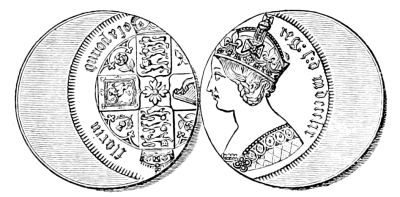
Fig. 20.—Brockage.
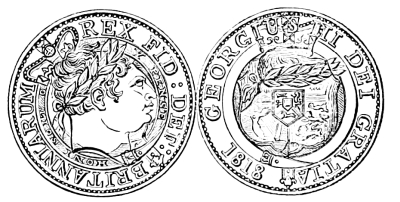
Fig. 21.—Brockage.
Such being some of the imperfections of Mr. Boulton’s coining press, it may perhaps be assumed that they can be readily overcome; but I am not aware of the existence of any press which is free from them. The French press has, however, many advantages, and the Mint authorities have recently had a new one made, from which extraordinary results were anticipated, but it now appears that this is simply another improvement of the usual type, and that it has cost about £1,500 and remains on the premises of the manufacturers.
As the coined money issues from the press it is collected in trays and examined; all imperfect coins, curiously termed “brockages,” are picked out; and the good coins weighed into drafts of 701 sovereigns, equal in weight to about 180 ounces: these are at present sent to the weighing room, where they are examined for imperfect coins by passing over a kind of blanket, so arranged on a series of rollers that each coin lying on its surface can be seen as the blanket revolves. The blanket covered with coins is carried round a set of rollers, and thus produces them on the upper side of a lower blanket, when the reverse side can be seen. The effect of this machine is to worry the eye, if constant watching be enforced, for no one can watch a string of coins in continuous motion and see each one. A very minute alteration of this machine would cause it to stop for a few seconds at intervals, and during that stoppage the accustomed eye could readily detect and select the imperfect coin.
After this overlooking, the coins are rung as blanks used to be, and then weighed separately, all the rejected going to the melting-pot, by which a waste[41] of 50 per cent. is incurred at the extreme end of an elaborate process; but this unwise course, it is to be hoped, will soon be abandoned when its expensive and perfectly useless extravagance is considered. After the various operations of the weighing room the coin is collected and weighed into separate bags, each containing 701 sovereigns; the exact weight of the contents of each bag is noted; and, the bags having been placed in a truck, are taken to the Mint Office, where they undergo what is called pyxing, which is simply the selecting from each and every bag a pound weight, from which two coins are taken; each coin is weighed and its weight recorded. Of these coins one is placed in the hands of the assayer to determine its value as to per-centage of gold, and the other is sealed in a packet, which is placed in a pyx for the trial of THE PYX at Westminster—an ancient process now useless, because any skilled man can detect by assay a deterioration of the coin. These particulars having been taken, the coin is in due course delivered to the officers of the Bank of England, who conduct it in amounts of about £140,000 to the Bank in a waggon.
The law enacts that 20 lbs. weight troy of standard or crown gold shall be made into 934·50 sovereigns, and this proportion gives the means of determining the theoretical weight of one sovereign; for if the 20 lbs. troy weight produce 934·50[42] coins, it is only necessary to divide by that number the number of grains in 20 lbs. troy, and the quotient will represent the weight of a single sovereign, viz., 123·2744783306581059 troy grains; therefore the journey of 701 sovereigns should weigh 180·032102728731942215 troy ounces, and a million 256821·829855377 troy ounces, equal to 7·8618927506797 tons avoirdupois; hence the War Indemnity of France will weigh 1572·37855 tons.
Since the coins of a people must represent food in proportion as they are of specific weight, it is to be regretted that the law does not fix the weight (with a remedy) of the individual sovereign, instead of fixing the number of coins in 20 lbs. weight, and giving a remedy[43] of 12 grains on the pound troy. Irrespective of law, the practice of the Royal Mint is to apportion the estimated amount of remedy (or latitude for error) to each coin; but in America the pound weight alone is studied; hence the individual coins vary so considerably in weight that it pays as a commercial speculation to select the heavy coins, and to sell them as bullion; thus leaving the light coins in circulation, to the dishonour of the nation, because if a man take 1,000 American gold coins to the Bank of England they will not be received at their nominal value, but as bullion; hence the loss becomes personal, and so the coins of America cannot, and do not, stand on a par with those of England.
The paragraph above has stood unaltered since the first edition, and I reproduce it because its history is perhaps curious. Mr. Graham, soon after I entered the Mint, commenced urging reasons why the system of weighing coins individually, which he considered expensive, should be abandoned; as well as I was able I met his proposition by firm but adverse arguments, until at last he “ordered me to omit the weighing of individual pieces, and to pound the work as is directed by law.” I therefore asked him, as the matter was a very grave one, to write the order. This he refused to do, and thought it hard of me to require a written order, and so the matter dropped; when, however, Mr. John Graham was appointed, Mr. Graham told me that he could now carry out his wishes without a “written order.” In the meantime he had asked me “to write a treatise on coining for Tomlinson’s Cyclopædia—in fact, I have already referred Mr. Tomlinson to you, and he will call; your difficulty will be to compress your information into a sufficiently small space.” After so long an attempt to preserve the accuracy of our coinage, I felt unwilling to allow such an opportunity to pass, and therefore placed my opinions in print, and thereby gave Mr. Graham so deep an offence that he refused to place my book in the Mint library, although I gave him a copy for that purpose; it was still absent from those shelves when I left the Mint. In August, 1864, Mr. John Graham, acting under the “Master’s orders,” directed “that the contents of only one bag in three should be weighed,” and this was carried out till pieces which bore the device of florins found their way to the Bank of England, and amongst them were found some of the intrinsic value of 1s. 6d., while others reached so high as 2s. 9d. Mr. Graham was greatly distressed about this occurrence, and, notwithstanding his brother’s position, directed me to stop this new system at once. He then attributed the innovation to myself, and blamed me for all that had happened. I therefore told him that he, and he alone, was to blame, for I had persistently refused to do it unless fortified with a written order. This caused, as I felt at the time, our final separation; but had I been willing to accept blame which belonged, as I told him, to himself first, and in a lesser degree to his brother, he would have made it a fair ground for my removal from the Mint—a result he had earnestly endeavoured to effect. I was so far free from blame that I was actually absent from the Mint part of the time, and during the remainder refused to enter the room where the blanks were cut, such action on my part resulting from a desire to protest firmly, by deed as I had done by word, against what I knew to be a fatal step. The wisdom of my proposition to apportion the remedy to the individual piece was so apparent that the Legislature incorporated it in the Act 33 Victoria, cap. 10, and as detailed information may be of special value to many, I quote the first schedule to that Act on the opposite page.
That others concur in my thus claiming the origination of the apportionment of the remedy to the individual piece, is, I think, clearly demonstrated by the subjoined letter, which appeared in the Money Market and City Intelligence of the Times, on Thursday, March 10, 1870.
“The following relates to the coinage question:—
“March 8th.
“Sir,—In your article of this day you draw attention to Mr. Ansell’s new work, ‘The Royal Mint,’ which I have studied carefully. I shall feel obliged if you will permit me, through you, to direct the attention of members of Parliament to the suggestion thrown out by Mr. Ansell in his ‘Treatise on Coining’ in 1862, and repeated in the book above alluded to.
“In the New Coinage Bill, which is to be discussed on the 10th inst., the Chancellor of the Exchequer would appear to have adopted in part the proposal of Mr. Ansell, to make the remedy on the individual coin, instead of on the pound weight of coins, as is now the law. Mr. Ansell gives very strong reasons, besides the expense, why 0·2568 grain should be enforced as the legal remedy on the individual coin, and surely, while the legislature is invited by Mr. Lowe to adopt 0·20 grain, it would be wise that those reasons should be considered, for the Act, once obtained, will be difficult to repeal, and the Mint seems capable of improvement.
“I am, Sir, your obedient servant, “Nummorum Famulus.”
I may add that Mr. Fremantle has purchased a copy of my last impression for the Mint Library.
The coinage of silver is precisely the same in every detail as the coinage of gold; but there are one or two points that require to be dwelt upon. Weight for weight, silver is more bulky than gold, and is coined in larger quantities; hence it has become important to expedite its coining by every means. Thus, in the process of annealing, it is simply placed unprotected, except by a lid of iron, upon an iron truck, and run into the annealing furnaces, from which, after twenty minutes, it is withdrawn and plunged at once into cold water. In the annealing of the silver blanks it is important to have the copper of the alloyed metal removed from their surface; this is effected by annealing the blanks for from seven to ten minutes in open pans, when the copper becomes oxidised, and is removed by the process of blanching, described under the coining of gold.[44]
FIRST SCHEDULE.
Denomination of Coin. Standard Weight. Least Current Weight.
Imperial Weight. Grains. Metric Weight. Grams. Imperial Weight. Grains. Metric Weight. Grams.
Gold:
Five Pound 616·37239 39·94028 612·50000 39·68935
Two Pound 246·54895 15·97611 245·00000 5·87574
Sovereign 123·27447 7·98805 122·50000 7·93787
Half-Sovereign 61·63723 3·99402 61·12500 3·96083
Silver:
Crown 436·36363 28·27590 — —
Half-Crown 218·18181 14·13795 — —
Florin 174·54545 11·31036 — —
Shilling 87·27272 5·65518 — —
Sixpence 43·63636 2·82759 — —
Groat or Fourpence 29·09090 1·88506 — —
Threepence 21·81818 1·41379 — —
Twopence 14·54545 0·94253 — —
Penny 7·27272 0·47126 — —
Bronze:
Penny 145·83333 9·44984 — —
Halfpenny 87·50000 5·66990 — —
Farthing 43·75000 2·83495 — —
Denomination of Coin. Standard Fineness. Remedy Allowance.
Weight per piece. Millesimal Fineness.
Imperial Grains. Metric Grams.
Gold:
Five Pound Eleven-twelfths 1·00000 0·06479 0·002
Two Pound fine gold, 0·40000 0·02592
Sovereign one-twelfth 0·20000 0·01296
Half-Sovereign alloy; 0·10000 0·00648
or millesimal
fineness 916·66.
Silver:
Crown 1·81818 0·11781 0·004
Half-Crown 0·90909 0·05890
Florin Thirty-seven 0·72727 0·04712
Shilling fortieths fine 0·36363 0·02356
Sixpence silver, 0·18181 0·01178
Groat or Fourpence three-fortieths 0·12121 0·00785
Threepence alloy; or 0·09090 0·00589
Twopence millesimal 0·06060 0·00392
Penny fineness 925· 0·03030 0·00196
Bronze:
Penny Mixed metal, 2·91666 0·18899 None.
Halfpenny copper, tin, 1·75000 0·11339
Farthing and zinc. 0·87500 0·05669
The weight and fineness of the coins specified in this Schedule are according to what is provided by the Act fifty-six George III., chapter sixty-eight, that the gold coin of the United Kingdom of Great Britain and Ireland should hold such weight and fineness as were prescribed in the then existing Mint indenture (that is to say), that there should be nine hundred and thirty-four sovereigns and one ten-shilling piece contained in twenty pounds weight troy of standard gold, of the fineness at the trial of the same of twenty-two carats fine gold and two carats of alloy in the pound weight troy; and further, as regards silver coin, that there should be sixty-six shillings in every pound troy of standard silver of the fineness of eleven ounces two pennyweights of fine silver and eighteen pennyweights of alloy in every pound weight troy.
In annealing the precious metals, it is intended to use large retorts of Stourbridge clay instead of the naked flame, as is the present practice. The advantage of using retorts will be the protection they will afford to the substances to be annealed, and the uniform temperature at which they may be kept for any required time. So great are the obstacles to improvement in the British Mint, that, although this suggestion was made by me, and plans were prepared, in June, 1861, the necessary alterations have not yet been attempted; indeed, it has been reserved to Mr. P. F. Comber, the intelligent chief coiner of the New Mint in Melbourne, to adopt this suggestion. The furnace for his use has been made by Messrs. Deane, of Arthur Street East, London Bridge, who, from experience, know this kind of furnace to be successful; indeed, it has been long used to gain higher temperatures than are required for metals in the annealing of glass, pottery, &c. I have recently been permitted to make a long series of experiments at the works of the Patent Fuel Company, on their wharf at Deptford, and these have convinced me that their mode of converting hydrocarbons into vapour, and burning that vapour with a proper supply of air under pressure, could be applied in the Mint with great advantage to the heating of the annealing furnaces, especially if the authorities of that department should adopt the retorts proposed.
In my previous editions I have suggested the use of these retorts, and I am glad to see that the Royal Mint is likely to adopt them, for Mr. Napier recommends them in his Report, and Mr. Roberts not only coincides in that recommendation, but specifically says, “It is a question for consideration whether muffles of clay instead of iron, and gas as fuel, might not be used with advantage.”
The coinage of bronze is somewhat new; that is to say, it has, after centuries, been re-introduced; and as little is known respecting it, it will be well to consider one or two circumstances connected therewith. The dimensions of the bars are previously given,[45] those measurements were determined by me after much troublesome experimenting, and the bars are found to be capable of producing the best blanks, as regards equality of weight one for another, with the least labour. In the rolling of bronze there are some singular facts to be noted; for instance, the finding the same metal at one time ductile, and at another absolutely brittle; yet if the bronze has been properly melted, with due precaution to avoid the access of atmospheric oxygen, it is uniformly malleable and ductile, and may be rolled from such bars as described without once annealing. It is sometimes preferred not to use the knowledge gained, and then complications commence. The following mode of operating will meet all cases:—The bars may be rolled down to half their thickness, and then will anneal perfectly well in an open furnace on an iron truck. The heating should be conducted rapidly, and when the fillets get to a full red heat they should be withdrawn, thrown out singly on the floor, and allowed to remain till perfectly cold. Should any bars be annealed in the rough state, they must be kept away from water. A little water thrown upon the end of a bar when red hot causes it to become rotten throughout, and on submission to any pressure it will fall to pieces as would gingerbread; yet if the bars be partly rolled to a certain proportion of their thickness, they may be plunged at once into cold water without damaging them for work. After annealing, the fillets should be blanched in diluted sulphuric acid, containing one per cent. of the ordinary commercial acid. It is well to save time by blanching two or three tons at a time; but a few minutes effect all that is required—that is, the separation of the film of oxide from the surface. The film is then removed by a mop made of rag or cotton waste, and with little labour a few boys may clean many tons in a day. Fillets which have been blanched before being rolled produce clean and bright blanks. The blanks require somewhat different treatment. It is better to anneal them in copper tubes. The bottom of the tube should be covered to about the depth of an inch with charcoal dust, then the tube filled with blanks, except allowing for another layer of coarse charcoal dust, and the top put on to the tube. The annealing should not occupy more than thirty-six minutes; the highest temperature should be that at which the tube looks a full reddish white, and this should be gained as rapidly as possible. The tube, after removal from the furnace, should be allowed to remain at rest till perfectly cold. The charcoal is intended to combine with the oxygen, which would otherwise combine with the metals of the bronze during the heating and the cooling of the blanks in the copper tubes. Having regard to the production of perfect coins, the blanks should be cooled in an atmosphere of ordinary coal gas, by which every particle of oxygen is prevented from access, and a great part of the oxides already existing in the alloy reduced by the combination of their oxygen with the hydrogen of the coal gas, thus leaving the blanks somewhat porous, and comparatively soft, so that, when coined, the metal wholly fills the work on the dies, and the coin is produced with a good protecting edge. Bronze as used at the Royal Mint consisting of 95 of copper, 4 tin, and 1 zinc in 100 parts—zinc should be omitted because it causes useless labour—may be coined to great perfection if the blanks be cooled in coal gas after annealing: whereas bronze of a far softer nature cannot be made to fill the work of the dies satisfactorily by any other method yet known, unless the engraving on the dies be very shallow. The bronze coins, which have replaced the old copper money, have what is considered to be an innovation in the inscription by the repetition of the T in the abbreviation of Britanniarum, which is simply the classical mode of expressing in an abbreviated form the number of the possessions which together form Great Britain; it is equivalent to MS., which is the abbreviation for manuscript, while MSS. represents the word manuscripts; so BRITT. represents the cluster of islands or possessions called Great Britain. The objection to BRITT., on the ground of its being an innovation, is singular, as this word occurs on the shillings of George III., coined in 1816. It is also curious that the original dies for the bronze coinage were made to carry BRIT. only, until a coin found its way into the hands of the Right Hon. W. E. Gladstone, who at once pointed out the error, and thus caused the re-introduction of the classical BRITT. Mr. Gladstone also suggested the issue of octagonal bronze coins, which undoubtedly would have been a mistake had it been adopted. Perhaps it may not be uninteresting to record that the pattern penny in bronze, which was submitted to and approved by her Majesty, was lost in its passage through the post, for the postman opened the letter and destroyed both it and the penny in a closet in the Royal Mint. Copper and bronze money are merely tokens; it is therefore well to reduce such tokens to as low a weight as is consistent with the rigidity of the coin.
By Royal Proclamation, dated at Windsor, 13th of May, 1869, the old copper moneys are declared illegal; or, in the words of the proclamation, “No copper moneys whatsoever (other than and except such bronze moneys as are now current by virtue of our proclamation bearing date the 17th day of December, 1860, or any proclamation dated subsequently to the said 17th day of December, 1860) shall be allowed to pass or be current in any payment whatsoever within the kingdom of Great Britain and Ireland after the 31st of December, 1869.” So that since that date no copper moneys have been legally paid away. This, however, will not affect those who wish to preserve copper coins of this or former reigns as specimens.
As dies are the means by which metal becomes COIN, it will be material to add the processes of their manufacture. Experience alone can indicate the proper steel to be used, so that it is useless to attempt a description. But the form of the steel is a matter upon which die-makers differ. Some use square bars of that metal, and cut off pieces, which are forged into the proper form for dies; however, the more experienced die-makers use round bars of steel, which are cut by a tool somewhat of the shape of the bar, so that when the tool is struck every part of its edge begins to cut. The tool is so shaped as to leave the end of the bar from which the piece has been cut quite square, so that it may form the bottom for the next piece cut off. The piece of steel thus cut off is taken to a lathe, where its upper end is turned somewhat into the form of the top of a sugar-loaf; the depth of this form being determined by the style of work to be impressed upon the steel when it is to be formed into a die. For the original matrix the piece of steel is turned to a flat end, and is usually strengthened by driving a carefully-welded ring of hot iron on to it: although some prefer thus to simply shrink on a ring of iron, the more experienced choose welding, because that which is shrunk on is never so solid, and is apt to enclose air bubbles, which prevent the mass becoming one, thus permitting an undue yield in a faulty spot when pressure is applied. In the making of a matrix, the steel is softened to different extents by different engravers, but all soften more or less. The steel having been softened, the engraver cuts with a kind of hand chisel, by a motion of the wrist, such design as may be required, and after many months of work produces a finished matrix, from which he requires to produce many copies, because this one matrix would itself soon wear out, and by frequent use would be more exposed to risk. It is, therefore, hardened to admit of its being submitted to such pressure from another piece of steel as to impart its design to that steel without itself being distorted by the pressure. For this purpose the matrix is fitted with a ring of iron round its upper part, which, when fitted on, gives the engraved part the appearance of being the bottom of a cup; this cup is filled with a paste made of beer grounds and fine charcoal dust, or, better still, with that small charcoal which is found behind the flue of the forge—a kind of soot produced by the spent sparks which fly upwards, and which is so much in request by the file-makers. Thus protected, the matrix should be placed in the naked fire wholly enclosed with fuel, and heated as rapidly as possible, keeping it constantly turned round and round, so as to insure each particle of its mass being equally heated; a quarter of an hour should be long enough to produce the necessary temperature. It must be borne in mind that the great principle is to avoid the decarbonisation of the steel, therefore the less time that is occupied the better. The temperature of the matrix should be that rich and peculiar full red which for a few seconds is visible before white heat supervenes, for a white heat once gained causes the steel to scale off, and renders the matrix partially worthless. This peculiar temperature once gained, the matrix must be permitted to remain for three minutes in the fire without any blast. If it should get too hot it must be cooled by adding exhausted fuel from the hearth. At the end of three minutes’ quiescent heating it may be assumed that the centre of the matrix has become of the same temperature as its outer particles; it is then taken quickly from the furnace and placed in a kind of colander, so that water may wholly envelope it, and yet flow freely past it while its under surface is wholly exposed. The matrix C is placed in the colander D, Fig. 22, bottom upwards, and is then brought immediately under the pipe dependent from a kind of funnel A, which should hold at least a hundred gallons of cold water; the bottom of the pipe must be secured by a plug of wood B, capable of being knocked out instantaneously. This is the most important process in the hardening of the matrix, and requires considerable steadiness with great rapidity of motion. The matrix being held in the colander about half an inch above a large surface of water E, and immediately under the centre of the plugged pipe from the funnel, the plug B is knocked out from the pipe, and the water falls in a continuous stream wholly unbroken until striking the very centre of the base of the matrix, thus securing the commencement of the process of hardening FROM THE CENTRE. So soon as this first shock of the flowing water has been effected, the matrix must be sunk into the vessel of water below, until it is uniformly covered to the depth of half an inch, and must be held there until the whole of the water from the funnel has run out; then the matrix must be sunk to the bottom of the vessel of water, and allowed to remain till absolutely cold. If it be removed before it be cooled throughout, there is great danger of a crack on its surface being produced by the expansion from within. The plug is preferred to a tap in the pipe from which the water is to flow, because the turning of a tap gives a motion to the water, which causes it to fall in a hollow stream, and thus obviates the very effect which it is desired to produce. This process has been followed for more than thirty years, and during that time the manufacturer who uses it—one of the most eminent engravers and die-makers in Europe—has never met with any accident, nor has he found any failure. I have recently visited a manufactory in South Yorkshire in which many thousands of dies are made annually on this system, without an instance of failure. Die-makers, after the hardening, proceed as follows:—Remove the paste of charcoal from the face of the matrix, and then clean the face of the die with hydrochloric acid. After this it is tempered—that is to say, it is raised to a temperature which somewhat relaxes the rigidity of its particles; this is commonly judged of by the COLOUR which the face of the matrix assumes; but since no two men are likely to distinguish the same tint, nor can any one actually judge of colour unerringly, it is wise to adopt another standard, the one most preferred being to temper the matrix until the engraver can make a good graver bite while the die is hot. The tempered die may be cooled by plunging it either into oil or into water as soon as the tempering has reached the desired point. If at this instant the tempering cease, when the die is dead cold the graver will no longer touch the steel, which is now just so hard as to resist a blow without fracture. It is next polished, and is then fit for use; that is to say, is fit for the multiplication of dies from itself.
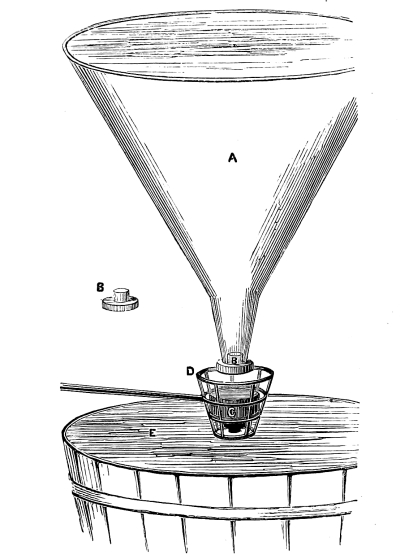
Fig. 22.—Die Hardening.
The multiplication consists in the taking a set of punches, each being an exact copy of the matrix. The steel, having been formed into masses with sugar-loaf tops in accordance with the depth of the engraving, is ready to receive the impression from the matrix, just as hot sealing-wax is ready to receive the impression from a signet. The matrix is placed beneath a press, and on its face is placed the sugar-loaf end of the annealed mass of steel; a very light blow is given by the press, so as to obtain simply the sinking of the first portion of the cone, for if a violent blow be given at this stage it is manifest that a large mass of steel is forced into a smaller space; in other words, the particles of steel which formed the cone are pressed into a dense mass on the surface of the intended punch, and prepare a crack, which by-and-by developes itself. After this light blow, the partly-formed punch is placed in a covered pot filled with charcoal, and heated in a furnace just as was described for the hardening of the matrix, bearing in mind that it is the cooling, not the heating, which softens the steel. So soon as the heating has been raised to the point before indicated, the pot containing the punch is removed, and bedded in hot ashes, and there left to cool as slowly as possible; it should be forty hours before it becomes cold. When cold it is cleaned, receives a second very light blow under the press, examined, afterwards receiving a third very light blow, and is then a second time annealed, &c. The number of blows required to bring out to perfection on the punch the work on the matrix, depends entirely upon the size of the matrix and the depth of the work engraved upon it. For these reasons, no accurate instructions can be given; but for all cases light blows should be made, because all metals mould more readily under gentle treatment.
From the punch is obtained, by processes which should be in every way similar, a series of dies for the use of the coining press. Each die from the punch is examined, and has the figures for the date impressed upon it before it is hardened. The dies are of two kinds: one, C, the obverse, with a long neck, upon which the collar B fits freely, and a second, the reverse, with a short neck, so that the face of the die just enters the collar sufficiently to meet and compress the blank. Fig. 23 demonstrates these two dies, and exhibits the collar, showing at B the milled interior circle, which gives the crenated edge to the finished coin at its formation. For the past few years the reverse die has been made to carry, in addition to its recognised device, a small number, with a view to determine at which coining press, and on what particular day, that die was used, that bad work might be traced to an individual. It need hardly be said that the accidents encountered in daily work overcome the object thus sought, for a die may last either minutes or days in wear owing to the irregularities of the steel from which it is made, and besides, the boys who work the presses are of necessity changed at irregular intervals.
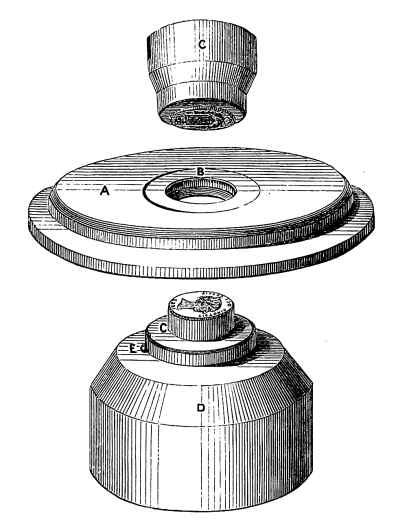
Fig. 23.—Coining Dies and Collar.
The long-necked die is fitted into a bolster D, as shown in Fig. 23, and is prevented from shifting its position in that bolster by a plug of iron indicated at E. The bolster, with its die, is secured in a kind of dish beneath the screw of the press by a series of screws, which admit of adjusting the bolster so that the die it carries shall be placed immediately beneath the upper die, which is carried on the main screw G of the press, as may be seen at page 60.
There is little doubt but that certain stages of die manufacture would be rendered more effective if more reasonable treatment were employed. It has yet to be demonstrated that carbon steel is the best metal that can be employed, for it seems more than probable that some alloys would render a metal which would possess within itself more of the properties which are necessary for the perfecting a die, and for its duration when in use. For the elimination of such an alloy we must await the time when the non-resident assayers are replaced by resident chemists who, during the leisure times in the Mint, will be willing and glad to experiment on some of the compounds of iron with the rarer metals, for in that field will surely be found a combination which will be definite, and therefore homogeneous and unvarying. There can be no doubt that the cause of the uncertainty which prevails as to the endurance of steel for dies arises from its unequal composition.
Gold possesses as many colours, and exists in as many conditions, as any substance ordinarily met with. Those various changes are due to the existence of impurities in the metal, which are neglected in assaying, because the only business of the assayer is to determine that the sovereign actually contains the lawful weight of pure gold, and also so much alloy as is specified: what this alloy shall be is, in the abstract, a small matter so that it is not silver, because if it be silver it is worth the expense to separate it, and thereby destroy the coinage. Yet, although the existence of such metals as lead, bismuth, tin, antimony, and arsenic, as well as palladium and osmium-iridium is not illegal, it becomes necessary to separate them, because these metals affect the coin in various ways. Palladium and platinum alloy with the gold only after considerable time, therefore these metals may generally be seen in the finished coin, frequently as a slight bar across its surface, sometimes as spots on its crenated edge. Osmium-iridium causes trouble, inasmuch as it is so infusible, that it simply floats about in the melted gold, and several crystals agglomerate; where this takes place, the difficulty of manufacture is so great, that it is impossible to produce the desired amount of coin within the limits of remedy as to weight. The simplest means for the removal of these substances is to allow the fused metal to remain for a considerable time, when they settle to the bottom, and the clear metal can be poured off; the dregs, if so they may be called, are then sent to the refiner, but the process of separation is too long, and hardly adapted for a description in this place.
As a practical matter, the other, or volatile metals, and lead, may be, and generally are, removed by means of corrosive sublimate. This is an expensive measure, and does not answer its intention, for some of the mercury combines with the gold and renders it brittle. In practice, the best process is that recommended by Mr. Warington, who proposed to add to gold found to contain tin, antimony, or arsenic, 10 per cent. of oxide of copper. The gold is fused in a Payen crucible, and the oxide of copper is then added and stirred into the gold by a rod made of the same substance as the crucible. This operation is easy of performance, because the infusible oxide of copper stirs up with the gold readily, and each particle of antimony, arsenic, or tin, as it comes into contact with the oxide of copper, reduces it to the metallic state, the volatile metals combining with the oxygen, while an equivalent of copper alloys itself with the gold. The impurities, as they oxidise, mix or combine with the oxide of copper. One or two experiments tell how much copper is thus added to the gold; consequently, how much fine gold is to be added to keep the alloy standard—and subsequent treatment by the oxide of copper simply removes the volatile metals. Gold treated by this process is perfectly workable on a large scale, and there is no trouble. A condition of success is, that no reducing agent, such as carbon, be present, and therefore plumbago pots cannot be used. In practice, half an hour is the best time to keep the metal in contact with the oxide of copper. The objection is frequently expressed, that to refine gold is not the business of the coiners. This opinion, however, will bear modification, for the expense of the oxide of copper is trifling as compared with the cost of labour in treating brittle gold.
I now advert to a most important matter in relation to coining, viz., that of the loss sustained, its cause, and prevention.
It appears that the Royal Mint should sustain less loss than any other mint by the coining of gold and silver. If allowance be made for the sale of the sweep or dust[46] which results from a coinage, the total loss, inclusive of every operation in coining, should be so small that it might be passed without notice; in fact, there ought to be a minute increase of weight from traces of oil which are left on the fillets to enable them to pass through the cylinders of the draw-bench;[47] by melting[48] there seems to be too great a loss of metal: this should reach about £100 per million coined, and such loss would be wholly explained by the refining, which takes place through the removal of copper by oxidation; although this is minute, still it is enough to explain the loss which I indicate. If the assays be closely watched there can be no loss, for the trial of the pyx invariably shows the gold coin to err on the side of purity, so that if the Master of the Mint should determine to issue gold of exact standard, and refuse to avail himself of the latitude allowed, he may fairly cover every source of loss, and coin money WITHOUT WASTE OF METAL. Each grain that is found in excess of the standard upon the pound weight of gold causes a loss of about £180 upon each million coined. The moneyers asserted that they sustained a loss of £700 for each million coined, such loss being exclusive of melting. This has never been believed to have been a truthful statement, nor has the loss by coining alone often reached so high an amount, although so large a sum as £373 per million would seem to have been determined, by some careful experimenters, as the necessary loss. Where the gold went to was not stated; but supposing such a loss to accrue, it is manifest that either the gold volatilised or the floors must be paved to many inches in thickness with gold, but it is an established fact that matter once existent cannot be annihilated; yet it has required many arguments to convince those most interested in coining that the mere cutting up of bullion into small pieces does not alter its actual weight: the present Mint Authorities entertain the fallacious notion that large loss of gold is, for metallurgical reasons, NECESSARY. Notwithstanding Mr. Graham’s opinion that a loss of £206 on a million was too high,[49] they in their “Reports on European Mints” have arrived at the conclusion “that the ‘waste’ shown to have existed of late years in the English Mint has not been excessive.”
To leave, then, the realms of speculation, and for a short time to examine figures, a matter which is little understood will be reduced to one of easy comprehension. Mr. W. T. Brande, in connection with others, carried on a series of experiments between 1851 and 1856, the results of which he gave me in writing, and which induced him to arrive at the conclusion that by coining alone there was a loss varying from 1·20 grains on the pound, to 3·10 grains on the pound troy, or a mean of 2·15 grains on each pound troy coined. This loss was thought to be a necessary consequence of coining, and by a simple rule-of-three it tells as follows:—
A loss of 1·20 grains on the lb. = £208·33 on each £1,000,000.
” 3·10 ” ” = £538·18 ” £1,000,000.
Mean loss 2·15 ” ” = £373·26 ” £1,000,000.
Mr. Brande and his colleagues, by his own admission, did not know the value of the sweep recovered, therefore this loss was believed to be absolute. We will next examine the accounts and see the fruit of that belief, and then determine the effect of a contrary faith. And in the following statements, given in a tabular form, I would observe that the facts recorded were compiled by the Mint officials for the Master at my suggestion, and that copies were given to me by the late Master, who indeed invariably, when such statements were prepared, handed them to me to copy and examine for my own information, and to see that they were accurate.
It is a fact that the Mint books do not record the loss upon the gold coined in November and December, 1851; or, if they do, these accounts have been only quite recently balanced. In the following statement I omit the coin of those two quarters, because the late Deputy Master assured me that the accounts were not made up. This, I am aware, lays me open to a correction; I therefore state that the coined money of these two months is not included in my calculations.
Statement showing the Rate of Coin obtained and the Loss of Metal incurred in each Quarter from March, 1852, to December, 1857.
(A) = Proportional Loss of Metal on each Million Ounces Coined.
Quarter ending:— Total Amount of Gold Coined per Quarter. Rate per Centum of Coin obtained from Rough Bars. (A)
Ounces. Ounces. Ounces.
March 31st, 1852 300260·201 446·94
June 30th, ” 501032·558 399·17
Sept. 30th, ” 615753·337 500·50
Dec. 31st, ” 828159·837 50·51 639·37
March 31st, 1853 1113414·454 47·28 691·60
June 30th, ” 1223454·550 49·40 472·34
Sept. 30th, ” 248434·554 39·34 1130·64
Dec. 31st, ” 484331·447 42·81 784·42
March 31st, 1854 769791·029 54·21 730·61
June 30th, ” 101611·604 49·65 787·21
Dec. 31st, ” 194968·684 47·76 583·07
March 31st, 1855 515639·229 47·42 447·05
June 30th, ” 501708·378 47·01 456·20
Sept. 30th, ” 283944·316 43·53 420·18
Dec. 31st, ” 1012329·518 44·57 509·08
March 31st, 1856 360409·244 38·39 489·05
June 30th, ” 818465·116 40·36 509·57
Dec. 31st, ” 362599·792 41·74 406·28
March 31st, 1857 73638·878 39·64 233·84
June 30th, ” 19872·998 40·52 57·86
Dec. 31st, ” 1154606·290 54·69 18·45
There will be occasion to refer to the next table for further information; but as the facts in this table are not strictly comparable with any others that will be given, it is better to explain this as it stands. Of the rate per centum of coin obtained from the bars there will be occasion to speak at a later period. These figures are placed here with a view to save repetition, which would be necessary when that subject is discussed.[50] Although the figures in the first column represent ounces, each item can at pleasure be converted into pounds sterling by multiplying it by £3·89375, which is the decimal expression for £3 17s. 10½d., the price per ounce of standard gold. In such case it will only be necessary to multiply the weight of the coinage by that value, and then to consider the loss of metal as pounds sterling—thus, 300,260·201 ozs. + £3·89375 = £1,171,318 5s. 3¼d., which sum lost weight by coining at the rate of £446 18s. 9½d. per million coined. If calculation be made by addition and division of the figures in the third column, it will be observed that the average loss per million between March, 1852, and December, 1856, is £577·96,[51] and this was believed to be absolutely wasted in coining; but this amount may be fairly reduced by the deduction of £72 10s., the average value of sweep recovered, when it will remain £505·85. It will also be seen that the rate per million missing—for that is the fact—varied a good deal according to circumstances.
It has been asserted that these losses were mere matters of account, and resulted from the removal of “fat or oil” in the various operations. These explanations shall be admitted to their fullest extent, but that they do not contain the cause for all the losses is to be gathered from the fact that gold has been returned to the Mint by the brickmaker, who found it in the ashes which he had bought. That there were cases of actual theft I am myself aware; for I, by the Master’s sanction, dismissed two men who were detected. Eleven others shared the same fate, but no prosecution was attempted or permitted, although strongly urged. As bearing on this point the following, in relation to “peculation,” is told and believed in the Mint:—In 1856, when the men had formed a strong opinion as to the honesty of one particular person, they took their own means to watch him, and to see how and when he abstracted the metal. A clear-headed man made it his business to do this duty. The suspected man was assisting the officer at the scales in the drag room, when the watcher saw him, after the bullion was weighed, take a piece stealthily and secrete it in the palm of his hand. The watcher, thinking to secure detection, requested the officer at the scales to re-weigh that draft; but this gentleman refused to comply. The watcher then told the officer what he had seen, and that if he would open the man’s hand the piece of gold was still in it, when the officer, addressing the suspected person, said, “Is it all right, John?” John replied “Yes,” and no more passed. On his road home “John” stumbled, and a piece of uncoined gold fell on the pavement.
That metal was actually removed from the premises is beyond doubt, for a late officer picked up a piece of gold in the courtyard wrapped in brown paper, and the police brought to the Master a “flat end”[52] of gold, which had been offered for sale. The police inspected all the men in the Mint employ; but the person who abstracted the gold did not personally offer it for sale, and thereby escaped detection.
On the 2nd of December, 1853, the cutting room book records a loss of 87·26 ounces of gold, for which no satisfactory explanation is given. This book also contains some significant remarks by the officer who had charge of that department.
The Mint books adopt the word “Wasteage” as explanatory of these losses, which were believed to be a necessary result of coining; so generally, indeed, was this firmly-implanted belief entertained, that at the bottom of each day’s account the word loss was printed, so that the officer had only to write the amount which was missing.
If indeed proof that unnecessary wasteage[53] took place be required, it will be but necessary to quote from the letter of the Master of the Mint to the Treasury, dated 7th June, 1860. This letter was placed in my hands on the 1st June, 1860, by the Master, who desired me to copy such parts as related to loss and were of service to me, and that I might confirm the accuracy of his figures. He said, “It appears by the table that the average loss on the gold coinage of the first six years is £784 0s. 0¾d., and on the gold of the last three years £172 8s. 11½d. per million coined, showing an improvement of £611 11s. 1¼d. per million coined. On the twelve millions of gold coined during the last three years the saving exceeds twelve thousand pounds.” The three years here referred to were contained in the period during which Mr. Graham entrusted me with the management of the coining department.
That the actual amount of loss by coining may be got at, it will be necessary to view the matter in a different form, and in that way to show the amount of money recovered by the sale of sweep; that is, by the sale of the ignited rubbish accumulated during a coinage, and in the statement given on page 90 the money value of each item is specifically represented. It need not be insisted that the utmost care should be exercised in preserving the sweep, when it is stated that this yields, at the end of a coinage, from 15 to 20 ounces of material bullion called scrap or supply, when picked over before sale, for only such as will pass through a fine sieve is sold; yet this sweep used to stand about in open, unlocked boxes from month’s end to month’s end.
It would be wrong to state that there is no apparent loss by coining gold. If, however, the whole circumstances be examined, it will be found that, after deducting every legitimate waste, an appreciable gain should be exhibited. In annealing sovereign blanks the loss is 54·12 ounces on each million. This then would appear to be an absolute waste; but starting on the undisputed fact that “matter cannot be lost,” let us see what becomes of these 54·12 ounces apparently lost. 54·12 ounces contain 25,977·60 grains troy. Now, since careful analysis extending over more than thirty millions of gold annealed has determined that each million lost 5,708 grains of copper, and this copper is washed away as sulphate of copper, it may be admitted that so much is lost, thus leaving 20,169·60 grains unaccounted for. These 20,169·60 grains are just 42·02 ounces, and if proper care were bestowed I could show how every particle should be recovered at the end of the coinage.
That there should be a gain is demonstrable from the fact that the gold as received into the coining department is quite clean; when wrought it becomes coated with oil, and this being returned on the scissel[54] to the melting-house is really charged as gold. In 1858 Mr. W. H. Barton, experimenting independently, arrived at the conclusion that there were 200 ounces of oil on 765,370 ounces of gold scissel, while on the same scissel I, by careful experiments, determined that there were 118·39 ounces of oil, the remainder being dust and other foreign matter. Further experiments, conducted by Mr. Barton for his own satisfaction, brought him to adopt my figures as accurate. This proportion would give 154·55 ounces to each million ounces of scissel; but since good work returns only 35·80 per cent. of scissel on the rough bars, it becomes manifest that this same proportion is but 101·22 ounces in each million coined.
Now the MONEYERS[55] used to make an allowance of 347 ounces to each million ounces of scissel, and with such sharp business-like people it is barely possible that they allowed too much. We may therefore assume that the scissel of the present day is much less covered with oil than it used to be; and this is indeed the truth, for whereas the trucks were wont to be actually spotted with oil which dropped from gold scissel, they are now unstained; and it may be mentioned that, to test the minute amount on the scissel, the Master has upon occasions wiped it with a white cambric handkerchief, by way of settling a disputed point, without perceptibly soiling the handkerchief. Admitting then a loss of 42·02 by annealing and blanching, we get, by deducting this from the gain by oil, an absolute gain of 59·20 ounces on each million ounces coined. In a little while, when examining the table, we shall see how this theory worked out in practice; for, to be perfect, it should be capable of demonstration. The question will naturally arise, If the oil be now so small in proportion, why should there not be an increased loss by melting? And here indeed arises a very nice point, but one which is proved to demonstration—that whereas large amounts of oil cause loss, small quantities of oil PREVENT loss by melting, and for the following reason. Standard gold consists of copper 2 parts, gold 22 parts. So soon as this gold approaches red heat it changes to a purple colour on its surface, owing to the oxidation of the copper. If, however, a trace of oil be present, the heat, while it warms the gold, volatilises the oil, and thus places the gold in an atmosphere free from oxygen, so that the standard gold remains metallic until it liquefies; hence the saving of loss, for any oxide of copper would be lost in the pot. This matter of the oil has been dwelt upon because it is a vexed question, and when the melter, by want of care, makes a large loss, he invariably, by a human weakness, attributes the loss to the oil on the scissel. It was on such an occasion that the assistant-melter produced the following amusing parody on the three witches of Shakespeare. The illustrative picture is clever, but unfitted for these pages.
First Witch. Round about the journeys go,
In the dirt and rubbish throw;
Extraneous matters, small and great,
Everything to make the weight.
Second Witch. Stone swept up and pounded small,
Pieces of the stuccoed wall,
A bit of saffron-coloured brick,
Odds and ends of broken stick;
Here’s the sweeping of the floor,
Weighing full an ounce or more.
All. Hubble bubble, toil and bubble,
Give the melter every trouble.
Third Witch. Copper by annealing got,
Send largely to the melting-pot;
A pennyweight of leather strap,
A piece of old brown paper cap,
Some cotton fluff, ten grains of coal,
Then OIL to saturate the whole.
All. Hubble bubble, toil and bubble,
Give the melter every trouble.
Macbeth (as Justice). How now, ye secret, black,
and cunning rollers!
What is’t ye do?
All.A deed without a name.
24th November, 1862.J. G.
Upon consulting the table—see p. 90—it will be found that, by deducting the value of the sweep recovered, from the value of the metal lost, between the periods November, 1851, and March, 1857, the actual loss was £19,930 18s. 0d., which sum, divided by the amount of gold coined in that period—viz., £40345185·450, gives £494 as a bona fide loss on each million pounds coined, when the belief was to the effect that there must be a loss. The great fact, that matter once existent cannot be lost, was never applied to the operations of minting until, in 1856, I demonstrated to the Master that the floors not being paved to many inches thick with gold, the bullion which was stated to be “wasted” in coining must have been absolutely volatilised, the proposition exposing me to more than ridicule at the time, and to positive hatred and misrepresentation thereafter; but when once the determination was formed to arrest what I saw clearly was unnecessary loss, it was carried out firmly, and in November, 1856, I commenced my determinations of the necessary amount of loss in each operation, as well as a series of experiments to elucidate other points requiring reform and explanation.
In furtherance of this firm resolve I assembled the men together, and informed them that I had now taken charge of the departments over which I had been placed, and that I should not permit any man to leave the Mint until the account was satisfied, and I had received from them the bullion to its uttermost part which I proposed to entrust to them. That I might effect this determination I weighed out to them, in their presence, a limited weight of gold, and then directed their foreman, on their behalf, to satisfy himself that the weight I charged was fair and honest; and then, with a firmness which surprised them, I followed this gold step by step, never for an instant permitting it to leave my sight, and at each step in its passage from bullion to coined money I carefully weighed it, and made the foreman again check me, all the men being witnesses. At the end of the operations a FIXED GAIN exhibited itself. I was called upon for an explanation, which I gave, and each man was thus convinced that it was no use to attempt to cheat me, and was compelled to acknowledge that unless by abstraction there could be no loss. Many arguments followed for months, but LOSS became a matter of history so long as I was present,—not so in my absence, even at that time, as the books will show.
Great firmness was required, but I persevered, and received not only thanks, but very valuable assistance from many of the men. With a view to keep the Master supplied with information as I gained it, I adopted a plan of reporting to him daily in writing the various changes which took place in the bullion under my care as regards differences of weighing, loss or gain, the amount per cent. of coin obtained, and other such details, and at the end of each coinage I summarised the whole of such facts into a tabular form, and thus rendered to him a complete history of the operations conducted. This proved of immense service, for upon the occurrence of an unusual event, attention was at once drawn to it, and means adopted to discover the cause, while at the same time a constant study of these reports could not fail to induce for myself a more minute inquiry into the various branches of my subject. I feel it cannot be unfitting to give, before proceeding further, one of these statements or reports relating to gold, and when I come to the discussion of silver I will, in its proper position, place such another table, because these seem to convey much practical information which will be useful to those engaged in coining.
The report placed on page 92 is a copy of one I made to the Master, so I give it in extenso, and it will be found that by it bullion may be traced from its first admission to the coining department to its final issue as coined money, while each item of its history finds a place in the immediate department in which the bullion may be under operation.
Statement of Losses incurred and of Sweep recovered. This refers wholly to Gold in the Coining Department.
Date—Financial Year. Weight of Coinage. Value of Coinage. Weight of Lost Metal.
Ounces. £ s. d. Ounces.
Nov. 1851 to March 1852 351837·830 1,369,968 11 0 134·206
April 1852 to March 1853 3058360·186 11,908,489 19 5½ 1851·888
” 1853 ” 1854 2726011·580 10,614,408 11 9¾ 1804·559
” 1854 ” 1855 812219·517 3,162,579 14 10½ 424·092
” 1855 ” 1856 2158391·456 8,404,236 14 7½ 1039·798
” 1856 ” 1857 1254703·786 4,885,502 17 2 581·615
” 1857 ” 1858 1256586·572 4,892,833 19 4 17·784
” 1858 ” 1859 736150·582 2,866,386 6 6¾ 16·603
” 1859 ” 1860 980070·679 3,816,150 4 2 74·857
” 1860 ” 1861 861205·000 3,353,316 19 5 263·568
” 1861 ” 1862 1872214·638 7,289,935 14 11
” 1862 ” 1863 2351444·336 9,155,936 7 8 27·480
” 1863 ” 1864 1807332·130 7,037,299 9 8 47·054
” 1864 ” 1865 1949438·200 7,590,624 19 10 43·491
” 1865 ” 1866 1256347·104 4,891,901 10 9 57·612
” 1866 ” 1867 175838·208 684,670 0 5 5·037
” 1867 ” 1868 109580·129 426,677 12 1¾ 3·357
June 1868 to Sept. 1868 280993·740 1,094,119 7 6 ⁂19·87
Date—Financial Year. Value of Lost Metal. Value of Sweep.
£ s. d. £ s. d.
Nov. 1851 to March 1852 522 11 3 89 1 3
April 1852 to March 1853 7,210 15 9¼ 716 11 11½
” 1853 ” 1854 7,026 10 0¼ 707 7 3½
” 1854 ” 1855 1,651 6 1¾ 222 14 3
” 1855 ” 1856 4,148 14 3 635 4 1½
” 1856 ” 1857 2,264 13 3 422 13 10
” 1857 ” 1858 69 4 11 192 14 10
” 1858 ” 1859 64 12 11½ 209 16 7
” 1859 ” 1860 291 9 6 254 4 9
” 1860 ” 1861 1,026 5 4 545 10 5½
” 1861 ” 1862
” 1862 ” 1863 + 107 0 1 360 1 11
” 1863 ” 1864 + 183 4 4 459 0 1
” 1864 ” 1865 169 6 10 295 9 3½
” 1865 ” 1866 224 6 6 350 3 9
” 1866 ” 1867 19 12 3 Nil.
” 1867 ” 1868 13 1 5 Nil.
June 1868 to Sept. 1868 77 7 7 Nil.
Date—Financial Year. Value of Lost Metal. per Million Coined. Value of Sweep. per Million Coined.
£ s. d. £ s. d.
Nov. 1851 to March 1852 381 8 10¼ 65 0 2½
April 1852 to March 1853 605 10 3¾ 60 3 5¾
” 1853 ” 1854 661 19 6½ 66 12 10
” 1854 ” 1855 522 2 1¾ 70 8 5
” 1855 ” 1856 481 14 10¾ 75 11 7½
” 1856 ” 1857 463 10 11¼ 86 10 4¼
” 1857 ” 1858 ⁂ 14 3 0 39 7 10½
” 1858 ” 1859 ⁂ 22 11 0½ 73 4 0½
” 1859 ” 1860 76 7 7 66 12 5
” 1860 ” 1861 96 8 6 51 5 1
” 1861 ” 1862
” 1862 ” 1863 + 11 3 8 39 6 7
” 1863 ” 1864 + 26 0 8 65 4 5
” 1864 ” 1865 ⁂ 22 6 2 38 18 6
” 1865 ” 1866 ⁂ 45 17 1 71 11 8
” 1866 ” 1867 28 12 10 Nil.
” 1867 ” 1868 30 12 8¼ Nil.
June 1868 to Sept. 1868 70 14 5¾ Nil.
Notes.—The sign + indicates that on those special coinages there was an actual gain by weight to the extent specified, which will be explained on page 98.
The ⁂ is intended to draw the attention of the reader to these figures when a little later they are explained at pages 89, 93, 94, 95, 98.
To obtain the true amount of loss, deduct the value of the sweep from the value of the gold lost.
Return to an Order of the House of Lords dated 17th February, 1870. The LORD ROSSIE. No. 1.
FROM THE COINING DEPARTMENT OF THE ROYAL MINT.
A Statement of the Weight and Value of the Gold Moneys coined in each Financial Year from 1851 to 1869 inclusive, exhibiting the Weight and Value of the Loss or Waste sustained in each Year, as well as the Value of Sweep recovered, and the average Proportion of such Loss or Waste and Sweep recovered to each Million Pounds Sterling coined.
Date. Weight of Coinage. Value of Coinage.
Ounces. £ s. d.
Nov. 1851 to March 1852 351837·830 1,369,968 11 0
April 1852 to March 1853 3058360·186 11,908,489 19 5
” 1853 ” 1854 2726011·580 10,614,407 11 10
” 1854 ” 1855 812219·517 3,162,579 14 10
” 1855 ” 1856 2158391·456 8,404,236 14 7
” 1856 ” 1857 1254703·786 4,885,502 17 4
” 1857 ” 1858 1256586·572 4,892,833 19 4
” 1858 ” 1859 736150·582 2,866,386 6 7
” 1859 ” 1860 980070·679 3,816,150 4 2
” 1860 ” 1861 861205·000 3,353,316 19 5
” 1861 ” 1862 1872214·638 7,289,935 14 11
” 1862 ” 1863 2351444·336 9,155,936 7 8
” 1863 ” 1864 1807332·130 7,037,299 9 8
” 1864 ” 1865 1949438·200 7,590,624 19 10
” 1865 ” 1866 1256347·104 4,891,901 10 9
” 1866 ” 1867 175838·208 684,670 0 5
” 1867 ” 1868 127485·816 496,397 17 11
” 1868 ” 1869 1270778·550 4,948,093 19 7
Date. Amount of Waste. Value of Waste. Value of Sweep recovered.
Ounces. £ s. d. £ s. d.
Nov. 1851 to March 1852. 134·206 522 11 3 89 1 3
April 1852 to March 1853 1851·888 7,210 15 9 716 11 11½
” 1853 ” 1854 1804·559 7,026 10 0 707 7 3½
” 1854 ” 1855 424·092 1,651 6 2 222 14 3
” 1855 ” 1856 1039·798 4,148 14 3 635 4 1½
” 1856 ” 1857 581·615 2,264 13 8 422 13 10
” 1857 ” 1858 17·784 69 4 11 192 14 11
” 1858 ” 1859 16·603 64 13 0 209 16 7
” 1859 ” 1860 74·857 291 9 6 254 4 9
” 1860 ” 1861 263·568 1,026 5 4 545 10 5½
” 1861 ” 1862
” 1862 ” 1863 !+ 27·480 107 0 1 360 1 11
” 1863 ” 1864 + 47·054 183 4 4 459 0 1
” 1864 ” 1865 43·491 169 6 10 295 9 3½
” 1865 ” 1866 57·612 224 6 6 350 3 9
” 1866 ” 1867 5·037 19 12 3 Nil.
” 1867 ” 1868 3·357 13 1 5 Nil.
” 1868 ” 1869 45·585 177 9 11 538 3 1
Date. Value of Waste per £1,000,000 Value of Sweep per £1,000,000
£ s. d. £ s. d.
Nov. 1851 to March 1852. 381 8 10 65 0 3
April 1852 to March 1853 605 10 4 60 3 6
” 1853 ” 1854 661 19 7 66 12 10
” 1854 ” 1855 522 2 2 70 8 5
” 1855 ” 1856 493 12 11 75 11 8
” 1856 ” 1857 463 10 11 86 10 5
” 1857 ” 1858 14 3 0 39 7 10
” 1858 ” 1859 22 11 1 73 4 0
” 1859 ” 1860 76 7 7 66 12 5
” 1860 ” 1861 96 8 6 51 5 1
” 1861 ” 1862
” 1862 ” 1863 11 13 8 39 6 7
” 1863 ” 1864 26 0 8 65 4 5
” 1864 ” 1865 22 6 2 38 18 6
” 1865 ” 1866 45 17 1 71 11 8
” 1866 ” 1867 28 12 10 Nil.
” 1867 ” 1868 26 6 7 Nil.
” 1868 ” 1869 35 17 5 108 15 2
! Note.—The financial years 1862/1863 and 1863/1864 exhibit a gain in the Coining Department.
C. W. FREMANTLE, Deputy-Master of the Mint.
Royal Mint, 2nd March, 1870.
Statement of Work Performed in the Coining Department from October 2nd, 1857, to December 17th, 1857, inclusive.
The Coinage was completed in 53 Days. The Value of the coined Gold was £4,495,748 4s. 10d.
IN ROLLING ROOM.
Received.
Weight of Gold Bars for Sovereigns
by Mint Office Beam 2110962·00 ozs.
Weight of the same Bars
by Rolling Room Beam 2110939·71 ”
Showing a minus difference upon
the Mint Office weight of 22·29 ”
Returned.
As by Rolling Room Beam. As by Mint Office Beam.
Ounces. Ounces.
Fillets 2016337·80
Stopped Pots 1256·15 1256·15
Brittle Bars 12142·36 12142·36
Ends 81207·18 81208·24
2110943·49 94606·75
Deduct “received” 2110939·71
Increase during work. 3·78
The Ends were 4·49 per cent. on Bars.
IN CUTTING ROOM.
Received.
Gauged Fillets for Sovereigns
by Rolling Room Beam 2016337·80 ozs.
Gauged Fillets for Sovereigns
by Cutting Room Beam 2016331·10 ”
Showing a minus difference upon
the Rolling Room weight of 6·70 ”
Returned.
As by Cutting Room Beam. As by Mint Office Beam.
Ounces. Ounces.
Cut Blanks 1250996·04
Scissel 755829·53 755830·74
Dumb Fillets 9540·00 9540·00
2016365·57 765370·74
Deduct “received” 2016331·10
Increase during work. 34·47
The Dumb Fillets were 0·45 p. c. on Bars.
The Scissel was 35·80 ””
IN WEIGHING ROOM.
Received.
Cut Blanks for Sovereigns
by Cutting Room Beam 1250996·04 ozs.
Cut Blanks for Sovereigns
by Weighing Room Beam 1250989·11 ”
Showing a minus difference
upon the Cutting Room weight of 6·93 ”
Returned.
As by Weighing Room Beam.. As by Mint Office Beam.
Ounces. Ounces.
Good Blanks 1163502·34
Rejected Blanks 87488·31 87488·57
1250990·65 87488·57
Deduct “received” 1250989·11
Increase during work. 1·54
The Rejected was 4·14 per cent. on Bars.
” ” 6·99 ”Blanks.
IN ANNEALING AND PRESS ROOMS.
Received.
Good Blanks for Sovereigns
by Weighing Room Beam 1163502·34 ozs.
Good Blanks for Sovereigns
by Annealing Room Beam 1163487·44 ”
Showing a minus difference upon
the Weighing Room weight of 14·90 ”
Returned.
As by Press Room Beam.. As by Mint Office Beam.
Ounces. Ounces.
Coined Sovereigns 1154590·87 1154606·29
Pyx Pieces 1903·92 1909·21
Brockages 6926·03 6925·90
One Sovereign missing. ·25
Loss of Weight by
Annealing and Blanching 57·05
1163483·12 1163441·40
Deduct “returned” 1163487·44
Loss during work 4·32
The Brockages were 0·33 on Bars.
The Coined Money was 54·79 on Rough Bars.
”” 57·26 on Clean Bars.
Paid for Wages of Men and Boys.
Rolling Fillets, £252·402225
Cutting Blanks, £260·624165
Annealing Do. £145·437875
Coining Do. £120·269875 = £778 14s. 8d.
for £4,495,748 4s. 10d. Coined Money.
Memorandum of Coined Gold Moneys delivered into Mint Office.
Ounces.
October 252030·274
November 594084·366
December 308491·650
1154606·290
4495748·2 : 778·7 :: 1000 : 0·173208 = 3s. 5½d.
4495748 : 36·64 :: 1000 : 1·955d.
The Wages paid for Melting 2,110,962 were £36·64
= 1·955d. on each 1,000 Sovereigns coined.
= 0·001955 on each Sovereign coined.
1,000 Sovereigns cost 3s. 5½d. to coin
= 0·04156992 of a Penny for each Coin.
To the Master of the Mint. GEORGE F. ANSELL, January 20th, 1858.
Reference to the table at page 84 will demonstrate the fact that, by March, 1857, the average loss had fallen to £233·84, while in June of the same year it had been reduced to £57·86, finally reaching so low as £18·45 in December, 1857, the sums being in every way strictly comparable with all those of that table, because the value of the sweep is not taken into account in any case. As is usual in all discoveries, the merit was soon found to be worth claiming, but that the credit was due to me the Master himself admitted; and it is a fact that I was the only new officer, while all those who had been previously employed were still retained; and I feel that the Master confirmed his opinion when, in consequence of the reforms I had effected, he obliged all officers to follow such directions as I gave. In all cases where time would permit, I made it a rule to obtain the Master’s sanction before giving orders; but in cases of necessity I was empowered to act independently, and did so act, he confirming such orders as I gave. It should also be mentioned that so soon as I entered the Mint, Mr. Graham gave me positive instructions not to allow either of the then chief officers to interfere with the coining department. Nor would he permit a gold coinage to be conducted in my continued absence. If, however, the business of the Mint called me away, he, to induce the belief that I was in town and on the spot, would pay my expenses to and from London from his own pocket, and this he did on several occasions, because he found that “in my absence unnecessary loss re-appeared.” The opposition offered to the coining of bronze in the Royal Mint was so great, that the Master wished me to go to the mint of Messrs. Heaton and Sons at Birmingham, and there make such experiments as were necessary to confirm the opinions I had formed on that subject. This firm, with a generosity ever their own, permitted me to make, during a considerable period, and free of charge, such experiments for the Mint as I deemed necessary, rendering every possible assistance; but my investigations and agreeable visit were brought suddenly to a close by the following note from the Master:—
“Royal Mint, 9th January, 1861.
“My Dear Sir.
“Owing to renewed pressure for gold coin, we find it necessary to begin rolling on Friday next. I am sorry to shorten your holiday, but your presence is very desirable as soon as gold enters the rolling room, and will relieve me of much anxiety.
“The pyx pence received from Mr. Gausby to-day appear to be of fair quality. We should like to have a ton or two.
“Very truly yours, “Tho. Graham.
“G. F. Ansell, Esquire,
“At Messrs. Heaton & Sons, Birmingham.”
To demonstrate, then, the correctness of the theorem I had proposed, it will be necessary to refer once more to the table on page 90, where it will be seen that these results exhibit themselves in the financial year April to March, 1857-58, when the loss in each million coined was £14 3s., and the sweep recovered in that year was sold at the rate of £39 7s. 10½d. for each million coined. If, therefore, the proportionate loss be deducted from the value of sweep sold, we have for the first[56] time in the experience of coiners a GAIN BY COINING to the extent of £25 4s. 10½d. on each million coined, thus approaching to the calculated gain of £59 4s., while in the next financial year it will be observed that there was a loss of £22 11s. 0½d., with a value of sweep recovered £73 4s. 0½d., giving an absolute gain of £50 13s., practically the result calculated upon. To comprehend, then, the reason, why in the following years a loss is again permitted, it will be necessary to enter into matters of the inner life of the Mint. By the year 1859 the hatred excited against me in consequence of these exposures had culminated to the extreme. The Master, then desirous of finding a permanent position for his brother,[57] listened to and encouraged any stories against myself, notwithstanding the facts above related, and instead of consulting me and sending necessary orders through me, as usual, sent written orders openly by messengers, whose instructions were to read them to each officer. These styled by himself “circulating orders,” were intended to disgust all the officers who had assisted in the reforms, and it was apparently determined by these and other like means to bring back the management of the Mint into the former chaos of irregularities, that he might make his brother’s appointment appear necessary.
The disrespect thus exhibited to myself, and to the officers generally, had to a certain extent its designed effect, for in 1859-60 the loss rose to £76 7s. 7d., the sweep selling for £66 12s. 5d., showing an absolute loss of £9 15s. 2d. It will now be necessary to refer to a statement of losses and gains upon each quarter, because the accounts were not officially balanced, the next statement being for the years April, 1860, to March, 1862,[58] but the quarterly account below[59] shows that the loss rose to 65·444 ounces, progressing rapidly in June, 1861, to 105·823 ounces, while in March, 1862, it had reached the ugly figure of 157·745 ounces. Before, however, this vast loss had been reached, the officers consulted together with a view to devise a means of arresting the downward course. About this time a piece of gold was discovered secreted in the drag room tunnel. I felt that this was a fact on which I could legitimately appeal to the Master against his new system, and this I did on the 31st December, 1861, when I represented to him that the reappearance of the losses was wholly due to his withdrawal of support from his officers, and that if he would not take the steps which were necessary, he alone must bear the blame, for I had now represented the truth to him. He asked my advice; so I told him boldly that he must come down officially to the works, as of old, and show himself a supporter of honest men. After much persuasion he assented to this advice, and came down. From that day the losses ceased, yet the effects, so far as the accounts are concerned, are exhibited till the quarter ending March, 1862; but the following quarter, ending June, 1862, exhibits a natural gain of 17·942 ounces. This table is of value, as showing the alternations of the apparent gain or loss; for in some quarters the loss appears to be greater than in others, arising from the fact that the bullion picked from the sweep is in some cases included; but this is always included in the return of the financial year.
STATEMENT SHOWING THE LOSSES AND GAINS UPON EACH QUARTER, FROM JUNE, 1856, TO SEPTEMBER, 1868.
Quarter ending:— Gold. Silver.
Loss. Gain. Loss. Gain.
Ounces. Ounces. Ounces. Ounces.
June 30th, 1856 417·070
Dec. 31st, ” 147·325 — 268·460
— — 9·550
March 31st, 1857 17·220 — 690·314
June 30th, ” — — 94·026
Sept. 30th. ” — — 315·903
Dec. 31st, ” 21·316
March 30th, 1858 — 4·673 500·335
Sept. 30th, ” — — 315·114
Dec. 31st, ” — — 211·250
March 31st, 1859 16·603 — 259·082
June 30th, ” 9·417 — 185·358
Sept. 30th, ” — — 240·890
Dec. 31st, ” — — 403·593
March 31st, 1860 65·444[60] — 69·096
Sept. 30th, ” — — 427·238
June 30th, 1861 105·823[61]
Dec. 31st, ” — — 606·765
March 31st, 1862 157·745[62] — — 2·501
June 30th, ” — [63]17·942 170·965
August 31st, ” 5·671
Dec. 31st, ” 5·584 — 132·984
March 31st, 1863 — 20·793
June 30th, ” — — 458·672
Dec. 31st, ” 13·767
March 31st, 1864 — 60·821 48·845
June 30th, ” — 13·843 9·042
Sept. 30th, ” — — 783·347
Dec. 31st, ” 39·679
March 31st, 1865 17·660 — 147·780
June 30th, ” — — 480·346
August 31st, ” — 1·020 195·546
March 31st, 1866 58·632 — 230·515
May 30th, ” 5·037 — 136·014
Sept. 30th, ” — — 631·037
March 31st, 1867 — — 260·352
June 30th, ” 3·562 — 158·951
August 31st, ” — 0·205 43·033
March 31st, 1868 — — 271·540
June 30th, ” — — 222·545
Sept. 30th, ” 19·873 — 19·897
These are grave charges, but an inquiry could not fail to establish their truthfulness. To return, then, to the table at page 90, it will be observed that the loss of 1859-60 increased in the years 1860-62 to £45 3s. 5d.; but the stimulus applied by the renewed support of the Master reproduced its legitimate results, and in 1862-63, instead of a loss of bullion, there was a gain of £11 3s. 8d., which, with the sweep, made £50 10s. 7d., and this increased in 1863-64 to £91 5s. 1d.
Statement of Losses Incurred and of Sweep Recovered.
This refers wholly to Gold in the Melting Department.
Date—Financial Year. Weight of Coinage. Value of Coinage.
Ounces. £ s. d.
Nov. 1851 to March 1852 351837·830 1,369,968 11 0
April 1852 to March 1853 3058360·186 11,908,489 19 5½
” 1853 ” 1854 2726011·580 10,614,407 11 9¾
” 1854 ” 1855 812219·517 3,162,579 14 10½
” 1855 ” 1856 2158391·456 8,404,236 14 7½
” 1856 ” 1857 1254703·786 4,885,502 17 2
” 1857 ” 1858 1256586·572 4,892,833 19 4
” 1858 ” 1859 736150·582 2,866,386 6 6¾
” 1859 ” 1860 980070·679 3,816,150 4 2
” 1860 ” 1861 861205·000 3,353,316 19 5
” 1861 ” 1862 1872214·638 7,289,935 14 11
” 1862 ” 1863 2351444·336 9,155,936 7 8
” 1863 ” 1864 1807332·130 7,037,299 9 8
” 1864 ” 1865 1949438·200 7,590,624 19 10
” 1865 ” 1866 1256347·104 4,891,901 10 9
” 1866 ” 1867 175838·208 684,670 0 5
” 1867 ” 1868 109580·129 426,677 12 1¾
Date—Financial Year. Weight of Lost Metal. Value of Lost Metal. Value of Sweep.
Ounces. £ s. d. £ s. d.
Nov. 1851 to March 1852 91·456 356 2 1½ 133 0 2
April 1852 to March 1853 1332·474 5,188 6 4¾ 708 10 0
” 1853 ” 1854 728·088 2,834 19 10½ 709 9 8¼
” 1854 ” 1855 223·811 871 9 3¼ 209 2 4¾
” 1855 ” 1856 867·277 3,376 19 2¼ 805 5 4¾>
” 1856 ” 1857 515·298 2,006 8 9¾ 469 1 5¾
” 1857 ” 1858 275·452 1,072 10 10 262 18 5¾
” 1858 ” 1859 248·804 969 15 7¼ 231 2 1½
” 1859 ” 1860 259·069 1,008 15 0 240 16 3
” 1860 ” 1861 17·668 3,183 15 11 729 19 10½
” 1861 ” 1862
” 1862 ” 1863 636·395 2,477 19 3 590 2 7
” 1863 ” 1864 629·815 2,452 6 10 507 11 0
” 1864 ” 1865 464·080 1,807 0 8 509 10 0
” 1865 ” 1866 585·622 2,280 5 4 535 5 0
” 1866 ” 1867 37·440 145 15 0 Nil.
” 1867 ” 1868 — — 71 10 6
Date—Financial Year. Value of Lost Metal per Million. Value of Sweep per Million.
£ s. d. £ s. d.
Nov. 1851 to March 1852 259 18 9½ 97 1 9¼
April 1852 to March 1853 435 13 7¾ 59 9 10¾
” 1853 ” 1854 267 1 9¼ 66 16 10
” 1854 ” 1855 275 11 1 66 2 5½
” 1855 ” 1856 401 16 3¾ 95 16 4
” 1856 ” 1857 410 13 10¼ 96 0 3¼
” 1857 ” 1858 ‡ 219 4 1¼ ‡ 53 14 8½
” 1858 ” 1859 ‡ 337 19 7 ‡ 80 12 6¼
” 1859 ” 1860 264 16 8 63 2 0
” 1860 ” 1861 297 10 1 68 11 9
” 1861 ” 1862
” 1862 ” 1863 270 12 9 64 9 0
” 1863 ” 1864 348 9 6 72 2 5
” 1864 ” 1865 238 1 2 67 2 5
” 1865 ” 1866 466 2 6 109 8 2
” 1866 ” 1867 212 18 6 Nil.
” 1867 ” 1868 — 167 12 6¾
This mark (‡) is intended to attract the attention when at pages 98, 103, these figures are discussed. To obtain the true amount of loss, deduct the value of the sweep from the value of the gold lost.
Return to an Order of the House of Lords, dated 17th February, 1870. The LORD ROSSIE. No. 2.
FROM THE MELTING DEPARTMENT OF THE ROYAL MINT.
A Statement of the Weight and Value of the Gold Moneys coined in each Financial Year from 1851 to 1869 inclusive, exhibiting the Weight and Value of the Loss or Waste sustained in each year, as well as the Value of Sweep recovered, and the average Proportion of such Loss or Waste and Sweep recovered to each Million Pounds Sterling coined.
Date. Weight of Coinage. Value of Coinage.
Ounces. £ s. d.
Nov. 1851 to March 1852 351837·830 1,369,968 11 0
April 1852 to March 1853 3058360·186 11,908,489 19 5
” 1853 ” 1854 2726011·580 10,614,407 11 10
” 1854 ” 1855 812219·517 3,162,579 14 10
” 1855 ” 1856 2158391·456 8,404,236 14 7
” 1856 ” 1857 1254703·786 4,885,502 17 4
” 1857 ” 1858 1256586·572 4,892,833 19 4
” 1858 ” 1859 736150·582 2,866,386 6 7
” 1859 ” 1860 980070·679 3,816,150 4 2
” 1860 ” 1861 861205·000 3,353,316 19 5
” 1861 ” 1862 1872214·638 7,289,935 14 11
” 1862 ” 1863 2351444·336 9,155,936 7 8