THE ROYAL MINT. (continued 2)
Reading edition
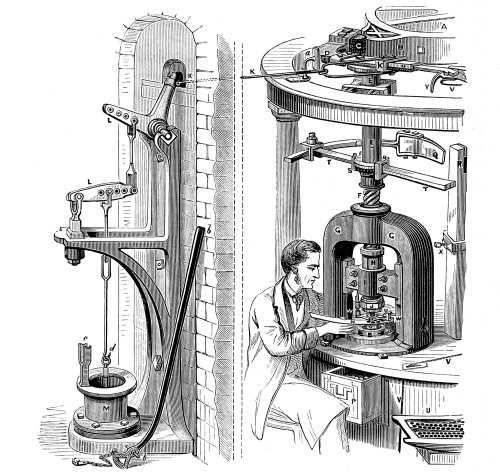
Fig. 13.—Cutting-out Press.
The fillets from which the blanks have been punched have the appearance of ribbons perforated with round holes, and are now called scissel (from the Latin scindo, to cut). These are thrown into a tray, U, from which they are taken at intervals, and bound up by strips of the same into bundles of 180 ounces—in the case of silver 360 ounces—ready for re-melting. The cutting-out press is set at liberty to start by the workman pressing his foot on a lever in connection with the line and spring indicated by V; and so long as he keeps this lever down, the press is worked continuously, but when he releases it the spring catches the extreme end of D, and motion is arrested. The blanks which accumulate in the box P are collected at frequent intervals and examined, to see that their edges are smooth; if they be ragged, as may happen from the wear or fracture of the edge of either the cutter or bolster, a loss would be entailed in after processes which would cause the coin to be outside the prescribed limit, and to pass at an illegal weight into circulation, as the rough edges would be removed after the weighing of the blanks had been effected. According to the quality of the work—the character of the gold—under operation, the trier tests more or less frequently the variations of weight in a given number of blanks. This process is called POUNDING, and is, next to the trying, the most important of his duties; if such an expression can be admitted, he has, by trying, fired his shot, and here determines if he has hit the bull’s-eye, all depending on his own unaided judgment. The gauge, Fig. 8, is found of great service in detecting irregularities as to diameter and thickness, which would not be, and are not, detected by weight, for the weight may remain equal, although both diameter and thickness may vary. All these points require considerable care on the part of those whose duty it is to attend to them; for the quality of a coinage is determined in this room: blanks which once leave it cannot be afterwards altered. The subsequent operations, being purely mechanical, would be quite as well performed by automaton machines.
The completing processes form undoubtedly the prettiest and most interesting part of the operation of coining; nevertheless the processes already described constitute its most essential features. The blanks are weighed from this room in drafts of about 720 ounces, and placed in bags; each bag, therefore, contains four journeys of about 180 ounces each. The term journey is said to be derived from an old French word, but circumstances render it probable that this derivation has been applied by others than the original inventor of the word, for it manifestly was not used by the coiner of it to imply a “day’s work.” I cannot find an author who gives a time at which 720 ounces of silver became a journey, while 180 ounces of gold were also called by the same name. It must have taken far longer to coin 720 ounces of shillings or groats than to coin 180 ounces of sovereigns or half-sovereigns; hence the same word could never have been intended to mean “a day’s work.” Be this as it may, it is time that such names gave place to more appropriate and expressive terms. It is to be hoped that 500 ounces will become the standard maximum weight for bags of either of the precious metals; such a system would be the means of reducing the chance of error, it would have an actual meaning, and would be a convenient weight for a man to lift to and from a scale-pan. When such a measure shall be convenient to the officers of the Bank of England, that institution will subserve the interests of the Mint by adopting it.
In a paper recently published by the Commissioners on the International Coinage (at page 228) it is stated that “in the British Mint 15 pounds troy of standard gold are coined into 701 sovereigns nearly (15 lbs. = £700 17s. 6d.).” This statement does not exactly convey the truth, and is calculated to mislead, because such an operation is not, and never has been, conducted in the British Mint, where the invariable rule is to abide rigidly by the law, and to coin 20 pounds troy weight of standard gold into 934·50 sovereigns, as specified in the Mint Indenture, now replaced by the Act of Parliament, 33 Vict., cap. 10. Of these sovereigns so coined, 701 are placed in a bag, and called a journey; but by a Mint fiction the journey was considered by the old moneyers, and yet more ancient weigher and teller, 15 pounds troy exact, because the parts of an ounce were difficult of addition; and this was maintained until 1860, when a disputed weight with the Bank of England as to the value of the deliveries corrected that which I had previously pointed out as an error. It is now the custom to consider a journey as consisting of 180·03125 ounces, instead of, as it is, 180·03210 ounces, an error of ·00085, which has a money value of about 6s. 7½d. on each delivery to the Bank.
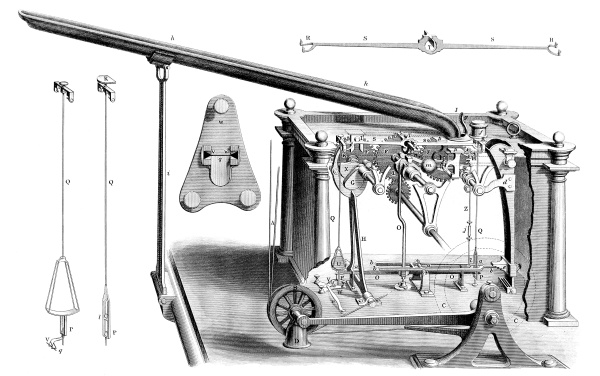
COTTON’S PATENT AUTOMATON BALANCE.
WITH PILCHER’S IMPROVEMENTS.
The bags of blanks should[24] be carried forward to the room in which the weighing of the individual blanks is effected by Mr. Cotton’s automaton weighing machines. Mr. Cotton’s weighing machines form perhaps the most elegant and clever invention of modern times. They effect the process of weighing far more accurately than man can hope to do, and with extraordinary accuracy determine the weight of about twenty-three blanks per minute. Peculiarly admirable as are these machines, their perfection has been greatly increased by improvements suggested by Mr. Richard Pilcher, who has immediate charge of those in the Royal Mint. Mr. Pilcher, whose inventive genius is only equalled by his desire to give to the public the benefit of his inventions, has rendered these automaton balances serviceable to the Mint; whereas, when they left the hand of Mr. William Cotton, they were of great service to the Bank of England alone, for there only two determinations, or in fact one determination is necessary. In that institution it is required to show that the coins issued by it are not below the legal weight for circulation, whereas the Mint must guarantee that coins leave its works neither above nor below the limits fixed by law: hence the necessity for the incorporation of Mr. Pilcher’s improvements with Mr. Cotton’s beautiful invention.
After reading the letter of Mr. James M. Napier in the Times of September 2nd, 1869, I can but express my surprise that that gentleman has not seen fit to acknowledge Mr. Pilcher’s modifications instead of claiming for himself all the credit, when a part only—and that undoubtedly an important one—is his due.
The steel engraving exhibits a view of Cotton’s automaton machine as used in the Royal Mint, where seventeen such machines are employed. For the purpose of illustration, the brass side of the machine has, in imagination, been torn away, as also has the top of the machine. To obtain the highly-finished drawing from which this engraving was made was a matter of no ordinary difficulty, but it was accomplished by the skill and assiduity of Mr. E. S. Gibson, to whom my thanks are due, as well as to Mr. J. W. Lowry, for the pains he has bestowed in executing the engraving.
The whole theory of this balance rests on the fact that the centre of gravity and the centre of action are in one line: either being disturbed, the balance is no longer equal. The machine gains its motion from a shaft fixed to the ceiling of the room. Steam contained in a boiler exists under an ever-varying pressure, arising from the amount of work which it may be necessary for the engine to perform, or from the irregular combustion of the fuel, as well as from other causes. Since it is of the utmost importance that the automaton balance should be made to maintain a uniform pace, Messrs. Napier and Sons found it necessary to drive the shaft which gives it motion by a small atmospheric engine, which is placed in the weighing room. It has been found that a chamber may be kept equably exhausted of air, if the atmosphere be admitted to it by a uniformly weighted valve. Such a chamber—to be described presently—is used in the Mint for other purposes, and Messrs. Napier conducted from this a pipe, by the agency of which the atmospheric engine is worked with a far more even and steady motion than could be obtained by steam; in fact, the exhausted chamber becomes a regulated spring, which softens down the variations in the motion of the steam-engine. The shaft supported by the ceiling conveys its motion to the weighing machine by a line A, which, passing over the friction wheels B, circulates round the stepped wheel C, which runs loose on the shaft communicating with E. The line A is maintained with sufficient rigidity by a weight D, which is suspended at the end of the lever carrying the friction wheels B. The weight D is just sufficient to insure the continuous working of the machine, but is so light as to permit the line A to slip on C in the event of anything going wrong in the works of the balance. When the machine is to be set in motion, a kind of cheek is made—by screwing—to touch the face of the wheel C, and thus, by friction, C gives motion to the wheel E. This is an elegant mode of meeting a chance of accident, for in the event of the weight D proving to be too heavy, any extra force simply disconnects this cheek from the face of C, and so stops the machine. The machine having been set in motion, E, by communication with the wheels F, all of which are driven by it, causes the cam G to push forward the lever H, which, terminating at I, pushes forward the flattened continuation of I indicated by dotted lines, until it moves a blank placed in the collar J, at the bottom of the hopper h, on to the scale-pan K, which, for the sake of clearness, is isolated, and will be seen behind the machine and under the extreme end of the hopper. So soon as the blank coin has been placed on the scale-pan K, the cam L lowers a lever n, the office of which is to permit the opening of the forceps M, and thus to release the rod, Q, dependent from K upon the knife-edge R. The forceps are closed by the cam L, which raises n, and by it compresses an attached spring. The forceps are intended to hold this rod Q while the blank is placed on K, because the friction caused by the placing of the blank would have a tendency to push K from the knife-edge on which it is suspended, and thus blunt its delicate edge. While the forceps are opened the cam N, by its partial revolution, lifts the rod O, which is steadied in its motion, by a pin rising from it, and entering the inverted arch o; its lower extremity working into a socket on the table on which the whole frame of the machine stands.
Towards its lower extremity the rod O will be seen to branch out right and left, until each end passes through a kind of step in the rods Q, indicated by P. The office of this rod is to bring the beam, from which the rods Q are dependent, to a dead level, as well as to release both ends of the beam by one action. At the moment that the forceps M have released the right hand rod Q, the cam N, by O, releases both the rods Q, by rising from the steps P, thus permitting the beam to determine the weight of the blank placed on K. A close inspection of the steel engraving will show that the rods Q are suspended from and rest upon the knife-edges R of the beam S, which has a centre knife-edge T, by which the whole mass is supported and poised. The knife-edges are made to find their own planes or resting-places upon curved or hollow pieces of steel, thus securing the smallest point of contact with a certainty of the smallest amount of friction. In ordinary balances the substance to be weighed is placed in a pan, which is on the same level as the pan which contains the counterpoise; but in Mr. Cotton’s balance this condition is of no consequence, so that the counterpoise rests ultimately upon a point which is at the same distance from the centre of action as the point upon which the matter to be weighed rests. The counterpoise U is placed in a kind of cage, and any variation from this standard is at once indicated, even if it reach only to the thousandth part of a grain. By law, the weight of a coin may vary to a certain extent from a standard weight;[25] the variation or latitude allowed is called remedy, from the Latin ad remediam; and in weighing, this remedy is taken advantage of by a contrivance much simplified by Mr. Pilcher. The weight of a sovereign is 123·274 grains, but it may by law be either 123·474 grains, or it may fall to 123·074[26] grains. Mr. Pilcher therefore reduced the counterpoise to the minimum allowed, thus avoiding the placing of a remedy-wire for the light side; and he then made the remedy-wire q (shown in the first enlarged portion on the left-hand side of the steel engraving), which is placed on the stand W, upon a peculiarly-formed point indicated by V, so heavy that any blank which would not raise it and the counterpoise must be within the remedy on the heavy side. In accordance with this arrangement, the continuation of the rod Q is terminated by a cage at V; so that if a blank be so light as to be unable to raise the counterpoise U until the stirrup comes in contact with the remedy, it is too light to make a legal coin. This fact being determined, the motion of the machine causes the cam X to bring back the rod I (indicated by dotted lines), that it may be ready when required to push forward another blank, and the forceps M to grasp the rod Q, while the cam Y permits the falling of the rod Z, which is nearly counterpoised by the ball m (the precise length of the rod being regulated by the screw j), until its finger a rests upon the indicator b. The depth to which a shall fall is fixed by the step l (shown by Q in the second enlarged portion of the steel engraving). This is, of course, determined by the forceps, securing Q at the position indicated by the weight of the blank. The indicating finger b having come to rest, the continued motion of the machine causes the cam c to permit the shoot d to fall until one of its steps e comes into contact with the indicating finger, when the lower part of the shoot must be exactly over, and form part of, one of the tubes k, which terminate in boxes labelled respectively “heavy,” “light,” “medium.” The shoot having taken its position, the continued motion of the machine causes the cam G to induce the placing of another blank on the scale-pan K, and this blank, by advancing, pushes off the one just weighed, which, falling into and through the shoot, passes to the compartment reserved for it. Suppose the newly-placed blank to be too heavy for forming a legal coin, the same operation goes on, but it now lifts not only the counterpoise, but also causes the stirrup at V to lift the remedy-weight q. This is a most delicate operation, for if a blow, however light, be given, it would cause unsteadiness in the beam. Mr. Pilcher therefore determined to make the carriage W, which supports the remedy-wire q, stand upon micrometer screws, by which the remedy-wire is made just to touch the stirrup, without pressure, while it also rests upon the most minute points, formed by cutting away every part of V which is not actually required—in fact, shelving it out. The scale-pan K is protected from draught by the lantern f, while the blanks are directed into the collar J by the guard g, as they slide down the hopper h, which at its centre is supported by an upright, i. The blocks p are the supports which hold all the machinery to the roof of the machine.
Some new machines have recently been supplied to the Mint by Mr. James Napier, but it is not certain that these are cheaper than the old ones. That they are lower in price may be admitted, and they are certainly more convenient in use, from the fact that the wheels shown at F are placed at the back. It is, however, to be regretted that Mr. Napier did not introduce into these new machines the recent inventions of Mr. William Bradshaw, which are supremely simple, and, now that they are effected, one cannot but wonder that so many minds having been engaged on these machines, improvements such as these have not earlier seen the light. To Mr. Bradshaw, particularly, great credit is due, for he was obliged to overcome, not only innate difficulties, but difficulties of position, and these latter were of no mean kind. It is to the credit of the Mint authorities that they finally adopted these improvements, and ordered the necessary alterations to be made in all the machines.
Mr. Bradshaw’s improvements enable the automaton balances to weigh 30 per cent. more coins in the same time; yet they permit each coin to occupy a longer space of time in being weighed. This would appear to be a mechanical contradiction, but if reference be made to the plate it will be seen that the cam G pushes forward the lever H, which ultimately, by the slide, pushes the blanks on to the scale-pan K. By altering the shape of the cam G, Mr. Bradshaw causes it to do its work more rapidly, and thus leaves the piece on K longer than before; but that this time may not be lost, he alters also the shapes of the cam L and of the cam N, so that the forceps M are opened, and the beam is released more rapidly: thus the balance would be longer in action; but to utilise the time ready to be saved, he alters also the driving pulley E, causing the machine to make 30 per cent. more determinations per minute, and that this may be effected with greater certainty he reduced the depth of the step, shown at e, to just one-half, so that the beam has to travel only half the distance it formerly travelled to determine the position of the light, heavy, or medium piece. He next proceeded to alter the rod O, because he observed that it received a tilting motion arising from its being lifted by a shoulder, as shown in the plate. To overcome this defect he made the rod straight up to a certain point, where he divided it into a kind of loop which passed over the cam N, which, as it revolves, lifts this rod perpendicularly. He still found that the cam N had a tendency to push this rod against its bearings, especially at o, so he placed a spring of brass between the top of its loop and the cam N, and secured at one end to p, and by this contrivance made the cam to lift the brass, and that in its turn to raise the rod O. There was yet another difficulty, caused by an occasional stoppage of the action of the spring which softens the descent of the bearing of the rod O into its lower socket; this he removed by cutting a hole in the side of the socket, so that it can be seen at once if the spring be in action. I am not one who approves his suggestions as to the remedy-wires. These may be the means of saving time, but they are wrong in principle, and I do not describe them.
Great inconvenience arose from the collection of dust, spangles of bullion, and other foreign matter on parts of the balance. This Mr. Bradshaw overcame by two simple contrivances; first, he pierced the bottoms of the grooved trays, so that these substances might in a great measure fall through while the blanks were being arranged in rouleaux, thus separating the largest pieces, which, falling down the shoot, would stop its action; and, secondly, he placed a glass shelf midway between the table and the beam, that is, beneath the hopper h, where it terminates at J, and above the beam S, where it is seen near the forceps M, thus protecting the beam and forceps. These may appear to be trifling alterations,—they are nevertheless to Cotton’s balance what the compound metal balance-wheel is to a watch. Mr. Pilcher was granted the magnificent sum of £40 for his invention of the file (to be described), but it is hoped that Mr. Bradshaw will be rewarded with a far more open-handed generosity; for if, by judicious liberality, encouragements are offered to those in the Civil Service to give to the country the benefit of their inventions, we may still hope that even our Government institutions will bear comparison with ordinary commercial manufactories as regards the development of inventive genius. Nor is this a small matter, for all the working improvements in the Cotton’s balance have been made by those whose duty it is to attend to their working; yet I am not aware that any acknowledgment, either direct or indirect, has been made to the officers concerned. It is said that their salaries cover all their time and energy. This may be true, but such a policy is not calculated to result in many great steps towards perfecting either machines or processes.
It is well to state that the beam in Mr. Cotton’s balance is 8·90 inches in length, and that its weight is 288·41 troy grains.
Those blanks which are neither too light nor too heavy are called medium, and are weighed and put into bags for future issue as coins. The light are reserved for the melting-pot. The heavy blanks should be reduced by means of a peculiar kind of file to the weight of medium blanks, and thus saved from being melted, so avoiding further loss to the Mint. This file was invented by Mr. Pilcher, who, being the officer of this room, considers his duty to be neglected if there be any improvement capable of being made, but which is left undone; he never tires till the invention is complete and the machine made. Mr. Albert Barre, the distinguished engraver to the Paris Mint, declares this file to have surmounted all the difficulties he has met with in this part of the process. In his own words, “it leaves the face of the blank untouched, and free to develop the work of the engraver, which no other file does, or can effect, because any metal which is ploughed out from the face of a blank, leaves a hole which is not filled up in coining.”
The opinions which I have here expressed have so far prevailed on two of the travellers to European Mints, as to induce them to glance, though rather shyly, at the necessity for reducing heavy blanks; but Mr. Napier writes a passage which I quote, as it demonstrates that he, who is admittedly one of the most successfully ingenious men of the age, has thought over and studied the words I wrote at page 60 of the last edition—he took that book in his hand to the Mint on the day after its publication—with that attention to which he thought they were entitled. I beg the reader to ponder over Mr. Napier’s words, they are most important; but I hope those who will be called upon to vote the necessary money will also read my remarks on this extract from Mr. Napier’s report on European Mints. He says at page 44:—
“Treatment of Too-heavy Blanks.—Notwithstanding the employment of the best mechanical appliances for rolling the bars, adjusting the fillets to gauge, and cutting out the blanks, and the most intelligent and painstaking workmen to carry on the operations, still, owing to unavoidable imperfections in the means, the blanks, when cut from the fillets, will not be found equal in weight, nor, indeed, so nearly equal that they can be recognised as of equal value, and passed on to be manufactured into coins destined to be put into circulation, and to represent one value. The irregularities will necessarily be more or less, according to the care and ability of the workmen, and the condition of the machinery; but under the most favourable circumstances only a certain proportion of the blanks will be found to come within the limits which it has been considered desirable to set down to restrict the quantity of error.
“This being so, the following questions present themselves: Are the too-heavy and too-light blanks to be returned to the crucible and remelted, or to be passed on and detected only in the finished coin, and then sent to the crucible? Or are too-light blanks to be avoided altogether, and all the blanks to be made either of sufficient weight or too heavy? and in such case are the too-heavy blanks to be submitted to some process for reducing their weight to within the legal limit? Or is a more exact means to be preferred, by which they will be equalised to that perfection which cannot practically be questioned, and by which they will become, for all purposes, one and the same weight?
“The facts collected are, that at nearly all the European Mints the reduction of too-heavy blanks, both of silver and gold, is practised, to avoid the loss attendant upon their return to the crucible, and that the endeavour is to make all the blanks either standard weight or heavier, so as to admit of reduction, to err, indeed, on the heavy side, even to the extent of necessitating the reduction of all the blanks. So great is the importance generally attached to this department, that it is calculated that, in some instances, nearly as many hands are employed in the service of it, including the weighing, as in all the other working departments combined. In Berlin, where particular care is devoted to the weight of the coins, between 200 and 300 men are employed in times of pressure in the weighing and equalising of the blanks, which operations are in this instance performed by the workman with a hand shaving apparatus, fixed to the table at which he sits, and a pair of scales also placed near to him. The work done by one man is revised by a second, and the file is used for giving the finishing touch, so that the blanks are brought to great perfection in weight. But although the extent of the means shows the great importance attached to the results in the establishments visited, and the large expenditure which, at least in the opinion of the directors of these Mints, may be permitted with profit in this department, the serious consideration of the employment of so many hands would militate against the carrying out of the system in the New Mint. It may be satisfactory, therefore, to know that, in case the desirability of an exact coinage should be entertained, means for assuring it are at hand without the employment of manual labour for the purpose. The subject has, indeed, for many years occupied attention, and, after much labour and expense, the difficulties have been overcome, and a machine has been constructed to the order of the Government of India which fulfils all the required conditions for equalising the coinage to that perfection that no appreciable difference need exist between the standard weight and the coin blank which has passed through the machine. This machine differs essentially from those employed at the Mints visited, and which, it has been explained, only take a fixed quantity off each blank presented to the cutting tool, without reference to the weight of the blank, the operation being repeated or not, according to the result; or, in other words, no matter what be the weight of the blank, whether nearly light enough, or much too heavy, the cutting tool of the machine treats all in the same manner.
“The equalising machine referred to, on the contrary, not only takes from the too-heavy blanks, each in succession, a quantity of their surplus weight, but it ascertains how much it is necessary to take off each blank to reduce it to the standard weight; and it deducts that amount only; so, although the blanks which are supplied to the hopper, or reservoir of the machine, enter the machine of unknown weight, they are equalised by it in once passing through, and are delivered into a receptacle for the finished work, all of one weight, the standard, or so near to it that good ordinary scales, such as are used for weighing blanks and coins, will not detect a difference.
“Means can therefore be provided for the purpose, should it be decided to reduce the blanks to equal weight, or only to within the pale of accuracy instituted by Parliament, the basis of which legislation must be taken to have been the then practicable approach to perfection; for it is to be presumed that, with a sufficient assurance that accuracy akin to perfection was attainable ALONG WITH ECONOMY, the wisdom of Parliament would have enacted accordingly.
“The first outlay for self-acting coin blank equalising machinery WOULD NECESSARILY BE LARGE, but it is believed at the same time that the saving would be considerable, especially upon gold.
“The question of the amount of economy would have to be more fully gone into, and the expense of the machinery accurately estimated. Extensive and continuous experiments with the machine have also STILL TO BE MADE TO ACQUIRE A KNOWLEDGE OF ITS USE, and to ascertain, after a lengthened probation, whether any modifications in the details are advisable: the limited experiments already made leave no doubt, however, of the successful result.
“The arguments in favour of an exact coinage chiefly rest upon an economical basis, and branch out beyond the walls of the establishment into questions of currency, wear, and recoinage, which it is not thought necessary to treat of here; at the same time it may be stated that it seems desirable that the coinage should be made as exact to weight as possible CONSISTENT WITH ECONOMY, and that an exact coinage would be found more economical as a circulating medium, would be more just, and a better starting-point from which to legislate for the withdrawal from circulation of worn coin than a coinage issued from the Mint with acknowledged errors, or differences in weight so substantial as to be represented in value, in the case of gold coins, by some of the lesser denominations of the coins of the realm.”
The reasons which Mr. Napier gives are worthy of grave consideration—they are mine wholly—except so far as regards those to which I have drawn attention by printing them in small capital letters, and which show that even with his vast experience he dare not answer for the success of his machine, while the suggestion of the necessity “to acquire a knowledge of its use” should make a desire to recur to a successful machine paramount. If, indeed, I rested on my own opinion, I should be content to see Mr. Napier’s machine tried, although I think its failure would be established; but it so happens that I can quote the opinion of the late Master of the Mint on the machine under consideration, expressed at a period when the efficiently economical conduct of the Royal Mint had received his utmost consideration. In his letter to the Treasury, dated 7th June, 1860, he says:—
“I may be allowed to call to your recollection that a Parliamentary grant of £1,100 was obtained by the Mint in 1856 for the purchase of two automaton filing and adjusting machines, which it was proposed to have constructed by Messrs. R. Napier and Sons, the eminent engineers. No part of this grant has been appropriated. The rapid amendment in the blanks which took place immediately afterwards led me to suspend the order for these machines, and ultimately to abandon the idea of any great expenditure for the object contemplated. In the meantime also, a machine of a much more simple character was contrived by Mr. R. Pilcher, of the weighing room, and was constructed in the Mint, with no assistance from without. Pilcher’s adjusting machine has proved sufficiently effective, costs nothing for labour, and has now been in constant operation for two years. The cost of making a pair of machines such as we now possess is estimated at £60, a sum which was saved to the public by the mode in which the work was executed. Trusting that the Lords Commissioners of her Majesty’s Treasury will be disposed to consider favourably the merit and practical value of such an invention, I venture to solicit their Lordship’s sanction to the application of £60, the sum just stated, to the benefit of the inventor, jointly with an ingenious mechanic on the establishment, who gave material assistance in the construction of the machine. I would propose the following awards, if agreeable to their Lordships:—To Mr. R. Pilcher, £40; to Meredith Jones, £20.”
It was upon advice tendered by myself that Mr. Graham thus excluded the machine now recommended by Mr. Napier. I maintain that a simple machine should be preferred before a complicated one, and the Mint authorities should give Mr. Pilcher’s £60 machines—admittedly perfect in operation—a fair trial against Mr. Napier’s £1,100 machines, and see if they prove equally effective. If, on the other hand, Mr. Napier’s fails, then it is but fair to the public that that machine which is undoubtedly a success, and for which the inventor has been publicly rewarded, although in a most inadequate manner, should be used.
The machine thus spoken of was used with the utmost advantage until 1866, when its use was abolished by the advice of Mr. John Graham, who subsequently, in 1868, broke it to pieces that his improvements might be rendered permanent, thus causing an expense of 50 per cent. on the total cost of manufacture for rejected coins,[27] because the use of the file having been abolished, the coined money alone was weighed, thus rendering it impossible to reduce the heavy pieces.
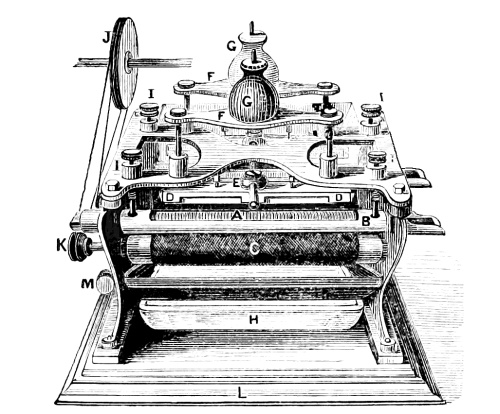
Fig. 14.—Pilcher’s Filing Machine.
Although the use of this file has thus been stopped, it is greatly to be hoped that it will again be employed, and thus enable the Government to produce coined money at the cheapest possible[28] rate, because it enables the Mint authorities to obtain the largest per-centage from the bars. Feeling that this much-desired re-introduction will take place, it is thought wise to give the following description of Pilcher’s file, which, if not desired for the benefit of our own Mint, will be adopted by other coining countries:—Fig. 14 is a representation of this compact machine. The blanks A are placed in rouleaux in a tube B, which is open at top and at bottom; through the opening at the bottom the blanks rest their EDGES on the file C, which, as it revolves about 1,000 times per minute, files off metal from the edge of the blank. Each machine has two tubes, and when both have been filled the rod D, which carries a triangular knife-edge, is released by the lever E, and the knife-edge resting upon the upper edge of the blanks A,—with the intention of offering resistance to their rotary motion,—enables the operator to remove MUCH OR LITTLE metal from their edges at pleasure by increasing the resistance which D offers by adding a weight G on to the gallery F. H is a glass dish into which the dust, as it is removed from the edges of the blanks, falls, thus insuring a perfect separation of the dust from the blanks. The blanks in B are kept in their position by small blocks of ebony, which are secured by the thumb-screws I. Motion is given by the wheel J, which communicates with the pulley K by a cord or catgut. The whole machine stands on a block of mahogany L, secured to a table of oak. M is a screw which is used to tighten the cords between J and K. Between C and H is a hopper of brass to catch flying particles of the precious metals. Each file reduces 250 sovereign blanks per minute.
The objections which were raised to the introduction and use of this machine were curious, and amongst others it was firmly maintained that it caused the coining press to make brockages, because the blanks which had been filed were smaller than those which had not been thus treated. The amusing part of this objection was that all the blanks were afterwards reduced to a uniform diameter by the edges being compressed before being coined.
The medium blanks—now unfortunately the coined moneys—are rung by boys to detect any which may be dumb or cracked, and which are rejected for melting. Dumb or cracked pieces arise when bubbles of air are enclosed in the bars at the time of pouring the fluid metal into the moulds in the melting-house.
Besides this source of dumb work may be mentioned another of large occurrence in silver, and occasionally met with in gold, which results from an imperfect mixture of the alloy at the time of melting, and developes itself at the draw-bench, where whole fillets, of six feet long, may be seen to separate into two complete layers of metal, the inner surfaces being coated with a thin film of copper, frequently quite pure, but sometimes in the form of suboxide. It would thus appear that a globule of copper becomes enveloped in a volume of fluid gold or silver, and, in the act of pouring, this globule is drawn out into a kind of wire, perhaps extending some inches in length, enclosed in precious metal. When this is rolled it is all flattened together, but there is no adhesion between the surfaces, so that when the fillet passes through the draw-bench the lateral motion given to the atoms of the metal causes the slip which finally separates the two surfaces of metal, and the eye at once detects the existence of the fault. In the coinage of 1857, no less than 141·38 ounces of gold fillets thus imperfect were returned to the melter in one day, and on the whole of that coinage these fillets averaged nearly 0·50 per cent. (see page 92). In the case of silver this defect is of less consequence, but of greater occurrence. It is the duty of the melter to see that such bars are neither produced nor forwarded, and there can be but little doubt that in a properly conducted Mint the melter would be directed to re-melt such fillets without payment to the men.
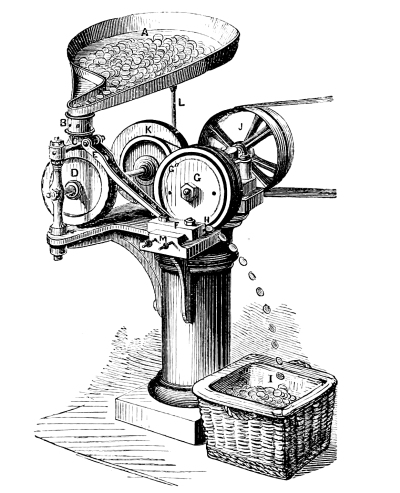
Fig. 15.—Jones’s Edge-Compressor.
The medium blanks which would now be fit for coining should be weighed up in bags of about 500 ounces, instead of 180 ounces, as is the custom, and sent forward to the room in which is placed a machine which has to diminish the diameter of each blank by compressing its edges. This is called a marking machine, but such a name being obviously improper, it is preferred to call it the EDGE-COMPRESSOR. Up to 1861 the best machine for this purpose was that invented and patented by Messrs. R. Heaton and Sons, of the Mint, Birmingham; but in the early part of 1858 the subject of the varying diameter of blanks came under consideration as effecting the production of brockage. Mr. Pilcher was consulted by me, and proposed a machine, of which he gave the outline, which I submitted to the Master of the Mint on the 31st of March, 1858. This machine was to be fed from the top, but was abandoned because it did not meet the desired minimum of 1,000 pieces per minute. Mr. Pilcher therefore proposed to erect on the same spindle five revolving discs, and to face these five discs with as many cheeks. At a given time it was determined to manufacture a marking machine, and one of five which Mr. Pilcher proposed was to be made. It was preferred to ask Mr. Meredith Jones to assist in its manufacture. Mr. Jones had also a design for a machine for this purpose, and it was arranged that as Mr. Jones made Mr. Pilcher’s file he should make his own machine. Mr. Jones proposed, and Mr. Pilcher accepted, the following proposition. Mr. Pilcher was to retire from the machine, and in consideration of his so retiring, and allowing the machine to be called Jones’s marking machine, Mr. Jones was to give Mr. Pilcher one-half of whatever sum might be paid by the Mint for the use of the machine. Fig. 15 represents Mr. Jones’s machine. The blanks are placed in the hopper A, and fall by an incline into a tube B until they rest at C, on a notched wheel D. As D revolves each of its notches carries away the bottom blank of the pile from the tube B, and leaves it to slide down the tube E till it reaches the block F. The block F is cut with a narrow groove, which exactly corresponds with the groove Gᵃ on the plate or disc G. The disc G revolves, and as the blank slides down and comes with some little impetus against the groove in the block F, the groove Gᵃ catches it, and causes it to take two revolutions between the disc G and the block F, finally permitting its escape at H, when it falls into I, being now reduced in diameter and thicker on the edge, but its centre remaining as it was before. The machine is driven by J, the shaft of which carries a reduced rigger for the driving of K. The hopper is supported by the rod L. The distance between F and G represents the diameter of the blank after its edge is compressed, this distance being determined by the screws seen at M. Blanks of all diameters may be compressed at this machine if the block F and the plate or disc G be removed and replaced by others, neither operation taking many minutes. The edges of the blanks are compressed at the rate of 700 per minute. A boy of fourteen could work this perfectly well, and with more convenience now that the hopper is replaced by such a one as is used to supply Mr. Cotton’s weighing machine. The edge of the blank is compressed with a view to prepare it for the crenating to be given by the collar in the after process of conversion into a coin.
The blanks are conveyed from the edge-compressor to the annealing room, where they are placed in rouleaux in iron boxes, the tops of which are luted on with clay, the boxes are then placed on iron carriages, and run into reverberatory furnaces, heated by Juckse’s smoke-consuming apparatus, where they remain for an indefinite period. The furnaces are like that represented in the rolling room for annealing the fillets in copper tubes. To anneal the blanks, the temperature should be raised rapidly until the boxes attain a full red heat; and the time allowed for the operation should be from twenty to twenty-five minutes at the utmost. After the heating, the boxes are withdrawn from the furnace and placed on the floor of the room, till the blanks are assumed to have become of a low red or black heat, the point below that at which copper combines rapidly with oxygen; they are then opened. If the boxes be opened while the blanks are still of a full red heat, there is what is called too much loss by annealing, or, in other words, too much of the copper has become oxidised, and thus rendered soluble in the dilute sulphuric acid into which they are presently removed. The box having been opened, the blanks are turned out into a copper tray, and on this carried to a cistern of cold water, in which a colander stands; they are thrown through the water into this colander, and thus cooled rapidly. When cool, they are taken in the colander to a leaden cistern of nearly boiling dilute sulphuric acid, into which they are placed, and allowed to remain for about three or four minutes. By means of this bath of sulphuric acid a thin skin of oxide of copper is removed; the gold on the surface from which the copper has been washed out is of a sponge-like form, and gives a beautiful bloom to the new coin when it is struck. This process is called blanching, and is of great interest to the coiner, as it is here that his loss by coining takes place. The bars of gold sent to the coiner are found to be standard within certain limits,[29] therefore the blanks produced from those bars must be of the same fineness; but by this process of blanching, copper is removed; hence the standard, or the amount of pure gold contained in the blanks, is proportionably raised, and this tells on the million to an amazing extent. When the annealing is conducted for too long a period, the copper becomes oxidised to too great an extent during the time of annealing, for there is no atmosphere more capable of oxidising than is that of one of these furnaces; it is for this reason that the heat should be gained rapidly, before that oxidising atmosphere shall have time to permeate the luting and attack the copper of the standard gold. At the trial of the pyx in 1861 the gold coined by Mr. Thomas Graham, the late Master, was found to be “4 grains on the pound too fine;” that is to say, containing in 5,760 grains 5,284 grains of pure gold in the place of 5,280 grains, which it should have contained. This is well for the people, but it is bad for the Master of the Mint, because he has lost 4 grains of pure gold on each pound that he has coined, which amounts to no less than £757·65870 in value upon every million of sovereigns. This loss may well be avoided, either by adding extra alloy to allow for this removal of copper, or, as would be far wiser, by abolishing the process of annealing the blanks, as was done in 1859, when more than a quarter of a million of sovereigns were coined from unannealed blanks obtained from brittle gold which was much harder than any ordinary gold to be met with. It must be remembered that the saving of bullion would leave a large margin for the increased destruction of dies, and in addition the coin would wear longer in circulation.
By his elaborate experiments Mr. Charles Hatchett proved not only that the British standard gold was the best alloy for coins, but that this alloy should be so manipulated as to avoid either the extreme of ductility or of hardness, and when this medium was attained the coins produced wore longer and better than any others.
It will be of importance in this place to consider the question of annealing the blanks previously to coining them, and experience teaches that this process should be omitted. The gold alluded to as coined in 1859 from unannealed blanks was the same gold that was spoken of as being so toughened in the form of bars when the fluid metal had been poured through a stream of coal gas.[30] The gold contained antimony, arsenic, and lead, so was predisposed to become brittle; but by pouring through the air it absorbed oxygen, and became certainly the most brittle gold that has passed through my hands. It was toughened by reducing the oxide of copper, and worked remarkably well, producing the most workable fillets, regular and uniform blanks, which yielded an average of 5·67 per cent. rejected. The blanks were tough, soft, and very malleable, capable of being cut with a chisel without fracture, and ringing musically on an iron block, thus satisfying all the requirements of good coining gold; but directly these blanks were annealed they showed 30 per cent. of pieces so brittle that they could be broken by a moderate pressure of the finger and thumb. After coining, the whole mass became so brittle that less than 2 per cent. remained sound after twice ringing on an iron block, as is the usual practice. These brittle coins, when again annealed, and suddenly cooled by plunging into cold water, became tolerably tough, and withstood ringing to 8 times, when they again became brittle. It now became evident that none of this gold should be issued to the public,—indeed, I may state that this same gold had been rejected by all the coining countries as unfit for coin. It was therefore ordered to be melted and returned to the Bank as unfit for coin, its value being £167,539. After every possible obstacle had been placed in the way, I overcame the aversion to change, obtained permission to try some experiments on this gold, rewrought it, and coined it all without annealing. The coin thus produced was so tough that an ordinary man could not break a sovereign even by the aid of a pair of pliers.[31] Yet when these toughened coins were annealed, they became so brittle that a child could break them readily. In the Royal Mint some of these coins in each state are preserved. Mr. Graham, then ever anxious to secure to the Mint any advantage, was pleased to address to the Treasury a letter on the subject of this gold, in which he said, “A correspondence between the Governor of the Bank and myself on the brittle property of the gold occasionally imported into the Mint to be coined was formerly brought under your notice in my letter of the 21st March, 1857. The evidence of the evil in question was not confined to the Royal Mint, but has, I believe, been felt at all other mints, and also by goldsmiths generally, since the recent gold discoveries. It was traced to the presence in the gold of a minute portion of antimony or arsenic (often not greater in quantity than one-tenth of a per cent.), which escapes the observation of the assayers. But no remedy in dealing with such gold then presented itself, except the expensive one of having the brittle gold refined.
“An unusually large proportion of the gold received for coining last year was of this defective character, but the whole of it was successfully coined notwithstanding, and no part returned to the Bank to be refined, as on former occasions.
“This improvement in the practice of the coining department is the result of a laborious investigation made in the coining department, of which I am happy to assign the chief merit to Mr. Ansell.
“It now appears that the antimony or arsenic acts injuriously when the gold blanks are allowed to cool gradually, but not when cooled suddenly, after annealing, the gold appearing to have time to crystallise and become granular under the influence of the antimony particles in the one case, but not in the other. The improvement may be justly represented as one of considerable value. It saves entirely much extra labour hitherto applied to brittle gold without any beneficial result. It will also lead to the diminution of waste, of which brittle gold was always a fruitful source.”[32]
I do not accept the conclusion arrived at by Mr. Graham, for my experiments showed clearly that this peculiar gold could not be heated even to a black heat after coining without becoming absolutely brittle under all circumstances. Notwithstanding the experience gained by the coining of this brittle gold, the annealing of coined money was effected by the present authorities at the Royal Mint in 1868, when a vast amount of brittle gold was coined, of which considerably more than half a million sterling in coined pieces were annealed and plunged into cold water, just as was done in 1859, and with precisely similar effects; that is, the production of brittle pieces, as soft as lead and perfectly rotten. These pieces were sent to the Bank of England, where they have given great dissatisfaction. They should have been melted, as were those of 1859. I, being an officer of the Mint at the time, offered to coin this gold as I had coined that in 1859; my offer was declined, and a vast mass of very brittle coin was, in addition to that of which I have spoken as having been annealed after coining, issued to the public, besides many thousands of ounces uncoined having been returned to the Bank of England by the Mint authorities, who found themselves unable to coin it; these facts being, as I think, little to the credit of the official ability.
The Right Honourable Lord Kinnaird, with a view to relieve the Mint authorities, suggested, on the 22nd of March last, from his place in the House of Lords, a proviso “that such gold”—specified in clause 8 of the Coinage Bill then under discussion—“should be free from lead, antimony, and other substances, so as to admit of its being coined without previous refining.” The Government promised to consider this suggestion, and, after consideration, rejected it, although the right thus proposed to be established has always been claimed by the Mint but disputed by the Bank of England. His lordship then drew the attention of the House of Lords to the issue of the brittle sovereigns, to which I have alluded, as having given so much dissatisfaction at the Bank, and on the 25th of March, the following letter appeared in the Times:—
“THE COINAGE BILL DEBATE. “To the Editor of the Times.
“Sir,—In your full and very correct report of what I stated in the House last night on the Coinage Bill, there is an error which I think must have occurred in the printing—‘sweat’ should be ‘sweep.’ I think what I said in regard to the £640,000 sent by the Mint to the Bank would have been clearer if I had added—‘Its brittleness was increased by being annealed after coining.’
“Your obedient servant, “Kinnaird.
“50, Avenue Road, Regent’s Park, “March 23rd.”
Attention being thus forcibly drawn to a great evil, the Marquess of Lansdowne, in reply to Lord Kinnaird’s remarks on the appointment of Mr. Roberts, stated that “Mr. Roberts was a very eminent chemist, who had proved his capabilities by devising a system for depriving gold of the obnoxious properties on which the noble lord recently commented.” Lord Kinnaird has already pointed out that this process, which the eminent Mr. Roberts has “devised,” was discovered by Dr. Percy, and that the process was published by that gentleman so long since as 1848. Dr. Percy conceived the elegant idea that if a stream of chlorine gas were passed over an ore containing gold, the chlorine would combine with the gold and dissolve it out from its matrix, as water would do sugar. This it does with complete success, forming a chloride of gold which is readily soluble in water, and from which it can be obtained with the utmost ease.
With regard to the invention of the process for which Lord Lansdowne gave Mr. Roberts credit, the facts of the case stand as follows. Dr. Percy discovered that by means of chlorine gas he could separate gold from its ores. He described his invention in the Transactions of the British Association in 1848, and in the Philosophical Transactions in 1850. Plattner carried it out practically about 1852 in Silesia, and I, in January, 1856, conducted a long series of experiments upon it for the Chancellorsville Gold Mining Company. The exact process now proposed or “devised” by Mr. Roberts was patented by Mr. Miller, the present assayer to the Sydney Mint, in 1867—No. 1767. When Lord Lansdowne finds himself thus deceived, he will probably in future think it necessary to examine statements suggested to him before making them from his place in the House of Lords.
This new process consists in forcing chlorine gas through melted gold, and it is assumed that the chlorine will carry off the silver, lead, antimony, tin, and arsenic, which render the gold brittle. On the face of the proposition, there are very grave reasons for believing that it will fail if tried. This also is the deliberate opinion of the most eminent metallurgical chemist of this or any other time; indeed, it has been tried and found a failure. It has failed of its object, and instead, attacks the gold, which, with the chlorine, will leave the melting-pot and pass into the chimney, creating a use for the proposed chimney chambers of Mr. Roberts.
Experience at the Mint is to the effect that the run of gold ingots produced by the melting of worn and light coins culled from those in circulation is found to be worse than standard by 1-500th, or two in each thousand parts. There can be no doubt but that this is mainly due to the fact of the loss of copper by the processes of annealing and blanching. In actual practice extending over many millions, it is found that 1,000,000 sovereign blanks lose 5,708 grains of copper: now, since this copper is removed from the surface, it leaves a sponge of pure gold coating that surface. Pure gold is very soft, and rapidly wears away, so that when the coins from which 5,708 grains of copper have been taken go into circulation, this film of gold, which amounts to £555·62 on each million pieces, is removed by friction. It will probably be argued that the copper being taken first and the gold afterwards, leaves the coin of the same standard as the original bars;[33] if, however, this proposition be examined, it will be seen that the bars are assayed and found to be below standard 0·55562 on the thousand coins; but the blanks obtained from the bars are, by annealing and blanching,[34] brought to standard before they are coined, and those coins assayed WHILE NEW are found to be standard by the jury of goldsmiths at the trial of the pyx, because they retain this film of gold; let them, however, go into circulation and lose their film of gold, and they will be reduced to the original composition of the bar; that is, worse than standard 0·55562 in the 1,000. The trial of the pyx[35] is supposed to be a great protection to the people against deterioration of the coinage. This opinion is not entertained by those who have witnessed the whole operation, for then it is manifest that the copper is sufficiently oxidised while melting to insure the alloy containing enough gold to enable the jury to find it “Fine, 4 grains on the pound,” or any other degree of fineness. There can be no doubt that the jury should be composed of men knowing something practically of assaying, and who would not hesitate to publish every detail of the process adopted, stating specifically the amount of loss incurred by melting the ingot produced from the selected coins. That the jury is composed of honourable men—goldsmiths—is beyond doubt; but that these goldsmiths should know how to assay is also an important matter, and should be a sine quâ non. It would be well if some independent member would move the House for a return of the assays by the Mint of ingots produced from worn and light coin received from the Bank of England.
Having thus specifically stated in my previous editions the facts as they exist of our coinage, I waited a refutation of my statement. I was informed that the Bank of England had made careful assays, and proved that the worn gold coin was not below the standard of fineness. I was also informed that bullion merchants in London had obtained newly-coined sovereigns, and by means of a scratch-brush had removed the film of pure gold of which I spoke, and upon a re-assay no difference had been detected. My reply was, and continues to be, the assays were either made by bunglers or were carelessly made, while with regard to the statement related for the Bank of England, I simply refused credence because in my own knowledge that Institution has been greatly puzzled for years as to the reason of the lower assay, and it was myself who pointed out the cause to Mr. Thomas Graham on the 4th January, 1860. That gentleman mentioned my suggestion to the then chief cashier, who preferred to think “it was due to the base coins which found their way into the Bank.” I said then as I think now—“I believe the officers of the Bank of England are far too sharp to take one base coin in five hundred.” This reply settled the discussion.
That the light and worn coin is habitually below the standard is conclusively proved by the fact that if any man should take, as the great Duke of Wellington did, a thousand sovereigns to a jeweller’s to be made into plate—and his Grace took coined money that he might be sure to have plate of the fineness of 22 carats, or standard gold—he would find, as the duke found to his cost, the plate “cut” at the Goldsmiths’ Hall as being below standard. That the case still exists is so well acknowledged by jewellers that they invariably add “fine gold” when they melt coin for plate which is to be stamped with the Hall mark.
“Monetarius,” who wrote to the Times from Malvern—where, singularly, Mr. Thomas Graham was then residing—and Sir John Herschel, quoted in their letters to the Times the report of a Belgian chemist to prove that our coinage is invariably standard. Such authorities seemed to quiet public opinion; but Lord Kinnaird moved on two occasions in the House of Lords for the “Returns of assays by the Mint of ingots produced from worn and light coin received at the Mint from the Bank of England.” The Government firmly refused these returns on the alleged ground that they were “too bulky;” Lord Kinnaird, however, explained the true cause of the refusal when he said that these returns would conclusively prove that the gold coinage, when worn, is habitually below the standard, as is also shown by Mr. Ernest Seyd in his letter of the 20th, inserted in the Times of the 21st August, 1869:—
“... The British public are under the impression that English sovereigns stand highest as far as correctness in quality is concerned. In reality, the British gold coin falls much more below its standard fineness than French, American, and Russian coin.... But the best proof of the greater inferiority of the British gold coin is given by the action of the Bank of England. The Bank of England cuts light gold coin, and so renders it unfit for further circulation. The holder of such coin thus loses, in the first place, the value of the gold worn away by abrasion, and the cut sovereigns are handed back to him as being now only bullion (the loss so far amounts to from 1d. to 4d. per sovereign); the bullion now remaining is the metal of which the coin had been made, presumably at the rate of 77s. 10½d. per ounce, and worth that much, or, at the Bank rate for buying gold, at least 77s. 9d. per ounce. Yet the Bank of England will not give more than 77s. 6½d. for it. Worth at Mint price, 934½d., the Bank pays but 930½d. per ounce—a deduction of 0·43 per cent.”
I need not express an opinion upon such a case so stated; but I can quote one of far higher value, for Mr. J. G. Hubbard, who is a profound authority, says, in his letter in the Times of September 4th, 1869:—
“This inaccuracy of our Mint assays was pointed out by Mr. Seyd in his intelligent and well-informed letter of the 20th ult., and I can corroborate his observations by my own experience of sovereigns sent to Russia, where the Mint, more exact than our own, ranked sovereigns at fully ⅛ carat grain worse than standard.”
Let us now see what steps are taken by the authorities, and then judge of their motive for introducing a reform so greatly needed, and which would never have been attacked had not I unceasingly urged it since 1860. In his Report on European Mints, Mr. C. W. Fremantle says:—
“I have therefore received with much satisfaction the expression of Mr. Roberts’s opinion that the process of blanching may, as far as gold coin is concerned, be discontinued without detriment to the appearance of the coin. It is this process which leads to the deterioration of standard found to exist in gold which has been for some length of time in circulation, and in consequence of their Lordships’ decision that light gold coin shall for the future be received back by the Mint for recoinage, the question becomes at this moment one of PECULIAR IMPORTANCE.”
I have emphasized some of the passages as showing that this decision is very like that of the unjust judge—not so much from conviction of right as from the necessity of the case. I do not charge the Mint with yielding to importunity; but being made to bear the loss, they are willing to amend that which they now openly admit to have been a wrong. Why is the opinion of Mr. Roberts quoted? why not some of the great officials at the Mint? Silence on this head is significant. Mr. Roberts will hardly desire to claim a discovery which he found in my last book, for he, too, bought one of the first copies which were sold. That I may not appear to be claiming that which is not my own, I quote the words from Mr. Roberts’s report:—
“It is evident that bars slightly below standard may be allowed to pass to the subsequent operations of coining, on the assumption, justified by calculation, that the blanching would be attended with a sufficient elevation of standard to bring the coins within the limits of fineness prescribed by law. The film of soft pure metal, however, is removed by wear; and the coins, when remelted, will consequently be found to be below standard fineness.
“This is a question of some importance NOW that the Mint has undertaken the operation of re-coining light pieces, and I would recommend, therefore, that the process of blanching gold coin should be altogether abolished.”
The italics are my own, and if the words so pointed out be read with reference to those I have persistently used, there can be but one conclusion, Mr. Roberts having had but a few months’ experience in the Mint, notwithstanding Mr. Fremantle’s reliance on his judgment.
As regards the trial of the pyx, useless and mischievously deceptive as it is shown to be, the Act of Parliament, 33 Victoria, cap. 10, makes it imperative to give this excuse for a dinner at the Goldsmiths’ Hall at least once a year. Had the Government assented to the proposition of Lord Kinnaird, and nominated the Professor of Metallurgy for the time being in the Royal School of Mines, one of their own officers, and who at present is the most distinguished of metallurgists, foreman of the jury, the country could have relied upon the verdict now given honestly enough; but upon inadequate knowledge, indeed, if the reader will refer to pages 10-12, it will become clear that so delicate a process as assaying should be watched by those who can appreciate its refinements, or its results can possess no judicial value.
I attended the trial of the pyx, which was held on the 17th July, 1860, with an especial view to, and an avowed intention of, publishing details of the operation. With a desire to further this object Mr. W. H. Barton, the then Deputy-Master, gave me the following particulars, and I, for myself, observed that the coin when melted was placed in an open crucible, without flux, and for part of the time without a cover: the ingot produced was of a GOOD BLACK colour from the oxidation of the copper. The objections to such a melting can hardly be exaggerated, and I am of opinion that however fairly selected—and they were honestly taken—1·310 ounces is not a sufficient bulk on which to form an opinion as to the purity of £24,654,849 of gold coin.
Coined Money. Name of Master when Coin was Pyxed. Value of the Coined Money Pyxed. Weight of Pieces taken from the Coined Money for the Pyx.
£ s. d. Ounces.
Gold Sir J. F. W. Herschel, Bart. 2,977,190 12 2 1052·200
Thomas Graham, Esq. 24,654,849 0 9¼ 8300·087
Silver Sir J. F. W. Herschel, Bart. 100,450 7 0 121·899
Thomas Graham, Esq. 2,331,666 19 6 2811·543
Coined Money. Name of Master when Coin was Pyxed. Weight of Coins taken to melt into an Ingot for the Assay. Loss by Melting to obtain the Ingot. Weight of Bullion actually taken from the Ingot for the Assay.
Ounces. Ounces. Ounces.
Gold Sir J. F. W. Herschel, Bart. 9·116 0·020 0·766
Thomas Graham, Esq. 51·500 0·077 1·310
Silver Sir J. F. W. Herschel, Bart. 3·137 0·046 1·287
Thomas Graham, Esq. 67·881 0·652 1·781
The authorities of the Mint, having assented to part of my proposition, have yet stopped half way, and blindly considering that the blanching alone was the cause of loss to and fictitious value of the coinage, they will find that their loss is greater now than it was when they unwisely permitted blanching. I do not point out to them the reason why—that is now their business; but I confess that I am a little amazed at Mr. Roberts’s recommendation—one that was given up by the moneyers before he was born, yet now gravely made by that gentleman in these words, “I should prefer that in order to prevent needless wear to the dies, the blanks should be annealed, after every trace of oil has been removed by washing with the aid of alkali, the utmost care being taken to avoid oxidation by exposure to air.” One seems to see Mr. Roberts in the presence of men who would dwell on his instructions as would a soldier on those of his general, directing the filling of a copper tube with gold blanks, previously divested of “oil by alkali,” so as to leave a film of lime soap neatly protecting their surface, and covering them with powdered charcoal. The tube so filled will be duly placed in the furnace, duly heated, and duly plunged into the cistern of cold water by the foreman, who, having taken an insurance ticket from the Accidental Death Company, feels quite safe, when, suddenly, a mass of copper and some pounds weight of gold blanks occupy the space from which it is hoped his head may have retired in time. Quite seriously, I have seen the cap of a tube blown suddenly off, and the blanks projected from the tube so plunged into water—from the same cause that bursts a kitchen boiler when cold water is admitted to one already red hot—with such violence as would certainly kill a man if he chanced to be in the line of fire. Do they not at the Mint understand the true cause of loss? An officer who tells his men to “go and do,” is not so likely to effect his object as if he were to show them “how to do” the work required of them; neither “bullying” nor making the men pay for losses will stop those losses of bullion. Knowledge alone is power. Knowledge alone can direct. Knowledge alone is required in the Royal Mint. There are plenty of men there who are most desirous to carry out any instructions; but, if the bugle give an uncertain sound, who can obey?
The effect of the annealing having been thus dwelt upon and explained, I will continue the description of the subsequent operations, stating what was formerly done and what had better be recurred to till experience is gained by those who are entrusted with the management of the Mint. After about three minutes’ boiling in dilute sulphuric acid, the blanks in their colander were washed under a stream of cold water, to remove the sulphate of copper and the sulphuric acid from their surfaces, otherwise these substances would deface the dies used for coining, as well as give the coin a dirty appearance. From the washing they were taken to a sieve of sawdust, A, Fig. 16, into which they were thrown to be dried by friction with the hand. A revolving drum of brass lined with wood has lately been introduced for this purpose. The objections to this form of apparatus appear to be that the blanks get hardened by blows, through falling against each other, lose more in weight, and become indented on the surface, thus producing a less perfect coin. It had been wiser to have introduced a sieve with an eccentric motion, which, if filled with sawdust, would shake that dust between the blanks and dry each one perfectly, when, by the removal of a false bottom, the sawdust could be allowed to sift itself from the blanks by one or two turns of the sieve, and the latter would be as soft as they invariably were before the introduction of the brass drum. This would be a matter of importance if, as is to be hoped, the authorities are induced to abolish the process of annealing and blanching, for then it would still be necessary to remove the film of oil which is left on the blanks in the cutting-out process, and this could be done more quickly and effectively in the proposed sieve than by any other process. The sawdust absorbs the water from the surface of the blanks just as would a piece of sponge; but the surface is not all, for it is found that by the removal of the copper the gold on the face of the blank has been brought almost into the condition known as frosted; it is, in fact, to a small extent, honey-combed. The gold represents the comb, and the copper the honey, but as the copper is removed, water takes its place, and has to be dislodged from these interstices by heat. The blanks, having been partially dried in the sieve A, are put into the tray B, and from this they were shot into the colander oven C, which was closed, and then thrust into the heated chamber D, and twisted gently round and round at intervals during ten minutes. The blanks were then turned out into a sieve E, by which any particles of dust were separated; the blanks were finally, by the aid of the tray B, placed in a bag. The sawdust fell from the sieve A on to a plate of iron heated by the furnace E, by which it was dried, and became ready for another operation. The chamber D was heated by a small furnace beneath it.
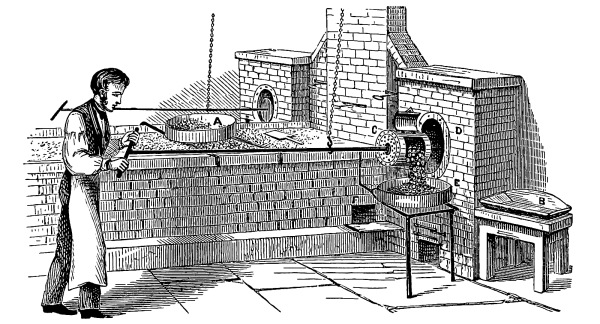
Fig. 16.—Drying Room.
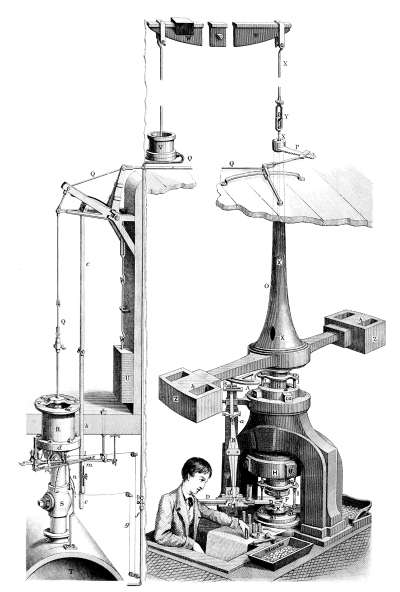
BOULTON’S SCREW-COINING PRESS.
AS USED IN THE ROYAL MINT.
The blanks, having been thoroughly cleaned after annealing, are taken to the coining press, which at the present time is, as to efficiency, about what the old water-wheel is to the steam-engine; yet, as a relic of the past, it is a magnificent conception. It is perhaps the most interesting in its work of any of the coining machinery; its action is truly pleasing to watch, but one must feel that the totally deaf would enjoy the watching it at work more than do those who are endowed with the sense of hearing, because the noise of the presses would not disturb their thoughts. The noise is really painful. In these opinions Messrs. Fremantle and Napier express entire concurrence. The blanks taken from the colander oven are each by a single blow at this machine converted into coins possessing the obverse and reverse impressions, as well as the crenated edge, which is one of the means employed to protect the coin from the peculations of the clippers, those enemies to coin of all ages and all countries, but whose business has departed, not so much from the crenated edge as from the better balances placed in the hands of almost every man—certainly within reach of every man. The crenated edge is known to be no protection against the plan called “sweating,” and which is effected by shaking the new coins in bags, when perhaps an ounce of gold may be obtained from 1,000 new sovereigns. The sovereigns thus treated are passed, and the operator makes his profit, but the light gold is detected by the balance, not by the eye. This is not the place to discuss[36] such a question, so that we pass on to a description of the machine which is used to give the image and superscription to coins which will be current in accordance with the law.
The steel engraving illustrates Mr. Boulton’s screw-coining press. The blank is laid by the automaton hand D on the lower die F; D retires, and the collar then rises and encloses the blank, while the upper die, fixed to the main screw of the press by the securing apparatus M, comes down with a blow estimated to be about forty tons, and, striking the blank, causes its particles to re-arrange themselves, and to assume the form given by the engraving on the dies and the crenated collar which surrounds them;[37] in other words, the plain blank becomes by one blow a coin in every way complete. The following description will convey to the reader an explanation of the processes as they arise. The press having been set at rest, with the fullest space between the dies, is called up—that is to say, the upper die has been raised from the lower die, and in this position the automaton hand D has conveyed a blank from the tube E to, and holds it over, the lower die F; upon the first motion of the press downwards, the eccentric wheel or cam A causes the lever B, which works on the pivot a, to withdraw D by the pin C. The lever B may be lengthened or shortened at pleasure by an arrangement against the lower B. The first motion towards the withdrawal of D causes its finger or hand to open, and to release the blank, which falls upon the face of the lower die. The opening of the finger, or hand, is effected by a pin which works in a slit in the movable finger of D, near to C. The continuation of the motion which draws back D, causes the rods I, which are carried by the main screw G, to release the collar K, by the levers J. The collar K, being thus relieved from downward pressure, rises by the elasticity of the springs L until it wholly encloses the blank which has been left on the lower die. The rods I pass through the shoulder of the frame of the press, and are destined for another service besides that just described; for the main screw G, which travels through a female screw fixed in the frame of the press (as may be seen by the dotted lines between G and H), thereby receives its power to rise or fall upon each part of a revolution, whereas the upper die must strike the blank a blow just such as would be struck by a hammer, and without a twisting motion; therefore that motion of G is lost just below H, where G fits into a cup suspended rigidly on, and is prevented from twisting by, the rods I, as shown at N. To the lower part of the cup N is fastened M, which carries the upper die. So that, just at the moment that the levers J have permitted the collar to enclose the blank, the upper die reaches the full force of its blow, and comes upon the blank. The force of the blow, by converting the blank into a coin, causes an instantaneous recoil of the screw G, which is assisted in its rise by a kind of balance just equal to its weight. The nature of this arrangement will be better understood by reference to the engraving, where the funnel-shaped tube O is seen to be traversed by a rod X, represented by dotted lines, and which terminates in the head of the screw G near the lowest X; the opening in the funnel being for the convenience of fixing this rod to G. At Y is a swivel, where the twisting motion of X, given by G, is lost. X is connected at its upper end with a balanced beam W, the other end of which is in communication with the chamber V by a rod which carries a piston working in V. The chamber V is not wholly exhausted, but is in connection by a tube with the partially-exhausted chamber T, an arrangement which, while it becomes a counterpoise to the weight of the press, is used as a regulator of the blow to be given, so that it is quite possible to coin blanks of differing denominations by the agency of this chamber without altering the vacuum in the large vessel T.
The motive power of the press, that which brings down the die with force, is gained by the pressure of the atmosphere upon a piston in the cylinder R, and is conveyed to the press as follows:—The lever P is fixed firmly on to the trumpet-shaped tube O, and is connected by a series of rods, Q, with the piston in R, from which the tube S communicates with T. The large chamber T is kept in a constant state of partial exhaustion by the action of a thirty horse-power steam-engine, through a well-made iron tube of considerable length. The boy who works the press starts it by first pulling a cord f, terminating in the box in which he sits; the cord f, by its spring n, releases the valve d at i, and permits it to act when required; he next pulls the cord g, which by its loose lever opens the valve j, through which the atmosphere passes freely across the bottom of the piston in the cylinder R into the tube S, and so into the partially-exhausted chamber T; this would cause a rush of air through the valve d, but d, at the instant of its release by the line f, is closed by a spring. Atmospheric air expands instantly if the pressure be removed from it, so that immediately on the opening of the valve j, the air beneath the piston in R expands, and part of it, entering the chamber T, produces an unequal pressure upon the upper and lower sides of the piston, and the result is that the piston is forced down by the weight of an atmosphere it is unable to support. By the time that the piston has completed its stroke, the rod c has brought a button, which it carries on its farther side, and situated at k, down so low that it strikes the lever l, and closes the valve j, thus stopping the expansion of air below the piston, while the button m has at the same instant permitted the falling of the lever e, and the consequent opening of the valve d; when the recoil of the screw G takes place, the piston in its descent expels (by compression) the small amount of air remaining in the cylinder R through d, thus opening it so that air can rush in at this valve and permit the rising of the piston. The rising of the piston insures the removal of the button at k, and so soon as k is removed, l is forced up by a spring at its farther end, and opens the valve j, thus giving the means of consecutive action to the press. If it be desired to stop the press, the boy loosens the line f, and so permits the spring n to keep the valve d permanently open. The boy, before supplying blanks to the tube E, piles them on an iron block b, and flattens each blank in the pile by one or two blows of a hammer on the top of the pile.
In “European Mints” are some apt words, with which I conclude my remarks on this great invention of Mr. Boulton—great beyond compare at the period of its birth, great beyond admiration if its results be estimated faithfully and gratefully by a thoughtful people. We in our day are indebted to Mr. Boulton for his press; yet its age has passed, and as a park loses its timber, so must our Mint lose—sorrowfully to all who love the past—its glorious mementos of men who dwell in history to make present men mere manikins. Original minds are not now tolerated; subservience if you will; but invention—not if a man values or depends upon his office. Mr. Napier says truly, “The press just mentioned and its apparatus are complicated, scattered, and unhandy, reaching into three apartments, and require a foundation of great solidity, and a special construction of building. The noise and vibration accompanying their performance are disturbing to a greater extent than in the case of the blank cutting screw press to which reference has been made.”
It has been conceived that coins are made of two discs of metal soldered together, and that the crenated edge is intended to hide the join. This notion has arisen from the occasional appearance of a cracked coin in circulation; the true explanation of the cracked coin being that at the time of pouring the fluid metal into the mould, an air bubble has been enclosed, and this air bubble has rent the fillet asunder at the time of its being rolled; but the separation does not exhibit itself until the final annealing, when it is too late for its discovery: recently, however, it has become a custom to ring the coined gold before it goes into circulation, and thus to detect and stop such defective pieces.
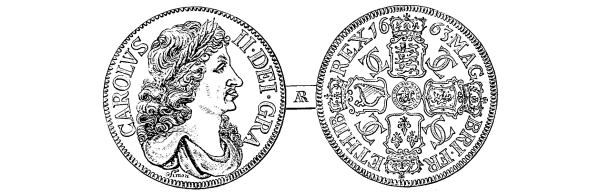
Fig. 17.—Petition Crown.

Fig. 18.—Inscription on edge of the Petition Crown.
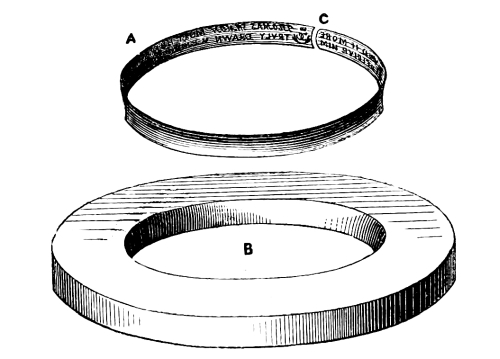
Fig. 19.—Fillet and Collar.
The origin of the crenated, commonly called the “milled,” edge (thus giving the name of the instrument to the substance operated upon), was the desire to make any clipping of the coin easily noticeable. Many devices were used, but John Evelyn suggested the motto, Decus et tutamen,[38] and this was retained for some coins until 1854. The crenated edge is now produced, without exception, and it is really the best, as admitting of easier detection if counterfeited. The distinctive marking of the edges of coins is of very early date, and was performed by various species of hand labour, each in its turn easy of falsification. At length this was effected by machinery, until finally the coin was formed by striking the blank while enclosed in a collar. The use of the collar, and its first invention, are somewhat doubtful; Mr. Hawkins, however, appears to have established the fact of its having been used at so early a date as William the Conqueror (vide “Ruding,” vol. i. p. 158); but the earliest coin which gives a clear notion of the use of a collar is the celebrated Petition Crown of Simon, which he coined for and presented to Charles II. Fig. 17 represents this very highly-prized coin, one of which was sold a few years since for £275. This wood engraving is by Messrs. Cheshire and Dickenson, from a fac-simile drawing taken by Mr. E. S. Gibson; it is an exact copy of the coin in the Mint collection. It is surrounded on its edge by a petition in raised letters, of which Fig. 18 is a fac-simile. The late Mr. W. H. Barton thought that this coin must have been struck while surrounded by a collar, or it could not have been produced at all. This opinion induced a further search for the collar which was used, and which is believed to be in existence, and to have been seen by men now living,—it is probably amongst the collection of curiosities of coining left by Mr. W. H. Barton. Mr. Barton suggested that the petition must have been engraved on a fillet of steel, which was then coiled up in a collar, as indicated by Fig. 19, and that the blank to be coined was then placed in the coiled fillet of steel. The coin having been struck, the fillet with the coin was knocked out from the collar, just as medals are now knocked out; and, once free, the fillet sprang off from the coin. This conjecture was so strongly confirmed by minute examination, that it may be interesting to represent the mode of operation by means of Fig. 19, where A is the engraved fillet coiled up and just ready to drop into the collar B; the opening C which is left is copied from the petition on the coin, which shows the metal to have been forced through this part of the fillet, where its ends, which were cut to fit each other, did not quite meet. The head of this protruding part has been filed off, the file marks still remaining visible on this part of the edge of the coin. This fact renders Mr. Barton’s conjecture almost a certainty. The coin weighs 517·10 grains; its average diameter is on the obverse 1·5784 inches, and on the reverse 1·5837 inches, both measures having been taken on the extreme edge. The petition is somewhat sunken and rounding inwards; if therefore it be measured from its lowest part, the centre of the edge of the coin, the diameter of the coin is 1·5741 inches, giving 0·0043 inch which must be worn away before the top of the letters of the petition can be touched in ordinary wear; thus the coin would circulate for centuries, and its petition still remain untouched. The coin being 0·0053 inch greater in diameter on its reverse than on its obverse side, admitted of its being more readily punched out from its collar, which was doubtless cut to admit of this design being carried out. The engraving on this coin is the cause of its great value, Simon having so perfectly carried out the idea that coins should represent sculpture, that this specimen stands wholly unrivalled as a coin. It has led to the impression that so good artists are not to be found at this day as flourished then. The fact is that artists seek such employment as remunerates them for their study; and until their conditions of employment are satisfied we must abstain from the desire to see coins such as were produced in ages past, and which gave an honourable name to the country producing them. It may be hoped that this means of preserving the history of the age in which so much has been done may be continued. It was probably from this collar of Simon’s that Sir Isaac Newton gained his idea for that which he is said to have invented. The collar of the present day leaves nothing to desire, for it gives so distinctive a mark to the edge of the coin that any mutilation must be detected; while forgers are unable to produce coins to imitate those struck in it, unless they use the same means, which would incur too great an expense. The coinages of Victor Emmanuel illustrate beautifully how easily coins may be struck, so that, after years of wear, they still represent the original more than creditably. To take an instance, a bronze coin, 5 centesimi, has been purposely subjected, for nine years, to more than ordinarily rough usage. This coin is little worn; the whole of the features are still perfect, except that the hair is worn off above the ears, and part of the moustache is removed. The secret of success in this coin appears to be that the ear and adjacent parts are slightly sunken, while the whole of the work and inscription are kept well below the protecting edges, and there is not an indistinct figure or letter on the coin.
In the British Mint false notions lead its authorities to believe that apparent saving is real economy; so far from such being the case, if our coins carried a better design they would not only look better, but wear longer, and still maintain their weight. While it is my intention to allude in another place to the large loss occasioned by our silver coinage, I submit to the reader the facts arrived at by Mr. William Miller, the late chief cashier in the Bank of England, who devoted great attention to the rate of wear of coins. He found that coins which had lost their protecting edges wear far more rapidly than those with a protecting edge, and showed me tabular statements demonstrating that fact. It was the intention of Mr. Miller to publish these tabulated results. However, his painfully early removal has, I fear, prevented that benefit being given to the public. His brother has no knowledge of their having been published; but Mr. George Forbes, the chief cashier in the Bank of England, has courteously given me a table closely allied to those of which I speak, and another to which I shall refer hereafter. I now, with permission, print this table, showing the rates at which coins of the different reigns have worn, and which rates all tend to prove clearly Mr. Miller’s opinion to have been correctly formed. The fact of the increasing rate of wear would appear to be explained by the larger surface exposed to friction by the removal of the protecting edge. When a little later I come to the discussion, on page 155, of the second table, I shall have occasion to say a few more words on this, which seems to find a fitting place on the preceding page, but contains matter which will cause too great a digression if dwelt upon now.
A Statement showing the Results of some Experiments made upon a Large Number of Silver Coins, of which 169,000 were examined singly, with the view of ascertaining the Present Condition of the Silver Circulation, and the Loss by Wear.
It should be observed that the average of loss by wear in a century, given in the Table, is founded upon the wear which the several coinages have undergone up to the present time; but as the rate at which a coin wears is an increasing rate, it is obvious that the actual loss in a century would be much greater than that here given:—