THE ROMANCE OF GILBERT HOLMES
Reading edition
Cover art
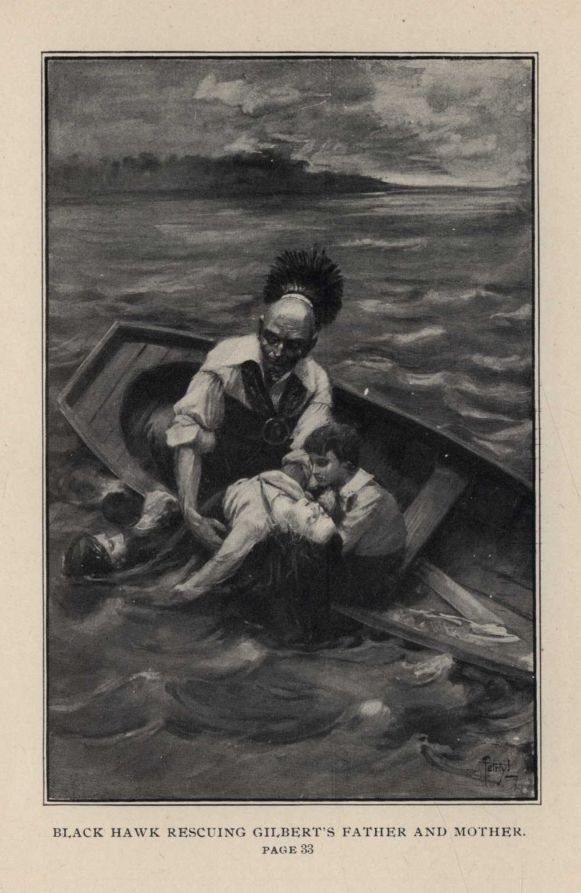
BLACK HAWK RESCUING GILBERT'S FATHER AND MOTHER. PAGE 33
THE ROMANCE
OF
GILBERT HOLMES
AN HISTORICAL NOVEL
BY
MARSHALL MONROE KIRKMAN
AUTHOR OF "THE SCIENCE OF RAILWAYS," IN TWELVE VOLUMES, "PRIMITIVE CARRIERS," ETC., ETC.
THE WORLD RAILWAY PUBLISHING COMPANY CHICAGO NEW YORK LONDON 1900
COPYRIGHT 1900 UNITED STATES, GREAT BRITAIN, FRANCE
All rights reserved
SEVENTEENTH EDITION
DEDICATION
THE WRITING OF THIS BOOK HAVING BEEN TO ME WHOLLY A LABOR OF LOVE, I DEDICATE IT IN A LIKE SPIRIT TO MY WIFE AND CHILDREN
M. M. KIRKMAN
LARCHMERE, JULY 10, 1900
CONTENTS
CHAPTER
A Sweet Lady
Gilbert Holmes's Account Of Himself
The Wreck
Black Hawk, the Sac King
The Swath of the Hurricane
Love's Ideals
Gilbert's Flight
Gilbert's Encounter with the Timber-Wolf
Driftwood from the Thames Battlefield
An Awakening
The New Country
The Unknown Passenger
The Place of Refuge
The Highwayman
Constable Blott
Before the Little Justice
The Singletons
The Shadows of Life
The Duel
Abraham Lincoln and Jefferson Davis—the Parting of the Ways
What the Canteens Held
Rolland Love
Cousin Angeline
The Fishers
The Conspirators
Lost in the Forest
In the Tiger's Mouth
Gilbert and the Highwayman Join Forces
The Tragedy of Murderer's Hollow
The Ride for Life
Constance
Convalescence
The Red Rose of Cuvier River
Glimpse of a Summer Sea
Conspiracy in Black Hawk's Cabin
Phantoms of the Woods
The Prodigal
The Dragon's Master
The Depths
Job Throckmorton's Trial: The Tragedy
The Reunion
An Adventure
On Board the War Eagle
The Steamboat Race
Telling the News
The Americans
Making the Most of Things
The Carriers
The Betrothal
Under the Widespreading Hawthorns
The Mauvaise Terre
Life and Death
Where All the Roads Meet
CHAPTER I
A SWEET LADY
The crowding and haste of other days no longer stirred the great wharf at New Orleans, and steamboats did not now as then struggle for place or preferment, but lay apart, a melancholy picture of the changing fortunes of carriers and the fluctuations of our country's commerce. On the wide expanse, once piled high with goods, only scattered packages lay, and these hid away under grimy coverings, like corpses awaiting burial. About the boat I sought, the tumult of the shipping ebbed and flowed, and to one side the great city lay as if deserted, or asleep under the hot afternoon sun. Close by, and near the river's edge, a procession of convicts came on, winding in and out amid sacks of coffee and bales of cotton, sad and noiseless, as specters might have marched. On either side armed men, alert and watchful, kept pace, a part of the melancholy show. Stripes encompassed the bodies of the convicts, as serpents might loosely coil themselves; but about the guards the stripes ran up and down—to the looker-on there was no other difference. Back of this procession of doomed men and as if threatening it, a herd of mules, half wild and frantic with fear, dashed here and there seeking a way out. About them, and in guardianship, a burly negro, black as night, rode hither and thither, headlong, wheeling and circling, like a Numidian of old, stopping the rush here and cutting it off there—not hurriedly, but at the last moment, as if craving excitement and the admiration his horsemanship elicited. When it seemed to those who looked as if he had lost control over the half-crazed brutes, his fierce cry and the crack of his great whip stayed the frightened animals, and, wheeling, the headlong race began afresh. On board the vessel, room and clean beds awaited these creatures; but for the marching convicts, fortunate he who found a bale or box upon which to lay his sorrowing head. Afterward, amid the swamps of Louisiana, the animals will live, sleek and fat; but the men of sin, less fortunate, will find graves in the shadows of the moss-grown oaks, or, returning, a place in some noisy alms-house, there to eke out their lives with shrunken frames and despairing hearts! This, however, in passing, and not in any way to judge the acts of men, but that I may pick up the beginning of my story, which in no wise concerns itself with such serious things, but is a tale of love and life in the new country, and nothing more.
From the quarter-deck passengers watched the busy scene, and among them one face gentler and fairer than the others. I, glancing up, thought it the most beautiful I had ever beheld, but looking, saw it only for a moment, and this as the convicts marching past were swallowed in the body of the great vessel. An angel grieving over the lost and despairing in life could not, I thought, have looked down on the world with more compassionate pity.
Of delay in loading there was none, or if some lull occurred, the negroes, losing all care, threw down their burdens, and flinging themselves on their knees, fell to playing "craps" as children play at marbles; this vehemently and with noisy contention, snapping their fingers as the dice flew from their trembling hands, each as he threw crying some inarticulate word of menace or entreaty to the goddess of good luck. Finally, when it was an hour past the time of leaving, and the wharf was deserted save by groups of waiting negroes, the bell rang its note of warning, and I, hastening on board, glanced upward, and doing so, saw again the face of the beautiful lady, but now less sorrowing than at first.
Backing into the stream amidst the ringing of bells and the splash of the great wheel, we passed the white city with ever-increasing speed as the sun, far to the west, tipped the buildings and shipping with a golden hue. Later, and as the night closed in cool and starlit, those who watched could yet see some glimpse of the city's lights far down on the edge of the horizon; but with this passing, no place save the trio of hill-clad cities on the western shore of the Great River met our view until we reached the landing-place at Memphis.
At the time of which I write spring floods filled the deep basin of the Mississippi to overflowing, so that the mighty stream, ever dark and sinister in its lower stretches, was never more cruel or repellent. Its built-up banks, tipped with foam and fast crumbling from the overflow, offered at many points such slight resistance to the conflicting currents as they swept back and forth in the windings of the river that a breath only seemed needed to sweep them away. As if to add some stress of tragedy to the scene, armed men patrolled the western shore, warning us away with angry cries when we sought to land, lest the wash of the boat should overcome the weakened dikes, and so engulf the villages and wide plantations that lay behind.
At many points the waste of water spread unchecked as far as the eye could penetrate the tangled forest, and at other places, eating into the yielding banks, turbulent bays were formed, in which vast whirlpools circled. Into these, trees toppled and fell as the banks gave way, to be sucked down into the murky water, so that we could get no glimpse of them afterward as we watched from the boat's side. In all this, how strange a contrast! For in the far north golden sands form the bed and rocky shores the borders of the mighty stream. From whatever point one surveys the great river, however, whether north or south or midway in its course, its aspect invites reflection and romantic thoughts, for throughout its length it is ever babbling and full of mystery and change, having a story to tell, had it the time; but evasive, as if in play, it hurries on with ripple of expectancy, beneath the shadows of overhanging trees and amid projecting roots and grasses, glowing with reflected light, to its final ending in the great gulf.
How like, one sees, is it to the lives of men and their affairs. Springing up in obscurity amid limpid springs in tranquil depths, far off, feeble and uncertain of course, it gains strength, like childhood, pushing on through opening vistas and enlivening prospects to its full estate. Thence, faster and faster, to where the waters grow dark and yellow and uncertain of temper, but still onward to the end, where, amid somber shadows and pendent reeds, in the ooze of the slimy earth, its waters are lost in the wide expanse, as men are swallowed up in eternity. Of its tragedies of men and women that have come and gone leaving no trace, who shall tell! Of that race, too, which on its silent shores in ages long gone by came into life, was nurtured, lived, grew old, and was lost, as if it had not been, we know nothing, nor ever will. Nor of that later people, whose warriors for uncounted centuries disturbed the solitude with their fierce cries or quenched their death-rattle in the depths of its silent waters. Here, amidst bordering forests and far-reaching plains, they passed their savage life as Nature formed them, chanting amid circling bays and quiet dells their plaintive love-songs, or listening to the requiem of the rustling leaves and murmuring waters when death at last confronted them. They, too, have gone, following as in a procession of stricken men, leaving no trace as we come on, doomed as they were. For as others have gone, we shall go, and in the end as in the beginning, the valleys of the great river will echo no sound save the ripple of its waters and the moan of the wind in the trees as in primeval days.
Along our course the great river plowed its unobstructed way through rich alluvial lands, bordered with forests and far-reaching plantations. On the edges of these last, hamlets clustered, and about them children played, while men and women watched the angry waters with bated breath. At spots far apart, landing-places were marked by lonesome cabins, and here, in the water-soaked bank, our boat poked its nose, and was held as in a vise by the soft receptive clay. At other places, warned away, we anchored at a distance, transferring our load to smaller crafts, or passed on to await a more favorable hour. Of danger there was none, or if at night the timid held their breath when the sharp sound of the bell caused the great wheel to stop as if stricken with death, they breathed more freely when the obstruction, crashing against the bottom of the boat, passed on and we were safe. Or if at times the tumbling waters and swift converging currents threatened us, the watchful pilots steered us clear, and we saw the danger from afar, and so paid little heed. Thus waiting, some read or slept or played, while others watched the sea-gulls as they flew back and forth across the foam of the flying wheel, searching for particles of food as sharks are said to do at sea.
Not meeting with accident of any kind, the more companionable among the passengers soon set themselves to form the acquaintance of those about them, and in this way, and happily, I was brought in contact with Gilbert Holmes. More fortunate still, I thought, he proved to be the companion of the beautiful lady I had seen looking down in pity on the marching convicts as I came on board. Strangely enough—but not strangely either, for such things are often noticed—he resembled her as men may resemble women. Not much alike, but as they will, without knowing it, take on some part of the features or gentle sweetness of these dear companions of their lives. Mr. Holmes was reaching on to old age, but youthful in face and erect of form and buoyant as if still in the vigor of manhood. Running through his slow speech and mirrored in the mild complaisance of his eyes there were ever present the melodies of the past, the remembrance of what had been. This as we often see in men of affairs who have mixed much in the world's strife, but are no longer concerned in its turmoil or ambitious ends. In his look and speech there was, however, still a pleasant note of interest, as if life had not tired him, nor his concern in its affairs been dulled by usage or infirmity of temper; but while he listened to what was said or took note of what went on about him, it was plain to every one that he lived only in the presence and reflection of his loving wife. She, on her part, it was also clear, had little thought of anything but her husband, her eyes following him with tender concern, as if in him all her life's interests were centered.
The great affection these two bore each other was soon discerned by every one, and at once elicited that kind and inquisitive interest which men and women are said ever to feel for those who truly love. Of her age I could form no idea, for life had left no trace of care on her beautiful face, and her eyes still showed in their placid depths the luster of youth and the tranquil calm of a loving and trustful heart. Her mouth, soft in outline and of engaging sweetness, ever led me to speculate anew as to which is the more attractive, the eyes or the mouth of women; but this, I know, others have puzzled over before me, and will to the end of time. Her soft speech and gentle manners quickly made every one her slave, the officers of the boat not less than others; and though harassed by the cares and perplexities of the journey, they lost no excuse or opportunity to come within the radiance of her gentle presence. This tribute of admiration that men ever pay, and with delight, to queenly women, one and all yielded, and gladly, to this sweet-faced lady.
Thus the days passed, and they were to me a new experience of life and its possibilities. A vision of love, burning on undimmed through years of health and sweet contentment to the very end. Happy association! Tranquil picture of life! It fades not from me now, but grows with each recurring day, so that I conjure it up anew and with greater interest than before when, in the turmoil of affairs, my mind finds need of rest or some sweet solace of comfort.
Mr. and Mrs. Holmes received me kindly from the very first, and this, it appeared, because of a resemblance they saw in me to a son lost to them long before at Lookout Mountain in the great Civil War. This resemblance and a certain reverent homage I paid them, which I did not seek to hide, caused them to take me trustfully and wholly within the influence of their lives; and this to my great happiness and good fortune then and now.
Mr. Holmes, or Gilbert, as she called him when not using some term of endearment, which she generally did, had passed his life in the West, as the country about the Mississippi Valley was called in his youth. He was fond of telling of the settlement of this new country and the people who had been connected with its early history, and in this was led on by his sweet wife. Into these accounts were interwoven glimpses of his own life, so that I was led to ask him more about himself, and particularly his early adventures, which his wife was most fond of having him recall. This I did at first, I will confess, not so much out of any great interest as that I might find excuse for being the more in his presence and that of his dear lady. After a day thus passed, I wrote out at night what he had recounted. Not at the beginning with any purpose, but because I ever had a peculiar knack in this direction, being designed, I think, from the first to be a clerk or something of that kind, and nothing more. However, lest I should transgress some law of good manners, I after a while informed Mr. Holmes of what I was doing. This, I saw, did not meet his entire approval, though he gave no expression to his thoughts save a look of surprise; but Mrs. Holmes, upon hearing it, was greatly pleased, and thereafter lost no opportunity to aid me in my efforts to draw from him the particulars of his early life. In this, however, we were never wholly successful, because of his reluctance to speak of himself; but as she seemed to know every incident of his career and to treasure it as a sweet memory, when he halted or sought to break the story, she would put her hand on his, and taking up the narrative go on, perhaps, until we parted for the night. These interruptions were greatly to his liking, it was clear, for he loved above all things to listen to her voice; and I continually detected him at such times looking at her with eyes half of remonstrance at what she told, but altogether full of affection for her and her engaging ways. By this the reader will see—and I am glad to make it plain to him—that while the life of Gilbert Holmes seems to be related by himself, it was in many parts—and the most interesting parts, I think—told by his wife as she sat by his side with her hand clasping his. Cherished memory! Sweet tale of love and adventure sweetly told! Surely I shall never know anything so beautiful again.
Our journey too quickly over, cut short the account of Mr. Holmes's life, and this to my sorrow, and so I said.
"You have heard but a part, and that not the most entertaining, you would think, could you hear all," Mrs. Holmes answered; "for among other things he has been a soldier in two of his country's wars, and in the last a general," she added, with a fond look at her husband.
"I am sure his life must have been full to the brim," I answered.
"Yes, and well you may be; but it is his early life that interests me most, and the part he loves best to recall. Nor of this have you heard the half—the dear, soft-hearted, modest man!" she answered, taking his face in both her hands and kissing him as women will those they greatly love.
Afterward, when I had written out the story and came to ask Mr. Holmes's permission to put it in print, I should by no means have succeeded except for the intercession of his sweet wife, who rightly believed the world could never know too much of so good and honest a gentleman.
"Surely, Gilbert, there is nothing in it you would not have told, and it will please me more than I can tell if you will let him have his way in this," the dear lady remonstrated; and he, saying nothing, assented, as he did to everything she proposed.
I have had much inclination to prolong the story, but this I have restrained, lest it prove tiresome; though how that could be I cannot see. In the telling I shall follow on with the reader, but more slowly, it being to me worthy of greater regard than he can give it; and this because in every word I shall detect a presence or hear again voices that will be dear to me forever. This pleasure the reader cannot share, nor see as I shall the loving couple, first one and then the other, take up the story on this page and on that as, in the telling, some halt or embarrassment of speech clogs the other's utterance.
Chapter I tailpiece
CHAPTER II
GILBERT HOLMES'S ACCOUNT OF HIMSELF
I was born on the borders of a rolling prairie in the great state of Illinois, near the spot where the Big and Little Sandy mingle their shallow waters to form the wandering Mauvaise Terre. This last, hesitating long as to the course it would pursue, or indeed whether it would move at all or not, finally making up its mind, takes its way to the west, there at last to be swallowed up in the turbid waters of the Illinois. This in 1826, when the state was just born and men lived far apart, and wolves uttered their doleful cries beyond the sheepfold and in the edges of the great forests at night and in the gray of the early morning. Of the county in which I was born, I am not sure, because of the uncertainty as to the boundary-lines in the early days, but this is not a matter of any account, as it in no wise concerns the subject of my story.
My mother, for family reasons, wished I should be called Job, but dissuaded, though why I do not know, she named me Gilbert, after a gentleman of amiable disposition she had once known. This, she said, because she traced in me a resemblance to him in this important particular.
"Did you ever see milder eyes or softer ways?" she would say aside to visitors, with an air of motherly pride, when I was scarce able to walk.
When she was gone, those who treasured her memory said I resembled her; but it was only a faint reflection of her presence, such as we often see in children, for of all women she was the most beautiful in the world save one.
As a child I was shy, and because of it, disposed to be much alone; and to this day I love above everything else to mount my horse, and leaving the streets and public highways, seek out the nooks and restful corners of the cool and silent country. This love of being alone—if one can ever be said to be alone in the country—has not in any way lessened my liking for my fellow-men nor my delight in their company, but has served rather as a gentle antidote to the cares and vexations of an otherwise busy life. As a youth I was rosy-cheeked and inclined to be dull; but this is said ever to be the case with children having a fine color. Why this should be so, if it is indeed true, I leave to those versed in such things, for I can see no reason for it whatever. I loved to play, but not to study and because of these opposites, so conflicting and inopportune, I ever found it hard to keep up with my class in school. Reading I liked, but not arithmetic, while grammar made my head ache, and in spelling I tripped on the simplest words. It often fell out, therefore, that when the other children piled their books on the rude benches in the cool of the afternoon, and went their way with shouts and laughter I settled down to try again. At such times the teacher would sit back in her chair on the little platform and scowl clown on me in gloomy discontent, tapping the desk to relieve her angry feelings.
"You little beast!" she would sometimes say when thus cheated of her afternoon outing, "you are not half so stupid as you seem, though you are dull enough, goodness knows. You could learn if you wanted to, but you would rather watch the girls or look out of the windows than study—the more shame to you."
This was true enough as regards the girls, I know, but I hated her for all that; only I hated myself still more. As I grew in years my dullness so preyed upon me that in all my reflections on the great and desirable things in life. Smartness always stood foremost and the best of all. My affliction made me still more shy, until in time what was at first only a trait, became a habit, and one that I have never been able to quite throw off, though the vicissitudes of life and much intercourse with men have somewhat lessened its embarrassments. While on this subject I may say, going to the other extreme, that neither my dear wife nor my children will ever admit that I could have been dull in my youth, and at this I smile and even make believe; but they know little of human nature, and their skepticism only proves their love. For their disbelief grows out of the knowledge that in middle life I was able to take up whatever interested me and carry it forward to a more or less successful conclusion. This facility, however, came too late to enliven my childhood, and did not arise so much from any talent I possessed as from experience and reflection—things that come to all of us with mature years.
My amiability in youth, coupled with my lack of smartness, caused me to be much set upon by boys more precocious than I, and, in consequence, the quiet of my life was often rudely disturbed. For it is only truth to say that while my eyes may have been mild and my manner soft, I really had a very high temper if much stress was put upon it. Then, going to the other extreme, no situation of peril could prevent its blazing forth. At such times my rage, rising higher and higher, like a prairie fire, grew with what it fed upon, only to die away finally of shame or for want of something to keep it alive. These outbreaks occasioned me much self-abasement, and I would often cry out in agony at the excess of my passions, but without much if any good coming from it that I could see. Such temper was unknown to my early youth, or maybe it only lay dormant. For afterward, when fortune threw me, a stripling, into the world, I was so crowded and jostled about, as the unprotected are apt to be in such cases—and generally to their good—that from being mild and gentle, I became as fierce and intractable as a wild beast. However, I now look back upon this period with a sense of thankfulness that I did not become so wedded to its excesses as not to be conscious in the end that I could not thus get on in the world, but that sooner or later I should have it arrayed solidly against me. With the aid of such reflections and other help, and the fact that I was inclined to be affectionate if circumstances favored, I was in time able to resume some part of my old cheerfulness of manner. This, however, I believe, that to those who were kind to me, and in every case to those who were weak, I was never aught but gentle. For certainly, to the unfortunate my heart has ever gone out in sympathy; but how much of this feeling has been due in later years to the trials of my youth and how much to natural love of my kind, I cannot tell.
When young my health was a source of anxiety to my mother, and after I lost her, to those who interested themselves in my affairs, but without any great reason, I have always thought. As a young man my complexion was fair and my height not above the medium, but because of my active life I appeared somewhat taller than I really was. In face, my nose was aquiline, and much too delicate to buffet the world successfully, it was said by those wise in such matters. Of my mouth, it was full, and my chin inclined to be pointed rather than heavy. This last, the village phrenologist said, denoted a subtle disposition; but in this I think he was mistaken, though I may say that I ever possessed that peculiar sense which leads animals and some men to the adoption of measures necessary to their preservation, and this without their being conscious of its exercise. This trait is, however, an instinct, and not one of calculation. In great men and in large affairs something akin to it, but of a higher order, is called Apprehension. Thus the great foresee what is to happen, and doing so, turn it to their advantage.
My mother said my mouth indicated a love of artistic things, and in this she was clearly right so far as her own sex was concerned. For I have always held women in such high esteem that the least among them have ever commanded my love and respect. As a lad there was not a blithe, sweet-eyed girl who pored over her lessons in the log schoolhouse by the forest stream, about which my early recollections cluster, whom I did not look upon as a divinity. This feeling of love and respect for the dainty companions of my youth has ever been my conception of women, and now, when no longer young, I look upon them as angels sent to eke out our life after it has been robbed of the delusions of youth. This feeling men share in common, and it is due to contrast, and more particularly to woman's superior delicacy of mind and heart, and also to something else, I cannot tell what. For she is and ever will be an unfathomable mystery to us, try as we may to understand her.
This account of myself I have striven to make as favorable as I can, and if it is partial, you will attribute it to pride, and not to vanity. For while all men may be proud, no one should be vain, and the first for the reason that it is not altogether conscience or the love of right that keeps men from wrong. Pride is a great factor in such matters, and so far as that is true this brittle cactus, so unjustly reviled by the thoughtless, should be fertilized according to our needs.
Like all men born to live in the country, I have ever had the habit of trusting fair-spoken men. This has resulted to my disadvantage many times, but on the whole I have not been the loser by it. For the goose is bound to be plucked, and is none the worse for it in the end, while the feathers the rogue scatters along his path serve in some measure to indicate his whereabouts afterward to the trusting and simple-minded.
In my youth I was disregardful of money, and thus early acquired credit for generosity that did not belong to me. Because of this I have always believed that merit in giving ought to attach only to those who do so with groans and contractions of the heartstrings. For such to give is real generosity, and in this regard it is a subject of gratitude to me, as it must be to all improvident men, that with the lapse of years and the coming on of old age, no untoward circumstance of poverty has caused me to regret any foolish thing I may have done in disregard of matters relating to money; and about the possession of this last there exists much misunderstanding, I have always thought. For I must say, that for the life of me I have never been able to discover that money is more prized among the trading-people with whom my life has been thrown than among the better bred of other communities. In whomsoever wealth dwells, to that person the social peacock and the common barnyard fowl alike droop their crests in respectful and distant salutation. Love of property is innate in man, and to that love we may trace most of the blessings we have above those of common savages. About this, however, men differ; but all agree that those who have little defer of their own accord to those who have more, and that so long as men have vigor and the hope of life their greed of property never ceases to grow. In my own case, lack of skill in getting and holding has been said by those who professed to understand such matters to be clearly indicated by my temperament. This prediction may have been true, though it has always been a conviction with me that if I had devoted myself to making money with proper spirit I might have been fairly successful. In this, however, I may be vain without reason, but in order to acquire and keep, one's thoughts, it is clear, must dwell much upon such subjects. Out of this concentration comes the gift of acquiring and holding, the genius of the money-getter. Such occupation of one's life many esteem uneventful and void of interest, but I am assured that it is more intense than the habit of gambling or the love of women; indeed, a passion so great that it eats up all others, and in its intensity is worthy to rank with the fanaticism of martyrs, the ambition of soldiers, the fierce egotism of artists, or the dry nervous disorder of writers.
CHAPTER III
THE WRECK
My father was a most kind and lovable man, and while he owned and cultivated a farm, he was a trader, and nothing else. The farm was a dream of my mother's, a vision of her girlhood, never fulfilled. He bought and sold cattle, and it was said could tell the weight of an ox by merely looking at it, so that his judgment in such matters was accepted everywhere without question by buyer and seller alike. One year, I remember, because of a great murrain breaking out among the cattle in the West, he turned his attention to swine, buying all there were in the country, and this to the great discomfiture of other dealers, who would not pay the price he offered. Afterward he drove them to market, where they were sold at a considerable advance, to the great benefit of all concerned. This venture was much thought of by those who profited by the enterprise, and added to the high esteem in which he was already held by the community generally. He did not, however, pursue the matter further, but returned the next year to his former occupation, to the great regret of his late patrons and the no less great satisfaction of those who made a business of buying and selling hogs. Winter and summer, in sunshine and storm, he traversed the country far and near, buying and selling cattle. On occasion, however, if opportunity offered, he traded in other things; but such dealings were aside and in the nature of perquisites, which he lavished on my mother or gave to the poor, of whom there were great numbers in the new country. When, from time to time; he had exhausted his money and credit and the market was right, he was in the habit of collecting his herds at some central place and driving them across the country, usually to St. Louis, that city being then as now a market of importance and noted, as it is to-day, for the enterprise and high character of its merchants.
The life my father led was one of hardship and constant danger, the newness of the country and the lawlessness that prevailed making travel dangerous and life insecure. Such things, however, did not deter him; and by repeating his venture many times successfully, it came about at last that he was thought to be among the richest men in the country. This glimpse of fortune, so alluring, proved not to be lasting, and later appeared to have visited us merely that the reverse of the picture might be the more forbidding. Esteemed a harbinger of greater things in store, it vanished in a moment to return no more.
In the autumn that I reached my tenth year my father's purchases were greater than ever before, embracing all his own resources and those of his neighbors and friends. For these last ever pressed upon him in this way, that they might share in his good fortune—and willingly enough upon his part, for he was in all things a most considerate and generous man. At last, collecting all his herds, he drove them by easy stages across the country to St. Louis, where he found a market favorable for their sale, as he had thought. This venture consummated the access of fortune he looked forward to, and assured him thereafter ease and quietude of life and the lasting comfort of those who were dear to him. The goal so many seek, and oftentimes fruitlessly, he had thus early in life fairly and honorably attained. Closing up his affairs with all haste, he collected the proceeds of his venture, and with his little army of retainers set out on his return home. My mother, as had often been the case before, was one of the party, and this that she might be with her husband, his prolonged absences from home being the one source of unhappiness in her married life. For they were in all things lovers, as at first; and starting out on our homeward journey no premonition of coming misfortune disturbed their happiness or clouded the bright hopes they had of the future.
Pursuing our way leisurely northward—for through my mother's indulgent love I had been permitted to accompany her—we came, after a wide detour which my father's affairs caused him to make, to the ferry where we were to cross the Great River into Illinois. This spot was one not easily forgotten, its beauty and solitude being such as to awaken to the full one's love of the romantic and picturesque in country life. On the western shore a fringe of graceful trees hung far over the margin of the river, and on the other side wild flowers and verdant grasses covered the valley that sloped back to the hills upon which a forest loomed. Nature, ever dainty in her handicraft, had encompassed the picture, as she never fails to do, with a graceful and appropriate setting. Some distance below the crossing, and as if to add piquancy to the scene, we could plainly discern the foam of the great rapids that there interrupted the flow of the river, but far away, and purposely, to avoid the danger of travelers being drawn into its turbulent waters. In other respects my father thought the ferry unwisely placed, because of the contracted channel and swift-running current. No accident, however, had ever occurred; and while the water was high at the time of which I speak, the prospect as we stood waiting on the shore was thought to be exhilarating rather than dangerous.
Looking forward to the passage as a pleasant diversion, the party rode onto the boat, commenting with cheerful gayety on the river and the wide expanse of the other shore, with its background of trees and projecting clouds. These last added greatly to the beauty and grandeur of the scene, and that they foretold danger in any way we did not dream. Such delusions, however, ever form a part of the destiny of men. The things that menace us we willfully disregard in the soft pleasure of idle talk, or lose sight of in the desultory fancies of the moment.
When the boat upon which we were embarked had left the shore, it was discovered, all too late, that the man in charge was far gone in drink and altogether stupid, so as not to be able to perform his duties except in a merely mechanical way. However, to turn about was impossible, the cumbrous craft being scarcely able to go forward in the turbulent current. Moreover, the difficulties of the situation appeared not to be great, and the necessity of skill on the part of the attendant a matter of little or no account; and so it would have been in most cases, but not now, as it appeared afterward.
Our craft was quaint of build in the extreme, and one not to be forgotten. In length it was some forty feet and in width perhaps a third as much. On either side a wheel projected beyond the boat, and on the inner axle a house perched in which a horse was hidden. From a distance the little craft resembled a crippled waterfowl, which, with half-closed wings, sought to rise above the stream, but at best was only able to agitate the waters in its struggle to get on. Our progress was slow and at times doubtful, the lurching of the boat oftentimes lifting the wheels clear of the water. Of this, however, we thought little, as it was in no wise attended with danger of any kind. Such was the prospect at the moment, and in the long years that have since intervened no detail of the little group as it stood huddled together looking out on the dark river has faded from my memory, or ever will.
As we neared the middle of the stream, the storm which had shown above the hills, and which we had so little regarded, burst upon us with the force of a tornado. At once all was confusion and uproar, the affrighted animals rushing hither and thither, tipping the boat this way and that as if it were a mere eggshell. Still we might have come safely to land, had not the boatman, bewildered by the uproar, lost even the semblance of habit, and failing to keep the bow resolutely to the wind, allowed it to drift hopelessly to one side. At this, and with scarcely an interval in which to cry "God help us!" the wind and waves, acting together, lifted the little craft high in the air, and holding it aloft for a moment as if in mockery, turned it bottom side up.
Before this, and as the storm arose, my father and mother stood at the bow of the boat, and happily for me I had not dismounted, but pushing to a place beside them, awaited, childlike, the coming shore. When the hurricane struck us I remember to have laughed, for storms have ever had an attraction for me, and to this day nothing gives me greater pleasure than to listen to the wind as it sweeps through the trees or spends its strength on whatever object impedes its course. I had no thought of danger, else why this great boat which seemed capable of withstanding any strain? My mother's fears and my father's anxious face, however, quickly conveyed to me some sense of the peril that threatened us. Nevertheless, the music of the tempest and the fitful gusts of rain and spray that beat in my face would have drowned all thought of danger, had not my mother's shrill cry, rising above the roar of the storm and calling my name, have startled me out of myself; and now, although half a century has come and gone, I see her, as then, standing by my father's side, holding her habit with one hand and clinging to him with the other, her paleface directed toward mine in an agony of supplication and fear. As I looked, her lips moved in prayer, as if in this way she would avert the danger that threatened those she loved. The sight brought me to my senses, and rising in my saddle, I waved my hand, and with a look sought to allay or lessen her fears. At this her face relaxed and tears darkened her eyes, as if some part of her prayer was already answered. Oh, blessed, fitful vision of a being and form divine! a glance only, but everyway sufficient for life's brief span!
As the storm increased in violence, the wind and waves tossed our boat here and there as if it were but a feather's weight. At last, when it was plain that the vessel was about to take its final plunge, I saw my father grasp my mother's hand and drag her to the edge of the boat, crying: "Quick, Margaret, for your life!" Calling to me to cling to my horse and give him free rein, he lifted the great whip he carried and gave the animal a mighty stroke across the back. At this the horse, startled out of himself, sprang forward, clearing the vessel's side at a bound, and thus in a second I found myself submerged in the angry waters. Coming to the surface, I saw my father a few feet away, supporting my mother, and now, strange sight! she seemed to have no fear whatever—at least her face gave no sign of it; but this was not out of the ordinary, for she was always trusting and womanlike, believing that in his company no harm could come to her. So that now, when the fierce waters swept over her, she clung about his neck with the same confidence, I must believe, that she had felt when he led her to the altar. For a moment we stayed together, but not longer; and as my pony straightened out in the struggle to reach the shore, I called back:
"I'm all right, pap; hold onto mother, and I'll soon bring you help!"
Oh, hopeful, evanescent spirit of youth! To you naught is impossible or beyond God's power to help. Of our companions who struggled with despairing cries in vain effort to free themselves from the dreadful wreck, what shall I say except to pray God that I may be spared from ever seeing or hearing anything so pitiful again.
CHAPTER IV
BLACK HAWK, THE SAC KING
Submerged in the icy stream, the waves and fierce current impeded our progress toward the shore, and soon, the effort being too great for my pony's strength, he showed signs of exhaustion, rising each time with greater difficulty from the water as the waves rolled high above our heads. Observing this, I slipped from his back and caught the stirrup with one hand, swimming with the other; but now my weight being on one side, threw him off his balance, so that he more than once came nigh to being overturned. In this extremity I knew not what to do; but when hope was fast giving way to despair, I bethought me how my father had once saved his life in a like case, and so releasing the stirrup I caught hold of the pony's tail. At this, freed from the unequal burden, he shot forward with new life, seeming no longer to regard my weight in the least. In this way we at last approached the shore, where soon my horse's feet, and then my own, touched the bottom, and we were saved. Climbing the bank, my joy was shared by my sturdy companion, for as we emerged from the water he straightened out his nose and whinnied again and again, as if in triumph. Patting him on the neck, I rested, looking back across the angry waters; but nothing met my gaze save the high-rolling waves tipped with foam and flying spray. Unable to make headway, my father and mother had drifted with the current, and this toward the dreadful rapids, now scarce a mile away. At the thought I sprang into the saddle, calling in a frenzy of fear: "Father! father! mother! mother!" but foolishly, for no sound answered my cry save the splash of the water and the whir of the tempest as it swept across the darkened river. Trembling with fright, I put spur to my horse, hoping to intercept their progress ere it was too late, but how I could not tell. In this way I went on until I could plainly hear the roar of the rapids, but of means of rescue I could discern none whatever. This until as I skirted a little bay I was gladdened by the sight of a boat drawn up on the shore and half hidden by the overhanging shrubbery. Seeing it, I gave a shout, and looking about, saw in the edge of the forest, which here grew nearly to the water's edge, a rude hut of logs. Jumping from my horse, I ran toward it, and without waiting to make summons of any kind, burst in the door, which was but loosely held with a wooden latch. At first I could see no one, but scanning the interior, all its parts became fixed in my brain as if it were for that and nothing else that I had come. At the farther extremity of the room, on a rude hearth, a dull fire burned, and above it a kettle of water simmered. From the rafters festoons of corn hung, and near by vegetables and pieces of venison and smoked fish. On the wall a bunch of arrows, loosely tied, was held by a wooden peg, and beside it an Indian bow. Below this a rifle rested. Of furniture there was none, pallets of bear and panther skins serving alike for seats and beds. On the floor a gourd filled with water supplied the place of pail and cup, and in the corner a rude box answered for a cupboard. At my feet a floor hard as flint glistened in the dim light like polished oak; and this was all. No detail of the dark inclosure escaped me, yet while thus seeing without consciousness, my eyes sought the help I came for, and this fortunately, for in the twilight of the room and in lonely abandonment an Indian woman sat. Her bent form and worn and wrinkled face told of a life of sorrow and hardship, and my first thought was one of discouragement; but giving it no heed, I ran to where she sat, and grasping her hand, cried, at the top of my voice:
"Help! help me to save my father and mother who are drowning in the river, and quick, before it's too late!"
At this she looked up as if not fully understanding, but upon repeating my appeal, she rose to her feet, saying slowly, as if not accustomed to the tongue, but plainly as one could wish:
"What has happened to the white-faced child?"
"The ferryboat's upset, and they're in the river; but we can reach them before it's too late, if you'll come with me, and quick," I answered, grasping her hand.
"The white child's mother's in the water?" she answered, interrogating me and pointing toward the river.
"Yes, my father and mother; and quick, please, or it'll be too late," I answered, in a frenzy of haste. Comprehending at last, she answered, and now with animation and a wish to aid me:
"Yes, yes, my child; I'll come, I'll come."
Saying which, she started forward, but as she did so the room darkened, and looking up I saw an Indian chief standing in the open door. His face and rugged features, bronzed by the sun, bore traces of paint, and surmounting his head, which seemed higher and greater than that of other men, there waved a plume of crimson encircled about with feathers of the sparrow-hawk. When he smiled with gentle tenderness on my companion I was filled with new hope; but a moment after, looking in my direction, his face darkened, as if he saw in me one of a race he hated, and so was dumb. Trembling, I could not speak; and looking toward him spellbound, his form, before commanding, seemed to tower higher and higher, while his eyes glowed in his dark face as if emitting flames of fire. Looking up, the woman spoke to him in the Indian tongue, smiling as she did so; but to all she said he paid no heed. At last, going to where he stood, she put her hand upon his breast and spoke to him again, and now with entreaty, as if asking a boon, pointing first at me and then toward the river. As she went on in this way, his features after a while relaxed, and finally reaching out his hand as if in acquiescence, he let it rest in gentle caress upon her upturned face. At this she smiled and drew back, as if made happy by his touch. Crossing the room and opening a door that led into a dark inclosure, he brought forth an oaken oar, and looking toward me, said, as one accustomed to command, but not unkindly, "Come." Upon this, and without speaking, I followed to the shore where the boat lay hid. Shoving it into the stream, he motioned me to enter, seating himself in the stern. Pointing upward as we reached the open water, I cried:
"There, there! they must be there!"
To this he vouchsafed no reply, but dipping his oar far into the water, the little boat shot into the bay and thence into the stream beyond. This, while still disturbed by high-rolling waves, was no longer lashed by the storm, the hurricane having passed as quickly as it came. Standing up in the boat, as we went forward my eyes sought in vain for some glimpse of those we came to help. At last, seeing nothing, fear chilled my heart and my limbs grew cold; but as we neared the center of the stream and were yet unable to discover any trace of those we sought, I saw above the glistening whitecaps, far away, an object rising and falling in the troubled waters. Filled with new hope, I pointed toward it, crying:
"There, there they are!"
Upon this my companion, putting forth all his strength, the boat flew through the water as a swallow might cut its surface, and in a moment I was made happy by the sight of my father upholding the form of my dear mother. At this I called to them, but they returned no answer to my anxious cry; and at last, when we had reached the spot, I should still have lost them except for the great strength of my companion, who, stooping, lifted first my mother and then my father into the boat, and they were safe.
Embracing them, with tears of joy, I stripped off my jacket and wrapped it about my mother's form, and for this she gave me a gentle smile, but speech or motion seemed gone from her forever. At the sight, my father, who did not appear much the worse for his adventure, fell to chafing her hands and limbs, I helping, and this with such vigor that in a little while she was able to move and speak. Now, after some further respite, my father turned about and thanked our rescuer with every show of love and gratitude for what he had done. To this, however, the other made no response, nor indeed appeared to have heard what was said to him. His eyes, turned toward the shore, were fixed on the dark forest we were fast approaching, and this as if there was naught else on earth. Thinking he had not heard, my father thanked him again, and now more earnestly. To this the chief at last responded, but without lowering his gaze or manifesting any interest whatever in those about him.
"Thank La Reine! It is she, the soft-hearted, who has saved you, not I."
"You, too, surely; and we can never thank you enough," my mother answered, turning to him.
"Yes, and we shall treasure your memory as long as we live, for we owe you our lives, and shall be ever grateful for it," my father again spoke up.
"Speak not to me of gratitude, for it has no meaning in the mouths of such as you. The voice of your race is ever thus soft-spoken, but only that it may the better hide its treachery," the chief answered, but absently and without passion, as if addressing an invisible spirit.
"Now and here, and to those we love and to whom we owe our lives, it is true and as we say," my father answered, surprised out of himself at what the other said.
"It is ever the same, and has no spark of life in it, more than the mist above yonder troubled waters," the other answered, without lowering his gaze. "It was with such speech that your race crept into my country, and like a tide that rises in the night overcame and destroyed my people, while they yet trusted and believed, and so it has always been."
"Surely that cannot be laid to us, for we have never injured your people in any way. Tell us who you are, your name only, if you will, so that we may treasure it as long as we live, and our children afterward," my father cried in desperation, as if determined not to be thus put off.
"I have no name nor place in life," the chief answered, sorrowfully, raising his eyes to the clouds that flew across the darkened sky. "In my youth I trusted your race, and thought to live with it in peace, dreaming of great and noble things for my people. In the end I have done nothing, and dying shall leave no trace, more than the wind that sweeps the tops of yonder trees, or the leaves that fall bitten by the winter's frost. As soon seek to follow the flight of the bird that has been snared or the path of the fish in the tumbling waters, for I have done nothing, and have no home nor place among men. A king and the son of kings, I dare not whisper my name lest the air betray it to my enemies and I suffer unjustly! Coming among us, your race divided my children, as the clouds are parted or the lightning cleaves the towering cottonwood. Scattered, where are they? Ask the Great Spirit, for only he can tell! Living in concord, you brought division; loving their king, you sowed distrust; loyal, you planted treason; sober, you made them drunk that you might buy their lands for a song. Now driven from their birthplace, they seek in a strange land the home of those who have no country; and I, coming back like a thief to visit the forests and streams of my youth, dare not speak my name aloud. Thank me not, for it is the act of the doe, the gentle-hearted La Reine, not I."
Ceasing, he raised his hand as if to forbid further speech, and giving the paddle a deeper and longer sweep, quickly brought the boat into the cove from whence we came. Securing the little craft, the chief took my mother in his arms and carried her to the cabin, where a great fire now welcomed our coming. Placing her upon a bed of furs, he spoke some words to La Reine in her own tongue, and then taking the rifle from its place, opened the door and went away. Nor did he return; and to all our inquiries La Reine answered only, and sadly, that we should see him no more. Nor would she tell his name, nor aught of his history save that he was a chief whose people had been divided and scattered, yielding their homes to the whites. Thus to their dying day my father and mother knew not that it was Black Hawk, the Sac chief, who had saved their lives. Nor I for many years, and then only by chance was I made acquainted with it.
CHAPTER V
THE SWATH OF THE HURRICANE
When at last I saw my mother resting on the soft couch of furs in the glow of the cheerful fire, my strength left me, and I fell forward on her body as one dead. Such weakness, you must know, ever afflicted me in my youth, though I sought to overcome it, as indicating the absence of control that strong people have, but without any success until I was near a man grown. When I returned to consciousness, my mother was bending over me murmuring prayers and entreaties with the vain efforts they were making to bring me back to life.
"My child, my sweet child, come back to me! Speak to your mother! Open your eyes and smile, sweet one! O God, he does not breathe; he's dead, my darling boy!" she cried at last, relaxing her efforts in a paroxysm of grief; but I, regaining my senses as quickly as I had lost them, clasped her about the neck and kissed her, crying out:
"I am not dead, mother, though I thought I'd lost you and pap, I was so long away and the water was so cold."
"Oh, my sweet child!" was all the answer she could make, as she buried her face in the soft pillow beside my own.
"Did you think I'd never come?" I asked caressing her hair and face.
"We heard you call back that you would bring us help, but we could see no way, and were given over to despair and death when at last you reached us. Oh, you were brave, my darling, to have planned as you did. Surely God must have guided you."
"He did, dear mother, and except for your prayer I'd never have reached the shore or known what to do once I got there"; and this, her prayer to the good Lord to protect her son, has been a legacy of love and tenderness to me to this day. For throughout all my life the sweet vision has not faded, nor will to the end, nor afterward, I must believe.
My father, now that the danger was past, appeared much cast down, and so sat silent and despondent beside the pallet on which I lay. Seeing him, I cried:
"Oh, pap, you looked so brave and grand as you struggled in the water! and when I saw you with mother clinging about your neck I never loved you half so much"; and reaching up I pulled him down and kissed him, and doing so, my face was wet as with rain with his tears.
"Except for you, my son, our struggle had been in vain; for in a few minutes we should have been drawn into the rapids, and that would have been the end. I am glad you have shown yourself so strong, my child, for your mother will soon need your young arms, I fear, for strength and life seem forever dead within me," he answered, in a voice so full of lugubrious forebodings that I cried out as if some great misfortune hung over us. My mother, too, burying her face in my bosom, also began to weep, and thus, despite our being saved, we all mourned as if some dreadful mishap threatened.
"Oh, pap," I answered at last, "I'm too small to do more than love you and come to you for everything I want, but we've got ourselves, and what more is there? When I'm a man I'll give you all I have, and we will make mother love us more and more every day."
To this he made no response, save a sob and the pressure of his hand, which was icy cold. Nor did he ever afterward speak to me in the old way, for from that time a dreadful melancholy seized him, which never departed nor lightened, but grew steadily darker each day until the end.
For our present comfort there was not one thing lacking, the good Indian woman nursing us as if we were her own children, so that in a little while we were well and strong as before. As soon as my father had rested, he set out in search of our companions, not returning till the evening of the following day. Of those he sought, however, there was no trace. All were lost, and with them the heaped-up wealth they had in charge. Comforting my mother and refreshing himself, he started again, but without result, save to recover the bodies of some of our companions as they came to the surface far down the river. Of the treasure there was no sign; the great rapids had sucked it down and so tossed and dispersed it about that no trace of it could be discovered.
After many days' fruitless effort in this way my father gave up the search; and now determining to return home, my little pony was brought to the door for my mother to mount. Then as we were about to take our departure, looking on our benefactress, we all with one accord burst into tears at the remembrance of her kindness and the unhappy fate of our late companions. At this the good La Reine, putting her arms about my neck, kissed me, calling me her son, adding some words in her own tongue that I did not understand. Then turning, she embraced and kissed my mother, tears trickling down her sad face as she did so. Of money or other valuables we had none to leave in remembrance of her kindness, until my mother, bethinking her, loosened a great chain from about her throat—my father's gift—and reaching down, clasped it about the neck of our benefactress.
"We shall never forget you, dear mother," she said, tears running down her face; "you have been our good angel, and may God bless you for your love and kindness to us."
"The Great Spirit is good, and will keep all his children," La Reine answered, sadly and in farewell.
Thus we took our departure, my father supporting my mother on one side and I clasping the stirrup on the other. Looking back as we turned to ascend the stream, we saw La Reine as we had left her before the little hut, her eyes fixed on ours, a melancholy picture of gentleness and lonely abandonment.
Our sad journey occupied many days, and oftentimes as we marched along my mother would reach down, and lifting me up, fold me in her arms, saying, "Let me hold you a minute, you little waif." Or maybe she would place me behind her, "just to give your tired legs a little rest," she would say, with an attempt at cheerfulness. Throughout the journey was one of sorrow and dark forebodings, my father's melancholy growing greater as the days went by. In such mood he would stride ahead like one crazed, waving his hand fretfully back and forth before his eyes, as if to shut out some horrible vision; or from being silent for a long time, would suddenly cry out: "Oh, God, Jesus of Nazareth, are they all gone, every one?" and at the remembrance great tears, like blots of ink, would start in his weary eyes, and his face would flush as if the pain of it was something too great to bear. Sweet mother! Angel of mercy! How lovingly you watched over him during that long and weary journey, and afterward. This as if he were an ailing child, and by love and endearing words could be brought back to his former self; but vainly, for no cheerful smile, nor trace of one, ever again showed itself in his sad and haggard face.
When at last we reached home, the good people from far and near flocked to our house to show their sorrow and mingle their tears with ours; and of those who had lost the part or the whole of their fortune, no hint was given that they in any way mourned. All alike were tender and solicitous to lessen, if they might, the melancholy of my father, or lighten the burden of my sorrowing mother. He, moving about as if asleep or dead, mingled with the guests, saying nothing, gazing with melancholy sweetness upon those who came to proffer aid, but accepting naught. When at last they had gone their way and we were once more alone, he straightway bestirred himself as in former times. Collecting all his belongings, he forced them to sale for what they would bring, dividing the proceeds among those who had suffered, giving most to the families of those who were lost. Many sought to refuse, but he received their overtures with such savage displeasure that no one was able, finally, to decline what he offered. In this way we lost all we had, and with it our home, which my mother had named Wild Plum, because of a pretty grove of trees of this kind that grew near by. In its transfer reservations were made which were much talked about at the time as in some way likely to lessen the grief of my father; but vainly, for he gave no thought to anything save to divide what he had among those who had suffered.
Alas, if this had been all, or the end! But when there was nothing more to give, the strain relaxing, he broke down, and this to his complete undoing. The struggle in the river and the death of his followers, and the losses of those who had suffered through him, brought on a fever of the head, from which he had no sooner recovered than he was stricken afresh. This last, passing away under my mother's care, was followed by a more dreadful and final attack. Thus his life was wrecked, and with it that of my mother, for the days of anxiety and the passing away of her husband broke her heart. Awhile she struggled against the doom that closed about her, but only feebly, and on account of her child. For she had no desire to live, and so feeling, died, her last words being a prayer for the welfare of her son.
Thus our little family, detached from its moorings by an untoward event, floated for a while like driftwood on the turbulent stream, only at last to be dispersed and lost. Saddest of days were these to me, for doubly unfortunate is the child bereft of a mother's love. All the warmth and sweet juices of life that make childhood a vision of love are lodged in her breast, and with her gone the gates of heaven are as if closed forever. In this way, and as I have described, there passed out of the world's busy life two youthful and loving hearts that only a little while before had fondly looked forward to a life of companionship and sweet contentment.
CHAPTER VI
LOVE'S IDEALS
All men, and more especially those of a sympathetic nature, have in their youth not one divinity only, but many, toward which their minds turn with love and fond entreaty. Afterward, when these romantic attachments have given place to other and more serious things, our lives are still colored by them, and to our lasting benefit. For such attachments, however evanescent, shape the destinies of men and sweeten their lives as with the gentle fragrance of a flower.
Nor are we less sincere in youth because the glass that reflects the image of our love to-day shadows forth another picture quite as attractive on the morrow. All are real, and add to the attractiveness of men's lives, as does every comforting or ennobling thought. The opening prospect of youth ever mirrors the present to the exclusion of the future, for which it has no thought; and, similarly, the newness of the world and its constant changes crowd out the imagery of yesterday with the expectations of to-day. For that which is past there is, for the present, no retrospective glance. Its attachments and delusions, however, are none the less real, and though seemingly without purpose, serve to enrich the heart and build up a love of life's graces that sweetens and softens the character of men forever afterward. Lacking such food, the mind and heart are deficient in the things that make men something more than animals. For the imagery of life, be it good or bad, has its growth in youth, but its pictures pass so quickly, one upon the other, that only in after years do they recur to charm our lives with their reflected glow or darken it with their somber shadows.
These thoughts, however trite they may be, recur to me now when I recall the memory of my mother. So long as she lived she possessed my tenderest affection, and nowhere except in her could I discern all that was good and beautiful in woman. While, however, I set her thus apart, a being to revere and worship, other imaginings of which I was not conscious were already beginning to light the fires of love along the pathway of my opening life. Looking back now over the fast-fading years of my youth, I cannot recall any period that did not thus have its imagery of love—its reflection of a youthful face set about with some sweet femininity that attracted and held me, but unobtrusively as a lily might take my fancy or the green of a meadow bordered about with trees and flowers. Such impressions have no consciousness at the time, and are doubly tender and lasting because thus expressionless; for woven in with the little things of life, they form the ideals of our youth and the tender strands that expand the heart and make mature existence tolerable.
In my mother I saw perfection, and if I found in another some sweet intrusion of character or line of beauty, it was but a reflection of something more perfect in her. Because of this great love, I have ever esteemed it the most happy circumstance of my being that at the time of losing her there should have come into my life one who was like her in gentleness and sweetness of character. So that while I ever cherished her memory with tenderest affection, I could never afterward picture her as different in any way from the sweet being who now came to take her place in all the dreams and longings of my life.
Such was Constance Seymour, of whom I speak; and it being true that we were both motherless and in a measure forlorn in the world, we straightway came to love each other, and in that sweet solace of life found the contentment and happiness our hearts so greatly craved; and it was wholly due to her love and gentle nature that I did not lose interest in the soft amenities of life after my mother's death or cease to make some effort to fulfill the aims to which she had so hopefully looked forward. Thus buoyed and cheered in my new life, and with my heart overflowing with love for the sweet creature, and desire above all things for her good opinion, I was able to look upon the mishaps that befell me as things not worth considering in comparison with the happiness of being thought well of by her.
CHAPTER VII
GILBERT'S FLIGHT
Thus, in the way I have described, my life passed without any great shock from the old to the new, and now, some time having elapsed and Constance being with me, I passed my last day at Wild Plum happily, if not in forgetfulness of what had gone before. Together we visited the little brook and the red-leaved plum-trees and the great forest beyond, on the edge of which we had passed so many happy hours. Every place about the old home we visited, my leave-taking of each sweet belonging being so filled with her dear companionship that its melancholy was for the moment quite lost upon me. This, however, was always the way, her presence causing me to forget what was sorrowful in life in the delight of being near her.
When at last the sun was well down in the west, and the shadows of the forest ran far into the unkempt prairie, giving its grasses a darker hue, Constance's father came to take her home in the way it had been planned. I was to go to my Aunt Jane's, my father's sister, to become her ward, and henceforth to make my home with her. This disposition of my life occasioned me much unhappiness, for she was in all things a most unlovable woman, her unsympathetic nature and icy heart showing all too plainly in her formal manner and cold, impassive face. She was now in middle life, alert and active, and with eyes of steely blue that chilled those on whom they rested like shadows from off a bank of snow. For all this, it is proper to say she was held in high esteem by her neighbors, and in such awe, too, that mothers in their far-off, lonely farmhouses conjured her name at night to quiet their unruly children. This as it was told me, but whether truly or not I do not know. Of my father's mishap it was said she cautioned him beforehand against risking all he had, and on his return sought to put new hope and courage in his heart, but unavailingly. After the disaster, she came more frequently to our house than had been her wont, my father and she being often closeted together for hours at a time. Of the nature of their conference we knew nothing, save much anger and loud talk upon her part at times, but from him not a word. It was not known how much she lost by his failure, but it did not seem to depress her in any way, for now she carried on her farm and other enterprises with greater spirit than before, and soon—so it was talked among our neighbors—she had more than made good her losses in the new ventures she had undertaken. Certain it is that she began again to dicker and trade as when my father acted for her, and now not less to her advantage than before.
It was this energetic lady that had arranged for me to come and live with her, and who was there to dispute anything she had set her heart upon? Certainly no one in Little Sandy or thereabout; and to me, being but a youth and of little account, she had never even mentioned the subject. Nor did she notice me any more now than before, save one day she drew me to her knee and stroked my hair and made as if she would say some pleasant thing, but whether because of the expression of my face or its resemblance to my mother's I know not, she put me to one side without vouchsafing so much as a word. Because of these things I had come to fear and hate her, and now looked forward to living under her roof with gloomy discontent; but so it must be, and I neither thought nor planned otherwise. This she well knew, and being a woman regardful of outlay, had said it was a needless expense to take legal steps to acquire possession of my body; for who was there that would question her right to such possession? In this it was thought she acted with her usual prudence, for no one so much as hinted at any other arrangement. Mr. Job Throckmorton, my mother's brother and my only relative save Aunt Jane, had come post-haste across the country on hearing of my mother's death, and to him I had looked with some hopefulness, but vainly, it appeared, for he made no sign. Nor ought I to have thought it likely, for he was only a young man, and had his way to make in the world, and so could not be expected to encumber himself with so helpless a burden as I. In this way, and as I say, it fell out that I was now to go to my Aunt Jane's as her ward and to make her house my home.
When Mr. Seymour drove up, Constance and I took a sad farewell of each other, for henceforth my life was to be circumscribed, no one could tell how much. Mr. Seymour, however, took no notice of us as we stood beside the wagon peering into each other's faces, but busied himself arranging and rearranging the robes as if much depended upon what he was doing. When at last they were fixed to his liking and Constance was seated beside him, he looked down upon me, and cried out in a cheerful voice:
"Now, my gay young spark, have you decided to go with us or stay here and await your aunt?"
"I'd like to go with you if I could," I answered, after a while, not understanding what he meant.
"Well, climb up, then, and we will show her a transformation scene she will remember all her bright and sunny life."
Not comprehending him in any way, I stood still, staring upward into his smiling face.
"Come, come, my son, be quick! We are losing time, and every moment is precious," he went on, when he saw I did not stir.
"I don't know what you mean," I answered. "I thought Aunt Jane was to come for me at sunset and that I was to go with her."
"She was, and if you are that way inclined, all right. I will not interfere; but Mr. Throckmorton thought you were greatly averse to going to her home."
"I am; but what else can I do, unless I run away?" I asked.
"That is it; and who is to prevent? I thought though that your Uncle Job had told you about his plans?"
"No; but will you help me?" I asked, excited at the prospect of thus escaping my aunt.
"Yes; and it is for that partly that I am here. So climb up and I will smuggle you into town, and once there, hide you where even your Aunt Jane's bright eyes can never find you. Afterward, if we need talk about that now, you are to go away with your Uncle Job." The hope thus held out so unexpectedly filled me with a happiness I cannot describe, but still I did not move, so greatly was I stirred by what he said. "We have planned to do this from the start, Gilbert," Mr. Seymour went on, seeing me hesitate. "There was no other way, you must know, for your aunt would have fought us through all the courts in the state if we had openly defied her. So be quick if you like the plan, and we will be off before it is too late."
I did like the plan, and so climbed into the wagon without further loss of time. When we had gone some little way on the road, seeing Aunt Jane coming toward us, Mr. Seymour pushed me down into the bed of the wagon, drawing the blanket tightly above my head. In a moment, however, and as if in comfort of my seclusion, Constance's hand crept beneath the robe, and feeling about, rested at last warm and loving against my cheek. Pressing it to my lips, I was content, nor wished, if I could, to stir from where I knelt.
"Now, Gilbert, hold your breath, for here is your loving aunt," Mr. Seymour exclaimed a moment afterward, pulling up his horses.
"Good evening, Miss Holmes," he spoke up, politely, as she stopped beside our wagon; "I hope you are quite well and that nothing has occurred to mar the happiness of your life."
"Thank you, I am very well," my aunt answered, but as if not desiring to prolong the interview.
"I have just been over to Wild Plum after Constance, who has been spending the day with your nephew," he went on. "A wild lad that, Miss Holmes."
"Indeed, it was very kind of Constance," my aunt answered, but not as if at all pleased with his familiarity.
"I suppose you are on your way to get the young scape-grace. He told us you thought to come after him," Mr. Seymour continued, appearing not to notice her manner.
"Yes, I am on my way to bring my nephew home," she answered, coldly.
"Well, I hope you will find him all you desire, but I fear he will not be much comfort to you."
"I know of no reason why you should speak in that way," she replied, with some heat.
"Perhaps, madam; but take my advice, and look well to him, for if I ever saw a roving vagabond he is one. There, there, Constance, keep still, will you? The lad's slippery, Miss Holmes, slippery, and upon my soul I believe he had it in his mind to decamp when we came away. I never saw anything stamped in a lad's face more plainly," Mr. Seymour answered, soberly.
"You are too severe, Mr. Seymour," Aunt Jane replied. "He has been allowed to do as he pleased since his father's mishap; but he is not bad, and will make a good man, you may be sure."
"I am sure you will make a man of him if it is possible, madam, although you have not had much experience with children," Mr. Seymour answered, dryly. "They are a troublesome set, Miss Holmes," he went on, "or at least I have found it so, and that makes it the more surprising to me that you should want to undertake so difficult a task."
"Thank you; but my brother's child is mine, and I will do by him as he would have done had he lived; but I will not detain you longer, Mr. Seymour. Good night," Aunt Jane answered, curtly, cutting short the interview.
"The evening is likely to be chilly, madam," Mr. Seymour replied, pleasantly; "can't you make use of this robe? We have another in the bottom of the wagon"; and he laid his hand on the blanket that hid me, as if he would gladly give it up, but my aunt answered back that she would do very well with the one she had, and so drove away. "A determined woman that, Constance, and with a wonderful head for affairs. There is not a man in the county half as smart," he went on, as the sound of my aunt's vehicle was lost in the distance.
When we were again on our way, Constance chided her father for speaking so badly of me and for saying I looked as if I intended to run away; but to this he only laughed, and putting his horses to their topmost speed, we soon reached Constance's home. On the way, Mr. Seymour would by no means allow the blanket to be removed from about my head, lest, he said, I should be seen by some passer-by and word conveyed to my aunt. When at last I was free, I found myself in the stable-yard of the Dragon, the tavern kept by Mr. Seymour in the town of Little Sandy. Getting down, Constance took my hand and led me into the house, and here, ascending to the floor above, she opened a door, and when we had entered, closed it and drew the bolt. Screening the windows, she presently lighted a candle, and doing so, stood revealed to me beside the table, a smile, half mirthful, half sad, showing in her beautiful eyes.
Thus we regarded each other, I thankful for my escape, and she showing plainly how happy she was to have in some way aided it. As we thus contemplated each other a strange thing happened, for from her young face, as I looked, the timid dependence of youth faded away, and in its place there came the look and presence of a woman; this as plainly as the dawn is merged in the light of day. Nor could I ever afterward think of her otherwise. There was a change in me, too, no less real. For as I stood watching her, every boyish feeling fell from me as if it had never been, and from that time on I thought and felt as men feel. Thus quickly and surely do sorrow and loneliness of life rob our youth of its sweet prerogative. Whether she was conscious of any change or not I do not know, but henceforth she was different, as I say. In that moment, too, as we looked into each other's eyes, the true and unquestioning love that we ever afterward bore each other stood revealed. This I know for myself, though the truth of it as regards her I was not conscious of at the time, not being wise in such matters; but while we stood thus, her eyes fell before mine and her face flushed, and all at once she became possessed of a shyness not like her at all. So that instead of coming to me as she had done before, she busied herself about the room, lighting first one candle and then another, until the whole apartment was ablaze. This, too, with such show of embarrassment that I stood gazing in wonder, not understanding the one nor the other. When there were no more candles to light and she had regained some control of herself, she turned to me, saying simply:
"This is your room, Gilbert."
"It's a fine one, and I hope it will be a long time before I shall have to give it up," I answered, the thought of leaving sending a chill to my heart.
"Maybe you will not have to go at all; or if you do, not far," she answered, with a reassuring smile.
"Uncle Job lives a great way off, if I'm to go with him," I answered, not much comforted.
"Perhaps your aunt will give you up, now she sees you do not care to live with her; then you can go and come as you please," she replied, her face lighting up as if she thought it might be so.
"No, Constance, aunt will never do that. She never gave up anything on which she had set her heart," I answered; but even as I spoke my feelings changed, and so I went on without stopping: "I'll not go with Uncle Job, but will stay here. Why not? Aunt Jane's never harmed me"; and on the moment all my fear and hatred of her vanished, so averse was I to being separated from the dear girl before me. Hearing me, Constance smiled her approval, as if she too thought that the best way, and presently, looking about, asked:
"How do you like your room, Gilbert? I hope it will please you."
"I never saw anything half so fine before," I answered, staring about me.
"Your father and mother always occupied it when in town, and your mother never tired of the pictures and the laces about the windows and bed."
"They're beautiful, but where did all these things come from?" I asked, examining the furniture of the room more carefully.
"Papa and mamma brought them from England when they came to this country," she answered.
I recall all this now, and vividly, because of the part the room and its furnishings afterward played in my life, and this under circumstances so peculiar that each article became at last fixed in my mind as if its image were engraven there.
Of the many things the apartment contained, not the least wonderful was the high canopied bedstead, with its rare lace, about which Constance had spoken. Scattered about the room were many chairs, some upright, some reclining, but all curiously carved and odd and of old fashion. In the center of the apartment a great table stood, and from its fat sides and legs lions and tigers looked out as if ready to spring upon you, so real were they in every particular. At one end of the room brass andirons, with tops like tigers' heads, adorned the fireplace, and at the side a shovel and tongs of similar pattern. The walls of the room were tinted, and on these pictures hung, and among them one of George III. Above this, and as if in guardianship, there was a portrait of the younger Pitt, but who he was I did not then know, any more than of the other. The room was called the Treasury, and in it and nowhere else, I afterward came to know, Mr. Seymour lived again the life of his youth. Here he preserved all the mementos of his young wife and of the land and home they had left beyond the sea. Here, after her death, it was said he would shut himself up for days together, from all save Constance, until, the mood passing, he would emerge again, the quiet, unobtrusive man the world knew.
Why Mr. Seymour left England was not known, but Constance thought it had in some way to do with his marriage to her mother, a delicate woman, who proved not strong enough to withstand the hardships of the new country, and so sickened and died. Nor was it known why Mr. Seymour had chosen to keep a tavern in preference to some calling of greater dignity, unless, all occupations being alike to him, he had believed this not so difficult as the others. Whatever may have been the reason, certain it was he spared no effort to do acceptably what he had undertaken, and thus it came about that his hostelry was held in high esteem throughout the country by all who had occasion to patronize places of this character. He called the tavern—for so such places were designated in the new country—the Dragon, but whether from some early association or because he in secret reprobated the place, I do not know. The Dragon's sign hung in the open street, and had for its background a delicate peacock green, designed to convey the idea of a soft, voluptuous sea. On the edge of this expanse a fierce dragon stood upreared with open mouth and protruding tongue. Of St. George, however, there was neither sign nor hint. This strange omission, which the knowing had discerned, it was whispered was intentional on Mr. Seymour's part and out of regard for the sentiment of the country, which at that time was by no means friendly to Great Britain or her patron saint.
Mr. Seymour had many ways out of the ordinary, and among them an odd habit, it was thought, of taking Constance to the woods on pleasant days, where they would wander about, hand in hand, gathering leaves and flowers. Or if a shrub pleased them, they would pluck it up by the roots and transplant it to the little garden she tended in the yard beside the Dragon. This fondness of Mr. Seymour for immaterial things, and the time he gave them, was much commented upon by the busy community in and about Little Sandy, and was thought by many to seriously cripple his business, if not foretell its final ruin.
CHAPTER VIII
GILBERT'S ENCOUNTER WITH THE TIMBER-WOLF
When we had examined all the beautiful things the room contained, or made pretense of doing so—for I was ever interested in Constance to the exclusion of other matters—she pointed with a show of pride to the battered head of an animal fastened above the door by which we had entered, exclaiming:
"See, Gilbert, where papa's put the horrid thing! I can never look at it without a shudder."
"It's ugly enough, I'm sure," I answered; "but what is it?"
"Surely you ought to know, if any one," she answered, taking hold of my hand and leading me close to the object.
"It's so cut up one can't tell whether it's the head of a pig or a panther," I answered.
"It's neither; but you're only making believe, Gilbert?"
"No; but I never saw anything half so ugly."