THE ROMANCE OF GILBERT HOLMES (continued 3)
Reading edition
"The lad is a runaway, and is to be taken back to his home; and the justice's summons is to secure that and nothing more."
"No justice has any authority to meddle with him," exclaimed Uncle Job, angrily. "Moreover, what interest have you in the matter?"
"As to the right of the justice to meddle, that is a matter for him to determine, having possession of the boy. For myself, sir, I am a lawyer, and come here at the instance of my client to regain possession of her ward."
"Oh, rot!" Uncle Job exclaimed, in great wrath. "No one has a right to make any such claim. But come, officer, we are losing time, and nothing will come of standing here wrangling. Take us to the justice, so that the matter can be explained and the lad released."
"Fall in, then, for the justice's order is to bring the lad straight to him. Come now, young man, no more slippin' out of your clothes, but be good"; and with this admonition he turned about and led the way toward the town, the others following.
As we went forward, Mr. Lincoln, who had looked on without remark, unable, it was apparent, to comprehend the reason of my arrest, asked Uncle Job the meaning of it all. Upon this the latter explained how it was, giving him such account of his dispute with Aunt Jane as he thought necessary, but more particularly how she, an austere maiden lady of fifty, and of questionable gentleness of heart, sought to become my guardian whether or no. This strangely enough, he thought, for she had never been friendly to my mother, and, indeed, was thought not to have been well inclined toward my father at the last. Nor had she my love or respect, for that matter. For these reasons, Uncle Job went on, he had opposed her wishes, and was determined to do so to the end. To all this Mr. Lincoln made no reply, and when Uncle Job had finished, continued on in silence, as if summing up the case, pro and con, as a judge might do on the bench.
The town of Quincy at the time of which I speak was one of many small places that had sprung up on the banks of the Mississippi about the time of the Black Hawk war. Most of these exist to-day as attractive cities, but others not so wisely located have long since been abandoned, many of them being lost even to memory. New and unkempt, the houses of the little city were scattered here and there, as if placed by blind men or spilled off a tray in some unaccountable way. Such, however, is the beginning of all cities, their dignity coming later, with pride and prosperity, as in the case of men. Most of the stores and warehouses of the town, and there were not many, were grouped about the public square near the center of the village, and in front of one of these, built of rough boards and roofed with like material, our little party presently came to a halt. Above the door of this structure there was a flaring sign recounting the goods sold within and the great bargains that awaited the fortunate buyer. Below this, one more modest told that it was also the office of the justice of the peace, and this not strangely, for it was common then, as it is now in the country, thus to merge the duties of tradesman and magistrate.
When we entered, the justice was busy tying up a package, as were all his clerks, and this as if that were the chief end and aim of trade in Quincy, as it was in fact, and properly enough. Observing us, he motioned for the officer to go on to the office in the rear, where he occupied himself at intervals of the day hearing such cases as were brought before him.
The store through which we now passed I thought pretentious in the extreme, and indeed it was such a one as to cause a country lad to open his eyes in wonder. On the left the shelves were packed with bottles filled with drugs, all with picturesque and highly colored labels, as if containing tempting delicacies or things of that nature. Farther on there was crockery, and this of every kind; yellow, however, over-shadowed all other colors. In the display of these wares perfect candor was observed, and this without reference to the use the article was put to; but trade is ever thus ingenuous, having no real modesty. For gain is a brazen hussy, and never loses opportunity to display her charms if trade may be fostered thereby. On the other side of the store shelves stuffed with dry goods reflected back the hues of bright calicoes and delaines, interspersed with worsted and highly colored scarfs. Stockings of a passionate hue also hung here and there invitingly from conspicuous places. On the counter gaudy jewelry was temptingly spread in cases covered with stout wire, as if much in need of such protection. Further back a receptacle was piled high with fat, obtrusive pies, for those who craved delicacies of that nature. Beyond this groceries and tobacco occupied the space. Nor was this all, for from the ceiling savory hams and succulent pieces of bacon hung, redolent of the smokehouse and temptingly, so that the very sight of them made one's mouth water with desire. In the extreme rear a space was cleared, and here, facing the front, a chair and table served for the seat of justice. About these were other chairs, and empty boxes tipped on end, all arranged in the form of an amphitheater. Still back of these, packages of goods were piled, in which cheese and fish predominated, as was apparent from the odor that filled the place. At one side, to tempt the good-natured, a barrel of tobacco stood open, inviting all who would to fill their pipes without hindrance or pay.
Such was the court of justice into which we were ushered. As we stood patiently waiting the coming of the judge, Blott mopped his face and shifted nervously from one foot to the other, as if laboring under great excitement of some kind, but of what nature I could not tell, until at last, losing all control over himself, he let go my arm, and springing back, cried, in a voice of terror:
"Scat, you imps! scat!" at the same time kicking angrily at some object he saw before him. Seeing nothing, we all looked at him in surprise, which he, presently noticing, remarked in a shamed way: "I hate cats, and black ones more particular. They give me the shivers. Take 'em away; take 'em away, please, please, please!" he added, plaintively, waving his hand.
"I have always heard it said that it was a sign of good luck to have a black cat rub against you; but there are no cats here," the little lawyer spoke up, after eying Blott curiously for a while.
"Mebbe your sight's failin' account age, for there's three of 'em peerin' from under them bags yonder," Blott answered, looking furtively in the direction indicated.
"Three of them? Well, well, you have got it bad. What do you generally take for these attacks?" the lawyer answered, grimly, as if enjoying the other's fright.
"What do I take? Can't a man see cats without bein' thought queer? Any one can see 'em," he answered, turning to Uncle Job to confirm his statement.
"It is a clear case of jimjams," the lawyer went on; "and if you will take my advice, you will sleep more and booze less, my friend."
"Don't git gay now, grandpa, nor expect a fee for your advice. A little liquor wouldn't hurt you, or meat, either, if I'm any judge of its effect on skeletons," Blott replied, Without taking his eyes off the hiding-place of his enemies.
"Here, take a pull at this," the lawyer answered at length, handing him a flask filled with liquor. "The hair of the dog is good for the bite, they say; anyway, it will quiet your nerves till we get through with this trial, when I would advise you to go and drown yourself."
To this Blott made no reply, but taking the flask, emptied it without stopping to breathe.
"It's the drops that woman give me as has brought this on, an' nothin' else," he exclaimed, as he wiped his mouth with the flat of his hand.
What more he would have said or done I do not know, for all further conversation was here cut short by the entrance of the magistrate.
CHAPTER XVI
BEFORE THE LITTLE JUSTICE
The justice of the peace, a smiling, amiable man, given to trade and knowing nothing of the law, nor professing to, except as it was filtered to him through the hints of lawyers, bowed politely as he entered, and taking his seat, said:
"I am ready to hear your case now, officer."
Upon this Blott, who had in some measure regained his composure, stepped forward and raised his hand to be sworn, but remembering that such formality was unnecessary, dropped it, with a gesture of disgust, and answered:
"Please, your honor, this is the lad the summons was for," nodding down on me as he concluded.
Motioning me to come forward, the justice spoke up, with a reassuring smile:
"Don't be frightened, my son, for no one here intends you harm." This as if in answer to my distressed look, or perhaps because he too had a child somewhere more happily placed than I. Then, assuming the air of his office, he went on, but mildly and as if to give me courage:
"What is your name, young man?"
"Gilbert Holmes, sir?"
"How old are you?"
"Twelve, if you please.'
"You look older. Are your parents alive?"
"No, sir."
"Have you a guardian?"
"No, sir."
"What near relatives?"
"My uncle, Job Throckmorton, and my aunt, Miss Jane Holmes."
"Where does your aunt live?"
"On her farm, near Little Sandy."
"Does she seek to become your guardian?"
"Yes, sir."
"Does any one else?"
"Yes; Uncle Job."
"Is your uncle present?"
"Yes, sir," I answered, turning around and pointing him out to the justice.
At this Uncle Job, taking a step forward, bowed, and addressing the justice, said:
"This lad is my nephew, if you please, and I am taking him to my home. He is in my care, and I trust you will allow us to to go on without further hindrance."
"I am sorry to put you to any trouble, sir, but I must look into the matter now that it is brought before me," the justice answered, politely, scrutinizing Uncle Job as he spoke. Then turning to me he continued: "If you were allowed a choice, my son, which would you choose for your guardian, this gentleman or your aunt?"
Ere I could answer, the gray-faced little lawyer, thrusting himself to the front, interposed angrily, saying:
"I protest, your honor, against this method of trying the case. It will not lead to anything definite, for the lad is not of age to choose for himself, and has therefore no voice in the matter. I—"
"Excuse me, sir, but what interest have you in the matter?" the justice interrupted, annoyance clearly showing in his mild face.
"My name appears as attorney in the affidavit, as you ought to know. It is Sylvester Moth, lawyer, and I am here to represent the interests of my client, Miss Jane Holmes, from whom this lad was abducted by Job Throckmorton, surreptitiously and with malice aforethought."
"I protest that what he says about the lad's being abducted is not true," Uncle Job objected.
"We will come to that in a moment," the justice answered, pleasantly. Then turning to Moth, he asked: "Is the Miss Holmes you refer to the guardian of the lad?"
"Every one understood she was to act in that capacity, your honor, and it was generally recognized as the only fit thing. Because of this, legal steps were thought to be unnecessary; but upon the matter being brought to the attention of the proper tribunal, in the emergency that has arisen, the judge has expressed a desire to pass upon it in due form—and in Miss Holmes's interest, I may add."
"Let me see his summons," the justice interposed.
"Please, your honor, upon hearing of the lad's abduction, the necessity for haste was so great that I only had time to consult the judge informally before my departure. There can be no doubt, however, what his decision in the matter will be."
"Why should he favor Miss Holmes, may I ask, in preference to the other claimant?" the justice said, glancing in the direction of Uncle Job, who stood looking on with a face black as midnight.
"Because of the two she only is fit to serve. There can be but one choice between them, as you yourself must acknowledge when you hear the facts. Miss Holmes is a woman of mature years and great respectability, and possessed, moreover, of large property, so that she is able to look after the lad's comfort while young, and advance his fortunes when he comes to manhood. She is his aunt, his father's devoted sister, and deeply attached to him, and earnestly solicitous of his bringing-up and final position in the world, and for these reasons should be his guardian."
"Is not this gentleman equally worthy, equally solicitous?" the justice asked, as Moth came to a halt.
"No, your honor; it is impossible. The lad's reputed uncle, Job Throckmorton, who is he? No one knows. A youth without friends or fortune or fixed abode! Who can tell what he designs doing with the lad? Who will hold him accountable? Who trace him hereafter? A myth—here to-day, to-morrow where? What fate has he in store for this tender and homeless youth? We may surmise, and doing so, hesitate. Will it be a home and careful schooling and Christian example, such as Miss Holmes offers? Or—the thought chills me—the slave-block perhaps, and afterward some far-off plantation in the everglades of Florida, where a fortune may be had for such a lad? In view of this, and other things that will occur to a man of your experience and discernment, can there be but one course to follow in disposing of the lad? No; and in this I am sure we will agree."
This tirade was more than Uncle Job could patiently listen to, and thrusting himself forward, he again addressed the justice:
"May it please you honor, this man's insinuations in regard to myself and what I will do are unworthy of your notice. What he says about my having no fixed home is true, but I will devise ways for caring for the child, and such as his father and mother would approve and applaud were they alive. I am most tenderly attached to him, and having no family, will make his happiness the concern of my life. This I pledge you my word."
This true statement Uncle Job thought unanswerable; but while he hesitated, considering whether it was best to say more, Moth broke in again, more vehemently than before.
"Stuff! Nonsense! Talk, your honor; nothing else. Mr. Job Throckmorton, if I know anything of men, is nothing more or less than an adventurer. He seeks possession of the child to gratify a spite against my client, the lad's loving aunt, and not from any interest in the child himself. His malice is born, I may say, in misapprehension and fostered by a vindictive spirit that only a man with a bad heart could have. Miss Holmes offers her nephew a home, shielded by love, and holds out to him the care of a wise and tender mother. Could more be asked? In one direction, your honor, security and happiness await the youth. In the other, uncertainty, distressing doubt—at best the life of a vagrant. In view of all this, I crave your enlightened action in furtherance of the beneficent purposes of my client. This, I may add, will be secured by your holding her nephew to await the summons of the judge having jurisdiction in the case."
Such disposition of the matter, it was clear, struck the justice as being, under the circumstances, a way that could be safely followed, and looking toward me, he nodded as if in acquiescence. Thus in a moment all my hopes were destroyed—and oh, the grievousness of it! To be disposed of out of hand, as if I were a mere baby and helpless, when, oh, how dim and immeasurably distant childhood seemed to me! Not a thing, indeed, of yesterday, but far off, as if it had never been. No, never was I to know again the unconscious happiness of youth, but in its place the maturity that sorrow and abandonment quickly bring. Thus mourning, my thoughts turned, as in every emergency of my life, to Constance. Sweet Constance! How her heart would bleed did she but know of my sad plight, and this unhappiness she would share, with embrace of love, as always; but oh, how unavailingly! Thus thinking, I was comforted as if she were near me, and in the thought forgot my misery and where I was.
While my mind was thus filled with tender remembrance of my love, Mr. Lincoln arose and made his way forward to the cleared space before the justice, and the latter, observing him, stood up, and with a smile of recognition, shook him warmly by the hand. After some further exchange of greeting, wherein both seemed pleased, the justice asked:
"Do you desire to appear in this case, Mr. Lincoln?"
"Yes, if you please," he responded, moving back a step and bowing to the justice, as if in recognition of the dignity of the law, howsoever presented; "and may it please your honor," he went on, in his slow, melancholy way, "I venture to do so without solicitation, but properly, I think, in view of the unfriended state of this youth. I am, I may say, in a measure familiar with the case, and may add that it appeals to me deeply. What has been said by my brother lawyer in regard to the social position, wealth, and high character of his client, Miss Jane Holmes, is true in every particular," he continued, bowing to Moth. "She is well known to me, and that her every thought in regard to her nephew is creditable to her I cannot doubt. She has no object in desiring to befriend him save his good, and this I firmly believe, and in this view of the matter she has my gratitude and admiration, as she should that of every man."
"You see, your honor," Moth here broke in, exultingly, "he confirms what I have said in every particular."
"Will you keep still!" Blott spoke up, laying his hand on Moth's shoulder. "You can't hold the yarn an' wind it, too, Pickle. Let the other side have a chance, man. Why you're as full of wind as a bellus."
"While we may admit Miss Holmes' worth," Mr. Lincoln resumed, "that does not lessen the claim of Mr. Throckmorton; and before proceeding it is my duty, as it is the duty of every one when the character of another is aspersed, to clear it from suspicion, so far as may be. This I desire to do in the case of Mr. Throckmorton, for Mr. Moth is misinformed, and grossly so, in regard to him. On no other grounds are his statements worthy of his calling as a lawyer or the dignity of the court he addresses. The facts are in every way honorable to Mr. Throckmorton. The candor of his face is proof of this, and I beg of you to study it attentively. The Almighty thus stamps the character of his children so that all may see, if they will. This is especially true of the young. For if malignant or uncharitable, time has not been granted in which to hide it behind the smile of complaisance; and if honest, distrust has not yet led its owner to conceal the truth behind a mask of cunning or a smile of incredulity. Thus we may judge, and never mistakenly, and we may do so in this case without going astray. I am confident of Mr. Throckmorton's uprightness and good intentions, and believing as I do, hope to make it equally plain to your honor. This is my reason and excuse for appearing here. It has been my good fortune to be the close companion of these young gentlemen for several days, and during that time my opportunities for studying them have been such as rarely fall to one's lot, and unconsciously too, and without purpose on their part. Moreover, I know Mr. Throckmorton through others, and no man stands higher in the regard of men, for he is trusted and his word accepted wherever given. Such is the testimony. That he will do as he says in this case, there can be no shadow of doubt, and I confidently appeal to you to believe him. He has no home, as has been said, and that is to be regretted; but he has the boy's love and entire confidence. In return his heart is tenderly regardful of the youth's happiness. Is not that a home in which childhood may safely dwell, if virtue and strength abide there? Can such a home be weakened or destroyed? Can it be lost, as wealth may be? Is it not the most secure anchorage and the only refuge for the young? Can the substantiality of wealth or position alone replace it? Here, your honor, a phase of the case presents itself that I approach with reluctance. My brother lawyer has recounted the virtues of his client, and to all he says in that respect I cheerfully subscribe. I leave it to candid men to judge, however, which of the two, Miss Holmes or Mr. Throckmorton, is the more likely to enlist the lad's sympathy and love. The maiden lady of fifty, a recluse upon her farm, without knowledge of children, with a demeanor that cannot, unhappily, be called inviting, or the young man, with a warm heart and blood still running fresh and vigorous along the lines of youth this child is treading, and will for many a day? Every instance, I am constrained to believe, recommends Mr. Throckmorton in preference. He had the mother's love and the father's confidence, and he loved them in return. Miss Holmes, if her heart responded to theirs, gave no sign, for they died believing in her indifference, if not her enmity. This lady now seeks control of their child, knowing what she does. Can we have any doubt in regard to the youth's feelings or preferences? Nothing, it seems to me, could be more inopportune, more incongruous, than Miss Holmes's action. It needs no great discernment on our part, your honor, to trace this lad's future. Had his father and mother lived, they could have controlled him. He would have been obedient and patient; but dying, others cannot fill their office unless he loves and trusts them. No one else will he obey. That is human nature; for lacking the wisdom that only comes of experience, he will revolt when discipline clashes with desire; for even in the case of men, you know, judgment and prudence travel with halting step when inclination leads the other way."
"Nonsense, you honor! What he needs is a master with a good wrist and a stack of rawhides," Moth angrily interrupted. "What would become of the world if such ideas were to govern the bringing-up of children? Why, we would have a nation of bandits, and no man would be safe."
"Will you oblige me," the justice objected, "by not interrupting Mr. Lincoln again?"
"Put him in the jug, your honor, for contempt. He'll git fat on the fare, an'll fool the rats, for they haven't any likin' for bones if there ain't any meat on 'em," Blott spoke up excitedly, appealing confidently to the justice.
"You may withdraw, officer; we will not need you longer. I will myself look after the lad," the justice spoke up, scrutinizing Blott's flushed face and trembling limbs.
"All right, your honor, I'm glad to git rid of the job; but if anything should turn up needin' somebody to handle Pickle, I'm your man, an'll not ask any fee either," Blott answered, scowling upon Moth as he made his way from the room.
"The heart of guardian and child must be responsive," Mr. Lincoln went on when quiet had once more been restored; "and can there exist any bond of sympathy between Miss Holmes and this young lad? No. How many wretched men and women does the world hold to-day, made so by disregarding truths of this nature! How many are there broken and lost who might have led useful lives but for lack of a sympathetic heart in which to confide when young! A child bereft, as in this case, is like a man cast naked upon an island. The world it knew is gone, and with it the love that nourished its life. It cannot, if it would, easily take up with new conditions. Yet upon its being able to do so finally depends its acceptability and usefulness to society when grown to manhood. Viewing the problem thus, can we conceive of any duty devolving upon those who execute our laws more delicate, more tender of application, than the disposition of children subject to their control, a disposition so fraught with good or bad to those whom it affects? The bodies and souls of those needlessly wrecked in youth because of lack of conscience or care in this respect cry out against the neglect of their just needs." Here Mr. Lincoln's voice quavered and died away, as if some black, unwholesome recollection of his own youth had suddenly obtruded itself across his mind. "To leave this feature of the case, however," he went on, slowly and in alow voice, "of which I have, perhaps, said too much, what are the rights of the parties? For the law is made to protect every one, and cannot be subverted now, more than at another time, that good may possibly follow. In this case it is clearly perverted, for there is no just warrant for holding the lad. Of this there can be no doubt, though circumstances for the moment may excuse it. The summons of the proper court has not been issued, and only a court of competent jurisdiction can act in its place. I need not point out, your honor, that acting alone you possess no authority, though conjointly with another justice you might. Putting aside this feature of the case, is there, I ask, any call for intervention? I feel assured there is not. The happiness and well-being of the child may safely be intrusted to Mr. Throckmorton, and sincerely believing this, and pledging you my faith that it is so as man to man, I ask that your honor annul the order of detention and let the lad go free"; and so concluding, Mr. Lincoln bowed to the magistrate and stepped back.
"May I ask your honor," he resumed after a moment, "that you will act in the matter with such promptness as you can, as we very much desire to go on by the boat now about to leave?"
Moth, however, had no intention of submitting the case without further hearing, and pushing forward, exclaimed:
"I protest, your honor, that this—" However, he got no further, his protest falling on deaf ears. For the justice had heard enough, and holding up his hand to command silence, said:
"I have to thank you, gentlemen, most heartily; and while listening to your statements have endeavored to weigh what you have said fairly. My conclusion is, that I have no right to act in the matter, and that being so, the case is dismissed."
At this termination a great silence fell on the assemblage, followed by a shout of approval from every one present; but Mr. Lincoln, not waiting to hear more, grasped my hand, and turning, walked rapidly from the room.
Gaining the boat, I looked back to see Moth, who had followed, regarding me with such savage determination that I shuddered at the sight, feeling that in him I had and should ever have a bitter and unforgiving enemy.
CHAPTER XVII
THE SINGLETONS
At the time of which I speak steam was only just coming into use on the Mississippi, and men went far out of their way to see the great boats that plied back and forth, and seeing them, stood spellbound, as did I. Nor have change and lengthening years served in any way to dull the recollection of that far-off day. Every detail comes back to me now; the clanging bell, the hoarse whistle sounding croupily across the water, the great boat coming buoyantly on, its busy decks, the passengers standing by, the gurgling water, the swash of the wheels, the rhythmic music of the exhaust, the black smoke trailing on behind, and, most striking of all—so simple are the impressions of youth—the letters painted in vivid plainness on the surface of the rounded wheelhouse. Naught is wanting to complete the picture, and if by chance some sound like the deep bell or croaking whistle strikes on my listening ear, it awakens afresh the scenes of that far-off time as if they were but yesterday. Not, however, as then, to thrill with ecstasy, but rather with pleasurable melancholy, like an echo from the past, so sad it is.
While the boat was making its way to the channel of the river, our little party ascended the stairs which led to the saloon above. Reaching the quarter-deck, what was our surprise to find Blott facing us, and unconcernedly, as if knowing us but casually, if at all. At sight of him, Uncle Job stopped abruptly, and after regarding him a moment, angrily inquired:
"What are you doing here, constable?"
"I'm holdin' down this mattin', an' as you've got feet, s'pose you come an' help me," Blott answered, moving about uneasily on the piece of carpet whereon he stood.
"You are following this lad," Uncle Job answered, paying no attention to what he said.
"Now, don't lose yourself, old man; I'm no trailer. Moth done you dirt, mebbe, but I never did nothin' to you, have I?" he asked, facing us and striving to appear calm.
"Perhaps not, but you are here to spy on us now."
"Not on your life; an' let me advise you, my friend," he answered, opening and shutting his hands nervously, "not to use that word too much in this country, or it'll git you into trouble. I'm no spy, least of all for Pickle."
"Then what are you doing on this boat?" Uncle Job inquired, by no means convinced of the other's good intention.
"Mebbe I'm toorin', but I ain't," he answered, more quietly. "I'm doin' the disappearin' act, though, an' to-morrow they'll be draggin' the river, I 'spect, thinkin' I'm drowned."
"Where are you going?"
"That's nothin' to you, but I don't mind tellin' now we're off. I'm goin' to Rock River, where I fit Black Hawk, to lie on its shady banks an' listen to the birds an' ripplin' waters. It's too noisy an' excitin' here, an' people stare, for I've bin seein' things that ain't real, they say—though you seed them cats yourself, didn't you?" he went on, excitedly, peering into Uncle Job's face. "They was as plain as day to me."
"Is that all you have seen?" Uncle Job answered, evasively.
"No; monkeys an' snakes, an' wassops as big as eagles. Things like that, out of the way, sorty, but all real, though it seems queer."
"Well, you know what causes it," Uncle Job answered.
"You bet; it comes from usin' toothache drops an ole woman give me, filled with opium or pisen of some sort."
"Toothache drops! Bosh! It comes from drinking whisky."
"Well, there's no use disputin' 'bout it; but if it's whisky, I'm all right, an'll git over it, for I'm goin' to cut myself down, an' that I've made up my mind to."
"Why don't you stop altogether?" Uncle Job asked.
"I can't, Job; I'd rather fall ninety-nine times than resist oncet. That's the way I'm built, you see, an' it's no use tryin'."
"Nonsense! You can stop if you want to."
"That's what people say; but if you had the thirst in the throat an' hot cravin' an' crawlin' in the stomach that I have, when the malary's comin' on an' the sky's red, an' you dasn't put out the light, nor shut your eyes for seein' things at night, you'd not give it up. Nor'll I, but I'm goin' to be more moderate-like." And ceasing to speak, he reached out as if to pick some object from Uncle Job's coat, but finding nothing, looked up abashed, and without saying more, turned and walked away.
Thus reassured in some measure in regard to Blott's purpose, we went on to the saloon of the majestic vessel. Here again I live in the memory of the past and what I saw, but not without a sob filling the throat, that it should all have proven so unreal. For it is not what we see as children, but the newness and strangeness of it, that causes our hearts to beat and our eyes to open with wonder. Never afterward, and that is the pity of it, does the splendor of real things cause the pulse to throb as do the small things of youth. For the vast apartment on the threshold of which I now stood seemed to my inexperienced eyes grand beyond the power of speech. Nor was it cut off in its limits, but reached away in perspective like the lengthened glade of a forest—a forest wherein overhanging clouds were frescoed with golden filigree and glistening silver, from which descended, as if held by outstretched arms, row upon row of glistening chandeliers, resplendent with radiating surfaces and pendent crystals. Such was the view; not cramped or confined, but reaching far away and bathed in light and soft, illusive shadows.
In the center of this vast room, tables succeeded each other as far as the eye could reach, while on either side chairs with gilded backs stretched away like disks of beaten gold. Above these, and from the borders of the ceiling, ferns and wild roses drooped, and beside them windows, half-concealed, gave a soft and glimmering light, as if the day were just beginning. On the sides of the room there were doors without number, of pearly white, inlaid with gold, and on the floor crimson carpets that gave back no sound to the footfall more than the moss one finds in the shadows of the dark woods. Such things I saw, and standing, wondered, and there I would have stayed; but to those about me it was only commonplace, so quickly are our impressions dulled by use. So, with scarce time to catch my breath or give expression to my thoughts, we hurried on to our room—and oh, its snugness and compactness! A playhouse fit for children indeed, but for bigger animals all too small!
When we emerged the great hall was full of the bustle and stir of supper, but of this last I remember only a little. For my mind was busy with other thoughts—with Wild Plum, my mother, Constance, the forlorn highwayman, the weazen-faced lawyer. This so fully that I scarce noticed the eager throng that laughed and chatted by my side. When supper was over, Uncle Job went forward to smoke, and I being alone, set out to explore the great palace, so calm and steadfast, yet pulsating as with the breath of life. This last in greater semblance of reality because of the far-off sound of the exhaust, so like a man breathing heavily in his sleep. Curious and loitering by the way, I after a while approached a part of the saloon set off by a great screen. This division I for a time respected, but presently reaching the barrier, and being curious, passed beyond. A group of ladies occupied the space thus set apart, and seeing this, I stopped, and would have turned about.
No sooner, however, did I come into view than one of them of gentle presence, detached herself from those about her and came toward me. Reaching the spot where I stood, to my great amazement, she clapped down on me as my mother was wont to do. Folding me in close embrace against her bosom, she kissed me as if I were her son, saying with tender emotion:
"My sweet child! how glad I am to see you again, and to know you got safely off from that little dragon of a lawyer. I have not thought of anything else since I returned to the boat, and oh, the pity of it and the pathos of the trial! I could not stay to see the end, but still I felt that no one, and least of all that kind-faced judge, could resist the adorable man who pleaded for you as for his son." Thus she went on, and giving me no chance to say a word, led me to a sofa, and drawing me to a seat beside her, sat down, her arm about my body. "Come now, my dear, tell me all about yourself and your Uncle Job, and that acrid old Aunt Jane, for I know she is both old and sour."
"My aunt's cold, madam, but she's more like ice than vinegar," I answered, not knowing what to say.
"Because of that you do not love her?"
"How can I, for she doesn't love me as my mother did."
"No one, my sweet child, ever will, save one, if you are lucky. But where do you come from?" the lady went on, as if to make me forget my unhappy state.
"From Little Sandy, madam."
"How quaint! And who is Uncle Job? What a droll name for so sprightly a gentleman."
"He is my mother's brother, and is to be my guardian, I hope."
"I hope so too, for I am sure he will be more indulgent than the other; and children do so much need indulgence," she went on, looking over at the little group she had just left. "Where are you going? How I wish you might live near us! I have children of my own, but I am sure I could love you too"; and with that she bent over and kissed me again, as my mother might.
"It would be better than I could hope, to be near you, but I am glad I've seen you, anyway," I replied, returning her caress, so gentle and kind were her ways.
"You have not told me where you are going. In this sparsely settled country one can never hope to live near anybody; but still," she went on comfortingly, "you might not be far away."
"I'm going to Appletop, where Uncle Job lives, but I have no idea where it is," I answered.
"Why, that is where we are going. How fine! You will be near us, and can come to me when you want anything—and you will come, anyway, I know, my dear?" she went on, pressing her cheek against mine.
"I will indeed," I replied, scarce able to restrain my tears.
"Well, now that we are to be neighbors, I am going to get acquainted with your Uncle Job, and make him promise to leave you with me when he is away. But come, I want you to get acquainted with my children"; and rising, she took my hand and led me across the room to the group she had left when I entered. "This is the young gentleman, my dears, I was telling you about when he came in just now," and she smiled as if expecting them to be as interested as herself. "This is my daughter Amelia, Gilbert," she went on, "and this is Viola, and this is the baby, Betty, though she is sixteen, and a pert miss, as you will find out when you come to know her," the sweet lady concluded, kissing her affectionately.
They were all fine-looking children, like their mother, with smiling faces and amiable manners, having about them the air of young people who have no thought beyond the present. Seating myself, I was overjoyed at being again in such company: for, as I may have told you, I have ever found my greatest pleasure in the society of women. Seated thus, it seemed a long time since I had felt the fragrance of their presence or listened to their gentle talk. Thus I was in the mood, ever more common to me than any other, to sit without speaking, and watch the faces of the dear creatures, and smile back my heart's response to their sweet ways and pretty speeches.
CHAPTER XVIII
THE SHADOWS OF LIFE
While occupied in the agreeable manner I have described, our little group was joined by a gentleman whom the lady welcomed as if he were a brother or dear friend—and not too heartily, I thought, for his person and manner were engaging in the extreme, and such as to attract and hold the attention of any one. Of commanding presence, and full of the glow and fire of life, his years sat so lightly upon him that he seemed only to have reached manhood, though he was in reality quite thirty years of age. Calling him to take a place by her side, he responded with pleasure, his high and noble features lighting up in response to her salutation and those of her children with so much animation and kindness that I was at once captivated by him, as in the case of Mr. Lincoln. When he was seated Mrs. Singleton spoke up, without preface of any kind, as was her way:
"Oh, Jefferson, I have had the queerest adventure! Something like a play at the theater, only a hundred times more exciting."
"Indeed," he answered, encouragingly.
"A play wherein a little tigerish lawyer sought to carry off a child. Without avail, though, for he was beaten off finally by a melancholy knight who appeared suddenly on the scene, to the great joy of those who were looking on," the lady concluded, with rising voice.
"I am sure it must have been interesting," he answered. "Pray tell me about it."
"Yes, it was interesting, and something more than that. I was shopping, you must know, while the boat waited at Quincy, and in the most accidental way ran across the trial. The quaintest thing it was, too, that any one ever heard of. It was before a little justice, in the back part of his store, and all about the possession of this young gentleman," she went on, laying her hand on mine, "who was being fought over by his Uncle Job, a fair-spoken young man, on one side, and a little dragon of a lawyer, who moved about like a hawk hovering over a brood of chickens. Oh, you should have seen him!"
"He was put to rout, though, finally, as you say?" the gentleman responded, smilingly.
"Yes; and in the end the good fairy carried off the child in triumph, as it does in the story-book."
"It must have been a sight worth seeing," he answered.
"Indeed it was. When the trial was going on you could have cried out with pain and rage, but not have laughed to save your life, it was so pitiable. It was grand, too; and what made it so was the presence of the sublime man who pleaded for the child—did he come on with you, Gilbert, the lawyer, I mean, who defended you?" the good lady stopped abruptly to inquire.
"Yes, madam."
"Well, Jefferson, you must hunt him up, for to know such a man is an inheritance in itself, he has such gentleness and wisdom; and oh, the pathos and mournful sweetness of his speech! His knowledge of mankind, and of children most, I would never have believed any one could possess—and he so young, too"; and the lady stopped as if to conjure up anew the tall figure and melancholy face of Mr. Lincoln. "When he pleaded for his little friend, such sweetness of soul and honesty of heart shone in his face and lighted up his eyes that I know I shall never see the like of it again. Oh, you must know him, Jefferson, indeed you must!"
"I am sure it will be a pleasure, after what you have said," he replied. "But what is the name of the gentleman? Surely such a man must be well known."
"No, I think not, for he is only a young lawyer making his way. I inquired his name in the store as I came out, and they told me it was Abraham Lincoln. Is that it, Gilbert?" she asked, turning to me.
"Yes, madam; and except for him I should have been lost, I know," I answered, remembering the desperate strait I was in when he came forward to plead my cause.
"That you would; but his benignity of manner and ingenuous truthfulness of speech no one could resist. His voice, Jefferson, was filled with such sweet melancholy that I could not listen without my eyes filling with tears. Oh, I could be enthusiastic in his praise if such a thing were possible to me," the good lady concluded, with a sigh.
At this reference, the gentleman's eyes wavered for a moment and filled with mirth, but respecting her kind heart and the intuition women have of men, he answered, soberly enough:
"I know Mr. Lincoln, or did at one time, for he was with General Gaines in Black Hawk's war, and commanded a company of Illinois troops."
"Indeed!" Mrs. Singleton responded.
"Yes; and he was much commended, I remember, for his tact and courage."
"I can well believe it; but you were yourself in that war, Jefferson?"
"Yes."
"Your dear wife, I remember, never tired of telling of the years of peril you passed among the Indians in this far-off country. Surely, such wisdom and courage in a mere lad would have made a great name had you stayed in the army."
"It is very kind of you to say so, but I was only one of many who risked their lives similarly in the uprisings and ambuscades of the Indians."
"Yet you have always been friendly inclined toward them?"
"Yes, their cause has always appealed to me; nor was the danger ever sufficient to efface it from my heart."
"Their wars have been so cruel, though, Jefferson."
"They fight in the way they have been taught," he answered, gravely, "and for their homes, as white men do and will. Their love of country is not less than that of our race, and greater, maybe, for they live in its very bosom. Everything they treasure is threatened by the inroad of the whites, and has been from the beginning, the waves rolling on and over them like a cruel sea from which they cannot escape. They have sought to check or stay them, but only here and there have they been successful, and then only for a moment. Their fate is pathetic, and such, it seems to me, as to make men cry out. Brave and lost souls, they are like little children, made old and savage by the subtlety of the whites and our disregard of plighted faith."
"Why did you quit the service, Jefferson? Surely it was a great loss to our country," she went on, as was her way, without stopping to give him time to reply; "and how does it happen that you come back here? Some speculation, I suppose, for I hear the country is full of opportunities of that kind."
"No, madam; I am on my way to Dubuque to adjust the claim of a poor man who is kept out of his rights, partly by reason of my action while in the service," he answered, simply.
"Pray tell me about it," Mrs. Singleton asked.
"There is little to tell. When I was in the service the government sent me to Dubuque with troops to remove the miners who had established claims there in advance of an understanding with the Indians, and who, up to that time, had obstinately refused to move."
"Did you succeed?" Mrs. Singleton interrupted.
"Yes; partly by show of force and partly by persuasion, they were in the end prevailed upon to withdraw, but only on my pledging my word of honor that I would see to it finally that every man was reinstated in his claim."
"Has not this been done?"
"Yes, except in the case of one man, and it is to aid in reinstating him that I am now on my way to Dubuque."
"Have you come all the way from your home in Mississippi to do this?" Mrs. Singleton asked, half incredulously, and yet with a note of admiration and believing in her voice.
"Yes; there was no other way," he answered simply.
"Oh, happy the cause, whatever it may be, that such men serve!" she answered, glancing at him with the pride women ever feel in the honor of men. "Surely, something great must be in store for one so brave and just and truly honorable."
"I have no thought of greatness, dear madam, but live on my plantation, busied with its small affairs, and the sad thoughts that fill my mind of her I lost," he answered, his face clouding.
For a time nothing further was said, but after a while, looking up, he continued, curiosity and interest showing in his face: "How does it happen, Mrs. Singleton, if I may ask, that I find you and all your belongings in this far-off land? What was it that tore you up by the roots, to transplant you to this savage country? Surely, you had no thought of leaving Mississippi when I saw you last."
"In that you are mistaken, Jefferson, for we have always looked forward to such a thing, but not to speak of it, except among ourselves. It dates back, indeed, to a time long before John and I were married," the lady answered; and here, at mention of her husband, her face suddenly became overcast, as one awakened from some pleasant dream to find a world full of worry and unhappiness.
"I do not understand, but perhaps you do not care to speak of it," he answered, as if puzzled by her manner and disturbed look.
"No there is nothing to hide. Our leaving grew out of an intolerable dislike of the surroundings of my home life that I had when a girl. I need not tell you what it was. Perhaps I was not justified, but when John asked me to marry him I refused unless he would come North. How could he, though? He had his father's plantation and the care of its slaves; and so he pleaded with me, but though I loved him, I would not yield. Thus weeks and months passed, he urging and I refusing, always with tears. Finally my mother, who knew of my reasons and how firmly I could cling to them, thought of a way out of our trouble. It was this: We were to marry and continue on, but if we had children, so she planned, we were, before any of them came of age, to leave the South and come North. To this we agreed, and gladly, for we loved each other devotedly, as we have to this day and will to the end." Here stopping, her face clouded again, as if some dire thought obtruded itself upon her to disturb her happiness and peace of mind.
"How strange; and yet I do not know that I should say that," he answered, after a while, "for others have done the same before and will probably to the end"; and ceasing to speak, his face showed in its lowering depths a trace of fear as of a vision of some far-off time when a nation should look upon slavery with her eyes and stand firm as she had stood. "Are you satisfied you have acted for the best?" he went on presently. "Your daughters will find the new life far different from the old, I fear."
At this reference Mrs. Singleton turned to her children, but they had long since gone to some other part of the boat. Facing her companion again, her eyes filled with tears, which she sought in vain to restrain; and seeing this and her deep agitation, I made as if I would go, but looking at me, she invited me to remain. Whether it was she felt the need of so soft a creature as I, or for some other reason, I know not, but plainly she asked me by her look to stay, and so believing, I sat still.
"I am not disturbed by that, Jefferson," she went on. "Their new life will give them self-reliance and strength. The hardships, I care nothing for. Besides, we were prepared to meet and lessen these, but it is in this that all my expectations have gone astray," the good lady concluded, sobs choking her utterance.
"In what way, madam, may I ask, if I do not obtrude myself upon you?" he asked, with the affection a son might show.
"Oh, can I tell you, or ought I to! Yet every one will know it soon. Yes, I must and will, and oh, Jefferson, I beseech you, for the love our families have borne each other for a hundred years, save my husband! save him from himself!" Saying which, she arose and threw herself on her knees before him, tears streaming in torrents down her sad face.
"My God, madam, rise, I beg of you!" he answered, lifting her up. "What danger menaces him? You know I would risk my life to save you or your family! I have not seen Mr. Singleton since I came aboard. What is the matter, and how can I serve him or you?" he concluded, his voice agitated so as to be hardly distinguishable.
"John has always been a devoted husband, and in everything regardful of me and our children, until the last few days. Now he is no longer himself," she answered, striving to control her emotion. "He has changed in everything. A demon has possession of him, follows him, tempts him, lures him on and on—in the morning, in the afternoon, in the night, never leaving him. Oh, my poor John! He has scarce spoken a word to me since we started. Save him, Jefferson, save him from the wretch who is ruining him body and soul! Surely men ought not to stand by and see such things. Oh, my poor husband! my poor children!" the lady concluded, burying her tear-stained face in her hands.
"Pray be calm, madam, I beseech you, and tell me what is the matter, and how I can aid you."
"It is all on account of our neighbor, Colonel Burke, whom you know, and who, under the guise of being a planter and a gentleman, lives only to rob those he can tempt or deceive.
"Yes, I know him. All he has he has acquired by gambling and trickery; but I thought he had left our country."
"He did, but only to return, and knowing John had everything we have in the world about him, found excuse to travel on the same boat with us, and from the first has lured him on to play. John, poor man, losing each day, yet hoping to regain his losses, has kept on till now our fortune is all but swallowed up, if indeed it is not wholly gone. Oh, save him, I beseech you, Jefferson, for the honor of men and the happiness of my poor children." Saying which, Mrs. Singleton pressed her hands to her face in agony of shame and grief.
"What you have told me, dear madam, surprises and distresses me beyond anything I can say; but rest assured, if it is possible to save your husband and break the man who has entrapped him it shall be done," he answered, rising to his feet. Then taking Mrs. Singleton's hand, he bowed over it with such courtesy and gentle tenderness that his manner, I thought, was in all things like that which characterized and set apart Mr. Lincoln from other men.
When he had taken his departure, which he did without delay, overcome with emotion I put my arms about the dear lady, as if I might thus comfort and shield her. Some grain of sense, however, returning to me presently, I kissed her as I would my mother or Constance, and bidding her good night set out to find Uncle Job. Coming across that amiable gentleman in another part of the boat, I asked him to go with me, and this he did, but with some surprise, because of my abruptness of speech and the scant ceremony I showed. Taking hold of his hand, I led him to the upper deck, where we found ourselves alone, save for Mr. Lincoln, who was walking back and forth in deep thought. Seeing us, he came forward, and after a few words we all sat down on a bench that stood near by. Then, without delay or any kind of preface, I told them of the kindness Mrs. Singleton had shown me, and the deep trouble she was in and the cause of it, not leaving out a thing. My story, I must believe, lost nothing in the telling, for they gave me rapt attention, and when I had finished I sprang up, crying out, without giving them time to speak:
"You will help her, Uncle Job, I know; and please come with me now, and I'll take you to the gentleman who's promised to save her husband."
At this, and without a word being said, they arose and followed me. When we reached the great saloon the gentleman I sought stood apart, watching two men at play. Glancing in their direction, I saw Mr. Singleton, and of this I was sure, for such anguish I never saw in man's face before. His companion, on the contrary, nowise disturbed, sat back at his ease, and with an air of being bored; but this was his mask, as it is of all men in similar cases. Going up to the gentleman I sought, I plucked his arm, and upon his turning about, said:
"This is my Uncle Job, and this is Mr. Lincoln, about whom Mrs. Singleton spoke. Uncle Job'll be glad to help you save her husband, I know."
"I am glad to meet you, gentlemen," he responded, politely, greatly taken back it was apparent by what I said.
"I had not thought of calling any one to my assistance," he went on, after a moment's pause, "nor do I know that anything can be done, but it is kind of you to make the offer, and I thank you with all my heart."
"I am glad to place myself at your disposal, as my nephew says, if I can be of service to you in any way," Uncle Job responded.
"Thank you," the other replied. Then turning, he extended his hand to Mr. Lincoln, saying: "I feel it a happiness and an honor to know you, Mr. Lincoln. My good friend, Mrs. Singleton, who heard you plead for our young friend here, is so filled with admiration at what she esteems your greatness of soul that she cannot find words to express her thoughts. Let me make myself known to you, however. My name is Jefferson Davis, and as you may perhaps remember, Mr. Lincoln, I served with you in the Black Hawk war."
"I remember your service in that war very well, and before and after," Mr. Lincoln answered, grasping Mr. Davis's hand. "It is the common property of our state, I may say, and for it you have the love and gratitude of our people, whom you so faithfully served. I am glad indeed of the opportunity to meet you again, and to be able to express some part of the obligation we are under for your services." Here, stopping, Mr. Lincoln by some chance looked down at me, and seeing the distressed look in my face, went on: "Now, if you will excuse me, let us take up the matter about which Gilbert has told us, not idly, but with a desire to aid the lady who has enlisted his sympathy. If Mr. Throckmorton or I can serve you in any way, Mr. Davis, please command us."
"Surely, sir, this lady's distress appeals to us as strongly as if we saw her being robbed by footpads on the open highway," Uncle Job spoke up with great energy; "and I wish to place myself at your service, Mr. Davis, to throw the scoundrel overboard or horsewhip him, it doesn't matter which."
"Thank you, gentlemen. Our common manhood is concerned in the matter, however distasteful it is. I hope we may be able to hit upon some means of saving Singleton and the fortune that is the mainstay of his wife and children, for they will be helpless without it. This place is too public, however, to discuss such a matter, and if you will come to my room we can talk it over there more freely."
Mr. Lincoln and Uncle Job assenting, they went away, leaving me alone. When they were gone, I turned again to the players, but after watching them for a while, feeling tired, sought my bed, where I was soon lost in the dreamless sleep of youth.
CHAPTER XIX
THE DUEL
In the early history of travel on the great river, gambling was common, and nothing thought of it more than eating and drinking. When, therefore, breakfast was over the following morning, the gentlemen, who stood about in expectant groups, sat down to play, and from that time on, except when meals were served, there was little or no diminution of the game. Throughout the day and far into the night the play went on, sometimes with uproar and curses and show of pistols and huge bowie-knives, but more often without speech or movement of any kind. Around each group lookers-on gathered, but quietly, refraining from so much as touching the chairs of players, lest the latter be unlucky in consequence. Many had charms, according to their fancy: one a hawk's bill, another a mildewed penny, another the toenail of a murderer; but above all other things, a rabbit's foot was thought to be most efficacious for bringing good luck. When these devices failed, new cards were called for, or men exchanged seats, no means being left untried to propitiate the goddess of good fortune. In such simple ways as these are the minds of gamesters sustained and diverted, not here or there only, but the world over.
Of the players, some had the semblance of calmness, others were irritable, some truculent; all observant. The panther about to spring upon his prey could not be more watchful or less pitying. The game was always the same—poker; and if by chance a chair was vacated, it was quickly filled by another so that there was never any falling off in number or interest. The players were one and all oblivious of their surroundings, or if the passing of a boat or other happening caused an idle craning of the neck, it was without interest or consciousness. Lust of money lighted up every countenance, and in this there was no difference. Those who lost were morose, some profane; others, half-crazed, cried out pitifully, like children. All, however, were alike anxious and resentful. Those who won were less repulsive than the others, but not less greedy, reaching out for their winnings with glistening eyes and soft chucklings, sometimes with boisterous hilarity, for flesh and blood cannot stand everything. A glance told who were winners, who losers; wrinkled foreheads and anxious faces, oftentimes trembling hands, marking the latter. With the former there was a certain comfort of ease, but they were not the less alert and watchful, lest opportunity for gain should pass unnoticed. Avarice here made no effort to conceal its ugliness, but stood without garments, shameless and unconfused, striving by cunning and bravado, or the mere act of waiting and watching, to satisfy its cravings. This not strangely, for such is ever the case where money is at stake, though the novelty of the situation and the tenderness of men's hearts may rob the practice of its repulsive features in the case of gentlemen and novices.
My interest, however, was not with the throng, but with Mr. Singleton and Burke, and these I singled out and watched, as they sat somewhat apart, and doing so, meditated many evil things against the latter, but unavailingly. As the game went on, Mr. Singleton from time to time took papers from his pocket and handed them to Burke, for which the latter gave him money in exchange. All the while the poor gentleman lost, and this until the middle of the afternoon, when, with an oath, he pushed all there was before him into the middle of the table. Burke, after a while, and as if hesitating, put up a like amount. Then the end came. Singleton had lost. At this he sat rigid, staring before him, while I, standing by, counted the exhaust of the boat as if it were the pulsations of his life. At last, catching his throat as if choking, striving the while to appear calm, he exclaimed:
"You have won, Burke; that is all. I am ruined, and can play no more."
Upon this, Burke, drawing the money toward him, answered in a soft, purring voice, as if surprised at what he heard:
"I am sorry, Singleton; but I have won honestly, you will admit."
To this the other made no answer, but after a moment dropped his face on his arms as they lay extended on the table before him.
At this ending, Mr. Davis, who stood back of Mr. Singleton, leaned forward, and looking Burke coldly in the face, said, in a voice so low that it was scarce audible:
"You are not sorry, Colonel Burke, but have overreached Singleton, and because of it, should return every dollar you have won."
"I have won fairly; it is mine, and I will return nothing," Burke answered, looking up surprised at what the other said.
"You have not won honestly, and I must insist that you return the money as I say," Mr. Davis answered, calmly.
"Not a cent; not to save his life," Burke answered, scowling.
"Yes, you will. You have cheated him, as you have others; and it is not strange, either, for while professing to be a gentleman, you are nothing but a common thief and blackguard, and as such I shall brand you publicly, so that the gentlemen of my country may hereafter know you for what you are."
Astonished beyond measure at what Mr. Davis said, Burke fell to trembling as if stricken with palsy; but after a while, his face darkening, he gathered himself together, exclaiming:
"You lie, sir, if you say I have cheated Singleton"; and with the words he drew a pistol, and would have killed Mr. Davis had not Uncle Job restrained him.
"You are not only a cheat, but an assassin, and would kill me without a chance to defend myself, as you have more than one of my friends. You are a coward, and would not think of resenting what I say unless opportunity offered to assassinate me," Mr. Davis answered, looking Burke in the face, but without moving or raising his voice.
"You lie!" Burke answered, striving to raise his weapon; but Uncle Job preventing, took it from him, saying soothingly, and with a fine air of cheerfulness:
"You must not kill him in that way, Colonel, if you do not care to give up the money, but make him answer for his words as gentlemen are expected to do when they say aught against another. He is bound to give you satisfaction, bound to Colonel. Excuse me," he went on, in answer to Burke's look of surprise, "if I am meddling in a matter that does not concern me, but I can't stand by and see a man thus insulted. You must call him out; it will not cause you any trouble afterward."
"He will not call me out, nor do I care to meet him," Mr. Davis answered, coldly. "All I ask is that he return the money he has taken from this poor gentleman, or even half of it, if he will not pay back the whole."
"I'll not pay back a cent, and you lie if you say I will not call you out! I will, and kill you, as sure as there is a God in heaven! I only wish there was opportunity," Burke replied, rising to his feet, his rage passing all bounds.
"You will not lack opportunity, Colonel Burke, for here it is," Mr. Davis replied, his high courage flaming up. "The boat is slowing up for wood, and the country about hidden with trees, so we can settle our affair without interference, or its coming to the knowledge of any one, if you are not inclined to return Singleton's money." Burke making no response to this, Mr. Davis presently went on: "Come, then, if you have the courage, which I doubt," saying which he turned toward the forward part of the boat, Uncle Job remarking so that both could hear:
"Go on, Mr. Davis; I will attend to the details of the meeting."
This near prospect seemed not at all to Colonel Burke's taste, and he would have held back, but Uncle Job taking his arm and urging him to protect his honor, partly by pushing and partly by coaxing, prevailed on him at last to follow Mr. Davis, who had now been joined by Mr. Lincoln.
All this time Mr. Singleton had not stirred, but lay as if fallen in a fit. Nor did he make any sign of life as we moved away; for I followed on, though some way off, determined to see the end of it. Passing the crew, who were loading wood amid the cries and curses of the mate, Mr. Davis struck into the forest, the others following. In this way, coming presently upon a cleared spot, he stopped, saying:
"This place will do. Mr. Lincoln, will you favor me by acting with Mr. Throckmorton, should he require assistance?"
"Certainly, I will be glad to serve you in any way I can, Mr. Davis, though this is something new to me," Mr. Lincoln answered, in a kindly voice, but without any enthusiasm whatever.
"It is new to me, and distasteful and nowise expected," Mr. Davis responded. "There is, however, no other way now; and besides, only private justice can reach such men as Burke. He has robbed other friends of mine and murdered them afterward, as he would have murdered me a few minutes ago."
To this Mr. Lincoln made no reply, save to grasp Mr. Davis' hand. Holding it thus a moment, as if about to say something more, or reluctant to leave the other, he at last turned about without further speech. Uncle Job meanwhile coming up, calmly surveyed the field as if such things were matters of everyday occurrence with him and of no account whatever. At last, looking toward Mr. Davis and Burke, he asked:
"Is it your wish that I should attend to the details?" and on their bowing assent, he went on: "As the meeting must be with pistols, the distance is the only thing to consider. Have you any wishes in regard to that?"
"I am quite content to leave the matter in your hands, Mr. Throckmorton," Mr. Davis responded.
Burke saying nothing except to nod his head, Uncle Job went on:
"If the matter is left to me, I shall arrange that you stand back to back twenty paces apart, and upon the word being given, turn and fire, or advance before firing, if you wish. Each principal will be entitled to one shot and no more. Is this satisfactory?"
"It suits me," Burke spoke up quickly, in a soft, insinuating voice. "Count five, the last number being the signal to fire—the last number, you understand."
"The arrangement is satisfactory to me," Mr. Davis answered; "but be quick, if you please, for time presses."
Matters being thus arranged, Uncle Job placed Mr. Davis, and doing so gave him one of the two horse-pistols he had brought with him, and such as were in common use in those days. Then pacing twenty steps away, he placed Colonel Burke as he had done Mr. Davis, giving him the duplicate of the other's weapon. The principals being thus fixed, he rejoined Mr. Lincoln, who stood looking on with troubled countenance. Facing about, Uncle Job turned toward Burke, as if expecting to see him throw down his weapon and cry for mercy. Instead, he stood firm, and with a look of such deadly hate in his sallow face that I shuddered at the sight. Seeing this, Uncle Job turned to Mr. Lincoln as if uncertain what to do next, but Mr. Davis, observing the pause, spoke up with some impatience, saying:
"Come, Mr. Throckmorton, why lose time? Let us get through with the business."
At this, everything being fixed, and there being no excuse for further delay, Uncle Job called out, but no longer with any heart in his voice:
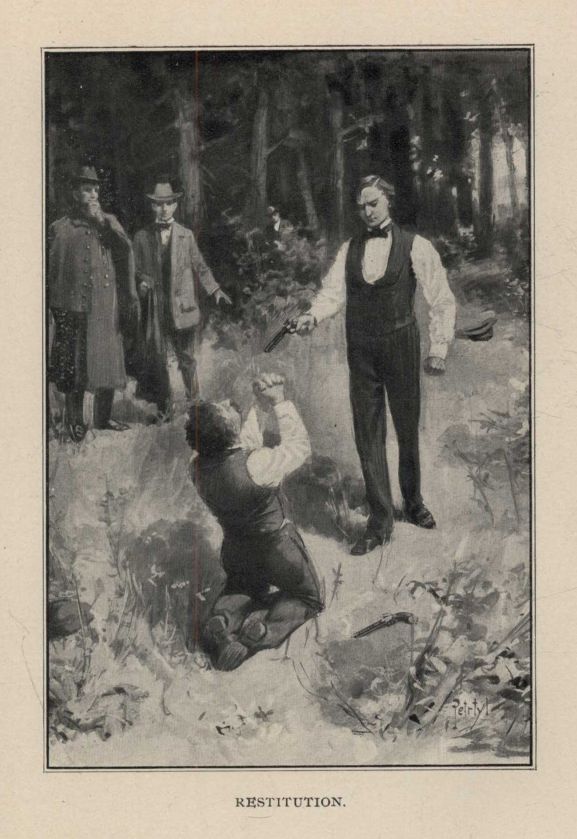
"Are you ready, gentlemen? Remember, when I count five, turn and fire, or advance before firing if You choose. Remember, five is the signal. Are you ready? One, two, three, four—" As the last number was called, Burke whirled about, and with quick aim fired. At this Mr. Lincoln's and Uncle Job's faces blanched, and they turned to Mr. Davis as if expecting to see him fall, Uncle Job calling out mechanically the final number, "Five." Upon hearing this, and not before, Mr. Davis turned about unharmed, but feeling his shoulder with his free hand as if he had been hit. Looking in the direction of Burke and observing his smoking pistol still upheld, Mr. Davis' face lowered and he hesitated for a moment; then, without remark of any kind, he straightened himself up, and keeping his weapon extended, advanced slowly toward where his opponent stood. As he went forward, Burke's face, from being red, turned purple, and then a livid white, his eyes and cheeks falling in as if he had been dead a month. When Mr. Davis had gone some distance, Burke, unable to control himself longer, screamed out in deadly fright:
"For God's sake have mercy, Mr. Davis! Don't kill me! No, no, you can't, Mr. Davis; it would be murder."
RESTITUTION.
Paying no heed, Mr. Davis kept on until he was within a few feet of Burke. There stopping, the fire of his eyes seemed to consume his enemy, for Burke, losing all control of himself fell on his knees, crying out in the most craven manner:
"For God's sake, as you are a Christian, don't kill me, Mr. Davis! I'll give back the money; I never meant to keep it, I swear to you, as God is my judge. I have children, Mr. Davis—little things. Surely you could not kill me"; and moaning and purring like a cat, the wretch dropped on his elbows, limp and undone.
"Let you live to go on robbing and killing men, you scoundrel! You deserve a dozen deaths for the murders you have committed," Mr. Davis answered, without stirring or lowering his weapon.
"I know it, Mr. Davis, but have mercy! I will never play cards again if you will let me off, nor harm any one! So help me God! Have mercy! have mercy!" and he dropped his face on the ground, unable longer to look upon Mr. Davis's towering height and angry countenance.
"You do not deserve to die by the hands of a gentleman, and I will spare you, though you would have murdered me; but on condition that you turn over to Mr. Throckmorton the money you have taken from Singleton, and afterward do as I say," Mr. Davis answered, without making any move.
Upon this, Burke, rising to his knees, answered in his soft, whimpering voice:
"I will do anything you say, Mr. Davis. I never meant to keep the money, and Singleton shall have every cent back"; and clutching his pocket with trembling hands, he drew forth a leather book, and searching it through and through, presently gave Uncle Job a handful of papers and money, saying: "There, that is all I have; every penny!"
Receiving what was tendered, Uncle Job put it in his pocket, and then, as if to assure himself, took the book from Burke's hand, and looking it through, presently came upon another paper, which he held up to view, saying:
"See, Mr. Davis, he would still have robbed Singleton of this, a bill of exchange for five thousand dollars."
"I did not know it was there, I swear to God!" Burke answered, dropping forward again on his elbows, as if this last act would surely cause his death.
"You did, you scoundrel," Mr. Davis rejoined; "but no matter. What I require of you now is that you remain here until the boat leaves, for if you come aboard or show yourself or cry out, I will kill you as I would a wolf."
"You will not leave me here, Mr. Davis, surely?" Burke purred, looking around at the dark forest.
"Yes, I will," Mr. Davis answered. "A walk of a few miles will take you to a landing where you will find a boat by which to get out of the country. Come, do you agree?"
"I must, if I am allowed no choice," Burke replied, rising to his feet.
Upon this ending of the matter Uncle Job secured the pistol Burke had dropped, and the three, without exchanging a word, took their way to the river, the bell clanging the boat's departure as they neared the landing. On the way Uncle Job lagged far behind, and with downcast head and sorrowful visage. Poor man! he had judged Burke to be a coward, and sure to give up Singleton's money rather than fight. So that his bravado on the field, and attempt to assassinate Mr. Davis, had come to him in the nature of a shock, and now when it was all over, his having suggested the meeting appeared to him in the light of a very foolish, if not criminal, act. Because of this he did not feel elated over the restoration of the money, as he otherwise would, but looked upon what he had done as silly in the extreme, and mourned accordingly.
CHAPTER XX
ABRAHAM LINCOLN AND JEFFERSON DAVIS—THE PARTING OF THE WAYS
When we returned to the boat Mr. Singleton had not stirred, but lay as if dead or asleep. Going straight to him, Mr. Davis laid his hand on his shoulder, and this with some impatience, if not anger, I thought. At first Mr. Singleton did not move, but after a while looked up confused and blurred, as if awakening from a debauch. Collecting himself, he arose and extended his hand in greeting, as if he had not known before of Mr. Davis' presence on the boat. Accepting his overtures, but somewhat curtly, it was apparent, Mr. Davis said:
"I come to tell you, Singleton, that Burke has left the boat, but before going wished to return the money he had of you, as he has designed doing from the first, he says. To accomplish this he has made me his messenger, as you see." Saying which, Mr. Davis laid the money and papers Burke had turned over on the table before him. At this Singleton drew back, flushed and scowling, replying in a harsh voice:
"I'll not accept it, Davis. It is his, and the more scoundrel I for risking it and ruining my family. No, he won, and that is the end of it." Saying which he sank down and buried his face in his arms as before.
"Very well," Mr. Davis answered, curtly, and placing the money in his pocket without saying more, proceeded to the cabin set apart for ladies. Here finding Mrs. Singleton, he called her aside, and after telling her as much as he thought proper of what had occurred, leaving out indeed all reference to the encounter, I thought, he handed her the package. When she was able finally to comprehend that the fortune of her children had thus been restored, she burst into a flood of tears, and would have fallen had he not supported her. Recovering herself after a while, she sought to kneel to him in gratitude, but he, lifting her up, made such light of the affair that she was able presently to resume in a measure her natural cheerfulness of manner. Then, and as if in remembrance of her husband's dignity, she said, tears dimming her eyes:
"Will you not oblige me, Jefferson, by giving the money to Mr. Singleton. Please do this for me."
"I have already offered it to him, dear lady," Mr. Davis, answered, "but he will by no means accept it. So there is nothing for you to do but take charge of it, for Burke has left the boat and will not return."
"God will surely bless you for your kindness in saving my husband and protecting my children," Mrs. Singleton responded, her emotion again overcoming her. Upon this ending, Mr. Davis stooping down with grave respect took her hand and kissed it, saying:
"I have a favor to ask of you in return, dear lady, and it is that I may present the gentlemen who have acted with me, and without whom I could have done nothing. You already know and admire them, and they are every way worthy of your high regard."
Saying which, and without waiting for a reply, he went forward, and finding Mr. Lincoln and Uncle Job, presented them to her with every expression of regard and friendship that one can in speaking of another. Taking the hand of each in turn, Mrs. Singleton pressed it between both her own, but overcome so that she could not speak. Then inclining her head and smiling upon them her tender thanks, she went to her husband, and seating herself beside him, put her arm about his neck in loving embrace.
Thus this dear lady's sorrows came to a happy ending through the efforts of the gentlemen who had been brought together in the strange manner I have related. Never before, I must believe, have men stood beside each other in such unconscious regard of the greatness of their souls and the exalted destiny fate had in store for them as Mr. Lincoln and Mr. Davis. Looking back now to that far-off day through the mists of gathering years and over the heads of intervening men, I see them again, as then, distinct and apart from all others; and thus I shall always see them. In many things they were alike, differing only in unimportant particulars. Mr. Davis' bearing was truly great, his carriage and dignity and chivalrous character stamping him as one born to command. Yet in all things his kingly air, for it was truly so, was softened into sweet conventionality by gentle courtesy and regard for the small things of life. Of his countenance, how shall I describe it, except to say that it was singularly handsome, and so exquisitely refined and attractive that no one could look upon it except with favor.[*]
[*] The painting of Mr. Davis in the War Department at Washington fully bears out what Gilbert Holmes says of Mr. Davis in this respect. For of all the faces there grouped of the War Secretaries, since the foundation of our Government, his is by far the most refined and attractive.—THE AUTHOR.
Differing from Mr. Lincoln, with whom he afterward came to share the events of a great epoch in the world's history, Mr. Davis's life had been nurtured in love and amid surroundings every way attractive. The crucible of misery through which Mr. Lincoln had passed, and that ever caused his heart to pulsate with tender emotion, Mr. Davis had happily escaped. Yet in all things he was not less gentle, nor did he in any way lack in conception of men's needs or desire to further them so far as lay in his power.
I had no thought, in recounting the story of my life, it is proper for me to tell you, to say aught of Mr. Davis or his chivalrous action in Mrs. Singleton's behalf, as my share therein was not worthy of mention. I have, however, been led to change my mind in this, for the reason that afterward, in the great struggle between the North and South, I had occasion to experience his gentleness and kindness of heart in my own person. At the time to which I refer I was confined in Libby Prison, broken in health by long confinement and irritating wounds, and above all, distressed on account of my dear wife, who was ill and sorely afflicted. Fearing a disastrous termination to my troubles, after many days' anxious thought I wrote to the President of my distressful plight, and doing so, recommended myself to him by recalling the memories of the past, and especially the link of friendship that bound each of us to Mrs. Singleton, who was now grown to old age, but still beautiful and kindly as in the years that were gone. Sealing my letter with much trepidation of heart, it had scarcely left my hand when a Confederate officer came with directions for me to accompany him, and doing so, he took me straight to the President. Mr. Davis received me with every show of hospitality, afterward plying me with tender inquiries about the Singletons and their life in the new home. Then, so great was his courtesy, he took me to sup with his family, where it was my good fortune to meet many of the officers of the Confederacy, and among them that great and serene man General Lee. Very kind they were to me too, and amiable of countenance and full of gentle speech, solicitous in all things of my comfort and ease of mind, that I should not feel myself to be a stranger in an enemy's country. When I returned to my prison, which I did much cheered in mind and body, the officer in command presently brought me word that the President had directed I should be permitted to be at large in Richmond, on my giving my word of honor to respect the parole. That is how it happened, you must know, that I was not among those who escaped from Libby Prison, some to reach their homes in safety, but many to suffer recapture or perish by the way. Directly after this Mr. Davis sent for me again, and receiving me graciously, as in the first instance, gave me a pass through the lines, there to remain on parole until exchanged. This with many kind messages to the Singletons and expressions of good will toward myself. For his act of unsolicited grace, by which I was able once more to be with my dear wife and children, I cherish him in grateful remembrance, as you may well believe, and each day with deeper and more tender affection.
Mr. Lincoln took leave of us the third day, much to the regret of every one, for in so short a time his kindness of heart and the simplicity of his nature had won the regard of all, as they never failed to do throughout his eventful life. This exalted man had many peculiarities, and all of them agreeable. The angularity of his features, not the least, lent piquancy of interest to what he said, and discovering this in early life, he used it, and wisely, to further his ambitious ends. For his story-telling was but a political device, designed to win and control the rude and impulsive men among whom his lot was at first cast. Afterward, when President, it became an instrument of vast significance to his country, to be used in the divertisement of those who surged about him in greed of place and preferment, or for other objects not consistent with the good of the state. In that moment of the nation's peril, when wealth melted away unnoticed and men sunk into the ground without a cry, this simple device of an alert mind, not less than what was truly great and majestic in his nature, helped in its place, and as intended, to control and hold the government on its appointed course.
Of Mr. Lincoln I saw but little more as a youth, but in after days the chance fell to me to have been of supreme service to him, had I been wiser or more alert. This on the fatal night of his assassination, in April, 1865, when the hearts of men stood still and the nation cried out in anguish; but being dilatory, without knowing it, the chance passed. I was in Washington at the time, brought there by some small affair of the army, and late in the afternoon, loitering about my hotel, a rumor reached me, though how I did not know, that some demonstration was contemplated in connection with Mr. Lincoln at the theater that night. Regarding it as unimportant, and yet thinking it otherwise in the disturbed condition of affairs, I determined to be present. Arriving at the theater, and observing Mr. Lincoln's unprotected state, and remembering why I came, and yet not knowing why, I passed to the side where he sat, striving as I went, but vainly, to think of some excuse for going to him, or, indeed, for being there at all. As I pressed forward, perplexed whether to go on or turn back, a gentleman brushed past me, going in the direction of the President's box. Upon the moment, and in impulse of thought, I reached out my hand to stay him; and this I had done, but looking up, saw it to be the actor Booth, whom I knew to have access to places of this kind. Thinking idly that he was on his way to the stage, I stepped aside and let him pass; and alas that I did so, for while I was yet deliberating, and some distance from the President, I heard the report of a pistol, and a moment afterward saw the assassin leap upon the stage, with that strange cry of his mad brain, "Sic semper tyrannis." Thus the opportunity to serve my benefactor came without my knowing it, and the strangeness of it all has closed my lips till now; but it recurs to me at this time, to add to the mournfulness of the picture as I look back to that far-off parting on the great river in May, 1838.
CHAPTER XXI
WHAT THE CANTEENS HELD
One evening, some days after leaving Quincy, we again ran across Blott, and seemingly not different from what he was at first. Accosting him, Uncle Job asked:
"How do you find yourself to-night, Blott?" but this as if seeking diversion rather than from any interest in the poor wretch.
"Oh, I'm just runnin' by gravity. The insects is botherin' me, but not's bad, not's bad. Why, they made more noise than a fannin' mill at one time, givin' me no peace, nor lettin' me sleep," Blott answered, kicking mechanically at some object before him. "Tell me," he went on, with the old scared look, "how're the stars appearin' to you to-night, Mr. Job? Sorty as if rain was comin'?"
"No; how do they look to you?"
"Like red blotches with purple rings about 'em, an' movin' here an' there quick, as if they was alive."
"You are ill, Blott," Uncle Job answered, sympathetically.
"No; it's nothin' but them toothache drops, an' it'll work off. You think it's whisky, mebbe, but it ain't, for I've drunk it for years, an' it's never hurt me before, an' I don't believe it'll hurt any one. No; it's the drops an' the malary," Blott answered.
"What makes you think you have malaria, Blott?" Uncle Job asked.
"Why, I've had it ever since Black Hawk's war, six years ago. It come of sleepin' out nights."
"Were you in that war?" Uncle Job asked, his voice showing more interest.
"Was I? I was one of the main guys; had a horse, an' helped pull the cannon an' things. The malary come on me first at Stillman's Run, where Black Hawk scart us stiff."
"Is that why the battle is called Stillman's Run?"
"It wa'n't a battle, just a volley an' a whoop an' a scramble to git away. Why we were that scart you could have stood on our coat-tails, they stuck out so."
"Tell us about it; I am sure it must be interesting," Uncle Job responded, offering Blott a chair and taking one himself.[*]
[*] In Mr. Holmes' references to Blott he at first manifested some impatience with was not strenuous in the matter and so I have included it, feeling it worthy of regard because relating to an historical event of great importance to the people of the Upper Mississippi Valley, in which Blott took a part.—THE AUTHOR.
"You see we were all cooped up at Fort Dixon," Blott went on, seating himself, "when Major Stillman determined to go an' do somethin'. So we marched out, full of expectation an' ignorance, in the direction where Black Hawk was. When he heard we was comin' he sent out three Injuns with a white flag to meet us. These we took prisoners, an' some of our people killed one of 'em. Then the boys in front lit out after the mounted scouts Black Hawk had sent to see what become of his flag, an' succeeded in killin' two of these. When Black Hawk saw this he took to the woods, an' by an' by, when our fellers come along, the Injuns gave a great whoop an' fired in the air, not hurtin' anybody. At that we turned an' run, an' them in the camp hearin' us comin' an' thinkin' we was Injuns, lit out, every one on his own hook, an' never stopped till they'd got under cover. It seems funny now, but it wasn't funny then. I happened to be on a long-legged mare that you couldn't see for the dust when she was runnin', an' so kept ahead. It was lucky for me, too, for them who got off first in the panic, thinkin' in the dark that them who was tearin' after was Injuns, fired, an' so a lot of our people was killed that way. Scart! Why we thought every bush or shadder was an Injun, an' one of our fellers' bridle ketchin' on a stump, an' he thinkin' it was an Injun, jumped off to surrender; but when he saw what it was, he gave the tree a whack, an' mountin', never stopped till he'd reached Dixon. If anythin' on earth can make an Injun laugh, they must have laughed that day."