THE ROMANCE OF GILBERT HOLMES (continued 2)
Reading edition
"Oh, fie! how stupid you are, or make out to be."
"Well, what is it? I can't guess," I answered, but in no hurry to have her tell me, so sweet was her voice and so entrancing her contention.
"Well, I've a good mind not to tell you, but it's the head of the wolf you killed. Papa had it mounted just as it was brought from Wild Plum; and it grows more ugly every day, I think," she answered, scowling at the hideous thing.
"I'd never have known it, it's so shrunken and wrinkled," I answered, gazing at the object with new interest.
"Then you remember, do you?" she asked, coming close to my side, as if it were still alive.
Yes, I remembered the wolf well enough, but most because it concerned Constance, and had, besides, so much to do with her father's kindness to me then and always. On this account it is proper I should tell you the story; and though it may seem out of the ordinary and improbable now, it was not so regarded at the time. For you must know that in the early days the panther and bear and many other savage animals made their homes undisturbed in the depths of the great forests of Illinois, and among the first recollections of my childhood were the cries, sometimes fierce, but more often doleful, of the wolves about our home. Our situation indeed in respect to such visits was peculiar, for from the plain that lay on one side there came the gray or prairie wolf, and from the forest opposite, his fierce brother, the black or timber wolf. The first was a cowardly brute, hardly above a chicken in courage, and given to pilfering about the stables and hen-houses, though sometimes venturing as far as the kitchen if there was anything it could steal. The timber-wolf was larger, and when hungry would attack animals ten times its size. Indeed, when famished, it did not fear man, and in this way numbers of the early settlers lost their lives. In the summer and fall, when food was plentiful, it rarely visited us, but in the late winter its cries at night were so common as hardly to attract attention.
Thus it was one day in the early spring, when the grasses were fairly started and the trees beginning to sprout, or only the laggards slept, as loth to waken now as they were quick to go to sleep in the early autumn. The day being warm and fair, Constance and I had ventured into the great forest, not far, indeed, but apart, the foliage shutting us off from view. At such times the thing that delighted her most was to run in and out among the trees, as children from the city always take pleasure in doing when visiting the country. In this way we had become separated for a moment, when suddenly there came to me from out the still woods a quick and agonizing cry. It was Constance's voice, and something to chill one's blood. Nor has a long life sufficed to still its vibrations, and often in the night it awakens me now, with the same dread as when I heard it in that afternoon in my far-off youth. Starting up in affright, I let fall the basket I carried, but retained in some unconscious way the small ax I had in my hand, my father's gift, and this fortunately, as it afterward turned out. Listening, and the cry being repeated, I hastened in the direction whence it came, but as I advanced it receded, faster and faster, until after a little while it came to me only plaintively, and then not at all. Hurrying forward, I after a time reached an opening in the forest, and doing so beheld on the opposite side a huge wolf, gaunt with hunger, carrying Constance in his mouth, with high uplifted head, as if her weight were nothing. Nor was it much to speak of, for she was but a child, and delicate as the lilies that bobbed and curtsied in the black pond on the edge of the great woods. At sight of the wolf I stopped, so benumbed with fear that I could neither move nor cry aloud, and thus I stood with open mouth, without any sense whatever, doing nothing. What could I do? The house was now far away, and only women there, and if I sought them it would be too late. While thus unable to think or act, I caught sight of the weapon I held, and with it courage returned to my heart—not much, to be sure, but enough. Something might be done with so good a weapon, and with the thought I hastened across the opening and plunged into the forest, following the direction the wolf had taken. After running some distance without response to my cries or finding any clew to guide me, I stopped again, filled anew with fear and dreadful forebodings. Surely she was lost, and her life a prey to the savage beast that bore her away. At the thought, taking fresh courage, I plunged ahead, and now into the very heart of the forest, thinking this the direction the animal would be most like to take. Thus minutes like hours passed, as I struggled forward through the dense undergrowth, but neither hearing nor seeing aught of her I sought. Worn out at last, I sank down in despair, tears blinding my eyes. Beyond, the great forest stretched away unbroken to the far west, receding ever to lower and lower levels, there to meet noiseless, half-hidden creeks or black, impassable swamps. Throughout its great expanse, and as a cover for the wild beasts that frequented its depths, dense undergrowth grew, and resplendent as in a garden. So much I knew from my father, who had penetrated its vast solitudes, and at another time I should have been stirred by its solemn splendor; but now it had neither beauty nor variety, revealing only darkness and terror, wherein a hideous tragedy lay concealed. Such were my thoughts as, after some moments' resting to gain new breath, I struggled to my feet and started afresh, but now without any purpose other than to follow aimlessly on. Going forward in this way, I came at last upon an opening in the trees, and there, a few feet off, and in the interval of the forest, I beheld the wolf, with tongue outstretched and bloodshot eyes, standing at bay. As I came into the cleared space, the animal raised himself erect and turned his fierce countenance on me as if inviting attack. This I did not think to offer, but losing all consciousness, I rushed forward, crying, "Constance! Constance!" Thus I reached the animal, and it not moving, I raised my weapon and struck it full in the face. The blow was not hard, for I was weak and dead with fear; but the brute not attacking me in return, and blood following the stroke, I struck again and again, sometimes missing altogether, but more often hitting my mark. Whether the animal was exhausted by its long flight, or surprised into fear by my quick attack, I do not know, but that it was dazed I must believe, for it made no effort to attack me, but stood sullenly before Constance's body, neither advancing nor receding. Finally, my blows growing weak, and the animal making as if it would spring upon me, I struck it again, and now with the strength of both my arms, full in the face. At this, as if grievously hurt, or else losing all courage, it gave a mournful cry, and turning, darted into the forest. Seeing this, and my strength being gone and my heart numb with fear, I fell forward unconscious beside Constance's prostrate body.
When I came to, my head was pillowed in her lap and she was stroking my hair, kissing me the while as if to bring back the color to my face, calling, now in a fever of fright and then again plaintively and coaxingly:
"Gilbert! Gilbert! My Gilbert!"
Feeling her soft breath on my face, I feigned unconsciousness, loth to move; and thus I lay for a while, not stirring, nor conscious of any reason why I should. Then the thought of the wolf came back to me, and I sprang up, terror-stricken lest the animal should return, alone or with its fellows, as these fierce brutes were sometimes known to do when crazed with hunger.
"Quick, Constance! We must be off before the brute returns," I cried, taking hold of both her hands. To my appeal, however, she returned no answer, but sat still, her face, torn and bleeding, turned imploringly toward mine. "You're hurt!" I exclaimed, filled with fear; "but come! I can carry you, and it's not far"; and stooping I raised her in my arms as easily as I would a child.
"No, I'm not hurt, Gilbert," she answered, trembling and clinging about my neck; "but I thought you were dead, and your springing up frightened me as much as the presence of the wolf."
"Are you sure you're not hurt in any way?" I asked, looking at her scared face and torn garments, not believing she could have got off so easily.
"Yes—and you?" she answered, peering into my face.
"I'm all right; but how could you have escaped so easily?" I asked, in wonder.
"I don't know, for I knew nothing after the first moment till I found you lying beside me," she answered, disengaging herself from my arms.
"See where the brute held you," I answered, pointing with a shaking hand to the marks of its teeth in the heavy woolen frock she wore.
"If my dress had been lighter, he might not have been able to carry me off at all," she answered. "But where is the beast, Gilbert? And see, you are covered with blood, too!"
"Come! We must leave here as quickly as we can. The wolf didn't have any more courage than a sheep, and ran away; but he may come back with the pack, if they're near by," I answered, looking about uneasily.
"How can you find the way, Gilbert? No one has ever been so far as this before, I know," she replied, scanning the dark trees as we hurried forward.
"It's no great distance, and I could find my way blindfolded," I answered, confidently; and so, guided by the sun, and this happily, we at last reached the edge of the forest just as the night was coming on. Here my mother, who had become alarmed at our long absence, was awaiting us, and as we came into view, she ran forward, crying:
"My children! My children! How could you frighten me so!" When, however, she had come near to where we were, and saw the blood on my garments, she stopped and came nigh to falling, but recovering herself, hurried forward and clasped me in her arms, exclaiming: "My son! my son! What dreadful thing has happened to you?"
Nor would she move or release me till we had told her the story from beginning to end. Then, kissing us, she put her arms about our bodies and led us to the house, and there kept us by her side until my father came home and heard the story. He, more used to danger, embraced us tenderly, and not waiting for a fresh horse to be saddled, mounted the one he had, and taking Constance in his arms, carried her to her home in town. The next day Mr. Seymour came out to Wild Plum with Constance, and together we all visited the spot where the encounter had taken place; but my father, following the animal's trail by its blood, presently gave a cry, and we, running forward, found him standing over the wolf, which lay dead on the ground.
That is the story, and it was the battered head of the animal, that Mr. Seymour because of some sentiment had preserved, that now stared at us from above the chamber door.
NOTE.—Mr. Gilbert Holmes, in reviewing this part of his life, thought, for some reason, that the story of the timber-wolf should be omitted; but to this Mrs. Holmes would by no means listen, treasuring every word as if it were Gilbert himself and a part of her life. Because of this I have included it as it was told me, and partly, too, because it explains Mr. Seymour's love for Gilbert as a youth and the great confidence he had in him always. It also illustrates Gilbert's courage, which was so simple and found expression so naturally when anything called it forth that he was never conscious he possessed it, but always spoke of the fear that oppressed him in the emergencies of life, though it was not fear at all, it was apparent, but merely the agitation of a sensitive nature. For of all men, none ever lived who were more brave than he; and it was said of him, and truly, as a general of cavalry in our great war, that no leader pressed forward with such ardor in the charge, and similarly it was told, none gazed upon the empty saddles after the conflict was over with so sorrowful and pitying a heart.—THE AUTHOR.
CHAPTER IX
DRIFTWOOD FROM THE THAMES BATTLEFIELD
While Constance and I stood with clasped hands gazing at the wolf's head, Mr. Seymour entered the room, followed by Uncle Job. At sight of the latter my heart went out to him with tender emotion, and I ran and embraced him as I would a dear friend.
"I hope you find yourself in good spirits, and none the worse for what has happened?" he inquired, affectionately, taking my hands in his and kissing me.
"Gilbert's in fine spirits," Constance spoke up, looking at me as a mother might on a petted child.
"Yes, and I can't thank you enough for what you've done, uncle," I answered.
"Don't talk that way, child, for you owe me nothing," he replied. "I was sorry to leave you in doubt so long, but there was no other way."
"It didn't matter; but I'm afraid I'll be a great burden to you," I answered, remembering what I had thought in regard to this.
"Nonsense! Only I'm not sure but you would be better with your Aunt Jane than with me; but your mother would approve what I am doing if she were alive, and that is what governs me," he answered.
"I'm sure she would," I replied, feeling that he spoke the truth.
"Then you are pleased?" he asked, smiling, as if comforted by my answer.
"Yes, but I fear Aunt Jane will be very unhappy when she finds I have gone without money or clothing. Wouldn't it be right to send her word that no harm will come to me?" I asked, a feeling of remorse coming over me that I had shown her so little respect.
"She will not fret nor lose an hour's sleep over you, my boy," Uncle Job replied. "Her heart will close up like an oyster when she finds you are gone; but when we are well out of the country we will let her know. She will never forgive you, but it doesn't matter, for she was never friendly to our family, anyway."
"Mother used to say we didn't understand her," I answered, remembering her words.
"Your mother found excuses for every one, so tender was her heart; and your Aunt Jane is not to be blamed if she is ice instead of flesh and blood," he replied.
"Please, Job, leave Aunt Jane in the quietude of her farm for a while. The die is cast, and nothing can change it now," Mr. Seymour broke in, good-naturedly. "Come, Constance, let us have dinner served here, where we can have the evening to ourselves—and make haste, for we are starving," he added, putting his arm about her as she turned to leave the room.
At the dinner which followed, it was my great good fortune to make a new acquaintance, and one I had occasion to prize more and more as the years went by. This in the person of Constance's companion and teacher, Setti, a young person who had lately come to make one of Mr. Seymour's family; and strangely enough for such companionship, and improbable you will say, she was of pure Indian blood. No one, however, would have known this, for except that her hair and eyes were black and her complexion olive rather than dark, she was in no wise different from those about her. She was above medium height, with graceful figure, and soft, shy manners that were truly captivating, and in regard to this last there was no difference of opinion. Her history, while it would be strange now and romantic in the extreme, was not thought peculiar at the time of which I speak. For you must know she was found when a child, playing beside the body of her dead mother on the Thames battlefield, where Tecumseh fell, a little way across the Canadian border. The officer who thus discovered her took her to his home and educated her, treating her in all things as his child. This until some months back, when, his family being broken up by one of the dreadful scourges of sickness common in the new country, Mr. Seymour had asked her to become the companion and instructor of Constance.
While nothing was known of Setti's parentage, it was thought she was the daughter of some great chief, from the ornaments clasped about her neck, and which she still wore. Of these, one was a cross of mixed gold and silver, sunk in an oval frame of copper and lead, the handiwork of some Indian craftsman, who, it was apparent, had only rude tools and molten metals with which to work. Another ornament, and one that struck you strangely, was a serpent, hammered out of pure iron and inlaid with silver; but of its significance nothing was known. Afterward, when I came to know this sweet creature as one does a sister or cherished friend, I could never discover anything to indicate her savage ancestry, save, perhaps, a reticence of speech unusual in attractive women—if I except, perhaps, a startled look she sometimes wore when coming suddenly upon any new or remarkable experience in life. This peculiarity, however, we see in people of our own blood, and so it should not have been thought strange in her. In all other respects there was nothing about her to mark the abrupt step from savagery to civilized life, for her intelligence was in all things of the order and delicacy that characterizes refined women. Her beauty and sweetness of disposition, too, were such as to confirm the romantic notions I have ever held respecting the Indian character; and it was no doubt due to her and other kindly influences that I was first led to believe our treatment of the Indian tribes had been somewhat lacking in wisdom and humanity. Mr. Seymour was also of this opinion, and never lost an opportunity to express his views on the subject, and with considerable abruptness.
"Setti's affectionate nature and sweetness of temper," he was in the habit of saying to his friends when the subject was brought up, "are natural to her—God's gifts; and had a wiser and more tolerant course been followed by our government, all the Indian tribes of America would have been led to accept civilization, as she has been—not grudgingly, but with their whole heart and soul. Either that, or they should have been left apart to follow the processes every race has passed through in its progress from savagery. Instead, we have the sad sight of great Indian nations debauched and hunted down and destroyed, as if they were a plague upon the earth. Surely they were worthy of something better, and should have been preserved to mark for all time the magnificent men and women who made up our native Indian population. To do this we would have had to recognize their right to live and multiply unmolested, as we do others more fortunate in color and birth; or failing in that, have subjected them to gentle treatment and wise laws. Surely they were worthy such care and consideration. Homer's Greeks, to make a point of it, were no better, nor scarcely more civilized, than the Sacs and Foxes we have but just driven like wolves beyond the confines of civilization after robbing them of their lands and villages."
Mr. Seymour's views, and others like them, however noble and humane, were not regarded by the community as meriting attention except in a sentimental way, one and all being animated by a desire to dispossess the Indians of their lands as quickly as possible, and without reference to their rights or any feeling of humanity whatever. However, he was not the less strenuous in giving them utterance, even to the extent of offending his friends and patrons.
"Bad faith and cruel harassment of the Indian tribes on their lonely reservations," he would say, "have characterized our government's policy from the first, and forms, indeed, so gross a crime that coming ages will reprobate it wherever men love justice and hate swinish greed. It will not in any way excuse us that we are hungry for the property of our neighbors, and because of this agree to treat the Indian as an inferior being. He is nothing of the kind, for God never made more perfect men physically, and the mind conforms in all things to the body. It is nature's law. Nor does it excuse our acts, however much our passions may be aroused, that the Indian in his savage state kills and mutilates his enemy. Achilles, the ideal Greek, circling the walls of ancient Troy with Hector's body chained to his chariot, has never been surpassed in cruelty and ignoble pride in Indian annals. The comparison is still more odious when we think of the hecatombs of harmless men the Homeric Greeks sacrificed to the manes of their honored dead. The Indian's heaven is lighted by no such baleful fires. Nor have we any reason to suppose the red man more backward than the Greek, for he is greater in courage and much superior to him in physical strength and patient endurance."
"If Achilles lived in our day," Uncle Job once answered, "we would not lose an hour in appropriating his incomparable horses and sending him to the wilds of Iowa to join that other savage, Black Hawk, saying to ourselves the while that we were well rid of a nuisance and disturber of the peace. Too much can't be expected, though, of our young country, Henry. It is too full of the bumptious exuberance of animal life. Children in experience make very poor governors; they are too headstrong and intolerant; but we will do better later on. Only mature nations, like mature men, know how to govern well. It's a pity, but so it is, and will be always, and the weak and dependent must suffer whenever contrary conditions exist."
Thus tender-hearted men declaimed in the years that are gone, but fruitlessly. These thoughts, however out of place, recur to me now and struggle for utterance when my mind reverts to the gentle being who came into my life that evening, and who afterward, and so long as she lived, did so much to add to the happiness and well-being of those with whom she was brought in contact.
When at last we were seated about the table, Mr. Seymour asked grace, and this with such show of reverence that I was awed by it as something new and strange. For such a thing was not usual, you must know, in the new country. Not that men were lacking in respect for religious observances; on the contrary, but time pressed, and, moreover, it was thought that such delicate matters should be left to those trained, so to speak, in things of that nature. On occasion, to be sure, the more venturesome would, if asked, raise their voices openly; but such practices were cause rather of wonder at the courage they evinced than desire to emulate them on the part of the more timid of the community. Mr. Seymour's custom, however, seemed to me to be so good and reverent that I determined if I ever grew to man's estate to do the same; but such resolves, however commendable, are rarely followed, for when I came to have a home of my own, and children sat about the table, I put it off, as weak men ever do in cases of this nature. For a long time the dinner promised to be without speech, all seeming to be oppressed at the step that had been taken—a step that would, for good or bad, color forever the life of at least one of their number. At last Mr. Seymour, looking across to where I sat, said, with an encouraging smile:
"I hope, Gilbert, you don't feel any regret at what has been done?"
"No, sir," I answered; "why should I?"
"Nor have any disposition to turn back?"
"It would be too late for that, I'm afraid, even if I wanted to," I answered. "Aunt Jane would never forgive me so great an offense."
"No, not too late, if you regret the step. The blame for what has been done is all ours, and no part of it would rest on your head," he answered, kindly.
"I don't regret it, but I'm sorry for Aunt Jane," I answered; for, however loth I was to live with her, she was entitled to my respect, if not my love. So much, I thought, I owed my father's memory.
"Well, you may be sorry," Mr. Seymour answered. "We all admire your aunt, and if she would unbend a little and let her face relax into a smile on occasion, she would be a most attractive and lovable woman; but immersed in her thoughts, and formal of manner because of it, she is like the icebergs one sometimes meets in midocean, she is so cold and inaccessible."
"It's her way, and doesn't mean anything, mother always said," I answered.
"Perhaps so; but age does not change or soften her way, as it does most people. Your Uncle Job may not prove as watchful a guardian as she would have been, Gilbert, but your heart will be the warmer and your figure the more supple for the freedom," Mr. Seymour went on.
"I'm sure I shall be content," I answered, looking at Constance, not finding it in my heart to say I could be happy with any one away from her.
"He will never have any other company save yours, nor desire for any. So you are likely to see a good deal of him, and always to your betterment, I am sure," Mr. Seymour answered.
"Why do you say that, Henry?" Uncle Job asked, looking up in surprise.
"Because you are destined to be an old bachelor, Job," Mr. Seymour answered, "and of this I am sure. Charles, Gilbert's father, used to say the same. You lack time and inclination to find a mate, and more's the pity. In such company, Gilbert," he went on, "your craft must hug the shore or sail into the open, as fate decides; but wherever wind and tide may take you, here is hoping you may have a prosperous voyage," and Mr. Seymour raised a glass of wine to his lips, and much to my astonishment, bowed to me as if I were a man grown. He was, however, always surprising those about him in some such pleasant way. Indeed, I thought his bearing so fine that for him to single out any one for notice was a distinction to be remembered and be proud of ever afterward. Thus strongly does kindliness and courtesy of speech ever impress the young or inexperienced in life.
"We all want to join in that toast, Henry," Uncle Job broke in, reaching for a goblet of water that stood beside his plate.
"Won't you join me in a glass of wine, Job?" Mr. Seymour went on, observing his action. "You will sleep the better for it. No? Well, I won't urge you; but you will excuse me, I know, if I say it has always seemed strange to me that in this new country, where all save the pious tipple, and even they indulge sometimes behind the door, you should so rigidly abstain."
"It looks odd, I suppose," Uncle Job answered, "but you know it doesn't grow out of any assumption on my part. I simply don't care for liquor, and can't cultivate it, for the same reason you give for my not marrying; I haven't the time."
"Well, that is a clever way to put it," Mr. Seymour responded. "You are all the better, though, for being free. I have been used to the custom since a boy, and so it would seem odd to dine without wine of some kind. It is all a matter of habit, however, and in this new country, where any kind of good liquor is hard to get, it is better to eschew it altogether, as you do, if one can. Many reprobate the use of wine, I know, but that is an extreme way to look at it, for it is as old as man, and so not to be criticised as if the fashion were new."
"Custom never makes a bad practice the better, though it may excuse it," Uncle Job answered, good-naturedly.
"No, but it is the excesses of those who use liquor that should be condemned; but there doesn't seem to be any middle course in most cases."
"That is not the only thing that is carried to excess in our new country," Uncle Job answered. "The habit of chewing tobacco is quite as harmful, and one that ought to be frowned upon by all men with the beating of drums and tom-toms. This for sanitary reasons, if for no other."
"That is as men think," Mr. Seymour, who was sometimes disposed to be very democratic, replied. "The custom is not nice, but it will die out when men live nearer each other and have leisure to observe the habits of their neighbors. Our people are not more peculiar in this than in giving up the pipe for the cigar."
"That was bad taste, for a pipe is every way superior to a cigar. It is more cleanly and costs less and is not so harmful," Uncle Job replied, with animation; for however abstemious he might be in regard to the use of liquor, he was seldom without a pipe or cigar in his mouth.
"The pipe will come into fashion again when men have more leisure," Mr. Seymour answered. "Now they have scarce time to bite off the end of a cigar or say 'Lord forgive me!' ere they die, so busy are they in bringing the new world into subjection. However, to talk about something of more interest to these children, what are you going to do next? What are your plans, Job, if I may ask?"
This reference to the future caused both Constance and me to stop our chatter and lean forward not to lose a word of what was said, but little comfort did we derive from Uncle Job's reply.
"I have a plan, and it is to leave for home to-morrow morning," he answered, abruptly, looking across the table to where I sat, as if to see how I took it.
"Why so much haste?" Mr. Seymour expostulated.
"Well, the more promptly we act, the less trouble we are likely to have. No one ever caught Miss Holmes napping before, and while we may have misled her up to this time, it is not possible to do so long. The safest way for us, then, is to hurry away."
"Surely, Uncle Job, there's no such hurry," I broke in, my heart ceasing to beat at the thought of going so soon.
"I would like to stay longer, but why take the risk of delay, my son? There is nothing to detain us, and the sooner we are off the less likely we are to be interfered with. So let us start in the morning—and that reminds me, I ought to go and procure the things you need for the journey, Gilbert, if you will excuse me, Henry," he asked, turning to Mr. Seymour.
"A day or two wouldn't make any difference, I should think, Mr. Throckmorton," Constance interposed. "No one will look for Gilbert in this room, and he has not thought of going so soon."
"Keep still, you little puss, and don't meddle in such serious business," Mr. Seymour interposed, half seriously, half in mirth at her earnestness.
"Well, I don't see any reason for such haste," Constance answered, as if that ought to settle it.
"Nor I," I added, shutting my jaws tight, so greatly was I wrought up over the prospect.
"There is no other safe way. Miss Holmes would be down on us like a hawk before noon to-morrow if she doesn't put in an appearance to-night. Indeed, it would not surprise me to see her enter this room any minute," Uncle Job answered, in a decided way, at which we all turned and glanced toward the door, as if expecting to see her enter, as he said.
This disposition of the matter I thought worse than going to Aunt Jane's, and when Uncle Job and Mr. Seymour presently left us to get things in readiness for the morrow, I turned and clasped Constance in my arms in an agony of grief at the thought of parting from her so soon. Thus for a long time we mingled our tears, our hearts too full for speech; but after a while, regaining our composure, we fell to talking of the future, and what we would do, and how we would meet, and this with so much earnestness that we quite forgot our present troubles in the contemplation of what was to come. Thus it is ever with the young; the illusions of life dry their tears and cheer them on when older people sink down in despair and die.
CHAPTER X
AN AWAKENING
When at last Constance left me for the night, I threw myself across the bed without removing my garments, that I might the sooner lose my sorrows in the forgetfulness of sleep. Without avail, however, till the night was far spent, and then only for a moment; for awakening, I found Aunt Jane bending over me grim and determined, a cruel smile lighting up her cold, impassive face. Yes, it was as Uncle Job had said. She could not be misled, and spying out my hiding-place, had bribed the attendants, and so gained access to my room—and I was lost. Stifling my cries, she beckoned her servants to her side, and they, taking me in their arms, bore me through the silent house to the carriage that stood waiting before the door. Thrusting me within, they drove away, muffling my voice till we were far beyond the town. Then releasing me, as if in mockery, I beat my head against the sides of the vehicle, screaming aloud for help, but vainly, for no answer was returned to my angry cries. This till my strength was gone and I sank back exhausted in my seat.
Thus we reached her home in the gray of the morning, but not to enter, for turning into a vacant field, she hid me in a house half buried in the ground, apart and far from the traveled road. Here they left me, but returning in the evening, covered my prison deep with dirt, so that it resembled a gigantic grave. In this loathsome cell I remained for many weeks, mold gathering on my garments and fever racking my worn frame. Nor was this all, for from out the sides of my prison snakes and lizards peered at me with lack-luster eyes as I sat brooding the day through, and at night monstrous field-rats, gaining entrance, ran to and fro across my body, or warmed themselves beneath my jacket. Here in the early morning or late at night my aunt came to visit me, striking the door of my prison with her staff as she called my name. Grieved and incensed, I for a long time refused to answer, but at last, rising to my feet in rage to upbraid her for her cruelty, I awoke, trembling and covered with sweat, to find Setti rapping on my door and calling my name:
"Gilbert! Gilbert!"
Springing up, I ran to her, crying:
"Here! here! Save me, save me, Setti!" clasping my arms about her body as I spoke.
Startled by my action and wild speech, she sought to disengage herself, but observing my distraught air, bent down and kissed me, saying soothingly:
"What is the matter, Gilbert? What has frightened you? You tremble, and your face is as pale as death."
"It's the cold and damp," I answered, scarce knowing what I said, only that I sought to cling to her the tighter.
"That is not it, Gilbert, for the morning is soft and warm," she answered, peering into my face. "You are ill or hiding something from me. What is it?"
"Oh, I've had a dream, a dreadful dream—or it was true, I don't know which. I thought Aunt Jane came and took me to her home and hid me in a cave where no one could find me or hear my cries."
"Oh you poor boy! It was only a dream, for see, this is the Dragon, and your uncle is downstairs, and Constance will be here in a moment with your breakfast."
"Let's go to her; it's better than staying here," I answered, looking back into the room, unable to command my voice or trembling limbs.
"No, Gilbert, not till you are yourself again. Constance must not see you in this way, for the poor thing is dead with grief already," she answered, striving to quiet my agitation.
"I'll stay, but don't leave me, for I'll not stop here alone; I can't!" I cried, fear still overcoming me.
"See, it is nothing," she answered, entering the room and looking about. "It was all a dream, Gilbert. There, you will be yourself again in a minute"; and putting her arm about me, she led me to the open window, and looking out, I saw the day was just breaking.
In this manner, and after some time, I regained my composure, so that when Constance entered she in no wise suspected that anything had gone amiss. Spreading the table, Setti motioned the servant to go away, and making some excuse, she presently followed, leaving us alone. Seating myself, I made pretense of eating, but only that, so deeply was I stirred by what had happened and the thought of parting from Constance. Now, though a long life has elapsed since that unhappy morning, I can see her as plainly as then, striving to smile or say some cheerful word, but more often with tears filling her gentle eyes and clogging her utterance as she sat sad-faced and despondent by my side. In this way I made believe I had some appetite, till the horn sounded the departure of the stage. Then, springing to my feet, I took her in my arms and kissed her a thousand times, but without speech of any kind, so full were we of the sorrow of parting. At last, tearing myself away, I hurried below, where I found Mr. Seymour waiting for me in the hall.
"Good by, God bless you!" he cried, with a striving at gayety as he put his arm about me and led me to the door. "Remember, Gilbert, that we love you always, and will welcome you back with open arms whenever you choose to come," he concluded, his voice choking.
My heart too full for utterance, I raised his hand and kissed it, and without stopping, hurried on to where Uncle Job stood waiting to put me in the stage. Thus we went away, and turning, I saw Constance looking down on me from the room where we had just parted, waving me a last farewell.
CHAPTER XI
THE NEW COUNTRY
When we were clear of the village and the straggling houses that lined the road beyond its limits, the sun was well above the horizon, lighting with ever-lessening shadows the great prairie spread out before us. Refreshed and enlivened by the pure air and the companionship of the quiet country, I looked about me, curious as to the route we were following and the far-reaching prospect on either side. On our right the gentle Mauvaise Terre pursued its slow and devious course through the quiet plain, marked throughout its winding way by trees and drooping bushes. To the south, low down on the hazy landscape, the great forest about Wild Plum, so dear of memory, showed its black depths in the soft morning air. This far-off glimpse of my home stirred the sorrows of my heart anew, but a turn in the road shutting out the view, I soon found myself scanning with curious interest the placid landscape on which we were entering.
Our great state, now so thickly peopled, had then, save here and there, only widely scattered inhabitants. Its forests and prairies were still undisturbed, save by the birds and wild animals that sought in their vast solitudes the security and food they craved. Of highways there were scarce any, and these as nature had left them, except at some impassable place where neglect would have barred the way. The streams, quiet and uneventful, pursued their noiseless way across the level plains, amid flower-strewn banks, unvexed by obstructions of any kind, save, perhaps, at points far removed on the great rivers, where primitive ferries added to rather than lessened the solitude of the gentle landscape.
In this way Nature's aptitude for grouping the beauties of her abundant harvest found material with which to work her will unvexed by man. The great prairies, looped together or apart, formed natural parks, interspersed throughout their length and breadth with quiet lakes and still-running streams, the whole fringed about with slumbering forests filled to the edge with every kind of foliage that could attract the eye or engage the mind. This grouping of forest and lawn, separate yet forever together, blending and scintillating in the sweet air, filled the heart of the traveler with the peace and restfulness that only the quiet of the country can afford. Man's presence here, I thought, as I looked forward on the road which scarred the face of the grassy plain as if cut with a whip, can only disfigure, not help it in any way.
Such was the prospect, but of its beauty I was only partly conscious. This is not strange, though no more so in the case of the young than of those of mature age. For the infinite is ever beyond us, no matter when or how presented. We can, at best, only understand the small things of life, the make-believes of the world. The petty park, the trick of some cunning landscape gardener, elicits our admiration and unstinted praise, and this properly; but the wide expanses of Nature, in which beauty blends in every line and shadow, pass by us unnoticed, or at most with only feeble comprehension. Their symphonies are beyond us, or at best, find only a faint echo in our hearts.
In this manner, and only half-conscious of what I saw, we pursued our way; but in excuse I may say one must share in the quietude of Nature to be able to drink in her beauties to the full. This I could not do—my awakening had been too rude; nor was our vehicle one to invite comfort or reflection. Hard usage had long since dulled its springs, and its narrow seats suggested poverty of material rather than desire to put one at his ease. Public need, however, it was apparent, could afford nothing better, and so the traveler was fain to be content, and was. Of paint or ornamentation it had none, and the horses, dulled out of all semblance of animation, dragged us forward in sullen discontent. In front, beside the driver, a mail-pouch lay, and in the body of the vehicle two seats faced each other, and behind these a rack for baggage. Above our heads a coarse canvas was upheld by rude supports, and at the sides soiled and tattered curtains flapped uneasily in the morning air. The vehicle, however rude, was thought to denote some attempt at splendor, and never failed to call the more curious to the roadsides as it went back and forth across the country.
Such were the surroundings, you must know, under which I set out that sunny morning in May, 1838, to take my first step in the serious affairs of life.
CHAPTER XII
THE UNKNOWN PASSENGER
For a long time we rode on in silence, Uncle Job sitting back in the corner of the stage, busy with the sad thoughts that darkened his fine face. Perhaps he might have spoken some word had we been alone, but there was another passenger, in the person of a tall gentleman with melancholy visage, who sat beside him wrapped in a great military cloak, as the fashion was at that time. Whether he came from Little Sandy or beyond I did not know, for we found him thus and asleep when we got into the stage. Nor did he arouse himself till the sun was well up and the air full of warmth and the perfume of the prairie. Then he stirred uneasily, and finally, after a prodigious yawn that cracked his jaws and caused his face to open up cavernous depths one would not have thought possible in any man, he opened his eyes and looked about. Amid such struggles, I idly speculated, man must first have awakened to life; and pleased at the conceit, I stared at him the harder, looking point-blank into his worn face as if some secret lay hidden there, though I knew that only impertinence prompted my rude behavior.
Of all situations in life there is no such place in the world for studying mankind or spying out their secrets as the old-fashioned stagecoach. Of escape to the modest and shrinking there is none, and of concealment not so much as a wink. Here all alike yield up their treasures, however loth. A gimlet could not more surely penetrate the heart than the cold, unfriendly eyes that peer into yours scarce a yard away. Old people of discretion and some pretense of manners may put a limit to their curiosity, but the young none whatever. Thus I sat watching our fellow-traveler, noting the processes of his awakening, and wondering what kind of a man he would turn out to be—merchant, or preacher, or boor, or all in one. For youth is ever thus inquisitive, and more often than otherwise at the expense of good manners, as in my case; but it is upon such small things, it may be said in excuse, that the mind is constructed and some knowledge of men and affairs finally attained.
When the gentleman at last awoke, he after a while took notice of my fixed attention, but not unkindly. Stroking the beard that covered his lower face, and seeing only an inquisitive youth, he opened his eyes to the full and smiled down on me with kind benignancy. This smile so instantly transformed the man, brightening his face and lighting up the depths of his eyes, that I stirred uneasily, as if by some imperceptible movement he had taken the place of the one I had been watching: and this was true; for when the smile died away, the other man—and it was another man—with the worn face and inscrutable eyes straightway reappeared. This other man, homely in looks, neither invited nor repelled confidence, but his face had about it something I had never seen before and shall never see again. Youthful, it had an air of immeasurable age and sphinx-like silence and mystery, the face of a man still young, but without mirth or hopefulness. Of its melancholy there was no fathoming the depth or cause. Worn and seamed, shadows filled its cavities and lingered about its shrunken surfaces, giving it an air of weariness one never sees except in the faces of those who have suffered much. Its expression was as of a man who looked at you from out his grave, but not forbiddingly. Rather as if seeing nothing in the surroundings he craved, or that could by any possibility satisfy his longings. Such, too, was the man as I afterward came to know him, and as all the world finally knew him. For through the cracked and shrunken surfaces of his face a great soul looked out, but a face wherein expectation was lost in disappointment and dreary waiting. Seen in the shadows of the stage, its angularities and deep-sunken eyes saddened the beholder as might the wailing of the wind on an autumn day; and this, it was apparent, would ever form its fixed expression, no matter what fortune might come to brighten the life of its possessor.
His hands, great like his body, lay limp before him, and in their huge proportions bore evidence of the usage such hands are put to in a new country when poverty leads the way. Observing them, my eyes again sought his face to determine, if I might, what manner of man he was, but to this scrutiny his eyes returned no answer. They were, as I have said, as if belonging to a dead man, or one feigning to be dead, yet having in their hidden depths a spark of life that might need only occasion to cause them to burn with indignation or warm with love. Above the veiled face that might hide an emperor's front or only plodding vacuity there rose a towering head, disfigured but not hidden by the hair that clung about it, as if filled with tears or winter's rain. Seeing, and not seeing, I sat, absorbed and staring, yet not forgetting his greeting and the sudden change that followed. Surely a man must be something out of the common, I idly reasoned, to have one moment the mien of a god and the next to shrink to nothing. Such change, I dimly saw, as it is sometimes given the young to see, could not be natural, but had its origin in some misery of life that led its possessor to seek rest and opportunity in evasion, or else had changed the man from what he was at first. Every part of this singular being corresponded to his face, so that no loophole was left by which to come at his real presence. Thus balked, my mind filled with romantic imaginings concerning him as he had stood revealed by his benign salutation, and I saw—though only as a youth might see such things and ponder them—that the face was one that in its processes could at will still the minds of men or cause them to follow its possessor, if profit in trade or other motive called forth its hidden power; a face that at the fireside or in the turmoil of politics, if its owner were that way inclined, would win and retain the love of those about him; a face so hidden or so open in its candor that no one would think otherwise than that its every thought stood revealed. A noble face, and without wrong, but concealing in its depths, as I afterward came to know, ambitions so boundless and hopes so great that the means necessary to attain their ends in this undeveloped country appeared so commonplace and vulgar that every instinct of the man's aspiring soul revolted at the disgusting sacrifice. Such, truly, was the inward nature of the then unknown man who sat silently facing me as we went forward in the warmth of that far-off day. Not all that I have said, indeed, came to me as I sat staring, but something akin to it, afterward to find more mature expression as I grew to man's estate.
While thus watching and dreaming, I became conscious, in turn, of his fixed attention. Not, indeed, as if he saw me, but as if studying some natural object, as if wondering within himself whether the thing he looked at was of vegetable or animal growth—a cabbage, perhaps, or a man just sprouting. Observing his look, I dropped my eyes and turned away, and seeing this, he relaxed his gaze, and reaching forward laid his great hand on mine, saying:
"Well, my young friend, why do you turn away? Never did I see a look more steadfast or prolonged."
"I hope you'll excuse me, sir," I answered, ashamed and blushing.
"There is nothing to excuse; but did my face interest you because it is homely, or was there something else you saw there besides plainness? Come, tell me! First, though, let us be friends"; and clasping my hands in his, the God-like smile again lighted up his face, driving the dark shadows before it as the summer wind drives the black clouds across a lowering sky. "If I had a son, I should like him to be something like you in complexion and build; so come now, tell me of what you were thinking."
His voice—and this I noticed—seemed not to have any beginning or ending, but fell on the morning air like a chime of bells heard afar off through the silent woods, so sweet and soft it was. Nor could I feel embarrassment in his presence once he had spoken, but rather as if contact with him had in some way made me more worthy of regard. Because of this I responded freely enough to what he said, answering:
"I was wondering, sir, how it came that you have two faces, if you will excuse me."
At this he smiled, as if not displeased at my reply, answering:
"Have I two faces, do you think?"
"Yes, sir; or so it seemed to me."
"Well, perhaps I have; and what would you say if I told you one was my business face and the other one I keep for my own entertainment?"
"I would think it strange, sir," I answered.
"Would it be?" he replied, pleasantly. "People, you know, who are on the lookout for custom strive to present as smart an appearance as possible. Most of the goods merchants keep they expect to sell, but there are articles in every stock for which there is little or no demand or profit in the handling. These the merchant keeps to gratify his pride of proprietorship. Perhaps I have such a weakness, but with which face do you think I seek preferment, my son?"
"Surely that which people like best; but why doesn't that please you, too?" I answered, led on by his engaging manner.
"Perhaps because I must use it of necessity," he replied, reflectively, and as if answering some serious question. "Maybe it is love of contrast, or perhaps the natural recoil of the mind. We love the blue sky the more because it is often overcast, and in turn the clouds and the storm are welcome after days of sunshine; so it is with men. Sometimes the contrasts are natural, and perhaps they are in my case; but how happens it, my young friend," he went on in his kindly way, "that so young and slight a lad as you should be alone and so early on the road?"
"I beg your pardon," Uncle Job here broke in; "he is my ward, and traveling with me, if you please. I have been so wrapped up in my thoughts that I had quite forgotten where I was, and am much obliged to you for recalling me to myself, and for your kind notice of my nephew." This was a very long speech for Uncle Job to make to a stranger, but being a man much given to regard the little politenesses of life, he saw in the speech and kind attention of our companion his gentleness of heart, and seeing it, was attracted to him, as men ever are toward one another. "We are very happy, sir," he went on, "in having the pleasure of your company on our journey, if you will permit me to say so."
"Thank you. The society of agreeable people who want nothing, the politicians say, is a thing to prize; and as we are likely to be long on the road, I must consider myself fortunate in your company and that of your nephew," he answered, with grave politeness.
"Companionship is doubly agreeable traveling these lonesome stretches of country, and my nephew and I are glad indeed of yours," Uncle Job went on, as if to draw the other out.
"You are very kind, sir. Company is valuable in many ways," the gentleman answered, and not altogether, I thought, as if talking to us. "If good, we approve and pattern after it; if bad, the discomfort we suffer strengthens our better impulses. Much solitude, however, is necessary to man's health. It is no idle saying that 'Silence is golden,' for it is in such intervals of rest that the mind is fertilized and strengthened, spreading out and grasping the mysteries and common affairs of life, just as the roots of a tree seek nourishment and added hold in darkness and solitude. Thus only are they able to sustain the great height and luxuriant foliage the world admires. The steer that is watched, to use a homely illustration, never lives to carry its meat to market, and the child that is too much petted dies young or lives an invalid. So men who talk too much have nothing for the mind to feed upon, if indeed they have any mind at all; while those who divide their time more profitably are enabled by their wisdom and foresight to untangle the web in which those less wise become entangled."
In this way, the ice being broken, our companion entertained us as the hours passed. Of all subjects, however, he seemed to like best those relating to government, and Uncle Job, while having little knowledge of such matters, had yet a patriotic interest; and so the conversation of our companion was not allowed to lag, as we journeyed on, for want of an attentive and appreciative listener.
CHAPTER XIII
THE PLACE OF REFUGE
The undulations of the great prairie we were traversing added to its beauty without in any way restricting the distant view, but late in the forenoon there loomed before us an elevation higher than the others and so noticeable as to attract and hold attention. Our companion, indeed, watched it intently from the moment it came into view, and this without speaking or motion of any kind, as if he were enraptured with the view, or saw something not perceptible to Uncle Job or myself. When we at last reached its base, he called to the driver to stop, and excusing himself, got down and made his way to the top of the hill, and reaching its summit, stopped and gazed about him and then upward, as if offering a prayer. Remaining thus for some time, his tall figure outlined against the distant sky, he at last turned and slowly retraced his steps, taking his seat in the stage without speaking. Whether oppressed by his thoughts or interrogating our silence, I know not, but after a while he turned to Uncle Job, as if in apology or explanation, and said:
"You wonder, perhaps, at what I did, but the hill is a sacred spot to me because of the recollections that cluster about it and the memory of a dear friend that is gone."
"Indeed!" Uncle Job replied, sympathetically; "what you say interests me greatly."
"Yes," our companion went on in a melancholy voice; "and except for his courage and knowledge of the prairie, I should have suffered a cruel death near the spot where we now are."
Saying which he relapsed into silence again, and Uncle Job, who was never curious about other people's affairs, or bashful about expressing it if he was—which latter is perhaps the more probable of the two—made no further comment, but sat still, gazing stolidly before him. I, not having any modesty, and being stirred by what the stranger said, could not restrain my curiosity, and so spoke up:
"Please, sir, tell us about it, if you will."
At this he smiled, and after a moment's reflection, answered:
"Certainly, if you would like to hear it."
"I should, very much," I replied; whereupon he turned to Uncle Job, as if to ask his consent, upon which the latter responded, with great heartiness:
"It would be a pleasure indeed to hear the story, if it is agreeable to you to tell it."
"There is not much to tell, and of little account to any one now save myself," the gentleman responded, the shadow deepening in his face as he spoke. "It was a new experience to me, however, though not uncommon then or now in our young state. It happened several years ago, when I had occasion, late in the fall, to cross the prairie we are now traversing. Fortunately, as it turned out, I fell in with the friend I speak of, and so was not alone, else I would not be alive to tell it. The night came on cold and cloudy, the wind, which had been strong during the day, increasing almost to a hurricane as the evening advanced. Being well mounted, however, we pushed on, anxious to reach our destination and scarce speaking a word. As we approached the hill we have just passed a rim of light, no wider than your finger, attracted my attention on the edge of the horizon. At first I gave it no thought, attributing it to some atmospheric disturbance; but upon its spreading and increasing in brightness, I turned to my companion to see if he regarded it as important. He, however, was fast asleep, sitting deep in his saddle with his head buried in his greatcoat, and this though we were riding at full speed. Loth to wake him, I said nothing for a while, but the light increasing and our horses showing signs of uneasiness, I took hold of his arm and spoke to him. At this he straightened up, snatching a pistol from his belt with the motion as if attacked. In a moment, however, he was wide-awake, and no sooner did his eyes rest on the lighted horizon than to my surprise he pulled his horse back on its haunches, stopping abruptly as if turned to stone. Gazing anxiously for a moment, he exclaimed, but as if unconscious of my presence:
"'My God! the prairie's on fire.'
"The fear his voice evinced alarmed me; but as the light was many miles away, I could not see that we were in any danger, and so expressed myself.
"'Not in danger!' he answered, absently; 'in a quarter of an hour the fire will have passed miles beyond where we are!'
"Even while we waited, the sky reddened and the circle of light grew longer and wider, extending now in both directions as far as the eye could reach. Still it seemed so remote that I could not make myself believe there was any danger. Not so my companion, who sat still, scanning the country about us, now beginning to grow red with the coming conflagration. Looking this way and that, his eyes at last rested on the hill we have passed, and seeing it he put spurs to his horse, crying:
"'Quick! quick! We may still be in time!'
"Spurring to his side, I called out, 'If there is danger, why not turn back!'
"'It is too late,' he answered, his voice drowned in the hoofbeats of our horses and the rush of the wind as it swept across the wide expanse.
"'There is still time to reach the forest,' I cried, following on, distrustful of his action.
"'No; in ten minutes it will be here, and then the Lord save us!'
"'If that is so, why go forward?' I persisted, as we went on at top speed, full in the face of the advancing fire.
"To this he made no response, but pointed upward to the hill we were passing, as if in some way our hope of safety lay there. When we had circled its base and reached the farther side, and that nearest the fire, he threw himself from his saddle, and in a voice so loud and fierce that it sounded high and clear above the shrieking wind, cried:
"'Blindfold and hobble the horses, and for God's sake don't lose time!'
"Saying which, he took from his saddlebags an old-fashioned pistol, and slipping the flint from out its socket, threw himself on the ground, and with its aid and the steel of his weapon sought to ignite the dry grass which covered the plain. Succeeding after a while, he gave a shout, as one might when saved from death, and springing to his feet, gathered a wisp of grass, and igniting it, trailed the flame along the base of the hill, first one way and then the other. In a moment the fierce wind catching the fire whipped it forward and upward, so that while my task was yet half done the flames had swept the sides of the height, and covering it, passed on. Following in a few minutes, we reached the summit, suffering little harm from the smoking and blistered earth. Arriving there, we were none too soon, for now the fire, that a little while before seemed so far away, reached us with leaps and bounds and such deafening roar that had we not restrained our horses we could by no means have kept them under control, so great was their terror. Reaching the edge of the burnt ground on which we stood, the flames leaped high in the air, as if striving to reach the spot whereon we stood, and this again and again, but after a while dying down without doing us any harm whatever.
"As the fire approached, it did not follow any given line, as one would think, but was caught up by the strong wind and thrown forward, and this in such quick succession that the whole plain seemed to take fire at once. It was in some respects like what one may see on the water when a hurricane, sweeping the tops of the rolling waves, carries them upward and forward, to let them drop finally like a deluge of falling rain. So the flames which we stood watching were continually lifted and carried forward by great leaps and bounds, and with such speed that the eye could only faintly trace their progress. At times, indeed, the earth itself seemed to be aflame, and all things about to perish, so fierce and all-pervading was the heat.
"As the fire came on a curious thing happened, for from out the tall grass about the base of the black hill whereon we stood the wild animals that live in the plain, with lolling tongues and bloodshot eyes, burst into the open, and seeing us, mounted to the summit, and crouched at our feet, trembling and panting, as domestic animals might have done, all their wildness clean gone out of them. At last, as the grass about us ignited, a fawn ran into the opening, but only to fall exhausted on its very edge. Seeing this, my companion ran to where it was, and taking the animal in his arms, brought it safely to the top. Afterward, not less curiously, when the fire had passed and we began to stir about, all the animals took fright and fled, their fear of man returning as if by one accord once the danger was gone.
"Thus we were saved, and in the manner I have described. When the fire had died down, and there was no longer any danger, I sought to express my thanks and admiration for my companion's coolness and bravery. He, however, as if thinking lightly of what had happened, was already preparing the horses for our departure, and with such expedition that ere I had recovered myself they were in readiness for us to mount. Springing into the saddle as if urged to haste by some motive unknown to me, he cried aloud:
"'Come, quick! the danger is past; I must be off!'
"Mounting my horse without response, we took our way down the side of the hill, and reaching its base, he stopped abruptly, saying:
"'I can't go on with you, but must hasten across the country to my home. My wife will have seen the fire and be crazed with fear until she knows I am safe; but if you would like,' he went on, seeing the look of distress in my face, 'I should be glad to have you go with me. It will not be much out of your way, and you can ride into town in the morning if you wish.'
"To this I answered that I should be only too glad to do as he said. 'But how,' I asked, 'can we find our way across the country on such a night, with every landmark gone?'
"'I know the direction, and my horse will take me home without bridle or spur or swerving an inch from the true course.'
"'Go on, then,' I answered, and without saying more we started; and after an hour's ride across the black expanse at a pace I thought only a madman would dare, we reached his home in safety, where we found his wife, as he had thought, prostrate and in tears. Our welcome was such as seldom falls to the lot of men in this world, though Mr. Holmes strove to make light of the risk we had run. She knew better, however, and so what he said did not lessen the shock; and at supper, which was soon spread, she ate nothing, but sat idly by, never taking her eyes off his face. Nor did he succeed in calming her during the evening that followed, though she said little or nothing. Thus we escaped, and alas! brave man, only that you should afterward be overtaken by a fate scarcely less cruel!"
Here our companion brought his story to an end, and leaning forward rested his face in his hands, as if consumed by the sad thoughts the recollection called forth. Waiting a while, Uncle Job spoke up, but with voice so low and broken as to be scarce audible:
"You used a name just now that is dear to us beyond speaking. Perhaps you remember Mr. Holmes' other name?"
"Yes, Charles; and his wife's name was Margaret," he answered without moving.
Hearing this, Uncle Job turned toward me and held up his hand as if in warning, but I overcome by what I had heard, burst into a paroxysm of tears, crying out:
"Father! Mother!"
At this outburst our companion raised his head, his look of melancholy giving place to one of surprise. Thus he continued to regard me for some time, until at last, understanding the meaning of what I said, he reached forward in tender pity, and lifting me up pressed me against his heart. Releasing me after a while, he took my hand, and leaning forward, looked in my face as one might gaze into the face of a friend long mourned as lost.
"Yes, the same; his mother's face and eyes, and something of his father's look, too," he murmured, as if talking to himself. "How strange that in the shadow of this hill I should meet their child. Gone; I thought never to see them again, but here they look out on me as before."
Overcome, I made no answer, and thus we went on in silence until our little party having in some measure regained its former composure, the gentleman, taking my hand, spoke up again:
"Tell me, my son, where you live, your home, if you do not mind."
"I'm going to live with Uncle Job," I answered; "but where, I do not know."
"I asked, thinking some time to be of service to you. Who knows: It would not be more strange than our meeting here; but this I want to ask of you, my child, that you will treasure the thought that I want to serve you: and that you may always know where I am and how to reach me, take this," and tearing a leaf from a worn book he took from his pocket, he wrote thereon his name and handed it to me; and I looking, read:
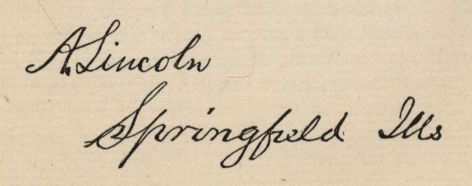
A. Lincoln, Springfield, Ills
This precious paper I still have and treasure, and shall transmit to my children, as one might the relic of a saint or the memory of an event in which love mingles and grows stronger with the lapse of time.
NOTE.—Mr. Lincoln at the time of which Gilbert Holmes speaks was in his twenty-ninth year, but already bore in his drawn face the look of melancholy habitual to it in later life. This, as if forecasting in some way the doom that was finally to overtake him in the height of his career; but not, indeed, until his task was done and his country saved through his great wisdom and patriotic effort.—THE AUTHOR.
CHAPTER XIV
THE HIGHWAYMAN
When the day was half gone, and we were worn with fatigue and hunger, we reached the edge of the forest toward which we had been tending since early morning. Here in its shadows we came upon a lonely tavern, where we found dinner and a change of horses. Here, too, the mailbag was brought forth for the first time, and its contents scanned by our host of the "White Cow"—for such was the name of the hostelry—but unavailingly, for of letters or other matter concerning him there was not a scrap. Our dinner, which was quickly served, was simple in the extreme, but greatly to our liking, consisting of cornbread and hulled corn, with pork and hot coffee for relishes; and then, to top all, and in the way of dessert, wild strawberries, with cream from the White Cow's own dairy.
When we were ready to depart the stage was brought to the door, and taking our places, we bade our host adieu, greatly refreshed in body and mind by our short stop. The way lay through the deep forest, and our progress, before slow, now became still more deliberate, for there was scarce more than a path, and across this the rank shrubbery stretched its luxuriant branches as if to further bar the way. Moreover, the road, softened by late rains, was in many places impassable, so that we often found it necessary to alight in order to lessen the load. Nor was this sufficient in many cases, but in such emergencies the great strength of Mr. Lincoln answered us in good stead, being enough in itself to lift the vehicle from the mire and place it on firm ground. In this way our stoppages were so frequent that we ceased to give them any attention; so that finally, when we came to an abrupt halt on emerging from a small stream, we thought nothing of it until a man, springing from behind the overhanging trees, called out:
"Halt! Throw up your hands!"
Not waiting a response, he came forward with resolute step, covering the occupants of the stage with the weapons he carried. Scarce had the summons been made, however, than Mr. Lincoln, with a quick movement, thrust a pistol forward and fired. Missing his mark, the shot did not stay the robber, for now, coming on with longer strides, he thrust his pistols into the stage, crying out:
"Throw up you hands, or, by heavens, I'll blow your heads off!"
At this, seeing further resistance useless, Mr. Lincoln and Uncle Job did as they were told.
"There! that's more polite. God Almighty, what an ugly shot, though!" the highwayman exclaimed, and in proof of it held up his arm, showing the sleeve of his coat half blown away. "Most men would fire back, my friend, but I am more considerate, you see, though it's not nice to welcome a man who seeks agreeable company in so rude a fashion. There! you need not excuse yourselves," he went on, in a whimsical, good-natured way; "but get down, and lest you pinch your fingers, keep your hands in the air meanwhile. There! like that; thanks!" Saying which he moved back so as to let us alight, but keeping his pistols all the while pointed in our direction. When I got down, which I did with all haste, he laughed aloud, as he did at Uncle Job; but when Mr. Lincoln bent forward to follow, the robber, scanning his face, gave a start of surprise, and lowering his weapons, cried out, as if astonished beyond measure at what he saw:
"Great God! Mr. Lincoln!"
Hearing his name thus called, Mr. Lincoln sat still, scrutinizing the robber, as if trying to recall his face.
"Good Lord!" the highwayman went on, after a moment's pause, "who would have thought to run across you here! And to think I might have killed you, of all men. Do not get down, Mr. Lincoln, but let me, and in that way ask your forgiveness, and on my knees." Saying which, and without more ado, the bandit dropped down in the road in the most ludicrous way possible, looking for all the world as if he wished he were dead, so forlorn was his aspect. To all this Mr. Lincoln made no response, but sat gazing upon the other with darkened brow in which anger and surprise were mingled. At last, raising his hand to still the other, he said, in his slow, measured way:
"What is the meaning of all this nonsense, man—if indeed you are not mad or acting a part?"
At this the robber, still kneeling, removed his hat, which before partly hid his face, and doing so, displayed a countenance singularly handsome and free from look of evil or dissipation of any kind. Seeing him thus more clearly, Mr. Lincoln exclaimed, in a voice full of astonishment and anger:
"Fox, the highwayman!"
"Yes, Fox; the scoundrel you saved from the gallows, only to risk your own life to-day."
"If not me, some one else," Mr. Lincoln answered; "for if you would rob and, if need be, murder a stranger, you would not long respect a friend; but men like you have no friends."
"No, nor deserve any, and I wish you had killed me; I would like to have died that way," the robber answered, averting his face and rising to his feet.
"I only sought to cripple your arm, as your torn sleeve shows," Mr. Lincoln answered, looking him over.
"That was like you, but I did not deserve it, nor was it a mercy to me."
"No, but I do not wish your blood on my hands. You are not to die that way, but by the hangman, Fox," Mr. Lincoln answered, soberly.
"No, no, not that!" the other cried. "I am not so bad as to deserve such a death, for I have never killed any one, and did not intend injury to you, though you will not believe it, and ought not to."
"It is not likely; but tell me how long you have been following this kind of a life," Mr. Lincoln asked, after a pause.
"I have not followed it at all, or only since yesterday."
"You are not telling the truth; but how could you take to the road again after the promises you made me?" Mr. Lincoln inquired, with a mournful cadence in his voice.
"Oh! you think I have always been a highwayman, and lied to you?" Fox cried out at this in a pitiful way.
"Certainly; or how does it happen you are here?" Mr. Lincoln asked, his voice filled with distress at the imposition that had been practiced upon him.
"It was exactly as I told you at the time, neither more nor less, though every appearance is now dead against me, I know," Fox answered, appealingly.
"I have forgotten the particulars, or remember them only vaguely. Tell them to me again, and quickly; and speak the truth as you hope to be saved," Mr. Lincoln interrupted.
"I will, but I can't speak more truly than I did before. I was in bad company, and that was all, as I told you at the time; but that was enough to undo me. A little while before you came across me in the hands of the farmers I had been sick and unfortunate. Traveling across the country, I fell ill of a fever at a farmhouse where I chanced to stop for the night; and here I remained for many weeks, while the man and his wife, themselves far from well, nursed me back to life. When strong enough to go on I had nothing save my horse with which to pay them for their kindness. This I left, though they would have prevented it if they could. Going forward on foot, and greatly enfeebled, I fell in after a while with a man leading an extra horse. Whether out of kindness because of my forlorn condition or for some other reason I know not, he asked me to make use of the spare animal. This I did, thanking him for his kindness; but when we had gone a little way on the road, and I was congratulating myself on my good fortune, I observed men following us, and as soon as they were within hearing they called to us to stop. Upon this I turned about, but my companion, going to one side, entered the forest which here grew near the road. Of this I thought nothing, but when the party, coming up, accused me of stealing the horse upon which I was mounted, I looked around for my companion to confirm my innocence, only to find he had disappeared. They laughed at my explanation, and would have hung me had you not come up, and by entreaty and promises to see that justice was done, prevailed upon them to put me in jail. For you know how it is in this disordered country; a man may rob another of his purse, and even take life, and still have the benefit of a doubt, but to have stolen a horse means death, with no trial save by men in the heat of passion."
"That is the story I remember you told me at the time; but what did you do afterward, and why have you turned highwayman if you were honest before?" Mr. Lincoln interrupted, his voice wavering between distrust and pity.
"When I was set free every one thought me guilty, nor would they believe otherwise, saying I got off because the jury was influenced by your belief that I was innocent, and that it was your plea that saved me, and nothing else. When finally no one would give me work and I was warned to leave the country, I turned to the road for a living, and poor it is, for save a worthless watch I have nothing for my pains."
Here the poor robber, as if realizing anew his forlorn condition, fell to crying as if his heart was broken. At this we were all greatly moved, so distressing was the sight, and from disbelief were every one of us led to think he spoke the truth, and in all things had been much abused by the community. For a long time nothing was said, until at last, turning to the robber, Mr. Lincoln exclaimed:
"Well, Fox, I am led to believe you again, though your presence here confirms all the things said of you before. Surely with your talents you ought to be able to do something better than this."
"Let me have a chance, Mr. Lincoln, for there never lived a man less inclined to lead such a life; but my good name is gone, and I dare not show my face among honest men. Of all the wrongdoing laid at my door this is the beginning and end," he exclaimed, drawing from his pocket a silver watch scarce worth the carrying, and handing it to Mr. Lincoln. "A few hours ago, coming upon an old man, this was all he had, and so sorrowful was his tale that in pity I was led to give him the few pieces of silver I had in exchange. Nor would I have taken the watch, only that I could not see how I was to succeed as a highwayman if I let the first man I met escape me."
"I am afraid you would make a poor robber, Fox," Mr. Lincoln answered; "and if you are still inclined to live an honest life, I will help you to start anew. Our new country is full of such breakdowns, and happy the men who can and will retrieve them."
Saying which, Mr. Lincoln, reaching out his hand, grasped that of Fox, and with such fervor and good will that should I live a thousand years I could not forget the action, nor how it thrilled me. At this tears welled up afresh in the forlorn eyes of the poor wretch, and reaching forward he would have embraced Mr. Lincoln's knees but the latter, lifting him up, exclaimed:
"There, mount and follow us, or tie your horse behind and get into the stage if you would like that better. No one here will speak of what has happened," he added, looking at each of us in turn to confirm his words. To this appeal we answered with our eyes, for we were all filled with the greatest pity.
"You are capable of great things, Fox," Mr. Lincoln went on, "and hereafter you shall look to me till you get on your feet again, which will not be long," he added, as if to encourage him. Upon this, Fox, without saying more, mounted his horse and fell in behind the stage, where he rode on in silence the rest of the afternoon.
No word was spoken after we took our seats, and so it came about that I found myself again peering into the face of the man before me, who had shown, by turns, such courage and trusting faith and womanly tenderness. It was less perplexing to me now, and in its sad expression I read, as a child might, the story of his life and its hardships; hardships patiently endured, and that would forever make its owner tender to all who were afflicted or in distress; a face shadowing forth a thousand miseries, and that in youth had looked out on a barren prospect from a body overworked and poorly nourished; a face that hid itself behind eyes weary with disappointment and vain striving; a face to invite confidence and hold it forevermore; a face full of expediency, and that would have been commanding and self-assertive had it not been softened by long waiting upon the pleasure of others; a face truly great, but having in its texture other and lesser strains such as all men's have, the kingly line, not less than the peasant's; a face in which greatness dominated all others, but sensitive withal, and scarce fitted to endure the buffetings of unthinking boors who, to be made useful, must be smoothed into good-natured complaisance. Yet such tasks its owner set about, and succeeding, suffered naught save martyrdom, of which mankind will forever reap the fruits. Of my scrutiny Mr. Lincoln took no further notice, but shrank back again within himself, as if he would hide from every one what he was or sought to be. Inscrutable man! How truly great, and yet how truly tender and honest of heart! Surely such combination ne'er found lodgement in man before, nor will again until suffering and ambition blend strains as widely divergent.
Thus the afternoon passed until the sun was setting, when we stopped at a wayside tavern for supper and a change of horses. Here Mr. Lincoln arranged for Fox to stay until his return, some days later. As for the latter, he could not be moved to take his eyes off his benefactor, but sat as if entranced, and when we drove away, watched us from the road until our lamps were lost in the depths of the surrounding forest.
CHAPTER XV
CONSTABLE BLOTT
Nothing further occurred to disturb the monotony of our journey until we neared its end, on the afternoon of the third day, when I was thrown into a fever of excitement by the strange actions of a man of savage aspect who overtook us as we were slowly making our way. Pistols protruded from his belt, and as he passed he slackened his pace, and thrusting his lean face into the stage, gazed about with such fierce assertiveness that I threw up my hands, expecting we should surely be called upon to halt; but after eying us attentively, and me most of all, he straightened up, and putting spurs to his horse, was soon lost in the distance. Before this, however, at every stop, no matter what the cause, I fell back in my seat, scarce able to breathe, thinking to hear the report of a pistol and an order to halt, so greatly had the adventure with Fox upset my nerves. Nothing of the kind occurring, my peace of mind returned at last, so that I was able to pursue the journey with some comfort, until, as I say, the savage little man with the beaked nose and fierce eyes stirred my blood afresh.
In this way our long ride came to an end on the third day, when we alighted, none the worse for our journey, in the little town of Quincy. Scarce looking to the right or left, we hurried to the river to take the boat which lay tied to the shore, with steam up. As I followed on, however, wide-eyed, I was thrown into a tremor of fright by the sight of the savage little man who had passed us on the road, who now stood as if awaiting our coming. With him there was another man of great stature, but harmless-looking, with flabby cheeks and bloated hands that seemed about to burst or drop to the ground, so limp and dangling did they appear. This man had on some badge of office, but loosely, and not as if it gave him honor or in any way added to his dignity. Between the two, the man of huge frame and the pigmy by his side, there was such contrast that for the moment I forgot my fears in staring open-mouthed. Surely nothing more remarkable was ever seen before. The weazened, parched-faced, pugnacious little man, frail of body, and with legs no bigger than mopsticks, and chest as flat as a pieplate, stood erect and eager-eyed, with the spring of a panther, though long past the prime and vigor of life; while the other, scarce thirty years of age, was shambling and heavy on his feet, and had about his sunken eyes and spongy features the marks of a man fast falling to decay. The first, any one could see, was filled to the ends of his nails with love of life, and so had studied how to prolong it; but his companion, not regarding such things, except as abstractions not needful for him to consider with his huge frame and stanch stomach, was broken and winded long before his time.
As I came up, eying them and wondering, the little man turned to his companion, and pointing to me called in a voice I could plainly hear:
"That is the lad we are after, Blott. Lay hold of him, and see that he doesn't get away."
Upon this the latter, winking heavily, as if to collect his wits, came forward, and laying his hand on my arm, said:
"Hold on, my lad, I want you."
"What for?" I asked, staring at him.
"For company mebbe, and mebbe because I've a summons for you," he answered, good-naturedly.
"A summons! What's that?" I asked, confused, not understanding fully what he meant.
"It's the beginnin' of trouble for you, I'm afeered; but what's the world comin' to, Pickle. Don't children learn nothin' nowdays, not to know what a summons is?"
"Never mind that," the savage little man exclaimed; "but tell him and march along."
"Well, sonny, it's an order to take you to court," the other answered, placidly.
"To court!" I exclaimed, striving to free myself.
"To the justice's office, innocent. Where else could it be?" he answered, taking a firmer hold of my jacket.
"Why? I've done nothing, for we have just got here," I answered, still attempting to get away.
"Mebbe, but don't ask me, for blister my nose if I know; but quit wrigglin'; you're harder to hold than an eel."
"Well, I'm not going to any justice's office," I answered, slipping out of my jacket and starting to run.
"Hello, my bird!" he cried, catching hold of me. "Now keep quiet, or I'll put the come-alongs on you, an' I'd hate to do that, you're so young an' fresh."
"You are a bigger boy than he, Blott, and don't know half as much," the little man here interposed. "What are you about? Are you going to stand here all day wrangling with him?"
"If it was you, Pickle, I'd show you how spry I could be," Blott answered, eying the other.
Seeing no way of escape, I called at the top of my voice to Uncle Job, who had stopped a few feet away, and stood beside Mr. Lincoln, watching the loading of the boat. Hearing my cry and seeing the officer, they turned and hurried back.
"What have you got your hand on that lad for, officer?" Uncle Job asked, as he came up.
"'Cause I'm attached to him," he answered, winking stupidly at Mr. Lincoln.
"What do you mean! Let go of him, I say!" Uncle Job demanded, advancing with a determined air.
"Yes, when I've delivered him to the justice, as the summons says, an' not before; so don't git red in the face or meddle," the constable answered, facing Uncle Job and straightening up.
"The summons! What summons? There is some mistake, man! No one has issued a summons for him, for we haven't been here five minutes."
"You've another guess, my friend. I only know what I know, an' as the fee is small I'm not 'tending night-school to increase my learnin'. So stand back an' don't interfere," the constable answered, good-naturedly, but as one in the right.
"What reason is there for issuing the summons? Surely you must know that?" Uncle Job asked, bewildered.
"I don't know what he's done, nor why; but mebbe Pickle there can tell you. He knows everything," Blott answered, nodding toward the little man in gray, who now stepped forward and spoke up with great show of authority.