Front matter (continued 4)
Henry Harland translation
As the fateful day approached, Mlle. Marguerite lost the feverish vivacity which had seemed to inspire her since the date of the marriage had been fixed, and relapsed at times into the fits of indolence and sombre reverie formerly habitual to her. Once or twice I surprised her watching me in wondering perplexity. Mme. Laroque, too, often looked at me with an anxious and hesitating air, as if she wished and yet feared to discuss some painful subject with me. The day before yesterday I found myself by chance alone with her in the salon, which Mlle. Hélouin had just left to give some order. The trivial conversation in which we had been engaged ceased suddenly, as by common consent. After a short silence, Mme. Laroque said, in a voice full of emotion:
"M. Odiot, you are not wise in your choice of confidants."
"Confidants, madame? I do not follow you. Except Mlle. de Porhoët, I have had no confidant in this place."
"Alas!" she replied, "I wish to believe you ... I do believe you ... but that is not enough——"
At this moment Mlle. Hélouin came in, and no more could be said.
The day after—yesterday—I had ridden over in the morning to superintend some wood-cutting in the neighbourhood. I was returning to the château about four in the afternoon, when, at a sharp turn of the road, I found myself face to face with Mlle. Marguerite. She was alone. I prepared to pass her with a bow, but she stopped her horse.
"What a fine autumn day!" she said.
"Yes, mademoiselle. You are going for a ride?"
"As you see. I am making the best of my moments of independence, and, in fact, I have been rather abusing my liberty, for I am somewhat tired of solitude. But Alain is wanted at the house.... Poor Mervyn is lame.... You would not care to take his place?"
"With pleasure. Where are you going?"
"Well ... I thought of riding as far as the tower of Elven."
With her whip she indicated the misty summit of a hill which rose on the right of the road.
"I think," she went on, "you've never made that pilgrimage?"
"I have not. I have often meant to, but until now I have always put it off. I don't know why."
"Well, that is fortunate; but it is getting late; we must make haste, if you don't mind."
I turned my horse and we set off at a gallop.
As we rode along, I tried to account for this unexpected fancy which had an air of premeditation. I imagined that time and reflection had weakened the first impression that calumnies had made on Mlle. Marguerite. Apparently, she had conceived some doubts of Mlle. Hélouin's veracity, and had seized an opportunity to make, in an indirect way, a reparation which might be due to me. My mind full of such preoccupations, I gave little thought to the particular object of this strange ride. Still, I had often heard the tower of Elven described as one of the most interesting ruins of the country. I had never gone along either of the roads—from Rennes or from Josselin—which lead to the sea, without looking longingly at the confused mass rearing up suddenly among the distant heaths like some huge stone on end. But I had had neither time nor opportunity to examine it.
Slackening our pace, we passed through the village of Elven, which preserves to a remarkable extent the character of a mediæval hamlet. The form of the low, dark houses has not changed for five or six centuries. You think you are dreaming, when, looking into the big arched bays which serve as windows, you see the groups of mild-eyed women in sculpturesque costume plying their distaffs in the shade, and talking in low tones an unknown tongue. These gray spectral figures seem to have just left their tombs to repeat some scene of a bygone age, of which you are the only witness. It gives a sense of oppression. The sluggish life that stirs around you in the single street of the village has the same stamp of archaic strangeness transmitted from a vanished world.
A little way from Elven we took a cross-road that brought us to the top of a bare hillock. Thence, though still some distance off, we could plainly see the feudal colossus crowning a wooded height in front of us. The lande we were on sloped steeply to some marshy meadows inclosed by thickets.
We descended the farther side and soon entered the woods. Then we struck a narrow causeway, the rugged pavement of which must once have rung to the hoofs of mail-clad horses. For some time I had lost sight of the tower of Elven, and could not even guess where it was, when all at once it stood out like an apparition from among the foliage a few paces in front of us. The tower is not a ruin; it preserves its original height of more than a hundred feet, and the irregular courses of granite which make up its splendid octagonal mass give it the appearance of a huge block cut out but yesterday by some skilful chisel. It would be difficult to imagine anything more proud, sombre, and imposing than this old donjon, impassible to the course of ages, and lost in the depths of the forest. Full-grown trees have sprung up in the deep moats which surround it, and their tops scarcely touch the openings of the lowest windows. This gigantic vegetation, which entirely conceals the base of the edifice, completes its air of fantastic mystery. In this solitude, among these forests, before this mass of weird architecture, which seems to start up suddenly out of the earth, one thinks involuntarily of those enchanted castles in which beautiful princesses slept for centuries awaiting a deliverer.
"So far," said Mlle. Marguerite, to whom I had endeavoured to convey these impressions, "this is all I have seen of it, but if you want to wake the princess, we can go in. I believe there is always somewhere near a shepherd or shepherdess who has the key. Let us tie up the horses and search, you for the shepherd, and I for the shepherdess."
We put the horses into a small inclosure near and separated for a little while, but found neither shepherd nor shepherdess. Of course this increased our desire to visit the tower. Crossing a bridge over the moat, we found to our great surprise that the heavy door was not closed. We pushed it and entered a dark and narrow space choked with rubbish, which may have been the guard-room. We passed thence into a large, almost circular hall, where an escutcheon in the chimneypiece still displayed the bezants of a crusader. A large window faced us, divided by the symbolic cross clearly carved in stone. It lighted all the lower part of the room, leaving the vaulted and ruined ceiling in shadow. At the sound of our steps a flock of birds whirled off, sending the dust of ages on to our heads.
By standing on the granite benches, which ran like steps along the side of the walls, in the embrasure of the window, we could see the moat outside and the ruined parts of the fortress. But as we came in we had noticed a staircase cut out of the solid wall, and we were childishly eager to extend our discoveries. We began the ascent, I leading, and Mlle. Marguerite following bravely, and managing her long skirts as best she could. The view from the platform at the top is vast and exquisite. The soft hues of twilight tinged the ocean of half-golden autumnal foliage, the gloomy marshes, the fresh pastures, and the distant horizons of intersecting slopes, which mingled and succeeded each other in endless perspective. Gazing on this gracious landscape, in its infinite melancholy, the peace of solitude, the silence of evening, the poetry of ancient days fell like some potent spell upon our hearts and spirits. This hour of common contemplation and emotions of purest, deepest pleasure, no doubt the last I should spend with her, I entered into with an almost painful violence of enjoyment. I do not know what Marguerite was feeling; she had sat down on the ledge of the parapet, and was gazing into the distance in silence.
I cannot say how many moments passed in this way. When the mists gathered in the lower meadows, and the distant landscape began to fade into the growing darkness, Marguerite rose.
"Come," she said in a low voice, as if the curtain had fallen on some beautiful spectacle; "come; it's over."
She began to descend the stairs, and I followed her.
But when we tried to get out of the donjon, to our great surprise we found the door closed. Most likely the doorkeeper, not knowing that we were there, had locked it while we were on the platform. At first this amused us. The tower was really an enchanted tower. I made some vigorous efforts to break the spell, but the huge bolt of the old lock was firmly fixed in its granite socket, and I had to give up all hope of moving it. I attacked the door itself, but the massive hinges and the oak panels studded with iron stolidly resisted all my efforts. Some stone mullions, which I found among the rubbish and hurled against the door, only shook the vault and brought some fragments from it to our feet. Mlle. Marguerite at last made me give up a task that was hopeless, and not without danger. I then ran to the window and shouted, but no one replied. For ten minutes I continued shouting, and to no purpose. We took advantage of the last rays of light to explore the interior of the donjon very carefully. But the door, which was as good as walled up for us, and the large window, thirty feet above the moat, were the only exits we could discover.
Meanwhile, night had fallen on the fields, and the shadows deepened in the old tower. The moonbeams shone in through the window, streaking the steps with oblique white lines. Mlle. Marguerite's gaiety had gradually died away, and she had even ceased to answer the more or less probable conjectures with which I still tried to calm her apprehensions. While she kept silent and immovable in the shadow, I sat in the full light on the step nearest the window, still shouting at intervals for help; but, to speak the truth, the more uncertain the success of my attempts became, the more I was conscious of a feeling of irresistible joyfulness. For suddenly I saw the eternal and impossible dream of lovers realized for me; I was shut in the heart of a desert and in the most complete solitude with the woman I loved. For long hours there would be but she and I in the world, but her life and mine. I thought of all the sweet evidences of protection and of tender respect it would be my right and my duty to show her. I imagined her fears at rest, her confidence restored, finally her slumbers guarded by me. I told myself, in rapture, that this auspicious night, though it could not give me her love, would at least insure me her unalterable respect.
As I yielded, with the egotism of passion, to my secret ecstasy, some trace of which, perhaps, expressed itself in my face, I was suddenly awakened by these words, spoken in a dull tone, and with affected calm:
"M. le Marquis de Champcey, have there been many cowards in your family before you?"
I rose, and immediately fell back again on the stone bench, looking stupidly into the darkness, where I saw dimly the ghostly figure of the young girl. Only one idea occurred to me—a terrible idea—that grief and fear had affected her reason—that she was going mad.
"Marguerite!" I cried, without knowing that I spoke.
The word no doubt put a climax to her irritation.
"My God, this is hateful!" she continued. "It is cowardly. I repeat, it is cowardly."
I began to see the truth. I descended one of the steps.
"What is the matter?" I said coldly.
She replied with abrupt vehemence: "You paid that man or child, whichever it was, to shut us up in this wretched tower. To-morrow I shall be ruined ... my reputation lost ... then I shall have perforce to belong to you. That was your calculation, wasn't it? But, I warn you, it will not serve you any better than the rest. You still know me very little if you think I would not prefer dishonour, the convent, death, anything, to the vileness of yielding my hand—my life—to yours. And suppose this infamous trick had succeeded, suppose I had been weak enough—which of a surety I never shall be—to yield myself, and what you covet more, my fortune to you, what kind of a man can you be? What mud are you made of, to desire wealth and a wife by such means? Ah! you may thank me for not yielding to your wishes. They are imprudent, believe me; for if ever shame and public ridicule drove me to your arms, I have such a contempt for you that I would break your heart. Yes, were it as hard and cold as these stones, I would press blood and tears from it!"
"Mademoiselle," I said, with all the calm I could command, "I beg you to return to yourself, to your senses. On my honour I assure you that you do me injustice. Think for a moment. Your suspicions are quite absurd. In no possible way could I have accomplished the treachery of which you accuse me; and even if I could have done so, when have I ever given you the right to think me capable of it?"
"Everything I know of you gives me this right!" she cried, lashing the air with her whip. "I will tell you once for all what has been in my thoughts for a long time. Why did you come into our house under a false name, in a false character? My mother and I were happy and at peace. You have brought trouble, anxiety, and sorrow upon us. To attain your object, to restore your fallen fortunes, you usurped our confidence ... you destroyed our peace ... you have played with our purest, deepest, and holiest feelings ... you have bruised and shattered our hearts without pity. That is what you have done or tried to do, it doesn't matter which. Well, I am utterly weary of, utterly disgusted with, all this. I tell you plainly. And when now you offer to pledge your honour as a gentleman, the honour that has already allowed you to do so many unworthy things, certainly I have the right not to believe in it—I do not believe in it."
I lost all control of myself. I seized her hands in a transport of violence which daunted her. "Marguerite, my poor child, listen. I love you, it is true, and a love more passionate, more disinterested, more holy, never possessed the heart of man. But you—you love me too! Unhappy girl, you love me and you are killing me. You talk of a bruised and a broken heart. What have you done to mine? But it is yours. I give it up to you. As for my honour, I keep it ... it is intact, and before long I shall compel you to acknowledge this. And on that honour I swear that if I die, you will weep for me; that if I live—worshipped though you are—never, never, were you on your knees before me, would I marry you unless you were as poor as I, or I as rich as you. And now pray! pray! Ask God for a miracle; it is time!"
Then I pushed her roughly far from the embrasure, and sprang on to the highest step. A desperate idea had come to me. I carried it out with the precipitation of positive madness. As I have said, the tops of the beeches and oaks that grew in the moat were on the level of the window. With my bent whip I drew the ends of the nearest branches to me, seized them at random, and let myself drop into the void. I heard my name—"Maxime!"—uttered with a wild cry above my head. The branches I held bent their full length towards the abyss; there was an ominous crack, and they broke under my weight. I fell heavily on the ground. The muddy nature of the soil must have deadened the shock, for I felt that I was alive, though a good deal hurt. One of my arms had struck the stonework of the moat, and I was in such pain that I fainted. Marguerite's despairing voice recalled me to myself.
"Maxime! Maxime!" she cried, "for pity's sake, for God's sake, speak to me! Forgive me!"
I got up and saw her in the bay of the window, standing in an aureole of pale light, her head bare, her hair loose, her hands grasping the bar of the cross, while her glowing eyes searched the dark abyss.
"Don't be alarmed," I said; "I'm not hurt. Only be patient for an hour or two. Give me time to get to the château—that is the best place to go. You may be sure I shall keep your secret and save your honour, as I have just saved my own."
I scrambled painfully out of the moat and went to look for my horse. I used my handkerchief as a sling for my left arm, which was quite disabled and gave me great pain. The night was clear and I found the way easily. An hour later I was at the château. They told me that Dr. Desmarets was in the drawing-room. I hurried there and found him and a dozen others, all looking anxious and alarmed.
"Doctor," I said lightly as I came in, "my horse shied at his own shadow and came down in the road. I think my left arm is put out. Will you see?"
"Eh, what?—put out?" said M. Desmarets, after he had removed the handkerchief. "Your arm's broken, my poor boy."
Mme. Laroque started up with a little scream and came towards me.
"It seems we are to have an evening of misfortunes," she said.
"What else has happened?" I asked, as if surprised.
"I am afraid my daughter must have had an accident. She went out on horseback about three; it is now eight, and she has not returned!"
"Mlle. Marguerite? Why, I met her..."
"Met her? When? Where? Forgive a mother's selfishness, M. Odiot."
"Oh, I met her on the road, about five. She told me she thought of going as far as the tower of Elven."
"The tower of Elven! She has lost her way in the woods. We must send at once and search."
M. de Bévallan ordered horses to be got ready immediately. At first I pretended that I meant to be of the party, but Mme. Laroque and the doctor would not hear of it. Without much trouble I was persuaded to take to my bed, which, truth to tell, I needed badly. M. Desmarets attended to my arm, and then drove away with Mme. Laroque, who was to await the result of the search inaugurated by M. de Bévallan at the village of Elven.
About ten o'clock Alain came to tell me that Mlle. Marguerite had been found. He related the story of her imprisonment without omitting any details, except, of course, those known only to me and the young girl. The news was soon confirmed by the doctor, and afterwards by Mme. Laroque, and I had the satisfaction of seeing that no one suspected what had actually occurred.
I passed the night in repeating the dangerous leap from the window of the donjon with all the grotesque complications of fever and delirium. I did not get used to it. Every moment the sensation of falling through emptiness caught me by the throat, and I awoke breathless. At last day came, and I got calm. At eight o'clock Mlle. de Porhoët came in and took her place at my bedside with her knitting in her hand. She did the honours of my room to the visitors who followed one another throughout the day. Mme. Laroque was the first after my old friend. As she held my hand and pressed it earnestly I saw tears on her face. Has her daughter confided in her?
Mlle. de Porhoët told me that old M. Laroque had been confined to his bed since yesterday. He had a slight attack of paralysis. To-day he cannot speak, and they are much alarmed about him. The marriage is to be hastened. M. Laubépin has been sent for from Paris; he is expected to-morrow, and the contract will be signed the following day, under his direction.
I have been able to sit up for some hours this evening, but, according to M. Desmarets, I should not have written while the fever was on me, and I am a great idiot.
October 3d.
Really it seems as if some malign power were hard at work devising the strangest and most cruel tests for my conscience and heart alternately.
M. Laubépin not having arrived this morning, Mme. Laroque has asked me to give her some of the information necessary for drawing up the general conditions of the contract, which is to be signed to-morrow. As I am obliged to keep my room for some days yet, I asked Mme. Laroque to send me the title-deeds and private documents in her father-in-law's possession, as they were indispensable for the clearing up of the points she had mentioned to me.
Very soon they brought me two or three drawers full of papers which they had taken out of M. Laroque's cabinet while he was asleep, for the old gentleman would never let any one touch his secret archives. On the first paper that I took up I saw my family name repeated several times. My curiosity was irresistibly aroused. Here is the literal text of the document:
To MY CHILDREN
The name I bequeath to you, and which I have honoured, is not mine. My father's name was Savage. He was overseer of a large plantation in the Island of St. Lucia (then French), which belonged to a rich and noble family of Dauphiné—the Champcey d'Hauterives. In 1793 my father died, and, though I was quite young, I succeeded to the trust the Champceys reposed in him. Towards the end of that disastrous year the French Antilles were taken by the English or given up to them by the rebel colonists. The Marquis of Champcey d'Hauterive (Jacques-Auguste), whom the orders of the Convention had not yet struck down, then commanded the Thetis frigate, which had been cruising on this coast for three years. A good number of the French colonists of the Antilles had succeeded in realizing their fortunes, which had been in imminent peril. They had arranged with the Commandant de Champcey to get together a fleet of light transports, to which their property had been transferred, and which was to sail for France under the protection of the guns of the Thetis. In view of imminent disasters, I had myself received, a long time back, an order and authority to sell the plantation at any price. On the night of November 14, 1793, I put out alone in a boat for the Point of Morne-au-Sable and secretly left St. Lucia, already occupied by the enemy. I brought with me in English notes and guineas the amount I had received for the plantation. M. de Champcey, thanks to his intimate knowledge of the coast, had slipped past the English cruiser and had taken refuge in the dangerous and unknown channel of Gros-Ilet. He had instructed me to join him there this night, and only awaited my arrival to leave the channel with his convoy and make for France. In crossing, I fell into the hands of the English. These experts in treason gave me the choice of being shot on the spot or of selling them, for the million I had with me, which they agreed to leave in my hands, the secret of the channel where the fleet was hiding. I was young ... the temptation was too great. Half an hour later the Thetis was sunk, the convoy taken, and M. de Champcey seriously wounded. A year passed—a year without sleep.... I was going mad.... I determined to make the cursed English pay for the remorse I suffered. I went to Guadeloupe; I changed my name; I devoted the larger part of the money I had received to the purchase of an armed brig, and I fell upon the English. For fifteen years I washed in their blood and my own the stain that in an hour of weakness I had brought on my country's flag. Though three parts of my fortune have been acquired in honourable combats, its origin was, nevertheless, the price of my treachery.
Returning to France in my old age, I ascertained the position of the Champcey d'Hauterives, and found that they were happy and wealthy. I kept my own counsel. I ask my children to forgive me. While I lived I had not the courage to blush before them. My death will reveal this secret to them. They must use it as their consciences may direct. For myself I have only one prayer to address to them. Soon or late there will be a final war between France and her neighbour. We hate one another too much; there's nothing else to be done; either we must devour them or they must devour us. If this war should be declared during the life of my children or grand-children, I desire that they give to the state a corvette fully armed and completely equipped, on one condition, that it shall be called the Savage, and be commanded by a Breton. At each broadside she shall send on to the Carthaginian shore my bones will tremble with joy in my grave.
RICHARD SAVAGE, called LAROQUE.
The memories that this terrible confession awakened convinced me that it was correct. Twenty times I had heard my father relate with pride and indignation this incident in my ancestor's career. But in the family we believed that Richard Savage—I remember the name quite well—had been the victim, and not the contriver of the treason or mischance which had betrayed the commandant of the Thetis. Now I understand the peculiarities I had often noticed in the old sailor's character, and especially his thoughtful and timid bearing towards me. My father had always told me that I was the living portrait of my grandfather, the Marquis Jacques, and perhaps some dim perception of this resemblance had penetrated to the old man's troubled brain.
This revelation threw me into a terrible perplexity. I felt but little resentment against the unhappy man who had redeemed a moment of weakness by a long life of repentance, and by a passion of desperation and hatred which was not without greatness. Nor could I, without admiration, breathe the wild blast which animated the lines written by this guilty but heroic hand. Still, what was I to do with this terrible secret? My first thought was that it removed all obstacles between Marguerite and me; that henceforth the fortune that had kept us apart would be almost an obligatory bond, for I was the only person in the world who could regularize her title to it by sharing it with her. But in truth this secret did not belong to me, and though I had learned it by the purest of accidents, strict honesty, perhaps, demanded that I should leave it to come at its own time into the hands for which it was destined. But while I waited for that moment the irreparable would be accomplished. Eternal bonds were to be forged. The tomb was to close over my love, my hopes, and my sorrowful heart. And should I allow it when I might prevent it by a single word? And the day these poor women learned the truth, and blushed with shame to learn it, perhaps they would share my regret and despair. They would be the first to cry:
"Ah! if you knew, why did you not speak?"
No, neither to-day nor to-morrow, nor ever, shall those noble women blush for shame if I can prevent it. My happiness shall not be bought at the price of their humiliation. This secret is mine alone. The old man, henceforth speechless, cannot betray himself. The secret does not exist; the flames have destroyed it. I pondered it well. I know what I have dared to do. It was a will, a sacred document, and I have destroyed it. Moreover, it did not benefit me alone. My sister, who is intrusted to my care, might have found a fortune there, and, without consulting her, I have plunged her back into poverty. I know all that, but I will not allow two pure proud souls to be crushed and dishonoured by the burden of a crime of which they are ignorant. There is a principle of equity at stake far superior to mere literal justice. If, in my turn, I have committed a crime, I will answer for it. But the struggle has exhausted me. I can do no more now.
October 4th.
M. Laubépin, after all, arrived yesterday. He came to see me. He was brusque, preoccupied, and seemed ill-pleased. He spoke briefly of the marriage.
"A very satisfactory business!" he said; "in all respects an excellent combination, where nature and society both receive the guarantees they have the right to require in such matters. And so, young man, good-night. I have to smooth the delicate ground of the preliminary agreements, that the hymeneal car of this interesting union may reach its goal without jolting."
At one o'clock this afternoon the family assembled in the drawing-room with all the preparations and formalities observed at the signing of a marriage contract. I could not attend this ceremony, and I blessed my broken arm for sparing me the trial. About three I was writing to little Hélène, and taking care to assure her more strongly than ever of my complete devotion to her, when M. Laubépin and Mlle. de Porhoët came into my room. In his frequent visits to Laroque, M. Laubépin has learnt to appreciate my venerable friend, and the two old people have formed a respectful and Platonic attachment, which Dr. Desmarets tries in vain to misrepresent. After an exchange of ceremonies, of interminable bows and courtesies, they took the chairs I offered them, and both set about considering me with an air of grave beatitude.
"Well," I said, "it's over?"
"Yes," they replied in chorus, "it's over."
"It went off well?"
"Very well," said Mlle. de Porhoët.
"Wonderfully well," said M. Laubépin. After a pause he added: "Bévallan's gone to the devil!"
"And the young Hélouin after him!" continued Mlle. de Porhoët.
I exclaimed in surprise:
"Good God! what has happened?"
"My friend," said M. Laubépin, "the contemplated union had every possible advantage, and it would have without doubt insured the common happiness of both the parties concerned, if marriage were a purely commercial partnership; but it is nothing of the sort. As my assistance had been asked, I thought it my duty to bear in mind the inclination of the hearts and the agreement of the character just as much as the relative proportions of the estates. Now, from the first, I had the impression that the contemplated marriage had one drawback. It pleased no one, neither my excellent friend Mme. Laroque, nor the amiable fiancée, nor their most sensible friends—no one, in fact, except perhaps the fiancé, about whom I trouble myself very slightly. It is true (I quote here from Mlle. de Porhoët), it is true, I say, that the fiancé is *gentilhomme...."
"A gentleman, if you please," Mlle. de Porhoët interrupted severely.
"A gentleman," continued M. Laubépin, accepting the correction, "but it is a kind of gentleman I don't care for."
"Nor I," said Mlle. de Porhoët. "There are curious specimens of the kind. Dissipated stablemen, such as those whom we saw last century deserting their English stables under the direction of the Duc de Chartres to come over here and prepare the Revolution."
"Oh, if they had only prepared the Revolution," said M. Laubépin, sententiously, "we should forgive them."
"A million apologies, my dear sir; but—speak for yourself! Besides, that is not the question; will you go on?"
"So," continued M. Laubépin, "seeing that every one was approaching this wedding as if it were a funeral, I searched for some honourable and legal means, not to break the engagement with M. de Bévallan, but to get him to withdraw voluntarily. This proceeding was the more justifiable, as in my absence M. de Bévallan had profited by the inexperience of my excellent friend, Mme. Laroque, and the weakness of my colleague in the neighbouring town, to make the most exorbitant demand in his own interests. Without departing from the wording of the agreements, I succeeded in materially altering their spirit. But there were limits which honour and the engagements already entered into forbade me to pass. And the contract remained favourable enough to be accepted with confidence by any high-minded man who had a sincere affection for his betrothed. Was M. de Bévallan such a man? We had to take that risk. I confess that I was not free from emotion when I began to read the irrevocable document before an imposing audience this morning."
"As for me," interrupted Mlle. de Porhoët, "I hadn't a drop of blood left in my veins. The first part of the contract conceded so much to the enemy that I thought all was lost."
"No doubt, mademoiselle; but, as we augurs say among ourselves, 'the sting is in the tail,' in cauda venenum.
"It was comical, my friend, to see the faces of M. de Bévallan and my confrère from Rennes, who assisted him, when I suddenly unmasked my batteries. At first they looked at each other in silence; then they whispered together; at last they rose, and, coming to the table where I sat, asked me in a low voice for an explanation.
"'Speak up, gentlemen, if you please,' I said to them. 'We must have no mysteries here. What have you to say?'
"The company began to prick up their ears. Without raising his voice, M. de Bévallan suggested to me that the contract showed mistrust.
"'Mistrust, sir!' I replied, in my most impressive tone. 'What do you intend to convey by that? Do you make that strange imputation against Mme. Laroque, or against me, or against my confrère here present?'
"'S-s-sh! Silence! No wrangling!' said the Rennes notary discreetly; 'But listen: it was agreed in the first place that the legal system of dotation should not be insisted on.'
"'The legal system? And where do you find that mentioned?'
"'Oh, my dear sir, you know that you have practically reconstituted it by a subterfuge.'
"'Subterfuge, monsieur? Allow me, as your senior, to advise you to withdraw that word from your vocabulary.'
"'But, after all,' murmured M. de Bévallan, 'I'm tied hand and foot, and treated like a school-boy.'
"'Indeed, sir! What, in your opinion, are we here for at this moment—a contract or a will? You forget that Mme. Laroque is living; that her father is living, and that it is a question of marriage, not of inheritance—at least, not yet.... Really, you must have a little patience; you must wait a little.'
"At these words Mlle. Marguerite rose.
"'That is enough,' she said.—'M. Laubépin, throw that contract into the fire. Mother, let this gentleman's presents be returned.'
"Then she rose and left us like an outraged queen. Mme. Laroque followed her, and at the same time I threw the contract into the fireplace.
"'Sir,' said M. de Bévallan in a threatening tone, 'there's some trickery in this, and I will find it out.'
"'Sir,' I replied, 'allow me to explain it to you. A young lady, who, with a just pride, values herself very highly, feared that your offer might have been influenced by her wealth; she wished to be certain; she has no longer any doubts. I have the honour to wish you good-day!'
"Thereupon, my friend, I went after the ladies, and—upon my honour—they embraced me.
"A quarter of an hour later, M. de Bévallan left the château with my colleague from Rennes. His departure and disgrace have naturally loosened the servants' tongues, and very soon his imprudent intrigue with Mlle. Hélouin was revealed. The young lady, already suspected on other grounds for some time past, has asked to be released from her duties, and the request has been granted. It is needless to say that our ladies will secure her future.
"Well, my dear fellow, what do you say to all this? Are you worse? You're as pale as death!"
This unexpected news had aroused so many emotions—pleasant and painful—that I felt myself on the point of losing consciousness.
M. Laubépin, who has to leave at daybreak to-morrow, came back this evening to wish me farewell. After some embarrassed remarks from us both, he said:
"Never mind, my dear boy, I'll not cross-examine you on what is going on here; but if you should require a confidant and a counsellor, I ask you to give me the preference."
As a matter of fact, I could not confide in a heart more sympathetic or more friendly. I gave the worthy old gentleman the particulars of my relations with Mlle. Marguerite. I even read some pages of this journal to him to show him more exactly the state of affairs, and also the state of my heart. I hid nothing from him save M. Laroque's secret.
When I had finished, M. Laubépin, who had suddenly become very thoughtful, began:
"It is useless to conceal from you, my friend, that when I sent you here I intended you to marry Mlle. Laroque. At first everything went as I wished. Your hearts, which I believe are worthy of one another, could not associate without sympathizing, but this strange event, of which the tower of Elven was the romantic scene, entirely disconcerts me, I must confess. Allow me to tell you, my young friend, that to jump out of window at the risk of breaking your neck was in itself a more than sufficient proof of your disinterestedness. It was quite superfluous to add to this honourable and considerate proceeding a solemn oath never to marry this poor girl except in contingencies we cannot possibly expect to see realized. I pride myself on being a man of resource—but I fully recognise that I cannot give you two hundred thousand francs, or take them away from Mlle. Laroque."
"Then tell me what to do, sir. I have more confidence in you than in myself, for I see that misfortune, which is always exposed to suspicion, has made me excessively susceptible on questions of honour. Speak. Do you counsel me to forget the imprudent but still solemn oath which alone at this moment separates me from the happiness you had imagined for your adopted son?"
M. Laubépin rose; his thick eyebrows drawn down over his eyes, he strode about the room for some minutes, then, stopping in front of me and seizing my hand, he said:
"Young man, it is true that I love you like my own child; but, even at the cost of breaking your heart and my own, I will not be false to my principles. It is better in matters of honour do too much than too little, and as regards oaths, all those that are not extorted at the point of the knife or the mouth of a pistol, should either not be taken or should be kept. That is my opinion."
"It is mine too. I will leave with you to-morrow morning."
"No, Maxime, stay here a little longer. I do not believe in miracles, but I believe in God, who seldom allows us to be ruined by our virtues. Give Providence more time. I know that I am asking a very courageous effort from you, but I claim it formally from your friendship. If within a month you do not hear from me—well—then you can leave."
He embraced me and left me to my quiet conscience and my desolate heart.
October 12th.
It is now two days since I have been able to leave my retirement and appear at the château. I had not seen Mlle. Marguerite since we separated at the tower of Elven. She was alone in the salon when I entered. Recognising me, she made—involuntarily—an effort to rise. Then she sat motionless, and a flood of burning crimson dyed her face. It was infectious, for I felt that I was blushing to the forehead.
"How are you, M. Odiot?" she said, holding out her hand, and she spoke these simple words so gently, so humbly—alas! so tenderly too—that I longed to throw myself on my knees before her. But I had to answer in a tone of icy politeness. She looked sadly at me, lowered her great eyes with an air of resignation, and went on with her work.
Almost at the same moment her mother called to her to come to her grandfather, whose condition had become most alarming. For some days now he had lost voice and movement; the paralysis was almost total. The last gleams of mental life were extinguished; only physical sensibility and the capacity for suffering remained. The end was not far off, but in this energetic heart life was too deeply rooted to be relinquished without an obstinate struggle. The doctor had foretold that his agony would last a long time. Still, at the first appearance of danger, Mme. Laroque and her daughter had tended him with the passionate self-sacrifice and utter devotion which are the special virtue and glory of their sex. The day before yesterday they broke down exhausted. M. Desmarets and I offered to take their places by M. Laroque to-night, and they agreed to have a few hours' rest. The doctor, who was very much fatigued, soon told me that he was going to throw himself on the bed in the next room.
"I am no use here," he said; "the thing is over. You see the poor old fellow doesn't suffer any more. That lethargic state is not painful. The awakening will be death. So we can be quiet. Call me if you see any change, but I think it won't come till to-morrow. I'm dying for a sleep."
He gave a great yawn and went out. His language and his conduct before the dying man had shocked me. He is an excellent man; but to render to death the respect that is due to it, one must not see only the brute matter it dissolves, but believe in the immortal essence it releases.
Left alone in the chamber of death, I sat near the foot of the bed, where the curtains had been withdrawn, and I tried to read by a lamp that stood on a little table near me. The book slipped from my hands. I could think only of the strange combination of events which, after so many years, gave this guilty old man the grandson of his victim as witness and guardian of his last sleep. Then, in the tranquility of that hour and place, I recalled, in spite of myself, the scenes of tumult and bloody violence which had filled the life that was now ebbing away. I looked for traces of it on the face of the dying old man and on the large features defined in the shadow with the pale distinctness of a plaster mask. I saw only the solemnity and premature peace of the tomb. At intervals I went to the bedside to make sure that the weakened breast still heaved with vital breath. Towards the middle of the night an irresistible torpor seized me, and I slept, leaning my forehead on my hand. Suddenly I was awakened by a strange and sinister sound. I looked up, and a shudder ran through the marrow of my bones. The old man was half-sitting up in bed, staring at me with an intent, astonished look, and an expression of life and intelligence that I had not seen in him before. When our eyes met he started, stretched out his arms, and said, in a beseeching voice, whose strange unknown quality almost stopped the beating of my heart:
"Marquis, forgive me!"
In vain I tried to rise, to speak. I sat petrified in my chair.
After a silence, during which the dying man's eyes were still fixed on mine beseechingly, he repeated:
"Marquis, deign to forgive me."
At last I summoned up strength to go to him. As I approached he drew back fearfully, as if shrinking from a dreadful contact. I raised my hand, and lowering it gently before his staring and terror-stricken eyes:
"Rest in peace," I said; "I forgive you."
Before I had done speaking, his withered face lighted up with a flash of joy and youth. Two tears burst from his dry and sunken orbits. He stretched a hand to me, then suddenly the hand stiffened in a threatening gesture, and I saw his eyes roll between their dilated lids, as if a ball had gone through his heart.
"Oh, the English!" he whispered, and immediately fell back on the pillow like a log. He was dead. I called quickly, and the others came. Soon he was surrounded by pious mourners, weeping and praying for him. I retired, my soul deeply moved by this extraordinary scene, which I had resolved should ever remain a secret between myself and the dead man.
This sad event brought me cares and duties which I needed to justify me in my own eyes for remaining in the house. I cannot fathom M. Laubépin's motives for advising me to delay my departure. What did he hope from it? To me he seems to have yielded to a vague presentiment and childish weakness, to which a man of his stamp should never have given way, and to which I also was wrong to submit. Why did he not see that besides bringing additional suffering on me, he put me in a position that is neither manly nor dignified? What am I to do here now? Would they not have good reason to reproach me with trifling with sacred feelings? My first interview with Mlle. Marguerite had shown me how hard and how unbearable was the trial to which I had been condemned. The death of M. Laroque would make our relations easier, and give my presence a sort of propriety.
October 26th, Rennes.
All is over! God, how strong that tie was! How it held my heart, and how it has torn it as it broke! Yesterday evening about nine, as I leaned on my open window, I was surprised to see a faint light coming towards my house through the dark alleys of the park, and from a direction which the servants at the château do not frequent. A moment afterward there was a knock at my door and Mlle. de Porhoët came in breathless.
"Cousin," she said, "I have business with you."
I looked straight at her.
"A misfortune?" I said.
"No, it is not precisely that. Besides, you shall judge for yourself. My dear child, you have passed two or three evenings this week at the château. Have you noticed nothing unusual, nothing peculiar, in the attitude of the ladies?"
"Nothing."
"Have you not even noticed an unusual serenity in their appearance?"
"Perhaps I have. Allowing for the melancholy due to their recent sorrow, they seemed calmer and happier than before."
"No doubt. Other things would have struck you if, like me, you had lived in daily intimacy with them for fifteen years. Thus, I have observed signs of some secret understanding and mysterious agreement between them. Moreover, their habits have been largely altered. Mme. Laroque has given up her braséro, her sentry-box, and all her little Creole fancies. She rises at marvellous hours, and at daybreak instals herself with Marguerite at the work-table. They are both taken with a sudden passion for embroidery, and have ascertained how much a woman can earn at that work in a day. In short, there is a riddle to which I cannot find the answer. But it has been told me, and though I may be intruding on your secrets, I thought it right to inform you at once."
I assured Mlle. Porhoët of my absolute confidence in her, and she continued:
"Mme. Aubry came to see me this evening secretly. She began by throwing her wretched arms round my neck, which displeased me very much. Then, to the accompaniment of a thousand jeremiads about herself—which I will spare you—she begged me to stop her relations on the brink of ruin. This is what she has heard, through listening at doors, according to her pretty habit: The ladies are trying to get permission to transfer all their property to a community at Rennes, so as to do away with the difference of fortune which separates you and Marguerite. As they can't make you rich, they will make themselves poor. I thought it impossible to let you remain ignorant of this determination, which is equally worthy of those generous souls and of those Quixotic heads. You will forgive my adding that it is your duty to put an end to this design at any cost. I need not point out the regrets it will infallibly bring to our friends, nor the terrible responsibility it will throw on you. That you will see at a glance. If, my friend, you can from this moment accept the hand of Marguerite, everything will end in the best way possible. But in that respect you have tied yourself by an engagement which is not the less binding because it was made imprudently and blindly. There is then only one thing for you to do—to leave this country and resolutely extinguish all the hopes that your presence here must inevitably encourage. When you are no longer here I shall have less difficulty in bringing these two children to reason."
"Very well. I am ready. I will go this very night."
"Good!" she said. "When I give you this advice I obey a very rigorous law of honour. You have made the last moments of my long solitude pleasant, and you have given me back the illusion of the sweet attachments of life, which I had lost for so many years. In sending you away I make my last sacrifice; it is immense."
She rose and looked at me for a moment without speaking.
"At my age we do not embrace young people," she continued, smiling sadly; "we bless them. Adieu, dear child, and thank you. May God keep you!"
I kissed her trembling hands, and she left me hastily.
I hurriedly prepared for my departure, and then wrote a few lines to Mme. Laroque. I begged her to renounce a decision the effect of which she could not foresee, and which, for my part, I was determined to have no share in. I gave her my word—which she knew she could rely on—that I would never accept my happiness at the cost of her ruin. And I finished—for the sake of dissuading her from her fantastic project—by speaking vaguely of a future which might bring me fortune.
At midnight, when everything was silent, I said farewell, a bitter farewell, to the old tower where I had suffered—and loved—so much. I slipped into the château by a secret door of which I had the key. Furtively, like a criminal, I passed along the empty and resounding galleries, guiding myself as I best could in the dark. At last I reached the salon where I had first seen her. She and her mother had not long left it, and their recent presence was revealed by a sweet and pleasant perfume which transported me. I searched, and I touched the basket where a few moments before she had replaced her embroidery. Alas, my poor heart!
I fell on my knees before the seat she generally occupies, my forehead against the marble. I wept. I sobbed like a child. God, how I loved her!
The last hours of the night I spent in reaching the little town secretly, and thence I drove to Rennes this morning:
To-morrow evening I shall be in Paris. O poverty, solitude, and despair, which I had left there, I shall find you again! Last dream of youth—dream of heaven, farewell!
PARIS.
The next day, in the morning, as I went to the railway station, a post-chaise stood in the courtyard of the hôtel, and I saw old Alain get out. His face brightened as he saw me.
"Oh, sir, what good luck! You've not gone! Here is a letter for you."
I recognised M. Laubépin's writing. He said that Mlle. de Porhoët was seriously ill and was asking for me. I only allowed time to change the horses, and threw myself into the chaise, after forcing Alain to get in with me. I questioned him eagerly, and made him repeat his news, which seemed incredible.
The evening before, Mlle. de Porhoët had received an official despatch through M. Laubépin, announcing her succession to the entire Spanish property.
"And it seems," said Alain, "that she owes it to you, sir, for finding some old papers in the pigeon-house that have proved the old lady's title. I don't know how much truth there is in this, but if it is so, what a pity she has those ideas about the cathedral and won't give them up, for she's more bent on it than ever. When she first got the news she fell flat on the floor, and we thought she was dead. But an hour after she began talking about her cathedral, the choir, and the nave, the north aisle and the south, the chapter, and the canons. To calm her we had to fetch an architect and masons, and put the plans of her blessed building on her bed. At last, after three hours of that kind of talk, she quieted down a bit and dozed. When she awoke she asked for you, sir—M. le Marquis" (Alain bowed, closing his eyes)—"and I had to run after you. It seems she wants to consult you about the rood-loft."
This strange event took me entirely by surprise. Nevertheless, my memory, aided by the confused details given me by Alain, enabled me to find an explanation, which more precise information completely confirmed. As I have before said, the affair of the Spanish inheritance of the Porhoëts had gone through two phases. There had first been a long lawsuit between Mlle. de Porhoët and one of the great families of Castile, which my old friend had finally lost. Then there had been a new suit between the Spanish heirs and the Crown, the latter claiming on the grounds of intestacy.
Shortly after this, while pursuing my researches in the Porhoët archives, I had, about two months before leaving the château, laid hands upon a curious document, which I will here transcribe:
"Don Philip, by the Grace of God, King of Castile, Leon, Aragon, the two Sicilies, Jerusalem, Navarre, Grenada, Toledo, Valencia, Galicia, Majorca, Seville, Sardinia, Cordova, Cadiz, Murcia, Jaen, of the Algarves, of Algeciras, Gibraltar, the Canary Islands, the West and East Indies, the islands and continents of the ocean, the Archduchy of Austria; Duke of Burgundy, Brabant, and Milan; Count of Hapsburg, Flanders, the Tyrol, and Barcelona; Lord of Biscay and Molina, etc.
"To thee, Hervé-Jean Jocelyn, Lord of Porhoët-Gaël, Count of Torre Nuevas, etc., who hast followed me throughout my dominions, and served me with exemplary fidelity, I promise, by special favour, that in case of the extinction of thy direct and legitimate progeny, the possessions of thy house shall return, even to the detriment of my Crown, to the direct and legitimate descendants of the French branch of the Porhoët-Gaëls, as long as any such shall exist.
"And I make this covenant for myself and for my successors on my royal faith and word.
"Given at the Escorial, April 10, 1716.
"YO EL REY."
Together with this document, which was merely a translator's copy, I found the original text, bearing the arms of Spain. The importance of this document had not escaped me, but I had feared to exaggerate it. I greatly doubted whether the validity of a title of such ancient date, and prior to so many momentous events, would be recognised by the Spanish Government. I even doubted whether it would have the power to give effect to it, even if it had the will. I had therefore decided to say nothing to Mlle. de Porhoët about a discovery, the consequences of which seemed to me most problematic, and I had contented myself with sending the document to M. Laubépin. As I had heard nothing more of it, I had soon forgotten it in the midst of the personal cares with which I was overwhelmed at the time. However, contrary to my unjust suspicions, the Spanish Government had not hesitated to carry out Philip V's covenant, and at the very moment when a supreme decree had handed over the vast possessions of the Porhoëts to the Crown, it had nobly restored them to the legitimate heir.
About nine that evening I stopped at the humble house where this royal fortune had arrived so tardily. The little servant opened the door. She was crying.
From the staircase above came the grave voice of M. Laubépin.
"It is he," said the voice.
I went up the stairs quickly. The old man grasped my hand warmly, and took me into Mlle. de Porhoët's room. The doctor and the curé stood silent in the shadow of the window. Mme. Laroque knelt at the bedside; her daughter was arranging the pillow where the pale face of my old friend rested. When the sick woman saw me a faint smile flickered across her face. Painfully she moved one of her arms. I took her hand; I fell on my knees; I could not keep back my tears.
"My child," she said, "my dear child!"
Then she looked intently at M. Laubépin. The old notary took from the bed a piece of paper, and, as if he were continuing to read after an interruption, he went on:
"For these reasons," he read, "I appoint by this holograph will Maxime-Jacques-Marie Odiot, Marquis de Champcey d'Hauterive, noble by heart as by descent, sole and universal legatee of all my property in Spain as well as in France, without reserve or condition. Such is my will.
"JOCELYNDE JEANNE, "COMTESSE DE PORHOËT-GAËL."
In my astonishment I had risen and was about to speak, when Mlle. de Porhoët, gently retaining my hand, placed it in Marguerite's. At this sudden contact the dear creature trembled. She bent her young forehead on the mournful pillow, and, blushing, whispered something in the dying woman's ear. I could not speak. I fell on my knees, and prayed to God. Some minutes passed in solemn silence, when Marguerite suddenly withdrew her hand with a gesture of alarm. The doctor came up hastily. I rose. Mlle. de Porhoët's head had fallen back; with a fixed and radiant glance she looked towards heaven; her lips half-opened, and as if she were speaking in a dream, she whispered:
"God! the good God! I see Him there ... up there.... Yes ... the choir ... the golden lamps ... the windows ... the sun everywhere.... Two angels kneeling before the altar ... in white robes ... their wings move ... God, they are alive!"
This cry died on her lips, which remained smiling. She closed her eyes as if she were going to sleep, and suddenly an air of immortal youth fell on her face, making it almost unrecognisable to us.
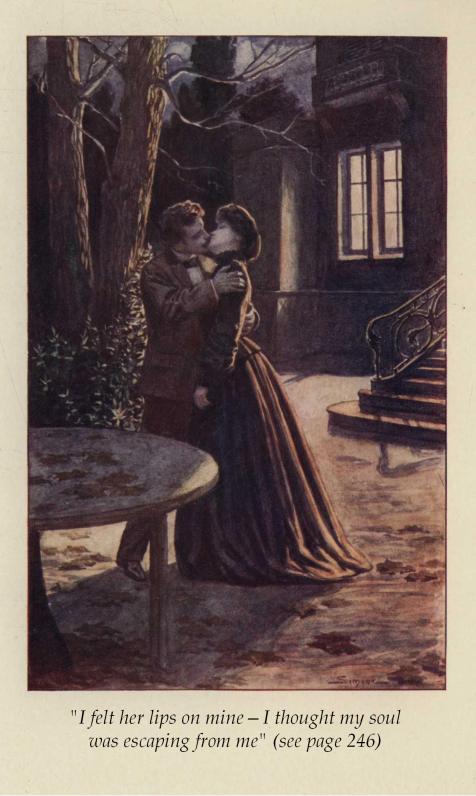
"I felt her lips on mine——I thought my soul was escaping from me" (see page 246)
Such a death, after such a life, had lessons with which I desired to fill my soul. I begged to be left alone with the priest in the room. This pious vigil will not, I believe, be unavailing. From that face, irradiated with a glorious peace, where a supernatural light seemed to glow, more than one forgotten or questioned truth came home to me with irresistible force. Noble and holy friend, well I knew that the virtue of sacrifice was yours! Now I see that you have entered into your reward.
About two hours after midnight, yielding to fatigue, I longed to breathe the fresh air for a moment. I went down the dark staircase and into the garden, avoiding the salon on the ground floor, where I had seen a light. The night was profoundly dark. As I approached the arbour at the end of the little inclosure, I heard a faint sound, and at the same moment a shadowy form detached itself from the foliage. I felt a sudden rapture; my heart leaped, and I saw the heavens fill with stars.
"Marguerite!" I cried, holding out my arms. I heard a little cry, then my name murmured faintly, then silence ... and I felt her lips on mine. I thought that my soul was escaping from me.
* * * * *
I have given Hélène half my fortune. Marguerite is my wife. I close these pages forever. I have nothing more to intrust to them. What has been said of nations may be said of men: "Happy are those who have no history."
* * * * * * * *
THE PORTRAITS OF OCTAVE FEUILLET
In spite of the fashionable popularity achieved by Octave Feuillet as early as the year 1855, a popularity which never waned to his last hour, it seems that his life, which we should have pictured excessively brilliant and public, was in reality quiet and retired. The author of "M. de Camors" and of the "Roman d'un Jeune Homme pauvre" was, as his portraits attest, melancholy of temperament and contemplative of mind, a man who was happiest in his own study, who preferred the distant echoes of his literary triumphs in his home, to noisy manifestations thereof in the world of social pleasure.
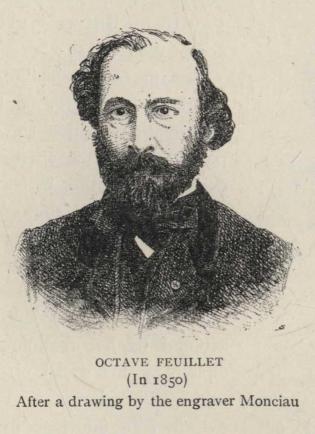
OCTAVE FEUILLET (In 1850) After a drawing by the engraver Monciau
Feuillet was the official novelist of the Second Empire, the pet writer of the Revue des Deux Mondes. He was received at Court among the distinguished guests who had the entrée at Compiègne and Fontainebleau. His plays and proverbes were acted in the Imperial theatres, at fashionable watering-places, and on the miniature stages of marionettes. The Empress treated him with marked distinction. It is difficult to understand why an author so honoured and so much sought after should have left so few portraits—canvases, medallions, water-colours or engravings. Feuillet evidently was not lavish of his time in his sittings to artists, for neither Dubufe, nor Carolus-Duran, nor Winterhalter reproduced his features—a fact we find it almost hard to believe of a man who enjoyed the popularity of Feuillet. But we must accept the fact.
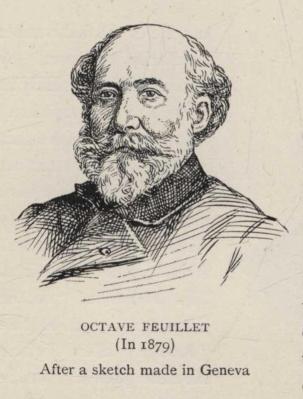
OCTAVE FEUILLET (In 1879) After a sketch made in Geneva
Madame Octave Feuillet, to whom I went for final confirmation of this supposed dearth of artistic documents relating to her deceased husband, showed me everything she had as mementoes of the delicate psychologist to whose success she so largely contributed by her feminine diplomacy, her social observations, and her subtle and very cultivated mind.
"Alas!" she said, "I do not know why I am not richer in pictures of my dear lost one, for he had endless opportunities of being painted, but he was always too nervous and too busy to undertake the sittings proposed by various artists. This is why I can only show you a little portrait painted by Bonvin just before 1850, which represents him with a Musset-like face, and agrees pretty closely with a drawing of the same period by the engraver Monciau, which could easily be reproduced."
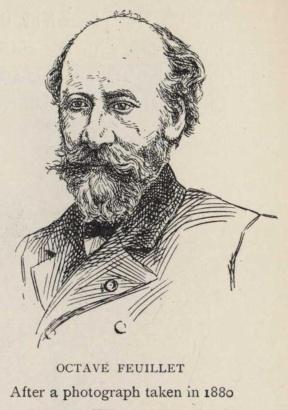
OCTAVE FEUILLET After a photograph taken in 1880
"Beyond these souvenirs of Octave Feuillet as a young man," continued his widow, "I have nothing but a drawing by Dantan, made at the time of the great success of the Sphinx at the Comedie Française, that is to say, about ten years before his death, and a large canvas by Hirch, a full-length, painted after 1880. But isn't it too dark for reproduction?"
To these portraits of the author of "Julia de Trécoeur" we may add a number of photographs, all of them taken after 1860. First, the large full-length portrait published by Goupil about 1869 in the "Galerie Contemporaine." In spite of the defects inherent in all photographs, this is the most like him of all his portraits: it is reproduced as the frontispiece of this volume. We have given several others, among them one from Monciau's drawing, which shows us an Octave Feuillet of thirty-five, who is nevertheless somewhat morose-looking, and various presentments of the quinquagenarian Academician, with the white hair and grey beard of a man still in his prime, which offer a much nobler and more attractive semblance of the writer who has been called "The family Musset."
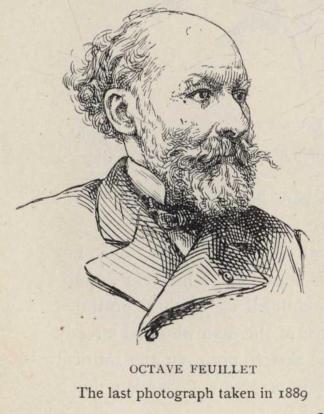
OCTAVE FEUILLET The last photograph taken in 1889
After the death of the famous novelist and playwright, the sculptor Crauck executed a fine bust of him with the aid of instructions given him by one of the author's sons, Richard Feuillet. Another bust, of little interest and a poor likeness, is at the Hôtel de Ville of St. Lo, where Feuillet was born, and where he often came to rest at his property during the summer.
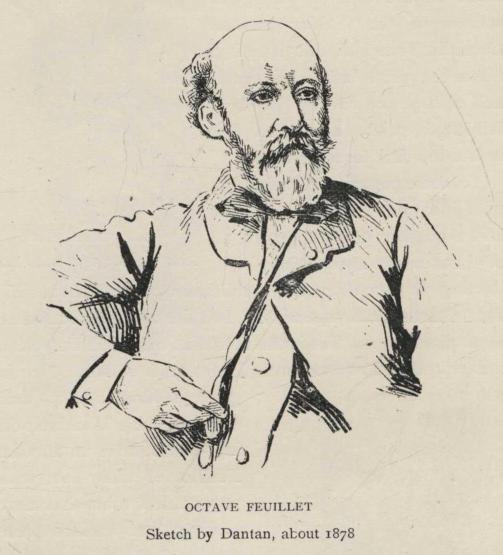
OCTAVE FEUILLET Sketch by Dantan, about 1878
Octave Feuillet's iconological record certainly does not arrest attention by any curious, startling, or hitherto unpublished elements. We have no childish or youthful portraits, nothing but the cold countenance of the man who had already "arrived;" no whimsical artistic sketch, not even any satirical caricature, to compromise, enliven, or give a Bohemian touch to the dignified attitude and severe correctness of the writer of the Revue des Deux Mondes. It is, we think, to be regretted. Octave Feuillet remains an over-official figure for us, bearing too obviously the stamp of the photographer's solemn poses, and sacramental "Quite still, please."
OCTAVE UZANNE.