Front matter (continued 3)
Henry Harland translation
"Agreed, mademoiselle, I will control myself."
"Yes, please do."
"I promise. And what is the name of this monument?"
"I call it a heap of big stones, but the antiquaries have more than one name for it. Some call it simply a dolmen, others, more pedantic, say it's a cromlech, and the country people—I do not know why—call it the migourdit."[#]
[#] In the wood of Cadoudal (Morbihan).
Meanwhile we glided gently with the current of the stream between two strips of wet meadow. Here and there, small black cattle with large pointed horns turned and looked fiercely at us. The valley through which the widening river crept, was shut in on both sides by a chain of hills, some covered with dry heather and furze, and some with green brushwood. Sometimes, at the end of a transversal cleft between two hills, we could see the crest of a mountain, blue and round in the distance. In spite of her indifference, Mlle. Marguerite was careful to draw my attention to all the beauties of this austere and peaceful country, and careful also, to qualify each remark with some ironic comment.
For a little while a dull, continuous sound had told us that we were approaching a waterfall. Suddenly the valley narrowed into a wild and lonely gorge. On the left stood a high wall of rock overgrown with moss; oaks and firs mixed with ivy and straggling brushwood rose one above the other in every crevice till they reached the top of the cliff, throwing a mysterious shade on to the deeper water at the foot of the rocks. A hundred paces in front of us, the water boiled and foamed, and then disappeared all at once, and the broken line of the stream stood out in a veil of white spray, against a distant background of vague foliage. On our right, the bank opposite to the cliff had only a narrow margin of sloping meadow, fringed with the sombre velvet of the wooded hills.
"Land, Alain," said the young Creole. Alain moored the boat to a willow.
"Now, sir," she said, stepping lightly on to grass, "aren't you overcome? Aren't you troubled, petrified, thunderstruck? You ought to be, for this is supposed to be a very pretty place. I like it because it is always fresh and cool. But follow me through the woods—if you are not too much afraid—and I will show you the famous stones."
Bright, alert, and gay as I had never seen her before, Mlle. Marguerite crossed the fields with a bounding step, and took a path which led along the hills to the forest. Alain and I followed in Indian file. After a few minutes' quick walking our guide stopped and seemed to hesitate, and looked about her for a moment. Then, deliberately separating two interlaced branches, she left the beaten track and plunged into the undergrowth. It was very difficult to make way through the thicket of strong young oaks whose slanting stems and twisted branches were knotted together as closely as Robinson Crusoe's palisade. At least Alain and I, bent double, advanced very slowly, catching our heads against something at every step, and at each of our clumsy movements bringing down a shower of dew upon us. But Mlle. Marguerite, with the greater dexterity and the catlike suppleness of her sex, slipped without any apparent effort through the meshes of the labyrinth, laughing at our sufferings, and carelessly letting the branches spring back after her into our faces. At last we reached a narrow glade on the top of the hill. There, not without emotion, I saw the dark and monstrous table of stone supported by five or six huge blocks half sunk in the earth, forming a cavern full of sacred horror. At first sight this perfect monument of a time almost fabulous, and of a primitive religion, has an aspect of eternal verity and of a real mysterious presence, that takes hold of the imagination, and fills the mind with awe.
The sunshine streaming through the leaves stole through the interstices in the roughly joined blocks, played about the sinister slab, and lent an idyllic charm to this barbarous altar. Even Mlle. Marguerite seemed pensive and brooding. For my part I entered the cavern, and, after examining the dolmen thoroughly, set to work to sketch it. For ten minutes I had been absorbed in this work, forgetting everything that was going on about me, when Mlle. Marguerite suddenly spoke:
"Do you want a Velleda to enliven your picture?"
I looked up. She had wound a wreath of oak-leaves round her forehead and stood at the head of the dolmen, leaning lightly against a sheaf of saplings. In the half-light, under the branches, her white dress looked like marble, and her eyes shone with strange fire in the shadow of the oaken crown. She was beautiful, and I think she knew it. I looked at her and found it hard to speak.
"If I am in the way, I'll move," she said.
"Oh, no! please don't."
"Well, make haste; put Mervyn in too. He'll be the Druid and I the Druidess."
I was so lucky—thanks to the vagueness of a sketch—as to reproduce this poetic vision pretty faithfully. Evidently interested, she came and looked at the drawing.
"It isn't bad," she said, laughing, as she threw her crown away. "You must admit that I am very good to you."
I did. I might even have added, if she had asked me, that she was not without a spice of coquetry. But without that she would not have been a woman. Perfection is detestable, and even goddesses need something besides their deathless beauty to win love.
We went back through the tangled underwood to the path in the wood, and thence returned to the river.
"Before we return," said the young girl, "I want to show you the waterfall, more especially as I am looking forward to a little diversion on my own account. Come, Mervyn, come along, dear dog. Oh, you are lovely!"
We soon reached the bank facing the rocks which blocked the bed of the river. The water fell from a height of many feet into a large and deeply sunk circular basin, which seemed to be shut in on all sides by an amphitheatre of vegetation, broken by dripping rocks. But there were unseen outlets for the overflow of the little lake, and the streams so formed reunited a little lower down.
"It is not exactly a Niagara," said Mlle. Marguerite, raising her voice against the noise of the falling waters, "but I have heard connoisseurs and artists say that it is rather pretty, nevertheless. Have you admired it? Good! Now I hope you'll bestow any enthusiasm you may have left on Mervyn. Here, Mervyn!"
The Newfoundland ran to his mistress, and, trembling with impatience, watched her while she tied some pebbles into her handkerchief. She threw it into the stream a little above the fall, and at the same moment Mervyn fell like a block into the lower basin and struck out swiftly from the edge. The handkerchief followed the current, reached the rocks, danced in an eddy for a minute, and then, shooting like an arrow past the smooth rock, swept in a mass of foam under the eyes of the dog, who seized it dexterously in his mouth, after which Mervyn returned proudly to the bank, where Mlle. Marguerite stood clapping her hands.
This feat was performed several times with great success. At the sixth repetition, either because the dog started too late or because the handkerchief was thrown too soon, Mervyn missed it. The handkerchief, swept on by the eddies from the fall, was carried among some thorny brushwood that overhung the water a little farther on. Mervyn went to fetch it, but we were very much surprised to see him suddenly struggle convulsively, drop his booty, and raise his head towards us, howling pitifully.
"My God! what has happened?" exclaimed Mlle. Marguerite.
"He seems to be caught among the bushes. He'll free himself directly, no doubt."
But soon one had to doubt, and even to despair, of this issue. The network of creepers in which the dog had been caught lay directly below one of the mouths of the sluice, which poured a mass of seething water continuously on Mervyn's head. The poor beast, half-suffocated, ceased to make the slightest effort to release himself, and his plaintive cries sounded more and more like a death-rattle. At this moment Mlle. Marguerite seized my arm, and whispered almost in my ear:
"He is lost. It's no use.... Let us go."
I looked at her. Grief, pain, and her violent effort to control herself had distorted her pale features and brought dark circles under her eyes.
"It is impossible," I said, "to get the boat down there; but if you will allow me, I can swim a little, and I'll go and give a hand to the poor fellow."
"No, no; don't attempt it. It's too far. And they say it's very deep and dangerous under the fall."
"You needn't fear, mademoiselle; I am very cautious."
At the same moment I took off my coat and went into the water, taking care to keep a good distance from the fall. It was very deep, and I did not find a footing till I reached the exhausted Mervyn. I do not know whether there had been an islet here which had dwindled and crumbled away, or whether a sudden rising of the river had swept away part of the bank, and deposited the fragments in this place; but, whatever the cause, there was an accumulated and flourishing mass of entangled brushwood and roots under this treacherous water. I got my feet on a trunk from which the bushes seemed to spring, and managed to release Mervyn. Feeling himself free, he recovered at once, and struck out for the bank, leaving me to my fate with all the goodwill imaginable. This was scarcely acting up to the chivalrous reputation of his breed, but Mervyn has lived a long while among men, and I suppose has become a bit of a philosopher. But when I tried to follow him, I found, to my disgust, that, in my turn, I was caught in the nets of the jealous and malignant naiad who reigns in the pool. One of my legs was entangled in the creepers, and I could not free it. It is difficult to exert all one's strength in deep water, and on a bed of sticky mud. And besides, I was half-blinded by the bubbling spray. In short, my situation was becoming awkward. I looked towards the bank; Mlle. Marguerite, holding to Alain's arm, hung over the gulf, and watched me with mortal anxiety. I told myself that it rested with me to be wept for by those bright eyes, and to end a miserable existence in an enviable fashion. Then I shook off such maudlin fancies vigorously, and freed myself by a violent effort. I tied the little handkerchief, now in rags, round my neck, and easily regained the shore.
As I landed, Mlle. Marguerite offered me her hand. It trembled a little, and I was pleased.
"What rashness! You might have been drowned, and for a dog!"
"It was yours," I whispered in the same low tone she had used to me.
This speech seemed to annoy her; she withdrew her hand quickly, and turning to Mervyn, who lay yawning and drying himself in the sun, began to punish him.
"Oh, the stupid! the big stupid!" she said. "What an idiot he is!"
But the water was streaming from my clothes on to the grass. I did not quite know what to do with myself, till Mlle. Marguerite came back, and said very kindly:
"Take the boat, M. Maxime, and get away as fast as you can. You'll keep warm rowing. I will come back with Alain through the wood; it is the shortest way."
I agreed to this arrangement, which was in every way the best. I said farewell, touched her hand for the second time, and got into the boat. To my surprise, when I was dressing at home I found the little handkerchief still round my neck. I had forgotten to restore it to Mlle. Marguerite, who must have given it up for lost, so I shamelessly determined to keep it as the reward of my watery adventure.
I went to the château in the evening. Mlle. Laroque received me with her habitual air of disdainful indolence, sombre preoccupation, and embittered ennui, which was in singular contrast with the gracious friendliness and playful vivacity of my companion of the morning.
During dinner, at which M. de Bévallan was present, she spoke of our excursion in a manner that stripped it of all sentiment, and as she went on, said some sharp things about lovers of nature, and finished with an account of Mervyn's misadventure, without mentioning my share in it. If, as I thought, this was meant as a hint of the line I was to take, the young lady had been at needless trouble. However that may be, M. de Bévallan, on hearing the story, nearly deafened us with his cries of despair. What! Mlle. Marguerite had endured such anxiety, the brave Mervyn had been in such danger, and he, Bévallan, had not been there. Cruel fate! He would never get over it. There was nothing for him to do but hang himself, like Crillon.
"Well," said Alain, "if it depended on me to cut him down, I should take my time about it."
The next day did not begin so pleasantly for me as its predecessor. In the morning I received a letter from Madrid, asking me to inform Mlle. de Porhoët that her lawsuit was finally lost. Her agent also informed me that her opponents would not profit by their victory, as the Crown, attracted by the millions at stake, claimed to succeed under the law by which the property escheats to the state.
After careful consideration, I decided that it would be kinder not to let my old friend know of the total destruction of her hopes. I intend, therefore, to secure the assistance of her agent in Spain; he will allege further delays, and on my side I shall continue my researches among the archives, and do my best to preserve the poor soul's cherished delusions to the end. However innocent and legitimate this deception might be, I could not feel at rest until it had been approved by some one whose judgment in such matters I could trust. I went to the château in the afternoon, and made confession to Mme. Laroque, who approved of my plan, and commended me rather more than the occasion warranted. And to my great surprise she finished the interview with these words:
"I must take this opportunity of telling you, M. Odiot, that I am deeply grateful for your devotion to my interests, that each day I appreciate your character more truly, and enjoy your company more thoroughly. I could wish—you must forgive my saying it, as you are scarcely likely to share my wish—I could wish that you could always remain with us ... and I humbly pray heaven to perform the miracles necessary to bring this about ... for I know that only miracles can do so."
I did not quite grasp the meaning of this language, nor could I explain the sudden emotion that shone in the eyes of the excellent lady. I acknowledged her kindness properly, and went away to indulge my melancholy in the fields.
By an accident—not purely fortuitous, I must admit—I found myself, after an hour's walking, in a deserted valley, and on the brink of the pool which had been the scene of my recent prowess. The amphitheatre of rocks and greenery which surrounds the small lake realizes the very ideal of solitude. There you are at the end of the world, in a virgin country, in China—where you will! I lay down among the heather, recalling my expedition of yesterday, one not likely to occur again in the course of the longest life. Already I felt that if such good fortune should come to me a second time, it would not have that charm of surprise, of peacefulness, and—in one word—of innocence. I had to own that this fresh romance of youth, which gave a perfume to my thoughts, could have but one chapter, one page, and that I had read it. Yes, this hour, this hour of love, to call it by its true name, had been royally sweet, because it had not been premeditated, because I had not known what it was till it had gone, because I had had the rapture, and had been spared remorse. Now my conscience was awake. I saw myself on the verge of an impossible, a ridiculous love, and worse, of a culpable passion. Poor and disinherited as I am, it is time to keep a strict watch over myself.
I was addressing these warnings to myself in this solitary place—any other would have served my purpose as well—when the sound of voices interrupted my reflections. I rose, and saw a company of four or five people who had just landed, advancing towards me. First came Mlle. Marguerite leaning on M. de Bévallan's arm; next Mlle. Hélouin and Mme. Aubry, followed by Alain and Mervyn. The sound of their approach had been drowned in the roar of the waterfall; they were only a few yards off; there was no time for retreat, so I had to resign myself to being discovered in the character of the romantic recluse. But my presence did not excite any particular attention, though I saw a shadow of annoyance on Mlle. Marguerite's face, and she returned my bow with marked stiffness.
M. de Bévallan, standing at the verge of the pool, wearied the echoes with the clamour of his conventional admiration. "Delicious! How picturesque! What a feast! The pen of George Sand.... The pencil of Salvator Rosa!"
All this was accompanied by violent gestures, by which he appeared to be snatching from these great artists, the instruments of their genius.
At last he became calmer, and asked to be shown the dangerous channel where Mervyn had nearly been drowned. Again Mlle. Marguerite related the adventure, and again she suppressed the part I had taken in the denouement. With a kind of cruelty, evidently levelled at me, she enlarged on the cleverness, courage, and presence of mind her dog had shown in his trying situation. Apparently she seemed to think that her transient good-humour, and the service I had been so fortunate as to render her, had filled my head with some presumptuous notions, which it was necessary to nip in the bud.
As Mlle. Hélouin and Mme. Aubry particularly wished to see Mervyn repeat his wonderful exploit, his mistress called the Newfoundland, and, as before, threw her handkerchief into the current. But at the signal the brave Mervyn, instead of jumping into the lake, rushed up and down the bank, barking furiously, lashing about with his tail, showing, in fact, the greatest interest in the proceedings, but at the same time an excellent memory. Evidently the head controls the heart in this sagacious beast. In vain Mlle. Marguerite, angry and confused, first tried caresses and then threats to overcome her favourite's obstinacy. Nothing could persuade the intelligent creature to trust himself again in those dangerous waters. After such high-flown announcements, Mervyn's stubborn prudence was really amusing. I had a better right to laugh than any one present, and I did so without compunction. Besides, the merriment soon became general, and in the end Mlle. Marguerite herself joined in, rather half-heartedly.
"And now," she said, "I've lost another handkerchief."
The handkerchief, carried along by the eddies, had naturally landed among the branches of the fatal bush, not far from the further bank.
"Rely upon me, mademoiselle," cried M. de Bévallan. "In ten minutes you shall have your handkerchief, or I shall exist no longer."
At this magnanimous declaration I thought that Mlle. Marguerite looked stealthily at me, as much as to say, "You see, there are others who are devoted to me!" Then she answered M. de Bévallan.
"For Heaven's sake, don't be so foolish! The water is very deep.... it is really dangerous."
"It is all the same to me," said M. de Bévallan. "Have you a knife, Alain?"
"A knife?" said Mlle. Marguerite, surprised.
"Yes, a knife. Please allow me ... I know what I mean to do."
"But what do you mean to do with a knife?"
"I mean to cut a switch," said M. de Bévallan.
The girl looked at him gravely.
"I thought," she murmured, "that you were going to swim for it."
"To swim!" said M. de Bévallan; "excuse me, mademoiselle.... Firstly, I am not in swimming costume; next, I must admit that I cannot swim."
"If you cannot swim," she said dryly, "the question of costume is not important."
"You are quite right," said M. de Bévallan, with amusing coolness; "but you are not particularly anxious that I should drown myself, are you? You want your handkerchief, that is the point. When I have got it, you will be satisfied. Isn't that so?"
"Well, go and cut your switch," she said, sitting down resignedly.
M. de Bévallan is not easily disconcerted. He disappeared into the nearest thicket, and soon we heard the branches crack. He came back armed with a long switch from a nut-tree, and proceeded to strip the leaves off.
"Do you think you'll reach the other side with that stick?" asked Mlle. Marguerite, who was beginning to be amused.
"Allow me to manage it my own way. That is all I ask," said the imperturbable gentleman.
We left him alone. He finished his switch, and then set out for the boat. We at last understood that he meant to cross the river in the boat, to land above the waterfall, and to harpoon the handkerchief, which he could easily do from the bank. At this discovery there was an indignant outcry from the ladies, who, as we all know, are extremely fond of dangerous adventures—in which they are not themselves concerned.
"A pretty contrivance, M. de Bévallan. Aren't you ashamed of yourself?"
"Tu-tu, ladies! Remember Columbus and the egg. The idea is everything, you know."
Contrary to our expectation, this apparently harmless expedition was not to be carried through without some emotions, and some risks, for M. de Bévallan, instead of making for the bank immediately opposite the little bay, where the boat had been moored, unluckily decided to land nearer the cataract. He pushed the boat into the middle of the stream and let it drift for a moment, till he saw that as the river approached the fall, its pace increased with alarming rapidity. We appreciated the danger when we saw him put the boat across the current, and begin to row with feverish energy. For a few seconds he struggled with doubtful success. But, little by little, he got nearer to the bank, though the stream still swept him fiercely towards the cataract, which thundered ominously in his ears. He was only a few feet from it, when a supreme effort brought him near enough to the shore to put him out of danger. With a vigorous spring he leaped on to the slope of the bank, sending the boat out among the rocks, where it was at once overturned. It presently floated into the pool keel upward. While the danger lasted, our only feeling was one of keen anxiety, but when it was over, the contrast between the comic dénouement and its hero's usual coolness and self-confidence, could not fail to tickle our sense of humour. Besides, laughter is a natural relief when a danger is happily past. Directly we saw that M. de Bévallan was out of the boat, we all gave ourselves up to unrestrained merriment. I should say, that at this moment his bad luck was completed by a truly distressing detail. The bank on which he had jumped sloped sharply and was very wet. His feet had scarcely touched it when he fell backwards. Fortunately there were some strong branches within his reach. He hung on to them desperately, his legs beating the shallow water like two angry oars. As there was no danger, his situation became purely ridiculous, and I suppose that this thought made him struggle so frantically and awkwardly, that his efforts defeated their purpose. He succeeded, however, in raising himself and getting another footing on the slope. Then, all of a sudden, we saw him slide down again, tearing the bushes and brushwood as he went, and renewing his wild pantomime in the water in evident desperation. It was irresistible. Never, I believe, had Mlle. Marguerite been at such an entertainment. She had utterly lost all care for her dignity. Like some mirthful Bacchante, she filled all the grove with bursts of almost convulsive gaiety. Between her shouts of laughter she clapped her hands and called out in a half-suffocated voice:
"Bravo! bravo! M. de Bévallan! Very pretty! Delicious! Picturesque! Salvator Rosa!"
At last M. de Bévallan succeeded in dragging himself to terra firma. Then, turning to the ladies, he made them a speech which the noise of the waterfall prevented us from hearing distinctly; but, from his animated gestures, the illustrative movements of his arms, and his air of forced good-humour, we understood that he was giving us a reasoned explanation of his disaster.
"Yes, yes," replied Mlle. Marguerite, continuing to laugh with a woman's implacable barbarity. "it was a great success. I congratulate you!"
When she was a little more serious, she asked me how we should recover the capsized boat, which, by-the-bye, was the best we had. I promised to bring some men the next day, and superintend the rescue. Then we struck across the fields towards the château. M. de Bévallan, not being in swimming costume, could not rejoin us. With a melancholy air he disappeared behind the rocks above the farther bank.
August 20th.
At last this extraordinary girl has revealed the secret of her stormy soul to me. Would that she had preserved it forever!
During the day that followed the scenes I have just described, Mlle. Marguerite, as if ashamed of the impulses of youthful frankness to which she had yielded, wrapped herself more closely than ever in her veil of mournful pride, disdain, and mistrust. In the midst of the noisy pleasures, the fêtes, and dances that succeeded one another, she passed like a ghost, indifferent, icy, and sometimes angry.
Her irony vented itself with inconceivable bitterness, sometimes on the purest pleasures of the mind, those that come from contemplation and study, sometimes on the noblest and most sacred sentiments. If an instance of courage or virtue was mentioned in her presence, she examined it minutely in search of its selfish motive; or if by chance one burned the smallest grain of incense on the altar of art, she extinguished it with a disdainful wave of her hand. With her short, abrupt, and terrible laugh, like the mocking of a fallen angel, she seemed determined to blight (wherever she saw a trace of them) the most generous faculties of the human soul—enthusiasm and passion. I noticed that this strange spirit of disparagement took on a special character of persecution—positive hostility—when directed against me. I did not understand, and even now I do not quite understand, why I have attracted these particular attentions. True, I carry in my heart the worship of things ideal and eternal, which only death can tear from me (great God, what would be left me if I had not that!); but I am not given to public ecstasies, and my admiration, like my love, will never be obtrusive. In vain I maintained more scrupulously than ever the modesty which springs from real feeling. I gained nothing by it. The most romantic fancies were attributed to me just for the pleasure of combating them, and perpetually some kind of grotesque harp was thrust into my hands, solely for the amusement of breaking its strings.
Although this open warfare against anything higher than the material interests and sordid realities of life, was not a new trait in Mlle. Marguerite's character, it had been suddenly exaggerated and embittered to the point of wounding the hearts most devoted to this young girl. One day Mlle. de Porhoët, weary of this incessant mocking, said to her in my presence:
"My darling, for some time past you have been possessed by a devil which you would do well to cast out as soon as possible, or you will finish by making up a trio with Mme. Aubry and Mme. de Saint-Cast. For my part, I do not pride myself on being, or ever having been, particularly romantic, but I like to think that there are still some people in the world who are capable of generous sentiments; I believe in disinterestedness, if only in my own, and I even believe in heroism, because I have known heroes. More, I love to hear the little birds singing under my arbour, and I like to build my cathedral in the drifting clouds. All this may sound very ridiculous, my dear, but I venture to remind you that these illusions are the riches of the poor, that M. Odiot and I have no other kind of wealth, and that we are so singular as not to complain."
On another occasion, when I had just received Mlle. Marguerite's sarcasm with my usual impassibility, her mother drew me aside.
"M. Maxime," she said, "my daughter teases you a little, but I hope you will excuse her. You must have noticed that she has changed very much lately."
"Your daughter seems to be more preoccupied than usual."
"And not without good reason; she is about to come to a very serious decision, and at such a moment young girls are apt to be capricious."
I bowed and said nothing.
"You are now a friend of the family," continued Mme. Laroque, "and as such I ask you to give me your opinion of M. de Bévallan."
"I believe, madame, that M. de Bévallan has a very handsome fortune—not so large as yours, but undeniably handsome—about a hundred and fifty thousand francs a year!"
"Yes, but what do you think of him personally, and of his character?"
"M. de Bévallan is what the world calls a perfect gentleman. He has wit; he is considered an honourable man."
"But do you think he will make my daughter happy?"
"I do not think he will make her unhappy. He is not unkind."
"What do you think I ought to do? I am not entirely satisfied with him ... but he is the only one Marguerite at all cares for ... and there are so few men with a hundred thousand francs a year. You can understand that my daughter—in her position—has had plenty of offers. For the last two or three years we have been literally besieged.... Well, it is time we decided.... I am not strong.... I may go any day.... My daughter would be unprotected. Here is an unexceptionable suitor whom the world will certainly approve—it is my duty to welcome him. Already people say that I have filled my daughter's head with romantic notions—which is not the truth. She has her own ideas. Now, what do you advise me to do?"
"May I ask what is Mlle. de Porhoët's opinion? She is a lady of great judgment and experience, and besides, entirely devoted to you."
"Oh, if I listened to Mlle. de Porhoët I should send M. de Bévallan about his business. But it is all very well for Mlle. de Porhoët to talk. When he's gone, she won't marry my daughter for me."
"But, madame, from the monetary point of view, M. de Bévallan is certainly a fine match. I do not dispute it for a moment, and if you stand out for a hundred thousand francs a year."
"But, my dear sir, I care no more for a hundred thousand francs than for a hundred pence! However, I am not talking of myself, but of my daughter. Well, I can't let her marry a mason, can I? I should have rather liked to be the wife of a mason, but it does not follow that what would have made me happy would make her so. I ought, in marrying her, to be guided by received opinion, not merely by my own."
"Well, then, madame, if this marriage suits you, and suits your daughter equally well..."
"Ah, no! ... it does not suit me ... nor does it suit my daughter any better. It is a marriage ... to speak plainly, it is un mariage de convenance."
"Am I to understand that it is quite settled?"
"No, or I should scarcely ask your advice. If it were, my daughter would be more at ease. Her misgivings disturb her, and then..."
Mme. Laroque sank back into the shadow of the hood over her chair and added:
"Have you any idea of what is going on in that unfortunate head?"
"None, madame."
She fixed her sparkling eyes on me for a moment, sighed deeply, and said, gently and sadly:
"You may go ... I won't detain you any longer."
The confidence with which I had just been honoured, had not surprised me much. For some time it had been evident that Mlle. Marguerite reserved for M. de Bévallan whatever sympathy she had left for humanity. But she seemed to show rather a friendly preference than an impassioned tenderness. And I ought to say that the preference was quite intelligible. I have never liked M. de Bévallan, and in these pages I have, in spite of myself, given a caricature rather than a portrait of him, but I admit that he combines most of the qualities and defects that are popular with women. He is absolutely devoid of modesty, which is a great advantage, as women do not like it. He has the cool, mocking, and witty assurance which nothing can daunt, which easily daunts others, and which gives to its possessor a kind of domination and a factitious superiority. His tall figure, his bold features, his skill in athletic exercises, his reputation as a sportsman, give him a manly authority which impresses the timid sex. And he has an air of daring, enterprise, and conquest which attracts and troubles women, and fills their souls with secret ardour. Such advantages, it is true, are, as a rule, chiefly impressive to vulgar natures; but though, as usual, I had at first been tempted to put Mlle. Marguerite's nature on a level with her beauty, she had for some time past seemed to make a positive parade of very mediocre sentiments, and I believed she was capable of yielding without resistance as without enthusiasm, and with the passive coldness of a lifeless imagination, to the charms of a common-place lady-killer, and, later, to the yoke of a respectable marriage.
AH this made it necessary for me to accept the inevitable, and I did so more easily than I should have thought possible a month ago. For I had summoned all my courage to combat the first temptations of a love, equally condemned by good sense and by honour. And she who had unwittingly imposed this combat on me, had also unwittingly powerfully helped me in my resistance. If she could not hide her beauty from me, she also unveiled her soul, and mine had recoiled. Small loss, no doubt, for the young millionaire, but a good thing for me.
Meanwhile I had to go to Paris, partly on Mme. Laroque's business and partly on my own. I returned two days ago, and as I arrived at the château I was told that old M. Laroque had repeatedly asked for me since the morning. I hurried to his apartment. A smile flickered across his withered cheeks as he saw me. He looked at me with an expression of malignant joy and secret triumph; then he said, in his dull, hollow voice:
"M. de Saint-Cast is dead."
This news, which the strange old man had wanted to tell me himself, was correct. On the previous night poor General de Saint-Cast had had a stroke of apoplexy, and an hour later had been snatched from the life of wealth and luxury which he owed to his wife. Directly the news came to the château, Mme. Aubry had started off to her friend, and the two had, as Dr. Desmarets told us, passed the day chanting a sort of litany of original and piquant ideas on the subject of death—the swiftness with which it strikes its prey, the impossibility of preventing or guarding against it, the futility of regrets, which cannot bring back the departed, the consoling effects of time, etc., etc.
After which they sat down to dinner, and gradually recovered their spirits. "Madame," said Mme. Aubry, "you must eat, you must keep yourself alive. It is our duty and the will of God."
At dessert Mme. de Saint-Cast had a bottle of the poor general's favourite Spanish wine, and begged Mme. Aubry to taste it for his sake. But, as Mme. Aubry firmly refused to be the only one to partake of it, Mme. de Saint-Cast allowed herself to be persuaded that God also wished her to have a glass of Spanish wine and a crust of bread. The general's health was not drunk. Early yesterday morning, Mme. Laroque and her daughter, both in mourning, took their places in the carriage. I accompanied them. About ten o'clock we were at the little town. While I attended the general's funeral, the ladies joined the widow's circle of official sympathizers. After the service I returned to the house, and with some other friends I was introduced into the famous drawing-room, the furniture of which had cost fifteen thousand francs. In the funereal half-light I distinguished the inconsolable Mme. de Saint-Cast sitting on a twelve-hundred-franc sofa, enveloped in crape, the price of which we were told before long. At her side was Mme. Aubry, an image of physical and moral prostration. Half a dozen friends and relatives completed this doleful group. As we took up our positions in line at the farther end of the salon, there was a sound of shuffling feet and some cracking of the parquet, then gloomy silence fell again on this mausoleum. Only from time to time a lamentable sigh, faithfully echoed by Mme. Aubry, rose from the sofa.
At last a young man appeared. He had lingered in the street to finish the cigar he had lighted as he left the cemetery. As he slipped discreetly into our ranks Mme. de Saint-Cast perceived him.
"Is that you, Arthur?" she said in a lugubrious voice.
"Yes, aunt," said the young man, advancing in front of the line.
"Well," continued the widow, in the same plaintive drawl, "is it over?"
"Yes, aunt," said Arthur, in curt, deliberate accents. He seemed to be a young man who was perfectly satisfied with himself.
There was a pause, after which Mme. de Saint-Cast drew from the depths of her expiring soul this new series of questions:
"Did it go off well?"
"Very well, aunt, very well."
"Were there many people?"
"The whole town, aunt, the whole town."
"The military?"
"Yes, aunt, the whole garrison, and the band."
Mme. de Saint-Cast groaned, and added:
"The fire brigade?"
"The fire brigade too, aunt—certainly."
I do not quite see why this last detail should have particularly affected Mme. de Saint-Cast, but she could not resist it. A sudden swoon, accompanied by infantile wailings, summoned all the resources of feminine sensibility to her aid, and gave us the opportunity of slipping away. I was glad of it. I could not bear to see this ridiculous vixen performing her hypocritical mummeries over the tomb of the weak, but good and loyal fellow, whose life she had embittered, and whose end she had probably hastened.
A few moments later, Mme. Laroque asked me to accompany her to the Langoat farm, five or six leagues farther on towards the coast. She intended to dine there with her daughter. The farmer's wife, who had been Mlle. Marguerite's nurse, was ill, and the ladies had for some time meant to give her this proof of their interest in her welfare. We started at two o clock in the afternoon. It was one of the hottest days of this hot summer. Through the open windows of the carriage, the heavy, burning gusts which rose in waves from the parched lande under the torrid sky, swept across us.
The conversation suffered from our oppression. Mme. Laroque, who declared that she was in paradise, had at last thrown off her furs and remained sunk in a gentle ecstasy. Mlle. Marguerite fanned herself with Spanish gravity. While we slowly climbed the interminable hills, we saw the calcined rocks swarming with legions of silver-coated lizards, and heard the continuous crackling of the furze opening its ripe pods to the sun.
In the middle of one of our laborious ascents a voice suddenly called out from the side of the road:
"Stop, if you please."
At the same time a big girl with bare legs, holding a distaff in her hand, and wearing the ancient costume and ducal coif of the peasants of this country, leaped quickly across the ditch, knocking over as she came along some of the sheep she was tending. She perched herself with a kind of grace on the carriage-step, and stood before us with her brown, self-possessed, and smiling face framed in the window.
"Pardon, ladies," she said in the quick, melodious tones of her country, "will you be so kind as to read this to me?"
She took from her bodice a letter folded in the ancient fashion.
"Read it, M. Odiot," said Mme. Laroque, laughing, "and read it aloud, if necessary."
It was a love-letter, addressed very carefully to Mlle. Christine Ogadec, ——'s Farm, in the commune of ——, near ——. It was written by an awkward but sincere hand. The date showed that Mlle. Christine had received it two or three weeks ago. Not being able to read, and fearing to trust her secret to the ill-nature of her associates, the poor girl had kept the letter in the hope that some passing stranger, at once good-natured and educated, would interpret the mystery that had been burning in her bosom for more than a fortnight. Her blue, wide-opened eyes were fixed on me with an air of ineffable satisfaction as I laboriously read the sloping lines which conveyed this message:
"Mademoiselle, this is to tell you that my intentions have not changed since the day we spoke on the lande after vespers, and that I am anxious about yours. My heart is all yours, mademoiselle, and I wish yours to be all mine; and if it is you may be sure and certain that no one alive is happier on earth or in heaven than your friend—who does not put his name here, but you know quite well who he is, mademoiselle."
"And do you know, Mlle. Christine?" I said, returning the letter.
"Very likely I do," she said, with a smile that showed her white teeth, while she gravely nodded, her young face radiant with happiness. "Thank you, ladies and gentleman!"
She jumped off the step and soon disappeared among the bushes, chanting as she went the deep and joyful notes of some Bretonne ballad.
Mme. Laroque had followed with evident rapture all the details of this pastoral scene, which harmonized deliciously with her favourite fancies. She smiled and dreamed at the vision of this happy, barefooted girl as if she were under a spell. However, when Mlle. Ogadec was out of sight, a strange notion came into Mme. Laroque's head. After all, she thought, it would not have been a bad thing to have given the girl a five-franc piece—in addition to her admiration.
"Call her back, Alain," she cried.
"But, mother, why?" said Mlle. Marguerite quickly, though so far she had apparently taken no notice of the incident.
"My dear child, perhaps this girl does not thoroughly understand how much I should enjoy, and how much she ought to enjoy, running about barefooted in the dust. It would be nice, at any rate, to leave her some little souvenir."
"Money!" replied Mlle. Marguerite. "Oh, mother, don't! Don't soil her happiness with money."
This delicate sentiment—which, by the way, poor Christine might not have appreciated—was astonishing enough in the mouth of Mlle. Marguerite, who did not, as a rule, pride herself on such subtlety. Indeed, I thought she was joking, though she showed no signs of amusement. However that may be, her mother took the caprice very seriously. It was decided enthusiastically to leave this idyll to innocence and bare feet.
After this pretty episode Mme. Laroque relapsed into her smiling ecstasy, and Mlle. Marguerite fanned herself more seriously than ever. An hour later we reached our destination. Like most of the farms in this country, where the uplands and plateaux are the sterile lande, the farm of Langoat lies in the hollow of a valley, with a water-course running through it.
The farmer's wife was better, and at once set to work preparing dinner, the chief elements of which we had been careful to bring with us. It was served on the natural lawn of a meadow, under the shade of an enormous chestnut. Mme. Laroque, though sitting in a most uncomfortable attitude, on one of the cushions from the carriage, seemed perfectly radiant. She said our party reminded her of the groups of reapers we see crowding under the shade of a hedge, whose rustic feasts she had always envied. As for me, I might perhaps at another time have found a singular sweetness in the close and easy intimacy, which an outdoor meal of this kind usually creates among the guests. But, with a painful feeling of constraint, I thrust away an enjoyment that might inflict regret, and the bread of this transient fraternity was bitter in my mouth.
"Have you ever been up there?" said Mme. Laroque to me as we finished dinner. She indicated the top of a lofty hill which commanded the meadow we were in.
"No, madame."
"Oh, but you should go. You get such a lovely view. You must see it ... Marguerite will take you while they're putting the horses in. Won't you?"
"I, mother? I have only been there once, and it was a long time ago ... However, I daresay I can find the way. Come, M. Odiot, and be prepared for a stiff climb."
Mlle. Marguerite and I started at once to climb a very steep path which wound along the side of the mountain, passing in some places through clumps of trees. The girl stopped from time to time in her swift and easy ascent to see if I were following her, and, panting a little, smiled at me without speaking. On reaching the bare heath which formed the plateau, I saw, a short way off, a village church, the lines of its little steeple sharply defined against the sky.
"That's where it is," said my young guide, quickening her pace.
Beyond the church was a cemetery shut in by walls. She opened the gate, and made her way with difficulty through the tall grass and trailing brambles, which choked the place of rest, towards a kind of semicircular perron which stood at the farther end. Two or three rough steps, defaced by time and rather strangely ornamented with massive balls, led to a narrow platform raised to the level of the wall. A granite cross stood in the centre of the semicircle.
Mlle. Marguerite had scarcely reached the platform and looked into the space that opened before her, when I saw her place her hand before her eyes as if she were suddenly dazzled. I hastened to join her. The beautiful day, nearing to its end, lighted with its last splendours a scene so vast, so strange, and so sublime, that I shall never forget it.
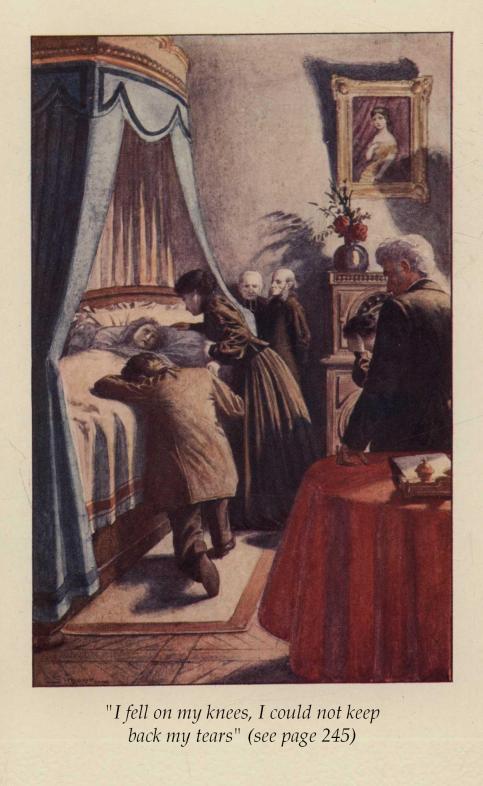
"I fell on my knees, I could not keep back my tears" (see page 245)
Facing us, and at a great depth below the platform, extended, farther than we could see, a sort of marsh studded with shining patches, and looking like a region slowly emerging from a deluge. This great bay stretched from under our feet to the heart of the jagged mountains. On the banks of mud and sand which separated the shifting lagoons, a growth of reeds and sea plants tinged with a thousand shades, sombre but distinct, contrasted sharply with the gleaming surfaces of the waters. At each of its rapid strides to the horizon, the sun lit up or darkened some of the many lakes which checkered the half-dried gulf. He seemed to take in turn from his celestial casket the most precious substances—silver and gold, ruby and diamond—and make them flash on each point of this gorgeous plain. As the planet neared the end of his career, a strip of undulating mist at the farther limit of the marshes, reddened all at once with the glare of a conflagration, and for a moment, kept the radiant transparency of a cloud furrowed by lightning. I was absorbed in the contemplation of a picture so full of divine grandeur, and enriched as with another ray of glory by the great memory of Cæsar, when a low, half-stifled voice murmured:
"Oh, how beautiful it is!"
I had not expected this sympathetic outburst from my companion. I turned eagerly towards her with a surprise that was not lessened, when the emotion in her face, and the slight trembling of her lips, had convinced me of the profound sincerity of her admiration.
"You admit that it is beautiful?" I said to her.
She shook her head; but at the same moment two tears fell slowly from her great eyes. She felt them rolling down her cheeks, made a gesture of annoyance, and then throwing herself suddenly on the granite cross, on the base of which she was standing, she embraced it with both hands, pressed her head close against the stone, and sobbed convulsively.
I did not think it right to say a word that might trouble the course of this sudden emotion, and I turned reverently away. After a moment, seeing her raise her forehead, and hastily replace her loosened hair, I came nearer.
"I am ashamed of myself," she murmured.
"You have more reason to rejoice. Believe me, you must give up trying to destroy the source of those tears; it is holy. Besides, you will never succeed."
"I must," said the girl desperately. "See, it is done! This weakness took me by surprise. I want to hate everything that is good and beautiful."
"In God's name, why?"
"Because I am beautiful, and I can never be loved."
Then, as a long-repressed torrent bursts its barriers at last, she continued, with extraordinary energy:
"It is true."
She put her hand on her heaving bosom.
"God had put into this heart all the qualities that I ridicule, that I blaspheme every hour of the day. But when he condemned me to be rich, he withdrew with one hand all that he had lavished with the other. What is the good of my beauty? What is the good of the devotion, tenderness, and enthusiasm which I feel burning within me? These are not the charms which make so many cowards weary me with their homage. I see it I know it—I know it too well. And if ever some disinterested, generous, and heroic soul loved me for what I am, and not for what I have ... I should never know ... never believe it. Eternal mistrust! That is my sentence—that is my torture. So I have decided ... I will never love. I will never pour into some vile, worthless, and venal heart the pure passion which is burning in mine. My soul will die virgin in my bosom. Well, I am resigned, but—everything that is beautiful, everything that sets me dreaming, everything that speaks to me of realms forbidden, everything that stirs these vain fires in me—I thrust it away, I hate it, I will have nothing to do with it."
She stopped, trembling; then, in a lower tone, she said:
"Monsieur, I did not seek this opportunity. I have not chosen my words ... I did not mean to tell you, but I have spoken ... you know all, and if at any time I have wounded your feelings, I think you will forgive me now."
She held out her hand. When my lips touched that soft hand, still wet with tears, a mortal languor stole through my veins. Marguerite turned her head away, looked into the sombre sky, and then slowly descended the steps.
"Let us go," she said.
Another road, longer, but easier than the steep ascent of the mountain, brought us into the farmyard. Neither of us spoke a single word the whole way. What could I have said, I who was more to be suspected than any other? I felt that every word from my overcharged heart would separate me still further from this stormy, but adorable soul.
Night had fallen, and hid from every one the signs of our common emotion. We drove away. After telling us again how much she had enjoyed her day, Mme. Laroque gave herself up to dreaming about it. Mlle. Marguerite, invisible and motionless in the deep shadow, seemed also to be sleeping; but when a bend in the road caused a ray of pale light to fall upon her, the fixed and open eyes showed that she was wakeful and silent, beset by the thought that caused her despair. I can scarcely say what I felt. A strange sensation of deep joy and deep bitterness possessed me entirely. I yielded to it as one sometimes yields consciously to a dream the charm of which we are not strong enough to resist.
We reached home about midnight.
I got down at the beginning of the avenue, and took the short way through the park to my quarters. Entering a dim alley, I heard a faint sound of voices and approaching footsteps, and saw vaguely in the darkness two shadowy figures. It was late enough to justify me in stepping into a clump of trees, to watch these nocturnal wanderers. They passed slowly in front of me. I recognised Mlle. Hélouin; she was leaning on M. de Bévallan's arm. At this moment the sound of the carriage alarmed them; they shook hands and separated hurriedly, Mlle. Hélouin going towards the château, the other to the woods.
In my own room, fresh from my adventure, I asked myself indignantly whether I was to allow M. de Bévallan to carry on his double love affair uninterrupted, and to let him find a fiancée and a mistress in the same house. I am too much a man of my age and time to feel the Puritan's horror of certain weaknesses, and I am not hypocrite enough to affect what I do not feel. But I believe that the morality which is easiest and most indulgent in this respect, still demands some degree of dignity, self-respect, and delicacy. Even in these devious ways a man must walk straight to some extent. The real excuse of love is that it is love. But M. de Bévallan's catholic tendernesses exclude all possibility of self-forgetful passion. Such love-affairs are not even sins; they are something altogether lower in the moral scale; they are but the calculations and the wagers of brutalized horse-dealers.
The various incidents of this evening, combined to convince me, that this man was utterly unworthy of the hand and heart he dared to covet. Such a union would be monstrous. But I saw at once, that I should not be able to prevent it by using the weapons that chance had put into my hands. The best of objects does not justify base methods, and nothing can excuse the informer. This marriage will take place, and heaven will permit one of its noblest creatures to fall into the arms of a cold-hearted libertine. It will permit that profanation. Alas, it allows so many others!
I tried to imagine how this young girl could have chosen this man, by what process of false reasoning she had come to prefer him to all others. I think I have guessed. M. de Bévallan is very rich; he brings a fortune nearly equal to the one he acquires. That is a kind of guarantee; he could do without this additional wealth; he is assumed to be more disinterested than others, because he is better off.
How foolish an argument! What a terrible mistake to estimate people's venality by the amount of their wealth! In nine cases out of ten, opulence increases greed! The most self-seeking are not the poorest!
Was there, then, no hope that Marguerite would see the worthlessness of her choice, no hope that her own heart would give her the counsel I could not suggest? Might not a new, unlooked-for feeling arise in her heart, and, breathing on the vain resolutions of reason, destroy them? Was not this feeling already born, indeed, and had I not received irrefutable proofs of it? The strange caprices, the humiliations, struggles, and tears of which I had been so long the object, or the witness, proclaimed beyond doubt a reason that wavered, not mistress of itself. I had seen enough of life, to know that a scene like that of which chance had this evening made me the confidant, and almost the accomplice, does not, however spontaneous it may seem, occur in an atmosphere of indifference. Such emotions, such shocks, prove that there are two souls already shaken by the same storm, or about to be so shaken.
But if it were true, if she loved me, as too certainly I loved her, I might say of that love what she had said of her beauty: "What is the good of it?" For I could never hope that it would be strong enough to triumph over the eternal mistrust, which is at once the defect, and quality, of that noble girl. My character, I dare say it, resents the outrage of this mistrust; but my situation, more than that of any other, is calculated to rouse it. What miracle is to bridge the abyss between these suspicions, and the reserve they force upon me?
Finally, granting the miracle, if she offered me the hand for which I would give my life, but for which I will never ask, would our union be happy? Should I not have to fear, early or late, in this restless imagination, the slow awakening of a half-stifled mistrust? Could I, in the midst of wealth not mine, guard myself against misgivings? Could I really be happy in a love that is sullied by being a benefit as well? Our part as the protector of women is so strictly laid upon us by all sentiments of honour, that it cannot, even from the highest motives, be reversed for an instant without casting upon us some shadow of doubt and suspicion. Truly, wealth is not so great an advantage that we cannot find some counterpoise to it. I imagine that a man who brings his wife, in exchange for some bags of gold, a name that he has made illustrious, acknowledged worth, a great position, or the promise of a great future, does not feel that he is under a crushing obligation. But my hands are empty, my future is no better than my present; of all the advantages which the world worships I have only one—my title—and I am determined not to bear it, that it may not be said it was the price of a bargain. I should receive all and give nothing. A king may marry a shepherdess; that is generous and charming, and we congratulate him with good reason; but a shepherd who lets a queen marry him does not cut so fine a figure.
I have spent the night thinking these things over, and seeking a solution that I have not yet found. Perhaps I ought to leave this house and this place at once. Prudence counsels it. This business cannot end well. How often one minute of courage and firmness would spare us a lifetime of regret! I ought at least to be overwhelmed by sadness; I have never had such good reason for melancholy. But I cannot grieve. My brain, distracted and tortured, yet holds a thought which dominates everything, and fills me with more than mortal joy. My soul is as light as a bird of the air. I see—I shall always see—that little cemetery, that distant ocean, that vast horizon, and on that glowing hilltop, that angel of beauty bathed in divine tears! Still, I feel her hand under my lips, her tears in my eyes and in my heart. I love her! Well, to-morrow, if so it must be, I will decide. Till then, for God's sake, let me have a little rest. I have not been overdone with happiness. I may die of this love, but I will live in peace with it for one day at least.
August 26th.
That day, the single day I asked, has not been granted me. My brief weakness has not had long to wait for its punishment, which will be lasting. How could I have forgotten? Moral laws can no more be broken with impunity than physical, and their invariable action constitutes the permanent intervention of what we call Providence in the affairs of this world. A great, though weak man, writing the gospel of a sage with the hand of a quasi-maniac, said of the passions that were at once his misery, his reproach, and his glory:
"All are good while we are their masters; all are bad when we let them enslave us. Nature forbids us to let our attachments exceed our strength; reason forbids us to desire what we cannot obtain; conscience does not forbid us to be tempted, it does forbid us to yield to temptation. It does not rest with us to have or not to have passions, but it does rest with us to control them. All the feelings which we govern are legitimate; all those that govern us are criminal. Attach your heart only to the beauty that does not perish; limit your desires by your conditions; put your duties before your passions; extend the law of necessity to things moral; learn to lose what may be taken from you; learn to give up everything at the command of virtue!"
Yes, such is the law. I knew it; I have broken it; I am punished. It is right. I had scarcely set foot on my cloud of folly when I was thrown violently off, and now, after five days, I have barely courage to recount the almost ridiculous details of my downfall.
Mme. Laroque and her daughter had gone in the morning to pay another visit to Mme. de Saint-Cast, and to bring back Mme. Aubry. I found Mlle. Hélouin alone at the château. I had brought her quarter's salary; for, though my duties do not, in a general way, trench on the maintenance and internal discipline of the house, the ladies had wished, no doubt from consideration for Mlle. Hélouin and for me, that I should pay both our salaries. The young lady was sitting in the small boudoir near the dining-room. She received me with a pensive sweetness which touched me. For at that moment I felt in myself that fulness of heart which inclines us to confidence and kindness. I quixotically resolved to hold out a helping hand to this poor lonely creature.
"Mademoiselle," I said, abruptly, "you have withdrawn your friendship from me, but my friendship for you remains unaltered. May I give you a proof of it?"
She looked at me and murmured a timid assent.
"Well, my poor child, you are bent on your own ruin."
She rose quickly.
"You saw me in the park that night!" she cried.
"I did."
"My God!"
She came towards me.
"M. Maxime, I swear to you that I am a virtuous girl."
"I believe it, mademoiselle, but I must warn you that in this little romance, perfectly innocent, no doubt, on your side, whatever it may be on the other, you are imperilling your reputation and your peace of mind. I beg you to reflect seriously on this matter, and at the same time I beg to assure you that no one but you will ever hear a word on this subject from me."
I was leaving the room, when she sank on her knees before a couch, and burst out sobbing, leaning her forehead against my hand, which she had seized. It was not long since I had seen sweeter and nobler tears, but still I was touched.
"Come, my dear young lady," I said; "it is not too late, is it?"
She shook her head decisively.
"Very well, my child. Be brave, and we will save you. What can I do to help you—tell me? Has this man any proof, any letter, I can demand from him on your behalf? Command me as if I were your brother."
She released my hand angrily.
"How hard you are!" she said. "You talk of saving me ... it is you who are ruining me. After pretending to love me, you repulsed me ... you have humiliated me and made me desperate. You are the sole cause of what has happened."
"Mademoiselle, you are unjust. I never pretended to love you. I had a sincere affection for you, and I have it still. I admit that your beauty, your wit, and your talents fully entitle you to look for more than fraternal friendship from those who see you every day. But my situation, and my duties to my family preclude my indulging any other feeling for you without being dishonourable. I tell you frankly that I think you are charming, and I assure you that in restricting my sentiments towards you within the limits imposed by loyalty, I have not been without merit. I see nothing humiliating for you in that; what might, indeed, humiliate you, mademoiselle, would be the determined pursuit of a man determined not to marry you."
She gave me an evil look.
"What do you know about it?" she said. "Every man is not a fortune-hunter."
"Oh! mademoiselle, are you a spiteful little person?" I said, very calmly. "If so, I will wish you good-day."
"M. Maxime!" she cried, rushing forward to stop me, "forgive me! have pity on me! Alas! I am so unhappy. Imagine what must be the thoughts of a poor creature like me, who has been given—cruelly—a heart, a soul, a brain ... and who can only use them to suffer ... and to hate! What is my life? What is my future? My life is the perception of my poverty, ceaselessly aggravated by the luxury which surrounds me! My future will be to regret, some day, to weep bitterly for even this life—this slave's life, odious as it is! You talk of my youth, my wit, and my talents. Would that I had never had the capacity for anything higher than breaking stones on the road! I should have been happier. My talents! I shall have passed the best part of my life in decking another woman with them, and giving her thereby additional beauty, power—and insolence. And when my best blood has passed into this doll's veins, she will go off on the arm of a happy husband to take her part in the best pleasures of life, while, old, solitary, and deserted, I shall go to die in some hole with the pension of a lady's maid. What have I done to deserve this fate, tell me that? Why should it be mine rather than that of those other women? Because I am not as good as they are? If I am bad, it is because suffering has envenomed me, because injustice has blackened my soul. I was born with a disposition as great as theirs—perhaps greater—to be good and loving and charitable. My God! benefits cost little when you're rich, and kindness is easy when you're happy. If I were in their place, and they in mine, they would hate me ... as I hate them.... We do not love our masters. Ah! this is horrible—what I am saying to you. I know it, and this is the crowning bitterness—I feel my own degradation, I blush for it ... and increase it. Alas! now you despise me more than ever ... you, whom I could have loved so much, if you would have let me; you, who could have given me all that I have lost hope, peace, goodness, self-respect! Ah! there was a moment when I believed that I was saved ... when for the first time I dreamed of happiness, of hope, of pride! ... Poor wretch! ..."
She had seized both my hands; her head fell on them, and she wept wildly under her long, flowing curls.
"My dear child," I said to her, "I know better than any one the trials and humiliations of your position, but let me tell you that you increase them greatly by nourishing the sentiments you have just expressed. They are hideous, and you will end by deserving all the hardships of your lot. But, after all, your imagination strangely exaggerates those hardships. As for the present, whatever you may say, you are treated like a friend here; as to the future, I see nothing to prevent you from leaving this house on the arm of a happy husband, too. For my part, I shall be grateful for your affection throughout my life; but—I will tell you once more, and finish with the subject forever—I have duties that bind me, and I do not wish, nor am I able, to marry."
She looked at me suddenly.
"Not even Marguerite?" she said.
"I do not see that it is necessary to introduce Mlle. Marguerite's name."
With one hand she threw back the hair which fell over her face, and the other she held out at me with a menacing gesture.
"You love her!" she said in a hoarse voice. "No, you love her money, but you shall not have it!"
"Mademoiselle Hélouin!"
"Ah!" she continued, "you must be a child indeed if you think you can deceive a woman who was fool enough to love you. I see through your manoeuvres. Besides, I know who you are. I was not far off when Mlle. de Porhoët conveyed your well-calculated confidence to Mme. Laroque——"
"So you listen at doors, mademoiselle!"
"I care nothing for your insults.... Besides, I shall avenge myself, and soon, too.... Oh, there's no doubt you're very clever, M. de Chamcey! I congratulate you. Wonderfully well have you played your little part of disinterestedness and reserve, as your friend Laubépin advised you to do when he sent you here. He knew the person you would have to deal with. He knew well enough this girl's absurd mania. And you think you've already got your prey, don't you? Adorable millions, aren't they? There are queer stories about their origin. But, at any rate, they will serve very well to furbish up your marquisate, and regild your escutcheon. Well, from this moment you can give up that idea ... for I swear you shall not keep your mask a day longer, and this hand shall tear it from you."
"Mlle. Hélouin, it is quite time we brought this scene to an end; we are verging on melodrama. You have given me an opportunity of forestalling you in tale-bearing and calumniation; but you are perfectly safe. I give you my word of honour that I shall not use those weapons. And, mademoiselle, I am your humble servant."
I left the unhappy girl with a feeling of mingled disgust and pity. I have always thought that the highest organization must, from its very nature, be galled and warped in a situation as equivocal and humiliating as that which Mlle. Hélouin occupies here. But I was not prepared for the abyss of venom that had just opened under my eyes. Most assuredly—when one thinks the matter out—one can scarcely conceive a situation which subjects a human soul to more hateful temptations, or is better calculated to develop and sharpen envy, to arouse the protests of pride, and to exasperate feminine vanity and jealousy. Most of the unhappy girls who are driven to this occupation only escape the troubles Mlle. Hélouin had not been able to guard herself against, either by the moderation of their feeling, or, by the grace of God, through the firmness of their principles. Sometimes I had thought that our misfortunes might make it necessary for my sister to go as governess into some rich family. I swore then that whatever future might be reserved for us, I would rather share the hardest life in the poorest garret with Hélène than let her sit at the poisoned banquets of an opulent and hateful servitude.
Though I had firmly resolved to leave the field free to Mlle. Hélouin, and on no account to engage personally in the recriminations of a degrading contest, I could not regard without misgiving the probable consequences of the treacherous war just declared against me. Evidently, I was threatened where I was most sensitive—in my love and in my honour. Mistress of the secret of my heart, mingling truth and falsehood with the skilful perfidy of her sex, Mlle. Hélouin might easily show my conduct in an unfavourable light, turn all the precautions and scruples of my delicacy against me, and give my simplest actions the appearance of deliberate intrigue. I could not foresee the form her malevolence would take, but I could depend upon her to choose the most effectual methods. Better than any one, she knew the weak places in the imaginations she wished to impress. Over Mlle. Marguerite and her mother she had the advantage which dissimulation usually has over frankness, and cunning over simplicity. They trusted her with the trust that is born of long use and daily association. Her masters, as she called them, were not likely to suspect that under the pretty brightness and obsequious consideration which she assumed with such consummate art she concealed a frenzy of pride and ingratitude which was eating her miserable heart away. It was too probable that a hand so sure and skilful would pour its poison with complete success into hearts thus prepared. It was true Mlle. Hélouin might be afraid that by yielding to her resentment she would thrust Mlle. Marguerite's hand into that of M. de Bévallan, and hasten a marriage which would be the ruin of her own ambition; but I knew that the woman who hates does not calculate, and risks everything. So I awaited from her the swiftest and blindest of vengeance, and I was right.
In painful anxiety I passed the hours that should have been given to sweeter thoughts. All that a proud spirit finds most galling in dependence, the suspicion hardest for a loyal conscience, the scorn most bitter to a loving heart, I endured in anticipation. Never in my worst hours had adversity offered me a cup so full. However, I tried to work as usual. About five o'clock I went to the château. The ladies had returned during the afternoon. In the drawing-room I found Mlle. Marguerite, Mme. Aubry, M. de Bévallan, and two or three casual guests. Mlle. Marguerite did not appear to be aware of my presence, but continued to talk to M. de Bévallan in a more animated style than usual. They were discussing an impromptu dance, which was to take place the same evening at a neighbouring château. She was going with her mother, and urged M. de Bévallan to accompany them. He excused himself on the ground that he had left his house that morning before receiving the invitation, and that his costume was inadmissible. With an eager and affectionate coquetry which evidently surprised even him, Mlle. Marguerite persisted, saying that there was still time to go back and dress and return to fetch them. She promised that a nice little dinner should be kept for him. M. de Bévallan said that his carriage horses were not available, and that he could not ride back in evening dress.
"Very well," replied Mlle. Marguerite; "they shall drive you over in the dog-cart."
At the same moment she turned towards me for the first time, with a look in which I saw the thunderbolt that was about to fall.
"M. Odiot," she said in a sharp, imperious tone, "go and tell them to put the horse in."
This imperious order was so little in harmony with such as I was accustomed to receive here, or such as I could be expected to tolerate, that the attention and curiosity of the most indifferent were excited.
There was an awkward silence. M. de Bévallan glanced in surprise at Mlle. Marguerite; then he looked at me, and got up with a very serious air. If they thought I should give way to some mad prompting of anger they were mistaken. It was true that the insulting words which had just fallen on me from a mouth so beautiful, so beloved, and so cruel, had struck the icy coldness of death to the very depths of my being. A blade of steel piercing my heart could hardly have caused me keener pain. But never had I been calmer. The bell which Mme. Laroque uses to summon her servants stood on a table within my reach. I touched it with my finger. A man-servant entered almost directly.
"I think," I said to him, "Mlle. Marguerite has some orders to give you."
At this speech, which she had heard in amazement, Marguerite shook her head quickly, and dismissed the man. I longed to get out of this room, where I seemed to be choking, but, in view of M. de Bévallan's provoking manner, I could not withdraw.
"Upon my word," he murmured, "there's something very strange about all this."
I took no notice of him. Mlle. Marguerite said something to him under her breath.
"I obey, mademoiselle," he said in a louder tone; "but you will allow me to express my sincere regret that I have not the right to interpose here."
I rose immediately.
"M. de Bévallan," I said, standing within a pace or two of him, "that regret is quite superfluous, for though I have not thought fit to obey Mlle. Laroque's orders, I am entirely at yours ... and I shall expect to receive them."
"Very good, very good, sir; nothing could be better," replied M. de Bévallan, waving his hand airily to reassure the ladies.
We bowed to one another and I went out. I dined alone in my tower. Poor Alain waited on me as usual. No doubt he had heard of what had occurred, for he kept looking at me mournfully, sighed often and deeply, and, contrary to his custom, preserved a gloomy silence, only breaking it to reply, in answer to my question, that the ladies had decided not to go to the ball.
After a hurried meal, I put my papers in order and wrote a few words to M. Laubépin. In view of a possible contingency I recommended Hélène to his care. The thought that I might leave her unprotected and friendless nearly broke my heart, without in the least affecting my immovable principles. I may deceive myself, but I have always thought that honour in our modern life is paramount in the hierarchy of duties. It takes the place of so many virtues which have nearly faded from our consciences, of so many dormant beliefs; it plays such a tutelary part in the present state of society, that I would never consent to weaken its claims, or lessen its obligations. In its indefinite character, there is something superior to law and morality: one does not reason about it; one feels it. It is a religion. If we have no longer the folly of the Cross, let us keep the folly of Honour! Moreover, no sentiment has ever taken such deep root in the human soul without the sanction of reason. It is better that a girl or a wife should be alone in the world, than that she should be protected by a dishonoured brother or husband.
Each moment I expected a letter from M. de Bévallan. I was getting ready to go to the collector of taxes in the town, a young officer who had been wounded in the Crimea, and ask him to be my second, when some one knocked at my door. M. de Bévallan himself came in. Apart from a slight shade of embarrassment, his face expressed nothing but a frank and joyful kindliness.
"M. Odiot," he said, as I looked at him in surprise, "this is rather an unusual step, but, thank Heaven, my service-records place my courage beyond suspicion. On the other hand, I have such good reason for feeling happy to-night that I have no room for rancour or enmity. Lastly, I am obeying orders which will now be more sacred to me than ever. In short, I come to offer you my hand."
I bowed gravely and took his hand.
"Now," he went on as he sat down, "I can execute my commission comfortably. A little while ago Mlle. Marguerite, in a thoughtless moment, gave you some instructions which most assuredly did not come within your province. Very properly, your susceptibility was aroused, we quite recognise that, and now the ladies charge me to beg that you will accept their regrets. They would be in despair if the misconception of a moment could deprive them of your good offices, which they value extremely, and put an end to relations which they esteem most highly. Speaking for myself, I have this evening acquired the right to add my entreaties to those of the ladies. Something I have long desired has been granted me, and I shall be personally indebted to you if you will prevent the happy memories of this day from being marred by a separation which would be at once disadvantageous and painful to the family into which I shall shortly enter."
"M. de Bévallan," I said, "I fully recognise and appreciate all that you have said on behalf of the ladies, as well as on your own account. You will excuse me from giving a final answer immediately. This is a matter which requires more judicial consideration than I can give it at present.
"At least," said M. de Bévallan, "you will let me take back a hopeful report. Come, M. Odiot, since we have the opportunity, let us break through the barrier of ice that has kept us apart till now. As far as I am concerned, I am quite willing. In the first place, Mme. Laroque, without revealing a secret that does not belong to her, has given me to understand that under the kind of mystery with which you surround yourself, there are circumstances which reflect the highest credit on you. And, besides, I have a private reason for being grateful to you. I know that you have lately been consulted in reference to my intentions towards Mlle. Laroque, and that I have cause to congratulate myself on your opinion."
"My dear sir, I do not think I deserve——"
"Oh, I know!" he continued, laughing. "You didn't praise me up to the skies, but, at all events, you did me no harm. And I admit that you showed real insight. You said that though Mlle. Marguerite might not be absolutely happy with me, she would not be unhappy. Well, the prophet Daniel could not have spoken better. The truth is, the dear child will never be absolutely happy with any one, because she will not find in the whole world a husband who will talk poetry to her from morning to night.... They're not to be had. I am no more capable of it than any one else, I own; but—as you were good enough to say—I am an honourable man. And really, when we know one another better, you will be convinced of it. I am not a brute; I am a good fellow. God knows I have faults ... one especially: I am fond of pretty women.... I am, I can't deny it. But what does it matter? It shows that one has a good heart. Besides, here I am in port ... and I am delighted, because—between ourselves—I was getting into a bit of a mess. In short, I mean only to think about my wife and children in future. So, like you, I believe Marguerite will be perfectly happy—that is to say, as far as she could be in this world with ideas like hers. For, after all, I shall be good to her; I shall refuse her nothing, and I shall do even more than she desires. But if she asks me for the moon and the stars, I can't go and fetch them to please her ... that's not possible.... And now, my dear friend, your hand once more."
I gave it him. He got up.
"Good! I hope that you will stay with us now.... Come, let me see that a brighter face! We will make your life as pleasant as possible, but you'll have to help us a bit, you know. You cultivate your sadness, I fancy. You live, if I may say so, too much like an owl. You're a kind of Spaniard such as one rarely sees. You must drop that sort of thing. You are young and good-looking, you have wit and talents; make the best of those qualities. Listen. Why not try a flirtation with little Hélouin.... It would amuse you. She is very charming, and she would suit you. But, deuce take me! I am rather forgetting my promotion to high dignities! ... And now, good-bye, Maxime, till to-morrow, isn't it?"
"Till to-morrow, certainly."
And this honest gentleman—who is the sort of Spaniard one often sees!—left me to my reflections.
October 1st.
A strange thing has happened. Though the results are not, so far, very satisfactory, they have done me good. The blow I had received had left me numb with grief. This at least makes me feel that I am alive, and for the first time for three long weeks I have had the courage to open this book and take up my pen. Every satisfaction having been given to me, I thought there was no longer any reason for leaving, at least suddenly, a position and advantages which, after all, I need, and could not easily replace. The mere prospect of the personal sufferings I had to face, which, moreover, were the result of my own weakness, could not entitle me to shirk duties which involved other interests than my own. And more; I did not intend that Mlle. Marguerite should interpret my sudden flight as the result of pique at the loss of a good match. I made it a point of honour to show her an unruffled front up to the altar itself. As for my heart—that she could not see. So I contented myself with informing M. Laubépin that certain things incident to my situation might at any moment become unbearable, and that I eagerly desired some less lucrative but more independent occupation.
The next day I appeared at the château, where M. de Bévallan received me cordially. I greeted the ladies with all the self-possession I could command. There was, of course, no explanation. Mme. Laroque seemed moved and thoughtful; Mlle. Marguerite was a little highly strung still, but polite. As for Mlle. Hélouin, she was very pale, and kept her eyes fixed on her work. The poor girl could not have been very much delighted with the final result of her diplomacy. She endeavoured once or twice to dart a look of scorn and menace at M. de Bévallan; but though this stormy atmosphere might have troubled a neophyte, M. de Bévallan breathed, moved, and fluttered about in it entirely at his ease. His regal self-possession evidently irritated Mlle. Hélouin, but it quelled her at the same time. I am sure, however, that she would have played him the same sort of trick she had played me the day before, and with far more excuse, if she had not been afraid of ruining herself as well as her accomplice. But it was most likely that if she yielded to her jealous rage, and admitted her ingratitude and duplicity, she would ruin herself only, and she was quite clever enough to see this. In fact, M. de Bévallan was not the kind of man to have run any risks with her, without having provided himself with some very effective weapon which he would use with pitiless indifference. Of course, Mlle. Hélouin might tell herself that the night before they had believed her when she made other false accusations, but she knew that the falsehood which flatters or wounds is much more readily believed than mere general truth. So she suffered in silence, not, I suppose, without feeling keenly that the sword of treachery sometimes turns against the person who makes use of it. During this day and those which followed I had to bear a kind of torture I had foreseen, though without realizing how painful it would be. The marriage was fixed for a month later. All the preparations had to be made at once and in great haste. Regularly each morning came one of Mme. Provost's bouquets. Laces, dresses, jewels poured in and were exhibited every evening to interested and envious ladies. I had to give my opinion and my advice on everything. Mlle. Marguerite begged for them with almost cruel persistence. I responded as graciously as I could, and then returned to my tower and took from a secret drawer the tattered handkerchief I had won at the risk of my life, and I dried my tears with it. Weakness again! But what would you have? I love her. Treachery, enmity, hopeless misunderstandings, her pride and mine, separate us forever! So let it be, but nothing can prevent me from living and dying with my heart full of her.
As for M. de Bévallan, I did not hate him; he was not worthy of it. He is a vulgar but harmless soul. Thank God! I could receive the overtures of his shallow friendliness without hypocrisy, and put my hand tranquilly in his. But if he was too insignificant for my resentment, that did not lessen the deep and lacerating agony with which I recognised his unworthiness of the rare creature he would soon possess—and never know. I cannot, and I dare not, describe the flood of bitter thoughts, of nameless sensations which have been aroused in me at the thought of this odious mésalliance, and have not yet subsided. Love, real true love, has something sacred in it, which gives an almost superhuman character to its pain as to its joy.
To the man who loves her, a woman has a sort of divinity of which no other man knows the secret, which belongs only to her lover, and to see even the threshold of this mystery profaned by another gives us a strange and indescribable shock—a horror, as of sacrilege. It is not merely that a precious possession is taken from you; it is an altar polluted, a mystery violated, a god defiled! This is jealousy. At least, it is mine. In all sincerity it seemed to me that in the whole world I only had eyes to see, intelligence to understand, and a heart to worship in its full perfection the beauty of this angel. With any other she would be cast away, and lost; body and soul, she was destined for me from all eternity. So vast was my pride! I expiated it with suffering as immeasurable.
Nevertheless, some mocking demon whispered that in all probability Marguerite would find more peace and real happiness in the kindly friendship of a judicious husband, than she would have enjoyed in the poetic passion of a romantic lover. Is it true? Is it possible? I do not believe it. She will have peace! Granted. But peace, after all, is not the best thing in life, nor the highest kind of happiness. If insensibility and a petrified heart sufficed to make us happy, too many people who do not deserve it would be happy. By dint of reasoning and calculation we come to blaspheme against God, and to degrade his work. God gives peace to the dead; to the living he gives passion! Yes, in addition to the vulgar interests of daily life, which I am not so foolish as to expect to set aside, a certain poetry is permitted, nay, enjoined. That is the heritage of the immortal soul. And this soul must feel, and sometimes reveal itself, whether by visions that transcend the real, by aspirations that out-soar the possible, by storms, or by tears. Yes, there is suffering which is better than happiness, or, rather, which is itself happiness—that of a living creature who knows all the agonies of the heart, and all the illusions of the mind, and who accepts these noble torments with an equable mind and a fraternal heart. That is the romance which every one who claims to be a man, and to justify that claim, may, and indeed is bound to put into his life.
And, after all, this boasted peace will not be hers. The marriage of two stolid hearts, of two frozen imaginations, may produce the calm of lifelessness. I can believe that, but the union of life with death cannot be endured without a horrible oppression and ceaseless anguish.
In the midst of these personal miseries, which increased each day in intensity, my only refuge was my poor old friend, Mlle. de Porhoët. She did not know, or pretended not to know, the state of my heart; but with her remote and perhaps involuntary allusions she touched my bleeding wounds with a woman's light and delicate hand. And this soul, the living symbol of sacrifice and resignation, which seemed already to float above our earth, had a detachment, a calmness, and a gentle firmness, which seemed to descend on me. I came to understand her innocent delusion, and to share it with something of the same simplicity. Bent over the album, I wandered with her for hours through the cloisters of her cathedral, and breathed for a while the vague perfumes of an ideal serenity.
I further found at the old lady's house another kind of distraction. Habit gives an interest to every kind of work. To prevent Mlle. de Porhoët from suspecting the final loss of her case, I regularly continued the exploration of the family archives. Among the confused mass I occasionally came across traditions, legends, and traces of old-world customs which awakened my curiosity and carried back my thoughts to far-off days remote from the crushing reality of life. My perseverance maintained Mlle. de Porhoët in her illusions, and she was grateful to me beyond my deserts. For I had come to take an interest in this work—-now practically useless—which repaid me for all my trouble, and gave me a wholesome distraction from my grief.