Front matter (continued 2)
Henry Harland translation
The worthy old gentleman then offered to impart to me some elementary general notions on the kind of administration I was about to undertake, and to these he added, in connection with the interests of the Laroque family, the results of some inquiries which he had made and put into shape for me.
"And when am I to go, my dear sir?"
"To say the truth, my boy" (he had entirely dropped the "marquis"), "the sooner the better, for those good people could not make out a receipt unaided. My excellent friend, Mme. Laroque, more especially, though an admirable woman in many respects, is beyond conception careless, indiscreet, and childish in business matters. She is a Creole."
"Ah! she is a Creole," I repeated with some vivacity.
"Yes, young man, an old Creole lady," M. Laubépin said dryly. "Her husband was a Breton; but these details will come in good time.... Good-bye till to-morrow, Maxime, and be of good cheer. Ah! I had forgotten. On Thursday morning, before my departure, I did something which will be of service to you. Among your creditors there are some rogues, whose relations with your father were obviously usurious. Armed with the thunders of the law, I reduced their claims on my own responsibility, and made them give me receipts in full. So now your capital amounts to twenty thousand francs. Add to this reserve what you are able to save each year from your salary, and in ten years' time we shall have a good dowry for Hélène. Well, well, come and lunch with Mâitre Laubépin to-morrow, and we will settle all the rest. Good-bye, Maxime; good-night, my dear child!"
"God bless you, sir!"
CHÂTEAU DE LAROQUE (D'ARZ), May 1st.
I left Paris yesterday. My last interview with M. Laubépin was painful. I feel the affection of a son for the old man. Then I had to bid Hélène farewell. It was necessary to tell her something of the truth, to make her understand why I was compelled to accept an appointment. I talked vaguely of temporary business difficulties. The poor child understood, I think, more than I had said; her large, wondering eyes filled with tears as she fell upon my neck.
At last I got away. I went by train to Rennes, where I stayed the night. This morning I took the diligence, which put me down, four or five hours ago, at a little Morbilian town not far from the château of Laroque. We had travelled ten leagues or more from Rennes, and still I had seen nothing to justify the reputed picturesqueness of our ancient Armorica. A flat, green country without variety; eternal apple-trees in eternal fields; ditches and wooded slopes shutting off the view on both sides of the road; here and there a nook full of rural charm, and a few blouses and glazed hats relieving the very ordinary scene. All this strongly inclined me to think that poetic Brittany was merely a pretentious and somewhat pallid sister of Lower Normandy. Tired of disillusions and apple-trees, I had for more than an hour ceased to take any notice of the country. I was dozing heavily, when I felt suddenly that the lumbering vehicle was lurching forward heavily. At the same time the pace of the horses slackened, and a clanking noise, together with a peculiar vibration, proclaimed that the worst of drivers had applied the worst of brakes to the worst of diligences. An old lady clutched my arm with the ready sympathy excited by a sense of common danger. I put my head out of the window; we were descending, between two lofty slopes, an extremely steep hill, evidently the work of an engineer too much enamoured of the straight line.
Half-sliding, half-rolling, we soon reached the bottom of a narrow valley of gloomy aspect. A feeble brook flowed silently and slowly among thick reeds, and over its crumbling banks hung a few moss-grown tree-trunks. The road crossed the stream by a bridge of a single arch, and, climbing the farther hill, cut a white track across a wide, barren, and naked lande whose crest stood out sharply against the horizon in front of us. Near the bridge and close to the road was a ruined hovel. Its air of desolation struck to the heart. A young, robust man was splitting wood by the door; his long, fair hair was fastened at the back by a black ribbon. He raised his head, and I was surprised at the strange character of his features and at the calm gaze of his blue eyes. He greeted me in an unknown tongue and with a quiet, soft, and timid accent. A woman was spinning at the cottage window; the style of her hair and dress reproduced with theatrical fidelity the images of those slim chatelaines of stone we see on tombs. These people did not look like peasants; they had, in the highest degree, that easy, gracious, and serious air we call distinction. And they had, too, the sad and dreamy expression often seen among people whose nationality has been destroyed.
I had got down to walk up the hill. The lande, which was not separated from the road, extended all round me as far and farther than I could see; stunted furze clung to the black earth on every side; here and there were ravines, clefts, deserted quarries, and low rocks, but no trees.
Only when I had reached the high ground I saw the distant sombre line of the heath broken by a more distant strip of the horizon. A little serrated, blue as the sea and steeped in sunlight, it seemed to open in the midst of this desolation the sudden vision of some radiant fairy region. At last I saw Brittany!
I had to engage a carriage to take me the two leagues that separated me from the end of my journey. During the drive, which was not by any means a rapid one, I vaguely remember seeing woods, glades, lakes, and oases of fresh verdure in the valleys; but as we approached the Château Laroque I was besieged by a thousand apprehensions which left no room for tourist's reflections. In a few minutes I was to enter a strange family on the footing of a sort of servant in disguise, and in a position which would barely secure me the consideration and respect of the lackeys themselves. This was something very new to me. The moment M. Laubépin proposed this post of bailiff, all my instincts, all my habits, had risen in violent protest against the peculiar character of dependence attached to such duties. Nevertheless, I had thought it impossible to refuse without appearing to slight my old friend's zealous efforts on my behalf. Moreover, in a less dependent position, I could not have hoped to obtain for many years the advantages which I should have here from the outset, and which would enable me to work for my sister's future without losing time. I had therefore overcome my repugnance, but it had been very strong, and now revived more strongly than ever in face of the imminent reality. I had need to study once more the articles on duty and sacrifice in the moral code that every man carries in his conscience. At the same time I told myself that there is no situation, however humble, where personal dignity cannot maintain itself—and none, in fact, that it cannot ennoble. Then I sketched out a plan of conduct towards the Laroque family, and promised myself to show a conscientious zeal for their interests, and, to themselves, a just deference equally removed from servility and from stiffness. But I could not conceal from myself that the last part of my task, obviously the most delicate, would be either greatly simplified or complicated by the special characters and dispositions of the people with whom I was to come into contact. Now, M. Laubépin, while recognising that my anxiety on these personal questions was quite legitimate, had been stubbornly sparing of information and details on the subject. However, just as I was starting, he had handed me a private memorandum counselling me at the same time to throw it in the fire as soon as I had profited by its contents. This memorandum I took from my portfolio and proceeded to study its sibylline utterances, which I here reproduce exactly.
"CHÂTEAU DE LAROQUE (D'ARZ)
"LIST OF PERSONS LIVING AT THE AFORESAID CHÂTEAU
"1st. M. Laroque (Louis-Auguste), octogenarian, present head of the family, main source of its wealth: an old sailor, famous under the first empire as a sort of authorized pirate; appears to have enriched himself by lawful enterprises of various kinds on the sea; has lived in the colonies for a long while. Born in Brittany, he returned and settled there about thirty years since, accompanied by the late Pierre-Antoine Laroque, his only son, husband of
"2d. Mme. Laroque (Joséphine-Clara), daughter-in-law of the above-mentioned; by origin a Creole; aged forty years; indolent disposition; romantic temperament; certain whimsies: a beautiful nature.
"3d. Mlle. Laroque (Marguerite-Louise), the grand-daughter, daughter, and presumptive heiress of the preceding, aged twenty years; Creole and Bretonne; cherishes certain chimeras; a beautiful nature.
"4th. Mme. Aubry, widow of one Aubry, a stock-broker, who died in Belgium; a second cousin, lives with the family.
"5th. Mlle. Hélouin (Caroline-Gabrielle), aged twenty-six; formerly governess, now companion; cultivated intellect; character doubtful.
"Burn this."
In spite of its reticence, this document was of some service to me. Relieved from the dread of the unknown, I felt that my apprehensions had partly subsided. And if, as M. Laubépin asserted, there were two fine characters in the Château Laroque, it was a higher proportion than one could have expected to find among five inhabitants.
After a drive of two hours the coachman stopped at a gate flanked by two lodges.
I left my heavy luggage there, and went towards the château, carrying a valise in one hand, while I used the other to cut off the heads of the marguerites with my cane. After walking a little distance between rows of large chestnuts I came to a spacious circular garden, emerging into a park a little farther on. Right and left I saw deep vistas opening out between groves already verdant, water flowing under trees, and little white boats laid up in rustic boat-houses.
Facing me was the château, an imposing building in the elegant half-Italian style of the early years of Louis XIII. At the foot of the double perron, and under the lofty windows of the façade stretched a long terrace, which formed a kind of private garden, approached by several broad, low steps. The gay and sumptuous aspect of this place caused me a real disappointment, which was not lessened when, as I drew nearer to the terrace, I heard the noise of young and laughing voices rising above the distant tinkle of a piano. Plainly I had come to an abode of pleasure very different from the old and gloomy donjon of my imaginings. However, the time for reflection had passed. I went quickly up the steps, and suddenly found myself in the midst of a scene, which in any other circumstances I should have thought extremely pretty.
On one of the lawns of the flower-garden half a dozen young girls, linked in couples and laughing at themselves, whirled in a flood of sunshine, while a piano, touched by a skilful hand, sent the rhythms of a riotous waltz through an open window.
But I had scarcely had time to note the animated faces of the dancers, their loosened hair, and large hats flapping on their shoulders. My sudden appearance had been received with a cry of general alarm, succeeded by profound silence. The dancing ceased, and all the band awaited the advance of the stranger in array of battle. But the stranger had come to a halt with signs of evident embarrassment. Though for some time past I had scarcely troubled my head about my social claims, I must confess that at this moment I should gladly have got rid of my hand-bag. But I had to make the best of the situation. As I advanced, hat in hand, towards the double staircase leading to the vestibule of the château the piano ceased abruptly. A large Newfoundland first presented himself at the window, putting his lion-like head on the cross-bar between his two hairy paws; immediately after there appeared a tall young girl, whose somewhat sunburnt face and serious expression were framed in a mass of black and lustrous hair. Her eyes, which I thought extraordinarily large, examined the scene outside with nonchalant curiosity.
"Well, what is the matter?" she asked in a quiet tone.
I made her a low bow, and once more cursing the bag which evidently amused the young ladies, I crossed the perron hastily, and entered the house.
In the hall a gray-haired servant, dressed in black, took my name. A few minutes later I was shown into a large drawing-room hung with yellow silk. There I at once recognised the young lady I had just seen at the window. She was beyond question remarkably beautiful. By the fire-place, where a regular furnace was blazing, a lady of middle age and of marked Creole type of feature, sat buried in a large arm-chair among a mass of eider-down pillows and cushions of all sizes. Within her reach stood an antique tripod surmounted by a brasero, to which she frequently held her pale and delicate hands. Near Mme. Laroque sat a lady knitting, whom I recognised at once by her morose and disagreeable expression as the second cousin, the widow of the stock-broker who died in Belgium. Mme. Laroque looked at me as if she were more than surprised, as if she were astounded. She asked my name again.
"I beg your pardon ... Monsieur...?"
"Odiot, madame."
"Maxime Odiot—the manager, the steward—that M. Laubépin...?"
"Yes, madame."
"You are quite sure?"
I could not help smiling.
"Yes, madame, quite sure."
She glanced quickly at the widow of the stock-broker, and then at the grave young girl, as if to say, "Is it possible?" Then she moved slightly among her cushions, and continued:
"Pray sit down, M. Odiot," she said. "I must thank you very much for placing your talents at our service. We need your help badly, I assure you, for—it cannot be denied—we have the misfortune to be very wealthy."
Seeing the second cousin raise her shoulders at this, Mme. Laroque went on: "Yes, my dear Mme. Aubry, I do say so, and I hold to it. God sent me riches to try me. Most certainly I was born for poverty and privation, for devotion and sacrifice; but I have always been crossed. For instance, I should have loved to have had an invalid husband. M. Laroque was an exceptionally healthy man. That is how my destiny has been and will be marred from beginning to end——"
"Oh, don't talk like that!" said Mme. Aubry dryly. "Poverty would agree with you—a person who can't deny herself a single indulgence or refinement!"
"One moment, my dear madame," returned Mme. Laroque, "I do not believe in useless sacrifices. If I subjected myself to the worst privations, who would be the better for it? Would you be any happier if I shivered with cold from morning till night?"
By an expressive gesture Mme. Aubry signified that she would not be any happier, but that she considered Mme. Laroque's language extremely affected and ridiculous.
"After all," continued Mme. Laroque, "good fortune or ill fortune, what does it matter? As I said, M. Odiot, we are very rich, and little as I may value our wealth, it is my duty to preserve it for my daughter, though the poor child cares no more for it than I. Do you, Marguerite?"
A slight smile broke the curve of Mlle. Marguerite's disdainful lips at this question, and the low arch of her eyebrows contracted momentarily; then the grave, haughty face subsided into repose again.
"M. Odiot," resumed Mme. Laroque, "you shall be shown the place, which, at M. Laubépin's explicit request, has been reserved for you; but before this I should like you to be introduced to my father-in-law, who will be very much pleased to see you. My dear cousin, will you ring? M. Odiot, I hope that you will give us the pleasure of your company at dinner to-day. Good-bye—for the present."
I was intrusted to the care of a servant, who asked me to wait in a room next to the one I had just left, until he had ascertained M. Laroque's wishes. He had not closed the door of the salon, so it was impossible for me not to hear these words spoken by Mme. Laroque with the good-natured irony habitual to her:
"There! Can you understand Laubépin? He talked of a man of a certain age; very simple, very steady, and he sends me a gentleman like that!"
Mlle. Marguerite said something, but so quietly that I could not hear it, much to my regret, I confess. Her mother replied immediately:
"That may be so, my dear, but it is none the less absolutely ridiculous of Laubépin. Do you expect that a man of that kind will go running about ploughed fields in sabots? I will wager that man has never worn sabots; he doesn't know what they are. Well, it may be a prejudice of mine, dear, but sabots seem to me essential to a good bailiff. Marguerite, it has just occurred to me, you might take him to your grandfather."
Mlle. Marguerite entered the room where I was almost directly. She seemed vexed to find me there.
"Pardon me, mademoiselle," I said, "but the servant asked me to wait here."
"Will you be so good as to follow me, sir?"
I followed her. She made me climb a staircase, cross many corridors, and at last brought me to a kind of gallery, where she left me. I amused myself by examining the pictures. They were, for the most part, very ordinary sea pieces painted to glorify the old privateersmen of the Empire. There were several rather murky sea-fights, in which it was very evident that the little brig Amiable, Captain Laroque, twenty-six guns, gave John Bull a great deal of trouble. Then came several full-length portraits of Captain Laroque, which naturally attracted my particular attention. With certain slight variations they all represented a man of gigantic height, wearing a sort of republican uniform with large facings, as luxuriant of locks as Kléber, and looking straight before him with an energetic, glowing, and sombre expression. Altogether not exactly a pleasant sort of man. While I studied this mighty figure, which perfectly realized the general idea of a privateersman and even of a pirate, Mlle. Marguerite asked me to come into the room. I found myself face to face with a shrivelled and decrepit old man, whose eyes showed scarcely a spark of life, and who, as he welcomed me, touched with trembling hand the cap of black silk which covered a skull that shone like ivory.
"Grandfather," said Mlle. Marguerite, raising her voice, "this is M. Odiot."
The poor old privateersman raised himself a little, as he looked at me with a dull and wavering expression.
I sat down at a sign from Mlle. Marguerite, who repeated:
"M. Odiot, the new bailiff, grandfather."
"Ah—good-day, sir," murmured the old man.
An interval of most painful silence followed. Captain Laroque, his body bent in two and his head hanging down, fixed a bewildered look on me. At last, having apparently found a highly interesting subject of conversation, he said in a dull, deep voice:
"M. de Beauchêne is dead!"
I was not provided with a reply to this unexpected communication. I had not the slightest idea who M. de Beauchêne might be; Mlle. Marguerite did not take the trouble to tell me; so I limited the expression of my regret at this unhappy event to a slight exclamation of condolence. But the old captain apparently thought this was not adequate, for the next moment he repeated, in the same mournful voice:
"M. de Beauchêne is dead!"
This persistence increased my embarrassment. I saw Mlle. Marguerite impatiently tapping her foot on the floor. Despair seized me, and, catching at the first phrase that came into my head, I said:
"Yes; and what did he die of?"
I had scarcely asked the question, when an angry look from Mlle. Marguerite told me that I was suspected of irreverent mockery. Though I was not conscious of anything worse than a foolish gaucherie, I did all I could to give the conversation a more pleasant character. I spoke of the pictures in the gallery, of the great emotions they must recall, of the respectful interest I felt in contemplating the hero of these glorious scenes. I even went into detail, and instanced with no certain warmth of feeling two or three battles in which I thought the brig Aimable had actually accomplished miracles. While I thus expressed the courteous interest of good breeding, Mlle. Marguerite still, to my surprise, regarded me with manifest dissatisfaction and annoyance.
Her grandfather, however, listened attentively, and I saw that his head was rising little by little. A strange smile lighted up his haggard face and swept away his wrinkles. All at once he rose, and, seizing the arms of his chair, drew himself up to his full height; the glare of battle flashed from the hollow sockets of his eyes, and he shouted in a sonorous voice that made me start:
"Helm to windward! Hard to windward! Larboard fire! Lay to; lay to! Grapple, smart now, we have them! Fire, there above! Sweep them well, sweep the bridge! Now follow me—together—down with the English, down with the cursed Saxon! Hurrah!"
With this last cry, which rattled hoarsely in his throat, he sank exhausted into his chair; in vain his grand-daughter sought to aid him. Mlle. Laroque, with a quick imperious gesture, urged me to depart, and I left the room immediately. I found my way as best I could through the labyrinth of corridors and staircases, congratulating myself very much on the talent for apropos which I had displayed in my interview with the old captain of the Aimable.
Alain, the gray-haired servant who had received me when I arrived, was waiting for me in the hall to tell me from Mme. Laroque that I should not have time to go to my quarters before dinner, and that it would not be necessary for me to change my dress. As I entered the salon, a company of about twenty people were leaving it in order of precedence on their way to the dining-room. This was the first time I had taken part in any social function since the change in my condition. Accustomed to the small distinctions which the etiquette of the drawing-room grants to birth and fortune, I felt keenly the first symptoms of that indifference and contempt to which my new situation must necessarily expose me. Repressing as well as I could this ebullition of false pride, I gave my arm to a young lady, well made and pretty, though rather small. She had kept in the background as the guests passed out, and, as I had guessed, she proved to be the governess, Mlle. Hélouin. The place at table marked as mine was next to hers. While we were taking our seats, Mlle. Marguerite appeared guiding like Antigone the slow and dragging steps of her grandfather. With the air of tranquil majesty peculiar to her, she came and sat down on my right, and the big Newfoundland, who seemed to be the official guardian of this princess, took up his place as sentinel behind her chair. I thought it my duty to express at once my regret at having so maladroitly aroused memories which seemed to have such an unfortunate effect on her grandfather.
"It is for me to apologize," she answered. "I should have warned you never to speak of the English in my grandfather's presence.... Do you know Brittany well?"
I said that I had not seen it till to-day, but that I was perfectly delighted to know it, and to show, moreover, that I was worthy so to do, I enlarged in lyric style on the picturesque beauties that had struck me during the journey. Just as I was hoping that this clever flattery would secure me the good graces of the young Bretonne, I was surprised to see her show symptoms of impatience and boredom. Decidedly I was not fortunate with this young lady.
"Good! I see," she said with a singular expression of irony, "that you love all that is beautiful, all that appeals to the soul and the imagination—nature, bloom, heather, rocks, and the fine arts. You will get on wonderfully well with Mlle. Hélouin, who adores all those things. For my part I care nothing about them."
"Then in Heaven's name, mademoiselle, what are the things you love?"
I asked the question in a playful tone. Mlle. Marguerite turned sharply on me, flashed a haughty look at me, and replied curtly:
"I love my dog. Here, Mervyn!"
She thrust her hand fondly into the Newfoundland's thick coat. Standing on his hind legs, he had already stretched his huge head between my plate and Mlle. Marguerite's.
I began to observe this young lady with more interest, and to search for the outward signs of the unimpressionable soul on which she appeared to pride herself.
I had at first supposed that Mlle. Laroque was very tall, but this impression was due to the noble and harmonious character of her beauty. She is really of medium height. The rounded oval of her face and her haughty and well-poised neck are lightly tinged with sombre gold. Her hair, which lies in strong relief upon her forehead, ripples at every movement of her head with bluish reflections. The fine and delicate nostrils seem to have been copied from the divine model of a Roman Madonna, and cut in living pearl. Under the large, deep, and pensive eyes, the golden sun-burn of the cheeks deepens into an aureole of deeper brown, which looks like the shadow of the eyelashes, or may be a circle seared by the burning glances of her eyes.
It is hard to describe the sovereign sweetness of the smile which animates this lovely face at intervals, and tempers the splendour of the great eyes. Of a surety, the goddess of poetry, of reverie, and of fairy realms might boldly claim the homage of mortals under the form of this child, who loves nothing but her dog. In her rarest creations nature often reserves her most cruel deceptions for us.
After all, it matters little to me. I see plainly that I am to play in the imagination of Mlle. Marguerite a part something like that of a negro, which, as we know, is not an object particularly attractive to Creoles. For my part, I flatter myself that I am quite as proud as Mlle. Marguerite. The most impossible kind of love for me is one which might lay me open to the charge of scheming or self-seeking. But I fancy that I shall not require much moral courage to meet so remote a danger, for Mlle. Marguerite's beauty is of the kind which attracts the contemplation of the artist, rather than any warmer and more human sentiment.
However, at the name of Mervyn, which Mlle. Marguerite had given to her body-guard, Mlle. Hélouin, my left-hand neighbour, plunged boldly into the Arthurian cycle, and was so good as to inform me that Mervyn was the correct name of the celebrated enchanter, whom the vulgar call Merlin. From the Knights of the Round Table she worked back to the days of Cæsar and all the hierarchy of druids, bards, and ovates defiled in tedious procession before me. After them we fell, as a matter of course, from dolmen to menhir and from galgal to cromlech.
While I wandered in Celtic forests with Mlle. Hélouin, who wanted only a little more flesh to make quite a respectable druidess, the widow of the stock-broker made the echoes resound with complaints as ceaseless and monotonous as those of a blind beggar: They had forgotten to give her a foot-warmer! They gave her cold soup! They gave her bones without meat! That was how she was treated! Still, she was used to it. Ah, it is sad to be poor, very sad! She wished she were dead.
"Yes, doctor"—she was speaking to her neighbour, who listened to her wailings with slightly ironical interest—"yes, doctor, I am not joking; I do wish I were dead. I am sure it would be a great relief to everybody. Think what it must be—to have been in the position I've been in, to have eaten off silver plate with one's own coat of arms, and now to be reduced to charity, to be the sport of servants! No one knows what I suffer in this house; no one ever will know. The proud suffer without complaining, so I say nothing, doctor, but I think all the more."
"Of course, dear lady," said the doctor, whose name was Desmarets. "Don't say any more. Take a good drink. That will calm you."
"Nothing but death will calm me, doctor."
"Very well, madame, I am ready when you are," said the doctor resolutely.
Towards the centre of the table the attention of the company was monopolized by the careless, caustic, and animated braggadocio of a M. de Bévallan, who seemed to be allowed the latitude of a very intimate friend. He is a very tall man, no longer young, of a type closely akin to that of Francis I.
They listened to him as if he were an oracle, and Mlle. Laroque herself showed as much interest and admiration as she seemed capable of feeling for anything in this world. But, as most of his popular witticisms referred to local anecdotes and parish gossip, I could not adequately appreciate the merits of this Armorican lion.
I had reason, however, to appreciate his courtesy; after dinner he offered me a cigar, and showed me the way to the smoking-room, where he did the honours to three or four extremely young men, who evidently thought him a model of good manners and refined wickedness.
"Well, Bévallan," said one of these young fellows, "you've not given up hopes of the priestess of the sun-god?"
"Never!" replied M. de Bévallan. "I would wait ten months—ten years, if necessary—but I will marry her or no one shall!"
"You're a lucky chap! The governess will help you to be patient."
"Must I cut out your tongue, or cut off your ears, young Arthur?" said M. de Bévallan, going towards him and indicating my presence with a hasty gesture.
A delightful conversational pell-mell then followed, which introduced me to all the horses, all the dogs, and all the ladies of the neighbourhood. It would not be a bad thing for ladies if, for once in their lives, they could hear the kind of conversation which goes on between men in the effusive mood that follows a copious repast. It would show them exactly the delicacy of our manners, and the amount of confidence they are calculated to inspire. I am not in the least prudish, but in my opinion this conversation outran the limits of the freest jesting; it touched on everything, gaily outraged everything, took on a gratuitous tone of universal profanation. My education is, perhaps, incomplete, for it has left me with a certain reserve of reverence, that I think should be maintained even in the wildest extravagances of high spirits.
But we have in the France of to-day our young America, which is not happy unless it can blaspheme a little after drinking; we have the future hopes of the nation, those amiable little ruffians, without father or mother, without God or country, who seem to be the raw products of some heartless and soulless machine, which has accidentally deposited them on this planet not at all to its beautification.
In short, M. de Bévallan, who had appointed himself professor of cynicism to these beardless roués, did not please me, nor do I think that I pleased him. I retired very early on the ground of fatigue.
At my request old Alain procured a lantern and guided me across the park to my future quarters. After a few minutes' walk, we crossed a wooden bridge over a stream and found ourselves in front of a massive arched doorway, flanked by two small towers. It was the entrance to the ancient château. A ring of aged oak and pine shut in this feudal fragment, and gave it an air of profound seclusion. It is in this ruin that I am to live. My apartments run above the door from one of the towers to the other, and consist of three rooms very neatly hung with chintz. I am not displeased with this gloomy abode; it suits my fortunes. As soon as I had got rid of Alain I began to write the account of this eventful day, breaking off occasionally to listen to the gentle murmur of the stream under my window, and to the call of the legendary owl celebrating his doleful loves in the neighbouring woods.
July 1st.
I must now try to pick up the thread of my personal and private life, which for the past two months has been somewhat lost among the daily duties of my post.
The day after my arrival I stayed at home for some hours, studying the ledgers and papers of my predecessor, le père Hivart, as they call him here. I lunched at the château, where only a few of last night's guests remained. Mme. Laroque had lived a great deal in Paris before her father-in-law's health condemned her to perpetual rusticity. In her retirement she had kept her taste for the culture, elegance, or frivolity which had centred in the Rue du Bac when Mme. de Staël and her turban held sway. She had also visited most of the large cities of Europe, and had brought away from them an interest in literature far exceeding the ordinary Parisian curiosity and erudition. She read a great many newspapers and reviews, and endeavoured to follow, as far as it was possible at such a distance, the movement of that refined civilization of which museums and new books are the more or less ephemeral fruit and flowers. We were talking at lunch about a new opera, and Mme. Laroque asked M. de Bévallan a question about it which he could not answer, although he professes to be well informed of all that takes place on the Boulevard des Italiens. Mme. Laroque then turned to me with an air that showed how little she expected her man of business to be acquainted with such matters; but it happened, unfortunately, that these were the only "affairs" with which I was familiar. I had heard in Italy this very opera which had just been played in France for the first time. The very reserve of my answers excited Mme. Laroque's curiosity; she questioned me closely, and before long put me in possession of all the enthusiasms, souvenirs, and impressions she had got in her travels. Soon we were discussing the most celebrated theatres and galleries of the Continent like old friends, and when we left the table our conversation was so animated that, to avoid breaking the thread of it, Mme. Laroque almost unconsciously took my arm. We continued our exchange of sympathies in the drawing-room, Mme. Laroque gradually dropping the kindly, patronizing tone which had rather grated on me hitherto.
She confessed that she was possessed by a mania for the theatre, and that she thought of having some theatricals at the château. She asked my advice on the management of this amusement, and I gave her some details of particular plays that I had seen in Paris and St. Petersburg. Then, as I had no intention of abusing her good-nature, I rose quickly, saying that I meant to inaugurate my work at once by examining a large farm about two leagues from the château. This announcement seemed to fill Mme. Laroque with consternation; she looked at me, fidgeted among her cushions, held her hands to the brazier, and at last said in a low voice:
"Oh, what does it matter? You can put it off."
And as I insisted, she replied with comical embarrassment:
"But you cannot; the roads are horrible.... You must wait for the fine weather."
"No, madame," I said, smiling, "I will not wait a minute; if I am to be your bailiff I must look after your affairs."
"Madame," said old Alain, who had come in, "M. Odiot could have le père Hivart's old gig; it is not on springs, but it's all the more solid for that."
Mme. Laroque darted a withering glance at the miserable Alain for daring to suggest le père Hivart's gig to an agent who had been to the Grand Duchess Hélène's theatricals.
"Wouldn't the buggy be able to do it, Alain?" she asked.
"The buggy, madame? Oh, no! I don't believe it could get into the lane, and if it did, it would certainly not come out whole."
I declared that I could walk easily.
"No, no," declared Mme. Laroque; "that's impossible. I couldn't allow it. Let me see ... We have half a dozen horses here doing nothing; but perhaps you don't ride?"
"Oh, I ride, but—you really need not—I am going to——"
"Alain, get a horse saddled for M. Odiot.... Which do you suggest, Marguerite?"
"Give him Proserpine," whispered M. de Bévallan maliciously.
"Oh, no! not Proserpine," declared Marguerite.
"And why not Proserpine?" I asked.
"Because she'd throw you," said the girl frankly.
"Oh, would she? Really? May I ask, mademoiselle, if you ride her?"
"Yes, I do, but she gives me some trouble."
"Oh, well, perhaps she'll give you less when I've ridden her once or twice! That decides me. Have Proserpine saddled, Alain."
Mlle. Marguerite's dark eyebrows contracted as she sat down with a gesture that disclaimed all responsibility for the catastrophe she foresaw.
"If you want spurs," said M. de Bévallan, who evidently did not mean me to return alive, "I have a pair at your service."
Without appearing to notice Mlle. Marguerite's reproachful look at the obliging gentleman, I accepted his offer. Five minutes later a frantic scuffling announced the approach of Proserpine, who was brought with some difficulty to one of the flights of steps under the private garden. She was a fine half-bred, as black as jet. I at once went down the perron. Some kind people, with M. de Bévallan at their head, followed me to the terrace—from motives of humanity, no doubt—and at the same time the three windows of the salon were opened for the use of the women and old men. I would willingly have dispensed with all this publicity, but it could not be helped, and besides, I had very little anxiety about the result of this adventure. I might be a very young land agent, but I was an old horseman. I could scarcely walk when my father put me upon a horse—to my mother's great alarm—and afterward he took the greatest pains to render me his equal in an art in which he excelled. Indeed, he had carried my training to the verge of extravagance, sometimes making me put on the heavy ancestral armour to perform my feats of equitation.
Proserpine allowed me to disentangle the reins, and even to touch her neck without giving the slightest sign of irritation; but as soon as she felt my foot in the stirrup she shied at once, and sent a volley of kicks above the marble vases on the staircase; then sat comfortably down on her hindquarters and beat the air with her forefeet. After this she rested, quivering all over. "A bit fidgety to mount," said the groom, with a wink.
"So I see, my good fellow, but I shall astonish her. See," and at the same time I sprang into the saddle without touching the stirrup and got my seat before Proserpine had quite realized what had happened. The instant after we shot at a hard gallop into the chestnut avenue, followed by some clapping of hands, which M. de Bévallan had the grace to start.
That evening I could see, from the way people treated me, that this incident, trifling as it was, had raised me in the public opinion. Some other talents of the same sort, which I owed to my education, helped me to secure the only kind of consideration I wished for—one which respected my personal dignity. Besides, I made it quite evident that I should not abuse the kindness and consideration shown me, by usurping a position incompatible with my humble duties at the château. I shut myself up in my tower as much as I could without being boorish; in a word, I kept strictly in my place, so that none should be tempted to remind me of it.
A few days after my arrival, during one of the large dinners which at that season were of nearly daily occurrence, I heard the sous-préfet of the neighbouring little town, who was sitting next to the lady of the house, ask her who I was. Mme. Laroque, who is rather forgetful, did not remember that I was quite close, and, nolens volens, I heard every word of her reply.
"Please, don't ask me," she said. "There's some extraordinary mystery about him. We think he must be a prince in disguise.... There are so many who like to see the world in this fashion. This one has every conceivable talent: he rides, plays the piano, draws, and does each to perfection! ... Between ourselves, my dear sous-préfet, I believe he is a very bad steward, but there's no doubt he is a very agreeable man."
The sous-préfet—who also is a very agreeable man, or thinks he is, which is just as satisfactory to himself—stroked his fine whiskers with his plump hand and said sweetly that there were enough beautiful eyes in the château to explain many mysteries; that he quite understood the steward's object, and that Love was the legitimate father of Folly, and the proper steward of the Graces.... Then, changing his tone abruptly, he added:
"However, madame, if you have the slightest anxiety about this person, I will have him interrogated to-morrow by the head constable."
Mme. Laroque protested against this excess of gallantry. The conversation so far as it concerned me went no further. But I was very much annoyed, not with the sous-préfet, who had greatly amused me; but with Mme. Laroque, who seemed to have been more than just to my personal qualities, and not sufficiently convinced of my official abilities.
As it happened, I had to renew the lease of one of the larger farms on the day following. The business had to be transacted with a very astute old peasant, but, nevertheless, I held my own with him, thanks to a judicious combination of legal phraseology and diplomatic reserve. When we had agreed on the details, the farmer quietly placed three rouleaux of gold on my desk. Though I did not understand this payment, as there was nothing due, I refrained from showing any surprise. By some indirect questions, which I asked as I unfolded the packets, I ascertained that this sum was the earnest-money of the bargain; or, in other words, a sort of bonus which the farmers present to the landlord when their leases are renewed.
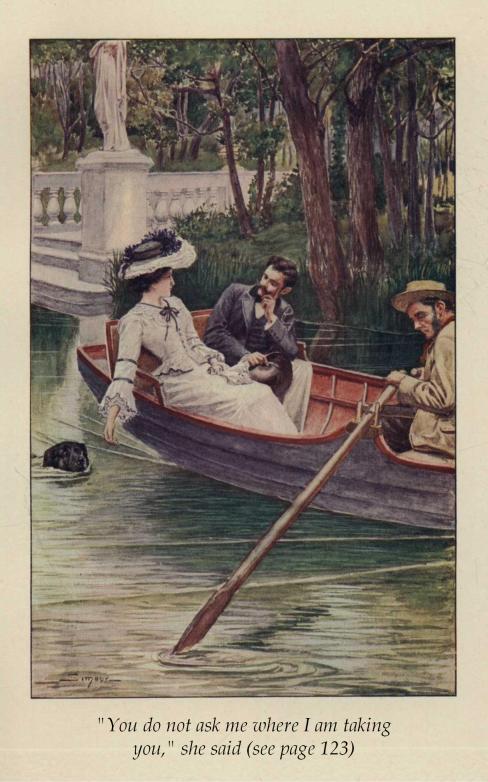
"You do not ask me where I am taking you," she said (see page 123)
I had not thought of claiming this, as I had not found it mentioned in the leases drawn up by my able predecessor, which had been my models. For the moment I drew no conclusions from his silence on this point, but when I handed over the windfall to Mme. Laroque her surprise astonished me.
"And what is this?" she said.
I explained the nature of the payment, and had to repeat my explanation.
"And is it a usual custom?" she continued.
"Yes, madame, whenever a lease is renewed."
"But, to my knowledge, there have been ten leases renewed in the last thirty years.... How is it we never heard of such a custom?"
"I cannot say, madame."
Mme. Laroque fell into an abyss of reflections, in which, perhaps, she encountered the venerable shade of le père Hivart. At length she slightly shrugged her shoulders, looked at me, then at the gold, then again at me, and seemed to hesitate. At last, leaning back in her chair, sighing deeply, and speaking with a simplicity which I greatly appreciated, she said:
"Very well, monsieur. Thank you."
Mme. Laroque had the good taste not to compliment me on this instance of ordinary honesty; but, none the less, she conceived a great idea of her steward's ability and virtues. A few days later I had a proof of this. Her daughter was reading an account of a voyage to the pole to her, in which an extraordinary bird is mentioned—-"qui ne vole pas."[#]
[#] "Which does not fly." But the French verb voler is also to steal; hence the application.
"Like my steward," she said.
I sincerely believe that from this time my devotion to the work I had undertaken gave me a claim to a more positive commendation. Soon afterward, when I went to see my sister in Paris, M. Laubépin thanked me warmly for having so creditably redeemed the pledges he had given on my behalf.
"Courage, Maxime," he said. "We shall give Hélène her dowry. The poor child will not have noticed anything unusual, and you, my friend, will have nothing to regret. Believe me, you possess what in this world comes nearest to happiness, and I am sure you will always possess it, thank Heaven! It is a peaceful conscience and the manly serenity of a soul devoted to duty."
The old man is right, of course. I am at peace, but I cannot say that I am happy. My soul is not yet ripe for the austere delights of sacrifice; it has its outbursts of youthfulness and of despair. My life is no longer my own: it is devoted and consecrated to a weaker, dearer life; it has no future: it is imprisoned in a cloister that will never be opened. My heart must not beat, my brain must not think, save for another. So be it! May Hélène be happy! Years are stealing upon me. May they come quickly! I pray that they will; the coldness that comes with them will strengthen my courage.
Besides, I cannot complain of a situation which has, in fact, fallen agreeably short of my worst forebodings, and has even surpassed my brightest expectations. My work, my frequent journeys into the neighbouring departments, and my love of solitude, often keep me away from the château, where I particularly avoid all the more festive gatherings. And perhaps it is because I go to them so seldom that I am welcomed so kindly. Mme. Laroque, in particular, shows a real affection for me; she makes me the confidant of her curious and perfectly sincere fancies about poverty, sacrifice, and poetic abnegation, which form such an amusing contrast to the chilly Creole's multitudinous contrivances for comfort.
Sometimes she envies the gipsies carrying their children on a wretched cart along the roads, and cooking their food under hedges; sometimes it is the Sisters of Chanty; sometimes the cantinières, whose heroic work she longs to share.
And she never ceases to lament the late M. Laroque's admirable health, which prevented his wife from showing that nature had meant her for a sick-nurse. Nevertheless, she has lately had fixed to her chair a kind of niche like a sentry-box, as a protection from draughts. The other morning I found her triumphantly installed in this kiosk, where she really awaits her martyrdom in considerable comfort.
I have scarcely less reason to be satisfied with the other inhabitants of the château. Mlle. Marguerite, who is always plunged like a Nubian sphinx in some mysterious vision, nevertheless condescends to treat me to my favourite airs with the utmost good-nature. She has a fine contralto voice, which she uses with perfect art, but at the same time with an indifference and coldness which I think must be deliberate. Sometimes, in an unguarded moment, I have heard her tones become impassioned, but almost immediately she has returned to an icy correctness, as if ashamed of the lapse from her character or from her role.
A few games of piquet with M. Laroque, which I had the tact to lose, won me the favour of the poor old man. Sometimes I find his dim and feeble gaze fixed on me with strange intentness, as if some dream of the past, some fanciful resemblance, had half revived among the mists of an exhausted memory, in which the images of a century hover confusedly.
They actually wanted to return me the money I lost to him. Mme. Aubry, who usually plays with the old captain, accepts these restitutions without scruple; but this does not prevent her from winning pretty frequently, on which occasions she has furious encounters with the old corsair. M. Laubépin was lenient when he described this lady merely as embittered. I have no liking for her, but, out of consideration for the others, I have made an effort to gain her good-will, and have succeeded in doing so by listening patiently first to her lamentations over her present position, and then to her impressive description of her former grandeur, her silver, her furniture, her lace, and her gloves.
It must be confessed that I have come to the right school to learn to despise the advantages I have lost. Every one here by their attitude and language eloquently exhorts me to the contempt of riches. Firstly, Mme. Aubry, who might be aptly compared to those shameless gluttons whose greediness takes away one's appetite, and who disgust one with the dishes they praise; the old man, perishing as sadly among his millions as Job on his dunghill; the good woman, romantic and blasé, who in the midst of her inopportune prosperity dreams of the forbidden fruit of suffering; and lastly, the haughty Marguerite, who wears like a crown of thorns the diadem of beauty and opulence which Heaven has forced on her brow. A strange girl!
Nearly every fine morning I see her ride past the windows of my belfry; she bows gravely to me, the black plume of her felt riding hat dipping and waving in the wind; and then she slowly disappears along the shaded path that runs through the ruins of the ancient château. Sometimes old Alain follows her, and sometimes her only companion is the huge and faithful Mervyn, who strides at the side of his beautiful mistress like a pensive bear. So attended, she covers all the country round on her errands of charity. She does not need a protector, for there is not a cottage within six leagues where she is not known and worshipped as the goddess of good works. The poor people call her "Mademoiselle," as if they were speaking of one of those daughters of kings who give poetry to their legends, and whose beauty and power and mystery they recognise in her.
I, meanwhile, am seeking the key to the sombre preoccupation that clouds her brow, the haughty and defiant severity of her eyes, the cold bitterness of her tongue. I ask myself if these are the natural traits of a strange and complex character, or the symptoms of some secret suffering, remorse, or fear, or love, which preys on this noble heart. However slightly one may be interested in the question, it is impossible not to feel a certain curiosity about a person so remarkable. Last night, while old Alain, with whom I am a favourite, was serving my solitary repast, I said:
"Well, Alain, it's been a lovely day. Have you been riding?"
"Yes, sir, this morning, with mademoiselle."
"Oh, indeed!"
"You must have seen us go by, sir."
"Very likely. I sometimes do see you pass. You look well on horseback, Alain."
"You're very kind, sir. But mademoiselle looks better than I do."
"She is a very beautiful young lady."
"You're right, sir, and she's fair inside as well as outside. Just like her mother. I'll tell you something, sir. You know, perhaps, that this property belonged to the last Comte de Castennec, whom I had the honour of serving. When the Laroques bought the château I must own that I was rather upset, and not inclined to stay with the new people. I had been brought up to respect the nobility, and it went against my feelings to live with people of no birth. You may have noticed, sir, that I am glad to wait upon you; that is because I think you look like a gentleman. Are you quite sure you don't belong to the nobility, sir?"
"Quite sure, my poor Alain."
"Well, it's of no consequence, sir, and this is what I wanted to tell you," said Alain, with a graceful inclination. "In the service of these ladies I have learned that nobility of the heart is as good as the other, more especially that of the Comte de Castennec, who had a weakness for beating his servants. Still, sir, it's a great pity mademoiselle cannot marry a gentleman with a fine old name. Then she would be perfect."
"But, Alain, it seems to me that it only depends on herself."
"If you refer to M. de Bévallan, sir, it certainly does, for he asked for her more than six months ago. Madame was not opposed to the marriage, and, in fact, after the Laroques, M. de Bévallan is the richest man hereabouts; but mademoiselle, though she didn't positively refuse, wanted time to think the matter over."
"But if she loves M. de Bévallan, and can marry him whenever she likes, why is she always so sad and thoughtful?"
"It's very true, sir, that mademoiselle has changed a good deal in the last two or three years. Before that she was as merry as a bird; now she seems to have something on her mind, but, if I may say so, it is not love for this gentleman."
"You don't seem very fond of M. de Bévallan yourself, Alain. But his family is excellent."
"That does not prevent him from being a bad lot, sir, always running after the country girls, and for no good either. And if you used your eyes, sir, you might see that he is quite ready to play the sultan here in the château itself while he's waiting for something better."
After a significant pause Alain went on.
"Pity you haven't a hundred thousand francs a year, sir."
"And why, Alain?"
"Because..." and Alain shook his head thoughtfully.
July 25th.
During the past month I have made one friend and two enemies. The enemies are Mlle. Marguerite and Mlle. Hélouin. The friend is a maiden lady of eighty-eight. Scarcely a compensation! I will first make up my account with Mlle. Hélouin, an ungrateful young lady. What she considers my offences should rather have secured her esteem. But she is one of the many women who do not care either to give, or to inspire, such a commonplace sentiment. From the first I had been inclined to establish friendly relations with her. The governess and the steward were on a similar footing; we had a common ground in our subordinate position at the château. I have always tried to show to ladies in her position the consideration which seems to me due to those in circumstances so precarious, humiliating, and hopeless. Besides, Mlle. Hélouin is pretty, intelligent, and accomplished, though she rather deducts from these qualities by the exaggerated liveliness of manner, the feverish coquetry, and the tinge of pedantry which are the failings of her profession.
I do not claim any credit for my chivalrous attitude towards her. It seemed to me a sort of duty when, as various hints had warned me, I became aware that a devouring lion in the semblance of King Francis I was prowling round my young protégée. This duplicity, which did credit to M. de Bévallan's audacity, was carried on, under cover of a friendly interest, with an astuteness and confidence well calculated to deceive the careless and unsuspecting. Mme. Laroque and her daughter, especially, are too little acquainted with the wickedness of this world, and too little in touch with realities to have the slightest suspicion. For my own part, I was angry with this insatiable lady-killer, and did my best to spoil his plans. More than once I secured the attention he desired to monopolize; and I tried more especially to counteract or diminish the bitter sense of neglect and isolation, which makes women in Mlle. Hélouin's position ready to accept the kind of consolation which was being offered to her. Have I ever throughout this ill-advised contest outstepped the delicate limits of brotherly protection? I think not. The very words of the brief dialogue which has suddenly altered the character of our relations bear witness to my discretion. One evening last week we were taking the air on the terrace. During the day I had had occasion to show some kindly attention to Mlle. Hélouin, and she now took my arm and said, as she bit at an orange-blossom with her small white teeth:
"M. Maxime, you are very good to me."
Her voice was a little unsteady.
"I hope so, mademoiselle."
"You are a true friend."
"Yes, indeed."
"But what kind of a friend?"
"A true friend, as you say."
"A friend who—loves me?"
"Surely."
"Much?"
"Most decidedly."
"Passionately?"
"No."
At this word, which I uttered very clearly and with a steady look, Mlle. Hélouin flung the orange-blossom away and dropped my arm. Since this unlucky hour I have been treated with a contempt I do not deserve, and I should have been convinced that friendship between man and woman is a mere illusion, if I had not had on the following day something like an antithesis to this adventure.
I had gone to spend the evening at the château, and as the two or three families who had been staying there for the last fortnight had left in the morning, I met only the habitués—the curé, the tax-collector, Dr. Desmarets, and General de Saint-Cast and his wife, who, like the doctor, lived at the neighbouring little town.
When I came in, Mme. de Saint-Cast, who had apparently brought her husband a handsome fortune, was in close conversation with Mme. Aubry. As usual, these ladies were in perfect agreement. In language in which distinction of form rivalled elevation of thought, they, like two shepherds in an eclogue, alternately lauded the incomparable charms of wealth.
"You are perfectly right, madame," said Mme. Aubry. "There is only one thing in the world worth having, and that is money. When I had money I utterly despised every one who had not, and now I think it quite natural for people to despise me, and I don't complain if they do."
"No one despises you on that account, madame," replied Mme. de Saint-Cast, "most certainly not; but all the same there's a very great difference between poverty and riches, I must confess, as the general knows well enough. Why, he had absolutely nothing when I married him—except his sword—and one doesn't get fat on a sword, does one, madame?"
"No, no, indeed, madame!" exclaimed Mme. Aubry, delighted with this bold metaphor. "Honour and glory are all very well in novels, but a nice carriage is much better in practice, isn't it, madame?"
"Of course it is, madame; and that's just what I was saying to the general this morning as we came here. Isn't it, general?"
"Eh, what?" growled the general, who was playing cards in a corner with the old corsair.
"You hadn't a penny when I married you, general, had you?" continued Mme. de Saint-Cast. "You won't think of denying that, I suppose."
"We've heard it often enough, I should say," growled the general.
"That doesn't alter the fact that if it hadn't been for me, general, you'd have had to travel on foot, and that wouldn't have been a fine thing for you with your wounds. Your half-pay of six or seven hundred francs wouldn't have kept a carriage for you, my friend. I was saying this to him to-day apropos of our new carriage, which is as easy as an arm-chair. Of course I paid a good price for it; it's four thousand francs out of my pocket, madame."
"I can well believe it, madame. My best carriage cost me fully five thousand, including the tiger-skin mat, which was worth five hundred francs alone."
"Yes," replied Mme. de Saint-Cast; "but I have had to be a little careful, for I've just been getting new drawing-room furniture; the carpet and curtains alone cost me fifteen thousand francs. You'll say it's too good for a country hole like this. You're right. But the whole town is lost in admiration, and, after all, one does like to be respected, madame!"
"Of course, madame," replied Mme. Aubry, "we like to be respected, and we are respected according to the money we have. For my part, I console myself for not being respected now, by remembering that if I were as well off as I once was, I should see all the people who despise me at my feet again."
"Except me, by God!" cried Dr. Desmarets, jumping up. "You might have a hundred millions a year, and I give you my word of honour you wouldn't see me at your feet! And now I'll go and get some air, for, devil take me, if one can breathe here!"
So saying, the honest doctor left the room, and my heart went out to him for the outburst that had relieved my own sense of disgust and indignation.
Although M. Desmarets was received at the house as a Chrysostom to whom great license of speech was allowed, his language had been so forcible that it had produced a certain embarrassment in the company, and an awkward silence ensued. Mme. Laroque broke it adroitly by asking her daughter whether it was eight o'clock.
"It can't be, mother," replied Mlle. Marguerite, "for Mlle. de Porhoët has not come yet."
The minute after, as the clock struck, the door opened, and Mlle. Jocelynde de Porhoët-Gaël entered the room, with astronomical punctuality, on the arm of Dr. Desmarets.
Mlle. de Porhoët-Gaël, who had this year seen her eighty-eighth spring, and whose appearance suggested a tall reed wrapped in silk, is the last scion of a noble race, whose earliest ancestors must be sought among the legendary kings of ancient Armorica. Of this house, however, there is no authentic record in history until the twelfth century, when Juthail, son of Conan le Tort, who belonged to the younger branch of the reigning family of Brittany, is mentioned. Some drops of the Porhoët blood have mingled with that of the most illustrious veins of France—those of the Rohans, the Lusignans, the Penthièvres, and these grands seigneurs had admitted that it was not the least pure of their blood. I remember that when in a fit of youthful vanity I studied the alliances of my family, I noticed the strange name of Porhoët, and that my father, who was very learned in such matters, spoke highly in its praise. Mlle. de Porhoët, who is now the sole bearer of the name, had always refused to marry, because she wished to preserve as long as possible in the firmament of the French nobility the constellation of those magic syllables, Porhoët-Gaël. It happened one day that the origin of the house of Bourbon was referred to in her presence.
"The Bourbons," said Mlle. de Porhoët, sticking her knitting-needle into her blond peruke, "the Bourbons are a good family, but" (with an air of modesty) "there are better."
However, it is impossible not to render homage to this august old lady, who bears with surprising dignity the heavy and triple majesty of birth, age, and misfortune. A wretched lawsuit in some foreign country which she has persisted in carrying on for fifteen years, has gradually reduced a fortune, which was but small to begin with; and now she has scarcely a thousand francs a year. Privation has not broken her pride or embittered her temper. She is gay, good-humoured, and courteous. She lives, no one quite knows how, in her small house with her little servant, and contrives even to find money for charity. To their great honour, Mme. Laroque and her daughter are devoted to their poor and noble neighbour. At their house she is treated with a respectful attention which amazes Mme. Aubry. I have often seen Mlle. Marguerite leave the gayest dance to make a fourth for Mlle. de Porhoët's rubber, for the world would come to an end if Mlle. de Porhoët's whist (halfpenny points) was omitted for a single day. I am one of the old lady's favourite partners, and on this particular evening soon found myself, with the curé and the doctor, seated at the whist-table with the descendant of Conan le Tort.
I ought to mention here that at the commencement of the last century a grand-uncle of Mlle. de Porhoët, who held an office in the establishment of the Duke d'Anjou, crossed the Pyrenees in the suite of the young prince, who became Philip V, settled in Spain, and prospered there. His posterity became extinct about fifteen years ago, and Mlle. de Porhoët, who had never lost sight of her Spanish relatives, at once declared herself heiress to their considerable property. Her claims were contested, only too justly, I fear, by one of the oldest Castilian families allied to the Spanish branch of the Porhoëts.
Hence the lawsuit which the unfortunate octogenarian maintained at great expense, going from court to court with a persistence akin to mania, which her friends deplored and other people ridiculed. Dr. Desmarets, despite his respect for Mlle. de Porhoët, belongs to the party who laughs; more particularly, because he strongly disapproves of the use to which the poor lady has prospectively devoted her fictitious heritage. She intends to build in the neighbouring town a cathedral in the richest flamboyant style, which shall perpetuate the name of the foundress and of a great departed race to all future generations. This cathedral—dream begotten of a dream!—is the harmless hobby of the old lady. She has had the plans made; she spends her days and sometimes her nights brooding on its splendours, altering its arrangements, or adding to its decoration. She speaks of it as already existent: "I was in the nave of my cathedral; to-night I noticed something very ugly in the north aisle of my cathedral; I have altered the uniform of the suisse;" etc., etc.
"Well, mademoiselle," said the doctor, shuffling the cards, "have you been working at the cathedral since yesterday?"
"Yes, of course I have, doctor; and I've had a rather happy idea. I have replaced the solid wall, which you know separates the choir from the sacristy, by a screen of carved foliage in imitation of the Clisson chapel in the church at Josselin. It is much lighter."
"No doubt; but in the meanwhile what is the news from Spain? Can it be true, as I think I saw in the Revue des Deux Mondes this morning, that the young duke of Villa-Hermosa proposes to put an end to the case in a friendly way, by offering to marry you?"
Mademoiselle de Porhoët disdainfully shook the plume of faded ribbons attached to her cap.
"I should refuse absolutely," she said.
"Ah, yes, you say so, mademoiselle! But how about the guitar that's been heard under your windows the last few nights?"
"Bah!"
"Bah? And that Spaniard who has been prowling about the country in a mantle and yellow boots, sighing as if his heart would burst?"
"You are a feather-head, Dr. Desmarets," said Mademoiselle de Porhoët, calmly opening her snuff-box. "Still, as you wish to know—I may say that my man of business wrote to me from Madrid a day or two ago that with a little more patience we should see the end of all our troubles."
"I can quite believe that! Do you know where your man of business comes from, madame? Straight from Gil Blas' cavern. He'll drain you of your last shilling, and then he'll laugh in your face. How much better it would be to give up this folly for good and all, and live at ease quietly! What good will these millions do you? Aren't you happy and respected ... what more do you want? ... As for your cathedral, I won't speak of it, because—it is a bad joke."
"My cathedral is not a bad joke to any but bad jokers, Dr. Desmarets; besides, I am defending my rights, I am fighting for justice; the property belongs to me. I have heard my father say so a hundred times, and never, with my consent, shall it go to people who are actually as much strangers to our family as yourself, my friend, or," she added, indicating me, "this gentleman."
I was childish enough to resent this remark, and at once replied: "As far as I am concerned, mademoiselle, you are mistaken; for my family has had the honour of being allied to yours, and vice versa."
At this startling announcement Mlle. de Porhoët hastily brought her cards, which she held spread out fanwise, nearer to her pointed chin, and straightening her spare figure, looked me in the face as if she doubted my sanity. By a tremendous effort she recovered her self-possession, and said, as she carried a pinch of Spanish snuff to her thin nose, "Young man, you will have to prove what you say to me."
Ashamed of my foolish boast, and embarrassed by the attention it had aroused, I bowed awkwardly without speaking. Our rubber was played in gloomy silence. It was ten o'clock, and I was preparing to slip off, when Mlle. de Porhoët touched my arm.
"Sir," she said, "will you be so kind as to accompany me to the end of the avenue?"
I bowed again and followed her into the park. The little servant in Breton costume went first, carrying a lantern; then came Mlle. de Porhoët, stiff and silent, carefully holding up her worn silk frock; she had coldly declined the offer of my arm, and I walked humbly at her side, feeling very much dissatisfied with myself. After a few minutes of this funeral march the old lady spoke.
"Well, sir?" she said. "You may speak; I am waiting. You have asserted that your family is allied to mine, and as an alliance of this kind is a piece of history entirely new to me, I shall be greatly obliged if you will enlighten me on the subject."
I had decided that I must at all costs keep the secret of my incognito.
"I venture to hope, mademoiselle, that you won't take a mere joke quite seriously."
"A joke!" exclaimed Mlle. de Porhoët. "A nice subject to joke upon! And, sir, what do you people of to-day call the jokes that can be boldly addressed to an old and defenceless woman, but which you would not dare to utter in the presence of a man?"
"Mademoiselle, you leave me no choice; I must trust to your discretion. I do not know whether the name of Champcey d'Hauterive is familiar to you?"
"I know the Champcey d'Hauterives perfectly well, sir. They are a good, an excellent Dauphin family. What inference am I to make from your question?"
"I am the present representative of that family."
"You!" exclaimed Mlle. de Porhoët, coming to a sudden halt. "You are a Champcey d'Hauterive?"
"Yes, the male representative, mademoiselle."
"That alters the question," she said. "Give me your arm, cousin, and tell me your history."
I thought that in the circumstances it would be better not to conceal anything from her. As I finished the painful story of my family troubles, we found ourselves opposite a small house, remarkably low and narrow. On one side stood a kind of low pigeon-house with a pointed roof.
"Enter, marquis," said the daughter of the kings of Gaël at the threshold of her lowly palace. "I beg that you will enter."
The next moment I stepped into a little salon meanly paved with brick; on the faded tapestry of the walls hung portraits of ancestors gorgeous in ducal ermine. Over the mantel-piece sparkled a magnificent clock in tortoise-shell and brass, surmounted by a group representing the chariot of the sun. Some oval-backed arm-chairs and an old spindle-legged couch completed the furniture of the room. Everything shone with cleanliness, and the air was filled with mingled odours of iris, Spanish snuff, and aromatic essences.
"Pray be seated," said the old lady, taking her place on the couch; "pray be seated, my cousin. I call you cousin, though we are not related, and cannot be, as Jeanne de Porhoët and Hugues de Champcey were so ill-advised as to leave no issue. But, with your permission, I should like to treat you as a cousin when we are alone, if only to make me forget for a moment that I am alone in the world.
"So, cousin, I see how you are situated; the case is a hard one, most assuredly. But I will suggest one or two reflections which have solaced me, and which I think are likely to bring consolation to you.
"In the first place, my dear marquis, I often tell myself that among all the charlatans and ex-lackeys one now sees rolling in carriages, poverty has a peculiar perfume of distinction and good taste. And also I am inclined to believe that God has brought some of us down to a poor and narrow life, that this coarse, materialistic, money-grubbing age may have before it the type of a merit, dignity, and splendour which owes nothing to money, that money cannot buy—that is not for sale. In all probability, my cousin, such is the providential justification of your situation and of mine."
I conveyed to Mlle. de Porhoët my satisfaction at having been chosen with her to give the world the noble example it needs so much, and shows itself so ready to profit by.
"For my own part," she went on, "I am inured to privation, and I do not feel it much. When, in the course of a life that has been too long, one has seen a father and four brothers, worthy of their father, perish before their time, by sword or bullet; when one has lost, one by one, all the objects of one's affection and worship, one must have a very paltry soul to be much concerned about more or less ample meals and more or less dainty clothing. Certainly, marquis, you may be sure that if my personal comfort only were at stake, I should not trouble about my Spanish millions; but to me it seems but right and proper and exemplary that a house like mine should not disappear without leaving some permanent sign, some striking monument of its grandeur and its faith. And that is why, cousin, I have, in imitation of some of my ancestors, thought of the pious foundation of which you must have heard, and which, while I have life, I shall not relinquish."
Assured of my sympathy, the noble old lady seemed to lose herself in meditation, and as she looked sadly at the fading portraits of her ancestors, only the beat of the hereditary clock broke the silence of midnight in the dim room.
"There will be," Mlle. de Porhoët suddenly resumed, in a solemn voice, "there will be a chapter of regular canons attached to the church. Each day at matins, a mass will be said in the private chapel of my family, for the repose of my soul and the souls of my ancestors. The feet of the celebrant priest will tread a slab of unlettered marble, which will form the step of the altar and cover my ashes."
I bent towards her with evident emotion, with visible respect. Mlle. de Porhoët took my hand and pressed it gently.
"Cousin," she said, "I am not mad, whatever they may say. My father, who was truth itself, always declared that when the direct line of our Spanish branch became exhausted we should be sole heirs to the estate. Unfortunately, his sudden and violent death prevented him from giving us more exact information; but, as I cannot doubt his word, I do not doubt my rights. However," she added, after a little pause, and in accents of touching sadness, "if I am not mad, I am old, and the people in Spain know it. For fifteen years they have dragged me on from one delay to another; they are waiting for my death to finish everything. And ... they will not have to wait long. Some morning, very soon now, I must make my last sacrifice. My dear cathedral—my only love, which has taken the place of so many broken or suppressed attachments—will have but one stone—that of my tomb."
She was silent; her thin hands wiped away two tears that flowed down her worn face, as, striving to smile, she said:
"Forgive me, cousin, you have enough troubles of your own. Besides, it is late—you must go. You will compromise me!"
Before leaving, I again recommended the greatest discretion in reference to the secret I had intrusted to her. She replied, a little naïvely, that I need not be anxious, and that my peace of mind and dignity were safe in her hands. Nevertheless, during the next few days, I suspected, from Mme. Laroque's increased attentions, that my excellent friend had handed on my confidence. Indeed, Mlle. de Porhoët admitted the fact, declaring that the honour of her family demanded this, and assured me that Mme. Laroque was incapable of betraying a secret intrusted to her, even to her own daughter.
Our interview had filled me with sympathetic respect for the old lady, which I tried to express by my actions. The evening of the next day I taxed all the resources of my pencil in the invention of decorations, internal and external, for her beloved cathedral. The attention seemed to please her very much, and I soon got into the habit of working on the cathedral every evening after our whist, enriching the ideal edifice with a statue, a pulpit, and a rood-loft. Mlle. Marguerite, who seems to feel a kind of adoration for her old neighbour, associated herself with my work of charity by devoting a special album to the Basilica Porhoët, which it is my duty to fill with designs and drawings.
And in addition, I offered my old confidant to take my share in the inquiries and other matters of business connected with her lawsuit. The poor lady confessed that I should do her a service; that though she could still keep up her ordinary correspondence, her sight was too weak to decipher the manuscripts of her archives. Hitherto she had not associated any one with her in this important work, for fear of giving more occasion to the rustic humourists. In short, she accepted me as counsellor and collaborator. Since this, I have conscientiously studied the voluminous documents of her lawsuit, and I have been convinced that the case, which must be sooner or later definitively settled, is absolutely hopeless from the beginning. M. Laubépin agrees with me in this opinion, which as far as possible I have concealed from the old lady. Meanwhile I have pleased her by going through her family archives piece by piece; she still hopes to find among them some incontestable proof in favour of her claim. Unfortunately, the records are very copious, and fill the pigeon-house from floor to roof. Yesterday I went early to Mlle. de Porhoët's to finish before lunch the examination of packet No. 115, which I had begun overnight. The lady of the house had not risen yet, so, with the help of the little servant, I quietly installed myself in the salon and settled down to my dusty work. About an hour later, as I was going joyfully through the last sheet of packet No. 115, Mlle. de Porhoët came in, dragging a huge bundle neatly wrapped up in a white linen cover.
"Good-morning, my dear cousin," she said. "I've heard how you have been working for me this morning, so I determined to work for you. Here is packet No. 116."
I must confess that at this moment Mlle. de Porhoët reminded me of the cruel fairy of folklore, who shuts the princess up in a lonely tower and imposes a succession of extraordinary and impossible tasks on her.
"Last night," she continued, "I dreamed that the key of my Spanish treasure lay in this packet. So you will very much oblige me by examining it at once. Afterward I hope you will do me the honour to share a frugal repast in the shade of my arbour."
There was no help for it. I obeyed, and I need not say that the wonderful packet No. 116 contained, like its predecessors, nothing more valuable than the dust of centuries. Precisely at noon, the old lady came to offer me her arm and conduct me formally to a little box-bordered garden which, with a bit of adjoining meadow, now constitutes the sole domain of the Porhoëts. The table was set out under an arched bower of foliage, and through the leaves the sunshine of a fine summer's day dappled the spotless, sweet-smelling table-cloth. I had done justice to the chicken, the fresh salad, and the bottle of old Bordeaux, which made up the menu of the banquet, when Mlle. de Porhoët, who seemed charmed with my appetite, turned the conversation on to the Laroque family.
"I will own," she said to me, "that I do not care for the old buccaneer. When he first came here he had a large and favourite ape, which he dressed up like a servant, and which he seemed to be able to communicate with perfectly. The animal was a nuisance to the whole country, and only a man without education or decency could have kept it. I agreed when they told me that it was an ape, but, as a fact, I have always believed that it was a negro, more especially as I had always suspected its master of having trafficked in that commodity in Africa. But M. Laroque, the son, was a good sort of man, and quite a gentleman. As to the ladies—I refer, of course, to Mme. Laroque and her daughter, and in no way to the widow Aubry, an extremely common person—as to the ladies, I say, they deserve every good thing one can say of them."
Just then we heard the hoofs of a horse on the path that runs outside the garden wall, and the next moment some one was knocking sharply at a small door near the arbour.
"Yes," said Mlle. de Porhoët. "Who goes there?"
I looked up, and saw a black plume above the top of the wall.
"Open," said a gay voice outside, full of musical intonations. "Open. 'Tis the fortune of France!"
"What? Is it you, my darling?" said the old lady. "Quick, cousin, run!"
As I opened the door Mervyn rushed between my legs, nearly throwing me down. Mlle. Marguerite was tying up her horse to the fence by his reins.
"Bonjour, M. Odiot," she said, without showing any surprise at finding me there. Throwing the long folds of her habit over her arm, she entered the garden.
"Welcome this lovely day, my lovely girl!" said Mlle. de Porhoët. "Kiss me, dear. You've been riding too fast, you foolish child. I can tell by your colour and the fire that literally seems to flash from your eyes. What can I offer you, my beauty?"
"Let me see," said Mlle. Marguerite, glancing at the table. "What have you got? Has M. Odiot eaten up everything? Not that it matters. I am thirsty, not hungry."
"I utterly forbid you to drink while you're so hot. But wait a moment; there are some strawberries left in that bed."
"Strawberries! O giòia!" sang the girl. "Take one of those fig-leaves, M. Odiot, and come with me. Quick!"
While I chose the largest of the fig-leaves, Mlle. de Porhoët half-closed one eye, and followed her favourite with the other, as she walked proudly along the sunlit alley.
"Look at her, cousin," she whispered, with an approving smile; "isn't she worthy to be one of us?"
Meanwhile, Mlle. Marguerite, bending over the bed and catching her foot in her train at every step, greeted each strawberry she found with a little cry of delight. I kept near to her, holding out the fig-leaf, in which she put one strawberry for every two she ate, to help her to be patient. When she was satisfied with the harvest we returned in triumph to the arbour. The rest of the strawberries were sprinkled with sugar, and crushed by the prettiest teeth in Brittany with great relish.
"Oh, that's done me good!" exclaimed Mlle. Marguerite, throwing her hat on the seat and leaning back against the side of the bower. "And now, dearest lady, to complete my happiness, you're going to tell me stories of the old days when you were a fair warrior."
Mlle. de Porhoët, smiling and charmed, needed no pressing, and began to tell us some of the most striking events of her famous expeditions with Lescure and La Rochefoucauld. And on this occasion my old friend gave me another proof of her nobility of nature, for she paid her tribute to the heroes of those troublous wars without distinction of party. She spoke of General Hoche, whose prisoner she had been, with almost tender admiration. Mlle. Marguerite listened with an impassioned attention which surprised me. At one moment, half-buried in her leafy niche, her long eyelashes a little lowered, she sat as motionless as a statue; at another, when the story became more exciting, she put her elbows on the table, plunged a beautiful hand into the masses of her loosened hair, and fixed the lightning of her brilliant eyes eagerly on the old Vendienne.
Among the sweetest hours of my dull life, I shall always count those I spent watching that noble face, irradiated by the reflections of the glowing sky and the impressions of a valiant heart.
When the story-telling was over, Mlle. Marguerite embraced her old friend, and waking up Mervyn, who was asleep at her feet, declared that she must return to the château. As I was sure it would cause her no embarrassment, I had no hesitation in leaving at the same time. Apart from my personal insignificance in the sight of the rich heiress, Mlle. Laroque was quite at her ease without a chaperon. Her mother had given her the same kind of liberal education she had herself received in one of the British colonies. And we know that the English method accords to women before marriage all that independence which we so wisely give them only when the abuse of it becomes irreparable. So we went out of the garden together. I held her stirrup while she mounted, and we set off towards the château.
"Really, M. Odiot," she said, after a few steps, "I am afraid I spoiled your tête-à-tête in the garden. You seemed to be very happy."
"Certainly, mademoiselle, but as I had already been there a long time, I forgive you; nay, more, I thank you."
"You are very good to our poor friend. My mother is very grateful to you."
"And your mother's daughter?" I said, laughing.
"Oh, I'm not so easily impressed. I am afraid you will have to wait a little before you get any praises from me. I don't judge people's actions leniently; there is generally more than one explanation of them. I grant that your behaviour towards Mlle. de Porhoët looks very well, but——" she paused, shook her head, and went on in a serious, bitter, and frankly insulting tone, "but I am not at all certain that you are not paying court to her in the hope that she may make you her heir."
I felt myself grow pale. But, seeing how absurd it would be to answer this young girl angrily, I controlled myself, and replied grandly, "Allow me, mademoiselle, to express my sincere pity for you."
She appeared very much surprised. "Your sincere pity?"
"Yes, mademoiselle, the respectful pity to which I think you have a right."
"Pity!" she said, stopping her horse and slowly turning her disdainful, half-closed eyes towards me. "I am not so fortunate as to understand you."
"It is really quite simple, mademoiselle; if disillusion, doubt, and callousness are the bitterest fruits of long experience, nothing in the world deserves pity so much as a heart withered by mistrust before it has even seen life."
"Sir," said Mlle. Laroque, with a strange vehemence, "you do not know what you are talking about. And," she added more harshly, "you forget to whom you are speaking!"
"That is true, mademoiselle," I answered gently, bowing. "I may have spoken without much knowledge, and perhaps I forgot, to some extent, to whom I was speaking. But you set me the example."
Her eyes fixed on the top of the trees that bordered the road, Mlle. Marguerite asked, with haughty irony:
"Must I beg your pardon?"
"Most certainly, mademoiselle," I replied firmly, "if either of us should ask pardon, it is you. You are rich, I am poor; you can humble yourself.... I cannot."
There was silence. Her tightened lips, her quivering nostrils, and the sudden whiteness of her forehead, showed what a struggle was going on within her. Suddenly lowering her whip as if to salute, she said:
"Very well, I beg your pardon."
At the same moment she gave her horse a sharp cut and set off at a gallop, leaving me in the middle of the road.
I have not seen her since.
July 30th.
The calculation of probabilities is never more misleading than when it has to do with the thoughts and feelings of a woman. After the painful scene between Mlle. Marguerite and myself, I had not been very anxious to encounter her. For two days I had not been to the château and I scarcely expected that the resentment I had aroused in this proud nature, would have subsided in this short interval. However, about seven o'clock on the morning of the day before yesterday, when I was working at the open window of my tower, I heard my name called out in a most friendly way by the very person of whom I thought I had made an enemy.
"M. Odiot, are you there?"
I went to the window and saw Mlle. Marguerite standing in the boat that was kept by the bridge. She was holding back the brim of her brown straw hat and looking up at my dark tower.
"Here I am, mademoiselle," I said eagerly.
"Are you coming out?"
After my well-founded apprehension of the last two days, so much condescension made me think, to use the accepted formula, I was the dupe of a disordered fancy.
"I beg your pardon.... What did you say?"
"Will you come out for a little with Alain, Mervyn, and me?"
"With pleasure, mademoiselle."
"Very well—bring your album."
I went down quickly and hurried to the bank.
"Ah! ah!" said the girl, laughing, "you're in a good-humour this morning, it seems."
I awkwardly murmured something to the effect that I was always in a good-humour, but Mlle. Marguerite scarcely seemed convinced of the fact. Then I stepped into the boat and sat down at her side.
"Row away, Alain," she said immediately; and old Alain, who prides himself on being a first-rate oarsman, set to work steadily, the long oars moving to and fro at his sides, making him look like a heavy bird trying to fly.
"I was obliged to come and save you from your donjon," said Mlle. Marguerite, "where you have been ailing for two whole days."
"Mademoiselle, I assure you that only consideration for you—respect—fear of..."
"Respect! Fear! Oh, dear, no! You were sulking, that is all. We behave much better than you. My mother, for some reason or other, thinks you ought to be treated with special consideration, and has implored me to sacrifice myself on the altar of your pride; so, like an obedient daughter, I sacrifice myself."
I expressed my gratitude frankly and warmly.
"Not to do things by halves," she continued, "I have determined to give you a treat to your taste. So here you have a lovely summer morning, woods and glades with all the proper light effects, birds warbling in the foliage, a mysterious bark gliding on the waves. As this is the sort of thing you like, you ought to be satisfied."
"Mademoiselle, I am charmed."
"Well, that's all right."
For the moment I was fairly contented with my fate. The air was sweet with the scent of the new-mown hay lying in swaths on either bank; the sombre avenues of the park, dotted with patches of sunshine, slipped past us, and from the flower-cups came the happy drone of myriads of insects feasting on the dew. Opposite me, old Alain smiled complacently at me with a protecting look at each stroke of his oars, and closer to me Mlle. Marguerite, dressed in white—contrary to her custom—beautiful and fresh and pure as a periwinkle blossom, shook with one hand the pearls of dew from her veil while she held out the other as a bait for Mervyn, who was swimming after the boat. I should not have wanted much persuasion to go to the end of the world in that little white boat.
As we passed under an arch in the wall that bounds the park the young Creole said to me:
"You do not ask where I am taking you?"
"No, mademoiselle, I do not. It is all the same to me."
"I am taking you into fairyland."
"I thought so, mademoiselle."
"Mlle. Hélouin, more versed in poetic lore than I am, has no doubt told you that the thickets that cover the country for twenty miles round are the remains of the ancient forest of Brouliande, the hunting-ground of those beings of Gaël, ancestors of your friend Mlle. de Porhoët, and the place where Mervyn's ancestor, wizard though he was, came under the magic spells of a damsel called Vivien. Now we shall soon be in the centre of that forest. And if this is not enough to fire your imagination, let me tell you that these woods are full of remains of the mysterious religion of the Celts; they are paved with them. In every shady nook you picture to yourself a white-robed Druid, and in every ray of sunlight the glitter of a golden sickle. The religion of these old bores has left near here, in a solitary and romantic place, a monument before which people subject to ecstasy are usually in raptures. I thought you would like to sketch it, and as it is not easy to find, I will show you the way, on condition that you suppress the explosions of an enthusiasm I cannot share."