MR. OLENDORF’S COMPLAINT.
Reading edition
YOUNG Mr. Olendorf used to board at a nice boarding-house out on North Hill, a little this side of the North Pole. It was a good way out; but Mr. Olendorf always was fond of pure air and pedestrian exercise, and as his business hours were easy, he preferred the comforts of a home in the suburbs to the excitement and clamor of a down-town hotel. A mild-looking, meek-faced, soft-voiced young man was Mr. Olendorf, as ever you could wish to see. He rarely complained about anything, and he never spoke harshly of any one. He would sit on his trunk, when the family had carried his chair down to the parlor for the convenience of invited guests; and he would patiently sew on his shirt buttons with a darning-needle and carpet thread, rather than intimate to his washer-lady that it wasn’t just the thing to run fine shirts through a corn-sheller to wash them. Many a time he crawled into a bed that looked like the crater of an extinct volcano, rather than report the hired girl for neglecting to make it up. And six times a week he cleaned his grimy lamp chimney with his fingers, as far as they would reach, because, he said, in the fullness of his charitable soul, the girl had so much to do she hadn’t got round to it. And the seventh night in the week, the lamp being empty and dry as a flat bottle on a hunting expedition, he would undress by the dim religious light of a match. He used to wash with a piece of soap four inches long and two inches thick, as brown as varnish, and so hard it chipped the edges of the washstand when it was carelessly dropped; and often and often, when his eyes were full of soap, and he reached out his imploring hands, groping for the short, thin towel that was seldom there, he had to feel his way to the bed, abrading his shins against things that he couldn’t see and didn’t know the names of, and dry his face and hair on the pillow-slips. But he never murmured. He used to find bright streaks of red by the dozen in his pomade, and go down to the breakfast table with his own coal-black locks as dry as good advice, and marvel at the exceeding glossiness and slickness of the hired girl’s bright auburn cranium. But he said never a word. And the drouth used to strike his perfumery bottles once in a while, and leave them as empty as a lecturer’s head; and he would wind his modest nasal horn in a handkerchief that smelled like a wash-tub, and when his landlady’s daughters sailed scornfully past him, perfumed for all the world like the ghosts of his toilet bottles up stairs, he never looked suspicious, but only smiled apologetically, as though it was wrong in him to leave temptation in their way. And once, when he had an attack of cholera morbus, and sent out for a quart of brandy, and took a tablespoonful of it, and came back at night to find the bottle very empty, and the landlady’s husband very full, and lying in Mr. Olendorf’s bed with his boots on, young Mr. Olendorf only agreed with the landlady that it was very singular, and that the old man must be ill. So you see Mr. Olendorf was inclined to be rather peaceable and meek, and when he did complain there must be some reason for it.
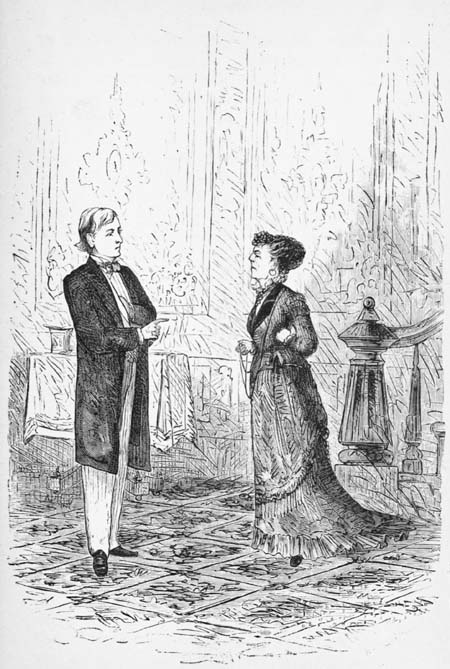
OLENDORF’S COMPLAINT.
One evening Mrs. McKerrel, his landlady, approached the young man for the purpose of securing the weekly dole which he paid for the comforts of a home, and bracing himself up by a desperate effort, Mr. Olendorf, for the first time in his life, complained.
“It’s the hash, Mrs. McKerrel,” he said plaintively. “It’s too monotonous. It’s good hash. I can’t say that it isn’t good. It is more nutritious than chopped straw, and a prize candy package doesn’t equal it for variety. But I want change. I like hash for breakfast. But when you give us baked hash for dinner and put boned hash on for supper, and give us plain hash again for breakfast, and serve stuffed hash again for dinner, it isn’t a square deal. I believe you impose on us. I never heard of ‘stuffed hash’ before I came here, and the only difference between it and the common kind is that it is thinner. The last ‘stuffed hash’ you gave us you made us eat with steel forks, and it was as thin as soup, and how is a strong man going to make out a dinner when he has only twenty-five minutes in which to eat soup with a three-tined fork? And I don’t think you do the fair thing by us on what you call ‘boned hash.’ It’s hardly right, Mrs. McKerrel, to make a hash of sardines and herrings and then call it ‘boned.’ It’s just like eating a shoe brush. Now there ought to be, once in a while, a change. Not too often, you know; I don’t expect you to keep a French restaurant for seven dollars a week, but just often enough to keep the bill of fare from growing tiresome. Say once every seven years. For instance, you may have ‘boned hash’ to-morrow for dinner, which, it being Sunday, you will. Well, then, you might have ‘boned hash’ every day until 1882, and then give us a roast, or a car-spring chicken. And so with ‘stuffed hash,’ and ‘hash a la mode,’ and ‘hash a la Mayonnais,’ ‘Lady Washington hash,’ ‘hash on toast,’ ‘spring hash, with mint sauce,’ and ‘hash a la mortar,’ and the other hashes on your bill of fare. By serving them up once every seven years, you have enough kinds to run clear into a Centennial.”
The landlady, looking aghast, made an effort to speak, but young Mr. Olendorf motioned her to silence.
“And if you would speak to Mrs. Muldoon, dear Mrs. McKerrel,” he went on, “and tell her that, while I am not proud, I do not consider the hickory shirts which the estimable Mr. Muldoon wears while he is developing the railroad resources of the United States exactly the things to wear to church; and even if I had no other scruples against attending public worship in a section hand’s shirt, torn all the way across the shoulders and fastened at the neck and cuffs with horn buttons, Mr. Muldoon’s are five sizes too large for me, and I would rather she would send me my own. And if you can bribe her to put the starch in my collars instead of my handkerchiefs, I feel that it will improve the appearance of my neck, and spare the feelings of a lacerated and tender nose. No man, Mrs. McKerrel, can wipe his nose on a sheet of tin and do the matter justice.”
Mrs. McKerrel placed her hands on her hips and stood up, but Mr. Olendorf begged her to be patient just a moment, while he went on:
“And do you think, if I made a chalk mark on them, that your domestic could learn the difference between my hair brush and my shoe brush? And if I made her a little present, might she not be induced to look up something else to black the stoves with instead of my shoe brush? It is dreadfully mortifying, Mrs. McKerrel, to black your shoes after night and get clear in church the next morning before discovering that your feet are glistening in all the glory of ‘Plumbago’s New Silver Gray Luster,’ and everybody is laughing at you. And then, Mrs. McKerrel, I don’t know how my things get so full of snuff. I never use snuff, and I don’t want to complain, but——”
Here the exasperated matron could restrain herself no longer. Hastily thrusting her snuff-box back in her pocket, she bade Mr. Olendorf pack. What he wanted, she said, was a Fifth Avenue hotel for seven dollars a week, and he couldn’t have it in her house. He was too particular for such a plain woman as her; if he didn’t like the ways of plain people, he would have to go where they were nicer. He was too stuck up and fussy to live in her house. Boarders she had kept, of the very best people in the highest classes in society, and this was the first time she had ever heard a word of complaint in her house.
And that is the way Mr. Olendorf happened to call around at the Gorham and ask Andrews for a nice room, a long ways up. And Andrews gave him a key and told him to climb till he knew he was lost, and then crawl into the first bed he saw.