MIDDLERIB’S PICNIC.
Reading edition
“IT isn’t age that makes people grow old,” Mr. Middlerib remarked to his family as they were gathered at the breakfast table. “It is incessant application; it is unending, incessant work and worry. The mind, the body, all the faculties, mental and physical, are kept on the alert without rest or recreation, until outraged nature rises in rebellion against the slavery to which it is subjected, and deluded man, with all the aches and tremor of senility in his young joints, awakes to find that he has lived his three score years and ten in half his allotted number of days.” And with this sage remark Mr. Middlerib leaned back in his chair and regarded his family with the air of a man who has just imparted a volume of information that would stagger the average comprehension.
“That’s what ailed these spring chickens, I reckon,” suggested Master Middlerib, struggling with a wing that was supplied with the latest improved fish-plate joints; “wore themselves out trying to lay ten years’ eggs in five.”
MIDDLERIB’S PICNIC.
Mr. Middlerib gazed at the boy in a meaning manner, and the young gentleman immediately elevated one of his elbows until it was as high as his head, and held his guard up while he warily regarded his parent’s disengaged hand. But the usual consequences did not follow, and Mr. Middlerib proceeded to announce that he would shake off the sordid cares of business, and free himself from the shackles of commercial servitude, and enjoy a picnic with his family and a few chosen friends. And immediately upon this, the family loosed their tongues and talked all together, and as loud and fast as possible for twenty-five minutes. Then, Mr. Middlerib, smiling benignly upon the scene of pleasure which his announcement had created, went off to his office. When he returned, Miss Middlerib had a list made out of the people they would invite. It embraced one hundred and fifteen names, not including alternates, and Mr. Middlerib’s jaw fell as he gazed at the catalogue.
“Daughter, dear,” he remarked, as soon as he could command his feelings, “do you take me for Calvary Mission Sunday-school, that you have included the census of this city in our picnic?”
Then explanations were demanded, and it appeared that Mr. Middlerib’s idea had been to take a couple of big wagons, furnished with temporary seats, and have a decidedly rustic, old-fashioned picnic, of an exclusively family nature. And Miss Middlerib sat down and blotted out an even hundred names with tears, after which Mr. Middlerib gazed upon the revised and corrected list, expunged edition, and pronounced it good. Then they fixed upon the day, which was settled after much wrangling and profound discussion. Mr. M. went out and looked at the sky, and noted the direction of the wind, and watched the movements of the chimney swallows with a critical and scientific eye, and came in and announced that it would not rain for five days, and they would have the picnic just two days before the rain. And from the hour of that announcement the Middlerib family and their invited relations did nothing but bake, and roast, and stew, and iron clothes, and declare they were tired to death and would be glad when it was all over and done with. It is a somewhat remarkable fact that all people who make up their minds to go to a picnic, always do say that they will be glad when it is over, and act as though they were going merely as an act of self-denial and a mortification of the flesh.
But when the day finally rolled around, as days will roll, the excitement was at its height. The sun struggled to his place at the usual hour, as soon as he was called, and his broad, red face had a terribly wild and dissipated look as he glared through the bank of clouds that curtained his getting up place, as though he had been tearing around all night, and had never had his boots off, and had only got up to collar the water pitcher. No wonder the whole party lost confidence in such a sun the moment they looked at him. He looked too much like a prodigal sun, just before he got starved into reform, rather than a smiling, cheery picnic sun. And the Middleribs took turns going out singly and in small groups to look at him, and revile his unpromising appearance, and after each observation they would return to the house and ask each other in tones somewhat tinged with a tender melancholy, “Well, what do you think of it?” And the questioned one would stifle a sigh and reply “I don’t know, do you?”
There is no scene in all this wide world of pathos more pathetic than a group of anxious mortals, on the morn of a picnic, trying to delude each other into the belief that when the sky is covered with heavy black clouds, 800 feet thick, and a damp scud is driving through the air, and the sun is only half visible occasionally through a thin cloud that is waiting to be patched up to the standard thickness and density, it is going to be a very fine day indeed. So the Middleribs looked at the coppery old sun, and the dismal clouds, and tried to look cheerful, and said encouragingly that “Oh, it never rained when the clouds came up that way;” and, “See, it is all clear over in the east;” and, “It often rains very heavily in town when there doesn’t a drop of water fall at Prospect Hill.” And thus, with many encouraging remarks of similar import, they awaited the gathering of the party, and the human beings finally climbed into one wagon, put the baskets and the boys in the other, and drove away, giggling and howling with well dissembled glee.
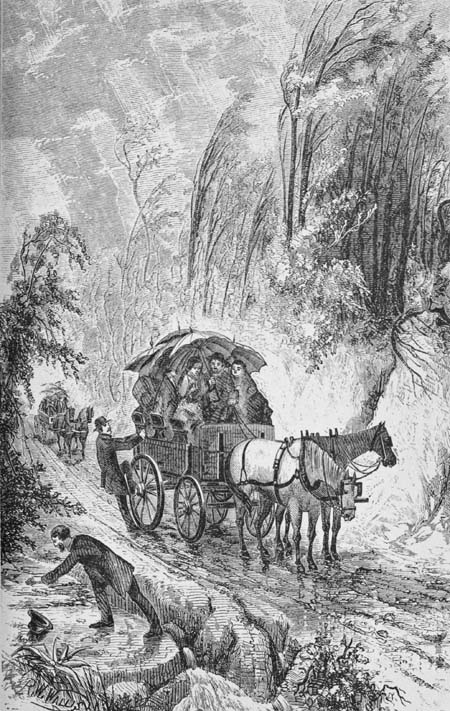
The happy party, although they well knew that it would not rain, had taken the precaution nevertheless to take a large assortment of shawls and umbrellas. They were a quarter of a mile from town when it began to thunder some, but as it didn’t thunder in the direction of Prospect Hill, distant some three miles, they went on, confident that it wasn’t raining, and wouldn’t, and couldn’t rain at Prospect Hill. They were half a mile from town when the cloud that all the rest of the clouds had been waiting for came up and remorselessly sat down on the last, solitary lingering patch of blue that broke the monotony of the leaden sky, but the party pressed on, confident that they would find blue sky when they got to Prospect Hill. They were a mile from town when old Aquarius pulled the bottom out of the rain wagon and began the entertainment. It was a grand success. The curtain hadn’t been up ten minutes before all the standing room in the house was taken up and the box office was closed. The Middlerib party having gone early, and secured front seats, were able to see everything. They expressed their pleasure by loud shrieks, and howls, and wails. They tore umbrellas, that had been furtively placed in the wagon, out of their lurking places, and shot them up with such abruptness that the hats in the wagon were knocked out into the road. Then the wagon stopped and people crawled out and waded around after hats, and came piling back into the wagon, with their feet loaded with mud. The umbrellas got into each other’s way, and from the points of the ribs streams of dirty water trickled down shuddering backs, and stained immaculate dresses, and took the independence out of glossy shirt fronts. And the picnic party turned homeward, but still the Middleribs did not lose heart. They smiled through their tears, and Miss Middlerib, beautiful in her grief, still advocated going on and having the picnic in a barn, and wept when they refused her. It rained harder every rod of the way back. Then when they got everybody and every thing into the house, the heart-rending discovery was made that the boys had taken the rubber blanket which was to have covered the baskets in case of rain, and spread it over themselves when the moisture gathered, and consequently the edibles were in a state of dampness.
Then the clouds broke, and the sun came out, and smiling nature stood around looking as pleasant as though it had never played a mean trick on a happy picnic party in its life; and the Middleribs hung themselves out in the sun to dry, and tried to play croquet in the wet grass, and kept up their spirits as well as they knew how, and were not cross if they did get wet. If smiling nature had only given them a show, or even half a chance, they would have got along all right. They were bound to have the picnic party anyhow, so they kept all the relations at the house, and when dinner time came, the grass was dry and they set the table out under the trees and made it look as picnicky as possible. It clouded up a little when they were setting the table, but nobody thought it looked very threatening. The soaked things had been dried as carefully as possible, and the table looked beautiful when they gathered around it. And just about the time they got their plates filled and declared that they were glad they came back, and that this was ever so much better than Prospect Hill, a forty acre cloud came and stood right over the table, and then and there went all to pieces.
That was what spoiled the picnic.
The pleasure-seekers grabbed whatever they could reach and broke for the house, uttering wild shrieks of dismay. They crowded into the hall, which wasn’t half big enough, and there they stood on each other’s trains, and trod on each other’s corns, and poured coffee down each other’s backs, and jabbed forks into one another’s arms. When one frantic looking woman would rush in and set a plate of cake down on the floor while she dived out into the rain with a woman’s anxiety to recover some more provisions from the dripping wreck, a forlorn looking man would immediately step on that plate of cake, and stand there gazing wonderingly and apprehensively at the shrieking crowd around him, pointing their forks and fingers at him and at his feet, and yelling, in a deafening chorus, something as utterly unintelligible as “shouting proverbs.” And when the man, in a vain effort to do something in compliance with the shrieking which was evidently intended for him, stepped off the cake and stood in a huge dish of baked beans for a change, the wail of consternation that went up from the congregation fairly rent the bending skies. And when Uncle Steve, who had found Aunt Carrie’s baby out under the deserted table, maintaining an unequal struggle with half of a huckleberry pie and a whole thunder-storm, came tearing in with the hapless infant, and, dashing through the crowd, deposited it on top of a pile of hard-boiled eggs, Miss Middlerib fainted, and the youngest gentleman cousin was driven into a spasm of jealousy because he couldn’t walk over a row of cold meats and lobster salad to get to her, and had to endure the misery of seeing the oldest and ugliest bachelor uncle carry her drooping form to a sofa, and lay her down tenderly, with her classic head in a nest of cream tarts and her dainty feet on Sadie’s Jenny Lind cake. And when Mrs. Middlerib looked out of the window, and saw the dog Heedle with his fore paws in the lemonade bucket, growling at Cousin John, who was trying to drive him out of it, she expressed a willingness to die right there. And when they were startled by some unearthly sounds and muffled shrieks, that even rose above the human babel in the hall, and found that the cat had got its poor head jammed tighter than wax in the mouth of the jar that contained the cream, everybody just sat on the plate of things nearest him, and gasped, “What next?” while Cousin David lifted cat and jar by the tail of the former, and carried them out to be broken apart. And when old Mr. Rubelkins lost his teeth in the coffee pot, half the people in the hall began to lose heart, and one discouraged young cousin said he half wished that they had put the picnic off a day. And finally, when the uproar was at its height, the door-bell rang, and the aunt nearest the door opened it, and there stood the Hon. Mrs. J. C. P. R. Le Von Blatheringford and her daughter, the richest and most stylish people in the neighborhood, arrayed like fashion-plates, making their first formal call. While they stood gazing in mute bewilderment at the scene of ruin and devastation and chaos before them, Mrs. Middlerib just got behind the door and pounded her head against the wall; while Miss Middlerib, springing from her sofa, ran to her room, leaving a trail of Jenny Lind cake and cream tarts behind her, as the fragments dropped from her back hair and heels. And the rest of the company, staring at the guests with their mouths full of assorted provisions, and their hearts full of bitter disappointment, mumbled, in hospitable chorus, “Wup pin,” which, had their mouths been empty, would have been rendered, “Walk in.”
This blow settled the picnic. Gloom hung over the house the rest of the day. Mr. Middlerib decided, after the company had departed, that the easiest and cheapest way to clean the hall would be to turn the river through it. And that night, when they were assembled at a comfortless tea-table—Master Middlerib having been sent to bed so sick that they didn’t think his toe-nails would be able to hold down till morning—Mr. Middlerib said:
“It isn’t the steady, honest, ambitious devotion to business that makes men old. Labor is a law of our nature. We are happiest and most content when we are busiest. It is the healthful labor of the day that brings the sweet, refreshing repose of the night. Pleasure flies us when we seek her; she comes to us when we least regard her calls. Remember what I have always said, and find your pleasure in your daily work—in the regular routine of daily life, and its duties and useful avocations—and age will only come upon you slowly, and youth will linger in your hearts and on your faces long years after the allotted days of youth are past. The next time you want to have a picnic, remember how often I have warned you against them.”