Front matter
Reading edition
"AND NOW LET'S HAVE SOME BREAKFAST." The Riddle Club at Sunrise Beach. Frontispiece—(Page 229)
THE RIDDLE CLUB AT SUNRISE BEACH
How They Toured to the Shore What Happened on the Sand And How They Solved the Mystery of Rattlesnake Island
BY
ALICE DALE HARDY
Author of "The Riddle Club at Home," "The Riddle Club Through the Holidays," Etc.
ILLUSTRATED BY
WALTER S. ROGERS
NEW YORK GROSSET & DUNLAP PUBLISHERS
Made in the United States of America
THE RIDDLE CLUB BOOKS
By ALICE DALE HARDY
12mo. Cloth. Illustrated.
The Riddle Club at Home The Riddle Club in Camp The Riddle Club through the Holidays The Riddle Club at Sunrise Beach
GROSSET & DUNLAP
Publishers : : New York
Copyright, 1925, by
GROSSET & DUNLAP
The Riddle Club at Sunrise Beach
CONTENTS
CHAPTER PAGE
I An Informal Session 1
II Ward's Hard Luck 10
III The Glorious Fourth 19
IV Mr. Kirby's Package 28
V Full Speed Ahead 38
VI Puns and Poems 47
VII An Interesting Detour 56
VIII Meeker's Cottage 65
IX Another Meeting 75
X Vacation Days 85
XI Some Old Friends 93
XII The Carnival 103
XIII Six Passes 114
XIV The Side Shows 123
XV Artie's Raft 133
XVI A Bit of Good Fortune 143
XVII The Beach Party 154
XVIII Swimming Races 165
XIX Bad News 177
XX Polly Saves the Day 188
XXI A Contrary Engine 197
XXII All Adrift 207
XXIII One Night at Sea 217
XXIV A Great Discovery 227
XXV The Treasurer is Pleased 237
THE RIDDLE CLUB AT SUNRISE BEACH
CHAPTER I
AN INFORMAL SESSION
"I don't think you ought to be fussing just because it is a little hot," Jess Larue said, scrubbing her chin with a moist and grimy handkerchief.
"A little hot!" cried Margy Williamson. "Why, last night I couldn't sleep a wink. I think last night was the hottest night we ever had in River Bend."
Fred, Margy's twin brother, pretended to fan himself.
"I never knew it to be like this before," he complained, mimicking his sister's tone. "Every year, just before the Fourth, we always have a snowstorm. I remember last year we shot off firecrackers under the snowman we built, and it was so cold not even the heat could melt the snow."
Margy sniffed and Artie Marley giggled.
"Oh, of course it's hot! But who cares?" said Polly Marley, the born peacemaker. "Think about the beach and the fun we'll have there. And just as soon as Ward comes, we'll hold our meeting."
"I don't know what can be keeping him." Jess spoke of her brother. "He can't run fast, because he is so fat, but he can hurry when he wants to. Perhaps he stayed to watch the boat come in."
It was a pleasant room in which the five children were gathered, even if it was a loft room of the Larue barn. The window was up and let in plenty of light and as much air as could be expected to circulate on a warm July day. From this window, neat gardens could be seen, and, beyond the gardens, green fields where early haymaking was already in progress.
"I'm going to finish sewing, if we have to wait forever," said Margy, moving over to the table. "Lend me your thimble, Jess?"
The room was so small that a table, a rug, and the six chairs for the members were all that could be squeezed into it. Margy, who was a good needlewoman and a little vain of her accomplishment, had a heap of soft bright green material on the table, and now she bent over this.
"What are you making, Margy?" asked Artie Marley curiously.
"Sewing the initials on my bathing suit," Margy returned. "See?"
She held up the Jersey cloth and showed the white letters "R.C." basted in place.
"How lovely!" cried Polly. "We can all have initials. That will be fun."
"But our pins are blue and gold," Artie objected, feeling of the little pin on his blouse.
"Well, this isn't a pin I'm putting on my bathing suit—just initials," said Margy.
"I guess Mother will sew some on for me," Jess announced hopefully. "My bathing suit is red—white letters would look all right, wouldn't they?"
"Of course. I'll have white, too, on my blue suit," decided Polly. "Where did you get your letters, Margy?"
"Mother cut them out for me—white flannel," Margy murmured, absorbed in going around the curve of the "C" with close, even stitches. "She cut out a set for each of you."
As Fred and Artie began to discuss how far it was from the window to the ground, Polly decided to call the meeting to order. Once the boys talked about jumping, it would be only a step to the actual jump.
"The Riddle Club will please come to order!" said Polly, thumping the table impressively. "While we are waiting for Mr. Ward Larue to arrive with the fireworks, we'll take up unfinished business—if there is any."
"I collected the dues," Fred contributed, and his manner indicated that his interest in any other club business was of the slightest.
Fred was club treasurer, and every one agreed that he was devoted to his duties.
"Oh, Polly, it's too hot to bother!" said Margy Williamson. "There isn't any unfinished business, anyway."
"What makes you so touchy, Margy?" Jess asked curiously.
To her surprise, Margy did not "flare up." Instead tears came into her eyes.
"I thought we'd have such fun at Sunrise Beach," she explained. "But ever since I heard Mattie Helms' mother had taken a bungalow there, I haven't felt like going. Everything will be spoiled!"
Polly swept away the sewing and gave Margy a hug that, despite its warmth, was very comforting.
"You're tired getting ready and the last day of school upset you," she declared. "Just wait till you get to the Beach—you may not see Mattie all summer. She is at the end where all the new houses are and we're in the unfashionable section. It will take more than Mattie Helms to spoil our fun."
"Ask a riddle, Polly," suggested Jess. "Here we are having a meeting and we haven't done a thing."
"All right, I know a riddle that is just the thing for to-day," said Polly, smiling. "I'll ask you, Margy. Name a wheel that can't be used in any machinery."
Margy thought for a moment. Her face cleared.
"A bicycle!" said she.
"You can use a bicycle in machinery," Polly insisted. "Take it apart and use it for lots of things. Three guesses, Margy, because it isn't thinking weather, as Artie says. Try again."
Margy thought so long that her brother Fred began to shuffle his feet impatiently. Margy looked at him reproachfully.
"How can I think when you are so noisy?" she asked. "Is this right, Polly? A flywheel?"
Fred and Artie hooted, for this was too much for their mechanical minds.
"A flywheel is a part of machinery," Fred explained.
"Then it must be a wheelwright," said Margy.
"What's that?" Artie demanded, while Polly looked puzzled.
"It's a man, isn't it?" said Jess slowly.
"Yes. And you can't use a man in any machinery can you?" Margy pointed out. "Daddy told me the other night about a wheelwright."
"But he isn't a wheel," declared Fred. "That isn't the answer, is it, Polly? Anyway, you said it was just the thing for to-day, and I don't see what a wheelwright has to do with to-day."
"The real answer is a pin-wheel," Polly explained. "And it's only two days to Fourth of July, you know, so it fits."
"Isn't it funny I didn't think of that?" said Margy. "But as long as we haven't forfeits, I don't mind. We shan't have forfeits, shall we, Polly, because it is so hot?"
"Margy can't seem to forget the weather for a minute," Jess thought. But then, Margy had often declared that she liked winter better than summer. Unfortunately she liked winter when it was summer and as soon as it began to snow she was heard to sigh for summer! There are a great many people who feel about the weather as she did.
"It's your turn now, Jess," said Polly quietly.
Jess Larue pulled her curly dark hair and thought for as long as two seconds.
"Artie," she said, "what kind of crackers are there that no one would care to eat?"
"Graham," Artie responded promptly.
They all laughed, for Artie's dislike for graham crackers was well known. Wherever he went, he was sure to be offered graham crackers—the River Bend mothers thought graham crackers wholesome, and so they are—and Artie had once been heard to say that if he ever kept a grocery store not a graham cracker should be allowed on his shelves.
"No, that's not right," declared Jess. "Try again."
"Nutcrackers?" said Artie brilliantly.
"Say, you're all right!" Fred exclaimed approvingly. "Isn't that the right answer, Jess? No one would care to eat nutcrackers?"
"No, they wouldn't," agreed Jess. "But, you see, I forgot to tell you this is a Fourth of July riddle."
"It's my fault," Polly announced, flushing a little. "I should have said that at this meeting all the riddles must have something to do with the Fourth of July. Thinking about Ward and waiting for him, made me forget."
"He's stopped somewhere," said Jess. "Well, Artie, you have one more guess. What kind of crackers would no one care to eat—and it has to do with Fourth of July, remember."
"Huh, firecrackers," Artie guessed confidently. "That's easy."
Jess admitted that he was right.
"But if I hadn't told you about the Fourth, you never would have guessed it," she told him.
It was decided that Fred was to ask the next riddle, and he was ready.
"Polly," he said slowly, "what kind of a candle never stands still?"
"A revolving one," Polly answered, speaking before she thought.
Naturally Fred demanded to know what a revolving candle was and Polly had to confess that she didn't know.
"It might be in a lantern," contributed Jess helpfully, but Fred discarded this answer as "silly."
"Well, two more guesses won't help me," Polly declared. "So I'll give up. What kind of a candle never stands still, Fred?"
"A Roman candle," said Fred.
Polly looked a little blank.
"Of course you don't want to say it that way," Fred explained. "Say a roaming candle and you'll get the idea."
"Lots of children say a 'roaming candle,'" declared Margy.
"But I don't," replied Polly. "Still, if you say that is the answer to the riddle, all right, it is."
"Now it's my turn!" Artie cried eagerly.
But he did not have a chance to ask his riddle. Just as he opened his mouth and the riddle trembled on the tip of his tongue, a loud explosion sounded outside.
Bang!
"A cannon!" screamed Jess. "Some one fired off a cannon!"
Bang! bang! bang!
As one person, the five children raced for the door. Down the loft ladder they tumbled and made for the barn door.
"It was, too, a cannon—half a dozen cannons," Jess argued as she ran. "What else could make a noise like that?"
CHAPTER II
WARD'S HARD LUCK
The noise of the explosions had been heard throughout the neighborhood. From the houses near by heads were thrust from the windows and a nervous dog was barking excitedly, trying to tell any one who would listen that he just knew something had happened.
"What was it?" cried Polly, as she and the other members of the Riddle Club ran out. "Where was it? It sounded back of the barn."
Around to the other side of the Larue barn the boys and girls ran and there saw a sight that made them gasp in astonishment. Ward Larue, Jess's brother, sat on the ground, surrounded by the smoking ruins of what had been a large package of fine fireworks. There was nothing left of the treasure but a few smoldering sticks—everything had burned.
"All blew up—everything!" was the way Ward expressed it.
"Are you hurt?" demanded Polly anxiously.
"What happened?" Margy cried.
"Where are the fireworks?" This from Artie, though what was left of the fireworks was only too apparent.
Ward got slowly to his feet. He was not seriously hurt, though one or two of his fingers were painfully scorched. He blew upon them to cool them.
"Now we haven't got a blamed thing for the Fourth of July," he remarked sadly. "After I spent two days persuading Fred to let us spend some of the money, too!"
Even Fred had to laugh at this. Ward had been most insistent that some of the dues of the club be expended for fireworks and he had, with some assistance from the others, induced Fred, as treasurer, to let them take a small sum from the bank and expend it for the coming Fourth of July celebration.
"Never mind, as long as you are not hurt," said Polly consolingly. "It is a wonder you didn't blow up with the fireworks."
"I suppose you put a box of matches in with 'em," Fred suggested. "Or were you fooling with the punk?"
Ward glanced at him indignantly. It was bad enough, he thought, to be almost frightened out of his wits by having a package of fireworks go off in his arms, but to be accused of setting the fire was too much.
"Is any one killed?" asked Mrs. Pepper, peering fearfully over the fence.
Her garden joined the Larue place and she had been weeding her onions when the noise had startled her and made her, so she complained, drop the sharp hoe on her foot.
"I came within an ace of slicing off my toe," she said. "What was that racket?"
"I had some fireworks and they blew up," Ward explained.
"I wish they'd all blow up and get it over with," announced Mrs. Pepper grimly. "The time to have fireworks go off is a week before the Fourth. Then we might enjoy the day in peace."
She looked severely at Ward as though she blamed him for the fireworks that had not blown up.
"Perhaps now you'll be spared to your folks for another year, with all your arms and legs," continued Mrs. Pepper. "You take my advice and don't get any more fireworks, young man."
She went back to her weeding, and Ward complained that there was no hope of getting more fireworks. Not unless Fred resigned as treasurer.
"What I want to know," Fred said sternly, ignoring this last remark, "is this: How came the explosions?"
Ward beckoned toward the barn door.
"Come up to the clubroom and I'll tell you," he whispered mysteriously.
Back in the clubroom, the members of the Riddle Club gathered around Ward. He was still carrying the smoking remains of the fireworks and now he put them down on the table and looked at them regretfully.
"They were the best Roman candles you ever saw," he mourned. "Better than last year, a heap. And pinwheels and snakes——"
Margy gave a squeak of anguish. "Snakes" were her pet diversion on the Fourth and she had expressly stipulated that they be included in Ward's purchases.
"But how did they blow up? What happened?" urged Fred.
"Those fireworks," Ward said solemnly, "were blown up!"
The others stared at him. Polly was the first to speak.
"You mean," she almost whispered, "you mean—some one deliberately blew them up?"
Ward nodded. His round face was smudged with smoke and damp with perspiration.
"Firecracker!" he told them shortly. "Joe Anderson threw it."
"That mean, hateful boy!" sputtered Margy, but Fred was strangely calm.
"Are you sure?" he demanded.
"Of course I'm sure," and Ward nodded. "I was coming around the back way, to go into the barn, and all of a sudden Joe ran out from behind the old lilac bush. He had a firecracker in his hand and it was sputtering. I yelled at him, but he threw it straight at me and the next thing I knew things started to go off with a bang. Did you hear it?" he asked as an afterthought.
"Yes, we heard it," admitted Fred.
"Of all the mean boys!" Margy said again. "Now I hope the Conundrum Club is happy—we won't have a thing to celebrate with on the Fourth of July."
"Perhaps he didn't know Ward was carrying fireworks," protested Polly, the peacemaker.
"Maybe there is something that will go off yet," her brother Artie suggested, a hopeful hint that had the effect of setting them all to looking over the wreckage to see what might be salvaged.
If this is the first time you have met these girls and boys, you will need to know something more about them. The history of the Riddle Club, how Polly Marley started it and how it prospered so that a rival organization was formed, is told in the first book of this series, called "The Riddle Club at Home." The story of the first prize riddle contests and how they were won, is also told in that book. A second volume, "The Riddle Club in Camp" follows the adventures of the six chums at beautiful Lake Bassing and tells how they were able to help a kind old hermit find his lost home and friends. Up to that time the Riddle Club had met in the Larue barn, where they had a room to themselves. But cold weather made a heated room desirable, and when Mrs. Marley gave them the use of a room in her house for the winter, the club took possession gratefully. How they enjoyed the winter and what sport they had, is revealed in the third book, "The Riddle Club Through the Holidays." Treasurer Fred Williamson lost the dues and the bank. But he found them again, and the experience only tended to make him more careful.
As soon as spring came, the children moved back to the clubroom in the Larue barn, for it was a delightful place and had the additional charm of seclusion. No matter how much the boys and girls stamped on the floor, or how often they might be moved to song, no one would ever be disturbed. No wonder the members of the Conundrum Club, of which Carrie Pepper was president, often envied the Riddle Club its choice of meeting places.
"There isn't a thing left," pronounced Fred, when he had examined the blackened ruins. "Not a thing. I wish I knew whether Joe meant to throw that firecracker at you."
"There wasn't any one else back of the barn except me," Ward declared. "Of course he was throwing it at me."
"Well, he might not have known that you were carrying fireworks," said Fred. "He might have been trying to scare you and tossed the firecracker before he noticed what you had in your arms."
"Yes, that must have been it," Polly chimed in, always ready to find an excuse for every one.
Ward did not seem convinced.
"Then why," he asked slowly, "didn't Joe Anderson stick around when he heard the noise? How did he know I wasn't burned up or something?"
This was a difficult question to answer, so no one attempted to reply. Instead, Polly suggested that they consider the meeting adjourned and go in to supper.
Of course, with the Fourth of July two days away and no fireworks on hand, the Riddle Club had something to think about. Urged by Fred and by Polly, who, as the oldest, had considerable influence, they were careful not to accuse Joe Anderson of purposely setting fire to the package in Ward's arms.
"You can't go around saying he did it," Fred declared, "for there is no way to prove it. Anyway, we can show the Conundrum Club that we don't bicker. We'll have some fireworks, anyway, because we each have a dollar to spend."
On hearing the tragic news, the three mothers had generously provided a dollar for each club member, and this, on the advice of Polly, was to be most wisely expended "fifty-fifty" for firecrackers by day and Roman candles and other glittering delights by night.
"We ought to get a lot of stuff," said Fred cheerfully, as they set off for the shop the next morning. "I'm glad now that Ward went early; if he had waited till the last minute and then the things blew up, everything might have been sold out."
Six dollars will, as you doubtless know, buy a quantity of firecrackers, punk and fireworks, even for six children with varying demands and tastes. Mr. Harrison, whose small store was crammed with Fourth of July supplies, wrapped everything up in one large package and the three boys agreed to take turns carrying it.
"Let's go down by the wharf," suggested Polly, as they left the shop.
Mr. Larue was the head of the steamboat line, and the wharf on which his office was built was of course familiar ground to the Riddle Club. Nearly all the express and freight business in River Bend was done by the boats, as the nearest railroad was some miles away.
"You're just the folks I wanted to see," said Mr. Larue, who was busy on the wharf as the boys and girls came in sight. "There is a package here addressed to the Riddle Club. I thought you might know something about it and where it ought to go."
"A package!" said six voices in chorus. "Who sent it?"
CHAPTER III
THE GLORIOUS FOURTH
"Where is it?" cried Artie, in great excitement.
"What is it?" Ward demanded.
Mr. Larue smiled as he continued to write placidly in his consignment book.
"I do not know what is in it," he admitted. "But I can tell you where to find it—on my desk."
Mr. Larue's office was small, but the entire membership of the Riddle Club succeeded in getting through the narrow doorway at the same moment—or nearly. There on the desk was a large square package.
"The Riddle Club, River Bend, Wharf Number One," read Polly aloud. "Oh, my goodness! What do you suppose it can be?"
The sharp-eyed Margy had been reading the sender's address printed in the upper right-hand corner.
"Look!" she cried. "Look! It says 'T. Kirby, Rye.' Mr. Kirby sent it to us!"
Before any one could stop him, Ward had torn off a small corner of the wrapping paper.
"Fireworks!" he shouted. "I saw the red! I saw the red!"
He meant he had seen the brilliant red of the paper which enclosed the contents of the package.
Of course there was nothing to do but open the parcel. It was from Mr. Kirby, the cousin of the old hermit the children had befriended at camp, the same Mr. Kirby who had sent them their club pins and rings. Evidently he knew exactly what the Riddle Club liked, though he could not have known their special need for fireworks, since the package had been expressed before the explosion which had come so near to burning Ward.
"Say!" Fred was so excited he almost stuttered. "Say! I tell you what let's do—we won't say a word about these fireworks. We'll pretend we have only the stuff we bought this afternoon, and then Fourth of July night we'll set all this off and the Conundrum Club won't know what to make of it."
Every one agreed to this plan and the package was left in the office, Mr. Larue promising to bring it home with him that night. This proved to be a lucky decision, as far as secrecy was concerned, for halfway home the children met Carrie Pepper, the head of the rival club, accompanied by two other members of the Conundrum Club, Stella Dorman and Albert Holmes.
"Where you been?" asked Carrie sociably.
"We had to go and buy more fireworks," Fred answered, noting with alarm the blank look in Artie Marley's eyes.
Artie was rather absent-minded and he had been known to give away a secret without knowing it.
"Oh, yes, yours burned up, didn't they?" said Carrie. "That was too bad. I don't suppose you could get very much; all the good things were bought. We have some dandy fireworks. We are going to set them off on my lawn. You'll be able to see them, and that will be almost as much fun as though you had some."
"Oh, we have some," Margy hastened to explain. "We each had a dollar, and if you put everything together, you have more, or at least it always seems that way."
"Well, anyway, you can see ours," repeated Carrie. "We have two dozen Roman candles."
Stella Dorman stared coolly at Ward.
"You burned up the fireworks, didn't you?" she asked, with apparent interest.
The unexpectedness of this left Ward gasping for breath. Jess spoke for him.
"Ward had nothing to do with it," she cried indignantly. "It's a wonder he wasn't burned up—every one says so. Joe Anderson threw a lighted firecracker and it exploded all the stuff."
"But he didn't mean to," Carrie put in hastily. "Joe wasn't looking. He just threw the firecracker over his shoulder and he jumped a mile when he heard the explosion."
"Yes, we noticed he jumped around the block and down the street home," commented Fred dryly.
"You don't think he meant to do it, do you?" Albert Holmes said. "Joe wouldn't do a thing like that."
Ward had regained his breath by this time and he was determined to be heard.
"I don't see," he remarked a little pensively, "how any one can throw a firecracker over his shoulder the minute I come in sight. He waited till I was almost in front of him."
"He told me that the firecracker was ready to explode," Albert insisted. "You wouldn't want him to burn his fingers off, would you?"
"I think we ought to be going home," said Polly. "Mother wants me to help her pack—the trunks are going to-night."
"We're going to Sunrise Beach for the whole summer," proclaimed Carrie. "If you get time, come and see us. We'll be at the bungalow colony: Mattie Helms' mother has a beautiful new bungalow."
"Now, Margy, don't burst," advised Polly, as the Riddle Club members walked on. "I wish you could have seen your face when Carrie was talking. You looked like some offended queen."
"Did you ever hear of anything so silly in your life!" sputtered Margy furiously. "Asking us to come and see her as though she had just met us. And I've known Carrie Pepper ever since we were in kindergarten!"
Margy was just a little inclined to "put on airs" herself, if the truth were known, but she did not like to be the victim of some one else's affectations.
"Oh, what difference does it make?" good-natured Polly protested. "We won't see her all summer—at least I don't think we shall. The Helms love to dress up and have parties, and we are not going to have that kind of summer at all."
"Anyway, wait till we have our own fireworks party," Artie said gayly. "Perhaps the Conundrum Club will come over and watch us. And won't they wonder where we got the stuff!"
The evening before the Fourth was close and muggy, but it is doubtful if any of the Riddle Club members minded the heat, even Margy, who dearly liked to be comfortable. Lights burned late in the Marley and Larue and Williamson houses, for trunks were being packed for the trip to Sunrise Beach. They would go to the railroad station by motor truck late that night, and the day after the Fourth of July the three families were to follow, making the trip in Mr. Larue's and Mr. Williamson's cars.
"I want to be right here at home for the Fourth," Mrs. Marley had declared, when the question was raised of spending the holiday at the beach. "Shore towns are crowded over the Fourth and we shall be more comfortable in our own homes. Besides, the traffic will be less crowded the day after, one way at least. Let's stay at home till after the Fourth."
This was felt to be wise advice, and the boys and girls were secretly pleased. They had a good many matters of importance to attend to, including the meeting of the Riddle Club which Ward had so unfortunately missed, and they felt that fireworks at home might present greater opportunities for "experiments" than a strange resort would afford.
Boom! sounded early the next morning. Boom! Boom!
"It's Fourth of July!" shouted Jess, tumbling out of bed. "I told Ward to wake me up!"
But Ward was merrily firing his crackers, with no thought of sleeping sisters. Fred Williamson and Artie Marley were with him, and by the time the three girls had joined them they had made a respectable hole in their packages and had announced to all of River Bend that another Independence Day had dawned.
"Mother says not to shoot another thing till after breakfast," said Margy. "Oh-h, look at the tin can!"
For as she spoke a tin can sailed skyward with telling effect and Fred beamed proudly.
"Let me do that!" begged Margy.
"After breakfast," Fred promised, and the chums separated reluctantly.
They all ate with more speed than their mothers could strictly approve, but as the Fourth of July, like Christmas, comes but once a year, leniency was granted.
"It is so warm, I shouldn't think you'd want to go near a firecracker," said Mrs. Marley, catching Artie as he asked to be excused and made a dash for the front porch.
"Oh, yes, Mother, they're great," he assured her. "Only Joe Anderson has a pistol," he added.
"He's a more foolish and reckless boy than I gave him credit for, then," declared Artie's father, who overheard this. "A lad of his age has no business with such a thing."
"Now let me fire a tin can," Margy demanded, as soon as they were reassembled after breakfast.
The sun was blazing down over them, but the boys and girls scarcely felt its rays. Margy knelt on the gravel walk and held her breath while she touched the firecracker with a long piece of punk, clapped the tin can over it, and dashed back to the grass.
The can trembled violently—and fell over.
"Yours went up!" complained Margy. "Why didn't mine go up, Fred?"
"Practice," her brother returned, but Polly laughed.
"He put more crackers under it, of course," she said. "Look, Margy—this is the way."
And Polly deftly placed a mound of half a dozen crackers under the can, touched a fuse with her lighted punk, and let the can slip over the sputtering pile.
Bang! the can shot to a gratifying height and Margy gazed at her friend with respect.
"I can do that," she declared. "Let me try it."
So Margy tried again, and then Jess, and finally they all tired of shooting off firecrackers under a can and turned their attention to something else.
"Want to see how far I can throw one?" boasted Artie. "Just you watch."
They were on the Marley lawn, and Mrs. Marley had cautioned them not to throw any of the lighted firecrackers toward the house. So now Artie, in his best pitching form, hurled a lighted cracker toward the road.
It went further than his fondest hopes encouraged him to expect. That lighted cracker landed in the middle of the road, beyond the sidewalk.
"Good gracious!" whispered Polly suddenly. "There's Mrs. Pepper's pet rooster. You don't suppose he will try to eat it, do you?"
"He is!" Jess shrieked. "I'm not going to look!" and she put her hands over her ears as though they would prevent her seeing what might be going to happen.
CHAPTER IV
MR. KIRBY'S PACKAGE
Mrs. Pepper, Carrie's mother, was very proud of her chickens. She spent a good deal of time and money in caring for them, and they were seldom allowed to stray from their own runs. But sometimes, as on an extremely warm day, she would let them out for a change of scene, and it must be stated that her neighbors did not like their subsequent behavior. Mrs. Pepper's chickens visited all the gardens and scratched up neat lawns and entered into battles with the dogs and cats who tried to argue the right of way with them.
Now here was the pet, prize rooster of the Pepper flock, gravely inspecting the sputtering firecracker Artie had thrown into the road.
"Go chase him!" Polly urged. "Chase him quick!"
Artie meant to be quick, but the fuse was short and just as he started the rooster bent his head to peck at the fraying, reddening string. It behaved, he probably thought, like some kind of worm.
Bang! Fire and smoke and a terrible noise overwhelmed the poor rooster, and with a loud squawk he scuttled for the safety of his own chickenyard.
"If my mother catches you throwing firecrackers at her chickens, she'll tell your father, Artie Marley!" called Carrie Pepper, appearing around a bush of the Larue place, a piece of lighted punk in her hand.
The Larues lived across the street from the Marleys and the Pepper house and yard faced on another street. But the back yards of the Larue and the Pepper places joined and most of the fences were hedge, so that it was easy enough to go from one street to the other without going around.
Artie, halted on his errand of mercy, looked as guilty as though he had intentionally thrown the cracker at the rooster.
"He came after it!" he told Carrie lamely.
"Huh, I suppose he did—and you came down to meet him," Carrie retorted disagreeably.
"Don't argue, Artie," Polly called in a low voice. "Come on back and we'll do something else."
Carrie was fond of declaring that she couldn't "abide" the Riddle Club—she didn't like any of the boys and girls who belonged to it. And yet, strange to say, whatever they did or said had a tremendous fascination for her. She wanted to be with them and listen to them.
"I'm waiting for Mattie Helms to come over," Carrie announced. "I'll come over and sit on your steps, I guess. Are those all the fireworks you have?"
"Well, ours burned up, you know," said Fred, trying hard to make his voice sound pathetic. "Of course, we did the best we could, but we couldn't buy so many things for to-night. Flower-pots and things like that cost too much."
"Firecrackers are cheap, but they don't look pretty at night," Jess observed, unconsciously helping Fred out.
"You ought to see what we're going to have to-night," said Carrie complacently. "Red and green and yellow fire—pinwheels—sky rockets—Roman candles. I guess you can see them from here. I have invited all the Conundrum Club over to our house, or I'd ask you to come over."
"Oh, we can see," Fred assured her.
"Don't you want to set off a snake?" said Polly quietly.
Carrie was as fond of "snakes" as Margy was, and she graciously consented to touch off one of the silvery, wriggling things. Indeed, so pleasant was this that she set off two more without further invitation. Then she tried some of the "baby" firecrackers—setting off half a pack at a time for the fun of seeing them sparkle and hiss—and she burned a package of sparklers and used up a box of torpedoes, aiming at a flower-pot.
"I guess I'll have to go around to Mattie's house and see why she doesn't come," she said, when not another torpedo could she shake from the box. "Don't forget to watch our things to-night."
When she was gone the Riddle Club looked at one another. Polly snickered and Jess laughed outright. Ward and Artie fell into each other's arms and rolled on the lawn, always an indication of their delight.
"I don't think it's funny," Margy said. "She burned up three of my snakes, and I have only four left."
"Take mine, Margy darling," offered the generous Polly. "I was the one who asked her to do it. But I didn't know she would try everything we had."
By afternoon, about everything in the first package had been fired off. The lawn looked as though a small battle had been staged on it and even Artie, most ardent of patriots, was ready to take kindly to the idea of lunch, a bath, clean clothes and the "exercises" on the town green.
Nearly every one in River Bend went to the Fourth of July exercises. The band played patriotic airs, the Declaration of Independence was read, and there were one or two speeches, followed by community singing.
"I wish it would hurry and get dark," said Ward, as the six chums were walking home together after the singing. "It's such fun to have fireworks that we don't know ourselves."
"You mean we don't know what they are," Fred replied. "Wouldn't it be a joke if Mr. Kirby sent us candy fireworks or something like that?"
"He wouldn't," declared Polly. "He never plays that silly kind of jokes."
"Here comes Miss Allen," Artie said quickly. "I wonder where she's been; she always leads the singing at the exercises."
Miss Allen was the town nurse, and she smiled when she saw the children.
"You'll have to go and see Joe Anderson and try and cheer him up," she said, putting down her black bag on the pavement and fanning herself with her handkerchief. She had been walking fast and was warm.
"Is he sick?" asked Polly quickly.
"Oh, dear no, not sick! Didn't you hear?" Miss Allen returned. "His pistol exploded—just before I was starting for the exercises—and he has some painful powder burns."
"It won't kill him, will it?" Margy said fearfully, while the others stared.
"Mercy no," the nurse answered vigorously. "He's lucky to get off as lightly as he has, though. The pistol was old and a cheap affair, and he should never have been allowed to touch it. His right hand is burned, but not deeply. Doctor Mains says he'll be all right in a few weeks."
She went on and the Riddle Club members continued their walk, a little sobered by the news.
"Do you suppose Joe really did mean to set off the fireworks?" asked Artie seriously.
"I do," Fred announced promptly. "But I don't see any sense in going all around town, spouting that. I wouldn't be surprised to hear it was a nice little plan, made up by some one who told him how to go about it. Joe isn't very good when it comes to having ideas of his own."
"I'll bet he means Carrie Pepper suggested that," said Jess to herself.
But she forgot Carrie and the burned fireworks when they reached home and found that Mrs. Williamson had invited the Riddle Club to a porch supper. It was served on the big front porch and was exactly like a picnic except, as Ward put it, you did not have to go anywhere.
"Where'll we set off our fireworks?" asked Fred, munching his fourth peanut butter sandwich.
"Can we start as soon as it is dark?" Artie wanted to know.
"We want to start early, because we have to go to bed early," declared Polly. "Mother says we want to get a good early start in the morning."
Margy gave a wriggle of pure delight.
"Isn't it fun!" she sighed. "We have fireworks to-night and in the morning we are going to Sunrise Beach and this minute we're going to have ice-cream!"
They all laughed at her summing up, but the red, white and blue ice-cream was hailed with a cheer.
It obligingly grew dark as rapidly as possible, and it was decided that the Larue lawn was the best for the fireworks. The mothers were to be the guests of honor and sit on the porch while the three fathers and the children would set off the contents of Mr. Kirby's package.
"There goes a Roman candle!" cried Ward, as one shot up from the dark tree tops that enclosed the Pepper yard.
There was a great hubbub of laughter and talk from the Pepper side porch, where the fourteen members of the Conundrum Club were gathered. They did not seem to be agreeing either, for several voices were arguing loudly that "it's my turn"—"you've had yours"—"you said it was my turn next."
But the Riddle Club forgot to listen when they began their own entertainment. Only one package of the many arranged neatly in the large box Mr. Kirby had sent was labeled. This bore a small card which said, "Set this off when everything else is gone."
"What do you suppose it can be?" the curious Margy speculated, holding it up to her ear and shaking it as if she hoped to detect it by this action.
"I don't know. Whoopee, look at the pin-wheel!" Jess cried joyously.
There surely had never been such a box of fireworks. Not in River Bend, at least. There were little tiny flat packages that flared into beautiful geometrical figures that spun and whirled and dazzled for long, breath-taking seconds. There were pieces that folded into a tiny space and yet which, when sent up, proved to be large and elaborate and quite beyond the power of any one to name. The Roman candles shot up to the stars—Polly was positive. The colored fire made the yard a place for fairies. They had never seen such fireworks, the Riddle Club were sure.
"My goodness, how long have you been shooting off things?" demanded Carrie Pepper suddenly, out of the darkness. "Did you see ours? We're all through and we were going in when we saw one of your rockets. Where did you get 'em? I thought you only had a few things."
"Come up on the steps, Carrie," Mrs. Larue called pleasantly. "Mr. Kirby sent the children a box of fireworks. Don't you want to stay and see? We must be nearly through, too."
"Seven more left!" announced Fred triumphantly. "Not counting the surprise."
That settled Carrie. If there was a surprise, she meant to see it. Followed by the thirteen other members of the Conundrum Club, she settled down on the steps of the porch and watched critically.
"Oh! Ah!" said every one, as a flower-pot of great brilliancy and wonderful color spread out before their eyes.
"Oh! Ah!" they said for each successive piece, and the Conundrum Club joined in the chorus of admiration.
"What is the surprise?" Carrie whispered to Polly, as she dashed up to get a new piece of punk.
"I don't know—none of us does," said Polly. "Fred is going to touch it off after we light this next piece."
Fred's hand trembled a little as he put the last piece in position and lit it. Then he stepped back and joined the others on the porch. They held their breaths for a few minutes and then——
"Well, what do you know about that?" shouted Ward Larue, in amazement.
CHAPTER V
FULL SPEED AHEAD
"My goodness gracious!" Carrie Pepper gasped. "Good land sakes!" she added, as though the occasion demanded more.
Before the delighted and envious eyes of the watchers, the pin of the Riddle Club was blazing—the gold question mark in the center of the shield. It burned brightly for a few seconds, faded to a red glow, grew cold, and died out.
"Oh!" breathed Polly softly. "Oh, how lovely!"
"Where did you get it?" Joe Anderson asked curiously, forgetting his bandaged hand and the pain it gave him.
"Mr. Kirby sent the box, but I don't see how he could get our pin," puzzled Fred.
"Why, Son, he had that piece made to order," Mr. Williamson explained. "I must say, he has gone to a great deal of trouble to give you pleasure. But I think he would feel repaid if he saw this crowd."
"Well, it was great," said Albert Holmes heartily. "I never saw anything like that. I didn't know you could have fireworks made to order. Good-night, everybody."
The three households were early astir the next morning. There was breakfast to get—and eat—doors to be locked, last minute reminders given to Dora, the maid in the Larue house who was to keep it open for the three fathers who would have to spend some part of each week in River Bend. There were messages and keys and plants and canary birds to be distributed around among the neighbors—who, by the way, all came out to see the two cars start—and finally, just as Ward had declared that he knew they would be in exactly the same place the next day, everything was pronounced in readiness.
"Wait one minute, till I call the roll," said Mr. Williamson. "Polly, Artie, Jess, Ward, Margy and Fred—they seem to be present and accounted for. All right, Mother?"
The children were to go in Mr. Williamson's car and Mr. Larue was to drive the grown-ups. This had been Mr. Marley's plan and, as he pointed out, the advantages were obvious. He didn't think, he said, that grown-up talk as a rule interested the youngsters, and, for his part, he liked to talk without being interrupted with endless questions.
"Of course, Tom, it is rather hard on you," said Mr. Marley, as he swung Artie into the car.
"I am glad to say I know when I am well off," jolly Mr. Williamson informed him. "You'll talk about business and complain of the heat and I'll be listening to plans for the best vacation ever. I wouldn't trade places with you for a farm."
"Gee, I'll bet we forgot the lunch!" exclaimed Fred, as the cars rolled down Elm Road. "Mother told me to put the box in and I never thought of it again."
"Guess we have to starve then," his father answered. "Can't go back. There were chicken sandwiches, too; Mother told me."
Mr. Larue was ahead and Fred stood up and shouted.
"We forgot the lunch!" he called. "I left it on the hall table."
"It's right here, in the car," Mrs. Larue called back. "Don't worry—we haven't forgotten a thing."
This was very comforting for, of course, no one likes to start a long automobile trip without something to eat.
River Bend was a straggling town and followed the river, so that, as soon as the cars turned into a cross-road, they were out of the town. Another turn brought them to the beautiful state road upon which two steady streams of cars were constantly passing.
"Gee, look at the cars!" said Ward. "Most of them are coming toward us. I suppose they're folks coming home from the shore."
"Did you see the shield on that one?" Fred exclaimed. "It was shaped like our pins," and instinctively his fingers sought the little Riddle Club pin he wore on his coat.
"You all have your pins on, haven't you?" said Mr. Williamson. "That would be an easy way to describe you, if you were lost—a boy wearing a pin with a question mark on it. Or one girl—has a pin with a question mark on its face."
"But our names are on the back," Polly reminded him. "Even if we forgot our names, the pins would tell."
As she spoke Polly unfastened her pin and turned it over in her hand. The car lurched suddenly, as Mr. Williamson sent it almost into the ditch in an effort to avoid a reckless driver who had turned out quickly from the line of cars headed toward them. Polly dropped the pin into the grass.
"My pin!" she cried in alarm.
"Did you drop it, Polly? Where? Here, I'll turn in and some of you children run back and find Polly's pin," Mr. Williamson said, bringing the car to a stop under a tree.
"When did you drop it?" asked Jess, opening the door as she spoke.
"Back there, when we turned out for that green car," Polly replied. "I hit the side of our car and that knocked the pin out of my hand."
"I can find it," declared Artie confidently. "I'll bet you it is right in line with that fence post with the sign for orange marmalade on it."
All the children tumbled from the car and hastened back along the road, walking carefully at one side so as not to be in the way of approaching automobiles.
"Orange marmalade!" Fred exploded. "What in the world are you talking about? What has that to do with Polly's pin?"
Artie merely sniffed and ran ahead. When he saw the fence post with the advertisement he had mentioned nailed to it, he walked to a point directly opposite it. Then, while the others hung back and watched him, he scuffled his feet about in the dusty grass that bordered the roadside. Suddenly he stooped and picked up something.
"You've found it!" Polly hugged him in her delight, though she knew that Artie did not take kindly to caresses. "You found it! Good for you, Artie!"
"How did you know it was there?" asked Margy, while Polly fastened the pin to her blouse and resolved to be more careful in the future.
"Yes, tell us how come you're a detective," Fred suggested.
Artie wanted to pretend that his feelings were hurt. He succeeded in looking injured and in keeping still until they came back to the car. Then Mr. Williamson's interest and curiosity were too much to be resisted.
"It was this way," explained Artie while Mr. Williamson shot ahead, anxious to catch up with the other car.
"I read in a book that people with sense always watch things. When they are taking a walk, they see the trees and the plants. When they are out driving they notice the landmarks. I like advertisements—I always watch them. And when our car tipped to let the other go by, I looked right at that advertisement for orange marmalade and I remembered it. So when Polly said she dropped her pin I knew she must have dropped it there."
"My goodness, you read a lot of books, don't you, Artie?" Jess said, with manifest respect.
"Improving ones," replied Artie modestly.
"Huh, what about the story books you keep under your bed?" Fred suggested. "Nothing very improving about Indians and pirates, that I ever heard of."
"That's because you don't read 'em," announced Artie. "Ward and I have an invention most made now—a new kind of arrow. Any book is improving that teaches you something."
"Right you are, Artie," Mr. Williamson flung over his shoulder. "I daresay even arithmetic and spelling books would be 'improving,' if certain students should learn something from them."
They all laughed, for Fred "detested" spelling and Margy and Jess were none too strong in arithmetic.
"That was rather mean of me—on vacation, too," said Mr. Williamson. "I hope you won't hold it against me. Hullo, what's this?"
He slowed down and the children looked ahead. There were three or four cars, one Mr. Larue's, motionless a few yards further on.
"Oh, my, just look at the cows!" cried Polly. "Where are they going? They fill the whole road."
The children stood up, to see better. The road, beyond the stalled cars, was filled with a moving, swaying mass of black and white cows.
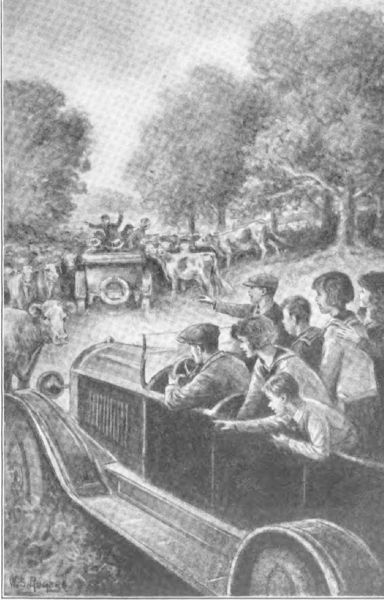
THE ROAD WAS A MASS OF BLACK AND WHITE COWS. The Riddle Club at Sunrise Beach. Page 44
"Where do you suppose they came from?" speculated Fred. "And why doesn't some one drive them to some place?"
"I read once that cows must not be hurried," Artie declared. "It makes them nervous, I think."
Polly laughed and Mr. Williamson frowned a little as he glanced back.
"There'll be a jam here, if something isn't done," he said. "More cars are coming in back of us. I think we'll have to do a little prospecting. The boys may come, but we'll let the girls cheer us on from their places in the car."
Mr. Williamson got out and the three boys tumbled eagerly after him. Even Margy, who did not generally envy boys, at that moment would gladly have exchanged places with her brother.
"They always have all the fun," Jess almost wept. "I can chase cows! I know I can!"
Mr. Williamson and the boys found half a dozen men, including Mr. Marley and Mr. Larue, trying to herd the cows down the road, the idea being that there must be a lane somewhere into which they could be turned.
"Of course we could jam a way through," said Mr. Marley. "But there is always the danger of hurting one of the animals. They've broken out of some pasture, of course—there must be a dairy farm in the neighborhood."
The poor cows were by now sadly frightened, and whatever sense they had had deserted them completely when the motorists on both sides of them began to blow their horns loudly. Whichever way the cows turned, there were champing, snorting machines and noisy horns to distract them.
"I agree with Artie that cows should not be made nervous," said Mr. Williamson. "Ward, go around and ask every one please to stop blowing his horn. Fred and Artie, help me let down these bars. I think we can drive the cows in here."
"But that's an alfalfa field," Mr. Marley protested. "The cows will ruin it, won't they?"
"If the cows stay here much longer they'll be ruined," replied Mr. Williamson. "The choice is not a wide one."
CHAPTER VI
PUNS AND POEMS
Fred and Artie hurried to let down the bars as Mr. Williamson directed, and then, not without some shouting and a wild rush after an obstinate beast or two, the cows were driven into the field and the bars replaced.
Some of the automobilists did not wait for the last cow to get out of the road before they started off, anxious to make up for the lost time. The Larue and Williamson cars were the last to leave, and, to the surprise of the children, Mr. Williamson drove ahead while Mr. Larue turned around and went back in the direction from which they had just come.
"I don't believe even the Riddle Club can solve that," said Mr. Williamson teasingly, as six pairs of eyes stared at him in amazement.
"Where are they going?" Margy asked. "Back home?"
"You see, we want to find the owner of the cows," her father explained. "We can't leave them to eat their heads off among the alfalfa. But who knows where the farmer lives? He may be in that house we passed a mile or so back, or he may live on ahead. This way we'll make sure."
A half mile further on they came to a farm that looked as though it might be a dairy farm. As Artie observed, it had a barn and most farms had barns. Better still, there were two large silos. That meant there were cows to be fed through the winter. And Mr. Williamson said that the owner of two silos would plant alfalfa to go in them. So they turned up the winding road that brought them to the great white-washed barns.
"Good morning," Mr. Williamson greeted the man who came out of the barn with a pitchfork in his hand. "Have you missed any cows lately?"
"Haven't seen 'em since we drove them out to pasture this morning," the man replied. "Have they broken through the fence again?"
All the children nodded silently before Mr. Williamson could speak.
"I'll go get 'em. Where are they?" said the man, as though he was used to getting the cows.
"They had blocked the road till another five minutes would have meant a detour," Mr. Williamson told the farmer. "Cars were held up both ways, and we did the only thing we could do—drove them into an alfalfa field."
"You've more than done your part, driving up to tell me," the farmer declared. "I'll send the boys right down. And wouldn't the kids like some cold buttermilk to drink?"
In another minute he had sent two tall lads flying down the lane after the cows and his wife had come out and was asking them all to "stay for dinner."
"We have our lunch," Polly explained. "We're going to the seashore—Sunrise Beach."
"Then you let me get you some of my cookies," Mrs. Marshall—she had told them her name—insisted. "I'll bet those pesky cows gave you a lot of trouble. My husband keeps his fences up, but he has a neighbor who won't do his share on the line."
She hurried into the house and in five minutes came back with a box which she told Polly not to open till lunch time.
"It's my baking day, and I just had some little pies handy," she said. "The boys like to take a little pie out in the field with them and eat it while they're at work."
Artie had spied a well, and nothing must do but he must pull up the bucket and have a drink.
"I read about a boy once who dropped his mother's teapot down the well," he announced, when he had had his drink and Polly was holding on to him as he leaned over the curb.
"That isn't so bad as dropping your brother down the well," Polly informed him. "And if you don't come away this minute, you're likely to go in—I can't hold you another minute."
"All aboard!" called Mr. Williamson, and three loud blasts from a horn told them that Mr. Larue's car was waiting at the foot of the lane.
Mr. and Mrs. Marshall waved to them till the tops of the orchard trees hid them from sight.
"We found the farmer!" called Ward, as he caught a glimpse of his father. "We found the man who owns the cows."
"They were driving them out of the field as we came past," said Mr. Larue. "The boys told us you had notified them. Now I suppose we continue our journey?"
"Unless we find another blockade," Mrs. Marley smilingly answered.
"Mother, you wouldn't call that a catastrophe, would you?" inquired Artie, who could use words "as long as himself" his father sometimes declared.
"Huh, that was a cowtastrophe," Fred said placidly.
"I never thought you'd do a thing like that, Fred," said Mr. Williamson. "Never. I am more shocked than grieved."
"What did he do?" clamored Ward and Jess, for the other car had shot on ahead. "What did Fred do?"
"He made a pun, and that is worse than a riddle," Mr. Williamson answered.
"He just did it for fun," said Polly, half-believing that Fred's father was displeased.
"I made a pun—just for fun," Fred chanted. "Gee, that's poetry."
"It was bum," sang Artie. "That makes more poetry."
"More truth than poetry, you mean," Margy put in. "'Bum' doesn't rhyme with 'pun.'"
"It does, too," Artie insisted. "Doesn't it, Polly?"
"No, it doesn't," the honest Polly admitted.
Then Artie wanted to know what would rhyme with "pun" and they told him "gun" and "run" and "sun" and half a dozen other words.
"I'll make up some poetry," Artie announced brightly, and forthwith he occupied himself with the poetic muse, paying not the slightest attention to the chatter and noise that went on about him.
They passed through Wickware and drove out on the country highway again. It was hot and dusty for perhaps another half mile, and then they came to a group of magnificent willow trees, growing close to a little white bridge that spanned a creek. The water was low in the creek now, but the grass was thick and green on either bank and the shade offered by the trees was delightful.
"Here's our hotel," said Mr. Larue, as they came up with him. "That is, if we haven't lost the lunch."
"Why, Polly, what is that?" asked Mrs. Marley, as the children climbed out of the car. "I didn't put that box in."
"It's lunch. Mrs. Marshall gave it to us," Polly explained.
"More lunch!" groaned Mrs. Larue. "We have more now than we can eat."
"I never heard of Mrs. Marshall—who is she?" said Mrs. Williamson curiously.
"She owns the cows," Margy told her mother. "She gave Polly the box because Daddy came and told her the cows were eating the alfalfa."
"Oh!" said Mrs. Williamson. "But what is the matter with Artie?"
Artie still sat in the car, though every one else was glad to be sitting under the trees in the shade.
"I'm writing a poem," he announced. "I'll be through in a minute."
So the lunch was unpacked and it was discovered that nothing had been forgotten—the chicken sandwiches were there and the boiled eggs and even the salt—Mr. Marley said it was the first picnic he had really enjoyed in fifteen years, because usually some one forgot the salt.
"Artie!" called Mrs. Marley, when everything was ready. "If you do not come this minute, you can't have your share of Mrs. Marshall's box."
The poet hopped down quickly. He said his poem was finished anyway. But to tell the truth, he was anxious not to miss the picnic lunch. He said it made him hungry to write poems.
Mrs. Marshall had put six beautiful rhubarb saucer pies in her box, two dozen sugar cookies and half a chocolate layer cake. As the three mothers had counted on hearty appetites, they had packed generous boxes, too, and Mr. Larue said that they could probably live the rest of the summer on what was left over. But, to everyone's surprise, there was very little left.
"We must all be poets," said Mr. Marley, pulling Artie over backward and tickling him. "For look what we have done to the party—the birds are lucky if they get a few crumbs."
"Tell us your poem, Artie?" coaxed Jess, when the waxed paper and the remains of the picnic—except the food scattered for the birds—had been neatly buried in a hole dug by Mr. Williamson. "Tell us what you wrote?"
"Well, I don't mind," agreed Artie unexpectedly.
He stood up and gazed at them calmly.
"Fred made a pun, And called it fun. I took my gun And made him run, Which seemed to stun Him."
"Is that a poem?" asked Fred doubtfully.
"Of course it is," the indignant poet retorted. "Don't you know poetry when you hear it?"
That rather discouraged further criticism, though Jess whispered to Margy as they climbed back into their seats that she thought it "ended queer."
"Lots of poems do," said Margy.
The grown-ups were anxious to reach Sunrise Beach in time for dinner, and the two cars made excellent time in the hour that followed.
"We'll soon be there now," Mr. Williamson had just remarked when Ward's sharp eyes saw the car ahead stop.
"Daddy's stopped! He's standing up and shouting to us," said Ward. "I wonder if there are any more cows?"
"The road is blocked—What on earth can that be?" Mr. Williamson frowned a little.
"It must be an automobile house," contributed Artie. "I read about one in a book. It is a regular house, except that it is on wheels, and people live in it."
"Well, what do you know about that!" Mr. Williamson said blankly, as they came abreast of the other car and for the first time could see clearly what it was that blocked the roadway.
CHAPTER VII
AN INTERESTING DETOUR
"Didn't I tell you?" Artie insisted. "It is an automobile house, isn't it?"
"Certainly it isn't," retorted Fred, in his most crushing manner. "I should think you would know a barn when you see one."
Artie stared. Truth to tell, the building did look more like a barn than a house. But what was a barn doing in the middle of the road?
"Can't hope to drive that anywhere," Mr. Larue called. "Wonder what we do next?"
"Detour," Mr. Williamson said briefly, and the three mothers groaned.
"There won't be anything in the house to eat, you know," Mrs. Marley announced. "We can't get supplies and cook dinner if we get there so late."
"We'll go to the hotel," promised Mr. Marley. "It will be our one chance to be fashionable, so we ought to make the most of it."
"Oh, Mother, let's go to a hotel!" Margy begged. "I love to eat in a big dining-room."
The boys sniffed and Mrs. Williamson laughed.
"We'll look out of place in these traveling clothes," she said, "but I suppose it is the only thing to do; we certainly won't make Sunrise Beach before seven o'clock or half-past now."
"You sound like Carrie Pepper when you talk like that," Fred told his sister as the cars were backed.
"What is the barn there for?" asked Artie.
"She doesn't sound like Carrie Pepper. Mattie Helms talks that way," Ward declared.
"Stop squabbling about Margy and her talk, or you can't have any pink ice cream for your dinner," Mr. Williamson warned them. "The barn is in the middle of the road, Artie, because it is being moved."
Artie then wanted to know why the barn was being moved and where it had come from and where it was going.
"Perhaps they sold the farm and the owner didn't like the location of the barn," Mr. Williamson explained. He was always ready to answer questions. "I suspect that is what happened, Artie, because I noticed that the old foundations, from which the barn had been lifted, were almost squarely in front of the farmhouse. You wouldn't want to sit on your front porch and have the view blocked by a barn, would you? I think they are moving it across the road, and then it will be farther from the house and nearer to the hayfields, two points in its favor."
They were going back over the road now and, following Mr. Larue's car, made a sharp turn.
"We can cut off five miles if we go through the Mooney estate," said Mr. Larue, who had been consulting a road map, when they were up with him.
"But that is private, isn't it?" Mrs. Williamson asked.
"I think it is open to the public on certain days of the week," her husband replied. "And doubtless they will not object to a couple of cars, if we don't speed. There's the main entrance. Let's drive in, and if we see any one we'll ask permission to go through."
Just ahead of them was an elaborate entrance, built of gray stone and fitted with tall spiked iron gates. These were open, and, as Mr. Larue said, that might be an indication that the public was allowed to enter.
"Who lives here?" asked Margy, almost in a whisper, as they rolled between the stone posts and found themselves in a beautiful park.
"Captain Hal Mooney," Mr. Williamson answered.
"Is he in the army?" Fred inquired, while Ward said he was sure he ran an ocean liner.
"Ward is nearer right than you are, Fred," said Mr. Williamson, with a smile. "Captain Mooney is interested in boats, though not in ocean liners. He is immensely wealthy and builds and sails racing yachts."
"Just look at the flowers!" Polly cried. "Did you ever see anything like them! And the grass—I wonder who runs the lawn mower?"
There were great beds and borders of flowers on either side of the road, beautiful trees, planted singly and in groups, and acres and acres of the richest and smoothest green lawns that the children had ever seen.
"Hello, you'll have a chance to see the lawn mower, Polly," said Mr. Williamson suddenly. "And we'll ask this man whether Captain Mooney allows trespassing."
Polly glanced over to one side and saw a tractor pulling a lawn mower as easily as her daddy pushed their lawn mower at home. So that was how these lawns were kept so evenly clipped and trimmed!
There was one man running the tractor and another stood on a gravel path, watching him. He turned at the sound of the cars and looked inquiringly at the driver. He was a tall, broad-shouldered man in golf clothes, and had a pleasant face and a white mustache that made his dark eyes very noticeable.
"I hope we're not trespassing," said Mr. Larue courteously. "But we are anxious to reach Sunrise Beach and were forced to make a detour because they are moving a barn across the road and the way is blocked. Do you know whether Captain Mooney objects to travel over his roads—the gates were open—or not?"
The man smiled a little and lifted his hat to show the white hair beneath.
"I am sure Captain Mooney will have no objections," he said heartily. "The roads are only closed to motorists who abuse their privileges."
The children were staring in fascination at the lawn mower, and so absorbed were they that the clang of a clear little bell made them all jump. A girl about Polly's age came wheeling up the gravel path and jumped from her bicycle.
"Daddy, I thought we were going to the beach!" she exclaimed. "Oh!" she said, suddenly noticing the two cars.
"Ella, all these young people are going to Sunrise Beach," said the white-haired man, smiling. "You'd like to have some brothers and sisters like that to play with, wouldn't you?"
The little girl smiled and Polly saw how pretty she was. Her bobbed hair was yellow, but her eyes were dark like her father's, and she was tanned as though she had spent much time near the water. Her teeth were very even and very white.
"I haven't any one to play with," she mourned. "Are you all brothers and sisters?"
It was slightly confusing to introduce so many at once, but Mr. Williamson managed it, and then the little girl's father put his arm around her and said something that surprised them all.
"I am Captain Mooney," he said simply, "and this is my daughter, Ella. And I hope we may see you this summer, for we drive to Sunrise Beach almost daily."
The mothers were anxious to reach the shore and get settled before it should be dark, so with a few more words, chiefly between Ella and the children, the two cars went on. They wound in and out, over a perfectly kept road and between handsome shrubbery, and soon came to the road that would take them straight to the beach.
"Hasn't Ella Mooney any brothers or sisters?" Jess asked, as soon as they had left the father and daughter.
"No. And her mother is dead," said Mr. Williamson soberly. "So, in spite of all her money, she is a lonely little girl."
"I suppose she has a pony," Artie mused.
"And all the dresses she wants." This from Margy.
"And she can go traveling and see California," said Polly.
"I wouldn't mind running that tractor," Fred declared.
"But I wouldn't want to live all alone and have no one to play with," objected Jess.
"She isn't all alone—she lives with her father," Ward declared.
"Well, fathers are all right, but you need a mother and some other people, too," Jess informed him, and Mr. Williamson laughed and said she was right.
"If she comes down to the beach and we see her, she can come to a meeting of the Riddle Club, can't she, Polly?" Margy suggested.
Polly said of course, and just then Artie caught a glimpse of the ocean and Ward saw a man in a bathing suit and every one was suddenly aware that they had reached the seashore at last.
"Where's our house?" said Margy, staring at the rows of houses on either side of the street as though she expected to recognize the house they were to occupy.
"It's at the other end of town, Margy," her father said. "This is the comparatively new section—pretty new houses and bungalows. There's the hotel—we'll come back there for dinner. Well, children, there's the ocean—are you glad to see it?"
They had turned down another street and were now facing the great blue ocean that lay smoothly before them. It was as smooth as the Rocio River, except for the breakers that broke and ran up the beach and back again.
The children had seen the ocean, for they had gone on excursions several times from River Bend. This was the first summer they were to stay for any length of time near salt water, and they looked forward to many good times.
"Is this the unfashionable part of Sunrise Beach?" asked Margy, a little uncertainly.
"It is," her father laughed. "So I have been informed. The houses are larger and more comfortable, they have yards of their own, and the bathhouses are built under the porch for comfort and convenience. Would you rather be comfortable or fashionable, Margy?"
"Comfortable, I guess," said Margy sensibly.
Mr. Larue and Mr. Williamson had hired the cottage and had wired ahead to have it opened and aired. It was a brown house, large and rambling and set in a garden that had been planted with many old-fashioned flowers and then left to itself. The effect was pretty, but so tangled that the paths around the house were quite over-grown. There was a porch around three sides, a fireplace in the hall, which was also the living-room and every room had an "ocean view." As Mr. Williamson said, what more could any one want?
They found the trunks had been delivered and were in the hall. But every one was too tired and too hungry to think of "dressing up."
"Let us go and get our dinners and come back and go to bed early," Mrs. Larue suggested. "Then we'll be up early to-morrow morning and accomplish wonders."
"All I wish is that Carrie Pepper could see me now," whispered Margy, a half hour later as she walked into the dining room of the large hotel.
"There's Mattie Helms!" Artie announced, in a tone that he fondly imagined was very low, but which made Mattie—across the room—look up in surprise.
CHAPTER VIII
MEEKER'S COTTAGE
Mattie was seated at a table with her mother and two other ladies. Mrs. Helms nodded pleasantly when she saw the River Bend folk, but Margy was almost crying as she sat down at the table the waiter found for them.
"I knew it!" she declared. "I knew it! If we didn't dress up, I was sure we'd see some one we knew."
The boys laughed at her wail, but Mrs. Williamson spoke soothingly.
"Never mind, Daughter," she advised. "We have been traveling and are tired. Our dresses are dark, but they are clean and neat, and that is all that is necessary."
Poor Margy, however, during the dinner kept glancing over toward the table at which Mattie sat. Mattie wore a pink dress, with slippers and stockings to match. She came over to speak to her friends before they had finished.
"Hello, everybody!" said Mattie cheerfully. "We got here at noon. Isn't this a nice hotel? We are going to take all our meals here, so Mother won't have to keep house. Have you seen our bungalow? It is the fourth down the street. It's painted brown and white. Carrie is coming to-morrow to stay with me. I suppose you came in the car? Wasn't it hot? Where are you going to be? Oh, that part of Sunrise Beach is awfully out of date. Nobody goes there any more."
She rattled on, hardly pausing for a reply to her questions, till her mother caught her eye and signaled to her to go with her. Artie stared after her as she left the dining room.
"She's kind of dressed up, isn't she?" he ventured.
"Did you see her lovely slippers?" Margy sighed.
"You know if you had to get into pink slippers every night, you'd make an awful fuss," the practical Fred declared. "I'm glad my mother has some sense."
"Thank you," laughed Mrs. Williamson. "And now let's wander back to our comfortable, old-fashioned house and see about settling down for a good rest."
The house had been thoroughly aired and all the bedding, and it did not take the three mothers long to have the beds made up. There was a shabby old barn at the end of the lot which served as a garage, and the cars had been run in there. The house was three stories high, but there was only one room on the third floor—a large room that had a balcony in front of one of the windows. Indeed, as Polly said, whenever they didn't know what to do, they built a balcony. Some were almost porches and others were little more than platforms, but nearly every window had its balcony. The large room in the third story, it was decided, should be given over to the boys. Three cots were put up there, and Fred and Artie and Ward were delighted.
"What's the bell for?" asked Fred, pointing to a black iron bell in one corner over the door.
"I suppose it connects with the kitchen, and if we had a maid it would be a signal for her," Mr. Williamson said. "We'll use it to let you know when breakfast is ready. One ring will be the rising bell; two, a summons to breakfast; three will mean that if you don't hurry you'll get nothing to eat; and four rings will tell you that all is over—we have eaten everything up."
There were four large square bedrooms on the second floor, and the one allotted to the three girls had two balconies, one of them directly under the third story balcony. Polly said they could sit out and listen to the ocean, but Margy was sure that some one would hear them and come to say they must go to bed.
"They won't hear us listen," argued Polly. "Of course I don't mean to-night, for we'd go to sleep sitting up. But some night we can sit out here, if we don't get to giggling."
However, no one felt like listening to the ocean that night. They were all tired from the long drive, and Polly's cheeks were burning from the wind. Within half an hour the whole house was dark and silent, and though the breakers came in and ran out ceaselessly and the tide turned, rose and turned again, not a person in Meeker's Cottage paid the slightest attention.
Polly was awake before Jess or Margy, and she dressed very quietly. When she was ready, she stepped out on the balcony to get a glimpse of the ocean, sparkling in the sun.
"Um, um, isn't that good!" she whispered, taking a long breath of the salty air. "I'm so glad we came to the beach—it is nicer even than Lake Bassing."
Then, in spite of her resolution to keep perfectly quiet and wake no one else, she jumped and shrieked. A huge black spider had spun silently down before her, and now dangled just under her nose.
"What is it?" cried Margy, rushing to the window. "What is it, Polly?"
A snicker made Polly look up. There was Ward perched on the upper balcony, holding the make-believe spider by a string.
"You're a wretch," Polly informed him, laughing. "How can you be playing tricks the very first morning, Ward? How long have you been up?"
"Hours," said Ward confidently. "I'm hungry."
Polly's shriek had wakened the others, and, as she waited for Margy and Jess to get dressed, they found the grown-ups downstairs when they went down. The boys did not wait for the warning bell, but came tumbling down, three steps at a time.
"Did you know there were bathhouses under the porch?" demanded Fred, who had made an inspection tour, when he came in to breakfast. "Dinky little closets where we can dress and not have to bring wet suits into the house. Say, I think this is a great place."
After breakfast, the three mothers announced that they wanted a morning to "put things to rights," and they said they would work much better if every one went down to the beach and stayed till lunch time.
"The children won't rest till they get into their bathing suits," said Mrs. Marley; "so they might as well do that first. Then, with three daddies to see that they stay out of the water for an hour or so, I think they will be all right. Take the old sweaters down with you and leave them in a pile on the sand. Our beach is so far from the crowd that it is safe to leave things unwatched—Mrs. Meeker wrote me that."
Mrs. Meeker owned the cottage, and that was why it was called "Meeker's Cottage." It had been known by that name for years, and once the governor of the state had rented it for a summer. Mrs. Meeker was very proud of that. In those days, Meeker's Cottage had been in the fashionable part of Sunrise Beach.
You may be sure it did not take the Riddle Club long to get into their bathing suits. Very pretty the suits looked, too, with the white initials "R.C." on each. The girls had caps to match their suits—Polly blue, Jess red and Margy green. Each had a sweater—"a last year school sweater," as Margy described hers—to put on if it was chilly when they came out of the surf. As soon as they were ready, they raced across the road, scrambled over a sand dune, and were out on the beach and capering about as though they had just been released from some box.
"Can't go in for a couple of hours," said Mr. Williamson firmly, capturing Fred, who seemed inclined to meet a breaker more than halfway. "Now we'd like to run through the papers before we go in. Will you promise to stay on the beach until we give the word?"
"Of course," promised Polly, and the others nodded. "I'll tell you what we will do—we'll walk up the beach as far as the fishing pier and back, and then we'll hold a meeting of the Riddle Club. By that time we can go in bathing."
"But I can't collect the dues," Fred objected. "No one has any money and I haven't any pocket."
"It won't be a regular meeting," argued Polly. "We'll just ask as many riddles as we can remember."
"Well, let me tell you this club can't go on forever and not collect any dues," Fred declared earnestly. "We're always having special meetings, and 'special' means no dues taken up. Ever since we put our money in the bank, you all seem to think we have a fortune and don't need any more."
"Calm yourself, Fred," said his father. "As this is a special meeting, I'll pay the dues."
"No, we'll chip in," Mr. Marley suggested. "I'll pay twenty cents for Polly and Artie."
"Here is twenty for Jess and Ward," said Mr. Larue.
Mr. Williamson took the money and added another twenty cents for his two children, Margy and Fred.
"I'll be acting treasurer till the real treasurer gets to his trousers pockets," said Mr. Williamson. "Now then, let's carry out the program."
The children started to walk to the fishing pier while the fathers settled down comfortably in the sand, under a section of abandoned boardwalk that served to shade them nicely. They were anxious to read their morning papers.
"I wonder how far the beach goes?" speculated Jess, as she let a breaker come up almost to her ankles before she retreated.
"Florida," Artie said promptly.
"Could we walk to Florida?" said Jess a little doubtfully.
"Sure we could! Don't you remember how the coast looks on the map?" Fred reminded her.
"We could walk all around the United States if we went on the top of Canada," said Ward, screwing up his eyes as though he were looking at a map a long way off. "Say, that would be fun, wouldn't it?"
"Don't let's start in our bathing suits," Margy cautioned, with something of her father's teasing seriousness.
Polly had stopped to examine a shell.
"Let's pick up all the prettiest shells we see," she suggested. "We can save them and then, just before we go home, select six perfect ones for our clubroom."
"What do we want shells for?" Jess asked.
"Oh, to remind us of Sunrise Beach," said Polly.
"You can use clam shells for dishes," Artie now announced. "I read it in a book. You wash 'em and bake things in them."
"All right, we'll get some for Mother," decided Fred, approving of this practical idea. "Here's a dandy clam shell."
There were many clam shells on the beach, and the boys and girls carried home a dozen that morning. These were scrubbed, and the Riddle Club was filled with surprise and delight when they appeared on the table that evening at supper—the clam shells, not the children—with escalloped potatoes in them.
"But try and find larger ones next time," said Mrs. Williamson. "Large shells make excellent dishes; they sell them in some stores for ramekins."
Picking up shells and seeing how near they could come to going into the ocean without actually getting wet, made the walk to the fishing pier seem short. It was a long pier and the end was black with people, all trying their luck with line and pole.
"Dad likes to fish from a boat," remarked Fred. "He said we could go with him, if he goes to-morrow."
"We can't go—I asked Mother," said Jess. "Just you boys, because girls don't go out. Ward says men have a better time fishing by themselves."
"Well, I should think they would," Polly declared. "I don't see any fun in catching fish, and Mother doesn't, either. So of course we wouldn't have a very good time."
"Fish are too smelly," said Margy, as though that settled the matter for her.
"Let's go back and have our meeting," Ward suggested. "I've just thought of a dandy riddle."
"We'll run, so you won't forget it," said Fred, wheeling suddenly and setting off down the beach at top speed.
CHAPTER IX
ANOTHER MEETING
Ward was not a good runner and he was quickly out of breath. Panting and gasping, he trailed after the others and by the time he came up with them he was in no shape to ask a riddle or any kind of question for as long as three minutes.
They all dropped comfortably on the sand and Polly insisted that no one should ask a riddle until Ward was ready.
"That is, if he hasn't forgotten the one he remembered," Fred remarked, for Ward often remembered something and forgot it before he could tell it.
Fat Ward looked reproachfully at Fred, but just then he recalled his riddle and that pleased him so much he decided not to be cross.
"I'm all ready," he beamed. "Who'll I ask?"
"Me," said Artie. "Bet you can't ask a riddle I can't answer."
Of course this rash challenge earned him the right to be "asked first," and Ward's eyes danced.
"When does the ocean resemble a big bakery?" he demanded.
"Huh," Artie said. "Huh, that's easy——"
Then he stopped.
"Hurry up," prodded Ward. "I thought you said you could guess any riddle."
"I didn't say without thinking," Artie retorted. "When does the ocean resemble a big bakery? Keep still and let me think."
Artie was famous for taking a fearful length of time to meditate on his answers to riddles, and the others settled down for a long wait. He was staring out to sea as though he expected the water to give him help of some kind.
"When does the ocean—" he kept murmuring. "When does the ocean——"
"Fish cakes!" he said triumphantly. "That's it, isn't it, Ward?"
"They don't have fish cakes in a bakery," Ward informed him. "Besides, I never heard of fish cakes in the ocean."
"If a fish hit the side of that old piling he'd be a fish cake, I guess," argued Artie.
"Well that isn't the answer, anyway," Ward declared, with finality.
"Let every one have a guess," suggested Polly. "If Artie gives up, ask Margy."
"My goodness, I don't know," Margy cried a little wildly. "I wasn't even thinking."
"Margy always shies off as though a riddle was going to bite her," said Fred. "I should say a bakery was like the ocean when it has scales."
"You mean the ocean is like a bakery," Ward corrected. "But that isn't right, Fred."
Jess ventured the answer, "when it is crowded," and in response to the laughter explained that the ocean was crowded "in spots."
"I've seen the excursion crowds," she said.
"When it's full of rolls?" Polly hazarded slowly, when it came her turn.
"You've got it!" exclaimed Ward, in delight. "'When it's full of fresh rolls,' is right, but rolls is the answer. Good for you, Polly!"
"How'd you do it, Polly?" asked Margy.
"I saw the breakers rolling in and that made me think of it," Polly said modestly.
They insisted that she must ask the next riddle, as a reward for guessing correctly, so Polly thought for a few moments and then asked:
"What fish always goes around armed?" and added: "That's the easiest one I know."
"A shark!" cried Jess.
Polly shook her head.
"I don't know many fish," Margy complained. "Only bluefish and weakfish and—and——"
"Poor fish!" said Ward teasingly. "Anyway, whose turn is it to guess?"
"I meant to ask Jess," Polly said. "If she has given up, any one may try."
Fred thought it might be a flounder. "He might flounder when he's attacked and then the other fish couldn't fight him," he explained.
"That doesn't sound just right," Artie objected, but Polly, anxious to forestall a long argument on flounders and floundering, suggested that Ward had not had his turn.
"The fish that always goes armed," recited Ward, in his best classroom manner, "is the swordfish."
"Good gracious!" Jess stared at her brother in mingled admiration and pride. "How did you know?"
"I thought of guns and then I thought of swords," Ward beamed. "Then, of course, I remembered swordfish."
"Want to go in now?" called Mr. Williamson. "We're going up to get in our suits, and we'll be right down. Wait for us."
The children waved their hands to show they had heard and understood and Margy said hurriedly:
"Ask another—let Artie, because he ought to know an easy one."
"I think we ought to have some system," Artie announced, with earnest disapproval. "I'll start with Jess and go right around the circle, asking: Why is a ship always polite?"
"I suppose because it is called 'her,'" said Jess composedly.
The others stared.
"Her?" repeated Fred. "Who says her?"
"I know it, because some one said so," Jess maintained. "You never heard a ship called 'him.' Daddy always says, 'She's built from the best dried lumber,' when he's talking about his boats."
"But what has that got to do with being polite?" Polly asked, puzzled.
"Oh, girls are always more polite than boys, so ships must be," said Jess, apparently thinking her reasoning was most clear.
"I don't know what you're talking about," Artie declared, with more frankness than courtesy. "But, anyway, that isn't the right answer. Margy?"
Margy looked anxious. She took her riddles seriously.
"Is it because it dips its colors when it meets another boat?" she asked.
"No, that isn't right," Artie said. "They don't all dip their colors, either. Can you guess, Ward?"
"Maybe because the decks are scrubbed," declared Ward. "My mother says it is polite to have clean hands."
Artie shook his head, not against the clean hands, but to signify that the answer was not the one sought.
Polly, whose turn was next, gave up frankly and Fred asked for a few minutes in which to think.
"Maybe it is because it will wig-wag back when some one signals," he said finally. "It is polite to answer when you're spoken to."
"Everybody's wrong," Artie announced, a little triumphantly. "I'm the only one who knows the answer."
Fred laughed good-naturedly.
"Well, I should hope you'd know the answer to your own riddle," he said quickly. "Come on and let us share the secret."
Artie cleared his throat.
"A ship is always polite," said he, "because it approaches with a bow."
"And arrow?" Ward chimed in.
"No, not an arrow, silly," said Artie. "This is another kind of a bow. I mean the front part of a ship."
Fred and Polly looked as though they wanted to laugh.
"Say," said Fred, "did you hear that riddle, Artie, or did you read it? I'll bet a cookie you read it."
"Of course I read it—in a book," Artie answered. "It said the front part of a ship."
"That's all right," replied Fred, grinning. "But you don't pronounce this b-o-w that way. The front part of a ship is the bow, the way you say you made a bow. See? That's where the being polite, comes in."
Ward made a dive for Artie and they rolled over on the sand.
"Nobody could guess the riddle!" chuckled Ward. "Not even Artie had it right!"
"Anybody going swimming?" asked Mr. Larue, coming down to them in his bathing suit, followed by Mr. Marley and Mr. Williamson. "If the Riddle Club will adjourn, we'll take you as far as you want to go, to make up for waiting so patiently."
"I move that the meeting be adjourned," said Jess, and Margy seconded the motion.
Two minutes later the Riddle Club membership might have been seen floating far out, just beyond the lazy breakers. They could swim a little, and all of them could float, and they stayed there till an unusually heavy comber frightened Margy and she wanted to come in. Then they splashed around in the shallower water for another half hour, and then put on their sweaters and toasted themselves in the sun till reminded that it was time to go up to the cottage and get dressed for lunch.
"Gee, I like it here," announced Fred, as they toiled through the heavy sand. "We can have heaps of fun—there's country back of all the cottages."
"Yes, farms and things," Polly agreed. "They bring in fresh vegetables every morning."
"Don't talk of vegetables—I'm starved," said Margy, and they all owned that whether it was the riddles or the swim in salt water that was responsible, the fact remained that they were exceedingly hungry.
The three mothers had spent a busy morning, and the trunks were unpacked, light curtains hung at the doors and windows—"to take away the bare, rented look," Mrs. Marley explained—fresh towels and bureau scarfs distributed throughout the rooms, and, best of all, a substantial lunch cooked and waiting.
"Now, this afternoon you're to rest," announced Mr. Williamson. "Whatever these young Indians do, they mustn't make a single demand on any mother. If we are not careful every one will have a fine vacation except these mothers, who will work harder than they do at home."
"Oh, the worst is done now," Mrs. Williamson said quickly. "We're ready to keep house with as little fuss and trouble as possible. This afternoon we have planned to take our needlework down to the beach, if you'll put up the tent for us."
A large square of canvas was rolled up in the back hall, and this, Mrs. Meeker had explained, was to be tied over a simple frame of light wood that rested in the sand. This gave the sketchiest kind of a "tent," merely a protection from the sun, but affording a comfortable place to sit and read and sew. The beach at this end of the town was dotted with these tents, and here mothers sat for hours while their babies slept and the older children frolicked on the sands.