Front matter (continued 3)
Reading edition
"Why, Carrie, maybe he isn't a tramp! How do you know he doesn't live near here?" expostulated Polly. "And if he is a tramp, what harm is there in letting him sit by our fire? I wish you wouldn't talk so loud—he might hear you."
"Captain Mooney is awfully particular," said Carrie, apparently on another track. "Everybody says he won't let Ella talk to hardly anybody. He won't like it if he finds you had a tramp come to your party."
"Maybe you think I'd better go, young lady?" the old man asked, getting to his feet slowly and painfully. "I'm not welcome here?"
Shy, quiet little Ella Mooney surprised them all by bursting into speech.
"Don't go," she urged earnestly. "We want you to stay."
"I think I'd better go," the old man muttered, and tugged at his beard with both hands.
Carrie shrieked and clutched at Fred.
"Look!" she gasped.
CHAPTER XVIII
SWIMMING RACES
Before nine pairs of astonished eyes, the old man pulled off his curly white beard and let it drop to the ground. He threw off his cap, turned down the collar of his coat, and grinned pleasantly, a grin that strongly reminded them of Fred Williamson when he was in mischief.
"Mr. Williamson!" cried Carrie, and:
"Dad!" Margy shouted together with Fred.
Mr. Williamson's eyes were dancing.
"Well?" he asked, enjoying the variety of expressions on the amazed faces turned to his.
"It was a trick!" Carrie scolded. "I might have known. I suppose you knew who he was all the time."
"I thought it was somebody like Mr. Williamson," said Mattie Helms. "But of course I couldn't be sure."
Fred chuckled, for he had seen Mattie's face when his father removed the beard. If there was ever a surprised girl, Mattie had been surprised.
"You're mistaken, Carrie," said Mr. Williamson pleasantly. "No one knew I was going to play a trick like this—least of all myself. But the temptation to try and fool you all was too much; I couldn't resist it. I went up to the house and got into these duds and raked out the beard from Mrs. Meeker's attic. I think it must be a Hallowe'en trophy."
Carrie's face was red. She would have given anything to have acted differently.
"By the way, Ella, I'll return this to you now. I don't need it, but thank you for the kind little thought," said Mr. Williamson, handing Ella a folded bill he took from the pocket of his coat.
It was Ella's turn to blush, and she did vividly.
"I didn't think you saw me," she said diffidently, putting the five dollars back in her purse.
"I knew I was right," Fred said to himself, and when they covered the fire and made ready to go home, he was the one to suggest that they all walk to the hotel with Ella.
Ordinarily Fred troubled himself very little about social duties, and he had been known to go to some trouble to avoid them.
After Ella had been left at the hotel—where her father was waiting for her on the porch—Carrie and Mattie were escorted to the Helms' bungalow and then the Riddle Club enjoyed a moonlight walk over the deserted beach to their own comfortable cottage.
"Gee, Carrie never will get over the way you fooled us, Daddy," Fred said to his father.
"I'm sorry if I hurt her feelings," declared Mr. Williamson seriously. "It was all a joke."
Polly and Margy and Jess enjoyed talking things over the next day. They were sure that Ella Mooney had had a happy time and really enjoyed the party. When the next week a gracefully-worded little note, addressed to Mrs. Marley, but including every one at Meeker Cottage by name, arrived from Ella, the girls were made doubly sure.
"It was the nicest party I ever went to," wrote Ella. "And I told my father every single thing that happened. I wrote it all down in my diary, too, and some day I will show it to you."
The busy summer days marched along briskly after the beach party. Captain Mooney had asked Mr. Williamson to bring the "young folks" over to see Ella, but one thing and another conspired to put off the visit. Once the Captain even sent his car, but the cottage was closed and every one off on a picnic. Most of the time, the three fathers were at River Bend, and when they were away the car left in the barn was almost useless, since none of the mothers liked very much to run it.
Then, too, truth to tell, the members of the Riddle Club had always been able to amuse themselves in perfect contentment without outside influences. Perhaps, without knowing it, they had grown clannish. They liked Ella more than a little, but they did not miss her, and so Captain Mooney's invitation passed from their minds except when one of the girls happened to recall it by saying:
"I suppose we ought to go and see Ella Mooney next week."
"What do you think!" said Artie one morning at the breakfast table. "I met Albert Holmes, and Joe Anderson is coming down next week to stay another two weeks."
"Now that," Fred remarked, reaching for another muffin, "is my idea of good news! Do you know any more?"
"Yes, I do," the literal-minded Artie informed him. "There's going to be swimming races, and I'm going in 'em."
Ward choked over his oatmeal and Fred stared.
"Why, you can't swim, Artie," said Jess, who was apt to speak frankly.
"Yes, I can. I can swim some," Artie insisted. "I started to learn at Lake Bassing and I have learned some more here. The races are for everybody and they have gold pieces for prizes and I'll put mine in the Riddle Club fund."
He beamed upon them so generously, exactly, Fred said, as though he had already deposited the gold piece in the bank, that it was impossible to try to discourage him.
"But will such little boys go in the races, Artie?" Mrs. Marley asked anxiously.
"Oh, of course, Mother. And I'm bigger than you think I am," her son assured her.
"Is that why Joe Anderson came down?" demanded Margy. "He thinks he is a fine swimmer."
"Now, children, I don't want to hear you begin and pick Joe Anderson to pieces," Mrs. Larue announced half in earnest, half in fun. "I don't think you realize it, but every time Carrie Pepper's name is mentioned, or Joe Anderson's, some one is sure to think of an unkind comment and make it."
"You mean we knock 'em?" said Fred slangily. "Well, all right, I am afraid we do. Let's reform—but Joe Anderson is conceited; any one will tell you that."
Mrs. Larue laughed and said she thought the habit was too strong to be broken easily, but that she hoped they would try.
"We do talk rather—rather—well, you know," said Polly, when the children found themselves alone on the porch. "I'm going to try not to say a word about any one after this, unless it is something nice."
"Tell about the races, Artie," urged Jess. "When are they going to be and where?"
Artie explained that the races were an annual affair, that people paid to see them, and that the money was turned over to the life guards.
"Like a benefit," said Margy wisely.
There were "all kinds of classes," to quote Artie. The expert swimmers swam for distance and speed and tried to establish records. There were classes for beginners and for children under ten. There was a "novice" class for those who had never tried to swim a stroke. There was a class for fat swimmers. Artie suggested that Ward enter this.
"I'll bet it's a heap of fun," said Jess. "Lots of the swimming will be a joke and people just go in it for a good time and to make money for the life guards. I'll tell you what! Let's each one of us enter something. One of us ought to get some kind of prize."
"If six of us go in, we must surely win something for the Riddle Club," added Fred.
They found the rules and regulations for the meet posted in the post-office and an eager group studying them. As Jess had surmised, the swimming itself was more or less of a joke, and the funnier spectacle the swimmers made, the better the audience liked it. The prizes ranged all the way from a ten dollar gold piece for the fastest time in the expert class, to one dollar gold pieces for the children's events. A charge of ten cents was made for each registration, and Artie was so sure that he was going to capture a prize that he made Fred loan him the ten cents and arranged that it was to be counted as his "dues" for the next club meeting and not charged against him.
Ward, much against his will, was entered in the fat swimmer's class for children. Margy, who had resolutely refused to learn to swim, cheerfully entered the novice class. Polly and Fred were registered in the boys' and girls' classes, for swimmers of their age. Artie cast his lot with the youngest beginners, and Jess was to be in the floaters' race.
"Captain Mooney gives the prizes every year," said Carrie Pepper, whom they met as they were coming out of the post-office. "I'm going in and so is Mattie. Are you?"
They said they were, and Carrie volunteered the information that Joe Anderson expected to win the prize for the boys' class and that Albert Holmes was going to float.
"I suppose Captain Mooney will be a judge—some one said he had consented to serve this year," Carrie chattered on. "Have you seen Ella lately?"
"No, Captain Mooney sent his car over for us, but we weren't home," said Margy, who no more could help saying that with an air than Carrie could, had the opportunity been reversed.
"I could shake you, Margy Williamson!" Polly declared indignantly, after they had left Carrie. "You sounded positively boastful."
"But I didn't say anything mean about Carrie, did I?" said Margy, with obvious pride.
Until the day set for the swimming races, the Riddle Club practically lived in the water. Their mothers united in making this statement. Of course a certain amount of practice was necessary for all except Margy, who would have disqualified herself by practice.
"But I hope you are not going to turn into ducks," said Mrs. Marley, pretending to be anxious.
Margy, the neatest needlewoman of the three girls, took pains to see that the letters on their suits were restitched tightly in place. She said that she wanted every one to see "R.C." plainly and to ask what it stood for.
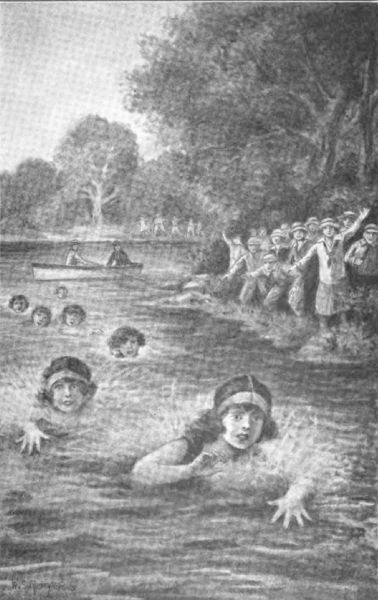
"SHE'S WON!" JESS SHRIEKED OVER AND OVER. The Riddle Club at Sunrise Beach. Page 175
"They'll say, 'Who is that boy who just won the race? He has R.C. on his shirt,'" said Artie.
"Artie, you mustn't set your heart on winning," Margy protested. "If you lose, you'll feel dreadful."
"But I won't lose," Artie assured her, with a sunny smile.
The day for the races was bright and cloudless and the banks of the inlet, where they were to be held, was crowded early in the afternoon with spectators. All sat informally on the grass, and the pretty dresses of the women and their bright-hued parasols made lovely splashes of color.
"Say, Captain Mooney isn't going to be a judge," Carrie Pepper announced, meeting Polly in the booth where the numbered badges that identified the swimmers were being distributed. "That is, he was supposed to be one of the judges, but they have just had word that he can't be here."
"I wonder why," mused Polly absently. "Maybe Ella will come and see the races."
"I haven't seen her," Carrie said. "There, they're signaling—we ought to go and line up."
The races followed in quick succession, for there was rather a long program to put through in the single afternoon allotted. One of the summer residents captured the prize for the expert class, and then there were four races for the older boys and girls in none of which the Riddle Club was vitally interested.
But when it came to the race in which Polly was to compete, they followed the event with closest attention. Polly was a fair swimmer, and she did her best evenly and seriously. She came in third, and finished with no other feeling than the one resolve that she would do better the next year.
Fred found it harder to take his defeat at the hands of Joe Anderson. If it had been any one else, he later told the others, he would not have minded. It must be confessed that Joe made the most of his opportunity to display his five dollar gold piece and he would brag a little more than was becoming to the victor, but Fred set his teeth, congratulated him, admired the prize, and set about encouraging Jess and Margy and Artie.
"Fred always expects to win," Carrie Pepper remarked in his hearing. "I guess he was surprised to find he can't come out ahead every time."
Carrie herself frankly said that she didn't mind losing as long as Polly Marley had also lost. If there was one thing, declared Carrie, she could not stand, it was to have the Riddle Club win any more prizes.
"Even if Albert loses, we're ahead," she told Joe gleefully. "You have five dollars and they haven't anything."
Carrie felt that Joe was upholding the honor of the Conundrum Club, despite the fact that he announced loudly he meant to spend his prize for himself.
The last events always attracted more attention and interest than the more serious races. When the novices started off, they were loudly cheered and the way they floundered and puffed and tried to run—at least Margy did—through the water, moved the "gallery" to loud laughter.
Margy, in her own way, was as determined as Artie, and, to gain her end, she simply shut her eyes and forged ahead. She galloped, she trod water, she pulled herself ahead with a sweeping motion. She sank, but she came up again, shook the water from her face and struck out blindly and doggedly.
"Go to it, little seal!" some one on the bank was roaring. "Go to it—you can make it. Just a little farther! Jump, little seal, jump!"
Margy had no idea the man was shouting to her, but she took the advice in good faith. Gathering the last ounce of energy she gave one tremendous hop forward—and came in first, the shouts of the audience ringing in her ears.
"She's won!" Jess shrieked over and over, jumping up and down. "Margy won the race! Girls! boys! did you see her?"
Polly had seen her, but she had also heard something. Back in the crowd a woman's voice was raised in excitement.
"Have you heard about Ella Mooney?" she was asking.
CHAPTER XIX
BAD NEWS
The dripping Margy was quickly surrounded by a laughing, congratulating group, but even as Polly put her sweater around her, she was wondering about Ella Mooney. Had anything happened to her?
There was no time to ask questions, for there were still three races to be decided. Jess and Artie and Ward were eager to win a prize, and the "fat" class was the next event scheduled.
Just about the plumpest children you ever saw were entered in that race. The mayor of Sunrise Beach was heard to remark that it showed what the sea air could do—he gave the beach all the credit for the fat, healthy children who pranced out on the platform and announced that they were ready.
"Just as though Ward wasn't always fat!" the justly indignant Jess exclaimed. "He's fat in River Bend, the same as here."
At the word, the fat youngsters started, and in their way they were quite as funny as the novice class. They knew something of the swimming strokes, but in their desire to win they abandoned skill in favor of speed and in three seconds most of them were floundering hopelessly.
Ward paid no attention to any one. Desperately he struggled on, his breath coming in gasps, his face red with his exertions.
"All I thought about," he told his comrades afterward, "was keeping a straight line."
This was an excellent thought, in fact, for most of the swimmers went far out of their course and one ambitious competitor actually drifted out beyond the safety mark and had to be rescued by a watchful life guard.
"Go to it, Ward!" Fred shouted suddenly. "Straight ahead! Speed it up!"
Ward had been sure that he could not do another stroke, but now he opened his eyes and obediently "speeded up." A volley of cheers greeted his effort.
"Here, kid, you don't have to go on forever," some one said, reaching down and grabbing him by his belt. "You've won the race—let it go at that, can't you?"
"Gee! Did I win?" Ward's astonishment made his listeners laugh. "Do I get the prize?"
He was assured that he did, and when he saw Fred and Artie the precious gold piece was already in his hand.
"Have you heard about Ella Mooney?" some one in the crowd behind him was saying. "She——"
The rest was lost in the bellow of the announcer's megaphone. The floaters' race was to be run off.
"Wouldn't it be lovely if I should win, too?" said Jess, and they all agreed that it would.
Mrs. Marley thought that a floaters' race sounded "so peaceful," but the actual race was not exactly to be described in those words. True they started peacefully enough, half a dozen children floating gently on their backs, arms spread out as though the rolling swells were comfortable pillows. But alas, none was an experienced floater, and most of them were used to depending on some kind of water wings. One little girl sank from sight almost as soon as she started and was pulled out, choking and sputtering. Jess managed to keep floating for perhaps three minutes longer, and then, much to her surprise, her head went down and her feet went up, as feet sometimes will when one is floating, and the next thing she knew, she came up, far behind the others and feeling as though she had swallowed most of the ocean.
"Never mind, you floated lots longer than you ever did before," Margy told her in an attempt to be consoling.
Polly was aware that there was a great deal of whispering going on among the people on the bank, and an undercurrent of excitement that was vaguely disquieting. But the last race was now to be decided and Artie was so confident that he would win that he really infected the others with his optimism.
"That will make seven dollars for the Riddle Club fund," he announced, as he went to take his place. "The five dollars Margy won and the dollar Ward won and then mine."
It was impossible to argue with any one who was so sure of victory, and Polly found herself wondering what Artie would say or do if he did not win. She hated to see him so eager, for his disappointment would be correspondingly great.
"They say her father is almost crazy," a woman in a bright pink dress said clearly.
"Well, you can't blame him—Ella is all he has, you know," another voice chimed in.
Then the crowd moved closer to the mark where the swimmers were to come in and Polly heard no more.
"Goodness, I hope nothing has happened to Ella Mooney," she thought nervously. "Is that Artie? Why, he is leading—I do believe he is ahead!"
Artie might have retorted "Certainly I'm ahead!" He was not at all surprised to find himself in the lead. He had meant to be there.
But his plans were upset by the frantic appeal of Albert Holmes. He had not distinguished himself in the floaters' class—in fact he had doubled up like a jackknife and dropped out early in the contest, but nothing daunted, he had entered the race for beginners.
"I'm drowning!" gurgled Albert. "I'm drowning—Artie, what'll I do?"
Here he swallowed a generous mouthful of water and began to cry, half from fright and half from the unpleasant taste of the salty water.
Artie was exasperated. It was bad enough to have to swim his head off, so he thought irritably, without being called upon to stage a rescue. Still, he could not very well let Albert drown. He wished some one else would look after him, but the other children were intent on winning the race and they paid no attention to Albert's moanings. They had troubles of their own.
"I suppose I'll have to help him," groaned Artie. "I never can do anything I want to do. Hush up!" he added rudely to Albert, who was beginning to thrash around wildly. "If you don't keep still, I'll leave you where you are."
Artie would rescue Albert, if no one else would, but he was not the boy to let a little thing like that interfere with his first and foremost intention. He still planned to win the race.
"Keep kicking your feet," he ordered Albert and, with a sudden backward sweep of his arm, he grabbed the astonished lad by his hair.
The crowd laughed and cheered, but Artie paid no attention. He knew what he meant to do, and with grim determination he forged ahead, swimming a queer, one-sided stroke and dragging Albert along by main force.
It is doubtful if Artie could have won, had not the other swimmers allowed their attention to be distracted by his performance. But they were so interested to see what he was doing and Albert made so much noise, too, that they turned their heads and one or two stopped swimming and floated, the better to watch.
"Great guns, he's done it!" Fred cried, a few minutes later. "Artie's won the race!"
And Artie, "I told you so" in every line of his expressive face, held up Albert with one hand and took his gold piece with the other, quite as though he was accustomed to doing double duty.
"I said I was going to win," was all the comment he made when the other members of the Riddle Club descended upon him to congratulate him.
"Carrie Pepper is looking for you!" a girl in the crowd called to Polly, as, the races over, the audience began to break up and drift away.
"Well, you needn't look for Carrie Pepper," Fred said crossly, but Polly stopped him.
"Here comes Carrie now," she said. "I wonder what she wants?"
Carrie burst into speech as soon as she caught sight of the Riddle Club, all gathered in a bunch.
"Have you heard about Ella Mooney?" she cried.
Polly took a step forward.
"I heard people talking," she said anxiously. "Has anything happened to Ella?"
"Well, you know I thought there was something the matter as soon as I heard Captain Mooney didn't come to serve as a judge for the races," stated Carrie with evident enjoyment. She did so like to be the first to tell a piece of news. "Ella Mooney," went on Carrie, "has disappeared. She's gone, and no one can find her. They think she may have been kidnaped and will be held for ransom."
"Oh, my!" squeaked Artie, but Polly was too distressed to speak for a moment.
"What ever will her father do?" asked Margy. "He thinks there never was a girl like Ella."
"Is she really lost?" Polly said. "How long has she been gone?"
Carrie was now surrounded by a circle of interested faces, for her voice had carried and the mention of Ella Mooney's name always held interest for any of the Sunrise Beach folk.
"She's been missing since last night," said Carrie importantly. "That is, since yesterday afternoon, really. Her father saw her at lunch, and he hasn't laid eyes on her since. She took her pony out of the stable, and they found that tied to the post back of the post-office. But Ella has completely disappeared."
"How awful," said Polly. "I don't see what can have happened to her. You don't suppose any one thinks for a minute that she really has been kidnaped?"
"Her father does," said a man in the listening crowd. "I heard this morning he was going to have bills printed, offering a reward. There's Jim Collins now—I'll bet he is posting 'em."
The eyes of all followed the direction of his pointing finger. A man in overalls was pasting something on a telegraph pole across the road. With one accord, the crowd surged over to read the placard.
"It's offering one hundred dollars reward for information!" ran the quick whisper. "One hundred dollars for information that will lead to finding Ella Mooney. The Captain must be just about wild, for Ella is the apple of his eye."
Jubilant as the Riddle Club were over their success in the swimming matches, the news that Ella Mooney had disappeared saddened them and made them anxious. They knew that she had never spent a night away from home, and Polly, especially, could picture her vividly as lonely and frightened, perhaps held against her will by strange and cruel people who would demand a large sum of money for her return.
Little else was talked of that night, and the next morning Captain Mooney drove up in his car to the Meeker Cottage and asked if they had seen Ella the day she disappeared.
"She was so fond of you and she talked so much about the Riddle Club," the Captain said, "that I thought she might have ridden over to see you. I never knew her to leave the grounds without letting me know where she was going, but I had a conference that afternoon with several business men and I suppose Ella did not like to interrupt me."
Captain Mooney looked as though he had spent a sleepless night, and he went away as soon as he found that the Riddle Club could give him no news of his missing daughter. He did drink the coffee Mrs. Marley insisted on giving him, however, and he mentioned that he had heard of the three prizes won the day before. He said that Ella would be glad to know the Riddle Club had captured them.
"You wouldn't think he'd even remember any of us won a race, would you?" said Polly. "Every one says he is the kindest man. But what do you suppose can have happened to Ella?"
The boys and girls did not feel like going swimming that morning, but they went down to the beach and were idly picking up shells when the put-put of a motor boat sounded close inshore.
"That's Larry," Fred said. "I wonder where he is going? He chases up and down the coast exactly like a delivery wagon."
"It must be fun to sail in that old boat," said Jess idly.
Just then Larry hailed them gayly. He was a middle-aged man, known to half the town and all the fishermen. No one had ever seen Larry ill-tempered or in a hurry.
"Want a little trip?" Larry called cheerily. "I'm going up to Glen Haven and back—won't take long."
"Let's go!" urged Margy. "Mother won't care."
"Run down to the wharf and I'll take you on," Larry yelled good-naturedly.
They scampered for the old wharf some yards farther down the beach, and when the shabby motor boat came alongside, dropped one by one into the tiny hold.
"Too nice a day to stay on land," said Larry, whose weather-beaten face was wrinkled with smiles. "I have to take a picnic party out this afternoon, and I'm running up the coast for some special supplies."
"Where's the picnic going?" asked Polly, more as a reply than from curiosity.
"Blackberry Island—prettiest place around here," Larry answered. "If you haven't been there, that's one place you ought to see."
"Girls, why don't we have a picnic of our own?" said Jess eagerly. "Why don't we go to Blackberry Island?"
CHAPTER XX
POLLY SAVES THE DAY
The more Jess thought about Blackberry Island, the surer she was that her happiness depended on a picnic there. The others were inclined to enjoy the present—the salty breeze blowing in their faces, the swift motion of the boat through the green water, and the sense of being quite cut off from the land, though they could see the shore line plainly.
"Wouldn't it be funny if we should pick up our own tin box?" giggled Jess. "You know, the one we put the messages in when we had our beach party."
"Poor Ella Mooney wrote a message, too," Polly sighed. "I guess we never thought then that she would disappear."
"Larry, what do you think has happened to her?" asked Fred curiously.
Of course Larry knew Captain Mooney and his daughter. He knew every one who lived within a twenty-five-mile radius of Sunrise Beach.
"What do I think has happened to her?" he repeated. "Well, I'll tell you. I think she has been kidnaped—that's what I think. Kidnaped and carried off, because her pa is rich and the kidnapers count on getting a mint of money from the Captain."
Larry was so confident that Ella had been kidnaped that the children accepted his theory without further speculation. They spent an hour in Glen Haven, while Larry made his purchases, and on the way home, Jess renewed her argument for a picnic.
"It's up to you," Larry declared. "If your ma is willing and says the word, I'll take you all over to the island and turn you loose. I can't hang around a whole day, but I'll take you early and come after you when you want to come home."
"Let's go," Jess urged again. "I want to see Blackberry Island. Mother will let us go, if we all say we want to."
And as soon as they were deposited on their own beach, she insisted that they go up to the cottage and see what the prospects were for a picnic at Blackberry Island.
"To-morrow would be a good day, because I'm hired for the rest of this week," Larry called after them. "If you can't go to-morrow, better put it off for a week."
Now Jess, like other girls, had no mind to wait a week for something she wanted very much indeed.
"It may pour rain all next week," she declared. "I'm going to ask if we can go to-morrow."
When the three mothers heard about Blackberry Island, they were just a bit dubious.
But Mr. Larue proved an unexpected ally. Both Mr. Williamson and Mr. Marley were in River Bend, but they were expected back that night.
"Let the kids have their picnic on Blackberry Island without any grown-ups to tag along and bother them," said Mr. Larue. "I know this Larry—he is absolutely trustworthy and nothing can happen to them under his care. Blackberry Island is a pretty place and safe, too. Then, with the children out of the way, what is to hinder a motor trip and picnic for the rest of us? I'm not so old that I can't enjoy an all day picnic."
"Well," said Mrs. Marley uncertainly, "if you mean to have two picnics to-morrow, I'd better see to putting the chicken on to cook."
Artie gave a joyous whoop and landed on the arm of his mother's chair.
"That means we can go!" he cried, kissing her. "When Mother begins to think about the eats, everything is as good as settled."
They all laughed, but they agreed with Artie.
And for the rest of the day Meeker Cottage was a very busy place indeed. One picnic, you know, is something to get ready for, but two simply doubles the excitement.
"I think we'll fix individual boxes of lunch," said Mrs. Marley to Mrs. Larue. "Then each will have something to carry, and it seems fairer than if one or two have to carry everything. I'm glad the children are going, because it will take their minds off poor little Ella Mooney."
Meanwhile Fred was busy giving advice to Artie.
"Now, whatever you do," he told him, "don't go publishing all over the place that we are going on a picnic to-morrow. Because, if you do, you know what will happen: Carrie Pepper and Mattie Helms will invite themselves and Joe Anderson and Albert Holmes will come along for good measure."
Artie was no more anxious for this calamity to befall their party than Fred, and he said so.
"Carrie says she would like to find where Ella Mooney is and get the hundred dollars," announced Artie.
"Huh, I'd like to find Ella Mooney and tell her father to keep his hundred dollars," Fred declared.
But Margy had already confided to Polly that she would like to find Ella "somewhere 'way off" and take her home and have the reward to put in the bank.
"In place of the money Mother wouldn't let me take for finding the diamond ring," Margy added.
Polly said little, but she thought more about Ella than any one, except perhaps her mother, suspected. She knew that Ella was quiet and rather timid and had been used to being taken care of all her life. She would, Polly thought, be afraid of strangers.
In the afternoon it happened that there was no one to go for the mail except Artie. Fred and Ward had gone to tell Larry to meet them at half past eight in the morning with his motor boat and the three girls were busy wrapping sandwiches.
Artie liked to go to the post-office, especially when, as in this instance, he had money for an ice-cream soda to cool the end of the long walk.
"I'll get my soda first," decided Artie, when he reached the town.
As luck would have it, two people were ahead of him at the soda fountain in the drug store. Carrie Pepper and Mattie Helms were discussing the merits of vanilla or chocolate ice-cream when in marched Artie and climbed up on one of the high stools before he recognized them.
"Hello, Artie!" Carrie greeted him, and Artie was so afraid that she would begin and ask him questions that he said "Hello" as briefly as possible and ordered his soda.
Carrie wanted to know how "all the folks were," and Artie answered her as though he had not a minute to spare.
But he was no match for Carrie Pepper, who was very observant. She guessed at once, from Artie's manner, that he was trying to conceal something.
"You haven't heard from Ella Mooney, have you?" she asked abruptly.
Artie shook his head.
"If Polly is going to be at home to-morrow, tell her Mattie and I will come over," Carrie said placidly.
This was dreadful and Artie floundered.
"She—she won't be at home," he stammered. "That is, I don't think she will be."
"Well, Jess or Margy will do," Carrie returned. "I want to ask them something."
"They won't be home, either," said Artie. "Nobody will be at home to-morrow."
"Won't your mother?" Mattie inquired curiously.
Artie shook his head.
"Are you going some place?" prodded Carrie.
"We're going on a picnic," poor Artie announced, swallowing an extremely cold spoonful of ice-cream before he was ready. "We're going to Blackberry Island."
Carrie merely said, "Oh," but he was sure she was thinking this information over. In a panic he slipped down from his seat and almost ran for the door. He dashed into the post-office, got the mail, and ran most of the way home.
"Where's Polly?" he demanded of his mother excitedly.
He found her out in the barn, hunting the lid of the vacuum bottle which Ward remembered leaving in the car.
"Polly, what do you think?" Artie cried unhappily, and then he told her of the meeting with Carrie.
Polly comforted him by saying that she was sure he would not have told Carrie if he could have helped it.
"But just the same, she and Mattie can't go on our picnic," Artie's sister declared firmly. "There isn't room enough in the boat and they'll spoil our fun. I must think up some way to make them stay at home."
Artie was sure his sister could be trusted to think up a way, and he felt better immediately.
"You didn't tell her what time we were going to leave, did you?" said Polly, when she had thought for a few moments.
No, luckily, that was one question Artie had not been asked.
"Then I know what we can do," returned Polly. "Come on and we'll find the rest and tell them."
There was a hurried and whispered conference out on the porch and an admonition from Polly, "remember no one is to say a word, except Margy to me," and then the picnic preparations went ahead with a rush.
Perhaps the older folks were a little surprised that evening after supper to see Carrie and Mattie come up the path. But the Riddle Club members were not surprised.
"We thought we'd come over for a little while," said Carrie blandly. "It is such a lovely evening, don't you want to take a walk on the beach?"
It was on the tip of Jess's tongue to say she was tired and that they expected to get up early in the morning, but she stopped in time. Margy spoke of the next day.
"I don't believe I'll go," she drawled lazily. "I'm tired from working so hard to-day, getting ready for to-morrow. I want to get to bed early."
Carrie said nothing, but she exchanged a glance with Mattie.
"You won't forget to call me, will you, Polly?" went on Margy clearly.
"No, I won't forget," Polly promised. "What time shall I call you?"
Margy appeared to be thinking. Fred pinched Artie gently as a reminder to keep still.
"Oh, if we don't leave till half past nine, I guess seven o'clock would be early enough," Margy decided.
Polly and Jess went for a walk with Carrie and Mattie, and not a word was said about picnics. Margy asked particularly, when her chums came back.
"But just the same, if Carrie Pepper gets down to the wharf at half past nine to-morrow morning, she won't find us," said Jess.
"Maybe she doesn't intend to go," Polly murmured dubiously.
And from the boys' room overhead came a derisive snort. They had been listening with the door open into the hall.
CHAPTER XXI
A CONTRARY ENGINE
"It's a bright morning and you're like it," Larry greeted the Riddle Club with enthusiasm at quarter past eight the next morning.
The Meeker Cottage had been early astir, and the zeal displayed by the younger members of the household was marveled at.
"Even though a picnic is to be the attraction, I never remember seeing such a concerted desire to be off," Mr. Marley remarked.
"Well, we can't be late," replied Ward, and all the Riddle Club giggled at some secret joke.
They were ahead of time, each with a large square box of lunch in one hand and a heavy sweater in the other. The mothers had insisted on the sweaters. The grown-ups had started in the car almost as soon as the Blackberry Island party left, and Polly felt relieved, for she believed that if Carrie's desire for a picnic was too strong, she might prevail upon the motorists to take her with them.
"And I do think they ought to have one day without any children to bother them," Polly confided to Fred and Jess.
"Especially Carrie," Fred agreed, with a grin.
Larry helped the girls and boys into the boat, and then made them nervous by tinkering with the engine.
"There's nothing the matter with it," he explained; "but I want it to run a bit smoother. We'll be off in a jiffy now."
Until the engine sputtered cheerfully, six pairs of anxious eyes kept watch on the wharf. Quarter past eight was not half past nine, but, as Ward said dismally, "you never can tell."
However, long before half past nine they were well out to sea and heading down the coast for the famous Blackberry Island.
"I suppose there are blackberries on it," mused Artie, who was always interested in names.
"It used to be a solid tangle of briars and bushes," Larry informed him. "Late years, it's been trimmed up and a stone fireplace built where you can do cooking. And before that, my father used to tell, the finest blackberries in the state was raised there. Big, cultivated ones—some man tried experiments and took the island because nobody could steal his secrets."
Jess wanted to know where he was now.
"Oh, I suspect he died and is buried and forgotten," Larry concluded cheerfully.
It was a hot day with a calm sea. Larry had grumbled at the start that he didn't like the looks of that sea.
"Why, there isn't a ripple on it," Fred said, surprised. "It's as smooth as glass."
"And the color of lead," declared Larry. "If the wind doesn't come up before night, I miss my guess."
Ward had put his lunch box with the others, but Polly detected him taking several looks at it, and once she saw him pinch the corners. Something had to be done to distract his attention, she felt sure.
"Ward," she said suddenly, "why must the model of a boat be always correct?"
Larry leaned forward, his oily rag poised in mid-air.
"That a riddle?" he demanded. "I used to be a great hand for riddles when I was young."
"You did?" Polly beamed. "Oh, perhaps you know some new ones. We have a Riddle Club, you know, and we love to hear new riddles."
Larry had to hear about the Riddle Club then and there, and even Ward forgot the tantalizing nearness of the lunches. Larry had never heard of a riddle club, but he thought it was a fine plan and said he would like to come to a meeting some day.
"We're not holding regular meetings this summer," Fred explained. "But if you ever come to River Bend, you be sure and come and see our clubrooms. We have two—a winter one and a spring and summer one."
Then Larry suggested that Ward had not answered the riddle Polly had given.
"Why must the model of a boat be always correct?" Polly repeated.
"So folks can sail it and not have it sink," said Ward.
"Now, is that any kind of an answer?" Polly demanded patiently.
"Well, I guess it is a hard one and I don't know the answers to hard ones," said Ward sadly.
Margy could not guess and Jess, after two wild attempts, also gave up.
"Let me think," said Artie, when it was his turn, and he went off into one of his thinking spells from which he emerged several minutes later with the suggestion that perhaps there was no answer.
"Isn't it a trick riddle?" he asked engagingly.
"Certainly not!" his sister announced coldly. "Do you know, Fred?"
Fred rose to his feet and bowed, not an easy thing to manage in a small boat going at high speed and trembling from bow to stern with the bursting energy of her busy engine.
"I have the honor, ladies and gentlemen," squeaked Fred, in a high voice, "to tell you the answer to the riddle. Why must the model of a boat be always correct? Because it must be shipshape."
"Ha-ha!" boomed Larry. "That's a good one. Because it must be always shipshape! Now I wonder who thought that up!"
As usual, Ward and Artie wanted an explanation.
"Shipshape means neat and tidy, in good order, nothing out of place," recited Fred obligingly. "Everything as it should be—correct, in other words."
"And you know what a model is," Polly reminded the two younger boys.
"Well, it's a queer riddle, but it may be all right," admitted Ward. "Now let Larry tell one."
Larry scratched his head and said he would have to take a little time. While he was thinking he tightened up several screws and nuts on the engine and changed the position of the rudder slightly.
"Ha!" he said at last, clearing his throat so deeply that he made Margy jump. "I recollect a good one now! What is the resemblance between a part of the year and a sailor?"
"Part of the year?" echoed Ward. "What part?"
"Any part you like," Larry answered promptly.
This was one of those deceiving riddles that sounded easy and was not. Margy was sure she had solved it, and she offered her answer before any one else was ready to report.
"Because they're both stormy?" she asked Larry.
Artie protested that a sailor wasn't stormy and Margy confessed that she had been thinking of the sea, not the sailor.
"Maybe it is because they have ragged sailors," Jess submitted. "I mean when the flowers come, you know," she hastened to explain. "And some sailors are ragged."
"If their wives don't mend 'em up, the way mine does me, they are ragged," said Larry. "But that isn't the way the answer goes, as I remember it."
Fred was frowning with his effort to solve the riddle.
"Not because they both wear blue?" he suggested. "Some flowers are blue, you know, and the hills are in the distance and the ocean—lots of times."
Larry shook his head and tapped a nut with his monkey wrench.
"She's knocking again," he muttered. "No, Fred, I begin to think you're a better fisherman than you are a riddle solver."
Polly almost had an idea—she opened her mouth and closed it again.
"I know exactly what it is," she said in a moment. "I'm just as sure I have it! Wait till I get it straight. Ocean—water—sea—that's it!" she cried in triumph. "Both are seasons! Isn't that it, Larry?"
Larry smiled at her proudly.
"They made no mistake when they put you at the head of the Riddle Club," he said admiringly. "'Tis right you are. Seasons—sea sons—is the answer."
"I thought of the four seasons," Polly explained. "Then I tried the water and ocean and all the words that mean the sea. I though of 'sea' last, and that was the word I wanted all the time."
"Tell another, Larry," begged Artie. "Tell an easy one that I can guess."
"What makes an engine stop when you count on her doing her prettiest?" Larry muttered half angrily. "It's dead she is."
Artie thought he was asking a riddle till he noticed that Larry was staring at the engine. That complicated affair of oily black plates and screws was coughing feebly, and as Artie looked at it that noise stopped. The boat began to drift.
"Dead!" pronounced Larry. "Well, I suppose I can start it with a little coaxing. Which one of you lads is after wanting to help me?"
All three of the boys and Jess hurled themselves forward with offers of help, but Larry selected Fred.
"The rest of you keep from falling overboard," he directed grimly. "I cannot be rescuing you in the middle of the ocean with a dead motor on my hands. If you fall over you have to sink or float without any help from me."
No one had the slightest desire to tumble into that lead-colored sea. It looked to be very deep where they were, and indeed they were out farther than they had ever been. The shore was a dim, indistinct line of gray.
Fred held Larry's tools for him, squinted obediently when told to "see if you can see where that screw has buried itself," and handed the oil can and waste rags as Larry demanded them.
"I don't know what's the matter with it, unless it is the heat," announced Larry, almost crossly. "Maybe she will start now."
But the engine refused to sputter or cough and the boat lay as calmly on the water as though it had been anchored.
"It's half-past twelve," said Larry, glancing at his watch. "I suppose we might as well have a bite to eat and then go at it again."
Polly reached out her hand for the lunch boxes, but to her surprise, he stopped her.
"I never go without some rations," he said. "And there is drinking water. But if you don't mind plain fare, I think you'd better eat my grub. Save that stuff in the boxes, because it is wrapped up and will keep."
"My goodness, to hear you talk, you'd think we were going to spend the summer on the Clara," Margy said lightly. "I'm so thirsty I could drink a barrel of water."
Larry brought out a store of cheese and crackers and passed them around, and when they had finished eating, he gave each one a small cup of water.
"Next time you can have more," he said gravely. "If we don't get started, food and water will keep you cheerful and it's better to go up in the world than to come down."
By this he meant that it would be easier for them to eat the plainer food first than to eat the best and then be forced to come to less attractive rations.
"But we won't have any time to stay at Blackberry Island, if we don't get there pretty soon," said Margy, after lunch.
Larry did not appear to hear. He was struggling into a heavy jacket that he took from a box on the floor.
"Better put on your sweaters," he advised quietly. "A blow is coming."
None of the children knew what a "blow" was, but they put on their sweaters and then looked in the direction Larry was staring.
"The ocean looks different over there. Is it the wind?" asked Polly.
Larry nodded. In a few moments they saw white caps scudding beyond them and then a murmur that was the wind rising rapidly.
"Here she comes!" cried Larry, seizing the rudder. "Hold fast!"
With a shriek, the wind pounced upon the boat and sent it scudding. Margy clung to Polly and Fred grasped Artie by the arm—he was actually afraid the lighter boy would be blown overboard. Polly opened her eyes in time to see something dark over her right shoulder. Larry shouted something she could not hear.
CHAPTER XXII
ALL ADRIFT
"What is it?" Polly screamed against the wind. "What are you saying, Larry?"
Larry jerked his head backward and shouted again.
"I can't hear a word he says," protested Polly, as the three girls huddled closer together in the bottom of the boat.
"It's something about Blackberry Island," Jess said, as loudly as she could.
"Oh!" and Polly seemed to understand. "Perhaps the wind is blowing us toward the island," she added hopefully.
But when fifteen minutes later a huge wave broke over the boat and Larry set the boys to bailing with heavy tin cans, Polly learned that they were not blowing toward the island.
"That was Blackberry Island we passed back there, a little after the wind came up," Larry shouted, leaning across Fred to make them hear. "We're miles beyond it now, and no telling where we'll end up."
Margy was frightened and Polly was worried because she did not see how they were to get home if they were blowing farther off the coast all the time. To Jess, it was something of a daring adventure. None of them was really aware of the seriousness of the situation. It did not occur to them that a disabled motor boat might easily be blown out to sea and either be wrecked in the storm or drift beyond the reach of help. The supply of food and water—especially water—on board was not large, and many thoughts were racing through Larry's mind of which he made no mention.
They did not ship another wave, and by the time the boys had bailed the Clara fairly dry, it seemed to Fred that the wind was not blowing so hard. He spoke of it to Larry.
"Yes, she's slowing up, I reckon," admitted Larry. "But don't fool yourself that all the damage is done. When a wind gets started, seems like it has to blow all its tricks and do all the damage it can, then it goes off to find a new place to torment."
"Let's—let's ask riddles," suggested Polly, in a voice that to her dismay persisted in sounding shaky. "We can't have supper yet," and she managed a little laugh that coaxed a wavering smile to the serious faces surrounding her.
"Perhaps we'll have supper at home," Fred said, trying to cheer them up in his own way. "Won't Mother laugh when we come back with our lunches still in the boxes?"
Larry said nothing, but his eyes scanned the dark clouds anxiously.
"I'll ask you a riddle," Polly announced. "Now listen—it's a brand new one Daddy told me. When does the ocean resemble a horse that has broken loose from his stable?"
"Huh, when it kicks everything in sight," Ward said, scowling at the choppy sea.
Polly laughed and admitted that he "sounded right."
"But that isn't the answer," she declared firmly.
Fred turned around so that his back was to the wind.
"When it's on the rampage?" he inquired hopefully.
Larry chuckled at that, and said he thought there might be more than one answer to a riddle.
"Not more than one that really counts," Polly insisted.
"Well, tell us what it is," begged Margy. "I can't think how the ocean can possibly be like a horse."
Artie snickered and murmured that he had "read about sea horses in a book."
"The riddle answer is 'When the tied runs out,'" Polly explained. "The tide of the ocean, you see, and the horse that was tied."
"Who do you suppose invents riddles?" speculated Margy.
No one knew, but Ward was bursting with the desire to give them one.
"Who," he shouted, for the wind was still blowing steadily, "is the smallest man in the world?"
"Tom Thumb," said Artie, moving his feet to keep them out of a puddle.
"He was make-believe," said Margy scornfully.
"Well, maybe he wasn't," Jess demurred. "Some of the fairy stories must have been true."
Ward argued that if a fairy story was true, it wasn't a fairy story and Larry was inclined to agree with this point of view.
"Just the same, I think it was Tom Thumb," the obstinate Artie declared. "If it wasn't, who is?"
Margy pulled her sweater more closely around her. They were all thankful that they had brought the warm garments with them, though at the time they started a sweater had seemed quite useless.
"It's such a hot day we'll perish with the heat," Margy had grumbled.
"Who is the smallest man in the world?" mused Fred. "It must be some midget, but how are we going to tell?"
Ward shook his head so violently that he was almost dizzy.
"A midget has nothing to do with it," he announced. "You don't even have to think of midgets."
"If it isn't a midget, I don't know what it is," Margy said. "I give up."
Polly and Fred echoed her surrender reluctantly. They, too, could not think of an answer that might fit.
"I don't give up," said Artie. "But I can't think of the answer. That is, not in a hurry."
Jess was of the same mind, and Larry shook his head when appealed to.
Ward consented to give the answer after Fred insisted that they could not "wait forever" for Artie to think.
"The smallest man in the world," he informed them, "is a sailor. It's funny you couldn't guess that."
Five members of the Riddle Club sat up with a jerk. They were so indignant that they forgot to scold about the wind or the crippled motor.
"A sailor!" cried Jess. "I knew you'd forgotten the answer yourself!"
"A sailor isn't the smallest man in the world." This from Fred. "Look at Larry."
"Well, there's more to it," Ward admitted. "The whole answer is that the smallest man in the world is the sailor who sleeps in his watch."
Larry laughed loudly, though the others appeared to be mystified.
"Ha! ha!" chortled Larry. "That's a good one. If I had had my wits about me, I could have figured that out. Sleeps in his watch! Ha! ha!"
"Well, how could he?" Polly asked dubiously.
"There's a catch in it," Larry explained, still smiling. "A watch on shipboard, you know, doesn't mean the kind of timepiece you carry in your pocket."
"I know!" cried Jess eagerly. "It's the time sailors are on duty."
"Do they go to sleep then?" Margy wanted to know, and Larry said they didn't if they knew what they were about.
"I think that's a pretty good riddle," pronounced Fred judiciously.
"I always know good ones," Ward declared, and Artie fell over upon him with crushing effect.
Fred now made a discovery, a not unpleasant one.
"The wind is dying down!" he cried. "Say, it doesn't begin to blow the way it did."
"If I could get this pesky engine started, we might get home to-night, after all," Larry muttered.
Polly and Margy exchanged startled glances. They had expected to go home as a matter of course. But, now they stopped to think of it, if the engine refused to start, how were they to get back to Sunrise Beach?
"Get home to-night!" Jess echoed. "Oh, what will we do if we can't get home?"
"If we had a wireless, we could get help," said Artie.
"Never heard of a wireless on a plain motor boat," Larry declared. "Hardly ever go out of sight of land. Just the same, if I had a set and could work it, we might do better than we're doing now."
"Why!" said Polly, with a startled cry. "Look! We can't see— What is it?"
Something soft and dense and gray was fast closing in around them.
"Fog!" Larry said briefly.
There it was—like a blanket—and to their alarmed senses, almost as smothering.
"Suppose—suppose we run into something!" stammered Margy fearfully.
"Well, suppose we don't!" Larry retorted cheerfully. "I don't think there's much danger and, if you ask me, I should say the most important thing to think about is, 'what can we have to eat?' If you're as hungry as I am, you'll be opening those boxes in a minute or two. But better save a snack, in case we have to drift till breakfast time."
It seemed to the older children that Larry's tone sounded a bit forced, and he did not change his position at the tiller when they opened the lunch boxes. On his earnest advice, they ate lightly, though Ward in particular was hungry and said so.
"Never did believe in overeating," said Larry grimly. He had eaten one sandwich, and now gave them each a small cupful of water.
"What time is it?" asked Fred presently, wishing that he could stop thinking about the hot clam chowder their mothers always prepared if the night turned cool.
"Ten after six," Larry replied, glancing at his watch. "Looks as if we'll have to make a night of it."
"But—but—stay out on the ocean all night?" quavered Margy. "Without any beds or anything?"
"It won't be so bad," said Jess, trying her best to feel that this was only an exciting adventure, but failing utterly.
"I've got a couple of old blankets tucked away somewhere and they'll keep you warm. Now the wind's gone down, there's nothing to worry about," Larry assured her, with far more cheerfulness than he felt.
"But our mothers will worry," Margy objected.
"Well, of course, they'll wonder where we are," said Fred. "But I guess they can figure out that if Larry and his boat don't come back, we're somewhere all together. Here's a blanket, Polly; better wrap up."
The blanket smelled of oil, for it had been crammed into a small cupboard close to the engine, but its extra warmth was very welcome. The fog was cold and damp, and, deprived of the sun, the sea seemed cold and depressing.
Polly made Jess and Margy sit down close together and wrapped them in one fold. Then she twisted herself in beside them and Fred pulled the end over her. They were wrapped snugly, "like caramels," Jess said.
"Try to go to sleep," Larry advised. "I'm sorry there isn't room to stretch out, but I guess you can manage forty winks the way you are."
Margy was sure she could never sleep in her cramped position, but before long the three heads were nodding and the girls slept as serenely as though they had been in their comfortable beds at home. Ward and Artie, on the floor, pillowed their heads against their sisters' knees and slept also, but Fred sat beside Larry and watched.
When Polly awoke with a start, several hours later, she looked up into a sky thickly spangled with stars. The fog had lifted and the boat was drifting before a stiff breeze. As soon as her eyes became accustomed to the inky blackness, she made out two figures sitting erect and silent.
"Is that you, Fred?" she called softly. "Where—where are we?"
The shorter figure stirred, and Fred crawled stiffly across the narrow little seat to speak to her.
"It's midnight," he said. "Aren't the stars pretty?"
CHAPTER XXIII
ONE NIGHT AT SEA
Polly was stiff and a little cold. Her neck hurt, for she had bent it forward while she slept as there was nothing against which she could rest it for support. Very cautiously she crawled out of the blanket and stood up.
"Isn't it still," she cried softly. "What are the little lights?"
There were two tiny lights lit on the Clara, a red and a green one.
"Starboard and port," Larry informed her, his good-nature as steadfast as ever.
"Is the engine still broken?" asked Polly, fearing that this was a delicate question, but anxious to learn.
"Dead as a door nail," Larry responded. "Can't raise a choke. I'm blest if I know what the trouble is. I cleaned the spark plug particular yesterday, so that can't be the answer."
He bent over the engine again and Fred held a flashlight for him.
"I never was up at midnight before," whispered Polly, a little thrilled in spite of her uncomfortableness. "Look how funny it looks way off there—like something white coming up."
"Fog," Larry said briefly. "Have to sound our horn this time, too. I don't know where we are. Suppose it will wake up the other kids?"
"What kind of a horn?" asked Fred eagerly. "I didn't know you had one! Let me blow it, Larry?"
"Have to have a fog horn—law says so," Larry jerked out. "The Clara's horn wasn't built for ocean work, so don't laugh when you hear it. Pull that cord there on your right."
Fred seized the bit of frayed cord and pulled with right good will. Something gave a funny squeak that woke up Margy and Jess and Ward and Artie so suddenly that it was a mercy they didn't tumble overboard.
"What was that?" cried Margy.
"Fog horn," Fred told her cheerfully. "Want to hear it again?"
"It sounds like a calf bawling," said Jess critically. "Let me make it go, Fred."
Larry nodded, and Fred relinquished the rope. Jess jerked it blissfully for a few seconds, and then Artie clamored for the honor.
"The more the merrier," was Larry's comment. "A fog horn is a good thing to keep going a night like this—morning, rather."
The soft white fog had shut down on them again, and the squeak of the little fog horn had a pitiful sound to Polly's sensitive ear.
"It sounds like a little lost boat, doesn't it?" she whispered to Jess. "As if a little boat was out at sea and was afraid."
Suddenly a long drawn-out, hoarse call drifted over the water to them. It sounded far off and yet powerful.
"Gee, that's a steamer, isn't it?" said Fred. "I'll bet that is one of the coastwise boats. Larry, could a boat come along and run us down before we knew it?"
"I wouldn't exactly say that," was Larry's careful response. "But I do know that if any getting out of the way was done, the other fellow would have to do it. As far as navigation is concerned, we're not in business."
"But that boat isn't very near, is it?" Margy urged fearfully.
"No. Miles off," was the cheerful answer. "We're not in much danger of being run down, though I fancy keeping that horn going won't be a bad thing in any case; we might get help that way."
The fact that it was after midnight captured Jess's fancy as it had Polly's.
"Is it really to-morrow morning?" she asked.
"This morning," Larry corrected. "To-morrow is another day now."
A low chuckle from Artie, who had given Ward the privilege of sounding the horn, surprised them all.
"Say, we might be worse off," he announced, as though he had recently made a discovery.
"I'm glad you think so," said Larry. "But, barring a great storm, I am the least bit inclined to doubt your excellent theory."
"Suppose—" Artie suggested, "just suppose we had Mattie Helms and Carrie Pepper with us!"
"My goodness, wouldn't they be furious!" cried Margy, laughing. "They would never forgive us in the world if we kept them out all night like this. Carrie would say that was a nice way to behave—invite her to a picnic and then have the engine break down."
"They'll be mad, anyway," Jess observed, "because we came off and let them think we were to leave an hour later."
"All I hope is that Mother doesn't worry," said Ward, and Polly silently wondered where Ella Mooney was and whether she had been found.
They were all rather silent for half an hour or so, each busy with his or her own thoughts. Jess was finally discovered in tears.
"My foot's asleep," she wept. "And I'm thirsty and I want to lie down to sleep—my neck hurts."
"I'll rub it for you," Polly offered.
"And there's no reason why you shouldn't all have a drink of water," said Larry kindly. "A sandwich, too, maybe, though if you'll take my advice, you will save the food that's left for breakfast."
He measured out the water for them to drink and not a sandwich was touched, though Ward whispered to Artie that he was sure he would starve to death before morning.
"Won't hurt you if you lose five or ten pounds," said Artie coldly.
"Now don't get scrappy," Larry intervened. "The real test of shipmates is whether they can stand bad luck and remain friends. It's easy enough to like the other fellow when you are warm and dry and comfortable. But if you like him and don't feel like tossing him overboard when you have a stiff neck and your shoes are wet and you're dead for the want of a good night's sleep—well, that shows you're not a fair-weather friend, but one to be trusted."
"Isn't it queer, it is so cold?" said Margy. "This is summer; but I do believe I would be comfortable in a fur collar."
"Always cool off shore and at night like this," Larry explained.
Polly sat down on the floor and threw an arm about Jess, pulling her chum's head to a rest on her shoulder.
"Crouch down here beside me, Margy, and see if you can go to sleep," she said.
Fred was nervously alert and had no wish to sleep, but Ward and Artie were almost dozing where they stood. Artie jerked the horn rope mechanically and Ward tried not to think of hot cakes.
"I keep remembering the way the butter melts on 'em," he told the others. "And the syrup—gee! I think hot cakes are the best food for breakfast I ever ate."
"Stop dreaming of hot cakes and help me spread the blankets over the girls," Fred directed. "They're all asleep. We'll stand watch with Larry, so we don't need to be covered up."
Fred was proud of his collection of nautical terms, and even Artie's sleep-drugged eyes opened a little wider at this announcement. He gave the rope a harder pull than usual.
"Why didn't you blow the horn when we ran through the first fog?" asked Fred, voicing a question he had been turning over in his mind for some time.
"Figured out we didn't need it," Larry replied. "Now we've blown so far over we must be near the track of the steamers. Don't aim to have a big brother come out of the clouds and walk through us."
The boys, by a desperate effort, managed to keep awake till three o'clock. Then, just as Artie was sure his eyes would not open again, they heard Polly stir uneasily.
"Fred?" she whispered. "Artie?"
"Right here," Fred said reassuringly. "What's the matter?"
"I can't get up," said Polly desperately. "I can't move. I feel as though I had turned to stone."
Fred tore off the blanket. Jess was asleep, her whole weight thrown against Polly, her head on her shoulder. Against the other arm slumbered Margy, resting heavily.
"Wake 'em up," said Fred. "You must be numb. What did you let them do that for?"
"Oh, I was asleep, too," Polly protested. "I wasn't one bit uncomfortable until I woke up and tried to move my foot. It feels like lead. There isn't one bit of feeling in my arms, either."
Larry had heard her, and he now came forward and lifted Jess gently. He put her on the narrow little seat that went around three sides of the boat and shook her awake slowly. Fred did the same for Margy, and when they understood that Polly was cramped and would have to get up, both were remorseful.
"I'm all right," Polly assured them, trying to get to her feet. "There's nothing the matter with me—oh!"
She pitched forward and would have fallen, if Fred and Artie had not braced her.
"I feel as though I was walking on stilts," poor Polly cried. "What do you suppose is the matter with me?"
"Rub her arms!" directed Larry. "She's about stopped the circulation in her arms and legs, sitting so long like that. It may hurt a little at first, Polly, but you'll be all right in a minute."
Polly was really a little frightened when she found that she could not raise her arms, but Artie rubbed one and Fred the other, while Margy and Jess rubbed her legs and ankles, and presently they began to feel better.
"I don't wonder you cried when your foot went to sleep, Jess," said Polly, managing a smile. "It's worse when you go to sleep all over."
At Larry's suggestion, Fred dropped down on the blanket for an hour's sleep, and though he was sure that he couldn't "do a wink," in less than a second he was fast asleep. The sound of the boat grating on something woke him.
"Is the engine going?" he asked, sitting up with a jerk.
"No such luck," said Larry grimly, pulling out his old-fashioned silver watch and looking at it in the glow of the green light.
"Three o'clock," he said. "It will be light soon. We've struck land, and I don't know anything else to do but go ashore."
"Land!" gasped Margy. "Where are we?"
Larry was already out of the boat, steadying it with one hand.
"If you'll be getting out now," he said politely, "so's I can haul this disreputable wreck a bit higher, I think perhaps I can tend to it, come daylight. My weather forecast for the morning is foggy—foggy and wet."
Dazed, the boys and girls tumbled out on the sand and all helped to push and drag the boat well up on the beach—if it was a beach upon which they walked. It felt like sand, but the nose of the boat rested in coarse stubble, as revealed by the flashlight.
"I don't see where it is," Margy marveled. "Larry, this isn't Blackberry Island, is it?"
"It doesn't look like it to me, but I've lost my bearings," said Larry, giving the boat a final haul. "No, this isn't Blackberry Island. If you ask me, I think we're on another island—Rattlesnake Island, they call it."
Jess screamed and ran for the boat. She reached it and scrambled over the side, falling head first across the seat.
"Polly! Margy!" she cried loudly. "Hurry! Don't stay there another minute! For all you know there are rattlesnakes all around you there in the dark!"
CHAPTER XXIV
A GREAT DISCOVERY
"Snakes!" echoed Margy frantically. "Ow, snakes. I heard one rattle! Come on Polly! Snakes!"
And crying "snakes!" at every step, Margy rushed for the boat and climbed over the side and to safety.
Polly did feel creepy, she admitted it. But she found Margy's behavior funnier than the idea of snakes, and she joined in the shout of laughter the boys and Larry could not restrain.
"Shucks! I never heard of a snake on this island for the last twenty years," Larry drawled. "There's nothing in a name, Margy. Suppose I had landed you on Angel's Point, thirty miles south of here, would you be hearing wings rustling in the dark?"
"Just the same," replied the frightened Margy, "you'd better come in this boat, Polly Marley. You'll be sorry if a snake bites you."
"Better get in to keep the peace, Polly," Larry advised. "Anyway, we can't do a thing till it's light. I could start a fire, but there's no sense in going around in the dark for wood. This light's about played out, too."
The flashlight was flickering feebly, and it was plain the battery was nearly used up. The girls separated the blankets, giving one to the boys who spread it out on the ground, grateful for the room and unmindful of snakes and promptly went to sleep. Inside the boat the girls huddled together under the remaining blanket, and the last thing Polly remembered was the loud snoring of Larry who had gone to sleep almost before his head touched the ground.
Something crackling and snapping awoke Margy a few hours later. It was light, though the thick fog pressed in closely around them. Peering cautiously over the side of the boat, Margy saw a cheering sight. A fire was blazing a few feet away and the three boys sat cross-legged before it on the blanket.
"Hi, Margy!" Ward waved his hand to her. "Come on—we can eat, if you are awake."
His voice roused Jess and Polly and they sat up and looked about them. The fire made them forget the dampness, and they were quickly out of the boat and stretching their hands to its welcome heat.
"We got the wood," announced Artie proudly. "We picked up all the chips and twigs and old boards we could find. Larry had matches, and though some of the wood was wet, that was only on top. Soon as we got it going, it burned fine."
"Where's Larry now?" asked Polly, and Ward said he had gone to see if he could find a spring.
He came back presently and reported that though he was sure there was good drinking water on Rattlesnake Island, he had not been able to find it.
"We have some left in my cask, and before that is gone, I aim to be well on the way home," he declared cheerfully. "And now let's have some breakfast."
They toasted the sandwiches from the boxes, and with the fruit left over made a comfortable if not luxurious breakfast. There were several packages of crackers and a couple of buns not touched, and these Larry was careful to wrap in oiled paper and put in the locker of his boat.
"My goodness, I hope we don't have to make our lunch on that," said Margy, but she had to admit that it would be better than nothing at all to eat.
"Now if I can have an hour or so without being interrupted," said Larry significantly, when breakfast was over and he had measured out the drinking water, taking none himself, "I think perhaps I can fix this stubborn thing that's called an engine for want of a better name."
"We won't bother," Fred promised. "It's all right to go round and look a bit, isn't it? Maybe we can find the spring you spoke of, Larry."
"Don't go too far, though I don't know as you could lose your way," said Larry, getting out his tools and preparing to work at the engine. "As I recollect, it isn't more than four miles around the whole island. I guess I'll be right here when you get back."
They laughed a little at the joke, and, Fred and Ward in the lead, set out to explore the island. It did feel good to have firm ground under their feet and Jess said that never, never, never would she be a sailor!
"The fog is lifting a little," said Jess. "Look—you can see the water from here."
All looked and saw the ocean beneath the edges of the fog which was like a blanket.
"Come on down and walk on the rocks," urged Ward. "Maybe we can find conch shells wedged in. I'd like to take some home to Mother."
Fred observed that he thought if they got themselves home they would be doing well, but they obediently turned and went down to the rocks. The fog was gradually blowing out to sea, but so slowly that it was scarcely perceptible.
"Don't stumble!" Polly warned. "It wouldn't be any fun to fall on those jagged points. What's the matter, Margy?"
"I thought I heard something," said Margy. "Hark!"
"Maybe it is a snake—rattling," Artie giggled, a remark which had the effect of making Margy hold her skirts higher and look around her with alarm.
"There aren't any snakes, Margy—don't listen to him," said Jess crossly. "If there were any they— What in the world is that?" she broke off in quick surprise.
"That's what I heard before," Margy insisted. "What do you suppose it is? A—a laughing hyena?"
Polly was listening intently.
"Sounded more like crying, than laughing," protested Ward.
"Well, when a hyena laughs, it cries," Margy told him. "As Artie says, I read it in a book. So there!"
"There it is again," said Fred. "Now hush, and listen."
They stood quiet. A low sobbing note that ended in what might have been a shriek, came to them.
"It's around that bend," Polly declared, pointing ahead.
"It sounds like a person, but it may be an animal. Perhaps you girls had better stay here," suggested Fred.
"We're coming, too," declared Jess.
"If it is a wild animal, six of us will frighten him away. And if it is a person—well, anyway, we're coming," announced Polly.
Margy nodded bravely, though her teeth were chattering and she felt a wild desire to hold on to her brother's coat sleeve. They stepped silently from rock to rock, and in a few minutes were around the curve where, presumably, the creature they had heard was hiding.
"Why!" Polly voiced their astonishment. "Why, it's a girl!"
A forlorn little figure was crouched down beside a huge rock a few feet from the advancing sextet. She was clothed in tatters. Her face was hidden in her hands, and she was sobbing and moaning.
"We won't hurt you—don't be afraid," called Polly softly. "What is the matter? Do you live on Rattlesnake Island?"
The girl leaped to her feet and faced them, fear in every line of her tense body. As her hands fell away from her face, the Riddle Club members experienced a shock they would remember as long as they lived.
"Ella Mooney!" they shouted wildly. "Why, Ella Mooney!"
There was no mistaking her—the dark eyes and yellow bobbed hair were the same, though no one had ever seen Ella Mooney in a dress like this, or with her face scratched from briars and streaked with dirt and tears.
Polly ran to her and threw her arms about the little girl.
"Oh, Ella, darling, what has happened to you?" she cried. "Your father was sure you'd been kidnaped. He came to our house to ask if we had seen you. Are you hungry? How did you ever get here?"
Ella clung to Polly as though she never meant to let her go. In her loneliness and fright she had dreamed of friends coming to rescue her, and these dreams had vanished with her waking. She was half afraid that Polly, too, would fade away and leave her alone again.
"It's really you!" she kept saying over and over. "It's really you!"
The others crowded around her, and Ella laughed and cried and answered questions in a confused way. She had gone rowing, she explained, and had lost her oars and then drifted.
"Daddy was busy and I wanted some fun," she said, holding fast to Polly's hand even as she talked. "I got cook's picnic basket while she was upstairs after lunch, and I packed some things to eat in it. I was going to have a beach party like the one you had. But when I lost the oars I couldn't do anything with the boat, and though I screamed and took off my blouse and waved it, I couldn't make any one hear me or see me."
"How long have you been on Rattlesnake Island?" asked Fred.
"Oh, ever so long," Ella answered confidently. "I was out on the ocean till it was dark, and then just as it was getting light, I felt the boat bump and I jumped out and pulled it ashore. I thought some one might live here, so I started out and walked all around it, but there wasn't a single house!"
"And you were here all alone last night!" commented Margy, pityingly.
"Yes, and it was awfully dark and there were mosquitoes," Ella confided. "I ate up all the lunch, too. And I'm afraid of bugs and snakes and wild animals, so I walked as much as I could till I fell over a tree, and then I was afraid to walk any more."
"Aren't you starved?" demanded Polly. "And thirsty?"
"There's a nice spring a little way back there," Ella said, pointing over her shoulder. "I had all the water I wanted. I found it yesterday. But I am so hungry. I could almost eat you."
"Come on. We've got some things to eat," said Ward eagerly. "I'm sorry we ate as much as we did. But we didn't know we were going to find you."
"Did you come after me?" Ella asked. "Did Daddy come, too?"
Then they had to explain how they happened to be on Rattlesnake Island. All the time they were retracing their steps toward the motor boat and Larry.
"And it's lucky we were blown out of the way of Blackberry Island," finished Fred seriously. "You might have had to stay here for weeks."
"We may have to, anyway," Margy reminded him. "If Larry doesn't get the boat fixed, we'll have to spend the winter here."
Fred noticed that Ella was limping a little and taxed her with it.
"I blistered my heel," she admitted reluctantly, "walking so much. I kept hoping I'd find somebody, and I walked and walked. I guess I've been around the island a dozen times."
Polly and Fred were the tallest, so they made a chair with their hands and insisted that Ella must not walk another step. Carrying her, they fell behind the others, and when they came out on the beach where Larry was tinkering with his balky engine, he saw Jess and Margy and Ward and Artie first.
"All aboard!" he yelled cheerfully. "I've got her going—and you'll never guess what I found was the trouble."
"Look what we found!" Fred shouted, as he and Polly broke into a gentle trot. "Where are the crackers, Larry? Ella Mooney is starved to death."
"Great glory!" gasped the dazed Larry, dropping his monkey wrench and staring. "Where under the canopy did you find Ella? Wasn't she kidnaped?"
"Will the boat go?" Artie cried, capering about in a delirium of excitement. "Will it go, Larry? Won't the folks be surprised when they see us come back!"
CHAPTER XXV
THE TREASURER IS PLEASED
Larry was so surprised that about all he could say was "Great glory," though when the Riddle Club explained in chorus that Ella was very hungry, he hurriedly brought out the buns and crackers he had so carefully put away.
"Great glory!" he ejaculated for the twentieth time, watching the famished Ella greedily eating the crackers. "It's a mercy there wasn't a rain storm—the exposure might have given you pneumonia."
"I'm all right," Ella said sunnily. "The Riddle Club found me. But how can we get home, if your boat is broken down?"
Before Larry could answer this question, he had to hear how Ella came to be on Rattlesnake Island and how long she had been there. As soon as she told him about the spring, he declared that he must fill his barrel.
"Then we'll go," he promised. "I reckon there's some folks back at Sunrise Beach will be kind of glad to see this party coming in."
"Yes, won't Ella's father be surprised?" Artie said eagerly.
"Guess your own father will be glad to see you, too," chuckled Larry. "Well, who's coming to help me fill these two pails with water? I can find the spring all right if one of you comes along to show me where you found Ella."
The three boys volunteered to accompany Larry and the girls stayed with Ella. Larry located the spring without trouble, and on the way back he explained that he had repaired his engine.
"It was the spark plug after all," he said. "Fouled. I didn't look at it before, because I'd just cleaned it. Soon as I scraped it with my knife, everything was all right. Turned the flywheel, threw in the clutch, and she began her song like a lady."
"Then we really can go home?" Ward asked.
"Just as soon as I sign up the crew," replied Larry, grinning. "We ought to be home for lunch, according to my way of figuring, though my watch stopped after we came ashore."
No one felt like lingering on Rattlesnake Island a moment longer than was necessary, and at a word from Larry the girls and Artie and Ward took their places in the boat while he and Fred pushed off. Almost breathlessly they watched while Larry spun the wheel, touched the clutch, and then—put-put-put—sounded the engine and a spontaneous cheer went up.
"Isn't it lovely!" cried Margy, her face glowing. "Isn't it too lovely to be going home!"
Ella forgot her tattered dress and her blistered heel in her delight at being found. She asked about her pony—whether it had been found.
"I never leave him tied long," she explained. "And all that night while I was drifting on the ocean, I wondered whether Duke would be fed and bedded down."
"What are you thinking about, Fred," Polly asked curiously.
Fred sat silent, and she could tell from the expression on his face that he had something he was turning over in his mind.
"Why," he said now, looking up, "I was thinking—Larry, if you could meet a boat with a wireless, or put in at a town with telephones, we could send word on ahead. Even if we make good time, the news would get there ahead of us and save an hour or two of worry, perhaps."
"For a boy, you sure have a level head," Larry declared approvingly. "I know I wouldn't want to be waiting much longer, after a night of wondering and hoping. Let's see—'tisn't likely we'll meet a ship with wireless, it's too early in the morning for the coastwise boats and we're too far in for the ocean-going vessels. Better to telegraph, anyway, Fred. Quicker. You write out a message and I'll see it gets sent."
Fred complained that he couldn't think in a hurry, so Polly and Jess helped him write a message on the back of an envelope Larry handed him.
"All safe. Coming home," ran the telegram. "Bringing Ella Mooney with us."
"Better send it to your folks, Fred," Larry advised. "Captain Mooney is likely to be anywhere up and down the coast, hunting. Somebody will be at Meeker's Cottage."
So Fred addressed the message to his father and Larry sent the boat spinning close to a long fishing pier that ran out far from land.
"Hi!" he called up to the faces bending down to peer at them. "This is North Beach, isn't it? Will some of you send a mighty important telegram for us?"
Half a dozen promised to send the telegram, and it was the work of a minute for Larry to fasten the message and a dollar bill to one of the fish hooks lowered to him on a long line. Then the boat sped on, without waiting to hear the shouts of the fishermen, some of whom had heard of Captain Mooney's missing daughter.
Put-put-put went the little boat, and once it sputtered as though it was going to stop. Larry looked worried and the boys and girls held their breaths, but nothing happened and the evenly timed put-put sounded again. Pretty soon they began to recognize the shore towns. Then they passed Glen Haven.
"There's the Sunrise Beach pier!" cried Fred.
"I see the bungalows!" Artie shouted.
"There's the hotel!" this from Margy.
"Don't go to the wharf, Larry," Ella begged. "I'm a sight. I'd hate to have people see me looking like this."
"Can't get through the surf, anyway," said Larry. "That wind yesterday kicked up a heavy sea. I'll have to run for the inlet."
That he would do so, must have been surmised by the little group of people standing on the right-hand bank as the Clara shot into the inlet waters and stopped at the floating wharf.
"Daddy!" cried Ella, almost leaping into the water as she tried to spring from the boat. "Oh, Daddy! Daddy! Did you worry about me?"
She was in her father's arms before she could finish her sentence. And tumbling from the boat with all her eagerness, the Riddle Club members found themselves held tightly in a circle of weeping mothers and of fathers who laughed as the safest way to keep from crying.
"Thought you'd play Robinson Crusoe, did you?" said Mr. Marley, lifting Artie to his shoulder. "Well, Larry, I'm afraid you've had more than you bargained for."
"How did you know we were on an island, Daddy?" asked Polly curiously.
"Didn't. Just made a guess at the Robinson Crusoe part," he answered her. "But we can't stand here—the whole town will be upon us. Come, Captain, we'll go up to the cottage and listen to the whole story. The children look as though they needed something hot to eat and then a good nap."
Captain Mooney was persuaded not to drive Ella home until she had had a good hot lunch, and Larry, too, was persuaded to go to the cottage. Every one talked very fast for an hour, for the fathers and mothers were anxious to hear everything that had happened.
Ella Mooney did not go home that night, for the little girl fell asleep in the midst of the story Larry told and Mrs. Marley put her to bed herself.
"While I never want to go through it again," concluded Larry, "I want to say this: I never saw a braver bunch of kids, or a bunch of better sports. They didn't one of 'em grunt or complain, and if they were afraid, they kept it pretty well to themselves. I'm proud to have had the Riddle Club on board the Clara and I hope to take 'em sailing many a day to come."
The telephone bell in the house next door began to ring that afternoon, and it rang till nearly midnight. All Sunrise Beach was asking for news—had the missing children really come home safe? Those who did not telephone came to see for themselves, and Carrie Pepper, Mattie Helms, Joe Anderson and Albert Holmes were among these.
"How funny you look!" said Carrie to Polly. "As if you were sleepy. But I'm awfully glad you weren't drowned," she added, and kissed her.
"I'm going to bed in a minute—we couldn't sleep much last night," Polly explained. "Ella is already asleep and so is Margy."
"Where did you find Ella?" asked Carrie, and nothing would do but she must have all the details.
"H'm—she ought not to be going around in boats by herself," Carrie commented at the end. "Say, you must have left awfully early yesterday. Mattie and I came down to see you off and you'd already gone."
Polly looked everywhere but at Fred, and was saved an answer by Mrs. Marley, who came in to insist that Polly must go to bed and rest.
In the morning—the Riddle Club members and Ella slept seventeen long blissful hours without waking—Captain Mooney drove up in his big car with an outfit of clothes for Ella. Fred was already dressed and down, and the Captain suggested that while he waited for his daughter he and Fred "take a turn on the beach."
"How queer Fred acts," said Polly to Jess, watching the two coming up the walk half an hour later.
In the excitement of saying good-by to Ella, Polly thought no more of Fred's behavior. He had had an air of suppressed excitement, she thought, "the way he acts on Christmas," Polly expressed it.
As no one felt up to any very strenuous form of exercise, Mrs. Marley suggested that they hold a session of the Riddle Club on the front porch.
"Before the callers descend," she added laughingly. "You're sure to have a good many to-day, friends who want to see for themselves that you are safe."
Polly called the meeting to order and was about to proceed by calling on Margy for a riddle when Fred interrupted.
"I have an announcement to make, as treasurer," he stated.
"No dues!" Ward warned him. "This is an—an informal meeting."
"This is once when I don't care a snap about dues," said Fred, his voice rising as it always did when he was excited. "Look at that—you fellows who squawk when I ask you for ten cents!"
He laid a slip of green paper in Polly's lap and the others crowded about her.
"A hundred dollars!" cried Polly, in amazement. "A check for a hundred dollars, payable to the Riddle Club. Why, Fred!"
"Captain Mooney gave it to me this morning and made me promise not to tell till he'd gone," Fred said. "It's the reward for the information about Ella, you know. He said he'd asked our fathers, and it's all right for us to have it. And, gee, won't the teller in the River Bend Bank open his eyes when he sees that!"