Front matter (continued 2)
Reading edition
By the time the tent was up, the Riddle Club members had decided that what they needed was exercise, and they declared they would walk to the post-office, going by way of the beach. There could not be any mail yet, but it would be interesting to see the town and, as Artie remarked, it was their duty to know the location of the post-office. Artie had a lively sense of duty, and now and then his friends confused it with curiosity.
"Here comes a girl in a pink dress," said Margy, when they had walked about half a mile up the beach. "She looks something like Mattie Helms, doesn't she?"
Margy and Polly and Jess wore dark blue skirts and middy blouses, and the two girls coming toward them were dressed in fluffy light-colored frocks and one carried a blue parasol.
"It is Mattie Helms," Jess declared. "Who do you suppose that is with her?"
"Well, no matter who it is, don't stop and talk," warned Artie. "We'll never get anywhere."
"There's a boy looks like Joe Anderson," Fred said suddenly. "Say——"
He and Polly had the same thought at the same time. They spoke simultaneously.
"That must be Carrie Pepper!" they cried.
"I knew if I wore this blouse with a berry stain on it, we'd meet somebody," Margy almost wept. "I wanted to change it, and you wouldn't wait."
CHAPTER X
VACATION DAYS
Carrie Pepper did not allow the berry stain on Margy's blouse to chill her greeting to the Riddle Club.
"Well, for goodness' sake!" she said most cordially. "Where are you going?"
"To the post-office," Polly explained. "Hello, Mattie. Hello, Joe," for Joe Anderson had stopped skipping stones into the water and had come up to them.
"We got here this noon," volunteered Carrie. "Joe Anderson is going to stay with Albert Holmes for two weeks—they have the bungalow next to Mrs. Helms'."
"Where is your bungalow?" Mattie asked curiously.
Fred glanced at Polly and laughed.
"Have to be some bungalow to get us all in," he said. "We have a large cottage and it's none too big. Guess you don't know it—the Meeker Cottage, they call it."
"We have balconies to spare," Polly chimed in. "Regular little porches and stuck wherever there is a window."
"Oh, those old-fashioned places are so queer," said Mattie, with a smile. "Daddy wanted Mother to take a cottage over where you are, but she says no one goes there any more. Our bungalow is awfully pretty, but the rooms are a little small and we have to keep the shades down all the time because the houses on either side are built so close every one looks right in our windows. But it's a lovely house, isn't it, Carrie?"
"I should say it was!" Carrie responded enthusiastically.
"Have you been in the water yet?" asked Fred, speaking to Joe Anderson, who seemed strangely silent.
Usually Joe was more than willing to tell what he had done or intended to do.
"Went in right away, had a cramp and had to come out," Joe said briefly.
Polly saw that he looked pale and instantly excused him for seeming rather sullen.
"I guess I'll go on to the post-office with you," announced Carrie, quite as though she had been considering this plan, as indeed she had.
Mattie stared and Polly at once asked her to come, too.
"I can't go so far in these slippers," Mattie answered. "Besides, the sun is too hot. I hate to get tanned. Polly, your nose is red this minute."
Joe Anderson said he was going to sit under the fishing pier in the shade and Mattie made for the boardwalk, which would be kinder, she had no doubt, to her patent leather slippers than the hot sand. Carrie slipped her arm through Margy's as the Riddle Club resumed its tramp.
Carrie did most of the talking on that walk, and it did not seem to exhaust her at all. When the Riddle Club reached the town, she accompanied them to the post-office, and when Fred said something to Polly about going home another way, she declared that she would love to go.
"I like to walk; and, anyway, you'll have to take me home for I don't know my way," she said. "I'll tell you—let's go as far as your cottage and I'll see your folks and then you can walk back to the bungalow with me."
No one was especially pleased with this plan, but there did not seem to be any reason for rejecting it. So, a little glumly, the Riddle Club members marched home again, Carrie going with them. Fred was a bit ashamed of himself when he saw how pleasantly his mother greeted Carrie. Mrs. Marley brought out ice-cold ginger ale for them, and Mr. Larue, who was going to run the car out to a farm and back, to make arrangements for the delivery of vegetables, offered to take Carrie back to the bungalow colony.
"It's a kind of nice house," said Carrie wistfully, when she was ready to go. "I suppose a crowd can have lots of fun in a place like this. You can't make a bit of noise in Mrs. Helms' bungalow, because the neighbors can hear you. And they play their phonographs sometimes till midnight, Mr. Helms says. I like this big yard."
"Come and see us whenever you feel like it, Carrie," Mrs. Williamson said, as Carrie went down the steps.
"Oh, Mother!" Margy hardly waited till the car had rounded the corner.
"Oh, Daughter!"
"What made you say that?" wailed Margy. "Now she'll be here all the time and spoil all our fun."
"No, she won't, Margy," Mrs. Williamson comforted her. "She will be too busy with Mattie to bother you very much. But her mother is a neighbor of ours, and Carrie might be lonely or home-sick down here and need old friends. You wouldn't want to be away from home, would you, and have old friends treat you unkindly?"
"I could stand her if she was lonely or home-sick," the rebellious Margy protested. "But all she does is to talk about Mattie's clothes."
Margy spoke with such energy that every one laughed and, after a minute or two, she had to laugh at herself.
"Take my advice, Margy," said Mr. Marley, from the railing where he was tying up a trailing vine, "and be so busy you won't have any time to be annoyed."
Meeker Cottage was so comfortable and so convenient that by the time they had occupied it three days, the three River Bend families began to feel as though they really lived there. They soon settled down to a more or less regular program, and as Sunrise Beach was one of those excellently managed shore towns where every one likes to know every one else and friendly courtesy seems to be part of the atmosphere, the children were allowed to come and go pretty much as they pleased. They had certain tasks to do each morning, as their contribution to the work of running the house, and some older person was always on hand when they went bathing. But they took long walks up and down the beach, explored the country back of the town with fair thoroughness, and, inside a week, knew, so Mr. Marley declared, the name of every cottage and bungalow resident.
"Artie speaks to all the dogs," said Mr. Marley. "Fred knows all the fishermen. And Ward, I notice, likes to do the errands. I hope he doesn't wheedle cakes from the fat bakery lady."
For the first week the three fathers enjoyed a rest and a real vacation, and then one morning they went back to River Bend in Mr. Larue's car, promising to return the following Friday.
"Polly, do you know what the boys are doing?" Margy asked, squinting a little, which gave her a wise look.
The sun was in her eyes, for she and Polly and Jess had ridden to the crossroads in the car and were now walking back to the cottage. The boys had declined the invitation to go.
"No, I don't, but it's something mysterious," said Polly promptly.
"I think they're mean not to tell us," Jess declared. "I met Carrie Pepper in the post-office yesterday and she said she saw them 'way up past the fishing pier. There's nothing to see up there."
"We might go and look," suggested Margy. "Maybe they're building that raft they're always talking about."
Polly giggled. Artie had been responsible for the idea of a raft. He had read of a raft—in a book—and nothing would do but that he must make one this summer. Fred and Ward had discouraged him good-naturedly, but at intervals Artie voiced his desire to build a raft.
"Let's go see if we can find what they're up to," Margy suggested. "They always want to know our secrets, and yet they have dozens they never tell us."
Margy was exaggerating slightly. Indeed, Fred had once declared that she found out everything he ever tried to hide from her, so it was safer to tell her and let her help.
Polly and Jess had no objection to walking as far as the fishing pier. They would cause no worry at the cottage if they did not come back till lunch time and they were quite as curious as Margy to see what the boys were doing. For three mornings the boys had vanished from the breakfast table and, turning up at bathing time, had resolutely declined to give a hint as to how they had been spending the hours.
"I don't see them anywhere," said Jess disappointedly, when they had walked to the pier.
"We'll walk under it and look on the other side," Polly replied. "They may be further down the beach."
Margy and Jess scrambled under the heavy iron beams, absorbed in getting through quickly. But Polly's quick eyes spied something that she had never seen before, though she had been under the pier a dozen times.
"Look!" she cried, stopping suddenly. "Somebody's been digging here."
There was a huge mound of sand heaped up between two beams and a circular pit dug carefully around it. A board was laid across a hole in the mound.
"That's Artie's shovel," Polly whispered. "I'll bet this is what they've been doing."
"But what is it?" said Margy, puzzled. "It looks like a—a—grave."
Polly clutched her arm and Jess shrieked. Before their fascinated eyes the mound was sinking. It slumped in the middle, cracks appeared in the sand far behind it, and without a sound the mound caved in.
"Dig!" commanded Polly furiously. "Dig! Don't stand there and do nothing!"
CHAPTER XI
SOME OLD FRIENDS
Polly was down on her knees, flinging handfuls of sand behind her with feverish energy.
"What's the matter?" Jess demanded. "What's underneath?"
Polly never stopped scooping up the sand.
"I don't know," she flung over her shoulder, with a flurry of sand. "I don't know for sure, but I think the boys are buried in this."
That roused Margy and Jess to action, and they began, too, to dig. A few feet behind the mound there was an upheaval and Fred's face and shoulders came into view. Polly never stopped digging, though Jess and Margy paused and stared.
"I've got Ward," sputtered Fred, and he pulled the younger boy up beside him.
Then they all rushed to Polly, who had uncovered the sturdy legs in their brown socks that belonged to Artie. A frenzied and concerted effort uncovered the whole boy in less time than it takes to tell it—a purple-faced Artie who was several minutes recovering his breath, but who was all right as soon as he found he could breathe.
"Gee," said Fred, "I never thought the thing would bust in like that!"
"I couldn't tell what hit us," Ward observed, trying to rub the sand out of his hair.
"You didn't see our cave, did you, Polly?" asked Artie, apparently unaware that he had been nearly suffocated.
"Is that a cave?" Margy's tone was scornful. "Is that what you've been doing all this time? It didn't look like much."
"That's because you didn't see the inside," said Fred. "You could almost stand up in the main room, and we had a lot of tunnels and passages we were building."
"It was great," and Artie nodded. "We were going to have the largest cave any one ever made at Sunrise Beach."
"It looks as though there'd been an earthquake, doesn't it?" giggled Jess.
All the tunnels and passages the boys had labored so faithfully to dig had caved in, together with the mound which had been the roof of the main room. As Jess said, the depressions did look as though an earthquake, or some such havoc-maker, had visited that section of beach.
"Well, I don't think you'd better build any more caves," Polly said, with decision. "It isn't safe. Artie might have choked before we dug him out."
"You mean, you dug him out," Fred declared. "You're the one who had your wits about you, Polly. What made you think we were in the cave?"
"I wasn't sure," admitted Polly. "But when the sand began to break down, I thought 'maybe the boys are under it somewhere,' and if you were, I knew the only thing to do was to dig you up."
"We figured out it was wet enough to pack and make firm walls," Fred explained. "But I guess it wasn't. Of course, if we had had boards we could have fixed up a good cave—shored it up as they do in mines, you know."
"Come on and let's go swimming," suggested Margy, anxious to get away from the talk of cave-building.
The boys, too, had had quite enough of their secret, and they abandoned the scene of their labors without a protest. When the three mothers heard what had happened, they declared that no more sand caves were to be thought of, as long as they remained at Sunrise Beach.
Artie and Ward went over for the mail that afternoon, and when they returned they were filled with news of a carnival that had come to the edge of the town and set up its tents on the vacant lots bordering the village limits.
"It's exactly like a circus, only different," said Ward, and then wondered why the others laughed at him.
"There's a merry-go-round," Artie announced, looking at Jess, who had a weakness for that form of amusement.
"And fat ladies and snakes and everything, probably," contributed Fred.
Mrs. Marley laughed and said that if Fred liked fat ladies he need not go so far from home.
"You're not fat, Mother!" Polly protested indignantly.
Pretty Mrs. Marley laughed again and declared that if she wasn't, it was not Mrs. Williamson's fault.
"For she will persist in giving us berry short-cakes, and I cannot refuse them," said Mrs. Marley regretfully. "Well, chicks, I suppose we'll have to go over and see this wonderful carnival some day."
"They don't stay very long in one place," hinted Artie.
"My goodness, won't it be there to-morrow?" his mother asked, in seeming alarm.
"It would be safer to go to-night," Ward assured her earnestly.
As eager as the other children were to go, they couldn't help laughing, and Mrs. Marley said she thought that the next afternoon would be time enough.
"I do, too," agreed Mrs. Larue decidedly. "If your fathers were here, we might go over at night, though I think it is far better to go to bed early. But we wouldn't find it pleasant going about in a crowd at night, so the afternoon will be much better in every way."
"I'll have lunch early, and we will go as soon as it is over," Mrs. Williamson promised. "Then we can have a long afternoon there and you will have a chance to go into everything and see everything."
Mrs. Williamson was "cook" that week. The mothers took turns so that the work might be evenly divided.
They were down on the beach—where Ward and Artie had brought the mail—and now the active mind of Jess suggested that they might go wading and pick up shells. So they took off their shoes and stockings and left them under the tent where the three mothers were comfortably established with their book and sewing, and off they went to walk and wade along the edge of the ocean.
"Here comes Joe Anderson and Albert Holmes," said Fred, looking up the beach. "I wonder where they're going?"
"Hello!" was Joe's greeting. "Been over to the carnival?"
"We're going to-morrow afternoon," Fred informed him. "Have you seen it?"
"On our way now," answered Albert Holmes. "Don't you want to come? All of you. Somebody at the hotel said it was pretty good."
"We'll wait, thanks," Fred responded. "Say, isn't that somebody calling to you?"
Joe did not turn, but he seemed to know that Fred was right.
"It's Carrie Pepper and Mattie Helms," he said hurriedly. "Come on, Albert, we'll have to hurry. You see, Fred, we said we'd take the girls to the carnival, and then we changed our minds. Carrie wants to eat everything she sees and Mattie isn't much better, and we haven't got money enough to take them and have a good time ourselves. Are they coming this way?"
"Sure! And waving for you to stop," Fred reported.
Without another word Joe and Albert hurried off up the beach, carefully refraining from looking over their shoulders.
"Nice unselfish people," remarked Margy sarcastically.
"I think it's pretty mean to invite the girls and then go off and leave them," Jess said mildly.
"What are you going to say?" Polly asked Fred.
"Tell 'em the truth, of course," that brave young man declared. "Carrie ought to hear it once in a while."
He looked so determined that Polly and Jess had hard work not to laugh when, as the red-faced Carrie and the wilted Mattie came up to them and demanded, "What did Joe say? Where was he going?" Fred began to stutter.
"I—I guess he was going to town," he said, and not another word.
"He and Albert are going to the carnival," chirped Artie, who had a passion for telling all he knew, as Polly had discovered more than once when she wished to keep Riddle Club matters a secret.
"They are! Why, they asked us to go!" exclaimed Mattie Helms. "Last night we had a beach party and we invited them, and Joe said would we go to the carnival this afternoon? I think that's a funny way to act."
"What did Joe Anderson say, Artie?" said Carrie suddenly, and flattering Artie with her attention. Usually she ignored him.
Polly and the others stared fascinatedly at Artie. They were all hoping that he would not remember Joe's remark concerning Carrie' appetite. By good luck he passed that over, but his memory was appallingly clear as regarded the rest of Joe's speech.
"He said he and Albert didn't have enough money to take you and Mattie and have a good time themselves," repeated Artie slowly and carefully as though he was on the witness stand.
An angry color came into Mattie's face and she opened the elaborate beaded bag she carried.
"Carrie and I don't need Joe Anderson to take us to any carnival," she declared loudly. "Daddy gave me five dollars when he heard we were going. Carrie and I'll have a good time all by ourselves."
"Go to it," advised Fred, in all sincerity. "We're going to take in the show to-morrow."
Carrie and Mattie plowed on through the sand, and the Riddle Club members trailed silently back to the water. Polly's eyes were dancing, and, happening to glance at Fred, she began to laugh. Jess and Margy snickered, and in a moment all six were laughing uncontrollably.
"Oh dear!" cried Jess, wiping her eyes. "Did you ever hear of anything so funny! Mattie and Carrie probably have more money to spend than the boys have."
"I hope Joe and Albert see them coming and dodge them," Fred gurgled. "Can't you picture those two boys dodging Carrie and Mattie all the afternoon, afraid they'll be asked to treat them to a soda or take them on a merry-go-round? And all the time Carrie and Mattie will be having a grand time and taking in all the sights as fast as they can! I hope Carrie gets a chance to tell Joe what she thinks of him. Trust her to do it."
"Mother said you weren't to talk about Carrie Pepper the way you do," Margy reproved him.
"I don't think she's so bad," said Artie in a tone that convulsed the others again.
"She probably thinks you're a wonder," Jess told him.
"The original little information booth, aren't you, Artie?" Fred added.
Artie happened to find an exceptionally large clam shell just then and wisely forebore to argue. And the Riddle Club spent the rest of the afternoon amiably, asking and answering riddles, searching for shells, and watching the fishing boats come in.
"There's a motor boat," said Jess, as a small boat some distance out turned and sped down the coast. "Look how fast it goes!"
"That's Larry's boat," Fred said. "It's called the Clara and he takes picnic parties out."
Fred had gone on several fishing trips with his father, and already he knew most of the boats at the beach and the names of their skippers.
"Who is Larry?" asked Margy idly.
"Oh, he's a native," Fred answered. "Every one calls him Larry. I never heard his other name."
Artie wanted to know if he was a native.
"Not of Sunrise Beach," Jess told him good-naturedly. "You're a native of River Bend, Artie."
"Why am I?" insisted Artie, whose thirst for information was remarkable.
"You happened to be born there," Fred told him. "Now I'll ask you a riddle: What is hung in the middle and wags both ways?"
"My tongue," said Artie, with irresistible sweet temper.
They carried home several additions to Artie's collection of dishes and were careful not to leave them on the porch railing. The talk at supper was all of the carnival.
CHAPTER XII
THE CARNIVAL
The alarm clock in the boys' room went off at five o'clock the next morning.
"Want any errands done before breakfast?" called Fred down the stairs.
Fred's mother was a wise woman, and she could, as her husband often said, make the most of any situation. If the boys, who usually had to be called at least twice, were awake at five and ready to give practical help, what reason was there for waiting till eight o'clock and breakfast time?
"I wish you'd go after some eggs, Fred," said Mrs. Williamson, perhaps a little sleepily. "Get yourself some bread and butter and a glass of milk and then you can walk out to the farm and back before breakfast."
"Let's go, too," whispered Polly to Margy.
The alarm had wakened the two girls, and now they jumped up and managed to get dressed without disturbing Jess.
"Are you up?" said Fred, when they came into the kitchen where he and Artie were getting their bread and milk.
"Did we wake you up?" Artie asked, staring round-eyed over his glass of milk.
"Yes, to both questions," said Polly. "We thought we'd go out to the farm with you. Hand me the bread knife, please."
"Where's Ward?" Margy demanded, pouring out a glass of milk for Polly and one for herself.
"Sleeping," replied Fred, grinning. "He said he wasn't going to get up early when he didn't have to."
"Well, I think myself it's kind of silly," Margy said frankly. "What made you set the alarm for five o'clock?"
"Oh, I just thought I'd feel gay this morning, and I do," declared Fred. "I think the carnival makes me a little skittish."
They all laughed, recognizing one of the pet words of Mrs. Pepper, Carrie's mother.
"Come on, or we won't get back for breakfast," Fred urged. "Mother gave me the egg money. Let's hurry."
Even Margy changed her mind about the silliness of an early rising hour when they stepped outside the cottage and saw the sunrise over the point of land that ran out beyond the fishing pier. A wonderful rosy glow was over the world, and the ocean, which had not yet begun to sparkle, lay smooth and dark.
"I can count three, four—no, seven, sails!" cried Margy.
"Fishing boats," Fred said. "Look—from here we can see eleven boats, counting the sails and hulls."
Polly found another ship, barely visible, and Artie picked up another and that gave them thirteen before they turned away to follow the road that would take them back into the country.
"Say, I know a riddle!" exclaimed Artie. "Fred, why is the ocean never a lonely place?"
"Why is the ocean never a lonely place?" repeated Fred slowly. "Because it's full of fish, I guess."
"No," drawled Artie.
"I don't think that was a good answer," observed Margy. "Fish—horrid old things—wouldn't keep any one, not even another fish, from being lonely."
"What is the answer, Artie?" said Polly, after a little more thought on the part of all. "We all give up."
"The ocean is never lonely because it is always filled with old Salts."
"Old salts?" queried Margy. "What does that mean?"
"Old Salts are old sailors, Margy," explained her brother impatiently. "And the ocean is full of salt and the old Salts— Well, I don't think that's a very good riddle, Artie. No wonder we couldn't guess it."
"Maybe not," agreed Artie good-naturedly. "But lots of our riddles aren't so very good."
"I wouldn't mind getting up at this time every morning," declared Fred, who seemed to be unusually energetic. "What say, Artie, my lad?"
"Go on, if you like," Artie encouraged him. "But I am not going to get up at five o'clock every morning—not if I know it."
"It's no fun getting up alone, so I'll have to stay in bed, I suppose," said Fred. "Well, if I am not famous for doing a day's work before breakfast, you'll be the one to blame, Artie."
The farm where Mrs. Williamson bought eggs was some two miles from the beach. The boys and girls were forced to walk in the middle of the road, for the grass was wet with dew. Now and then a farmer's cart rattled past them, but it was too early for the truck gardeners to be out with their loads of green vegetables.
"Why don't we take the Riddle Club dues and buy a farm with 'em?" suggested Artie, as they passed a particularly well-kept place which apparently struck his fancy.
"The only reason," Fred returned, "is that if we took the dues out of the bank, it would collapse. I don't want to be responsible for wrecking the River Bend Bank—do you?"
Artie giggled and shook his head.
"I guess we won't add much to the account this summer," said Polly seriously. "We have the dues for the last meeting, but even if we have another meeting we won't be fussy about collecting. Mother said she thought we should have our allowances to spend for vacation fun as long as we were at the beach."
"I don't care if we don't add much to the amount in the bank," Fred said. "But it does get me to have the boys always planning some way to spend what we have. If Ward and Artie had had their way, we wouldn't have a cent to show."
"Well, can't I even have ideas?" demanded the aggrieved Artie. "I didn't say to buy a farm—I just asked why we couldn't."
"Isn't this where we turn in?" Polly suggested diplomatically.
They had reached the farm, and though Margy whispered that she didn't believe the folks would be up, they found the farmer and his family at breakfast. While the "farmeress," as Polly designated her, bustled around and put three dozen eggs in a pail, her husband kept urging the children to "pull up your chairs and have a bite to eat."
"We're going to have breakfast as soon as we get home, thank you," said Polly, who was generally appointed spokesman by silent consent. "And we had bread and milk before we started."
They found it a little difficult to get away, for the farmer's wife liked to talk and did not often have visitors so early in the day. When they finally were out on the road again, Artie announced that he had changed his mind about buying a farm. He thought they could do better with the money saved from their club dues.
"Did you hear that man?" he asked. "He said he gets up at four o'clock the year around. Gee, in winter it's pitch dark at four o'clock! Why, I wouldn't get up at four o'clock in winter for—for anything."
They brought tremendous appetites home with them for breakfast, but Mrs. Williamson was ready for them. So was Jess, who scolded roundly because the other girls had not wakened her. The morning sped by on wings, for there was the prospect of a lively afternoon before them to lend zest even to the tasks of putting their rooms in order and sweeping off the porches before they went swimming.
"That's the only trouble with all these balconies," Margy confided to Polly. "You have to sweep 'em off, just as though they were really porches. I think there is such a thing as having too many balconies."
Sometimes the children sat about on the sand in their bathing suits and found the hot sun so pleasant after their baths that they over-stayed their time and one of the mothers had to come out and ring a huge old-fashioned dinner bell to remind them that it was time to come in and get dressed. However, this morning they cut their water sports short and were dressed before lunch was ready.
"I see that nothing is to prevent our trip to town this afternoon," remarked Mrs. Larue, smiling, as they sat down at the table. "All I ask is, please do not expect me to ride on the merry-go-round."
"We'll watch and let the youngsters do the wild things," Mrs. Williamson said, ladling out the delicious clam chowder she had made for them. "I dare say the carnival will be too full of motion for us."
"Oh, but, Mother, they have movies!" said Margy eagerly. "You like moving pictures, Mother! You know you do!"
"Yes, I do," Mrs. Williamson admitted. "Well, we can see them and then find a quiet place to sit while you investigate the rest of the carnival."
There was a neat little bus that ran from one end of the beach to the other and through the town. This passed Meeker Cottage on a side street, and the mothers voted to ride to the carnival grounds. As soon as the lunch dishes were out of the way, they started, and when Artie saw the bus coming toward them with a huge sign fastened on the front, reading "To The Carnival," he almost ran to meet it. Or so Fred declared.
"Here it is!" cried Artie, when they came in sight of the tents. "They have a band! I hear it!"
"A band does certainly affect Artie," Mrs. Larue declared. "We'll have to watch him or he might follow it as the children did the Pied Piper."
Artie scarcely heard what they were saying. His eyes were shining and his feet were tapping merrily and he looked so happy and so thoroughly alive that every one who passed him turned to smile.
"Let's go to movies first," suggested Margy. "Mother likes them."
The moving pictures were shown in a large tent. It was not as large as it looked, for it was set over another tent, and in this darkened inner place were the seats for the people who came to see the pictures. If you think it is hard to find your way down the aisles of a dark theater—especially if you are staring at the screen as you walk, so as not to miss any of the picture being shown—you ought to try to find your way into a tent as the Riddle Club members and their mothers did that afternoon.
The chairs were fastened together in rows of six, and if the people in them happened to be excitable when something happened on the screen they were apt to jerk or twist about in their seats and in time this moved the rows closer together or sent them sideways. As a result, some of the rows were closed, some were open, a few were bunched so closely together that it was impossible to walk between them, and at least one row was completely overturned.
Margy and Polly made this discovery in a rather painful manner by falling over the chairs.
"Ow—oh!" wailed Margy, in the darkness. "What was that?"
"Sh!" Polly warned her, trying not to laugh. "We walked into something. Come on."
Jess grabbed Margy and dragged her along in the darkness until Fred managed to find them an unoccupied row of seats into which they filed. He had not counted enough, and he and Artie found themselves "left over," as Ward expressed it.
"We'll go further down," Fred whispered.
"Wait for us at the door, will you, when you go out?"
The others promised him to wait, and Fred and Artie went down the aisle, trying to find two more vacant seats.
"There's two," Artie said, in a shrill whisper, and darted ahead of Fred.
He slipped into a row and sat down. Some one large and impressive rose and shook him from her lap as though he had been a small and troublesome lap dog.
"I sat on a lady," Artie explained, rejoining Fred, who laughed and guided him into another row with better success.
The moving pictures were a great success, from Artie's point of view, because they displayed a wonderful raft in one of the stories. It was a trick raft, so Fred insisted, but Artie chose to believe that any well-constructed raft could behave as well.
"I'm going to build a raft and then you'll see," he whispered to Fred.
"Better let Larry put in a motor for you," Fred counseled him. "Then you can make better speed. I think a motor raft would be a wonder, Artie."
"I'd rather pole it along," said Artie earnestly. "Motor boats are always breaking down. Larry had engine trouble the other day."
"When he was coming from Blackberry Island?" said Fred. "Yes, I heard about that. But Larry always fixes his engine. He's a dandy mechanic."
Then the people about them said "Sh!" and the boys turned their attention to the picture which was delighting Margy, but which did not have the appeal for Fred and Artie the raft picture had had, because it was, to quote them, "all girls and clothes."
Ward blinked as they came out into the sunlight, after staying till the intermission.
"Bet you were asleep!" Jess accused him.
"I was not!" he flashed back indignantly. "But I couldn't see very well because a tall wide man sat in front of me. Let's go on the merry-go-round."
"I hear it stopping now," Jess cried. "We'd better hurry."
CHAPTER XIII
SIX PASSES
Mrs. Larue laughed and said she thought that even if they missed the next ride, it would not be a serious matter.
"I see a number of comfortable benches over there in the shade," she announced, "and they look as though they had been placed there especially for patient parents. We'll go over there and wait for you."
The entrancing music grew slower, the platform of prancing beasts began to revolve more slowly and at last stopped. There was a wild scramble of children to get on their favorite mounts.
"I want the giraffe!" cried Jess, who never rode anything else.
"I like a lion!" this from Ward.
Polly and Fred chose cream-colored horses and Artie was delighted with an elephant while Margy climbed into a red plush car and sat on the high seat like a queen in a gondola.
With a suddenness that made Mrs. Marley jump, the music started, the merry-go-round began to move, and the blissful ride was well under way.
When the music stopped, Jess took another giraffe, on the outside of the platform this time, Ward deserted his lion for a friendly-looking bear and Fred and Polly tried the zebras. Artie stuck to his elephant and Margy refused to budge from her car, though the others urged her to ride an animal.
"It's lots more fun than that silly old car," said Fred, with brotherly disapproval.
"I like it here," Margy retorted.
When the second ride was over, they trooped off. Margy pulled Polly aside as they were walking over to the benches where the mothers were waiting.
"Polly, look!" said Margy.
She held out her little pink hand, palm up, and there twinkled a ring with two white stones.
"Diamonds!" Polly said. "Where did you get that?"
"I found it," explained Margy. "You know when I sit on a sofa or in a stuffed chair, I run my fingers down along the edges of the seat. I don't even know when I do it—I just do, that's all. And that's what I did in that car on the merry-go-round. And I felt something hard and pulled out this."
As soon as Margy showed the ring to her mother, Mrs. Williamson declared that some one must have lost it.
"We'll hunt up the man in charge of the merry-go-round and he will know if any inquiries have been made," she said.
"You don't want a parade following you," Mrs. Larue declared; "so the rest of us will wait here for you."
"Let Polly and Jess come," begged Margy. But Mrs. Marley said that was too many; so Mrs. Williamson and Margy went in search of the man who was in charge of the merry-go-round.
They found him—after some questioning—in a queer little cubbyhole so surrounded by odds and ends of lumber and tent rigging and paint pots that Margy wondered how he ever got in or out of his tiny office without breaking his neck.
Mrs. Williamson explained that her little girl had found a ring in one of the cars on the merry-go-round. She had hardly explained, before the manager was greatly excited.
"You don't say!" he cried in a hoarse voice. "So that's where it was! A lady lost it last night and she's offered a reward of a hundred dollars. Has the ring got two diamonds, ma'am? Yes, that's it. Then your little girl gets the money."
"Oh, she doesn't want any money for finding the ring," Mrs. Williamson said quickly. "She's only too glad to return it to the owner. No, we won't leave any name or address. That isn't necessary either."
The manager tugged at his mustache and seemed distressed.
"I wish you'd let me do something for you, ma'am," he said wistfully. "If you don't want the little girl to take the money, how about a pass? I own most of this show and I'll write her out a pass in a minute that will take her into most anything she wants to see."
Mrs. Williamson laughed and explained that Margy was one of a party of six children who had come to the carnival.
"That's all right—I'll be glad to give 'em all passes," said the manager heartily. "You say the word and these kids can have the run of the show. We've got as fine a side show over on the other lot as you'll see in the best circus going."
He was so anxious to do something for Margy that Mrs. Williamson did not want to decline the passes. So she said that the children would be delighted, and within a few moments Margy had six bright-colored bits of pasteboards that would, the manager told her, "let her in free" to any of the carnival attractions.
"And don't miss the side show, or you'll always regret it," he finished earnestly.
Mrs. Williamson and Margy went back to the rest of their party, and maybe those children's eyes didn't pop out when Margy showed them the passes and explained what they meant.
"Can you get ice cream cones with 'em?" Ward wanted to know.
"Are they good for any time?" demanded Fred. "Then, let's come every day and see something different."
Mrs. Williamson laughed and shook her head.
"Make the most of your fun while you're here," she said warningly. "This is positively the last trip we'll make. Besides, Fred, these traveling carnivals seldom stay long in one place. The whole thing may move on to-morrow."
"What do you want to do, Polly?" Margy asked.
"I'd perfectly love to have my fortune told," said Polly, her eyes dancing.
"But maybe nobody tells fortunes," Margy objected.
"Oh, you'll find that in the side show," Mrs. Larue interposed. "I never yet saw a good side show that didn't reveal a fine future for any curious person who asked."
"Goodness, he said we mustn't miss it, either," said Margy eagerly. "The side show, I mean. We'll always regret it, if we do."
"Probably," agreed Mrs. Larue. "But I think any one over sixteen who does see a side show regrets it. I think we can wait here for you in this quiet, shady place."
"I think so, too," Mrs. Marley said. "The children will be all right—there isn't a large crowd and they all seem to be nice people. So if you'll promise to keep together and not get lost you may investigate this wonderful side show and then come back and tell us everything you see."
Margy gave each child a pass, and they set gayly out for the side show. The manager had said it was on "the other lot," and they found this to mean a lot across the road from the one where the merry-go-round was put up. On the way Ward saw a peanut and popcorn stand, and he could not resist trying the magic of his pasteboard.
"Could I have some peanuts—I mean buy them with this?" he asked the little fat man behind the stand.
"Sure! A quart enough?" was the answer, and Ward managed to say he thought a quart would be enough.
"Here, what are you trying to do?" asked the man, as Ward took the bag of peanuts and started to walk away. "Fifteen cents, young feller."
"But I have a pass," Ward said, his face scarlet. "I showed it to you and you said it was all right."
"I thought it was a dollar bill," declared the fat man. "What's a pass to me? I don't care if the manager did give it to you, he doesn't own my peanuts and popcorn. I pay him rent for this stand, and what I sell is my own. See?"
Ward never, by any chance, having a cent in his pockets, Fred paid for the peanuts and as several people had stopped to listen, Ward was glad to get away.
"I'm awfully sorry, Ward," Margy apologized, feeling she was responsible for the fat boy's trouble. "I thought he said it was good for everything."
"Refreshment stands are different, I guess," said Jess. "I don't believe you can ever get anything to eat on a pass. Here's the place to have your fortune told, Polly."
Polly looked eagerly. She saw a black tent, the front plastered with queer signs cut out of red cloth. Suns and stars and moons were freely sprinkled over the sides of the tent, too. The signs on the front flaps were the zodiac signs, though Polly did not know that.
"I don't believe you can go in on a pass," said Ward. "You'd better not try."
Boys are seldom as eager to have their fortunes told as girls, for some reason, and Fred and Artie declared that nothing would induce them to go in and see "Madame Zelda Orlando," who would, so her announcement said, "read your past, present and future for fifty cents."
"Huh, I know my past and the present is what is happening to me right now," Artie sniffed. "And I can get along without the future till it happens."
But Polly and Margy and Jess were filled with curiosity and they held out their yellow, blue and white passes to the strange turbaned man who stood on guard at the tent door.
"Enter!" he said, and held back the mysterious curtain.
Polly gave one startled backward glance at the boys and went in, followed by Jess and Margy. The turbaned guard dropped the curtain back into place.
"Say, I didn't think they could get in on their passes," said Fred. "I wonder if we ought to have gone in with them."
"They're all right," Ward declared carelessly. "Come on and let's see the snakes while we're waiting."
"No, we said we'd keep together and we'll stay right here," said Fred firmly. "The girls will want to see the snakes, too. I don't suppose it takes very long to tell your past and present and future."
Madame Orlando evidently agreed with Fred, for in less than fifteen minutes Polly and Jess and Margy came out. Madame had read their palms, they said, and she said that good fortune awaited them all through life.
"I could have said that," complained Ward. "Hurry up and let's see the snakes. They're over here."
Their passes admitted them into the inky darkness of the snake tent where the reptiles, in glass tanks, writhed back and forth in the glare of electric lights turned full upon them.
"Wait a minute, I dropped my pass," whispered Ward.
The next moment a woman began to shriek and to jump up and down and wring her hands.
CHAPTER XIV
THE SIDE SHOWS
"It's out!" screamed the woman. "Oh-oh! It's out and it's got me! Save me! Save me!"
As Polly told her mother later it was "creepy" to hear these screams in the darkness of the tent, and a dozen voices began to ask:
"What is it? What's the matter?"
The snake charmer, who had been behind the scenes of the tiny stage, came out in her beautiful pink velvet dress and spoke calmly.
"What is it, lady?" she called clearly. "What is the matter with you?"
"There it is again!" shrieked the woman. "It's the boa constrictor! I can feel it creeping over my feet!"
My goodness, that was enough to make any one nervous! Two or three more people began to cry that they, too, could feel the boa constrictor crawling over their feet on the floor of the tent.
There might have been a panic in another minute, but a carnival attendant who had heard the racket came pushing his way through the crowd of people, a powerful flashlight in his hand.
"What's the matter here?" he kept asking. "What's wrong? Hey, madam, keep still and tell me what's bothering you."
"A snake!" gasped the woman. "There! There! Get him, quick!"
Polly and Margy were holding hands tightly and Jess had a desperate clutch on Polly's skirt. Fred and Artie were close by. All leaned forward as the attendant swept the floor with his light.
Then every one began to laugh and the tent resounded to the sound of relief. There in the glare of the light, flat on his stomach, was Ward, his hair sticking straight up, his face red with the heat and his exertions, and the precious pass gripped tightly in his right hand.
"I got it!" he beamed. "Somebody stepped on it, but I found it all right."
"My land, was it you crawling around in the dark?" the woman who had begun the screaming asked in amazement. "Don't you know any better than to scare folks out of their wits?"
"Ladies and gentlemen," began the snake charmer diplomatically, "now that your fears have been proved groundless, may I ask for your kindest attention? I want to present to you Richard the Third, the noblest snake——"
She began to fondle and exhibit her snakes and the crowd pressed closer. Ward made all haste to get further away from the woman who had been frightened. He was afraid she might begin to scold again, but she was too interested in the snake charmer to remember her fright.
The Riddle Club stayed till the last snake had been put back in its box and then came out, the strong sunlight making their eyes blink after the darkness.
"Say, this is your unlucky day all right, Ward," said the grinning Fred. "First your pass is no good for peanuts and then you give the whole snake show a regular fit. Now here's the fat boy. We'll go see him, and if he takes you for his brother, don't blame me."
Ward was fat, there was no denying the fact. But he was not as fat as the lad they found propped up in a red velvet chair on a little red velvet platform. This boy looked as though he might be ten or twelve years old, but he was fatter than Mr. Higsby, the fattest man in River Bend.
"Willis King, the fattest boy for his age in the world," read Artie.
"Sh! That isn't polite," Polly reproved him. "You'll hurt his feelings."
"No, he won't. I'm used to that," the fat boy answered, for he had overheard. "I know I'm fat, and I don't mind if people do say so."
Ward silently handed him the bag of peanuts, and he took a handful.
"I should think you'd like to travel around," said Artie. "It must be fun to see all the different places and people."
"Do you have to go to school?" Ward asked.
"Can't—I'm too fat," said the boy. "I'd break down all the benches. My mother teaches me. And let me tell you, it isn't such fun going around, especially in hot weather. I'd like to spend a summer at the beach and just have a good time."
"Why don't you?" Margy asked.
"Because I have to work," the fat boy replied. "This is work, though you may not know it. I have to sit up here and have people look at me and the lights make it awful hot at night. Then going on trains and boats is tiresome. You don't know how lucky you are, to stay in one place all summer."
"How did you get fat?" asked Jess, determined to prevent Ward from gaining another pound.
"I was born fat," was the answer. "And then I eat lots of food and don't exercise. Now I try not to get thin, because I expect to earn my living this way, and if I was thin, I couldn't be an exhibit."
He ate three more peanuts as though he feared he might have lost some weight through the exertion of talking.
"I don't think he is very bright," commented Jess, as they left the tent. "First he says it is no fun to be fat and then he says he wants to stay fat so he can be an exhibit."
"Well, I don't suppose he'd ever be real thin, and if he is going to be fat, he thinks he'd better be fatter than any one else," Polly said. "Whatever is worth doing at all, is worth doing well, Mrs. Pepper says."
The others laughed and Ward asked anxiously if they thought he would ever be an exhibit.
"You'd better be careful," said Jess.
"And whatever you do," added Fred, "stop when you have had two helpings of dessert. It is the third time that will put you in the freak class, Ward."
"Mother hardly ever lets me have even two helpings," Ward murmured. He would take Fred's teasing seriously nearly every time.
There were a few more sights, not many, for the carnival was a small one, and when they had been into every tent they went back to the benches where the three mothers were waiting.
"We thought we wouldn't have ice cream till you came," said Mrs. Marley, "but we are glad we don't have to wait any longer. Who knows where we can find something cool to eat and drink?"
The children had passed a refreshment pavilion and they led the way back to this. Here they had ice cream and rice waffles, and then it was time to think of starting for home.
As they were standing at the side of the road, waiting for the bus, Joe Anderson and Albert Holmes came up the road. They had walked from the bungalow colony and they looked warm and dusty.
"We've seen everything," Artie told them as soon as the two boys were within hearing distance. "Margy found a diamond ring and we had passes and saw everything free."
Joe and Albert stared open-mouthed and the members of the Riddle Club were obliged to explain.
"Gee, what did you do with the passes?" asked Joe quickly. "Perhaps we could use them."
"We gave them back to the manager. Mother said to," Margy told him.
"I don't see why you did that. We could have had a good time with them to-night, and maybe you could have used them again to-morrow," said Joe, looking much put out, as though Margy had acted very inconsiderately.
"Mother said we couldn't come again, and anyway the carnival won't be here long," Fred announced.
"And the man meant us to go in just once, I think," said Polly slowly. "It wouldn't be fair for everybody to use the passes and see the carnival free."
"Just the same, I think you might have let us have 'em," grumbled Joe.
The bus came along just then, and the Riddle Club members followed their mothers, leaving Joe and Albert to go on to the Carnival and make the most of their nickels.
"I don't believe he liked it because we gave the passes back," said Margy, finding a seat between Jess and Ward.
"Who? Joe? Don't let that worry you," Fred counseled. "I'm glad you didn't have a pass to give him; he would have thought he owned the show."
"The hundred dollars would have been nice in the bank account, wouldn't it?" Margy suggested, with a little sigh.
Now, Margy was not the only one who had had that idea, and Mrs. Williamson had talked to Fred about it at some length while they waited for the bus. Fred was club treasurer and very proud of the bank account opened in the name of the Riddle Club. Mrs. Williamson had been afraid that he would regret the hundred dollars Margy might have taken for finding the ring.
"Mother said," Fred reported, "that she hopes we'll never take money when we haven't done anything to earn it. She said it is all right to offer rewards and to accept them, if we really do something. If Margy had heard about the ring being lost and she had gone out and hunted and walked miles and worked her head off and then found it, it wouldn't be so bad to take the money. But Mother says all she did was to put her hand down in the crack and pull out the ring. If she kept it, that would be stealing. But if she took it back and took the hundred dollars that would be almost like paying her for not stealing. You have to really earn a reward."
"But we'll not ever have a chance to get a hundred dollar reward again," sighed Jess.
"How do you know?" Polly challenged. "I'm going to have good fortune all my life—my hand says so. Maybe I'll get a hundred dollars reward for doing something wonderful."
"Will you put it in the club fund?" asked Jess, and Polly promised that the money should go in the bank and be credited to the Riddle Club.
All were tired after their strenuous day, and there were no protests when Mrs. Marley suggested that every one go to bed at eight o'clock. Waking up at his usual hour the next morning, Fred discovered that Artie was not in the room.
"He's dressed and gone out," said Fred in surprise, noting that Artie's shoes were not under the chair where he always left them and that his clothes had disappeared.
Fred made haste to get downstairs and found that Artie was not in the house. The sound of hammering drew him to the barn. There was only one car in it now, of course, since one was in River Bend whither it had carried the three fathers.
"What do you call it you're doing?" asked Fred, peering in at the door.
The hammering stopped. Artie was working in the darkest corner.
"I'm building a raft," he announced coolly. "I want to get it done before Daddy comes to-morrow night."
"Why don't you build it somewhere near the water?" Fred asked. "I should think you'd know it has to be carried down somehow."
"Well, I guess a horse can pull it, can't he?" said Artie. "Lots of boats are built where there isn't any water. I've seen them on freight cars."
So had Fred. But his common sense told him that when one lived almost across the street from the ocean, the beach was the place to construct a raft.
"Where did you get your hammer and nails, Artie?" he asked curiously. "And the boards? It must take heavy boards to build a raft."
"They're already nailed together," Artie informed him. "I only have to put on a couple of cross-pieces and it will be done."
"But I think you're an awful chump to build it in the barn," persisted Fred. "You can't see in that dark corner, either. And why get up in the middle of the night to build a raft?"
"It isn't the middle of the night," Artie argued. "Besides, I want to try to sail it before breakfast."
Fred suddenly thought of something. He darted out and ran around back of the barn. Sure enough, his suspicions were correct.
"Come out here a minute, Artie!" he called.
CHAPTER XV
ARTIE'S RAFT
Artie came reluctantly. His face was red and he looked anxious.
"What do you want?" he asked ungraciously.
"What do you suppose Mrs. Meeker will say when she finds you took half her fence to build a raft?" Fred demanded sternly.
He pointed to a wide gap in the board fence back of the barn which showed the source of Artie's lumber supply.
"I didn't take it," that ambitious youth protested. "It fell down, truly it did, Fred. And I saw it and it was just the right size for a raft. I can put it back, anyway, after I've used it a little."
"You'd better not let any one see you taking the fence," warned Fred. "Leave it alone till after breakfast, and I'll help you carry it down to the water. We'll get Ward to help."
Artie decided that Fred was interested in the raft—as indeed he was—and as he knew he could not carry the heavy boards down to the ocean without help, he readily agreed to let the rest of his carpenter work go till after breakfast.
Fortune favored the conspirators, for as soon as breakfast was over Mrs. Larue declared that she must get wool to finish a sweater she was knitting and that as she had tried and could not match it in Sunrise Beach, she meant to take the Shore Line bus and go down the coast to Glen Haven, where there were larger shops.
"Let's all go," Mrs. Marley suggested. "I've always wanted to take a trip on that bus—it follows the boulevard part of the way, and they say the scenery is beautiful."
Polly and Margy and Jess were eager to go, but the boys hung back.
"It's no fun going into stores," Fred complained.
"I hate standing around for hours," almost wept Ward.
And Artie, his raft ever in mind, remarked that he didn't feel as though he could spare the time.
"That's a speech you have borrowed from your daddy," laughed Mrs. Marley. "But if you boys want to stay at home, I don't see any reason why you should not. We can leave you a nice lunch on the kitchen table, and perhaps you'll have a good time without any feminine friends to bother you."
"If you go in bathing, promise not to go out beyond the tent piling," Mrs. Williamson said quickly.
This was the limit always imposed on the children when they went in swimming without an older person at hand. The boys promised readily, and after half an hour of bustling preparation, the three mothers and their daughters were off.
"Now come on out and help me with the raft," coaxed Artie, as soon as the house was quiet. "Ward will want to eat up the lunch right away, if he stays here."
Ward was even then lifting the cloth which covered the lunch that had been left for them, but he declared that he meant only to look and had no intention of tasting.
"Come away from temptation," Fred insisted, dragging him across the kitchen floor and out the door. "We have a busy day ahead of us. We have to try this raft and get it back in place before my dad and yours and Mr. Marley come to-night."
Ward had not known that Artie was building a raft, much less that he had "borrowed" a section of the fence, and his questions rather nettled the young builder, who was intent on getting his invention down to the water-side.
"How do you know that it will float?" asked Ward, as he tugged manfully at the end allotted to him.
"I don't!" puffed Artie. "But the only way to find out is to put it in the water. Are you lifting, Ward, or just talking?"
Ward was purple in the face. The fence boards were heavy and the section which had fallen was wide. Artie had been unwilling, or afraid, to cut it, so he really had a larger raft than he would have chosen to build.
By dint of much tugging and dragging, the boys managed to get the heavy thing across the sand and down to the water. They were dripping with perspiration when they finally accomplished this feat and were glad to sit down and rest a moment before the launching.
"I'm glad there isn't any one around," confided Artie, glancing up the deserted beach. "It may not float, and then we'd feel foolish."
"If it sinks," said Ward, staring placidly out to sea, "you won't be able to put it back in Mrs. Meeker's fence."
Artie had not thought of this and neither had Fred. The latter now suggested that they ought to have an anchor.
"Or I tell you what we can do," he said. "Tie it to the piling. Then if it sinks, we can pull it in."
Artie protested that he wanted to sail the raft and Fred pointed out that if it did not sink, they could untie the rope and sail it as far as they liked.
"Well, all right; but where's a rope?" demanded Artie, feeling that he had done all that could be expected of him when he supplied the raft. Anything else, like ropes, could be furnished by those suggesting them.
"I saw one in the barn. I'll go get it," offered Ward, with unusual alacrity.
He was gone longer than it would have taken Fred or Artie, but they forgave him because they knew that if he hurried he was apt to lose his breath. He brought back a coil of fairly heavy rope, and this was tied around one end of the raft. They had to drag it almost a hundred feet to get it near the piling, and while Fred was in the act of fastening the other end of the rope to a brace between two of the logs, who should hail him but Joe Anderson and Albert Holmes.
"Joe's going home to-day," Albert volunteered. "What are you doing?"
"Nothing," replied Artie, scowling, for once in his life averse to giving information.
"Gee! it's a raft, isn't it?" said Joe. "Whose is it—yours? Have you any poles to guide it with?"
They had forgotten poles, but Fred thought oars would do.
"I saw a couple of old ones in the barn," Ward chimed in. "I'll go and get them."
He darted off before Fred and Artie could say yes or no, and this time stayed longer—but he might have been hunting for the oars.
"Let me try to sail it?" said Joe, when Ward came back, trailing the clumsy oars in the sand behind him.
"It won't carry five," Artie declared, including Albert in his calculations.
"No, it may not carry one," said Fred. "Artie has the first chance to be drowned, because it is his raft. We'll stand by to rescue him, and then if he survives some more of us can ship with him."
Artie giggled and took off his shoes and stockings. As he remarked, there was no use in spoiling them.
Fred and Ward took off their shoes and stockings, too, for they knew they would have to help shove the raft into the water.
"Let her go!" sang out Artie, as he stepped into the water, holding up his end of the raft.
With the best intentions in the world, Fred and Ward shoved. The raft caught Artie under the chin and he went over backward. Of course he was in shallow water, but it was as wet as any other kind would have been and when he rose, sputtering and wrathful, Fred made an unfortunate remark.
"You ought to have put on your bathing suit," said he.
"I would have, if I'd known you were going to be so dumb," Artie returned angrily.
"Anyway, it floats," said Ward, pointing to the raft bobbing gently up and down.
Sure enough, it did float, and all the boys were eager to climb on it. Artie, who could certainly get no wetter than he was, scrambled on it and it sank a few inches with his added weight, but still floated.
"Ward's too fat—let me try," urged Joe Anderson.
He waded into the water—he had taken off his shoes and stockings when the others had—and Albert followed him. In spite of Artie's warnings, they insisted on climbing aboard. As a result, they found themselves sitting in water up to their waists.
"Didn't I tell you?" Fred scolded.
"Gee, these are the clothes I am supposed to wear home this afternoon," Joe sighed crossly. "My others are packed."
"You'd better come on back to the house and get dried off," suggested Albert, whose teeth were chattering. He seldom went bathing in the ocean because the water was too cold for him.
Joe slid off the raft and tramped moodily ashore. He was inclined to blame Fred and Artie for what had happened, but even Albert declared that it was not their fault. "But it isn't much of a raft," Albert added.
"Now let me on," urged Ward, as the two boys disappeared up the beach. "I'm glad Joe is going home to-day—perhaps we can have a little peace."
Ward gingerly took his place on the raft, though he had to be pulled by Artie and pushed by Fred, before he could gain a foothold, and then, as the craft did not sink, Fred himself came aboard. The raft remained afloat, though it could not be said to be absolutely dry.
"I'll try poling," said Fred, who had brought one of the oars with him.
He meant to pole toward the piling, but either because he was excited or did not think, he began to propel the raft away from the anchorage, and the first thing he knew his oar had stuck in the sand. It broke off with a loud crack and Fred pitched into the water, head over heels.
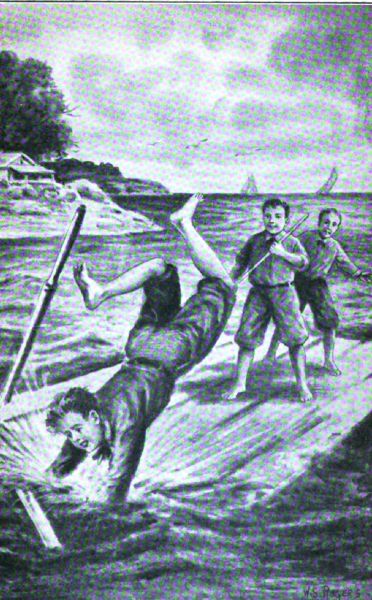
IT BROKE OFF AND FRED PITCHED INTO THE WATER. The Riddle Club at Sunrise Beach. Page 141
"Did he land on his head?" cried Artie in alarm, running to the end of the raft where Fred had disappeared.
As Ward was also at that end, naturally the raft tipped and both boys went into the sea, coming up within a foot of Fred, who was shaking the water from his eyes and staring about him with a bewildered expression.
"Hello!" Artie greeted him rather foolishly.
"Some raft!" said Fred, in disgust. "And we're the dubs not to have worn our bathing suits. Let's go up to the house and get them on now and hang these clothes out to dry."
This was voted a sensible plan, and the boys waded ashore. When they reached the house and donned their bathing suits, hanging their wet clothes on the line strung in the side yard, Ward suggested that they might as well eat their lunch.
"Then we can stay out all the afternoon," he said.
"Don't forget we have to have that fence fixed before Dad gets here," Fred reminded him.
Artie reached the kitchen first and lifted the cloth which was spread over their lunch. Alas, three empty saucers showed that some one had been there before him.
"Ward Larue, you ate the pies!" cried Artie. "Of all the mean tricks!"
"So that's why you were so anxious to come up and get the rope and the oars," Fred said, suddenly understanding.
"I never get enough pie," stammered Ward. "I thought you wouldn't mind. I won't touch the sandwiches and milk—you can have 'em all."
It was impossible to be long angry with Ward and of course he had his share of the rest of the food. Ward dearly loved to eat, and those pies had been too much for him—at home his mother kept the cookie and cake and pie cans securely locked, lest he be tempted too severely.
At Artie's suggestion they washed the dishes—after a fashion—and then hurried back to the beach. It was then only eleven o'clock and the prospect of a long afternoon was entrancing. Artie ran ahead to see if the raft was still afloat.
"It's gone!" they heard him shout. "Boys, the raft is gone! Somebody's stolen our raft! What do you know about that?"
"And it's Mrs. Meeker's fence, too," Ward muttered, fear-stricken. "What shall we do?"
CHAPTER XVI
A BIT OF GOOD FORTUNE
Ward said the rope must have broken and Fred thought perhaps the raft had sunk, but nothing would convince Artie that his raft was not stolen.
"All right, say somebody took it," Fred gave in. "What would they do with it?"
"Use it," said Artie. "It was a good raft."
"Maybe," Ward offered in his slow way, "Joe Anderson took it, just to be mean."
"Now you're talking!" exclaimed Fred. "That would be a Joe Anderson trick, all right. But he's going home this afternoon."
"He could hide it," Ward suggested.
"Well, I didn't think he'd take it on the train with him," grinned Fred. "Now it's up to us to do a little detective work."
This sounded exciting, and Artie and Ward waited expectantly for Fred to tell them what to do.
"Are there any footprints?" Fred demanded. "Look around and see if you see any footprints on the sand."
The boys reported that, as far as they could tell, the only marks were those made by their own feet.
"That proves," announced Fred triumphantly, "that Joe came in a boat and towed the raft away—just what I thought!"
"Huh," Artie snorted, "the tide's been in. Even if he had walked, we wouldn't see his footprints. Those we made ourselves before lunch are all washed out."
This shrewd observation was disconcerting, even to a detective of Fred's ability.
"He couldn't drag the raft very far on land," he argued. "I know he couldn't drag it as far as the bungalow. That's more than a mile from here."
"Yes, I know," replied Artie. "But I don't believe he came in a boat. Look!" and he swooped down upon something in the sand.
He held up a long splinter—an ugly, jagged strip of wood from which a rusty nail protruded.
"He chopped it!" Artie cried, his voice shaking with rage. "He went and chopped it up. And now the fence is gone!"
The loss of the raft would have been serious enough, but far more tragic was the double crime of destroying Mrs. Meeker's fence. And, as Ward said, the first thing their fathers would notice when they came home would be the gap in the boards.
"Perhaps it would have fallen down anyway," said Ward, trying to say something comfortable.
"I shook it—just a little," Artie confessed.
Now that they guessed the raft had been chopped up, it was easy enough to find more evidence. There were numerous splinters lying on the sand and a few feet past the piling a tangled wreckage of boards and rope floated on the water.
"I guess Joe came back, all right," admitted Fred. "All I have to say is that it was a mean trick."
But that did not help solve the problem of how to replace the borrowed section of fence.
The boys waded in and brought the bits of floating wood ashore, but Joe, if he had chopped it, had been thorough and any hope of salvage was seen to be hopeless.
"Well, we might as well go home," Fred said at last. "The folks will be coming back."
Rather disconsolately they trailed up to the cottage and Artie's guilty conscience gave him a distinct shock when he saw a strange man sitting on the porch steps.
"I—I guess I'll walk out to the bus line and meet the folks," he murmured, hanging back.
"In your bathing suit, I suppose," Fred countered sarcastically. "You come along—he can't arrest you for knocking down a piece of fence."
Artie did not feel at all sure on this point, but he dragged himself up to the steps and managed a weak smile in response to the broad grin with which the stranger greeted them.
"I thought every one was drowned, perhaps," said the man, pointing over his shoulder to the array of garments swinging on the line. "Where's your ma?"
The boys explained that their mothers were away for the day.
"Well, I figured there wasn't anybody home, so I told Ben to start right in," the man said comfortably. "Mrs. Meeker gave the order, and she allowed the noise wouldn't disturb any one, but I thought I'd ask first, if there was some one hanging around to ask."
For the first time the boys were aware of a noise of hammering. It seemed to come from behind the barn.
"Are you Mr. Meeker?" asked Artie fearfully.
"Mr. Meeker's been dead ten years, son," the stranger replied. "I'm Jim Wright, the carpenter. That's Ben you hear back there. He's making a racket all right, isn't he? But once it's torn down the worst is over. The wood's so rotten, Mrs. Meeker said to chop it up for firewood. Your ma can have it and welcome."
Fred was puzzled, and so were Artie and Ward. By common consent they moved toward the barn. The sound of hammering and ripping and tearing grew louder. Half dazedly, they went around to the back of the barn and to the fence which had furnished Artie with his ill-fated raft.
There was another man, evidently "Ben," the carpenter's helper. He was busily engaged in tearing down the fence, and, as they watched, a section fell with a crash. Dust and splinters flew high in the air.
"Hello," Ben greeted the boys cheerfully. "You're just in time to see the wrecking crew get in the last fine strokes."
He hit one of the posts a mighty blow with his hammer, and it fell with a crash. The boys stared in fascination till Margy, running out to them, announced the arrival of the party from Glen Haven.
"They're tearing down the fence, aren't they?" said Margy, as one who makes a discovery. "Say, we called you and called you and you never answered. Mother wants to know if you fell in—all your clothes are out on the line."
There was a scramble to get dressed quickly after that, and by the time they were ready for supper and had heard the day's shopping adventures Mr. Larue drove up with Mr. Marley and Mr. Williamson.
"The next time you want a raft," muttered Fred to Artie, as they sat down at the table, "I hope you'll have sense enough to let other people's fences alone."
Artie said nothing. He was still thinking over his narrow escape.
"We came through the Mooney place again," said Mr. Larue at supper. "It is still necessary to make that detour."
"Did you see Ella?" asked Polly and Jess eagerly.
"What did she have on?" Margy chimed in.
Mr. Larue laughed and answered that he could never tell what little girls wore.
"But we did see Ella, and she and her father are going to spend this week end at the hotel," Mr. Larue went on to stay. "The Captain thinks that a little change will be good for Ella—they live such a quiet life in that beautiful big house with no one to talk to but the servants."
"Maybe we'll see Ella," said Polly hopefully.
She had liked the rather shy little girl who had smiled at them in such a friendly manner, but who had said almost nothing.
Later that evening, when they were all sitting on the porch, Jess suddenly announced that she had a bright idea.
"Why can't we give a beach party and invite Ella Mooney?" she suggested.
"What's a beach party?" Artie asked immediately.
"Oh, it's a party," said Jess impatiently.
"Carrie Pepper and Mattie Helms are always giving 'em," put in Margy. "They've had two since we've been down here."
"Mother, can't we have a beach party?" asked Jess.
"I suppose so," Mrs. Larue answered. "I think it would be nice to ask Ella Mooney. And to-morrow night, if it is clear, would be a good time to hold it."
Ward wanted to know if there would be "eats," and, satisfied on that score, he seemed to think that his only responsibility toward the party was to attend it.
"Are we going to ask Carrie Pepper?" said Jess. "And Mattie?"
"For goodness' sake, why?" Margy demanded. "They never asked us to any of their parties."
"Well, I just thought perhaps we ought to," Jess replied, and subsided.
The next day was hot and clear and every one knew that the evening would be ideal for a beach party. Mrs. Marley and Mrs. Williamson went over to the hotel, taking Polly with them, to call on Captain Mooney and his daughter. They announced, on their return, that Ella had seemed delighted with the idea of a party and that she would come at half past seven.
As always, when a party is to be given, there was a great deal to be done to get ready for it.
"We'll get the driftwood," Mr. Marley promised, "and we'll see that you have enough sticks sharpened for the bacon and marshmallows. I think right out in front of the house is a good place for the fire; the sand dune will break the wind."
Along in the afternoon, Artie took advantage of the temporary lull in the day's activities to suggest that he might go after the mail.
"Get the marshmallows, too," his mother asked him, giving him the money. "And, Artie, do try to hurry."
Artie promised speed and set off joyfully for the town. He went by way of the beach, and of course no one can hurry along a beach, for there are so many interesting things to see and do, even though one has seen and done them all many times before.
"Shall I get the mail first, or the candy?" thought Artie, as he came in sight of the town.
He decided to get the candy first, for he rather hoped the marshmallows would be sold by the pound. If they were in a paper bag, he argued, there would be no harm in eating one or two.
Alas, the marshmallows came in pound tins and the shopkeeper gave Artie three tins so tightly sealed and wrapped that a burglar could not have opened them and left no trace.
Artie went on to the post-office and there, waiting for the letters to be sorted, was Carrie Pepper.
"Hello, Artie," she greeted him. "Mercy, what's that you are carrying? Eggs?"
"No," said Artie, always ready to give information, especially when asked. "No, I haven't any eggs. These are marshmallows."
Carried looked as though she rather expected him to offer her one.
"They're in a box and sealed up, so I can't offer you any," Artie explained. "Anyway, they're for to-night."
"What are you going to do to-night?" asked Carrie curiously.
"Have a beach party down in front of our house," Artie replied. "Ella Mooney is coming."
Carrie said "Oh!" and just then the little wooden shutter at the post-office window went up with a bang and the postmaster began to distribute the mail. Artie had a small sheaf of letters and papers to take back with him and he did not see Carrie again.
Margy was the only one of the three girls who was deeply interested in the question of what she should wear. Margy dearly loved pretty clothes and, if her mother had allowed her, it is to be feared she would have worn her most fetching frock to the beach party, a white lace affair with a pink sash. As it was, she had to be content with her pongee, but at least, so she said, she could do her hair a new way. She meant part it a new way, for it was bobbed.
After supper she went upstairs to dress, knowing by experience that it would take her longer than either Polly or Jess. Polly, drying dishes for Mrs. Larue, was startled a few minutes later to hear a frantic call from Margy.
"Polly!" called her chum. "Oh, Polly! Jess! Listen, girls!"
Dish towel in hand, Polly ran out into the hall. Margy was leaning over the banisters, distress pictured vividly in her anxious face.
"Polly, who do you suppose is coming?" whispered Margy. "I happened to look out of the bathroom window, and I saw them coming down the road! Mattie Helms and Carrie Pepper!"
"Perhaps they're not coming here," Polly whispered back hopefully, but at that instant the screen door banged and Jess flew into the hall.
"Say, Carrie Pepper and Mattie Helms are coming!" she cried. "I saw them up the road. Who invited them to our party?"
Polly's sense of humor helped her to see the funny side.
"You sound as though you were telling us, 'the enemy are advancing!'" she giggled. "I don't know who invited Mattie and Carrie, but if they have come, we'll just have to be nice to them, I suppose. Maybe they didn't know we were going to have a beach party and this is just a call they're making."
"I'll bet a cookie they've come to the party!" Margy announced, as they heard the unbidden guests ascending the porch steps.
CHAPTER XVII
THE BEACH PARTY
Margy declaring that she was not dressed and Jess flatly refusing to go, Polly had to answer the ring at the door.
"Hello," said Carrie, smiling. "We thought we'd come over for a little while. Isn't it a lovely evening?"
Polly thought it was and asked them to sit down on the porch, "while I tell Jess and Margy you're here."
She also told her mother and the others. To her surprise, they seemed to take the situation calmly.
"Why, dear, we have plenty of everything to eat," Mrs. Marley declared. "I think it will be nice to have Carrie and Mattie stay. Run out on the porch and talk with them until I get the rest of this bacon sliced."
"But they didn't ask us to their parties!" objected Jess, who was listening.
"What difference does that make?" Mrs. Larue said briskly. "Beach parties are anything but formal. Of course we must ask Carrie and Mattie to stay and share our fun."
Polly and Jess went out on the porch and talked to Carrie and Mattie till Margy came down in her pongee dress, her hair parted on one side. She usually parted it in the center.
"Here comes somebody," Carrie observed, a few minutes later. "Why, she's coming here. Do you know her?"
"That's Ella Mooney," said Polly quietly, going down the steps to meet the little girl who was advancing shyly.
She introduced Ella to the two girls she had not met and then every one came out on the porch and in the general hubbub of greetings and getting started for the beach, Ella quite forgot to be tongue-tied, and chatted as gayly as any of the others.
The boys' amazement when they saw Carrie and Mattie was so open that Polly wanted to laugh. Fred frankly scowled and his mother thought it best to keep him very busy with boxes and parcels, lest he forget his position as host and say something discourteous.
"A beach party!" trilled Carrie, when Mrs. Williamson explained what was planned. "Oh, I didn't know you were going to have a party to-night! Mattie and I would not have dreamed of coming over."
Artie was halfway down the steps with a box of stuffed eggs in his hands, but he heard this remark and turned in astonishment.
"Why, I told you we were going to have a party," he said clearly. "In the post-office this afternoon. Don't you remember? I said Ella Mooney was coming. That was why I had the marshmallows."
Carrie blushed and Mattie looked queer, but neither girl made any reply. In desperation Polly began to talk very fast about nothing at all, and in a few minutes the party had climbed over the dunes and were on the beach.
The fire was the most important thing to be attended to, and when the wood was piled, Mr. Williamson handed a match to Ella Mooney.
"We'll ask the honor guest to light the fire," he said, with a smile.
Ella was such a quiet child that one had to look at her intently to realize the charm of her seriousness. She had bright eyes that missed nothing of what went on around her, and though thinner than Jess, she was more muscular. It was easy to see that she lived an outdoor life and that she was much alone. She rarely spoke unless first spoken to, and then she replied readily enough and with a charming smile that lighted up her sober face.
"But she has a good time, just listening," said Polly to herself, after watching her guest a few minutes. "She likes to hear the fun and she laughs at all the jokes."
"Tell about the club," suggested Ella Mooney, forgetting to be shy. "Your father said you had a Riddle Club, and I'd love to hear about what you do. I never belonged to any club, because I don't know many boys or girls."
"Don't you go to school?" Mattie Helms asked curiously.
"No, I have a governess who comes and teaches me," answered Ella. "Daddy doesn't like to have me go away to school, and the Sunrise school isn't very good."
So Polly, with the active help of the other members, tried to tell her something about the Riddle Club, and what they did and something of the experiences they had had.
"What nice times you have together!" said Ella wistfully.
"We have more fun in our Conundrum Club," Carrie declared. "We meet around at different houses, and it's more exciting. Besides, there are fourteen of us—seven boys and seven girls—and we can have better times with a crowd."
"I think clubs and pins and meetings are all nice," replied Ella quietly.
By this time the fire presented a glowing bed of embers and was pronounced "just right" for toasting the bacon and cheese sandwiches. Fred passed around the pointed sticks, and as fast as one toasted his or her sandwich, it was eaten.
"Gee, that's good!" sighed Ward, in blissful satisfaction, after he had disposed of three sandwiches and as many more of the stuffed eggs.
The moon was making a silver path across the water, and the older folk decided that a walk on the beach would please them more than sitting still and toasting marshmallows. So, after promising to return within an hour, they set off up the beach and left the fire to the Riddle Club and their guests.
"I've eaten so many marshmallows I don't want to taste another one," said Carrie Pepper, putting down her stick, after a busy interval in which the luscious brown and dripping marshmallows had been enjoyed to the uttermost. "Let's do something for fun."
It was, perhaps, not Carrie's place to propose a change in the program, but Carrie had never been called backward or shy. She said what came into her head and said it so plainly that few people were left in doubt as to her opinions and wishes.
"Ella hasn't finished yet," said Polly significantly.
Ella Mooney was intently roasting a marshmallow, her whole mind absorbed in getting it just the right shade of brown. There was no doubt about Ella having a good time—her face was transfigured with happiness, and though she did not talk much, she laughed more and more spontaneously.
"That child is lonely," Mrs. Marley had remarked, as the elders left the children gathered around the fire. "It will do her good to play a little with our boys and girls; she needs companions of her own age."
"I'm through now," Ella said hastily, popping her candy into her mouth. "I didn't know I was eating so many."
"You didn't—not half as many as the boys," Jess assured her. "And there's a pound left in that box we haven't touched."
Ella, however, could not be persuaded to eat any more, so they put more driftwood on to burn and leaned back to watch the fire.
"I tell you what would be fun to do," said Carrie, helping herself to a marshmallow from the freshly opened box and apparently forgetting what she had just said. "Let's each write a message on a strip of paper and put them in that tin box. Then throw it in the ocean and perhaps it will be picked up fifty years from now."
"By the Chinese, who can't read it," Fred suggested.
"Then they can have the messages translated," retorted Carrie.
Artie's mind approved thoroughly of this idea, and he was eager to try it. He was quite sure that a waiting world would be eager to hear from them fifty years hence.
"Well, here's a pencil," said Fred grudgingly. "But I haven't any paper."
"Tear up the labels on the candy boxes," Jess suggested. "We can write on the back."
"And don't let any one know what you are going to write," said Mattie Helms. "Then it will be a surprise."
Jess whispered that she didn't see who was going to be surprised, but Margy was busily writing and told her to hush.
After some thought and a little bickering, due to the impatience of one or two of the writers who didn't like to have to wait for the pencil, the nine slips of paper were ready to be put in the box. The lid fitted tightly and, once in place, seemed quite likely to stay there for fifty years, if the box was not found before that time.
It was low tide, and Fred had to go out several yards before he thought it safe to fling the box. He threw it as far as he could and it fell with a satisfying splash.
"I wish I knew who was going to find it," sighed Carrie. "Wouldn't you like to know?"
"I don't think it makes much difference," Polly declared, and Fred said that he hoped an Eskimo found the box and ate the papers.
"Say," Artie remarked matter-of-factly, "there's somebody sitting at our fire."
Artie spoke as though it was the most ordinary thing in the world, but Carrie was at once excited.
"I left my sweater!" she cried. "If that's a tramp, he'll steal it."
Ella said nothing, but Polly remembered the little beaded bag she had seen.
"You left your purse, didn't you, Ella?" she asked.
"Oh, yes, but there's only ten dollars in it," Ella said calmly, though the others gasped at thought of this sum.
"Probably it's only some one who wants to get warm," Jess declared. "Come on—he'll go when he sees us coming."
But the tramp, if tramp he was, did not move at their approach. He merely stared, and the children stared back at him.
They saw an old man, stoop-shouldered and dressed in wrinkled, baggy clothes that were vaguely reminiscent of sailor's clothing. He wore a funny little peaked cap and he had a curly white beard.
"Evening," he said, as they did not speak.
"How—how do you do?" Polly stammered.
"I saw the fire and I thought I'd sit down and warm my old bones," croaked the tramp, in a hoarse voice. "You don't mind, do you?"
"Well, if you're warm, I should think you could go now," Carrie said, before any one else could speak.
She snatched her sweater from the ground, almost from under the old man's elbow.
"Oh, Carrie, how can you talk like that?" whispered Polly.
"Well, you never can tell what a tramp will take," Carrie said, taking no pains to keep her voice low.
"I wouldn't take anything, lady," the old man protested, with dignity.
"I'll bet he's hungry," Jess whispered to Polly. "Are there any sandwiches left?"
There were three or four, and a little shyly Polly offered them to the tramp who thanked her and ate them with evident appetite. Then Jess toasted him several marshmallows, and though he said he wasn't "any great hand for sweet things," he ate them without further protest.
Fred put more wood on the fire, and as he leaned over to prod it into a better blaze, he saw Ella Mooney slip her hand into the gaping pocket of the shabby jacket the old man wore.
"I'll bet she gave him some money," ran Fred's swift thought. "She's that kind of a girl—while all Carrie can think of is that she may lose her silly sweater."
Ella's eye caught Fred's, and she blushed violently. He shook his head to signify that he would not tell, and she seemed relieved. Meanwhile, Mattie Helms had been asking questions: Where had he come from? Where was he going? Was he a sailor?
"We just sent some messages off in a tin box," she chattered. "Do you suppose maybe sailors on a ship will pick them up, or people on shore?"
"Maybe a ship will sight your box," the old man said slowly. "It's hard to say. Then again, it may never be found—it may float for years and not be picked up."
"I don't see why he doesn't go," Carrie muttered disagreeably to Polly. "I don't think your mother would like us to be talking to an old tramp."