SUMMARY OF WAR HONOURS, 1914–1919.
Reading edition
Victoria Cross 8
C.B. 1
C.M.G. 1
M.V.O. 3
Order of the British Empire K.B.E., 1; C.B.E., 2
„ „ „ „ O.B.E., 43; M.B.E., 37
Distinguished Service Order 52; Bars, 4
Distinguished Service Cross 4; Bars, 1
Military Cross 822; Bars, 63; 2nd Bars, 6
Distinguished Flying Cross 23; Bars, 3
Air Force Cross 15
Royal Victorian Medal 4
Distinguished Conduct Medal 6
Military Medal 15
Meritorious Service Medal 14
Foreign Decorations 90
Mentioned in Despatches 564
Brought to notice of Secretary of State 70
STRENGTH.
Numbers on Mobilization 621
Recruits during the War (including past members rejoined) 14,401
Total of Muster Roll 15,022
Gazetted to Commissions (so far as ascertained) 10,256
CASUALTIES.
Nature. As Officers. As Rank and File. Total.
Killed in action or died 1,614 389 2,003
Wounded or gassed 2,816 434 3,250
Missing 418 114 532
Prisoners of War 256 30 286
6,071
Note.—The above figures include only enlisted Artists, not officers or men transferred or attached from other Regiments.
A CALENDAR OF REGIMENTAL NUMBERS.
showing at a glance the approximate date on which any recruit joined, or old member rejoined, by reference to his Regimental Number[5]
Date. Highest No.
1st Battalion.
Old style New[6] style
1908 1 to 425 760001 760032
1909 787 48
1910 940 57
1911 1037 64
1912 1137 75
1913 1281 98
Aug. 3/14 1345 760111
„ 30 „ 1749 165
1914 2nd Battalion.
Aug. 31 1907 760188
Sep. 1 2000 200
„ 15 2500 276
Oct. 30 2800 300
Nov. 24 3000 375
Dec. 31 3063 391
1915 3rd Battalion
Jan. 5 3100 760400
Feb. 2 3300 455
Mch. 16 3500 500
Apr. 20 3700 552
May 27 3900 580
June 21 4100 600
July 13 4200 612
Aug. 20 4400 643
Sep. 23 4500 700
Oct. 29 4800 760
Nov. 12 5000 800
„ 29 5500 761000
Dec. 6 5800 100
„ 10 6000 180
„ 13 6100 200
„ 28 6300 290
1916
Jan. 1 6400 761300
„ 14 6600 400
„ 27 6900 500
Feb. 1 7000 570
„ 7 7100 600
„ 17 7300 720
Mch. 1 7600 860
„ 7 7700 920
Apl. 27 7800 970
May 7 7850 944
June 8 7900 762000
„ 14 8000 100
July 1 8100 150
Aug. 24 8200 200
Sep. 13 8300 300
„ 20 8400 400
„ 26 8500 500
Oct. 4 8600 600
„ 17 8800 800
„ 25 9000 763000
„ 30 9100 100
Nov. 6 9200 200
„ 11 9400 400
„ 20 9600 600
„ 27 9700 700
Dec. 11 9800 800
„ 14 9900 900
„ 18 10000 764000
„ 29 10200 200
1917
Jan. 6 10400 400
„ 8 10515 764516
End of re-numbering.[6]
Date. Highest No.
3rd Bn.
1917
Jan. 11 764517
„ 13 700
„ 16 900
„ 7 200
„ 21 300
Mch. 27 400
„ 26 600
May 7 700
„ 25 900
June 7 766000
„ 29 200
July 20 400
„ 31 500
Aug. 9 600
„ 30 800
Sep. 25 767000
Oct. 26 200
Nov. 16 300
Dec. 7 400
1918
Jan. 24 600
Feb. 20 800
Apl. 5 900
„ 24 768000
May 29 200
June 15 400
„ 28 500
July 10 700
„ 27 900
Aug. 7 769000
Sep. 4 200
Oct. 2 400
„ 21 600
Nov. 11 769703
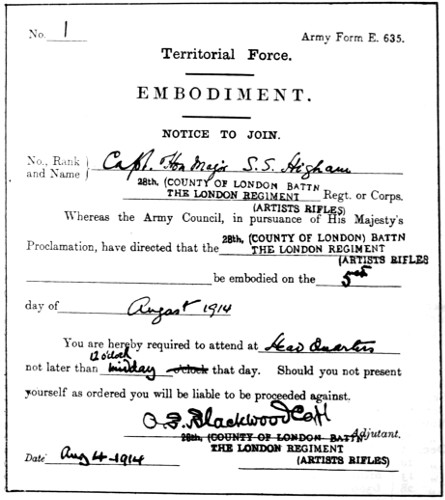
THE “FALL-IN.”
August 4th, 1914.
(facsimile.)
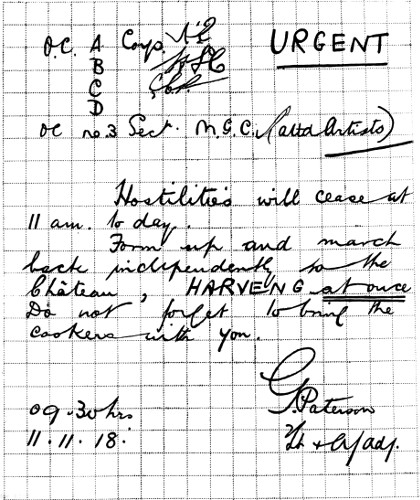
THE “CEASE FIRE.”
November 11th, 1918.
(facsimile.)
THE FIRST FIFTY.
Roll of N.C.O.’s and men of the Overseas Battalion who went into action in November, 1914, as Probationary 2nd Lieutenants in the 7th Division.[7b]
20th INFANTRY BRIGADE.
1st Grenadier Guards.
1076 Cpl. Crisp, F. E. F.
1634 Pte. ♦Edlmann, F. J.
1464 „ ♦Hillas-Drake, R. F.
1186 „ Moller, A. A.
2nd Border.
392 Cpl. ♦Close, M. A.
1614 Pte. Cuthbertson, F. T.
1551 „ Sampson, H. F.
1613 „ ♦Wornum, T. H.
2nd Gordon Highlanders.
691 Cpl. Chater, A. D.
1437 Pte. Horsley, O.
1436 „ Horsley, S. M.
997 L/Cpl. Mulock, E. R.
21st INFANTRY BRIGADE.
2nd Yorkshire.
2220 Pte. Crosse, M. E. B.
1167 „ Cuttle, G.
2255 „ Hollis, H. L.
1794 „ Pickup, A. J.
2nd Bedfordshire.
1260 Pte. Brewer, C. H.
1929 „ Dabell, N. V.
1033 L/Cpl. de Buriatte, H.
1030 Pte. Willans, H.
2nd Royal Scots Fusiliers.
1760 Pte. ♦Raymond-Barker, C. L.
1755 „ Stewart, J.
1578 „ Wallace, J. R.
1573 „ ♦White, L. S.
2nd Wiltshire.
1823 Pte. Carden, R. H.
1138 „ Kitcat, A. J.
1536 „ Shepherd, W. S.
1725 „ Strawson, F. M.
22nd INFANTRY BRIGADE.
2nd Royal Warwickshire.
1101 Pte. Herbage, P. F. W.
1285 „ Monk, G. B.
539 „ Peace, G. V.
787 Sgt. Standring, B. A.
2nd Royal West Surrey.
693 Sgt. Austin, C. F.
1372 Pte. Humphreys, D. F.
1390 Cpl. Messom, H.
1371 Pte. Rought, C. G.
1st Royal Welsh Fusiliers.
954 Cpl. Jones, L.
608 L/Cpl. Parkes, H. F.
1429 Pte. Rees, J. T.
1934 „ Winters, J. W.
1st South Staffordshire.
706 Cpl. ♦Frost, K.
1744 „ Mackintosh, H. L.
1087 L/Cpl. Silcock, A.
1399 Pte. ♦West, F.
ROYAL ENGINEERS.
1150 ♦Hunter, J. W.
1491 ♦Hutt, H. V.
WITH THE ROYAL NAVAL DIVISION.
A SHORT HISTORY OF 1/ARTISTS IN THE LINE, FROM JULY 1917, TO THE ARMISTICE.
Oppy Wood.
Passchendaele.
On the Somme (Marcoing).
Withdrawal to Metz and Beaulencourt.
Advance to Couillet Wood Sector.
Retirement from Havrincourt Wood to Forceville.
To Aveluy Wood Sector.
Attack on Hindenburg Line.
Rest at Bailleulval.
Capture of Hindenburg Line.
Fall of Cambrai.
First British troops in at Blaugies and Sars-la-Bruyere.
Pursuit to Harvengt and Harmignies.
Mons.
63rd (ROYAL NAVAL) DIVISION.
188th Inf. Bde. 189th Inf. Bde. 190th Inf. Bde.
1/R.M.L.I. “Drake” Bn. 1/Artists.
2/R.M.L.I. “Hawke” Bn. 4/Bedford.
“Anson” Bn. “Hood” Bn. 7/R. Fusiliers.
“Howe” Bn. “Nelson” Bn. 4/Shropshire L.I.
From July to Sept. 1917, the Division was in the front line (“R3” and “R4” Sectors, Oppy and Gavrelle) and with the exception of a few casualties, nothing of special note occurred during this period so far as the Artists’ were concerned. After a normal tour, the Division was relieved by the 47th (formerly 2/London) Division, the Artists themselves being replaced by the 22/London, commanded by Lt. Col. C. F. H. Greenwood, an Artists’ Officer, and moved to La Comté.
On coming out of the line inexorable Anno Domini deprived us of our Commanding Officer, Col. Chatfeild-Clarke, while our esprit de corps was momentarily ruffled by the appearance of a reinforcing draft composed not of Artists, but of 119 men from another unit.
It was recognised however that pooling, not only of reinforcements but of C.O’s. was now inevitable: that as no other Battalion overseas was being exclusively fed from its own Regiment, the Artists could not expect different treatment.
During the ensuing twelve months they had five new Commanding Officers, all drawn from other Regiments.
October 1917.
In October, the Division was ordered to the Ypres front: we journeyed to Houtkerque, thence to Reigersburgh and on the 28th left camp for our first big fight, the C.O. Major Edlmann, bringing news, that owing to the impossible state of the ground the Divisional front had not been advanced so far as had been expected, so that what was to have been our jumping off line would now be our objective. During the next thirty hours we suffered a good many casualties from long range artillery fire, D Co. losing their C.S.M., C. W. W. King.
The story of the battle for the Passchendaele Ridge, so far as the Artists are concerned, is soon told. Other Divisions before us had been taking their share in the slow process of gaining ground in this water-logged area, at tremendous cost. The 188th was the first Brigade of the 63rd Division to attack; and advancing under a terrific artillery and machine-gun barrage they, too, made some headway, but suffered severely. Early on the 30th our Brigade attacked, also under a very heavy barrage: the British artillery averaged one gun to every 9 yards of front. To reach our objective we had to cross the Paddebeeke, on the map an insignificant streamlet, but in fact by this time a wide and almost impassable swamp.
ORDER OF BATTLE B Co. (Capt. Bare). A Co. (Capt. Mieville).
C Co. (Capt. Chetwood) Support.
D Co. (Capt. Royds) Reserve.
The instant our attack started, the forward troops came under intense machine-gun fire from an almost invisible enemy who had taken refuge in their “pill boxes” during our bombardment, and were now posted in carefully chosen tactical positions. Simultaneously our supporting troops suffered heavy casualties from enemy artillery, while the ground to be traversed was a deep sea of mud, which drowned wounded men and clogged rifles and Lewis guns in the first few minutes, rendering them entirely useless. Consequently it was not long before the attack was brought to a complete standstill, and the very attenuated Battalions proceeded to consolidate as best they could on our side of the Paddebeeke.[8] On our right the Canadians continued to advance: being on higher and drier ground they were able to get on, so that presently there was a dangerous gap between their left and our right. This was closed by sending up the Shropshires from our Brigade reserve.
On this day the Artists went into action about 500 strong and suffered 350 casualties, amongst those killed being Captains Bare, Chetwood and Gordon Williams, Lieuts. Haslam and Howe, and our splendid Padre, Capt. Harry Dickinson. The toll of deaths would have been still higher but for the untiring efforts of our M.O., Capt. Matthew, who for 72 hours hardly rested from the work of collecting and dressing the wounded.[9]
The task set the Division appeared to be an impossible one, and no doubt would not have been attempted but for the urgent necessity of those tremendous attacks in this sector, which drew away all the enemy’s reserves from other points where it was of the utmost importance to prevent his attacking in force. It was not a case of lives being fruitlessly thrown away, but of sacrifices which enabled the whole Allied line to remain intact at a time when the Russian débacle was straining to the utmost our resources on the Western Front.
The next day the remains of the Battalion moved out of the line to refit, and while at Eringhem received a special message of sympathy in respect of their losses, and congratulations on the part they had played in the battle, brought direct to them from Earl Haig. They learned also from the Canadians (who were loud in their praises of the way in which our men had pressed forward) that several Artists had succeeded in actually crossing the Paddebeeke before being killed.
December, 1917.
After a period of rest and reorganisation (during which Lt.-Col. John Harington, 3/Rifle Brigade, took over the command, Major Edlmann was appointed O.C. 63rd Divisional Wing, and substantial reinforcements arrived, including 6 Officers and a draft from 3/28th), the Battalion was on its way back to the Passchendaele sector, when the successful British offensive before Cambrai was checked and the Boche began to press back the wedge that had been driven into his line there. Thereupon the 63rd Division was sent to the Somme district, and at the end of December moved into the front line in the Marcoing salient (Couillet Wood sector).
On the 30th the enemy launched a terrific attack and succeeded in penetrating the front line to the east of the Welsh Ridge salient. The Artists who were in support at this point were detailed for a counter-attack which had to be made without artillery support. It was pressed for all we were worth but resulted in very heavy casualties without the achievement of our object. However, we heard subsequently that our efforts were not in vain as the enemy, deceived as to the strength of our available reserves by the promptitude and determination with which the counter-attack was delivered, refrained from exploiting their initial success. Had they done so, it is conceivable that their object in driving us from the Welsh Ridge might have been attained.
ORDER OF BATTLE A Co. (Capt. Pike) B Co. (Lieut. Skinner).
D Co. (Capt. Barnett) Support.
C Co. (Capt. Lepingwell) Reserve.
A very gruelling night followed, consolidation work having to be carried out in ground which was frozen hard. Sufficient praise cannot be given to the Medical Staff under Capt. Mathew, M.C., who were again working all day at high pressure and at night did much to assist in the recovery of the wounded men who were lying out in front of our line. Excellent work was accomplished by D Co. under Capt. Barnett in forming a defensive left flank, by Capt. Mieville in reconnaissance, and by Lt. Holland, these officers gaining on that occasion very hard-earned M.C’s.[10] Lt. Margetson also earned recognition for good work in the maintenance of signal communication[11] and R.S.M. Emslie did much to keep things going by the organisation of carrying parties to get hot food up during the night. One Corporal did yeoman service to his Company by going back under heavy fire, crossing a gas-filled valley and bringing up the Company water supply which had had to be abandoned in the rush of the morning.
Our casualties were nine Officers and 110 other ranks. Lieuts. Salisbury, English, Shinner and Lightfoot, with our M.G. Officer (Groom) and Intelligence Officer (Godfrey) were killed, while Pike, Lepingwell and Holland were wounded, and from this date the Battalion ceased to be exclusively officered by Artists. But although Officers and men came to us from many other Regiments the spirit and traditions of the Corps were maintained to the end: one of the most striking features in connection with the arrival of reinforcements from other units was the rapidity with which our new comrades assimilated Artists’ ideas and methods of getting things done.
January-March, 1918.
During January and February, 1918, we put in further tours of duty in the front line (during one of which both the Boche and ourselves lived on top behind our respective parados, the trenches having become nothing but ditches of liquid mud several feet deep), while Col. Harrington left us to command the 2/Rifle Brigade (eventually becoming a Brigadier-General), and Major Lathom who had been temporarily in command of the Fusiliers was appointed acting C.O. of the Artists.
The Brigade was then withdrawn to Divisional Reserve at Beaulencourt where we were joined by Major F. S. B. Johnson, 1/Royal Lancaster, as our own new C.O. and our strength was brought up to 28 Officers and 766 other ranks by the addition of a complete half Battalion of the 2nd Bn. London Rifle Brigade which had been broken up on the formation of 3-Battalion Brigades.
In March we returned to the Couillet Wood sector, and on the 21st had our first experience of the anxious times experienced by the Allies during the Spring of 1918. Shortly after daybreak, while in camp in Havrincourt Wood, we were aroused by a violent bombardment. A dense gas and smoke cloud passed through the Wood as we moved to our battle positions. On the way up Lt. Lintott, L.R.B. (formerly an Artist Sergeant), was killed. The next night we were ordered back to Havrincourt Wood as the enemy had gained a considerable amount of ground on our right (the Fifth Army Front). During the withdrawal, Lt. J. I. Royds was killed in Trescault. We started to dig in, but the next morning were retired to a defence line east of Ytres. There we again made ready to fight a rearguard action, but we were again disappointed as we were directed to withdraw on a line Ytres—Bus-le-Transloy. That night the whole Brigade withdrew into Ytres, and as communication with both Brigade and Divisional H.Q. was lost, a meeting of all the C.O.’s in the Brigade was called, and it was arranged that the Brigade should form a defensive flank extending East-West, to conform with the withdrawal of the 2nd Division on our left. The Brigade was then taken over by Lt.-Col. Collings Wells of the 4th Bedfords, who for his good work during the withdrawal was awarded the V.C.[12]
We moved to our new position about midnight, the route taken leading us past the vast ammunition and petrol dump which was being destroyed. Here a shell splinter from the dump wounded Major Lathom, who was carried back to Beaulencourt. C Co., under Lt. Eric Willis, was also unfortunate in running into a Boche M.G. post and suffering severe casualties. Good work was done by Sergt. A. Coviello, who succeeded in penetrating the enemy lines in rear of us and establishing communication.[13] Next morning the retirement continued through Barastre with heavy casualties (amongst whom was Lt. Dow, our American M.O.) to Beaulencourt, where we found Brigade H.Q. Then back through Gueudecourt, Flers, Bazentin-le-Grand, Bazentin-le-Petit to Courcelette, and the next day’s trek took us through Pozieres to Thiepval. On the slopes in that neighbourhood we had an opportunity of checking the Boche, great work being done by a Lewis Gun team, for whom the Brigade Major was spotting. During the night orders came to cross at Authuille to the west bank of the river before daybreak, when the R.E.’s were to destroy the bridges. On reaching the other side we found the 12th Division waiting to take over from us. To celebrate the conclusion of our long innings, Bn. H.Q. indulged in a game of stump cricket which was rather spoilt by the arrival of a Hun H.V. shell. It ruined the pitch and scattered the field, but fortunately no one retired hurt. We then marched through Martinsart to Englebelmer, and the same evening moved to Millencourt for an attack on another Divisional front on the outskirts of Albert. This attempt to dislodge the Boche proved fruitless and resulted in somewhat serious casualties, chief among which was the loss of Lt. Eric Willis.
The Battalion was then withdrawn (via Senlis and Mailly Maillet) to Forceville for a complete rest over Easter. Our total casualties during the retirement amounted to 17 officers and 300 other ranks.
April-August, 1918.
During April and May we performed tours of duty in the new line established after the retreat north of Mesnil and in Aveluy Wood sector. We lost Capt. Neighbour (who had rejoined us in March) through sickness and Col. Johnson was wounded in Aveluy Wood. Thereupon Capt. Wilkinson (L.R.B.) assumed command. In June the Battalion went into Corps reserve at Toutencourt Wood and was attached to the “flying” Corps, kept for operations on any front, and throughout July we were engaged in line holding alternately between Acheux Wood south of Auchonvillers and the line north of Mesnil.
In August, on the eve of the Australian offensive before Amiens, we went to Beaucourt-sur-l’Hallue. After their attack had been successfully launched the Division marched north again via Famechon to Souastre, whence we moved out via Fonquevillers to take our part in the commencement of that vast movement which resulted in the eventual overthrow of the enemy. The Division attacked on the 21st in heavy mist supported by a very intense artillery barrage and at the end of the day the Artists found themselves in the front line, having passed unconsciously through the Battalion we were supporting who had lost direction to a certain extent and moved too far to the right.
The next morning the C.O. and Adjt. (Capt. Barnett) were wounded and we sustained our most deeply regretted casualty in the death of R.S.M. Peter Emslie, who was ever a magnificent stand-by in the line, where his courageous efficiency rendered him at all times invaluable. The Battalion was brought out by Lieuts. Bayne and Besch.
On the 24th at Achiet-le-Petit we went over in close support of the 188th Brigade in a heavy ground mist intermingled with gas and smoke. Objectives were carried and the attack turned south-east towards Warlencourt and Ligny-Thilloy where stout opposition was encountered and the attack delivered on the following morning in conjunction with the Canadians failed. The Division was then withdrawn via Irles, Miraumont, Achiet-le-Petit, Bucquoy, Ayette to Boiry St. Rictrude.
The next day we moved into trenches at Boiry-Becquerelle, and on the 26th we followed up the attack as Division in reserve, the attacking waves passing through Fontaine and Hendecourt to Caignicourt, and so on to the Hindenburg line between Inchy and Moeuvres.
September, 1918.
Early in September the Division was withdrawn by stages to Bailleulval on the Arras-Doullens road, where we remained for a period of rest and “fattening.” On leaving we received an address from the Mayor thanking us on behalf of the population for our considerate treatment of them and their belongings.
We then marched back again to the Croisilles area, the Artists finding a home in tents and shelters on the high ground south-east of St. Leger near L’Homme Mort Wood. Here we were joined by our new C.O., Lt. Col. Goldthorp (4/West Riding), who shall now continue the narrative.
I think that my story, such as it is, had better take the form of a sort of letter. It was late on the night of 18/19th September, 1918, when I reached the 63rd R.N.D. Wing, then at Boisleux-au-Mont, where I was welcomed by Major Edlmann, the O.C. Wing, and Capt. Baillie-Hamilton, the Adjutant, who informed me that I was either for the Artists or the Bedfords, who were both without C.O.’s.
The following morning I was taken forward to Divisional H.Q. in dug-outs between St. Leger and Ecoust, and I was officially told that I was to take over the command of the Artists. After reporting to the Brigadier, General Lesslie, who proceeded to tell me all he knew about the Artists as a Regiment and about the officers individually, I set out on my lonely journey across a little valley to their H.Q. to “take over.” I can imagine their Officers watching me come along, and wondering what sort of a “blighter” they were getting this time. Well, my feelings were much the same, but I had learned from the Brigadier some of their good points, and they did not know even my bad ones then, so I started “one up” on them anyhow.
I took over from Acting-Captain Hermelin, who was then in command; Besch was the Intelligence Officer; Morris, Signalling Officer; Nelson, the “Doc.”; Hewitt, Acting Adjutant; Light, Quarter-Master; Prentice, Transport Officer; Robinson, Padre; and Wyler our Interpreter.
Very early a batch of officer-reinforcements arrived, and it became obvious we were in for a show the nature of which we could only guess, but for my part I should like to say that from the very first I had every help from Officers, N.C.O.’s and men, and my work was made easy by the spirit they all showed of welcoming me as one of themselves from the start. I shall never forget those first few days and the solid foundation of trust and comradeship they laid for what was before us.
On the 26th September we left our Camp for the old trenches just outside Queant, where we were to assemble prior to a march on to our “tape” between Moeuvre and Inchy, and we knew when we left (having received all the barrage tables, etc.) that we were in for one of the biggest battles fought by the British Armies during the whole of the War, as the Division had to cross the Canal du Nord and take the Hindenburg Line in conjunction with the Canadians on our left, and the Guards on our right. This was only to be the first phase, and as far as the Naval Division was concerned, the 190th Brigade was the first to kick off. Afterwards, the other Brigades were to go through us and capture Anneux and get on as far as they could.
I was rather pleased to find that it fell to the Artists to do the lion’s share of the work of our Brigade, i.e., we had to capture the Hindenburg Line after the Fusiliers and the Bedfords had crossed the Canal, a very delicate and involved movement which required a great deal of preparation and explanation.
We arrived at our Assembly Point without trouble and at midnight started off—a pitch black night, in a deluge of rain. We made very slow progress; it was a difficult job keeping in touch and following the line, which was marked out by whitewashed posts, most of which had either been knocked down by the Artillery, or obliterated by the rain. Without Hewitt and Goacher we should have found it very difficult indeed, and might easily have had the same misfortune as was experienced by another Battalion who missed the track somewhere outside Pronville and got too much to the left. But these two officers did splendidly and we eventually arrived at a trench which marked our then front line. I halted the Battalion and they laid down and soon went to sleep. We waited about, hoping against hope that the other troops would arrive, but finally gave up all expectation of seeing them and got the Battalion out into shell holes slightly in advance of our previous position.
Seeing that the situation was exceedingly vague, I decided to put every available man on the line, and issued orders to the Company Commanders telling them that unless the missing Battalion turned up, we should have to tackle their job as well as our own on our immediate front, and that in the advance up the Hindenburg Line we would take half their objective, and the Canadians would look after the other half.
About 4.30 a.m. everything was ready as far as we could foresee, and there was nothing further to be done then but wait, and what a long time the last half hour before zero seems! However the time arrived at last and so did the Boche attempt at retaliation. It seemed to come down on our trench for some reason or other, and soon the doctors were very busy, and after what seemed an age Morris arrived back to say that all was going well, that the Battalion was in the Canal taking a lot of prisoners, that our barrage was as near perfection as anything he had ever dreamed of, and that the Boche barrage was falling well behind our men—all of which was good news. With my H.Q. and runners I started off at once.
What a change from the night before! It was a lovely morning, and once out in the open, going towards the Canal, it was a wonderful sight to see our barrage and the men following it up. I cannot describe the feeling I had watching the Artists in action—to me the first time. From behind it looked as near drill-perfect as you could wish for. We were not long in getting across the Canal, where we saw one of our tanks stuck, and met many wounded coming back, amongst them being Fergus Young, who was supported by a Boche prisoner about twice his size. He was very worried about his Company, though as it turned out he had no need to be—they were carrying on all right, away on in front. As we got nearer the front line things seemed to get very busy. There were crowds of prisoners coming down—batches of 200 at a time in charge of one or two men—all their officers wanting to go down into dug-outs to collect their belongings, but I do not suppose they found many, because the ground was literally on fire, and after walking a short distance between the Hindenburg Line one’s feet were quite hot from the heat of the earth. Soon messages began to come back—that the first objective had been taken—then the barrage moved on again, so did our men, and our messages came fast—“Cannot get on for machine gun fire;” “No sign of the Bedfords on the right flank,” and with like messages from the left.
It then appeared that things were sticking a bit, so we pushed on up to see what really was happening, and found things pretty well mixed up—our men short of bombs, having used everything they had and everyone doing his level best. We discovered that both our flanks were well in the air, and getting forward was out of the question until matters righted themselves on the flanks. By this time we had lost the barrage for our second objective, and it had become a question of holding on to what we had until the position cleared up. Being shot at from three sides is never a very pleasant experience but the men stuck it out wonderfully. I saw that we should need every single available man to hold on, so I went down the line a bit to collect any oddments I could find. It is surprising the number one comes across in a big show like this. There were Bedfords and Fusiliers who were beginning to come along in large batches. They were all gathered into parties and sent up straight away. The Fusiliers had had a pretty rough time trekking about all night, and had just arrived in time to go over with the Canadians, where they were soon doing their share “good and hard” as the Brigadier, who had spent his time cheering up the men, would say. I found the Signallers fixing up communications to the Companies and we got news of the poor Bedfords too who had had a very rough crossing, but had come through all right. We knew then that our right flank was in touch though it was thrown back very considerably, and we seemed to catch the whole attention of the Boche.
Presently orders came through that the attack preceded by heavy barrage on one or two selected places—a sugar factory on the Bapaume-Cambrai Road being one—would be resumed at 2.15.
Everything up the line was as good as we could hope for, and the 188th Brigade was getting ready to carry on. They were to go through us, and on to Anneux and as much further as they could get. We then returned to Brigade H.Q. where we found Prentice and his transport—all safe and sound, and rather surprised to be so near the battle. Thoughts of hot food for the men seemed to be within the range of possibility provided the resumed attack went off all right. I saw the Brigadier again, told him that we were all ready for our original third objective, but he said we need not move at all, as the 188th were going through us, where we were, to their objective. The rest had been cut out and was being dealt with by the Artillery alone, so I went back post-haste, but was not in time to stop many men getting on, especially those at the front, who had numerous scores to pay off by this time.
The 2.15 show was a complete success, so much so, that the 188th were able to move right up to Anneux without any trouble: then they bumped into plenty, I believe, but that is outside the story of the Artists. Shortly afterwards the Divisional General came round our line, thanking the men for the splendid victory, and still more for the magnificent resistance they had made when checked. I had been told beforehand that if we got the crest of the hill—which was our first objective—and stuck to it, we should have won the day whatever happened. As it was we got beyond and held on, against Machine-Gun fire, Trench Mortars, and Bombing, for hours, until the whole situation cleared all along the line; a hard enough test for any troops and an achievement in itself that would have made any Battalion’s reputation.
Late in the evening we got orders to spend the night on our battle positions. Besch and I took a look round the places where we had been held up earlier in the day and in every case there was no lack of evidence of the supreme courage of our men. Before settling down we buried all our dead: there seemed to us to be a lot, but in comparison to the total casualties of the day, and in relation to the value of the work accomplished, there were really few. So ended one of the greatest days in this War and my first experience of the Artists in action. I, for one, shall never forget the 27th September, 1918, and I can only pray to be forgiven if I in any way failed them during that day, or subsequently: they never failed me once.[14]
There were one or two incidents in the battle which are, perhaps, worth noting. One was the wonderful view we got from our first objective—how we could see right across the Bapaume-Cambrai Road the Germans directing their fire, both field and machine-guns, and watching the battle. From one of the forward posts we actually saw the officer-in-charge and one of the guns knocked out, and we could see the Guards trying to get forward and being held up, as we were.
As a matter of interest in training, I found in a large square hole (which had probably been intended for a concrete shelter) Capt. Hall with several men, including a Lewis Gun team. It was a very warm corner, and there he was directing the fire of his men and the Lewis Gun team as if he was carrying out a Range Practice in the most approved Hythe manner. It is a point which is so apt to be forgotten in training, that if your instruction has been good, you will unconsciously do the right thing in a tight corner. The mere fact of real good fire-orders at such a time had a most wonderfully steadying effect.
What struck me largely about the Boche prisoners was that they did not seem to be a bit sorry to be captured, that they worked well and hard in helping the wounded, and that a large number of them spoke English very well. Our attack along the Hindenburg Line in a southerly direction must have been an entire surprise to the enemy, as we found their machine-guns were mounted facing west, and that when our attack down the line developed from the north they had had to dismantle all their guns.
I think that a large portion of our success should be attributed to the Artillery; the barrage was marvellous, especially the swing to enable us to change our direction. This took 79 minutes, and it was not particularly pleasant for us to wait the time, but it obviously fooled the Boche.
Another thing which came to our help that day (which has rarely happened in connection with the English) was that the wind and the weather were perfect for us, and as for our smoke barrages, the smoke went just where it should have gone. But by far and away the greatest satisfaction to me was to know that whatever happened afterwards, I could depend absolutely upon the Battalion in every conceivable circumstance. To take a new Battalion into an action of that size, without ever having been in the line at all with them before, is a very anxious job.
ORDER OF BATTLE C Co. (Capt. Young) A Co. (Capt. Goacher).
D Co. (Lieut. Elliott) B Co. (Lieut. Ashford).
Hd.-Qrs. Co. (Lieut. Morris.)
The Artists were detailed to follow the front-line troops and then swing with the Artillery on to the Hindenburg Line.
Next morning (28th) we were on the move again and reached the sugar factory on the Bapaume-Cambrai Road. There we waited until the afternoon—had a sleep and were off again via Graincourt to Cantaing. This was well behind the Boche lines, and we were going towards the Canal de l’Escaut, which was obviously the next obstacle that was before us. We halted rather to the north-west of the village and dug in. We were not troubled very much during the night. We could quite easily see the towers of the town of Cambrai, and watched some large fires which the Germans had started there.
Early in the morning (29th) I went round the lines—if you could call them such. It was most encouraging to find the men so cheerful after what they had been through, a testament of their excellent training, and of the wonderful esprit de corps which I always found with the Artists, and it was no joke camping out in a beastly little hole all night long. It was very cold indeed and there were no nice Army blankets to help matters. Still, they were Artists—and they were winning—so what did it matter?
We were not wanted that morning and made the most of it, whilst the other Brigades had the pleasure of forcing a crossing over the Canal. It was Naval Division against Naval Division that day, so our fellows were all out for it, somewhat enlivened by the success on the 27th. From where we were it did not sound a big show when it started, but one could see we were not getting things without paying the price. Many good fellows were coming back, some badly wounded to a Dressing Station near our Headquarters and lots of prisoners.
Later in the day we moved up to the east of Cantaing and had just got nicely settled down hoping to get a decent night’s rest when we got orders to cross the Canal de l’Escaut and form up on a road running south from Cambrai near a farm called La Marliere. So off we went cursing the old Boche and the War in general through some gun positions round to a place where a pontoon bridge had been thrown across the Canal. It was a very noisy journey as far as the Canal, and then the fun began. As usual it started to rain—real rain—and it was as black as ink as we plodded along. After a good deal of trekking about we found our road well to the right of the place where we should have hit it—so far so good. We had to put up with a ditch where there were far more machine-gun bullets flying about than was exactly pleasant and had just settled down to sleep when I was sent for by Brigade, and learned there was a ‘show’ hatching. We were to attack at 5.30 in the morning, and were given three objectives. Our attack was roughly due east, and the final objective was a place called Niergnies. The difficulty in the show was the barrage arrangements. No guns up to then had been brought across the Canal, and Niergnies was 5,000 yards away from the nearest gun, also they were in low country, and angles for shooting all wrong. Anyway we were to go on and push the Boche back, and the second Corps on our right was to co-operate with us.
About 1.30 a.m. (Sept. 30th) all was settled so far as we could arrange it, and the horrible time of waiting started, we trying to sleep. Zero arrived, our men started off and I sent Hewitt and a few runners on to select a new H.Q. just to the rear of our first objective. Presently one of them came back with the information that the party had arrived all right, having gone through very heavy machine gun fire. He also stated that there was no sign of the Battalion, that it was a very bad place and that one of Hewitt’s men had been hit. We did not like this news, so we went to find out what had happened. It soon became only too evident that the attack was held up, and we had not even been able to reach our first objective. I made my way up to the Battalion who were digging-in under very heavy machine gun fire, about 300 yards east of the road and found they could not get any further forward; they were in some sort of line in the open and in a trench, but in a poor position, under machine-gun fire all the time and it was a case of sitting tight again. Meanwhile, our right flank was thrown back a bit, and the Second Corps Troops who ought to have gone over with us came up but were quite unable to push forward.
An anxious morning passed somehow, and then we got orders to resume the attack—in other words, to try again. We tried but only to fail. This meant a lot of reorganising for the Company Commanders, and a tremendous extra strain on the men, but they stuck it and we had to stay where we were.
A long night came to an end and presently to my relief Hewitt turned up. Afterwards we got his story out of him. The poor fellow who had been hit had died, and they had to bury him as best they could. If they showed their heads above the top they were at once shot at. Hewitt had sent no further messages back as it was too risky, and he decided to wait until dark and then get back as best he could. He did so, and luck was with him—they found their way eventually to our present place. They had had a dreadful time, and a really terrible experience, but like all good soldiers, they hated to talk about it, so we left it at that.
October, 1918.
In the evening (Oct. 1st) the Division was relieved and we went back again to the west of Cantaing into trenches with improvised shelters. The next day or two we spent in reorganising, quite a difficult job as we were very weak, and cleaning up.
We now felt fairly certain that we were going out for a rest, as we had had a pretty stiff time since the 26th and had lost a lot of very fine fellows, mostly wounded, thank goodness. We needed a rest, and felt somehow that we had earned it, but on October 6th a message came before breakfast that we were to have another go for Niergnies, this time jumping off from Rumilly. It was to be an “in-and-out show,” just a day’s hard fighting and then out again, and if we were successful it would ensure the fall of Cambrai.
Our reconnaissances and plans having been made we moved (7th) to Noyelles, and so to a field where we tried to sleep a bit, to the accompaniment of a neighbouring 6-inch naval gun, and crossed the canal after dark and slowly made our way to our assembling place.
Soon the show started and we found that a sunken road, where our H.Q. dug-out was, came in for considerable attention from the Boche. Quite a lot of people were wounded just outside, my signalling officer (Bayne) amongst them.[15] Then the two Intelligence Officers—my own (Besch) and the Bedfords—went to find us a new H.Q. The latter was hit before he got across the road, Besch escaped and got on all right. Soon all the rest of us followed. The shelling did not seem to be so bad when we got out—it never does—dug-outs are beastly, and things sound much worse in them than they are. It was nice to be out and following up the Battalion, of which we could see nothing at first, but we soon got up to them, found they had managed to keep together, and were in good order and busy digging in. Things seemed to be going very well. “A” Co. were very pleased with themselves, as they got 105 prisoners and 12 machine guns in one trench on the way. Soon there was unusual activity up at the front, and one of our tanks came back chased by a 5.9 all the way. It was a wonderful sight, and rather funny, but poor sport for the men in the tank. It was extraordinary how near the shells fell round it and yet never once hit it, and I heard afterwards that it got home.
We were conscious of a lot of extra firing, and a number of little shells which seemed to come very low. All at once I saw the line to our south begin to move back—this gave one a very uncomfortable feeling, to say the least of it. We heard that the Germans were counter-attacking with tanks—so I went forward, and found that the Commanding Officer of the Battalion in front of us had gone to retrieve the position, and could quite easily see the German Tanks—which really were our own captured in November, 1917 (or even later during the retreat in 1918) and were equipped with German and Belgian Guns. The nearest one to us was burning away, as it had been hit and set on fire. Another one we were firing at from a Boche anti-tank gun. In passing, it is interesting to note that out of five (possibly seven) tanks that attacked us, two were knocked out by German weapons we captured that day: one by a Boche anti-tank gun and the other by one of their anti-tank rifles. The other tanks, seeing the fate of two of their companions and that the Boche infantry did not support them, decided it was wiser to go back where they came from. It was really quite an exciting hour until the situation became normal again.
Nothing more happened for a bit. The situation seemed vague on the left flank and in the village of Niergnies, so I sent up an officer (McKinley) to make a reconnaissance for the Brigade, which he did, and telephoned the result back, and later went up again just to make certain that everything was still. The information he got was of the greatest assistance to the Brigade, and the reconnaissance was very well done indeed.[16]
Shortly before dusk we were warned that a counter-attack was expected on our left flank, and I was told that should it assume a serious nature, the Artists would be required to carry out the counter-counter-attack and restore the position. However, it was no good looking for trouble before it came, so we just kept a special look-out on this flank, and moved a few more Lewis Guns there in case anything occurred. Nothing happened, and later in the evening I heard we were to be relieved by a Battalion who we could see coming up. It seemed an interminable time before we got the word to go home. We were all ready for it, watching the valley behind us, which was receiving continuous attention from the Boche who was using gas and H.E., mixed with instantaneous fuses, very freely, and when we finally got the order to go the gassing was really quite bad. Between where we were and Rumilly, it was a sort of nightmare going back. We had to use our gas-masks and fortunately all got through safely to our billets outside Cantaing. The attack had been a great success and a surprise for the Boche—Cambrai fell the next day, as a direct result of our work. To show how we had suffered, and to what small units we had descended, it is interesting to note that the Battalion which relieved us, relieved the whole of the Division. It was a strong Battalion of over 800, but all the same it is not often that a Battalion can relieve a Division.
This time we were fairly certain to be taken out of the line, for the obvious reason that we were no longer a real fighting force. We had been at it since the 26th September, and had suffered very heavily. The Division soon got orders to go North out of the 3rd Army into the 1st, in places round St. Pol where we were to refit, get our drafts, train hard, and get back as soon as possible, as it was now Division against Division, and no one could be spared out of the line for long.
We were soon on our way by stages via Vaulx-Vraucourt to Brias where we settled down to the work of reorganising. We were a small Battalion now, but a very cheerful one. We started giving each other dinners, and on the night the Brigadier dined with us Croft reported to the Battalion.
One dinner which I shall not forget was the fourth anniversary (Oct. 28th) of the Artists coming out to France, when all those who were left, amounting I think to 26, met at a little estaminet in Avesnes-le-Comte. I took it as a great compliment to be the only guest asked.
These good times soon come to an end. After various alarms and excursions, we finally marched off and embussed, our destination being a place called Le Forest, just outside Douai. It was rather a wonderful ride, and a lovely day. We went via Lens, which was a pitiable sight. I do not think I have ever seen any place of its size so completely and deliberately destroyed. There were a lot of refugees coming back, both east and west, carrying their worldly belongings with them. There was no possibility of anyone finding anything habitable when they got to Lens. One family struck me as a particularly bad case, even amongst so many. They had come goodness knows how far, and consisted of an old man, his wife, their daughter, and son-in-law, and their child in a tumbled down old perambulator, piled up with all kinds of other things. They had just arrived, and were standing on a heap of bricks, which they realized was the site of their old home. I shall never forget the look of utter desolation on their faces—they were beyond crying. There must have been many, many cases like this, and they would all either have to settle there, or face the journey back from where they had come, a case of 7 or 8 miles at the least, on roads that only bore the name out of courtesy. I saw some of our men crying when they saw these people. There is something about a Frenchman’s love of his home that appeals to us. With dog-like faith they tramp for miles to start all over again in a place rendered more than desolate, which seems to me the highest form of patriotism imaginable.
At Henin-Lietard we had to get out, as the bridges across the Canal were blown up, and trekked to Le Forest. The Artists got an old Boche hospital and after the usual spring clean was not too bad a home. Headquarter Mess was in a nice little house in the main Street—at least the bottom part of it was nice, the staircase having been burnt out, and the upstairs rooms were rather a muddle. Here we gave a concert and some conjuring exhibitions to the inhabitants, who hardly seemed to realise that they were actually free and allowed to do more or less as they liked. Some rumours of moves began to come along, and we realised that it would not be very long before we were off again—this time to some purpose.
November, 1918: The Last Phase of the War.
On November 5th our rest at Le Forest came to an end and we journeyed back via Auby and Douai to Thiant. The next morning we marched on to Saultain, movement being slow owing to the congestion on the roads and their state, and we got completely blocked up in a village (Aulnoy) which showed signs of recent fighting, a good many dead lying about outside.
On the 7th we were off again to Sebourquiaux. By this time the Brigade that we were following were in action, and we were moving up in readiness to go through it when ordered, and that evening reached Angré.
Early the next day (8th) we reached Audregnies, where we went through the other Brigade, and had three objectives assigned, but it was obviously impossible that we should accomplish them in the time that was left to us in the day. Near Wiheries there was a fair amount of indiscriminate shelling on forward slopes and we lost some men. However, we moved on in artillery formation, keeping pretty well closed up and halted in the outskirts of Blaugies where we managed to get on the line of our first objective without further trouble and had to pass the night there as we could not overcome the Boche machine-gun fire.
November 9th was a day which I do not think any Artists who were then with us are ever likely to forget. We advanced in all 15,000 yards, as the crow flies, which of course meant considerably more trekking, and a good bit had to be done through woods and across country. We started off something like a triumphal procession, as we were the first English troops to enter Blaugies, and we were met by the inhabitants, who rushed out and kissed us, old and young alike, and offered us coffee, liqueurs, and anything they could lay their hands on. It was really pathetically sad, and yet very funny, and it was with difficulty one refrained from crying, by the necessity of laughing.
Passing through Blaugies, we ran into our own barrage, which eventually I got stopped, as it was falling amongst the cavalry and was holding up our advance. From that moment we were not bothered with any more barrages, the artillery being attached to us, which is really far the most sensible way in going through open country, as we were. It gives one the means of visible retaliation, which is always lacking when dependent entirely on artillery behind you, whose doings, except barrage work you know nothing about. We next had to go through the Wood of Sars-la-Bruyere and on to the village of the same name, where again we were welcomed by the inhabitants in like manner. I was presented with a large bouquet of flowers, tied up with Belgian ribbon and had to walk through the village carrying the beastly thing. The centre of this village had been our last objective, and we had no sooner got through than we had orders to move on again to a railway embankment on the other side of the wood to the east of Sars-la-Bruyere. Further orders came extending this objective right up to the Mons-Maubeuge Road in front of Quevy-le-Petit, so we packed up once more and started off. Then taking two runners with me, I started off straight through the wood, arrived in the village before the Battalion and took up my H.Q. in the Burgomaster’s house, which had only been left a few hours earlier by a General of the German Army, who had stopped to watch our advance and then gone off in a motor car. At last the Battalion was in possession of their objective and settled down for a few hours rest.
The next morning (10th) I got orders to ‘side-slip’ to the north, take up a position on the Mons-Maubeuge Road to the west of the village of Harvengt and support the Fusiliers and Bedfords. This was the first time that the Artists had been in support to either of the other Battalions since coming north from the Cambrai Sector, but it only lasted half a day. I met my Company Commanders at a Chateau on the Mons-Maubeuge Road, just below a bridge, which the Germans had blown up. We had a short conference in a delightful room placed at our disposal by the owner of the Chateau, then marched on up the road and we were in our place almost as soon as the cavalry had gone out.
I noticed going up the road that there was a Boche Observation Balloon up—the last one we saw during the War—and the only one which had been visible since our start on the 5th. Unfortunately, it saw the other Brigade, which was coming up to go through us, and this drew a considerable amount of fire round our H.Q. in the village of Asquillies.
Just after they had gone, I got the news by runner, that poor old Croft had been killed. It is no use trying to tell you what that meant to the Battalion, or to me personally. He had not been back with us very long after a prolonged absence, and I know he felt like coming home when he rejoined us at Brias. He was always like a ray of sunshine if there was anything doing. With him were two other good fellows, 2/Lt. King and Sergt. Garbutt; also a Lancer with whom they were talking at the time; a stray shell fell in the sunken road and killed all four of them.
We were anxiously expecting rations and orders to return to Asquillies for the rest we were all wanting, but were sent forward to Harvengt where there seemed to be a good deal of confusion, so I halted the Battalion and had a look round. I found from the 56th Division who were there that they had been held up just outside the village by heavy machine gun fire and that it would be quite impossible to go forward that night. Eventually it was arranged that the Artists should relieve the 1st London and we moved forward again as far as we could get.
November 11th. At daybreak I started off up the line, having received information that the Battalion had commenced to move and that the Boche had ‘hooked it.’ Reaching Harmignies, I found that our men had been in within less than half an hour after the departure of the Germans, and our patrols reported that at two of the villages in front there were no signs of the enemy. We had orders to take up our position and remain at Harmignies, and that the 188th Brigade would go through us early in the morning. I went round, saw everybody and waited until the other Brigade had started to move forward and then set off to return. On my way back I met a whole lot of the Lancers, all formed up ready to go through. It was a fine sight seeing them all on their horses anxious to be off. On getting back I was met by a Doctor who said that he owed me some money (he had made a bet with me; that there would be no armistice or peace this year). For a moment I could not quite make out what he meant, until I noticed that everybody seemed pleased and then I learned the news of the Armistice which had come through a few minutes previously. I saw the Brigadier, got confirmation of the Armistice news, sent it up to the Companies, scrounged round making arrangements for baths for the men, got them all back again, and they had their baths and went to bed.
In the afternoon the Band arrived, after a somewhat chequered journey from England, very sorry for themselves. Also British prisoners, who had been left behind by the enemy, began to trickle through; they were in a most pitiable state. And so came the Armistice to the Artists—in the line to the very last. It will always be a satisfaction to us when we come to look back upon things that we were there when the end came and that the efforts of our Division contributed in no small degree to the final collapse of the Boche.
After the Armistice.
Of course we could hardly realise things at first and there was still an awful lot to do. The silence seemed almost uncanny at times.
I do not know if I can describe the funeral of Ben Croft, King and Garbutt, but of course it was the first thing we did. As they were killed just outside the village, we decided to bury them at the side of the road where they fell, with such Military Honours as we could, their own Company finding the firing party, and the buglers sounded the Last Post. It was a sad little party that gathered round the graves of the last Artists to fall in action. A large number of Officers and men came and the Brigadier found time to be present. I think these three were the last casualties of the War in our Brigade. It seemed so very hard, that it was only a matter of 24 hours, and all would have been well. The inhabitants of the village had given us some oak to make a cross from and someone else thought of flowers-and after doing all we could we returned to our billets.
We soon heard stories of going on to the Rhine and were selected for this, but owing to the heavy fighting, and our additional wastage through sickness, our strength was so far short that finally it was decided we should not go. So we had to accept the hard fact and see another Division put in our place. At the time we were generally disappointed, but on looking back now I think it was just as well, and possibly most Artists will agree.
On the 15th, a cold, clear November day, we took part in the official entry of the First Army into Mons, lined the street, and after hours of waiting marched past the Army Commander in the square. We did not exactly enjoy it, but now that distance is lending its enchantment we can regard it as a thing to have done.
Soon we got permission to move back to Harmignies to better billets, thence to Athis, where we started Education Classes and a Debating Society. We also had to practice for a Review by the First Army Commander, had two full-dress rehearsals, and then the show was put off, but I suppose a little ceremonial drill did not do any of us much harm; anyway it provided a certain amount of amusement. Next we were moved back to Blaugies where we were not long in getting ready for our Christmas plans. We decided to have Company dinners, three in one day was the maximum reached, and we came safely through the lot. It was really a great Christmas taking it all round. There was not one of us who did not want to be home for it, but as we could not, we put our backs into it, and made the most of it under the circumstances, and now it is all over I do not think one of us regrets having spent it in Blaugies.
All this time we were slowly getting smaller, and one day were sent to our final destination, St. Ghislain. It was an eye-opener for the men when they arrived there—almost like going home, without the home—real beds and sheets for every man, it must have been the first bed that most of them had seen for many, many months.
I soon found that the men preferred their own time to organised amusements, which so long as all went well was really much better for them, and I am more than glad to know that it did go well. It was a very good change for them to get into some sort of civilisation, and demobilisation started quicker when we got to St. Ghislain.
One day I got special leave, as I had been applied for at this end. I do not know exactly how to describe what I felt: I knew that this special leave was tantamount to saying “Farewell” to the Artists. However, it was unavoidable and would have had to come sooner or later, and perhaps it was as well that it was hurried a bit at the end. I got all packed up, and then went on to the Mess, where I found some villain had collected most of the Battalion to see me off. I think it takes nearly as much courage to go round and say “Good-bye” to people as it does to go over the top.
Soon after this I went down for the first time to the Artists Headquarters in Duke’s Road, where I met a lot of people whom I had often heard of, but never before seen. They one and all made me so welcome, that I almost felt I was going to my own home. I shall never forget Colonel May coming up to me, and saying that he would like to thank me for all I had done for the Artists, but that he did not quite know how to do so, so he thought perhaps he had better repeat to me what one of the men had said to him. When asked something about their new Commanding Officer, this man had replied, “Well, Sir, he might have been an Artist himself.”
I think that if I have earned those words, honestly spoken, it is as much as anyone could have wished.
R. H. G.
P.S.—I have said very little about the organisation and interior working of the Battalion because I do not consider it would be a compliment to go into such details. I think the secret of the Artists’ success was very largely the wonderful amount of material always at hand. When Adjutants, Scouts, Signallers, Runners, Pioneers, and all these people were ever ready, and there was always somebody fit to step into someone else’s shoes if anything happened, it really was very easy work for a stranger, once he realised this. Then there was old Freddy Light, with his 40 years service in the Corps, and R.Q.M.S. Hack, a veteran of the Boer War times. They always worked quietly without any fuss or bother, always had what was wanted, and would have done anything in the world which was humanly possible, that the men should be comfortable, and that the Battalion should always have the best of everything. There were few Territorial Regiments who had the services of one of their own Quarter-Masters, and the Artists have been extremely lucky in theirs.
Then you will find in my notes that the names of the Officers are nearly always the same. I have avoided using names at all except where I thought it would simplify matters, but I do not wish to convey the impression that these are the only names worthy of note, as it is not so. I should not know where to begin, or end, if I had to tell you what I thought about individuals. I see that R.S.M. Fox is not mentioned—there again we were singularly fortunate, and had to do a great deal of “wangling” to keep him. As you know, any man who occupied that position after Peter Emslie had gone, had a very tough proposition before him.
ADDENDA TO SECTIONS I. TO VI.
Particulars received whilst this Edition was in the Press—
Add to ROLL OF HONOUR (pp. 2 to 42).
† = Died of Wounds.
✠ = Military Cross.
1917 Dec. 22. Abel, 2/Lt. James Edgar,† 6/R. West Kent Died as Prisoner of war
1918 Nov. 4. Atkinson, Edward Arthur, 14/London (late 2/Lt. 1/London)
1920 Nov. 22. Baggallay, Capt. Geoffrey Thomas, 1/Welch (A.P.M.) Assassinated in Dublin
1920 Nov. 28. Bayley, Lieut. Cyril Dunstan Wakefield, R.F.C. Kilmichael, Ireland
1917 Dec. 3. Bevan, 2/Lt. Wilfred, 20th Squadron, R.F.C. Belgium
1920 Aug. 13. Buchanan, Capt. Edward Laurie, R.F.A. & R.A.F. Baghdad
1920 Oct. 9. Corfield, Lieut. Frederick John Arthur, Bucks Bn. O.B.L.I.
1919 Nov. 2. Fleet, Pte. Charles Arthur, 2/Artists Died
1919 Sept. 20. Gerhardi, 2/Lt. Charles, R.A.F.
1920 Dec. 3. Golding, Lieut. Harold Gordon Lancelot, 35/Sikhs Palestine
1919 Feb. 9. Grassick, 2/Lt. William Henderson, R.F.A. Died, Wimereux
1919 Sept. 22. Higginson, Capt. John Victor, 2/R. Welch Fusiliers Gas poisoning
1918 Oct. 23. Hilditch, 2/Lt. Charles Henry, 27th Bde. R.F.A.
1917 July 31. Hopkins, 2/Lt. George Henry Stanton, 45/Machine Gun Corps
1917 Dec. 20. Humphreys, Pte. Albert Brent, 1/Artists Died
1917 Nov. 5. Lorimer, Capt. John Scott, 1/Norfolk
1917 June 18. Lowrie, 2/Lt. John Edward, Household Battalion
1918 Mar. 21. Richardson, 2/Lt. Arthur Balfour, 8/Royal West Kent
1917 June 22. Rudge, Lieut. Arthur Edgar, R.A.F. Combat near La Bassée
1918 April 21. Sherlock, 2/Lt. Gerald,† 55/Machine Gun Corps
1915 Aug. 9. Shuffrey, Lieut. Gilbert, 6/South Lancashire Gallipoli
1920 May 7. Spiller, L/Cpl. Herbert George, 1/Artists
1919 Aug. 13. Taylor, Lieut. Norman Samuel, R.A.F. In Russia
1916 Jan. 1. Vernon, Cpl. Harold, R.E. (Meteorological) Mailly Maillet
1918 May 31. Vivian, Lieut. Vincent, 22/Durham L.I.
1918 Feb. 27. Ward, 2/Lt. Eric,† 10/R. Fusiliers
1919 Mar. 2. Webb, 2/Lt. Bernard Hugh, S.B./Middlesex Died (septic pneumonia)
1916 Sept. 26. Wendt, Pte. George Norman, 13/London
1918 Sept. 6. Wharton, Pte. Ernest Philip, 1/Artists Accident
Add to DISTINGUISHED SERVICE ORDER (pp. 46 & 47).
Clark, Capt. Philip Lindsay
11/Royal Sussex
E. of Ypres, 25th to 27th October, 1917. For conspicuous gallantry and devotion to duty when in command of the left flank company of the battalion. When the enemy broke through on his left he organised a defensive flank. Finding a gap on his left he filled and held it with some of his own men and of the unit on his left. He personally led a charge against the advancing enemy and dispersed them, and later repelled another attack. He was wounded by a piece of shrapnel in the head, but though dazed, continued in command of his company for two days until relieved.
[3712
Fagan, Capt. Herbert Archer, M.C. (bar)
9/Gurkha Rifles (late 5/Yorkshire)
In South Russia. For conspicuous gallantry and determination on several occasions, particularly at Sorarogha, on the 18th January, and at Makin, on the 19th February, 1920. In the first instance he was in charge of a company ordered to establish a piquet in a position which was much exposed and commanded by fire. He set a fine example in beating off attacks and in attempting to establish the piquet. Subsequently he withdrew his company with great skill. In the second instance he again showed gallantry and leadership when troops on the left were ordered to withdraw.
[3635
Field, 2/Lt. Edward
Machine Gun Corps
Roupy, near St. Quentin, 21st March, 1918. For conspicuous gallantry and devotion to duty when in charge of a section of guns during repeated enemy attacks. For eight hours he fired his guns with great judgment under heavy machine-gun and artillery fire. The enemy poured out of a valley in large numbers, and the guns fired with terrific effect. The enemy was held for seven hours. Then, reinforced, they advanced to within 100 yards of the guns and bombed the positions from the right rear. He ordered his guns to cut their way to new positions while he helped their retirement by throwing the remainder of the bombs. In getting back he was shot through the body. His determination and fearlessness were magnetic. Throughout the day he fought magnificently.
[763848
Johnson, Lt.-Col. Francis Shand Byam
R. of O., Royal Lancaster (1/Artists)
Pozieres Ridge, 24th March, 1918. For conspicuous gallantry and devotion to duty. When his battalion became isolated during an enemy attack and both flanks were exposed, by his courage and skill he succeeded in withdrawing his battalion without serious loss. The successful withdrawal was entirely due to his splendid leadership and determination.
Add to MILITARY CROSSES (pp. 55, 89 & 117).
Astbury, 2/Lt. Alec
R.F.A. (D/286 Brigade, R.F.A. (T.F.)
Near Boyelles, 22nd August, 1918. For conspicuous gallantry and devotion to duty. He brought his battery into action under very heavy fire, and got his ammunition wagons up to the battery position in spite of congested traffic. Later, he was instrumental in laying telephone wires from a very advanced post to the battery over open country under heavy machine-gun fire. The information which he sent back was of great value in enabling the enemy line to be driven back.
[765207
Hey, 2/Lt. Percy
R.G.A.
Near Villers Bretonneux, 7th August, 1918. For conspicuous gallantry and devotion to duty. When a number of tanks filled with bombs and explosives close to his battery position had been set alight by enemy shell fire, he led a small party and successfully extinguished the burning camouflage covering his own and neighbouring guns, and dragged into safety all exposed cartridges. His determined courage saved the loss of ammunition and stores.
[765448
Richard, 2/Lt. Stanley
Machine Gun Corps
Near Les Rues Vertes, 3rd December, 1917. For conspicuous gallantry and devotion to duty. During an enemy attack, and whilst under intense artillery fire, he performed magnificent work, keeping his guns in action, being with one gun himself in an exposed position until gun and team were blown up. Being the only one remaining unwounded, on his own initiative he moved up to his other three guns, which he continued to keep in action and supplied with ammunition, until these also were put out of action and he was wounded. Throughout he set a fine example of courage, and was of great assistance in checking the hostile attack.
[6352
White, 2/Lt. Lawrence Arthur
R.F.A.
Awarded 3rd June, 1918.
[2786
Add to MENTIONED IN DESPATCHES (p. 152–158).
3383 Barnes, Lieut. R. C. Haig
760549 Dawson, Capt. F. A. Haig
2256 Savory, Major K. S. Hamilton
598 Thorne, Lieut. A. J. P. Haig
766235 Taylor, Capt. P. S. Murray
— Tyer, Capt. A. A. Haig
Add to BROUGHT TO NOTICE (p. 159).
557 Irwin, csm H. G., Artists (M-G. School).
Add the following to G.H.Q. MACHINE GUN SCHOOL (p. 313), and in Section IV. (p. 434) insert the symbols a or f as below against their names.
3591 Duclos, Henri François 26/ 6/16 f
3637 Fielding, Percy Arthur 3/ 9/16 a, f
5685 Fleming, Ernest 3/ 9/16 f
7194 Jacques, George 26/ 6/16 f
3643 Land, Leo Frederick 3/ 9/16 f
1728 Morgan, Hugh T. 15/12/15 To 2/Lt. M.G.C.
6189 Newton, William McIntosh 3/ 9/16 a, f
3145 Seymour, Bernard Gilbert 26/ 6/16 To 2/Lt. 4/East Lancs.
3645 Taylor, Bertram Walter 26/ 6/16 a, f
3112 Tucker, Richard Stuart 21/11/15 f
2862 Webb, Francis Rands 2/ 1/16 f
3648 Willis, William Stephen 26/ 6/16 f
Add to FURTHER COMMISSIONS (p. 427).
2364 Beale, William Piere 7/ 9/15 R.A.S.C. Capt.
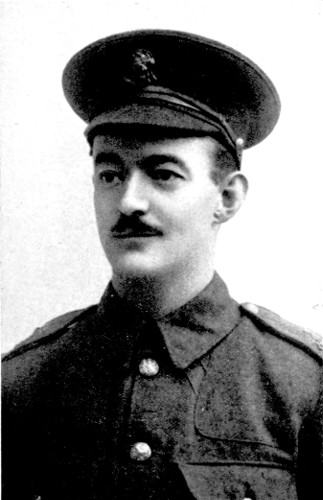
[pp. 44, 319.
R. P. HALLOWES, V.C.
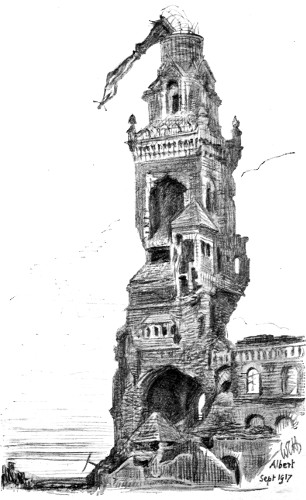
Copyright.]
[Col. Walter C. Horsley.
NOTRE DAME DE BREBIÈRE, ALBERT, 1917.
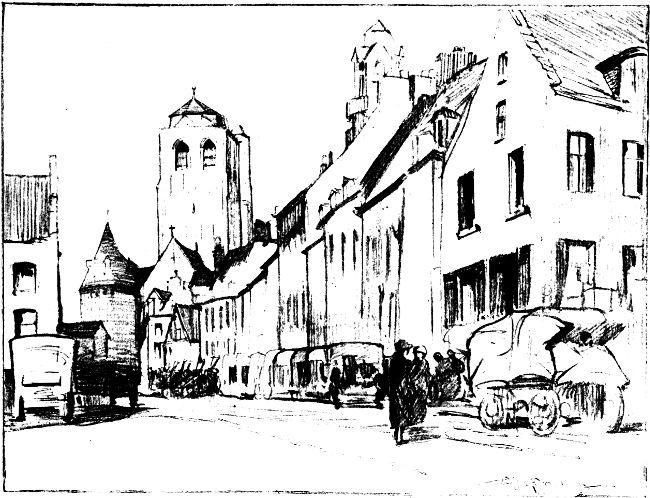
Copyright.]
[Capt. W. Lee-Hankey.
BAILLEUL IN 1914.
BAILLEUL IN 1918.
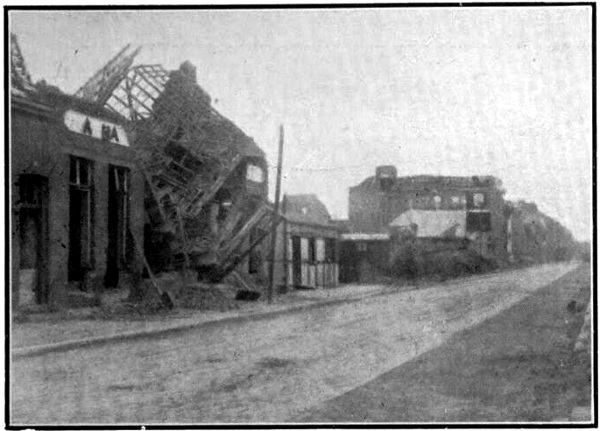
Rue de la Gare, Bailleul.
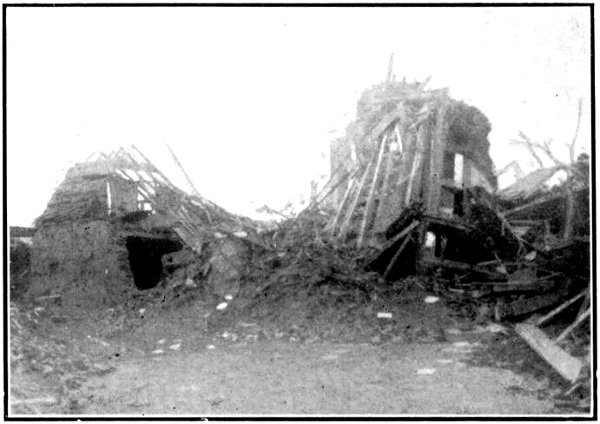
The Pâtisserie, Bailleul.
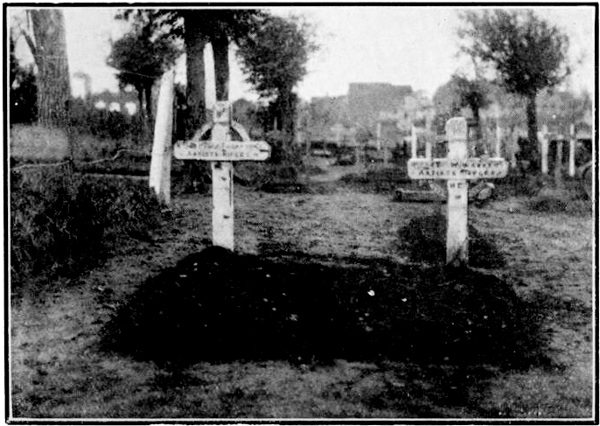
Artists’ Graves at Neuve Eglise
(The first two casualties).
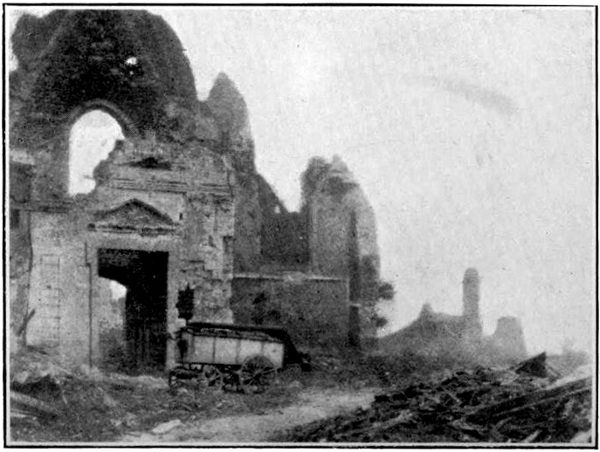
Church and Town Hall, Bailleul.