EDITOR’S PREFACE.
Reading edition
At an Army examination in 1913 the candidates, who included a few Officers of the Artists in pursuit of the coveted “Q,” were confronted with the following conundrum:—
“Supposing a war continues—What machinery exists in England for supplying the wastage in Officers?”
Little did any of those candidates dream how soon this question would insist on an immediate answer: that within the next twelve months the old regular Army, hopelessly out-gunned, would have been sacrificed: and that the nation would be called upon to provide, and would eventually succeed in producing, from civilians, upwards of a quarter of a million new Officers.
Still less did any member of the Artists then imagine that the quota of such new Officers furnished by his own Battalion of amateur soldiers—one of the original Rifle Volunteer Corps that was raised by Painters and Art students in post-Crimean days and incorporated in 1908 in the new Territorial Force as the “28th London (Artists Rifles)”—would run into five figures. Or that within a few months of the outbreak of hostilities ex-Artists (over 1,000 in number) would have been gazetted to every regular infantry regiment in the British Army including all the Foot Guards.
There is no more striking incident in the whole history of the Corps, since the day when in beards and shakos our ancestors made their first appearance on parade, than the story of the first little batch of men suddenly called out of our ranks to replace, in the field, Army Officers who had become casualties.
From this small beginning, extemporised to meet an emergency, sprang the huge organisation which in the words of Earl French may be said to have laid the foundation of that Officers’ School of War whose ramifications were soon to extend, not only behind all the fighting lines, but throughout the United Kingdom. By the end of the war this Territorial unit had furnished over 10,000 Officers to our big Armies, as chronicled in detail in the following pages, and had also trained in its schools in France and in England several thousand cadets from other Regiments, in addition to maintaining latterly a fighting Battalion in the line.
The First Battalion.
On the 2nd August, 1914, the 2nd London Division T.F. to which the Artists were allocated as Army Troops, assembled on Salisbury Plain for their annual camp. At midnight the Division was recalled post-haste to London and on the 5th August was mobilised for active service and placed on duty the same day. Within a fortnight it moved out to its War Station in Hertfordshire, minus the Artists, who were left behind, much to their chagrin “to help in the defence of London.” Quartered successively at Manchester Street Schools, Lord’s Cricket Ground, and the Tower, they presently rejoined their Division in the country but had not been there a week when at less than 48 hours’ notice the Battalion was embarked overseas, landing in the critical period at the end of October, 1914.
On their way up to Ypres they were dramatically halted at Bailleul by a Staff-Officer (as it happened, an old Artists Adjutant, Col. Romer) with an urgent message from the Commander-in-Chief who wished to see them. They de-bussed and were visited by him there. The result of an historic interview between him and Colonel May was that a few days later some 50 “other ranks,” public school and University men who had taken to heart Lord Roberts’ warning and trained in peace time, were rapidly given some practical tips, promoted to Second Lieutenant and the next day went straight into action (still wearing their Territorial private’s uniform and Artists badge with the addition of a “pip”) against some of Germany’s most famous Regiments, in command of seasoned regular soldiers of the immortal Seventh Division.[1]
The experiment of thus attaching Artists to the Old Contemptibles as “Probationary Officers” having proved successful, a further batch was called for and orders were issued by the G.O.C. directing the Battalion to be transformed into an Officers’ Training Corps to be drawn on from time to time to supply Officers, the remainder being retained as a fighting unit to be used as occasion demanded. He thus refers to the matter in his first Despatch.
“I established the Battalion as a Training Corps for officers in the field. The cadets pass through a course, which includes some thoroughly practical training as all cadets do a tour of 48 hours in the trenches, and afterwards write a report on what they see and notice. They also visit an observation post of a battery or group of batteries, and spend some hours there. A Commandant has been appointed, and he arranges and supervises the work, sets schemes for practice, administers the school, delivers lectures, and reports on the candidates. The cadets are instructed in all branches of military training suitable for platoon commanders. Machine-gun tactics, a knowledge of which is so necessary for all junior officers, is a special feature of the course of instruction. When first started the school was able to turn out officers at the rate of 75 a month. This has since been increased to 100. Reports received from Divisional and Army Corps Commanders on officers who have been trained at the school are most satisfactory.”
Earl French has since on several occasions written and spoken on this subject in generous terms and in particular at a recent reunion of survivors, when he said:—
“I shall never, never forget the first visit I paid to the Artists after they landed in France, or the wonderful impression they left on my mind of the possibilities which were in that Corps of furnishing a want which was so terrible to all of us at that time, the supply of officers. What really influenced me in trying the experiment I had to try was the appreciation I had of the splendid material of which I saw you were composed, and of the marked aptitude of Colonel May and those who helped him for organizing and commanding such a Corps. Just at the period I am speaking of we had suffered fearful casualties, and the proportion of losses in officers was higher than in any other rank, and it was going on every day. I was really positively at my wits’ end, suffering almost agony, to know where I could get officer reinforcements. You all know how any fighting force must deteriorate, and deteriorate badly, unless this supply of officers is kept up properly and regularly.
Well, in this trouble and difficulty the Artists came to my help, and I shall never forget as long as I live the courage, the determination, the skill, the organizing power which they displayed in trying to meet my wishes. By day and by night, almost under the enemy’s guns, and very often under close rifle-fire in the trenches, they commenced, they carried on, and they developed this work to the very highest standard of efficiency, and they showed clearly what men of energy and skill could do in this direction when they knew how. They taught us, indeed, a very great lesson, among the many lessons which all we regular soldiers had to learn in the war. We never knew what the possibilities were before. We used to talk about it taking two years to train an artillery driver, and, above all things, we said we could not turn out officers under a certain considerable length of time. Well the Artists showed us we made a mistake there, because they turned out a most efficient body of officers, and kept up everything they said they would. From that moment they became the model for and an example to that large number of training establishments all over France, which to the end of the war turned out officers with the utmost speed and the utmost efficiency. What they suffered in doing it is recorded in this book which I now hold in my hand (Artists Rifles Regimental Roll of Honour, 1914–1919), and I may recall at this moment, without frivolity, the fact that these boys, all of them, looked death straight in the face, laughing and smiling, and that the Artists earned at that time the sobriquet of ‘The Suicide Club.’ That, perhaps, is the highest honour that could be paid to them.”
The School in France was originally run entirely by Colonel May and his Officers and Sergeants, but presently, as the enemy pressure relaxed, he had the advantage of the assistance of Regular Officers (one of whom was appointed “Commandant of School”) and gradually as additional candidates for commissions began to arrive from other regiments, the two units were worked as separate organisations.
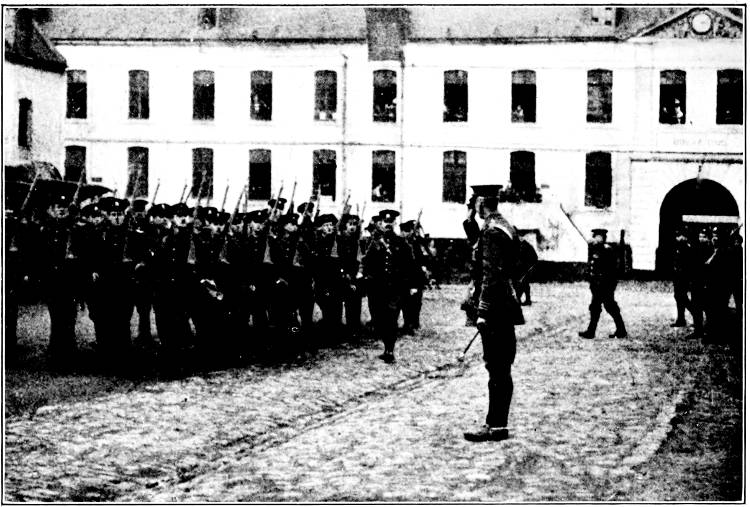
In April, 1915, quarters were changed from Bailleul to St. Omer and a new Commandant to the school was appointed, which from that date became “G.H.Q. School.” Thereafter Artists who came out in drafts, together with selected N.C.O’s. from Cavalry, Artillery, Canadian and other units sent up for instruction in Infantry work, were first trained in “the Colonel’s Class” and on passing out went on to this School until July, 1916, when the Battalion was specially authorised by Earl Haig to send candidates approved by their C.O. direct to Commissions.
Another branch of their early activities was the staffing of the Machine Gun School at Visques, near G.H.Q., which was started by a Hythe Instructor (Major Baker-Carr), who had one Hythe Sergeant to assist him. They trained as assistants 16 men from the Artists, who in their turn trained others of their comrades, until eventually multitudes of little groups (each of eight Officers or N.C.O’s. temporarily withdrawn from the trenches) were daily to be seen dotted all over the parade ground keenly studying the intricacies and tactics of the weapon, expounded to them by an Artists’ Sergeant who had specialised in the subject. A large proportion of such Instructors afterwards passed on to Commissions in the M.G. Corps, Tanks, R.F.C., and other units where their expert knowledge was invaluable.[2]
Reinforced from time to time by strong drafts, the special task of supplying and training Officers thus undertaken by the Artists kept them at G.H.Q. (where as “Headquarters Battalion” they were also entrusted with multifarious other and responsible duties) for about 2½ years. During this period there were of course considerable changes in personnel. The bulk of the original N.C.O’s. and men had soon obtained Commissions, while senior Captains had been promoted to command Battalions in the field, and many junior Officers had been attached or transferred to regular Regiments. In December, 1915, Col. May was invalided home. On recovering from a severe illness he was appointed to the important post, which he held till the end of the War, of Commandant at Tidworth of the Southern Command School of Instruction for Infantry Officers, where over 14,000 Officers (including 5,000 Australians) passed through his curriculum. He was succeeded in France by his Second-in-command, Lt. Col. Chatfeild-Clarke, who carried on until the summer of 1917, when the authorities decided to close down Cadet Schools in France and to send all future candidates for Commissions back to England for training. Thereupon the remaining Officers and men, less 200 cadets whose training was on the point of completion, at last had an opportunity of fulfilling the role for which the Artists had volunteered in 1914 (the reason they then went to France), of going into action together as a fighting unit, and they were allotted to the 190th Brigade in the Royal Naval Division (63rd).
There was nothing very nautical about the 190th, the explanation being that there were not enough naval men available at that time to make up an entire Division, so the Army was called in to complete it by adding four Battalions.
Appended to this Preface is an abridged account of their adventures in the line for which the Editor is indebted to Captains Money and Hewitt and to Col. Goldthorp, whose contribution is of especial value as shewing the impressions, necessarily unbiassed by preconceived Regimental associations, of a “foreign” C.O. when in command of a Battalion of the Artists. His very live account of a modern battle will be of absorbing interest, both to those who have shared this experience and to those who have not been through the mill.
The Second Battalion.
Prior to the departure of the original Battalion overseas, a second (Reserve) Battalion, distinguished as “2/28th London,” had been raised under the command of Col. Horsley, the late Commanding Officer of the Artists, who was assisted by Officers transferred from the First Battalion (1/28th) or promoted from the ranks. Enrolment started on the 31st August, 1914, and within a week 5,000 would-be recruits had applied for admission, ‘Varsity Blues, rowing men and athletes of every description, mostly without any previous military training. Uniforms and arms were for a time unobtainable, but soon every one of the 1,000 selected recruits had succeeded in purchasing a khaki outfit at ruinous prices, from somewhere, and presently the authorities unearthed a large supply of ancient Martini-Henry carbines. The sole equipment then provided was a regulation water-bottle for each man but with no means of attaching the same to the person of the soldier. Mufti overcoats were worn en banderole and rations were carried in neat brown paper packets tied on to waist-belts of every hue and shape.
After three or four months recruit training with only 50 modern rifles available, interspersed with daily journeys into Kent of strong working parties to assist in the construction of “the last ditch,” the Battalion was properly equipped and armed and moved to Roehampton, thence to camp in Richmond Park where they also initiated a valuable machine gun school.
Like many similar units this Reserve Battalion was eventually drained dry in supplying drafts to its 1st Battalion overseas. It also furnished Officers for the New Armies and some other Territorial Units. Col. Horsley was then appointed to the command of the 104th Provisional Battalion for Home Defence, stationed at the Tower of London, and eventually finished up his 42 years service in the Artists by proceeding overseas to a Staff appointment as Area Commandant at Englebelmer in France.
The Third Battalion and No. 15 (Artists’ Rifles) O.C.B.
Meanwhile on the 1st January, 1915, by which date old Artists and others were beginning to arrive from the Colonies for training as Officers, a third Battalion, “3/28th London” had been started (at first severely restricted to two Companies under a Major), in which all subsequent recruits had to be enrolled. It was placed under the command of Lt.-Col. William Shirley, an old friend of the Corps, recently retired from the Indian Army, who had been acting as Second-in-command of 2/28th. He brought very special qualifications to the post, having been for some years an Army Instructor in India, at Sandhurst, and at Cambridge University, where on the outbreak of war he was holding the appointment of Director of Military Studies. On occasions this Battalion, which was principally officered in the first instance by senior N.C.O’s sent home for the purpose from 1/28th in France, was over 3,000 strong and in 3½ years had passed 9,352 recruits through its ranks. After a period of recruit training in London, which included the construction at Kenwood of a series of entrenchments and dug-outs on the most up-to-date Continental models, it also went into camp in Richmond Park, whence it was moved in July, 1915, to High Beech in Epping Forest, thence to Hare Hall, Romford, and finally to Berkhampstead, and on the absorption of the original 2nd Battalion by the 1st it was re-numbered 2/28th.[3]
In May, 1915, instructions were issued for the formation within this Battalion of a separate School of Instruction for newly gazetted Officers of other Territorial regiments on similar lines to the School in France and during the next few months upwards of 1,500 such Officers passed through the School courses and examinations.
In November, 1915, the Regiment was officially recognised by Army Order[4] as an Officers’ Training Corps, and the Home Battalion became the 2nd Artists Rifles O.T.C.
In March, 1916, its separate School, then at Gidea Park, was converted into four Companies of cadets to which recruits were passed on for training as Officers after receiving a preliminary military training in the ranks of the other four Companies, the whole being under the command of Colonel Shirley and run by Artists’ Officers and Sergeant Instructors. In August, 1916, by which date the organisation of Officer Cadet Battalions throughout the United Kingdom had been perfected, the four Cadet Companies were separated from Colonel Shirley’s Battalion and transformed into “No. 15 (Artists Rifles), O.C.B.” which was placed under the command of Lt.-Col. E. St. L. Shaw (1st East Surrey) an invalided Regular Officer, with a Staff of Artists and other Officers and Sergeant Instructors. Thenceforth recruits enrolled in 3/28th were sent, on completion of their preliminary training, indiscriminately to No. 15 or to any other O.C.B. in which there were vacancies at the moment, while No. 15 as part of the general scheme of these O.C.B.’s received Cadets from other units besides the Artists.
In 1918 Colonel Shaw was succeeded by Colonel Gascoigne who retained command of this O.C.B. until the end of the War.
In July, 1918, Colonel Shirley was compelled by ill-health to relinquish the command of 3/28th, and was succeeded by Lt.-Col. Ostle (an Artists Officer who went out in October, 1914, as a junior Captain, rose to be Second-in-command of the 2nd Border Regiment, and subsequently commanded two different Battalions in the Field before being sent home to Hospital.
The history of this publication is shortly as follows:—
Early in 1915, the Editor, as an Officer who had served in all three Battalions, was deputed by the three Commanding Officers to keep a record of Commissions and Honours then being obtained by members of the Regiment and of casualties suffered, there being in the nature of things no provision in Official regimental documents or T.F. Records for following up the career of a man after he had been struck off the Artists on obtaining a Commission in another unit. Correspondents were appointed in each Battalion to assist the Editor, and on the first anniversary of the Declaration of War the first Edition of the present work, containing 1508 names, was published.
The intention was to re-issue the pamphlet periodically until the end of the War, and on the second anniversary a second Edition brought up to date, containing 3434 Commissions, was printed and on the point of distribution when the Press Bureau Order was issued, which prohibited any reference to places, numbers of Battalions and other details in which the book abounded.
These copies were accordingly sealed up, but monthly supplemental lists were published in the Regimental Journal for a time, the publicity thus obtained being a valuable check against error. Presently the Journal itself was also suspended for some months, but eventually it was allowed to reappear, and the supplemental lists were resumed after being shorn of all offending details, and were continued until the Armistice.
It then became necessary to dig out from every available source the particulars which had not been previously obtainable, such as dates and places of deeds and deaths, and this research has occupied an unconscionable time. Still it has been done, and the result is a much more complete and reliable record than was previously obtainable.
With regard to the plan of the book, the original scheme was to make it a record only of Commissions and Honours, with a list of casualties in all ranks, but whilst this final edition was in the press a very strong desire was expressed for a complete Roll comprising every one of the 15,000 Artists who at one time or another during the War had served in the Regiment in any capacity. An additional Section No. IV has therefore been compiled and added containing the names of all N.C.O.’s and privates who are not known to have taken Commissions. Here, however, the Editor came up against an insurmountable difficulty. It soon became evident that this Section not having been, like the rest of the book, entered up from day to day, it would now be absolutely impossible to ascertain what had happened to a very large number of men who had been discharged or transferred to other Regiments since August, 1914. In these circumstances it has not been practicable to make Section IV more than an alphabetical list of some 4,800 “other ranks” not included in the Roll of Commissions, with the addition of reference letters and symbols indicating those who are known to have served overseas with the 1st Battalion or in other units, or to have been killed, wounded, etc.
It is probable that there may be discovered in this Section the names of many men who had in fact obtained Commissions, some further casualties, and possibly a hidden D.S.O. or other Honour.
In these circumstances it will be realised, and the Editor desires to emphasize the fact, that the absence of any reference letter against a man’s name in Section IV is no reflection upon him. It simply means that the news of his promotion, reward or other event has not reached the Regiment. And the list includes the very large number of cadets who were under instruction in England on the cessation of hostilities, at least 2,000; also men discharged during the War as medically unfit.
Crown Copyright.]
By permission of the Imperial War Museum.
EMBRYO OFFICERS.
Cadets leaving Barracks at St. Omer, on completion of Course, 1915.
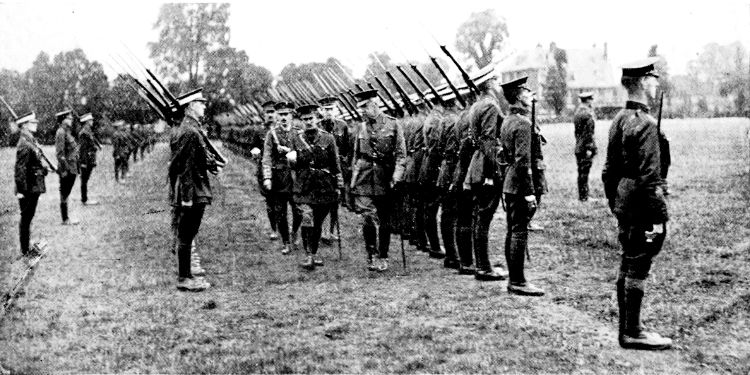
EMBRYO OFFICERS.
Passing-out Inspection of Cadets at Romford, 1917.
The Editor much regrets that he is compelled strictly to limit this Section IV to those who enlisted originally in the Artists, as recruits. He recognises that this means the exclusion of those members of other units who were transferred or attached to the 1st Battalion in France, wore their regimental badge, fought and died with them. Probably they are included in their own Regimental War Records, but they were all so thoroughly imbued with the spirit and traditions of their new unit, that he would willingly have inserted in this book every one of the hundreds of additional names had the exigencies of space and expense permitted. He has, however, been sufficiently inconsistent to include their Officers, together with their Military Crosses and other Honours if gained whilst serving with the Artists.
In conclusion, the Editor warmly acknowledges his very great indebtedness to his hosts of correspondents in every theatre of war, to sympathetic Record Officers at home and abroad, and to the patient and painstaking members of his constantly changing staff, without whose meticulous care in the laborious daily task of searching Gazettes and Casualty Lists against their ever-growing Card Index, the compilation of this gigantic record would have fallen through. To enumerate all those who during a period of nearly five years lent a hand in this way, invalids and light duty men at home, Officers and men on leave, cadets awaiting Gazette, and other keen helpers would fill pages, and it is useless to attempt it.
In the mass of detail dealt with in this work and the circumstances under which it was collected, there are no doubt mistakes and omissions: possibly a considerable number. To meet such cases the copy of the book which is to be deposited in the War Memorial recently erected at Headquarters will be interleaved and if short particulars of any serious error that may be discovered are forwarded to “The Hon. Secretary, Roll of Honour,” Artists Rifles, Duke’s Road, Euston Road, W.C.2, it shall be rectified in such Headquarters copy. Arrangements may also be made for periodical publication of lists of corrections in the Regimental Journal.