Front matter
Reading edition
Cover
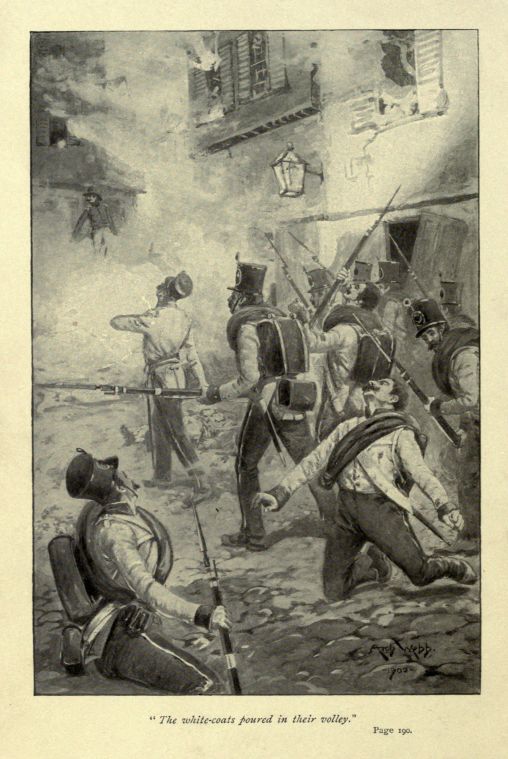
"The white-coats poured in their volley. Page 190.
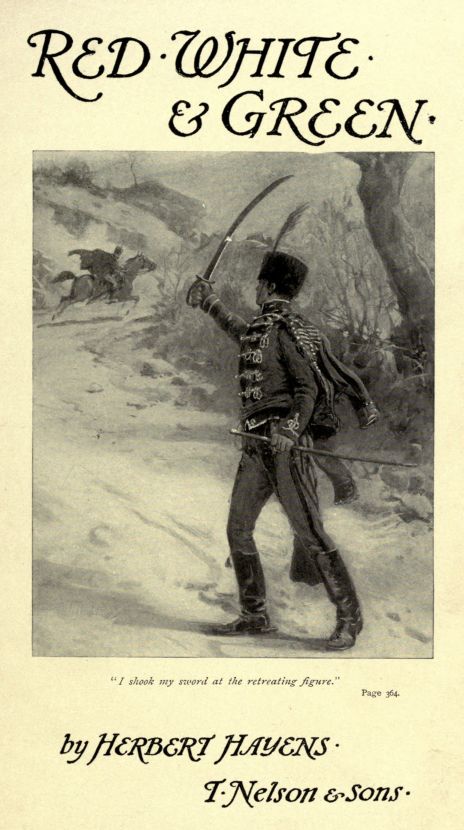
"I shook my sword at the retreating figure. Page 364.]
The Red, White, and Green
By HERBERT HAYENS
Author of "A Captain of Irregulars," "A Vanished Nation," "A Fighter in Green," "An Emperor's Doom," &c. &c.
WITH ILLUSTRATIONS
THOMAS NELSON AND SONS London, Edinburgh, and New York 1901
By the same Author.
THE BATTLE AND THE BREEZE. Price 5s. A VANISHED NATION. Price 5s. A CAPTAIN OF IRREGULARS. Price 5s. A FIGHTER IN GREEN. Price 5s. IN THE GRIP OF THE SPANIARD. Price 5s. AN EMPEROR'S DOOM. Price 5s. CLEVELY SAHIB. Price 5s. UNDER THE LONE STAR. Price 5s. THE BRITISH LEGION. Price 3s. 6d.
T. NELSON AND SONS, London, Edinburgh, and New York.
CONTENTS.
WILL THE REGIMENT MARCH?
A SOLDIER OF THE RIGHT SORT
THE INSURRECTION IN FULL SWING
VIENNA IN FLAMES
ARRESTED
HARD WORK AT PESTH
A FIGHT IN THE MOUNTAINS
A DRAWN BATTLE
THE RETREAT
ON THE SICK LIST
GÖRGEI TO THE RESCUE
A SORROWFUL VICTORY
A VISIT FROM STEPHEN
THE QUARREL WITH COUNT BEULA
HOW STEPHEN CARRIED THE FLAG
I JOIN THE STAFF
THE WOUNDING OF GÖRGEI
GÖRGEI FORGETS HIS WOUND
SENT SCOUTING
NEARLY CAPTURED
THE LAST BLOW
THE SURRENDER
COUNT BEULA DISLIKES HANGING
THE END OF COUNT BEULA
IMPRISONED AT ARAD
LED OUT TO EXECUTION
AN AUSTRO-HUNGARIAN ALLIANCE
LIST OF ILLUSTRATIONS.
"THE WHITE-COATS POURED IN THEIR VOLLEY," Frontispiece "I SHOOK MY SWORD AT THE RETREATING FIGURE," Vignette "FROM THE WOODS THEY POURED A HOT MUSKETRY FIRE UPON THE DEFENDERS" "MY HEART LEAPED TO MY MOUTH AS I SAW STEPHEN FOREMOST" "GÖRGEI AND HIS STAFF RODE TO THE FRONT, WHERE THE RUSSIAN GENERALS MET THEM"
THE RED, WHITE, AND GREEN.
CHAPTER I.
WILL THE REGIMENT MARCH?
"Cowardly rats, deserting a sinking ship!" exclaimed my brother Stephen; "I would not raise my little finger to help them!"
"It seems to me this insurrection will do good to our cause."
Stephen pushed his chair back from the breakfast-table, and stood up.
"We are Hungarians," said he, "and we fight for our nation. We want no assistance from these Austrian rebels. If they care a kreuzer for their country, why don't they rally round the emperor?"
Laughing at Stephen's expression of disgust, I crossed the room to the little window, and looked into the street.
It was the morning of October 5, 1848, and still fairly early, yet the people of Vienna were pouring by in hundreds, all eager, restless, and apparently too excited to think of such an ordinary thing as breakfast.
Some were mere lads, pale-faced and spectacled, but armed with sword and pistol, and looking very resolute; these were students from the public schools and universities. Mingling with these enthusiastic youths were a few shopkeepers, a more considerable body of respectably-dressed artisans, numbers of National Guards in uniform, and, most significant of all, the men from the slums--bare-headed, dirty, gaunt, but carrying knives, hatchets, clubs, and other death-dealing weapons.
Thus far, this year of 1848 had produced most remarkable changes throughout Europe.
Louis Philippe, King of the French, had been driven into exile; Sicily had revolted against King Bomba; insurrections had arisen at Madrid; the whole of Germany had been, and was, in a state of turmoil; the Prussians had conquered Poland afresh.
Thrones had crumbled into dust, and monarchs and rulers had been swept away like chaff before the wrath of the people.
But of all the European countries, none in this wild gale of popular fury was so severely tried as the proud empire of Austria.
In northern Italy, the veteran Radetzky was upholding the black and yellow flag of Austria against a host of insurgents; in Bohemia, the Slavs, bent on founding a great Slav nation, were suppressed with difficulty by the Austrian general, Prince Windischgratz; my own gallant land of Hungary had drawn the sword to win back the ancient rights of which it had been deprived by the Viennese government; while here at Vienna, in the very heart of the empire, thousands of men were working their hardest to overthrow their own Kaiser.
With these people neither Stephen nor I had the least sympathy. We were Hungarians, but royalists, loving our country with a fond and faithful affection, yet wishful to preserve our loyalty to the emperor-king.
News of the dispute between Hungary and Austria had reached us in London, and we had just arrived at Vienna on our homeward journey.
My brother Stephen was eighteen years of age, and my senior by twelve months.
In figure he was tall and elegant; his face was regularly oval, with a pale complexion; his forehead was high and broad, his mouth small and well formed. His black hair fell in long curls almost to his shoulders; he wore a black moustache in the Hungarian fashion; and his eyes were dark and fiery.
A true Magyar, every inch of him, he might have stood beside King Stephen of glorious memory.
He came to join me at the little window, and we were still gazing intently at the throngs below, when some one, hurrying up the stairway, knocked at the door.
"Come in!" I cried, and turning round added hastily, "Why, it is Rakoczy, looking as miserable as a caged bird! Are the folks too busy demonstrating to get you some breakfast?"
The newcomer closed and locked the door, and came over to us.
John Rakoczy, or "John the Joyous," as we called him, was, like ourselves, a Hungarian, though there was a slight mixture of German blood in his veins.
He was a handsome man, several years older than myself, with chestnut hair, dark-blue eyes, and a frank, open, jovial face.
His merry laugh and light-hearted manners had earned him the title of "John the Joyous;" but on this October morning his face was gloomy and troubled.
He placed himself between us, so that he could speak to both without raising his voice.
"Heard the news?" he asked.
"We've heard the row!" I replied. "These poor people will strain their throats."
"The city's in a state of insurrection. The students and the Nationals and the Burgher Guards are going to overthrow the government."
"Barking dogs never bite," said Stephen sarcastically.
"These will soon--they're only sharpening their teeth; and the Richters are to help them."
"The Richter Grenadiers?" I exclaimed.
"Yes. Our fellows have beaten Jellachich, who is in sore straits; and Latour, the war minister, has ordered the grenadiers to march to his assistance. They are in a state of mutiny, and the citizens are backing them up."
Earlier in the year, Croatia, under its Ban or Governor, Baron Jellachich, had revolted from Hungary; and though at first the emperor had denounced the rising, he had now taken Jellachich under his protection.
"Count Latour can take care of himself," said Stephen; "he is a man, not a lath."
Our companion rubbed his hands together softly, and, lowering his voice to a whisper, said,--
"This affair is serious. Don't ask how I obtained the information, but you can rely on its truth. A secret meeting was held last night in the city. The chiefs of the extreme party were present, and to-morrow, when the regiment marches out, has been fixed for a general rising."
"This is interesting to the Viennese," said my brother, "but not to us."
"Wait a bit. You know what happened a few days since in Pesth?"
Stephen's face flushed with shame, and I hung my head.
On September 28, Count Lamberg, the Austrian commander-in-chief, had been seized in the streets of Pesth by an armed rabble, and cruelly put to death--a foul crime that would long stain the fair name of Hungary.
"To-morrow," Rakoczy continued, "the victim will be Count Latour, and the butchers will cry, 'Long live Hungary!'"
"What do we want with such brutes?" cried Stephen passionately. "Cannot we fight and win our battles with our own swords? We shall be disgraced for ever by this rabble!"
"The count must be put on his guard," I exclaimed. "I will go to his hôtel and inform him of the plot."
"It will be useless trouble," said Stephen. "One man cannot fight against thirty thousand, and the count is too brave a veteran to yield."
"He must yield or die," said John. "I have learned enough to know that. The chiefs of the revolution have decided to kill him unless he recalls the order for the regiment to march."
I put on my hat; the others did the same, and accompanied me into the street.
A crowd of students rushing by caught sight of our costume, and surrounding us, cried, "Long live Hungary!"
Much to their surprise, we bared our heads and responded by a hearty, "Long live King Ferdinand!" for, although our country was at war with Austria, we remembered that Austria's emperor was Hungary's king.
In the square on the north side of the hôtel we stopped, and I gave my weapons to Stephen, so that the guards might not suspect me of having any design on the life of the minister.
"Tell him," said Rokoczy earnestly, "that unless he gives way his life is lost."
I left them standing at the corner of the square, and went on alone to the courtyard of the hôtel.
Hundreds of citizens stood about, all armed and gesticulating violently, but as yet offering no personal mischief to any one. Several times I had to stop while they cheered for Hungary and Kossuth; but at length, after considerable pushing and squeezing, I reached the gate.
There were few soldiers about, and these could certainly have been overpowered by one determined rush of the mob outside; but the time for that had not yet come.
At first the officer on duty made some difficulty about passing me; but at length I was sent under escort across the courtyard, and admitted into the building.
Here still further delay occurred. Count Latour was busy; he could not see me; it would be better to call another time, or deliver my message to the count's secretaries.
Patience, however, is a useful weapon, and by its aid I found myself at last in the audience-chamber, where the minister was engaged in animated discussion with his colleagues.
"Well, young sir?" exclaimed the noble-looking veteran sharply. "Your news must be of extreme importance to justify your persistence."
"You shall judge for yourself, count, if these gentlemen will leave us for five minutes."
At this the others smiled, and one muttered something about a Magyar adventurer.
I had entered the room with peace in my heart; but this insult was abominable, and I loudly demanded to know if they took me for an assassin.
A little old man with a white beard and small ferret eyes stopped my high-flown speech by saying, "Remember Lamberg!" and at those words, so full of meaning, I hung my head in shame.
Would that fatal act be thrown into the teeth of the Magyars for ever?
I think that the count must have pitied me, for he said kindly,--
"What is your name, my young friend? It is needless to ask your nationality."
The question restored my self-respect, and I raised my head proudly.
"George Botskay has little reason to be ashamed of his name," I said.
"A son of the late General Botskay?"
I bowed in reply, and the count addressed a few words to his colleagues, who retired one by one with evident reluctance.
"Now, my lad," exclaimed the fine old soldier, "what is it you wish to say? I am very busy, and cannot spare much time."
"I have come to warn you, count," I began, but at that he stopped me.
"The son of General Botskay should have known that I take no warning from rebels," he said sternly, and made a movement to ring the bell.
"One moment, count; you must listen to me. I have learned by accident something you ought to know. The city is up in arms"--Latour smiled--"and the grenadiers are to be prevented from marching."
"I have issued the order," he said, as if that settled the matter.
"It will not be obeyed. The leaders of the insurrection met last night in secret, and made their arrangements. A revolution has been decided on, and you, count, are to be the first victim."
"Why do you tell me this?"
"That you may be prepared."
"Are you on our side?"
"No. I must fight for my own country."
He took a sheet of note-paper from a drawer, and placing it in my hand, said, "Read!"
It was an anonymous letter, warning him that unless he recalled the order, the people would put him to death.
"It came this morning," he remarked quietly. "The writer will learn my answer to-morrow."
Gazing at the well-knit figure and the calm, proud face of the sturdy veteran, I felt convinced that he would not move a finger to avert the impending tragedy.
"You seem sorry," he said, "but there is little to grieve about. I am a soldier, and know how to die at my post. Still, I thank you for trying to help me; and may the time soon come when Austrians and Hungarians will once more join hands as brethren and loyal subjects of the emperor."
"Amen to that!" I replied fervently, and the proud old noble, shaking my hand, himself led me to the door.
At the head of the stairs I turned and glanced at him again. He waved his hand cordially; his features were calm and unruffled, his air was serene, as though he knew nothing of the dangers which threatened him.
Brave old count! After all, he chose the better part!
Rakoczy and my brother waited at the corner of the square, but they saw at once that my errand had been in vain.
"He will die at his post, if need be," I said, as we got clear of the crowd.
"What else could he do?" asked Stephen. "You would not expect the soldier of half a century to run away from the armed rabble."
"Well," exclaimed Rakoczy, "we have done our best to save him; now we must look to ourselves. I suppose you two intend joining the army?"
"Yes; but we will wait and see what happens to-morrow."
"If you could stay a few days longer, we might all go together."
This proposal suited me capitally; and as Stephen did not wish to lose the speaker's company, it was agreed that we should remain in Vienna till the end of the week.
"We aren't likely to miss much," said Rakoczy. "Kossuth can do nothing till the Honveds have been properly drilled. At present they are no better than these worthy citizens who shout 'Long live Hungary!' so abominably."
The Honveds, or Home-Defenders, were practically peasants drawn from the plough, without drill or discipline, or even knowledge of arms beyond their scythes and pikes and cumbrous old-world guns.
No general would expect them to stand for an instant against the Austrian veterans; and, as Görgei, our great leader, humorously said, he reckoned much more upon their legs than their arms.
However, they were brave fellows at bottom, and those who laughed at them had reason to repent of it before the war ended.
During the afternoon Rakoczy left us to attend to his private affairs, so Stephen and I strolled about the city watching the actions of the excited people.
It was easy to tell that something out of the common was going to happen; and when we returned to our rooms I felt more sorry than ever for the brave old count, who so proudly defied the enemies of his master.
But to help him further was beyond our power; we could only wait and watch the events of a new day.
It was certain that Latour would not withdraw his order; but whether he would meet force by force and command Count Auersperg to bombard the city, or offer himself as a sacrifice to the fury of the mob, we did not know. From midnight till about three o'clock a dead silence brooded over the town, but when daylight fairly broke Vienna was in arms.
Rakoczy joined us at breakfast, and by his advice we ate a substantial meal before venturing out, as the time of our return was very uncertain.
"Now," said he, on rising from the table, "pistols in working order? There will be a big kravalle before the day's over."
"If it's nothing worse than that, so much the better," I replied. "A street brawl doesn't hurt."
Stephen locked the door, put the key in his pocket, and we all three went down into the street, where the people were packed like herrings in a barrel.
Men, women, and children of all classes were there--the shopkeeper, the artisan, the labourer, and the dweller in the slums who had come out expressly for plunder, and who would as soon cut a Hungarian as an Austrian throat. One of this last class, however, a brawny fellow, hatless and coatless, with arms bare to the elbow, and carrying a murderous-looking axe, professed great sympathy with the Magyars, and attached himself to Stephen, much to the latter's disgust.
John and I walked directly behind, laughing to see my rather fastidious brother in the society of the soi-disant patriot.
"Keep a brave heart, young sir!" we heard the unwashed one say, "and trust to us. We'll see you get your rights. Down with the emperor and up with the people! It's our turn now!" and he put one arm affectionately round my brother's waist.
"Bravo, comrade!" cried John, winking at me. "The brave Viennese will take care of Hungary!"
"Right you are, brother!" shouted back the brawny ruffian. "We'll join hands. Long live Hungary and the Viennese! No more emperors! No more kings! We'll have a republic and be our own masters!"
"And not do any more work!" said John.
"No; we've had our share. Let the rest take a turn;" and he gave Stephen another squeeze to show his goodwill.
Happily for my brother's peace of mind, we had by this time reached the end of the narrow street, and a vigorous push by the crowd parted us from our enthusiastic friend.
We had started with the intention of going to the hôtel of the war minister, but it soon became plain that we had no choice in the matter; we were compelled to go wherever the mob carried us.
One thing I noticed which rather astonished me--the National Guards and the armed students had disappeared. Here and there one certainly caught sight of a citizen warrior, but they were very few, and I wondered what had become of the others.
"We shall soon find out," said Rakoczy, to whom I put the question. "There's mischief brewing somewhere. Listen to, that!" and a great shout of "Long live the Grenadiers!" rose on the air. The people, sufficiently excited hitherto, now became frantic. They waved their arms, and cheered the mutinous regiment wildly.
"Link arms!" exclaimed Rakoczy, and it was well we took his advice. A tremendous rush nearly took us off our feet, and we were carried along in the midst of the tumultuous throng.
"Tabor! Tabor!" shouted the crowd. "Make for the bridge of Tabor! That's where they cross! Hurrah for the Grenadiers! Down with the emperor! Death to Latour! Long live the brave Hungarians!"
As we approached the bridge of Tabor the excitement became intense. We were pushed this way and that, and, but for the linking of arms, we must quickly have lost sight of one another.
"Keep a firm grip," cried John. "Look out! There goes the military!" and instantly the cheers for the Grenadiers redoubled.
"There's a cavalry regiment escorting them," I exclaimed; "and look! Some one has brought up a couple of guns!"
"They want twenty," said Stephen. "Ah! now for it!"
At the farther end of the bridge the National Guards and the University Legion were drawn up in battle array, waiting to oppose the passage of the troops.
The mob pressed to and fro like the unquiet waves of the sea; now we were thrown almost bodily into the ranks of the soldiers, again carried back many yards.
The windows of all the houses anywhere near were filled by groups of rioters, who levelled their guns ostentatiously at the loyal troops, while the sans-culottes in the streets roared approval.
At the moment my brother spoke we had a full view of the situation.
The Grenadiers, with their escort, had reached the bridge-head. Behind them were a body of infantry and the artillerymen with a couple of guns. An officer in general's uniform commanded the whole.
Suddenly the Grenadiers broke loose, and, with triumphant cries of "Long live Hungary!" crossed the bridge at the pas de charge.
The students and Nationals received them with open arms; the general sat on horseback, immovable as a bronze statue. Then a smile, half of pity, half of scorn, appeared on his face. He opened his mouth to give an order, when, from the farther side of the bridge, rang out a sharp report, and the Austrian fell dead.
Stephen tore himself from me, his eyes flashing, his handsome face crimson with anger.
"You cowards!" he cried, and would have run to the bridge had not Rakoczy dragged him back by main force. Only just in time!
Crash! And a storm of grape whizzed through the air as the gunners discharged their two pieces.
The insurgents who were advancing to the charge wavered; another dose of iron hail, and they fell back in disorder.
But the loyalists were few, their enemy legion.
Their brave leader, too, was dead; and, though they fought valiantly for a time, the end was certain.
The students especially behaved like madmen. Shot and shell tore through their ranks, making long, narrow gaps, but the survivors pressed on; the mob picked off the loyalists; the men at the windows shot them down; the Nationals eagerly backed up their comrades; the bridge was gained; there was a desperate, confused, hand-to-hand struggle round the guns, and then a loud shout of victory echoed and re-echoed through the exultant multitude.
"To the gates! Seize the gates!" they yelled; and presently another cry rose--one which we had been expecting every moment to hear.
"Death to Latour!" bawled a huge, hairy-throated fellow; and we recognized our acquaintance of the morning, whose butcher's axe was wet with blood.
"That's the word!" cried another. "Death to Latour, and no more ministers!"
"Forward! Forward! Long live the republic! Up with the tricolour!"
"To the hôtel!" said Stephen feverishly. "We may yet help to save him."
Alas! if we were powerless in the morning, we were equally so now. The mob carried us whithersoever it listed. We were flung bodily from side to side, shot down narrow streets like stones from a catapult, jammed together without power of movement, then pushed forward again by the masses in the rear.
Rakoczy soon disappeared. Stephen was yards in front, separated from me by hundreds of yelling madmen. I was panting and breathless, and felt as if some one had beaten me well with a stout stick.
A man just before me--a small, pale man with wide-open, frightened eyes--went down, and was lost in the crowd; it was like dropping a pin.
Had his life been worth the value of the universe, no one could have saved him; as it was, he simply dropped, like a stone into the water, and the crowd pressed over him.
To add to the uproar, the tocsin sounded, and everywhere it seemed as if the soldiers were discharging their muskets.
In one street people were busy erecting a barricade. The head of the crowd, seeing this, wished to turn back; they might as well have tried to turn the stars in their course.
The street was narrow and sloping; unfortunately, we shot into it from the higher end, and there was no stopping.
Those in front raised a cry of despair as they were hurled against the half-built barricade, the workers on the other side of which ran into the houses, while the living torrent swept on.
Crash went the structure--logs of wood, bodies of carts, stuffed sacks, piles of stones, and human beings all mingled together! I caught a brief glimpse of Stephen wedged into the corner of a doorway, looking as if he would be squeezed to death, but there was no helping him.
I was off my feet, supported only by the bodies of my nearest companions, one of whom moaned in pain.
Through the débris we were hurled, swept round the corner to the left, and dropped, panting and bruised and battered, in the Place of St. Stephen.
CHAPTER II.
A SOLDIER OF THE RIGHT SORT.
I stood for several minutes between the palace and the great church trying to draw some breath into my lungs, for the pressure of the crowd had left me like a squeezed lemon.
To search for the missing Rakoczy was useless labour, but it might be possible to return to the narrow street where I had last seen my brother.
I soon discovered, however, that the short delay had put that also out of the question. The people were pouring into the Place; and, though the terrible stress had been lessened, I was still a prisoner, blocked in on all sides by the tumultuous throng.
The huge bell in the tower of St. Stephen's clanged out its brazen peals of warning and menace, and a sharp musketry fire told me that fierce fighting was going on in the very shadow of the sacred edifice.
A handful of loyal National Guards, faithful to their oaths, and led by a brave commander, were, like good men and true, sacrificing their lives in the performance of duty.
Of course, the contest was a hopeless one; but the men stood their ground bravely, and I guessed from the savage cries of the rioters that the faithful few were selling their lives dearly.
From where I stood nothing could be seen save the heads of the populace; but the surging of the crowd backward and forward showed how the fight progressed.
Clang! clang! pealed the great bell, swinging high in the air, while below the whirr and rattle of musketry mingled with the frantic shouts of the people.
A louder yell than usual proclaimed that something decisive had occurred, and soon the news spread to the very outermost of the packed onlookers.
"Now they have them! Into the church! Follow them up! Well done, brave Nationals! Well done, students! Now we'll see who's to be master!"
It was even so. The gallant band, overwhelmed by numbers, had fallen back foot by foot, until the insurgents by one wild rush had forced them into the cathedral, where their leader was slain on the high altar itself.
All this I learned only from the conversation of the people, being unable to see anything for myself.
But from what happened next I might easily have known the end had come.
From the middle of the throng a cry rose, and the multitude in their thousands took it up, shouting wildly, "Latour! Death to Latour!"
This way and that they rushed, some to the south, some to the north of the Place, seeking any outlet which would lead them to the hôtel of the minister of war.
In an instant I was caught up and hurried off out of the Place, across a wide street, then into a network of narrow ones, until I was stopped with the rest in front of the hôtel where lived Count Latour.
Was he still there? There had been ample time for escape, and I hoped against hope that he had taken advantage of it; but, remembering the calm, proud face of the man, I had my doubts.
The gates were closed; the soldiers, scanty in numbers but well disciplined, stood at their posts, eyeing the frenzied mob with contempt.
Some of the students at once opened fire; the soldiers replied, and, the target being so broad, every bullet lodged somewhere.
Inside the building Count Latour was holding a council of war, and the members, fearful lest in the growing excitement the monarchy itself should be swept away, prevailed on him to issue the order to cease firing.
This of course paralyzed the action of the loyal troops, both at the hôtel and at the barracks, while the spirits of the rebels were proportionately raised.
From the conversation of those near me, I gathered that their surprise was equal to their delight, but they gave no thought to the humanity of those in power.
The fearful cry, "Death to Latour!" was again raised. The gates were threatened. The soldiers, prevented from firing by the order of the council, were unable to act. Fresh bodies of rioters came swarming from various directions. The pressure grew terrible; the gates--I suppose, as I could see nothing--gave way; the courtyard was filled with the noisy, shouting, bloodthirsty pack; the doors of the great building were smashed like glass; and the crowd, screaming and struggling, surged up the broad staircase.
At the first rush some were thrown violently against the outer walls; others, by no power of their own, were carried into the interior of the building, and fate so willed that I belonged to the latter portion. The name of the gallant old count was on the lips of every one, as if he were responsible for all the ills in the world, so easy is it to inflame the passions of a mob which does not think for itself.
It was on the first landing that we received a slight check.
A few National Guards, still loyal to their pledges, attempted to stem the human torrent. Their success was only momentary, and they were borne back, but not dispersed.
Here the crowd broke up, some running one way, some another, but all intent on killing Count Latour.
I followed the Nationals, thinking they would most likely retire in the direction of the council chamber.
This they did, and that apartment was speedily filled. I caught a glimpse of Latour, round whom the handful of loyalists pressed. His face was pale; otherwise he showed no sign of fear, but gazed calmly on the throng of butchers. Once he made an attempt to speak, but his words were drowned in the tumult.
"Kill Latour!" was the savage cry. Beyond that one scarcely heard anything.
However, the brave Nationals resolved to make a fight of it, and by a stroke of great good fortune I managed to join them.
"Long live Latour! Long live the gallant count!" I cried, with all the strength of my lungs, and his defenders echoed the cry.
But the others drowned our shouts with "Kill Latour!" and one man, towering above the rest, sprang at the count with uplifted axe.
It was the burly ruffian who had walked with us a short time in the morning, and at sight of me his face grew black as a thunder-cloud.
"Traitor!" he shouted, and, swinging round, aimed his axe full at my head.
There was little time for action, much less for thought; but, having my pistol free, I levelled it swiftly, and shot the truculent bully dead.
The count threw me a glance of gratitude mingled with pity; and in truth it appeared as if I needed the latter.
The insurgents rushed at us, bore us back, flung themselves into our midst, and, acting like wedges, split us into small groups.
I found myself in front of Latour, where the fighting was fiercest, and emptied my pistol recklessly into the crowd.
The bullets cleared a space, but it was soon reoccupied. Most of the loyalists were overpowered and disarmed, and now their opponents came to help seize Latour.
Planting my feet firmly on the ground, I stood by the side of the veteran, and did my best to save him.
The attempt failed; it was hopeless from the start, and the end came very suddenly.
There were scarcely half a dozen of us all told, standing shoulder to shoulder, to stay the rush, and we toppled over like so many wooden pegs.
I lay on the floor half stunned, with the body of a man right across my chest. He was badly hurt, and kept moaning feebly.
For several minutes I was unable to rise, or even to move, and during that time the noise of the fighting grew less and less distinct, finally dying away altogether.
The shouts of the populace, however, continued to ascend from the courtyard, and could be plainly heard through the open windows.
As soon as I had recovered a little strength, I shifted the wounded man gently, and stood up.
The rioters had left the apartment; only the dead and those seriously injured remained, and amongst these I looked in vain for Latour.
Had they spared his life? The idea seemed too good for truth, but it was just possible.
Picking up an abandoned sword, I made my way from the chamber to the staircase. Several bodies lay where they had fallen; otherwise the place was empty.
I ran down to the first landing, and overtook a frightened, pale-faced man--a servant, probably, belonging to the hôtel. The fellow looked at me with such a comical expression of woe, that, in spite of the day's work, I could hardly refrain from laughing.
"There's nothing to be afraid of," I said, slapping him on the shoulder. "I'm not going to eat you. What have the rebels done with Count Latour?"
The man's eyes opened wider than before. He bowed his head and mumbled some words which I could not understand.
"Speak up!" I cried sharply, "or, by the honour of a Botskay, I'll throw you over the balustrade."
The threat reduced him to a state bordering on imbecility. He made no attempt to speak, but, plucking at my cloak like a chidden dog, led me into a small chamber having a window which overlooked the courtyard.
What I saw there held me spellbound; and the man, seeing he was no longer noticed, quietly slipped off.
Outside, Count Latour, the minister of war, the veteran general who had carried the black and yellow flag to victory a score of times, who over and over again had risked his life to uphold the honour of his country, hung, battered and dead, suspended from a lamp-post.
The mob still lingered about, but in smaller numbers; the most violent had departed to pursue their work of butchery elsewhere.
Many of the disloyal National Guards, who found it easier work to insult a dead man than to combat a living one, swaggered about, looking fierce and truculent. Some decently-dressed citizens regarded the murdered count, it appeared to me, with pity and sorrow; even to some of the insurgents remorse had come with terrible swiftness.
The students and men of the slums had gone--the former to fight, the latter most likely to plunder. More peaceable people helped to fill up the gap thus caused.
I left the room and descended the stairs slowly, thinking of Stephen. Where was he? Had he been killed by that terrible crush in the narrow street? Perhaps he was still there, hurt and unable to move. I must go and find out.
On the lower part of the staircase I met numbers of citizens coming to view the scene of the struggle.
I stood aside to let them pass, and they, recognizing my nationality, saluted me with the cry of "Long live Hungary!" I thought of the dead man outside, and the blood surged to my face.
In the courtyard there was room to move freely, and, anxious on my brother's account, I was hurrying away, when the sound of a girl's voice coming from the left caused me to stop.
A low, angry growl from a section of the onlookers told me something was wrong, and I ran to the spot.
A young girl, evidently of high birth, stood facing a group of Nationals. Her head was uncovered, and her hair hung down her back in a thick, wavy, chestnut-coloured mass. She had a beautiful face, sweet and fresh as the morning; her features were regular and refined; her dark-blue eyes were of wonderful depth and expression.
She was slightly, almost delicately framed, and little more than a child in years; but the inherited pride of centuries burned in her face, and she confronted the citizen soldiers fearlessly.
Standing erect, with her head thrown back defiantly, she pointed to the body of the murdered man, and, with a superb gesture of scorn, exclaimed in a ringing voice, "You pitiful cowards!"
The crowd murmured, some in sympathy, others in anger. Several of the Nationals moved as if to chastise the speaker, but she did not quail.
One, a bigger poltroon than his fellows, placed his hand on her arm; but at that instant I sprang to the girl's side and sent the aggressor sprawling.
"It is true!" I cried recklessly. "You are a pack of cowards to murder an aged and unarmed man!"
"A Hungarian and a traitor!" shouted a voice from the crowd.
"No traitor," I replied, "as I hope my sword may prove; but no assassin either."
"Don't be a fool," said the unseen speaker, but using now the Hungarian tongue. "What is the daughter of an Austrian noble to you? These others are our friends, and they have done no worse than we did in Pesth."
"Knock him on the head, and the girl too!" cried one of the soldiers; but he kept clear of the sword which I had brought from the council chamber.
"Leave me, sir," implored the high-spirited girl. "The butchers will kill you. I do not fear them."
I looked at her in smiling admiration, and said, "A Magyar does not leave a lady in distress. Permit me to take you away from this crowd."
Thinking perhaps of my danger, she shuddered slightly, and passed her arm within mine, while I prepared to guard her with my life.
We might have escaped without further trouble, but for the action of one of the Nationals, who, angered by the girl's taunts, threw himself across our path.
I requested him to stand back, but he refused insolently, and endeavoured to run me through with his bayonet.
At this several of his comrades came to his assistance, and there was nothing for it but to cut my way out.
Some of the citizens now interfered, crying "Shame" on the soldiers for attacking a girl; and, while our opponents stood undecided, I received a welcome though unexpected reinforcement.
There was a movement in the crowd as of a person pushing his way through; and all at once I beheld my brother, who, crying, "A Botskay to the rescue!" sprang between us and the soldiers.
In either hand he held a loaded pistol, and there was an air of determination in his handsome face which showed he would not hesitate to fire.
I had just told the girl who the newcomer was, when a second man broke through the crowd and joined us.
A giant of a fellow he was, wearing a round hat and furred coat, and carrying in his hand a ponderous club which would have crushed the skull of an ox.
My fair companion cried delightedly, "Franz! Franz!" and the man bowed to her with an air of respectful deference.
His countenance was of a ruddy colour, his hair sandy; he had pleasant blue eyes, a cheerful face, and the massive limbs of an athlete.
"Make way there!" he cried, twirling his tremendous club as if it had been a soldier's cane; "make way there for the Fräulein von Arnstein!"
A portion of the spectators, crying, "Room for the Fräulein von Arnstein!" hustled the soldiers, who, being pressed by Franz and Stephen, sullenly began to give ground.
The movement was very slow, and we had not made much progress when a young man rode into the courtyard, and was received with round after round of cheering.
He was dressed in civilian costume, but wore in addition a broad red sash and a red cockade in his hat.
Who or what he was I did not know, but he was plainly a person of importance amongst the rebels.
At sight of our companion his face expressed the broadest astonishment, and leaping to the ground he advanced quickly towards her.
Speaking in a soft, silky voice and using polished, well-turned phrases, he expressed his regret at the conduct of the Nationals, and offered to accompany her home.
"You will encounter neither danger nor insult while with me," he concluded smilingly.
The girl looked at him in genuine scorn.
"Your offer comes too late," she said coldly. "These two gentlemen and my servant Franz are ready to protect me from all the cut-throats in Vienna, either in or out of uniform."
The stranger's face turned white, but his eyes burned like fire, and I prepared for mischief.
He controlled his passion, however, bowed low, and made a sign to the Nationals, who stood back, leaving the way to the gates clear.
As for the girl, she took no further notice of him, but, still leaning on my arm, walked out haughtily.
Franz marched in front with his club, Stephen, who had replaced his pistols, followed, while we two brought up the rear.
It was difficult to carry on a conversation, owing to the shouting; and indeed it suited me well enough to walk in silence, and to glance from time to time at the face of my beautiful companion.
At last Franz stopped before a large house, and the fräulein, making a gracious inclination of the head, begged us to enter, that her mother might thank us for what we had done.
Stephen, who cared little for the society of ladies, would have declined the honour, but I did not give him the chance, thanking her myself for her courtesy.
So the three of us--the lady leading--passed over the threshold, and, traversing a wide hall, mounted a stately staircase, which led to a magnificent apartment, as sumptuously furnished as any I had seen in Paris.
Here we were left by our charming guide, who, however, shortly returned with an older lady, grave and ceremonious, but no doubt kindly at heart.
This was the Baroness von Arnstein, the mother of the proud yet dainty girl, whom she called Theresa, and the wife of an officer highly placed in the army commanded by Prince Windischgratz.
The baroness listened to her daughter's story, and at the end thanked us for having, as she was pleased to say, saved her child's life.
Having passed an hour very pleasantly, and promised to repeat our visit, we took our leave of the ladies, and once more found ourselves in the streets of the excited city.
It was late evening now, and rapidly growing dusk; but the people were still abroad, shouting, singing the French Marseillaise, and congratulating each other on the result of the day's doings.
Many, however, occupied the time in far different fashion. Some paid visits to the principal shops, especially to those containing food or weapons, which they promptly seized. Others, with an eye to the future, were erecting barricades or strengthening old ones, and trying to put the city in a state of defence.
"Imbeciles!" exclaimed Stephen angrily. "When Windischgratz arrives he will knock the place about their ears. I wonder what has become of Rakoczy."
"She has the most beautiful eyes," I murmured, pursuing my own train of thought, "and of the loveliest blue. And what remarkable bravery to be shown by a girl so young!"
"Remarkable folly," replied my brother, "if you are speaking of the Austrian maid; but enough of her. Let us think of Rakoczy. The poor fellow may be dead, or sorely needing our help."
"If so, he will take some finding. I haven't seen him since we left the bridge; but I don't think 'The Joyous' will come to any harm. Look at that red light in the sky! There is a big fire somewhere."
"It is at the arsenal, my brave Hungarians!" said a wild-looking fellow staggering along beneath a load of plunder. "The students are attacking the arsenal. Never fear, my boys! We'll soon give you your independence!"
This speech was particularly galling to Stephen, who moved on quickly, saying, "Come, George; it is likely we shall find Rakoczy there."
It was difficult to get near the arsenal, as the streets were crowded, and from some we had to turn back, owing to the erection of barricades.
We were hungry, too, having eaten nothing since the early morning; and seeing an open café, I persuaded Stephen to enter. The place was dirty, and the food not the best; but hunger is a good sauce, and we ate what was set before us without complaining.
From the talk of the men in the café we learned that the soldiers guarding the arsenal were making a stout fight against the students and National Guards, though, unless reinforcements arrived, they were certain to be overpowered by numbers.
"Well," said one fellow, chuckling, "we have our revolution at last. There's no drawing back for the faint-hearts now."
"Latour's death has let them in up to the neck," said another. "They'll find it mighty hard to pull out of that bog!"
"And a good job too!" replied the first speaker. "What's the use of making a revolution in kid gloves? Strike while the iron's hot is my motto. Why should we stop at Latour when there's bigger game to be found at Schönbrunn? Why not--"
Fortunately by this time we had finished our meal, and were moving to the door; so, linking my arm in Stephen's, I led him out hastily.
Though the government called him a Hungarian rebel, he had scanty sympathy with Austrian republicans, and I feared an explosion which would do little good.
Once outside the shop, we forgot the incident in looking at the sky, which, near the arsenal, had now become a deep-red colour, made more intensely vivid by the increasing darkness.
"The building's on fire!" I said. "The garrison will have to surrender."
"Unless the sparks fall on the powder-magazine, and then--"
"It will be farewell both to soldiers and students!"
A man whose face was blackened by powder, came up the street shouting, "The arsenal's captured! Cheers for the brave students!" and immediately the people set off running.
"Let us go too!" said Stephen. "It is possible we may find our friend;" and I, knowing how irresistibly a fight attracted "John the Joyous," willingly agreed.
CHAPTER III.
THE INSURRECTION IN FULL SWING.
For some time the flames from the burning building leaped high into the heavens, and, spreading out, lit an immense area by their glow; but gradually the vivid red grew paler, and we concluded that the insurgents, having captured the arsenal, were now trying to extinguish the fire.
A nearer view, however, made it plain that our informant had brought false news, as the garrison still maintained a fierce fight against the students and the National Guards. The scene was more striking even than that at the hôtel of the minister of war. The darkness of the night was illumined by the flames which continually burst forth from one part of the arsenal, while the flashes from hundreds of rifles showed that the roofs and windows of the adjoining houses were occupied by the insurgents.
"Not much chance for the garrison," I said. "All these houses command the arsenal."
Still the unequal contest continued; the soldiers stuck to their posts, and while some threw water on the flames, the others returned the fire of the rioters.
The sharp-shooters on the roofs and at the windows suffered little, but their allies in the street, being more exposed, by no means escaped lightly.
All through the night the struggle lasted, but between five and six o'clock in the morning it became plain to every one that the powder-magazine was in imminent danger of being blown up.
Then the brave garrison agreed to an honourable capitulation; and as they marched out, the people, with savage cries of triumph, flung themselves into the building.
The students and many of the National Guards did their utmost to save the magazine; of the others, some sought for weapons, while the remainder appeared bent solely upon destruction.
After a tremendous amount of work, the fire was got under, but really I expected to see it break out again in a dozen different places.
The more foolish of the rioters played the strangest antics, and having obtained both rifles and ammunition, found pleasure in firing them at anybody or anything.
All the treasures were brought into the streets, and the swords of the great Scanderbeg and Prince Eugene became the property of men of the lowest classes.
We saw, without being able to prevent it, the helmet of that Francis the First who was taken prisoner at the battle of Pavia, tossed from one to the other of the ignorant mob, and watched the destruction of the armour once worn by the mighty Wallenstein and the faithful Daun.
We could not find Rakoczy; so, after searching a long while, we decided on returning to our lodging.
The streets were less crowded now than they had been during the last twenty-four hours. Numbers of people, tired by the fighting and excitement, had gone to rest; others, shocked by the excesses committed, had withdrawn; and indeed the broadening daylight made every one look more or less ashamed of the night's events.
From the talk of the rioters we learned that the emperor had left Schönbrunn with his family for Olmutz, and that Count Auersperg had sent four thousand troops to form an escort. The rest of the army had been stationed in the gardens of the Schwartzenberg and Belvidere palaces on heights commanding the city.
But for the order to cease firing, these same soldiers would most likely have nipped the insurrection in the bud.
Still we did not meet Rakoczy; but a scrap of paper pushed beneath the door of our room relieved our anxiety concerning him.
"8 a.m.--Call again later. Don't leave before seeing me.--J.R."
"Now we can go to bed with easy minds," I said, passing the paper to Stephen.
We were both exceedingly tired, and having once fallen asleep, knew nothing further till awakened by a loud knocking.
"Rakoczy," murmured Stephen lazily. "Let him in, George. There's no more rest for us."
"The Joyous" now began to troll forth a Magyar hunting-song, and the sound of the rich, full notes put all sleep to flight. Dressing hastily, I went into the sitting-room and opened the door.
Street fighting and loss of sleep appeared to have little effect on our companion. His handsome face was bright and cheerful as usual, and bidding me finish my toilet, he continued his song.
"So the insurgents carried out their threat?" I said, when, some time later, the three of us sat down to dinner.
Rakoczy nodded.
"Heard the news at the arsenal?" he asked. "What a rush it was! The crowd swept me away like a chip in the Danube. And as to getting back; there wasn't the slightest chance."
"We were separated too," said Stephen, "but met again in front of the hôtel. George had quite an adventure. Rescued a royalist maiden from the mob; quite like a hero of romance."
"A charming girl--the daughter of Baron von Arnstein. But Stephen has left out his share of the business;" and I straightway related all that had happened.
"Fortunate youngsters," said Rakoczy. "And a plucky girl. We shall soon be looking for an Austro-Hungarian alliance. I have some news, too, though not as pleasant as yours. Count Beula is in the city."
"What of that?" asked Stephen coldly.
"A great deal. He is the head of the Hungarian Committee formed to aid the Viennese in their insurrection."
"The work ought to suit him," I said carelessly.
"So it will till the Austrians recapture the town; then he'll change sides fast enough."
"Very likely," said Rakoczy. "But that isn't the point. At present the rebels are victorious, and Count Beula is a man of importance."
"Well, it has nothing to do with us," observed Stephen rather crossly.
"Wrong again, my boy. By virtue of his office, he orders you to appear before the committee this very evening;" and the speaker took a printed paper from his pocket.
Stephen tore the document in halves, and threw the pieces on the floor.
"I won't go!" he exclaimed haughtily.
"Yes, you will."
My brother sprang to his feet. His face was crimson, and he angrily demanded what Rakoczy meant.
"Don't lose your temper. The explanation's simple. Unless you attend, the committee will brand you either coward or traitor."
"Rakoczy is right, Stephen. My advice is to go and hear what the count has to say."
Stephen examined his pistols and reached down his sword.
"Very well," he answered grimly; "but I'm afraid the meeting won't be any the pleasanter for my company. When do we start?"
"The Joyous" laughed genially.
"Not for a couple of hours yet; but if you're tired of the house we can take a stroll through the town."
Stephen and I considered this a good suggestion, so, having locked the door, we went out on a tour of inspection.
By this time there was no mistaking the fact that the city proper was completely in the hands of the insurgents. The tricolour floated over the principal buildings; the National Guards patrolled the streets, and directed the operations of the people who worked feverishly at the strengthening of the barricades; the gates were guarded by armed students enrolled as soldiers. Of the imperial government not a trace seemed to be left.
Turning back from the Scotch Gate, Rakoczy led us through several streets, and finally stopped before a house which, outwardly at least, differed in no wise from its neighbours.
Our guide, speaking a word to the doorkeeper, led the way into an ordinary passage, at the farther end of which a second janitor directed us to a large room.
Several men had already assembled, and others came afterwards, bringing up the number to perhaps twenty.
They sat in rows facing a raised desk, and we, being of modest dispositions, took our seats right at the back.
"How long before the mummery begins?" asked Stephen.
"Don't know. Never was here before. Expect they're waiting for the count. Choice company some of these gentlemen, eh?"
"Half of them, at least, are not Hungarians," I said.
"Friends of Hungary, my boy. A few Magyars like Beula, half a dozen Poles, several Italians from the Austrian provinces, a German or two from Munich, and a red republican from Paris. Here comes the count;" and a hum of applause greeted the president as he took his place at the desk.
He was a man about Rakoczy's age, a true Magyar in appearance, richly dressed, and exhibiting an air of easy self-assurance which suited him well.
As soon as the applause subsided, he rose and began in German to congratulate his associates on the triumph of the revolution. The emperor, he said, was a fugitive, the empire destroyed; henceforth the Austrians were a free people, and the brave Hungarians would hold out to them the right hand of brotherhood.
This statement produced frantic cheering, and the president had some difficulty in restoring quiet.
Much yet remained to be done, he continued; but before opening the regular business he had a pleasing duty to perform, to welcome to that meeting, in the name of the committee, three Hungarians, the possessors of glorious names--names that would endure while Hungary remained a nation.
This harangue had exhausted Stephen's patience, and when the speaker went on to glorify the actions of bygone Rakoczys and Botskays, he sprang to his feet.
"Now for a thunder-clap!" exclaimed my companion.
Unlike the president, Stephen spoke in the Hungarian tongue, which prevented the majority of his hearers from understanding a word he said.
The others, however, did not miss a syllable, as their angry faces showed, and the hand of more than one man played ominously with his weapons. But Stephen, in his passion, heeded nothing.
"I am a Hungarian, but not an assassin!" he cried boldly. "We will fight the Austrians on the field of battle as long as any of you; but we won't help to slaughter defenceless old men, nor butcher brave soldiers on the altar of God. Magyars, I am ashamed of you! Has the ancient spirit descended so low as to find cause for satisfaction in a brutal murder? Let the Viennese fight out their own quarrel; Hungary is strong enough to stand alone."
"My brother is right!" I cried, before the men could recover from their astonishment. "Only last evening I stood by the side of Count Latour when he was hacked to death by brutal savages who shouted, 'Long live Hungary!' Have we not been shamed enough by the riff-raff of our own people in Pesth? In the olden days we met our foes in the open. If we have not the courage to do so now, let us be quiet, and not try to screen ourselves behind a petty squabble in the Austrian capital."
"I," said Rakoczy, in his musical voice, "am a Magyar of the Magyars. I fight against Ferdinand the emperor, who takes from us our privileges; but Ferdinand the king is the lawful ruler of Hungary, and when he restores our rights I shall hold that man a traitor who raises his voice against him."
"Well spoken!" cried Stephen.--"And now, Count Beula, President of the Committee and slaughterer of old men, you know what at least three Hungarians think."
Before he had finished speaking, a dozen men placed themselves between us and the door to bar our passage.
"Are we to be your next victims?" asked Stephen scornfully. "Well, every man to his trade."
Rakoczy had levelled his pistols, and I followed his example, though nearly a score against three made long odds. Fortunately the threatened struggle was prevented by Count Beula, who ordered his men to let us go.
"They will not escape their punishment," he said. "The nation shall judge them."
"As it shall judge you," I answered.
"Come," said Rakoczy, taking my arm; "let us leave before your brother starts on the war-path again."
"The next thing," I remarked, when we were again in the street, "is to get away from Vienna. It seems to me that we are in an awkward fix. The imperialists will probably kill us because we are Hungarians, and the insurgents because we are not."
"We can go to-morrow, unless the count has given orders to arrest us at the gates."
"Perhaps it will be better," exclaimed Stephen. "I am tired of Vienna."
"I hope the fräulein will not be hurt in the scuffle."
"Why not stay behind to protect her?" said Rakoczy in his laughing way, little dreaming that we should all three be compelled to remain.
Yet that is what happened, as the next morning the gates were zealously guarded, and we tried in vain to pass. It was rumoured that Jellachich, the Ban of Croatia, had arrived within a few hours' march of the town, and the insurgents were taking extraordinary precautions.
Guns were placed above the gates, and men stood near with lighted matches; National Guards patrolled everywhere; ten thousand men--students, Nationals, men in blouses, and coatless artisans with upturned shirt-sleeves--lined the ramparts; crowds thronged the steeples, gazing earnestly for the first signs of the savage Croats.
We spent the day in ineffectual efforts to leave the capital, and on trying again the next morning found we had lost the last chance.
Jellachich was actually in sight, and from the roofs of the lofty buildings we could see the varied uniforms of his motley army.
The red caps of the Illyrians, the grey blouses of the Seregranes, and the scarlet mantles of the Croats, formed a portion of the picture, while in the background could be distinguished the imperial uniform of the Austrian cavalry and artillery.
"No running away now," I said. "We must stay and see the end of it."
Rakoczy laughed. His main regret was that we had no part in the approaching conflict.
"If the Viennese really hold out," Stephen said, "there will be plenty to be done in caring for the wounded, and we will help in that."
For the next three or four days the city was in a state of suppressed excitement. Of course the air was thick with rumours, mostly ridiculous, but eagerly believed by the credulous burghers. Meanwhile only one thing was certain--that Jellachich, changing his position, had joined Count Auersperg in the Belvidere Gardens.
"They'll wait for Prince Windischgratz, who can bring twenty thousand men from Bohemia," said Rakoczy, "and then good-bye to the insurrection."
Since the terrible evening when Latour lost his life, the insurgents had refrained from violence; and although many robberies were committed, the disorder was far less than we had expected.
Every day I walked past the residence of the Baroness von Arnstein, but all was quiet there, and once I met the ladies returning without escort from a visit to some friends.
The baroness greeted me kindly, but with a certain haughtiness which was entirely absent from the behaviour of her daughter, who showed frankly that she was pleased to see me.
"You have not paid us your promised visit yet," she said; "but perhaps you are too busy? No? Then we shall expect you to come with your brother."
Stephen did not greatly appreciate the honour, but he consented to go, and we passed several very pleasant evenings with the Austrian ladies.
Of Count Beula and his committee we saw nothing more--they were busy making speeches; but Rakoczy, in case of accidents, obtained from Messenhauser, the Viennese commander-in-chief, a document which gave us, as non-combatants, the right to assist the wounded.
A fortnight now passed without incident, except for the arrival of Joseph Bern, the famous Polish general, who instantly set about the work of defence.
"A marvellous man!" said Rakoczy one evening. "Over fifty years old, yet hot-headed as a boy. You should see him in a battle with the shells bursting and the bullets coming down like hail. He's a regular salamander, and the hotter the fire the better Bern is pleased."
"He certainly knows how to make the men work."
"Isn't there some gipsy prophecy concerning him?" asked Stephen.
"Yes, and Bern believes in the truth of it. An old woman told his fortune many years ago, and prophesied he would never come to any harm till 1850. His body is covered with scars, but Bern doesn't count these. The Poles are fanatical about him, and believe he can't be killed.
"If the Austrians catch him," said Stephen, "they will put it to the test by means of a hempen rope."
"Rather a risky experiment, for Bern," replied our companion with a humorous twinkle.
That same night Prince Windischgratz arrived with a fresh army, twenty thousand strong; and, having joined his colleagues, he summoned the city to surrender.
The reply was a curt refusal, and the citizens prepared for the ordeal of battle.
Three more days passed quietly while the royalists placed their guns in position; then, at ten o'clock on the morning of October 28, 1848, the tocsin rang loudly, and the générale beat to arms. Instantly the citizens ran to their appointed places, and it must be admitted that very few showed traces of fear or cowardice. The men in blouses, accompanied by hundreds of women and girls, guarded the barricades; the students formed up on the ramparts, where all night they had lain by the long line of watch-fires; and the Nationals, rifle in hand, marched to their stations.
It was nearly noon when a signal-shot was fired from the Schwartzenberg heights, and immediately the bombardment began.
Shot and shell and flaming rockets came hissing and roaring into the city; but the civilian gunners stood to their pieces, and answered shot by shot, though without doing much damage to their opponents.
It was soon seen that the principal attack would be made by way of the Leopoldstadt and Landstrasse suburbs, to the former of which I hastened with my brother and Rakoczy.
The Croats and Chasseurs had already reached the Prater, from the houses and woods of which they poured a hot musketry fire upon the defenders of the first barricade. Men dropped fast, and we were soon busy carrying those who were seriously wounded into places of safety, where their hurts might be attended to by the surgeons.
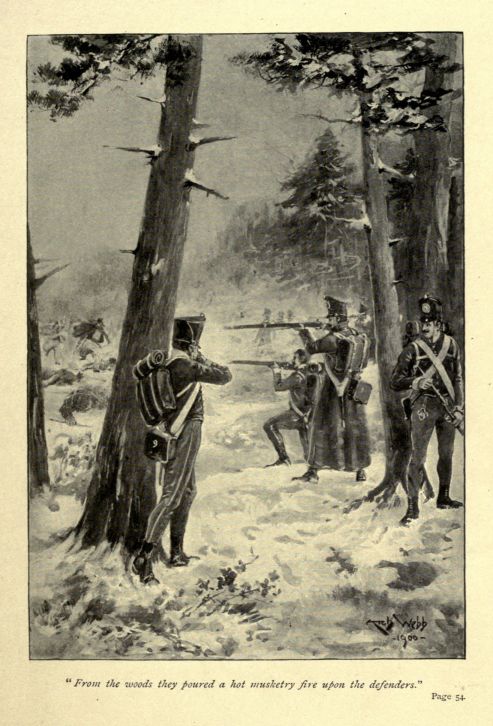
"From the woods they poured a hot musketry fire upon the defenders." Page 54.]
The bullets fell thickly around us while we ran here and there with flasks of water to moisten the parched throats of the stricken men.
Some, alas! were dying, and for these we could do little but cheer their last moments; others, who possessed a chance of recovery, we raised in our arms and bore tenderly away.
We had just returned from one of these sad errands when Rakoczy, seeing a fallen body on the top of the barricade, immediately climbed up in order to examine it.
We paused in our work to watch the handsome, bright-eyed fellow as he stood there, quite cool, the target for hundreds of rifles.
The insurgents, understanding his action, cheered and cheered again as he bent over the motionless body; but his heroism was useless--the man was dead.
Rising slowly, the brave Rakoczy stood for a second, glancing toward the Prater, then returned to us untouched.
"Dead," he said briefly; "and the Austrians are preparing for a rush."
Stephen glanced at the handful of insurgents who still fought doggedly, but their time was almost come.
A savage cry heralded the onslaught of the Croats, those hardy fighters from the south; and five minutes later the defenders of the barricade were in full flight, leaving behind only their wounded and dead.
At first I thought of retreating also; but "The Joyous" was already giving aid to another sufferer, and the sight of his calm face brought me to my senses.
So we three stayed, doing what we could; and almost immediately the enemy were upon us, leaping, shouting, tiring, and cheering like a body of savages.
A wild-looking lot they were, having little uniform, save the famous red mantle which hung loosely over the shoulders, and was fastened round the throat with a small cord.
For the rest, speaking generally, their costume was a dark cap carelessly placed on the side of the head, rough brown jacket almost threadbare, drawers tied in at the knees, gaiters, and clumsy-looking sandals fastened with strips of leather. Most of them wore a gay-coloured sash, and all were armed with the weapons peculiar to their country.
Each man carried a stanitza or long gun, a long and ornamented pistol, a cartouch-box on his shoulder-belt, and, in a richly-embroidered sheath, a handjar, which is half yataghan and half carving-knife.
You may be sure I did not see all these things as the redoubtable warriors came swarming over the barricade, but later I had ample opportunity of studying the weapons of the Ban's soldiers.
After them marched a regiment of Austrian infantry, well disciplined and steady as a rock.
As the Croats went by, I expected every second to be shot through the head, or to feel one of the murderous handjars in my throat; but I continued my labour, at least with outward calm. Happily, the Viennese had left the adjoining houses empty, so there was nothing to hinder the imperialists from advancing, or to further excite their passions.
The Croats swept by like a furious whirlwind, the Austrians followed more steadily, and we were left to our self-imposed task.
When the enemy had disappeared, dozens of women and men not engaged in the fight came from their hiding-places, and we were surrounded by a band of willing helpers.
The dead we left where they had fallen, for time was precious; but the others were all removed into the houses, and made as comfortable as possible till the surgeons arrived.
We had just finished our work, and were resting a while, when the booming of cannon sounded not far off.
"They're taking the second barricade!" I exclaimed.
"It will cost them dear," said Rakoczy; "Bern is there!"
"Let us go and see," said Stephen; "we may be of use."
CHAPTER IV.
VIENNA IN FLAMES.
For the second time the Croats were about to hurl themselves against the barricade defended by the daring Pole. A cluster of bodies twenty yards in advance of it showed where the first rush had been stayed.
The black nozzles of several guns peeped from the huge pile, and the gunners stood ready with lighted matches.
Looking at Bern, I remembered Rakoczy's story, and really it appeared as if the man were bullet-proof. Others exposed themselves for a moment, and were shot down; he, holding a short riding-whip in his hand, stood with the most perfect sang-froid in the hottest of the fire, cheering, directing, encouraging, and was not hit once.
Had I not seen it with my own eyes, I should have doubted a narrator who told me the story, for the thing was almost incredible even to an eye-witness.
But the Croats were ready. The signal rang out; they went forward in loose formation, slowly at first, afterwards more quickly, a few dropping by the way. Then, with an appalling yell, they literally flew over the ground, brandishing their handjars.
Once at close quarters, the Viennese would go down before them like ripe corn beneath the sickle.
The Austrians in reserve cheered. Another minute and their allies would be swarming over the barricade, when suddenly, from the mouths of Bern's heavy guns, belched sheets of flame. There came a tremendous report; the barricade trembled; the whole scene was blotted out by a cloud of smoke, which drifted slowly away, and then the Croats were seen retiring sullenly.
Of all their number, one alone had reached the goal, and he was a prisoner.
The Viennese cheered like mad; Bern gave some orders to his artillerymen; the imperialists covered the retreat of their allies by a sharp musketry fire.
Then both sides paused--the insurgents smilingly secure in their stronghold, their opponents to get ready for a fresh attack. With many other non-combatants, we had climbed to the roof of a house, from which we obtained a splendid view.
"The Austrians are going to do the work," said Stephen, who had a strong prejudice against irregular troops.
"It's throwing life away," answered our companion; and even I, who knew much less of military matters than he did, felt that the drilled infantry had little chance of success.
However, they were forming steadily for the assault. The officers sprang to the front, holding their swords unsheathed, the drums beat the advance, and the regiment moved on with the regularity of clockwork.
They made a brilliant spectacle, those hardy veterans, with heads erect, and resolute, determined faces, marching to destruction like one vast machine.
Faster and faster their feet moved, faster and faster the drums beat, rataplan, rataplan, till the music got into their bodies, and with a "Vivat der Prinz!" they broke into a swift run. I looked at the Polish leader; he stood like some genius of the conflict, directing and even controlling the progress of the strife.
The infantry, although advancing so swiftly, never for an instant got out of hand. As one man fell, another filled the gap; and when we last saw them before the thick smoke shut out the view, they were in even lines, shoulder to shoulder, as if on parade.
Crash, crash, went the heavy guns, and the shot and shell ploughed through the solid ranks, making great gaps, as we well knew, though nothing was visible till the sulphur cloud lifted.
The attack, like the two preceding it, had failed miserably. Would they try again? It really seemed like it, though in the three assaults they had been punished fearfully.
"They may keep on like that all the afternoon," said Rakoczy, "but they won't take the barricade. These front attacks are useless. I wonder the Ban permits them. Oh, there's the reason! See!" and he pointed toward the barricade.
Everything there was in confusion. While most of the citizen fighters clung to their posts, many ran or tried to run away.
In vain the Polish general exposed himself with the utmost recklessness; the position was lost.
While one body of Croats, supported by the Austrian infantry, had been attacking in front, the remainder, led by Ban Jellachich, had fought their way through the suburb of Leopoldstadt, and clearing the Avenue of the Emperor Francis, had fallen upon the barricade in the rear.
"Forward, forward!" rang out the cry at our feet, and the whole force advanced at a run.
The Austrians charged with bayonets levelled; the Croats, discarding their stanitzas, gripped their handjars, and with loud shouts hurled themselves against the position.
Between these two forces the Viennese were crushed. The gunners stood bravely by their guns till they were cut down. Bern appeared to be tranquilly giving orders; half a hundred students, banding themselves into a solid body, fought doggedly; but from the moment Jellachich's troops arrived the issue was certain.
A great burst of cheering rose when the black and yellow standard of the Austrians and the red, white, and blue of the Croats fluttered side by side on the summit of the barricade.
The fight, in that place at least, was over; the citizens had disappeared. The imperialists embraced each other, shook one another by the hand, laughed and danced and waved their caps in the air, shouted for Jellachich and the emperor, and finally ran on to pursue their victorious career. Round the captured barricade the dead lay thick, and the wounded as usual moaned piteously for water.
We went amongst them, doing the little that was possible to ease their pain, and helping to remove some into safer quarters.
To add to the horror, one of the houses caught fire, and it was feared that the whole street would soon be ablaze.
Farther off we could hear the booming of the heavy guns, the sharp rattle of musketry, the shouts of the combatants, the cheers and counter-cheers which told us how the battle was going.
From time to time, too, people brought reports of the fight, and they all boded ill to the insurgents.
The railway station of Gloggnitz, the Hôtel des Invalides, the Veterinary School, were taken one after the other by the imperialists, who, when night fell, were practically masters of the suburbs of Leopoldstadt and Landstrasse.
And such a night as that twenty-eighth of October I had never beheld. The town was on fire in more than twenty different places. Half the houses of the two suburbs were riddled by shot and shell; the flames were consuming the other half.
Red tongues of fire leaped into the sky, forming a grand but terrible spectacle.
The homeless people stood in the streets, some hopelessly dazed and stupid, others fighting the flames as sturdily as they had fought the Austrians; while a few philosophers, who had nothing at stake, looked on calmly at the conflagration.
As for us, our time was fully occupied in removing the wounded from the burning or threatened buildings. Throughout the night we toiled, and it was pleasant to see the genial Rakoczy, with his bright, cheerful face, giving water here, binding up a wound there, or helping to carry a sick man to a safer shelter.
A few kind words, a cheery smile, a pressure of the hand, a look of sympathy, he distributed impartially; and men of various nationalities must have blessed the handsome Hungarian, who spent himself so freely in their service.
Several times we had to face the gravest dangers. Houses were burning, walls falling; but the helpless must be rescued, and Rakoczy, never blenching himself, inspired confidence in others.
Many pitiful little dramas took place in the streets, where women and children searched, often, alas! in vain, for the bodies of their loved ones.
Thus the night passed, and the return of day revealed the horrors of the scene more plainly still.
During the hours of darkness there had been something grand about the conflagration. The great red blotches lighting up the sky, the vivid tongues of fire leaping, as it seemed, sportively from point to point, darting here and there, now joining, now separating, throwing into bold relief some noble building which again was lost in the black smoke, bringing into view the varied uniforms of the victorious soldiery--all these things powerfully seized the imagination, crowding out the more prosaic horrors.
Daylight restored the true proportion of things, and it was indeed a sorrowful sight on which we gazed.
Charred and blackened walls met us at every turn; half-consumed houses, battered and ruined buildings, huge gaps in the streets where the fire-fiend had worked his will; and, worse than all, the white-faced, sad-eyed women and innocent children, bereaved alike of home and of the strong arms that had hitherto been their support.
Some, wringing their hands in despair, cried aloud the names of their lost ones; the majority, dazed by grief, sought silently and with an unremitting patience that touched the hearts of the beholders.
The fighting, as far as we could tell, had long since ceased, and was not renewed.
A rumour spread that the chiefs had sent to ask for a suspension of hostilities while they talked over the terms of surrender, and I thought they acted very wisely.
"Bound to submit," said Rakoczy cheerfully, "they can't do anything else. A revolution seldom succeeds unless the army joins the people."
We spent the day amongst the wounded, and at night, a capitulation having been agreed on, helped to convey some of them into the city.
Then, quite worn out by thirty-six hours of continuous labour, we went to our lodgings, and after eating a little food, lay down to rest.
Rakoczy, who lived in another house, joined us the next morning at breakfast, and we sat for an hour talking over our plans.
Stephen was anxious to leave Vienna at the first opportunity, and as Rakoczy had finished his private business, it was arranged that we should do so.
"We will go and see the imperialists march in," remarked John; "afterwards it will be easy to slip away."
Accordingly we went out, and found the streets filled with excited people who were shouting tumultuously, "Long live the brave Hungarians!"
"What's the meaning of this craze?" Stephen asked, looking at us in surprise.
"Something up," said Rakoczy, "and something queer too. Let us follow the crowd; we shall soon learn."
"Strange there should be so few students and National Guards about," I remarked.
"They're on the ramparts and at the gates. They'll stay till the surrender is formally completed."
Several men in blouses heard the word "surrender," and immediately shouted, "No surrender! Down with the Hapsburg butchers! Long live the brave Hungarians!"
On all sides the cries were repeated, and we, more astonished than ever, ran on quickly.
The Place of St. Stephen's appeared to be the rendezvous, where a wildly-excited mob had gathered round the noble cathedral. A cheer rose from the surging mass as a young man, mounting above the heads of his fellows, read out the contents of a billet sent down from the summit of the tower by Messenhauser.
We were too far off to hear the exact words, but they were to the effect that the Austrians were being attacked.
The thoughts of every one immediately flew to the Hungarians, and shouts of "Long live Hungary!" once more rent the air. A light cloud of annoyance spread over Rakoczy's face.
"That's no soldier's doing," he said. "No one but an imbecile would pit our raw recruits against an army of veterans."
The Viennese thought differently; and when, two hours later, a second bulletin was issued, stating that the Hungarians were advancing, the citizens became wild with joy.
The capitulation was forgotten; flags were waved, cannon discharged, and paeans of victory sung.
Stephen and I talked largely of Hungarian prowess, and of what our countrymen could do; Rakoczy smiled and said nothing, which showed his wisdom.
The fight had drawn nearer; the insurgents were cannonading the imperialists from the ramparts with their long-range guns; we stood in the Place of St. Stephen's, and gazed eagerly at the summit of the tower.
Suddenly a great stillness fell on the crowd. By what mysterious means the knowledge of the evil news spread from the mind of one man to another I cannot say, but certain it is the cheers and flag-waving stopped before the vast majority of the crowd even knew that Messenhauser had sent down his third note.
A yell of rage and disappointment greeted the reading of the message.
Rakoczy's good sense had proved superior to our boasting: the Hungarians were in full retreat.
The news produced a startling effect on the Viennese. Obedience to any power came to an end; the reign of disorder began.
Shops were looted and private residences sacked; furniture was thrown into the streets, and the owners were assaulted; the town went mad.
I thought of the Baroness von Arnstein and her pretty daughter; and Rakoczy, guessing at the cause of my gloomy face, proposed that we should go round to their house.
"Von Arnstein is known to be with the army," he said, "and it is just possible the worthy citizens may wreak their vengeance on his family."
We found the ladies at home, and very glad they were to see us.
In spite of her pride, the elder lady showed signs of fear--not so much, I think, on her own account as on her daughter's.
"This is terrible," she said, "and just as we hoped the mischief was at an end. Your countrymen have much to answer for, mein Herr."
"Nay," replied Stephen, to whom she spoke. "The Hungarians fight against men; they do not attack women and children."
"But," said the young girl, "the rebels acted very unfairly in firing on the soldiers this morning."
"And unwisely, too," answered Rakoczy. "They are in a worse position now than they were before. They are bound to capitulate within a few hours."
"Meanwhile," said I, blushing boyishly, "if agreeable to you, we propose to remain here till the danger is over."
The baroness thanked us warmly for what she was pleased to call our chivalrous conduct, while the fräulein's eyes spoke as eloquently as her mother's lips.
"My servants are well armed," the elder lady continued, "and Franz is a host in himself, but we shall certainly feel more secure, knowing you are with us. Yet how strange it is that we should be relying on the services of three Hungarian gentlemen!"
"Really," exclaimed the fräulein with a merry laugh, "we ought rather to be afraid of you. But why do your people quarrel with us, and drive away our poor emperor?"
Rakoczy drew out a locket, which hung round his neck by a fine gold chain.
"Do you recognize that picture?" he asked, releasing the spring.
"Why, it is the emperor himself."
"It is also the King of Hungary, for whom thousands of Hungarians would lay down their lives."
The girl knitted her brows, as if trying to solve some knotty problem.
"I don't understand," she said. "You fight against the emperor, yet you profess great devotion to the King of Hungary, who is the same person."
"Yet it is very simple. The Magyar's first love is for his country, his second for the king. Now, as emperor, Ferdinand has taken away our rights, which we must have back. When we get them, no king will have more loyal subjects than Ferdinand."
"But I understood you were all republicans," said the baroness.
"We are royalists, madam," replied Stephen.
"Who will fight for a republic. That is what Kossuth wants. We know here what the pulling of the wires will lead to. If your countrymen succeed in this war, they will become the subjects, not of King Ferdinand, but of Dictator Kossuth."
"Listen!" I exclaimed. "The street is filled with people."
The windows in the lower part of the house were already secured by heavy wooden shutters, and now we heard Franz barring the door at the main entrance.
Rakoczy and Stephen ran to aid the servants in case of need, while I stayed with the ladies.
I suggested it would be well to draw the curtains, but the baroness would not consent, so we sat looking down into the street.
The people did not appear to have any wish to do harm. They passed along singing, and waving flags, and many were already out of sight when some one raised a cry of "Von Arnstein." At the sound of that name the others stopped, and quickly collecting in front of the house, began in loud tones to abuse the absent noble.
The baroness gave an expressive little shrug of the shoulders.
"What poltroons!" she exclaimed contemptuously. "If my husband were here they would run like a flock of frightened sheep."
With this remark I could scarcely agree; nevertheless I had sufficient wisdom to keep my doubts to myself.
I looked at the fräulein. Her face was pale, but she was perfectly cool and collected; as she said afterwards, a soldier's daughter must learn to face danger.
"It's only a street brawl," I said. "They will get tired soon and go away."
But it is always difficult to reckon on what a mob will do, and this was a case in point.
The words had hardly left my lips, when a man, wearied perhaps of shouting, varied his pastime by aiming a stroke at the door with a heavy hatchet.
The effect of that one blow was to change the character of the crowd entirely.
Hitherto it had been one of merely disorderly citizens, lawless and unruly, no doubt, but not bent on any definite mischief. The ringing of the axe against the door acted as a signal for the loosing of a flood of evil passions.
Every one struggled to get in a good blow, and instead of the harmless though bitter language of a few minutes previously, we heard the more alarming cry of, "Death to the aristocrats! Death to Von Arnstein!"
The baroness moved nearer to the window, and I placed myself in front of her, saying,--
"This is madness, madam!"
She asked me with haughty courtesy to stand aside, and I, fearful of the risk she was running, appealed to her daughter. Her answer was to place herself by her mother, who opened the window.
The battering at the door and windows stopped while the crowd looked up curiously.
In a clear, hard, but passionless voice the baroness said,--
"I am Von Arnstein's wife; this is his daughter. My servants are armed, my house is defended by friends. If you enter, it will be at your peril."
For answer, some one on the outskirts of the crowd fired a shot, which lodged in the window-frame, and I drew the ladies back.
"Foolhardiness is not bravery," I said brusquely, and shut the window.
Then the attack on the door recommenced, and we heard quite distinctly the thud, thud of the heavy weapons.
I went to the head of the stairs and looked down.
Franz stood by the door with his ponderous club in his hand; I pitied the man who should be first to enter.
The other servants were on the stairs, and by their looks I judged they would be of scanty service to their mistress.
My brother and Rakoczy, sword in one hand, pistol in the other, stood near Franz.
"The Joyous" caught sight of me, and laughed.
"A new way of entertaining guests," he said. "The Baroness von Arnstein will become famous for her receptions!"
"The door yields!" exclaimed Franz gravely. "See to the ladies, mein Herr;" and he took a firmer grip of his club.
I nodded and went back, though I would rather have remained; shortly afterwards a yell of delight from the crowd proclaimed that the door had fallen.
The baroness looked at her daughter, who smiled back in answer; neither appeared the least moved.
The fighting on the stairs had lasted ten seconds perhaps, when the servants came rushing into the room in a body. Their faces were white; their hands shook so that the pistols they carried pointed to twenty different places at once, and I thought it extremely likely that the rioters would be spared the trouble of killing us.
"Put those things down, you scoundrels!" I cried, feeling certain they would be more dangerous to us than to the enemy; and when it was done, I added, "Now, back to the staircase and fight for your mistress, or I will kill every man of you!"
"What cowards!" exclaimed the baroness scornfully. "They will do no good."
"They may form shields for braver men," said her daughter.
Meanwhile, the sounds of the fighting grew more acute, and, knowing how far outnumbered my companions were, I felt compelled to run to their aid.
The servants whom I had driven out were huddled together at the top of the stairs, doing nothing; but, half-way down, Stephen and his two companions were still making a great fight.
Uttering a cry of encouragement, I ran down, and, discharging my pistol into the thick of the crowd, drew my sword.
My brother had received a slight cut across the head; Rakoczy, as yet untouched, was smiling cheerfully, and by his marvellous skill of sword keeping back the most dangerous of the assailants.
Franz's right arm was hanging by his side useless; but he swung his club with the left, and smiled grimly when a man dropped.
The situation, however, grew desperate. Force of numbers compelled us to yield several steps; Stephen had again been hit, and Rakoczy was bleeding from a wound in the arm.
I would like to record how, in this last extremity, we alone, by the aid of our good swords, cleared the house of the rioters; but that would not be true, as we owed our safety to quite other means.
In the next chapter I will relate exactly what happened.
CHAPTER V.
ARRESTED.
We were, as I have mentioned, being pushed steadily back, and the mob had begun to cheer, when a disturbance arose near the doorway, and a man, elbowing his way to the front, demanded angrily that the conflict should cease.
At the sound of his voice many of the rioters fell back sullenly; and the rest, being thus deserted by their companions, were compelled to follow, though not without angry cries and mutterings.
The newcomer, taking his stand directly below us, faced the mob, and in a sensible speech urged them to withdraw. The man was evidently well known to his hearers, and it was plain that he possessed considerable influence.
At first they seemed half inclined to resent his interference, but by a skilful mixture of flattery and firmness he finally succeeded in getting them to disperse.
Then he turned to us with graceful courtesy, and I recognized the handsome young fellow who had so opportunely come to our assistance outside the hôtel of the minister of war.
However, before he had time to speak, we were joined by the ladies, who had watched the progress of the fight from the stair-head.
The young fellow removed his cap, and bowed deferentially, almost to the ground.
"I am happy," he began with a stammer, very different from his former fluent speech, "to be of service to the Baroness von Arnstein and her daughter."
The elder lady looked at him in scorn, and said coldly, "Your ragamuffins have much to answer for, Captain von Theyer."
"And as for the service," exclaimed Theresa, "but for these gallant gentlemen who have now twice defended me against my own countrymen, it would be far too late."
"Were you in your right place, you would be outside, not inside, the walls of Vienna," the baroness said with a marked sneer.
"I have done what I believed to be my duty," the young man replied humbly, "and my influence has always been used on the side of mercy. This very night I am trying to arrange conditions for the entry of the emperor's troops."
"Conditions!" cried the baroness scornfully; "Windischgratz will make no terms with the rebels!"
"The night grows late," said Theresa, making him a mock curtsy, "and we have yet to repair the mischief done by your friends."
I was sorry to see the humiliation put upon this blue-eyed young fellow; and though it was no concern of mine, I felt relieved when, with a confused apology for the excesses committed by the rioters, he took his leave.
Besides, it was necessary to set Franz's arm, and Stephen also required attention, though happily he was not seriously hurt.
The servants, who during the fight had left us in the lurch, now came forward to help.
While one went to fetch a surgeon, others temporarily refixed the shattered door, and washed the blood-stains from the stairs.
Rakoczy bound the arm of the valiant Franz, who, after receiving the thanks and praises of the ladies, was taken to his room.
We persuaded Stephen to lie down on a couch, where the baroness herself washed his wounds, while Theresa prepared a cooling drink for him.
As soon as the surgeon had paid his visit, the ladies retired, and Rakoczy and I took it upon ourselves to watch through the remainder of the night.
We did not think it likely that the rioters would return; still it was possible, and we resolved upon leaving nothing to chance.
My brother, weakened by loss of blood, had fallen asleep; the servants, with the exception of two posted as guards over the broken door, had gone to bed; the house was quite still.
Rakoczy walked to and fro very softly, so as not to disturb Stephen, and I stood at one of the windows thinking of the yellow-haired fräulein and the dashing young leader of the insurgents.
The hours dragged by very slowly, but daylight came at last, and I immediately sent one of the servants into the streets for news.
He returned in about an hour, smiling and well pleased. The city was perfectly quiet, he said. There were no signs of fighting; the insurgents had once more submitted, and in a short time the National Guards were to give up their arms to the imperialists.
With this information we joined the ladies at breakfast, Stephen looking rather pale but not seriously ill, and the rest of us little the worse for the night's adventure.
Franz, too, was doing well, and the knowledge of the capitulation relieved the mind of our hostess from further fear.
We were still sitting at table talking over the events of the brief revolution, when the loud report of a cannon caused us to spring to our feet.
The baroness asked to have a window opened, and a white-faced servant obeyed with trembling fingers.
"Surely I hear the great bell of St. Stephen's?" exclaimed our hostess in astonishment.