Front matter (continued 5)
Reading edition
Mizvy was not exactly popular with his fellows, but he was a man whose opinions claimed some attention, and his remarks concerning our allies were far from comforting.
We did not dream for an instant, of course, that any of them would be frightened, but at the same time there were various little matters concerning which we felt doubtful.
Nicholas Szondi summed up the case very clearly.
"There's no question of Bern's courage," he said, "or of Dembinski's either; but we needn't pretend they're in love with Görgei, or he with them. Now, if we joined forces--and that's the only way to save Hungary--we should only want one chief."
"Well, Görgei isn't likely to yield his command to the Poles."
"Just so; and they won't be too eager to serve under him. That's where the difficulty lies."
"If old Mizvy's plan were in working order," said one man lazily, "'twould save a lot of bother at present."
"We certainly shouldn't suffer from having too many generals."
Szondi agreed laughingly. "Görgei and Klapka look very solemn over there."
"They're discussing the new plans, and it's my belief we shall find Mizvy wasn't far out in his forecast."
That same night our general told us he had resolved on retreating to Waitzen with a portion of the army, while Klapka, with 76 guns and 18,000 men, was to throw himself into Comorn.
I now learned that one Austrian army corps was marching straight on Pesth, from which our troops had withdrawn, and I looked forward with pleasure to again meeting my old friends of the 9th Honved regiment.
Since joining the staff I had not heard from Rakoczy, but as there had been no fighting at the capital I concluded he was still alive and well.
Early on the morning succeeding the stubborn fight we said farewell to our friends in Klapka's division, and before it was really light began the march.
Two days later, having picked up various bodies of troops on the route, we halted a few hours' distance from Waitzen.
Here the 9th Honveds were assembled, and as soon as the general had finished with me, I rushed off to find Rakoczy.
I really don't know which of us was the more pleased at the meeting, though the genial colonel could not forego his chaff, and pretended it was a great honour to receive a visit from one of the staff. Then he took me into his tent and sent for Dobozy, from whom I had another warm welcome.
"The accounts from the front frightened us a bit," said Dobozy. "We began to think you would have been better off in Pesth."
"Been pretty warm, hasn't it?" asked Rakoczy. "But there, you shall tell us all about it. You must be getting pretty used to playing a losing game by now, eh?"
"Still, I don't know that I like it any better than at first. By the way, have you seen Count Beula lately?"
"Cleared out the same time as Kossuth. Paid you a visit at Raab, didn't he?"
"Yes, with a proclamation from the Diet in his pocket. But I had better begin at the beginning, and tell you the story properly."
"Much better. Make yourself comfortable. You may be sure of an interested audience, though a small one."
He was right in that remark, for both he and Dobozy listened most attentively, only interrupting by an occasional exclamation.
"You certainly can't complain of having been dull yonder," said Rakoczy at the finish.
"Did you kill that Von Theyer fellow?" asked Dobozy.
"I hope not, though I'm afraid he got a nasty slash across the face."
"Pity that, being a handsome sort of chap. 'Twill spoil his beauty."
"In that case," said the colonel, "our friend Botskay must take care of himself. This Von Theyer, though a splendid soldier, is vainer than any woman, and he won't easily forgive the man who disfigured him."
"Aren't we getting on a bit too fast? The fellow may be dead and buried, for aught I know. When our troopers came back from the Russian guns, they didn't give me too much time for investigation."
"That Russian division seems to be the mainstay of the army."
"It has been, so far; but now tell me what you've been doing in Pesth."
"Putting the regiment straight again," said the colonel.
"And forming guards of honour," added Dobozy. "We've had a very pleasant and agreeable time."
"A wonder you left."
"We had such very pressing invitations to leave that the colonel could hardly refuse. The Diet, you know, has gone to Szegedin with the army of the north."
"Yes. We heard that."
"Well, directly Haynau had you beaten up yonder, he sent an army corps hot-foot for Pesth. At the same time Paskewitch dispatched a Russian corps from the east, and we thought it time to move."
"How was it you didn't go south with the others?"
"Because, fortunately, we had orders to join Görgei here."
"Shall we make a stand at Waitzen?"
The colonel shook his head. "May stay for a bit of a fight," he replied. "Nothing more."
"Then what do you think Görgei will do?"
"Retreat through the mountains, and threaten to strike at Galicia. That will bring Paskewitch back in double quick time, and Dembinski will have only the Austrians to tackle. Oh, we shall lead them a lively dance yet!"
"If we aren't caught here," said Dobozy, "which seems rather likely."
"I see you are still wearing the baron's ring," remarked Rakoczy, as I rose to go.
"Yes. I thought it would be as safe on my finger as anywhere else, till I am able to take it to Vienna."
"Unless you happen to be badly wounded and left on the field. There are a good many prowlers who would willingly finish you for the sake of a stone like that."
"They would be counting without Mecsey Sándor, who follows me everywhere like a dog; but I really must go now. We shall move again at daybreak;" and, bidding my two friends good-bye, I walked across to the general's quarters.
The first man I met was Nicholas Szondi, who had just returned from a long ride with Nagy Sándor.
"Better get a bit of supper and a nap while you've the chance," he said. "We're likely to be off before long."
"Anything serious?"
"Only that the Russian cavalry are close at hand."
"Then we're in for another fight?"
"I expect so, unless the general prefers to run."
Taking my comrade's advice, I had some supper; and wrapping my mantle around me, I lay down to snatch an hour's sleep.
CHAPTER XIX.
SENT SCOUTING.
As Szondi had predicted, reveille sounded before day had fairly broken, and an hour after dawn the whole army moved to the ridge of low hills outside the town of Waitzen.
Here we halted, and immediately set to work making our position as strong as possible. The artillery was posted on the hills, earthworks were hastily thrown up, extra ammunition was served out, and everything prepared to give the enemy a warm reception.
Most of the work was finished when Görgei's scouts came in with the information that the Russian cavalry, supported by an infantry brigade, was approaching.
"They're just come to have a look," said Szondi cheerfully. "They aren't likely to attack till their main body arrives."
This was the general opinion, and we could hardly believe our senses when the Russians were seen preparing for an assault. I suppose it was a very gallant action, but it certainly had not the slightest chance of success from the beginning.
On our side the battle was fought by the artillery, and the bravest cannot stand before a cannon-ball.
Again and again the Russians charged desperately, only to be hurled back in utter confusion; and at length their leader admitted his mistake by drawing his men off altogether.
"So far, so good," remarked Rakoczy, with whom I spent half an hour that evening, "but we mustn't expect to win so easily to-morrow."
"I thought we should probably slip away during the night."
"That's possible, of course; but I fancy Görgei intends trying to hold the town. However, we shall see before long."
The Russians had been so badly beaten that they made no further effort to molest us, and the night passed away peacefully.
Nor did they renew the struggle in the early morning, but waited for the arrival of the main body, which had made a forced march of eight German or forty English miles in twelve hours.
"They make a fine show," exclaimed Szondi, as we stood on a hill with the general, watching the heads of the columns as they approached.
"They make stubborn fighters," growled Mizvy.
"Just like dogs," added another fellow: "as long as you whistle them on, they'll go."
These Muscovites were indeed wonderful soldiers, and far different from our own men.
The Magyars were full of fire and dash. They rushed to death with a cheer and a shout, or to the rattle of a song. When the warning blast rang out, their faces flushed, their eyes burned with a fiery glow, the hot blood sped more swiftly through their veins--they were real live human beings.
On the other hand, it seemed to us, as we gazed from the hill, that there were no individual Russians--only companies, or regiments, or brigades.
It was a weird sight to witness one of these regiments, compact and grey-coated, come gliding up towards the guns.
As Szondi put it, one forgot the men in watching the movements of the machine.
It advanced silently, steadily, and in one piece; it--not they--moved faster; suddenly a curious shiver passed through it, a curtain of smoke was spread over it, and presently you saw the one piece, only very much smaller, moving back again, leaving bits of grey lying here and there, as if chipped from the mass.
Farther along, another machine, similarly constructed, was going through exactly the same performance, becoming smaller in the same manner.
One such I saw more distinctly still, having carried a message from the general to the artillery chief just as it approached.
The fate of that regiment was so terrible that even now I sometimes shudder at the remembrance.
Like the others, it came on regularly and without noise. The great guns at my feet roared out as if in fright; the smoke cleared away, showing the grey mass diminished in size, but nearer; the guns cried out again, the smoke-cloud settled and lifted, discovering the grey mass very much smaller, but still moving nearer, until at length it reached the very muzzles of the guns, and then--well, then it simply vanished!
Some parts of it doubtless returned in safety, though to me, watching from behind the cannon, it seemed as if the whole body had been swept away.
Yet, although the Russians lost men so terribly, it was plain that in the end they would be able to oust us from our position, and our chief began to make arrangements for the retreat. Owing to this, I saw little more of the battle, having been sent into Waitzen by the general.
Here, while our comrades held the Muscovites back, we were sending off the sick and wounded, provisions, ammunition, and the troops that could be spared from the fighting.
From time to time we heard news of the combat, which grew fiercer with every hour; yet, in spite of the most furious assaults, the Magyars stood their ground.
"The men must hold the field till dark," was the order passed round to the different leaders; and Görgei knew that, whatever happened, it would be obeyed.
During the early part of the afternoon the noise of the battle died away, but the lull was only for a time. The uproar began again, increased in volume, and came so near to us in the town that we thought the enemy had carried the defences.
They had indeed got to hand-to-hand fighting, being repulsed only after a desperate encounter.
How our poor fellows out there on the ridges must have prayed for the coming of night!
Meanwhile, carts and wagons were rolling through the town and away into the mountainous country beyond.
Once riding out with some special message to the general, I found him standing with his arms behind his back and his head bent forward, surveying the fight.
The bullets were dropping around, but of these he took no notice, though two of the staff had already been seriously hurt.
"Lucky fellow!" remarked Szondi, as I repassed him on my way back. "You're well out of it;" and, seeing how the general was exposing himself, I thought so too.
I could not see the 9th Honveds--they were somewhere on the left--but I earnestly hoped my two friends were safe.
Once more the fury of the battle lessened. It was growing dusk, and even had the light lasted, neither side could have fought much longer.
The Russians naturally were the more fatigued, but when the last shot was fired many of our own fellows sank down exhausted.
Yet the general could grant them but small time for rest.
Many, indeed, tired and hungry as they were, marched straight off the ground. All the night through, the streets of Waitzen echoed to the tramp of infantry, the rumbling of baggage-wagons, the clatter of horses' feet, and the roll of artillery.
Hour after hour, while the Muscovites lay wrapped in peaceful slumber, the sad procession filed through the town, and daylight revealed to the astonished enemy only an abandoned camp.
It was night before I learned anything of Rakoczy; and then, to my great joy, I discovered that both he and Dobozy were unhurt.
Our position had now become practically hopeless.
The allies had joined hands in the centre of the country, while our armies were scattered in all directions, and completely out of touch one with the other.
Bern still battled hard in Transylvania; Dembinski was on the borders of Croatia; while we, trudging through the lower spurs of the Carpathians, were separated from both by over 100,000 veterans.
Rakoczy and a few of his stamp still put on a brave show, talked cheerily to their men, and prophesied that Dembinski was about to do great things; but most of the officers privately admitted that our final defeat was certain.
Görgei himself shared this view, though it did not prevent him from doing all in his power to avert the calamity.
"We're bound to draw the Russians after us," he said cheerfully, "and that will take them from Dembinski's shoulders. If only we can outmarch the Russians and join the Pole anywhere near Debreczin, there may still be a chance."
But could we?
That was a question time alone could answer.
One corps was toiling hard after us through the mountains, but what was Paskewitch doing with the rest of his army?
One morning, about the fifth day of the retreat, the general suddenly told me to go and find where the Russian chief was, and what he was doing.
"The reports of the scouts are very unsatisfactory," he said. "I can't make head or tail of them. Just find out all you can for yourself, and catch me up at Miskolcz."
Taking Mecsey Sándor with me, as he knew the country much better than I did, I started immediately, being in a short time out of sight and sound of the retreating army.
Knowing that Paskewitch had stopped his southward march, we concluded he would try to prevent Görgei crossing the Theiss.
My best course evidently was to ride due south, questioning the country people as I passed.
"We shall learn something at Gyongyos," said Mecsey, "and we ought to reach there by nightfall."
It was a dreary and disheartening journey. Of men we saw hardly a sign; only women and children remained in the little villages, or worked hard in the fields to save the ripening crops from destruction.
These poor people could tell me nothing of the enemy. They only knew that their own men-folk were far away fighting for the land of their birth, or haply already lying at peace beneath the sod.
Evening fell before we reached Gyongyos, but I resolved to push on in the gathering darkness, although Mecsey very much doubted if we could find the way.
At the village of Kis-Palaty we learned that the Russians were in the neighbourhood, but whether they constituted an army or only a scouting party it was hard to tell.
Here, as elsewhere, the population consisted of women and children, and a few old men who shook their heads sadly, and mumbled words that had no meaning.
After a long talk with the most intelligent of the women, I came to the conclusion that the enemy were simply a cavalry detachment out scouting. Then came the question what was best to be done.
It seemed equally dangerous to go or stay, and I was still turning the question over in my mind when a man on a splendid horse galloped up to the inn door.
His speech told me he was a Magyar, and by his dress I judged him to be a servant in some nobleman's family.
At first he glanced at us suspiciously; but, discovering I was an officer in Görgei's army, he became very friendly, and answered my questions readily enough.
"You cannot venture into Gyongyos," he said. "The town is filled with Russians. The general is there with his principal officers, but I hear they start for Kapolna in the morning."
"Will they come this way?"
The Magyar shook his head. "No," he replied; "I wish they would. It would keep them clear of my master's estate."
"Is your master with our army?"
"Alas, no! My sweet master is a cripple, paralyzed. He never leaves the house. But why not ride there with me? The count, my master, is a great patriot, and will make you welcome."
"But it might lead him into trouble."
"Not at all. The Russians are not likely to pay us a visit. If they do, we can easily hide you."
"And Paskewitch will march that way?"
"The Russian general? Yes; the highroad passes the edge of the pine-wood. You had better come. The count thinks a great deal of General Görgei, and will be delighted to see one of his officers."
"You have not told me who your master is."
"Count Arnim Kemeny."
"Well, Mecsey," I said, "what do you think? Shall we be likely to run the count into any danger?"
"How? The Russians will be gone to-morrow."
"Then if you will ride on," I said to the servant, "we will follow."
"In one minute. I have a little business to transact first," and making a respectful bow, he went into the house.
"All right, Mecsey?" I asked.
My servant tapped his pistol significantly. "I'm sorry for our friend if it isn't," he answered.
When the count's man came out again it was quite dark, and we had some difficulty in following him over the execrable roads. It was even worse when, leaving the highway, he struck across country; but after a couple of hours' hard riding we arrived at his master's residence.
We rode into the courtyard amidst the barking of numerous dogs; but the servant silenced them, and several men came running quickly to take charge of our horses.
Then our guide led the way to the front of the house, and ushered us into a small room which served as an ante-chamber.
"I go to inform my mistress," he said, and in two or three minutes there entered the room one of the loveliest women in Hungary. She was a brunette, with a complexion so clear that the warm blood could be seen beneath the delicate skin. Her hair was beautifully wavy, her eyes were large and shaded with long, silky lashes, her lips red as a rose, her teeth glistened like pearls.
She greeted me with ease and graciousness, and I knew in a moment that the welcome was a genuine one.
"I must apologize for my husband," she said sweetly. "He is, alas! an invalid, and I must welcome the guests of the house."
"It is I who should apologize for thus intruding," I replied, "but that I see it will not be necessary. I am George Botskay, a captain in the army commanded by General Görgei. This is my servant, and we are in the neighbourhood on special duty."
"Exactly," said my hostess, "and you must be in need of refreshment. Supper is almost ready, and meanwhile you would like to go to your room."
Mecsey was now handed over to the care of our guide, and a servant conducted me to a bedroom, where I was able to make myself more presentable.
The house was a one-storied building, very similar to my own at Gyula--built on much the same plan, but rather more extensive.
After I had washed and dressed, a servant showed me to the dining-room--a fine, spacious apartment, the walls of which were hung with pictures painted by Hungarian artists.
As before, the countess stepped forward, smiling, and led me to her husband.
"Arnim dear," said she sweetly, "this is Captain Botskay, whom a lucky chance has sent us as a guest."
While she spoke, I gazed with the deepest emotion at the count.
He partly sat, partly reclined in a wheeled chair drawn close to the table.
He was a wonderfully handsome and athletic-looking man, with a massive, well-shaped head firmly set on broad, sturdy shoulders. His face was frank and open, his eyes smiled, though with a suggestion of sadness, his mouth was firm, his chin square and determined.
I pictured him charging at the head of a squadron of horse, and thought what a magnificent cavalry leader he would make. As it happened, the poor fellow could not cross the room, could not put foot to the ground, could not move a single muscle of his legs; from the waist downwards he was practically dead. Yet he made no moan, no complaint, but once, and then it was to regret that his infirmity prevented him from joining Görgei.
"Forgive my apparent lack of courtesy, Captain Botskay," said he; "but I am somewhat of an invalid, and my wife kindly does the honours of the house in my stead."
"I shall not readily forget madam's kindness," I replied.
"Nay," answered the countess, "it is we who are your debtors, since you will be able to tell my husband the truth about the war; but first we will have supper," and she rang the bell.
I was certainly very hungry, and did ample justice to the good things placed before me, while the pleasure was heightened by the appearance of the table with its cloth of snowy whiteness, beautifully-cut glasses, nicely-chased silver, and tastefully-arranged flowers.
This was unusual experience for a soldier in Görgei's army while on active service.
It was delightful also to watch how fondly my hostess waited on her crippled husband, how swift she was to anticipate his wants, how lovingly she performed every little service--every action showing how thoroughly the invalid was centered in her heart.
Then, when we rose from the table, it was her hand that guided his chair into the drawing-room; her pretty fingers that made him comfortable; her eyes that looked lovingly into his, questioning if there was aught else that could be done for him.
On his part, the count worshipped this beautiful woman who thought only of him. His eyes followed her everywhere; and when, drawing forward a cosy chair, she sat down beside him, his face lit up with a smile of sweet content.
Of course I was pleased to find the count was of my way of thinking, and had no sympathy with the republican party.
He listened with the greatest interest to the story of the campaign, and asked several questions which showed he was not ignorant of military matters.
"Görgei has made a wonderful fight of it," he remarked; "but, in my opinion, he can do very little more. This Field-Marshal Paskewitch is a clever general, and, from what I hear, he has an overwhelming number of men."
"That is what I wish to find out. Your man tells me they will be en route again to-morrow."
"Nicholas is generally right, and in that case you will have a fine chance of obtaining your information with little risk. A quarter of a mile away the wood stretches right down to the main road. The trees are close together, and just now, of course, are in full leaf. One in particular, which we generally speak of as the Eagle's Nest, would afford you fine shelter, and from it you could see everything which passed. It will be a tedious affair, but--"
"Oh, that's nothing!" I exclaimed quickly. "The only thing I'm afraid of is a chance visit of the enemy to you. My horse would tell tales, and there is my man to be considered."
The count looked at his wife and smiled.
"Do not fear for us," said she. "We have hiding-places here that would not be discovered even if they burned the house down."
"The trappings of the horses can be put in one of these," added the count, "and in case of danger we can put your servant there as well."
"But if they find me in the Eagle's Nest?"
"They will shoot you and ask no questions, so I hope you'll not be discovered."
After a little further conversation it was arranged that my host's servant should call me at daybreak, and take me to the Eagle's Nest before the Russians began their march.
Mecsey was to remain at the house, as he could not be of any use in the tree, and might possibly do harm by attracting attention.
Having settled this matter, we sat chatting another hour, when my host said pleasantly, "Captain, I am going to play the commanding officer and order you to bed. As it is, you will have a short rest, while there is a heavy day's work in front of you. Of course, if I considered myself only, I should wish the pleasure of your company half the night."
"It's very kind of you," I answered, "and really I would rather sit here and talk, but I might feel drowsy to-morrow."
"And we do not wish you to fall out of the Eagle's Nest," said my hostess merrily.
"I fear the general would obtain little information from me afterwards."
Bidding them good-night, I went to my room, and once more enjoyed the luxury of lying down in a real bed.
As the count had observed, there was not much time for sleep, and a portion of that I wasted thinking of my host's terrible affliction and his wife's goodness.
Then, too, I wondered how the next day's adventure would turn out, and whether Görgei had been forced to stand at bay again.
At length my brain ceased working, and I fell into a sound sleep.
CHAPTER XX.
NEARLY CAPTURED.
I seemed to have slept scarcely five minutes when a knocking at the door wakened me, and I rubbed my eyes dreamily.
It was Nicholas, with the information that breakfast was ready; so, jumping out of bed, I quickly washed and dressed.
In spite of the early hour, the countess had risen to see that I had a comfortable meal, and to wish me success in my enterprise.
While I ate she superintended the packing of a wallet which was to bear me company to the Eagle's Nest, and for which, later in the day, I felt very grateful.
After a hearty breakfast I thanked my kind hostess again, and promising, if all went well, to return at dusk, joined Nicholas, who had slung the wallet over his shoulder.
The faithful Mecsey was waiting in one of the rooms through which we passed, and he begged very hard to go with me.
I would have taken him gladly, but he could do no good. There was no question of fighting or even of strategy. I had simply to sit in a tree and watch.
Nothing could save me if the Russians discovered I was there; if they did not, I was perfectly safe.
Mecsey was shrewd enough to see the reasonableness of this, but he had attached himself so strongly to my fortunes that he hated the idea of my going into possible danger alone.
He yielded at last, however, kissed my hand, and stood on the top of the steps gazing mournfully at me as I trudged off with Nicholas.
The new day was breaking gloriously as we entered the wood; hundreds of songsters carolled gaily, and the undergrowth was alive with game.
"Your master has plenty of shooting," I remarked to my companion.
"Ah!" replied he, with a wise shake of the head, "the count has been a mighty hunter. But we must hurry; it will be broad daylight soon, and you must be in the Nest before then."
Accordingly we walked faster, Nicholas leading me by tracks well known to him and the rest of the count's household.
At last he stopped and, pointing to a giant tree, exclaimed, "There is the Eagle's Nest! Near the top you will find a snug sitting-place formed by the branches, which will give you a splendid view of the highroad."
He took off the wallet, strapped it on my back, and waited to see me climb the tree.
I had done little climbing for years, and the unusual exercise made my muscles ache; but I had not altogether lost my old skill, and gradually mounted to the spot which Nicholas had described. Perhaps it was a trifle less comfortable than his memory pictured, but in one matter at any rate he had been right--there was a splendid view of the route the Russians must take if they were trying to prevent Görgei from crossing the Theiss.
I removed the wallet, and fastened it carefully to one of the branches; then I took out the notebook which Count Kemeny had provided, and waited.
An hour passed uneventfully, and then in the west there rose up a cloud of dust, which swept towards me at a rapid pace.
It was a body of cavalry--Cossack irregulars, by the look of them--mounted on shaggy, little horses and armed with long lances.
I caught a glimpse as they dashed up, a fuller one as they passed beneath me; then the sand-cloud swept on to the east, and the van of the Russian army vanished in the distance.
Those rough, uncouth riders formed the head of a procession that occupied all the day in filing past.
It was a splendid spectacle, but my eyes grew tired of gazing at it.
Provision-wagons, baggage, ammunition, and stores were followed by field-guns, large masses of infantry, hussars, lancers, and dragoons; then more guns, wagons, foot-soldiers, and cavalry in what promised to be an interminable succession.
As they passed I calculated their numbers, making my entries accordingly; while, about noon, a sudden stoppage of the procession gave me a capital opportunity of investigating the interior of the wallet.
The halt lasted two hours, when the march began again, and evening had fallen before the last stragglers went by.
Then I put away my notebook, strapped the empty wallet to my back, and prepared to descend.
I moved very slowly and with the utmost caution, as my limbs were terribly cramped, and I was half afraid of missing my footing and slipping to the bottom.
However, I succeeded, and found Nicholas ready to pilot me back to the house.
"Your master has not been troubled by the Russians?" I asked.
"A friendly visit from half a dozen officers," replied he; "nothing more."
"And Mecsey Sándor?"
"Kept in the background while they stayed."
Mecsey ran out from the courtyard at my approach to make sure I had returned unhurt; but once certain of that, he became stolid as ever.
"Get the horses saddled," I said, before entering the house. "We shall start soon."
"Not to-night, captain, surely?" cried my hostess, whom I had not noticed standing on the steps. "The count will be so disappointed. He has reckoned so much on your company this evening."
"And I would very much like to stay; but in a matter of duty a soldier has no choice."
"That is what Arnim feared you would say. However, you cannot go until after dinner."
"It's rather a queer way of entertaining one's guest," laughed the count as we entered--"to set him on a perch all day long. I hope you have not suffered martyrdom in vain?"
"No. Thanks to your kindness, I can take the general the fullest particulars of the enemy's force."
"And Captain Botskay wishes to go at once," said my hostess.
The count sighed. "We must not keep him," he said. "His information may be of the utmost importance to the general. But you will dine before going, captain, will you not?"
Now to this I readily consented, as it gave me a little further time with my host, for whom I was beginning to feel a warm friendship.
After dinner I sat half an hour longer, while Mecsey got the horses ready, and then I was reluctantly compelled to say farewell.
"Take care of yourself," said the count, "and come and see us whenever you have a chance. We are rather lonely here."
"Good-bye, Captain Botskay," said his wife; "and I hope sincerely that no harm will come to you in this cruel war."
I promised to visit them again should opportunity arise, and, with a last hand-shake, joined Mecsey, who had the horses ready.
Nicholas, too, came to guide us a few miles on the road, and amidst the cheers of the domestics the three of us set off.
Mecsey and Nicholas were good company for each other. I rode a short distance behind them, wondering if I should find Görgei in time for my information to be of use.
The night was fine, calm, and still. There was no moon, but the stars glittered in myriads overhead, serving to show the route.
In those days our best roads were shocking to a stranger, but the cuts across country were simply abominable.
Several times that night I escaped a nasty--perhaps fatal--accident solely through the intelligence of my horse.
Having accompanied us five or six miles, and given Mecsey full directions as to the way, Nicholas pulled up, wished us farewell, and started for home.
"He's dreadfully afraid of leaving the count long at a time," said Mecsey. "He looks on himself as a sort of bodyguard."
"He's evidently an affectionate and faithful servant. Now, if you know the road, we'll go a little faster. The horses have had a splendid rest and plenty of corn; they ought to carry us well."
Of course there was always the danger of falling in with a detachment of the enemy's troops, but I thought this less likely to happen at night than in the daytime.
From his own knowledge of the district, and helped by some directions from Nicholas, Mecsey found the way with little difficulty, and for several hours we rode at a brisk pace over a broad plain.
Thanks to the kindness of the beautiful countess, we had plenty of provisions for man and beast, and about six o'clock we stopped for rest and breakfast.
By this time I was so tired that my eyes would hardly stay open, and Mecsey pressed me to have an hour's sleep.
"We shall save time in the end," he urged. "The animals will be fresher for an hour's rest; in fact, they won't travel much farther without."
"And what about yourself?"
"I had a long sleep yesterday."
"Then keep a good lookout for the enemy, give the horses a feed, and call me in an hour."
I lay down, drew my cloak round me, and lost consciousness almost before my head touched the ground.
Mecsey wakened me, according to promise; we then ate a hurried breakfast, and started again, now in broad daylight.
The brief halt had done me a world of good. I was much brighter, and felt capable of riding all day.
As it chanced, however, the Russians did not give me the opportunity of trying.
We had left the great plain and entered a mountainous district when Mecsey, who was in front, suddenly stopped his horse and held up a finger in warning.
"What is it?" I asked in a whisper, getting close to him.
"Soldiers!" he answered promptly. "Russians!"
We were half-way through a narrow gorge, with huge limestone cliffs on either side of us, and with no way of escape but by going straight on or turning back.
Mecsey's sharp ears had detected the noise made by the soldiers before they were in sight.
"They are behind us," I said quietly.
"And on our right. There must be a regiment."
"Well, there's no going back, so we must keep straight on. If once we get out of the gorge they can whistle for us."
Mecsey shook his head, saying, "We can try."
This did not sound very promising; but Mecsey, though brave as a lion, was not the most cheerful of men.
"Let us go," I said. "It's our only chance."
The Russian leader, unfortunately for us, was a man who knew his business; and, before the main body of his troops marched through the gorge, he had sent a detachment along the cliffs in search of a possible ambuscade.
A loud shout and the discharge of many muskets proclaimed that we were discovered.
"Push on!" I exclaimed. "We must get through somehow."
It was a poor place for fast travelling, but we went as rapidly as our horses could take us.
The shouts from the cliffs were now repeated in our rear, and several bullets whistled unpleasantly about our ears.
Still we kept going until Mecsey came in sight of the outlet from the gorge; then he pulled up once more with a gesture of despair.
There was little need for questioning or speech of any kind; a body of grey-coated infantry was drawn across the narrow exit.
Just for one moment I thought of making a dash at these stolid warriors and trying to cut my way through; but I had sufficient sense left to recognize the madness of the scheme.
Without speaking, we turned and rode back in our tracks.
We could now see the head of the column approaching, and I felt like a rat in a trap.
The Russians, understanding how completely we were in their power, treated the matter as a rich joke, and the men on the cliffs stopped firing.
"Let me have the book for the general," said Mecsey, "and I will try to escape. If you surrender they won't harm you."
"But what can you do?"
"Leave the horse and try to scale the cliffs."
"All right. We'll both try. I mean Görgei to have that list. Swing yourself off. Now!"
I did not like abandoning the gallant animal that had carried me through so many dangers, but there was no help for it; and, indeed, I had little time to spend in regrets.
Directly the Russians saw our plan, those on the opposite cliffs discharged their muskets, while the head of the column quickened its pace.
Whiz! whiz! came the bullets, singing overhead or chipping the rocks beside us--much too near in either case for comfort.
At first we managed to dodge them pretty well behind the boulders, but we should soon have to move out into a more exposed position, and it did not require an extra amount of brains to foretell what would happen then.
However, we were having a try for our lives, and that was more satisfactory than sitting still to be killed; but we were rapidly approaching the end of our tether.
The men on the opposite cliffs could not fire now for fear of hurting their comrades, who came after us in full cry for all the world like dogs on the track of a boar.
Suddenly Mecsey's foot slipped and he fell, but he was up again in an instant.
"Hurt?" I asked anxiously.
"It's nothing," he said--"nothing. Look! Look just above us! There is a hole in the rocks. If we could get inside there we might hide."
I did look, and saw a huge fissure in the cliffs several yards in length and about six feet in depth.
Certainly it might help us, but I hardly thought so.
The soldiers would see us enter, and would follow. It was not as if they numbered only a half-dozen or so.
Still, it might be worth trying for; and we pushed on recklessly, running, climbing, jumping, scrambling--any fashion, so as to get there.
The Russians had been shouting and jabbering behind us, and it was much easier to understand the meaning of the bullets than of the words; but now the noise stopped, and a strong, clear voice shouted in German,--
"Surrender yourselves! I pledge my word that you shall not be hurt."
"Come, captain," cried Mecsey, who did not understand this offer; "here we are. In you go. It's dark at first, but you'll soon get used to it."
"For the last time," cried the Russian officer; "will you surrender?"
We were inside the cavern now, but I showed myself at the mouth and asked for five minutes' grace.
For myself there was but one course open--to return to Görgei. Death alone could absolve me from that duty; but there was no need to sacrifice my trusty servant.
Accordingly, I told him of the Russian's offer, and urged him to accept it.
"You will save your life," I said, "and there is really no sense in your getting killed. Let me tell the Russian officer that you surrender."
Mecsey looked at me proudly. "I am a Magyar," he said, as if that settled the question.
And it did with me.
I urged him no more, but turned again to the enemy.
They, meanwhile, by command of their leader, had halted, and were gazing at us curiously. It seemed strange to them to be called off their prey at the moment of running it to earth.
The officer was well in advance, and I saw by his face that he would gladly save our lives.
"You will surrender?" he questioned; but I shook my head.
"That is stupid. You cannot escape. I shall send my men in there, and you will be-- Ach! what folly!"
"Many thanks for your offer," I said lightly, "but we must refuse. Now you are at liberty to fire," and I sprang back into the shadow.
As far as I could judge, we were in a cavern of vast extent, having a low roof; and I began to think that, after all, we stood a good chance of escaping.
It was hardly likely that a large body of soldiers would be set to search long for two runaways; and, of course, I was well aware that some of these limestone caves extended for miles into the very heart of the mountains.
Had this immense rock-chamber a second outlet?
I asked myself this question as we rushed over the damp, uneven floor, and a sharp exclamation of joy from Mecsey answered it.
Just as the Russians entered, we made our exit by way of a narrow passage, through which a stream ran.
We dashed on, followed by, perhaps, twenty of the enemy, who carried torches; the others were searching the cavern.
Gradually the passage became wider, then it contracted once more, and finally opened into a second chamber, from which two passages branched.
We had little time for choice. The Russians, yelling and waving their torches, were not far in our rear. Whatever we did must be done at once.
Mecsey was for turning to the right; but I, pointing to the stream, said, "Where that goes we can go," which was true, but not in the sense I meant.
Mecsey nodded. It was for me to give orders, for him to obey.
We ran on, with the roar of the water in our ears, the yell of the enemy behind us, but in front a chance of safety.
The Russians had traversed the narrow passage; they were in the second chamber. I looked back and saw their torches, some turning to the right, but the majority, unfortunately, keeping straight on our track.
They were creeping nearer and nearer, while Mecsey was slackening his pace.
The long ride and the absence of sleep had told upon him; he was tired; he could not keep on; surely he was stopping--had stopped. I sprang forward to catch him in case he fell, and my heart almost ceased beating.
The river had taken a sudden dip downwards and disappeared. The chamber had come to an end; we were caught.
"We can kill three or four," said Mecsey quietly.
At sight of us standing there the Russians set up a yell of triumph, waving their torches wildly; but we were not in their hands as yet.
"Mecsey," I said, "do you hear me?"
"Yes, captain."
"We've come to the end of our tether, and you must give yourself up. That's not advice, but an order from your officer. The Russians will treat you kindly; and when you are set free, carry news of me to the general and to Colonel Rakoczy."
"Where are you going, captain?"
"To Görgei or to death. I don't know which."
"I am not to fight?"
"No. Put your weapons down, and mine."
The Russian officer must have seen this performance, as I heard him calling off his men; and though I had not intended to deceive him, his mistake gave me a little extra time. This I utilized to take off my boots, a proceeding which greatly interested Mecsey; and then the Russian leader approached us.
"You have made a plucky attempt," he said in German, "but the luck is against you. Now, you yield yourself prisoner, and we will return together like good friends."
He was a nice fellow, that Russian officer, and I learned later that his courage equalled his generosity.
His German was far from good, but I understood him, and smiled.
Then, with a last word of farewell to Mecsey and a friendly gesture to my courteous enemy, I jumped into the river, which disappeared beneath the rocks.
Before striking the water I had filled my lungs with air, and it was well for me that I had done so.
I was a strong swimmer, but strength could avail nothing in this desperate venture.
The waters seized and swept me along, whither I knew not. There was a roar of thunder in my ears; my lungs felt like bursting.
Once, and to my recollection only once, my head was above the water, and I took a good deep breath.
The black flood caught me again and rushed on, swirling and eddying, holding me helpless as an infant in its grasp. Then, when the agony became wellnigh insupportable, I was able to breathe again, and, to my astonishment, saw the blue sky above my head.
At this I tried to smile; but all was suddenly blotted out. Something seemed to take me under the shoulders, to give me a push forward, and after that I lost consciousness.
CHAPTER XXI.
THE LAST BLOW.
"What shall I do with this Russian, captain?"
It was Mecsey talking, Mecsey very wet and bedraggled, but prompt and soldier-like.
"Russian!" I echoed, sitting up. "What Russian?"
Mecsey pointed to a half-drowned figure at his feet, and I recognized the officer who had led the pursuit in the caverns.
"He followed us, then?" said I, in a tone of wonder, for I had not dreamed of any one being foolhardy enough to jump after me into that horrible pit.
"We came together," replied Mecsey, nearly laughing. "He leaped at my throat as I went over the side, and only loosened his hold when we shot out from the mountain."
My faithful follower now helped me to rise, and once fairly on my feet, I felt very little the worse for the adventure.
With the Russian, however, things had gone much worse, and it took us the best part of half an hour to restore him.
He was very weak and dazed, but sensible; and pointing to his jacket, said, "Vodka."
I nodded in answer, and searching his pockets discovered a flask filled with spirits, of which he swallowed a mouthful, and by signs intimated that we should do the same.
It was fiery stuff, and took away my breath; but Mecsey appeared to relish it, though it was very unusual for him to drink anything half so strong.
However, the liquor was warming, and I thought it would be well, while its effect lasted, to take our new companion on with us, believing that the exercise would the better restore his circulation.
At first he leaned all his weight upon us, but gradually his steps became firmer, and before long he walked with very little assistance. Still, it was evident he could not go far, and this made the situation awkward.
Travelling at his pace I should not reach Görgei for days, when my information would be useless; yet I could not leave the brave fellow utterly alone in a strange land, where he would be far more likely to meet with enemies than friends.
Mecsey must stay with him. I could see no solution but that, and yet I had depended on Mecsey to guide me to Miskolcz.
However, it had to be done; and at the first halt I explained the matter to the Russian.
"It is very kind of you to think of me at all," he said. "I am grateful."
"You seemed so very anxious for my society," I said, laughing, "that I am bound to take an interest in you; but, seriously, my man will remain to look after you. He is an honest fellow, and to be trusted. Of course, there is a chance of falling in with your own people. In that case, I trust you to do everything in your power to set him free."
"I promise that willingly."
"Then I will say good-bye; it is possible we may not meet again."
"I hope we shall, if only that I may have the chance to return your kindness. Will you not tell me your name?
"George Botskay."
"And mine is Michael Popkoff."
"I shall remember it; but now I must go. I am on special service; and since you have deprived me of my horse, I must do the journey on foot."
He laughed at that, and we parted very good friends.
Mecsey, of course, disliked the arrangement; but, as the only alternative was to leave the Russian to die, he loyally accepted the inevitable.
I left them there on the lonely mountain side, and set off resolutely with my face towards Miskolcz.
Mecsey believed this mountain stream which had so nearly cost us our lives flowed into the Sajo River; if so, I had but to walk along its bank--unless, indeed, it took another subterranean excursion, when it would lose my company.
It proceeded now with a rush and a rattle towards the plain, and its rocky course reminded me of my shoeless feet.
For a staff officer, I was in a pretty plight. My cap, of course, had gone; my feet were bare; I had flung off my attila with my weapons; and I was wringing wet.
The notebook was a mass of pulp, and so entirely useless that I threw it into the stream; but I had previously committed the most important facts to memory, so that its loss mattered little.
Then my thoughts wandered to Mecsey and his companion, and I could not help laughing.
My servant knew not a word of any language save Magyar; his companion, in addition to Russian, could only speak bad German, and I wondered how they would get on.
The ludicrousness of their position kept me merry for a long time; and when the stream, leaving the mountains behind, debouched into an open plain, the journey became much pleasanter.
I was now growing desperately hungry, but even in this matter good fortune stood by me, as I had the luck to stumble against a zingari encampment.
The gipsies were wretchedly poor, their tents were patched and dirty, they themselves were clothed in rags and tatters, but they had a fire and a big round pot with something savoury in it.
They did not wish to share their meal with me, and warned me off with scowling looks and surly words; but I was far too hungry to be got rid of so easily.
If they would not give me a dinner, I would buy one; and after a good deal of angry squabbling we made a bargain.
The wrinkled old dame in charge of the cooking operations ladled out enough of the hot stew to fill a huge platter, in exchange for which I gave the head man of the party my gold-braided jacket.
Elsewhere it would have been a dear dinner, but under the circumstances I was quite content.
In addition, they told me that by following the stream I should certainly come up with the army before nightfall, which was very cheering news.
These poor folk were often on the verge of starvation themselves, and they showed no surprise at the ravenous way in which I gobbled up the plateful of food.
The men sat about lazily and smoked; the women continued their labours; the naked children played their uncouth games without even a glance in my direction.
When the plate was empty, I rose to go, and no one even took the trouble to say good-day.
"Lucky that Görgei is so near," I thought, "if every meal is to cost me a garment," for I was now reduced to a shirt and pair of trousers.
However, the hot food had set me up, and I walked rapidly, keeping a sharp lookout for any signs of my friends.
Afternoon had passed into evening, and darkness was falling, when an alert "Who goes there?" in Hungarian brought me to a halt.
"A friend," I answered promptly.
"Advance, friend, and give the countersign."
"Pass the word for your officer," I said. "I am Captain Botskay of General Görgei's staff."
"Stand quite still. If you move an inch I'll shoot you."
I could not see the speaker, but his voice told me he was a man of his word, so I stood still.
Presently I heard the clatter of hoofs, and in a few minutes a party of horsemen rode up.
I guessed at once that the general was visiting the outposts, and it was no surprise to hear him calling, "Botskay, where are you? Come this way!--Bring a torch, some one. Quick!"
The light showed my strange attire, and the general, in spite of his genuine distress, could not forego his joke.
"Ach, Botskay!" cried he good-humouredly, "I'm afraid we've disturbed you. Just going to bed, eh? Here, take this," and removing the bunda which lay across his saddle, he threw it over my shoulders.
"Thanks, general," I replied gratefully. "That feels more comfortable."
"Have you brought any information? Yes?--Szondi, lend Botskay your horse. He can tell me his news as we go back."
My brother-officer jumped down at once, and I mounted in his stead.
"Now," said Görgei, as he and I rode in advance, "what have you learned?"
In reply I related how I had watched the march of the Russian army, and gave him the approximate numbers of their men, horses, and guns.
He listened very attentively, put numerous questions, most of which I was able to answer, and appeared exceedingly thoughtful.
"Well, well," he at last exclaimed, "we must do our best; but unless Dembinski joins us from the south, I don't see how we're to escape. Other three weeks, my boy, will see the end of it."
It was perfectly plain that the general's common-sense prevented him from hoping any longer, but he kept his knowledge to himself; and when, later on, we gathered round his table for an hour, he was the life and soul of the party.
Fortunately, my personal effects were in the camp, so that I was able to join the others properly dressed, though, of course, I had to endure much good-humoured raillery.
After supper we lingered for a half-hour's chat, and the general asked me to relate the story of my personal adventures.
At the part where we abandoned the horses, Görgei exclaimed laughingly, "Now we are on the track, gentlemen. It seems to me that our friend has been hunted by wolves. First, he sacrifices the animals; then he empties his pistols; next, his servant gives up his life; then, one by one, he discards his garments to the ravening pack."
"It's the wrong time of year for wolves, general."
"Ach, so it is. Well, go on, Botskay. We're all wondering what it means."
As the story unfolded bit by bit, the fellows craned forward eagerly, being loud in their applause when I told how Mecsey and Popkoff followed me into the dark waters.
"That Mecsey is a servant worth having," said Görgei; "and the Russian proved a very plucky fellow."
"His men showed the white feather, though," growled Mizvy, who always fastened on the seamy side of things.
"I think I should have done the same," cried Szondi, with a laugh. "This underground travelling isn't much to my liking."
"Some of these Muscovites would have been none the worse for a good bath," chimed in another fellow.
"But Mecsey Sándor and the Russian--what became of them?" inquired the general.
"Oh, Mecsey saved my life;" and I told how the trusty fellow had dragged both Popkoff and myself from the river.
At the idea of Mecsey and the Russian, neither of whom understood a word the other said, being left together, they all laughed heartily, being no less amused at my method of procuring a dinner.
However, in spite of their fun, I knew they were very pleased at my safe return; and the general's "Well done, Botskay!" as I left his tent, was ample reward for what I had gone through.
Early the next morning we were again in retreat, and on the twenty-fifth of July crossed the Theiss at Poroszlo, after a sharp engagement with the Russian advanced guard, commanded by Prince Gortschakoff.
Mecsey had not yet returned, but his absence did not alarm me, as Colonel Popkoff was not in a condition to travel very fast.
During the retreat I had seen Rakoczy several times, and also Dobozy, who had recently been made major.
The former retained his joyous spirits, came up with a cheery smile after each misfortune, and professed to believe that before long we should gain a tremendous victory, and drive both Austrians and Russians out of the country.
All this was only for outside consumption, but Dobozy assured me that the colonel really had not the slightest hope of success. In fact, a general depression settled down on the army. The soldiers began to grumble and to ask why they were fighting. The old grievance broke out afresh, and men said openly it was a folly to sacrifice their lives for a cause in which they had no part.
They were not republicans, and if Görgei had had a free hand, all they wanted would have been granted long before.
Still, they trusted implicitly in their great leader, and if he told them to fight on, why, fight they would.
Occasionally we heard accounts of Bern's gallant exploits in Transylvania, where in the face of heavy odds he astounded his opponents both by his daring bravery and his military skill.
Yet we all felt that, whatever the result of the campaign in that quarter, it could have little effect on the real struggle.
If we could join our forces with those of Dembinski, there remained a chance of striking at the Austrian and Russian armies separately, but it was as difficult to join the Pole as to avoid the enemy.
However, Görgei persevered, and, leaving Nagy Sándor to cover the approach to Debreczin with 18,000 men, continued his march, hoping by a wide circuit to deceive the Russians and reach the fortress of Arad.
There, if anywhere, we should be joined by Dembinski; and if he could not or would not meet us, we could either surrender or die where we stood.
It was, if I remember rightly, on the fourth morning after leaving the Theiss that the general sent me back in hot haste with a note for Nagy Sándor.
"Another journey, Botskay?" cried Szondi, as I rode past. "Don't forget to bring your clothes back this time."
There was a hearty laugh at this from his comrades, and one said it would be easy to track me, were I missing, by looking for my abandoned garments.
Indeed many years went by before I heard the last of that unlucky incident.
I answered their chaff in the same strain, and rode off in good spirits, though sorry that the trusty Mecsey was not with me.
Everything went well on the journey. There was no likelihood of meeting with the Russians, and my worst enemies were the bad roads.
At night I slept three or four hours in a peasant's hut, entering Debreczin about noon next day.
The city was in the greatest uproar. The people crowded the streets talking excitedly, and the word "Russians" was on the tongue of every speaker.
Being fairly well acquainted with the district, I expected to find Nagy Sándor posted on the sandhills about a mile from and covering the town.
I had just cleared the city when a tremendous cannonade opened from the hills. It was Nagy Sándor's artillery showering grape and canister upon the enemy's advanced guard.
Spurring my horse vigorously I overtook the general, with several officers, riding to the scene of conflict.
He glanced at Görgei's note, thrust it into his pocket, told me to wait till the end of the battle, and dashed on to the hills where he had posted his masked battery.
Forty guns were belching forth canister and grape on the advancing Russians, who appeared to be taken by surprise.
They came on, however, in dense columns; but the iron hail was too much for them, and at last they went back beaten, amidst the cheers of our infantry massed behind the guns.
The advantage, however, did not remain with us long. Four heavy batteries, placed in good positions, replied to our guns, and a short time afterwards we saw the horse artillery galloping to the front.
"The odds are too great," said the man next me savagely. "The enemy must have forty against our eighteen thousand, and we shall be beaten again."
"We're getting well used to it," muttered his comrade, laughing harshly.
"Our fellows are sticking to their guns grandly for all that," I said; and indeed for several hours the cannonade continued without the Russians gaining a step.
Having no special duty to perform, I busied myself in attending to the wounded, for the enemy's fire was committing havoc in our ranks.
Late in the afternoon I again found myself near the general, who had sent off all his aides-de-camp, when I saw a movement on our right which told me that the battle was lost.
Nagy Sándor saw it too, and his face grew black as night.
"Paskewitch has brought up his reserves," he exclaimed, "and we have only a handful to oppose them. Well, we must do what we can."
He looked round for a messenger, and, seeing me, said, "Botskay, ride to the rear and tell Torot to bring up every man he has. You see that?" and he pointed to the Russian movement on our right.
I bowed, and rode off to find Torot.
Two infantry divisions, supported by four field-batteries, were preparing to attack us in our weakest place; while far away on the right a column of infantry and a division of cavalry were marching by a wide circuit towards the town.
As for us, every man except the reserve had been fighting for hours against overwhelming odds, and there was not one to be spared from his place.
With a heavy heart I told Torot what was happening, and glanced disconsolately at his small body of troops.
"The Muscovites will swallow us up," said he cheerfully. "However, there's the order; so off we go."
I placed myself with the cavalry, and we moved out in good order from the shelter of the hills.
In the centre our guns maintained an equal conflict, but our right was terribly weakened, and incapable of resisting this fresh attack.
The poor fellows so sadly harassed greeted us with loud cheers, though really we could do little more than swell the number of dead and wounded.
I do not know who led the cavalry charge, but he was a gallant fellow and deserved a better fate.
The nearest battery was our goal, and few of us that survived will ever forget that terrible ride.
It was almost the last blow we were to strike in defence of our flag, though we did not know it then.
The colonel pointed to the battery that was dealing out death to our comrades.
"My lads," he said simply, "it is for us to take those guns."
The men shook their swords, answering by a savage cheer.
The battle had got on their nerves. They were desperate, and cared nothing at all for the fact that three-fourths of us were going to meet death.
It was the culminating point of the fight. All around rose the roar of the guns, the cheers and groans of the combatants, the tramp of rushing feet, the rattle of artillery.
A blaze of light on the left marked where a powder tumbrel had exploded. Yells of victory and defiance came from the same spot, but we rode on steadily with the fixed idea of capturing the guns in front of us.
A decimated infantry regiment, going goodness knows where, paused to cheer us; but we sped onward, gathering speed at every stride--gathering such momentum that I doubt if we could have stopped.
The colonel was a horse's length in front, going straight for the battery, when the first crash came.
The shot tore holes through our ranks, and men shrieked with pain; but the survivors never drew rein, and in an instant our dead were left behind.
At the second discharge the gallant colonel reeled to and fro in his saddle; but he kept his seat, though I knew he must be mortally wounded.
Again the guns spoke, and this time both horse and man dropped; but I took our leader's place, and still we went on like a company of mad furies.
I dared not look behind, I dared not even think. I could only shake my sword and cry "Forward!"
Then we were in the midst of the guns, slashing at the artillerymen, who fought us till the very end.
But we did what we had been sent to do, and cheered exultingly as we emerged on the other side.
Alas! that cheer was the death-knell of many.
Whiz! whiz! sang the bullets as a battalion of infantry, hitherto hidden by a depression in the ground, sprang to their feet and poured volley after volley into us.
Broken by our charge, disordered, panting, we waited a moment irresolutely, then tried to form up and return.
Only the maddest of madmen would have faced this fresh enemy.
But the horror was not yet at an end.
As we rode back, a mere handful of wearied men, a dense mass of heavy cavalry barred our path.
Flight was impossible. There were but two alternatives--surrender or death.
The Magyars chose the latter, and, gripping our swords firmly, we went straight at the grey-coated mass, and were instantly swallowed up.
There was no time for parrying of blows; we had to take our chance, and, cutting and thrusting, try to force a passage.
"Follow me, my lads! follow me!" I shouted, as long as my voice held out, but before the end of the fight I was past speaking.
I do not know how many of us got through. My head was dizzy, my sight dim. I heard a babel of sounds without being able to distinguish one, and sat my horse only by mechanically gripping the pommel of my saddle.
Then a number of black figures surrounded me; and in the midst of this, to me, phantom army I swept on into the land of darkness.
CHAPTER XXII.
THE SURRENDER.
It seemed perfectly natural that the first face to meet my waking senses should be that of Mecsey Sándor.
I was lying on a bed in a little room, rather bare of furniture, but scrupulously clean, and my trusty servant stood looking at me.
On seeing my open eyes, he placed himself at attention, made a rigid military salute, and said with all seriousness, "I am sorry to report, Captain Botskay, that the Russian officer left in my charge has been rescued by his friends."
At first I stared hard at him without understanding, then I broke into a hearty laugh that must have done me a world of good.
"Hang the Russian officer!" I exclaimed; "tell me where I am and how I came here."
"A few miles from Debreczin," Sándor answered gravely. "I found you in the town light-headed, charging a Russian battery that wasn't there."
"Where's our army?"
Sándor puckered his lips and blew; he could not have given a more significant answer.
"Then it's all over?"
"Thereabout, unless Dembinski can reach Arad. Bern's troops have been broken into little bits at Hermanstadt, and Dembinski has been chased out of Szegedin."
I groaned at this, and closed my eyes.
"General Klapka has done well, though," Mecsey continued in his stolid way.
I opened my eyes again, saying, "Klapka is shut up in Comorn."
"So the Austrians thought till the general taught them better. The day you were being beaten at Debreczin he came out of the fortress, smashed the Austrians, chased them to Presburg, took a thousand prisoners, thirty pieces of cannon, and enough ammunition to last him a year."
"Well done, Klapka!" I cried delightedly.
"Of course it won't make any difference in the end," said Mecsey composedly; and his words were like a douche of cold water.
"Go away, you rascal!" I cried. "But no; tell me first what became of Dembinski after he was driven from Szegedin."
"I don't know. Perhaps he's trying to join the general at Arad."
"If so, we still have a chance. Now help me to dress; we must find our way back to the army."
"Not to-day," replied Mecsey, "nor to-morrow. The next day, perhaps, if you're stronger. Just at present, twenty miles in the saddle would leave you weaker than a child."
This was perfectly true, and I let Mecsey have his own way.
So for three days longer I lay in my comfortable bed, waited on by Mecsey and the good woman of the house, whose husband and two sons were in Görgei's army--at least she hoped so.
Then, early in the morning of the fourth day, we set out to ride to Arad by a circuitous route, as the main road was barred by the Russians.
The people of the villages, who freely gave us food and shelter, were filled with strange rumours which totally contradicted one another.
At one place we heard that Kossuth was at Arad with Görgei; at the next it was believed he had fled into Turkey. Each man, I think, believed the report which best fitted in with his inclination.
At last we struck the trail of Görgei's army, and all our informants agreed that the fearful forced marches had told on the troops terribly.
They were short of provisions and forage; the men were half-starved, the horses like skeletons.
This we learned from the villagers, while I knew for certain there could be but a small supply of ammunition.
Then shock followed shock in quick succession. Dembinski, who had never tried to reach Arad at all, was totally defeated by the Austrians under the walls of Temesvar, which had held out against part of our forces for one hundred and seven days.
Following this came the news that Kossuth had resigned his office and fled, leaving Görgei to act as he thought proper.
"That's a good dodge," said Mecsey. "Our general's bound to surrender unless he wants all his men slaughtered; and then everybody will throw mud at him--call him a traitor, very likely."
I laughed at this prophecy, little dreaming how my heart would ache at its fulfilment.
Long afterwards Rakoczy told me that my servant was far from being alone in his foresight.
Many gallant officers thought the general should refuse to be made the figure-head, now that everything was in ruins; but Görgei was a true patriot. He thought of the welfare of his distracted country, and manfully threw himself into the breach.
He had sacrificed everything for his countrymen; now he was prepared to lose even their goodwill and esteem.
The chance had come too late. Paskewitch, with his two corps of veterans, was pressing on one side; General Luders barred the way into Transylvania; Görgei's old opponent, Schlick, at the head of the Austrian advanced guard, was hurrying from Temesvar to hem him in, and there was none to help.
On the twelfth of August he wrote a letter to the Russian general, offering to capitulate, and laid it before his chief officers, who sorrowfully acknowledged that nothing else could be done, unless they were willing to fight a battle which would be only a massacre.
These details were told me later by Rakoczy, for at the time of their happening I was riding with Mecsey over villanous by-roads to Arad, and only arrived on the morning of the thirteenth of August, the date fixed for the surrender.
Mecsey urged me to turn back at once; but although I could do no good, I determined to proceed to Vilagos, where the laying down of arms was to take place.
As it chanced, a robe which Mecsey had procured completely hid my uniform, and I was wearing a kalpag--a round fur cap ornamented by a white heron's plume.
Crowds of peasants swarmed in the country roads, while people of higher degree rode on horseback or in light latticed-side wagons to witness the mournful spectacle.
And it was mournful in the extreme.
To a high-spirited nation this blow was almost worse than death.
Hardly a word was spoken among all the sad company. Women wept, strong men bowed their heads and shuffled along like felons. Even I, who loved Görgei, felt a spasm of indignation that he had not chosen to sacrifice his country rather than consent to such humiliation.
Yet the sight of his broken army showed he could have done nothing else.
Ragged, shoeless, half-starved, without ammunition, exhausted by hundreds of miles of terrible marching, hemmed in on all sides by the victorious enemy, what could these brave fellows have done?
There was only one answer, which came from a woman--hardly more than a girl, in fact--who stood near me.
"They should have died!" she cried passionately. "I have a brother and a sweetheart over there, and I would willingly have lost them to spare our country such disgrace."
A murmur of applause arose from the bystanders, and when one--an old man who had seen many years and much sorrow--ventured to object, I thought the crowd would have torn him in pieces.
The disputes, the endless squabbles, the different aims of the insurgents, the bitter enmity between the national party and the republicans, were all forgotten in this sad hour.
"O land of the Magyars! land of the Magyars! that it should ever come to this!" cried another woman in heart-breaking accents. "I would give husband, father, brother, sons, everything to wipe out this eternal shame from my native land!"
"And cry your eyes out for them afterwards!" exclaimed Mecsey roughly. "What good will twenty thousand dead men do Hungary? Let them live, woman, and bide their time. The turn of the black and yellow dogs will come."
This plain talk would have provoked disorder; but just then our attention was distracted by the sight of Görgei riding alone to meet the Russian general.
He was simply dressed, the only bit of colour being the collar of gold braid attached to his brown blouse. His heavy riding-boots reached above the knee, and he wore a round black hat, with a waving white feather.
The staff followed, conspicuous in short green attilas, with heavy gold trimmings, and with herons' plumes in their hats.
The Russian leader, similarly accompanied, advanced from his lines, and we watched the two generals exchange hand-clasps.
I sat my horse and gazed spellbound while they talked, pitying the chivalrous Görgei from my heart.
Meanwhile, the Hungarian troops were still marching to their appointed places, while the Russian army stood in two long lines on the plain of Vilagos.
The conference between the leaders ceased; they returned to their posts, and we waited impatiently for the end.
At length all was ready. The Magyars were drawn up in two lines opposite their Muscovite foes--the infantry in the first, with the cavalry on the wings; the artillery in the second.
Once again Görgei and his staff rode to the front, where the Russian generals met them.
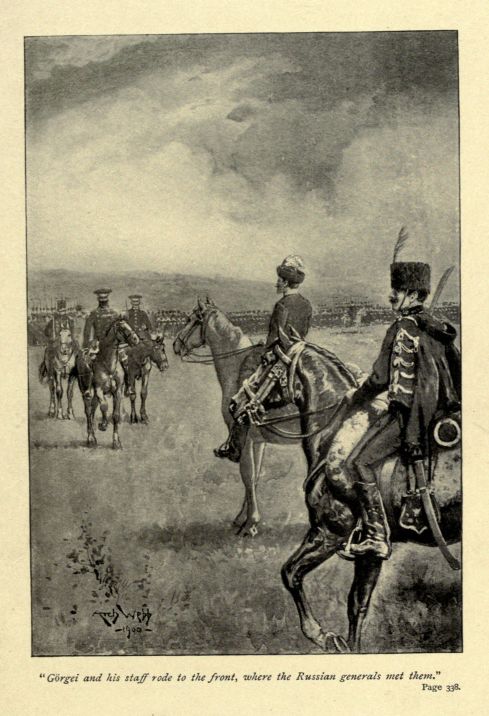
"Görgei and his staff rode to the front, where the Russian generals met them." Page 338]
The two leaders saluted, and then along the whole line sounded the beating of drums.
My eyes ached, my brain grew dizzy, my heart throbbed violently as I strained forward, eagerly watching.
That rolling of drums was the death-knell of all our hopes.
At its signal the Russians presented arms, proudly but not vaingloriously, and then--
There was a low wail, a cry of despair from the spectators, an outburst of grief such as I had never heard, shall never hear again.
Strong men shook with grief, women sobbed as if their hearts were broken, as our gallant infantry laid their useless weapons on the ground, the cavalry on their saddles.
As for me, I crouched low, hiding my face in my horse's mane.
I have known much of happiness since then, but no joy has ever effaced the impression made on that sorrowful day.
Even now, as I sit dreaming many years after the event, the picture rises before me fresh as ever.
With eyes open or shut, I see as in reality the pyramids of muskets; the cannon drawn close together, and without gunners; the dismounted cavalry, with their swords on the pommels of their saddles; the loved flags and standards, that had fluttered so proudly on many battlefields, lying in the dust.
I see the glorious red, white, and green stripes dirty and in rags, and think of the one that wraps all that remains of my gallant brother. I see the thousands of brave men who have fought and bled for Hungary, now disarmed and impotent, but still undaunted even in that hour of bitterness.
Then again the rolling of drums pierces my ears, and I see the breaking of the ranks as the men, under strong escorts, are marched off to their various destinations.
I hear, too, the first whisper, which afterwards swelled into a loud roar, that Görgei is a traitor, and has sold his country to the Russians. My ears burn like fire, and I blush for my countrymen.
It is not given to us to probe the secrets of the human heart, and I was absent from my general in the latter days; but I had marched with him, toiled with him, fought at his side, seen him go again and again to almost certain death, in order to rally his failing soldiers, and I judge a man by his actions.
But my dreams run away with me. I must return to that sorrowful evening of August 13, when Mecsey, plucking at my sleeve, brought me back to real life.
"It's all over," he said brusquely; "and now that the prey is secured, the Austrian jackal will come to pick the bones."
"The Austrians will not dare," I began; but he stopped me with a mirthless laugh.
"Görgei has saved the army at the expense of the officers," he said. "There will be a fine feast of death before long."
These words added to my misery, for I thought of my light-hearted friend Rakoczy, and wondered if he would be counted amongst the victims.
I expressed my fears to Mecsey, who promptly proposed that we should discover where the colonel had been taken.
This, however, was more easily said than done, as we soon found.
Russian troops in charge of their prisoners were marching in all directions, and it was impossible to scan them all.
We went about hither and thither, asking questions of the crowd to little purpose; but at length we had the good fortune to meet with a number of soldiers belonging to the 9th Honveds, who had slipped from the ranks at the very moment of surrender.
They were all looking miserable and dejected; but one, catching sight of me, ran up eagerly.
"From the colonel, sir," he cried joyfully; "though neither of us ever expected I should have the luck to meet you."
He took a folded paper from his pocket, and I pounced on it quickly. Here, no doubt, was the very information we sought; but in this I was disappointed.
The dear, unselfish fellow, indifferent to his own fate, had used the last moments of his freedom to send me a warning.
"Look out for yourself," the note ran; "your name alone will get you into trouble. Give Gyula [that was my home] a wide berth till the wolves are gorged.--J.R."
Not a word either of hope or fear for himself; all his cares were for me.
That was just like "John the Joyous," and my eyes were dim as I placed the paper in my pocket.
The faded characters, barely legible now, meet my eyes as I write; for that scrap of soiled paper remains one of my most sacred treasures, and it lies in a little golden casket on my desk.
"Have you found him, captain?"
The speaker was Mecsey, and when I shook my head sadly he immediately began to question the soldiers.
Here, again, we were at fault. No one really knew where the colonel was, some asserting he had been taken to Gros-Wardein with Görgei, others saying he had gone south with his regiment to Nagy Kikinda.
We spent another hour in questioning various men who had escaped from Vilagos, but could gain no news of the colonel, though several stated positively that the 9th Honveds had marched southward under a strong escort.
Then I held council with Mecsey, and we decided to separate, he to reconnoitre Gros-Wardein, while I followed my old regiment. At the end of a week we were to meet again at Arad, by which time it was likely that one of us would have discovered my missing friend.
"Good-bye, captain," said Mecsey, grasping the hand I held out to him, "and take the colonel's advice. It's easier to get into an Austrian prison than out of one."
"All right, my trusty fellow; I shall keep my eyes open, though I'm not tall enough for the Austrians to cut down."
So we parted, guessing little of the events which would happen before we met again.
Night was fast closing in by now, and in the darkness I missed the bridge over the Maros River, which made me lose nearly two hours, and prevented me from striking the trail of the 9th Honveds.
However, I found the bridge at last, and, crossing to the other side, pursued my way at hap-hazard as long as my horse could keep going; then I sat down by the roadside and waited for the morning.
At sunrise I started again, leading the animal by its bridle, until a lucky chance brought me to a village.
It was a small place, containing not more than twenty houses at the outside; but it boasted an inn, where I might haply procure food for myself and horse.
Four men dressed in peasants' clothes, but having a distinctly military bearing, sat on the "word-bearer"--the bench placed against the wall of most Hungarian country houses--gossiping. At sight of my uniform (for I had unfastened my mantle) they sprang to their feet and approached me with bare heads.
My suspicions were at once verified, and I exclaimed, "You have done well, my lads. A free Magyar is worth more than an imprisoned one. Only, should the Austrians pass through, slouch your shoulders and stoop a little; you bear the marks of the drill-sergeant too plainly."
They smiled at one another, and one taking my horse led it through the courtyard into the stable behind the inn.
Another spoke my name, and though I could not remember their features, they claimed to belong to the old regiment.
He who had attended to my horse was the keeper of the inn, which he now respectfully invited me to enter.
Bidding the others come too, I questioned them concerning their colonel, while the hostess prepared a meal.
Fate was, perhaps, against me, for they could tell little beyond what I already knew.
The 9th Honveds had passed through in the night without a halt, and all the country round was covered with our disarmed troops marching to prison in charge of their Russian captors.
All this they told me eagerly; but as to Colonel Rakoczy they could tell nothing.
Naturally I was much disappointed; but comforting myself with the thought that I was at least on the track of the regiment, I made a hearty breakfast, took a look at my horse, and having sent the men to act as sentries, lay down for a couple of hours' sleep.
At the end of that time my host wakened me, and I rose, greatly refreshed by the brief rest.
My horse, too, was all the better for its food and grooming; and I mounted quite gaily, having first thanked the keeper of the inn for his kindness.
"Take care you don't run against the Austrians, captain," the man answered. "From what I hear, their cavalry can't be far off."
"All right, my good fellow; though they aren't likely to interfere with me."
The innkeeper shook his head. He had little faith in the mercy of the Austrians.
The other men now came to say a word in parting, and then I rode slowly past the little gabled, whitewashed houses, and so again into the open country.
It was a glorious day, and under other circumstances I should have enjoyed the ride immensely; but my good spirits sank at thought of Görgei's surrender, and of John Rakoczy's personal danger.
Everywhere the people whom I met or overtook were ready to answer my questions; but the day ended without my having seen any sign of the 9th Honveds.
From time to time, however, it was told me that the Russians were in the neighbourhood; so towards night I went warily, not wishing to be taken prisoner.
Between nine and ten o'clock I entered the street of another village, and pulled up at the inn--the only house that showed a light.
A huge hound lying in the courtyard barked violently, the noise bringing out several men, who eyed me with suspicion.
Inquiring in sharp tones for the landlord, I ordered him to take my horse to the stables, and without paying any attention to the others entered the kitchen of the inn.
The men followed closely, and by the light of the candles I was able to see the kind of company I had got amongst.
There were six of them altogether, each wearing a cuirass and armed with a pair of pistols; while the room was littered with sharp lances and loaded hatchets.
The fellows stood looking at me with broad grins, as if amused at my surprise; while I, on the other hand, had more than a passing doubt as to what might be the upshot of this adventure.
It would be rather a melancholy end to my campaigning if I were knocked on the head by these "poor lads," as the country folk called the bandits, whose profession my new companions evidently followed.
Thinking the sight of my uniform might inspire respect, I unfastened my mantle carelessly; and, as I had half expected, the men at once assumed a respectful bearing.
"An officer of the staff who has escaped from the Russians!" cried one. "We must tell the chief."
"Where is he?" I asked.
"At supper in the inner room, my master."
"Then tell him Captain Botskay will be pleased to bear him company."
The man knocked at the door separating the kitchen from the next apartment, held a conversation with some one inside, and returned to say that Batori Gabor would be happy to give me greeting.
CHAPTER XXIII.
COUNT BEULA DISLIKES HANGING.
Batori Gabor stood at the door of the inner room, and with the instinctive courtesy of the Magyar bade me welcome.
This famous brigand, who for years had lived an outlaw's life, was tall and strongly built, with massive limbs and deep, capacious chest. His face was bronzed and rugged; his black hair hung in curls over his shoulders; his eyes were dark, fiery, and searching.
He had laid aside his steel cuirass; but a brace of pistols peeped from his richly-ornamented girdle, and I doubted not they were both loaded.
"The Austrians overload me with favours," he exclaimed laughingly. "You are the second guest I am indebted to them for.--Count, I think you said Captain Botskay was an acquaintance of yours?"
Hitherto I had not noticed that Batori Gabor had a companion in the room; now I saw a man in military uniform sitting at the table.
At the outlaw's words he rose, and, turning toward me, showed the blue eyes and handsome, cynical features of Count Beula.
"This is a surprise, count," I said coldly. "I thought a clever man like yourself would by now be over the border with Kossuth."
"How strange!" he answered lightly. "I concluded you had found refuge with Görgei's Russian friends."
"Yet you are both with Batori Gabor," broke in the brigand cheerfully; "which is stranger still, since a month ago either of you would have had him shot like a dog."
"Not I, my dear Gabor," murmured Beula sweetly. "I appreciate your courage too much."
"And my knowledge of the country," added Gabor slyly.
"Well, yes. I think that may be turned to very good account, till Haynau has grown tired of his butcher's knife."
"Which will not be soon. We are, however, keeping Captain Botskay from his supper--an unpardonable offence."
Opening the door, he ordered an extra knife and fork. Then he invited me to sit, saying, "The table's rather crowded, captain; but we have all our courses laid at once. It isn't a banquet, but you'll find it better than black bread and bacon. Help yourself. I can recommend the salmon, because one of my fellows caught it this evening. I fancy the veal has done a breadth or two of ploughing in its time; but the chicken's tender."
The outlaw certainly proved a most attentive and courteous host, and enlivened the meal by relating some of the most humorous and inoffensive of his adventures.
During the war he had turned patriot, and had really done the enemy a great deal of mischief by cutting off convoys and intercepting mounted messengers.
After supper he went to give his orders for the night; and I, not caring to remain alone with Count Beula, borrowed a lantern, and strolled out to the shed which served as a stable.
There were nine or ten horses in the place, and I noticed that saddles and bridles were all hung so that they might readily be got at.
My own animal had received an ample allowance of food, and, after a night's rest, would, I reckoned, be in capital trim.
I might have stayed longer to get a better look at the robbers' horses, but the big dog sniffed so longingly at my legs that I thought it best to remove temptation from his path.
Batori Gabor returned at the same time, and one of the band brought in some wine of a quality rarely found outside a nobleman's house.
"Been to look at your horse, captain?" he asked. "Sensible that, seeing you may have to trust your life to its speed.--Well, count, I think we may reckon on a quiet night. Andras has returned, and says the Austrians are sound asleep.
"I should feel easier if we were twenty miles farther on," answered the count.
"So should I, for that matter; but the horses were bound to have a long rest. Meanwhile we may as well make ourselves comfortable.--Captain Botskay, a glass of wine? By the way, you have not yet told us how you come to be in this part of the country. I should fancy this a very unhealthy spot for persons of your habits of life," and he laughed at his little joke quite pleasantly.
"The tale will not take long in telling," I said. "The general sent me to Nagy Sándor at Debreczin, where I had a nasty knock which laid me up for several days. Then I followed the army, arriving at Vilagos just in time to see the surrender."
"But after that?"
"I started for Nagy Kikinda, where they say the 9th Honveds have been taken."
"Looking for Rakoczy?" asked the count, and I nodded.
"You wouldn't guess what a hero our friend is," remarked the count to Batori Gabor. "He is actually risking his life on the chance of finding out what has become of John Rakoczy, colonel of the 9th Honveds."
"Then you're a very gallant fellow, Captain Botskay," said the outlaw; "though I must stop you from playing such a mad prank. Do you know that every road in your path is barred by Austrian troops? You cannot possibly get past them; and if you could, the journey would be useless."
"Still, I intend trying."
Batori Gabor shrugged his shoulders. The count laughed in the sneering manner which always made me anxious to pitch him out of the window.
"You must be fonder of a hempen rope than I," he said; "but perhaps your name isn't on the proscribed list?"
"I don't know."
"Well, mine is."
"And mine," laughed Gabor. "It's been there for years. It doesn't hurt me in the least. I look on it as an honour."
"Every man to his taste," said the count. "I have no fancy to die in a hempen collar. I am no coward, but the thought of being hanged like a dog by these Austrian butchers puts me in a bath of perspiration."
"You came pretty near it yesterday."
The count shuddered.
"Don't," said he; "it gives me an ague fit to think of it."