Front matter (continued 4)
Reading edition
The count nodded to us all very politely, and, seating himself at the next table, ordered wine for his company.
Whether the man really meant to create a disturbance or not I cannot say, but, filling his glass, he cried, "Here's to the Hungarian republic!"
His friends drank their wine and applauded boisterously, while Stephen, springing to his feet, exclaimed in ringing tones,--
"Gentlemen, this is a free country. Let us drink our own toast, 'Hungary and the constitution of '48!'"
"Bravo!" I said, feeling compelled to back him up, though not desiring a quarrel. "That is what we are fighting for."
"And more than we shall get," added the colonel good-humouredly.
"Thanks to Kossuth's meddling!" said Stephen. "If he had left the general alone, we should be over the frontier by now."
"The young man carries messages for Görgei," the count explained to his associates in a tone of amusement. "That is how he comes to know so much about fighting."
"Even that gives more training than talking rubbish in a back room," I put in hotly, thinking of the scene at Vienna.
"Perhaps the count has come out of his shell since then," said Rakoczy, with a merry twinkle.
"It must have been to get into a safer one," exclaimed Stephen contemptuously.
The quarrel, like a fire, once started, blazed furiously, and but for a shaggy-haired German, we should speedily have come to blows.
He was puffing vigorously at a tremendous pipe, and, coming through the dense volume of smoke, his voice sounded like a fog-horn.
"Ach!" he grunted, "the quarrel is stupid; let it rest. The count has made his reputation with General Bern; he can afford to laugh. As for the boys, they seem very nice boys--ach!" and the oracle faded behind a cloud of smoke of his own construction. This was like a douche of cold water on the fire; but though the flames were put out, the embers smouldered, and presently sprang into a fresh blaze.
I hardly know how it happened, but the conversation once more turned upon the siege of Buda, and Stephen maintained, quite rightly, as after events proved, that even a successful assault must be attended by immense slaughter.
"The boy speaks sense there!" growled the smoke-hidden Teuton. "I know Hentzi well; he's just the man to strike hard and to strike often."
"Well, well. Our young friend need not be afraid," broke in the count sneeringly. "We shall find men stout-hearted enough to storm the breach when it's made."
"I do not fear for myself," Stephen answered proudly.
"No, no," said the count, laughing insolently. "It isn't likely, since you won't be there till the danger's over. Most men are brave enough when they haven't to do the fighting."
"Perhaps," said I quickly, stopping an angry outburst from Stephen, "that accounts for your coolness."
"A good thrust, my boy," said the benevolent Teuton.--"Count, he had you there."
Count Beula laughed again, showing his white teeth, refilled his glass, and answered brightly, "The thrust was parried before it was delivered. I have already been named as the leader of one of the storming parties whenever a breach is practicable. Kossuth's friends fight as well as talk."
"They do more than their leader then," said Dobozy, who formed one of our party.
The count's statement fell on me like a thunderbolt. I had thought him an arrogant, conceited fellow, having nothing of the soldier about him but his uniform and his swagger, yet here he spoke calmly of leading a forlorn hope.
He saw his triumph, and glanced at us, but particularly at Stephen, with an insolent patronage for which I could have kicked him.
"Oh no," he said loftily, in answer to a remark from a companion; "I take no merit for it. The opportunity offered, and I accepted--nothing more. Of course our young friend has his fixed duties, otherwise we might have seen him at the breach."
The words were simple and harmless, but the sneer was so open that it could not be mistaken, and my brother's face flushed crimson. "And so you shall," he cried hotly. "I cannot claim so high an honour as Count Beula, but I can and will enter the fortress as soon as he."
The count smiled, drained his glass, rose to go, and then, looking round at the company, said pleasantly, "A challenge before so many witnesses must be accepted; but"--maliciously--"perhaps before Görgei's guns have made the breach our young friend will have had time to repent his hasty words."
Then he and his friends went out, and left us looking at one another gloomily.
"What's the matter, George?" my brother asked gaily. "One would think I had been condemned to death."
"Not at all," I answered, shaking off my gloom. "I was only thinking how we were deceived in that fellow. Fancy Beula at the head of a body of stormers!"
"It will be a night attack, so perhaps he'll lose his way in the dark," my brother answered, and later on the words acquired a strange significance.
"How you youngsters chatter!" exclaimed Rakoczy cheerfully. "The place hasn't been summoned yet, and Hentzi may surrender."
This, of course, was possible, though not probable, and the very next day the idea had to be put aside altogether.
"The emperor, my august master, has entrusted to me the keys of Buda; I will return them to him alone. Meanwhile my honour and my duty command me to defend the fortress, and I will do so to the last man. Should the twin cities perish in the conflict, I declare you responsible for their ruin. I appeal to God, my right, and my sword."
That was Hentzi's reply to the summons to surrender, and I could not but admire the writer of it.
"Brave words these," said Rakoczy, "and he's a brave man if he makes them good, though I don't exactly see why he should bombard Pesth, when our guns will be on the Blocksberg."
It was the fourth of May when the answer came, and Görgei, who had established his headquarters at Schwabenberg, immediately gave orders for the beginning of the siege operations.
For the next week the fighting was mainly confined to outpost engagements, in which our regiment had little share; then the batteries were opened between the Stuhl-Weissenberg and Vienna gates.
This being the weakest part of the defence, Hentzi had strengthened it with twenty-five guns, which thundered away at our artillery day and night.
For the greater part of another week the terrible cannonade continued, and as we lay on the hillside we saw with intense grief the beautiful twin cities wrapped in flames.
During the second week we had much more of Stephen's company than usual, and I heard with regret that the general had given him leave to volunteer for the attack.
He rallied me on my sober looks, saying it was no more dangerous for him than for me, as the 9th Honveds were to form one of the assaulting columns.
It was the evening of May 17, and several officers, including Stephen, were watching the heavy guns at work, when Count Beula came up.
The story of the quarrel in the restaurant had spread widely, and the officers waited with much curiosity to see how the meeting would go off.
"Well," said the count, bowing all round in his finicking way, "I hear that the breach is nearly practicable."
"We shall most likely start in a few hours."
"Then you have not drawn back?"
"My place is with the first column," said Stephen calmly.
"Ah! I lead the fourth. I am going now to see the general, but, as you say, we shall meet in the fortress," and he lounged off.
As the count had stated, the breach was considered practicable, but the great guns thundered on, doing as much damage as was possible before the assault took place.
Our regiment, being the farthest off, was to start first; but the evening wore away, and Rakoczy had not received any definite orders.
Always careful of his men, he made them turn in early; but we officers sat or stood about in groups, talking over the chances of the coming assault.
It was nearly midnight when Stephen, who had been sent for by the chief, returned, and we crowded eagerly round him, anxious to know what had been decided.
My brother first delivered his message to the colonel; but as no secret was made of it, we soon learned that the assault was fixed for the first streak of dawn.
Several of the officers now went to get an hour's rest, but Stephen and I passed the time with the colonel, who maintained a cheerful conversation.
Just at the last he left us alone, and it was only then I discovered the real state of my feelings.
Stephen, too, was much affected; but he carried it off well--not lightly or vaingloriously, but as a brave lad should.
I thought, and think still, he was greatly to blame for getting into such a scrape; but no one could blame his conduct afterwards.
"Let us say farewell, dear old fellow," he whispered, "in case one of us should not return. If I fall, remember you are the head of the Botskay family, and that our father died fighting for his king."
"I don't forget; and if my time has come, take this ring and portrait to the ladies at Vienna, and say a word of farewell to the fräulein."
At this he threw off his grave air, and joked me pleasantly, so that when the signal was made to fall in, we took our places in quite a cheerful humour.
My brother, of course, went with the stormers, while we followed closely in support.
It was still dark, but we trusted the guides to keep us straight, and calculated on arriving at the breach as soon as dawn broke.
No one spoke, and hardly a sound was heard as the column wound its stealthy way along.
By this time the cannonade had ceased, and it seemed also as if the sorely-harassed garrison had ventured to take a short rest. Tramp, tramp, we marched along, pausing at intervals to give the rear of the column time to close up.
The men with the scaling-ladders were out of sight, but we kept on in the weird and eerie darkness, expecting every moment to see the flash of the rockets, and to hear the thunder of the guns.
All was, however, silent, and I wondered we had come across no sign of the other columns.
I don't know why it should have done so, but the truth suddenly flashed into my mind--we had lost our way.
I spoke to the colonel, and it was obvious he shared my opinion.
"Yes," said he quietly. "We certainly ought to be in touch with them by now. Run forward and question the guides."
I did so with difficulty, but might have spared myself the trouble. They had lost their heads completely, and were painfully groping their way, now in this direction, now that.
Remembering Stephen's scornful words about Count Beula losing the route in the dark, I dared not speak to my brother, but hurried back to Rakoczy.
I had barely told him the story, when far on the left the guns roared out. Bright flashes of flame leaped from their muzzles, telling us that the garrison was on the alert, and that we were not at hand to help our comrades.
I hardly heard the colonel's orders. My head was in a whirl. I walked or ran just when and where the others did, wondering all the time what Stephen would do.
What a triumph for Count Beula!
Hitherto I had feared for my brother's life; now I would have cheerfully laid down mine that he might have a chance of risking his. Guided by the flashes of light and the sound of the guns, we ran on, hoping we might yet be in time to strike one blow.
The dawn was breaking; we could see our way more clearly, and were getting near enough to hear the shouts and cries of the combatants.
"Forward, my brave lads! forward!" I cried excitedly. "We shall do it yet!" But alas for my hopes! Suddenly there came a wave of cheering, and then, as if to herald the first pink streak of the opening day, the triumphant notes were heard of a song well known to most of us. The attack had failed. The victorious garrison were jubilantly singing the Austrian National Anthem, "Heil, unser Kaiser, heil!" as our three shattered columns hastily fled.
Seeing that for the present all was lost, Rakoczy halted his column, and in shame and confusion we retraced our steps.
Really it was a fortunate circumstance we had thus blundered, as the breach was not fit, and the scaling-ladders had been found too short for their purpose.
Our comrades, whose losses were enormous, had struggled gallantly, and by common consent the bravest man among them was Count Beula.
Everywhere we heard the most marvellous tales of his daring and recklessness. He had fought in the very front, had cheered his men again and again to the attack, and, while they fell around him in scores, had himself remained unharmed.
He had not got his foot inside Buda, but his reputation was established, and it was acknowledged he had made his vaunt good.
Rakoczy, who knew how terribly my brother suffered under what he deemed a disgrace, tried to cheer him.
"Don't fret about it, my boy," he exclaimed brightly; "'twas not your fault. The count had the luck--that's all. No one who knows you will question your courage."
"It's very kind of you to speak like that," my brother replied, "but all the talking in the world won't alter the facts. Perhaps I shall feel better after the next attempt."
"There's no need to try again," I said stoutly. "You did your best, and can't be blamed because the guides missed the route."
"Do you think I will let a shadow of reproach rest on our name?" he said. "Don't try to turn me, George; it is useless. My mind is made up, and, with or without the general's leave, I mean to take part in the next assault."
The colonel signed to me to let the subject drop, which I did, and presently we all sat down to breakfast.
After the meal and an hour's sleep, Stephen said he must report himself to the general, and Rakoczy made an excuse for us to go with him.
"He may drop across Beula," whispered the colonel, "and if we're there the meeting will be less awkward."
Rakoczy guessed rightly. We found the count near Görgei's tent, the centre of an admiring group of officers, to whom he was relating the events of the previous night.
He carried himself with his usual swagger, and catching sight of us, cried jovially,--
"Ah! here comes my young friend who lost his way in the dark."
There was a laugh at this, which made me hot and angry; but Stephen's behaviour was, to my thinking, admirable.
His face was very white, and his lips twitched a little, but he spoke quite calmly.
"Count Beula," he said, "permit me to add my congratulations to those of your brother officers. What you did last night will never be forgotten by this army. We are not good friends, you and I, but that doesn't prevent me from admiring your bravery. Last night I failed to keep my promise; next time I may be more successful."
"Well spoken!" said Rakoczy, and a familiar voice behind us echoed the words.
The second speaker was Görgei himself, who had come from his tent in time to hear what was said.
The count smiled, showing his white teeth.
"Captain Botskay must have been terribly annoyed at finding himself out of reach of danger," he said sweetly.
Here again it was impossible to take offence at his words, though they might, and most likely did, convey a false meaning.
Görgei, however, came handsomely to the rescue.
"It would be something of a novelty," he said bluntly. "I doubt if he has been out of danger before since the war began.--But I say, colonel, somebody made a horrible mess of it last night. You'll have to put your fellows in the front next time."
Rakoczy saw his chance of getting in a counter-stroke on the count, and seized it.
"Yes," he said, smiling pleasantly, "I was afraid the affair would fall through without us, though I hear Count Beula did not fail through want of trying."
"There's praise for you, count!" cried Görgei with a broad laugh. "But we'll have another try soon, and then, if you don't succeed, I'll lead the stormers myself.--Captain Botskay, you're just in time to take a message to Pesth;" and he carried Stephen off to his tent.
The colonel and I stayed awhile chatting, but not being over fond of the count's company, we took the first opportunity to go.
As soon as the wounded were brought in, the gunners resumed the bombardment, while Hentzi, on his side, not only replied to our fire, but sent hundreds of shells hurtling across the water into the town.
Stephen told us that the state of the city was pitiable. Whole quarters had been destroyed, and hundreds of people, not only homeless but in imminent danger of their lives, were camping on the Rakos, whither they had carried the wounded soldiers, both Hungarian and Austrian.
Meanwhile Görgei thundered day and night at the walls, while the stout-hearted garrison worked like slaves, repairing the breaches, erecting breastworks, and doing everything possible to strengthen their position.
All the officers who were not of Kossuth's party grumbled openly at this waste of time and loss of valuable lives; but since the fortress had to be taken, every one felt the sooner the better.
During the evening of the twenty-first of May we marched to the trenches and lay on our arms, once more waiting for the signal to rush forward.
"The general means to get in this time," said Rakoczy. "There are nearly twenty thousand of us, all told, in the trenches."
"He can't afford to risk a second repulse," remarked my brother, who, in spite of all our efforts, had insisted on joining us. "By the way, Aulich has driven the Austrians back to Presburg."
"But for this folly we should be under the walls of Vienna now."
"What time is the attempt to be made?" I asked.
"Midnight, I believe; so we've some time to wait yet."
After that, relapsing into silence, we sat in the gathering gloom, each busy with his own thoughts; and sad enough mine, at least, were.
CHAPTER XV.
HOW STEPHEN CARRIED THE FLAG.
"George!"
"All right, old boy," I answered in a whisper, rubbing my eyes. "I believe I've been asleep."
"I'm sure you have. But wake up now; the word to be ready has come."
At the very moment of waking I knew something was wrong, but it was not until my brother spoke the second time that I remembered where we were.
By some odd chance I had been dreaming of the years gone by, when Stephen and I were merry children playing in the old home at Gyula.
The past had returned to me so vividly--the sound of my father's voice, the picture of my mother's beautiful face and loving smile--that even now I could scarcely grasp the truth.
I had forgotten all about the cruel war, the trenches, the coming assault, and the near danger of death, so that the shock of awakening unnerved me for the moment.
The word had come! What word? Where was I? Ah! my memory returned with a rush, and I sprang to my feet.
"Steady, old fellow," said my brother cheerfully; "we mustn't make a noise yet."
I pressed his hand and whispered,--
"I had forgotten. I was dreaming we were children at home again."
"Don't, George; you hurt me," said he sharply, as if in pain, though I only pressed his hand gently.
It was past midnight, and the men were in their places, while the bands stood massed behind the lines.
The colonel came to us, and shook each by the hand.
"One never knows what may happen," he said. "There will be a fearful struggle. After Görgei's words the other day, my regiment can't go back; so, in case of accidents, you know--" And he shook our hands again.
Rakoczy seemed much graver than usual, but I think he was filled with pity on his men's account.
Stephen was, on the contrary, much more cheerful.
"George and I had a solemn leave-taking the other night," he said gaily, "and yet we didn't see a shot fired."
"Ah!" exclaimed the colonel, responding to his humour; "we have no chance of missing our way this time."
He moved off to his place, and again all was still.
The silence and the darkness got on my nerves. I dreaded yet longed for the signal at the same time.
We did not see the count, but he had sent a sarcastic message to Stephen during the evening, appointing a meeting inside the fortress.
I leaned on my sword, staring into the darkness.
"Dreary work this!" exclaimed a voice in my ear, and Dobozy joined me.
Like the rest of us, he looked forward to a terrible slaughter, and had come to say a word of farewell.
"I hope we shall soon go," he continued, after a pause; "the men are getting nervous."
"The general's keeping up a tremendous cannonade," I whispered. "The guns must be nearly red-hot. Why, it's actually getting lighter."
"Nearly two o'clock," said Stephen. "I suppose the general's been waiting for the engineer's report."
Dobozy left us, and we resumed our watching.
Although two-thirds of May had run out, it was bitterly cold in those early morning hours, and several times I shivered violently.
The night was passing, and we could now see our own men, the still shadowy outlines of surrounding objects, and the ramparts of the fortress.
At length the moment arrived. A flight of shells and fiery rockets went hissing and trailing over the stronghold; our men changed from figures of shadow-land into beings of flesh and blood; a hoarse whisper of command circulated through the trenches; the massed bands stationed behind broke into soul-stirring music; almost without knowing it we were advancing. Stephen, with a last hand-shake, a murmured good-bye, darted to the front. I headed the company; Rakoczy, to whose eyes the sparkle had returned, led the regiment.
We moved forward unopposed; Hentzi was saving his ammunition.
Of the conflict to the right and left I am not competent to speak; I know only the doings of our own regiment, and of the battalion led by Count Beula, which chance or fate brought close to us.
Concerning the Austrians, or rather Croats, who held the fortress, it would be unjust to attempt to belittle their stubborn bravery. At the beginning of the siege General Hentzi had made a proud boast, and no man ever fulfilled a vaunt more truly.
As the men with the scaling-ladders ran to plant their burdens, the great guns of the fortress boomed out, and instantly the place became like a babel.
Cries of rage and pain rent the air, almost drowning the rattle of the musketry and the roar of the cannon.
Through the smoke-cloud that shut out our view the white flashes pierced more and more quickly, as if the artillerymen were not giving themselves one moment's breathing space.
A man at my side exclaimed "Oh!" in a surprised sort of way, and dropped, while I barely understood he was dead.
A few paces farther a bursting shell knocked over half a dozen.
We were rapidly approaching the thick of the firing.
"Forward! forward!" cried our colonel cheerfully. "The safest place is at close quarters."
I remember laughing to myself and thinking it would be even safer at Debreczin with Kossuth and the members of the Diet.
Bang! bang! The firing grew heavier, and our losses more considerable; but, as Rakoczy had said, there was no retreat for the 9th Honveds.
After the mess we had made of it before, we were bound to get inside the fortress--that is, if any of us survived to reach the walls, which seemed doubtful.
Meanwhile most of the ladder-men were dead or disabled. The stormers had taken their places, and were trying to rear the ladders against the ramparts.
Stephen was with them, his face aflame, his eyes burning with excitement.
We were quite near when he got one planted, and instantly began to climb.
The light was breaking now, and our fellows cheered madly as they beheld the lithe, graceful figure springing to the top.
A group of Croats, led by an officer, waited patiently with bayonets fixed, and I groaned at the thought of what must happen.
Inspired by his example, the men crowded behind him eagerly--too eagerly, as it proved; for the ladder, groaning and creaking beneath their weight, snapped off, and the whole party dropped with a crash to the ground.
Several never moved again, and I must confess I hoped Stephen was hurt, since it would save him from a sadder fate. To our astonishment, however, he jumped up from the wriggling mass, and was soon cheering on the survivors to fresh efforts.
A loud shout on the left proclaimed that something of importance was happening there, and then it was I beheld Count Beula.
The Croats were yelling with savage joy. Out of a dozen ladders not one remained upright, and the remnant of the assailants was in retreat, with the exception of the count.
I always disliked the man, and indeed to this day I hate him, yet I must admit that here at Buda and elsewhere he proved himself a first-class fighting man.
He stood now alone, save for the dead and wounded; but though the bullets fell around him fast, he never budged an inch.
The distance was too great for me to see his face clearly, but I felt quite sure his lips were curled in a sarcastic sneer.
Enemy of mine though he was, I cheered with the rest when, as if tired of waiting for the runaways to come back, he coolly advanced alone.
What occurred next, or who induced the battalion to return, I cannot say, as the colonel immediately gave the signal for the assault.
The men responded with a cheer. They burned to be on the walls, where they could meet the defenders on more equal terms, and the regiment bounded forward like one man.
Now, too, I missed Stephen, for the fighting became so fierce and confused that it was impossible to see anything beyond what took place close at hand.
The fire from the great guns continued steadily; but it was less violent, and we afterwards learned that three of the pieces had blown up.
The bullets, however, rattled down faster than ever, and man after man fell.
The rest of us rushed on. We were at the breach. Already some of the stormers were entering, and my heart leaped to my mouth as I saw Stephen foremost.
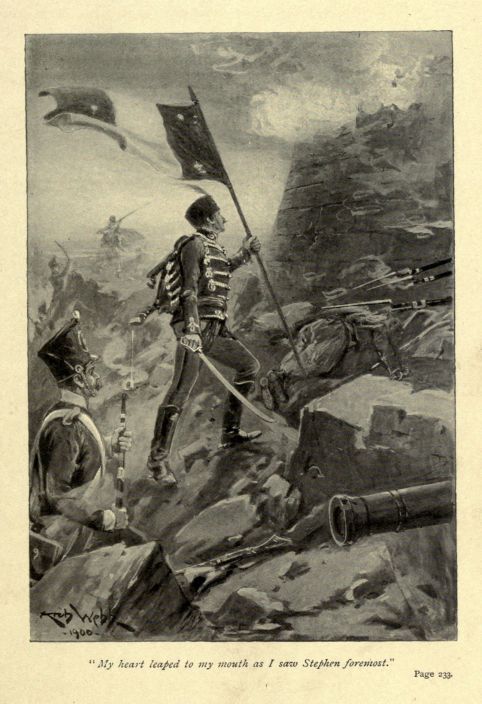
"My heart leaped to my mouth as I saw Stephen foremost." Page 233.]
Plainly he was determined that the count should have no cause to crow over him this time.
I caught a brief glimpse of Rakoczy. He had been hurt, but his voice was still cheerful as he encouraged his men forward.
On and up we went, sometimes packed together, then separated into small groups, while frequently one of the foremost came crashing backward, falling at the foot of the battlements.
Though numbers dropped, the survivors pressed on doggedly. Whatever our loss, every one knew now that the assault must prove successful.
Vainly the Croats poured in their murderous volleys; they could not keep us back. We were getting into close touch with them, where steel would take the place of lead.
I was a short distance behind the colonel when he suddenly paused, waved his sword, and cheered vigorously.
The Honveds took up the cry, and the sound of their voices drowned all else, while I stood spell-bound.
The first of the assailants had put foot inside the fortress; the first Hungarian flag fluttered on the ramparts.
For one moment I was the proudest, as I was soon to be the most miserable lad in Hungary; for the flag belonged to the 9th Honveds, and the soldier guarding it was my brother.
"That's one better than Count Beula!" shouted Dobozy, when another cheer arose. A little to the left the count appeared--the second to mount the walls.
Perhaps I lost a second--not more--enjoying my triumph; then I shot past the colonel, and reached my brother's side.
He had already received several hurts, but was still gallantly holding his ground against long odds, when I joined him.
"Bravo, old fellow!" I cried, parrying a fierce thrust from an Austrian officer.
"It's all right now, George! I beat him!" he shouted.
At the same moment a savage-looking Croat sprang at him; but there was the rapid gleam of a bayonet, a sharp cry, and the fellow fell dead.
A swift glance showed me Mecsey Sándor, who throughout the fight had, as usual, followed my steps like a dog.
Every moment now strengthened us, while it weakened the enemy, who, seeing this, made a desperate effort to hurl us back before the rest of our forces arrived.
A tall, fine-looking veteran, with huge snowy moustaches, led the charge, cutting his way almost to the walls.
The others were beaten off; but they came at us again and again, till scarcely a single officer remained alive to lead them.
It was cruel work, and I rejoiced with my whole heart when at length the brave fellows, overwhelmed by numbers, sullenly gave way.
Stephen, forgetful of his wounds, leaped forward with the flag, and we all followed, panting like hounds with the quarry in sight.
Count Beula, who had fought his way well to the front without receiving a scratch, ran with the main body; but in front of every one was my brother, with Sándor and myself next, and the wounded Rakoczy a foot or so behind.
The flag danced and waved in the reddening dawn; then suddenly it fell, rising again the next instant as proudly as before, but now, alas! stained with newly-shed blood.
The Croats, as if ashamed of retreating--though they had little cause for shame--once more drew together, and those who had loaded rifles fired into the midst of us.
A few men fell, but they were mere drops in the ocean. The crowd closed up solid and compact as before, and it was seen that the enemy had made their final effort.
A wild cheer greeted the hoisting of a white flag on the summit of the citadel; a wilder one still was raised when Stephen planted the glorious red, white, and green colours beside it.
My loved brother stood there a few moments, his face white, save where the red blood trickled, his eyes bright and burning, his bearing proud and defiant.
But, alas! I saw that he held the staff with effort, and, climbing up, was just in time to catch his swaying body as it fell.
"Dear old George!" he murmured, "I meant to do it, and succeeded."
Then his eyes closed, his head sank, and I laid him gently on the ground in the shadow of the flag he had borne to victory.
The noise of the conflict ceased. The Croats, yielding their arms, were granted quarter, and marched off as prisoners. Buda was ours!
I heard later how fearful the struggle had been. Of the twenty-five guns near the breach but one remained of service, and near the spot where we forced an entrance lay a group of no less than thirty-six Austrian officers.
The foremost was Hentzi himself, who, in the very front of the fight, had gained imperishable renown, both for himself and the flag he had so stubbornly defended.
Many hard words had been said of him when, lying out on the hillside, we had watched our beautiful Pesth half ruined by his artillery; but he had fought and died like a brave soldier and loyal subject of his emperor.
These things were far enough from my mind on the morning of the storming; in fact, I forgot all else in tending my wounded brother.
Several men came and looked at him sorrowfully. Rakoczy was one, I know; and I believe, but am not sure, that one was Count Beula.
Then a little group approached, the leader being a surgeon, who stooping down shook his head in grief.
The others brought water and bandages, and he washed away the blood, leaving the face wan and colourless. Then he loosened my brother's jacket, uttering a hasty exclamation at sight of something beneath.
I sat stupid with grief beside the wounded lad, nothing rousing me till I beheld the closely-cropped hair and rugged features of General Görgei.
"My poor boy!" said he, in a tone soft and caressing as a woman's. "Stephen, don't you know me? I am Arthur Görgei. Look at me, my dear young friend," and he gently chafed my brother's hand.
At the general's words Stephen opened his eyes, and looked at Görgei with a feeble smile.
"It's--all--right--general," he murmured very softly, and his eyes closed again.
Görgei stooped and kissed the boyish face tenderly.
"As gallant a youth as ever fought for Hungary, and worthy of his honourable name!" said he with deep feeling.
Then, turning to me, he spoke some kindly words, and, having questioned the surgeon privately, went his way.
The master of legions has little time for private griefs; and indeed this visit to my brother, taking place as it did before anything else was done, furnished matter for much talk in the army.
When the general had gone, the surgeon came to me. He had a pleasant face, and the horrors of war had failed to blunt the natural kindness of his heart.
"Captain Botskay," he began, "this is a very sad event; but you must be brave, and nerve yourself to bear the blow. Your brother is seriously hurt--so seriously indeed that I dare not venture to move him."
"Do you mean he is dying?" I asked hoarsely.
"One ought never to despair," he answered; "and yet I cannot hold out false hopes to you. Only a miracle, my poor boy, can save your brother's life. I have done what I can for him. He is not in pain, but his wounds are fatal. It may not be for an hour or two, but certainly he cannot live through the day."
"Thank you," I said simply, turning again to my task of watching.
At the end of an hour some one placed an open flask in my hand, saying, "Drink, my sweet master; it will keep up your strength."
It was Mecsey Sándor who had brought me food and drink.
I shook my head.
"I cannot take it," I said.
The faithful fellow insisted.
"You are weak, my sweet master," he urged. "In a little time you will become faint for want of food, you will grow delirious, and perhaps just then the captain will ask for you."
I stretched out my hand for the food eagerly, alarmed by Sándor's suggestion, as the worthy fellow intended I should be.
It must have done me good, though I ate and drank mechanically, hardly knowing, indeed, what I did.
The morning passed very slowly. Twice the kind-hearted surgeon returned; but, as he had said, nothing could be done--we had only to wait for the end.
Towards the middle of the afternoon I discovered Rakoczy standing near me.
He had been badly wounded, and his proper place was in the hospital; but, like a stanch friend, he had come directly his hurts were dressed to share my grief.
"Is there no hope?" he asked.
I shook my head. "The surgeon says he will die before the day is out."
"Poor old Stephen!"
That was all--not a long rigmarole of words, but just a few that came from his heart.
Then we sat and watched the dying lad in silence. Even now the pain I felt was more like that caused by a horrid nightmare than by a proper understanding of the truth.
Could this swathed and bandaged figure really be my bonny brother--he who so short a time back was full of life, and hope, and energy?
So motionless he lay, so still, that I frequently pressed my lips to his to find if he still breathed.
Had it been possible, I would willingly have changed places with him; for Stephen had ever been the object of my fondest love.
"George!"
The sound almost brought the tears to my eyes, it was so feeble, and recalled so vividly the memory of our childhood.
I gazed lovingly into the dear face, already taking the hue of death.
"I am dying, George, but don't grieve for me. With a good conscience, death is not hard, and I have tried to do my duty. Our father is smiling on me, and I am content. Is that Rakoczy? Dear old friend! True as steel! Is it evening? My sight is dim. Closer, brother; let me feel you. Ah!"
I thought he had drawn his last breath, but presently he rallied.
"Rakoczy," he said very feebly, "good-bye! Tell the general. Remember me sometimes. What's that? John, you are weeping! 'John the Joyous' in tears--and for me? Good-bye, brother; God bless you."
I placed my arm tenderly round his neck, and kissed him. I could not make answer in any other way; the words choked in my throat.
Just at the last he whispered,--
"George, stand by Görgei. He is the true patriot."
As we bent over him, he smiled at us with infinite tenderness; then his eyes closed, and his breathing became hard; he tried to speak, but only one word escaped his lips, and that so faint we could not tell if it were my name or the general's.
Rakoczy touched my arm.
"God has taken your brother to Himself!" he exclaimed solemnly.
I heard him in a dazed way, and with true thoughtfulness he retired, leaving me alone to battle with my grief.
I will not dwell upon the despair that wellnigh overwhelmed me. There are secrets of the heart that one does not betray even to the dearest of friends; but all who have lost some loved one will readily enter into my sufferings.
When Rakoczy returned, I wiped away my tears and stood up, ready, though my heart was nearly breaking, to act in a manner worthy of him who had gone from me.
The general, who, since the opening of the campaign, had grown very fond of my brother, gave orders that he should have a grand military funeral, and assisted at the ceremony himself.
We wrapped the dead lad in the flag he had carried so bravely to the front, and buried him on the very spot where he fell.
They told me afterwards that Count Beula was there to show respect to his late opponent; but I did not see him, and had no wish to do so.
I cannot pretend that Stephen was blameless in the matter, but, rightly or wrongly, I looked on the count as being partly responsible for my brother's death, and hated him.
The last volley was fired, the band struck up a spirited air, the troops marched off the ground, and after a while I was left alone to indulge my grief at the side of the newly-made grave.
CHAPTER XVI.
I JOIN THE STAFF.
The fortress of Buda fell on the twenty-second of May. It was now the fifth of June, and the twin cities, though sorely scarred by the terrible bombardments, had dressed themselves in gala costume.
All the troops--the 9th Honveds amongst them--stationed in the two towns were assembled under arms; and the men of the artillery on both sides of the Danube stood to their guns.
A glance at the streets, however, showed that the citizens did not anticipate any fighting.
The scene was a most animated one, and under happier circumstances I should doubtless have enjoyed the brilliant spectacle. Hundreds of gay flags--the red, white, and green stripes predominant--fluttered from the cupolas of the buildings; arches of garlands stretched across the streets; the people, dressed in their best finery, and many of them carrying splendid bouquets, promenaded to and fro, or occupied good positions from which to view the coming pageant.
All along the route from the railway station the windows were crowded by richly-dressed ladies and children, craning their necks to catch the first sight of the hero.
As our regiment marched to take its place, I could not help thinking of the many ruined families and the hundreds of wounded soldiers to whom this pageant must seem little more than a hollow mockery.
"I don't think this triumphal entry shows good taste on his part," I remarked to Dobozy, after we had halted.
"Suit him capitally!" declared he. "It's just like a stage-play. Did you hear how he is coming from Szolnok?"
"By rail, I suppose."
"Yes, and in the emperor's private carriage. Anything's good enough for a thorough-paced republican."
"I suppose his wife accompanies him?"
Dobozy laughed and said we should see.
Suddenly the guns roared out their brazen welcome; the people, waving their flags, cheered loudly; the bands played Rakotzy's patriotic march, and a company of guards issued from the station. Then the cheering became louder and wilder, and shouts of "Elijen Kossuth!" rose as Count Karoly's handsome chariot, drawn by four magnificent Hungarian horses, made its appearance. In it, his head crowned with laurel, sat the observed of all beholders, Louis Kossuth, Dictator of Hungary, and on his right a tall, haughty-looking woman with black hair and eyes, pointed nose, long chin, and regular mouth.
This was the dictator's wife, Madame Theresa Kossuth, and I thought, though perhaps wrongly, that the light in her eyes was one of satisfied pride.
Behind the chariot rode a long line of Magyar nobles, making a brilliant show in their national costume, though, for the country's sake, I would rather have seen them at the front in simple uniform.
As Dobozy truly remarked, patriotism required very little sacrifice if it was satisfied by riding about the streets of the capital in gala attire.
However, the procession passed, the hero was withdrawn from sight, and we were at liberty to return to barracks.
The festivities continued all day, and in the evening the city was illuminated in honour of the dictator.
"Foolish people!" said the colonel sadly, as we strolled along the river-bank that night. "One would think, to see their transports, that the war is over, while it is really only beginning."
"I can't understand why the general doesn't make a forward move, and drive the enemy out of Presburg."
"Because he's waiting for ammunition and men," put in Dobozy, who was walking with us. "I saw Juranics yesterday--just come from the front, wounded in some outpost affair, I believe. He says only half the recruits have been sent on, and they don't even know their drill. Besides, they haven't any weapons, if they knew how to use them. Lively sort of army, eh? Juranics said plainly he believed Kossuth's party was jealous of Görgei's success."
"They're afraid he'll topple their brand-new republic over," said the colonel; "which is just what he would do if the Austrians were cleared out. However, it's too late now. While we've been wasting our time, the enemy has been getting ready."
"They say we shall have 160,000 Russians, besides the Austrians, to tackle."
"That's so," replied the colonel cheerfully; "while we are split up into two factions, each fighting for a different object."
Matters were, indeed, in a more desperate state than we thought. The Austrians, thoroughly frightened for the safety of the empire, had begged the assistance of Russia.
They had already twice changed their chief, and were now led by Baron Haynau, an officer who had won distinction in several campaigns, but whose name was hereafter to be linked with acts of savage cruelty against which all Europe cried out in horror. He was now at Presburg with 60,000 men, waiting for the arrival of a veteran Russian division, which had been dispatched to his assistance.
The principal Russian army, 76,000 strong, and led by the famous field-marshal, Paskewitch, was in Galicia, ready to descend on Central Hungary by way of the Carpathians. A third Russian army was to invade Transylvania, while Jellachich covered Croatia.
However, there were gay doings in Pesth for one day at least, and when we turned in at night the city was still en fête.
I think it was the third evening after Kossuth's triumphal reception when the colonel sent word that he wished to see me. Being off duty, I returned with the messenger, little dreaming how great a change in my prospects the next half-hour would produce.
"Come in," cried Rakoczy pleasantly, as I knocked at the door.
He was standing by the window overlooking the barrack-yard with another man, whom I immediately recognized as Görgei.
"All well?" cried the general genially, stretching out his hand. "That's right. Bit tedious hanging about Pesth, eh?"
"I think we should all be glad of a change, general."
"You'll all get one soon, when the white-coats drive you out, and even then you'll grumble--eh, colonel?" and he gave Rakoczy a playful dig in the ribs.
"We'd much rather help you get inside Vienna," replied the colonel.
The general's smile vanished.
"Too late!" he said shortly. "That should have been done a month ago. Take my word for it, old comrade, the game is lost; but we'll play it right out all the same, and only give in when we must.--Botskay, can you ride?"
"Fairly well," I answered, not wishing to boast.
"Would you like to come with me?"
"The general means on his staff," explained Rakoczy, smiling.
Now, I should have liked this very much indeed, but for leaving Rakoczy, and this made me hesitate.
The colonel, seeing my difficulty, laughed, and said,--
"I'll answer for him, general. The berth will suit him capitally. The campaign has made him pretty hardy, and he'll soon learn to do without sleep."
"Well," said the general kindly, laying his hand on my shoulder, "I shall be glad to have you. I was very fond of your brother, and miss him more than you would think. So just pack up anything you may want. I'm leaving by the steamer in an hour."
I hurried to my room and called for Mecsey, who received the order to pack without betraying the least surprise. He would have taken it quite as a matter of course had I been appointed commander-in-chief.
Then I went to say farewell to the officers of my regiment, had a last chat with Dobozy, who was sorry to lose me, and finally returned to the colonel's room.
"Good-bye, George," exclaimed my old friend warmly. "Sorry we're parting, but it will be better for you. Besides, we shall often see each other, and the war can't last long. From what the general tells me, we haven't the slightest chance. His army's in a wretched state, and the other leaders are all pulling different ways. However, we must keep our heads up and do the best we can; but don't take too many risks, my boy. Görgei will keep you well occupied, and there's no sense in knocking your head against a stone wall just for the fun of the thing."
"Not a bit!" cried the general, coming in at the moment, "even if you have a wooden one. Well, good-bye, old fellow. We shall soon begin to move now, one way or the other. Get the regiment into trim as soon as you can; every man will be wanted.--Ready, Botskay? Come on then."
Rakoczy pressed my hand, and accompanied us to the gates, where Sándor was already in waiting.
With another warm hand-shake we left the colonel, and walked sharply to the embankment.
Görgei had thrown an ample grey mantle over his sombre uniform, and had pulled his hat over his brow as if not particularly wishing to be recognized.
He did not speak till we reached the landing-place, where a boat lay with steam up, ready to cast off at a moment's notice.
"Jump aboard," he exclaimed sharply. Then, to a sailor, "Help this man with the baggage. Are you right?--Go ahead, captain."
The ropes were cast off, as I could tell by the movements of the steamer, but it was now too dark to see much.
Görgei disappeared, while I, going to the bow of the boat, gazed ahead into the gloom.
Here and there a light shining from the river's bank roused my interest for the moment; but taking it altogether, it was dreary work, and I thought regretfully of the snug barracks.
Presently, however, Görgei joined me, and in his company I lost all sense of weariness and discomfort.
Though burdened by such a load of care, and ready at any moment to assume the sternness of the chief, he laughed and joked with me as if we were equals, his cheerful gaiety making the time pass quite pleasantly.
Indeed the general was a splendid companion, but he had two foibles--he thought sleep was a mistake, and eating a luxury one should try to do without.
With these opinions I did not altogether hold, so I inwardly blessed the captain of the boat when he suggested we should go below and have a snack of supper.
Having made a good meal, I wrapped myself up warmly and lay down, leaving Görgei poring over some maps and making calculations.
I cannot say what occurred during the night, but when I awoke next morning the general was still intent on his work and looking fresh as ever.
About mid-day the steamer slowed down; a boat was lowered, into which Sándor put my baggage; then Görgei got in, and we followed.
We were not near any town, but the general had evidently made his arrangements, for as the sailors pulled us ashore, a body of soldiers--some on foot, others on horseback--came down to the water's edge.
Görgei sprang out briskly, and held a hurried conversation with the leader of the party. Then he directed a soldier to give me his horse, mounted his own--a beautiful grey--and we all set off for headquarters.
The appearance of the army confirmed my feeling of despondency. The men who had served throughout the campaign were in good trim, but those newly drafted to make up for our previous losses looked anything but soldiers.
I discovered, too, that the officers were secretly uneasy, and their anxiety increased when, a few days after my arrival, Görgei's scouts brought word that a Russian division had joined Haynau at Presburg.
This was on the fourteenth of June, and two days later witnessed the beginning of what may be called the second campaign.
Our engineers had built several bridges over the river Waag, and on the fifteenth of June the army crossed to the farther side.
"Ah!" exclaimed one of my new comrades regretfully, "if we could have done this a month ago!"
"We should be in Vienna now," said another gaily; "but we aren't, and it's no use grumbling. Here comes Bethlen. Klapka has sent him with an important message, to judge by the state of his horse's flanks."
The rider approached at a gallop, pulled his horse up sharply, and having saluted, handed a note to Görgei.
The general, glancing at the contents, put the crumpled paper into his pocket.
"Tell General Klapka I'm much obliged, but I don't think anything serious will happen to-morrow."
Bethlen saluted again, nodded to several of his acquaintances, and rode away at a quieter pace.
Görgei had made his calculations accurately, and although several desperate outpost affairs occurred, it was not until the morning of the seventeenth that the two armies really joined battle.
On the very same date, although we did not know it then, Field-Marshal Paskewitch emerged from the Carpathians on his march into Central Hungary.
The battle began with a terrible artillery fire, which was directed against our centre; and Görgei himself, followed by the staff, galloped down to encourage the sorely-tried soldiers.
At the same time he sent me to the colonel of a hussar regiment with an order to break up a mass of infantry, which was preparing to hurl itself on our weakened centre.
"Directly it's done, ride back as hard as you can," he said, and I dashed off.
The colonel listened to the order, well pleased.
"Tell the general we will do it," he said with quiet confidence.
"He wishes me to stay and take back your report," I answered, and the colonel kindly agreed that I should ride with him.
The regiment was composed of seasoned warriors, who hailed the sound of the trumpet with delight.
With swords bared, we started at a trot, increasing the pace as we approached the enemy.
The ground for the most part was flat, but there were several sandhills or banks, and from one of these a storm of shot ploughed into us as we rode by.
The fire was so severe and unexpected that a regiment of young soldiers would have been thrown into confusion; but these veterans only shook their fists, vowing to capture the battery on their return.
Our horses had got into their stride now, and we were fairly racing over the level ground.
It was the first time I had taken part in a cavalry charge, and the blood ran hot in my veins.
The colonel rode upright as a dart and stiff as a poker, but I, more accustomed to a horse's back on the broad plains than in a military riding-school, rode in a much easier though less dignified position.
That men and horses were thoroughly well drilled one glance would have shown. In spite of the artillery fire and the speed at which we rode, there were no gaps. The horses raced neck by neck, with equal strides, and the whole regiment went forward like a piece of machinery.
The Austrian battalions stood quite firm to receive us, and as we got nearer I doubted very much if we could break through that solid mass.
But Görgei had not sent us to do the work alone. On our left, farther down the field, several squadrons, springing up unexpectedly, were riding straight at the battalions, and we, seeing this, cheered excitedly.
"Forward!" shouted the colonel, rising in his stirrups, "and keep together!"
Whatever was going on elsewhere, the Austrians before us stood like a stone wall till we were well within range. Then came a blinding flash, a loud report, a greyish cloud of smoke, and, from behind me, fierce shouts and cries of pain.
But above all rang out the stirring "Forward!" of the colonel, and almost at the same instant we were amongst the bayonets.
Crash! we went, driving into the very centre of the mass, splitting it up into groups, pushing it this way and that, till a ringing cheer announced that the enemy were in full flight.
The hussars, flushed and excited, would have gone pell-mell in pursuit, but fortunately the leader had his men well in hand, and made them re-form their ranks.
Our comrades farther along the field, carried away by excitement, dashed after the runaways, and were soon widely scattered.
Then, through a gap in the sandhills beyond, there suddenly issued a close, compact body of cavalry, which charged down upon us like an avalanche.
Our horses were already blown; we ourselves were spent by the fierce fight; our losses had been severe, and many of the men still in the ranks were wounded; yet the colonel did not hesitate.
Flight would result in our being cut to pieces; to stand still would give the enemy a tremendous advantage; there was nothing for it but to charge afresh.
The colonel, waving his sword, sprang to the front; the bugles rang out; the men, cheering loudly, dug their spurs into their horses' flanks. Once more the regiment was in motion.
The distance to be covered was short, but enough to get our animals well into their stride before the crash came.
Fast as we rode, the Austrians rode still faster; and, but for the superior strength of the Hungarian horses, we should simply have been swept away by the furious shock.
As it was, we charged them gallantly, and soon steel met steel as swords crossed or rang on the polished breast-plates.
Our colonel--evidently a magnificent swordsman, and mounted on a powerful animal--drove his way through the serried ranks; but my passage was barred by the Austrian leader, who seemed to have singled me out specially.
I wondered at this for a moment; then in a flash remembered who this handsome, blue-eyed fellow was.
"Von Theyer!" rose to my lips as, sitting his horse with a natural gracefulness, the former rebel rode straight at me.
From that moment I lost sight of the general conflict.
Round us rose the cries and groans of wounded men, the cheers and counter-cheers of the combatants, the sound of clashing swords; but to all I gave but a passing thought.
This Von Theyer, who by some means--probably reckless bravery--had already risen high in the Austrian service, meant to kill me.
His deadly purpose shone in his eyes, and it was obvious he expected to have an easy task.
However, though he was by far the better master of the sword, I knew the more of horsemanship, and by swerving aside at the proper moment, caused his stroke to fail.
Before he recovered I had pricked him in the arm. It was a slight wound, but it drew blood and made him angry.
This was all in my favour, as he lost his caution, and, throwing away the advantage of his superior skill, attacked furiously.
Again and again I avoided his weapon almost by a miracle; but at last I made a fierce cut which he failed to parry, and my sword slashed him right across the face.
He threw up his hands with a cry of pain, falling in a heap on his horse's back.
At the same instant a shout of alarm was raised; the hussars in advance, wheeling about, came dashing back, separating me from Von Theyer.
Since I had left Görgei the aspect of the battle had entirely changed.
While we had broken the Austrian battalions, our centre, fearfully weakened by a heavy cannonade from twenty-four guns, and furiously assailed by two brigades on its right flank, had given way.
Worse still, the Russian general, seeing that the tide was turning, sent a splendid body of cuirassiers and two field-batteries to change the retreat into rout.
It was the rapid approach of these famous horsemen that made us turn back.
The colonel was angry, but he could not hope to pit his broken regiment successfully against the cuirassiers, while a prompt retreat might enable him to cover the flight of the infantry.
So he gave the word, and we retired in good order, but at a gallop.
Meanwhile the Austrian gunners received their allies with a roar of welcome, and the cuirassiers in glittering helmets and breastplates swept proudly on.
With a message from the colonel, I made the best of my way to the chief, who as usual was in the thick of the fight, risking his life as freely as the humblest soldier.
But the day was lost. We were outnumbered both in men and guns, and the Russian division had converted a possible victory into a disastrous defeat.
For a time we made a desperate attempt to hold the village of Pered, but it was simply throwing men's lives away to no purpose; and at length the general, who, however much he objected to be beaten, did not believe in knocking his head against the wall, issued orders for a retreat.
"Find General Klapka," said he to me, "and tell him to withdraw his men across the Waag; but he must do his best to hold the bridges. If he doesn't, the enemy will chase us back to Pesth without a stop."
I turned my horse's head, and dashed off along the line of fire; but time being precious, I could not afford to go a long way round.
CHAPTER XVII.
THE WOUNDING OF GÖRGEI.
"All right, Sándor. It's only a pin-prick; but I've had it bandaged, though the surgeon said 'twas a waste of lint. Rub the horse down, and give it a good feed; there may be fresh work soon."
The battle was over. The army, including Klapka's division, had retired beyond the river, though we still held possession of the bridges. I had just returned from my dangerous ride, and the worthy Sándor had given me up for lost.
I was dead tired, and wrapping myself up cosily, lay down, expecting to fall asleep instantly.
In this I was wrong, for though my eyes closed, I could not make my brain rest.
I thought of my chivalrous brother lying wrapped in his country's flag in the citadel at Buda; I thought, too, of the gallant Rakoczy at Pesth, and wished the old regiment had been in the field that day; but, most of all, my mind dwelt upon the Austrian leader with whom I had been in deadly conflict.
The hussars had retreated too quickly for me to find out if I had killed him.
Somehow I hoped the poor fellow was not dead; though, had the case been reversed, I suppose he would not have wasted a thought on me.
From Von Theyer my mind naturally drifted to the beautiful Theresa, and I wondered how she had borne the news of her bereavement.
At least it would be some comfort when I could restore the baron's memento, and tell how we had buried him in the quiet little churchyard.
My heart grew sadder and sadder as I lingered over the details of this cruel war, which the day's fighting conclusively showed we could not carry to a successful issue.
It was not that a single defeat caused me to despair, but I saw clearly that we had thrown away our chance of victory.
Against the Austrians alone we might even now recover our position, but the arrival of the Russians had made the struggle hopeless.
Even united we should fail now, and we were not united. Envy, jealousy, and distrust had crept into our councils, and every day the breach between the two parties became wider.
Not that I would have you imagine there was more than one party in Görgei's army. We were all of one mind; but the general was hampered by the orders of the Diet, and in addition had to shape his course by the movements of Dembinski.
Thinking over these things, I lay awake till the dawn, when I at last managed to fall into a sound and refreshing slumber.
The days following our defeat at Waag were days of extreme misery. All the time we fell back, pressed by Haynau's victorious troops and their Russian allies, till we reached Raab.
Even here Görgei could do no more than make a feint of defending the place, which delayed the enemy two or three days, while our main army pushed on towards Waitzen.
I now understood more clearly the kind of life Stephen had enjoyed.
Görgei was here, there, and everywhere, directing and encouraging the men, and of course we were with him.
We slept where and when we could, and did not expect dainties--to any great extent, at least--at meal-times. Our banquets were for the most part consumed in the saddle, and consisted of bread or biscuit, cheese, and a drink of wine.
Occasionally the cheese went astray and the wine was missing; then we munched our bread thankfully, and praised the sweetness of the water.
Görgei's spirits never once gave way, though I believe that from the hour of turning our backs on the river Waag he knew in his heart the contest was hopeless.
Careful of his men, he was utterly reckless of his own safety, and several times during the retreat his staff were within an ace of being cut off.
Our old opponent Schlick led the pursuit, being well supported by the veteran Russian division which had caused our defeat on the Waag.
On the morning of the third of July Görgei halted his troops in the forest of Harkaly.
During the previous night he and I, unknown to almost every one, had retraced our steps as far as the village of Acz, which we found occupied in force by the Austrians.
Having by good-luck managed to return safely, the general spent the rest of the night making plans for striking a blow at the dogged Schlick, who seemed to be ever-lastingly hanging on our rear.
I do not know if any one else on the staff went to bed, but I lay down for an hour in the morning, and was wakened by Sándor just before the combat began.
Some of the troops were sent on ahead, where they could be seen by the enemy; while the main body of infantry, with the guns, had been secretly posted in advantageous positions.
The first blow was to be struck by the cavalry, and the various regiments presented a magnificent sight as they waited in the cover of the forest for the word to advance.
The mere notion of a fight had restored the men's spirits. They might be beaten again, but anything was better than the continual running away we had practised for the last fortnight.
Görgei, alert and vigorous, had placed himself at the head; and though we feared for his life, it was impossible not to admire his courage.
He had sent me with a message to General Klapka, and while returning I caught a glimpse of Schlick's corps moving up from Acz through the open country.
Our decoys had served their purpose, and the Austrians, thinking us still in full retreat, swung along merrily.
I hastened to the general, and from the look on his face guessed he had already heard the news.
"Yes," said he; "it's working out nicely. We'll give Herr Schlick a little surprise presently."
And we did.
The affair was over so quickly that I hardly realized it had begun.
At the word of command we issued from the forest, broke into a trot, then a gallop, finally bursting with a loud cheer upon the astonished foe.
The surprise was complete. Before they had time to make a stand they were running away.
Hatless, but unhurt, Görgei pulled up; sent Nicholas Szondi with an order to Klapka; ordered the pursuit to be continued as far as the village of Acz; and rising in his stirrups, took a further survey of the field.
"Botskay," said he quickly, "we must have half a dozen guns planted on those sandhills. See them? Off you go, then, to Benitzky, and don't lose a second."
I put my horse to the gallop, and having found the chief of artillery, delivered my message, and rode back.
At this moment the day was ours. Schlick's corps was routed, our fellows were hot in pursuit, and a few enthusiasts were already dreaming of Vienna.
But we reckoned without the Russians.
Before our artillery could get there, the sandhills were occupied by Russian guns, whose murderous fire sent our cavalry back.
At the same time our cuirassiers dashed forward on the right, and then we saw a body of infantry advancing at the double.
In half an hour the situation had become critical. Nothing could save us but the most desperate effort.
Our general, as usual, rose to the occasion. Placing himself in front of the hussars, he delivered a short but stirring address, and led them against the Russian infantry.
Twice we dashed at them in gallant style, being thrown back each time; the third time, we resolved, should pay for all.
Nicholas Szondi and I rode on either side of the general, who once more gave the word to charge.
Away we went in the midst of a cloud of bullets, while our ranks were ploughed by shot and shell.
A man somewhere behind me dropped, and his frightened horse, breaking from the ranks, rushed to the front.
With a cry of pain the colonel of the regiment fell, but I afterwards heard that the gallant fellow used what strength he had left to urge on his men.
Crash! It seemed too good to be true, but we really had driven the charge home; and the riderless horse, the first to make a gap, was lashing out furiously with its heels.
Görgei was the first man inside, but Nicholas Szondi and I followed closely, while it seemed as if the whole regiment was treading on our heels.
The Muscovite soldiers fought gallantly enough, but I think they would not have lasted other ten minutes, when a terrible misfortune happened to us.
The general, as I before remarked, was fighting like a common trooper, and several Muscovites had already felt the weight of his arm, when, suddenly slipping from his saddle, he fell to the ground.
Instantly I jumped down and ran to him, while Szondi and Mecsey Sándor, who, unknown to me, had joined in the charge, kept off a crowd of foot-soldiers.
I raised Görgei in my arms. His face was covered with blood; he was quite insensible, or dead.
A trooper came to my assistance, and between us we lifted him to his saddle.
All this time Nicholas Szondi and Sándor fought like demons in order to preserve breathing space, and by the time we got the general on his horse they were joined by several others.
The trooper held Görgei while I remounted, then Szondi joined me, and between us we cut our way through the press.
The news of the disaster quickly spread, and the hussars, disheartened by the loss of our gallant leader, drew off from the fight.
On the other hand, the Muscovites, imbued with fresh spirit, redoubled their efforts; the infantry resumed their advance, firing volley after volley into our retreating ranks.
Görgei made neither sound nor movement. He sat huddled up just as we placed him, and but for our support would have fallen helpless.
Szondi looked at me questioningly, but I shook my head. It was impossible for either of us to tell the extent of the mischief.
We rode fast till we were out of the line of fire, and I then suggested to my comrade that he should seek Klapka.
"He is in command now," I said, "and should be told at once."
Szondi nodded, and asked if I could manage alone; but the faithful Mecsey, who was close behind, volunteered to take his place.
This he did; and while Szondi galloped off to find Klapka, we proceeded with the general.
Everywhere now the battle was over, and the Muscovites had again saved their allies from destruction.
But our men retreated in fairly good order, and it was evident that, although Görgei had fallen, the army still possessed a capable chief.
Halfway through the forest the surgeons had set up an ambulance, and thither we took the general.
"Görgei?" cried the chief surgeon, when I told him what had occurred.
"Here, Moritz! Take him gently--so. Now let us see. Plenty of blood, at all events. Bring me some water. Open his jacket, Moritz, and see if the heart beats. Yes? That takes a load off my mind. Now to find the wound. Ah! I thought so.--Don't look so scared, Captain Botskay: the general will be all right in a fortnight or so. The blow has made him senseless for a time, but there ought not to be any real danger. I would let the soldiers know, if I were you; 'twill raise their spirits."
I started at once to find General Klapka, and on the way spread the welcome intelligence far and wide.
The men cheered as heartily as if we had gained a brilliant victory; for they looked on Görgei not only as a general, but as a personal friend, and there were few amongst them who would not willingly have given their lives to save his.
General Klapka was busy directing the retreat, but he found time to question me closely about his wounded chief, and was unaffectedly glad on hearing the surgeon's report.
"Görgei is just the one man Hungary cannot afford to lose," he said in his mild way, and turned again to his duties.
Having failed to stop the pursuit, the only course open to us now was to fall back upon the entrenched camp before Comorn, and this Klapka at once set about doing.
By nightfall we had completely abandoned the forest of Acz, and the vanguard had taken up a strong position several miles eastward.
I did not see Görgei again till the last man had turned into the camp at Comorn, as Klapka kept me pretty busy during the march; but I heard from time to time he was progressing favourably, and that the doctors had no doubt of his recovery.
It was strange to see him lying in his tent, his head bandaged, his face white and bloodless, his body still.
"Ah, Botskay!" said he, smiling, when I went in the first time, "I have to thank you. Szondi's been here and told me all about it. Lucky for me that I took you away from Rakoczy, eh?"
"Szondi had as much to do with it as I, general--more, in fact, for he kept the Russians off while I picked you up. There's a trooper, too, who--"
"Klapka saw to him--made him a sergeant. There's your man as well; what of him? Would he like to have the stripes?"
I shook my head smilingly. To be a sergeant, Mecsey would have to leave me, and this I was sure he would not do.
"Never mind!" exclaimed the general. "I'll find some means of doing him a good turn. He's a fine fellow, and not over free with his tongue. Well, it seems likely you'll soon meet Rakoczy again."
"Is the old regiment coming to join us?" I asked eagerly.
"No," said he; "but we are rapidly making our way back to Pesth," and he looked at me with a faint smile.
"We shall turn westward again soon," I exclaimed; but he shook his head with the air of a man who had no wish to disguise the truth from himself.
The very morning after this conversation a rumour crept through the camp, though no one seemed able to trace its origin, that Field-Marshal Paskewitch, driving Moritz Perczel's troops before him like a flock of sheep, had entered Debreczin in triumph. In the men's presence the truth of the story was contemptuously scouted, but before night the officers of the staff were made aware that for once rumour had not lied.
The great Russian army, under its famous chief, had captured Kossuth's stronghold--the headquarters of Hungarian republicanism.
This was a serious blow, and I did not wonder that our leaders looked grave.
With Paskewitch at Debreczin, and Haynau forcing us back upon Pesth, we were awkwardly placed, the more especially as we could only look to ourselves for help.
But this peril was absolutely trivial compared with the astounding information that Nicholas Szondi brought me one morning. I had been out all night seeking news of the enemy's movements, and was breakfasting alone, when my new crony joined me.
"Glad to see you busy," he said chaffingly.
I finished the steaming coffee made by the worthy Sándor, and nodded.
"General better this morning?" I asked.
"Much. Able to walk about and give directions. Can't ride yet, though; can't stand the jolting. Going to have another smack at the Austrians in a day or two--at least that's what he intended; but I suppose it won't come off now."
"Why not?" I asked curiously.
"Ah!" exclaimed my comrade eagerly, "I thought you hadn't heard the news. Count Beula's in the camp."
"Well?"
"Comes from the Diet, or Kossuth--one and the same thing, I fancy--with a letter or proclamation, or whatever you call it. Expected to find Dembinski here, it appears."
"You make a first-class story-teller, Szondi, only you're in such a dreadful hurry to get to the end. Still, the narrative's wonderfully exciting, so far."
"Keep your chaff, old fellow. You'll find the finish exciting enough."
"There is an end then? That's something to be thankful for."
Szondi took no notice of the interruption, but continued steadily,--
"This Count Beula, then, arrived last night, expecting to find the Pole; but of course we knew nothing of Dembinski."
"Not likely."
"He made himself very agreeable, and we had a pleasant evening."
"While I was sitting on my horse's back for hours, like a dummy!"
"Well," said Szondi, without even a smile, "that wouldn't be such hard work--for you."
"Not half as difficult as listening to this story."
"The story? Ah! I'm just coming to the climax. What do you think was in the letter that Beula brought for Dembinski?"
"One of Kossuth's brand-new bank-notes."
"Don't talk rubbish, Botskay. The letter is an official document proclaiming Dembinski commander-in-chief, in succession to Arthur Görgei, deposed."
"What?"
"Thought you'd get interested at the finish," said he, laughing harshly.
"How have they wrapped it up?"
"You may be sure they've sugared the pill nicely. His wound's the excuse, and he's to be made war minister, or something of that sort."
We looked hard at each other, and I saw my own thoughts reflected in Szondi's eyes.
"All right," said he. "I can tell we're both in one mind, and we'll find a good many others to join us."
"All the staff for certain."
"And every man in the army. Dembinski, indeed!"
"What does Klapka say?"
"He'll stick to Görgei through thick and thin; so will Nagy Sándor. I'm off now. See you again this evening, and tell you more about it."
Szondi's news soon spread amongst the officers, causing the greatest consternation.
To remove Görgei was to take away the very life and soul of the army. To replace him by the Pole would be rank folly.
As the day wore on, I became convinced that unless the Diet--or Kossuth, as rightly or wrongly the officers would have it--withdrew the order, there would be mischief.
Towards the end of the afternoon Szondi came to take me to a meeting of the staff.
"The fellows are furious," he said, "and want to sign a paper refusing to serve under any one but Görgei. What's your idea?"
"I'll put my name down fast enough."
"So will the others. Then we'll take it to Klapka, and he'll bring Kossuth, or whoever the mover of the affair is, to reason. Here we are at Mizvy's tent."
The discussion which took place was rather monotonous, as every one spoke on the same side, and the keynote was that Görgei should not go.
After that Mizvy drew up a counter-proclamation, and I, being the youngest officer present, was invited to sign first, which I did. The others appended their signatures, and then Mizvy was deputed to carry the document to General Klapka, and explain matters.
"The general is sure to be with us," said one man, "but, if he needs stiffening, tell him there isn't an officer in the army who wouldn't gladly put his name to the paper."
"Nor a soldier either," added a second man.
"That will make some of them draw long faces over at Pesth," said Szondi gaily. "I don't think we shall hear much more of Dembinski as commander-in-chief."
Szondi was right. The Diet, interviewed by the two generals, Klapka and Nagy Sándor, saw it had gone too far; and Görgei was restored to his rank, almost without knowing he had been deprived of it. But the more I looked at the incident the less I liked it.
Görgei was the great chief to whom all who did not wish separation from Austria looked for guidance; and the attempt to take him from the army showed very clearly the wide gulf between the two sections of the Hungarian nation.
Meanwhile, matters were becoming very serious in all parts of the country.
In the south, Bern, who seemed to grow stronger after each defeat, still made headway against the enemy, but elsewhere our prospects were cheerless.
Field-Marshal Paskewitch was making a military promenade with his army, and it was likely that we should soon be crushed between him and Haynau.
Certainly our entrenchments were very strong, and every day--for Görgei had a great belief in pick and spade--made them stronger; but they could not keep out Haynau and the Russians.
The chief was still prevented by his wound from riding about; but he had long and anxious talks with Klapka, and it was finally decided we should make one more attempt to defeat the Austrians before Paskewitch could send them help.
It was the tenth of July when this decision was made, and none of the staff went to sleep that night till everything had been put in trim for the approaching conflict.
CHAPTER XVIII.
GÖRGEI FORGETS HIS WOUND.
"It's make or break to-day, Botskay. Of course we shall keep on fighting, but unless our fellows smash Haynau up our chance is gone."
Szondi and I were standing behind Görgei on a piece of rising ground from which we could obtain a view of the battle. The chief's face showed how annoyed he was at having to remain behind, and I nudged my comrade, who shrugged his shoulders.
"Wound or no wound," he whispered, "if the fight goes against us you'll see him in the thick of it. Look! He's waving his hand to the hussars we charged with the other day. They'd be glad to have him at their head now."
Our hearts beat high as the cavalry passed in numerous bodies, our hopes being largely placed on these gallant fellows.
Klapka had posted twenty batteries in the forest of Harkaly, and it was his plan, or rather Görgei's, by a combined attack of infantry, horse, and artillery, to break the Austrian centre, and push it back beyond the village of Czern.
It was nine o'clock in the morning when the infantry moved out, and very soon we heard the thunder of the heavy guns.
This was the beginning; I asked myself what would be the end. The soldiers knew how much depended on their exertions, and I judged by their set faces that the enemy would have all their work cut out to beat them.
Görgei stood looking intently through his glass, occasionally giving a smile of satisfaction as the troops took up their positions.
"It ought to answer," he muttered. "Upon my word, I believe we shall beat them; Klapka's handling his men beautifully. They want more guns, though, on the right. Szondi, tell Benitzky to move some of his guns to the edge of the forest.--Botskay, ride to General Klapka, and wait to see what happens in the centre. Come back the instant he drives the Austrians from the village.--Mizvy, tell Prince Leiningen to hold--"
I did not hear the rest, being already on my way to General Klapka.
The battle was now in full swing, but the thick volumes of smoke made it difficult to see what was going on.
Soon I met wounded men dropping to the rear, and from one of them gathered that the Austrian centre was getting a terrific pounding.
"They'll have to go, captain," said the man. "Flesh and blood can't stand it much longer."
After giving him a drink from my flask, I rode on, finding myself at length amongst Klapka's staff.
I delivered my message to the general, who said smilingly, "I don't think you will have long to wait;" and turning to one of his officers, he sent him off somewhere with an order.
Everything around me was bustle and excitement. Men came and went in endless succession, and almost without a pause.
One young fellow, whose horse's nostrils were laced with foam, dashed up at a gallop, and saluted with his left arm, his right being shattered by a musket-ball.
The general said something to him, but he shook his head, smiled gaily, and was off again in spite of his broken limb.
Meanwhile the fight in the centre was fast approaching a crisis.
That the Austrians would break I felt sure, my only wonder being how they had managed to hold out so long.
Shot and shell made gaps in their ranks, a fearful musketry fire swept them away in scores, while hussars and dragoons thundered down upon them almost without intermission.
As the wounded Magyar had said, flesh and blood could not stand it much longer, and Klapka's keen eye saw that the critical moment had arrived.
Another officer darted off like lightning; and we, looking on, saw our cavalry draw up in one immense body.
We could not hear, but we knew they were cheering, and then we watched them move forward.
Walk, trot, gallop! It was a superb spectacle as the sun shone down on the beautiful horses, the forest of glittering swords, the lithe and muscular horsemen.
We held our breath as they flew over the ground, and in our intense excitement almost felt the shock as they crashed into the enemy.
So certain was the result that I asked Klapka's permission to follow, knowing how eager Görgei would be to learn every detail.
As I expected, that last charge broke the Austrian centre through and through; and the men who had stood up so bravely against the pick of our army were thoroughly beaten.
Back they went, helter-skelter, anyhow--men and guns and horses all mixed together!
Here half a company; there part of a squadron; yonder a field-gun, the horses clattering and tearing along like mad.
Back they went pell-mell into their lines, into the village, and through it; at which I turned my horse's head, and rode, cheering like a maniac, to Görgei.
"Make or break," Szondi had said. Well, we were made, and the Austrians were broken.
Good little horse! On you go, straight as the crow flies. Never mind obstacles. We'll think of these to-morrow; for we're carrying good news, my beauty.
Cheer, my lads! You have the right. There's the general! How pleased he will be at the news!
I dashed up, breathless, while my horse trembled all over.
"Czern is ours, sir!" I panted. "The Austrians are in flight!"
There were several officers near, but my head was so dizzy that I could scarcely distinguish them.
One, whom I took to be Szondi, then helped me to dismount.
The ride, the excitement, and possibly an accidental blow, though I could not remember one, had made me feel quite strange.
The men around me became shadowy figures, their conversation mere disjointed scraps, such as, "Klapka--key of position--pay for Acz--Vienna--next to Görgei," which I heard without understanding.
Then Szondi put a flask to my lips, and I took a deep draught of something which stopped the shivering in my limbs, and enabled me to stand firm.
A messenger had arrived from Klapka. He was telling the story of the Austrian flight, but with more detail, and our general's face beamed with delight.
Some of the officers had disappeared; others remained; and these, like the general, were filled with joy.
Into the huge gap which I had seen made our fellows were pouring at the double, and the battlefield rang with shouts of victory.
I had put my arm through the bridle, and stood leaning against a hillock of sand, waiting for the next order.
Suddenly there came the sound of a report so tremendous that the earth shook, and we gazed at one another aghast.
Again and again it broke forth, while the field was hidden from sight by dense curtains of thick smoke.
At a word from the general Szondi darted off, but almost before he had gone a mounted officer dashed up to us.
He came from Klapka, and told his tale briefly.
Every man and every gun of the Austrian reserve, every man and every gun of the Russian division, had been flung across the path of our victorious columns.
Eighty pieces of cannon were vomiting death; thousands of rifles were pouring deadly volleys into our vanguard.
What the Austrians had suffered during the earlier part of the morning our people were suffering now, only on a more fearful scale.
Yet we gathered from the messenger that they had not retreated a foot, though it was impossible for them to advance.
Our sole hope now lay in Prince Leiningen and the reserve which he commanded.
Klapka had already sent to him, and now Szondi returned with the information that the prince was advancing with reckless bravery against the Austrian left.
Görgei could no longer contain himself. Go forward he must; go forward he would; and if his wound burst out afresh and killed him, as the doctors feared, well--he would not be the only man to die!
I jumped into the saddle and went with the others.
The awful cannonade continued without intermission, and every man who had ever seen a battle felt his heart sink at the thought of the havoc it was committing.
But we did not altogether ride without hope. Another messenger had found the general to tell him that the gallant Leiningen had broken the Austrian left, and we cheered the news heartily.
The story of the fight, as it thus came to us piecemeal, was a succession of ups and downs.
Ill news, it is said, travels apace; and hardly had we finished cheering when a fresh officer brought word that the Russians, by a sharp manoeuvre, had trained their guns on our reserve, and were decimating it.
Perhaps it was as well that those who forced us to waste those precious weeks before the arrival of the Russians were not on the battlefield outside Comorn.
At the Waag, at Acz, and now here, the Muscovites had actually snatched victory from our grasp.
As we plunged together into the conflict the soldiers caught sight of their gallant leader, and for a moment ceased fighting, while they rent the air with shouts of "Görgei! Görgei!"
Had it been possible to save the battle, the presence of this one man would have accomplished the feat; but it was not.
The men died willingly enough, but they could not advance in face of those awful guns.
In vain our artillerymen worked at their batteries like slaves, vainly footmen and cavalry threw themselves against the solid mass; they came back every time baffled, broken, and in sadly-diminished numbers.
Of my personal share in the fight there is little to tell.
Görgei, forgetful of his wound, threw himself into the thick of it, and where he went I followed.
Now we charged at the head of a shattered remnant of a cavalry regiment; again we were in the midst of an infantry square, encouraging the men to stand firm; then we were making a desperate attempt on a battery.
The staff had their fill of fighting for once, but to no avail.
Even Görgei acknowledged the truth at last, and reluctantly gave the order to withdraw.
We were fairly beaten, but not routed; and the enemy had been too severely handled to follow up their success.
Taking our wounded, we retired slowly, the men, in spite of their terrible punishment, being unwilling to leave the field.
I had lost sight of Szondi in the heat of the conflict, but he returned later to the entrenchments unhurt, save for an odd scratch or two of little account.
Fortune had dealt less kindly with several of our comrades, and we missed more than one familiar face.
"That's the worst bout I've ever been in," said Szondi. "I thought at one time not a man would come out alive."
"We might as well have stayed out there," said Mizvy gruffly. "The game's up."
"Oh, come!" I cried cheerfully. "It surely isn't as bad as that!"
"Well, my young wiseacre, if you can show me one single loophole, you've more brains than I ever gave you credit for."
There was a laugh at this, but Mizvy went on sulkily, "We can't stay here--that's certain; and where are we to go? It will take 20,000 men to garrison Comorn, and what's Görgei to do with the rest? Fight Haynau and Paskewitch together?"
"There's our army in the south," I began, but Mizvy pulled me up.
"Army in the south!" he echoed scornfully; "why, Bern, brave old fellow as he is, can hardly hold his own head above water!"
"But there's Dembinski. He'll make a big effort to join us."
Mizvy looked at me with a grin. "Dembinski's off to Szegedin with the Diet," he said. "It's a handy place to slip over into Turkey from, when the crash comes."
Several of the officers cried "Shame!" but Mizvy took this mark of displeasure with admirable coolness.
"All right," he said quietly. "But just wait till any of those fellows venture north."
"What then?" I asked, laughing.
"Why, then you can sew me up in a sack and drop me into any river that's handy!"
"We'll do that with pleasure," said Szondi. "But there's the general beckoning to you."
Mizvy took himself off, but he left an unpleasant sensation behind him.
He was a level-headed man, with plenty of shrewd sense, and having no prejudices to warp his judgment.
I am not sure that personally he cared the toss of a button for either Görgei or Kossuth, the constitution of '48, or independence; but he was a thorough soldier, and did care very much about beating the enemy.
In his eyes, a man's chief if not sole merit lay in his ability to win battles, and I remember hearing him more than once unfold his pet theory about the treatment of generals.
Mizvy had little sympathy with unsuccessful leaders, and his scheme would hardly have proved popular amongst men of weak minds; yet, as Szondi often pointed out to scoffers, promotion would become rapid.
The foundation of the theory was that no responsible officer should ever be beaten; if he so far forgot himself, the authorities were to have him shot, and give his command to another.
"Cruel?" growled Mizvy, when a listener offered that objection. "Not half as cruel as the present system. It would soon weed out all the duffers, and the peacocks, whose only idea of soldiering is to strut about in gold lace. Now, here's a fellow--goodness knows where he comes from, but he has influence; give him a brigade, and set him to do something. Back he comes in a day or two with a handful of men; the enemy has accounted for the others. He wouldn't do that trick often, if you shot him the first time. Think a second duffer would want to fill the vacancy? Hardly. None but the best men would try to get the pick of the berths in my army, I can tell you."