SCRIPTURE LESSONS FOR SCHOOL AND HOME
Reading edition
INTERNATIONAL SERIES
With Illustrative Anecdotes and References.
March 19th.—Christ the Good Shepherd.
To read—St. John x. 1-16. Golden Text—Ver. 11.
Last lesson showed Christ as source of light—giving sight to the eyes and heart of blind man; to-day's shows Him as "Love," the Good Shepherd, giving His life for His sheep.
I. Christ the Door of the Fold (1-10). Connection with healing of blind man.
Pharisees were bad shepherds—he found the true.
They drove him away—Christ the Good Shepherd took him into His fold.
Explanation of the different parts of the parable.
The sheepfold—Christ's Church on earth (ver. 16).
The door—Christ Himself, the only way to God.
The sheep—the people of Christ (Ps. c. 2).
The shepherds—God's ministers, feeding and leading the flock (1 Pet. v. 2) in the right way.
The porter—God's Spirit opening hearts to Christ.
Illustration: Christ is as a Good Shepherd. How?
He comes to the sheep in the fold. He calls by name, and goes before to lead them. They recognise voice, trust Him, and follow.
Contrast between Christ and the Pharisees. They are robbers (St. Matt. xxiii. 14, etc.), blind guides, hypocrites, leading men to ruin. Now thirsting to kill Him. Christ is the way of salvation. Thief takes life; shepherds protect life. He gives life, here and hereafter.
Application. Whosoever believeth in Him shall have everlasting life.
II. Christ the Good Shepherd (11-16). His name.
Good, i.e. beautiful, noble, loving. He is perfect in contrast with imperfect ministers; true as opposed to false; good as giving His life. Mere hirelings desert the flock in danger.
His work. Knows each intimately—cares for wants. Dies that they may be saved. Seeks wanderers. Folds all safely in fold at last.
Lessons. The privileges of Christ's flock.
1. Safety in the fold of His Church.
2. Succour in time of want and danger.
3. Sympathy. They know Him, and He knows them.
Christ the Door.
It is said that the ancient city of Troy had but one way of entrance. In whatever direction the traveller went, he would find no way into the city but the one which was legally appointed, and the only one which was used by those who went in and out. There is only one right way to the favour of God, to the family of God, to the presence of God in prayer, and, finally, to the City of God in eternity, and that one way is Christ. "I am the way," He declares, "and no man cometh unto the Father but by Me."
March 26th.—Review Lesson.
Golden Text—St. John x. 27.
Christ's divine nature been seen in twelve lessons with the results ensuing therefrom.
I. True Light (i. 1-14). Showing Father's eternal glory, power, wisdom. Dwelling as man among men to lighten their souls.
II. First Disciples (i. 29-42). Divinity testified by God's voice at His baptism. Faith shown by new disciples who saw Lamb of God.
III. First Miracle (ii. 1-11). Divinity shown by almighty power and glory in sympathy.
IV. First Convert (iii. 1-17). Christ as Teacher unfolds divine mysteries. He knows for He has seen. Nicodemus, a Pharisee, believes.
V. First Samaritan (iv. 5-26). Divinity shown by omniscience. Gives water of life. Samaritan woman and others believe.
VI. First Child (iv. 46-54). Christ gives fresh life to sick child. Nobleman believes.
VII. Christ's Authority (v. 17-29). Shares Father's counsels. Appointed Judge. All men honour Him.
VIII. Multitude Fed (vi. 1-14). He Who made world, supplies His people's wants. As God, He multiplies food; as Man, cares for and sympathises.
IX. Feast of Tabernacles (vii. 14, 28-39). Christ as God, gives life, also refreshment (like water) to soul by Holy Ghost. Thus, Three Persons in Godhead share work of man's salvation.
X. Freeing from Sin (viii. 13, 31-36). Divine power alone can free from bondage of sin and Satan. This Christ gives. Many believed on Him.
XI. Healing Blind (ix. 1-11). Christ's divine light opens eyes and heart. Blind man saved.
XII. Good Shepherd. Christ, Himself God, the way to God. Gives life by laying down His life. One fold, one flock, one Shepherd.
Lessons. 1. Jesus Christ, the same yesterday, to-day, and for ever.
2. No man cometh to the Father but by Me.
3. Lord, I believe, help Thou my unbelief.
Christ, Lord of All.
During the last moments of a godly woman, speech had left her; but she managed to articulate the word "Bring." Her friends, in ignorance of her meaning, offered her food, but she shook her head, and again repeated the word "Bring." Thinking she desired to see some absent friends, they brought them to her; but again she shook her head; and then, by a great effort, she succeeded in completing the sentence—
"Bring forth the royal diadem, And crown Him Lord of all"—
and then passed away to be with Jesus.
April 2nd.—Raising of Lazarus.
To read—St. John xi. 32-45. Golden Text—Ver. 25.
Gospel began with miracle at joyful family gathering. To-day's lesson tells of sad gathering of family and friends at a funeral. He would again show divine power.
I. Death Triumphant (32-37). Scene of sorrow at Bethany, two miles from Jerusalem. Little family, Lazarus and two sisters. Had received Christ before (St. Luke x. 38). Now the breadwinner has been taken ill and dies. Sickness, death, bereavement, all causes of sorrow and sadness. Had sent for Christ, but He had delayed to come (ver. 6). At last He arrives, but body had been buried. Martha meets Him first (ver. 21), then Mary. Both utter same reproach—had He been in time, their brother need not have died. Their faith weak. Thought of Him as Good Physician—did not fully realise His almighty power. How did this affect Christ? He was troubled, He sighed, He wept. His best friends not yet learned Who He was and what His power. To them sorrow, suffering, death, seemed to have triumphed. Was it so?
II. Death Vanquished (38-44). Scene of joy. A Conqueror of death is there. See actions of the different people. Christ commands removal of stone. Martha remonstrates—the body begun to corrupt—four days dead (no coffin, only wrapped in linen). Showed unbelief, after Christ's words (ver. 23). Mary watches in silence, trusting in Christ to do right. Jews, expectant, roll away the stone as bidden. Then Christ speaks; thanks God for hearing His prayer; cries aloud to Lazarus. The dead man comes forth, is released from grave-clothes, and restored to his home. Death is swallowed up in victory.
Result. Many of the Jews believed. God's glory is manifested.
Lessons. 1. Christ a loving Friend. Can be touched with the feeling of our infirmities.
2. Christ a living Saviour. Taught Martha, comforted Mary, restored Lazarus. Gives eternal life.
Faithful unto Death
In the excavations made at the buried city of Pompeii, the remains of a Roman soldier were found at one of the gates. Embedded in the once molten lava which swept down upon the doomed city was found the skeleton of the soldier whose post of duty was at the gate, still grasping a sword in its bony fingers. When the panic came upon the city, and those who could made good their escape, he had remained faithful to his sense of duty, and with resolute courage faced a fearful death. The Christian soldier can face death with equal courage, for he has obtained victory over sin and death through Jesus Christ his Lord.
April 9th.—The Anointing in Bethany.
To read—St. John xii. 1-11. Golden Text—St. Mark xiv. 8.
Christ again at Bethany, preparing for His sufferings and death. Chief priests and Pharisees took counsel to kill Him (xi. 53). His friends gather in numbers to give Him a public welcome.
I. Christ's Friends (1-3, 7-9). The feast. Took place at Bethany, at house of Simon, once a leper. The family of Bethany all present—showed their regard for Christ in different ways. Lazarus, honoured guest, at the table with Him. Martha giving of her skill in house-keeping (St. Luke x. 38). Mary giving a costly present.
The anointing. Mary comes behind Christ—having fetched an alabaster box full of precious ointment—breaks the box, pours it on His head (St. Mark xiv. 3) and His feet (ver. 3), wiping them with her hair. The house is filled with sweet smell. Why did she do this? It was an act of love. Christ had done much for them—stayed with them, above all restored their brother to life. Another reason: Christ had lately spoken of His death as soon coming. This thought quickened her love to intensity. She must give it outward expression. She had kept it for His burial (ver. 7), but gives it now. It was an act of self-denial. Did not stay to count the cost, to think how little she need give. Gave the best gift she had. Would keep back nothing from Him. The act was approved and accepted. She did what she could.
Lessons. 1. Christ's death draws men's hearts (xii. 32). Therefore send the Gospel to all.
2. True love delights in self-denial. Deny self, take up cross and follow Christ.
3. Offerings accepted by God. Alms as well as prayers come before Him (Acts x. 4).
II. Christ's Enemies (4-6, 10, 11). Judas grudges the gift—calls it waste—professes zeal for the poor. What was his real motive? Covetousness. Had been made treasurer of monies given to and spent by Christ and apostles. Hoped to get something out of it for himself. Was it waste? Gifts given to Christ cannot be wasted. Others will take note and copy. This loving gift has led multitudes to do what they can. Missionaries to give up lives for Christ, many to give money, work, service, etc. Even cup of water only given for His sake rewarded.
Chief priests. Consult out of envy to kill Lazarus. His rising led many to believe in Christ. Their power became less.
Lesson. Take heed, and beware of covetousness.
Which are we: friends or foes of Christ?
Give the Best you have to God.
It matters not how poor the offering, if given in the right spirit. A legend tells how once a little boy in church had no money to place among the offerings. So he gave a rosy apple, the only gift he had it in his power to offer. Presently, when the alms were removed, there was found among them an apple of gold. The simplest gift is in the sight of God as pure gold.

SHORT ARROWS
Notes of Christian Life & Work
Our New Waifs.
In accordance with the announcement in our December number, we left it entirely to our readers to select the new Quiver waifs. All the votes have now been received, and arranged, with the result that Rose Heelis heads the list of the candidates for Miss Sharman's Orphan Home, whilst John Harrison is the successful candidate for Dr. Barnardo's Home.
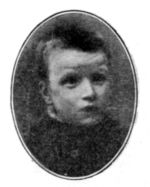
JOHN HARRISON.
(The new Quiver Waif at Dr. Barnardo's Home.)
Our readers will doubtless be interested in the portrait of each to be found on this page, but it is unnecessary to repeat the particulars concerning these little ones which were given at the time we invited the votes. The support of the new waifs will involve a total annual expenditure of £31 (£15 for Rose Heelis and £16 for John Harrison), and for this amount we are relying upon the generosity of our readers. Contributions to the special Waifs' Fund will be gladly received, and duly acknowledged month by month in our pages. Such contributions should be addressed to the Editor of The Quiver, La Belle Sauvage, Ludgate Hill, London, E.C. A list of the donations to the fund during the month of January will be found on page 480.
Stooping to Conquer.
A peculiar feature connected with the Ancient and Honourable Artillery Company of Boston is that each officer, at the end of his term of command, which lasts a year, returns to the ranks as a private; thus there are something like a score of gentlemen who have had full control of the regiment, and who are now once more content to obey. Here is a lesson for those who serve in the Church Militant. We cannot all be colonels and generals—there must be a few private soldiers!—and it is certain that he who cannot obey is not fit to command. Much energy and temper is wasted by those who fight against sin and sorrow through unwillingness to take what is called a subordinate position. Surely this is to forget the Saviour's words—"If any man desire to be first, the same shall be last of all, and servant of all."
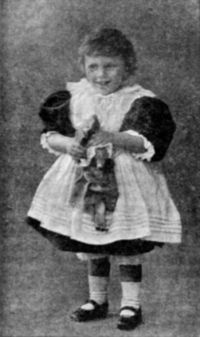
ROSE HEELIS.
(The new Quiver Waif at Miss Sharman's Home.)
The "Welcome."
Sixteen years ago, the first restaurant for women in the City of London was started at 16, Jewin Street. The "Welcome" was opened in a five-storeyed house in the very midst of factories. It is now the centre of help of every kind for a class brought before the public in Sir Walter Besant's "Children of Gibeon." Hundreds of women frequent this place to refresh their jaded and chilled bodies with soup and bread at three halfpence or excellent meat-puddings at twopence. In cases of distress and starvation free dinner tickets are granted. Who can tell how many women this aid has saved from crime when hunger has driven them to the verge of stealing? The work of the "Welcome" is not limited to care for the bodies of City toilers. Three rooms are used for dinner and tea, three others for evening classes of various kinds. From six to half-past nine clubs, musical drill, sewing and improvement classes, services of song, missionary or Gospel temperance meetings, attract an attendance averaging from 270 to 300. The largest number come on Thursday evening, which is devoted to Bible classes. To many whose days are spent in hot workrooms the shady gardens lent on Saturdays by kind friends are like a new world. One girl asked if she could see the strawberry trees; another, why the bunches of grapes were tied to the top of glass-houses. The revelation of a new world outside their own limited sphere helps to raise the ambition to live a new and higher life.
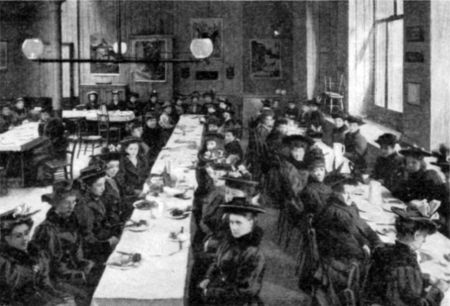
(Photo: Cassell and Co., Ltd.)
IN THE "WELCOME" CLUB AT MIDDAY.
"Nobody's Own."
Many regiments in the British army are called after and said to be owned by this or that prince or princess. There is "The Princess of Wales's Own," "Princess Charlotte's Own," and so on. One regiment, however, rejoices in the nickname of "Nobody's Own," because it is not named after anybody. It is a grand thing to think that no Christian can be called "Nobody's Own," for we are all called after Christ and owned by our Father in heaven.
New Books.
Elsewhere in this number will be found an illustrated article on "Childish Memories of Lewis Carroll," and we venture to think that readers of those reminiscences will require no pressing to turn to the biography of this universally favourite author, just published by Mr. Fisher Unwin under the title "The Life and Letters of Lewis Carroll." Mr. S. D. Collingwood, who is responsible for the work, frankly admits that it is impossible to give a really adequate presentation of the extraordinarily complex character of his late uncle. He has, however, produced a most able and interesting sketch, which includes many characteristic letters, and is profusely illustrated. Quite a different life-story is also before us in the form of the Rev. George Adam Smith's biography of his friend, the late Professor Henry Drummond (Hodder and Stoughton). No one could lay down this book without feeling that Drummond was in every sense a great man—with a great intellect, a great heart, and a constant, burning desire to be about his Father's business. It is true that he made mistakes, that he put forth certain theories not generally acceptable, and which he himself modified in later years, but throughout his life his honesty of purpose was unquestionable. His influence and power as a preacher and teacher were remarkable, and many of those whom he reached through his addresses and books will feel indebted to Dr. Smith for this critical and comprehensive story of his life.—From Messrs. Smith, Elder and Company comes a new story from our own contributor, Katharine Tynan, entitled "The Dear Irish Girl," of which we need say no more than that it is the love story of a most winning Irish lassie, written in the bright, entertaining style so well-known to our readers.—"Helps to Godly Living" (Elliot Stock) is the happy title of an excellent little work which consists of helpful and comforting extracts from the writings and addresses of the present Archbishop of Canterbury, selected and arranged by the Rev. J. H. Burn, B.D.—A pathetic interest attaches to the two dainty volumes of poems by the late Dr. J. R. Macduff, entitled "Matin and Vesper Bells" (Cassell), in that the author did not live to see their completion. Many of the poems have been already published independently in various forms, but we believe that this collected edition of Dr. Macduff's tender and inspiring verse will be heartily welcomed.—We have also to acknowledge the receipt of a tastefully produced volume entitled "The More Excellent Way" (Henry Frowde), in which the Hon. Mrs. Lyttelton Gell has carefully arranged the choicest extracts from the works of ancient and modern authors on "The Life of Love"; a collection of addresses on the Beatitudes by the Rev. J. R. Miller, D.D., entitled "The Master's Blesseds" (Hodder and Stoughton); an interesting and instructive work on medical missionary work amongst the blind in India, entitled "They Shall See His Face" (Bocardo Press, Oxford); "Aids to Belief" (Elliot Stock), a series of studies on the divine origin of Christianity by the Rev. W. H. Langthorne; and a volume of sermons by the late Charles H. Spurgeon, which have been published by Messrs. Passmore and Alabaster under the title "The Metropolitan Tabernacle Pulpit."
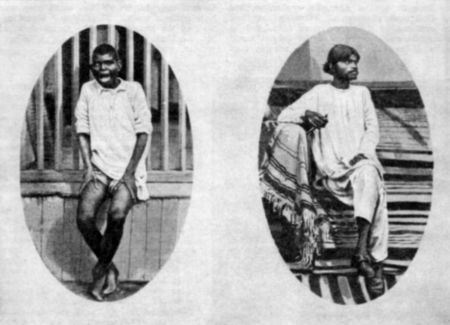
(Photo supplied by the Missionary Leaves Association.)
THE WOLF-BOY OF SECUNDRA.
AS A BOY. AS A MAN.
A Wolf-Boy.
What was to be done with such a boy! The magistrate sahib of Bulandshahr had heard of Romulus and Remus, but rational people rejected the legend of their infancy. Yet here was a child of five or six years of age, crawling on the ground before him, and the statement of several witnesses that he had been smoked out of a wolf's den could not be disputed. These men were natives of India. Whilst travelling in a jungle of the Bulandshahr district, they saw a queer though undoubted specimen of humanity crawl into a hole. By the magistrate's order a fire was lighted at the mouth. Out sprang a snarling and indignant mother-wolf, which, after scattering the bystanders, fled for life. Behind her ran on all fours a little boy, who was speedily secured and conveyed to the magistrate. He was imbecile. He would eat no food but raw meat, and he tore any clothing placed on him into shreds. The magistrate sent him to the Church Missionary Orphanage at Secundra, a refuge for between four and five hundred children, nearly all infants picked up in the streets or by the roadside. There this child, who was found on Saturday, February 4th, 1867, grew up into manhood. On the same principle that Robinson Crusoe called his man Friday, the wolf-boy was named Sanichar, or Saturday. By degrees a certain amount of intelligence and a decided religious instinct developed. He became gentle and sociable, and ready with cheerful unselfishness to share the many little presents he received with his companions. He attached himself with great affection to one of the caretakers. On the death of this man, Sanichar in dumb sorrow and bewilderment looked from one to another of his friends for an explanation. They pointed to the grave, and then to the sky. The boy was deeply impressed, and ever afterwards, if he felt ill, he would feign sleep, and point first to the ground and then to the sky. He never learnt to speak, but perhaps he was trying to convey the impression that he looked forward to following his dear friend. Two other wolf-boys and one wolf-girl were brought to the Secundra orphanage, but they died soon afterwards. Whether they had been cast out by their parents or kidnapped by the inveterate robber-wolves of the district could not be discovered. They were a witness that tenderness, too often lost in heathenism, may be found in one of the most rapacious beasts. With hundreds of little outcasts under Christian care, they tell of a Father above who remembers even though parents may forget their children.
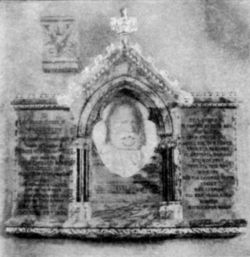
THE LOCKHART MEMORIAL.
(In Lewisham Congregational Church.)
Memorial to a Medical Missionary.
Medical missions have come into deservedly increasing prominence of late years; and a few months ago a beautiful tablet was erected in Lewisham Congregational Church to the memory of Dr. Lockhart, the first Protestant medical missionary to China, who went out about the year 1838. The tablet is a beautiful piece of work in alabaster and marble, and is carved in the form of a triptych, i.e. in three panels, the medallion portrait occupying the centre. On the left hand panel appears the following inscription:—"In affectionate memory of Dr. Lockhart, first medical missionary to China, founder of hospitals at Macao, Shanghai and Pekin, who served the London Missionary Society with untiring zeal for twenty-six years in the mission field, and with unabated devotion in England to the last day of his life. Member of this church for thirty-seven years. Deacon and Church Secretary. Born October 3rd, 1811. Died April 29th, 1896." The following inscription appears on the right hand panel:—"This memorial is erected by those who admired him as a strong man, loved him as a friend, hold his services in grateful memory, and who pray that his zeal for missions and his devotion to the Church may inspire all who shall ever worship within these walls." The tablet is placed on the wall of the church near the vestry door, where Dr. Lockhart used often to stand before the service, watching the people enter.
Self-control.
A man who lately came over from America told the writer that on board the steamer one of the passengers went up to another in the smoking-room and asked him to have a drink with him. The man thus invited continued reading a newspaper and made no reply. The other man again asked him to drink with him. No answer again. A third invitation was then given in these words: "Sir, I have asked you in as friendly a way as possible to drink with me, and each time you went on with your reading, and had not the civility to answer me. Now I ask you for the third time if you will drink wine, whisky, or anything else with me?" The man then put aside his paper and answered very quietly: "Do you see that glass, sir? Well, if I were to take even a quarter of it, I could not leave off until I had drunk all the liquor on board. This is why I would not drink with you." All present admired the man's self-control, and learned a striking lesson on the danger of putting temptation in a brother's way.
An Ever-Recurring Question.
Two friends of the writer were sitting in a close carriage, discussing the problems of life—where we came from and whither we are going. The driver of the carriage went rather too near another vehicle. "Where are you going to?" shouted the driver of the latter. The occupants of the carriage looked at each other and remarked, "That is just what we were wanting to know." So it is that the great problems of life cannot be ignored, for they are reflected in the small incidents of daily existence. Particularly is this the case with the question whence we came and whither we are going. This can never be shelved.
The Circulation of the Bible.
Few people have any idea of the enormous number of Bibles published annually in this country. Mere figures of so many millions mean little to most folks. But it may give some more adequate idea of the vast number to put it as follows: The British and Foreign Bible Society, of Queen Victoria Street, alone publish above a million and a half of Bibles every year, or more than 4,100 every day. Now, if each of these 4,100 Bibles was of the average thickness of one and a half inches, they would, if piled upon one another, reach to a height of 6,159 inches. As the top of St. Paul's cross is about 364 feet or so above the level of St. Paul's Churchyard, this huge pile of Bibles would reach to a height nearly one and a half times as great as the top of the famous cross! Or we might represent the whole lot by one immense Bible, which would be 66 feet by 47 feet by 14 feet, and would reach from the steps leading to St. Paul's right to the top of the pillars there! And this would but represent the output for a single day of only one of the great Bible circulating mediums of this country!
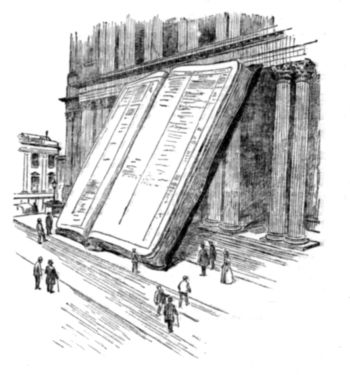
A BIBLE 66 FT. BY 47 FT. BY 14 FT.
(Representing one day's output of the British and Foreign Bible Society.)