Chapter IV
Reading edition
"There follows a mist, and a weeping rain, And life is never the same again!"
Ishbel might have thought of these words, if she had known them, on the morrow and on many morrows that followed. For Rory MacPhee was not the man to come back, or to speak lightly. He sailed with the agent to Glasgow—was believed to have started for New Zealand within the week. There, as far as his Skye friends were concerned, he vanished. They were the days of rare and slow communication, and Rory never wrote.
But Ishbel did not marry her cousin, as everyone expected, including MacLeod. She answered him "No," listlessly, but quite doggedly, and nothing that he could say, or that Catriona could threaten, served to change her. Once the old woman muttered vengefully that she would never see the fairies, for she had lost her luck, and Ishbel turned on her almost fiercely.
"It is all false," she cried in Gaelic, "for there are no green folk at all, and I do not care!"
The mystery and the charm had fled; she no longer dreamed on the green grass circle, no longer wondered at the night-song of the burn, no longer watched for the kelpies under the boulders in the burns or in the Rowan Pool. Belief in the fairies had faded on the night in which Rory left her. Except in the little bald, white kirk on the hill-side, Ishbel never sang. Song dies on the lips when care and sorrow lie heavy on the heart.
It was five years now since that fatal visit to the Gave of Gold—Ishbel never mentioned it—and she was returning, in the soft, golden haze of a September evening, from the castle. Catriona was growing feeble, and Ishbel did everything; the old woman only spinning a little, and wandering out to gather sticks and twigs for the fire. The girl had been taking up carded wool to the castle, and giving the great London ladies there a spinning lesson.
Before the cottage came in view, with its surrounding field of poor and thinly growing oats and yellow daisies (there being, indeed, a far more plentiful crop of the latter), she paused to look up the fairy knoll. There, on the top was the fairy ring. Something made Ishbel suddenly turn and mount the little hill.
The sea-loch lay beneath her, tinged with red; the sky was a wonder and a glory, but Ishbel was not looking at the sky, or at the loch. She was thinking how strange it was that she should go on living, and living much as usual, when all that was best and fairest in life was gone.
She sighed, looking down at the burn, plashing and leaping over the grey boulders. There was that story about the kelpies; her grandmother rarely spoke of them now. Were there really no kelpies—no brownies? And yet——
A step behind her made her start violently, and she gave a sharp cry. A man's tall figure was there, not ten yards off, and there flashed across Ishbel suddenly the thought that perhaps, after all, it was all true, for this was a ghost! And if there were ghosts, why not wee folk and kelpies?
"I believe it is Ishbel, herself. Do you not know me, Ishbel?"
He spoke in a new voice. The fluent Gaelic was gone, and the stiff, translated English; he spoke easily, with a strange accent. And yet, ah! she knew him at once! It was Rory! Rory, well-dressed, handsome, upright, with a different and more independent carriage, but Rory all the same!
Ishbel rose and stood quite wordless for a moment. And then—"You are a great stranger," she said. "It is a very long time, I believe, since you hef been in Skye."
He almost smiled. He was looking down at her earnestly, intently. Was it possible that she should be so little changed? Had the five years been a dream? Just as he remembered her—with the pale, clear skin, the deep sloe-eyes, the ruddy crisp hair, the little droop of the head! Ishbel! The girl he had turned his back on, and been furious with, and quite forgotten—oh, yes! quite forgotten, though he had come back to the Winged Island—well, just to see how all the old folks were!
"It is five years," he said deliberately, "five years! Are you—are you married, Ishbel?"
The girl raised her eyes and looked at him. It was getting dark, and the burn was beginning its night-song. Ishbel noticed that, and remembered just how the water used to sing, quite suddenly. The lovely, indescribable breath of the muir wind swept in their faces. How sweet it was—how entrancing! And oh! me, the velvety deeps of her eyes, the little half-sad, half-humorous mouth!
Was she married? Was she?
He repeated the question, but with a new and eager ring in his voice, and Ishbel shook her head.
"Though there will have been a good many marriages since you left. There was Mari MacLean and Dougal Nicolson, and there was Colin——"
"What about MacLeod, your cousin?"
"He is to be married this year," she said, "to an English lass."
"So you did not marry him, after all, Ishbel?"
"Who said that I would?" she cried, as if stung. "You knew better than that! Who said that I would?"
"He did; and that you would go with him that night, if he asked you. And you did, Ishbel! It was very cruel, but——" Rory paused then, and suddenly spoke in Gaelic, as if it all came back to him. "But I am beginning to think that I was cruel, too. Was I?"
He waited, watching her.
Ishbel nodded gently. She also spoke in Gaelic, as if they had parted only yesterday.
"Yes, you were cruel, Rory, and you were very hasty. It is true that I was a foolish lass, but you might have given me another chance. I believed in my grandmother's stories. I wanted to see the good folk." She looked away, and sadness and disillusion crept over her face. "But I do not believe in them any more, not any more."
"Poor little Ishbel. Poor wee lassie!"
It could not be five years. It could not! They had only parted yesterday!
"But it does not matter," Ishbel said, rousing, "and now perhaps you will call and see my grandmother? Are you on your way to Uig?"
He did not answer that.
"Ishbel," he said, "I was very cruel, and I was just as angry as a man could be, and for five years I have been mad and sore; but deep down, deep down, I never forgot you. I hated him, but I loved you. I will come and see your grandmother; but—first—first, will you give me a kiss, Ishbel, for the sake of the old days?"
Would she? Perhaps, after all, he did not wait for her consent. He had her in his arms, and they closed round her, and Isabel's head fell on his shoulder with a little sob that was an epitome of all the five years' sorrow and heartache.
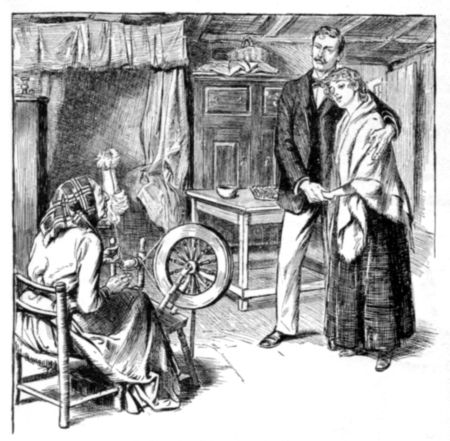
Catriona heard his story in silence.
"Muirnean (darling)," Rory whispered, "I love you; and when I leave Skye, you will come too, or I will be staying on here with you. You shall choose Ishbel—you shall choose; and to-morrow I will buy you something better than the claymore brooch that I was cruel enough to throw away!"
They walked down to the cottage, and Catriona, who was never surprised at anything, shook hands sourly with him; she heard his story in silence, and nodded consent when he told her that he and Ishbel were to be married, after all. He could look after the croft, she said, or buy Colin MacDougal's farm, just above, if he had money enough. Would he have money enough? For Duncan kept her very close now. Rory laid a packet smilingly in her lap, and said he thought he had money enough.
Next forenoon Catriona saw him coming up the road; Ishbel ran to meet him, and together they wandered off to the burn-side. They came back by-and-by, and Ishbel stood smiling in the cottage door, her arms full of rowan branches; Rory had a spray in his coat, and the red berries nestled under her chin.
"I have brought you back luck," the girl cried happily. "We found the rowans down by the pool. And Rory says that there are maybe good folk in the world, after all! Who knows, grandmother?"
Catriona's peat-brown old face was bent over her wheel. She allowed there might be one or two, with a half-grunt of satisfaction.