THE QUEEN'S FAVOURITE (continued 4)
Reading edition
"She shall come to you as soon as possible," he answered, "but at present she cannot;" and with that he rose, bade both Patience and her farewell, and left them.
"Let us go on to the terrace, aunt," said Agnes; "maybe we shall get a breath of air from the river." So they went down the magnificent staircase, through the gorgeous banqueting-hall, on to the terrace.
Though the day was over and the sun had set, the heat was beyond description. The whole city seemed to glow with the after-math. The girl was tired, and quietly, without knowing it, she began again to weep.
"Oh Agnes, my child, what is it?" said Patience.
"I don't know," she answered; "my soul is heavy within me. I am afraid."
Patience did not ask her what she was afraid of; she knew only too well she was afraid of everything. She put her arm round her and talked to her quietly of life and death.
After a little time the child's soul was comforted, and Patience took her by the hand and led her to her own chamber; as she could not sleep, she sat with her far into the night, and only when the day was dawning did she leave her.
CHAPTER XVIII
Lost
Suddenly out of her sleep Agnes woke to full consciousness. She heard distinctly the cry of the watchman call out three o'clock in the morning as he passed his rounds.
She turned her face to the window and looked out--the sky was blood-red. A great horror seized her. She sprang out of bed and began putting on her clothes. She hardly knew what she was doing. One door in her room opened into Patience's, the other on to a landing leading to the grand staircase. She felt she must have air--she could not stay in that closed-up room; so, slipping her clothes on and wrapping a light cloak round her, she drew the hood over her head and left the room. She had not gone far when she was confronted by one of the watchers, men told off to guard the queen's house.
The sight of the girl walking about surprised him. He thought she must be one of the maids and spoke to her coarsely, laying his hand on her arm. Agnes wrenched herself free and ran, as she thought, in the direction from which she had come; but she had mistaken her bearings and found herself in a small turret-chamber at the farther end of the passage, in which there was a winding staircase.
At that moment the remembrance of Ann came to her.
"They will not let me go to her, but I will go. I cannot stay here," she thought; "I will go now at once. Surely this staircase must lead somewhere!" And, feeling in the darkness, she groped her way to the bottom, where a gleam of light came from a door which stood half-open. She remembered having noticed this turret from the terrace one day, when, to amuse herself, she had reconnoitred, and she had discovered that it led out into a small courtyard.
"I shall find means of getting out into the street," she thought, "and then I can easily find my way to the Old Bailey."
She was not mistaken; the staircase gave into a court-yard, at the farther end of which was an iron gate. She had some difficulty in forcing the bolt back and in pulling the gate open, but it yielded at last, and, quick as lightning, she passed out into the street. She had a sort of hunted feeling; she did not know herself what drove her to act thus. She was as one walking in her sleep. She was not naturally a coward, nor even fearful, but at the present moment a feeling of terror dominated her whole being.
When she found herself alone in the deserted streets she did not hesitate; she went straight forward without reasoning, moved by some inexplicable impulse. Here and there she saw the houses marked with the red cross, with the words, "Lord, have mercy upon us!" written in red letters over the doors, and she shuddered.
"Supposing, when I reach Ann, I find her in such a house, and cannot get to her!" she thought.
She had gone some distance when she heard steps following her. She dared not look back, but, hastening her speed, turned up the street which led to the Old Bailey. The steps came nearer and nearer, and suddenly she was caught up, a cloth thrown over her face, a hand pressed over her mouth, and a voice said sharply:
"Lie quiet and you are safe; move and I will kill you!"
Instinctively she obeyed, and felt herself carried she knew not whither.
When Patience awoke a few hours later from a restless sleep, her first thought was naturally for Agnes. She rose, went into her room, and found it empty. To call Martha, to rouse the whole house, was the work of a few seconds. The house-watchman told how he had met a girl in the gallery, and how at sight of him she had fled; he could not tell where she had disappeared to, indeed, for aught he knew, it might have been a ghost. There were ghosts in Somerset House. It was said that the young Duke of Gloucester might be seen in the old building gliding along the passages, down to the terrace walk.
Patience had no such superstitions. If the man had seen a girl, that girl, to her mind, must have been Agnes. But how could she have got out of the house? Why should she go? In the search that followed, the door of the turret was found open, also the gate in the court-yard. That was sufficient proof that she must have gone out that way.
A messenger was immediately sent to Lord Craven, and throughout that day the search continued, but no Agnes was forthcoming. Through the deserted streets Patience wandered, indifferent to all danger, searching for the child. She went to Ann, and with tears told her what had happened; and Ann came down, and they wandered together till they reached St. Paul's. Then they entered the church, knelt, and prayed, and wept, as did many others, for there was nothing but weeping and moaning throughout this afflicted city.
"She will come back, surely she will come back!" repeated Ann.
"If she had gone forth of her own free will, I should say yes," Patience answered; "but I am persuaded she has not done so. Someone was lying in wait for her."
Those who sought for Agnes were many, but it was all in vain. Martha wept and wrung her hands in wild despair, but neither weeping nor moaning nor prayers availed. Throughout that long summer day and the night which followed, they sought but did not find her. Hour after hour, day after day, the search was continued, but in vain. The plague was ever on the increase. At night long lines of coffins were carried hastily by men through the city out to some far-distant burial-place; even that did not long suffice, and carts, with tingling bells on the horses' heads, wound their way through the deserted streets, men calling out as they went:
"Bring forth your dead, bring forth your dead!" and the bodies, ofttimes in nothing but a winding sheet, were tossed into the cart and carried forth to the common pit.
Ann still refused to go to Somerset House. She would not leave the precincts of the prison, neither could Patience go to her. They waited for their loved ones in their homes, and Lord Craven went and came between them--he was their only comforter, their only guide. Never was a braver or more honourable man; he had no fear of infection. He was "in God's hands," he said, "to live or to die".
All those who possibly could left the city. The streets were deserted, but the churches were crowded. A few ministers remained faithful to their duty, but many, to their shame, fled. But there were found other devoted men from the country to replace these deserters, the churches were all thrown open, and within their precincts was weeping and wailing. "Surely the scourge was sent by God because of their sins," people said, and their ministers bade them repent, ay, in dust and ashes; therefore it came to pass that men and women alike fell upon their faces and made their humble confession to Almighty God, praying for pardon and deliverance.
Still the disease continued to spread. The lord mayor, the chief councillors, the physicians, all those in authority, made laws, saw to the cleansing of the city, and did their very utmost to check the frightful ravages of the plague, but throughout the month of August it raged unremittingly.
One morning a message came to Lord Craven from Newgate to say that Mistress Newbolt had departed that night, that her last hours had been most edifying, that she had sung and prayed, and glorified God even in the agony of death. He it was who broke the news to Ann. In vain she asked for a sign by which she might know it was her mother who had died. The prison authorities answered it was impossible. All she had possessed was destroyed, and she was carried forth and buried in the common pit, amongst the malefactors, the thieves, the murderers, the cut-throats, whom she had tended.
Thus Ann found herself alone. Then she went to Patience and the two dwelt together.
"Why do you not both go north?" said Lord Craven. "I see no end to our afflictions."
"I cannot go," said Patience. "If Agnes were to come back and find me gone, what would she do?"
A message had been sent to the queen to tell her what had happened, and her anger was very great against Patience.
"If you had let me have the child, she would have been safe," she said; "now she is dead, or worse than dead."
Lord Orford, when he heard the news, appeared astounded. He would have gone up to London himself, but the king would not permit him.
"My Lord Craven will do all that there is to be done," he said.
* * * * *
"Well, sirrah, what have you done with her?"
"The only thing which in reason could be done, my lord," answered a small, insignificant man, almost a dwarf, who was known everywhere as the Marquis of Orford's factotum.
He was intensely ugly, with an extraordinary look of cunning in his eyes when you saw them, but that was not often--they were small, with heavy lids which were seldom raised, and if they were, it was with a sidelong glance. He was standing now before Lord Orford in a room which that nobleman had succeeded in hiring at Oxford, and for which he paid an enormous price, for the town was crowded to excess, and yet was kept so cleanly by the authorities that the plague had not come near it. The lovely city with its colleges and chapels, the walks in the surrounding country, the beautiful river upon which the boats went and came all day long in gay succession, made of it a most delightful resort, and but for the daily reports from London, the life led by the court would have been ideal.
"Give an account of yourself," said Lord Orford.
"I set Ben Davies to watch his opportunity," said the man, "bidding him never lose sight of the lady. Ben is a bargeman, and has a craft which he takes from London Bridge to Holland or to France as he chooses. His wife, two children, and a boy, live on board. It is by no means a bad craft, and Mistress Ben is an uncommonly cleanly, thrifty woman, so I just told him that if ever he could catch the lady and take her on board, and then strike off to Holland with her, he might reckon on a hundred pounds."
"You did not mention my name?" said his lordship.
"I'm not quite such a fool, though I look it," answered the man, with a short laugh. "No; he thinks I am doing business on my own account. He took it in good part. 'It's a service you're doing the lady,' I explained; 'she has a whim for staying in London because of her lover, but it's a pest-hole, it will be a good deed if you can get her out.' And so he watched and watched, and one morning at dawn, as he was passing by Somerset House, he saw a girl come running out and making her way down the Strand. There was no one else to be seen, the streets were deserted, so he dodged her to find out who she was, and as good luck would have it, her hood fell back from her face, and he saw that it was none other than the Lady Agnes I had pointed out to him one day. Then it was all quickly done: he caught her up, took her in his arms, and, muffling her face, carried her down to the barge. It was in the Old Bailey he got her."
"And where is she now?" asked Lord Orford.
"Coasting about, maybe on her way to Holland," said the man. "At all events she is out of that pest-hole; you ought to be satisfied, my lord."
Lord Orford walked up and down the room.
"Have you any further orders, sir?" asked the man.
"Only that I have been a fool. I should have done better to have left her alone," said the marquis; "the queen's moving heaven and earth to find her."
"Ah well, sir!" said the man, "when the plague's over we can drop her at Somerset House again--she will be none the wiser. And Ben Davies's wife will keep her comfortable; she'll take no harm."
"But that does not answer my purpose," said Lord Orford. "I wanted to marry her, and I see very little likelihood of doing so under present circumstances."
"Oh, you can marry her right enough!" said his factotum. "You just tell her you did it for love, to save her life. Girls are soft. Now will you pay me the money? These sort of folk won't wait, you know."
"I suppose not," said the marquis, "but I have precious little coin; however, what I have you shall have." And, putting his hand in his pocket, he took out a bag of money and threw it on the table.
"Count and see how much there is," he said.
The dwarf emptied the bag on the table, and with his long thin fingers counted the gold.
"There are ten pieces missing," he said.
"Then you must find them," answered the marquis, "for I am sucked dry."
"I suppose I must put it down to your account," said the man; "it's already a pretty long one."
"I was reckoning on the girl's dower to pay it up," answered Lord Orford, "so you see it's as much to your interest as mine that I should have her. You know she is sole heiress of the De Lisles, and the king dowers her."
The dwarf stuck his tongue into his cheek and muttered, "That's not much of a recommendation."
"Well, you run a risk and so do I; it is for you to make the matter sure," said Lord Orford.
"I can't make her say 'Yes' if she says 'No'," grumbled the dwarf.
"I'm of opinion you have done wrong in carrying her off to Holland. I never bade you do so. I told you to hide her away," said Lord Orford.
"Sure she'd have got the plague if I had not sent her to sea," answered the dwarf.
"I only wish we could get her into the queen's hands," said Lord Orford, "that would settle the matter."
"If that's all you want, it can be easily managed," answered the dwarf; "leave it to me."
"I must, for I can't help myself," muttered Lord Orford. "Now get you gone; I'm sick of you."
The man shuffled the gold into his pockets, and with a "Good-day, sir!" went his way.
When the dwarf was gone, Lord Orford paced up and down the room, muttering between his teeth:
"Gone to Holland! How am I to get at her there? The fool was mad to imagine such a thing. If it leaks out that I have had a hand in this business, it will be to my discredit, unless, as the fool advises, I say I did it out of my great love for her, to save her from the plague; but it will cost me a hundred pounds and more, perhaps, for hush-money. However, matters must take their course now. They'll not land in Holland at present, for no barge from London will be allowed to put into port; in the meantime I can consider what is to be done." And with the natural carelessness which belonged to the habitués of Charles II's court, he strove to forget the matter altogether.
Weeks went by and he was surprised at having no news from his factotum.
It was not until his return to London with the court that he learnt that the man had died of the plague.
So as far as he was concerned the matter ended. Later, seeing the course events took, he was too wise a man to rake up ugly stories. The dwarf dead, there was only the bargeman to reckon with, and he was ignorant even of the existence of my Lord Orford. So the bubble burst, and he had to look about for another bride to pay his debts! Besides, Reginald Newbolt was now Prince Rupert's friend, and it was therefore unlikely he would be dispossessed of his estates even for Lady Agnes De Lisle. The wheel of fortune had turned.
CHAPTER XIX
On the Track
Pestilence on land, battle on the seas! The jealousy between the English merchants and the Dutch was a matter of long standing, and on both sides there had been a clamouring for war. It came in due time.
On the third of June, just when the plague was at its height, the Duke of York encountered the Dutch fleet off Lowestoft. A terrible battle took place. It is said that eight or ten thousand men were killed and eighteen ships blown up--this was on the Dutch side; but on the English side also there were many disabled ships and many wounded men cast ashore. Had the English admiral chosen, he might have followed the Dutch up in their flight, and the war would have come to a speedy end, but instead an order came from the Duke of York to slacken sail, and so the Dutch escaped to Texel. The neglect and misery of the seamen of the royal navy, who were cast ashore to go where they would, without money, food, or clothing, was piteous. A great number found their way to London, thinking that there, at least, they would get their pay from the admiralty, but there was no money to be had for the arrears of payment. The Commons had voted the king a large sum for war expenses, and he had squandered the whole of it on his own pleasures.
The result was that these men, to whom England owed her safety, lay about the streets and in hovels, and many of them died of the plague.
Reginald Newbolt had enlisted under Prince Rupert. He was not in this fray because Rupert's squadron had sailed to the West Indies. When the news of the plague reached Reginald, he had written entreating his mother to go to Newbolt Manor for her own safety and for Ann's, but naturally he received no answer, and knew little or nothing of the events which were taking place. He had risen to high favour with the prince, for on many occasions he had distinguished himself, and was always at hand when there was any deed of daring to be accomplished. Indeed, he and Prince Rupert agreed in many ways, and Reginald's natural good sense served as a check on the hastiness of the almost pirate prince. Rupert had found there was little doing save pleasure at King Charles's court, and for that reason he entered the navy, and made for himself a name as the admiral of the White Squadron. Every man in those days was a lord himself on the high seas, and any ship which did not hoist the English colours was a legitimate prey to the numberless pirate vessels which floated here, there, and everywhere. Many merchant vessels disappeared with their cargoes of wealth, and no questions were asked.
It was a wild life and a daring one; but when Rupert heard of the war with the Dutch, and a possible war with the French, he set sail for the west. Neither he nor Reginald had any idea of the ravages the plague was making until they neared England, and then the accounts were so horrible that Rupert refused to allow any man to land.
It was in vain that Reginald, as they sailed along the coast, entreated to have a small boat and be allowed to go ashore by himself. The prince was firm, and all knew his discipline was severe.
"If you attempt to go I will have you put into irons," he said to Reginald; and he was certain the Prince would be as good as his word, so he was obliged to be satisfied with writing to Lord Craven and to Ann. But his letters never reached their destination.
Before he left England Agnes had gone north, he knew not whither; the secret had not been told him, and he had been greatly hurt, but now he was glad, for he was assured of her safety. So the days went by, and throughout the months of July and August the terrible scourge laid thousands low; but in the beginning of September it began to lessen. Many people had left the city and were encamped outside it, but Patience and Ann had remained in Somerset House, and had even gone forth amongst the sufferers and tended them. Their good works, their many deeds of charity, had made them well known. Without ceasing, using every means in their power, they had sought to trace Agnes, but in vain.
They were assisted in this by young Delarry, who, when he had heard of Agnes's disappearance and Mrs. Newbolt's death, had returned to London and sought Ann and Patience.
"You cannot remain here," he said. "Let me take you away out of London, if it be but to a village in the suburbs." But Patience had refused to go, and Ann remained with her.
"If the child be still living," said Patience, "it is here she will come to find us. I am persuaded Lord Orford is at the bottom of this thing. He knows who Agnes is; he knows that the De Lisle property will be hers, and he himself is a beggar. The queen told me as much."
"But he has gained nothing by her disappearance, and I know for sure he has not heard of her whereabouts," said Delarry.
"I think you are wrong there," said Patience; "he knows where she is."
"We must find that out," said Delarry. "Now I have come to London I cannot go back to Oxford; I am in quarantine! As for the Lady Agnes, I fully believe she has been taken out of the city and is in safety. No one has any interest in her death; on the contrary, her life is valuable, and, believe me, she will not be attacked."
With this Patience had to be satisfied. The devotion and the bravery which Ann showed under these trying circumstances excited not only Delarry's admiration, but increased the feeling of devotion which had long existed in his heart for her.
She was so simple and so brave, so devoutly religious. Morning and evening, and ofttimes at mid-day, he would meet her on her way to St. Paul's, and they would go together and pray for the deliverance of the nation, and listen to the preachers, who upbraided men for their sins and besought them to repent. It is not surprising if the link between them grew to be strong, and so one day, finding himself alone with her on the terrace, he asked her to be his wife.
"Then I shall have a right to do what I will for you," he said, "in life or in death."
"This is no time for marrying or giving in marriage," answered Ann.
"Why not," he asked, "if it unites two souls in good works? You are so utterly alone, having neither father, nor mother, nor brother, no kith or kin. I ask your leave to be all things to you. I have no need to tell you that I love you; I prove it by my desire to serve you."
The tears gathered in Ann's eyes.
"Truly you have given me the best proof of love a man can give," she answered.
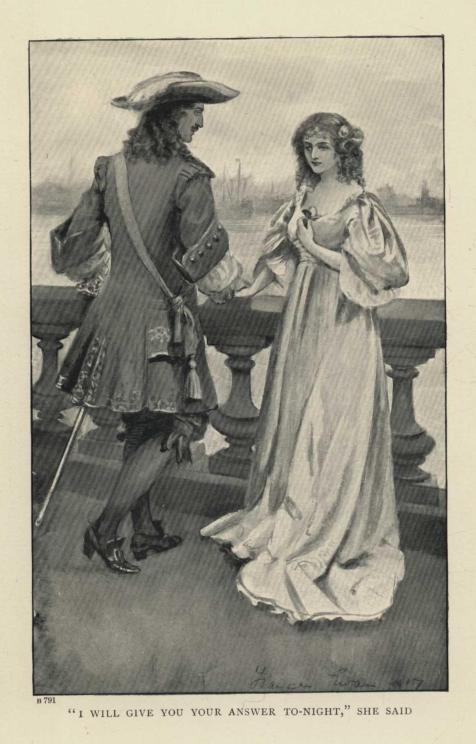
Her hand was resting on the stone parapet; he laid his on it.
"Well," he said, "which is it to be? yea or nay?"
Ann looked up at him; a glint of Irish mirth, which she had not seen for many a day, lighted up his eyes, She was tempted to say "Yea", but she still hesitated.
"I will give you your answer to-night," she said, "after vespers. Now let us go and find Patience."
"I WILL GIVE YOU YOUR ANSWER TO-NIGHT," SHE SAID
"As you will," he answered; but he took her hand, placed it on his arm, and they went together to Patience's room.
At the door Delarry left her.
"Till to-night," he said.
Ann went in to Patience, and, standing at the open window looking over the deserted city, she told her what Delarry had said.
"What think you?" asked Ann.
"I think," said Patience, "that life is so short, that if something comes to gladden our hearts we do well to accept it. This thing is a joy to you, is it not, Ann?"
"To be George Delarry's wife? Oh, yes!" answered Ann, and her face flushed.
"Then take him," said Patience, "and thank God."
So that same evening, as she came down the steps of St. Paul's, her hand sought Delarry's, and he knew what his answer was.
To find a minister, to go in the early morning to plight their troth one to another, with only Patience and Lord Craven as witnesses, was an easy matter, and did not interfere with the work of the day which followed after; only, as Patience had said, some of the sadness passed out of their hearts, and joy crept in. The knowledge of the tie which bound them, the union of two in one, seemed to strengthen both their hands and hearts for the work they had to accomplish.
It was decided that they should stay at Somerset House with Patience because of that hope, which was nevertheless growing vaguer and vaguer each day, that Agnes would come home.
A few days later Delarry came in quite excited. He found Patience and his young wife picking lint, making bandages, and doing other things which were necessary for their vast hospital. They never stopped their labours, those two women, but when Ann looked up with a smile to greet her husband, she saw something in his face which startled her.
"What has happened?" she asked.
He came and sat down beside her.
"I have found a clue," he said. "It is only a little one, but it may lead to something bigger."
"About Agnes?" asked Patience.
"Well, I suppose it is connected with her," he answered. "I have followed up your idea of Lord Orford being at the bottom of this affair, and just now I met a creature I loathe sauntering down the Fleet."
"Who?" asked Ann.
"The Marquis of Orford's factotum," he answered, "a scurvy little rascal, with a mind as crooked as his body. He is not full-grown, a dwarf, or very nigh one, with a growing hump and an evil countenance. I accosted him and asked him where his master was.
"'Where should he be,' he answered, 'save in his master's company at Oxford?'
"'And why are you not with him?' I asked.
"'Since when, Mr. Delarry, are you my master's keeper?' he answered. 'I am Lord Orford's servant, not yours.'
"'I'll keep my eye upon you until I find you out in some dark deed,' I answered, 'and then I'll get you hanged.' The man turned white to his lips, and even as I spoke to him there came up another man from behind, a bargeman. I know him, because he happens to have taken me up to Gravesend more than once. When he saw me talking to that little imp, he turned suddenly and went back the way he had come.
"'I wish you good morning,' said the dwarf, 'there's Ben Davies waiting for me.'
"I fired a shot at random: 'Is he in the plot?' I asked.
"'What plot?' he shrieked.
"'I'll leave you to tell me that,' I answered, 'only I warn you, if you brew evil you shall swing for it.' Therewith I went off and left him to digest my words, the real meaning of which I do not myself know." And he laughed.
"Oh, George," said Ann, "you may be all wrong! How could they know anything about Agnes?"
"How can I tell? The clue is faint, but there is a connection."
"You are right," said Patience. "I shall always believe Lord Orford is at the bottom of it."
"So shall I," answered Delarry; "at all events, we will follow that track."
Towards the middle of August Patience received by special messenger a letter from the queen.
"I am deeply grieved ", she wrote, "at having no news from you. My own health is failing, my life here does not please me. I am of no account at my son's court, therefore I have decided that I will go back once more to France, where I may possibly be of some use to my daughter, and where the climate at least suits me. If all things go well, I shall return to England in the spring. In the meantime, send me news of yourself and Agnes, but not while you are in London, lest your letter should carry contagion. I cannot understand why you remain in the city. I much fear me the child is dead, and probably cast, as so many others I hear are, into the common pit. I have wept many tears over her; but then this world is a world of sorrow, at least it has proved itself so to me. England is a dreary place; I would I could persuade you to join me and spend the rest of your life at my side, for I have loved you and your sister better than any other of my English so-called friends. I had a letter from the little duchess a short time since. She is well, and her child is well. She does not speak of her husband--it is not worth while, we know what he is--but she takes life philosophically, and the King of France makes much of her. She wrote very sadly concerning Agnes, blamed both you and me for letting her remain in London; but, as you know, it was not my fault, but your will.
"I trust you will come safely out of the great dangers which surround you, and that we may yet meet under happier circumstances. Commend me to my Lord Craven and to George Delarry. I am glad they are with you, for I am sure they will be helpful. My Lord Orford is still here, but his humour is not of the best. He feels he has been cheated of his bride, and I think he is in money difficulties; he reckoned on Agnes's dower to set him straight.
"Now farewell, my good Patience. I shall keep you in my remembrance. Your ever faithful friend and mistress, HENRIETTA MARIA, R."
In a postscript the queen had added:
"I have spoken to the king concerning you, and he has decided that you are to continue to occupy, as long as you choose, your present apartment in Somerset House."
Patience read the letter sadly. She had never been blind to the queen's faults, but she had both loved and pitied her, and this farewell letter was the breaking of another link.
She folded the letter and put it with her private papers, among the things of the past.
* * * * *
Throughout the months of August and September the plague raged in London, then it gradually died out, and the court ventured to return to Hampton Court, until, in the month of December, there was so little fear of contagion that the king took up his residence again at Whitehall; and indeed all those who had left the city crowded back as thick as they had fled. The empty houses were thrown open, the grass which had grown in the streets was once more trodden under foot, and to all intents and purposes the ordinary life of the city was renewed.
It is wonderful how soon people forget, how ready everyone is to fall back into the old routine. Such was the case now. There were many empty houses. Some families had been swept clean away, and in others there were vacant chairs; but those who remained had still to live, and though hearts were sore and many longed "for the touch of a vanished hand, and the sound of a voice that is still", they had to gather up the threads of life and live their new lives, bare and empty though they seemed to them at first, until, from beneath the deep clouds which overhung them, they caught the glimpse of a silver lining.
CHAPTER XX
A Great Sea-Fight
As the plague died out in England, and life resumed its ordinary course, the war with the Dutch threatened to be more formidable than ever, for the French king made common cause with the Dutch. The great Admiral de Ruyter came out of the Texel and made straight for England with a splendid fleet of eighty-four ships. They were to be joined by the French fleet from the Mediterranean, consisting of thirty more ships.
Wholly unsuspicious of what was taking place, the English admiral, Monk, now his Grace of Albemarle, awoke one summer's morning to find to his great surprise that the Dutch fleet was lying at anchor half the channel over. Prince Rupert should have been with him, but with his usual impatience of inaction, he had steered westward with his White Squadron, therefore Albemarle had but sixty vessels, great and small, with which to face the enemy, but nevertheless, with English pluck, he gave the signal to attack.
"He would neither wait for the weather nor Prince Rupert," he said.
There was a great south-west wind, which blew the English ships straight upon the Dutch, who were surprised at the suddenness of the attack, and had not so much as time to weigh anchor, but cut their cables and made their way back to their own shore.
Everything was against the English. Their ships were so laid down by the gale that they could not open their lower port-holes to leeward, whereas the Dutch, facing them with their broadsides to windward, had the free use of all their tiers of guns. A terrible fight ensued. Monk had followed the Dutch to Dunkirk, but being forced suddenly to tack, his topmast came to grief, and he was obliged to lie to.
It were in vain to tell here of the gallant deeds done alike by Dutch and English. It was a fight for the supremacy of the seas. Many of the English officers had protested against the unequal attack made upon them by the Dutch. "A mad fight" it is called in history. The English suffered severely; many of their ships were sunk, some were taken, and nearly all those which came into action were ruined in their masts and rigging by the chain-shot, a new invention.
So night fell; but on the morrow Monk resumed the conflict, and all day long the English fought against a far superior force. Another night fell and another day dawned--the third day of carnage--and the fight was renewed; but now Monk fought retreating, and after removing the men from some of the disabled ships, he caused them to be burnt.
Where was the White Squadron? Where was Prince Rupert and his brave men? On the first day of the battle the prince had stopped on his westward course, intelligence having reached him that the Dutch were at sea.
To put back, to make for Dover, was speedily done; but when he reached the Downs he heard no sound of battle, nor could he obtain any information concerning the enemy. Reginald was beside him, and together they strained their ears to catch the least sound. At last, on the 3rd of June, heavy cannonading was heard. Instantly the prince spread his flying canvas to the wind.
He came up just in time to save Monk. All day they fought, and all the following day also. How any man survived to tell the tale is marvellous. In the beginning of their second day the Prince Royal, esteemed the best man-of-war in the world, struck on a sand-bank, and was taken by the Dutch. It seemed as if nothing human would stop the fighting and the carnage; only God's hand could stay it.
Suddenly there arose and enveloped both fleets a thick and impenetrable fog. The guns were silenced and the slaughter ceased. When it lifted, the Dutch fleet was in full retreat, and the English were too disabled to follow them. Victory or no victory, it had been a cruel experience. It was called an English victory, and thanksgivings were ordered.
Truly we had reason to thank God that we had not lost our whole fleet.
Monk and Prince Rupert from henceforth remained close together, and when De Ruyter again put to sea with a stronger force than ever, they went out together to meet him, and drove him back in rage and despair to the Texel. Then the English scoured the Dutch coast, burned and destroyed two ships of war and one hundred and fifty merchantmen, and laid two defenceless villages in ruins.
It was in vain that some brave English officers tried to prevent this last deed of savage warfare. They could not do so; the anger of their men, their thirst for blood, was in the ascendant.
In the hope of stopping the carnage, Reginald, now commander, besought Rupert to let him land, believing that by his presence he might bring a certain amount of discipline to bear upon the excited sailors, but he accomplished little. He was standing in the midst of a group of men when he caught sight of two women, one with a child in her arms, trying to make their way along the bank of the canal towards a barge which was floating still uninjured on the water. Two half-drunken sailors were pursuing them.
To shout to them to desist Reginald knew would have been useless, so with quick strides he caught them up, seized one man by the neck and threw him to the ground, threatening the other with his sword. The men recognized their officer, and muttering an excuse kept quiet. The two women, exhausted, had sunk on the ground, unable to go a step farther. Reginald went up to encourage them; the youngest woman, a mere girl, sprang to her feet.
"Save us," she cried, "save us!"
Then she stopped short, for, notwithstanding his changed appearance, she recognized their deliverer and cried out:
"Reginald Newbolt!"
"My Lady Agnes!" he answered, and, kneeling before her, he seized her hand.
The sense of safety relaxed the tension on her nerves, and she would have fallen had he not caught her in his arms.
"How on earth did she come here?" he exclaimed, addressing himself to the woman who was with her.
"No time to ask that now," was the answer; "for God's sake, carry her to yonder barge!"
Without hesitation Reginald proceeded to obey. He noticed how light she was and how thin too the face was which rested on his shoulder. For a second he almost doubted whether it could be Agnes, the girl who had skated so merrily with him on the lake at Hampton Court.
It was a good ten minutes before they reached the barge. The woman had run on in front, slipped down the bank, and, notwithstanding the weight of the child in her arms, had leapt into the barge. Reginald followed her example.
"We must put off," she said, "or the soldiers will be after us."
"There is no fear whilst I am with you," said Reginald, as he laid Agnes down on a wooden bench. "Get some water." But it was not needed, for of herself Agnes opened her eyes, and, seeing Reginald stooping over her, a smile of wonderful sweetness lighted up her face, and, holding out her hands to him, she said:
"I am so glad, so glad!"
He could not answer her, but, taking both her hands in his, he kissed them, not once but thrice. She blushed rosy red and sat up.
"Is it not wonderful," she said, "wonderful that you should save me?"
"Yes, it is wonderful--God's will," said Reginald; "but how on earth are you here? I thought you were in England, up north somewhere."
"I wish I could get there now," said Agnes, tears filling her eyes, "But you will take me, take me now at once!"
"How can I?" he said. "There is war on land, and war on sea, and I am not my own master. But tell me quickly how you came here at all."
"Jeanne, tell him; I do not remember," said Agnes.
"My lord," said the woman, "I cannot tell you much. My husband brought her to me one night. He told me to keep her safely, for she was worth much money to him. He had been paid to find her and bring her out of London from the midst of the plague by a person he knew of, a dwarf, the servant of some great lord. We presumed he was her lover."
"I had no lover," said Agnes indignantly; "I do not know who the man could be. This is all I can remember: I was very miserable; Ann had gone into a poor house, and I was alone with Patience in Somerset House. The plague was getting worse each day, and I was frightened. One night I went to sleep and woke up, and the whole place was red as if in flames. Patience had been sitting beside me when I fell asleep, but she was gone, and I was frightened. I got up, and somehow I found myself in the streets. They were quite empty, I saw nobody. I will go to Ann, I thought; she will take me in, and I ran as fast as I could. It seemed to me that I heard steps behind me, but I dared not look round. Suddenly I felt myself caught up, my breathing stopped, and I remember nothing more until I found myself alone with this good woman on this very barge."
"And she was like mad," said Jeanne. "I could not quiet her, I could not keep her still; my husband had to threaten her. 'You are quite safe,' he said, 'if you will keep quiet.' But she cried so bitterly and called out so loudly that he was fearful others would hear her, so he shoved out into the middle of the river; we kept afloat for several days up and down; but she knew nothing of what went on, for she never recovered her senses. She was stricken with a terrible fever of the brain, which lasted well-nigh two months. At first she made much noise, but at last she was quite still. Once only my husband landed and got to London. He came back with much money; he told me it was his reward for saving the girl. I took all the care I could of her. We put out to sea and came over to Holland, hoping to do some business, as we always did--the shipping of wood and various other sorts of merchandise--but we did nothing because of the plague and the war which followed, so he put us ashore in this little village, and he went to and fro picking up what odd jobs he could. Happily we had that money, and my husband told me that if he could get to England he would have much more, for he had received only half what had been promised to him. But we managed to live, and I did what I could for her."
"Ay, indeed she did; she has been very good to me," said Agnes. "I was ill a long, long time, and she nursed me well and kindly, and always promised, 'as soon as we can we will go back to England', for I told her who I was, and that I felt sure a mistake must have been made, that no one wanted me, that I had been safe with Patience. Both she and her husband think also there must have been a mistake, only, the man who gave him the business to do took him several times to Somerset House and pointed me out to him. Is it not strange, Reginald?"
"Very," he answered; "I do not understand it at all."
"Do you know what Ben Davies was told the last time he saw his employer?" said Agnes. "That it was not only because of the plague that I was removed, but because I was a great heiress, and that my estates had been stolen from me, that the people who now held them wanted to get rid of me, but that there was a man who loved me, and wished to save me."
"And you believed him?" said Reginald.
"No, I did not," she answered, "because you see I am Agnes De Lisle and you are Reginald Newbolt, and Newbolt Manor is De Lisle Abbey, and I knew you would not hurt me."
"If I had only known it!" he said. "I would to God I had!"
"Well, you know it now," she answered, "and you can take me home."
"I wish I could," he answered, "but I am not going home myself. To whom can I trust you?"
"I have waited so long," said Agnes, "I can wait a little longer, and until you are ready I can stay with Jeanne. I am not afraid of her."
She had risen and was standing before him. He almost laughed as he looked at her in her quaint Dutch dress, short petticoats and sabots, and on her head a little tight cap which could not hide the golden hair curling about her face. Ah! she was very pretty and very young, a pale white shadow of the Agnes of olden days; but to him the very sadness of her sweet face added to its beauty. She had been all smiles and dimples; now one had to watch, for the smiles and the dimples were gone.
He left her standing, and walked twice round the deck of the little barge; then he came back to her.
"I think you are wise," he said; "remain with Jeanne; only you must go farther up the canal. It is not safe for you to stay here. Where is the woman's husband?"
"We do not know; we thought he would have come back before this," said Agnes. "Perhaps he is killed!"
Jeanne, hearing this, began to weep.
"Oh no, the good God would not afflict me so!" she said. "If we did wrong in taking the money our eyes were blinded, and we did not know. Surely we shall not be punished!"
"Your husband did wrong," said Reginald severely. "It is quite certain no man has a right to kidnap a girl; but you have been kind to her, and that will stand you in good stead. Tell me how I can find your husband."
"If I only knew!" said Jeanne.
Even as she uttered the words, a man came running along the side of the canal.
"Ah, there he is!" said Jeanne, clapping her hands; "thank God!" And she took the kerchief off her neck and waved it to him.
When he came near, and was about to leap into the barge, he saw the English officer and hesitated.
"Come on!" said Reginald.
The man obeyed, and in a minute more stood in front of him frowning deeply.
"What does he here?" he whispered to his wife.
"He has saved our lives, and he is the little lady's friend," she said.
"I have heard your story," said Reginald, looking at him severely, "and it is by no means a creditable one. For a sum of money you could kidnap a girl and carry her away. Do you know it is a punishable offence?"
"I know it," answered Ben Davies, "and I ran the risk. There was no work going, and we were reduced to our last coin. I never meant any harm should happen to her. I was told it was to save her from the plague and from a bad man who would despoil her."
"She is the queen's ward," said Reginald, "and I am the man who would despoil her."
The bargeman doffed his hat. "I am in your hands, sir," he said, "to do as you will with me, but I pray you to remember that we have given her the best we could, and my wife has nursed her by night and by day."
"That shall go to your account," said Reginald severely; "in the meantime, what are we to do now?"
"I would have taken her to England long ago if I could," said Ben, "but you know the high seas have been impossible for little crafts like mine. We should have been made prisoners, and goodness knows what might have befallen us."
"There you're right," said Reginald; "but is there no place of safety farther inland where you can go for the present until I can arrange to take my Lady Agnes home?"
"Yes, higher up away from the sea; we were going there," answered Ben Davies.
"Then I think you had better go," said Reginald. "I am on Prince Rupert's ship, and I will tell his highness what has happened."
Agnes clapped her hands. "Ah, Prince Rupert will remember me!" she said. "He has known me always. I saw him last at my Lord Craven's. He is a great friend of mine."
"Rest assured he will see you righted," said Reginald. "What is the name of the village you propose taking her to?" said Reginald, turning to the barge-man.
"It is off the great canal," he said, "and therefore safe;" and he named a little village unknown to Reginald. "It is not far. I can take them there to-night and be back here to-morrow for you, sir, if you choose to visit it."
"Are you sure they will be quite safe there?" he asked.
"Quite safe," he answered. "My father was an Englishman, my mother is a Dutch woman. She lives there; I will take them to her."
"Will this suit you, Lady Agnes?" asked Reginald.
"Quite well," she answered, "if you think it right; but why do you call me my Lady Agnes? I am not so; I am simply Agnes Beaumont De Lisle;" and there was just a touch of pride as she spoke the last name.
Reginald smiled. "Then I will leave you," he said, "until to-morrow, when I hope we shall be able to manage something for your return home; but it will be difficult. We cannot take you on our battleships," he said, smiling.
"Why not?" she asked. "I should not be afraid. I can never understand why I was so frightened the night I was lost; I must have been ill. Have you heard anything of Aunt Patience or of Ann?"
"Nothing," answered Reginald. "You know I left home immediately after my father's death, and I have not been back since. I have been wandering half over the earth, or rather the seas, and communication is not easy. But we shall hear soon now," he said.
"Alas, if they have died of the plague!" said Agnes; "what shall I do? It was awful when I was there!"
"We will hope not; we must not look on the black side of things. Let us trust we shall find them safe and well," answered the young man.
"Patience will have grieved sorely for the loss of me," said Agnes.
"Well," said Reginald, "'joy cometh in the morning', and now I must leave you, or I shall be reported missing. Farewell; may God be with you!"
She smiled up at him, holding out her hand.
"Everything is coming all right," she said. "I am well content."
"So am I," said Reginald, "but I am loath to lose sight of you even for a time."
"Sir, I will answer for it, no harm shall come to her," said Jeanne.
"Thank you, my good woman!" said Reginald; and he would have put a piece of money in her hand, but she would not touch it.
"I will not barter a human life again," she answered.
"You're right there," said Reginald, and he sprang ashore, waving his hat as he walked rapidly back towards the village.
"How brave and handsome he looks!" thought Agnes to herself. "I did not know he was so fine a man." And certainly the last two years had worked a wonderful difference on Reginald.
He had changed from a youth to a man. His seafaring life had bronzed his fair complexion; the habit of command, the discipline (though it was somewhat lax in those days), had given him a more manly deportment. Altogether the alteration in his appearance was wholly to his advantage, and it was even surprising that Agnes had recognized him.
As soon as he had disappeared, Ben Davies began loosening his little craft.
"We must be quick," he said, "or night will overtake us before we reach Broek, and there are so many adventurers about, one is not safe even on the canal." Turning quickly to Agnes, he said:
"I understand you are a great lady; I always thought you were. I earnestly beg your pardon if I have injured you, and I entreat you to plead my cause with your friends."
"Indeed I will," she answered. "Of course you were very wrong to carry me away; but you have been so good to me, and Jeanne, dear Jeanne, and my little Lisette, I love you all." She picked the child up from the deck and hugged and kissed her.
"I have been very happy with you sometimes, since I got well," she said.
"Oh, no harm shall come to you, I promise!" he answered; and she smiled again in answer that wonderful bright smile of hers, which brought a look of gladness to the two other faces.
Thank God that there are in the world some who have this gift of joy giving! They are like angels dropped down upon the earth to scatter little grains of gladness in sad places.
CHAPTER XXI
London on Fire
The summer of 1665 had been hot, but the summer of 1666, if possible, was hotter. In the month of August there had been a long drought, and many people wondered that the plague did not reappear; but there had been no signs of it.
The Dutch War was the principal topic of conversation and excitement. The court and home affairs were gradually settling down; the evil days seemed well-nigh forgotten.
So it came to pass that on the first of September a group of men and women was assembled on the leads of the roof of Somerset House, to breathe the air which came up from the river; indeed, an east wind was blowing, but the day had been so excessively hot that it hardly seemed to bring freshness with it.
Patience was there, looking so fragile that the very sight of her made Parson Ewan's heart ache. He and Jessie had come down from the north to see if they could persuade her to return with them. They had heard of Agnes's disappearance, and it was so long ago that they had ceased to entertain anything but a shadowy hope of her return. Mr. Ewan could therefore see no reason why Patience should remain alone in London. Indeed, looking at her as she lay on a couch which had been brought up on to the leads for her especial use, it seemed to him that she would not be long with them. The patient face was so white and still, the eyes had that strange, far-away look in them which we see in the eyes of the dying.
Jessie was sitting beside her holding her thin, white hand, and talking to her of that home among the hills which they both loved so well, telling her all the little village gossip, which brought a smile to Patience's sad face. Ann and George Delarry were there also; but for them, indeed, Patience's life would have been unbearable. They had done all they could to comfort her.
To Parson Ewan especially the sight of London, as viewed from the roof of Somerset House that night, was wonderful. Indeed, they were all destined never to forget it. The sky was absolutely clear and cloudless, of that pure blue peculiar to it when an east wind is blowing. Every bit of colour stood out distinctly. The grey of the stone of Somerset House, and of other buildings looked white from the dry heat; the river below shone like silver. Looking towards the city they could see the spires and turrets of a hundred churches rising in the clear air. St. Paul's seemed very near to them. It was now under repair and surrounded by a net-work of scaffold poles, all exceedingly dry, almost as if dried in an oven, so hot had the summer been. In the city of London itself there were many picturesque wooden houses, so close one to another in the narrow streets that they almost touched. They were very dry, except here and there, where the tar with which some were covered was oozing down because of the heat.
In these narrow streets there was much buying and selling, eating, drinking, and making "mighty merry". A few hackney-coaches were returning with family parties who had been out on excursions refreshing themselves at Islington or some other suburb, from the heat of the city. Many people were singing, girls were playing on virginals. There was much laughter and merriment, and even dancing in the streets. No one seemed to think of going to bed, the night air was so refreshing.
To those on the leads of Somerset House the scene was inexpressibly fascinating. The sun had long set; there hung over the city the strange beauty and mystery of what is called the 'raven's twilight'. They did not speak much, but stood or sat and watched the city until night fell. Then the moon rose and once more lit up that marvellous vision. It was so lovely no one desired to leave it. There was not a trace of any mist. The moon mounted to her highest noon, in cloudless majesty, while the city was hushed to sleep. Midnight chimed from St. Clement's, and the bells of a hundred other churches rang out. The watchman's call was heard:
"Past twelve o'clock and a windy morning. All's well. It is the Lord's day."
Stooping over the parapet, Delarry said carelessly, addressing himself to Mr. Ewan:
"Do you see, sir, down yonder by the river, near London Bridge, that light? It is not the light of the moon. It is a fire. Well, we need not be anxious, fires are frequent; it will be nothing. My Lord Craven will be at his best, he never misses a fire. It is said his horse is so used to take him to fires that he knows the smell of it a long distance off, and will gallop to it as soon as he feels his master's foot in the stirrup."
"I have heard that a fire is a very fascinating sight," said Mr. Ewan. "After all, it is a battle with the elements. But it would not be a good thing to-night, with this east wind blowing."
As they watched that little light they saw that by degrees the sky grew red and strong flames came driving westward. The east wind blew a fierce gale; cries rose up from the streets; there was much rushing about and confusion even in their neighbourhood, though the fire was certainly at a great distance.
"I think we had best go down and see what is happening," said Delarry. "Shall we take you ladies into the house? We shall not be long absent."
"No; we will abide here," said Patience. "It would be intolerable to be below and see nothing."
Indeed, even as she spoke many of the servants came up, anxious also to witness the conflagration.
"You need have no fear," said Delarry, "I am going to the king."
"I wish you would not go," said Ann. "See how the flames are riding, and how quickly they spread!"
"It is my duty to go to the king, Ann," he said, "but I will be back as quickly as possible. In the meantime, Mr. Ewan," he continued, "if the ladies are fearful it would be well to put them into a barge and send them out into the river. You had better see if the barges are in order," he added to the chief steward of the household, "and Peter Kemp, you will help Parson Ewan with the ladies; but there can be no haste, the fire will be cut off in no time."
Even as he spoke these words he looked anxiously at the great flames which kept rising from amidst volumes of smoke.
"Courage, dearest," he said, kissing Ann, "I shall be back immediately." And without more ado he left her.
Martha was in tears. Patience had risen and was standing leaning upon Jessie, looking at the wonderful sight. By this time the whole centre of the city seemed to be one mass of flames, driven in long tongues of fire westward, spreading quickly along the water side.
"Do you think it will come this way?" asked Mr. Ewan of Peter Kemp, who stood beside him.
"Lor' no, sir," answered the man; "it's a pretty long way off yet, but the houses be so dry and so near together, and many of them are tarred, so that they set one another on fire."
Peter Kemp was right. The chronicles of the time tell us that the fire broke out in the house of one Farryner, the king's baker, in Pudding Lane, where the Monument now stands, and that it spread so quickly that before three o'clock in the morning three hundred houses were down. St. Magnus, by the bridge foot, was alight, and the houses near it in flames; the wind was so strong it seemed to sweep everything before it.
Unfortunately no one knew what to do, and the first few hours were lost. The lord mayor was at his wits' end, and when he received the command from the king to spare no houses, but pull them down before the fire, he exclaimed:
"Lord! what can I do? I am spent; people will not obey me. I have been pulling down houses, but the fire overtakes us faster than we can do it."
People were wandering about the streets distracted, and there was no efficient means of quenching the fire.[#]
[#] Pepys's account.
Delarry found the king leaving Whitehall in his barge with the Duke of York.
"You had better come with us, Delarry," he said; "you have a steady head, and we may need your services." And so Delarry went down on the king's barge to Thames Street, where they landed. And the king and the Duke of York behaved splendidly, encouraging the men, speaking cheerfully and with authority to the distracted people; their presence did much to control the populace.
Almost as soon as they had landed, the king had said to Delarry, "Go back and bring soldiers and gunpowder; we must stop it even if we blow up half the town." And Delarry had gone.
He came back with a score of men, and it was done as the king desired.
Suddenly there came running into the very midst of this scene of destruction a tall, fair man in the dress of a naval officer, and with him a dozen or more blue-jackets with axes in their hands; they looked like men who had both the will and the power to do good work. A cry went up from the crowd:
"Hurrah for the 'blue-jackets'!" And the men answered the greeting with a shout and a wild hurrah. The Duke of York, who had taken his part in the Dutch wars, left the king's side, and, riding forward, greeted the young officer, who paused in his running, and by a word of command drew up his men in front of the duke.
"You've come in the very nick of time, Commander Newbolt," he said; "I wish we had more men like you."
"Others are following, your highness," answered Newbolt. "My ship, the Orient, anchored in Harwich this morning, and the news reached us that London was burning, so I got permission from Prince Rupert to come on and see if we could help, if help were needed."
"It is needed," said the duke, "and badly; go to work. Do not spare the houses; it is the king's order. The fire must be cut off, but above all things save as many lives as you can. Away with you!"
No second bidding was needed; from that moment Reginald Newbolt and his blue-jackets did such strenuous work that he and Delarry together were the heroes of the day. Many were the women and the children whom they carried out of danger; many were the poor wretches, sick, and halt, and maimed, whom they took to places of refuge.
It is impossible to relate here the agony of that first day of the fire, a Sabbath day never to be forgotten, the Lord's day as it was called then. The river was crowded to excess with lighters and boats taking in goods of every description. The water itself was thick with baskets, boxes, anything that would float, and above in the air there was the screaming of birds, of pigeons which would not leave their houses, and which hovered about the windows and balconies licked by the flames, until they burnt their wings and fell down.
Black with smoke and grime, almost beyond recognition, Lord Craven and Reginald Newbolt came face to face, and, strange to tell, recognized each other. It was no time for ceremony, they clasped hands.
"You here!" said Lord Craven; "it is well, for we need brave men, and I have been hearing all day long of the blue-jackets and their commander."
They had no time to say more, for even as they spoke there was a great crash, and a block of houses fell as in a burning pit, and such a cloud of smoke and dust arose that for a few seconds they were in darkness, half smothered in the suffocating furnace of heat and dust. When they recovered themselves, they found that they were still together.
"Can you tell me anything of Ann?" asked Reginald quickly.
"She is safe with Patience Beaumont at Somerset House," said Lord Craven. "You know she is Delarry's wife; he will see after her."
"I know nothing," said Reginald, "but I have one bit of news--Mistress Agnes De Lisle is, or rather was, safe a week ago. She was to start for England; let us hope she has not done so. You can carry the news to Patience; she must have had a hard time of it."
"She is dying of it," said Lord Craven. "Who knows, this may make her live!" But another burst of flames, another rush of half-distracted men and women separated them, and each went his way, brave men and true, ready to face every danger, not thinking of themselves, doing their duty to God and man as Christian knights and English gentlemen.
At Somerset House, as the danger increased, Mr. Ewan and Peter Kemp decided that as the rapidity of the fire was so great that at any time it might sweep up westward and render even Somerset House untenable, they had better get the women on to a barge and go out into the river. It was difficult to steer, as there were so many other vessels filling the river. The heat was intolerable, and they were almost burnt by the shower of fire-drops which fell continuously. It was by these fire-drops that the fire spread. They fell into the barges, beyond the range of the actual fire. It was as if the heavens showered down burning coals. Many persons threw themselves on the ground or into the river itself, saying it was the last day, and that the judgment of God had fallen upon the city.
The sky was a lurid sheet, like the top of a burning oven. The fall of houses, the sudden collapse of the churches, was hideous to hear and see.
The air was so hot and inflamed, that at last no one was able to approach the radius where the fire raged fiercest. This circle of fire was nearly two miles in length and one in breadth, and because of the long trail of smoke the whole town and country for six miles round was in total darkness, so that at noonday travellers could not see each other, though there was no cloud in the sky! The Guildhall was a fearful spectacle. It stood in view for several hours after the fire had taken hold of it, a great lurid body without any flames, because the timber with which it was built was of solid oak. It shone forth a bright mass, as if it had been a palace of gold.
St. Paul's was under repair as has been said, and the scaffolding helped to set the cathedral on fire. The great stones of which it was built were calcined.
Patience, Jessie, and Ann watched the scene with terror. They had only Mr. Ewan, Peter, and the house steward with them, along with one bargeman. Martha and one or two maid-servants had followed them.
We have already said that the heat was so fierce, the shower of fire-drops so continuous, that but for the water which surrounded the barge they would of necessity have been burnt up. The water in the river was almost boiling, and hissed and bubbled as the red-hot drops fell into it. At last, overcome with fatigue and fear, Patience became unconscious. Heavy drops of perspiration were pouring down the faces of all; it was intolerable.
"Cannot you steer the barge across to the other side?" asked Mr. Ewan of the bargeman.
It was late in the afternoon when he made this proposition.
"I will try," he answered, "but you can see for yourself, sir, the river is covered with craft and with floating bales; it is not easy."
Mr. Ewan had been an oarsman when he was a student at Oxford, and with his assistance at steering they succeeded in crossing the river and reaching the Surrey side, which put them comparatively out of danger. It was called "the Bank side" in those days.
"I know of a little ale-house where, if not overcrowded, they would take us in," said Peter.
"Then for God's sake guide us there," said Mr. Ewan, as he lifted Patience in his arms and carried her out of the barge on to land.
The refugees swarmed along the river front, but, guided by Peter, the little party found its way at last to the ale-house, which stood back in a garden of its own.
As good fortune would have it, there was one room still unoccupied. Of this the women took immediate possession, and where Patience could be tended. Late in the afternoon they were able to join the men in the little garden, and witnessed the fire growing ever more and more vivid, creeping up the steeples, appearing between the churches and the houses, as far as they could see up the hill on which the city stands, a most horrid, malicious, bloody flame, not like the fine flame of a fire, but in fashion like a bow--a dreadful bow it was, a bow which had God's arrow in it with a flaming point.[#]
[#] Vincent.
It was an awful sight, and throughout Monday and Tuesday, Wednesday and Thursday, the fire continued, at times seeming to die down, and then bursting forth again with redoubled fury. Up and down the city the Duke of York rode. Lord Craven, Delarry, Reginald Newbolt, and many other brave men fought the fire as they had never fought a living enemy. There was no thought of rest, no thought of staying their hand--desolation, ruin, surrounded them on every side. The town itself was in those days hardly more than a mile wide at any point; open country was all around, and the people who had made their escape camped out on Moorfields and in the meadows of the hillside slopes.
Fortunately the weather continued warm and dry, and there was bright moonlight. By mid-day on Friday all danger was past; but what had been the most picturesque city in Europe, was now a heap of ruins and ashes. Few lives had been lost, but old London had ceased to exist.
CHAPTER XXII
Found
It was Sunday morning, just a week since the fire had broken out and consumed the city. The bells of the churches that remained uninjured were ringing out, and crowds were passing over the ruins to reach the churches, there to confess their sins and their misdoings, and to pray the Lord to stay His wrath, and not utterly destroy His people.
No such scene of desolation was ever witnessed before, and let us pray it may never be witnessed again in the capital of the English nation. She had fallen very low, and now her people humbled themselves, acknowledging the hand of God which had chastised and yet had not slain them.
A man, a woman, and a girl were making their way from the crowded banks of the river up the Strand towards Somerset House. When they reached it they found the gates closed and guarded by soldiers, for the people who remained in the city were afraid of the many marauders and thieves who had escaped from the prisons and places of detention during the last few days. Newgate had been burnt down, and it had been impossible to keep a close watch over the prisoners, so that, now the danger of fire was over, a great fear of rapine, theft, and murder fell upon the honest inhabitants.
Those who could afford it, themselves set watchmen before their houses, and barred and bolted their doors. In the court-yard of Somerset House there were both soldiers and sailors mingled together. There was also a watch-box, used at night by the watchman, but at present a soldier stood in it with fixed bayonet. Seeing all this array, the three strangers slunk back and began conversing together.
"What shall we do?" asked Ben Davies. "To whom shall we address ourselves to gain admittance?"
"Oh, it will be quite easy!" said Agnes, who was still in her peasant's dress. "I must know if Patience is here. If she is not, then perhaps Martha will be."
Even as she spoke, Martha's portly figure came through the gate out into the street. She was accompanied by Peter Kemp, to whom she was saying in a loud voice, hugging a book of prayers in her arms:
"Indeed, if ye have never prayed before, it would be well if ye did so now. Come along with me."
Peter looked somewhat sheepish, but he had no time to answer, for Agnes sprang forward, exclaiming:
"Martha, Martha, take me to Aunt Patience!"
"Ah, my lamb!" said Martha, "where have you sprung from?"
"Oh, never mind that, never mind anything!" said Agnes; "only take me to Aunt Patience." And she clung to the woman.
"I'll take you fast enough," said Martha, tears rolling down her face. "Maybe it will be the saving of her." And she turned back, holding Agnes's hand tightly in hers.
They heard a scuffling behind them, and, looking round, they saw the guards driving back Ben Davies and his wife.
"Oh, let them come!" Agnes said, "they are my friends. Go and fetch them, Peter; I must go to Aunt Patience." And she ran across the court-yard, not heeding the groups of sailors who instinctively moved on one side to let her pass. Old Martha followed her as fast as she could, but Agnes ran on through the great vestibule. Her foot was on the first step of the stairs when a hand was laid on her shoulder, and looking up she saw Parson Ewan.
"Agnes!" he exclaimed.
"Aunt Patience--take me to Aunt Patience!" she cried, not heeding him.
"Come!" said Parson Ewan; and they went quickly on together, without speaking.
They paused at the door of Patience's sitting-room.
"Agnes," said the parson, "your aunt has been ill--very ill, indeed; and the last few days have tried her beyond measure. We must be careful. Jessie is with her. I will call her out, and I will go into your aunt and tell her you are here."
"Be quick, then," said Agnes. "Joy does not kill; she will get well now I am here."
She had raised her voice a little, and as the door of the room opened, a voice they both knew called out:
"Agnes, Agnes!"
"She has heard me," said the girl, and, running forward, she found herself in Patience's arms.
"My darling, my well-beloved!" said the elder woman, sinking into a chair and drawing Agnes on to her knees; and the two loved each other with kisses and with tears, in silence, because their hearts were overflowing.
Parson Ewan closed the door and left them alone.
Ben Davies and his wife were conducted by Peter Kemp to the servants' hall, and were being questioned, but they were very reticent. Ben Davies simply said that the Lady Agnes had been given into their charge, he did not even know by whom. Her very name had been hidden from them for many months. When they did know it, but for the war they would have brought her to England at once. Then a young commander, who knew the lady, had found them in Holland, and bidden them keep her quiet until the war should be over; but she was so impatient to come home, that she had persuaded Ben to hire a larger barge and to put out to sea.
They came up by the Medway and had expected to be in London in a day or so, when the fire broke out, and they had had to lay to. As soon as it was possible, the Lady Agnes had insisted on pushing forward. She would not let them rest. Her one cry was:
"Aunt Patience, Aunt Patience!"
Presently Parson Ewan came in, accompanied by Reginald Newbolt, who said sharply:
"Well, Ben, you haven't obeyed orders."
"I couldn't, sir," answered Ben; "the young lady would not let me. When I told her I had no money to charter a ship, she said it did not matter, that I could promise the owner what I chose; she was sure she was rich, she was sure the money would be found, and my wife took sides with her. What could I do? So I chartered a boat, and we crossed over; but when we came within reach of London, and saw the fire raging, still she would not go back. So we waited in the river until we could move on, which we did as soon as possible. She seemed to have no fear, and but one thought--to get home."
"Well, you had better remain here for the present," said Reginald. "Martha will take care of your wife."
"Please, your honour, I must go back to my ship to-night," said Ben Davies, "and my wife cannot leave the little one. Fortunately my mother came with us, and took charge of the child; but my wife must be back before night."
"Very well," said Reginald; "tell me in what dock your ship is lying and I will go to you. You must not go without seeing the Lady Agnes. Stay here and take proper refreshment. I will see to your getting back the quickest way possible."
"Thank you, sir!" said Ben Davies; then, speaking in a low voice so that no one else could hear, he said:
"You will not betray me, sir? You will not let evil happen to me because I listened to that wicked man?"
"No, I will not," said Reginald, "I promise you. You have redeemed yourself. You shall go scot-free. Indeed, I expect you will be rewarded for your care of the Lady Agnes."
"Thank you kindly, sir!" said the man. And then Reginald and Mr. Ewan left the hall.
That same evening there was a great consultation, and it was agreed that the very next day Mr. Ewan, Patience, and the two girls, with their men and women servants, should start north. They would have to go very slowly because of Patience. It was impossible for her to travel on horseback, so a carriage had to be hired, and everything done to ensure the least possible fatigue for her.
Patience wrote to the king, telling him how Agnes had been found. She dwelt but slightly on her disappearance. All she said was: "She was carried away from us by some misadventure or by some evil design, which the Lord has frustrated, and she has mercifully been given back to my arms. Surely her angels have watched over her that her foot should not slip. With your majesty's leave I am taking her back to Westmorland to my home, seeing she has none of her own--De Lisle Abbey, her ancestral home, having passed into the hands of strangers. I would entreat your majesty to inform the queen-dowager of these facts; and also I would remind your majesty that her father died serving that saint and martyr, your most gracious majesty's father, and of your promise to befriend the child, who is fatherless and motherless, with nothing she can call her own. As regards myself, I shall not be here long to protect her. The late events have shattered my health, and I am going home to die; then she will be alone. Praying your majesty's goodness for the orphan, I kiss your majesty's hand, and leave her to your tender mercy.
"PATIENCE BEAUMONT."
"I will take the letter," said Reginald, "and you, Delarry, shall accompany me."
"Willingly," said the young Irish officer; and the two went off together.
The conduct of the young men had been so remarkable during the late events of the fire that they were in high favour with both the king and the Duke of York, to whom they had access at any hour of the day or night.
When the king had read the letter, he looked at Reginald with that peculiar expression of bonhomie which was so familiar to his courtiers.
"Are not you the present possessor of the De Lisle estates?" he asked.
"Yes, sire," answered Reginald boldly; "they were given my father in return for his services in the Parliamentary army. But let not that trouble your majesty; I am ready to restore them to their rightful owner."
"And their rightful owner is this Lady Agnes Beaumont De Lisle," said the king. "Well, Captain Newbolt, I have a bit of advice to give you, and at the same time a tangible recognition of your services during the Dutch War, of which my cousin, Prince Rupert," and he turned to the prince, who was standing by him, and smiled, "has given me full account. Go courting this lady; make her your wife. It will not be very difficult, seeing she is the fairest maiden at our court, and my mother has kept her hidden as a pearl in an oyster shell. It is for you to bring her forth, and when you present her at our court as your wife, I will create you Sir Reginald De Lisle, and ratify to you and to her conjointly the estates of which you have defrauded her; so shall we do away with all difficulties. What say you to this, my cousin?" And he turned once more to Prince Rupert.
"That your majesty has as usual solved the question with your happy wit. What can be better than love, and marriage, and wedding-bells?"
But Reginald answered:
"I am only too willing, your majesty; but there is one thing I would beseech of you, namely, to restore the estate to Lady Agnes without delay, and with no regard as to whether I win her hand or not."
"But unless you wed her you cannot be Sir Reginald De Lisle," said the king.
"Then, with your permission, I will be Sir Reginald something else," said the young man boldly; "but I would have the Lady Agnes left free, quite free, to wed me or not as it seems best to her."
"But you will go a-courting her?" said Charles, laughing.
"Ah, verily I will!" answered Reginald, drawing himself up, "and I hope to win her."
"Have it your own way," said the king. "Send us the parchments concerning the De Lisle estate and we will make them over to the young lady, and you, you will be penniless and a soldier of fortune. Now, begone, and do not tarry on the road, but win your spurs and a wife."
Reginald bent his knee before the king and kissed his hand; then rose and went his way.
CHAPTER XXIII
Home at Last
It was a long journey north, and a wearisome one. They had to make many halts on the road because of Patience's weakness. She was as a queen amongst them; they loved and tended her, each one in his or her own way. Jessie fairly worshipped her, and was almost jealous of Agnes. How was it possible that, thus cradled in love, she should not live! and it was evident to them all that as she approached north there seemed to dawn upon her face a look of happiness, and in her voice there was a note of gladness. So they were content and ceased to fear for her.
"You are getting well so quickly, Aunt Patience!" said Agnes. But Patience shook her head; she could not think so herself, for she could not shake off the horror of the past months--the plague, the fire, and the loss of Agnes--she could not believe it possible that she should live, she who had ceased to desire life. Again and again she said to Parson Ewan, "If only I could see Agnes married and settled with a good man, I should be content to go."
"Have you not learnt through all this time of trial," said Parson Ewan reproachfully, "to leave things in God's hands? Each day you say 'Thy Will be done', and yet you make plans for the future. You say you do not care to live, but if it be His will that you should live, surely you will be content. You are still a young woman, and there may be work for you to do--others to comfort and care for. Who can tell what God requires of us?"
"When Agnes is married I shall be alone," said Patience, "and I do not like the thought of being alone. I would sooner go home to my dear ones."
"Loneliness is a thing we have all to face," said Parson Ewan sadly; "but there is no need to trouble about it until it comes. Rest assured that when it does, with God's grace you will bear it. The vicarage is not far from Holt Farm, and there is Jessie."
"You are right," said Patience, and a slight colour crept over her face; "besides, we are talking as if Agnes were married and gone, and we do not even know that she thinks of either love or marriage."
"Just so," said the parson; "as I told you, you were taking trouble by the forelock."
Their last halting-place was at Appleby, which was but a short distance from De Lisle Abbey.
"Would you like me to take Agnes over to see the old home?" asked Mr. Ewan the following morning.
"No," said Patience; "she shall not go there until it is her own, and that may never be. I have had no answer from the king."
"All in good time," said Mr. Ewan, and he smiled, for he had had a conversation with Reginald and Delarry the morning before they started, when he had learnt the king's pleasure, "that De Lisle Abbey was to be restored to Agnes, and that Reginald was to go a-courting."
"I don't think he will need to do that long," Delarry had said. "Agnes has always been his sweetheart."
"Ah, but I was a rich man in those days, now I possess nothing! You know this full well, Delarry, seeing you have had no dower with Ann, and I can give you none."
"I am quite content," said Delarry.
"But I, 'a soldier of fortune', shall have to woo an heiress," said Reginald, "so I am not content."
"What matters it; what matters anything," said Mr. Ewan, "if she loves you?"
"True," said Reginald, "if she loves me." And then they parted company, for Reginald and Delarry were much in request at court, and could not even wait to see them off; but, as Reginald bade Agnes farewell, he said:
"As soon as I can get leave of absence, may I come north and visit you?"
"If you will," said Agnes; "but we are poor folk now. We live at Holt Farm, and you are master of Newbolt Abbey."
"I shall not be master there long," he answered; and so he bade her farewell.
At every cottage door in the little hamlet of St. Mary's, women and children, even the men in the fields, stopped now and again, and, shading their eyes with their hands, looked up over the hills in the direction of Appleby. There was an air of expectancy and gladness on every face, for the news had reached them through Rolfe that the parson, Mistress Patience Beaumont, and the two young maidens were coming home that day.
"It's a wonder they're alive," one woman said to another; "to think they've been through the plague and the fire!"
"But it seems that Mistress Patience is terribly ill," answered her companion.
"So I heard," said the first speaker, "but she'll soon get hale and hearty when she is home again. There they be;" and she pointed down the valley to where a coach was just visible, accompanied by horses and riders. A general movement took place among the villagers, as if they would have all gone forward to meet the travellers.
Suddenly there arose a cry of pleasure, for they saw two youthful figures come running on in front.
"Ah, it's the maidens!" said an old man, leaning on his stick. "I thank the Lord my eyes will see them once again!" and then there was no holding back. Children and women and men left their cottages to take care of themselves, and went on their way cheering and waving their kerchiefs until Agnes and Jessie were in their midst, shaking hands with one and all, half-laughing and half-crying.
"Follow us," said Jessie. "Father says we must thank God first of all for His great mercies vouchsafed to us;" and she and Agnes led the way to the little parish church, and the old sexton threw the door open, and they entered. Patience, very pale and very feeble, but with a glint of life and gladness in her eyes, walked between the two girls, leaning on them both, and Mr. Ewan went first, entered the church and stood on the altar steps, whilst the people crowded in. Then he spoke to them and told them something of the danger through which Patience and Agnes had passed, of that terrible plague, of the fire, and the long separation, for which no one could account. Tears poured down his hearers' faces, and the women sobbed.
"But it is over," he said, "and God has been very merciful, for He has brought them home again; therefore, let us kneel and give thanks to Him Who is the Lord of life and death."
They knelt for a time in silence, which spoke more eloquently than words, and then there broke upon the stillness the first words of that great song of triumph:
"We praise Thee, O Lord, we acknowledge Thee to be the Lord.
All the earth doth worship Thee, the Father Everlasting."
It poured forth from every heart and every tongue, the sound rolled out through the open door into the sweet country beyond; and it seemed to Patience, as she listened, as if healing were coming to her, the love of life, the gladness which belongs to the true believer. As the last words, "O Lord, in Thee have I trusted, let me never be confounded", died out, with one accord they knelt again; every head was bowed, as the pastor raised his hands and blessed them.
Then they went forth. Patience was lifted on to a horse, and it was, "Who should lead it?" And so they trooped up to Holt Farm. Doors and windows were wide open, and the scent of the summer flowers, roses and sweet lavender, filled the air.
Oh, the joy of that home-coming, the sweet peace which crept over them as they crossed the threshold and stood for a second waving their thanks and their good-byes to those who had followed them!
Mr. Ewan stepped into the midst of his flock.
"You will go now," he said, "all of you, because the Mistress must have rest and peace to recover her strength." So they went, and Patience was taken up-stairs and put to bed in the sweet lavender-scented sheets, with open windows looking out over the moors; and as she lay there it seemed to her as if the past were an ugly dream from which she had just awakened. As she listened to the birds singing, and the voices of Agnes and Jessie as they went and came, she buried her face in the pillow and wept tears of gladness and thanksgiving. All the bitterness of her soul for those dark years of mourning passed away. Her youth had departed from her, but it seemed to her almost as if there were a resurrection within her, a new life dawning, a life which did not belong to others, as all her past had done, but to herself. A strange gladness, a sense of peace, crept over her, and she fell asleep.