THE QUEEN'S FAVOURITE (continued 2)
Reading edition
"Ah, he is a dear dog!" said Agnes, laying her hand on his head. "Why were you looking for me, Patience? You knew I should not be far."
"Because you forget you are alone now," was the quiet answer, "and you must not wander away; it is not safe for a young girl like you to be alone. You know how seldom I left you and the princess, and then you had an attendant."
"I thought that was for the princess," said Agnes, "because of her high dignity. It does not matter about me; I am nobody."
A slight smile played round Patience's mouth. "We are all somebody," she said; "we have our honour to safeguard, and a young maiden cannot be seen alone, in these times especially."
"Is that why I am to have a governess?" asked Agnes sharply. "I do not like it; let me stay with you, Patience."
"For you to run away as you have done now?" was the answer. "Besides, you need someone to teach you many things of which I am ignorant."
"And I am to have a tutor too; I cannot require both," Agnes continued. "We shall be happier alone, Patience, you and I. I will promise you I will work and never run away; and when you want to leave me, to see after the queen's affairs, Ann Newbolt will come and sit with me or stay with me if her mother will let her. I cannot have a governess sending me to the right and to the left; it would drive me wild; that would make me run away."
"Well, we will see," said Patience; "I am not much inclined for it."
"Oh, you are not inclined for it at all!" said Agnes. "Think of someone always present in our quiet evenings, or when we stroll about as we are doing now; a third party would not be pleasing to either of us. If I must needs always have someone with me, then there is old Martha; surely she will frighten anyone away, and snarl like an angry dog if man, woman, or child come within ten yards of me."
Again Patience smiled--she never laughed. It was a sad smile, as if there lay beneath it a whole world of memories.
They moved to the edge of the terrace and looked up and down the river. The waters sparkled and shone in the sunlight of this lovely June day. Barges went and came, boatmen shouted to one another, the sky was blue, the light of the sun was dazzling: it was one of those days which have a touch of Italy in them--the very air was warm with perfume, and the scene was so bright that it seemed to sweep away the great sadness which had oppressed Agnes.
"Yes, you will think about it, Patience," she persisted. "We must be happy together, you and I. After all, I knew the princess would go one day."
Once more the tears gathered in her eyes; but they did not fall, for coming towards them was Reginald Newbolt.
He made them a deep bow, his plumed hat sweeping the ground, and his young handsome face alight with kindly sympathy. He saw the tears in Agnes's eyes, but taking no note of them, said:
"My mother has sent me to ask you on this lovely day to go with her in our barge to the park at Greenwich, which adjoins the palace. It is well in the country, and the air is fresher there than it is here in the city. You must come, because my mother so seldom proposes anything approaching a diversion. I have not known her go beyond the precincts of her own home for years. I think, Mistress Agnes, you have thrown your spell upon her."
Agnes blushed. "I should like to go," she said. "Can we, Patience?"
"Why not?" was the quiet answer, for Patience knew that Mistress Newbolt had conceived this plan to divert Agnes from her sadness.
"Yes, we will go," she said. "Where is the barge?"
"At London Bridge. You can use your own till you get there, then you will use ours. Ann and mother will be waiting for us."
A barge not unlike a Venetian gondola always stood moored to the steps leading down from the terrace to the water's edge, so they had not far to go. The distance to London Bridge was but short, and during the journey to Greenwich Agnes found herself made much of, not allowed to grieve or feel herself alone. She was verily a spoilt child, and whilst Patience and Mistress Newbolt sat beneath the trees in the Park, Agnes, Reginald, and Ann wandered into the quaint old garden of the palace known as "The Queen's House", filled with all the blossoms of summer, scented with great bunches of lavender and sweet marjoram. As they strolled about there the strength of her youth overcame the sorrow of her heart, and the great world in which Agnes had lived so lonely, fine gentlemen and ladies, valets and maid-servants, all those accessories to court life, seemed to drop away from her as useless and cumbersome. The sweetness and simplicity of nature, as she had never known it before, crept over her. She had lived all her life in palaces surrounded by etiquette, now for the first time in her life she walked with quiet folk, with neither queens nor princesses, only with this simple maiden Ann and this young man, who, notwithstanding his military attire, was so easy and kindly of manner that she had no fear of him. To divert her thoughts Reginald and his sister talked to her about things of which she knew little--the country, the flowers. They told her, too, of Newbolt Manor, and how pleasant it was up in the bonnie north.
"But you have not always dwelt there?" said Agnes.
"No," answered Ann, "we are new people. Cromwell gave it to my father for his services. One thing comforts me," continued Ann, "we have turned no one out, for there was no heir; the last owner was killed fighting for King Charles."
"It would not have mattered if there had been an heir," said Agnes, a little bitterly; "we Royalists were dispossessed of all we had. What was the name of the people who came before you in the land?"
"De Lisle," said Reginald shortly.
An old man busy weeding a pathway suddenly drew himself up and said sharply:
"De Lisle! Who talks of the De Lisles? They were accursed and driven out, possessors of church lands. Fire and sword have purified them; they will come back again."
He looked from one to another till his eyes rested on Agnes. Pointing at her, he added:
"Yea, verily, they will come back to their own again. Hate drove them out; love will bring them back."
There was a prophetic tone in his voice and a flash in his eye; both died out, and he went back to his weeding.
"Let us go into the park," said Agnes; "he has frightened me, I know not why."
Passing through a side gate they entered the park, crossed a stretch of level grass, and came to the foot of a steep hill.
"Let's see who will reach the top first," said Ann gleefully. "Not you, Reginald, that would not be fair." And off she went, Agnes running beside her, the one a strong north-country girl, the other a fairy creature, who had never climbed a hill in her life. But Agnes was so light, so swift, that she outran her companion, and stood at the top of the hill clapping her hands and laughing with pleasure. Reginald with long strides had followed them.
"You are a fay," he said. "Now let us run down."
"All of us!" exclaimed Agnes, excited with the unusual motion, and the fresh breezes which came from land and river.
"Give me your hand," said Reginald, "or you will be tripping."
She would have resisted, but he took it. And it was well he did, for she had not reckoned on the impetus of a downhill race, and more than once her foot slipped on the green sward; but he held her firmly, and they reached the bottom, laughing merrily, her pretty golden hair all ruffled with the wind, her face flushed, and her eyes bright.
Ann was equally joyous. They were a merry trio when they joined Patience and Mistress Newbolt under a great oak tree, where a cloth had been spread, pies, and cakes, and a heap of ripe strawberries presenting a tempting meal.
Verily there are bright days in life which leave their mark in our hearts, and bring a rush of gladness to the eyes and a smile to the lips when we recall them.
This day was a red-letter day; it had begun sadly, but it ended brightly. They re-entered the barge, and in the quiet evening twilight they floated up the great river on the top of the tide, and, landing once more at Somerset House, bade each other farewell, with a feeling of regret that so lovely a day had its ending.
CHAPTER VII
A King's Vengeance
For some time past both Mistress Newbolt and Ann had noticed a great restlessness in Colonel Newbolt's speech and manner. He was given to great rages. If anyone came suddenly into the house, he would start up and question them as to their business; indeed, it seemed to his family as if he feared something.
Ann told Reginald this one day, and the young man looked grave.
"I am not surprised," he answered. "Matters are getting serious; the king's exchequer is somewhat empty and difficult to refill, and those about him are not scrupulous as to the ways and means by which it may be replenished. You know that all the principal regicides, eighty or ninety odd, some of the best men, have already been dragged to the scaffold, and in most cases their property has been confiscated. But this does not suffice; there are hundreds of others, gentlemen and commoners, ministers, all sorts and conditions of men, who, if they did not vote for the king's death, did not vote against it. Many have been arrested and thrown into prison; some have fled to Geneva, where they are safe; others are in hiding; but some, like my father, have remained at home, fully persuaded that no harm is likely to befall them, seeing they have given their adhesion to Charles II. But I am much afraid this will not be enough. Courtiers are turning a cold shoulder to them, and I find myself somewhat put on one side.
"I should not be surprised at any moment if my father were called to account and in a certain measure made to refund, for the old Royalists are clamouring to be restored to their estates and to be rewarded for their fidelity. Charles tries to satisfy them in many cases, but not in all; he cannot, and there is much discontent. An empty exchequer and followers who have despoiled themselves for their masters are difficult to deal with. It is not a pleasant prospect, and both he and his ministers seem to think the only way of meeting it is by taking back what Cromwell gave, if it can be proved that the recipients were accessories to Charles's death."
"And our father commanded a regiment of horse at Whitehall on the very day of the king's execution," said Ann, looking up.
"I know it," answered Reginald. "It was his duty; he was under orders. If this knowledge comes to the king's ears, then his command, probably his estates, will be taken from him and he will be brought to trial."
"That is what troubles him, then," said Ann.
"It is enough to trouble any man," answered Reginald. "You see, he is trying to serve two masters, which never answers, in this world or the next."
"What would you have him do?" asked Ann, aghast.
"Do! There is nothing to do," said Reginald, "until the bomb bursts; then, if there is still time and he can escape out of England, his life may be spared, but his estates will be forfeited, and Newbolt Manor will pass into other hands. A case of pure bartering," he added. "His majesty will rob Paul to pay Peter; it has ever been the same."
"Can nothing be done?" asked Ann. "I do not care for the loss of Newbolt Manor, but I care for our father and our mother; it will break their hearts."
"I see nothing for it but to wait," said Reginald. "It is not likely that our father will be passed over; indeed, I am not sure myself that I shall not come in for a certain amount of opprobrium."
"They cannot touch you, you were only a child," said Ann.
"No, they cannot touch me. I am in the king's service, and I did him homage before he came to the throne; but still there are so many with better claims seeking advancement, it is difficult for me to hold my own."
Even while they were speaking there was a sound of many steps outside in the street and in the hall, and a porter came in in haste.
"Sir," he said, "there are men here asking for the master in the king's name!"
Ann's face turned deathly white.
"So soon!" she exclaimed.
"The sooner the better," Reginald answered; "it will be the quicker over."
"My father is not here," he said, going into the hall and addressing the men. "I do not know even if he is in the house. You had better assure yourselves of this; but first let me see your order."
The commander of the company handed him a sheet of parchment. The colour mounted to the young man's face as he read the order of his father's arrest, "to answer certain questions as to his having been treasonably concerned in the late king's death".
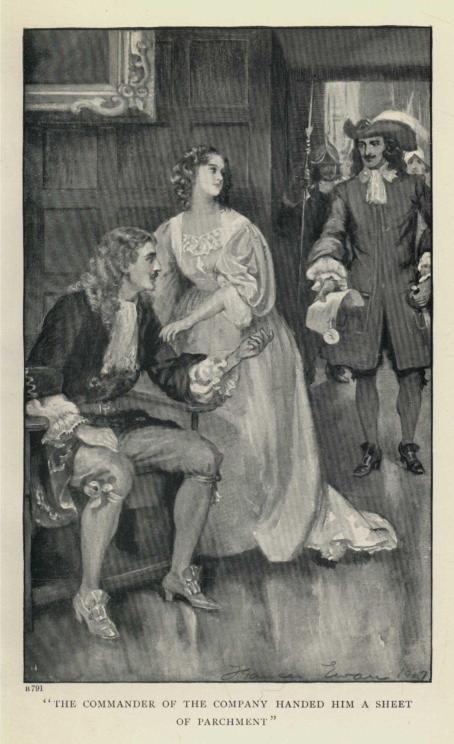
"THE COMMANDER OF THE COMPANY HANDED HIM A SHEET OF PARCHMENT"
Ann had followed him. He bent his head and whispered to her:
"Go to our mother, but do not tell her."
She was trying to slip away, but she found her passage barred by the officer in command of the company.
"I regret it, madam," he said; "but I cannot let you pass until the house has been searched and we are assured the colonel is not here."
"I never told you he was not here," said Reginald. "I bade you search for him."
As he uttered these words, a door at the farther end of the hall opened, and the colonel came forward.
"What do you require of me?" he asked.
Before anyone could answer, Reginald handed him the paper.
"It is well," he said; "I have expected this. I did not tell your mother nor you, children, because I would not have you needlessly anxious; now it has come to pass, I leave your mother to your care, Reginald. Deal gently with her. Nay, weep not, Ann. You are a soldier's daughter; it is not seemly." Notwithstanding his rough words, he took her in his arms and kissed her.
He shook Reginald by the hand, then saying:
"Gentlemen, I am ready for you," passed out of the hall, and, mounting the horse that was waiting for him, rode away surrounded by a guard of soldiers.
Ann and Reginald remained alone with the frightened servants, who crowded around them. In a few words Reginald told them what had happened, adding, "I do not think there is any danger for my father's life; but that he will suffer imprisonment and be heavily fined is probable. I would entreat of you all to keep quiet, and in public not to make more ado than you can help."
Reginald was a great favourite in the household; he was young and generous, and they served him willingly. So with a loud voice they all promised obedience, adding also their hope that their master would soon be amongst them again.
"I do not think there is the least fear but that he will," Reginald said assuringly, and so they dispersed, and Reginald and Ann remained alone.
Ann was very pale, but she was not trembling. She had a courageous heart, and was at the present moment thinking more of her mother than of her father. She knew full well that her mother had always been averse from her husband joining the present king's cause, and she felt sure now that she would call this a just retribution; but she would not take it the less to heart, for under a cold exterior she had loved her husband dearly, and served him as a true and honourable wife.
Whilst the two stood hesitating, the door opened and Patience and Agnes entered.
"What's happened?" asked Agnes. "We saw a troop of soldiers riding away; the street was full of them. They seemed to have a prisoner in their midst; we could not see who it was."
"It was my father," said Reginald. "He has been arrested for consenting to the late king's death."
"May the Lord help him!" said Patience. "Has there not been bloodshed enough already, that they must be ever seeking for more!"
"I do not think it is a case of blood," said Reginald, with something approaching a sneer in his voice. "I think money will settle this;" and the words and manner of the young man revealed a bitterness which had been growing in his heart for some time past. He and Ann had been so eager for King Charles to come back, they had welcomed him with such unfeigned joy, such belief that he would bring back all that was noble, all the greatness, the courage, and the bravery, the high moral tone which had been his father's, that whatever errors there had been in the past would cease now, indeed were already forgotten. Had not the whole race of Stuarts been chastised? Had not the whole nation suffered? And therefore they welcomed the king back as their chief good. The crown was his by Right Divine and by the will of the people. He had come back, and made merry, but he had no thought of forgiveness in his soul, only a fierce desire for vengeance against those who had slain his father and sent him into exile. That father had been a saint, and they slew him. The son was a great sinner, and they bowed down before him.
Reginald thought, and others thought with him, of all the blood that had been shed. They had hoped that a great pardon would have sealed that homecoming, instead of which it was vengeance and blood; whilst in the very palace where they had witnessed the death of Charles I, there was revelry and evil living, and an ignoring of all sacred things.
Their idol was broken, and their ideals had faded into nothingness. For the young this is a terrible experience: it cuts them to the heart, it wounds them to the soul. As men and women grow older they become accustomed to the daily and hourly disappointments of life. The shadow of death has passed over them, the lights have gone out; either they have grown hard and self-contained, or they have learnt to look beyond this world and patiently abide in faith, hope, and charity, until they shall pass into the kingdom of everlasting life. But the lesson has to be learnt, the road has to be trodden, and the pricks hurt their feet. The nobler the girl or the youth, the harder it is for them to lose their ideals.
Reginald was passing through this phase. He had built so much on this home-coming of his king, he had thought of him almost as a god, from his youth upwards; the son of that blessed saint and martyr, how should he be less than a hero! The disillusion was great, the sorrow was greater. Had he been of a less sensitive, a less noble nature himself, he would have thrown all care to the wind, have joined the revellers, and been content to lead the wild life of the young Cavaliers who had returned with Charles from foreign lands, and who now thought of little else but of making up for the years which had been passed in poverty and exile. Those lean years had taught them no lesson of frugality or decorum; rather they had made them impatient of restraint, desirous of making up in folly and extravagances for the years they called wasted.
Truly they were wasted, for they had brought forth no fruit. The lesson God would have taught to the race of Stuarts and their adherents had been of no avail. These men were like the Israelites of old, they had neither ears to hear nor eyes to see, and the few faithful ones, who loyally in England had waited for and prayed for their coming, were now sick at heart.
Yet Reginald had no thought of throwing up his allegiance; it was based on too good a foundation--his God and his king. He could not serve one and forsake the other, and so, though his heart was sore within him, and he felt that dark days were coming both for him and his, as a brave man he looked straight before him, trusting in a higher power than his own to deliver them from evil.
CHAPTER VIII
Arrested
It was Patience who sought Mistress Newbolt in her chamber and told her in a few words what had happened. It was even with her as her children had thought it would be.
"It is the Lord's justice," she said. "His will be done." She straightened herself, went down to her household, and rebuked Ann when she wept.
"Shall not the Lord chastise His children?" she said. "Whom the Lord loveth He chasteneth. Indeed, I am well pleased that our God careth for us so well that He does chastise us; for, seeing we were so prosperous, I feared He held us to be of no account, but now I am exalted, and my spirit is glad within me, for the Lord has laid His hand on my house."
This enthusiasm was wonderful; her face, which before had been sad, shone now with an inner light of satisfaction. She went about her duties with an energy and a briskness which had long failed her.
The maid-servants exclaimed, "The mistress is of cheerful countenance; is it seemly that she should rejoice over the master's misfortune?"
If she divined their thoughts she paid no heed to them.
"Poor ignorant souls, they cannot understand," she said to Patience, who, to tell the truth, herself did not understand why the wife should rejoice when her husband was sent to prison and was in danger of his life.
She remembered how sorely she had grieved over the misfortunes which had befallen the royal standard, and how she had mourned for those who were then laid low.
"It is not natural," she said to Agnes; "we must accept the will of the Lord, but we are not bound to rejoice when He afflicts us."
Reginald had left the house almost immediately after his father's departure, to find out where he had been taken to and what could be done to further his release, so Agnes and Patience remained with Ann and cheered her as best they could. Mistress Newbolt needed no cheering; she busied herself arranging her husband's clothes, packing them to send to his prison, wherever that might be, and she employed the maids in taking off the lace ruffles from his shirts, replacing them with plain linen ones.
"He shall not appear before his judges like a popinjay," she said, "but like a sober, righteous man."
"Mother, you are wrong," said Ann. "He is a king's man now, and is serving the king. Why will you try to show forth to the world that he was ever aught else?"
"Because it is my duty, my joy," she answered, and she would not be gainsaid.
"Do not trouble," said Patience to Ann. "Let her have her own way. You can easily supplement what is lacking."
The day seemed long to them all except to Mistress Newbolt, whose pale face had a red spot on either cheek from the excitement of her heart. Her muslin kerchief was crumpled, a thing Ann had never seen before, and her hands trembled as she went about her work.
Once Agnes crept on tiptoe to the small closet which Mistress Newbolt called her own, where she was wont to read and pray. Opening the door gently she looked in. The window was wide open, and Mistress Newbolt stood before it grazing up into the sky, which was dark, threatening rain; but sunshine or rain, storm or clouds, were naught to her, her soul had soared beyond these earthly signs of fair weather or foul. Her hands were clasped, her face was turned upwards as if she saw a vision, and from her lips a quick flow of words poured forth so rapidly that Agnes had difficulty in following them.
It was more conversation than prayer, as if she were speaking to the Almighty as to a familiar friend, thanking Him for having thus cast His eye upon them, and chastening her husband for his sin. She prayed also for Reginald and Ann, that they might be reclaimed and brought back into the true fold. Then came an impassioned act of worship:
"Glory be to Thee, oh Lord Most High!" and so on.
Agnes stood transfixed. She had never heard the like before. It moved her as if a great wave had swept over her. She listened, drinking in the words with wonder and astonishment.
"It must be even as the prophets of old spoke," she thought. "I wonder if she is right and we all wrong;" and even as she was thus thinking Mistress Newbolt turned round, saw her, came quickly, took her in her arms, and almost carried her to the open window, crying in exultation:
"Lord, behold this child! Make her Thine; teach her Thy ways; make her worship Thee, the only true God, in truth and equity."
So tight were her arms wound round her that Agnes could not move. She held her as if she would have almost carried her up to heaven in her exultation. Looking into her face it struck Agnes as strangely beautiful; she had never seen it thus before. Her eyes were as coals of fire; the lips parted as the impassioned words dropped from them.
Suddenly the woman collapsed. She loosened her hold of Agnes, staggered, and would have fallen had not the girl upheld her; but she threw her off, and, casting herself on the ground, broke forth into fierce weeping. The bands of iron which had bound her soul gave way and she could only cry:
"Save me, oh God, save me, for Thy mercy's sake!"
With that delicate instinct which is inherent in some souls, Agnes felt that this was no place for her, that she had no right to look upon the weakness of this strong woman, and quietly, with tears pouring down her face, she left the room, closing the door behind her.
She paused for a moment on the landing, then, descending the stairs, found her way into the little sitting-room, where Ann and Patience were waiting for her. The discomposure of her face revealed to them at once that something unusual had happened.
"Have you seen my mother?" asked Ann, coming forward.
"Oh, it is too terrible, too terrible!" said Agnes, her tears bursting forth again, and, letting herself fall on the settle beside Patience, she clung to her for protection.
"What has happened, dear? tell me," said Patience softly.
"Nothing has happened," was the quiet answer, "but her grief is terrible to see."
"I will go to her," said Ann, rising.
"It is of no use," said Agnes, standing before her; "let her be. Her soul is wrestling with the Lord; she wants no human help; we do not understand her."
"I know what you mean," said Ann, "I have seen her in that state before. When my father declared that he would welcome King Charles and join himself to the royal cause, she was three days and nights shut up in her own room and would see no one; she would eat nothing but bread and water, and we heard her pacing up and down, talking to herself, apostrophizing the Almighty, praying aloud. Sometimes she would sing psalms or hymns. As I tell you, she remained three days in this state, and then she came forth haggard and thin, but quite calm. 'I have left it in God's hands,' she said; 'what He doeth will be well done.' Go home, dear friend," Ann continued. "You can give us no help, we must await events. I do not think my father's life is in danger, but how long he will be deprived of liberty, what his punishment will be, we cannot tell until his trial, and that may be retarded for many months. We were going to Newbolt Manor for a few weeks. Now, of course, we must remain here. I am sorry, because my mother's health suffers from the confinement in London, but I know nothing will move her hence so long as my father is in prison."
"Of course not," said Patience. "We shall also remain in town for the present. The king has gone with his court to Hampton, and I do not care to be there when that is the case, for there is no peace--the gardens are full of gallants and fine ladies--so we will remain at Somerset House until the king returns to town."
"I am glad of it," said Ann; "it is a comfort to feel that you are near me. We have many acquaintances, but few friends."
"You must count us as friends," said Patience.
"I will gladly do so," answered Ann. "I feel as if I have known you all my life."
"Therefore, if you have any fear, send for us," said Patience. "Now we will bid you farewell."
The distance between the Newbolts' house in Drury Lane and Somerset House could be traversed in a few minutes, but nevertheless the streets were by no means pleasant for women to walk through alone, therefore Patience and Agnes had come in sedan-chairs, which were waiting in the courtyard. These were now brought forward into the house, as was the custom, and, taking a tender adieu of Ann, they got in and were carried out. Agnes drew the curtain on one side, waved a last adieu, and then Ann turned away and went up to the first story, where was her mother's apartment.
She was sad at heart, and felt at a loss as to how she should comfort her, for she knew full well that there was no disguising the fact that her father had been a prominent man under Cromwell, also that he had commanded a body of horse at the late king's execution. One thing alone was in his favour: his name was not on the list of those who had voted for the king's death.
It was late at night when Reginald returned. He had no good news. His father, he had ascertained, was in Newgate, but he had not been able to gain access to him.
"I fear much," he said, "that there is a traitor somewhere, for why have we been thus suddenly attacked? The king was quite aware from the first that my father was a Parliamentarian; the only thing he did not know was that he was present at the late king's death. It is upon this charge that my father has been arrested. We cannot clear him; it is quite hopeless; we can only trust to the king's clemency, and that," he continued, "is of no great account. I am much afraid that I shall be obliged to resign my commission, and thus, though I am blameless, I must suffer, and the king will lose a good servant."
"Do you think he will be arraigned for treason?" asked Ann.
"No, that he cannot be," was the answer, "seeing that he was only captain at that time of a body of horse. He obeyed orders, and he kept the street clear in the precincts of Whitehall, but he was not actually on the spot."
"And though he has never allowed that it was so," said Ann, "in his heart I believe he grieved that the execution was carried out."
"His refraining from giving his vote was a proof of it," said Reginald. "Where is our mother?"
"In her own apartment," said Ann. "It is no use your trying to go to her; she will see no one. Agnes was with her, and I think she frightened the child; she has been very much excited all day. Martha tells me she has gone to bed, which is proof that she has worn herself out. She may be more composed to-morrow. You see, she considers our father's arrest a retribution."
"And she may not be quite wrong," said Reginald. "If he had only voted against instead of keeping silent, he would have been not only safe from molestation, but honourably revered."
"That he could not do," said Ann. "I have heard him say that though he disapproved of the king's execution, he did not see how otherwise order and justice were to be restored, or the Civil War ended."
"The whole thing is ineffably sad," said Reginald; "it is too late in the day now to discuss the pros and cons. Go to bed, Ann, and sleep; you will need all your strength and courage to face the next few months." And so they bade each other good-night and parted.
So worn out was Ann that her head was no sooner on the pillow than she slept; but Reginald sat till an unusually late hour in the house-parlour thinking matters over and trying to find out who could have betrayed his father.
He rose at last, and stretched himself, muttering, "It is folly and to no purpose my seeking to find the man; there are so many witnesses of my father's presence at Whitehall. We must abide by the results; but I will see Sir Nicholas Crisp to-morrow, he has always been kindly disposed towards me, and stands high in the king's esteem. He may perchance speak a word in my father's favour." With this he also retired to his chamber to await the events of the morrow.
CHAPTER IX
Old Newgate
We have all read, and we all know by hearsay, how, till within the last century, the prisons were worse than the lowest hovels. We know and honour the men and women by whose influence humanity was brought to bear upon them. What they must have been two centuries earlier passes all imagination.
We learn from old chronicles that as far back as 1218 the prison of Newgate existed. It was built in the portal of the new gate of the city, and from that fact took its name. Two centuries later it was rebuilt by the executors of the famous Sir Richard Whittington, Lord Mayor of London, and his statue with his cat stood in a niche. This building was destroyed in the great fire of which we shall soon be telling. It was here, in old Newgate, that Colonel Newbolt was imprisoned--a noisome place, within high, dark, stone walls, without windows, where the prisoners were crowded together irrespective of age or sex. At the time we are writing of, it was crowded to excess. To obtain a wisp of straw to lie upon at night, and the space necessary for a litter, meant a hand-to-hand fight between the occupants.
The jailers reaped a rich harvest, charging fabulous prices for the merest necessaries. There was no provision made for sickness, not even for the ordinary decencies of life; men and women of every class were herded together.
It is easy to imagine Colonel Newbolt's feelings when he was thrust into this den. On the first day he bore it with a certain amount of equanimity, feeling assured that he would be released on the morrow; but when two or three days passed by, and all the money he had on his person was expended, he was seriously disquieted, wondering why Reginald or some other of his friends did not come to his rescue. He could not know that Reginald had been daily at the prison, and had expended a considerable sum of money in pleading with the jailers for news of his father. He was dismissed with the assurance that his father's name was not on the prison list; they could not find the man.
This answer was given purposely. It would not have suited the jailers to find their man too soon, for then the enquiry money would cease to fall into their pockets, so they sent Reginald to Aldersgate and to smaller jails, of which there were several. Four days had elapsed after his father's arrest before Reginald was admitted into the prison and allowed to interview him.
He was horrified when he saw him. From a hale, fine-looking soldier he had dwindled into an old man, with sunken eyes and haggard face. His lace ruffles and jabot had been torn to shreds. He had had no change of linen, the lappets of his coat had been wrenched away, his head was bare, and his hair bleached.
He staggered as he came into the guard-room, and in his impotent rage shook his fist in Reginald's face.
"What do you mean, sirrah," he cried, "by leaving me in this condition?"
"Father, I did not leave you," said Reginald, tears gathering in his eyes. "I have been here daily, and could get no news of you. They have sent me about to the right and to the left; only to-day have I found you."
"The rascals!" said the colonel in a low voice, fearful of being overheard. "I am starved, Reginald," he continued, "I am unclean. I would sooner die than remain thus; ay, they will kill me before they bring me to trial. Is this what the king promised us? Is this the royal clemency?"
"Hush, Father, hush!" said Reginald, for in his excitement he had raised his voice. "I have brought gold; I will see what I can do for you."
He looked round, and seeing a keeper whose face seemed less evil than the others, he beckoned to him.
Slowly and sullenly the man came forward.
"Look here!" said Reginald, "if you can find the smallest cell in which my father can be alone I will give you fifty crowns."
"If you offered me a hundred I couldn't do it," said the man; "the place is crowded from top to bottom, and more prisoners are coming in every hour."
"But surely there must be some place less horrible than the one I am now in," said Colonel Newbolt. "I am herded with the scum of the earth. I hear nothing but cursing and swearing all the live-long day and throughout the night. I am covered with vermin. I will give thee a hundred crowns, sirrah, if thou wilt get me out of this."
The man thrust his hands into his pockets. A hundred crowns was an offer he did not often get.
"I am sick, sick unto death," continued the colonel.
"Then I will report you to the head keeper," said the man quickly, "and he will report you to the governor, and he will--I don't know what he'll think proper to do."
"In the meantime must I go back to that hell?" said the colonel. "Give me a knife and let me cut my throat!"
"We don't have that sort of thing done here," answered the jailer; "we keep no knives and no ropes inside the jail."
"Listen!" said Reginald. "Surely there must be some place, some cell in which there are three or four privileged prisoners, where you could manage to put my father until I take measures for his removal. Go at once and speak to the head jailer."
Saying this, Reginald put money into the man's hand. "Not a groat more do you get," he said, "if you do not succeed, but I will double it if you do."
He turned away, and, taking his father by the arm, succeeded in finding a seat in a far corner of the room.
"See, Father, I have brought you food!" he said. He cut the strings of a basket which he had been carrying and drew forth a pasty, some white bread, and a flask of brandy.
The prisoner flew at the brandy. Reginald was forced to stop him.
"Gently, Father, gently," he said, "you will make yourself ill; there is no hurry." And he handed him bread and meat, which he ate ravenously.
The keepers, noting that the young man wore the king's uniform, and that the old man, even in his soiled clothes, had an air of distinction, let them be. Besides, Reginald was generous with his money; he knew there was no other means by which to gain a little respite.
When his father had eaten and drunk, more perhaps than was good for him, he laid his head back on the wall and went to sleep. Reginald kept watch over him. Once or twice the keepers came up and would have roused him and sent him back to the common prison, but Reginald pleaded:
"Let him be a little longer," he said; "I am waiting for a message from the governor." Again money passed from hand to hand, and they were let alone.
Not till the day was far advanced did the first keeper return.
"The governor will see you," he said; "follow me."
Reginald looked at his father. If he roused him now would he be sensible?
"Father!" he said, bending over him.
The colonel started and opened his eyes, but his mind seemed to be wandering. He stood up, gave the word of command, as if he had been on parade, then, looking round him, he said: "Where am I? What does it mean?"
"He is in delirium," said Reginald in a low voice to the keeper. "Take hold of him on one side and I will take him on the other; the governor can judge for himself." So they crossed the room, the old man muttering and talking to himself, until they came to the governor's room.
To Reginald's surprise, he proved to be an old friend of his father's, who, however, had kept fairly quiet, and had not been in any way offensive either to the Commonwealth or to the king's Government. It was not in his power to remedy the state of the prison, and he had no thought of attempting to do so. A prison was a prison in those days. Prisoners, if refractory, were chained up like wild beasts and kept on bread and water. They lived or died, as the case might be; some went under at once, others, thanks to stronger constitutions, managed to survive, until they were dragged on hurdles to execution, or by some lucky chance found their way out of that prison-house, brutalized, hating both God and man.
When the governor, looking up, saw Reginald and his father, he said shortly:
"When I heard your name, I wondered what Newbolt it was. How happens it that your father has let himself fall into this strait? I thought he was a cleverer man."
"There must be a traitor somewhere," said Reginald. "My father has taken the oath of allegiance; he went with General Monk to meet the king on his return. I, who have never drawn sword in any other cause, hold a commission from the king in his own Guards. But some traitor has informed his majesty of what, alas! is only too true, that my father was captain of a body of troops who kept the streets at the time of the execution of his most gracious majesty, Charles I--hence his arrest."
"Ah, that is compromising!" said the governor. "Do you know who the informant was?"
"No, I do not," answered Reginald, "but I will make it my business to find out. There is no denying the fact that my father was on duty that day. He was arrested four days ago, and see what it has made of him! He was a strong, hale man when he came here. I ask your clemency for him."
"It is a common case," said the governor. "The class of men to which your father belongs cannot stand this place. I will do what I can. He has caught jail fever. Put him in yonder chair."
The keeper and Reginald obeyed, the old man talking and jabbering all the time.
Reginald stood before the governor, who continued: "You see, we cannot put him back into the public room, and there is not a free cell. You may believe me or not as you choose, the prison is literally swarming. Knight," he said, addressing the keeper, "is there any hole you can give the colonel to lie in until I can get him removed?"
"There is the cell at the end of the right-hand corridor, where that madman was confined; he died yesterday. His body was thrown out to-day, but the cell has not been cleaned yet; it is not fit to put even a dog into."
"Let it be done immediately," said the governor. "Let fresh straw be laid down and the colonel carried thither. I give him into your hands, Knight. I think you will find it worth your while to treat him well," he added, with a glance at Reginald.
"I have promised him a hundred crowns; I do not care if I make it two hundred," answered the young man.
"Sir," said Knight, "I thank you. May I leave the gentleman here whilst I see to the cleaning of that dog's kennel?"
The governor nodded.
Worn out, the colonel's head fell on his breast; he was in a sort of coma.
"I'll write a letter," said the governor, "which you may take to the Secretary of State, or, if you prefer it, to the king himself. If you can get an audience, that might be better. If your father is really to be prosecuted, he must be removed from this prison to Aldersgate."
"I do not think he will be removed anywhere except fro his last resting-place," said Reginald.
"Tut, tut! men do not die so easily," said the governor. "That is our strong point. I will represent that if the colonel is left here he will certainly die, and then who would pay the fine, which will be the least thing imposed upon him? The king's exchequer, they say, is empty, and there is nothing to be got out of a dead dog; therefore, you see, it is to their interest to keep him alive. Rest assured they will nurse him with the utmost tenderness, so that, if he be hanged, he may be hanged alive, and his lands forfeited to the crown. If he dies now, you will inherit; you have committed no misdemeanour. On the contrary, you are the king's man, and they cannot, in all decency, prosecute you. Do you understand?"
"Yes, I understand," said Reginald, with evident disgust. "Write the letter for me, sir, and I will carry it."
The governor scrawled a few lines, folded it, and gave it to Reginald.
"I think you will find that serve your purpose," he said.
"May I send clean linen and clothes for my father?" asked Reginald. "He cannot remain as he is."
"I should advise you to send nothing, but to bring everything," said the governor; "otherwise I greatly fear he will not benefit much. This is a den of thieves and robbers."
Reginald hesitated for a moment, then he said:
"And my mother! When she knows I have found my father, nothing will keep her away."
The governor shrugged his shoulders.
"Then you must bring her, that is all," he said. "Knight will let you in the back way. Your father will not be so bad to look at when he is in his new cell. Now you must be gone; I have given you more time, young man, than I have favoured anyone with for months. Look through that window in the wall and you will see the crowd waiting to interview me."
"I am more than grateful to you, sir," said Reginald.
"All right, all right!" answered the governor, holding out his hand. "We will try to pull him through; not that it will be easy, I warn you."
"I fear not," answered Reginald; "nevertheless I thank you, sir," and, bowing to the governor, he turned round to where his father still sat in a deep, heavy slumber: his face was crimson, his hands, as Reginald felt them, were burning.
"I have cleaned the place up as best I could, sir. Shall we take him there at once?" said Knight, coming up.
"Yes," said Reginald shortly; and between them they carried the colonel down two or three long passages, lined on either side with cells. At the very end there was an open door, showing a cell of about eight feet square. Upon the ground in one corner was a heap of straw, which, with a table and a chair, both riveted to the wall, and a basin, completed the furniture.
"I found this here thing in the corner of the public room where the gentleman has been lying. I don't know how it has escaped the eyes of his late companions, but it has. I got it and brought it here. He will want it," said Knight.
Reginald recognized his father's cloak, so they wrapped him up in it and laid him in the straw which was strewn on the damp floor.
"Look here, man," said Reginald, "I must go. I have pressing business. Here are the hundred crowns I promised you, and for every week he stays here and you care for him decently, you shall have as much again. I shall be back in a couple of hours with sheets and bedding, and all that is necessary for his comfort. You must fetch the doctor, and whatever he orders that you must provide."
"Very good, sir, I understand," said Knight. "But I have other duties, you know; I cannot be always here."
"Pass them over to someone else. I'll pay, as paying is the order of the day. Do you agree?"
"I should be a fool not to," answered Knight. "I'll see to the old man; you shall have nothing to complain of." And with that half-promise Reginald was obliged to be satisfied. With one more look at his father he went out.
Knight followed him, closing and locking the door.
"You will lose your way unless I take you out," he said to Reginald. "You had better not come in at the front gate in future."
So saying he guided him into a small courtyard, which was evidently seldom used. In it was a huge mastiff, which walked to and fro, snarling and growling. He sprang forward to meet the two men, and would have flown at Reginald if Knight had not caught him by the collar.
"Speak to him, caress him, then in future he will never hurt you," he said. "When you come back, bring him food; you must be friends."
Reginald had a great liking for all animals. He spoke to the mastiff, which, after a few minutes' inspection, sniffed around, and suffered him to stroke him.
"That's all right," said Knight, satisfied.
Taking a key off a bunch at his side he opened a side gate, and Reginald passed out into the street opposite the Old Bailey.
"You have only to ring that bell when you return," he said, pointing to a long iron chain by the door. "I shall answer."
Reginald nodded, and went forth with a heavy heart, feeling as if years had passed over his head since he penetrated within the mighty walls which separated the prison of Newgate and its inmates from the outside world.
CHAPTER X
A Legend
When Reginald returned to his mother he found her waiting impatiently for him; indeed, she had done so for the last three days. Her whole time had been spent between prayer and waiting, seated in the window with her hands folded.
In the morning she attended to her household duties--she forgot nothing. It was with difficulty that they could get her to take any food; she seemed to have no need of it. Now, when she saw Reginald coming up the street, she said to Ann:
"He has news--he has found your father." And she went to the door to meet him.
"Well?" she asked.
"Yes, I have found him," said Reginald; "but you must not rejoice too soon, Mother, for he is in a terrible condition."
"Dying?" she asked.
"I cannot say, for I do not know," answered Reginald. "He is very ill--his sufferings have been great, and he is now delirious. I saw the governor, and he had him removed to a cell by himself. He is in want of everything. There are no rules to prevent our taking anything we choose to him."
"And I may go to him?" she asked.
"Yes, you may go to him, but Ann must not," said Reginald; "the place reeks of fever, small-pox, and every other disease. You must be prepared for the worst, Mother."
"Whatever the Lord orders is for the best," she answered.
"But what is to become of Ann? She cannot remain in this house alone," said Reginald.
"Take her to Patience," said Mistress Newbolt. "She can abide with her all day, and at night when I return you can fetch her--if I do return."
"At sunset you must leave the prison, Mother; it is the rule."
"Very well," said Mistress Newbolt, "I will abide by the rule. Now order a coach; I have everything ready."
"I am afraid not everything," said Reginald. "He lacks bedding, sheets, the veriest necessaries. I left him lying on straw in a damp cell. I will order a cart to come round to take the larger luggage, but you must go in a coach."
"I can walk if necessary," said Mistress Newbolt; "it is no great distance."
Two hours were spent putting things together, providing food, broths, and jellies. Ann went about with her mother, thinking of everything. When all was ready and the coach was called, she said to Reginald:
"Shall I not be allowed to go?"
"No, it is not a fit place for you," said Reginald; "and you would do no good. I don't know when I shall return myself, therefore you had better get your women to take you to Somerset House. You can tell them how matters stand, and I shall probably fetch you at nightfall, or when my mother comes back."
Whilst they were still conversing, Mr. Delarry came up. It was by no means the first time he had come to the house--indeed, he and Reginald were very good friends, and he would frequently drop in to supper--but he had been away with the king at Hampton Court, and had only just heard of the colonel's arrest.
"I am deeply grieved for you," he said, "and I hastened here to tell you so. Is there anything I can do for you?"
"Nothing at present," said Reginald. "I have been three days finding my father, and now he is sick unto death; I do not know whether he will live. I am taking my mother to him. I have no time to say more, so farewell!"
Mistress Newbolt appeared on the steps, and Reginald hastened to help her into the coach. Many of the servants had followed her, and were weeping. Although she was a stern mistress, she was a just one, and they all respected her.
"Delarry," said Reginald, before following his mother into the coach, "will you see my sister to Somerset House? She cannot stay here alone, and neither my mother nor myself can be back before nightfall."
"If she will allow me to do so, I shall esteem it a favour," said Delarry. "And, Reginald, let me know if I can be of any use to you; I am at your service."
"Many thanks!" said Reginald. "It is something to feel that one has a friend in these hard times." The two young men shook hands, Reginald took his place beside his mother, and they drove away. Ann went slowly back to the house, Delarry following her.
"Shall you go at once to Somerset House?" he asked.
"In about an hour," she answered. "I must put my mother's room in order, and attend to a few household duties. But do not let me detain you; my own woman will accompany me."
"You would not grieve me thus?" said Delarry. "I esteem it a high honour to have been asked to take care of you."
"Very well," said Ann, "come back in an hour, and I will be ready."
He did so, and accompanied her the short distance from Drury Lane to Somerset House. They made no haste, for they liked each other's society.
When they reached Somerset House they found Patience and Agnes on the terrace taking their mid-day airing.
"We did not venture to come to your house," said Patience, after greeting Ann and her companion, "for fear of disturbing your mother. We felt sure if you had news that you would send us word."
"We have news," said Ann, "but it is of such an evil kind that the telling of it is grievous to me."
"Still we must hear it," said Patience.
They sat down on the bench facing the river, and there Ann told them all she knew.
"It is a very terrible state of affairs," said Delarry, looking serious; but he did not venture to say how serious he thought it, for he knew full well that the king was still very bitter against anyone who had had a hand in his father's murder. Nevertheless he tried to speak cheerfully.
"It will be better," he said, "for Reginald to go to the king himself. He is rather partial to the young man; indeed, only the other day he asked why he was not in attendance. He then learnt of the arrest of Colonel Newbolt, and expressed his regret that the son should have to suffer for the father."
Ann coloured. "That means that Reginald will have to resign his commission," she said.
"I am afraid so," answered Delarry. "It would hardly do, when his father is imprisoned for connivance with the regicides, for him to remain in the king's service. But we cannot tell. Charles is a strange character; he may not choose to accept your brother's resignation."
"It was not Colonel Newbolt's fault that he was on duty on that day at that place," said Agnes.
"No," said Delarry, "that was a coincidence, but still the fact is there."
"Don't let us talk about it," said Ann; "it will not mend matters."
"My friend is right," said Agnes. "We will talk of other things. Is there any news from France, Mr. Delarry?"
"Yes, the king heard from her majesty the queen no later than yesterday. The marriage of the duke and the princess is to be the occasion of great festivities; it is to be conducted with royal state. The King of France is making much of the bride."
"I wish I were in Paris," said Agnes; "I know just how it will all be. I think I like Paris better than London."
"Oh no, you don't!" said Ann. "You must not. You are an English girl, and must love your own country best."
"So she will in years to come," said Patience. "There is so much in habit. She has always lived in France. The sun shines more brightly there, and the days are longer."
"And people are less stiff, and they are kinder and more courteous," said Agnes. "You English are so cold! I have lived a long time here now, and I have only one friend--that is you, Ann."
"And is it not a grand thing to have one friend?" said Mr. Delarry. "We may have many acquaintances, little lady, but a friend is a rare gem."
Having said this, Mr. Delarry rose and took his leave.
Patience and the two girls went up to their own apartment, and occupied themselves at that fine tapestry work at which Agnes, like all French ladies, was an adept. Ann was not so clever with her needle, but she loved to watch her friend, whose proficiency was astonishing; the flowers, the birds, the figures, seemed to grow under her fingers.
"I wish I could work as you do," she said.
"I love it," answered Agnes; "it makes me forget. When I have any trouble or any vexation I come to my framework and create a bird, or a flower. Sometimes I dream dreams. It does not matter what I do, but I grow quieter and happier."
"You are a town girl, and I am a country girl," said Ann. "I have lived all my life in the open, in the midst of the flowers and the birds, with my dogs and horses, riding and hunting with Reginald and my father over miles of moorland. Oh, it is glorious! Would you not love it?"
Agnes looked up. "Love it? Indeed I am sure I should!" she answered. "Patience said just now we grow accustomed to things; that is true. I was accustomed to the great dark rooms at the Louvre, and the long dull days; but sometimes, I remember, I used to feel suffocated, as if I were a bird beating against the bars of the cage. I used to look up through the windows at the sky, and long--oh, how I used to long!--to have wings to fly away."
"And yet you say you like France better than England," said Ann.
"I knew of nothing better," said Agnes. "I loved the queen and I loved Henrietta, but still I have always known that it was not my own life, that there must be something better! We used to go to Fontainebleau sometimes, but we children never went beyond the edge of the wood. We were allowed to wander in the great gardens, which were very beautiful, with long avenues of trees and a big pond full of tame carp, which came when we called them, and which we used to feed. It was a great pleasure, but still it was not liberty. I longed for liberty, to ride, to walk, as the desire might come to me. Ah, you are very happy!" she said to Ann. "Tell me about that place up north of which you speak so often."
"Newbolt Manor?" answered Ann. "It is the most beautiful place in the world. Long, long ago it was a monastery, and belonged to a religious order. There are the ruins of the most lovely chapel you ever saw; and although the house has been restored and rebuilt, there are still parts of it which belong to the old days--the great hall, the refectory, and the library. They are very beautiful, with much carved oak and many stained-glass windows."
"And it belonged to the De Lisles!" said Agnes thoughtfully.
"Yes," answered her companion, "and there is a long picture-gallery containing portraits of the family of De Lisles; and now I come to think of it, Agnes, there is one picture of a child who lived a long time ago--oh! a hundred years ago, perhaps. You are exactly like her; is it not strange?"
"Very," said Agnes. "Go on and tell me more."
"Well," said Ann, "the story is that when the monks were driven out, King Henry VIII gave it to a certain Reginald De Lisle."
"How did that old man at Greenwich know anything; about them, I wonder?" said Agnes. "How did he know the De Lisles?"
"That I cannot tell," said Ann. "He may have been an old servant, and have known the legend that the De Lisles, being possessed of church lands, would be driven out."
"It has come true," said Agnes.
"Only to a certain extent," said Ann. "They were not driven out, they died out; the race is extinct."
"How then can they come back again?" asked Agnes. "You know he said they would."
"Ah! that I cannot tell," answered Ann. "If he were an old servant of the De Lisles, the wish might very possibly be father to the thought."
"But," said Agnes thoughtfully, "supposing it were a mistake, and that one day a De Lisle should turn up and claim his own?"
"I do not suppose it would make much difference now," said Ann. "The land is ours as far as lawyers and parchment can make it so."
"You would be sorry to lose it," said Agnes.
"Yes, I should," answered Ann. "I love the place, and I would like to think that Reginald would have it one day, and that he would marry and have children; and so it would go down from generation to generation, a fair heritage."
"As it was with the De Lisles," said Agnes thoughtfully. "Ah well!" she added, "it does not much matter; the world passeth away, and the glory of it."
Instinctively the words had come to her lips--how they did so she knew not--it was the inspiration of a moment. She had dropped her needle whilst listening to Ann, and there was a strange, dreamy look in the great dark eyes as she gazed through the window up to the sky which overhung the river. The summer day had come to a close; she could no longer see to put her stitches into the canvas. A sense of unreality crept over her, a sort of feeling as if she had lived in another world once upon a time--she was, and she was not--a spell seemed laid upon her. Would she awake and find her present life only a dream?
Patience's voice roused her.
"Ann Newbolt," she said, "a messenger has come from your brother. Neither he nor your mother can return to-night. He requests me to keep you with us."
"My father is dying, then?" said Ann.
"The messenger does not say so," answered Patience, "merely that they cannot leave the prison."
CHAPTER XI
A Brave Woman
Sooner or later we all find a place which fits us in the world, and when Mistress Newbolt crossed the threshold of Newgate to take charge of her husband, unwittingly, even to herself, she had reached her bourne. She did not know it, she did not realize it till long after; but her work had found her, and she was not one of those who, having put her hand to the plough, would turn back again.
An ordinary woman would have shrunk from the misery which surrounded her, but she never did. All the sorrow, the discontent, which so often troubled her, ceased to be as she stood beside her husband in that narrow cell. With strong hands, helped by Reginald, she arranged his bed; she spoke to him, she comforted him; even in his delirium he knew her and clung to her. That he was desperately ill she saw at a glance, but even the doctor, a rough, hard man, when he came to visit him, grew soft in Mistress Newbolt's presence.
"Madam," he said, "I cannot tell whether he will live or die. His life is in your hands."
"Not in mine," said Mistress Newbolt, "but in God's."
"We do not hear much of God here," said the doctor roughly. "It is verily a God-forsaken place; but your presence is potent, your care may save him."
"I can only stay here a few hours," she answered, "at least, so I am told. I will do what I can."
"You may stay here as long as you choose," said the doctor. "I will speak to the governor."
And so it came to pass that Mistress Newbolt was established at Newgate. That first night her husband was seized with such violent delirium that it required two men to hold him down.
Reginald therefore remained till early morning, when, exhausted, the patient dropped into a deep sleep. Then his mother bade him go and rest.
"You have your duties to attend to; you have Ann to see after," she said. "I am sufficient here."
"Will you not be afraid to remain here alone, Mother?" asked Reginald.
"Afraid!" she answered, "of what? Is not God with me?" And that strangely inspired look came into her face. "I feel as if my place were here, as if at last I had found my appointed task. Go, and do not trouble about me or your father."
Reginald kissed her hand.
"You are wonderful, Mother," he said. "I will return this evening before the prison gates close." And so he left her.
As Mistress Newbolt stood in the passage she heard cries and moans, loud voices, and bitter plaints.
"Are those the prisoners?" she asked of Knight, the jailer.
"Yes," he answered, "they are hungry dogs to-day. They declared that the morning allowance of food was insufficient. There was not a hunch of bread for each man, and it was sour, not fit to cast to the dogs."
"How was it so?" asked Mistress Newbolt.
The keeper shrugged his shoulders.
"How can I tell?" he said. "It is bought by contract. As we get it we give it them. Those who have no money of their own, and no friends, come badly off. Your husband is sleeping, will you come and look at them?"
Mistress Newbolt acquiesced.
He took her down the passage to a great iron door, in which there was a sliding panel, not large, but large enough to allow an outsider to look into the interior. The keeper drew back the panel, and shrill voices fell upon her ears, uttering curses and foul language. She saw men and women with scarce any semblance of humanity, rather like wild beasts. Some were tearing at hard crusts of bread, others at meat of the worst kind; men belaboured the women and thrust them back, snatching the food out of their thin hands. And they in their turn clutched at them and tore their hair, scratching their faces in their madness. One or two had infants in their arms, parodies of childhood.
"It is terrible!" said Mistress Newbolt, her pale face paling.
"Here is gold," she said to the keeper; "go fetch me food! I will give it them. And look you," she continued, "that you are just, and bring me full measure for the money."
Her stern eyes stared straight into Knight's, and he, as if affrighted, looked away; nevertheless he took the gold and departed to do her bidding.
Mistress Newbolt faced the opening again and called out, "Peace, peace!"
Her words were received with a loud yell.
"Peace? There is no peace here."
"Peace, peace, God's peace be with you!" she continued; and then in a loud voice, which rose above the turmoil, she began:
"Our Father which art in heaven."
Shrieks of mockery greeted her words.
"He who would have bread let him pray for it," she cried out. "Surely it will come to him who asketh."
A loud voice greeted her words.
"We have asked, and they have given us stones for bread," said a gaunt man.
"Because ye have asked amiss," she answered. "Down on your knees and I will pray for you."
A moment's hesitation, then there was dead silence, and that crowd fell down as if moved by some invisible power.
"Repeat what I say, after me," she cried. "Our Father."
And so through that blessed prayer, the like of which there is none other, these poor wretches, the outcast of the earth, followed her, repeating the words, some with sobs, some still cursing between the words.
As the Amen died out, Knight stood beside her.
"Open the gate and let me in to them," she said, "and then do as I bid you."
She took a great white loaf from the basket he had brought.
"There are more coming," he said in a low voice; "this is not all your bounty gives."
"A knife," she said. "I will break each loaf in four. Open the gate," she continued, "and I will go in and feed them myself."
"They will tear you to pieces," said Knight.
"No they will not," she answered; and she stood erect as one inspired.
The jailer took the bunch of keys from his side, unlocked the door, and she passed in.
In a second she was surrounded.
"The bread, the bread we have prayed for!" they cried.
"It is coming," she answered; and she took the lumps of bread which Knight handed her. Quickly they were snatched from her.
Suddenly she stopped, for she saw that the men in their greed were thrusting the women back, and fighting their way towards her.
"Cowards!" she cried, "stand back! The women and the children. Have you nothing human left in you? Shame! Shame!"
There was a deep growl of anger, but slowly the men fell back, and the women rushed forward, kneeling at her feet, kissing her hands. Their souls were touched, and she, stooping over them, bade them rise, and gave them food. She took one child in her arms and fed it with her own hands.
"Water!" they called out, "water!" And they showed her a pitcher filled with a foul liquid.
"Water, bring water!" she repeated; and the keepers brought it as they would have brought it at an angel's word.
She held the jars to the parched, thirsty lips, and they drank, all those who could get near enough; but it was not enough, there were so many.
"That is all," she said at last. "I have no more; but to-morrow I will come back and feed you again; only be human and know there is a God who careth for you. Ye have sinned, but He will pardon you if you repent. He suffered, though He was sinless, and you are sinners. It is but just that you should suffer for your sins. Listen to what the psalmist of Israel sang." In a loud, clear voice she recited the 77th Psalm:
"'I cried unto God with my voice, even unto God with my voice, and he gave ear unto me'," and so on to the end.
Where there had been such an uproar there was now a grave stillness, save for the groans of the men and the weeping of the women. She stood with the half-naked child still in her arms, and looked down upon the people, her tall figure resting against the unclean wall of that prison-house. Her voice was steady; her eyes had in them that strangely luminous look of inspiration.
When she had finished she gave the child back to its mother.
"If they will let me, I will come to you to-morrow," she repeated, "and so each day. Only be patient, and the Lord will be with you."
As she spoke she backed out of the cell, and disappeared from their sight.
The keepers told the governor they had never had such a quiet day; the prisoners seemed subdued. They took their portions of food at night and hardly murmured. There were many brutes amongst those men, and many shameless women, but their passions were curbed and their evil tongues silenced.
Mistress Newbolt went back to her husband and tended him all that day, praying beside him with such earnestness, and with such impassioned eloquence that the warders came and stood at the door of the cell and listened. There was not one of them who would not gladly serve her; she might ask what she would of them, they did it.
The governor, hearing what she had done, though knowing it to be against the rules, said:
"Let her do what she will for the poor wretches!"
And so every morning for ten long days she went in to them. Some passed away, but the greater number remained. Every day she added something to her bounty: she gave the women cloths and brooms, and bade them try to keep some order and cleanliness in the cells; but it was impossible, and she soon recognized it was so.
Some days she would repeat a few verses from the Bible to them, and they would listen. Her heart would be glad then, thinking she had won them, but on the morrow there would be fresh cursing, swearing, and evil-speaking. Still, she never wearied. She brought fresh water and clean linen, and dressed their wounds; she brought milk for the little children; she spent herself and her wealth for these outcasts. They grew to look upon her coming as the one thing in the twenty-four hours for which they lived.
"Our mother's coming," they told one another, as the hour approached, and like children they watched for her.
It was wonderful how her strength stood it all--those long days and nights at her husband's pallet, and the horror of her surroundings.
The order came at last that her husband should be removed to Aldersgate to await his trial. The class of prisoners there was of a higher degree, and the prison was less crowded. But the order came too late; they could not move him.
"He will die on the way," the doctor said; "he must die, therefore let him remain here in peace."
When she was not tending the prisoners or waiting on her husband she was praying, this marvellous woman, in whom verily the blood of martyrs must have flowed. She grew gaunter and gaunter, but there came into her face a look of enthusiasm, as if she no longer belonged to this world, but to the heaven of which she spoke.
"If Ann is to see my father alive, I must bring her soon, Mother," said Reginald, on the eighteenth day of the colonel's illness.
"He will not die until the twenty-first," she answered.
On the morning of the twenty-first it was evident that he was sinking, that he would not outlive the day, and so Reginald went for Ann and brought her to the prison. He had told her something of their mother's doings, but it was difficult for anyone who did not see it to know what that prison life was, and Ann was spared the horror. In the cell where her father lay dying everything was spotless. There was scarcely standing room for two or three people, but the door was left open; there was no fear of his escaping--the spirit would go, but the shell would remain, until it was given back to earth. Man could not hurt him; he need not fear being called to any earthly judgment.
So changed was he that Ann hardly knew him. If she had not known he was her father she would not have recognized him. Looking at her mother, she saw it was the same with her.
"Can this be my father," she thought, "by whose side I have ridden over moor and fell, whose voice was so strong to command, whose presence was so good?" And then, looking at her mother, she grew faint with fear.
There was something unearthly in Mistress Newbolt's appearance: her tall figure had grown supernaturally thin, her hands and face were transparent in their whiteness, her eyes shone with kind and tender pity--they were no longer cold and hard as they had been.
When Ann, overcome with grief, sank by her father's bedside and sobbed out her sorrow, she felt her mother's hand on her head, and her voice whispering:
"Nay, my child, do not weep; it is well with him. We have prayed together, he and I, when God has vouchsafed to him short glimpses of reason, and I am persuaded that his soul is safe in the hands of his Maker. Do not trouble; it is well with him."
Then she knelt beside her and poured forth her soul in prayer. It was wonderful to hear her; she was as one inspired; the words flowed forth in a stream of unbroken eloquence. The warders, the keepers, the women of the prison, all gathered round to hear her, and many having come to mock, remained to pray. Throughout the day this went on.
Towards evening Reginald came to take Ann away. Suddenly life seemed to come back to the dying man. He sat up; they put pillows behind him. He looked around him, and seeing Ann and Reginald, beckoned them to come to him. Laying his hands on their heads, he blessed them.
"I have one desire," he said. "I have loved lands, and wealth, and all the good things of this world; now I know they are of no value at all. I charge you two to discover if there be any child, kith or kin, of those who possessed Newbolt Manor before it came into my hands. If so, give it back to them; if not, then do as the disciples of old--succour the poor, make a home for the destitute, let the wealth go back to God who gave it. You will remember?"
"I will remember, Father," said Reginald; "have no fear."
Colonel Newbolt sank back on his pillows as if content, and quietly, without an effort, as if he were falling asleep, passed away.
His wife rose from her knees and covered his face. At a sign from her all those present left the cell, except her children. They remained with her until the last offices for the dead had been accomplished, then, at her command, hand in hand they went forth; she remaining alone to keep watch beside him who had been her husband.
CHAPTER XII
A Faithful Friend
In the life of every one of us, from the cradle to the grave, there are landmarks. The child's first tooth, its first step as it half tumbles across the floor into its mother's arms, the first word from the baby's lips, are stages in the child's life and in the mother's heart. So it goes on imperceptibly--the child, the youth, the man, school and college; these come to all. But there are waves which sweep over each individual soul, casting it ashore; a master wave, drawing us into the great sea of destiny.
The death of Colonel Newbolt changed the current of more lives than one. Ann had adored her father, and when Reginald took her forth out of that prison-house where he lay dead, she was as one stunned. How great the change in her life was to be she did not then conceive, for in the first hour of a great sorrow, that sorrow alone holds us.
Ann went back to Somerset House, and Patience and Agnes tried to comfort her; but on the morrow Reginald fetched her, and she went home to her mother.
Then a strange thing happened. One morning, as Patience and Agnes sat at work, a commissioner came and informed them that the king had given orders that the queen's apartments, and, in fact, the whole of Somerset House, was to be put under repair. This was to be done quickly because of the king's marriage and the return of her majesty, the queen dowager. "Therefore", he said, "the king desires that you should remove to Hampton Court, to the apartments he has given you there."
Patience listened in silence, and when the messenger had departed she went and shut herself into her own room and did not appear till supper-time, much to Agnes's astonishment, for she had never before been left so many hours alone. The first words she spoke startled Agnes.
"You heard the order for us to leave this house and go to Hampton Court," she began. "Well, I will not obey, because I do not choose that you should live in the midst of the king's court. I find," she continued, "that with great economy, and by living in some quiet country village, I have money enough to keep us for two or three years. Will you be content to live thus?"
"I shall be glad to do so," said Agnes. "Ever since we were at Greenwich my heart has yearned for a country life. I told you a long time ago I was tired of courts. Take me where you will, Patience, as far out of the world as it pleases you. Of course, Ann and Reginald will know where we go?" she added.
"No," said Patience, "nobody must know. I am taking you where it would be a danger for you to be known."
Agnes's face fell. "But I love my friends," she said, "and would not be wholly parted from them."
"For the present you must be," said Patience. "What the future holds in store for you I cannot tell. May the Lord guide our footsteps in the right way!"
When Reginald called the next day to ask them to come to his mother and Ann, they were gone--no one could tell where, no one knew. They had left soon after dawn, taking Martha with them, also Rolfe, a north-country man who had accompanied Patience to France many years before. Evidently Patience had judged these two to be fitting persons to serve them, to be trusted.
Sad at heart, Reginald returned and told his mother what had happened.
"I am sorry," she said. "I was going to ask Patience to take charge of Ann, because this night I had a call--I heard voices and I saw visions. The spirit of the Lord bids me forsake the world and serve Him only. Nothing must hinder me, and yet Ann stands in my way; she is there before me, blocking my path. What can I do with her? The Lord calls me and I must go. Within those prison gates my work lies; my work is the saving of the souls which He has given into my hands."
"But, Mother," said Reginald, "what can you do for so many?"
"Do!" she answered. "I will feed their bodies and souls; I will teach them and I will preach to them, if perchance I may save but one soul alive."
"And who will care for you, Mother?" asked Ann.
"The Lord," answered Mistress Newbolt, "He will care for me."
Tears were pouring down Ann's face.
"Ah, Mother, you will surely need someone," she said. "I will tend you, I will love you, I will care for you; my heart tells me this is my work. We will leave this great house. We will take just two rooms without the prison gates; you can do your work and I will do mine. When you are weary you can rest, and I will tend you. Shall it not be so, Reginald?" And she turned to her brother.
"Ann speaks wisely, Mother," said Reginald. "Let her remain with you."
"I will not hinder you, Mother," said Ann; "I will help you. To Newbolt we cannot go, because you know my father has willed that we should not dwell there."
"In any case," said Reginald, "I doubt if we shall keep it long. The king's greed is great; he would not have suffered us to remain. Doubtless, now that my father is dead, he will take it in payment for the fine which would have been imposed."
"Then sell it at once, and give the money to my poor," said his mother.
"If I can," answered Reginald; "but I doubt if that be possible. For myself, I shall go abroad. Surely better days will dawn ere long!"
He might well say this, he might well hope this. Throughout England and Scotland a religious persecution was waging: the Act of Uniformity was passed. Against the Independents and the Presbyterians the utmost rigour of the law was enforced; the prisons were filled with nonconformist ministers and their people. Many compared this time to the great St. Bartholomew massacre of the Huguenots. And what was still more grievous to all righteous souls, the court was a hideous place, full of evil-doings, grieving those who retained still the faintest semblance of morality.
The marriage of the king did not improve the state of things; indeed, it made matters worse, for the misery endured by the young queen, Catherine of Braganza, was very great. She was left in solitude, her own country-people were taken away from her, and she was forced to consort with the king's friends, who, for the most part, were distasteful to her.
All the ideal dreams which Reginald and Ann had dreamt fell crumbling to the ground. They looked back with something almost of regret to the days of Cromwell's rule, when the strictest observance of religious duty and of virtue was at least commended. Their hearts were sore within them. How would it end? There seemed much trouble in the future for both of them.
"If only a war would break out I would volunteer," said Reginald. "I will not stay at home. If I cannot serve my king at home, I will serve my country by sea or by land."
"And I will serve my mother," said Ann; and timidly, because she feared her, and yet fondly, because she knew she was her mother, Ann threw her arms round her neck and whispered softly in her ears:
"Where thou goest I will go; thy God shall be my God."
Mistress Newbolt did not return the caress, she merely answered:
"It is the will of the Lord. Thou shalt abide with me."
That same day she dismissed all her servants, acting justly by them, even kindly, for she gave them their full wages and something over; then she and Ann went together into the city, and found two or three rooms at the top of a house in the Old Bailey.
Ann, who had been accustomed to open air and freedom, wondered how she would live there; but she did not oppose her mother. On the contrary, she fell in with her views, and for the next day or two they were busy moving what furniture was necessary from the great house to the poor lodging. Ann thought of many things, and her activity was very great. She piled up the linen, she took all she imagined could possibly be for their comfort; but her heart sank as she went up those narrow stairs, meeting ever and again strange faces of men and women such as she had never looked on before. To her it was an ugly life: would anything make it beautiful? She never thought of that; she only knew she had to live in the midst of it, and she prayed for strength to do her duty.
Sometimes for days together she never saw her mother. She wondered where she was, until at last Reginald told her that the governor had sent for her. It came to pass that when Mistress Newbolt ceased to go amongst the prisoners they had become insubordinate and had clamoured for her. Therefore the governor besought her to renew her work amongst them, for it meant a certain amount of peace, which no one else could secure, and she answered him:
"I was waiting for your call, sir; God told me it would come. I am ready."
So Ann was left alone in the upper part of the strange house, with only an old woman whom she had taken to help her in the work, for her mother would have no servants. The old woman lived in the same house in a garret, and she had no belongings. The neighbours said that in winter time she was well-nigh starving, but in the summer she hawked flowers in the street, and sometimes fruit.
"You will do that no longer," said Ann. "I will feed you, and you will do the rough work for me while my mother is out."
Thus it was arranged. At first Ann would send her marketing--she was herself afraid of being alone in the streets--but gradually, as she grew familiar with her new life, she ceased to do this, and went out herself to make her purchases. The air did her good, and, as her mother gave her but little money, she had to be economical.
One day, as she and Reginald were walking down Drury Lane, she asked: "Where has all our father's fortune gone?"
"Our mother is spending it," he answered. "There are the rents of Newbolt Manor; she gets them all. I went to see our lawyer the other day. He told me that by my father's will everything went to our mother, unconditionally. She is mistress of everything; we are dependent upon her."
"It is not right," said Ann; "we shall be beggars."
"I am afraid we shall," said Reginald, "but it cannot be helped. You will care for our mother; I, as best I can, will care for you both; but the glory is gone out of my life."
"Tut, tut!" said a man's voice, and a hand came down heavily on Reginald's shoulder.
He turned sharply, put his hand to his hat, exclaiming: "My Lord Craven!"
"I was coming on behind you, and I heard you say that wicked thing, that the glory was gone out of your life," said Lord Craven, "and you but a lad still. You are starting in life, and because you have one disappointment your heart fails you. Is that being a man? Turn in with me, and we will speak together. I am no longer young, and verily the glory has departed out of my life." And his quaint face, neither old nor young, grew very sad.
Lord Craven had been all his life the champion of the Protestant religion throughout Europe, and the acknowledged knight of that beautiful but unfortunate queen, Elizabeth Stuart of Bohemia, aunt of Charles II. The queen had come to London, and had lived a few months at Lord Craven's house in Drury Lane. She had died in the early spring, and so a life-long service had come to an end, and disappointment and ingratitude were to be his reward.
This is the romance of history, savouring of that mediæval worship of a woman which we meet with once and again, the Lauras and Beatrices of life; stories scattered here and there to show us what so few realize, the spiritual side of the life of man and woman; love which is content to live, asking for nothing, looking for nothing that this earth can give, wholly unselfish, content to serve, content to worship.
Both Reginald and Ann knew Lord Craven's story well, they knew his devotion to the queen and to the Protestant faith, also his untiring goodness to the whole Stuart family. They had seen him, as all the world had seen him, follow the coffin of his "queen", as he always called Elizabeth Stuart, holding in his hand his plumed helmet, in which was fastened always a small white glove, his token of service. Many mocked, some smiled at the little Lord Craven, as he was ofttimes called; but in their hearts all good-minded men honoured him.