THE QUEEN'S FAVOURITE (continued 3)
Reading edition
That the earl should address him thus familiarly was a high honour for Reginald, and he felt it as such.
"My lord," he said, "I thank you, but I have my sister with me, and cannot leave her."
"Mistress Ann," said Lord Craven, and his kindly face smiled down upon the girl, "it seems to me we do not live far apart. Had you not a house about here?"
"Yes, my lord, we lived in yonder house," answered Reginald, and he pointed to their old home. "But my father was arrested and thrown into prison. He is dead, and we have moved to a humbler lodging."
"I thought as much," said the Earl. "Come and tell me all that has befallen you." And with that graciousness which bespoke the man who had lived in courts, he bowed, and, looking at Ann, added:
"You will do me much honour if you will accompany your brother to my house." And he doffed his hat, with the white glove.
Ann curtsied, and the three turned back together until they reached the great portal leading to the earl's house at the corner of Drury Lane and Aldwych. The door was wide open, as was often the custom in those days, and men-servants stood here and there ready to receive and execute their master's orders. Passing through the great hall, the earl conducted his guests to his private library, where he mostly sat himself. It looked out upon gardens, and seemed to all intents and purposes far removed from the busy world. Over the mantelpiece was a lovely portrait of Elizabeth, Queen of Bohemia, and beneath it was written:
"Your most affectionate and most obedient slave, who loved you and will love you incessantly, infinitely, unto death".
Such was the vow William Craven had made as a young man, and from which, now his hair was grey, death alone had released him.
To Ann and Reginald in their youth, with the glamour of life still before them, this room seemed a sanctuary.
"Sit down, sit down," said the earl, "and tell me what your trouble is, and why the glory has gone out of your young life."
He smiled as he repeated Reginald's words. He recognized in them the impatient cry of youth.
Reginald never knew how it happened, but he poured out his whole soul to the earl. He told him how he had refused to have anything to do with Cromwell and the Commonwealth, how he had vowed allegiance to King Charles and the Stuarts, how his father had been, so to speak, done to death, and how he himself, seeing what the court of Charles II. was, had lost heart.
"You have been serving a man and not a cause," said Lord Craven; "that is why you are in this plight. Forget the man, and think of the cause. You do not know the Stuarts as I know them. They are a wild race--they will not be curbed either for good or evil--daring, brilliant, beautiful!" He paused, his eyes turning involuntarily to the portrait of his queen. Then he continued, "They hold men's hearts in their hands, and they break them without more ado than if they were of common clay. Look back to their past history!" he exclaimed, and his face had in it a strange beauty as he stood before the two young people and spoke to them. "Think of Mary Stuart; she lost her crown, her kingdom, everything, for love, and others lost everything for her. It is in their blood; they cannot help it any more than men can help kneeling before their shrine and worshipping them. We were a score of gentlemen who first vowed ourselves to the service of the Princess Elizabeth when she went forth out of England to wed the Prince Palatine. They are all dead; I am left alone. Do you think I have not suffered? And yet you, because you have high ideals and are disappointed, turn away in disgust, and would go over to the enemy."
"No, not that," said Reginald, "not that, but I will not be a courtier. I will be what you are, my lord, a soldier. I will fight if there be still a cause to fight for."
"I think that will be easily found," said the earl; "there is likely to be war with Holland before long. If you are truly desirous of seeing active service, I will take care that you have a place found for you. Will you serve under Prince Rupert?"
"Indeed I will," answered Reginald. "I could hope for nothing better."
"Then take courage," said the earl, "I will speak for you. You say that your father is dead. He was like many another; the tables turned. Your estates are likely to be forfeited, you will surely have heavy fines to pay, but beyond that, seeing that you are yourself in the king's service, and that you have never drawn sword against him, you will not suffer. What estates have you?"
"We have but one large estate," said Reginald, "and my father with his dying breath bade me return it either to its lawful heirs or to God's poor."
"Where is it?" asked the earl.
"Up north, in Westmorland," answered Reginald. "Newbolt Manor it is called now, but it was once De Lisle Abbey, and belonged to the De Lisles."
"That's strange," said the earl; "poor Gilbert De Lisle! I knew him well. He was killed at Worcester, and he left a fair young wife, who died of a broken heart in child-birth. I never heard whether the child lived or died."
"I have always understood it died," said Reginald, "and that there was no heir to the estate."
"Ah, well, then the king will bestow it on some of his favourites," said Lord Craven. "And your sister, has she no fortune, no dower-money?"
"My father left some money," answered Reginald, "but my mother is spending it." And then rapidly he told the earl of his father's imprisonment and death, and how by natural instinct his mother had taken up work in the prison, and now was spending all the wealth they had upon it.
"Then, Mistress Ann, we shall have to see to you," said the earl; "only prevent this brother of yours from forsaking the cause. It has had its dark days; you must live them down. Be not down-hearted," he said, turning to Reginald. "We cannot make the world as we would have it; we must take it as it comes and make the best of it. Resign your commission in the King's Guards, and go abroad to Holland; I will give you an introduction to Prince Rupert."
Reginald hesitated for a moment.
"My mother and my sister," he said, "I cannot leave them unprovided for."
"I will see to them," said the earl; "they shall not suffer. We cannot afford to let young earnest souls like yours go adrift."
"Thank you!" said Reginald, "I will think the matter over and bring you my answer, if you will let me; but in any case I thank you for your kindness to us strangers."
"You are no strangers," said Earl Craven. "I have heard of you from my friend Delarry." As he said this he looked at Ann, whose face coloured and eyes drooped. "Moreover, I have watched you both. I knew of your father's arrest and of his death, and I shall be glad to be of service to you. I am afraid the king is making enemies of those who would be faithful servants, so, as is my custom, I must step into the breach."
"And we thank you," said Reginald; "your generosity will not have been bestowed in vain."
He bowed to Lord Craven, Ann curtsied, but the earl held out his hand to them both.
"We are friends. Think of me as such," he said; "for I am a lone man, and would gladly boast of a son and daughter such as you are, to comfort me in my old age. My house is open to you; when you need me you will not be refused."
With that he turned away, and Reginald and Ann went out together.
"Surely it is God's hand," said Ann. "We were well-nigh despairing, you and I, Reginald, and now we have a friend."
"Yes," answered Reginald, "not too soon; the world seemed very dark, and now, well, I see the sun."
Ann looked up and smiled at him.
"So do I," she said, and they went on together with light hearts. The young are so glad to cast a burden off their shoulders, to greet the sunshine, to welcome hope; it is the prerogative of youth!
CHAPTER XIII
The Hamlet of St. Mary's
It was but a tiny village nestling in the midst of moors and fells. The river Eden ran through it, and all around was the richest verdure, woods and plantations, such as can only be seen in Westmorland, one of the smallest but also one of the most fertile counties in England.
It was just before harvest time--the golden corn waved over many an acre. A tiny church stood with its white turret just under the hill-side; beside it was the vicarage, and there for many a year the Rev. John Ewan had dwelt and ministered to a scattered moorland flock. He had come there as a young man with a young wife. She lay in the little churchyard, and of their three children there remained but one, a girl of sixteen summers, who kept house and served her father with untiring devotion. She had never been beyond the radius of the three counties which bound Westmorland, and she had no ambition to wander. She had no companion save her father; she rode and walked with him. He had taught her all she knew, and that was considerably more than most girls, for the winters were long and the days short, and in the evening, over the fireside, she read much, and she listened to her father as he spoke to her of things of the past. She knew much of the history of England; it was a passion with her, and she had ever been a rigid loyalist, as her father was.
Strange to tell, throughout the Civil War this little village and its minister had been left unmolested, and yet it was at no great distance from Appleby; but then it was such a little place, and the farmhouses were so scattered. Often during those days of internal warfare they had seen men on horseback, Roundheads and Royalists alike, ride in hot haste through the village, and Jessie had longed for them to stop. She would have dearly loved to speak with them, but they passed on. There was nothing to tempt them in the dozen low thatched cottages which clustered together; there was no inn for them to halt at for refreshment, so they invariably rode on. Almost at the top of the hill, beyond which the moorlands stretched, there was an old farmhouse. No one knew to whom by rights it belonged. Some said it was part of the De Lisle estate; others that it was tithe land, and the vicar could lay claim to it. Be that as it may, it had been long uninhabited, when one morning a serving-man stopped at the vicarage gate and asked to see the minister.
He was shown into a room with great rafters across the ceiling and walls lined with books. At a table in the centre, at his desk, sat the vicar. He was a man something over forty, with a handsome, clever face, but with a look of abstraction in his eyes not unusual in one who lives far away from the world and its doings. This morning he had two companions, a big sheep-dog and Jessie, the latter curled up in an arm-chair deep in her book.
"A man wants to see you, sir," said the woman servant, opening the door just wide enough to put in her head.
"Show him in, Mary," answered the vicar; and a big man in a rough brown jerkin, leggings, coarse stockings, and hob-nailed shoes entered, holding his cap in his hand. He was a man of about five-and-thirty, with a mass of brown hair and a somewhat reddish beard.
He came up and stood at the vicar's table. As he did so he laid a letter before him.
"My mistress has sent me with this," he said; "will you please read it, sir, and give me your answer."
The vicar looked at the man.
"It seems to me I have seen you before," he said.
The man shook his head.
"It is many a long day since I have been in these parts," he said.
"Then you have been in these parts before?" asked the vicar.
"Will you read the letter, sir, because I have left the missus in the wood out yonder," he answered shortly, adding, "We have travelled all the way from London, and shall be glad to have a roof over our heads."
Jessie twisted herself round, looked at the man, then rose, saying quickly:
"There is no room in this village, and no inn; you must go farther on to Dearham."
The man looked at her, a queer smile lighting up his rugged face.
"There be the Holt, missie, I ween."
"The Holt!" exclaimed Jessie; "people don't go to the Holt, do they, Father?"
During this conversation the vicar was reading the letter which had been given to him. It consisted of four pages of close writing, and the vicar's face changed more than once while he was mastering its contents.
When he had finished he laid the letter down and rested his head in his hands.
"Well, sir?" said the man anxiously.
"I will go back with you, my man," he said.
"Jessie," he continued, "the key of Holt Farm is on the nail; take it, go quickly and open the house." And without another word he and the man went out together.
Jessie rose, took the key, whistled, and went to the door, the sheep-dog at her heels.
"Where be you going, miss?" asked Mary, looking out from the half-open kitchen door.
"I am going to Holt Farm," she answered, "to open it."
"What for? It was aired last Monday," said Mary.
"Father told me to go," answered Jessie; and with that she left the house, went through the garden and the adjoining churchyard, crossed a low stone bridge which spanned the river a few yards lower down, and began climbing the hillside.
It was pretty steep, but she did not feel it; she had been born among the hills, and fells, and dales. The dog bounded before her, sniffing the balmy air, odorous with the scent of the heather and the multitudinous wild flowers which grew on the hillside. It was a good walk before she reached the wicket-gate, and, lifting the latch, went into the farm garden.
A gravel path led up to the house. There were no weeds, no overgrowth of any sort, as is often the case in an uninhabited homestead.
He had never given any reason for his doing so, but the vicar had himself kept the place in order, had had repairs done when necessary, and had seen that the garden was trim and neat, and that every week the windows were thrown open. The house was literally buried in trees, so that till you came close up to it you could not see more than the outline of a building. There had been no clearance made for the last fifteen years, and the boughs of the elm-trees touched the windows.
It was not a large place: a stone house with a deep porch in the centre, on either side of which were long low windows, with lozenge-shaped panes of glass. On the first and only story were two similar windows, that was all; but the house extended far back, looking out upon a somewhat large court-yard, in which there were stables and outhouses, as was common in farmhouses.
Jessie turned the big key in the door; it opened immediately, and she entered a small, square hall. It was red-tiled and furnished with some oak chairs, and a great clock of the kind we nowadays call a grandfather's clock. From this hall a staircase led to the upper rooms. On either side of the hall were doors, which Jessie now threw open. The one on the right hand showed a long, low, oak-panelled room, with a large fireplace, a great oak table in the centre, a sideboard, and a dresser, upon which were arranged plates, and dishes, and great pewter mugs.
Evidently this was the dining-hall and kitchen in one, for beyond was the scullery. Everything was spotlessly clean, save for a light covering of dust. The door on the other side of the hall led into a parlour, which was furnished with unusual luxury for those days. The sofas and easy-chairs were covered with a delicately faded chintz. There were taborets and small tables, scattered here and there, of highly-polished oak, upon which stood vases and big bowls of old china. A pair of virginals occupied one corner of the room, and beside them, on a stool, lay an unstrung guitar. It was a room which conjured up dreams. Who had dwelt there? What gentle soul had once touched those now broken cords, or let her fingers run over the notes of the virginals? There were portraits also on the walls, not many; but two attracted the eye at once. They represented a young man in full court dress of the time of Charles I, and a young girl, a child almost, in a white satin gown, with strings of pearls round her neck, and her fair, golden hair in curls about her forehead.
Jessie from her childhood had always loved this room. Once or twice she had asked her father whom these pictures represented, and what was the story of this house where no one dwelt, but he had answered:
"I cannot tell you, Jessie. I was a young man when I came here. I only saw the mistress once--when she was dying. Don't ask me anything more, child!"
So she had dreamt of many things, and made pictures to herself of those who had once lived in those rooms.
Upstairs there were two bed-rooms with great beds in them, one shrouded in damask, the other in white dimity.
Looking out of the window she saw her father and the man coming up towards the house leading three horses. On two of them women were riding on pillions; the other one had no rider, but instead a girl was running on in front. She had thrown off her cloak, for although it was early morning the day was warm, and she was bareheaded.
Jessie went out into the porch, and, looking down at this girl, saw that her face and figure were unlike any she had ever seen before. She resembled a lily, tall and willowy, with golden hair, upon which the sun now glinted, and with a face so sweet that at a distance it might have been an angel's.
She was evidently impatient, for she ran quickly on in front of the others. Once she paused and looked back, and Jessie heard her call out:
"Is it up there--all the way up there?"
And her father, raising his hat, had answered her:
"Yes, up there, my child."
In a short time she had reached the wicket-gate, caught sight of Jessie in the porch, and laughed at her, such a glad, merry laugh, which seemed to bring joy with it, and stir up all the echoes in the old house!
Jessie started. Could it be that she heard that laugh re-echoed from somewhere? But she had no time to listen; her hands were taken, and rosy lips pouted to kiss her.
"You have come to welcome us!" exclaimed the girl. "That is good of you. Oh, I am so glad to be here; I am so tired!"
"One would not think so," returned Jessie; "you have come so quickly."
"Of course, of course I came quickly, because I am so tired," was the merry answer. "Let me see." And she pushed her way past Jessie and ran straight into the parlour.
"Oh, how sweet! how pretty!" she exclaimed. "I thought it would be ugly and desolate. Patience would not tell me; she said she had seen Holt Farm long long ago, and verily it looks as if someone had just gone out and left it for us. Oh, I shall be so happy here, so happy!" And she let herself fall into a great arm-chair, which seemed to swallow her up.
Just at that moment the vicar and Patience reached the house. The vicar lifted Patience down, and, turning, said to Rolfe, the man-servant:
"Take the horses round to the back. I will come and show you the way to the stables."
"Thank you kindly, sir, I know the way," answered Rolfe. "You had better get down here," he added, speaking to the serving-woman, and he lifted her to the ground; but she was stiff with her long journeyings, and would have fallen if he had not steadied her.
"Lack-a-day!" she exclaimed, "I hope this is the end of our journeyings. A poor place, and a lonely one! Why, man, we might be murdered up here and no one be any the wiser!"
"Have no fear; you will not be murdered," said Rolfe, and, taking the three horses by their reins, he led them away.
Patience had entered the house. Her face was very white, her eyes full of tears, as she stood inside the parlour door looking around her.
Agnes, when she saw her, sprang up.
"Patience, you never told me it was so beautiful! It is the loveliest little place I have ever seen."
"It is a very humble home," said Patience, "but it is home."
"I have never had a home before," said Agnes, "only big rambling palaces. I shall love this; it breathes of love." And, taking Jessie's hand, she said, "Take me, show me everything."
Jessie looked at her father. This impetuous young person was a revelation to them both; life was so still and calm at St. Mary's, for so the hamlet was called. A little way down the river there had once been a chapel, dedicated to the Virgin. It formed part of an old convent, but the convent and chapel had been destroyed in the time of Henry VIII; a few stones only remained to show where it had been, but the name of St. Mary's had remained to the hamlet.
"Well," said Agnes, "are you not going to show me anything?" And she frowned at Jessie.
"Yes, yes! Come, I will show you all!" Jessie answered quickly, as if she were bound to obey this newcomer.
"First tell me your name."
"My name is Jessie," was the answer.
"And mine is Agnes. That will do; now, Jessie, come along." And the young feet pattered away over the tiled floors, through the kitchen and scullery, out into the court-yard, then up the stairs, and through the bed-rooms, awakening echoes where there had been a long silence.
Patience looked up at the vicar.
"Have I done well?" she asked.
"I think you have done well and wisely," he answered.
"And you, is it well with you? How beautifully you have kept the place. It is just as we left it."
"I have done my best," the vicar answered; "it has been a labour of love. I thought you would bring the child home one day."
"It is time I did," she answered.
CHAPTER XIV
The Mystery Cleared Up
"Father, who are these people who have walked into Holt Farm as if it belonged to them?" asked Jessie that same evening. "Is it for them you have kept it so beautiful?"
The vicar hesitated a moment, looked at his daughter, then said quietly:
"Yes, Jessie, it was for them."
"Why have you never told me about them? Have you known them long?" she asked.
"I baptized that child," he answered, "and I buried her mother; she lies beneath the chancel in our little church."
"Where the cross is in the pavement, Father?" Jessie asked.
"Yes, there," he answered.
"There is no name," said Jessie softly.
"No, there is no name," answered her father.
"Does she know?" asked Jessie.
"Do you mean does the child know?" asked the vicar.
"Yes; who else should I mean?"
"I cannot tell," he answered; "I do not know myself."
"And the person who is with her?" asked Jessie.
"She knows everything; more than I do," answered her father. "She carried the child away, and I have not seen her since; only from time to time I have heard from her, and have had sums of money sent me to keep the house in order. It belongs to her. Now you must ask no more questions, and you must answer none. Can I trust you?"
"Of course you can," said Jessie, with a little touch of temper. "How beautiful this Agnes is!" she continued; "she is like two persons in one. She has the golden hair of the lady in the picture, and the laughing brown eyes of the man."
"You saw that?" asked her father.
"Of course I saw it; anyone would," she answered.
"Well, then, say nothing about it," said her father.
They sat down to their evening meal. Mary, the faithful servant, who had been with them ever since Jessie's birth, who had nursed the mistress, who had seen the other little children laid beside her to rest, was excited to-night, and could not keep silence as she waited on the vicar and his daughter.
"The people in the village are all agog to know who the newcomers are," she said. "Only a few are left who remember the coming and the flitting from the Holt, fifteen years ago. They remember the christening of the babe and the burying of the mother. Old Thomas, the sexton, says he's sure the child's name was Agnes. Can that girl be the child?"
"It is even so, Mary," said the vicar, "but you need not talk about it. Let them say what they will. In a few days they will quiet down, and we shall hear no more gossip."
"I am not given to gossiping," said Mary in an injured tone, "but it's not that easy to shut other people's mouths."
"Don't try," said her master; "let things be."
The vicar was right. Things let alone settle down by themselves, and before a month was over Agnes and Patience had stepped into their places; it was as if they had always been at St. Mary's.
To the child it was a homecoming, a joy to her who had never had a home. From the first it was settled that she should go every day to the vicar to be taught with Jessie.
"She is very ignorant," Patience said, "she can barely read or write in English; but she is quick, and I shall be much mistaken if she does not learn as fast as you can teach her."
So the girlish figure running down the hillside, crossing the bridge, picking her way over the tombstones of the little churchyard on her way to the vicarage garden, was soon a familiar sight. The men and women going to their work in the fields wished her good morrow, and she answered them with a glad voice and a brilliant smile, so that at last many went out of their way to win that smile and that gracious greeting.
"She be that beautiful," they would say amongst themselves, and gradually a few remembered how the vicar had baptized a babe who was born at the Holt and how he had buried the mother a few days later. "If she be that babe," they said, "surely she be one of us." And they straightway adopted her.
Holt Farm, though not in itself an extensive holding, consisted of fields which had always been used by the vicar for grazing purposes. Also there was an acre or two of agricultural land, where the corn and the barley waved in their seasons. The vicar had superintended the farming of all this, and had gathered in the money, but now Patience took all things into her own hands. She engaged the labourers, she presided over the dairy, and the cattle and the poultry yard became a great feature of the place. Rolfe was her head man and Martha saw to the house, and the vicar went each day to the Holt to see that all was well with Patience, and if she needed counsel, he gave it.
This homecoming of these two strangers changed many things in the hamlet of St. Mary's. Holt Farm became a centre to which they all looked. In that scattered parish for miles round the peasants soon learnt that for every ill and for every sorrow they would find help and sympathy there, so they came without fear and returned to their own homes cured, they said, both in body and soul.
Never for one moment did Agnes complain of the tasks set her by the vicar. Jessie was always there, and Jessie always helped her as long as she needed help, but she had come to her teacher with a clear, untired mind, and everything was easy to her. The vicar was a wonderful teacher; as he had taught Jessie, so he taught Agnes, not dry regulation lessons, but the pith of knowledge of people and of things. He let her talk; he let her tell him all her difficulties. She had but little clear knowledge of religion. This he put down to her foreign life. What she did know was indeed a strange medley; but with his strong mind he made things plain to her, so that she learnt to see and to understand rightly.
She was very confidential with him, as if he had been her father.
"I do not know anything about my father or my mother," she said one day, "only that they are dead." And tears gathered in her eyes so that the vicar was moved. He laid his hand on her, saying, "I baptized you, Agnes, and the same night your mother died. Will you come and see where her body lies until the great resurrection day?" He took her by the hand, and Jessie followed them. The three knelt before the altar, in front of which was a black cross embedded in the stone. It had been the vicar's own handiwork.
When they rose from their knees Agnes asked under her voice:
"What was my mother's name?"
"Go home and ask Dame Patience," said the vicar. "I cannot tell you; she is your guardian."
Agnes went home, and that night the vicar came and spoke to Patience, and told her she had best tell the child the mystery of her birth.
"It is no mystery," said Patience, "only because we feared those to whom Cromwell might give her lands, and what evil might befall her in consequence, have I kept it secret, and the queen also." Then, taking Agnes by the hand, she pointed to the two pictures and said:
"That is your father, Sir Gilbert de Lisle, and that is your mother, Agnes, his young wife, and my sister. This place belongs to me, it was part of my inheritance, and when your father joined the king's army he entreated me to bring his wife hither because it is a quiet place, and because to leave her alone at De Lisle Abbey would have been to expose her to great danger if the king's army were routed. I consented, and he brought her himself to the Holt, and here they parted never to meet again. Our worst fears were realized: your father was killed at Worcester, and from that hour your mother never lifted her head. She waited to give you birth, and died within the week, desiring me to take you as soon as I could over to France to Queen Henrietta Maria. I was loath to do so; I would sooner have kept you here. But she proved right, for before long Cromwell laid his hands on everything, distributed lands and estates, and a child like you, with no one to protect you, would probably have fared badly. We heard that the whole of the De Lisle estate had been bestowed upon a Parliamentarian, but who he was we do not know."
Agnes turned sharply round:
"But I know," she said.
"Who?" asked Patience.
"Colonel Newbolt!" answered Agnes.
"How do you know?" asked the vicar.
"Because, as Aunt Patience knows, his son and daughter are great friends of mine, and as we were talking one day they told me they had come into lands belonging to Royalists. I asked the name of the Royalists, and Reginald answered, 'The De Lisles'. Afterwards Ann told me all about the De Lisles, and the legend concerning them. Then again, I heard from an old man that though they had been driven out the De Lisles would come back again. But Ann and Reginald are my dear friends! I will not have them turned out for me! They would have gone of themselves if they had been asked, but they shall not be asked; they are my friends." And she burst out weeping.
It was such an unusual thing for Agnes to weep that Patience took her in her arms, and petted and made much of her.
"We will leave things in God's hands, my child," she said. "If He gives you back your own it will be well; if not, then it will be well also."
"What do I want more than I have?" said Agnes. "I am your child, my own dear aunt, and this place shall be my home; here I was born, and here my mother is buried--I am content."
"So be it," said Patience. "No one shall trouble you; we will dwell in peace together."
Verily they did dwell in peace, buried in this little out-of-the-way spot. If Agnes sometimes thought of her old friends, she silenced her longings, for to find them she must go back to a world which she did not love, to London or to Paris, to courts and court life. In the quiet hours of study her mind grew with such rapidity that even the vicar marvelled.
Jessie was no laggard at learning or at work of any sort, but Agnes outstripped her, with that quiet ease with which she did everything. Her beautiful soul was reflected in her form and face. To see her was to love her. She was a sunbeam going in and out of the cottages, running to and fro, kneeling in church; wherever she passed, brightness followed in her wake.
Excepting at night she and Jessie were never parted. The Holt and the Vicarage were one home for both; so they grew side by side, Jessie a quiet maiden, very wise and good, ordering her father's house, teaching in the little school, visiting the sick all day. In the evenings the two would sit together reading or talking, the vicar and Patience would join them, and the former would bring tidings from the outside world. Two or three times a year he would go into Appleby, and then he would come back with a great store of court news. He told them of the battles which were being fought at sea, of the selling of Dunkirk--a shame to England--of stories of De Ruyter and many other great captains.
"England is losing her prestige," he said, "by sea and by land. The king loves pleasure too well, and his country too little."
Like tall lilies the two girls grew, side by side, with sunshine in their hearts and on their faces. The tender blossoms of spring, the bright summer days with their fruits and flowers, the mellow autumn with its crimson sunsets, the snows of winter, went and came almost unheeded by them, for each season had its joys. There was not a cloud on those young brows; unreasoningly, as if it were a natural thing, they rejoiced in life. Shadows had gone before and might follow after, but for the time they walked in light.
CHAPTER XV
At Court
Men stopped their work, women turned out on to their door-steps, to see a king's messenger riding through the hamlet of St. Mary's. He drew rein at the vicarage gate, threw himself off his horse, and would have knocked at the door had it not been wide open; so he called out:
"In the king's name, parson!"
The vicar, bending over his next Sunday's sermon, rose hastily and came out.
"Are you Parson Ewan?" asked the man.
"I am," answered the vicar, straightening himself.
"Then can you tell me if a woman by name Patience Beaumont is living hereabouts at a place called Holt Farm?"
"Certainly she is," said the vicar. "She has dwelt there for well-nigh three years."
"Will you direct me to the farm?" asked the messenger.
Without any further answer the vicar stepped out into the garden.
"You have but to cross yonder bridge and go straight before you. Holt Farm stands just behind that clump of trees."
"It is a steep ride for a horse," put in the man.
"Yes; you would do better to go on foot," answered the vicar. "I will see to your horse; you will find it here on your way back."
"Thank you!" said the messenger, "I shall be glad to walk. I have been riding since dawn."
"You come from London?" asked the vicar.
"Naturally," answered the man. "Do you not see I am a king's messenger? But I come from a queen." And he showed on his sleeve the embroidered lilies of France entwined with the rose of England.
"Queen Henrietta Maria of France?" said the vicar slowly.
"The same," answered the man, giving the reins he still held to the vicar. "Have you no inn in the place?" he asked.
"No," said the vicar, "but you will find good refreshment up yonder. I would offer you some myself, but it is better for a man to do his work first and eat and drink afterwards. You have not far to go."
The man shrugged his shoulders.
"Perhaps you are wise," he said, and went off.
The vicar watched him. "What news can he have brought?" he thought. "Is our peace going to be broken into?" And a look of regret crept over his face. Three peaceful years is a span in a man's life which he does not willingly see disturbed.
He turned, re-entered the house, and was met by Jessie in her bibbed apron, her hands white from kneading the bread.
"Who is that man, Father?" she asked.
"The king's messenger," he answered.
"What can he want? Why has he come here?"
"That I cannot tell you," answered her father. "We shall probably know in due time."
"If I had not my first batch ready for the oven, I would run up to the farm at once," she said regretfully.
"Better wait, my little girl," said the vicar. "If it is good news it will come to us quickly; if it is bad, there is time enough. Go back to your bread-making; I will go back to my sermon."
"Oh, that is all very well!" Jessie muttered to herself, "but I am always afraid of what will happen up there, lest something should take them away again, and then, then what should I do?" And tears gathered in her eyes.
If Jessie had had few joys in life, she had had no sorrows, so that even this little cloud, no bigger than a man's hand in her horizon, frightened her soul. She went back to her bread-making, but her heart was no longer in her work, and the bread suffered; it was long rising, and she felt guilty when on the morrow Mary remarked:
"It's not so light as it might be, Jessie."
Agnes was in the garden tying up some plants, gathering the roses, and clearing away any dead leaf or bud which had faded on the bushes. Suddenly she heard a click at the garden gate, looked up, and saw a man in the royal livery she remembered so well, just walking up the gravel path to the house.
He saw her, came up, and doffed his cap.
"Are you Dame Patience Beaumont?" he asked.
"No," she answered, laughing; "I am Agnes Beaumont. Patience is my aunt. What do you want with her?"
"I have a letter for her," answered the messenger, opening a satchel which was flung over his shoulder, and drawing forth a somewhat large packet. "I was to deliver this into her own hands," he continued. "Will you call her? And then will you bid your serving wench give me some food? I have ridden hard since dawn without breaking my fast, and I am both hungry and thirsty--more thirsty than hungry," he added, with a meaning look.
"Come this way," said Agnes, and though she was clad in simple homespun, with a white kerchief folded across her bosom and an apron tied over her skirt, and though she wore thick high-heeled shoes--on which, however, were silver buckles--there was about her a something which spoke of gentle birth. She walked so erect, so easily, with such an unspeakably graceful swing.
The man watched her curiously. He was accustomed to court dames, queens, and princesses.
"If you will come this way," she said, "Martha will give you food and drink, and I will take your letter."
He followed her to the back premises, and, opening a side door which led into the kitchen, she called out:
"Here is a king's messenger, Martha, asking for Aunt Patience. He has travelled from London, and is hungry and thirsty. Will you see to him?"
"Lack-a-day!" said Martha, coming forward, "I guess he'll bring us no good."
"That's a hard speech, Mistress Martha," said the man. "Why should I bring you ought but good from her gracious majesty, Queen Henrietta, whose servant I am?"
She stood before him and looked at him.
"Why," she cried, "you're Peter Kemp!"
"And you be Martha," he said. "Well, the place has agreed with you, Martha; you look ten years younger." And he caught hold of her two hands and shook them.
"Supposing you give me my aunt's letter," broke in Agnes with a stately air, "you can greet each other after."
"I beg your humble pardon," said the man, and fumbling once more in the satchel, he drew out the packet, and without any further trouble gave it to her.
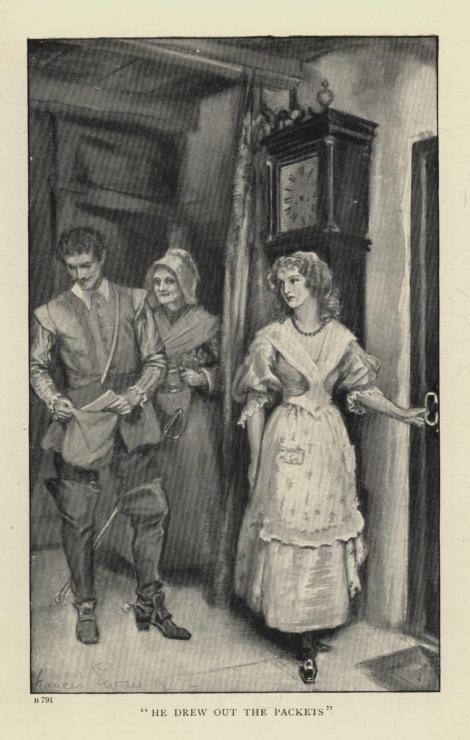
"HE DREW OUT THE PACKETS"
She turned to go, but remembering, looked back and said somewhat haughtily:
"You can feed him now, Martha."
She was hardly outside the door when she heard them talking, fifty to the dozen. She paused, and looked doubtfully at the packet in her hand.
"Is it for good or evil?" she murmured; then she added quickly: "Why should I fear? Surely what God sends must be good."
She was no longer a child but a girl, verging upon womanhood, tall, not over slight of figure, but, as we have said before, graceful and perfectly built. The face was the same child's face; the tendrils of golden hair still clustered round her head and lay on her white neck; the brown eyes had the same luminous, laughing look in them; her colouring was rich and perfect, a little sunburnt, like a ripe peach, and the lips were ripe too.
A door led from the kitchen to the living-room, so she had not far to go. Patience was sitting at the table with a pile of snowy linen in front of her, which she was sorting and arranging with housewifely care.
"Aunt Patience," said Agnes, going up to her, "a king's messenger has just brought this;" and she put the packet down before her. Then she stood at the other side of the table, her hands on her hips, watching her aunt, who took the packet up, turned it over, sighed, and exclaimed:
"Ah me, I have always feared this day would come!"
"Why have you feared it?" asked Agnes sharply.
"Because I am very much mistaken if it does not mean an uprooting," said Patience.
"But if you do not choose to go, must you?" asked Agnes.
"Yes, I must," answered Patience. "You are old enough to understand now, Agnes, that I owe it to your father's honour to show you to the world as his child, the heiress of the De Lisles. There is no need now to hide it; if the queen has sent for me it is because she is of the same mind." With that she broke the seal and read the queen's letter.
It contained an express command for her to come to London and bring the child, Agnes De Lisle, with her, with all the papers necessary to prove her father's marriage with Agnes Beaumont, and her own birth.
"But I do not care," said Agnes. "I do not want to go; I am quite happy here."
"We are what we are born," said Patience. "Have you forgotten your catechism, 'to do your duty in that state of life in which it has pleased God to place you'? We will go to London, Agnes, and come back here if we can, my child."
Then Agnes threw herself face downwards on the table and sobbed her heart out. Patience herself was as white as the linen which lay before her, but she never swerved from what she believed to be right. That, too, was her nature; she gave no thought to her own likings or dislikings. Young as she had been when her sister died, all these years she had lived for her child and her duty. She sat quietly waiting till Agnes's storm of sobs should cease. Upon this scene the vicar entered.
He was evidently very serious and very much troubled. Patience looked up as he entered and their eyes met for one second, then she looked away, and a faint flush coloured her face. He went up to Agnes.
"My little girl," he said, "why this great grief?"
"The queen has ordered us to London," said Patience. "She must have divined our hiding-place, or someone must have told her, and she has bidden me take Agnes with me."
"Well, of course you must go," said the vicar; "what is there so very terrible in this, Agnes? I have heard you say you loved the queen well, and her daughter too."
"So I did," said Agnes, "but all that is past like a dream. I have been so happy here."
"And you were happy before you came here," said the vicar, smiling. "I thought you looked the happiest child I had ever seen when I first saw you. You will always find some joy in life, Agnes; it is in your nature. Come, cheer up!"
The vicar's power over Agnes had always been unquestioned. She stood up, wiped her eyes, and a poor little smile crept over her pretty face.
"There, that's all right," said the vicar, patting her on the shoulder. "Now, Mistress Patience, let me see your letter."
"Well," he said, laying it down, "much honour awaits you, Agnes, and you must try and do us all credit, and prove yourself worthy to be the representative of so good and so old a family as the De Lisles. You are your father's daughter, remember. You never knew him, but your Aunt Patience did, and she will tell you that he was a man of high honour and a good Christian soldier. He served God, he honoured his king, and he loved your mother. Is it not so, Patience?"
"Ah, it is indeed!" she said; "he worshipped his young wife. She was so young and fragile, it was something more than ordinary love which he bore her, and she could not live without him, that is why she died, Agnes. I see her now standing at his stirrup as he bade her farewell. She was brave as long as she saw him, but she fainted in my arms when he was out of sight. I tried hard to make her live for love of you, but she shook her head. 'I cannot', she said, and so she died."
Tears filled even the vicar's eyes as Patience told this story of true love.
Fortunately Martha broke in upon them.
"Peter Kemp says he must be off, that he must be at Skipton before nightfall. The queen was urgent that he should not tarry on the road. He waits your answer."
"He shall have it," said Patience, and going to an ancient cabinet she opened it, drew forth paper and pens, sat down and indited her letter, folded and sealed it, and then went herself into the kitchen and gave it to the man.
She knew him well, even as Rolfe, whom Martha had fetched, did. The men had been comrades together.
"You will come back to London, Rolfe," Peter said, as he took up his cap to go.
"Not I," answered Rolfe. "I never had much liking for court life; I shall abide here and keep the place together."
"Then you'll come, Martha," said Peter.
"I shall go where my mistress goes," answered the woman. "Good-day, and good luck go with you, Peter Kemp!"
They shook hands.
"I'll go down the hill with you," said Rolfe. "You left your horse at the vicarage?"
"Yes; he was well-nigh done, and it's a mighty steep climb up here," said Peter.
"We are near the top," answered Rolfe carelessly; "it's fine and airy."
They went down the hillside together. Before them, flitting like a fairy over the grass, they saw Agnes; she sped so quickly that they could not overtake her. She crossed the bridge and disappeared into the vicarage before they reached it.
"A bird of ill omen he is," said the vicar's Mary, standing by Rolfe at the vicarage gate watching Peter ride away; then she added, in a low voice, "Those two young creatures are well-nigh breaking their hearts over the news he brought."
"They're young," answered Rolfe; "their hearts will mend, have no fear, Mary."
CHAPTER XVI
Under the Shadow of Newgate
"Let Mistress Patience know that I am waiting to receive her," said Queen Henrietta Maria, as she sat before her dressing-table, the barber being engaged in the dressing of her hair.
She was no longer the beautiful Henrietta Maria who had come to England as the bride of Charles I. Trouble had told upon her and aged her even before her time, and we find her spoken of in the chronicles as a "little old woman". And yet she was not more than fifty-six years of age; but she had grown crusty, and evil-tempered, jealous of those who were younger than herself, and nothing ages a woman like jealousy and spite. A kindly, loving heart softens away the hard lines and keeps the face young because of the love which dwells in the heart; but where there is no love, there is no youth.
She had hardly given the order when the door was thrown open and the usher announced: "Madam Patience Beaumont and the Lady Agnes De Lisle."
The queen turned sharply round, despite her barber's exclamation of despair, and the tired face brightened up. "At last, you truants!" she exclaimed, as Patience hurried forward, knelt, and kissed the extended hand. The queen's eyes passed over her and rested on Agnes: "Verily a beauty!" she whispered. "Well, ma mie," she said aloud, as Agnes approached her, "have you quite forgotten your queen-mother?"
"I have not forgotten her at all, your majesty," answered Agnes, as she followed her aunt's example, knelt, and kissed the royal hand; but Henrietta lifted her face between her hands and looked at her, tears filling her eyes.
"Patience," she said, "she is the most beautiful thing I have seen for many a day; she is father and mother welded together. Is she as good as she is beautiful?"
"Ah, Madam, who can tell?" answered Patience; "she is very young, and has not been tempted."
The queen's brow darkened as she repeated the words. "Ah, that is it; she has not been tempted! You have kept her in cotton wool, Patience."
"Nay," answered Patience, "I have kept her beneath God's heaven in the world of nature, and I would have kept her there still had your majesty not sent for her."
Again the queen's brow darkened, but she answered quickly: "It was our duty to her father and mother. If I had not interfered you would have married her to some country bumpkin. Now we will see that she is restored to her rightful position; is it not so, Agnes?" And she tapped the girl on her cheek. Then she turned back again and the barber renewed his offices.
"Come, stand beside me, child, and tell me what you have been doing all these years, and why you did not write even to Henrietta? She is mightily angry with you!"
"I did not let her," answered Patience; "it would have only been a disturbing element in her life."
"I have not forgotten that she was my first friend," said Agnes. "I have prayed for her every day, and I should love to see her, only----"
"Only what?" asked the queen sharply.
"I do not think I like court life."
"Ah, you will soon speak differently," said the queen, "when you are flattered and made much of! Have you brought the necessary papers, Patience, that I may show them to my son? I see she has taken her rightful name, Agnes De Lisle; the next thing will be to restore her estates. Do you know who holds them?"
"We know who did," answered Patience, "but they may have been dispossessed."
"Who may it be?" asked the queen.
"The De Lisle estates were given to Colonel Newbolt, who was imprisoned and died at Newgate," answered Patience. "His son Reginald was his heir."
"Has he not inherited?" asked the queen.
"He certainly has put in no claim," answered Patience, "for he went abroad soon after his father's death and has not returned."
"But someone has taken the rents," said the queen.
"That remains for your majesty to find out," said Patience. "I cannot tell."
"Well, we will enquire into the matter," said the queen, as, released from her barber, she stood up and faced Agnes. Again she smiled as she looked at the girl, who was simply charming, in a plain, white gown, unbedizened, with only a coil of pearls round her white throat, and her hair in natural curls. She was as fresh as a flower, and the queen, delighted, clapped her hands, and, turning to her friend, Lord Jermyn, said in a low voice, "She will make a sensation. Did you ever see anything so fresh?"
"Not of late years, certainly," he answered. "But your majesty is forgetting your appointment with the king at Whitehall."
"Well, well, I must be gone," said the queen, "but I shall expect you to be here when I return, Patience; I have many things to ask you. Bring the child with you; mind you always bring the child."
"Your majesty does her great honour," said Patience. "I will not forget."
Then the queen nodded kindly to Agnes, and gave her hand to Lord Jermyn, who conducted her down the stairs and across the hall to her coach, which was in waiting.
Patience and Agnes returned to their own apartments, which were the same as they had occupied before; for, although Somerset House had been restored and a certain portion rebuilt, these rooms had been left almost as they were.
Agnes was very serious when they found themselves alone. "I wish we were home again, Patience!" she sighed. "Do you know, I am frightened--frightened of the queen, frightened of everything; and yet I used not to be. I did not care a bit for queens and princesses in olden days. I remember quite well sitting on the queen's lap and talking to her as I would to anyone else. I could not do that now. And then, again, I thought she was very beautiful; but she is not beautiful now, yet it is not so very long ago."
"It has been long enough to make a woman of you, Agnes, and therefore long enough to age the queen and mar her beauty."
"It has not marred yours, Patience," said the girl. "I never remember you any other than you are now; your face was always so sweet. It is like, well, it is like a madonna's face. It must be because you are so good."
"Hush, hush!" said Patience, her pale cheeks colouring. "I am not at all good, Agnes; I have been very wilful, as wilful as you could be if you were driven to it."
"I hope that will never be," said Agnes. "Do you know, Aunt Patience, I heard you tell the queen that I had never been tempted. Surely to be tempted is not a necessity. I always stop in my prayers and say twice over, 'Lead us not into temptation; but deliver us from evil'."
"As long as you do that, you will never go far wrong," said Patience, stroking the fair face which she loved so well.
"Now, what shall we do this afternoon, little one? It is very hot."
"Yes, it is very hot," said Agnes; "this London is stifling." She went to the window and threw it wide open. "Ah, it is like a furnace outside!" she added, and quickly shut the window.
"I think we had best stay where we are," said Patience, "and later we will take a barge and go up or down the river; surely there will be some air there!"
Agnes did not answer, she seemed to be thinking.
"Does not what I propose suit you, child?" asked Patience.
The girl threw herself on her knees beside her aunt.
"Dear," she said, "I have a great wish. I don't seem to care for anything else in London, but I want to find Ann Newbolt! How can we do it? You remember we heard that Reginald had gone abroad, and that Ann was living somewhere with her mother not far from Newgate."
"That is no good," said Patience; "it would be like hunting for a needle in a haystack. Besides, I am not sure that it would be well for you to find those Newbolts again. You see, if the king is determined to restore you to your own they must be driven out."
"I should hate that; oh, I should hate it terribly!" cried Agnes.
"But it must be well," said Patience. "Cromwell had no right to give what was not his own."
There was a pause, then Agnes looked up and said quietly:
"Jessie and I were looking through an old book which treated of the estates and lands in Westmorland, and we found De Lisle Abbey. Henry VIII seized it, drove the monks out, and gave it to a Sir Gilbert de Lisle--not my father, but one long before him. So you see, Aunt Patience, it was stolen land, and, what is worse, there was a curse upon it; the De Lisles were to be driven out by fire and sword, and so we have been. Let things be as they are, Aunt Patience, and let us live at Holt Farm and be happy once again."
"Do not think I wish for anything better, Agnes. It is for you, my child," said Patience.
"I'm sure I don't want it," said Agnes. "Let us go back as soon as we can, Aunt. I have a sort of feeling that something dreadful is going to happen."
"That is because you are tired, and London is strange to you now," said Patience. "Lie down and rest, then we will go out, and, as your heart is set upon it, I will enquire about the Newbolts; they may be dead or gone away from London."
The knowledge they desired came to them quite unexpectedly. Martha was by no means sorry to find herself amongst old acquaintances. She had already been out and about, gossiping here and there. Amongst other scraps of knowledge, she had learnt much concerning the Newbolts. Dame Newbolt, she was told, always lived near Newgate. She was looked upon as a guardian angel. "She works there night and day," they told her, "preaching and teaching, and when the prisoners chance to come out she succours them. Men and women alike worship the ground she treads on."
"And Mistress Ann, her daughter, what has become of her?" Martha had asked.
"She lives in a mean lodging-house near the Old Bailey, over against Newgate, and but for her, her mother would well-nigh starve. But Mistress Ann will not suffer it; she makes her take her food, she fetches her from the prison, and brings her home at night. They say her devotion knows no bounds. She is never weary, never goes abroad save once and again when my Lord Craven fetches her, and insists on taking them both in his barge for a breath of fresh air, or driving them out into the country beyond St. Giles'. My lord is as good to her as a father. Ah, there are queer people in the world," said the speaker, "but the queerest are sometimes the best, and my Lord Craven is one of them. He has seen many things in his time, and has succoured many people. I doubt much whether the Stuarts would have been able to hold their own but for his gold."
"Have you heard of Reginald, the colonel's son?" asked Martha.
"Oh, yes; he comes and goes. He has joined Prince Rupert, and is half the time at sea with the White Squadron."
Primed with all this news, Martha hastened back to Somerset House, and poured it all out afresh into the eager ears of Patience and Agnes.
"Then we will go this afternoon and find Ann," said Agnes; "shall we, Aunt Patience?"
"She lives in a bad part of the town," said Martha. "There are rumours that there have been some cases of the plague in the by-ways round Newgate. It would be well to be careful. I know not how it is," continued Martha, "but people seem anxious. There are men who go about preaching that the times are so evil, that the Lord will sweep London off the face of the earth because of its sins."
"As for the plague, I do not think we need be alarmed," said Patience; "there are always some cases in London, I am told. It only affects the very poor and the unclean. Last year I remember Mr. Ewan telling me that there were a few cases, just three, but it did not spread; the winter checked it. No, I do not think we need be anxious; besides, it would be of no use. What is to be will be. We shall not be long in London, I hope." And with that the subject dropped.
It was late in the afternoon when they sallied forth. Even then the heat was so intense, and the air so dry, that they decided they would take a barge and go down to Blackfriars, land there, and find their way to the Old Bailey. Martha went with them, because she knew the way better than they did. When they landed from the barge, it was but a little distance across the Fleet until they gained the narrow streets leading to the Old Bailey.
On the summer night, with all the refuse of the day lying about waiting for the night scavengers to pass their rounds, the stench which arose from many a foul heap was noisome.
Patience and Agnes held their kerchiefs to their faces. Fresh from the sweet moors and the scented flowers, they were the more susceptible.
"Fit for swine!" muttered Martha behind them. "Talk of the plague! The dirt is enough to breed any amount of plagues." And she was right. It was the dirt and uncleanliness which was about to cost thousands of lives. For the last ten years the plague had been raging in Europe. In Genoa 60,000 persons died of it; in Holland, in the years 1663 and 1664, upwards of 50,000 people died of plague in Amsterdam alone; and yet during all these years London had been singularly free.
The origin of the plague has been much discussed. Some authorities imputed its arrival in London to have been caused by bales of merchandise from Holland which came originally from the Levant, where it was quite usual to sell the clothes of those who had died of plague at once, without disinfecting them; according to others, it was introduced by the Dutch prisoners of war. In any case, we may attribute its spread to the uncleanliness of London, which, we are told by contemporary writers, was comparable to that of Oriental cities at the present day. The disease gradually increased because there was everything to encourage it to do so, especially in a squalid neighbourhood and among the poor. For this reason it was called "the poor's plague".
Those who lived on the river in ships or barges were free of it; those in the houses on London Bridge were also little affected. Probably the slowness with which it gained ground in London was owing in a great measure to the beautiful streams of flowing water which intersected the city--the Fleet, the Walbrook, &c. At all events, it was not until the autumn of 1664 that a few isolated cases were observed in the neighbourhood of St. Martin's, St. Giles', and Charing Cross. The winter of that same year happened to be a very severe one, which checked it, and nothing more was heard of the plague until this month of May, 1665. Then one or two cases were reported, but so few that they excited but little attention; many, doubtless, of the inhabitants had not even heard of them.
Then, as now, such things were hushed up for fear of creating a scare, so that with perfect equanimity Patience and her companion walked along the very streets which were soon to be the centre of that terrible epidemic. They came at last to the house which had been described to Martha. It was at the top of the street, almost opposite Newgate, and was entered by a low oak door which gave into a passage, beyond which lay a court-yard, in which were outside staircases giving access to wooden balconies leading into the tenements. Martha had been told that Mistress Newbolt lived at the front, almost at the top of the house, and that her rooms were reached by an interior staircase. So they stumbled up in the dark, until at last they came to a landing in which was a small window, which Patience was thankful to see wide open, but which, on this hot evening, seemed, instead of cooling the air, rather to let in heat and bad odours.
The three stood wiping their faces, Martha panting. Suddenly a door opened, and a voice, which Agnes recognized at once, said:
"Who are you? What are you doing here? My mother is sleeping; you will waken her."
Agnes went forward instantly, threw her arms round the girl, saying:
"Ann, do you not know me?"
"Know you!" repeated Ann. "Is it Agnes or her spirit? Surely in her body she would not come here, and yet how I have longed for her!"
"Why should I not come, if you are here?" said Agnes.
"You must go," said Ann. "Go quickly! I cannot let you in; I dare not. My mother came home an hour ago. All day and all night she has been in the prison. Do you know what I have done? I have taken her clothes and burnt them, they were so foul. I stood for hours waiting for her outside the gates, and when she came forth she dropped down like one dead, and I carried her home in my arms. If you could see her, she is almost a skeleton! Ah me! what will the end be?" And, covering her face with her hands, she wept.
"I will see her," said Patience. "We have come here to help you, Ann, and we will help you, have no fear, child. Stay with Martha, Agnes. Now, Ann, show me the way."
Ann hesitated. "You do not understand," she said.
"Then it is time I did," answered Patience. "Take me to your mother."
As she spoke she looked at Ann. Could this be the same girl she had known so fresh and blooming? She seemed to have grown taller, and her face was sallow and thin; she might have been any age, she looked so worn and anxious. She was scrupulously neat in a linen gown, with a white apron and a muslin kerchief folded across her bosom; over her head she wore a sort of linen wrapper, which hid all her hair, leaving only a small band on either side of her forehead. She had adopted this dress because she was able thus to keep herself clean amidst so much foulness.
Agnes still held on to Ann, and pleaded!
"May I not go too, Aunt Patience?"
"No, my child, one of us is enough."
Still she would not let go of Ann's hand.
"Kiss me, dear," she said; and Ann stooped and kissed her.
It was so long since any lips had touched hers that it brought tears to her eyes.
"Wait here," she said, "I will come back." And she passed into the room with Patience.
It is curious how, in times of great excitement, we see everything so clearly; even the smallest details strike us. Patience noted that the first room they entered was comparatively well furnished and spotlessly clean. It was evidently the living room, with tables and chairs, a dresser, and a few articles of luxury which had been brought from the old home. They passed through this into another room, which served as bed-room for Ann and her mother. There was a small fire in the hearth, notwithstanding the great heat. Ann pointed to it.
"The doctor told me to have it always, to purify the air," she said.
A great four-poster bed of carved oak occupied the middle of the room. It had once been curtained round, but the curtains were gone now, and Patience saw, lying upon the white pillows, a face which might well have been that of a dead woman.
"Can it be Dame Newbolt?" she thought. The closed eyes were sunk in the sockets; the features stood out sharp and hard, yellow as parchment; the hair, parted on the forehead, was thin and snowy white; and the hands, which rested on the coverlet, were like the hands of a skeleton.
"Oh, Ann," exclaimed Patience, "how could you let her get into this condition?"
"How could I help it?" said the girl, bursting into tears. "I have watched over her, I have fed her, I have stood outside the prison gates waiting, always waiting, but she has paid no heed to me. Had it not been for my Lord Craven I should have had no food to give her, for she would spare me no money. I have known her go for days, eating nothing but a crust of bread. More than once the jailers have brought her here, carrying her in their arms. It was of no use, on the morrow she was up and about, and with them again; even as you see her she has still great strength."
"It is wonderful," said Patience.
Though they were speaking loudly, Mistress Newbolt did not hear them. She did not move; indeed, one could hardly hear her breathe.
"She will sleep like that for twelve hours at least," said Ann, "longer perhaps; then she will wake up and eat what I shall have prepared for her; then she will go back to the prison, and I shall not see her again for perhaps twenty-four hours, when I shall bring her home, or one of the warders will. It is a terrible life, so terrible, I wonder how she lives at all."
"And you, you poor thing?" said Patience, taking Ann's hand in hers, then stooping over the sleeper she added, "She will die."
"No, she will not," answered Ann. "Good Doctor Bohurst, whom Lord Craven sent to visit her, says she will not die, that she has more vitality than many a younger woman, and that these long sleeps restore her completely, only I have to feed her. See," she continued, and going to a table she took up a bottle, poured a little of the contents into a spoon, and held it to her mother's lips.
Without waking, she just sucked it down like a child.
"There," said Ann, "in two hours I shall give it her again, and so on until she wakes. Then she will eat and drink. It is a wondrous life."
"How long has this been going on?" asked Patience.
"For many months," answered Ann; "but of late it has been much worse, for the prison is fuller than it ever was, and disease is rampant there. Then," lowering her voice, she added, "they say there has been a case of the plague. If it be so, and that foul disease break out within those walls, God only knows what will happen! The prisoners themselves are in terror of it. I think they will go mad with fright."
"And you?" said Patience.
"I try not to think of it," she answered quietly; "what is the use? Come, let us go into the other room; Agnes may come in there, may she not?"
"If you think there is no danger," said Patience.
"There is nothing infectious here," she said. "You see all the windows are open, and either I burn my mother's clothes, or old Doris takes them away and washes them."
"Very well," said Patience, and Agnes and Martha were admitted. They sat together round the tables and Ann learnt what had brought them to London.
"You would have done better to have stayed away," she said; "one never knows what may happen, and there are strange signs in the heavens. People say London is accursed, and will be destroyed because of its great sin. Have you seen the comet?"
"No, not yet," answered Patience; "I shall not linger long in London. I wish we could take you away with us, Ann!"
"How can I leave my mother?" she answered; "and Reginald is away."
Her head drooped on her hands as she spoke; her spirit seemed broken.
"Listen, Ann," said Patience, "I will come to-morrow with Martha and fetch you out; you shall spend the whole day with us. We will go down the river. You shall breathe sweet, country air; it will strengthen you."
"It will, indeed!" said Ann. "I think I am cowardly because I am so much alone. But now you must be gone. It is getting late, and this neighbourhood is not safe at night; indeed, you must not go back by the river. Go to Holborn and find a coach there, so that you can be driven back."
Alarmed, Patience rose quickly. "Yes, we will go, Ann," she said; and they made their way out, down the stairs into the street. They had not gone far when they were accosted by a gentleman.
"Madam," he said, looking at Patience, "this is no place for such as you at this time in the evening."
"I have just been told so, sir," said Patience, "but I am a stranger to London. Cannot I procure a coach?"
"No," he answered sharply. "Step this way; you shall have mine."
Patience looked at him.
"I thank you kindly, sir," she said, "but before I can accept your offer, I must know who you are."
"I am Lord Craven," he answered; "you can trust me."
Without another word he walked on in front of them to the top of the street, where a coach was waiting. He signed to the driver, who wore the Craven livery.
"My man will take you wherever you choose, madam," he said.
"I would be driven to Somerset House," said Patience.
He started and looked askance at her. She understood.
"You gave me your name, I must give you mine," she said. "I am Mistress Patience Beaumont and this young girl is Agnes De Lisle, my niece. We are the queen-dowager's guests."
Lord Craven uttered an exclamation of surprise and swept them a low bow.
"I have been fortunate in meeting you," he said; "but take my advice and do not wander out so late at night."
"We have been to see a protégé of yours," said Patience, "Ann Newbolt."
"Ah, I am glad!" he answered; "she needs friends, poor thing."
Then he signed to his valet to open the coach door, and helped Agnes and Patience to mount, for the step was high. Martha followed, and they were driven quickly in the direction of Somerset House.
CHAPTER XVII
The Great Plague
Again and again we read of miraculous signs in the heavens before some great disaster befalls a country. A fiery sword is said to have hung over the ill-fated city of Jerusalem for long months before its destruction. At the time of which we are writing a great blazing star, probably a comet, appeared in the heavens over the city of London, terrifying the inhabitants. Crowds of people would turn out at night into the open fields to see this wonderful thing, and would go back, with terror in their hearts, feeling assured that it was an omen of evil. Every night it appeared, a great, blazing star hanging in the firmament. Gradually, very gradually, the plague crept into the city; so slowly did it come, that only those whose business it was to note the mortality were aware of the gradual increase of deaths. It began first in the heart of the city, then it spread to the suburb of St. Giles'. Just two or three isolated cases against which no precaution was taken; indeed, they caused but little alarm. There are always pessimists, and people do not heed them. A small evil, therefore, remains unchecked until it becomes a great evil; then, and then alone, when it is too late, men take note of it. Such was the case at the present time. At Whitehall feasting and revelling were the order of the day throughout this month of May. The king and his court were to be seen in St. James's Park, gilded coaches rolled through the narrow streets of the city, despite the overpowering heat. It was as if that blazing comet, unseen by day, burnt the land up. The animals suffered fearfully: horses fell down dead, dogs had to be killed because they went mad. Even before the month of June streams were running dry, there was no rain, no moisture in the air, and gradually, striking men down by ones and twos, the scourge crept on, until at last people awoke to the knowledge that the fell disease was in their midst.
One morning Queen Henrietta summoned Patience to her.
"I do not care for it to be generally known," she said, "but it is settled that the court is going to Oxford. You, of course, will follow; make your preparations as quickly as you can. We shall probably leave here the day after to-morrow; it is to be done quietly not to scare the people."
"Is it necessary we should accompany your majesty?" said Patience. "With your permission, I think we would rather go home."
The queen turned haughtily towards her.
"Why must you always oppose me, Patience?" she asked. "Why do you wish to bury the child alive in that out-of-the-way place? The king is well disposed towards her. The Marquis of Orford has spoken of her with admiration. I am set upon making a marriage between them. If you do not choose to come, at least give me the child."
"I promised her mother I would never part from her," said Patience, "and so far I have kept my word. If your majesty insists upon her going to Oxford, I will go also."
"Do you mean to say that you wish to keep her in this infectious atmosphere?" said the queen.
"Not longer than I can possibly help," answered Patience; "but your majesty must know that the plague is confined so far to certain quarters of the city. Here, on the river front, we run but little danger." Then, approaching nearer Henrietta, she said in a low voice:
"Will not his majesty's gay court at Oxford be worse for my child than the plague? Is not her soul more precious than her body? and that Marquis of Orford of whom you speak, is he worthy to touch the hem of her gown? Nay, let her be, your majesty; sooner let her live and die a maid than be coupled with such a man; and if she be doomed to die, then, at least, let me give her back to her mother 'unspotted from the world'."
It was not often Patience let herself go, but at the present moment she spoke with intense earnestness, almost with exaltation, and she possessed more influence over Henrietta Maria than any other member of her household.
The queen kept silence, her head resting on her hands, and, to Patience's surprise, tears fell on the table. She knew that she had hit hard. The mother's heart was aching at the thought of her own daughter whom she had given up to that bad man, Philip, Duke of Orleans. She knew well what she suffered; could she condemn another girl to the same fate!
"Take her away, Patience," she said impetuously, "take her away, and may the Lord have you both in His keeping!"
Patience knelt at the queen's side.
"Forgive me," she said, "if I have hurt you."
The queen held out her hand.
"Go," she said, "whilst I am in the mood, and do not let me see the child again or I may repent giving her up to you."
"That you will surely never do," said Patience, and, rising, she curtsied and left the room.
In her own mind Patience was sorely troubled how to act. To go back at once to Westmorland would have been the most natural thing; but then there was Ann Newbolt, how could she leave that girl alone in the worst part of the city? She did not herself believe that there was much danger for any inhabitant of Somerset House, because it gave on to the river, and so far all the habitations near the river, even the houses on London Bridge, had remained unaffected; also, the dwellers in ships and barges had escaped infection.
"If the worst come to the worst," she thought, "we will take the barge and go down the river; but the great thing will be not to let the child get frightened."
Whilst she was still cogitating Martha came into the room.
"Madam," she said, "everybody is leaving the palace; what are we to do?"
"I have just come from the queen, Martha," said Patience. "She desired me to pack our belongings and follow her to Oxford, whither she is going with the court. What say you? Shall I do so? Shall I thrust Agnes into the midst of all the profligacy and all the evil which dwells in the king's house?"
"For God's sake, no!" said Martha. "It is the talk of the court that our young lady is to be wedded to the Marquis of Orford, but you will not let it be. We servants know more of what goes on in the great houses than you do, and he is not worthy of her; besides, she is only a child."
"You are right, Martha," said Patience; "I will not let her go. I have told the queen so, and she has consented that I shall keep her with me."
"That is well," said Martha, her face brightening up, "only we must guard her, for I have heard that the Marquis of Orford has set his heart on wedding her, and the king has promised him the De Lisle estates, forfeited by Colonel Newbolt. They were to have been sold at once to the highest bidder to pay the fines and law expenses, &c., but the king has been so engrossed with his pleasures that he has let the matter slip. Now, however, he has made up his mind not to sell, but to dower our Lady Agnes with what is by right her own."
"How do you know all this?" asked Patience, surprised.
"I know it from Peter Kemp, who is at Whitehall, and hears all the gossip in the ante-chambers and in the servants' department; he also knows Jefferson, Lord Orford's first valet."
"Perhaps the king will change his mind now that I will not suffer Agnes to go to Oxford," said Patience.
Martha shrugged her shoulders.
"We shall have to be careful," she said, "for the marquis is not a man to be thwarted, and if he has set his heart on the Lady Agnes, he will surely win or take her."
"I think we had better start at once for Westmorland," said Patience; "it seems to me the only place where we can live in safety."
Martha shook her head.
"That's just what he will expect you to do," she said. "And as he has more horses than we have and more serving men, he will surely follow us, and who will protect us on the road? There are many desolate places between London and Westmorland."
"Surely he would not dare assault us?" said Patience.
"Ah, Madam!" said Martha, "he will stand at naught. If he has set his heart on the Lady Agnes, he will leave no stone unturned to possess her. You must devise some other plan for her safety."
"I am loath to believe all you say; but leave me, Martha, I must think it over."
The following day the court started on its way to Oxford, and the queen announced to the king that the Lady Agnes De Lisle would not accompany her.
"She is ailing," the queen said, "and she is rather young still for all the dissipations of court life. Let my Lord Orford wait till the scare of this plague is over. Patience Beaumont is going to take Agnes back to Westmorland to restore her health, which the heat of London has injured."
"I never saw a brighter face than the Lady Agnes's yesterday," said the king. "She was the star of your suite, ma mère. I do not think much ails her."
"Possibly she was flushed and excited," said the queen, "and Patience has my permission to take her away. I cannot go back upon my word."
"But I have not said the last word either," said Charles angrily, "and my Lord Orford has had no say in the matter at all."
"He had better let his suit drop for the present," said Henrietta; "when we come back from Oxford it will be time enough." And with that she left the room.
Charles shrugged his shoulders; he never opposed his mother's will.
When Lord Orford was informed of Agnes's defection he was in a white rage, but he gave no outward sign of it, only that night he was closeted for a long time with his man, Jefferson, and the next day he himself followed the king to Oxford.
The palace was very silent; indeed, the whole city of London was beginning to be what we should call hushed. The plague was gaining rapidly. The citizens stopped their trading, and every man looked with fear at his fellow.
In the gardens belonging to noblemen's houses, which in many cases sloped down towards the river, the flowers were in full bloom. It was the season for roses, and they had never been so plentiful, but no one gathered them, for fear of infection, no one dared even to inhale their sweet perfume; people went about with a bunch of rue and wormwood in their hands, for these herbs were thought to ward off contagion; and yet this was only the beginning of what was to be.
There was a certain cruelty in the egoistical way in which men strove to protect themselves. For example, if it was known that someone had died in a certain house of the plague, no matter the number of the inhabitants who were still resident there, a red cross was painted over the door with these words in great letters over it, "Lord, have mercy upon us!" and watchmen with halberds stood on guard before it to prevent anyone either leaving the house or entering it.
All the inhabitants of that house were thus shut off from the outside world, lest they should carry infection; semi-starvation and death therefore stared them in the face. This was in the early days. It was a great mistake, for the houses were thus made the centres of disease; later it was found impossible to carry this plan into effect, and it was therefore openly ignored.
A few noblemen and gentlemen had the courage to remain in London and face the evil. Among these was Lord Craven. We are told that his servants packed his luggage and brought his coaches into the court-yard of his house; but to their dismay he told them they could go if they chose, every one of them, but he should remain and do what he could to stay the evil which surrounded them.
"A man can die but once," he said. He had faced death ofttimes on the battlefield, he was not going to turn his back on it now; and, brave man that he was, he set about his work with diligence. He founded a kind of cottage hospital for the plague-stricken in the Soho; he also gave a piece of land for burial purposes in the same neighbourhood. He himself remained at Craven House.
A day or two after the court left London, Patience sent for him and told him of her decision.
"And now," she said, "I must get out of this place as quickly as possible, for if anything happens to the child I shall never forgive myself."
"And yet," said Lord Craven, "this is the only place in which you are free from the Marquis of Orford. I know the man. He is but watching his opportunity; if he see you start to go north he will follow."
"That is what old Martha said," answered Patience, "and she is a wise woman."
"She is right. Remain where you are for the present, keep the windows open on to the river side by night and by day, and do not let the Lady Agnes go abroad."
"But she is so anxious about Ann Newbolt!" said Patience. "I found her weeping yesterday because I would not let her go and would not go myself to the Old Bailey."
"You did well," said Lord Craven; "the disease is spreading from there right up to St. Giles'. Rest assured I will bring you news of Ann as often as I can. The authorities will not let her mother leave the prison now because of infection. She spends her days, ay, her nights, tending those wretched creatures, preaching to them of the world to come, closing their dying eyes amidst the most frightful agonies, and seeing to their burial."
"And she lives through it all!" said Patience.
"Yes, marvellous to tell, she lives through it all," he answered, "and is but little changed. She seems to have no material body, to live in and by the spirit. The poor creatures cling to her, and she has no fear of them."
"Is the plague very bad at Newgate?" asked Patience.
"Bad!" said Lord Craven. "They carry the bodies out at night that they may not be seen. What is worse, the poor creatures go mad with fear, and can hardly be restrained from killing one another."
"It is terrible," said Patience. "And Ann, what is she doing?"
"She is in her own two rooms with that old hag who waits upon her, and I have entreated her on no account to move out of it," said Lord Craven.
"But if she came to us," said Patience, "surely that were better for her!"
"She will not hear of it. She says she would be too far from her mother; now she can have news of her continuously. The old woman goes backwards and forwards, and I go to her. So long as the plague does not enter her dwelling-place, she will remain there."
"And when it does it will be too late," said Patience; "they will not let her out."
"We shall see," said Lord Craven.
At that moment Agnes came into the room. Except that she was very pale, which might be attributed to the great heat, there was no change in her appearance. She wore a thin, white linen gown, with long, open sleeves; her beautiful golden hair was gathered up away from her neck because of the heat, and she had sandals on her feet.
"Oh, my lord," she exclaimed, "this is truly terrible! Why cannot we go back to Westmorland and take Ann with us?"
"Because, my child," said Lord Craven, "the roads just now are not safe." He had to make some such excuse because she had not been told anything concerning Lord Orford.
"I thought the plague was in London, not on the roads," she answered peevishly.
"But there are other things besides the plague, my child," said Lord Craven. "All sorts and kinds of people have left the city, bad as well as good. We must let this first rush go by, and then you shall go. In this heat you could not travel," he continued. "The horses could only carry you a few miles at a time, evening and morning. It would take you an infinitely long time to reach your haven of rest."
"You call it by its right name," said Agnes; "If is a haven of rest. I wish we were there, Aunt Patience." And she sat down on a stool beside her aunt, laid her head on her lap with the air of a spoilt child, and wept.
"We will go as soon as ever we can," said Patience, stroking her hair; "and now, see if you cannot find some of that fruit which we brought in yesterday from the country. Lord Craven will, I know, take it to Ann. It has been well covered up, so that no impure air can have reached it."
Agnes sprang up, ran across the room to a cupboard, and drew forth a basket in which there were some luscious strawberries, red currants, and wall peaches. She packed them carefully in a little basket, and took them to Lord Craven, with her pretty childish air, saying:
"Tell Ann, with my dear love, that they are the only things worth eating. I would she could come to me, as you will not let me go to her."