THE PROBLEMS OF PSYCHICAL RESEARCH (continued 4)
Reading edition
Photographs of the Soul (13, 14)
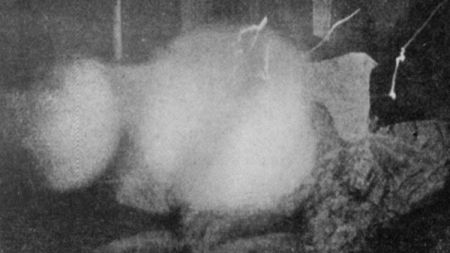
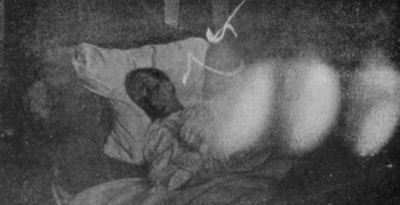
Frequently, within the next few days after these experiments, Dr. Baraduc saw similar globes in various parts of the house. By means of automatic writing, obtained through the hand of a non-professional psychic, he succeeded at last in establishing communication with this luminous ball, and was informed that it was the encasement of Madame Baraduc's soul, which was still active and alive within it! It was asserted that, as the days progressed, the encircling cords were one by one snapped, and that the spirit more nearly assumed the astral body facsimile of the earthly body. André, however, was seen by him to be a completely developed astral body; and his wife asserted that she too would shortly take her place beside André in her permanent form. As further photographs were not developed, however, there is no experimental evidence confirming these statements.
Although these initial experiments of Dr. Baraduc cannot, of themselves, be considered conclusive, they are nevertheless highly interesting, and should lead to further research in the same direction. The evidence afforded by apparitions, single and collective; by haunted houses; the indirect testimony afforded by the apparent psychic perception by animals; the evidence, such as it is, for "spirit photography"; the recent experiments in thought-photography, and the photographs made at the séances of Eusapia Palladino, all tend to confirm, it seems to me, the conclusions arrived at by Dr. Baraduc, as the result of his preliminary researches. If an astral body of some sort exists, it must occupy space; and, being space-occupying, must, a priori, be material enough to occupy it! Whether or not this material is sufficiently solid to reflect light waves, and make an impression upon the sensitive plate of the camera, is an aspect of the problem still open to debate.
Further indirect testimony is afforded by the statements of clairvoyants, and by the direct testimony (taking it for what it is worth) of so-called "spirits" who communicate their sensations and the knowledge they have gained after bodily death. They invariably assert that there is an astral facsimile, or spiritual replica, of the physical body. Repellent as the idea may be to some of a semi-material, space-occupying soul, the facts would seem to indicate that such is true. Yet there might be a way out of the difficulty, since we might still suppose that the soul, or seat of consciousness, exists as a point of force within this spiritual organism. Whichever theory is ultimately proved correct cannot, of course, be settled by a priori speculation, but by facts; and such experiments as those conducted by Dr. Baraduc in "photographing the soul" are, perhaps, the best line of investigation to follow, and one from which,—with the improvements in photography,—the most is to be hoped.
The reader now has the facts before him. I have no theory to offer as to the nature of these photographs, save that they appear to me to be genuine and supernormal from all the evidence and testimony that I have been enabled to obtain. In my Physical Phenomena of Spiritualism I have explained a number of ways in which fraudulent "spirit" photographs can be obtained; and in Modern Psychical Phenomena I reproduced a number of photographs which seemed to me to be supported by excellent testimony, and which were, so far as I could see, genuine psychic photographs. In that volume I also discussed the various theories which have been advanced in the past to explain these extraordinary photographs. The present collection is intended merely to supplement the former, and to present a number of photographs the solution for which is, it seems to me, yet to be found.
FOOTNOTES:
CHAPTER VII
HALLUCINATION AND THE PHYSICAL PHENOMENA OF SPIRITUALISM[25]
The discussion begun by Count Solovovo, and continued by Miss Johnson,[26] is assuredly of supreme importance to psychical research. Whether or no many of the alleged "physical phenomena" are genuine, or whether they are merely hallucinatory in character, is a question which involves—not only the phenomena themselves, but psychology and human life in general, and even influences strongly science and scientific experiments in other fields.... The senses are to be relied upon in every science other than psychic research; that seems to be the dictum of the world, and strange and even absurd as it may seem, it is, as we know, more or less founded upon fact. In no other science is fraud practised as it is in this; in practically no other line of research are the mental and physical powers so strained out of their usual or normal relations and perceptions as they are in this. It is only right, then, that Caution should be the password, and should be most rigidly employed in all such investigations as these.
While admitting all this, however, one must also admit that it is easy to go too far in the opposite direction, and reject evidence which depends upon the senses simply because they depend upon them. This, I think, is invalid reasoning. No one would be more willing than I to admit their fallibility and untrustworthiness—especially when we are dealing with conditions and phenomena where mal-observation is possible; but I do not think that any negative conclusion can be drawn from this. The case is still an open one; nothing is proved, one way or the other, and, in such work as ours, proof—and not mere conjecture—must be forthcoming. Very true it is that proof of the sort desired is often impossible; but it is obtained sometimes. If a medium be caught masquerading in a white muslin "robe" and a mask, we are doubtless within our rights in saying that the medium has been proved a fraud. But failure to detect such trickery does not prove the phenomena genuine. That would depend upon other considerations, and would only raise a presumption in favour of their authenticity. In such a case, "proof" is largely a question of relative probability, and can be obtained only by making the probability in favour of the reality of the phenomena so strong that the negative aspect is rendered logically unsound by the sheer weight of evidence against it.
These trite remarks were nevertheless rendered necessary because of the enormous amount of misunderstanding which exists in connection with these phenomena, and of the general methods and objects of psychic research. The papers that have already been published on the question of hallucination in relation to the physical phenomena should do much to clear away many of these misconceptions, for in them we find (i) a willingness to treat the phenomena seriously; (ii) an admission that the witnesses described what they thought they saw; and (iii) a certain amount of evidence advanced to show that the alleged phenomena were in reality hallucinatory in character, while appearing to be external physical realities to the onlookers. Let us now examine the evidence advanced, and see in how far it is conclusive of the theory entertained—the hypothesis of hallucination.
As both Count Solovovo and Miss Johnson have concentrated their attention upon the phenomena occurring in the presence of D. D. Home, I shall do so likewise in the first part of this chapter. As briefly as possible, I shall review their papers, before passing on to more general remarks—remarks which it is the object of this paper to bring into prominence.
Count Solovovo thinks that it is evidence in favour of the hallucination theory that: "A flower or other small object is seen to move; one person present will see a luminous cloud hovering over it, another will detect a nebulous-looking hand, whilst others will see nothing but the moving flower."[27]
Miss Johnson agrees with this, and in fact goes so far as to say: "If these hands had been completely invisible to some person with normal sight looking directly at them in a good light, we should then have good evidence that they were hallucinatory."[28]
To this I cannot agree. I find myself completely differing from Miss Johnson in my interpretation of such an incident as this. For, while hallucination is one possible theory to account for the phenomena, another equally plausible theory is that the hands were in fact objective and real, but were only perceptible to various individuals in varying degrees. This aspect of the problem is hardly touched upon by Count Solovovo, but is discussed at some length by Miss Johnson. In this connection she says:
"Here [in the hand, i.e.] is a kind of matter which is not only temporary in character—a fact in itself extraordinary enough—but exhibits another quite unprecedented characteristic in the arbitrary selectiveness of its effects on other matter. In order to be visible at all, it must reflect light. How does it manage to reflect light that affects the retina of one person and not the retina of another? We may reply that the difference must lie in the retinae, one being more sensitive than the other. But we do not find the same difference of sensitivity in regard to the light reflected from ordinary objects. It seems to follow then that the light reflected from the spirit-hand is a peculiar kind of light, lying outside the limits of the ordinary visible spectrum. But in that case, why is not the person with the more sensitive retina affected by it? For of course all ordinary objects are constantly giving off radiations outside the limits of the visible spectrum; but our supposed sensitive apparently does not perceive them."[29]
First, as to the matters of fact. Where is the evidence that those with the most sensitive retinae were not the very ones who perceived, most perfectly, the spirit-hand? Were a series of experiments conducted to show which of the onlookers possessed the most sensitive eyes? If so, where are these experiments recorded? It is quite possible that the body is constantly giving off a kind of aura—perceptible to some, invisible to others; and the fact that some do not see it is no proof that it is not there. If the experiments of Reichenbach and others go for anything, indeed, there is very good evidence that such emanations do take place—and I venture to think (however rank heresy this may appear) that these experiments have never been completely refuted, and the results obtained shown to be traceable in toto to suggestion. The eyes of certain individuals might be attuned to receive vibrations or impressions quite imperceptible to others, no matter how sensitive their retinae to normal perceptions or sensations.
But, quite apart from such purely "physical" speculations, I can quite conceive that these hands were not "seen" in the ordinary sense of the word at all. The physical eyes may have played some part in their perception, but only a small part. It is quite possible that "hands" of the character here seen were active and functioning upon another plane altogether than the sense plane, and were perceived at the time by a species of clairvoyance. What "clairvoyance" is I do not pretend to know (unless spiritism be true, in which case I can quite easily conceive its modus operandi), but the mass of evidence in its favour seems to place it quite beyond the pale of doubt. But even if this be not granted, I can quite see how a certain rapport between the sitter and the hand—or the intelligence behind the hand—might easily enable one sitter to perceive it, and not another. Analogies from trance phenomena and even from experimental thought-transference might be drawn here, in favour of such a theory. The whole theory of apparitions at the moment of death depends upon this established rapport, since, if it did not exist, and affect the results, the apparition might just as well appear to Tom, Dick, and Harry as to the percipient—and the percipient is such (supposedly) simply by reason of this pre-established rapport.
There might be, then, a certain rapport between some sitters and a plane of activity upon which such hands manifest, enabling these individuals to see the hands, while prohibiting others from seeing them. The receptivity or capacity might indicate a greater or lesser degree of psychic capacity—they would be "more mediumistic." That is, the more mediumistic the sitter, the more likely would he be to perceive such hands. And of course we all know in this connection that mediums or psychics in a circle will perceive hands and faces and other forms quite invisible to the ordinary observer. The usual recourse in such cases is to assume that the mediums are fraudulently in league with one another; but when unprofessional psychics experience the same sensations (or perceptions) there is good ground for calling a halt, and asking whether or not the sensations were not possibly genuine in the case of the professional medium also.
In other words, and to summarize this part of the discussion, I can only say that there seems to me no valid reason for thinking that the spirit-hands in Home's séances were probably hallucinatory in character because only some of the sitters saw them. They might just as well be explained by supposing that certain of the sitters were more psychic or mediumistic than the others, and these saw—clairvoyantly or by some similar mode of psychic perception—hands and forms invisible to those less sensitive. It need hardly be said that the carrying about of objects by these hands renders their objective nature and existence far more probable than if such movements had never taken place. These physical phenomena remain, no matter what view we take of the visible (or invisible) hands.
In speaking next of Home's "full-form phantasms," Miss Johnson draws attention to the fact, so often pointed out by Mr. Podmore, that the various witnesses in subsequent accounts do not describe the phenomena in the same terms or in precisely the same manner. The narrative differs in the various accounts, and the phenomena appear far more remarkable in some than in others. The inference is that none of them is right—certainly not the more remarkable ones—and that the inaccuracy of the reports invalidates the records.
Now I have nothing to say against this method as a method. But I think it can be pushed too far and wrong deductions drawn therefrom. It is right to discount the value of the evidence, but that is a different thing from discrediting it altogether. If individual records differ when describing any particular phenomenon it is right that the less marvellous be accepted as the more probable; but this is not saying that the phenomenon did not take place at all! Any two accounts of a given phenomenon must necessarily differ—more or less, according to circumstances. But if all the accounts obviously concern a given phenomenon, and if they agree, even in the essential outlines, it is probable that the event resembled the description more or less; and if in all these accounts there is no evidence of fraud forthcoming, and no indications that it existed, we must take it for granted that no suspicious circumstances were noted and no fraud detected—for otherwise it would have found its way into the records. And the fact that it never did find its way into any of them (with one doubtful exception, Journal, S.P.R., vol. iv. pp. 120-21, and Jan. and May 1903) seems to indicate, not that the phenomena were necessarily genuine, but that the central theme of the account, so to speak—the phenomenon—was seen alike by all, and was variously described by the witnesses afterward in the subsequent reports. The minor discrepancies do not suffice to explain away the phenomenon altogether. They serve merely to render it less marvellous. Many psychic researchers, however, seem to imagine that because the various accounts do not agree, the fact recorded probably did not occur at all. That is surely an entirely unwarranted supposition, and were this carried to its logical conclusion, would suffice to disprove the whole of the past history of the human race.
Miss Johnson's discussion of Home's famous levitation out of one window and in at another is surely masterly, and is precisely the kind of criticism which psychic research needs. After reading her account, I can only say that were this case an isolated incident, unsupported by any similar eases of a like nature, it would be so far "explained away" as to lose all evidential value. At the same time I think that Count Solovovo sums the whole argument up when he says that none of Home's phenomena were ever proved to be hallucinatory; all that has been done by the discussion is to show that some of them might possibly have been so. And there is a great difference between the two. There is a natural tendency in many minds to assume and take for granted that because a given phenomenon might possibly have been produced by fraud, it was unquestionably produced in that manner. That is quite an unwarranted supposition, and fraud should be clearly proved in every given instance before a medium be charged with trickery. This is a rule far too seldom observed by sceptical investigators, but an important one nevertheless.
Leaving aside this particular case of Home's levitation, however, it may be said that there are others on record far more conclusive in character, and against which many of Miss Johnson's criticisms could not be levelled. Taken singly, it is probable that no single case of any class of phenomena would prove convincing to a sceptic; sufficient objections could be raised, and sufficient discrepancies in the records pointed out, to invalidate any evidence whatever. Quite apart from any a priori objections, any single incident can almost invariably be "explained away." It is the weight of a great mass of cumulative evidence which tells the tale. The most expert and exact description of the fall of a meteor would not have forced an acceptance from the scientific world; the relative improbability of the whole of the past experience of the human race would have been so much greater than the fact that the latter would have been discredited. Gradually it would have receded in the mind, and even the original witness might ultimately be persuaded that he had not in reality seen a meteor at all!
And so it is with psychic research; and so it is with the theory under discussion. No single incident, taken by itself, can be said to prove anything; only the great mass of facts, taken together, and all pointing in the same direction, can be said to do so. One can quite see how this would be the case, e.g. in Mrs. Piper's automatic utterances or writings. No matter how conclusive any individual "test" might be, it would prove nothing by itself. No matter how well attested an apparition at the moment of death, singly it would indicate no telepathic communication nor other supernormal factor at work. But together these cases form a strand[30] which becomes too strong to be broken, and which, taken together, practically prove telepathic communication at the moment of death—at least so thought Professor Sidgwick's Committee, of which Miss Johnson was one member. (See Proceedings, S.P.R., vol. x. p. 394.)
In Home's case, then, the evidence for his levitation phenomena rests, not on any one case taken by itself, but on the mass of cumulative testimony offered by scores of witnesses. However completely one case might be explained away, the other cases still remain to us—each case standing on its own merits, and many of them excellently observed, if not so well recorded. For example, the cases mentioned by Sir. William Crookes (Journal, S.P.R., vol. vi. p. 342) are certainly far superior, in point of observation, to the famous case so severely criticized by Miss Johnson. And I think that if one is going to offer any hypothesis at all, it must be one that covers all the facts, and not merely one which explains only some of them. The hallucinatory nature of Home's phenomena is certainly not inclusive—it does not include many of the more striking incidents to say nothing of the lesser phenomena. For this reason, it does not appear to me to be conclusive either.
After a brief discussion of Home's fire-tests, which Miss Johnson practically admits are inexplicable by any process either of fraud or of hallucination known to her (p. 498), she passes on to what are called "quasi-hypnotic" effects. To many of the incidents classed by Miss Johnson as due to suggestion, I should be inclined to give an entirely different interpretation. Some of them doubtless resemble hallucinations in a striking degree, but what evidence is there that, e.g., passes made over the heads of the sitters can induce identical hallucinations in all of them; or that, because one of the circle becomes hysterical, the others are thereby rendered susceptible to suggestion? However, I shall defer this question until we come to discuss hallucination in general.
After some wholesome criticisms devoted to the "recognition" of materialized forms, and the very true statement (p. 509) that "a very small error in perception may sometimes lead to a very large error of inference," Miss Johnson ends her remarkably interesting paper with two illustrations—one a hallucination (?)[31] induced by false association of ideas; the other an incident in her own experience, occurring at a séance with Eusapia Palladino. Both of these are of importance, and should be studied carefully.
Count Solovovo on the contrary considers it somewhat in favour of the hallucination theory that hands were found to melt in the sitters' grasp, when they were forcibly retained (p. 441). I cannot agree with this. It is a different thing to say that hallucination might account for the facts, and saying that the facts tell in favour of hallucination. Chance might account for an experimental apparition, but the fact that the apparition occurred does not prove it to be chance. One must be careful to distinguish facts and inferences, in a case of this character. Whether or not the hands were hallucinatory will depend, not upon a priori probability, or the fact they were visible to some, invisible to others, (for all this might just as well be accounted for on the opposing theory), but upon the fact that, so far as we know, there is no analogy whatever between this oft-recorded event and any of the phenomena of suggestion known to us. If we offer a theory to explain certain facts, it must not only explain them in a rational manner, but must dovetail into what we know—into the known. That is the whole method of science. If, therefore, a man advances "hallucination" as an explanation of such facts as those under discussion, he must show how it is that hallucination might be supposed to work: he must bring forward some analogies and examples of somewhat similar instances in order to have a case at all. In science, we cannot speculate in vacuo, but must connect with what is already known, if we wish to be scientific at all. What analogies, then, have we that spirit-hands, similar to those described, can be created by suggestion; and that suggestion can cause a number of investigators, at various times, in various places, to believe that these hands melted in theirs while they were trying to retain them?
I venture to think we have no analogies whatever. It is quite possible that a subject in a hypnotic trance might be induced to believe that he was holding a hand while in fact no hand was there, and, further, that this hand melted away in his grasp while he was holding fast on to it. But I can see practically no resemblance whatever between the two cases. For, in the case we have supposed (i) the hand did not move any material object; (ii) no one but the hypnotized subject saw the hand; and (iii) the illusion was only induced by repeated verbal suggestion to a subject already hypnotized. Where is the analogy in the two cases? Home's hands moved objects; they were seen by several people at once; and, so far as the records prove anything, they prove that constant verbal suggestions of the sort necessary were certainly not given, while there is no evidence whatever that the subjects were hypnotized! On this very subject, speaking of Home's séances, Sir William Crookes has said:
"General conversation was going on all the time, and on many occasions something on the table had moved some time before Home was aware of it. We had to draw his attention to such things far oftener than he drew our attention to them. Indeed, he sometimes used to annoy me by his indifference to what was going on...."[32]
Does this look like suggestion? Is there any similarity between the two cases? Their differences are too obvious to dwell upon. And, apart from the performances of the Hindu fakirs (which I have discussed elsewhere,[33] and which Count Solovovo himself thinks too few and too weak evidentially to require serious consideration), there is no similarity between an hallucination induced in a hypnotized subject by constant verbal suggestion, and one supposedly induced instantaneously in a large number of persons, not hypnotized, without any suggestion. The cases cannot be considered similar, or even as resembling one another in the slightest degree; while the improbability is heightened a thousandfold by the fact that these hands apparently performed physical actions and moved physical objects at the same time. The coincidence would have to be explained as well as the hallucination, in that case.
Both Count Solovovo and Miss Johnson lay particular stress upon the fact that the Master of Lindsay seems to have been extremely suggestible. Assuredly, that is an important point in so far as his own experiences are concerned, but the fact in nowise affects the experiences of others. In order to prove that suggestibility played an important part in the phenomena, it would be necessary to show that all witnesses of the phenomena were suggestible—for the phenomena were seen by all in a slightly varying degree. Yet there is no evidence that many of the witnesses were suggestible at all: they did not see things Home suggested they should see, while, on the other hand, they saw things quite on their own account, when Home was busily engaged in conversation with some one else. The whole case must be made to hang together, and if "suggestion" be the key to the puzzle, it certainly fits the lock remarkably ill.[34]
In summing-up his paper and the evidence contained therein, Count Solovovo concludes:
"For my own part I lay it down as a general proposition ... that the testimony of several sane, honest and intelligent eye-witnesses is, broadly speaking, proof of the objectivity of any phenomenon. If there are people who maintain an opposite view, let them make experiments themselves" (p. 477).
That is precisely the position I should assume: I do not believe that collective hallucinations of the kind supposed exist at spiritistic séances, except perhaps very rarely, and to special gatherings of individuals. Let me now adduce the evidence in favour of my position, and the reasons for my taking this stand so strongly.
First, then, let us distinguish between illusions and hallucinations, as this is of the very greatest importance in a discussion such as this. An illusion is a false sensory perception, the basis of which is, nevertheless, real. Thus, if an old coat in a corner of the room be mistaken for a dog, that would be an illusion. A point de repère is there—a peg, upon which the mind hangs its false inferences or perceptions. An hallucination, on the other hand, is entirely a creation of the mind, and there is, in this case, no point de repère, which exists externally, and serves as the basis of the hallucination. Roughly speaking, this may be said to be the difference between the two. Now, let us apply this to Home's séances, and to spiritistic séances in general.
During the course of my twenty years' constant investigation, I have had many score séances with various mediums—slate-writing mediums, materializing mediums, physical mediums, clairvoyant mediums, et hoc genus omne. Speaking now of materialization séances only—of which I have seen many—I may say that in all my investigations I have never seen one single instance of suggested or spontaneous hallucination. Plenty of illusions were observed, but never the trace of a full-blown hallucination.[35] And I venture to think that, if we examine the evidence in the case of D. D. Home, we find very few cases which could have been illusions—the vast majority of them seem to have been "pure hallucinations"—if they were psychological processes (as opposed to physical) at all. So that we should have to suppose that we find in these séances—not mere illusions, commonly seen at spiritualistic séances, but full-blown hallucinations of a type rarely or never seen elsewhere. In other words, these séances present evidences of psychological processes for which we can find no analogy in any other series of séances, or in hypnotic or any other phenomena with which we are familiar. I venture to think that this entirely new order of things cannot be accepted upon such evidence: that the hypothesis of hallucination cannot be said to explain anything whatever, inasmuch as it is entirely unsupported by facts, and finds no analogies whatever in any other psychological processes known to us.
At the very conclusion of his paper, Count Solovovo places his finger upon the vulnerable spot: he there points out the only way to solve the difficulty. It is by the accumulation and study of new facts. Discussions as to the historical phenomena might go on for ever and the question still remain unsolved. The only way out of the difficulty is to establish, if possible, the objective or the hallucinatory character of these newer phenomena—if such are obtained—and from them draw conclusions concerning the older manifestations. If these newer phenomena turn out to be hallucinatory—in spite of all the testimony in favour of their being objective—then it is highly probable that many of the older phenomena were hallucinatory also. If, on the other hand, the newer phenomena turn out to be physical and objective, then the improbability of the older manifestations having been hallucinatory is proportionately increased—until it becomes almost a certainty that they were not so. For, if physical phenomena of a genuine character ever do occur, the a priori improbability is at once removed, and thenceforward there is but little ground for objecting to the phenomena in Home's case; and not only those, but the phenomena in the case of Stainton Moses, and scores of others less well attested. The props would have been knocked from beneath all logical scepticism of the historical phenomena, once newer manifestations of the same type be proved true. The whole case hinges upon the fact of whether or not such new facts as may be forthcoming tend to prove either the one theory or the other. Let us therefore turn to this newer evidence, and see which alternative is rendered more probable by the phenomena in question.
This newer evidence is, of course, supplied by the case of Eusapia Palladino. Here we find phenomena of a physical character recorded by many men and women—including numerous eminent scientists—not one of whom tolerates for a moment the idea that these phenomena are hallucinatory. Indeed, the photographs of table levitations, of hands and heads,[36] of instruments flying through the air,[37] and the impressions left in cakes of plaster,[38] leave no doubt whatever that, in this case, the phenomena—no matter how produced—are objective. This conclusion is further supported by the fact that registering apparatus has been employed, and has successfully recorded the results of physical movements. From this, it is certain that real, objective facts have been observed.[39] Whether the phenomena were due to fraud or were the results of the operation of some supernormal force, or whatever their explanation, they were certainly not due to hallucination.
Our own sittings, it seems to me, abundantly confirm this conclusion. During the greater part of the time, when phenomena were in progress, Eusapia was passive and silent: when she did speak, she did not suggest anything to us directly, and even if she had done so, it would have been in Italian—a language I do not understand. And yet I saw the phenomena—the movements of objects, the hands and the heads, and felt the touches—just as the others did: in fact, I think I may say more frequently than either of my colleagues did. How was this? Eusapia only "suggested" anything to us on three occasions, and on two of these we failed to perceive what she wished us to see! On the other hand, we frequently perceived what she did not "suggest" to us, and which came as a complete surprise to us all. The expression "Oh!" occurring, as it does, at several places in the notes, shows how unexpected the manifestation was. When one's hair is suddenly and forcibly pulled by living fingers, and when one is banged over the head by a closed fist, and when one is grasped by a hand and pulled so forcibly as to almost upset one into the cabinet—it requires a strong imagination to believe that this is nothing but hallucination. Then, too, we all saw the phenomenon at the same instant, invariably; and if one of us failed to do so, it was always because there was a physical cause for it: the curtain intervened, or something of a similar nature occurred. I need hardly point out that this, in itself—looked at from one point of view—is exceedingly strong evidence that the manifestation was not hallucinatory, but objective. The unexpected nature of the majority of the phenomena—when Eusapia was in deep trance, and we were doing all the talking—renders the hypothesis of hallucination quite untenable, it seems to me; at least, if any one chooses to defend it, he must give some analogies and somewhat similar instances of the power of suggestion—a task that will never be satisfactorily undertaken; of that I am sure.
No; whatever be the interpretation of these phenomena, they are certainly not hallucinatory. And if they were objective, it is almost certain that the Home phenomena were objective also—since the parallel between the two cases is often extremely close.
And this, it appears to me, is the only way of approaching this problem that is liable to prove conclusive or trustworthy. Discussions of historical phenomena will never settle anything one way or the other: nothing is proved thereby, one way or the other. The only conclusive method, as Count Solovovo pointed out—and I heartily agree with him—is the accumulation of new facts; and these new facts, when obtained, have, it appears to me (and to my colleagues also), proved beyond all question that the phenomena were genuine in at least some instances; and, that once admitted, the a priori doubts are removed, and the historic phenomena raised to a standard of probability which amounts to certitude. Some of the physical phenomena of spiritualism are objective—real, external facts; and I am assured that they are not due to fraud or trickery. Whatever their ultimate explanation, however, they can no longer be said to be due to any form of hallucination in the sitters.
FOOTNOTES:
CHAPTER VIII
THE PROBLEMS OF TELEPATHY
"I suppose everybody would say it would be an extraordinary circumstance," said the Right Hon. A. J. Balfour, M.P., F.R.S., in his Presidential Address before the Society for Psychical Research, some years ago, "if at no distant date this earth on which we dwell were to come into collision with some unknown body travelling through space, and, as the result of that collision, be resolved into the original gases of which it is composed.... This is a specimen of a dramatically extraordinary event. Now I will give you a case of what I mean by a scientifically extraordinary event—which you will at once perceive may be one which, at first sight and to many observers, may appear almost commonplace and familiar. I have constantly met people who will tell you, with no apparent consciousness that they are saying anything more out of the way than an observation about the weather, that by the exercise of their will they can make anybody at a little distance turn round and look at them. Now such a fact (if fact it be) is far more scientifically extraordinary than would be the destruction of this globe by some such celestial catastrophe as I have imagined. How profoundly mistaken, then, are they who think that this exercise of 'will power,' as they call it, is the most natural and the most normal thing in the world, something which everybody should have expected, something which hardly deserves scientific notice or requires scientific explanation. In reality it is a profound mystery, if it is true, or if anything like it be true; and no event, however startling, which easily finds its appropriate niche in the structure of the physical sciences ought to exercise so much intellectual curiosity as this dull and at first sight commonplace phenomenon." (Proceedings, S.P.R., vol. x. pp. 9-10.)
These were the words, not only of the Premier of England, but of an exceptionally well-balanced and learned man of science, from which it will be seen how extraordinary a thing this "thought-transference" or "telepathy" is to the scientific world; and how hard it is for the savant to accept it! Yet, as Mr. Balfour says, nearly every one at the present time believes in telepathy, and accepts it as the only explanation for certain facts, and as a more or less commonplace event. Why, then, is there so much mystery about it; why is it so extraordinary?
The reason for this lies in the fact that psychologists hold a certain view of the nature of the mind which is not shared or understood by the majority of persons. They believe that the mind, or consciousness, is bound up with the functionings of the brain; and that it is inseparable from them. Just as digestion is a function of the whole digestive apparatus, circulation of the circulatory apparatus, and respiration of the respiratory apparatus; just so, it is believed, is thinking a function of the thinking apparatus—the brain and nervous system. And one is no more detachable than the other; and one is no more "immortal" after the death of the body than the other. All these functions fall away and perish at once, at the moment of death. This is the position of positive, materialistic psychology—which is the psychology taught in our schools and colleges at the present day. Naturally, our professors do not believe in telepathy; were this theory true, it would be "impossible," just as impossible as it is for a solid object to be in two places at the same time. Consciousness cannot be both inside the brain and out of it; and as it is believed to reside inside, it cannot be outside! As it is a function of nervous tissue, how can it make itself manifest at a distance of 2000 miles—at the moment, too, when it is being annihilated. Obviously the thing is impossible!
But, alas for science (or rather for the dogmatic scientist), the experience of the past tells us that many things deemed impossible are nevertheless facts. Though they are jeered at when they are first brought to the attention of the scientific world, subsequent investigation has only served to confirm them.... It is on record that no physician over forty years of age at the time of his great discovery ever accepted Harvey's proof of the circulation of the blood—so great was the force of tradition and orthodoxy.... And today the facts of "psychical research" are laughed at, and its investigators held up to ridicule, because of this same spirit of prejudice and intolerance, and the desire to mock at what we do not understand. "But," as Professor James so well remarked à propos of this subject, "whenever a debate between the mystics and the scientists has been once for all decided, it is the mystics who have usually proved to be right about the facts, while the scientists had the better of it in respect to theories." But inasmuch as only the "facts" are now in dispute, and no one cares as yet what theory shall be adopted in order to explain them, is it not time at least to investigate them, and to see whether or not such facts exist—quite irrespective of whether they are explainable, when found?
The facts, then; are they true or are they not? It is a question quite open to discussion, one quite capable of being solved by scientific methods. It is useless to say beforehand whether or not such and such things are or are not possible; the question is: Do they exist? We must not question their utility either, even if true, for this never enters into any scientific question of fact. Like the celebrated French philosopher whose friend had proved to him the "impossibility" of a certain happening, he replied: "My dear sir, I never said it was possible; I said it was a fact!"
So, then, we come to the evidence for this wonderful power of telepathy or thought-transference. Here I must be very brief, indicating merely a fraction of the evidence which has been accumulated in proof of this startling scientific truth.
When the Society for Psychical Research was founded, in 1882, its main energies were directed toward the investigation of this faculty, and of the reality of thought-transference. The various Committees who were engaged in this investigation soon came to the conclusion that its reality was beyond doubt. Some of the most interesting and conclusive experiments were those conducted by Mr. Guthrie, a gentleman living in Liverpool, and two of his employés. The tests were so arranged that fraud was out of the question, even had it been attempted. All the subjects were in a normal state, blindfolded, and separated some distance. Strict silence was observed. In the presence of Messrs. Myers and Gurney, the following trials in transferring the sensation of taste were attempted. Various substances were provided the "agent" (the one who was to transfer the sensation) and he placed a small quantity of one of these in his mouth; while the "percipient" (receiver of the telepathically sent message) stated what his or her impressions were. To quote one set of trials:
September 4
Substance Tested Answers Given
Worcestershire sauce. Worcestershire sauce.
" Vinegar.
Port wine. Between eau de Cologne and beer.
" Raspberry vinegar.
Bitter aloes. Horrible and bitter.
Alum. A taste of ink—of iron—of vinegar. I feel it on my lips; as if I had been eating alum.
" Do. distinct impression: bitter taste persisted.
Nutmeg. Peppermint—no; what you put in puddings—nutmeg.
" Nutmeg.
Sugar. Nothing perceived.
" "
Cayenne pepper. Mustard.
" Cayenne pepper.
The next series of experiments concerned the transference of bodily pains. The subjects still being blindfolded, and some distance apart, the agent was pricked in various parts of his body by a needle. Several physicians were present at these experiments:
Back of left ear pricked. Rightly located.
Lobe of left ear pricked. Rightly located.
Left wrist pricked. "It is the left hand."
Third finger of left hand tightly bound round with wire. A lower joint of that finger was guessed.
Left wrist scratched with pins. "Is it the left wrist? Like being scratched."
Left ankle pricked. Rightly located.
Now it would be foolish to attribute such results as these to chance. But let us proceed.
Dr. Blair Thaw tried a number of experiments in transferring colours. The following are samples:
Colours Chosen at Random
Chosen 1st Guess 2nd Guess
Bright red. Bright red. ....
Bright green. Light green. ....
Yellow. Dark blue. Yellow.
Bright yellow. Bright yellow. ....
Dark red. Blue. Dark red.
Dark blue. Orange. Dark blue.
Orange. Green. Heliotrope.
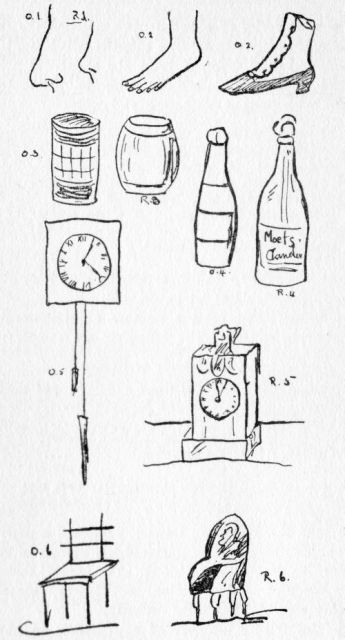
In 1895 Mr. Henry G. Rawson published a paper on the subject, in which he narrated his success in transferring the diagrams of objects. Tracings of these are given herewith. (O = original and R = reproduction.) Further comment is hardly necessary.
Diagram Illustrative of Thought-Transference.
He also tried a number of experiments in naming cards drawn at random from the pack (where the chance is always 51 to 1 of being correct, and the chance of being correct a number of times in succession is inconceivably great) and he attained the following results, among others:
Card Chosen Card Guessed
5 of Hearts. 7 of Hearts, Ace of Diamonds.
8 of Hearts. 8 of Hearts.
10 of Clubs. 9 of Clubs, 10 of Clubs.
Jack of Diamonds. Jack of Diamonds.
5 of Spades. 7 of Spades, 5 of Spades.
2 of Clubs. 2 of Diamonds, 2 of Clubs.
Queen of Hearts. Queen of Hearts.
5 of Diamonds. 9 of Diamonds, 5 of Diamonds.
Ace of Diamonds. Ace of Diamonds.
Ace of Hearts. Ace of Hearts.
Ace of Clubs. Ace of Clubs.
King of Spades. King of Diamonds, King of Spades.
Again, it is useless to say that such results are attributable to chance. The good standing of the participants places their good faith beyond question; all normal means of communication were prevented. How are we to account for such facts—short of invoking some sort of mental interaction, through other than the ordinary channels of sense?
But these were experiments conducted in the normal state. Equally and even more interesting and conclusive results were obtained when the subject was placed under hypnotism. Of these, the most conclusive experiments were those conducted by Mrs. Sidgwick and Miss Alice Johnson. Put to the law of chance, it was shown that such coincidences were many hundreds, not to say thousands, of times more numerous than chance could account for. Then, again, we have the experiments at a great distance, in which Dr. Pierre Janet willed a patient of his to come through the streets, and she almost invariably came when he willed it. We have, too, a number of most interesting experiments in which dreams have been induced in others—by trying to influence the sleeping thoughts of the dreamer. Here is a fruitful field, as yet hardly touched, for an experimenter in this line of research.[40]
Among the most interesting and dramatic cases of the kind are those experiments in which one person has voluntarily caused a figure of himself to appear to another at a distance. Thus, A sits down and wills intently that he shall appear to B that night—in sleep or waking, as the case may be. The next morning A receives a letter from B, stating that he has seen an apparition of him, and asking him if he is well. The following is an example of a case of this character:
"One certain Sunday evening in November, 1881, having been reading of the great power which the human will is capable of exercising, I determined with the whole force of my being that I would be present in spirit in the front bedroom of the second floor of a house situated at 22 Hogarth Road, Kensington, in which room slept two young ladies of my acquaintance, viz. Miss L. S. V. and Miss E. C. V., aged respectively twenty-five and eleven years. I was living at this time at 23 Kildare Gardens, at a distance of about three miles from Hogarth Road, and I had not in any way mentioned my intention of trying this experiment to either of the above ladies, for the simple reason that it was only on retiring to rest upon this particular Sunday night that I made up my mind to do so. The time at which I determined to be there was one o'clock in the morning, and I also had a strong intention of making my presence perceptible.
"On the following Thursday I went to see the ladies in question, and in the course of conversation (without any allusion to the subject on my part) the elder one told me that on the previous Sunday night she had been much terrified by perceiving me standing by her bedside and that she screamed when the apparition advanced toward her, and awoke her little sister who saw me also...." (Corroborative evidence was obtained from the two ladies mentioned.)
Such a case is called a "telepathically induced hallucination" or an "experimental apparition," for the reason that the figure seen is doubtless hallucinatory in character and was induced by means of telepathy. Such cases (and there are plenty of them) are very striking proof of the direct action of mind on mind; and at the same time form a sort of bridge across the gulf which otherwise seems to exist between the experimental cases we have just quoted and the spontaneous cases to which we must now refer.
Soon after the Society began its work it was noticed that numbers of cases were sent in, in which apparitions were seen at the very moment of the death of the person symbolized by the apparition. In many such cases, no other experience such as this has happened to the percipient throughout his or her life; but on the very occasion when such a figure was seen, the individual was found to have died at that particular time! Can so many cases of so remarkable a character be attributed to chance?
The answer at first sight is: No. But here we must be cautious. In scientific research such as this, we must not be guided by impressions, but by facts and figures. Accordingly it was decided to put this matter to the test, and an "International Census of Hallucinations" was inaugurated, which extended throughout several countries (America being represented by Professor William James), and the taking of which lasted several years. As the result of this laborious undertaking, 30,000 answers were received—the percentage of coincidental apparitions being calculated. After making allowances for all possible sources of error, it was ascertained that the number of coincidences received were several hundred times too numerous to be attributed to chance; and the following statement was signed by Professor Sidgwick's Committee[41]:
"Between deaths and apparitions of the dying person a connection exists which is not due to chance alone. This we hold as a proved fact."
These are important words in many senses; and donné à penser. It shows us that, after all is said and done, this old theory of "ghosts" is not so far wrong, and that they, in a certain sense, do exist; it is only a matter of their interpretation: the "mystics" have as usual been right as to the existence of the facts, but the "scientists" may be right in their interpretation of them.
So we have the whole class of "spontaneous" telepathic phenomena, so called because they are not induced by direct experiment. In this class we have all those manifestations which take place at or about the moment of death; phantasms of the living, phantasms of the dying, and phantasms of the dead—according to whether the subject is yet living, is dying, or has recently died. In all such cases we may postulate a telepathic action at the moment of death, for in those cases when the apparition was seen but a few minutes or even a few hours after death, the impact might have been transmitted at the moment of death, and only have emerged into consciousness during the quietness and peace of the evening, or when night gave it a chance to do so. For we now know that subconscious ideas do tend to rise into consciousness when the latter is less occupied with the events of the day.
It is, of course, impossible to detail here the mass of evidence of all kinds which has been accumulated of late years in favour of the existence of telepathy, but enough has been quoted to indicate the method of approach and the character of the evidence adduced. Suffice it to say that, in the eyes of those who have inquired into the subject closely, telepathy is now held to be proved; it is now considered to be a scientific fact, though not as yet explained. Again I repeat, the question is not: Is it possible? but, Is it a fact?
Taking all that has been said into consideration, it may fairly be contended that the mere fact of telepathy may therefore be said to have been proved. This being so, the interesting question of its nature or character presents itself. How is such action to be explained? How account for the facts?
There are many theories which have been advanced from time to time to explain this remarkable phenomenon, and, if it be a fact in nature, its scientific explanation must some day be forthcoming. Once telepathy stands proved it will mean the remoulding and recasting of many of our scientific theories, and even a reconstruction of science—in so far, at least, as it refers to physiological psychology. Such being the case, and telepathy being proved, as many eminent men of science today believe, the question of its theoretical explanation becomes most important.
Now the first analogy which strikes one in the consideration of this question is that of wireless telegraphy—the subtle electric vibrations which journey to and fro with incredible swiftness through the universal ether. In short, telepathy is thought by many to be simply a species of physical vibration, proceeding from brain to brain, just as electric waves pass from the transmitter to the receiver in wireless telegraphy. This explanation is so common that many persons accept it without further ado, as being the correct explanation of the facts. But such a theory cannot be said to cover the facts in a satisfactory manner.
In the first place, there seems to be no definite or prescribed area in the brain adapted for such a purpose; no cell or centre has as yet been discovered which appears destined to send out waves of this character. Still, perhaps it will be some day, for the functions of certain portions of the brain—particularly the frontal lobes—are as yet very little understood. But there is the argument that, if such waves exist, they must be detected by means of our scientific instruments—instruments so delicate and subtle that they are able to measure the difference of the pull of gravity of an article when placed on the table or on the floor, or can register the heat of a candle at a distance of more than a mile (Langley's bolometer). Compared with such delicate instruments, our five senses are coarse indeed, and any vibrations which can affect these same senses must surely affect the more delicate and sensitive instruments just mentioned. Yet none of them have as yet been able to indicate the existence of any such vibrations, and this would seem to show that they cannot exist.[42]
But there is a reply to this argument. It may be said that, although the senses do not register any such vibrations, the brain might do so, in some direct manner; and the brain might be far more sensitive than any instrument so far devised. Indeed the definition of telepathy, "the ability of one mind to influence or be influenced by another mind otherwise than through the recognized channels of sense," would seem to indicate that in this process only the brain is involved, and not necessarily the physical senses at all. So far, then, so good; telepathy might still be vibratory in character.
But if so, how could such waves get through the skull to act upon the brain direct? This is a staggering thought to the ordinary materialist, and at first sight renders such an action unintelligible and hence "impossible"! But to reason thus would be very superficial. For we know that certain physical energies pass through solid substances—substances impervious to other physical energies. Thus we know that glass permits light to pass through it, but is a non-conductor of electricity; while steel is impervious to light, yet electricity can traverse miles of steel in the fraction of a second. "Gravity" seems the only energy which cannot be isolated by some means or other. No substance is opaque to gravity. It acts through all substances, at all times, continuously. In this respect telepathy may resemble gravitation.[43] If this were true, or anything like it were true, we could easily see why a solid substance, such as the human skull, might offer no appreciable resistance to the passage through it of undulations of a certain velocity—of a speed so great, perhaps, that they could not be detected by any of the instruments at the command of the physicist today.
But there are other and still more serious objections to the vibratory action of telepathy which have not as yet been mentioned. For if we try to push the analogy further, we shall find that it is by no means so clear as might be supposed. Thus in the case of wireless telegraphy the vibratory action of the ether is a purely mechanical process and does not carry emotion, thought, or intelligence with it—being vibration pure and simple. Now, in the case of a supposed telepathic message, thought flashed from one brain to another must be supposed to convey with it intelligence of some sort; for if it were a purely mechanical vibratory action, how is it that this would impress another brain in such an entirely different manner from all other vibrations as to create in that brain not only a thought, but the precise kind of thought—the replica of the thought—which originated in the brain of the agent? Granting that vibrations are but "symbols," and that they are interpreted by our brains as things, the difficulty remains that, in all other cases, such vibrations, no matter what their intensity, convey to the brain the idea of external objects, or qualities of those objects, and do not convey to it the idea of mind or intelligence. How is it, therefore, that one particular species of vibration, which, we must assume, would vary more or less with each individual, can convey with it the idea of thought, and that this vibration is associated with mind, and in fact is thought, while all other vibrations in the world are in nowise connected with intelligence and do not appear to us to be so connected? And further, how infinitely we should have to vary the degree and type of vibration to correspond to all shades of thought and feeling and emotion! Sir William Crookes some years ago urged the possibility of this vibratory action of telepathy; but Mr. Myers has pointed out its defects and stated that all we can at present say about telepathy is that "life has the power of manifesting to life"—a formula surely general enough, yet highly significant.
Again, the theory has been advanced that all minds are in touch in a sort of subterranean way—through their subliminal regions—just as all spokes of a wheel ultimately reach the hub, though each spoke is distinctive. In this way we could imagine an inter-connection taking place, of which we are quite unaware, under certain favourable conditions. To use an analogy somewhere employed by Professor James, our conscious minds are like the leaves of the trees which whisper together, but the roots of the trees are all embedded in the same soil and are interlaced inextricably. So our minds, though they appear to be so separate and apart, may really be at basis fundamentally one. There must be, it is said, some common ground of interaction; possibly a sort of universal fluid, in which all minds are bathed, and by means of which interaction of thought is effected. This is somewhat akin to the theory first propounded by Mesmer, and which has been revived, in somewhat altered form, more than a hundred years later. Mesmer held that thought was communicated from brain to brain "by the vibrations of a subtle fluid with which the nerve substance is in continuity." Truly, if any sort of physical action is employed, this seems a significant enough remark. We know that two tuning forks will resound in unison, if one of them be struck. Put in motion a magnetized needle; at a certain distance and without contact another magnetized needle will oscillate synchronously with the first. Set in vibration a violin string, or the string of a piano; and at a certain distance the string of another piano or violin will vibrate in unison with it. Such analogies make us wonder whether or not communication of this kind might not exist, and, certainly, in order to make telepathy intelligible at all, we must suppose some such action taking place. We all have a tendency to think in physical symbols, owing to our materialistic training.
For if we try to picture to ourselves the process of telepathy as taking place in some manner other than physical, how are we to conceive such action? Does one consciousness stretch out, as it were, and grasp the other passive mind? or does the agent project the thought from his brain and impress the mind of the percipient with it—just as a bullet might be shot from a rifle, or light waves radiate from some centre? The first of these theories would be somewhat akin to true mind-reading, the other to thought-projection or transference. But if the latter theory be correct, is all thought directed into one single channel—at a target as it were—or does it spread equally in all directions, like all other vibratory radiations? It may be conceived that telepathy is a combination of both the above processes—it being a kind of mutual action—a projection on the part of one, and a mental reception or grasping on the part of the other. If this be the case, we must conceive the thought as met, as it were, in space, and in some way joined or seized upon by the percipient thought; but how can we conceive such seizing or such perception?
It will be seen that the problems arising from a study of telepathy are numerous and remarkable. Let us briefly summarize the chief theories which have been advanced to date. These are:
1. The Theory of Exalted Perception.—This is, that the subject is in some manner enabled to see the thoughts of his "magnetizer" or hypnotist. This explanation applies only to those telepathic manifestations observed when the percipient is in a state of trance; and even here the theory cannot be said to explain, for it explains one mystery by propounding another.
2. The Hypothesis of Brain Exaltation with Paralysis of the Senses.—On this theory, a sort of sympathetic action and reaction or rapport is supposed to take place, but of the exact nature of this process its exponents can tell us nothing. Again, it only evades the direct issue and answers one problem by asking another.
3. The Hypothesis of Direct Psychic Action.—This is the view whose ablest exponent is Mr. Frederic Myers. It is supposed that such action takes place in its own world—its own sphere—just as distinct and just as real as the material world. If this were true we could never demonstrate the action of telepathy scientifically, since it would be beyond the reach of such demonstration. Others again believe that the action of telepathy is akin to the phenomena of induction; others that it is akin to gravitation or the magnetic force. While the details of these theories are lacking, there is here a valuable suggestion and a field for future research.
4. The Hypothesis of Direct Physical Action.—This supposes that the molecular changes in one brain, accompanying thought or emotion, set certain ether vibrations in motion, which are caught up by another brain, sensitive enough to receive them, or attuned to the proper degree. This theory is one which appeals to most persons, though it is open to the criticisms before raised. Nevertheless, it may be true; and if so, its law ought one day to be discovered. There is here also a field for legitimate scientific research.
5. The Idea of a Universal Fluid.—This is the theory held to by the majority of mystics and occultists. There is supposed to exist a sort of fluidic intermediary between mind and mind, which acts as the means for thought transmission, and it is upon this that all thought is impressed. It acts as a sort of mirror, which reflects the thoughts of all living persons, just as a material mirror might reflect material objects. In such a case, the thought is really made objective and is perceived by the subject in a sort of clairvoyant manner. I do not feel competent to pronounce upon this hypothesis in the present embryonic state of psychical science.
6. The Theory of Spiritual Intermediaries.—This is the theory that our thoughts are read by some purely "spiritual" process, by "spirits," who convey this thought to another individual and impress him in some psychical manner directly. They thus act as carrier-pigeons between mind and mind. To this theory it may be replied, as Professor Flournoy has replied in his Spiritism and Psychology, that it represents the grave methodological defect of multiplying causes without necessity; by postulating spirits and importing them into the problem when they are not wanted. It would be better to seek an explanation elsewhere.
7. The Psycho-Physical Theory.—This theory supposes that all thought is accompanied by nervous undulations, which are carried to the surface of the body, there setting the ether in vibration; and this, in turn, impinges upon the periphery of another person, particularly sensitive to receive them, and by him re-transformed into nervous currents—into thought! Such a theory completely fails to take into account those cases of long-distance telepathy, of which so many have now been collected; and in other ways is very defective.
8. Assuming all the above theories to be insufficient, we now come to:
The Elements of a Scientific Explanation
In studying this subject we must remember certain things:
(a) That telepathy is a highly complex phenomenon, and for that reason we must not expect to find its solution easily or state it in a single sentence.
(b) That we must consider it from the double standpoint, physical and mental; and
(c) That we must consider the conditions affecting the operator, the subject, and, if possible, the connection between them.
All scientific explanation consists in reducing the unknown to terms of the known. We can often classify a phenomenon without being able to explain its innermost nature. If we discover its laws, we have advanced to that extent.
Dr. J. Ochorowicz, who has made a prolonged and minute study of this question, writes as follows regarding the necessary conditions to be observed in the operator:
"On the side of the operator the conditions have been very little studied. But it is probable:
"1. That there are personal differences.
"2. That these differences may be due not only to the degree of thought intensity, but also to the nature of the thought itself, according as it is visual, auditive, or motor.
"3. That some account has to be taken of a sort of accord, of concordance between the two intelligences.
"4. That excessive will-power impairs the definiteness of the transmission without much enhancing its intensity.
"5. That strong, persistent, prolonged thinking of a thought repeated for a longer or shorter time constitutes a condition in the highest degree favourable.
"6. That any distraction which causes the thought to disappear for a moment, or that makes it cease to be isolated, seems eminently unfavourable to the mental action.
"7. That, nevertheless, thoughts that are not intense, and even thoughts that are at the moment unconscious (subconscious), may be transmitted involuntarily.
"8. That the muscular efforts which usually accompany an exertion of will are more or less indifferent; but that the muscle expression of the operator may be useful, subjectively, by reason of the habitude that connects thought with these expressional signs.
"It follows from these considerations that the operator should insist less upon the 'I will it' than upon the content of that willing; and hence it is probable that, properly speaking, it is not the 'strong will' that helps telepathy so much as clear thinking."
As to the subject or percipient, experience has taught us that the four following states are probably the most important for the recipience of a telepathic message:
1. In the state of profound aideia (complete lack of thought) transmission is never immediate, but it may sometimes be latent.
2. In the state of nascent monoideism (one idea) it may be immediate and perfect.
3. In the state of passive polyideism (many thoughts) it may be either immediate or may take place after an interval of greater or lesser length.
4. In the state of active polyideism the conditions are complex and subject to further subdivisions, for:
(a) Transmission may be direct if the subject helps by voluntary self-absorption in a concentration of mind more or less monoideic; he lends himself to the action; he listens mentally; he seeks, sometimes he finds!
(b) It may be indirect, i.e. latent; this time also with some concurrence on the part of the subject. This seems more frequent.
(c) Finally, it may in exceptional instances be either mediate (delayed) or immediate, even without the subject's being advised beforehand of the action.
Here, then, are the probable conditions; also the state of the agent and percipient. Now what about the connecting links?
Here we come to the heart of the problem. I shall be as brief as possible, since we cannot pretend that the problem is yet solved. I merely offer a few suggestions, some original, others advanced before by writers on these subjects.[44]
In order to obtain a specific action we must employ a specific instrument: a telephone for a telephone; a brain for a brain.
Every living thing is a dynamic focus.
A dynamic focus tends ever to propagate the motion which is proper to it.
Propagated motion becomes transformed according to the medium it traverses. A force may be transmitted or transformed.
In an identical medium there is only transmission.
In a different medium there is transformation.
A dynamic nucleus, in propagating its motion, sends it out in every direction; but this transmission becomes perceptible only on the lines of least resistance.
A process that is at once chemical, physical, and psychical goes on in the brain. A complex action of this kind is propagated through the grey matter, as waves are propagated in water.
Regarded physiologically, a thought is only a vibration, probably, which does not pass out of its appropriate medium. It is propagated, and it must be along the motor nerves, since science admits no other route. But the thought itself does not radiate; it remains "at home," just as the chemical action of a battery remains in the battery; it is represented abroad by its dynamic correlate, called, in the case of the battery, a current; and in the case of the brain, I know not what; but whatever its name may be, it is the dynamic correlate of thought. Thought, therefore, is dynamic. Thought is transformed; and may be re-transformed, in another organism which supplies the necessary conditions. Thought may be restored.
We have now reached, from a purely physiological standpoint, a position which I desired to reach before I advance the final part of the theory—which may at first sight appear somewhat fantastic. But telepathy itself is fantastic; and yet, being a fact, it must be accounted for somehow, or left altogether unexplained.
It has always been contended by a peculiarly-gifted group of individuals known as "clairvoyants," that we possess a "spiritual body"—just as we possess a physical body—of exactly the same shape and appearance; and that we inhabit this body at death. It is further contended that all our physical senses find their exact counterpart in this "etheric double"; there is a physical eye and a spiritual eye; a physical ear and a spiritual ear, etc. With the spiritual eye we see "clairvoyantly"; with the spiritual ear we hear "clairaudiently," and so forth. I shall not discuss the possibility of such a body, except to say that there is now a mass of evidence in its favour. Assuming it to exist—assuming it to be the exact counterpart of the physical body—then it too possesses a brain; and it too must pulsate and vibrate just as the physical brain does, when accompanying thought.
Now this inner body may be the vehicle of thought. It may possess "centres" whose normal office is to send and receive telepathic messages. One "etheric centre" may thus act upon another "etheric centre" directly—only indirectly upon the physical brain cells. The action would thus be dynamic, yet psychical; physical in a sense, yet not physical as we conceive it. Philosophy tells us that the table we see (the phenomenon) is not the "real" table (the noumenon)—the reality behind; but, if we knock the two tables together, the noumena touch, just as the phenomenal tables do; only we have no means of knowing or directly seeing it. Thus there is a sort of physical communication of a spiritual thing. Those who have entered rooms of a certain character have often sensed their "psychic atmosphere." This is a sort of duplicate or replica of the physical atmosphere, yet it is different from it. The whole subject is so subtle that one cannot follow it unless he has had some experience or some knowledge of these things. The process cannot be explained in clear-cut fashion—any more than mediums can tell the source of their thoughts and impressions. A little intuition is needed in order to grasp the problem and comprehend its difficulties.
Were I to try and state my theory briefly, then it would be somewhat as follows: Every thought necessitates a three-fold phenomenon—(1) the purely psychic activity; (2) the physiological correlate; and (3) the "dynamic correlate," which is as yet unrecognized by science. This "dynamic correlate" is the manifestation of the activity of the etheric double; which sets into motion certain vibratory activities which, though they are not physical vibrations, are their counterpart or equivalent on the plane above matter—the "astral" plane, if the term be allowable; which is parallel to, but not identical with, the material plane. Thus by a sort of "doctrine of correspondences" we arrive at the conclusion that telepathic action is physical, in a sense, yet is not sufficiently physical to be measured by our instruments in the laboratory. The activity is, as it were, the noumenon, of which the physical vibration would be the phenomenon; but no phenomenal aspect of this activity may ever be manifested to us; and hence never be capable of being registered by science, as it exists today.
I do not know whether or not I have made this theory very comprehensible, but it seems to me some such theory might explain the facts and at the same time do away with the difficulties. At all events no theory of telepathy which has been advanced to date can be said to be explanatory, when all the facts are taken into consideration; and if this first tentative groping serves to stimulate others to speculate, and above all to experiment, in this obscure field, I shall feel that a first onward step has been taken toward a correct understanding of the "Marvels of Telepathy."
FOOTNOTES:
CHAPTER IX
THE USES AND ABUSES OF MIND-CURE
Within the past few years the country has been flooded by a host of books, pamphlets, and periodicals dealing with "psychotherapy" and mind-cure in general. In some ways it would be impossible to exaggerate the good which this has done. It has cheered-up many desponding souls; it has brightened many a life; it has stimulated activities and lines of thought which otherwise would have remained dormant; it has added real zest to life and made it worth living. Undoubtedly, too, real cures have been effected by means of these modern mental methods, and any one who denies this must surely be ignorant of the vast amount of steadily accumulating evidence in their favour. The many advantages of the system are doubtless pointed out with acuteness and insisted upon with vigour in the books which defend it, and need not be re-stated here. And yet, while I acknowledge all this; while I am forced to admit the many wonderful cures and much mental relief on account of these newer methods of healing, I still believe that a vast amount of harm is also brought about by the incautious application of the doctrines taught; by over-enthusiasm for the ideals which are ever before us, luring us on and on. In the present chapter, therefore, I propose to show in what these pitfalls consist; to illustrate some of the errors into which over-enthusiastic "mental-curists" are apt to fall.
First of all, however, a confession of faith! For a number of years I believed as implicitly as it was possible for any one to believe in the great power of mind to cure disease. I read nearly every book of importance that had been published on this theme—including Mrs. Eddy's books, all the standard works on hypnotism, mind-cure, faith-cure, new thought, etc. I was deeply imbued with the truths they contained. I became greatly opposed to the so-called "materialism" of medical science. The rationality and philosophical truth of the mind-cure systems appeared to me irrefutable.
The fundamentals of the system are indeed well laid. We know of the tremendous effects of the emotions upon the body—its functions, secretions, etc. Cheering faith and optimism are assuredly great incentives to health; more than that, they are actual physiological health-stimulators. We know that we can make ourselves ill by morbid and unwholesome thoughts; and, as Feuchtersleben says: "If the imagination can make man sick, can it not make him well?" By opening up the great "sluice-gates" of the organism we somehow allow a great influx of spiritual energy to pervade us, and the disease vanishes. It is a very fascinating doctrine, and, for many diseases, doubtless a true one.
In spite of all this, however, I believe the present tendency to treat all diseases—or next to all—by purely mental methods is a great mistake. It leaves many persons ill and crippled for life; it allows many hundreds of others to sink and fall into premature graves.
And the first objection I would make to mind and faith-curing, and all kindred systems, is this: that they tend to suppress symptoms rather than remove causes. This is a very grave objection indeed. If one suffers constantly from constipation or dyspepsia, the natural habit of the mind would be to worry about them more or less and take steps to prevent their continued progress. But the faith and mind-curists say: "No, it is not at all important; imagine yourself whole and well, and whole and well you will be!" Many persons have done this and their troubles have, apparently, lessened and disappeared. They may have and they may not. It is easy to ignore troubles of this kind; but this sort of ostrich-philosophy, which buries its head in the sand and refuses to look at what is before its eyes, is not natural or by any means the best for the bodily organism. Ignoring symptoms does not cure them. What such persons fail to take into account is this: that any unpleasant symptom which may have arisen must be due to some cause—sickness and disease do not arise de novo and without just cause. This is not the order of a good and kind nature. It must be due to something, and generally that "something" is the condition of the body at the time; and that condition depends, in turn, upon the previous habits and modes of life. These have engendered the diseased condition we see before us; and the only effective and rational way to stop the effects—the symptoms—is to stop the causes, to change the habits of life which have led to such results; and not to tinker with the effects. Even pain may be ignored to some extent; but pain is due to a certain pathological state which requires treatment. It is simply an indication of an existing bodily condition. What is the good of ignoring that state, when it exists? Symptoms may be ignored, but the causes of those symptoms run on in the body, nevertheless, and in the end work havoc and breed sickness and decay.
I am aware of the fact that the Christian Scientists, e.g., would reply to this that the bodily state (there is no body, according to them, but we let that pass, for the moment) is cured at the same time; that, by the mere affirmation that the body is whole, we thereby make it whole; we do not suppress symptoms, we remove causes as well. This I deny, at least in many cases. I have seen too many of such "cures" and relapses not to know whereof I speak. A patient goes to a "healer" and becomes "cured." A few weeks or months later his trouble returns; or, if not the same trouble, another and perhaps a worse one. This is "cured" in turn, and so on.
Now it is a well-known fact that a disease suppressed in one place or one direction has a tendency to break out in another. It has been gathering in force all the time within the body, and finally bursts forth again worse than before. "And the last state of that man was worse than the first." The causes have run on. Similar causes can produce opposite effects—just as opposite causes can produce similar effects. Although no tangible connection between the first and the second illness can be traced, it is there nevertheless; and both have been produced by a common cause. We cannot ignore causes; we must treat them; and if we do not, they will, in the majority of cases, repay us a thousandfold for our past neglect.
When a person is diseased the majority of mental-scientists would at least admit that certain unphysiological conditions were present and needed to be overcome. If this be so, I ask: Why should we allow the body to become diseased at all and thus necessitate its cure by mental or any other means? Would it not be much simpler to prevent such a diseased condition, in the first place, by proper physiological habits of life; and so render any cure by mental or other means unnecessary? It seems to me that, by thus allowing the body to become diseased, and then "curing" it by mental control (even granting that this is the case), we burn the candle at both ends—for the reason that we devitalize the body by allowing it to become diseased and then waste more energy in the mental effort to get well again! Would it not be more simple and more philosophical so to regulate the life that such diseased states and such cures are unnecessary?
The fundamentals of Mrs. Eddy's doctrine are well known. God is all in all; God is good; hence all is good. Sin and sickness are delusions of poor mortal mind. They do not really exist. And this, they say, may easily be proved—on the one hand by the cures which take place; and on the other by the doctrine of idealism, which philosophers and scientists alike are accepting more and more as a satisfactory interpretation of the universe. The whole system is very delightful—and very illusory!
In the first place, as to the cures. I must contend that because some remarkable cures have been effected, that, therefore, the doctrines of Christian Science are not thereby established. We know similar cures have been effected at Lourdes; over the bones of saints (which did not really exist under the sacred cloth); over (fraudulent) "chips of the Cross"; by means of hypnotism, and in a hundred ways. The whole root of the matter lies in auto-suggestion; in the patient's faith in himself, and in the degree of faith he places in the curing object or dogma. The dogma may be quite false, but the cures are effected just the same. Because cures are effected by Christian Science methods, therefore, it is no proof whatever that the Christian Science theology or philosophy is right. It may be one huge error, but the cures would be effected just the same—provided the faith, the emotions, the imagination and spirit of the patient be touched in an appropriate manner.
True it is that science and philosophy tend towards idealism; and the belief that there is, strictly speaking, "no matter." But this belief need not make us any the more believers in Christian Science and its methods. There is a subtle error here which is unperceived by the majority. When first the truth reaches the mind that there is "no matter" that matter cannot feel, etc., it bursts like a flood of light upon the unfettered mind and appears a fact so overwhelmingly great, so vast and so true, that to gainsay it would be to acknowledge ignorance of its teaching; to admit intellectual shortsightedness. (This is perhaps the reason for the supercilious superiority of many Christian Scientists; they imagine that no one perceives this truth but themselves.) And once grasped, is it not self-evident, and does not all else follow in consequence? At first sight it would indeed appear so!
The great error, however, lies here. Because this fact is theoretically true, it is not practically true also. We may admit the one; we cannot accept the other. The fallacy has been clearly pointed out by Sir Oliver Lodge (Hibbert Journal, January, 1905), and I cannot do better than to quote his words in this connection. He says:
"We cannot be permanently satisfied with dualism, but it is possible to be over-hasty and also too precisely insistent. There are those who seem to think that a monistic view of existence precludes the legitimacy of speaking of soul and body, or of God and spiritual things, or of guidance and management, at all; that is to say, they seem to think that because these things can be ultimately unified, therefore they are unified proximately and for practical purposes. We might as well urge that it is incorrect to speak of the chemical elements, or of the various materials with which, in daily life, we have to deal, or of the structures in which we live, or which we see and handle, as separate and real things, because in the last resort we believe that they may all be reduced to a segregation of corpuscles, or to some other mode of unity.... The language of dualism or of multiplism is not incorrect or inappropriable or superseded because we catch ideal glimpses of an ultimate unity; nor would it be any the less appropriable if the underlying unity could be more clearly or completely grasped. The material world may be an aspect of the spiritual world, or vice versa perhaps; or both may be aspects of something else; but both are realities, just the same, and there need be no hesitation in speaking of them clearly and distinctly as, for practical purposes, separate entities."
This, it seems to me, disposes of the argument for Christian Science drawn from idealism. No matter whether the material world exists or not, we always have to live as if it existed. If we close our eyes and walk across the room, we shall be rudely stopped by the brick wall at the opposite end when we come to it. No matter how strongly we believe that such a wall does not exist, it does, nevertheless, stop us; we have to live as if it existed. And, just so, it seems to me; no matter how strongly we may believe that the body does not exist, we always have to live and act as if it existed—so long, at least, as we live in and inhabit the body at all.
Christian Science says that hygiene, diet, etc., are unimportant factors in the cure of disease. They "do not count." Apart from the immediate, practical disproof which cases of blood-poisoning, etc., would offer to such a theory, it may also be disproved theoretically. For if it be unnecessary, e.g., to fast during illness—if food is a negligible quantity and can be left out of account—why do Christian Scientists ever eat at all? If food is unimportant in one case, it must be in the other case also. And if it be replied to this, as it is, that the only reason for food is because the Christian Scientists are not yet sufficiently "advanced" and have not yet sufficient "enlightenment" to do without it; then, I reply, by the same logic they are not as yet sufficiently advanced, and have not as yet sufficient knowledge to treat all cases of accident and disease, which, in point of fact, they do treat. If the limitation be acknowledged in one direction, it must be acknowledged in the other direction also. Christian Scientists cannot yet live without food because they have not yet sufficiently "perfected" themselves. So, in like manner, they should not treat many cases of disease they do treat because they have not yet sufficiently "perfected" themselves.
I might advance arguments such as the above to fill many pages. But I do not think it necessary. As a cure for certain functional diseases, for nervous disorders, and for many of the affections of the mind, mental methods of treatment must be acknowledged to be a great and a most important factor. But when an organic lesion is present, in grave states demanding immediate attention, I think it little short of criminal that such states should meet with almost total neglect because of the perverted ideas of physiology and a sickly sentimentalism illogically extended from the philosophical doctrine of idealism. As a metaphysical doctrine, it may be correct; as a basis for medical practice, it is certainly incorrect. Let us once more set our feet to earth and determine to live a good and a useful life in the material world of which we undoubtedly form a part. We are in a material world, and I believe we should be of it. I, for one, raise my voice in protest against the tide of intellectual asceticism which is inclined to accept without question the modern doctrine and methods of "psychotherapy" and mind-cure in place of the more rational and certain measures of hygiene and medicine. The further a pendulum swings in one direction, the further will it swing in the other, when released. And I believe that the modern extreme acceptance of faith and mind-cure in all its forms is but the moral and intellectual and spiritual reaction against the materialism of the past generation. Hail the day when it again swings back to its mid-position; and when mental methods of cure and bodily hygiene shall together march hand in hand to the joint attack against disease! They each have their mission to fulfil, their cases to cure. Tolerance, tolerance! Let them each recognize the rights of the other!
CHAPTER X
THE PSYCHOLOGY OF THE OUIJA BOARD[45]
Before we proceed to discuss the intelligence lying behind the Ouija Board, I must offer a few remarks upon the subject of automatic writing in general, passing in very brief review the various theories that have been advanced from time to time by way of explanation of the action of this extraordinary little device.
One of the sanest and most rational popular accounts of this instrument and its workings that I have so far come across (all things considered) is a little pamphlet entitled The Planchette Mystery, very little known, from which I shall quote in writing this review. Epes Sargent's book, Planchette: the Despair of Science, contains in reality very little on the planchette board, and the title is somewhat deceptive. Mr. Myers's articles on the subject (particularly in Proceedings of S.P.R., vol. ii. pp. 217-37; vol. iii. pp. 1-63; and vol. ix. pp. 26-128) are, of course, classical, but are involved and inaccessible for the general reader, even had he the time to read them carefully; so that perhaps the following résumé may not be unnecessary or out of place.
It is to be presumed that every reader of this book knows what a Ouija Board is, and, roughly, what it does. How it does it is a more difficult question to answer; in fact, it may be said that no definite answer has even yet been forthcoming. All that has been done, or that we can do, is to examine the facts, and to advance an explanatory theory that is really explanatory and in accord, as nearly as possible, with accepted theories and teaching.
First, let us consider the movement of the board. There can be little doubt that the same force which propels the planchette board propels the ouija board also; and this is still further demonstrated by the fact that, in many experiments, the planchette board is used as a ouija, and points to the letters, which are written out on a large piece of paper, and the pencil point indicates the letter in the same manner as does the ouija. It certainly appears far easier for the board to point to letters than to write—and this is most suggestive and interesting when we consider it. It would seem to indicate that the controlling intelligence found it easier to convey its thoughts when the letters were before it, in plain sight—a very suggestive fact, taken in conjunction with certain mediumistic phenomena.[46] Of course there is the alternative explanation of this fact—that a straight push-and-pull action is easier to accomplish than the more detailed and complicated action of forming words and letters. But that would not make plain to us why it is that no attempt at writing should be made, very often, until the letter-pointing system is adopted.
Presuming, then, that the movement or impelling force is the same in each instance, the question is: What is this force? In the great bulk of cases there can only be one answer to this question: unconscious muscular action. Whenever muscular contact is allowed, this may safely be assumed to be the explanation of the movements of the board—even if it shows an apparently independent will and movement of its own, and apparently drags the hands of the sitters with it. I have discussed this at some length in my Physical Phenomena of Spiritualism, pp. 66-72, and it is unnecessary to go into the question again here. Unconscious muscular action will account for so much that, even if it were not the true explanation of the facts, in reality, we should have to assume that it was.
It will be observed that I have said "in the great bulk of cases." Some of my readers may object to this limitation, and say that it is the true and sufficient explanation of all the cases, without exception. Personally I doubt that fact. There are numerous cases on record when the board has continued to write after the hands of all the sitters have been removed from it. Now, if there be operative a force which has been in some way generated during the sitting, it is quite possible, of course, that this same force may be operative in those cases where contact is allowed, only it is difficult to prove that fact.[47] Personally I have no difficulty in conceiving such a force or power, at least theoretically. This force may be the first glimmerings of the force whose more powerful manifestations we see in the movements of tables (witness Gasparin's experiments, e.g.), and ultimately in telekinetic phenomena, as, for example, in the Palladino case. This would seem to indicate that such forces and powers are possessed by every one in a limited degree, but that it is only in certain individuals that it becomes so marked and extraordinary that it produces the phenomena spoken of above.