THE PROBLEMS OF PSYCHICAL RESEARCH (continued 2)
Reading edition
The three chief difficulties involved in mediumistic messages may be summed-up under three headings: (1) intra-mediumistic conditions; (2) intra-cosmic conditions; and (3) the mental conditions of the communicators.
Under the first head may be placed all those difficulties which are liable to interfere between the communicator and the amanuensis. If the communicator is naturally a good visualizer this may help his visual communications, but impede the others; an audile might be better in some instances. Again, the impulse may come in some motor form, in which case neither of these types would be that best suited to control the organism of the medium. Whether the communicator is a good visualizer or not may affect the communications to a great extent. Whether or not he had a normally good memory would also have a great influence. In fact, the whole construction of the mind might have great influence upon the results. This is a subject which deserves to be studied very carefully one day, when the mere fact of communication is established.
As is well known, both Drs. Hodgson and Hyslop wrote strongly in defence of the theory that the communicator, at the time of communicating, was in an abnormal mental condition, somewhat resembling trance or delirium or secondary personality. They were, at least, not in full control of their thoughts; and this was said to be established by the statements of the communicators themselves; and by a study of the messages communicated, wherein it was found that they became dreamy and vague; that they showed the same rapid change of imagery and subject which is manifested in dreams; an automatic tendency to capricious and confused association, a general indifference to personality, etc., as manifested in delirium. In dreams and sleep we have practically no control over the body at all, any more than if we were dead; and Dr. Hyslop contended that probably "somnambulism and hypnosis, dreaming, sleep, trance conditions, and death are all simply different degrees of the same state." Dr. Hyslop during his later years modified his views upon this question, and came to the conclusion that other conditions play a greater share in the results than the state of the communicator's mind. But there can be no doubt that this has its results.
Then, too, the medium's subliminal has a great and very decided influence upon the content of the messages. This was very small before Dr. Hodgson's death, but increased very much after that time. In a letter to me, dated January 27, 1908, Mrs. Ledyard, an old Piper sitter, said:
"Dear Mr. Carrington,—... All sorts of false statements don't necessarily tell against the spiritistic hypothesis. If you get other evidences of personality, the false statements only confirm R. H.'s belief that "they" are in a sort of dreamy, half-trance state and very suggestible. My own opinion of the Piper trance is that, since R. H.'s death, when Mrs. P. has been less carefully guarded in many ways, and allowed to have so much voice in what she would and would not do, that there is much more effect of Mrs. Piper herself on the trance—and more leaks through from Mrs. Piper—though I have, so far, seen no special evidence that it leaks the other way, and that what is told her by sitters during the trance gets into the normal consciousness. But it does affect her normal life, just as an hypnotic suggestion does, on which the subject acts quite unconscious of its source...."
But Rector's[12] business seems to be more far-reaching and more complicated than this. I quote from Dr. Hyslop's second Piper report (p. 197) the following interesting passage:
"I may notice a remark Dr. Hodgson once made to me regarding the office of Rector in the phenomena of Mrs. Piper. It was not only as control that he exercised an influence over the results, but also both as intermediary between the communicator and the sitter, and as an inhibitor of the influence of the sitter's mind and the subconsciousness of Mrs. Piper upon this same result.... His view was that Rector inhibited the thought-transference from the sitter to Mrs. Piper's subliminal, on the messages, so far as that was possible...."
From this it will, at all events, be seen that the relationship, and the whole system of inhibitions and influences at work in the Piper case is very complicated. It must be remembered that, on any theory, the "messages" must come through the medium's subliminal, which acts as a sort of matrix in which the whole mould of the supernormal is cast; and, this being the case, it is only natural to suppose that the results would be most complicated and inextricably mixed in their relationships and influences. If spirit communications influence the subconscious, we have a right to suppose that the subliminal influences the communications in turn. And this is apparently proved by the facts.
21. Now a few words as to the psychological processes of communicating, and the interplay of minds one with another, which figure in this process. Writing of this, Dr. Hyslop says:
"Psychology distinguishes between what it calls visuals, audiles, and motiles. A visual is one in which visual experiences receive such emphasis, and which prove to be of such predominant interest to the subject that his habit of thinking about objects is expressed mentally or mnemonically in visual terms—that is, in the memory pictures of vision.... An audile is one in whom the sense of hearing is predominant. [In motiles the impulse is towards motor action.]
"Suppose the psychic is a visual and the communicator an audile, might not that difference make a marked difficulty in the adjustment necessary for communicating clearly?... A visual might see apparitions more easily, and have more difficulty in automatic writing; and an audile might easily hear voices and write with more difficulty, etc.... A proper name is purely an auditory concept. It has no visual equivalent whatever, except the letters which form it. If, then, the process of communication at any time involves a dominant dependence on visual functions of the mind, the sudden attempt to interpose an auditory datum might meet with the difficulty of prompt adjustment to auditory conditions for its transmission, and it might even be that the psychic could not, from habit in visual methods, adjust herself to all the needs of a proper name, except by converting it readily into visual terms, as the spelling of the name would express....
"In the lighter trance it is clear that visual phenomena play a most important part in the communications. With Mrs. Piper the phenomena seem to be more auditory. Mrs. Piper never sees apparitions or phantasms in her normal state; none have been reported of her as systematic experiences, as I have observed them in Mrs. Chenoweth....
"What we gain in clearness of consciousness in the communications when the message comes through the active subliminal of the medium, we lose in the accuracy and specific value of the message, while what we gain in the specific definiteness of the messages through Mrs. Piper, where the subliminal, if intermediary at all, is passive and automatic, we lose in the dream-like and disturbed mental state of the communicator."
22. Another difficulty must be referred to in this place; and that is the probable loss of control over the stream of thought by spirits, such as we exercise in this life. Here, the checks and inhibitions are easily accomplished, unless disease in some manner prevents them; but there are strong indications that a "spirit"—at least when communicating—cannot control his stream of thinking to the same extent; and that, if it is constantly interrupted—by questions, etc., as it usually is—it tends to break up and become automatic, echolalic, or useless. That even experienced and careful psychic researchers will interfere with the flow of consciousness in this manner I know to be a fact; I myself, though I had been especially warned against doing so, did the same thing in my Piper sittings! Some of these difficulties I endeavoured to make clear in a letter, which I wrote to the English Journal S.P.R., and which appeared in March, 1908. In it I said:
"For the sake of argument, let us assume that the intelligences that communicate through the organism of Mrs. Piper—and perhaps of some other mediums—are spirits of the departed, and that they temporarily 'possess' the organism of the medium (at least in part) during the process of communicating. That is the generally-held theory, I believe, and the simplest one to account for the facts. If this be true, it is to be supposed that the normal consciousness of the medium is in some manner removed, superseded, or withdrawn, and that only some "vegetable consciousness" remains, as it were, sufficient to keep the organism going until the return of the normal consciousness and normal control by the medium. Meanwhile, the controlling intelligence is, by supposition, influencing the nervous mechanism of the medium's body—directly or indirectly through some etheric medium—and influencing it to write out letters and words by the usual slow and laborious process. That they do find it slow and laborious is evidenced by the fact that all possible abbreviations are adopted—'U.D.' being used for 'Understand'; 'M' is frequently written 'N,' and so on. Even in our normal life we know that thoughts frequently flow faster than we can put them on to paper, and this would almost certainly be the case with spiritual intelligences who have no material brain to hinder their flow of thought. It is probable that the brain is as much an inhibitory organ as anything else; and when this inhibition is removed, it is natural to suppose that the flow of thought would be far less controllable and far more automatic than it is with us. It would be impossible for spirits to check and go on with their stream of thought at will, as we do on this hypothesis; they would be far more automatic and less under the control of the will. If this were true, it would account for much of the confusion present in the communications. Suppose a spirit is trying to communicate some fact or incident in its past life. It is endeavouring to force this thought through, in the face of great difficulties, and while trying to retain its grasp of the organism. Now, let us suppose that this stream of thought is suddenly interrupted by the sitter asking an abrupt question—referring to another incident altogether, and perhaps related to another time in the communicator's life. Is it not natural to suppose that, labouring under these difficulties, and lacking the inhibitory action of the brain, the communicator's mind should wander, and that he should either think aloud to himself as it were (all this coming through as confused writing, be it understood), or that the spirit should lose its grasp of the organism altogether and drift away? The mind cannot retain two vivid pictures at the same time; either one or the other must grow fogged and dim; and this would certainly be so in the case of any communicator, where we may suppose a certain amount of mental energy—corresponding to a mental picture perhaps—is necessitated in the very process of holding the control of the organism. If communications take place at all in reality, we may well suppose that the difficulties of communicating would be so great that all clear, systematic thinking would be impossible. People seem to imagine that the process of communication is as simple as possible, instead of the most delicate and complicated imaginable—the very difficulty being evinced by the rarity of the intelligible communications coming through. If any one were to try the simple subjective test of closing the eyes and attempting to conceive his spirit controlling some other person's organism, he would very easily perceive the tremendous difficulties in the way of controlling an organism other than his own!
"However, my object in writing this letter is not to point out difficulties of this character, which are probably well understood by the majority of the readers of the Journal. It is to draw attention to another fact, and an analogy. Let us take a man in good health, whose brain and mental functions are normal. Let this man be all but killed in a railroad accident. In the jar and shock of the collision this man was thrown (let us say) against an iron post, and his head badly cut and bruised. He was knocked insensible, and it was several hours before he returned to the first dim consciousness of his surroundings. Gradually he would revive. Objects would present themselves to his eyesight vaguely, indistinctly; he would "see men as trees walking." Sounds would be heard, but indistinctly; there would be a vague jumble of noises, and no definite and articulate sounds would be recognized at first, and until consciousness was more fully restored. Tactile sensations, smell and touch, would probably come last, and be least powerful of all; they would not be even distinguishable until consciousness was almost completely normal. All intellectual interests would be abolished, only the most loving and tender thoughts would be entertained or tolerable, and these would be swallowed up, very largely, in the great, central fact that the body and head were in great pain; that the memory was impaired, and that anything like normal thinking and a normal grasp of the organism was impossible. Thoughts would be scattered, incoherent, and only the strongest stimuli would focus the attention on any definite object for longer than a few moments at a time, and perhaps even these would fail. But if oxygen gas were administered to such a person, in moderate doses, he would recover and rally far more quickly and effectually than if no such stimulant were employed. He would rally more quickly, and be enabled to think more clearly and consistently—at least pro tem. In shocks to the living consciousness this would almost certainly be the case.
"Now, when we come to die, the departure of the soul from the body must be a great strain and stress upon the surviving consciousness, and must shock it tremendously—just as the accident shocked it in the case given above. Certainly this would be so in the case of all sudden deaths, and in those cases which 'die hard'; and it is natural to suppose that it would be true also, more or less, in every case of death, however natural—since the separation of consciousness from its brain must be the greatest shock that any given consciousness could receive in the course of its natural existence. But after a time the spirit is supposed to outlive and 'get over' this initial shock, and to regain its normal functions and faculties. In its normal life, it is then supposed to be once more free and unhampered by any of the bodily conditions that rendered its manifestations on earth defective. But when this consciousness comes once more to communicate, it seems to again take on the conditions of earth life, i.e. those conditions which were present when the person died, and this would account for the fact, often observed, that mediums 'take on' the conditions of certain spirits who are communicating, i.e. they suffer pro tem. from heart or bowel trouble, pains in the head, etc. Further, this seems to extend to the mental functions and conditions also. Idiocy and insanity, e.g., are supposed to gradually wear off in the next life, and a gradual return to normal conditions ensue. This is, at least, the statement made through several mediums, and it is only natural to suppose that such should be the case. The spirit gradually returns to a normal mental condition; but when any attempt is made to return to the 'earth plane,' and especially to communicate, these conditions return with greater or lesser force—varying with and depending upon the length of time such a person had been dead, and other considerations. On any theory, the consciousness must undergo some sort of temporary disintegration, while communicating, and must be scattered over a wide field of recollection, while at the same time attempting to 'hold on' to the organism. It must also be remembered that the flow of thought is far more automatic than with us. All this being so, we can readily understand that any attempt at communication would be attended with the greatest difficulties, and such a consciousness, if it were constantly interrupted by questions, etc., would tend to go to pieces—to lose its grasp of the organism, and to drift away—only confusion and error coming through. This consciousness might be strengthened and rendered clearer, perhaps, by the presentation of some object belonging to the person when alive—as, no matter how explained, this seems to clear the communications. Any means that can be adopted to render clearer the mind of the communicator, on the one hand, or improve the condition of the nervous mechanism of the medium on the other, should therefore be of great utility and should at least be tried. This being so, I now come to the heart of the matter, and offer a suggestion which, if followed out, might improve the physical body of the medium, and hence render the conditions better from this side—as the presentation of objects might be supposed to render the conditions better from the other side.
"I have pointed out before that, in certain cases, when it is desirable to restore the consciousness and to render its renewal more certain and clear (after an accident, e.g., that has knocked a person senseless) a mixture of oxygen gas is sometimes administered to the patient in order to produce these results. This being so, I ask: why may it not be a good idea to administer a diluted mixture of this gas to the medium when she is in a trance state—and when a communicator is attempting to convey his thought to the sitter by means of automatic writing? Might not such an experiment be tried, since no harm could come to the medium if the oxygen were diluted and only sufficiently strong to effect the desired results? And might not its administration tend to improve the tone of the nervous system pro tem., and render clearer the consciousness that is trying to use it and manifest through it—just as one's own consciousness might be rendered clearer by the same device? Of course such a process might have the effect (especially at first) of breaking the trance altogether, and of reviving the medium. But if the medium understood the experiment beforehand, and the process were also explained to the controls, it is reasonable to suppose that—after some trials at any rate—the trance would not be broken, and that better, clearer results would follow. At all events, when some of our physicians in America are experimenting upon the effects of various electrical rays upon mediums in a trance, might not this far simpler and better-understood method be tried with more or less impunity? I at least suggest that it be so tried."
23. It must not be thought that this "possession" theory of the Piper and similar cases is the only one which has been held in the past. On the contrary, as we know, there have been several others—Mrs. Sidgwick's telepathic theory—from the discarnate; Mr. Andrew Lang's theory of telepathy à trois; Mr. Podmore's theory of simple telepathy; the theory held by Andrew Jackson Davis and other clairvoyants, that there exists a sort of mirror-like sphere, upon which all thoughts and acts are recorded, and which the medium is somehow enabled to "read" during the trance state; the theory that discarnate spirits somehow project their thoughts upon a wax-like surface of astral substance, and that the medium is enabled to reinterpret them in some mysterious manner; the Theosophical theory; the theory of the occultists and mystics; the Catholic theory—that these manifestations are all the result of evil, lying spirits—these are but a few of the hypotheses which have been advanced in the past by way of explanation of these phenomena. I may say that this latter theory has some respectable evidence in its support, by the way, a few very remarkable cases having come under my own observation, which I hope to detail at some future time; and Dr. J. Godfrey Raupert has cited some impressive cases in his Dangers of Spiritualism, Modern Spiritism, and The Supreme Problem. This is assuredly a side of psychic investigation which demands close study and prolonged investigation; and, in spite of the masterly analysis of some of these cases by Professor Flournoy in his Spiritism and Psychology (chap. iii.), I cannot but feel that there is yet much to be learned as to the nature of the intelligence manifested in these cases. And this was, as we know, the opinion also of Professor William James, for he wrote (Proceedings of S.P.R., vol. xxiii. p. 118): "The refusal of modern 'enlightenment' to treat 'possession' as a hypothesis to be spoken of as even possible, in spite of the massive human tradition based on concrete experience in its favour, has always seemed to me a curious example of the power of fashion in things scientific. That the demon theory (not necessarily a devil theory) will have its innings again is to my mind absolutely certain.... One must be blind and ignorant indeed to suspect no such possibility...." It must by no means be taken for granted, therefore, that the intelligences operating through Mrs. Piper and other mediums are all that they claim to be, even if their externality to the medium were proved.... We must be extremely cautious in accepting any messages coming through mediums until the most certain and convincing proofs of identity be forthcoming—and then we should be cautious!
The only plausible theory which in any way accounts for the Piper and similar phenomena—short of the spiritistic—is one based upon the existence of independently fluctuating strata of the medium's mind, acquiring their knowledge by means of telepathy, clairvoyance, and other supernormal means. This view of the case is held and defended with extreme ingenuity and persuasiveness by Professor Flournoy in his Spiritism and Psychology—a book which I myself think should be read by every one interested in psychics or inclined to "dabble in spiritualism." The complete isolation and individuality of the various personalities involved could only be explained, it seems to me, by postulating a series of subliminal strata, between which there would be no memory connection—very much like Mr. Gurney's strata obtained by him and described in his paper on "The Stages of Hypnotic Memory" (Proceedings, vol. iv. pp. 515-31). In this way alone could we account for the facts; but even so, are they explained?
When psychical research becomes a recognized science there will be ample room for "specialization," and for many years of study in each branch of the work. Consider, for instance, the many ramifications and possibilities which would be thrown open to the researcher! A man might become a "specialist" in haunted houses, in the investigation of such cases, and in their "treatment" and "cure." He would then have to investigate the nature and character of the phenomena which occur in them, and of the intelligences which manifest themselves. The nature of the figures seen in such houses would form a special branch of research, and the degree of their objectivity or subjectivity in any particular case. Numerous experiments might be tried, such as crystal-gazing, automatic writing, séances, induced dreams, etc. Experiments should be tried in photographing the apparitions, and in getting them to register their presence upon delicate and sensitive instruments of all sorts. Phonographic records of the "footsteps" of the ghost (if such occur) should be made, and a record taken of all the sounds and noises which occur in the house. Clairvoyants should be sent on "trips" to ascertain the character of the haunting, if possible, in order to "check off" their descriptions against the experiences of those living in the house. Communication should be established with the "haunting spirits," if possible, by means of raps, table-tipping, etc. The character of the phenomena should be studied, and the physical separated from the mental. The nature of the intelligence "haunting" the house should be investigated psychologically. The dreams of those who sleep in the house should be recorded and analysed. Animals should be taken to live in the house, to see whether or not they perceive anything unusual. The effect of suggestion, exorcism, etc., should be tried and noted. Experiments in hypnotism, "magnetism," etc., should be conducted in the house. Red lights and lights of other colours should be tried, to see whether they affect the phenomena in any manner. These are but a few of the many tests and experiments that might be made, and which would doubtless suggest themselves to the mind of the investigator as soon as the legitimacy of the subject were once granted.
Again, in the case of telepathy. Once the facts were proved, the fascinating study of the laws and causes would begin. Under what mental, physical, and, possibly, spiritual conditions does telepathy operate? What is the best mental condition of the agent? of the percipient? What would be the effect of hypnotic trance? What of dreams? (These are not original ideas, but they have never been followed out as they should be, and might be, if the subject were pursued scientifically as other questions in science are.) Again, might not telepathy be facilitated if we chose individuals of the same general temperament? If we chose two individuals to whom the same chord on the piano appealed (say the common chord of G minor or C sharp), and this chord were struck repeatedly, might not telepathic transmission be facilitated under such conditions? If both subjects were hypnotized, and the agent were told to "will" certain figures, etc., might not the percipient receive them more easily? If both agent and percipient were placed in a strong magnetic or high-tension electric field, might not this in some way influence communication? Again, these are but a very few of the experiments which might be tried, once telepathy became an accepted fact.
In the case of clairvoyance the field is even greater, but here more original work has been done, owing largely to the fact that many of the experiments have been conducted upon subjects in the hypnotic trance, and hence more fully resembled "laboratory experiments." Still, much remains to be done, particularly in the realm of the explanation of clairvoyance, and in the investigation of the neural and general physiological concomitants of the condition.
In the field of "thought-" and "spirit-photography," the possibilities of research and experimentation are obvious and almost unlimited. The recent researches of Dr. Ochorowicz in "radiographs," and of Commandant Darget in thought-photography and the so-called V-rays, are of extreme importance, if true. Here is a field which any one may invade; and, with the aid of a camera and specially sensitive plates, might accomplish really valuable and striking results. Very rarely have attempts been made to photograph apparitions (probably because they were too fleeting and unexpected), and the forms at séances have been photographed on only a few occasions. The human "aura"—granting it exists—should certainly be capable of being photographed, under certain conditions, as well as the radiation said to issue from magnets, crystals, etc., as explained by Reichenbach.
The human "aura" itself should be made the subject of special study. Here is a perfectly tangible thing, so to speak, which physicists can work on to their hearts' content, without becoming "contaminated" by the general run of psychic manifestations! Is the aura a form of physical radiation? Does it affect the atmosphere? Can it be photographed? Is it connected with the phenomena of exteriorization of sensitivity or motivity? Will it affect the galvanometer needle, or other delicate electrical or physical instruments? Is it connected with the "astral" or "etheric body"? What is its condition when the subject is asleep? Can it be altered at will? Is it affected by passing a high-tension current through the body of the subject? (We know that these high-tension currents will themselves create an electric aura around the body.) What becomes of the aura after death; and what changes, if any, does it undergo at the moment of death? Such are a few of the questions which the psychic student might ask himself, and which certainly call for solution.
Once more: is "psychometry" a fact? If objects can retain certain "influences" within them, what is their nature, and how are they retained? How does the sensitive perceive these impressions? Is there not a connection between these phenomena and haunted houses? or between the "charging-up" of a table or planchette board before it proceeds to answer questions and behave in the manner it is often reported to do?
What is the nature of the "cold breeze" which is so often experienced, not only at séances, but during very many psychic phenomena, both of the experimental and spontaneous types, in all parts of the world? Is it a physical breeze, or is it purely "psychical"? Could it be collected and analysed, as was suggested in the case of the cold breeze issuing from the scar on Eusapia Palladino's forehead? What is its source? And what is its object? On this subject alone much suggestive and valuable research might be undertaken.
Take the simple phenomena of raps. What produces them? What is the bond between the hand of the medium which makes a gesture in the direction of the table, and the table itself? What is the nature of the physical impact upon the table? Are these raps due to exteriorized vital force? If so, does this energy exude from the nerve termini, or is it connected only with the etheric body or double? Can these raps be controlled at will, or directed and controlled when the subject is under hypnosis? Can this energy be directed at will? Could it not impress delicate physical instruments? Might not a connection be thus established between these phenomena and the impressions of hands and faces, etc., occasionally seen in the presence of Eusapia and other mediums?
Then the phenomena of materialization! Here is a wide field for study indeed! How can such an organism be built up? Out of what materials is it constructed? What degree of density can be attained? What is the power which manipulates this matter? and what is the structure of the matter itself? How can will plastically mould matter in space? On what framework, so to speak, is the body constructed? What is the nature of the vital drain upon the medium and the sitters? What is the nature of the intelligence animating the materialized figure? What is the connection between so-called "thought-forms" and materialized phantoms?
These are but some of the questions which would suggest themselves, and call for solution when "psychics" is recognized as a legitimate science, as it surely will be one day. These are problems mostly on the physical plane; but the psychological problems are just as many and just as alluring! I have referred to some of these elsewhere; and would content myself with again saying, that only when the facts of psychical research are recognized will their real, scientific study begin.
FOOTNOTES:
CHAPTER II
INVESTIGATING PSYCHICAL PHENOMENA WITH SCIENTIFIC INSTRUMENTS
It is generally conceded that Aristotle possessed the greatest single intellect the world has ever known; yet any schoolboy today knows more of the structure of our universe than did Aristotle! The reason for this is that Science has more fully penetrated the secrets of Nature, and we now know approximately the constitution of matter and a good deal concerning life and mind. How has this progress been possible? Only in one way. Improvement in the mechanical instruments by means of which we study Nature. We might "speculate" as to the constitution of matter for a thousand years, but we should never have arrived at our present positive knowledge had it not been for the delicate and sensitive instruments which are today in the hands of the physicist and the chemist, and employed by him in his laboratory.
Doubtless much the same law will be found to apply in the realm of "psychics." Until we can apply definite "laboratory methods," and study psychical phenomena by means of physical instruments far more delicate than our senses, it is probable that the present state of things will continue to exist; but it is my firm belief that, were a laboratory fitted up with physical and electrical apparatus, suitable for this work, and if we could by their aid study a promising case of "psychic" or "mediumistic" phenomena, we should (within ten years or so) arrive at some definite conclusions! We should then know something about the laws and conditions under which telepathy, clairvoyance, telekinesis (the movement of objects without contact), et cetera, operate, and not until this is done, I believe, will such positive conclusions be reached.
Of course the reader may object, just here, that I am assuming such phenomena to be true—while the tendency of many present-day scientists is to regard them as unreal, hallucinatory, and the result of fraud. I cannot spare the time in the present place to argue the point. While I admit freely that a very large percentage of such phenomena are so produced, and while I freely admit that probably 98 per cent of so-called "mediums" are fraudulent; I am equally emphatic in declaring that a residuum of genuine phenomena exists—that supernormal manifestations do occur, and that every one who investigates carefully enough and long enough will find them. This has been not only my own experience, but that of every person who has investigated this subject with an impartial mind for any length of time. As Sir Oliver Lodge said, in writing of this very question:
"The result of my experience is to convince me that certain phenomena, usually considered abnormal, do belong to the order of Nature, and as a corollary from this, that these phenomena ought to be investigated and recorded by persons and societies interested in natural knowledge."
Based on this conviction, Sir Oliver Lodge wrote, as far back as 1894, in a paper entitled "On Some Appliances Needed for a Psychical Laboratory":
"If the investigations are to go on easily and well, special appliances must be contrived and arranged conveniently for use, precisely as is done in any properly fitted laboratory. It has already doubtless been realized that one of the needs of the future is a psychical laboratory, specially adapted for all kinds of experimental psychology and psycho-physics...."
Sir Oliver Lodge suggested at the time, among other necessary appliances, a delicate registering balance,—so adjusted that it would record the medium's weight, unknown to her, at all times during the séance—the fluctuations in weight, if any, to be recorded on a revolving drum. Means ought also to be provided for studying the temperature, pulse, muscular exertion, breathing, etc., etc. The lighting of the room should be carefully attended to and capable of the slightest gradation. Means should be provided for obtaining moving pictures of the séance from without the room, unknown to the medium. Were the sittings held in complete darkness, these photographs could be obtained by means of ultra-violet light, with which the room might be flooded. In addition to these devices, we may add others—such as X-ray tubes, high-frequency currents and a delicate field of electric force,—while instruments for testing the ionization of the air (if it exists) in the immediate vicinity of the medium, during a séance, should also be employed,—together with the more strictly psychical instruments and devices which have been utilized of late years.
Electrical apparatus has, in fact, been utilized on several occasions to test so-called "physical mediums" in the past. Italian investigators, particularly, have excelled in this. In a series of séances conducted in Naples, the following apparatus was employed. (Fig. 1.)
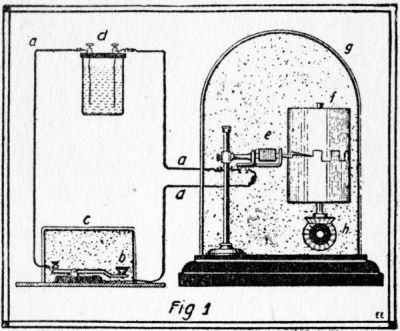
A telegraphic key (b) was connected by wires (a,a) to a battery (d) and to two screws, connecting them with an electro-magnet (e) to the opposite end of which was attached a needle. The point of the needle touched a revolving drum (f), with a smoked surface, driven by two interlacing, cogged wheels. The whole of this registering apparatus was enclosed under a glass bell-jar (g). The telegraphic key itself (b) was covered by a cardboard box (c). The "powers" manifesting were asked to press the telegraphic key without tearing the cardboard box (that is, through it). When the key was depressed, this would be instantly communicated to the electro-magnet, and cause the needle to oscillate,—these oscillations being marked upon the smoked surface of the revolving drum. A number of successful tests were conducted by means of this apparatus.
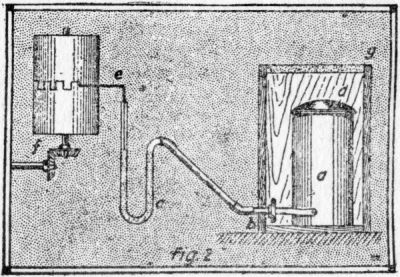
A variation of this was then employed (Fig. 2). A cylinder filled with water (a) was connected by means of tubing (b) to a U-tube, or manometer (c), filled with mercury. Upon the further side of this tube floated a bent wire (e) inserted into a small cork. The point of this wire, again, was so adjusted as to come into contact with the smoked surface of a revolving drum (f), driven as before. The top of the cylinder (a) was covered with a rubber cap (d), and this whole apparatus was inserted under a wooden box (g) having a cloth top.
Now, if the rubber covering (d) were pressed upon, this would force some of the water, in a, along the tube, b, and the added air-pressure would depress the column of mercury in the manometer, causing the floating needle to rise on the opposite side, and scratch upon the revolving drum. Fig. 3 shows some of the tracings which were obtained in this way—the force acting through the cloth top, g.
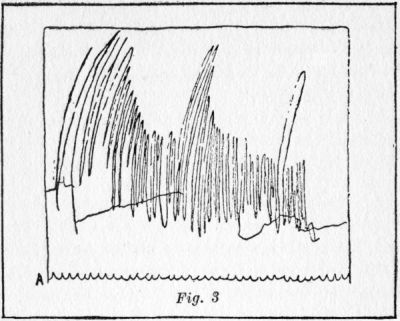
The instruments thus recorded a definite physical, intelligent force.
It may interest my readers to know that, at the time of his death, M. Curie,—who had been completely convinced of the reality of these phenomena,—was busy devising an instrument which would register and direct psychic power liberated from the body of a physical medium when in trance.
Dr. Imoda, the assistant of Professor Mosso, has also conducted a number of experiments in the discharge of an electroscope, by means of "rays" issuing from the medium's body. It was found that, if the medium held her fingers at a distance of an inch or so from the knob of the electroscope, some form of energy, apparently radio-active in character, issued from her fingers, and gradually discharged the electroscope. This is the "radiation" or "emanation" issuing from the body, which has been studied extensively by students of the occult. Dr. Imoda concluded—as the result of his experiments—that "the radiations of radium, the cathode radiations of the Crookes' tube, and mediumistic radiations are fundamentally the same."
Some other very interesting facts have been observed by means of the electroscope. For example, Dr. W. J. Crawford (D.Sc), in his experiments, noted that:—
"... In séance rooms where tables are moved without physical contact, I found that after a sitting was well started, I was always unable to charge an electroscope, even though I tried to do so in the corner of the chamber farthest from the medium. In order to charge it I had to take it outside the room. I asked the 'operators' (intelligences 'directing things,' apparently, in the séance-room) if there was any 'power' in the séance-room so far away from the medium, and they answered in raps that there was. By 'power' I understand them to mean particles of matter taken from the medium...."
Again, in his Reality of Psychic Phenomena, he says:
"I took the electroscope to the table in the corner; then placed it in the circle near the medium. I asked the operators to touch the disc of the instrument very gently. They did this almost at once, the 'touching' consisting of a metallic scraping upon the brass disc, quite audible, similar in type to the imitation of the floor being rubbed with sand paper, a phenomenon I quite often observed.
"Result:—On examination, the electroscope was found to be completely discharged!
"I took the electroscope to the table in the corner of the room and tried to recharge it, but found I was unable to do so even after repeated trials. Accordingly I asked the 'operators' to put back into the body of the medium the matter they had taken out (for the production of the sledge-hammer blows) and to give a few raps when they had done so. In a minute or two some very light raps were given, and when I asked if the process was complete I received no raps in reply at all, which seemed to indicate to me that all the matter used for rapping had been returned to the medium. At any rate, I found that I could now charge the electroscope; which done, I placed it on the floor as before within the circle, and asked that the disc should be touched lightly. After a little time, there was the metallic scraping as before, and on examination the electroscope was found to be completely discharged."
It will be at once apparent to the reader that two problems confront the investigator, when once he is called upon to solve such problems as the above: (1) the physical miracle itself; and (2) the nature of the intelligence, lying behind and directing or controlling the manifestations. This latter is purely a psychological question, which, immensely important as it is intrinsically, does not enter into the physical problem. It need only be said that this is the baffling question in psychical investigation, and the most puzzling. Whether it be an independent "spirit," as it claims to be; or the subconsciousness of the medium; or whether it is a sort of compound consciousness, made up of the collected minds of those forming the circle at the time; or whether some other interpretation is open to us—this is all a moot question, which is referred to here, merely to draw attention to the fact of its existence.
It will be at once apparent to the reader, also, that physical and electrical apparatus have played an important part in such investigations, in the past, and are certainly destined to occupy a far more important place in the future. These curious phenomena—like all others in our world—depend upon invisible forces or energies for their production. Those interested in electricity should realize, more than all others, the power of the invisible; and the fact that the invisible is the real. Anything that we see consists merely in a bundle of "phenomena"—of effects. The real cause is always behind, and is always invisible.
There is nothing inherently absurd or impossible, therefore, in these odd manifestations,—however bizarre and unusual they appear to us at first sight. An unusual combination of circumstances might bring them about. Stones do not ordinarily fall out of the air; yet at times they do (meteors). Water does not usually rise above its own level, yet it can be made to do so. The curious freaks of lightning are well known. There is nothing inherently impossible, therefore, in supposing that a table can be "levitated" into the air, under unusual conditions; it is simply the manifestation of an unknown energy—of which, doubtless, there are many. We can manipulate and control the electric current; but we do not know yet precisely what it is. Similarly, we can study the effects of many of these curious biological forces, without understanding their true nature. Above all, it behooves us to keep an open mind, and not to cry "impossible," just because we have never seen such facts, or because they appear to us innately improbable.
Here, as elsewhere, we depend upon hidden and unknown energies. Could we but find an energy common to the two worlds—the spiritual world and the material world—we should have here a means of direct communication, possibly by instrumental means. Delicate physical and electrical apparatus may be the means, after all, by which such communication will ultimately be established! At all events, when subtle causes and forces are in operation (as they doubtless are during a séance) it is only natural to suppose that instruments, far more delicate than our senses, should be the logical method of detecting them, and, as yet, such experiments have rarely been attempted.
When we take into consideration, finally, the electrical theory of the nature of matter; when we remember the many striking analogies between electricity and the life-force; when we remember that the science of electricity is yet in its infancy, it should hold out to us the hope that, here, we may find a solution of many of these obscure problems, and that further investigations in the field of electricity may serve to explain to us many of these unknown and mysterious secrets of our inner nature, and the still more mysterious secrets of the séance-room. No more interesting and profitable researches could be attempted than those which endeavour to establish a connection between known and unknown phenomena; between physical and electrical manifestations, on the one hand, and these curious "psychical" phenomena, on the other. The crying need of the day is a "Psychical Laboratory," wherein such experiments as these could be conducted. It is my sincere hope that, some day, I may assist in the foundation of such a laboratory.
CHAPTER III
LIFE: AND ITS INTERPRETATION
(In the Light of M. Bergson's Philosophy)
The philosophy of life which M. Bergson advocates is more than a mere philosophy—more than a metaphysical doctrine; for, in so far as it endeavours to account for the "phenomena" of life, it entrenches upon biology; and M. Bergson himself is the first to acknowledge this. His own books are filled with interesting scientific data, which he has interpreted most ingeniously; and no broad-minded biologist can afford to neglect his work in the future. Two points of his theory call for special mention, however, it seems to me, and are subject, not to criticism but to discussion. One of these is that M. Bergson has not gone far enough in his interpretation of the facts; in the other he is, I believe, wrong in his interpretation—though his is the one commonly advanced and accepted. A few remarks on these two points may not, perhaps, be without interest.
It is apparent to any student of these problems that the interpretation of life which M. Bergson has adopted is very different from that usually held. The facts, the phenomena of life, are the same on either theory, the difference lying in their explanation. All the facts of life are the same; they may be interpreted equally well on either theory. It is important to bear this in mind for reasons which will become apparent as we proceed.
Now, the difference between M. Bergson's theory of life and that commonly held is this: that, whereas one[13] regards life as created or resulting from the total functioning of the body, the other regards it as something separate and distinct—merely utilizing the body for the purposes of its manifestation. In the one case, life is, as it were, made; in the other, it exists apart from the body it animates, and is merely associated with it. To sum up in two words, one is the production theory of life; the other is the transmissive. One theory leads direct to materialism; the other allows all sorts of possibilities, which are readily perceived by any student of these questions.
Thus stated, the situation at once reminds us of the controversy which raged some years ago as to the relation of brain and mind, as the result of the publication of James' lecture on Human Immortality. He then showed that it was quite possible to accept all the facts as to the relation of brain and consciousness, yet interpret them in a different manner; that there might be a transmissive function of the brain as well as a productive or secretive function; and that the undoubted fact of the inter-relation of the two sets of phenomena might just as well be interpreted in one way as in the other. The mere facts proved no theory true. As James so well said: "The psychologists noticed a connection, and at once assumed that it was the only possible kind of connection"—which was not at all the case. Mere coincidence, in two sets of phenomena, does not prove that they are causally related; that one produces the other. They may be quite separate from one another (psycho-physical parallelism), or both may be aspects of something else, etc. It is all a matter of interpretation, not of fact. But this is a view of the case which is seldom perceived, it seems to me, by psychologists generally. Seeing a coincidence, they at once postulate causal relation, and then proceed as if this had been thoroughly and scientifically established!
I have spoken of this analogy, drawn from psychology, because it bears upon the problem before us in the clearest possible manner. Just as consciousness is usually conceived to be due to the functioning of the brain; so life is conceived to be due to the functioning of the body; but just as mind can be shown to exist apart from brain, and merely manifest through it, in the same way, M. Bergson suggests, life may exist apart from matter, and merely animate it in its passage through it. It is all a question of interpretation.[14]
Is the interpretation correct? As Hamlet said: "That is the question!" To use the words of the Right Hon. A. J. Balfour (Hibbert Journal, October 1911, p. 18):
"M. Bergson regards matter as the dam which keeps back the rush of life. Organize it a little (as in the protozoa)—i.e. slightly raise the sluice—and a little life will squeeze through. Organize it elaborately (as in man)—i.e. raise the sluice a good deal—and much life will squeeze through. Now this may be a very plausible opinion if the flood of life be really there, beating against matter till it force an entry through the narrow slit of undifferentiated protoplasm. But is it there? Science, modesty professing ignorance, can stumble along without it, and I question whether philosophy, with only scientific data to work upon, can establish its reality."
It would seem to me that the only way to settle this question one way or the other is to bring forward certain facts which can be accounted for more fully and rationally on one theory than on the other. If facts could be produced which one theory could not account for at all, the alternative theory might be said to stand proved. Do such facts exist which tell in favour of M. Bergson's theory as against the other? I believe they do. Before coming to them, however, I must draw attention to certain weaknesses in the generally held theory of life, which are, it seems to me, also shared by M. Bergson's theory. Until these are disposed of, I do not believe that any definite forward step will be taken towards proof either in one direction or in the other. So long as certain fundamental tenets are held, it seems improbable that any one theory of life will be proved more than any other theory. M. Bergson has gone part of the way, in his demonstration, but he has stopped there instead of carrying his train of argument to its logical conclusion. At least so it appears to me; for I think it obvious that the chain of argument which M. Bergson adopts can be carried much further than he has carried it, in his various writings.
The view which M. Bergson adopts is somewhat as follows: Life is directive and creative; it utilizes the chemical and physical forces of the body for the purposes of its manifestation. It is the "spark" which sets off the explosive; it is the "hair-trigger" which liberates the enormous energy contained in the cartridge, etc. To apply the analogy: life utilizes and directs the energy obtained from food (by a species of chemical combustion) so that the bodily energy, as such, is, so to say, a "physical" energy, and subject to the law of conservation; while the power that guides, controls, and directs it is conscious life—the power of choice, the guider, the controller.
This view of the case is, I believe, unsound, and for two reasons. In the first place, it does not, I think, go far enough in its interpretation; and, in the second place, we are face to face with a paradox—the problem of no-energy affecting energy. Let us take the second of these objections first.
If a solid body, a fluid or a gas, be moving in a certain direction, a certain amount of energy must be exercised in order to divert its course—for otherwise it would continue in a straight line. Similarly, any energy will continue to exert itself in one direction, unless its course of activity be diverted into another channel; and this "divertion" constitutes a pressure, as it were, upon the energy; and this "pressure" can only be brought about by a "physical" force or energy—and so be within the law of conservation. No matter how slight this pressure—this guidance—may be, it is nevertheless there; and in so far as it directs the flow of energy, it must itself be energy—for otherwise it could not direct or divert it. Even the analogy of the banks of a river fails us, because in that case every atom of the banks is acting upon the body of the water by a material pressure; and hence the banks as a whole are. Either life must be energy, or it must be no-energy. If the first of these suppositions be true, things would be intelligible; but if the second were true, they would not be, because no-energy cannot effect or guide or control energy without itself being energy; and this would either make life a "physical" energy, or remove its power of guidance altogether. I do not see how these alternatives are to be avoided.
M. Bergson apparently tries to evade this issue by supposing that life only affects the energies of the body (derived from food) very slightly by a sort of "hair-trigger" action, which releases a vast amount of energy, quite disproportionate to the energy of direction applied. But surely this is a mere begging of the question! One is reminded of Marryat's character, who asked to have her illegitimate baby excused "because it was such a little one!" No matter how slight the amount of energy may be, if it is capable of affecting energy at all, it is energy, and hence subject to the law of conservation. Life, as energy, must lie wholly outside the law (in which case all talk of "control" and "guidance" must go by the board), or it must lie wholly within it (in which case life becomes a purely "physical" energy, like any other, and cannot well be thought to exercise this "guidance").[15]
We have thus seen that the second of our two alternatives (that life is no-energy) is untenable. Let us now return to the first—that life is energy—and see whither it leads us.
If life be a form or mode of energy, it might affect, guide, and direct other modes of energy, or the matter of the body (and, through it, of the inorganic world) readily enough. It would affect them, but blindly. It could have no intelligent action. If life be an energy, it must be like all other energies in this respect; it must fall within the law of conservation and be non-intelligent. Otherwise it would be something different from all other forms of energy; and so we should have energy, plus intelligence, in the case of life; and only energy for all other forms. But in that case life could not simply be converted into or derived from any other mode of energy; because we should have "intelligence" left over, in our equation—which was created de novo whenever life was derived from other energies, and plunged into extinction and nothingness whenever life passed into any other mode of energy—in the course of our daily lives. But this is contrary both to experience and to all legitimate scientific thinking! Life, therefore, cannot be an intelligent or a directive energy. And so this argument also goes by the board, and we have left to us only the old materialistic conception of a non-intelligent, blind, life-force, or energy, derived from food, by a process of chemical combustion, and essentially no more mysterious than any other energy. This, therefore, is the conclusion to which we seem driven.
But such a conclusion is not only contrary to M. Bergson's philosophy, but to daily observation and scientific knowledge; for we know that life is directive, purposive, and progressive, and if evolution teaches us anything, it tells us that it must have been so always. We are thus driven into this dilemma: life must be an energy—but, as such, it cannot be purposive! Life is purposive, yet it must be an energy—for otherwise it could not affect the bodily energies and the material world! Here then is an apparent paradox—a flat contradiction—incapable of solution or further elucidation.
M. Bergson (and before him Sir Oliver Lodge and others) has attempted to meet this difficulty by supposing that the energy of the body is a "physical" energy, derived from food, and, as such, blind and subject to the law of conservation. This energy, they assert, is however manipulated and directed by the power of life or consciousness, which makes "use" of it, directs, and guides it. But this theory is, it seems to me, refuted by the arguments just advanced, which show that life and consciousness cannot affect energy in this way unless they themselves be energy; and thus we are in a "vicious circle" again, with no hope of ever getting out.
The whole difficulty has arisen, it seems to me, because of the conception of the nature of life usually held. Were this altered these problems would be found to have a ready solution. M. Bergson has gone half way toward finding this solution, but has stopped there; he has clung to the most fallacious part of the theory, and for this reason has been unable to emerge altogether from the difficulties above mentioned. Only when we change our conception of the nature of the life-force will these problems become clearer—these questions find their true solution.
Have I, then, any theory to offer as to the nature of this power of life which is essentially new to physiology and biology? I believe that I have—not new as to facts, but as to the interpretation of facts (the latter remain the same on either theory).
In order to make the theory which follows plain in as few words as possible, it will be necessary to refer for a moment to the current conception of vital energy—of life—in the human body. It has been stated by Bergson himself with admirable clearness (Hibbert Journal, October 1911, pp. 35-36; Creative Evolution, pp. 253-54, etc.), and is briefly this:
Food, when broken down and oxidised in the body, gives forth or liberates energy—just as coal liberates energy when burned in the engine. In both cases energy (contained in the food or the coal, as the case may be) is liberated, and this energy is utilized to drive our engine—the human body or the steam-engine (it makes no difference to the argument). The energy thus gained is, it is contended, again given off as heat and work—muscular and mental work in the case of the human engine (the body); mechanical work of all sorts, and heat, in the case of the steam-engine. Thus one is essentially no more mysterious than the other—the body no more so than the steam-engine—vitality no more so than steam! Both are "physical" energies, subject to the law of conservation, and as such transmutable one into the other. This is the generally accepted theory, which likens the human body to a steam-engine, and is the theory all but universally adopted by scientific men, held as proved and adopted without question by M. Bergson!
But such a view of the case is, I believe, essentially untrue. It is one interpretation of the observed facts, truly; but not the only interpretation. The facts remain equally true on either theory; the difference lies in their explanation. It is the old error of confusing coincidence with causation—and not only that, but a particular kind of causation, and "treating it as the only imaginable kind." Just as the psychologists reasoned upon the acknowledged facts of the relation of brain and consciousness; so do the physiologists, in our own day, reason upon this question of the causation of vital energy by food. In both cases there has been one-sided and partial reasoning.
If, however, we reject the prevalent notion of the causation of vital energy by food, we must have another theory to offer in its place. It is, I know, presumptuous thus to run counter to the whole of accepted teaching, in this respect, and my excuse must be that I believe my theory represents the truth, while that universally held does not! Again, I must emphasize that I speak, not of facts, but of inferences drawn from facts. With this apology, I shall state my own view of the case as follows:
Instead of comparing the human body with the steam-engine, it should be compared with and likened to the electric motor. Just as the motor is recharged, or receives its energy from some external source, just so, I believe, is the human nervous system recharged from without, during the hours of sleep. It is placed into a peculiar, receptive condition, in which this "recharging" process takes place. Our energy is derived through sleep, and not from food. Food merely replaces broken-down tissue (and, if you will, the animal heat) but never supplies or creates its vital energy. This depends upon its nervous mechanism, and upon sleep, and not upon the muscular system and chemical combustion. What differentiates the steam-engine from the human organism is the fact that one needs sleep while the other does not (in other words, one is living and vital, and the other is not), yet, in spite of this obvious difference—which is so great that it really destroys all the analogy—physiologists have continued to disregard it, and to treat the human body as a mere machine—such as a steam-engine—which requires no sleep, and derives its energy solely by combustion! To my mind, this is one of the most curious paradoxes of modern science.
To place the theory in as clear a light as possible, then, it is this: Food supplies or replaces broken-down tissue (and heat) to the body; but not vitality, or the power of life, which comes only from rest and sleep. No matter how much food we may eat and perfectly oxidise, there comes a time, nevertheless, when we must go to bed, and not to the dining-room, to recuperate our strength and energies. During sleep, vital energy flows into us (our nervous systems), and all animals need sleep—this fact differentiating them, at once, from any form of mechanical engine. Life, vital energy, is not due, as is universally thought, to chemical combustion, but to vital replenishment. No energy is created within the body; it is merely transmitted. The body, in fact, acts as a means of transmission—as a sort of "organic burning glass" which transmits and focuses the sun's rays on one focal point. And just as any crack, or blur, or clouding, or other accident to the burning glass would interfere with its power and capacity from transmitting the rays, so, any accident or disease or pathological state of the organism would interfere with or altogether prevent the passage or flow through it, of the life or vital energy. "The more perfect, the better these conditions, the greater the influx of vital force, and vice versa. We must see that all the electrodes and avenues and channels are bright and clear, so that there shall be as little hindrance as possible to either the inflow of energy in the form of power, or to its outflow in the form of work done." My theory of the relation of body and bodily energy is, in fact, an extension of James' "transmission theory" of consciousness to the whole of our life and vital energy. And I believe the one is as defensible as the other.
But, I shall be asked, is there any evidence for such a theory? There is much evidence, there are many facts, which I have adduced in full elsewhere.[16] This is not the place to discuss the physiological intricacies involved, and I can only refer those interested to the work in question. At present, I shall assume its accuracy—or at least its validity—and proceed to show in few words why it is that this theory is not contrary to any known facts, but is capable of explaining them just as fully as the generally accepted theory, and other (disputed) facts far more readily.
The facts upon which the current theory is founded are well known, and, apparently, thoroughly established. Briefly, they are these: So much food, oxidised or burned outside the body, can be shown to yield so much heat and energy. The same foods, oxidised within the body, yield approximately the same amount of energy. Further, the energy which the body expends (in conscious and unconscious muscular activity, thought, emotion, and as heat, etc.) is, it is contended, practically equivalent to the energy which is thus supplied. There is, therefore, an equivalence, a balance, between income and outgo of energy: so that the recently conducted experiments in calorimetry are held to prove beyond question the causation of vital energy by food.
I shall not in this place stop to question the accuracy of the figures obtained—to point out that the results do not always tally; that far too little allowance has been made for mental and emotional states, etc. I shall assume that the figures are accurate and prove all that they are held to prove. The question then arises: Do the figures prove the causation of vital energy by food? Apparently they do, no doubt, and they are held to do so by the majority of experimental physiologists; but I do not believe that this is at all the case. Admitting the facts, admitting far greater accuracy than the figures really show, we have to consider the question of their interpretation. And this brings us back to the remarks made at the beginning of this paper—that coincidence does not prove causation; and that the same set of facts may often be interpreted in an entirely different manner—one which would show that life is not directly dependent upon food combustion at all, as is generally supposed. The alternative method of interpreting the facts would be as follows:
Life is a power which acts upon organized matter, under certain conditions, in a variable and fluctuating manner. Whenever energy acts upon substance, substance wastes. Whenever work of any kind is done by the body, therefore, the tissues are broken down, and to supply this waste, this destruction, food material is needed. The more waste, the greater the need for repair, and per contra the less waste, the less the need of repair. So far as the material equivalent (food) is concerned, therefore, it will be seen that this is only what we should expect on either theory; and tells no more in favour of one than the other.
But what of the energy? The greater the expenditure of energy, the more work done, the more tissue destroyed. The more tissue destroyed, the more food needed, and the more ingested. But this does not prove that the extra amount of food has created the extra energy! That would be putting the cart before the horse with a vengeance! And yet this is what is universally done by physiologists in considering these experiments! Perhaps I cannot do better than to quote, just here, a portion of the excellent Introduction which Dr. A. Rabagliati, F.R.C.S., F.F.C.P., etc., wrote to my book, and which really states the case more clearly than I stated it myself. He says in part:
"To take an analogy: It seems to me it would be as pertinent to argue that because the strings of a violin or harp waste in proportion to the quantity of music evolved through or by means of them, therefore the waste of the strings is the cause of the music, while in fact it is the hand of the player, and even the spirit behind the hand, which is the real and efficient cause of the music. So the form of the infinite and universal energy, which we may call erg-dynamic, is the cause of the waste of the body through which it works; and this is at once made good by the increased trophic metabolism which occurs, to replace the waste—this increased trophic metabolism showing itself in increased O_2 intake and coincidently or correspondingly with increased CO_2 output. If the strings of a musical instrument were self-repairing, we might perhaps be induced to think that the material which fed the strings was the cause of the music, since in that case some measure of the waste would probably be discoverable in the débris emitted; and we might imagine that the débris was the measure of the music, while what it really was, was the measure of the waste of the strings, when they were made the instrument of the music. If a spade is used in digging, the spade wastes in proportion to every spadeful of earth it is made to lift. The more it digs, the more it wastes. If we could arrange that a stream of fine steel particles flowed into the spade, to replace the waste caused by each act of digging, we might perhaps come to think that these fine steel particles were the cause of the digging, especially as the quantity of them required would always be exactly proportioned to the amount of work done. Nevertheless, this would be a very inconsequent assumption. Yet this is the assumption invariably made by modern scientists."
It will thus be seen that another interpretation might easily be placed upon the observed facts, and that, while the latter are accepted without question, it is yet possible to conceive the relationship as quite other than usually imagined; and consequently of life as an energy independent of the food supply,[17] and outside the law of conservation—a force absolutely distinct, separate, per se. M. Bergson has gone so far as to speak of life as a "power," as a "vital impetus"—utilizing matter for the purposes of its manifestation, etc. I have merely extended this conception in what appears to me a logical and necessary direction. It appears to me certain that life is a sentient power—different from any other mode of energy of which we have any knowledge, and as such no longer subject to the objections raised earlier in this paper (to other conceptions of life), which might also be advanced, it seems to me, against M. Bergson's theory. Were the theory of life here defended true, it would not only enable us to account for life in a satisfactory manner, but it would render clear many obscure and sporadic phenomena which the current theories are quite incapable of explaining (and hence often ignore!); and it would also practically assure us continuity of life beyond the grave—after the dissolution of the body—because mind and consciousness are shown to be independent of physical energy, even in this life! This, however, is a subject which requires special and lengthy treatment, and I cannot touch upon it now. All that I can aim to do at present is to show that there may be a spiritual source even for our physical life and energy here. And, were this true, psychic phenomena might readily be accounted for—since there would no longer remain any valid objection to their occurrence.
FOOTNOTES:
CHAPTER IV
THE HUMAN WILL IS A PHYSICAL ENERGY
AN INSTRUMENT WHICH PROVES IT
PART I
The Facts
That the human will is a definite physical energy, which can be registered by means of a scale or balance, may appear so incredible that the bare statement of the case would seem to carry with it its own refutation! Yet I firmly believe that this is a fact; that the energy of the will may be registered by means of an instrument I am about to describe; and that any one can prove this,—any one, i.e., who cares to take the time to repeat these experiments, and to try a sufficient number of subjects until the right ones be found—who are capable of affecting the balance in the manner described.
Such a fact—if fact it be—is of the utmost importance to science and to philosophy; even more important and more far-reaching in its implications than may at first sight appear. Not only is the fact itself of extraordinary interest, but the very origin and structure of our universe is called into question—and shown to be capable of an interpretation very different from that usually offered by modern science. And, further, if it be true that the human will is a physical energy, we have here the discovery of a new force—a force just as new to science as magnetism or electricity—and vastly more interesting, since it is intimately associated with all of us, and subject to our direction, guidance, and command—a force for us to wield and manipulate—for weal or woe!
It may be thought, by some, that this is no new discovery; that the human will is a physical energy is a fact of common observation; and that we all feel the liberation of this energy whenever an act of volition is performed. I may reply at once to such critics that (common sense as it may appear) this is not at all the attitude of modern psychology; and that, by savants the will is not considered an energy at all, but rather a choice of actions or an effort of attention. It is a state of consciousness merely, possessing intrinsically no more energy than any other state of the kind. This may, perhaps, be made clear by the following brief quotation from James' Psychology:
"We can now see that attention with effort is all that any case of volition implies. The essential achievement of the will, in short, when it is most "voluntary" is to attend to a difficult object and hold it fast before the mind. The so doing is the fiat; and it is a mere physiological incident that when the object is thus attended to, immediate motor consequences should ensue. Effort of attention is thus the immediate phenomenon of will." (p. 450.)
This, then, is the attitude of psychology. It contends that the will is by no means an energy, in the sense in which physicists use that term; but rather that it is a mere state of mind, or of consciousness. As such it is, of course, helpless; a mere witness of the drama of life, incapable in itself of affecting or changing the external world. So far as the physical world is concerned, it is a mere by-product, a useless adjunct—the feeling of energy-expenditure being delusory. Such is the attitude of modern psychology, and a very hopeless and unattractive belief it is!
As opposed to this view, I propose to show that the human will is a definite physical energy, which forms an essential part of our human personality—and forms, indeed, the very core of our being, so far as its expression into the physical world is concerned. This view of the case, I may say, is not altogether new; several competent neurologists have, of late, defended this conception in no measured terms. Thus, Dr. William Hanna Thomson, in his Brain and Personality, says:
"An important conclusion is led up to by these facts, namely, that we can make our own brains, so far as special mental functions or aptitudes are concerned, if only we have wills strong enough to take the trouble. By practice, practice, practice, as in Miss Keller's case, the Will stimulus will not only organize brain centres to perform new functions, but will project new connections, or, as they are technically called, association fibres, which will make nerve centres work together as they could not without being thus associated.... It is not the power of the brain, it is the masterful personal Will which makes the brain human. It is the Will alone which can make material seats for mind, and, when made, they are the most personal things in a man's body.... Man can always do what he chooses, or, in other words, wills. Therefore this very different thing, his Will, makes man different from every other earthly living thing."
Such a view of the case certainly gives a far greater dignity and power to the will; but is it true? That is the question; it is a mere matter of interpretation, without any means of settling the facts one way or the other. It may be "pleasant" to believe this or many other things; but that does not make them true!
It is obvious that arguments such as this might go on for ever. The nature of the human will would never be settled by such means. We desire a more definite and concise method—one capable of settling the case one way or the other—and settling it, not by argument, but by fact. Arguments convince no one; facts every one! It is only by an appeal to fact, therefore, that this question can be settled one way or the other. The difficulty has been that, until now, no direct method has been devised capable of solving the problem. This has now been rendered possible for the first time, by means of the instrument described in this chapter. The experiments herein narrated settle, to my mind, the question of the nature of the human will; they prove it to be a definite physical energy—as much so as any other energy we know. The majority of these facts have been before the scientific world for some time; and why their philosophic interpretation and implications have not been seen is to me a great mystery. One can only account for it by assuming that most scientists are not at the same time philosophers; they do not see the full meaning of the facts they observe. Only in this manner can one account for the apathy with which the scientific world has, so far, accepted the facts in question—why it has utterly failed to see their tremendous philosophic and even religious value and significance.
My attention was first drawn to the instrument in question by Professor Th. Flournoy, of Geneva, the author of From India to the Planet Mars, Spiritism and Psychology, and other works, well known to English readers. Immediately I learned of the experiments in question, I wrote to Professor Alrutz, and obtained from him one of his instruments, by means of which the experiments described below were performed. Writing of the early results obtained by him, Professor Alrutz says ("Report to the Sixth Congress of Psychology," etc.):
"In spite of the knowledge we have gained of the electrical and chemical phenomena of the central nervous system, we must confess that we know little indeed of the inner nature of the psycho-physical processes. What is happening in the brain—especially in the psycho-motor centres—when we move an arm by means of an act of will? What are the forms of nervous energy which are employed? Are these entirely electrical and chemical forces, the neural impulses being mere electrical currents? Or are there other forms of energy which experimental physiology has not as yet brought to light? Might there not be, perhaps, some form of energy more closely allied to the psychic acts, constituting a sort of bridge or transition between psychic phenomena, on the one hand, and electrical and chemical phenomena, on the other?
"When we wish to study the electrical charge contained in any body, we obtain exactitude only when we succeed in transferring this charge to another body; we may then study the nature of the charge under varying circumstances, and establish the influence of the two charges upon one another. It is only in this way that experimentation becomes truly fertile. Should we not apply the same laws to the phenomena of the nervous system, and institute a similar mode of experiment for the nervous energies? Under what conditions can we conceive this transference?
"The most natural supposition seems to be that it would occur, if at all, in labile organizations; in those subjects which, according to Janet (Les Névroses, p. 339), possess an excessively unstable personality; and whose psychic life is characterized by great suggestibility, by instability, and a certain peculiar mobility. Such individuals are also characterized by the great facility with which the functions vary and react upon one another. Binswanger has said that the nervous system of these individuals is characterized by the variability of the dynamic cortical functions; that is to say, by the fact that the nervous segments of their cerebral cortex present a mélange of greater or lesser irritability...."[18]
Professor Alrutz goes on to say that, guided by this idea, he constructed an instrument designed to test his theory—based in part, but not wholly, upon the earlier instruments employed by Hare, Crookes, etc., to test the same thing. As is well known, these experimenters spent much time in their investigations—both of them coming to the conclusion, after years of patient research, that physical apparatus could be definitely influenced and moved by the will of certain persons, when exercised in the direction of their movement, and without sufficient contact to account for the observed facts. Crookes' experiments, in particular, are very conclusive in this direction—his apparatus being very similar to that designed by Professor Alrutz. He employed a board, one end of which was attached to a spring balance, while the other end of the board rested upon a solid table. The subject placed his hands upon the board, and a definite pressure was registered by the balance—far more than could be obtained in any normal manner. These experiments of Crookes are classical, and have never been "explained away." With the present instrument, there seems every likelihood of confirming these earlier experiments.
The apparatus employed is of the simplest possible construction. A solid board, some 10-1/2 by 13-1/2 inches, and 1 inch thick, forms the base of the apparatus. In this, at a distance of some 6 inches, two holes are drilled, into which are inserted pegs, 3-1/2 inches long, and sharpened at their top edges to a fine knife-edge. This constitutes the fulcrum—the upper board resting on these knife-edges, and being unevenly balanced on them. (See Frontispiece.)
The upper board, resting on these edges, is some 19 inches long by 13 inches broad at the lower end, and 10 inches broad at the upper end. The narrowing takes place about 6 inches from the end of the board (broad end), in the form of a rapid inward curve. It is here that a groove is cut, and, 7-1/2 inches from the broad end of the board, two pointed grooves are also cut, which allow the board to rest nicely upon the knife-edges of the two pegs below it. In this position the board would naturally assume a downward slant, owing to the greater length of the board on one side of the fulcrum than on the other. (See Frontispiece.) When the long end of the board is supported, by means of a piece of string, to a letter scale, however, the board is made to assume a horizontal attitude, parallel to the table top. In this position the board weighs just 5 ounces, and if the balance registers more than 5 ounces, it shows that a weight or pressure or force has been applied to the long end of the board. If force be applied on the short end of the board (where the hands rest), it would have the effect of merely depressing this end of the instrument, and causing a lessening of weight, as registered by the balance. This is noted invariably whenever pressure of the hands is made upon the board near the sitter.
With this little instrument, Professor Alrutz tried a number of experiments, on several occasions, which he divided into groups or series. The history of his initial experiments is, as briefly as possible, as follows:
1st Series.—No results.
2nd Series.—The board, after a short interval, lowered, showing a pressure of 40 grammes. This was at the first trial. It descended slowly, remaining at this point for about 5 seconds. It again descended several times, making at one time a depression of 120 grammes. On another occasion the board was depressed, and showed a pressure of 100 grammes, which lasted for 35 seconds. On other occasions lesser depressions were noted, but for longer periods of time. On several occasions the balance registered a downward pressure for two minutes or more. This was in good light, and was carefully observed by two physicians, as well as by Professor Alrutz. The "subjects" were, in this case, ladies of good Swedish families, who had never seen or heard of the instrument before. They were, however, during the experiments, treated as professional "mediums," and every precaution was taken to prevent fraud. The following were some of the precautions observed:
The light was sufficiently good to enable the observers to see that no threads or hairs were attached to the board or any part of the apparatus or balance. They also ascertained this with their hands. It was also seen that none of the subjects lifted the board by slipping their fingers under the edges of the board and pulling it upwards. (It may be remarked in this connection that even had they done so this would not account for the results noted; since, in several instances, the downward pressure recorded was more than the weight of the entire board.) As the eyes of the observers were close to the board and to the fingers of the subjects, it was clearly seen, however, that nothing of the sort took place. Besides, as before said, the subjects who tried the board were ladies, and not professional "psychics" in any sense of the word.
It was also ascertained that no sticky material was upon the fingers of the subjects; they were carefully examined both before and after each experiment. Further, to test this hypothesis fully, thin strips of wood (shavings) were on several occasions introduced between the subjects' fingers and the board, which was depressed. Had they lifted their fingers, therefore, they could not possibly have lifted the board, which would not have adhered to them under these circumstances.
3rd Series.—Two "functionaries of state" attended this series, the principal subject tried being the wife of one of these dignitaries. He himself was extremely sceptical of his wife's ability to move the board, and remained so until convinced by the facts! The board was lowered, and the balance showed a pressure of from 70 to 100 grammes. The subject was extremely fatigued after these tests, and went to sleep almost immediately. Others who tried the board could obtain a registration of only 2 or 3 grammes.
4th Series.—Several very successful trials were made in this series with two ladies as subjects. Both placed their hands on the board together, and the depressions were of very long duration. In these experiments sooted paper was placed under the hands of the experimenters. It was noted that better results were obtained if one of them cried "Now!" when the board was to be depressed. The desire to sleep was strong after these trials, and in one instance the subject really did fall asleep during the experiment! An odd fact which should be noted in this connection is that no results were obtained unless the subject looked at the long end of the board while the "willing" was in progress.
5th Series.—This series of experiments was attended by a well-known physician and a psychologist. The light was good as before. From 40 to 50 grammes were registered by the balance on several occasions, the downward pressure lasting from 20 to 30 seconds. Clearly, therefore, none of these depressions could be attributed to mere oscillations of the board, but denoted a definite and persistent downward pressure.
Nausea and a strong desire for sleep were experienced by the subjects in this series of experiments, as before.
The above is a very rapid summary of the report drawn up by Dr. Sydney Alrutz, and read to the Sixth Psychological Congress, which met at Geneva in August 1909. Professor Alrutz also attended the Congress in person, and brought with him one of his instruments, which he desired to try upon some of the members in the presence of a number of psychologists. In several instances these attempts were entirely successful; and Professor Flournoy, editor of the Archives de Psychologie, was enabled to say of these experiments:
"Professor Alrutz invited me to assist in two séances, in which we experimented upon some of the feminine members of the Congress who desired to try it. The first, in which the subject was Mme. Glika, yielded nothing conclusive. But at the second, at which Professor Alrutz attempted to increase the force by adding two other members of the Congress (strangers who had appeared to him to possess suitable temperaments), it succeeded fully, and I was able to prove conclusively after three trials, and under conditions precluding all possibility of fraud or illusion, that the will of these ladies, concentrated upon a certain material object with a desire to produce a movement in it, ended by producing this movement as if by means of a fluid or an invisible force obeying their mental command." (Spiritism and Psychology, p. 291.)
So much for the testimony of Professor Flournoy and Professor Alrutz. In view of the facts and the well-known caution of these investigators, we may assuredly take it for granted that there is here no room for doubt, and that the manifestations really took place as recorded.
My own experiments with this board have not, unfortunately, proved nearly so conclusive as those of Professor Alrutz—owing, doubtless, to the rarity of good "physical mediums" or those capable of exercising their will in the desired manner. It must not be thought that any one possessing a "strong will" can manipulate the board—as Professor Alrutz has pointed out. It is only a peculiarly endowed person who can move the board, one capable not only of exercising the necessary will power, but also of externalising it—a very rare power. Hence the small number of successes. Out of all those tried, I have found only two who could (apparently) move the board at all, and even in their cases the results were far less striking than in the cases reported by Professor Alrutz. In one case a number of slight depressions were obtained; but these were so fleeting, and lasted for so short a time, that it was almost impossible to be certain that the results were not due to mere oscillations of the board. In the second case, however, more definite results were obtained. On several occasions, depressions of half an ounce were noted; and, on two occasions, of more than an ounce, lasting for several seconds. I was enabled to assure myself at the time that these depressions were real, and were not the result of fraudulent manipulation of the board. Although these results are few and meagre compared with those of Professor Alrutz, still they tend to confirm his views, and add to the testimony adduced by him and by Professor Flournoy, in favour of the reality of the facts—of the actual physical pressure by the Will upon the board in question.
In view of these results, then—of this apparently mutually confirmatory testimony—it seems impossible to doubt the fact that we have here definite and conclusive proof that the human will has succeeded in depressing the board in question—in being registered upon the balance, and, consequently, that it is a physical energy, capable of affecting the material world just as any other physical energy does.
PART II
Theories
It may be contended, however, that in thus postulating the human will as a physical energy I have not taken into account the alternative explanation of the facts which might be adopted or assumed. This theory contends that it is not the will itself which causes the movement we observe, but the cerebral activity which corresponds to it, and is its physiological counterpart. It has frequently been pointed out before (cf. Ribot, The Diseases of the Will, pp. 5, 6), that when we will to move our arm, e.g., it may not be the will at all, per se, which affects the movement, but the brain-state or neural activity which accompanies the act of will. In other words, mind or will never affects matter (as we feel it does), but it is always one portion of the body which affects another portion—the will or state of consciousness being merely coincidental with this observed action.
This has been one of the classical objections to the doctrine of inter-actionism; and it must not be thought that I have failed to take into account this alternate theory. But opposed to this view of the case we have the facts—(1) that the state of consciousness, and not the brain-state, is surely here the important factor; and (2) that, even were the supposition true, this nervous action or influence must cease at the periphery of the body; for, were this not the case, we should already have exceeded the limits of the orthodox physiological theory, which contends that one portion of the body affects another portion (only), and does not contend or pretend that this action may extend beyond the surface of the body; for, if it did so extend, we should have a nervous current without nerves—an appalling fact, and one totally opposed to accepted physiological teaching!
In order for nervous energy or life force to exist independent of the body (upon the functionings of which it supposedly depends), it would be necessary for us to reconstruct the mechanistic interpretation of life, since it would show that life is not dependent upon the body for its existence, but might exist independently of it, which is the very point in dispute. It cannot logically be contended, therefore, that the energy which we here see in operation lies in the nerves or in the brain-centres, but rather that it is a separate force, which physiology, as taught today, cannot account for. Introspection and experiment seem to unite in telling us that this energy is none other than the human Will.
But if it be granted, on the other hand, that the will is a physical energy, we immediately encounter certain difficulties which must not be ignored. In the first place, if the will be a physical energy, it is subject to the law of Conservation, and, consequently, must be included within the cycle of forces which that law encompasses. Light, heat, chemical affinity, etc., are supposed to be mutually convertible and transmutable; and, according to the present hypothesis, Will must also be included in this series! But every energy we know in the physical universe is a non-intelligent energy, and, as I have pointed out elsewhere, if we make the human will thus subject to the law of Conservation, it seems to form a unique exception to the law. For we know (if our consciousness tells us anything) that willing is an intelligent act, and we should consequently have this conscious act or intent left over in the equation. For we have, in all other cases, purely physical energy, and in this case physical energy plus something (conscious intent). The law of Conservation tells us that one energy is derived from another, and is converted again into another form of physical energy, when it is expended. But if will, ex hypothesi a physical energy, is derived from another physical energy (by a process of combustion, or what you will), we have here a case of the lesser including the greater—of a thing giving rise to something greater and more inclusive than itself—which is contrary to all accepted thinking. The will, therefore, cannot be entirely subject to the law of Conservation, but appears to draw upon an additional fund or source of energy, which is infused into it, as it were, from without. This "thing" which is infused or super-added, this "something" which is the "plus" in our equation, appears to be the directive element, the life element, the sentient element—which is thus shown to lie outside the law of Conservation, as many physicists and philosophers (Lodge, Crookes, Bergson, etc.) have for some time past contended it must or might lie.