THE PROBLEMS OF PSYCHICAL RESEARCH (continued 3)
Reading edition
One significant fact, in this connection, is that while the law of Conservation is doubtless true, so far as it goes, there is also in operation another law, well known to physicists, called the law of the Degradation of Energy, which asserts that energies of a higher order are constantly being converted into energies of a lower order. This law maintains that energies of a lower order cannot be reconverted into energies of a higher order. All other energies are being slowly but surely converted into heat—the lowest of all forms of energy. And this heat is gradually being dissipated, or radiated away, into space, so that, at some distant day, our universe will be cold and lifeless, like the moon.
Now it is a significant fact that the single exception to this rule consists in, and is constituted by, life, or vital energy, which is constantly building lower forms of energy into higher forms. Life is certainly the highest form of energy which we know in this world, and all energies are below this in rank—as may readily be proved by an appeal to the facts of nutrition and metabolism. And, as life is constantly being added to or infused into the world (as the population increases), it is certainly true that there is here a definite increase of the sum-total of the highest form of energy of which we have any knowledge. Life thus occupies not only an important but a unique position—in that it is constructive instead of destructive; and this fact alone should give us pause, and make us ask whether life is, in its totality, subject to and included within the law of Conservation of Energy.
The establishment of the fact that the human will is a definite physical energy is of importance also, because of its bearing upon the problem of the connection or inter-relation of mind and matter. Theories as to this bond or connection have been propounded since the dawn of philosophy. Aristotle and others wrote and thought deeply upon this subject. As is well known, this question formed one of the central points of debate in the works of Hobbes, Berkeley, Hume, Descartes, Leibnitz, Spinoza, Kant, Hegel, Lotze, and many other philosophical writers—all of whom wrote and speculated at length upon this subject. The theories which have been advanced in the past are briefly as follows:[19]
1st. Crude Materialism.—This doctrine contends that consciousness is merely matter, or energy, or matter in motion. It is not necessary to discuss this theory here, as it is not held today by any scientist of the first rank.
2nd. Epiphenomenalism.—This doctrine found its foremost champion in Huxley. It contends that the important happenings are the brain-changes—which are causally connected—and that our thoughts, or corresponding states of consciousness, merely accompany the brain-changes, just as the shadow of a horse may be said to accompany the horse.
The objections of this doctrine are:—
(a) That it is just as inconceivable to believe or imagine that brain-changes generate consciousness as it is to imagine that consciousness generates brain-changes.
(b) The law of Conservation is preserved at the expense of the law of Causality. For, if no part of the cause passed over into the effect (the state of consciousness), the law of Causality would be violated.
(c) The appearance of consciousness, at some definite point in the course of the evolution of the animal kingdom constitutes a breach of continuity.
For these and other reasons epiphenomenalism is today held by few, if any, philosophers.
3rd. Psycho-Physical Parallelism.—This is the doctrine maintained by Münsterberg and others. It contends that brain-changes and states of consciousness are merely coincidental in point of time, and do not ever influence each other. Their relation is that of mere coincidence or concomitance, and not causation. The two flow along, side by side, without in any way interfering with one another.
As regards this doctrine, it need only be pointed out that, were it true, mind and body could never influence one another, since they are not causally connected. Yet, if there be no connection, how is it that they correspond so exactly?—for, as James said, "It is quite inconceivable that consciousness should have nothing to do with a business which it so faithfully attends."
4th. Phenomenalistic Parallelism.—This is the theory maintained by Kant, Spinoza, and others. It maintains that both brain and consciousness (or mind and body) are but two different expressions of one underlying reality—just as the convex and concave surfaces of a sphere are but two expressions of an underlying reality. As to the nature of this reality, Kant and Herbert Spencer were content to call it X or the unknown, while Spinoza maintained that it was God.
Analogies which are held to support this doctrine are, however, extremely defective; but the subject is too lengthy and technical to elucidate in detail here.
5th. Psychical Monism.—This doctrine contends that consciousness is the only reality—the material world being external appearance only. Thoughts are causally connected, but not physical events. (The doctrine is thus the exact inverse of epiphenomenalism.)
In refutation of this theory, it may be pointed out that, if brain-changes are thus caused by, or are the outer expressions of, thought—why not muscular changes, and in fact all physical phenomena throughout the world everywhere? For we cannot rationally draw the line of distinction here. Such is the logical outcome of the theory—and has, in fact, been accepted in this form by Fechner and others.
While many philosophers are inclined to accept this view, it may be stated that the physical scientists are, naturally, repelled by it, and so is common sense!
6th. Solipsism.—The contention of this theory is that nothing exists save states of consciousness in the individual. Neither the material world nor other minds exist, save in the mind of the individual. This doctrine is so opposed to common sense and daily experience that it is unnecessary to dwell upon it.
7th. Inter-Actionism (Animism).—Here we have the world-old notion of soul and body existing as separate entities, influencing each other. Mind is here supposed to influence matter, and utilize it for the purposes of its manifestation.
That there are many facts difficult to account for on this theory cannot be doubted. Heredity and the origin of life must be taken into account; the "inconceivability" of the process has some weight; and the apparent infringement of the law of Conservation of Energy is a serious objection. Further, it may be urged, what evidence have we that consciousness can exist apart from brain-functioning? And, it may be said, apart from the facts offered by "psychical research," so-called, there is no evidence, strictly speaking. Hence the importance of these phenomena, if true. But the greatest objection to the doctrine of inter-actionism is doubtless that drawn from the law of the Conservation of Energy, which says that, inasmuch as mind is a non-physical energy, inasmuch as matter cannot be affected by a non-physical cause, brain-changes cannot result from will, or the activities of the mind.
But once prove that the human will is a physical energy, and this objection is readily disposed of. A physical energy is doubtless quite capable of causing all the changes within the brain which we know to exist within it—molecular, chemical, whatever they may be. It at once removes this classical objection to the doctrine of inter-actionism; and at the same time virtually proves that theory correct—thus solving this problem once and for all!
It may be pointed out, en passant, that philosophers and metaphysicians have really attacked this problem from the wrong standpoint—in their arguments concerning the relations of mind and brain—for this is a question which might have been (and in my opinion should have been) determined not by argument, but by fact. Instead of arguing, a priori, as to the nature of the connection, the problem might have been solved in the same way that all other problems are solved, viz., by an appeal to evidence and fact. The fundamental point made by practically all philosophers, in discussing this question, is that brain-states and conscious states are always found together, and that consciousness can never exist in the absence of brain. In other words, mind cannot exist as an "independent variable" in the world; it must always accompany a human brain.
I pass over, without comment, the fact that, according to the doctrines of idealistic monism and psycho-physical parallelism, this independence is virtually allowed, by the very nature of the doctrine; and shall point out merely that, if consciousness could be proved to exist independent of brain functioning, philosophic theories would have to be remodelled to conform to the evidence; the a priori problem could be settled at once by an appeal to actual fact. And again this separate existence of consciousness seems to be established by the facts of "psychical research," which apparently show that mind can exist apart from brain structure. This important fact once established, it would at once alter the whole case and render inter-actionism not only a "respectable" theory, but a proved fact.
So much for the importance of this doctrine (that the will is a physical energy) from the point of view of philosophy, and as applied to the question of the inter-relation of brain and mind. Now let us see if it cannot be applied in another direction.
The present interpretation of the character and nature of the will, and its inclusion as a physical energy, has a distinctly important bearing upon one of the most bitterly disputed points in the whole history of philosophy, viz., the question of the Freedom of the Will.
As is well known, there are two opposing views upon this subject—held by opposite schools—the theory of Determinism, on the one hand, and of Free Will on the other. The Libertarians assert that our wills are free—we having power of choice in all our actions. The Determinists, on the other hand, contend that our thoughts and actions are determined by definite, ascertainable causes. They contend that the feeling of freedom we all experience is but illusory, and that, in reality, our every action is inevitable—predetermined by its previous cause of causes, and could have been predicted by an intelligence wide enough and possessing a grasp deep enough of human nature to perceive life in all its tendencies. Indeed, one eminent philosopher went so far as to say that a belief in Free Will showed simple ignorance of science and a clinging to superstition!
A great deal has been written upon this subject of Free Will in the past; the point has been bitterly disputed for years. It may be said, however, that, at the present day, practically all philosophers and scientists, with few exceptions (e.g., James, Schiller, Bergson, etc.), believe in Determinism. The arguments for that doctrine are certainly weighty, and may be summarized, briefly, as follows:
1. The Law of Conservation of Energy tells us that no energy can be added to or abstracted from the total stock of physical energy in the universe. If the will be a non-physical energy (as it is conceived to be, by psychologists), it cannot affect the physical world, for if it did the law of Conservation of Energy would be overthrown. Hence, the will cannot affect the material world: hence, it cannot be a true cause.
2. Biology contends that heredity and environment alone are capable of explaining the actions and movements of the lower organisms, without postulating any "will." Inasmuch as man is connected with these lower organisms by an unbroken line of descent, why should not these factors explain man's actions also?
3. Physiology teaches that in-coming nerve stimuli give rise to certain physical changes in the nerve cells or centres, which, in turn, give rise to out-going (afferent) currents. There is here an arc or loop of unbroken physical causation; and there is no "room" for consciousness, save as an "epiphenomenon," as postulated by Huxley.
4. The Law of Causation tells us that an effect must have a cause, and that the cause must, in a certain sense, resemble the effect—since the effect is, in a sense, the cause translated. But, inasmuch as the effect is a physical event, the cause must also be physical in its nature; hence will (supposedly a non-physical event) cannot possibly play a part, or be a true cause.
5. Philosophical Science contends that Nature is a "closed circle." Mechanical causation holds supreme sway. Everything happens according to law and order. If Free Will were allowed a place in the scheme of things, chance and caprice would immediately be introduced into our world—which could never be tolerated for a moment!
6. Psychology holds that every mental state has its equivalent or counterpart in a corresponding brain-state. But each brain-state is not caused by the state of consciousness, but by the preceding brain-state. Here, again, there is no room for "free will" to play any part.
(Inasmuch as we are approaching this subject from a purely scientific point of view, the arguments drawn from sociology, ethics, and theology need not here be discussed. The interested reader is referred to Professor H. H. Horne's excellent little book, Free Will and Human Responsibility, for an extremely clear summary of this problem.)
The reply of the Libertarian to these problems is usually somewhat as follows:
1. The doctrine of Conservation has not been experimentally proved with regard to the relation of mind and brain; it is only assumed. Still, granting it to exist, all energy may, in its ultimate analysis, be psychical, instead of physical, in its nature—the doctrine of idealism, which is today gaining wider and wider acceptance, seeming to support this view.
2. That man resembles the lower animals does not prove that he is identical with them. On the contrary, the observed differences constitute the very differences about which the argument rages. Further, recent theories of organic evolution are tending to prove that interior (spontaneous) forces play a part, as well as exterior forces.
3. If consciousness were a mere "epiphenomenon," having no "use" to the organism, it would soon perish (if it ever appeared) according to the law which says that all useless functions perish. But we know that, as a matter of fact, consciousness has grown more and more complex, as evolution has progressed.
4. The Law of Causation is doubtless valid and universal; but to assume that this is invariably physical begs the question at issue. May there not be psychical causation? Only thorough-going materialism can say "No" to this question; but materialism is today out of date.
5. The Philosophy of Nature.—This is a strong argument, a priori, but is subject to re-interpretation, in the light of new facts, to which it must conform. Facts might be adduced which proved this particular view of nature wrong. It is, in short, only a working hypothesis, subject to revision, as new facts are adduced, tending to alter it.
6. Psychology.—Our ignorance of the possible relation of brain and mind is no excuse for our dogmatically asserting that no such connection is possible. It may be a fact, though unintelligible to us. Mental states may influence, partially at least, successive brain-states. We cannot say. If one man asserts that they cannot, another may assert that they do. Hence every one is at liberty to believe what he pleases! Nothing is proved.
If, now, we glance at the preceding arguments, we find that they may be summarized somewhat as follows:
Arguments 2, 3, 5, and 6 are practically valueless, one way or the other. Both sides might claim a victory; none of these arguments would settle the question.
Argument 4 is certainly valid, to a certain extent, and can only be surmounted by assuming that a non-physical energy can affect physical energy. But I do not think that any physicist would be inclined to admit this. So that this argument cannot be used in support of the doctrine of Free Will.
There remains the first argument, drawn from the law of the Conservation of Energy. This is certainly the strongest of all (to my mind), and is, as it stands, valid. Though idealism may maintain that all physical energy may be, in its ultimate analysis, only psychical energy, I do not for a moment believe that any physicist really believes this, or that any man accepts it as a common-sense doctrine—one which can be acted upon in daily life. It is mere philosophical sophistry and hairsplitting, and we must believe, as a matter of fact, that physical energy is really physical, and not psychical, in its nature.
As to the first portion of this argument, although the law of Conservation of Energy has never been shown to be invalid, when applied to the connection of brain and mind, still, every one probably believes that it does actually obtain, and that a brain-state cannot result in consequence of non-physical influences any more than any other physical event could so result. It is tacitly admitted, therefore, that the law of Conservation holds good here also, and that will cannot affect brain, because will is not a physical energy.
We are now in a position to see the tremendous importance of the facts contained in the first part of this chapter. Inasmuch as theory must follow fact; inasmuch as it has been proved experimentally that the human will is a physical energy—this whole question of the relation of brain and mind, of the influence of the former by the latter, and the question of Free Will, must be remodelled in accordance with these facts. The whole Free Will controversy is settled at one stroke (and in favour of Free Will!), and all the books which have been written upon this subject, and all the thought and energy which have been expended in the past are thus shown to be so much waste-paper and wasted effort! For, as we have seen that the whole question resolves itself into the central problem of whether or not the law of Conservation of Energy is valid—whether will or mind can affect brain—it will be seen that the proof that will is a definite physical energy settles the case once and for all. Determinism is routed; Free Will wins the day; and here again, as usual, theory follows fact, instead of dictating what those facts should be! At "one fell swoop" we are enabled to solve and to settle for ever one of the most bitterly disputed points in the whole history of philosophy and metaphysics!
This theory (might we not say, this fact?) that the will is a definite physical energy, at least in part, is thus of great philosophic, no less than scientific importance, if true. It even enables us to recast our conception of the origin of the world, and of all forces, and enables us to reconstruct—in a more or less intelligible manner—the story of Creation, contained in the first chapter of Genesis—an account which has been more ridiculed, perhaps, by dogmatic physicists than any other account in the whole Bible.
Much has been written upon this subject in the past; but it must be admitted that, from the point of view of physics, the whole difficulty lay in conceiving the first initial impulse which started our Universe on its endless way. All matter being but an expression of energy, all energy being (in all probability) but the varying modes or forms of expression of one underlying primal energy, the difficulty has been in accounting for the origin of this primal energy—the initial "push," so to say, which sent the Universe on its way.
Many evolutionists have admitted that, once given this initial impulse, all might readily be accounted for. The difficulty lay in conceiving this primal impetus.
But if Will be also a form of energy—though, as we have seen, only partly within the law and partly beyond it—then it is conceivable that this energy, coming from a source external to that presented by physical nature and physical science, should have infused or imparted enough energy (perhaps only an infinitesimal amount, enough to originate the impetus), which, according to Haeckel and others, is all that need be supposed, to enable us to account for the whole of organic and inorganic nature! This fiat, having once gone forth, would originate, or be the source of, the first "cosmic urge"—would, in fact, supply that impetus which modern science has so long sought in vain!
FOOTNOTES:
CHAPTER V
MODERN DISSECTION OF THE HUMAN MIND
Dissection of the mind! Can that too be dissected? We hear much nowadays of dissection of the human body; of organs which have been transplanted and which perform their functions in the body of another animal; of marvellous operations, in which tissues and viscera have been removed, repaired, and replaced—seeming none the worse for their remarkable experience; of operations which have been performed even upon the brain, in which whole segments have been cut away, and other delicate experiments undertaken—all of these marvels we have grown more or less accustomed to, by reason of the ease and certainty with which they are performed. But the human mind; that is a different matter. Here is something which, intangible in itself, seems incapable of dissection or of objective experimentation, in the ordinary sense of the word. Yet that is what present-day normal and abnormal psychology has been enabled to do! Shakespeare's adage: "Who can minister to a mind diseased?" can now be answered by saying: "To a certain extent, the specialist in normal and abnormal psychology."
If you shut your eyes, and turn your attention inward, in an attempt to find your real "self," you will probably find a good deal of difficulty in catching it. It will be found as illusory as the proverbial figure of Happiness, which ever flits on before us. The real centre of being, the self, the ego, the person, the individuality, evades us at every turn. Each of us has the feeling, under all ordinary and normal circumstances, that, as James expressed it, "I am the same self that I was yesterday." And one would be most astonished, I fancy, were he to wake up one fine morning and find himself some one else! Like the Arab in the tale, he would be bewildered indeed!
From the solitary desert Up to Bagdad, came a simple Arab; there amid the rout Grew bewildered of the countless People, hither, thither, running, Coming, going, meeting, parting, Clamour, clatter, and confusion, All around him and about. Travel-wearied, hubbub-dizzy, Would the simple Arab fain Get to sleep,—"But then on waking, How," quoth he, "amid so many Waking, know myself again?" So, to make the matter certain, Strung a gourd about his ankle, And, into a corner creeping, Bagdad and himself and people Soon were blotted from his brain. But one that heard him and divined His purpose, slyly crept behind; From the sleeper's ankle clipping, Round his own the pumpkin tied, And laid him down to sleep beside. By and by the Arab waking Looks directly for his signal— Sees it on another's ankle— Cries aloud, "Oh, good-for-nothing Rascal to perplex me so, That by you I am bewildered, Whether I be I or no! If I—the pumpkin why on you! If You—then where am I, and who?"
One can quite appreciate the tangled state of our Arab's mind on awakening under such peculiar circumstances, and, from the point of view of common sense and common experience, such an awakening would be an utter impossibility—fit only for fairy tales and the traditions of savage tribes. Yet, in our own day, here in civilized New York and London, similar cases have been recorded and studied by experts! Under peculiar circumstances, patients have gone to sleep one person and awakened another; and they have remained another, not only during the first temporary moments of bewilderment, but sometimes for days, weeks, and months at a time; and in some cases even whole years have elapsed before the first "self" returned to tenant the body, to look out of the eyes it had looked out of years before; to take up the self-conscious life it had lain down in sleep. And to this there may be the added horror that, during the intervening period of oblivion (for this Self) the same external body, actuated by another "Self," may have performed actions and lived a course of life utterly at variance with the tastes and desires of the primary "Self." The other Self may even have married the common body in the interval—to a man whom the original self had never known—does not know now! There may even have been children; friends, environment, all, all may have been changed in the interim. Like Rip van Winkle, the setting of life may be found to have altered; but in some of these cases, the awakening must be the greater nightmare. The unfamiliarity, even horror, of the situation can be imagined. Yet many such cases exist; and the two Selves alternately usurp and manipulate a common body; the Real Self and the Stranger. Who and what is this Stranger? Apparently it is an alien spirit—another soul, perchance, entangled miserably in the body of some equally unhappy mortal! Yet modern psychology contends that such cases represent, for the most part, mere splits or dislocations or dissociations of the normal personality; and that the two or more Selves we see before us, at such times, are none of them a real self; but mere fragments of the primary self, dissociated from it, owing to some shock or accident or disease. Let us see if we can penetrate a little deeper into this mystery of being; and lay bare the secrets of this alien Self, as well as the original Self which owned the body from birth.
The older psychology held that the mind was a unit; that it was a separate thing or entity, a sort of sphere, which, if it could ever be caught, would reveal all the secrets of True Being. Accordingly, they tried to catch this sphere-of-being, by inward reflection or "introspection." But it was never caught! There are many reasons why this should be so, the chief reason being that a subject cannot be an object also; it is as impossible for a thought to catch itself as it would be to turn a hollow rubber ball inside out without tearing the cover.[20] But the newer psychology studies the mind objectively, from the outside, by means of recording instruments, and does not depend upon introspection for its results. Further, the very conception of the nature of the "self" is different; it is not now considered an entity, as of old; but rather a compound thing, a product, a complex, composed of a variety of elements. Instead of being considered a single gossamer thread, it is now thought to be rather a rope, composed of innumerable, interwoven elements—and these, in turn, of still finer threads, until the subdivision seems endless. The mind, in other words, is thought to be compounded of innumerable separate elements; but held together, or compounded into one, by the normal action of the will, of attention, and the grip upon the personality of the true Self. When this will is weakened; when the attention is constantly slackened, when the mind wanders, this single strand of rope separates and unravels. The "threads" branch out in various directions, no longer in control of the central, governing will; the Self has become dissociated or split-up into various minor Selves—all but parts of the real, total self; yet separate and distinct, nevertheless. And if enough of these threads become joined together, or interwoven, one with another, it can easily be imagined that this second strand of rope might become a formidable opponent to the original strand; it might become so large and strong, in fact, by the constant addition of new threads, and the dissociation of these from the first, true strand, that it would assume a more important rôle, and become stronger, and finally even control the whole. What was originally but a single fine, divergent thread has become, in course of time, a successful rival to the original strand of rope.
Now let us apply the analogy. The mind as a whole represents the rope; its elements or component parts are the threads; and, under certain abnormal conditions, these can become torn away from the original Self—like little rivulets, branching off from the main stream of consciousness, forming independent selves. This is an abnormal condition; a splitting of the mind, a dissociation of consciousness. Another fragment of consciousness, distinct in itself, has been formed. Thus we have a case of so-called double consciousness, of alternating personality; or, if there are three or more such splits or cleavages, of multiple personality.[21]
Now we are in a better position to understand the nature of this alien self which has been formed, and which alternately usurps the common body. It is no foreign spirit; it is not a demon or fiend which has entered into the subject; it is merely a portion of the patient's own mind, acting independently a life of its own. It is a portion of the real Self, functioning independently. Let us now see how these splits or dissociations take place.
Often they are the result of some shock to the emotional nature. In one of Dr. Morton Prince's cases, the patient happened to look up and saw in the window the face of a man whom she had known years before, and with whom she had tragic emotional associations. It was storming at the time, and a lightning flash revealed the face in the window. It was a highly dramatic scene, and the shock to the patient's emotional nature caused her consciousness to split-up or become dissociated into various selves; and thenceforward for years these separate "selves" lived independent lives, each ignorant of the life of the other. In this case, there were several such personalities which alternated; and they were only finally unified and the real Self again restored by means of hypnotic suggestion, after a careful analysis of the various selves. This synthesis of the various streams of consciousness, and their ultimate unification into one primary normal self, is one of the most startling, as it is one of the most interesting and suggestive, feats of modern psychological medicine.
The principle upon which many of these cures rest, and the efficacy of suggestion, is thus apparent. By its aid the skilled specialist in abnormal psychology is enabled to gather up the "loose ends" of conscious life, as it were, and unify and consolidate them into one normal, healthy Self. He is enabled to weave them all together, and again restore the "sheath" or "wrapper" of the individual human will, keeping these threads in place henceforth, and restoring the healthy, normal personality; the mens sana in corpore sano.
Exactly how all this can come about I shall now endeavour to show. Before any of the more complex and complicated disorders of the mind can be understood, it will be necessary for us to discuss very briefly the nature of the subconscious mind—since it is upon this that all modern researches have in a great measure rested—upon the improved understanding of its nature that many of these cures rest.
It has long been known that there is a sort of mind in us, capable, at times, of performing complicated and intelligent actions without the co-operation or knowledge of the conscious mind. We see examples of this daily—in the absent-minded actions of certain individuals, in the dream life, in hypnotic trance, and in many of the cases of normal and peculiar mental action, of which numerous examples might be given, but which are so well known that it is hardly necessary at this late date to elaborate in detail. The idea has been so extensively employed by Hudson in his theory of "the subjective mind," and by others, that the general theory has pretty well saturated the public mind. Hudson's theory—otherwise open to many criticisms—is very lax, not to say erroneous, in its construction, and is not accepted today by any competent psychologist. Apart from the mysterious powers with which he endowed the "subjective" mind, he makes it now synonymous with the whole of the subconscious life outside the field of immediate consciousness; now as equivalent merely to the hypnotic stratum; now to a dream-like self, etc., until the term has become so elastic that it means nothing intelligible but everything in general! As understood by the modern psychologist, the term "subconscious mind" must be defined far more accurately before we can proceed to use it as a working hypothesis. What, then, is understood by the subconscious mind? What part of us can perform conscious operations without our being conscious of them? How can we perform intelligent operations without intelligence? It all depends upon the meaning we give to our terms. We must begin by explaining just what is meant by the "subconscious mind"; then, perhaps, we can better understand its operations and aberrations.
There are several theories as to the nature of this subterranean stratum of our being—this hidden self—each of which finds its champion in the modern psychological schools. First, there is the theory that it consists merely in the mechanical workings of the brain—a purely physiological theory, which makes the subconscious mind synonymous with certain brain activities—much the same as a series of complex reactions. It is well known that there is a brain-change corresponding to every thought we think; and the nature of the connection between the two has been one of the most debated points in metaphysics, and is one which, if we thoroughly understood it, would doubtless solve in a great measure the nature of life and of consciousness. Without going into this very complex question, however, there remains the undoubted fact of the connection; the thought, which is known by us in consciousness; and the brain-change, which has been verified by ingenious mechanical and electrical instruments, and the effects of which we behold in the chemical changes in the brain-substance itself after severe thinking. This being so, it has been said, Why not suppose that so-called subconscious actions are merely brain activities which take place, but which have never risen into consciousness? Professor Münsterberg and others hold this view. It has been conclusively shown, however, by Dr. Morton Prince and others, that this theory fails to explain adequately many of the facts—seems indeed contrary to much experimental evidence; and this view is now given up by all but the most materialistic of the modern psychological school. We have to search deeper yet for the mystery of the subconscious mind; and we shall have to grant it a certain amount of consciousness of its own, apart from all purely brain activity.
A very opposite theory is that advanced by Mr. F. W. H. Myers—that of the "subliminal self." This theory says that the conscious mind is but an infinitely small part of our total self—a mere fragment; that portion best adapted to meet the needs of everyday life. To borrow an analogy from physics, "consciousness is only the visible portion of the spectrum; the invisible, ultra portions are our subconscious selves." I shall not venture upon a criticism of this theory beyond saying that the majority of modern psychologists do not hold to it; and hence, whether it be ultimately true or false, we must disregard it for our present purposes.
Thirdly, there is the theory that the subconscious mind is composed entirely of dissociated or split-off ideas—ideas which have been dissociated or split off from the main stream of consciousness, much as a few freight cars might be shunted on to a side track by the switch-engine. This hypothesis is very similar to another theory, which contends that the subconsciousness consists of dissociated experiences—mental happenings which have been forgotten or passed beyond voluntary recall. For these mental states, or rather trains of thought, Prince has suggested the term "co-conscious," because they are conscious processes in operation at the same time as the normal consciousness. This theory is doubtless far nearer an adequate explanation of the facts than that which contends that the subconscious is merely a portion of the field of consciousness which happens to lie outside the field of attention, because that is a theory certainly inadequate to cover the facts. This last hypothesis is one which seems to be favoured by Coriat and others, but it is certainly limited in its application.
Now let us see if we cannot obtain a clearer grasp of the facts, in view of the above discussion as to the nature of the subconscious mind. We may sum-up the facts as follows:—
As the result, either of some sudden shock, or by reason of certain subjective psychological practices carried to an extreme, we have a splitting of the mind into two or more separate streams, which function separately and independently, and generally with no memory connection between the two, so that each is ignorant of what the other stream, or self, is doing. This is already an abnormal condition, a pathological state, and its severity depends upon the degree of cleavage between the streams of thought. If this be deep and lasting, we have a well-marked case of hysteria, or other disorders to be noted immediately; if, on the other hand, the cleavage be slight, we have merely absent-mindedness, wandering of the mind, and many lesser symptoms which indicate this tendency to dissociation, and which should be checked at all costs in their inception, since they are symptomatic of the tendency to disintegration of the mind, and which, if unchecked, would lead to grave disturbances later on. It is because of this fact that too much automatic writing, crystal-gazing, meditation, attendance at spiritistic circles, etc., is harmful; they one and all induce a passive state of the mind which favours dissociation and disintegration. Many of the insanities start in this fashion; and all such practices, instead of being encouraged, should be discouraged; and all experienced and intelligent students of psychical research warn those who "dabble" in the subject against the repeated and promiscuous indulgence in such practices—because of the dangerous, even disastrous, effects upon the mind, in many instances.
But we have not yet reached a distinctly morbid state. This dissociation may be slight, and of little consequence; and may even be completely "healed" without the knowledge of the patient; without his knowledge that anything strange has taken place at all—just as tubercular lesions of the lungs may be healed without the patient ever having known that he had suffered from tuberculosis. The co-conscious stream may again be diverted into the main, healthy channel; the threads of the wounded mind may again be bound up, with only a scar to indicate where the delicate protective covering had been ruptured. If such is the case, all is well thenceforward.
But the termination of the accident may not be so fortunate. If, as before said, the cleavage be deep and lasting; and if, instead of attempting to bind up the wounded mind, those practices which caused the original "split" be persisted in; if shock follow shock—to the mental, moral, emotional, or physical nature; if great exhaustion, lack of sleep, or of proper food, or other causes of a like nature, be present—then it is evident that the cleavage must become deeper and deeper yet; and, in a short time, the few stray, wandering thoughts become grouped and bound together, and begin to form a veritable psychological entity. A secondary, an alien self, has been formed. And just as it is increasingly difficult to dam-up a river which has once found its way to some unaccustomed channel, so this secondary stream of consciousness will soon become a rushing, mighty torrent, incapable of being checked or dammed in its mad course.
So long as this split-off portion remains a mass of sporadic thoughts, not much damage has been done; but when they become abnormally linked or associated together, forming groups, then the abnormal conditions have begun in earnest. These masses of subconscious experiences are called "complexes," and give rise to all sorts of trouble. It must not be thought that this complex formation is always harmful; on the contrary, this very process, when normally conducted, is the basis of our educational processes. But when they are thus conglomerated and consolidated outside the conscious mind, and function automatically, involuntarily, by themselves, then they have become dangerous to the mental stability. Their pressure and influence may be felt in the conscious life—in fantastic imaginations, in fears, phobias, and obsessions—in morbid dreams—in morbid emotional and moral reactions throughout the entire psycho-physical life. It is these automatic, self-acting complexes which originate many of the disorders of the mind.
How, then, are we to diagnose this condition when once it has been reached; and, when once diagnosed, how is it to be treated? These are the all-important questions which modern psychological students have set themselves to solve, with more or less success. As briefly as may be, these are the methods.
In the first place, a careful system of observation, question, and experiment will yield many important results. An analysis of the dream life will prove of great value in this connection also. If the dreams cannot be voluntarily recalled, they are brought to light by means of hypnotism, psycho-analysis, or the employment of what is known as the "hypnoidal" state—as induced by Dr. Boris Sidis. This is an artificially induced condition, half-way between sleeping and waking, in which many half-forgotten experiences again merge into the mind; and even thoughts which had never been in the conscious mind at all—subconscious observations, etc., or the content of the dream life. These dreams are then analysed. It is a very striking fact that differing or alternating selves may have entirely different dreams; or, on the other hand, different and distinct selves may have a common meeting-place in the dream world. By means of dreams, it has thus been possible to come in touch with the thoughts of the other Self, which had been impossible by any other means at our disposal. A study and analysis of the dream life has thus assumed great importance within the past few years, and bids fair to assume greater and greater importance as the study of the subconscious, and abnormal psychology, increases.
Other methods of tapping the subconscious mental life are: planchette, automatic writing and crystal-gazing. In the former cases, a pencil is placed in the hand of the subject, or the hand is placed on a planchette; and, while the conscious mind is occupied in conversation, or reading aloud, etc., the hand is, nevertheless, writing out an account of its experiences—its thoughts and feelings—which prove highly valuable to the investigator. Or the patient may be asked to look into a crystal, and describe what, if any, visions and pictures form within the ball. These pictures are, of course, hallucinatory; but they indicate, none the less, the content of the subconscious mind; since they are the externalized thoughts and feelings of that stratum of the mind. Here, again, we have a valuable means of diagnosis.
Again, we have a purely experimental method of studying the emotions—by means of the galvanometer. An electric current being passed through the body, variations in the current are detected by means of an electric needle, which fluctuates as the current varies. Now, it has been found that these fluctuations vary in accordance with changed emotional states; and that in certain conditions of the mind, such as dementia, the variations are almost entirely absent, because of the lack of emotional reactions. It has thus been found that this form of insanity is largely a disease of the emotional life. On the other hand, when the emotions are strong, the fluctuations of the needle are very marked and prolonged. We have thus another most valuable method of testing the emotional life—always largely subconscious—by means of purely mechanical instruments.
Finally, we have hypnotism, the skilled employment of which has been found of inestimable value in laying bare the secrets of the subconscious life. By its aid it has been found possible to disclose the secrets of being, to tap the subconscious mind at will, to explore the hidden regions of Self, which would otherwise have remained for ever inaccessible to the experimenter. For, by placing the patient in the hypnotic condition, the subconscious mind is exposed to view, as it were, and its secrets made manifest. The wounds and scars are thus rendered visible to the mental eye of the physician, and he is enabled to treat his case accordingly.
Yes, hypnotism has been found one of the chief means of cure as well as of diagnosis. By its aid the tangled skein of the mental life may be unravelled, the mental knots may be untied, and the threads may be woven and plaited together again into one normal, healthy chain of being. This may be accomplished by means of suggestion rightly applied. When once the hidden complex has been brought to the surface, when its story is told, its secrets laid bare, it seems incapable of doing more damage, of again influencing the mental life detrimentally. Its life, its vitality, seems to have gone; its ammunition has been stolen, it has "shot its bolt," it is incapable of doing more injury to the normal self. Many hidden fears, depressions, and obsessions have been removed in this manner, simply by bringing these hidden fears and thoughts to the surface and disposing of them by means of suggestion. Many seemingly miraculous cures have been effected in this manner. The "demons" have been expelled, the brooding thoughts have vanished. This method of dispelling them is technically known as the cathartic method, and consists simply in a frank and full confession. When this has been brought about, when the brooding thoughts have been brought to light—confessed and discharged, as it were, from the mind—then a cure will be found to have been wrought; the man has again been made whole—a very significant fact if taken in connection with religious conversion, communion, confession, and prayer.
We have somewhat diverged, however, from our main theme, to which we must now return. We have seen that the subconscious mind may become, so to speak, diseased—this consisting very largely in the processes of dissociation, complex formation, etc. Further, we have seen that this dissociated, automatically-acting "self" may exist either as a separate stream of thought running alongside of, or rather below the main current; or may alternate with it, by rising to the surface and occupying the whole stage to the exclusion of the normal consciousness—when we have those cases of alternating or multiplex personality which have so puzzled psychologists for many years—and the correct interpretation of which we are only just beginning to realize. When this complete change of "self" has taken place, we have those cases of altered personality referred to at the beginning of this chapter—cases which are tragic in the extreme in many instances, but which represent merely extreme types of those losses of memory from which we all suffer, to a greater or lesser extent, even in our normal life. The restoration of lost memories by means of suggestion—the synthesis of the dissociated states—this is the key to the mystery, the great secret of modern psychotherapy.
And this theory of dissociation of consciousness has enabled us to explain many puzzling facts hitherto inexplicable. Thus hysteria, with its multiform symptoms and its internal contradictions, has long been the stumbling-block of medicine. Now it is no longer thought to be a morbid state (dependent usually upon sexual disturbances), but it is regarded rather as an indication of the splitting of the mind, a dissociation which embraces all the motor, physical, and psychical activities. On this theory, hysteria is easily explained and all its multiplex symptoms understood. In treating it, the self is unified, abnormal suggestibility is removed, and the patient is cured!
Psychaesthenia again, with its obsessions and fears, may be explained in the same manner, and its cure rests upon the same principles. The "attacks" cease so soon as the psychical synthesis is effected and the morbid self-consciousness removed.
Neurasthenia, long regarded as a pathological state, due to auto-intoxication and similar causes, is now thought to be due chiefly to dissociation, caused by excessive fatigue—one of the known contributory causes to this condition. Psycho-epilepsy—a sort of fictitious imitation of the real disease—is due to precisely similar causes, and may be cured in a similar manner.
A word of caution may not be out of place in this connection. Inasmuch as hypnotism is itself a method of inducing a passive psychological state—one peculiarly open to suggestion of all kinds—it can readily be seen that its employment may be exceedingly dangerous, save in the hands of a skilled operator. It may be the very cause of a splitting of the mind—if improperly administered—if the patient is not thoroughly awakened, the effects of suggestion completely removed, etc. In this lies the great danger—of which we hear so much, usually with so little foundation! The real danger in the process is thus apparent; but, properly applied, hypnotism is doubtless of great therapeutic utility and of great practical value to the psychologist.
Just how these dissociations of the mind take place we do not yet know with any degree of certainty. We might suppose that certain areas in the brain-cortex become detached in their functionings, as it were, from the general activities, and set up a little "monarchy" of their own—interactions and associations going on within that area, but never extending beyond its periphery; that each one of these centres or areas corresponds to a "self," a personality; and that a cure consists, physiologically speaking, in bringing about a healthy and normal interaction between this "self" and the rest of the brain area, so that associations go on thenceforward in a complete and uniform manner. But this is pure speculation, for which there is no experimental evidence, though it probably represents something of the truth. At all events, the dissociation of the mind is the chief cause of the trouble, and its synthesis the chief means of cure. That much has been rendered certain by the newer researches in the field of the subconscious, and by the persistent search for that greatest of all secrets—the Mystery of Being.
FOOTNOTES:
CHAPTER VI
PSYCHIC PHOTOGRAPHY
(New Experiments)
In my Modern Psychical Phenomena (Chap. viii.) I reproduced a number of "spirit" and "thought" photographs, the evidence for which seemed to me to be exceptionally good. Since that time, I have received a number of "psychic" photographs, from various sources,—some of them obviously fraudulent, and some of them extremely puzzling, when the circumstances of their production were fairly taken into account. It will be remembered, for instance, that I published a number of curious photographs obtained by Mr. E. P. Le Flohic, on whose plates curious streaks of light were obtained, in a dark room. Since then, I have discussed the matter at some length with Mr. Le Flohic, and I am more than ever convinced that no conscious trickery was involved in the production of these pictures; I have also examined the negatives (plates), and am prepared to state that no external markings are upon them, and that they have not been tampered with in any way. In other words, the lights were undoubtedly in the room at the time the plates were exposed. Yet no one saw anything unusual! It is a curious and baffling case.
Since then, Mr. Le Flohic has tried other experiments, with almost uniform failure. In a letter dated August 14, 1920, he says:—
"... Since resuming my experiments in psychic photography, I have taken about 25 pictures, and with but two exceptions have had no results whatever. One of these I sent you some time ago, and the last one I am sending you under separate cover. (Reproduced as Figs. 1, 2.) I have not had very favourable conditions for experiments, and discontinued them about three weeks ago. I am going to arrange soon to start a series of experiments, by myself, in my private library, and should I get any results, will gladly inform you."
The curious streak of light noted in Fig. 2 is, on any theory, most remarkable. The central band seems to be dark in the middle, surrounded by a band of light, from which a golden "aura" radiates. The sitters saw nothing unusual—either in the dark, or during the flash-light, with which this picture was taken.[22]
Among the newer methods of experimentation I may mention "thought photography"—in which attempts have been made, by individuals, to obtain photographs of their own thoughts.
This method of obtaining psychic or thought-photographs is entirely different from that employed in obtaining so-called "spirit-photographs." In the latter case, a camera is focused upon the sitter, who "sits" as usual, and the forms appear upon the plate when developed. In obtaining thought-photographs, no camera at all is used; the plates (or films) are carefully wrapped in opaque black paper and sealed up, so as to prevent the slightest ray of light from reaching the plates. These plates (or films) are then placed against the forehead, where they are held for from five minutes to half an hour, or longer, according to the patience of the experimenter and the degree of his psychic power. An intense effort is made to impress upon the plate, by an act of will, a mental picture or image held in the mind. Anything will do—the head of an eagle, the sun, the face of a friend. The plate is then taken into the dark-room, unwrapped and carefully developed. In those cases which have been successful, an image, more or less clear, of the picture held in mind will be found upon the plate.
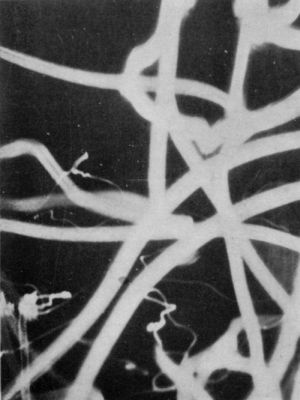
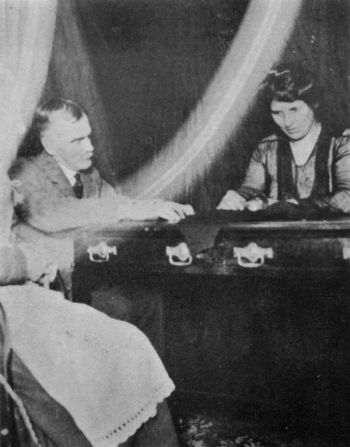
Psychic Photographs (1, 2)
This will, I have no doubt, appear incredible to the average reader. The facts, nevertheless, remain! Such photographs have been obtained—in America, France, Poland, Japan and other parts of the world. A series of careful, simultaneous experiments have proved to us that such photographs can be taken, under precisely the conditions I have described.
Commandant Darget, of the French army, obtained a number of very striking photographs in this manner. A number of these are to be found in Joire's book, Psychical and Supernormal Phenomena, where we find thought-photographs of bottles, a walking-stick, the head of an eagle and other subjects obtained in this manner. Writing of the impression of the eagle's head, M. Darget says:
"With regard to the eagle, it was produced in this way: Mme. Darget was in my office, lying on my sofa, about ten o'clock in the evening. I said to her: 'I am about to put out the lamp and to try (as I have already done sometimes) to take a fluidic print over my forehead. I will hand you a plate for you to do it as well.'
"I therefore handed her a plate, which she held with both her hands about an inch in front of her forehead. A short time afterwards—it might be about ten minutes—she said to me: 'I think I am going asleep; I am very tired: I am going to lie down.' And feeling her way in the darkness, she handed me the plate.
"I then went to develop it, and was surprised to see this astonishing figure of an eagle. I have called it a 'dream-photograph,' although my wife does not remember having dreamed of a bird or anything else while she held the plate."
Dr. Baraduc, of Paris, likewise asserted that he had obtained psychic photographs of human radiations and of human thought. For instance, calm, peaceful emotions are said to produce pictures of softly homogeneous light, or the appearance of a gentle shower of snowflakes against a black background; whereas sad or violent passions suggest, in the arrangement of the light and shadows, the idea of a whirlpool or revolving storm, somewhat like a meteorological diagram representing a cyclone. If these photographs are really what they are believed to be, they would seem to indicate that, in our ordinary normal condition, we emit radiations which are regulated and flow forth in smooth, even succession; but when violent emotions, such as anger or fear, break through the control of the will and take possession of us, they produce a violent and confused emission.
There is no reason, a priori, why the soul should not be a space-occupying body, save for the tradition of theology. For all that we know, the soul might be a point of force, existing within and animating some sort of ethereal body, which corresponds, in size and shape, to our material body. But at all events, there is an abundance of very good testimony to the effect that the shape of the spiritual body corresponds to that of the material body; and, as such, it certainly occupies space, and possibly has weight also. It might and it might not; it is a question of evidence. It will have to be settled, if at all, not by speculations, but by facts. Are there any facts, then, that would seem to indicate that the soul might be photographed? Have we any evidence that the soul may be photographed—say, at the moment of death? If so, we should have advanced a great step in our knowledge of this subject.
Before I adduce the evidence on this point, however, it may be well to illustrate the fact that there is no inherent absurdity in the idea, as many might suppose. Of course the spiritual body would have to be material enough to reflect light waves, but where is the evidence that it is not? There seems to be much evidence, on the contrary, that it is. It must be remembered that the camera will disclose innumerable things quite invisible to the naked eye, or even to the eye aided by the strongest glasses or telescopes. Normally, we can see but a few hundred stars in the sky; with the aid of telescopes, we can see many thousand; but the photographic camera discloses more than twenty million! Here, then, is direct evidence that the camera can observe things which we cannot see; and, indeed, this whole process of sight or "seeing" is a far more complicated one than most persons imagine. As Sir Oliver Lodge has pointed out, there is no reason why we should not be enabled to photograph a spirit, when we can photograph an image in a mirror—which is composed simply of vibrations, and reflected vibrations at that! We are a long way from the tangible thing, in such a case; and yet we are enabled to photograph it with an ordinary camera. Any disturbance in the ether we should be enabled to photograph likewise—if only we had delicate enough instruments, and if the "conditions" for the experiment were favourable. The phenomena of spirit-photography, and especially the experiments of Dr. Baraduc, to which I shall presently refer, would seem to indicate this.
These experiments, as well as those that are about to follow, gain greater credibility when considered in the light of the newer experimental researches in physics, which demonstrate, apparently, that matter can be made to disintegrate and disappear, and can be again reformed from invisible vortices in the ether into sufficiently solid bodies to be photographed by the sensitive plate. In his remarkable work, The Evolution of Matter, Dr. Gustave Le Bon has devoted a whole section of his argument to what he has denominated "the dematerialization of matter." He proves by experiments in the physical laboratory that matter can dissociate, and vanish into apparent nothingness. What really takes place, however, is that the solid matter, as we have been accustomed to conceive it, is resolved into its finer constituent parts—not only into the material atoms of which it is composed, but these atoms are in turn dissociated and resolved into a series of etheric vortices, invisible to normal sense perception. Apparently, therefore, matter has ceased to be, as such; and, in fact, it has been resolved into energy! Conversely, Dr. Le Bon proved that, by producing artificial equilibria of the elements arising from the dissociation of matter, he could succeed in creating, with immaterial particles, "something singularly resembling matter." These equilibria were maintained a sufficient length of time to enable them to be photographed.
On p. 164 of Dr. Le Bon's Evolution of Matter, are to be found photographs of what is practically materialized matter. This author says, in part:—
"Such equilibria can only be maintained for a moment. If we were able to isolate and fix them for good—that is to say, so that they would survive their generating cause—we should have succeeded in creating with immaterial particles something singularly resembling matter. The enormous quantity of energy condensed within the atom shows the impossibility of realizing such an experiment. But, if we cannot with immaterial things effect equilibria, able to survive the cause which gave them birth, we can at least maintain them for a sufficiently long time to photograph them, and thus create a sort of momentary materialization."
If, therefore, physical science now admits, as it does, that vibrations, or disturbances in the ether, can be photographed, there is no longer any a priori objection to these experiments by Dr. Baraduc—which claim, merely, that similar vibrations have been photographed—such vibrations being the external modification or impression left upon the ether by the causal thought.
So much for theoretical possibilities: now for the facts.
In a remarkable little booklet, entitled, Unseen Faces Photographed, Dr. H. A. Reid has presented a number of cases of supposed spirit photography, some of which are certainly difficult to account for by any theory of fraud. It is true that the methods of imitating this process by fraudulent means are numerous and ingenious; but practically none of them are unknown. In The Physical Phenomena of Spiritualism, pp. 206-23, I have described these fraudulent methods in considerable detail; and have also published an account of a case in which trickery was actually detected in the process of operation. (See Proceedings of the American S.P.R., 1908, vol. ii., pp. 10-13.) But there seem to be certain cases on record that are most difficult to account for by any theory of trickery—partly because of the excellence of the conditions, and partly because of the character of the experimenter. Let us glance at one or two of the cases in which the character of the experimenter would seem to insure the fact that no conscious and voluntary fraud was practised. A résumé of a few such cases is to be found in Mr. Edward T. Bennett's little book on Spiritualism, pp. 113-20.[23] I quote in part:—
"The most notable exception to this (rule of fraud) which I am able to quote is that of the late Mr. J. Traill Taylor, who was for a considerable time the editor of the British Journal of Photography. The following quotations are from a paper on 'Spirit Photography' by Mr. Taylor. It was originally read before the London and Provincial Photographic Association in March, 1893, and was reprinted in the British Journal of Photography for March 26th, 1904, shortly after Mr. Taylor's death. He says:—
"'Spirit photography, so called, has of late been asserting its existence in such a manner and to such an extent as to warrant competent men in making an investigation, conducted under stringent test conditions, into the circumstances under which such photographs are produced, and exposing the fraud should it prove to be such, instead of pooh-poohing it as insensate because we do not understand how it can be otherwise—a position that scarcely commends itself as intelligent or philosophical. If, in what follows, I call it "spirit photography," instead of psychic photography, it is only in deference to a nomenclature that extensively prevails.... I approach the subject merely as a photographer.'
"Mr. Taylor then gives a history of the earlier manifestations of spirit photography, and goes on to explain how striking phenomena in photographing what is invisible to the eye may be produced by the agency of florescence. He quotes the demonstration of Dr. Gladstone, F.R.S., at the Bradford meeting of the British Association in 1873, showing that invisible drawings on white cards have produced bold and clear photographs when no eye could see the drawings themselves. Hence, as Mr. Taylor says: 'The photographing of an invisible image is not scientifically impossible.'
"Mr. Taylor then proceeds to describe some personal experiments. He says: 'For several years I have experienced a strong desire to ascertain by personal investigation the amount of truth in the ever-recurring allegation that figures, other than those visually present in the room, appeared on the sensitive plate.... Mr. D., of Glasgow, in whose presence psychic photographs have long been alleged to be obtained, was lately in London on a visit, and a mutual friend got him to consent to extend his stay in order that I might try to get a psychic photograph under test conditions. To this he willingly agreed. My conditions were exceedingly simple, were courteously expressed to the host, and entirely acquiesced in. They were that I, for the nonce, would assume them all to be tricksters, and, to guard against fraud, should use my own camera and unopened packages of dry plates purchased from dealers of repute, and that I should be excused from allowing a plate to go out of my own hand till after development, unless I felt otherwise disposed; but that as I was to treat them as under suspicion, so must they treat me, and that every act I performed must be in the presence of two witnesses; nay, that I would set a watch upon my own camera in the guise of a duplicate one of the same focus—in other words, I would use a binocular stereoscopic camera and dictate all the conditions of operation....
"'Dr. G. was the first sitter, and, for a reason known to myself, I used a monocular camera. I myself took the plate out of a packet just previously ripped up, under the surveillance of my two detectives. I placed the slide in my pocket and exposed it by magnesium ribbon which I held in my own hand, keeping one eye, as it were, on the sitter, and the other on the camera. There was no background. I myself took the plate from the dark slide, and, under the eyes of the two detectives, placed it in the developing dish. Between the camera and the sitter a female figure was developed, rather in a more pronounced form than that of the sitter.... I submit this picture.... I do not recognize her, or any of the other figures I obtained, as like any one I know....
"'Many experiments of like nature followed; on some plates were abnormal appearances, on others none. All this time Mr. D., the medium, during the exposure of the plates, was quite inactive....
"'The psychic figures behaved badly. Some were in focus, others not so. Some were lighted from the right, while the sitter was from the left; some were comely ... others not so. Some monopolized the major portion of the plate, quite obliterating the material sitters.... But here is the point: Not one of these figures which came out so strongly in the negative was visible in any form or shape to me during the time of exposure in the camera, and I vouch in the strongest manner for the fact that no one whatever had an opportunity of tampering with any plate anterior to its being placed in the dark slide or immediately preceding development. Pictorially they are vile, but how came they there?
"'Now, all this time I imagine you are wondering how the stereoscopic camera was behaving itself as such. It is due to the psychic entities to say that whatever was produced on one-half of the stereoscopic plates was produced on the other—alike good or bad in definition. But, on a careful examination of one which was rather better than the other ... I deduce this fact, that the impressing of the spirit form was not simultaneous with that of the sitter.... This I consider an important discovery. I carefully examined one in the stereoscope and found that, while the two sitters were stereoscopic per se, the psychic figure was absolutely flat! I also found that the psychic figure was at least a millimetre higher up in one than in the other. Now, as both had been simultaneously exposed, it follows to demonstration that, although both were correctly placed, vertically in relation to that particular sitter, behind whom the figure appeared, and not so horizontally, this figure had not only not been impressed on the plate simultaneously with the two gentlemen forming the group, but had not been formed by the lens at all, and that, therefore, the psychic image might be produced without a camera. I think this is a fair deduction. But still the question obtrudes: How came these figures there? I again assert that the plates were not tampered with by either myself or any one present. Are they crystallizations of thought? Have lens and light really nothing to do with their formation? The whole subject was mysterious enough on the hypothesis of an invisible spirit—whether a thought projection or an actual spirit, being really there in the vicinity of the sitter—but it is now a thousand times more so....
"'In the foregoing I have confined myself as closely as possible to narrating how I conducted a photographic experiment open to every one to make, avoiding stating any hypothesis or belief of my own on the subject.'"
Let us now return to some later experiments in psychic photography. Two small photographs, one showing a face, the other a series of small starlike markings, were sent to me by a member of the Society for the Study of Psychic Photography, of England. Writing of these prints, my correspondent says:
"A week or so ago we distributed one hundred and ten strips of sensitive film, in light-tight packages, for friends of the members to 'wear.' This was done with the idea of ascertaining approximately what percentage of individuals possessed this gift. We agreed that the films should be carried about for a week, and where possible worn round the forehead at night. The experiment proved more successful than we had anticipated, since six out of the one hundred and ten films were more or less affected. The two best results are those shown on the prints enclosed herewith." (Not shown.)
These results are quite in keeping with some that have lately been obtained in California. In a recent communication which I have received from Mr. Vincent Jones, Vice-President of the California Psychical Research Society,—under whose auspices the experiment was undertaken—he says:—
"Then we tried thought-photography. I bought some ordinary plates, which were opened in the dark-room of an X-ray laboratory. The plate was inclosed within an envelope of opaque black paper and this in another envelope. It was then suspended about twelve inches in front of the eyes of the sitting experimenter....
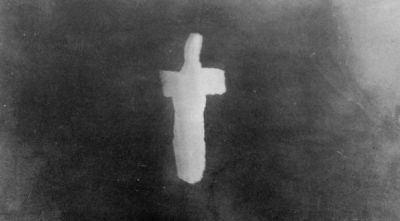
"This experimenter first wrote down on a slip of paper the thing he was going to concentrate on, folded it and handed it to a committee. Then he sat and concentrated for ten minutes. The plate was then developed, and contained the image, clear and strong and unmistakable, of a cross. This proved to be the subject handed to the committee." (See Fig. 3.)
In view of the remarkable character of this experiment—as well as its importance, and taking into account the apparently excellent conditions under which the test was made, I wrote to Mr. Jones, asking him to be kind enough to secure, if possible, the statements of any additional witnesses who might have been present on this occasion, and he sent me, in response to this request, the following affidavit, signed by five of the witnesses who were present at the time:
California Psychical Research Society, San Francisco, Calif., Nov. 3, 1920. Dr. Hereward Carrington. 504 West 111th St. New York City. Dear Dr. Carrington.
Enclosed is the print I promised you of the "Thought Photograph" taken by a Committee composed in part of members of the Council of the California Psychical Research Society, in May, 1919. The conditions were as follows: I purchased at Hirsch & Kaye, opticians and photo-supplies, a box of one dozen ordinary rapid Seed plates. I took the box unopened to the Committee meeting, which was held at the X-Ray Laboratory of Preston & Huppert in this city. Mr. Henry Huppert, Dr. Frank Collins, Dr. Cecil Nixon and myself went into the dark room, where Mr. Huppert opened the box of plates, took one at random from the centre of the package, enclosed it inside an opaque black envelope, and this again inside another yellow envelope and sealed it. This was taken outside and suspended about 12 inches in front of our subject, who was seated and had previously written down what he would concentrate upon, and handed the memo to Dr. Collins. The subject drew a rough outline of the object of his concentration, gazed fixedly upon it for about 5 minutes, then put it aside and for ten minutes concentrated upon the plate without touching the same. The plate was immediately taken into the dark room and developed, and the image of the cross developed at once, clear and strong. One of the Committee was in the room with the subject during the whole time, and there was no opportunity for any tampering with the plate. The object developed proved to be the one previously written down and handed to Dr. Collins.
Yours very truly, Vincent Jones, Frank T. Collins, D.O., J. C. Anthony, M.D., Cecil E. Nixon, D.O.S., Henry K. Huppert.
Thought Photograph (3)
Supplementing this formal report, Mr. Vincent Jones sent me the following letter, in answer to my questions, which I also quote:—
San Francisco, Calif., Nov. 10, 1920. Dr. Hereward Carrington. 504 West 111th St. New York City. Dear Dr. Carrington.
Here is the signed statement I promised you, and the better print of the cross photo. The others who were present at the experiments are not where I can reach them at present, but the five whose signatures are appended to the accompanying statement are the best-known of the eight who were present,—men whose testimony in a court of law would be accepted without question. Dr. Frank Collins is, or was, President of the Osteopaths' Association, a Spiritualist, student of Astrology and mystical subjects, and a member of the Council of the California Psychical Research Society. Dr. J. C. Anthony is a well and favorably known physician, who has practised here for many years, also a member of our Council. Dr. Cecil E. Nixon is a Dentist, best known as a Magician, and as the inventor of "Isis," a wonderful automaton which plays any tune you request of her on the zither. Mr. Henry Huppert is one of the partners in the Preston-Huppert X-Ray Laboratory, a man with scientific training and a student of the Occult.
Such a thing as substitution by the subject of another plate for the one we suspended before him was out of the question for two reasons. First, he was not left alone. Second, he did not know in advance just what was to be the nature of our experiment. When Mr. Huppert broke the seal on the box of plates, in the presence of the Committee of four, in the dark room, and selected one at random from the centre of the box, and enclosed it in the two envelopes, he not only sealed the envelopes but marked the envelopes, so that he would know if they had been tampered with. They could not have been opened without destroying these marks. Furthermore, in the room where the experiment was conducted, there was an ordinary electric light burning, and no substitution could have been made without affecting the plate. It could not have been possible that the subject, being previously unaware of the exact nature of the contemplated experiment, could have provided himself with plates of the same size and envelopes of two colours and of identically the same paper as those used in the X-Ray Laboratory. If anything happened to the plate it happened through the paper of the envelopes. But, as I have said, one of the committee was in the room during the whole experiment. The sole possibility of fraud was for the subject to have come prepared with a cross painted with radio-active paint, and to have held this against the envelopes whilst the Committee was off its guard. But the character of the subject is sufficient guarantee to all of us that such was not the case. I admit that to those who do not know him, this would furnish no guarantee, and that for this reason we should have taken even more stringent precautions. Had we known that such a result was to be obtained we probably would have done this, but we were just a company of friends who had gathered to try what we might accomplish, after having read of Colonel de Rochas' experiments along this line. We trusted one another, and so it is barely possible that for a moment some one who was supposed to be watching the subject was off his guard. Therein lies the sole possibility of fraud in this result, and, as I said, this is out of the question with us who know the character of the subject.
Yours very truly, Vincent Jones, 215 Balboa Bldg.
P. S. The reason we were not all in the room with the subject during the trial was that we were trying to do the same thing ourselves. I was concentrating upon a V, with a film on my forehead, and the others were trying it either with film or plate. Only one other secured anything at all, and that was but a blur. Our subject who did get the Cross result is a very highly developed mystic with remarkable powers of concentration, but modest about his powers and for that reason, and because he is extremely busy, we have not been able to repeat the experiment with him since. V. J.
As might be expected, many of these "psychic photographs" take on the characteristics of "spirit-photographs," in that they show definitely recognizable forms. This is especially true of a number of psychic photographs which were recently taken at Crewe, England, in the presence of two non-professional mediums, who have, nevertheless, obtained hundreds of successful photographs in this manner. Regarding their experiments, a correspondent writes me:
"They are not professionals and charge no fee. A nominal charge is made for prints.... I do not know of any one who has sat with the Crewe circle who has not been satisfied that fraud, at any rate, will not explain these things. Those who have not been and who know nothing of the subject, say just the opposite.... Many of the results in themselves rule out faking. I have had many sittings with these mediums and have not the slightest doubt whatever regarding their absolute genuineness. In fact, in some of the tests I have carried out with them, faking would have been quite impossible, even had they been desirous of tricking. I speak as an amateur photographer of many years' standing, in touch with photography every working day of his life."
Several photographs obtained at this now-famous Crewe circle are reproduced herewith. Certainly it is true that such photographs might be obtained by means of double exposure, double printing and other devices; but the point is that we have the word of an expert photographer that they were not produced in this manner; and when once their genuine character is admitted, they assume very great interest, no matter what view we may care to take as to the results.
Miss Estelle Stead, daughter of the late W. T. Stead, writing of her experiences with this same group of psychics, says:
"I have several times, since he passed on, obtained photos of my father on the same plate I took with me, under the most rigid test-conditions—on plates which I have never let out of my sight, save for the few moments they were in the camera for my photo to be taken.
"I also obtained a splendid photo of my brother, who passed over in 1907. He promised that before I went for the sitting he would be photographed instead of Father, if he could manage it. I said nothing of this to the lady who sat with me for the photograph to be taken, or to the photographer. I put my own marked plate in the slide myself, and stood by while it was developed. My brother's face appeared quite as plainly as mine, and has been recognized by many who knew him in life. He was seldom photographed while here, and certainly never with his head in exactly the position it is in this photograph, received nine years after his death.
"It is only natural that those who have passed over in the war should, when conditions allow, use this means of establishing their identity, and many have done so successfully! One case of particular interest is that of a boy who was blown to pieces in France last year. His mother wrote in great distress to a friend in Edinburgh stating that the boy had been killed. This friend had not seen the boy since his school-days, but being interested in spiritualism, and able to get in touch with those on the 'other side,' she asked her father, who had passed over, if it would be possible for the boy to be photographed. He said it was doubtful, but they would do their best. She therefore made arrangements to have a sitting with the Crewe mediums, who possess this power which enables those on the other side to manifest sufficiently to be photographed.
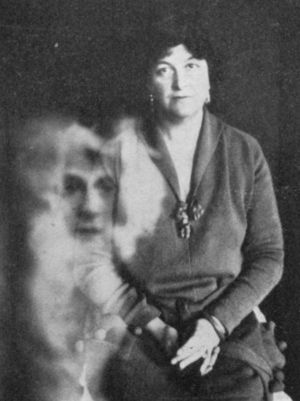
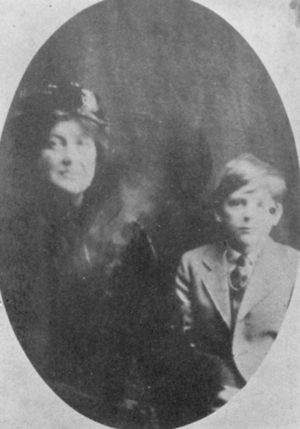
Psychic Photographs (4, 5)
"Two plates were exposed, and on one side, beside the photo of the lady herself, there is an unmistakable photo of the boy. I have seen it, and a photo of the boy taken before he went to France, and there is no mistaking the likeness. She sent the pictures to his parents, who before this had not been believers in the possibility of communication with those who have passed on—with the result that they are now convinced of it, and have received several comforting and assuring messages from their boy."
We see how imperceptibly ordinary psychic photographs shade off into those more definitely spiritistic in character. This is true in nearly all phenomena in this realm. It is hard to draw any hard-and-fast line, and say: "This is due to powers within our own being, and this is due to external spiritual beings!" They merge one into the other so gradually that it is extremely difficult to draw any line of demarcation between the two.
Certainly some of these photographs are due to the thoughts or other psychic activities of the sitter. Thus we can hardly suppose that the "spirits" of bottles, walking-sticks and eagles (as in Darget's experiments) were actually present, and that they impressed themselves upon the photographic plate! Again, some pictures show us a definite face, which we cannot attribute to any outside influence. The experimenter merely thought of the face, and it appeared upon the plate. This being so, how can we ever obtain proof that the forms and faces which appear upon photographic plates are those of discarnate spirits,—even though they appear and are recognized,—since we know that mental images or memories of faces have been photographed in just this manner?
That is indeed a difficult problem: it is very like that which confronts us in the case of any good trance-medium. Inasmuch as telepathy is a fact, and the medium almost certainly derives some of the facts from one's mind, or from the minds of other living people, how can we ever prove "survival"—the actual communication of our spirit friends?
We can only apply the same sort of tests in the one case as in the other. We must discount all those facts which might possibly have been obtained normally, or by telepathy, and pin our faith on those which could not possibly, or conceivably, have been obtained in this way. Similarly, we must assume that all psychic photographs represent normal markings upon the plates, or the emotions or thoughts of the sitter, or the vital radiations issuing from his body, until indisputable proof to the contrary be forthcoming. (It may be added that some very striking evidence of identity has been obtained in this manner, from time to time in the past, and is now being obtained in various circles both in this country and abroad.)
Regarding these "vital radiations" issuing from the body, a number of interesting experiments were undertaken in this connection in Poland, Paris and elsewhere. M. Durville obtained imprints of hands, from which emanated streaks of light, as though the hands were radio-active; indeed in no other way can we account for these results.
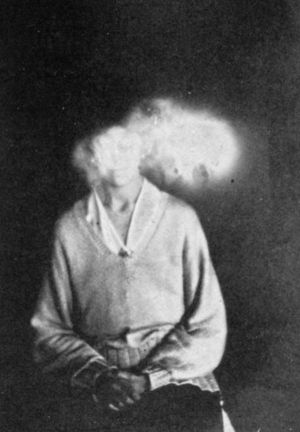
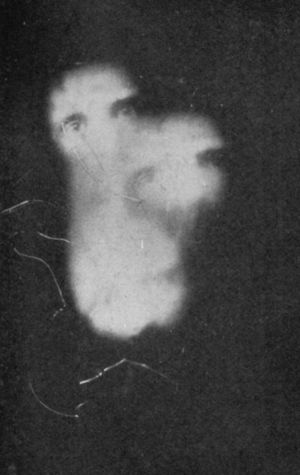
Psychic Photographs (6, 7)
I next present a remarkable series of photographs, kindly lent to me by Lady Glenconner,—to whom I am indebted for permission to reproduce them. These photographs were taken at the "Crewe Circle," in the presence of Mr. Hope, the medium. Personally, I have never had the opportunity to attend a Crewe séance, and hence cannot speak of the evidential value of these pictures from first-hand evidence. All I can say is that Mr. Hope is not a professional "medium," in the usual sense of the term, since he receives no payment for his services; that no evidence of fraud, in connection with his photographs, has ever been forthcoming; and that rigid test conditions have, apparently, been enforced on a number of occasions, when successful "extras" were obtained upon the plates. In practically all the cases known to me, the sitters provided their own marked plates, placed them in the camera themselves, took them out themselves, and developed them themselves. Such, I understand, were the conditions under which the accompanying photographs were obtained. All that Mr. Hope does is to place his (opened) hands upon the plate-holders, after the plates have been inserted therein, and before these are placed in the camera. It is during this period that the psychic "extras," appearing upon the plates, are thought to appear; or at all events it is this "magnetizing" of the plates which renders them susceptible to impressions which would not be recorded upon ordinary plates. How far this belief of the sitters coincides with the actual facts of course I cannot say.
The first photograph shows us Lady Glenconner, seated, with a clearly-defined face over her right arm. This face is enshrouded in the same curious mist-like "clothing," common to "spirit" photographs, and materialized forms, and especially evident in all the Crewe pictures. The face is, I understand, recognizable as that of a lost friend. (Fig. 4.)
The second photograph is one of Lady Glenconner and her son,—a faint, whitish mist appearing over (or on) her left shoulder. This is interesting for the reason that, some time before this picture was taken, a "spirit" had announced through another medium in London that he would appear in one of Hope's photographs and place his hand on her left shoulder. Within the whitish mist-like mass, a hand and arm are clearly distinguishable, upon close examination. (Fig. 5.) In photograph number 6 (with a different sitter) the double impression of a face is clearly seen, almost obliterating the face of the sitter. These faces appear sideways, and represent a woman's face,—wearing glasses! This same woman's face appears in the next picture (No. 7) no less than three times; the uppermost face is the clearest, the one to the right next best, while the lowermost "face" is little more than a misty impression,—in which, however, the eyes are quite clear. This photograph is, on any theory, it seems to me, a very striking and suggestive one, and seems to indicate that the "spirit" attempted three different times to appear and impress the plate, with the greatest strength the first time, and with gradually diminishing energy or power thereafter. This, at least, is the appearance of the facts, and such an interpretation is, it may be said, in strict conformity with the statements made through Mrs. Piper, and other reliable mediums, as to the difficulties actually experienced, in attempting to "communicate." To my mind,—though I do not know the precise conditions under which the picture was obtained—this is a most suggestive and remarkable photograph, strongly indicative of the spiritistic theory.
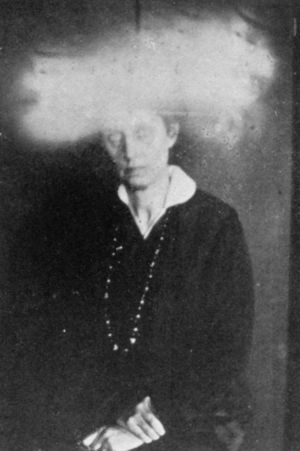
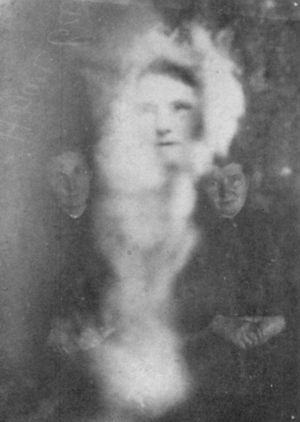
Psychic Photographs (8, 9)
In the next illustration (No. 8), a white cloud appears over the sitter's head. There are traces of two "faces" in this cloud, but they are too uncertain to be emphasized. In the next picture, however (No. 9), a face, clearly visible, and enveloped in the usual white mist-like drapery, appears. It is to be noted that the "face" is, in this case, about twice the size of the sitters' heads, as though the "extra" were much nearer the camera. It is, however, still in focus!
Photograph No. 10 shows us Lady Glenconner, and upon the plate a number of "extras" appearing at various "angles" in relation to the sitter's head—some of them at right angles, some of them upside down, etc. (The "cracks" are merely defects upon the plate.) Upon examination, it will be seen that all these faces represent one man, who, apparently, has made a number of separate attempts to "appear" at this sitting. An enlargement of this face is given in photograph No. 11, where the features are quite distinguishable. There are several peculiarities about this face, however, which a closer examination will reveal. The enormous left ear is one of these—mal-formed, or as though in the process of formation. The right side of the head, on the other hand, is partly enveloped in a whitish cloud, through which the outline of the face is faintly perceptible. Further impressions of this same face are shown in photograph No. 12, when several "impressions" were again obtained, all clearly recognizable. In the right-hand photograph, the whitish mass seems to have been just removed from about the head, and it will be seen that part of this still remains, like a thin veil, in front of the lower part of the face (under the eyes) and up the left-hand side of the head. This, to me, is a very curious circumstance.
Having thus "cleared the ground," so to speak, let us now consider the more startling statements and experiments by Dr. Baraduc, summarized by him in his work, Mes Morts; leurs Manifestations, etc., later on in the account.
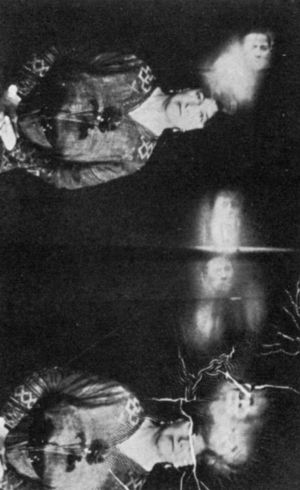
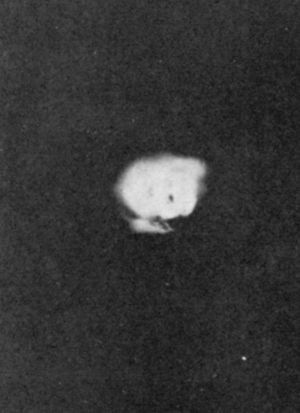
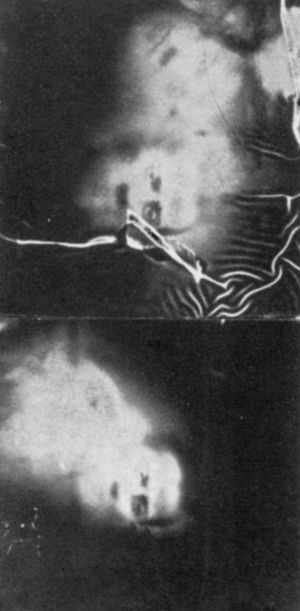
Psychic Photographs (10, 11, 12)
At a quarter-past nine, on a certain memorable day in April, 1907, died André M. Joseph Baraduc, at the age of nineteen years. Throughout his life there had been a close bond of affection between himself and his father, and we are assured that during the lifetime of the son, telepathic communication had been frequent between them. When he was but nineteen it was discovered that André was suffering from that dread disease, consumption; and henceforward he grew rapidly worse, dying within the year. Toward the close of this year he made two visits to Lourdes, without, however, receiving much benefit in either case, and returning apparently without augmented faith in the cures brought about at that centre. André was exceedingly religious in temperament, as was his father, and both were given to experiments in psychic research. We are informed that, during the lifetime of the son, his "astral" form had been experimentally separated from his bodily frame on more than one occasion. It was only natural to suppose, therefore, that, at the death of this favourite son, the father's grief should be so intense that the emotional reflex found expression in various visions and apparent conversations with the dead boy. For within six hours after the death of André, the son appeared to his father, and thenceforth many apparitions were seen, and several long conversations were apparently held between father and son. Of course, these in themselves would, under the circumstances, have no evidential value, since it is only natural to suppose that hallucinations, both of sight and hearing, would result in a mind so wrought.
These subjective and apparently telepathic experiences of Dr. Baraduc cannot, therefore, be considered of value; but the objective experiences—that is to say, the experiments performed by him are of great interest, since one can hardly suppose that the camera can be hallucinated, because of the grief of the photographer! The impressions left upon the plates, then, such as they are, have their evidential and scientific value, and it is to a consideration of these photographs that we now turn.
Nine hours after the death of André, Dr. Baraduc took the first photograph of the coffin in which the body was deposited. When this plate was developed, it was discovered that, emanating from the coffin, was a formless, misty, wave-like mass, radiating in all directions with considerable force, impinging upon the bodies of those who came into close proximity to the coffin, as though attracted to them by some magnetic force. On one occasion, indeed, the force of this projected fluidic emanation was so great that Dr. Baraduc received an electric shock from head to foot, which produced a temporary vertigo. Emerging from the body are dark, tree-shaped emanations, issuing in formal lines, which gradually diverge, and become more and more attenuated and misty as they recede further and further from the body. Although this photograph[24] does not in itself prove anything supernormal, it is highly suggestive, and it aroused Dr. Baraduc's interest in the subject, and enabled him to pursue his more conclusive experiments immediately upon the death of his wife. (Figs. 13, 14.)
Six months after the death of André, Nadine, Dr. Baraduc's wife and the mother of André, passed quietly away, giving vent, at the moment of her death, to "three gentle sighs." Remembering the result of the former experiments (photographing the body of André shortly after his death), Dr. Baraduc had prepared a camera beside the bed of his wife, and, at the moment of her death, photographed the body, and shortly after developed the plate. Upon it were found three luminous globes resting a few inches above the body. These gradually condensed and became more brilliant. Streaks of light, like fine threads, were also seen darting hither and thither. A quarter of an hour after the death of his wife, Dr. Baraduc took another photograph. Fluidic cords were seen to have developed, partly encircling these globes of light. At three o'clock in the afternoon, or an hour after her death, another photograph was taken. It will be seen from this photograph that the three globes of light have condensed and coalesced into one, obscuring the head of Madame Baraduc, and developing towards the right. Cords were formed in the shape of a figure eight, closed at the top, and opened at the point nearest the body. Thus, as the globe develops in one direction, the cords seem to become more tense, and pull in the opposite direction. The separation becomes more and more complete, until finally, three and a half hours after death, a well-formed globe rested above the body, apparently held together by the encircling, luminous cords, which seemed also to guide and control it. At this moment, the globe becomes separated from the body, and, guided by the cords, floats into Dr. Baraduc's bedroom. He speaks to the globe intensely; the globe thereupon approaches him, and he feels an icy cold breeze, which seems to surround and issue from the ball of light. It then floats away and disappears.