Volume 2 / Part 6 — APPENDICES. (continued 2)
Reading edition
These conclusions are supported by the evidence which exceptional cases supply. If intermittent mechanical strains thus cause the formation of wood where wood is found, then where it is not found, there should be an absence of intermittent mechanical strains. There is such an absence. Vascular plants characterized by little or no deposit of dense substance, are those having vessels so conditioned that no considerable pressures are borne by them. The more succulent a petiole or leaf becomes, the more do the effects of transverse strains fall on its outer layers of cells. Its mechanical support is chiefly derived from the ability of these minute vesicles, full of liquid, to resist bursting and tearing under the compressions and tensions they are exposed to. And just as fast as this change from a thin leaf or foot-stalk to a thick one entails increasing stress on the superficial tissue, so fast does it diminish the stress on the internally-seated vascular tissue. The succulent leaf cannot be swayed about by the wind as much as an ordinary leaf; and such small bends as can be given to it and its foot-stalk are prevented from affecting in any considerable degree the tubes running through its interior. Hence the retentiveness of the vessels in these fleshy leaves, as shown by the small exudation of dye; and hence the small thickening of their surrounding prosenchyma by woody deposit. Still more conspicuously is this connexion of facts shown when, from the soft thick leaves before named and such others as those of Echeveria, Rochea, Pereskia, we turn to the thick leaves that have strong exo-skeletons. Gasteria serves as an illustration. The leathery or horny skin here evidently bears the entire weight of the leaf, and is so stiff as to prevent any oscillation. Here, then, the vessels running inside are protected from all mechanical stress; and accordingly we find that the cells surrounding them are not appreciably thickened.
Equally clear, and more striking because more obviously exceptional, is the evidence given by succulent stems which are leafless. Stapelia Buffonia, having soft procumbent axes not liable to be bent backwards and forwards in any considerable degree by the wind, has, ramifying through its tissue, vessels that allow but an extremely slow escape of dye and have unthickened sheaths. Such of the Euphorbias as have acquired the fleshy character while retaining the arborescent growth, like Euphorbia Canariensis, teach us the same truth in another way. In them the formation of wood around the vessels is inconspicuous where the intermittent strains are but slight; but it is conspicuous at those joints on which lateral oscillations of the attached branches throw great extensions and compressions of tissue. Throughout the Cactaceæ we find varied examples of the alleged relation. Mammillaria furnishes a very marked one. The substance of one of these globular masses, resting on the ground, admits of no bending from side to side; and accordingly its large bundles of spiral and annular vessels, or partially-united cells, have very feebly-marked sheaths not at all thickened. In such types as Cereus and Opuntia we see, as in the Euphorbias, that where little stress falls on the vessels, little deposit takes place around them; while there is much deposit where there is much stress. Here let me add a confirmation obtained since writing the above. After observing among the Cactuses the very manifest relation between strain and the formation of wood, I inquired of Mr. Croucher, the intelligent foreman of the Cactus-house at Kew, whether he found this relation a constant one. He replied that he did, and that he had frequently tested it by artificially subjecting parts of them to strains. Neglecting at the time to inquire how he had done this, it afterwards occurred to me that if he had so done it as to cause constant strains, the observed result would not tell in favour of the foregoing interpretation. Subsequently, however, I learned that he had produced the strains by placing the plants in inclined attitudes—a method which, by permitting oscillations of the strained joints, allowed the strains to intermit. And then, making the proof conclusive, Mr. Croucher volunteered the statement that where he had produced constant strains by tying, no formation of wood took place.
Aberrant growths of another class display the same relations of phenomena. Take first the underground stems, such as the Potato and the Artichoke. The vessels which run through these, slowly take up the dye without letting it pass to any considerable extent into the surrounding tissues.[70] Only after an interval of many hours does the prosenchyma become stained in some places. Here, as before, an absence of rapid exudation accompanies an absence of woody deposit; and both these go along with the absence of intermittent strains. Take again the fleshy roots. The Turnip, the Carrot, and the Beetroot, have vessels that retain very persistently the coloured liquids they take up. And differing in this, as these roots do, from ordinary roots, we see that they also differ from them in not being woody, and in not being appreciably subject to the usual mechanical actions. In these cases, as in the others, parts that ordinarily become dense, deviate from this typical character when they are not exposed to those forces which produce dense tissue by increasing the extravasation of sap.
To complete the proof that such a relation exists, let me add the results of some experiments on equal and similarly-developed parts, kept respectively at rest and in motion. I have tested the effects on large petioles, on herbaceous shoots, and on woody shoots. If two such petioles as those of Rhubarb, with their leaves attached, have their cut ends inserted in bottles of dye, and the one be bent backwards and forwards while the other remains motionless, there arises, after the lapse of an hour, scarcely any difference in the states of their vessels: a certain proportion of these are in both cases charged with the dye, and little exudation has been produced by the motion. Here, however, it is to be observed that the causes of exudation are scarcely operative; the vascular bundles are distributed all through the mass of the petiole, which is formed of soft watery tissue; and they are, therefore, not so circumstanced as to be effectually compressed by the bends. In herbaceous stems, such as those of the Jerusalem Artichoke and of the Foxglove, an effect scarcely more decided is produced; and here, too, when we seek a reason, we find it in the non-fulfilment of the mechanical conditions; for the vascular bundles are not so seated between a tough layer of bark and a solid core as to be compressed at each bend. When, however, we come to experiment upon woody shoots, we meet with conspicuous effects, though by no means uniformly. In some cases oscillations produce immense amounts of exudation—parallel transverse sections of the compared shoots showing that where, in the one that has been at rest, there are spots of colour round but a few pitted ducts, in the one that has been kept in motion the substance of the wood is soaked almost uniformly through with dye. In other cases, especially where there is much undifferentiated tissue remaining, the exudation is not very marked. The difference appears to depend on the quantity of liquid contained in the shoot. If its substance is relatively dry, the exudation is great; but it is comparatively small if all the tissues are fully charged with sap. This contrast of results is one which contemplation of the mechanical actions will lead us to expect.
And now, with these facts to aid our interpretation, let us return to ordinary stems. If the upper end of a growing shoot, the prosenchyma of which is but little thickened, be allowed to imbibe the dye, the vessels of its medullary sheath alone become charged; and from them there takes place but a slow oozing. If a like experiment be tried with a lower part of the shoot, where the wood in course of formation has its inner boundary marked but not its outer boundary, we find that the pitted ducts, and more especially the inner ones, come into play. And then lower still, where the wood has its periphery defined and its histological characters decided, the appearances show that the tissue forming its outer surface begins to take a leading part in the transmission of liquid. What now is the explanation of these changes, mechanically considered? In the young soft part of the shoot, as in all normal and abnormal growths that have not formed wood, the channels for the passage of sap are the spiral, annular, fenestrated, or reticulated vessels. These vessels, here included in the bundles of the medullary sheath, are, in common with the tissues around them, subject, by the bendings of the shoot, to slight intermittent compressions, and, especially the outermost of them, are thus forced to give the prosenchyma an extra supply of nutritive liquid. The thickening of the prosenchyma, spreading laterally as well as outwards from each bundle of the medullary sheath, goes on until it meets the thickenings that spread from the other bundles; and there is so formed an irregular cylinder of hardened tissue, surrounding the medulla and the vascular bundles of its sheath. As soon as this happens, these vascular bundles become, to a considerable extent, shielded from the effects of transverse strains, since the tensions and compressions chiefly fall on the developing wood outside of them. Clearly, too, the greatest stress must be felt by the outer layer of the developing wood: being further removed from the neutral axis, it must be subject to severer strains at each bend; and lying between the bark and the layer of wood first formed, it must be most exposed to lateral compressions. Among the elongated cells of this outer layer, some unite to form the pitted ducts. Being, as we see, better circumstanced mechanically, they become greater carriers of sap than the original vessels, and, in consequence of this, as well as in consequence of their relative proximity, become the sources of nutrition to the still more external layers of wood-cells. The same causes and the same effects hold with each new indurated coat deposited round the previously indurated coats.
This description may be thought to go far towards justifying the current views respecting the course taken by the sap. But the justification is more apparent than real. In the first place, the implication here is that the sap-carrying function is at first discharged entirely by the vessels of the medullary sheath, and that they cease to discharge this function only as fast as they are relatively incapacitated by their mechanical circumstances. And the second implication is, that it is not the wood itself, but the more or less continuous canals formed in it, which are the subsequent sap-distributors. This, though readily made clear by microscopic examination of the large pitted ducts in a partially lignified shoot that has absorbed the dye, is less manifestly true of the peripheral layer of sap-carrying tissue finally formed. But it is really true here. For this layer, though nominally a layer of wood, is practically a layer of inosculating vessels. It is formed out of irregular lines and networks of elongated pitted cells, obliquely united by their ends. Examination of them after absorption of a dye, shows that it is only along the continuous channels they unite to form that the current has passed. But the essentially vascular character of this outer and latest-formed layer of the alburnum is best seen in the fact that the vascular systems of new axes take their rise from it, and form with it continuous canals. If a shoot of last year in which growth is recommencing, be cut lengthways after it has imbibed a dye, clear proof is obtained that the passage of the dye into a lateral bud takes place from this outermost layer of pitted cells, and that the channels taken by the dye through the new tissue are composed of cells that pass through modified forms into the spiral vessels of the new medullary sheath. This transition may be still more clearly traced in a terminal bud that continues the line of last year’s shoot. A longitudinal section of this shows that the vessels of the new medullary sheath do not obtain their sap from the vessels of last year’s sheath (which, as shown by the non-absorption of dye, have become inactive), but that their supplies are obtained from those inosculating canals formed out of last year’s outermost layer of prosenchyma, and that between the component cells of this and those of the new vascular system there are all gradations of structure.[71]
It is not the aim of the foregoing reasoning to show that mechanical actions are the sole causes of the formation of dense tissue in plants. Dense tissue is in many cases formed where no such causes have come into play—as, for example, in thorns and in the shells of nuts. Here the natural selection of variations can alone have operated. It is manifest, too, that even those supporting structures the building up of which is above ascribed to intermittent strains, may, in the individual plant of a species that ordinarily has them, be developed to a great extent when intermittent strains are prevented. We see this in trees that are artificially supported by nailing to walls; and we also see a kindred fact in natural climbers. Though in these cases the formation of wood is obviously less than it would be were the stem and branches habitually moved about by the wind, it nevertheless goes on. Clearly the tendency of the plant to repeat the structure of its type (in the one case the structure of its species; and in the other case that of the order from which it has diverged in becoming a climber) is here almost the sole cause of wood formation. But though in plants so circumstanced intermittent mechanical strains have little or no direct share, it may still be true, and I believe is true, that intermittent mechanical strains are the original cause; for, as before hinted, the typical structure which the individual thus repeats irrespective of its own conditions, is interpretable as a typical structure that is itself the product of these actions and reactions between the plant and its environment. Grant the inheritance of functionally-produced modifications; grant that natural selection will always co-operate in such way as to favour those individuals and families in which functionally-produced modifications have progressed most advantageously; and it will follow that this mechanically-caused formation of dense substance, accumulating from generation to generation by the survival of the fittest, will result in an organic habit of forming dense tissue at the required places. The deposit arising from exudation at the places of greatest strain, recurring from generation to generation at the same places, will come to be reproduced in anticipation of strain, and will continue to be reproduced for a long time after a changed habit of the species prevents the strain—eventually, however, decreasing, both through functional inactivity and natural selection, to the point at which it is in equilibrium with the requirement.
Another side of the general question may now be considered. We have seen how, by intermittent pressures on capillary vessels and ducts and inosculating canals, there must be produced a draught of sap towards the point of compression to replace the sap squeezed out. But we have still to inquire what will be the effect on the distribution of sap throughout the plant as a whole. It was concluded that out of the compressed vessels the greater part of the liquid would escape longitudinally—the longitudinal resistance to movement being least. In every case the probabilities are infinity to one against the resistances being equal upwards and downwards. Always, then, more sap will be expelled in one direction than in the other. But in whichever direction least sap is expelled, from that same direction most sap will return when the vessels are relieved from pressure—the force which is powerful in arresting the back current in that direction being the same force which is powerful in producing a forward current. Ordinarily, the more abundant supply of liquid being from below, there will result an upward current. At each bend a portion of the contents will be squeezed out through the sides of the vessels—a portion will be squeezed downwards, reversing the current ascending from the roots, but soon stopped by its resistance; while a larger portion will be squeezed upwards towards the extremities of the vessels, where consumption and loss are most rapid. At each recoil the vessels will be replenished, chiefly by the repressed upward current; and at the next bend more of it will be thrust onwards than backwards. Hence we have everywhere in action a kind of rude force-pump, worked by the wind; and we see how sap may thus be raised to a height far beyond that to which it could be raised by capillary action, aided by osmose and evaporation.
Thus far, however, the argument proceeds on the assumption that there is liquid enough to replenish every time the vessels subject to this process. But suppose the supply fails—suppose the roots have exhausted the surrounding stock of moisture. Evidently the vessels thus repeatedly having their contents squeezed out into the surrounding tissue, cannot go on refilling themselves from other vessels without tending to empty the vascular system. On the one hand, evaporation from the leaves causing a draught on the capillary tubes that end in them, continually generates a capillary tension upwards; while, on the other hand, the vessels below, expanding after their sap has been squeezed out, produce a tension both upwards and downwards towards the point of loss. Were the limiting membranes of the vessels impermeable, the movement of sap would, under these conditions, soon be arrested. But these membranes are permeable; and the surrounding tissues readily permit the passage of air. This state of tension, then, will cause an entrance of air into the tubes; the columns of liquid they contain will be interrupted by bubbles. It seems, indeed, not improbable that this entrance of air may take place even when there is a good supply of liquid, if the mechanical strains are so violent and the exudation so rapid that the currents cannot refill the half-emptied vessels with sufficient rapidity. And in this case the intruding air may possibly play the same part as that contained in the air-chamber of a force-pump—tending, by moderating the violence of the jets, and by equalizing the strains, to prevent rupture of the apparatus. Of course when the supply of liquid becomes adequate, and the strains not too violent, these bubbles will be expelled as readily as they entered.
Here, as before, let me add the conclusive proof furnished by a direct experiment. To ascertain the amount of this propulsive action, I took from the same tree, a Laurel, two equal shoots, and placing them in the same dye, subjected them to conditions that were alike in all respects save that of motion: while one remained at rest, the other was bent backwards and forwards, now by switching and now by straining with the fingers. After the lapse of an hour, I found that the dye had ascended the oscillating shoot three times as far as it had ascended the stationary shoot—this result being an average from several trials. Similar trials brought out similar effects in other structures. The various petioles and herbaceous shoots experimented upon for the purpose of ascertaining the amount of exudation produced by transverse strains, showed also the amount of longitudinal movement. It was observable that the height ascended by the dye was in all cases greater where there had been oscillation than where there had been rest—the difference, however, being much less marked in succulent structures than in woody ones.
It need scarcely be said that this mechanical action is not here assigned as the sole cause of circulation, but as a cause co-operating with others, and helping others to produce effects that could not otherwise be produced. Trees growing in conservatories afford us abundant proof that sap is raised to considerable heights by other forces. Though it is notorious that trees so circumstanced do not thrive unless, through open sashes, they are frequently subject to breezes sufficient to make their parts oscillate, yet there is evidently a circulation that goes on without mechanical aid. The causes of circulation are those actions only which disturb the liquid equilibrium in a plant, by permanently abstracting water or sap from some part of it; and of these the first is the absorption of materials for the formation of new tissue in growing parts; the second is the loss by evaporation, mainly through adult leaves; and the third is the loss by extravasation, through compressed vessels. Only so far as it produces this last, can mechanical strain be regarded as truly a cause of circulation. All the other actions concerned must be classed as aids to circulation—as facilitating that re-distribution of liquid that continually restores the equilibrium continually disturbed; and of these capillary action may be named as the first, osmose as the second, and the propulsive effect of mechanical strains as the third. The first two of these aids are doubtless capable by themselves of producing a large part of the observed result—more of the observed result than is at first sight manifest; for there is an important indirect effect of osmotic action which appears to be overlooked. Osmose does not aid circulation only by setting up, within the plant, exchange currents between the more dense and the less dense solutions in different parts of it; but it aids circulation much more by producing distention of the plant as a whole. In consequence of the average contrast in density between the water outside of the plant and the sap inside of it, the constant tendency is for the plant to absorb a quantity in excess of its capacity, and so to produce distention and erection of its tissues. It is because of this that the drooping plant raises itself when watered; for capillary action alone could only refill its tissues without changing their attitudes. And it is because of this that juicy plants with collapsible structures bleed so rapidly when cut, not only from the cut surface of the rooted part, but from the cut surface of the detached part—the elastic tissues tending to press out the liquid which distends them. And manifestly if osmose serves thus to maintain a state of distention throughout a plant, it indirectly furthers circulation; since immediately evaporation or growth at any part, by abstracting liquid from the neighbouring tissues, begins to diminish the liquid pressure within such tissues, the distended structures throughout the rest of the plant thrust their liquid contents towards the place of diminished pressure. This, indeed, may very possibly be the most efficient of the agencies at work. Remembering how great is the distention producible by osmotic absorption—great enough to burst a bladder—it is clear that the force with which the distended tissues of a plant urge forward the sap to places of consumption, is probably very great. We must therefore regard the aid which mechanical strains give as being one of several. Oscillations help directly to restore any disturbed liquid equilibrium; and they also help indirectly, by facilitating the re-distribution caused by capillary action and the process just described; but in the absence of oscillations the equilibrium may still be restored, though less rapidly and within narrower limits of distance.
One half of the problem of the circulation, however, has been left out of sight. Thus far our inquiry has been, how the ascending current of sap is produced. There remains the rationale of the descending current. What forces cause it, and through what tissues it takes place, are questions to which no satisfactory answers have been given. That the descent is due to gravitation, as some allege, is difficult to conceive, since, as gravitation acts equally on all liquid columns contained in the stem, it is not easy to see why it should produce downward movements in some while permitting upward movements in others—unless, indeed, there existed descending tubes too wide to admit of much capillary action, which there do not. Moreover, gravitation is clearly inadequate to cause currents towards the roots out of branches that droop to the ground. Here the gravitation of the contained liquid columns must nearly balance that of the connected columns in the stem, leaving no appreciable force to cause motion. Nor does there seem much probability in the assumption that the route of the descending sap is through the cambium layer, since experiments on the absorption of dyes prove that simple cellular tissue is a very bad conductor of liquids: their movement through it does not take place with one-fiftieth of the rapidity with which it takes place through vessels.[72]
Of course the defence for these hypotheses is, that there must be a downward current, which must have a course and a cause; and the very natural assumption has been that the course and the cause must be other than those which produce the ascending current. Nevertheless there is an alternative supposition to which the foregoing considerations introduce us. It is quite possible for the same vascular system to serve as a channel for movement in opposite directions at different times. We have among animals well-known cases in which the blood-vessels carry a current first in one direction and then, after a brief pause, in the reverse direction. And there seems an à priori probability that, lowly-organized as they are, plants are more likely to have distributing appliances of this imperfect kind than to have two sets of channels for two simultaneous currents. If, led by this suspicion, we inquire whether among the forces which unite to produce movements of sap, there are any variations or intermissions capable of determining the currents in different directions, we quickly discover that there are such, and that the hypothesis of an alternating motion of the sap, now centrifugal and now centripetal, through the same vessels, has good warrant. What are the several forces at work? First may be set down that tendency existing in every part of a plant to expand into its typical form, and to absorb nutritive liquids in doing this. The resulting competition for sap will, other things being equal, cause currents towards the most rapidly-growing parts—towards unfolding shoots and leaves, but not towards adult leaves. Next we have evaporation, acting more on the adult leaves than on those which are in the bud, or but partially developed. This evaporation is both regularly and irregularly intermittent. Depending chiefly on the action of the sun, it is, in fine weather, greatly checked or wholly arrested every evening; and in cloudy weather must be much retarded during the day. Further, every hygrometric variation, as well as every variation in the movement of the air, must vary the evaporation. This chief action, therefore, which, by continually emptying the ends of the capillary tubes, makes upward currents possible, is one which intermits every night, and every day is strong or feeble as circumstances determine. Then, in the third place, we have this rude pumping process above described, going on with greater vigour when the wind is violent, and with less vigour when it is gentle—drawing liquid towards different parts according to their degrees of oscillation, and from different parts according as they can most readily furnish it. And now let us ask what must result under changing conditions from these variously-conflicting and conspiring forces. When a warm sunshine, causing rapid evaporation, is emptying the vessels of the leaves, the osmotic and capillary actions that refill them will be continually aided by the pumping action of the swaying petioles, twigs, and branches, provided their oscillations are moderate. Under these conditions the current of sap, moving in the direction of least resistance, will set towards the leaves. But what will happen when the sun sets? There is now nothing to determine currents either upwards or downwards, except the relative rates of growth in the parts and the relative demands set up by the oscillations; and the oscillations acting alone, will draw sap to the oscillating parts as much from above as from below. If the resistance to be overcome by a current setting back from the leaves is less than the resistance to be overcome by a current setting up from the roots, then a current will set back from the leaves. Now it is, I think, tolerably manifest that in the swaying twigs and minor branches, less force will be required to overcome the inertia of the short columns of liquid between them and the leaves than to overcome the inertia of the long columns between them and the roots. Hence during the night, as also at other times when evaporation is not going on, the sap will be drawn out of the leaves into the adjacent supporting parts; and their nutrition will be increased. If the wind is strong enough to produce a swaying of the thicker branches, the back current will extend to them also; and a further strengthening will result from their absorption of the elaborated sap. And when the great branches and the stem are bent backwards and forwards by a gale, they too will share in the nutrition. It may at first sight seem that these parts, being nearer to the roots than to the leaves, will draw their supplies from the roots only. But the quantity which the roots can furnish is insufficient to meet so great a demand. Under the conditions described, the exudation of sap from the vessels will be very great, and the draught of liquid required to refill them, not satisfied by that which the root-fibres can take in, will extend to the leaves. Thus sap will flow to the several parts according to their respective degrees of activity—to the leaves while light and heat enable them to discharge their functions, and back to the twigs, branches, stem, and roots when these become active and the leaves inactive, or when their activity dominates over that of the leaves. And this distribution of nutriment, varying with the varying activities of the parts, is just such a distribution as we know must be required to keep up the organic balance.
To this explanation it may be objected that it does not account for the downward current of sap in plants that are sheltered. The stem and roots of a drawing-room Geranium display a thickening which implies that nutritive matters have descended from the leaves, although there are none of those oscillations by which the sap is said to be drawn downwards as well as upwards. The reply is, that the stem and roots tend to repeat their typical structures, and that the absorption of sap for the formation of their respective dense tissues, is here the force which determines the descent. Indeed it must be borne in mind that the mechanical strains and the pumping process which they keep up, as well as the distention caused by osmose, do not in themselves produce a current either upwards or downwards: they simply help to move the sap towards that place where there is the most rapid abstraction of it—the place towards which its motion is least resisted. Whether there is oscillation or whether there is not, the physiological demands of the different parts of the plant determine the direction of the current; and all which the oscillations and the distention do is to facilitate the supply of these demands. Just as much, therefore, in a plant at rest as in a plant in motion, the current will set downwards when the function of the leaves is arrested, and when there is nothing to resist that abstraction of sap caused by the tendency of the stem- and root-tissues to assume their typical structures. To which admission, however, it must be added that since this typical structure assumed, though imperfectly assumed, by the hothouse plant, is itself interpretable as the inherited effect of external mechanical actions on its ancestors, we may still consider the current set up by the assumption of the typical structure to be indirectly due to such actions.
Interesting evidence of another order here demands notice. In the course of experiments on the absorption of dyes by leaves, it happened that in making sections parallel to the plane of a leaf, with the view of separating its middle layer containing the vessels, I came upon some structures that were new to me. These structures, where they are present, form the terminations of the vascular system. They are masses of irregular and imperfectly united fibrous cells, such as those out of which vessels are developed; and they are sometimes slender, sometimes bulky—usually, however, being more or less club-shaped. In transverse sections of leaves their distinctive characters are not shown: they are taken for the smaller veins. It is only by carefully slicing away the surface of a leaf until we come down to that part which contains them, that we get any idea of their nature. Fig. 1 represents a specimen taken from a leaf of Euphorbia neriifolia. Occupying one of the interspaces of the ultimate venous network, it consists of a spirally-lined duct or set of ducts, which connects with the neighbouring vein a cluster of half-reticulated, half-scalariform cells. These cells have projections, many of them tapering, that insert themselves into the adjacent intercellular spaces, thus producing an extensive surface of contact between the organ and the imbedding tissues. A further trait is, that the ensheathing prosenchyma is either but little developed or wholly absent; and consequently this expanded vascular structure, especially at its end, comes immediately in contact with the tissues concerned in assimilation. The leaf of Euphorbia neriifolia is a very fleshy one; and in it these organs are distributed through a compact, though watery, cellular mass. But in any leaf of the ordinary type which possesses them, they lie in the network-parenchyma composing its lower layer; and wherever they occur in this layer its cells unite to enclose them. This arrangement is shown in fig. 2, representing a sample from the Caoutchouc-leaf, as seen with the upper part of its envelope removed; and it is shown still more clearly in a sample from the leaf of Panax Lessonii, fig. 3. Figures 4 and 5 represent, without their sheaths, other such organs from the leaves of Panax Lessonii and Clusia flava. Some relation seems to exist between their forms and the thicknesses of the layers in which they lie. Certain very thick leaves, such as those of Clusia flava, have them less abundantly distributed than is usual, but more massive. Where the parenchyma is developed not to so great an extreme, though still largely, as in the leaves of Holly, Aucuba, Camellia, they are not so bulky; and in thinner leaves, like those of Privet, Elder, &c., they become longer and less conspicuously club-shaped. Some adaptations to their respective positions seem implied by these modifications; and we may naturally expect that in many thin leaves these free ends, becoming still narrower, lose the distinctive and suggestive characters possessed by those shown in the diagrams. Relations of this kind are not regular, however. In various other genera, members of which I have examined, as Rhus, Viburnum, Griselinia, Brexia, Botryodendron, Pereskia, the variations in the bulk and form of these structures are not directly determined by the spaces which the leaves allow: obviously there are other modifying causes. It should be added that while these expanded free extremities graduate into tapering free extremities, not differing from ordinary vessels, they also pass insensibly into the ordinary inosculations. Occasionally, along with numerous free endings, there occur loops; and from such loops there are transitions to the ultimate meshes of the veins.
These organs are by no means common to all leaves. In many that afford ample spaces for them they are not to be found. So far as I have observed, they are absent from the thick leaves of plants which form very little wood. In Sempervivum, in Echeveria, in Bryophyllum, they do not appear to exist; and I have been unable to discover them in Kalanchoë rotundifolia, in Kleinia ante-euphorbium and ficoides, in the several species of Crassula, and in other succulent plants. It may be added that they are not absolutely confined to leaves, but occur in stems that have assumed the functions of leaves. At least I have found, in the green parenchyma of Opuntia, organs that are analogous though much more rudely and irregularly formed. In other parts, too, that have usurped the leaf-function, they occur, as in the phyllodes of the Australian Acacias. These have them abundantly developed; and it is interesting to observe that here, where the two vertically-placed surfaces of the flattened-out petiole are equally adapted to the assimilative function, there exist two layers of these expanded vascular terminations, one applied to the inner surface of each layer of parenchyma.
Considering the structures and positions of these organs, as well as the natures of the plants possessing them, may we not form a shrewd suspicion respecting their function? Is it not probable that they facilitate absorption of the juices carried back from the leaf for the nutrition of the stem and roots? They are admirably adapted for performing this office. Their component fibrous cells, having angles insinuated between the cells of the parenchyma, are shaped just as they should be for taking up its contents; and the absence of sheathing tissue between them and the parenchyma facilitates the passage of the elaborated liquids. Moreover there is the fact that they are allied to organs which obviously have absorbent functions. I am indebted to Dr. Hooker for pointing out the figures of two such organs in the “Icones Anatomicæ” of Link. One of them is from the end of a dicotyledonous root-fibre, and the other is from the prothallus of a young Fern. In each case a cluster of fibrous cells, seated at a place from which liquid has to be drawn, is connected by vessels with the parts to which liquid has to be carried. There can scarcely be a doubt, then, that in both cases absorption is effected through them. I have met with another such organ, more elaborately constructed, but evidently adapted to the same office, in the common Turnip-root. As shown by the end view and longitudinal section in figs. 6 and 7, this organ consists of rings of fenestrated cells, arranged with varying degrees of regularity into a funnel, ordinarily having its apex directed towards the central mass of the Turnip, with which it has, in some cases at least, a traceable connexion by a canal. Presenting as it does an external porous surface terminating one of the branches of the vascular system, each of these organs is well fitted for taking up with rapidity the nutriment laid by in the Turnip-root, and used by the plant when it sends up its flower-stalk. Nor does even this exhaust the analogies. The cotyledons of the young bean, experimented upon as before described, furnished other examples of such structures, exactly in the places where, if they are absorbents, we might expect to find them. Amid the branchings and inosculations of the vascular layer running through the mass of nutriment deposited in each cotyledon, there are conspicuous free terminations that are club-shaped, and prove to be composed, like those in leaves, of irregularly formed and clustered fibrous cells; and some of them, diverging from the plane of the vascular layer, dip down into the mass of starch and albumen which the young plant has to utilize, and which these structures can have no other function but to take up.
Besides being so well fitted for absorption, and besides being similar to organs which we cannot doubt are absorbents, these vascular terminations in leaves afford us yet another evidence of their functions. They are seated in a tissue so arranged as specially to facilitate the abstraction of liquid. The centripetal movement of the sap must be set up by a force that is comparatively feeble, since, the parietes of the ducts being porous, air will enter if the tension on the contained columns becomes considerable. Hence it is needful that the exit of sap from the leaves should meet with very little resistance. Now were it not for an adjustment presently to be described, it would meet with great resistance, notwithstanding the peculiar fitness of these organs to take it in. Liquid cannot be drawn out of any closed cavity without producing a collapse of the cavity’s sides; and if its sides are not readily collapsible, there must be a corresponding resistance to the abstraction of liquid from it. Clearly the like must happen if the liquid is to be drawn out of a tissue which cannot either diminish in bulk bodily or allow its components individually to diminish in bulk. In an ordinary leaf, the upper layer of parenchyma, formed as it is of closely-packed cells that are without interspaces, and are everywhere held fast within their framework of veins, can neither contract easily as a mass, nor allow its separate cells to do so. Quite otherwise is it with the network-parenchyma below. The long cells of this, united merely by their ends and having their flexible sides surrounded by air, may severally have their contents considerably increased and decreased without offering appreciable resistances: and the network-tissue which they form will, at the same time, be capable of undergoing slight expansions and contractions of its thickness. In this layer occur these organs that are so obviously fitted for absorption. Here we find them in direct communication with its system of collapsible cells. The probability appears to be, that when the current sets into the leaf, it passes through the vessels and their sheaths chiefly into the upper layer of cells (this upper layer having a larger surface of contact with the veins than the lower layer, and being the seat of more active processes); and that the juices of the upper layer, enriched by the assimilated matters, pass into the network-parenchyma, which serves as a reservoir from which they are from time to time drawn for the nutrition of the rest of the plant, when the actions determine the downward current. Should it be asked what happens where the absorbents, instead of being inserted in a network-parenchyma, are, as in the leaves of Euphorbia neriifolia, inserted in a solid parenchyma, the reply is, that such a parenchyma, though not furnished with systematically arranged air-chambers, nevertheless contains air in its intercellular spaces; and that when there occurs a draught upon its contents, the expansion of this air and the entrance of more from without, quickly supply the place of the abstracted liquid.
If then, returning to the general argument, we conclude that these expanded terminations of the vascular system in leaves are absorbent organs, we find a further confirmation of the views set forth respecting the alternating movement of the sap along the same channels. These spongioles of the leaves, like the spongioles of the roots, being appliances by which liquid is taken up to be carried into the mass of the plant, we are obliged to regard the vessels that end in these spongioles of the leaves as being the channels of the down current whenever it is produced. If the elaborated sap is abstracted from the leaves by these absorbents, then we have no alternative but to suppose that, having entered the vascular system, the elaborated sap descends through it. And seeing how, by the help of these special terminations, it becomes possible for the same vessels to carry back a quality of sap unlike that which they bring up, we are enabled to understand tolerably well how this rhythmical movement produces a downward transfer of materials for growth.
The several lines of argument may now be brought together; and along with them may be woven up such evidences as remain. Let me first point out the variety of questions to which the hypothesis supplies answers.
It is required to account for the ascent of sap to a height beyond that to which capillary action can raise it. This ascent is accounted for by the propulsive action of transverse strains, joined with that of osmotic distention. A cause has to be assigned for that rise of sap which, in the spring, while yet there is no considerable evaporation to aid it, goes on with a power which capillarity does not explain. The co-operation of the same two agencies is assignable for this result also.[73] The circumstance that vessels and ducts here contain sap and there contain air, and at the same place contain at different seasons now air and now sap is a fact calling for explanation. An explanation is furnished by these mechanical actions which involve the entrance or expulsion of air according to the supply of liquid. That vessels and ducts which were originally active sap-carriers go completely out of use, and have their function discharged by other vessels or ducts, is an anomaly that has to be solved. Again, we are supplied with a solution: these deserted vessels and ducts are those which, by the formation of dense tissue outside of them, become so circumstanced that they cannot be compressed as they originally were. A channel has to be found for the downward current of sap, which, on any other hypothesis than the foregoing, must be a channel separate from that taken by the upward current; and yet no good evidence of a separate channel has been pointed out. Here, however, the difficulty disappears, since one channel suffices for the current alternating upwards and downwards according to the conditions. Moreover there has to be found a force producing or facilitating the downward current, capable even of drawing sap out of drooping branches; and no such force is forthcoming. The hypothesis set forth dispenses with this necessity; under the recurring change of conditions, the same distention and oscillation which before raised the sap to the places of consumption, now bring it down to the places of consumption. A physical process has to be pointed out by which the material that forms dense tissue is deposited at the places where it is wanted, rather than at other places. This physical process the hypothesis indicates. It is requisite to find an explanation of the fact that, when plants ordinarily swayed about by the wind are grown indoors, the formation of wood is so much diminished that they become abnormally slender. Of this an explanation is supplied. Yet a further fact to be interpreted is, that in the same individual plant homologous parts, which, according to the type of the plant, should be equally woody, become much thicker one than another if subject to greater mechanical stress. And of this too an interpretation is similarly afforded.
Now the sufficiency of the assigned actions to account for so many phenomena not otherwise explained, would be strong evidence that the rationale is the true one, even were it of a purely hypothetical kind. How strong, then, becomes the reason for believing it the true one when we remember that the actions alleged demonstrably go on in the way asserted. They are ever operating before our eyes; and that they produce the effects in question is a conclusion deducible from mechanical principles, a conclusion established by induction, and a conclusion verified by experiment. These three orders of proof may be briefly summed up as follows.
That plants which have to raise themselves above the earth’s surface, and to withstand the actions of the wind, must have a power of developing supporting structure, is an à priori conclusion which may be safely drawn. It is an equally safe à priori conclusion, that if the supporting structure, either as a whole or in any of its parts, has to adapt itself to the particular strains which the individual plant is subject to by its particular circumstances, there must be at work some process by which the strength of the supporting structure is everywhere brought into equilibrium with the forces it has to bear. Though the typical distribution of supporting structure in each kind of plant may be explained teleologically by those whom teleological explanations satisfy; and though otherwise this typical distribution may be ascribed to natural selection acting apart from any directly adaptive process; yet it is manifest that those departures from the typical distribution which fit the parts of each plant to their special conditions are explicable neither teleologically nor by natural selection. We are, therefore, compelled to admit that, if in each plant there goes on a balancing of the particular strains by the particular strengths, there must be a physical or physico-chemical process by which the adjustments of the two are effected. Meanwhile we are equally compelled to admit, à priori, that the mechanical actions to be resisted, themselves affect the internal tissues in such ways as to further the increase of that dense substance by which they are resisted. It is demonstrable that bending the petioles, shoots, and stems must compress the vessels beneath their surfaces, and increase the exudation of nutritive matters from them, and must do this actively in proportion as the bends are great and frequent; so that while, on the one hand, it is a necessary deduction that, if the parts of each plant are to be severally strengthened according to the several strains, there must be some direct connexion between strains and strengths, it is, on the other hand, a necessary deduction from mechanical principles that the strains do act in such ways as to aid the increase of the strengths. How a like correspondence between two à priori arguments holds in the case of the circulation, needs not to be shown in detail. It will suffice to remind the reader that while the raising of sap to heights beyond the limit of capillarity implies some force to effect it, we have in the osmotic distention and the intermittent compressions caused by transverse strains, forces which, under the conditions, cannot but tend to effect it; and similarly with the requirement for a downward current, and the production of a downward current.
Among the inductive proofs we find a kindred agreement. Different individuals of the same species, and different parts of the same individual, do strengthen in different degrees; and there is a clearly traceable connexion between their strengthenings and the intermittent strains they are exposed to. This evidence, derived from contrasts between growths on the same plant or on plants of the same type, is enforced by evidence derived from contrasts between plants of different types. The deficiency of woody tissue which we see in plants called succulent, is accompanied by a bulkiness of the parts which prevents any considerable oscillations; and this character is also habitually accompanied by a dwarfed growth. When, leaving these relations as displayed externally, we examine them internally, we find the facts uniting to show, by their agreements and differences, that between the compression of the sap-canals and the production of wood there is a direct relation. We have the facts, that in each plant, and in every new part of each plant, the formation of sap-canals precedes the formation of wood; that the deposit of woody matter, when it begins, takes place around these sap-canals, and afterwards around the new sap-canals successively developed; that this formation of wood around the sap-canals takes place where the coats of the canals are demonstrably permeable, and that the amount of wood formation is proportionate to the permeability. And then that the permeability and extravasation of sap occur wherever, in the individual or in the type, there are intermittent compressions, is proved alike by ordinary cases and by exceptional cases. In the one class of cases we see that the deposit of wood round the vessels begins to take place when they come into positions that subject them to intermittent compressions, while it ceases when they become shielded from compressions. And in the other class of cases, where, from the beginning, the vessels are shielded from compression by surrounding fleshy tissue, there is a permanent absence of wood formation.
To which complete agreement between the deductive and inductive inferences has to be added the direct proof supplied by experiments. It is put beyond doubt by experiment that the liquids absorbed by plants are distributed to their different parts through their vessels—at first by the spiral or allied vessels originally developed, and then by the better-placed ducts formed later. By experiment it is demonstrated that the intermittent compressions caused by oscillations urge the sap along the vessels and ducts. And it is also experimentally proved that the same intermittent compressions produce exudation of sap from vessels and ducts into the surrounding tissue.
That the processes here described, acting through all past time, have sufficed of themselves to develope the supporting and distributing structures of plants, is not alleged. What share the natural selection of variations distinguished as spontaneous, has had in establishing them, is a question which remains to be discussed. Whether acting alone natural selection would have sufficed to evolve these vascular and resisting tissues, I do not profess to say. That it has been a co-operating cause, I take to be self-evident: it must all along have furthered the action of any other cause, by preserving the individuals on which such other cause had acted most favourably. Seeing, however, the conclusive proof which we have that another cause has been in action—certainly on individuals, and, in all probability, by inheritance on races—we may most philosophically ascribe the genesis of these internal structures to this cause, and regard natural selection as having here played the part of an accelerator.
EXPLANATION OF PLATE.
Fig. 1. Absorbent organ from the leaf of Euphorbia neriifolia. The cluster of fibrous cells forming one of the terminations of the vascular system is here imbedded in a solid parenchyma.
Fig. 2. A structure of analogous kind from the leaf of Ficus elastica. Here the expanded terminations of the vessels are imbedded in the network-parenchyma, the cells of which unite to form envelopes for them.
Fig. 3. Shows on a larger scale one of these absorbents from the leaf of Panax Lessonii. In this figure is clearly seen the way in which the cells of the network-parenchyma unite into a closely-fitting case for the spiral cells.
Fig. 4. Represents a much more massive absorbent from the same leaf, the surrounding tissues being omitted.
Fig. 5. Similarly represents, without its sheath, an absorbent from the leaf of Clusia flava.
Fig. 6. End view of an absorbent organ from the root of a Turnip. It is taken from the outermost layer of vessels. Its funnel-shaped interior is drawn as it presents itself when looked at from the outside of this layer, its narrow end being directed towards the centre of the Turnip.
Fig. 7. A longitudinal section through the axis of another such organ, showing its annuli of reticulated cells when cut through. The cellular tissue which fills the interior is supposed to be removed.
Fig. 8. A less developed absorbent, showing its approximate connexion with a duct. In their simplest forms, these structures consist of only two fenestrated cells, with their ends bent round so as to meet. Such types occur in the central mass of the Turnip, where the vascular system is relatively imperfect. Besides the comparatively regular forms of these absorbents, there are forms composed of amorphous masses of fenestrated cells. It should be added that both the regular and irregular kinds are very variable in their numbers: in some turnips they are abundant, and in others scarcely to be found. Possibly their presence depends on the age of the Turnip. Judging from the period during which my investigations were made, namely winter and early spring, I suspect that they are developed only in preparation for sending up the flower-stalk.
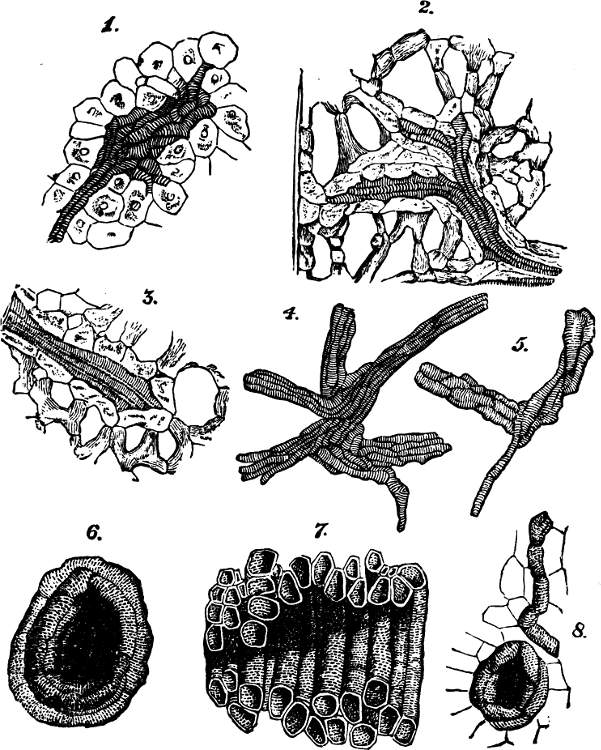
Figs.1–8.
Let me add that experiments on circulation in plants made during the state of inactivity, when it is to be presumed that the vessels and tissues contain but little gap, are much more successful than those made in the summer. It would seem that when the tissues are fully charged with sap the taking up of dyes is comparatively slow and the above-described effects are not so easily demonstrable.
[An expert writes concerning this essay:—“I have not attempted to annotate critically this paper. There is no doubt that many of your conclusions are perfectly sound, particularly those relating to the passage of crude sap through the cavities of the elements of the wood, though the opinion that the actual passage was through the walls very generally held till about 12 years ago.”]
APPENDIX D. ON THE ORIGIN OF THE VERTEBRATE TYPE.
[When studying the development of the vertebrate skeleton, there occurred to me the following idea respecting the possible origin of the notochord. I was eventually led to omit the few pages of Appendix in which I had expressed this idea, because it was unsupported by developmental evidence. The developmental evidence recently discovered, however, has led Professor Haeckel and others to analogous views respecting the affiliation of the Vertebrata on the Molluscoida. Having fortunately preserved a proof of the suppressed pages, I am able now to add them. With the omission of a superfluous paragraph, they are reprinted verbatim from this proof, which dates back to the autumn of 1865, at which time the chapter on “The Shapes of Vertebrate Skeletons” was written.—December, 1869.]
The general argument contained in Chap. XVI. of Part IV., I have thought it undesirable to implicate with any conception more speculative than those essential to it; and to avoid so implicating it, I transfer to this place an hypothesis respecting the derivation of the rudimentary vertebrate structure, which appears to me worth considering.
Among those molluscoid animals with which the lowest vertebrate animal has sundry traits in common, it very generally happens that while the adult is stationary the larva is locomotive. The locomotion of the larva is effected by the undulations of a tail. In shape and movement one of these young Ascidians is not altogether unlike a Tadpole. And as the tail of the Tadpole disappears when its function comes to be fulfilled by limbs; so the Ascidian larva’s tail disappears when fixation of the larva renders it useless. This disappearance of the tail, however, is not without exception. The Appendicularia is an Ascidian which retains its tail throughout life; and by its aid continues throughout life to swim about. Now this tail of the Appendicularia has a very suggestive structure. It is long, tapering to a point, and flattened. From end to end there runs a mid-rib, which appears to be an imbedded gelatinous rod, not unlike a notochord. Extending along the two sides of this mid-rib, are bundles of muscular fibres; and its top bears a gangliated nervous thread, giving off, at intervals, branches to the muscular fibres. In the Appendicularia this tail, which is inserted at the lower part of the back, is bent forwards, so as not to be adapted for propelling the body of the animal head foremost; but the homologous tails of the larval Ascidians are directed backwards, so as to produce forward movement. If we suppose a type like the Appendicularia in the structure and insertion of its permanent tail, but resembling the larval forms in the direction of its tail, it is, I think, not difficult to see that functional adaptation joined with natural selection, might readily produce a type approximating to that whose origin we are considering. It is a fair assumption that an habitually-locomotive creature would profit by increased power of locomotion. This granted, it follows that such further development of the tail-structures as might arise from enhanced function, and such better distribution of them as spontaneous variation might from time to time initiate, would be perpetuated. What must be the accompanying changes? The more vigorous action of such an appendage implies a firmer insertion into the body; and this would be effected by the prolongation forwards of the central axis of the tail into the creature’s back. As fast as there progressed this fusion of the increasingly-powerful tail with the body, the body would begin to partake of its oscillations; and at the same time that the resistant axis of the tail advanced along the dorsal region, its accompanying muscular fibres would spread over the sides of the body: gradually taking such modified directions and insertions as their new conditions rendered most advantageous. Without further explanation, those who examine drawings of the structures described, will, I think, see that in such a way a tail homologous with that of the Appendicularia, would be likely, in the course of that development required for its greater efficiency, gradually to encroach on the body, until its mid-rib became the dorsal axis, its gangliated nerve-thread the spinal chord, and its muscular fibres the myocommata. Such a development of an appendage into a dominant part of the organism, though at first sight a startling supposition, is not without plenty of parallels: instance the way in which the cerebral ganglia, originally mere adjuncts of the spinal chord, eventually become the great centres of the nervous system to which the spinal chord is quite subordinate; or instance the way in which the limbs, small and inconspicuous in fishes, become, in Man, masses which, taken together, outweigh the trunk. It may be added that these familiar cases have a further appropriateness; for they exhibit higher degrees of that same increasing dominance of the organs of external relation, which the hypothesis itself implies.
Of course, if the rudimentary vertebrate apparatus thus grew into, and spread over, a molluscoid visceral system, the formation of the notochord under the action of alternating transverse strains, did not take place as suggested in § 255; but it does not therefore follow that its differentiation from surrounding tissues was not mechanically initiated in the way described. For what was said in that section respecting the effects of lateral bendings of the body, equally applies to lateral bendings of the tail; and as fast as the developing tail encroached on the body, the body would become implicated in the transverse strains, and the differentiation would advance forwards under the influences originally alleged. Obviously, too, though the lateral muscular masses would in this case have a different history; yet the segmentation of them would be eventually determined by the assigned causes. For as fast as the strata of contractile fibres, developing somewhat in advance of the dorsal axis, spread along the sides, they would come under the influence of the alternate flexions; and while, by survival of the fittest, their parts became adjusted in direction, their segmentation would, as before, accompany their increasing massiveness. The actions and reactions due to lateral undulations would still, therefore, be the causes of differentiation, with which natural selection would co-operate.
APPENDIX D 2. THE ANNULOSE TYPE.
The production of a segmental structure by undulatory movements, suggested in Appendix D, as also in B (first published in 1858) as explaining the vertebral column, has been recently suggested by Prof. Korschelt as the cause of that segmentation of the annulose type which gives the name to it. He espouses a—
“view which is based upon the assumption that at first an unsegmented, elongated ancestral form was produced by terminal growth, whereupon the entire body became separated at once into a large number of segments by a re-arrangement of the individual organs. This assumption is supported by the consideration that with the lateral sinuous movement of the body, and with the rigidity of the tissues caused by increasing differentiation, the formation of alternating regions of greater and less motility was of considerable advantage to the individual, and rendered possible a further elongation of the body. The first cause for the appearance of metameric segmentation would then be sought in the manner of locomotion and in mechanical conditions. However, this latter view is not supported in any way by embryology.” (Embryology of Invertebrates, Part I, pp. 349–50.)
I venture to think the confession that this view “is not supported in any way by embryology” should be joined with the confession that it is at variance with that abstract embryology which comprehends the process of development in general. The assumption that there took place “a re-arrangement of the individual organs” of “an unsegmented, elongated ancestral form,” in such wise that the organs, previously single, presently became multiple, so that instead of one organ of each kind there were substituted many organs of each kind, is inconsistent with the general law of evolution, organic and other—implies not integration but disintegration. Everywhere the advance is from many like parts performing like functions to relatively few unlike parts performing unlike functions. The higher forms of the annulose type itself show this. Compare a myriapod and a crab. In the one we have not only a great number of similar segments bearing similar limbs, but we have in each segment a dilatation of the main blood-vessel—a rudimentary heart—a swollen portion of the nerve cord—a small ganglion—and so on; whereas in the other, besides relatively few segments and few limbs (sundry of them extremely unlike the rest) we have a vascular system concentrated into a central heart with arteries and a concentrated nervous system, such that the great ganglia in the integrated carapace immensely subordinate the ganglia of the remaining segments; and similarly with the other organs. Now unless it be denied that these highest decapods have been evolved from low types akin to myriapods in composition, it must be admitted that the progress has been from a string of many like segments with similar sets of organs to a group of relatively-few unlike segments with dissimilar sets of organs. If so we cannot rationally deny that the progress has been of this nature up from the lowest annelid, instead of having been, as Prof. Korschelt’s hypothesis implies, of opposite nature at the beginning.
In a preceding passage a clear recognition of the normal course of development occurs. In opposing the view set forth in §§ 205–7 of this work, Prof. Korschelt says:—
“It seems scarcely favourable to this theory that the degree of independence which the individual segments present is comparatively slight. The most important organs (nervous system, body musculature, blood-vascular system) show themselves to be single fundaments of the entire body, and are also developed as such even though they also exhibit evidences of metamerism. Even the excretory canals may give up their segmental isolation and become united to one another by means of longitudinal canals.” (Ib. p. 348.)
On turning back to § 206, the reader will, I think, demur to the assertion that the independence is “comparatively slight”; seeing that, as in Ctenodrilus, a single segment sometimes becomes separate and reproduces other segments to form a new series. Instead of admitting that “the most important organs” “show themselves to be single fundaments of the entire body,” it may be held, contrariwise, that their original independence in each segment is masked only to the degree involved by their co-operation as parts of a compound organism. But chiefly I remark that when it is said that “the excretory canals may give up their segmental isolation and become united” by “longitudinal canals,” there is a clear confession that the isolation of these organs was original and their union superinduced—an implication that the course of evolution is as I have described it, and at variance with the course of evolution assumed by Prof. Korschelt.
Yet another incongruity is involved in his interpretation. He writes:—
“Just as in the consideration of the tapeworm chain we were induced by the comparison with unsegmented forms to refer the entire chain to an unsegmented individual, and, on the other hand, to see in the proglottis, not a complete individual, but only the abstricted hinder portion of the body of the Cestode, in the same manner, and with much more reason, we adhere to the individuality of the Annelid body.” (P. 349.)
And then on the preceding page, referring to the composition of the Annelid body, he says:—“The most natural comparisons are those with the tapeworm chain and with the strobila of the Scyphomedusæ.” Now since it is here assumed that the tapeworm and the strobila are analogous in composition, it is implied that the detached proglottis and the detached medusa are analogous; and hence if we are to regard the proglottis as “not a complete individual but only the abstricted hinder portion of the body of the Cestode,” then we must similarly regard the medusa as not a complete individual, but only the abstricted hinder portion of the strobila. This commits us to the strange conclusion that whereas individuality is ascribed to the original simple polyp, and by and by to the partially-segmented strobila, though these are without special senses and with only rudiments of muscular and nervous systems, individuality is denied to the detached medusa, which has organs of sense, a distinct nervo-muscular system and a considerable power of locomotion, as well as a generative system: traits which in other cases characterize developed individuals. Here also, then, there seems to be an inversion of the ordinary conception.
This conception of the proglottis and the medusa is, I see, accepted by some as tenable. But if we accept it we must accept also an analogous conception, which will I think be regarded as untenable. It is that supplied by the Aphides. From an egg proceeds a series of sexless and wingless females, and at the end of the series there come winged males and females with resulting gamic reproduction. If instead of forming a discrete series the imperfect females formed a concrete series, the members of which could individually feed without being detached from one another, as the segments of a tapeworm can, the parallelism would be complete; and then, according to the view in question, we should have to regard the perfect males and females eventually arising, not as individuals but as terminal portions of the series, containing generative products and having wings for the dispersion of them—locomotive egg-bearing segments of the chain. Whoever espouses this view must hold either that the first imperfect female of the series was the individual or that the entire string of them constituted the individual (in conformity with a view once propounded by Prof. Huxley). But he must do more than this. Since the Aphides have descended from some winged species of the order Hemiptera, he must hold that among those remote ancestors each particular fly, male or female, was an individual; but that when abundant food and inert life led to the partheno-genetic habit, and to chains of sexless forms, the males and females eventually produced at the end of each chain, though, like their remote ancestors, possessed of procreative organs and wings, are not individuals.
[Some memoranda bearing on the question here discussed, mislaid at the time when the chapter dealing with it was revised, have been discovered in time for utilization in this appendix.]
One of my critics says:—
“You have overstated the case in your favour: the alimentary canal does not, as you suggest, show a segmentation corresponding to that of the other organs in Annelids. Either it is a simple uniform tube, or else its differentiations (pharynx, œsophagus, crop, intestine) are quite independent of the repetition of the somites.”
In presence of statements made in works of authority, this objection greatly surprises me. I meet with the descriptive word “moniliform” applied to the intestine in some Annelids, and then in the Text Book of Claus, translated and edited by Sedgwick, it is said, concerning the alimentary canal in the Annelida:—
“This is followed by the gastric region of the gut, which occupies the greatest portion of the length of the body, and is either regularly constricted in correspondence with the segments, or possesses lateral diverticula.” (P. 365.)
And again on p. 369 it is said:—
“The intestine usually preserves the same structure in its entire length and is divided by regular constrictions into a number of divisions or chambers, which correspond to the segments and dilate again into lateral diverticula and cæca.”
The alimentary canal thus presents the segmental character as clearly as consists with fulfilment of its function. If the successive segments are co-operating units of a compound animal having but one mouth, then, necessarily, the gut cannot be completely cut into parts, each answering to a segment, for there could be, in that case, no passage for the food. If the portion of the intestine belonging to each segment has a conspicuous dilatation, or has a cæcum on each side, it exhibits the segmental character as much as the physical requirements permit. So far from being at variance with the hypothesis, its structure exhibits a verification of it.
The next objection runs as follows:—
“Then, again, the ovaries and testes do not exhibit a corresponding segmentation. When it is allowable to speak of ovary or testis at all as in Lumbricus, we find that in the case of both organs we have at most two pairs.”
It seems to me that the distribution of the generative organs in a comparatively-developed member of the Annelid type, is not the question. We have to ask what it is in undeveloped members of that type. Among them the repetition of generative parts is in some cases just what the theory implies. Thus in Claus I read:—“In the marine Chætopoda, the ova or spermatozoa originate on the body-wall from cells of the peritoneal membrane, either in the anterior segments alone or along the whole length of the body.” So that in these last cases there are, in all the segments, parts from which arise generative products. The fact that these parts are not definite ovaries and testes is irrelevant. Ovaries and testes are developed generative structures, and in the order of evolution are preceded by undeveloped ones; and the fact that these undeveloped ones are found in little-developed members of the type conforms perfectly to the hypothesis. [I may remark in passing that here is a good illustration of that process of evolution which, in the above speculation of Prof. Korschelt, is supposed to be inverted: many dispersed, similar, and indefinite parts, are integrated into a few localized and definite parts.]
In continuation the critic above quoted says:—“My position is that the repetition of segments in an Annelid is a phenomenon of the same nature as the repetition of hairs in a Mammal or of scutes in a Reptile”, and he proceeds to give instances of repetitions of organs in other types, as of the reproductive structures and excretory system in the young Dog-fish or of the ovaries in Amphioxus. These examples do not seem to me relevant. No parallelism exists between the repetition of a particular organ in an animal, and the repetition of an entire cluster of organs constituting a physiological whole. The repetitions of the ovaries in Amphioxus and of the excretory system in a young Dog-fish, occur without threatening to divide into similar parts the entire organism. But the segmental repetitions in an annulose creature implicate the structures at large, and would, if pushed a little further, result in separate creatures. The segment of a low Annelid contains alimentary, vascular, nervous, excretory, reproductive, sensory and locomotive organs—all the organs required for carrying on life, save certain organs of external relation which its position excludes. When there is shown some vertebrate animal, or proto-vertebrate animal, that is divisible into parts each of which is in great measure physiologically independent, I shall feel obliged to abandon my position.
While this appendix is in hand I have received from another expert, whose view is in general agreement with my own, a letter containing the following passage:—
“You will see that Dohrn’s theory was the antithesis of your own view of vertebrate structure, namely that the vertebræ were formed by the segmentation, from mechanical causes of a body originally simple. This view of yours has been confirmed by later researches, which have shown that the most primitive forms allied to the Vertebrates, possessing the essential organs, viz., gill-slits, notochord, and dorsal nerve cord, are not segmented animals, like Annelids and Crustacea, but simple animals, having at most three regions, not exactly corresponding to segments. These primitive unsegmented forms are Ascidian tadpoles, Balanoglossus, and certain other primitive forms. The embryology of Vertebrates also proves that they are originally simple and not segmented animals, especially the fact that there is originally one pronephric duct or primitive kidney.”
Nevertheless there survives a leaning towards the notion of a segmental origin of the Vertebrata. But the repetitions of organs named in support of this notion have, I think, no more relation to the genesis of the vertebrate type than the multiplication of vertebræ in a snake has relation to the genesis of the vertebral column.
APPENDIX E. THE SHAPES AND ARRANGEMENTS OF FLOWERS.
In Part IV., Chapter X., under the title of “The Shapes of Flowers,” I have, after describing their several kinds of symmetry, as habitually related to their positions, made some remarks by way of interpretation. The truth that flowers exhibit a radial symmetry when they are so placed as to be equally affected all round by incident forces, having been exemplified, and also the truth that they assume a bilateral symmetry when they are so placed that their two sides are conditioned in ways different from the ways in which their upper and lower parts are conditioned; I have gone on to inquire (in § 234) by what causes such modifications of form are produced. I have stated that, originally, I inclined to ascribe them entirely to differences in the relations of the parts to physical forces—light, heat, gravitation, etc.; but that I found sundry facts stood in the way of this interpretation. And I have said that “Mr. Darwin’s investigations into the fertilization of Orchids led me to take into account an unnoticed agency.” Continuing to recognize the physical forces as factors having some influence, I have concluded that the most important factor is the action of insects; which, aiding most the fertilization of those flowers which most facilitate their entrance, produce, in course of generations, a form of flower specially adapted to the special position.
Though still adhering to this interpretation, I have since found reason to think that the original interpretation contains a larger portion of truth than I supposed at the time when I was led thus to revise it. While staying at Mürren, in Switzerland, in 1872, I observed some modifications in a species of Gentian, which proved to me that the action of incident physical forces on flowers is, in some cases, very rapid and decided. The species furnishing this evidence was the Gentiana Asclepiadea; which I found in a copse formed of bushes that were here wide apart and there close together. In some places not near to the bushes, the individuals of the species grew vertically; in other places, partially shaded, their inclined shoots curved in such directions as to get the most light; and in other cases their shoots were led to take directions almost or quite horizontal. That, along with these modifications in the directions of their shoots, there went adjustments in the attitudes of their leaves, was a fact not specially worthy of remark; for plants placed inside the windows of houses habitually show us that leaves quickly bend themselves into attitudes giving them the greatest amounts of light. But the fact which attracted my attention was, that the flowers changed their attitudes in an equally-marked manner. The radial distribution passed into a bilateral distribution with the greatest readiness. Comparison of the annexed figures will show the character of this change.
Figure I. represents part of a vertically-growing shoot. This belonged to an individual growing unimpeded by bushes, and getting light on all sides. Here it is observable that the pairs of leaves, placed alternately in directions transverse to one another—one pair pointing, say, north and south, and the next pair pointing east and west—maintain, taking them in the aggregate, a radial distribution; and it is also observable that the alternate pairs of flowers are similarly arranged.
Figure II. is a sketch from a shoot which leaned towards one side, and of which the higher part, as it bent more and more, got its upper side more and more differently conditioned from its lower side. Here we find that not only the leaves, but also the flowers, have adjusted themselves to the changed conditions. The leaves of the lowest pair hang out in the normal way, on the opposite sides of the axis, so that a plane passing through their surfaces will cut the axis transversely; and their two axillary flower-buds, c and d, are similarly placed on opposite sides of the axis. But at the other part of the shoot, we see both that the leaves have adjusted themselves so that their planes, no longer cutting the axis transversely, keep a fit adjustment with respect to the light; and also that the flowers, no longer on opposite sides of the axis, have bent round to the upper side, as at a and b.
Figure III. shows us this re-arrangement carried still further. The shoot it represents was growing in a direction nearly horizontal, and therefore receiving the light only on one side. And here, besides seeing that the leaves have so adjusted themselves that they all lie in approximately the same plane, which is parallel to the axis instead of transverse to it, we see that the two pairs of flower-buds have both come round to the upper side of the axis. So that in this shoot, the original radial symmetry in the arrangement of leaves and flowers, is completely changed into a bilateral symmetry.
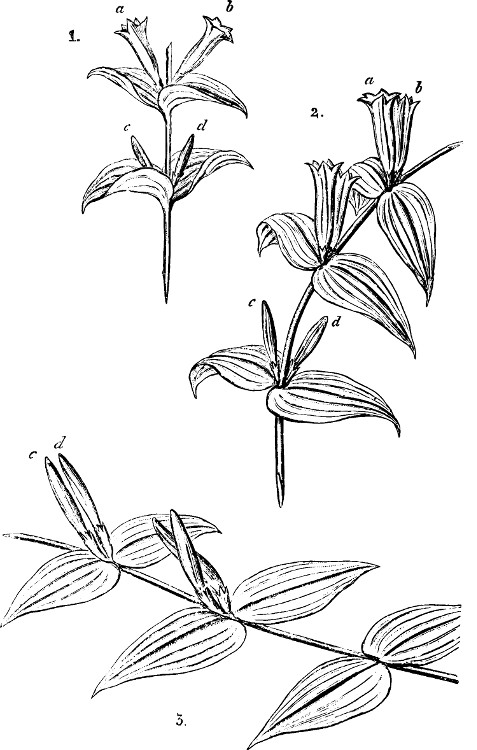
Figs. 1–3.
These facts do not, it is true, prove any modification in the forms of the flowers themselves: they only prove modification in the grouping of the flowers. But beyond showing, as they do conclusively, how readily a bilateral arrangement of flowers is producible out of an arrangement that was not bilateral, by the action of light, etc.; they give increased probability to the belief that changes in the shapes of flowers are producible by the same agencies. Doubtless this change in the attitudes of the flower-buds is due to the action of light on their calyces and peduncles more than to its action on their unfolding corollas. But along with an action so decided on the growth of these sheathing and supporting organs containing chlorophyll, it is scarcely probable that there is no action on the growth of the petals, containing other colouring matter; considering that in both cases the development of the colouring matter depends on the action of light, and considering also the effect of light on petals, familiarly shown by their opening and closing. And if even but a small effect is producible on the growth of the corolla, then it is to be expected that light will be an agent in changing the form of the corolla, when the attitude of the flower causes its parts to be differently exposed. For a small effect on the individual flower will become a great effect in the flowers of remote descendants; provided the changed attitudes of the flowers preserve considerable constancy throughout the succession of individuals.
Be this as it may, however, the facts I have here described, which I doubt not other observers have seen paralleled in other plants, are instructive, as showing how quickly certain metamorphoses are produced, and as implying the easy establishment of such metamorphoses as permanent characters in a species, if the modifying conditions become permanent. The changes of arrangement I have pointed out, do not become permanent in this species because its individuals are variously affected by the modifying forces: on some they do not act at all, on some a little, on some much; and even on the same individual the different shoots are quite differently affected. But if the habit of this plant were greatly changed—if, for instance, by spreading into habitats yielding abundant nutriment, the plant became very luxuriant, and, multiplying its branches, grew shrub-like; it is clear that, being shaded by one another, these branches would be habitually circumstanced in a way like that which we here see produces bilateralness in the distribution of the flowers, if not in the flowers themselves; and being thus permanently affected, would become permanently bilateral. Accumulating by inheritance, what is here only an individual peculiarity, would become a peculiarity of the species—a specific character.
APPENDIX F. PHYSIOLOGICAL (OR CONSTITUTIONAL) UNITS.
There has recently come before me a fact which has a significant bearing on the hypothesis of Constitutional units: serving, indeed, to give an apparently conclusive proof of its truth. Before stating it, however, I may with advantage re-state the several evidences already assigned in support of it.
1. First comes the à priori reason. These units in the germ of an organism which cause development into a special structure, cannot be chemical units—cannot be simply molecules of proteid substance in one or other of its forms; since these are not special to any type of creature but common to all creatures. Nor can they be what we may call morphological units—the cells or protoplasts; because in the early stages of development the cells of one organism are indistinguishable from those of others, and because were cells the units of composition there could be no interpretation of what are called unicellular organisms—nothing to account for the innumerable varieties of them. Hence, of necessity, the structural elements of which each organism is built, being neither proteid molecules nor cells, must be something between them: probably some complex combination of different isomeric forms of proteids.
2. That units of such natures are the essential components of each species of organism, is shown by the fact that in low types of creatures, little differentiated into special tissues, any considerable portion of the body will, when separated, begin to assume the structure proper to the species—a truth recently shown afresh by Prof. T. H. Morgan’s experiments on the regeneration of Planaria maculata (already referred to in § 206) showing that various fragments cut out develop into new individuals, and that when, being too small they die before doing this, there is always an abortive attempt to assume the specific structure.
3. This truth that a portion of undifferentiated tissue, if adequate in quantity, assumes the structure of the type, illustrating as it does the proclivity of the constitutional units towards the structure of the species, allies itself with the phenomena of both agamogenesis and gamogenesis. The first of these shows us how a fissiparously-detached portion of the parental tissue takes on the same form as the parent; and the second shows how those small detached portions distinguished as sperm-cell and germ-cell also, when united and supplied with the needful materials, do the same thing.
4. But the set of phenomena following the union of sperm-cell and germ-cell differ in a certain way from those which follow when a gemma or other unfertilized portion of parental tissue is detached. The incomprehensibleness of this difference as otherwise contemplated, and the partial comprehensibleness of it when joined with the hypothesis of physiological units, furnish a further support for the hypothesis.
The familiar truth learnt by the tyro in algebra that an apparent solution which contains the unknown quantity is no solution, is a truth apt to be overlooked in other spheres than the algebraic. An illustration is supplied by the answer once given in Parliament to the question “What is an Archdeacon?”—“One who discharges archidiaconal functions.” But science as well as daily life furnishes examples. When it is said by Engelmann, Hensen, Hertwig, and Maupas that “the essential end of sexuality is rejuvenescence, that is, the restoration of growth-energy,” we have another instance of an explanation which explains nothing. What is the phenomenon to be explained? That unfolding of an organism from a germ which displays growth-energy. And what is the explanation? The giving of fresh growth-energy. The unknown quantity “growth-energy” is contained in the explanation proposed. There exists no conception of “juvenescence” save that derived from observing developing plants and animals; and if “re” be prefixed, no interpretation is thereby given to the unexplained thing “juvenescence.”
Coleridge somewhere comments on a source of fallacy which he calls the “hypostasis of a relation”—the changing of a relation into a thing. The plumber who tells you that water rises in a pump “by suction” supplies an instance. Having assumed suction to be an agent, he thinks that he understands how the piston does its work. Some of the explanations given of fertilization supply further instances. When it is said that sexual union has for its end “to give increased vigour to all the vital processes,” it is tacitly implied that vigour is a something—a something which can be given. But now, in the first place, it is only by the hypostasis of a relation that we are led to think of vigour as a thing. Vigour is a state—that state of a living body which enables it to give out much motion. What enables it to do this? The presence in it of abundant molecules containing much molecular motion which can be transformed into molar motion: the transformation being effected by the falling of these molecules into their simpler and relatively-inert components, which are thereupon excreted. Energy-containing matter is used up, and more energy or vigour can be given only by supplying more such matter. How then can the union of two nuclei—those of the sperm-cell and germ-cell—give vigour? Only an infinitesimal portion of vigour in the sense above explained exists in either, and the union of them leaves it still infinitesimal. And then, even supposing the vigour to be an entity and to be appreciable in quantity, how could it go on producing that immense combination of physiological actions seen in the unfolding of the germ into an organism? and how could it go on producing the physiological actions of an adult organism during a whole century?
May we not then say that these proposed explanations leave the question where it was—are nominal solutions, not real solutions?
5. But the hypothesis of constitutional units furnishes, if not a satisfactory answer yet, something in the nature of an answer—a true cause; that is to say, a cause actually known to us as operating in other cases. In § 92 it was pointed out that in proportion as units are similar, there may be built up from them an aggregate which is relatively stable, and that along with increasing dissimilarity the stability of the aggregate decreases. It was inferred that if a group of constitutional units belonging to one individual which have become moulded into relatively exact congruity with the organism and with one another by long co-operation, are mingled with some belonging to another individual which, differently circumstanced, has become somewhat different in itself and in its units, then the mass formed by the union of the two groups will be relatively unstable—relatively modifiable by incident forces. Whereas in either organism, no longer perpetually changed in the relations of its parts by growth, there is an approach towards equilibrium between the whole and its components, the components contributed by the two to form a germ, being slightly unlike one another, will not form a group in a state of equilibrium. The group they form will be capable of easy change by incident forces; and they will so be rendered free to follow their proclivities towards the typical form of the species. Inferring this we must also infer that so long as these two sets of slightly different units are not exposed to any constant forces tending to coerce them into the same form, there will continue to exist in the nuclei of all descendant cells this same relative instability and consequent plasticity.
Such evidence as we have verifies this interpretation. There is first the universal fact that development of the germ begins when it is exposed to an incident force—heat—the undulations of which, increasing the oscillations of the mixed units, give them greater freedom to arrange themselves in conformity with their type. We see this alike when spring warmth makes a seed germinate and when the warmth of a sitting hen sets up organization in her eggs. Heat frees the molecules of inorganic matter from local restraints and, as we see in molten metal, lets them yield to other forces; and similarly in this organic matter, the units are made free to follow their proclivities. Then, secondly, there comes the evidence from comparisons between the effects of mixing constitutional units differing in various degrees. Let the cluster of mixed units be derived from animals that are ordinally distinct. Nothing happens. The units each contributes tend to arrange themselves after the parental type. Hence a conflict between the tendencies towards two markedly unlike structures, and no structure arises. Suppose the mixed units come from two kindred species—say horse and ass. The structures which they respectively tend to form, being in their main characters alike, there is such co-operation as produces a working organism but an organism in certain respects imperfect—a mule. Suppose, again, the units come from two varieties of the same species. A perfect organism results, and, as shown by Mr. Darwin when detailing the effects of crossing, an unusually vigorous organism. The units being more unlike than those belonging to the same variety, the instability of the germ-plasm is unusually great, and the transformations which constitute development and action become unusually active. When, as in ordinary cases, the units are supplied by members of the same variety who have not been made very much alike by their antecedents, there follows the usual amount of organic vigour. Coming now to the results of breeding in-and-in—breeding between individuals whose constitutions (i.e. constitutional units) have for generations been growing more alike in the absence of crossing with other stirps—we see that diminution of organic vigour is displayed: there is a decrease in the rate of physiological change. Finally, on coming to a closer relationship, as in marriages between cousins, in whom the constitutional units are more than commonly alike, we see there frequently follows either barrenness or the production of feeble offspring.
All these facts, then, are congruous with the hypothesis that the use of fertilization is the mixing of unlike units, and consequent production of plasticity. Leaving out cases in which the unlikenesses are so great as wholly to prevent co-operation among the units, the degree of vigour, that is, the activity of physiological change, is great where the unlikeness is great and diminishes with the approach towards likeness.
6. The existence of constitutional units seems otherwise necessarily implied. I refer to the fact that no organism is a homogeneous mean between its parents but consists of a mixture of parts, some following one parent and some the other. Among illustrations of this the most conspicuous are those yielded by the variously-mixed colours of hair or feathers. Horses, cattle, dogs, cats, hens, pigeons display these mixtures: colours in one place like the mother and in another place like the father. As the internal organs are invisible, and as visible organs have indefinite shapes and graduate indefinitely into adjacent ones, the mixture of traits is elsewhere less conspicuous; but occasional marked cases (especially in malformations) leave no doubt that it pervades the entire organism.
This peculiarity of transmission seems necessarily to imply that there are distinct units derived from the two parents, and that in the course of development there is more or less segregation of them—those of the one origin predominating so far in some places as to give special likeness to one parent, and those derived from the other doing the like in other places. All which interpretation is impossible unless the hypothesis of constitutional units be admitted.