EXOGENOUS TREES. (Dicotyledons.)
Reading edition
Exogenous trees are those the trunks of which are built up by rings or layers, each deposited consecutively upon the outside of the others. A section exhibits first a central point or canal known as a pith-cavity, next and consecutively the annual layers, and finally the bark. The woods of this series are familiar to all. The oaks, pines, and practically all of the merchantable lumbers are among them. The forests are widely distributed, and the species are so numerous as to present an almost infinite range of possibilities.
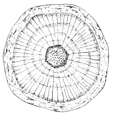
Fig. 2.—Section Boxelder, showing Pith-cavity at Centre.
The young wood of exogenous trees is porous. It permits the passage of sap and is known as sapwood (Alburnum). As a layer is enclosed by others and retreats from the surface of the tree, it becomes denser, its canals are filled with gums or tannin, color changes, and the result is heartwood (Duramen). This change goes forward rapidly in some trees, such as locusts, so that their sections appear to be almost wholly heartwood; other species require longer time, and sapwood then predominates.
Heartwood gives stability to the tree, but is not needed in its physiological processes. It is tougher, heavier, stronger, and more valued in construction. Sapwood is vitally essential to the life of the tree, but is lighter, weaker, less durable, and less valued in construction. Sapwood is pliable, and the sapwoods of several trees are valued for this reason.
Wood-making varies as it takes place in the springtime and in the summer. Consequent differences in the densities [p008] of the deposits serve to mark the limits of the yearly rings. Some species, as the oaks and hickories, show pores throughout their spring woods which thus contrast with denser summer growths. Others, as Southern pines, change sharply, and their spring and summer growths appear as solid bands. In even climates, where seasons are not pronounced, growth is more regular and layers correspondingly less definite.[9]
The cellular structure of wood is principally vertical, a fact that explains the ease with which wood is split up and down. Beside the vertical, there are horizontal cells, that cross the tree, strengthen and bind the vertical cells, and assist in the life-processes of the tree. These horizontal cells form what are known as medullary or pith-rays and appear as simple lines or glistening plates according to the way in which the wood is cut. Woods differ in the size and number of these rays, which are by no means always visible to the eye (see plate 3).
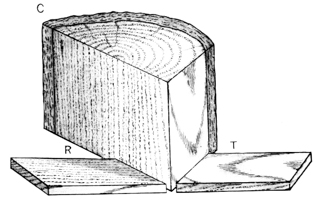
Fig. 3.
Woods are easy or difficult to work in proportion as their fibres are arranged in a simple or a complicated manner. This is shown in the figures on plate 4. A knife pressed upon the oak must crush or cut into the fibres themselves, whereas with the pine it finds some natural passage between the cells. Wood may be cut so as to develop cross-sections (C, Fig. 3), radial sections (R), or tangential sections (T). The respective [p009] markings are in a general way indicated on the boards in the figure.
PLATE 3. EXOGENOUS STRUCTURE IN WOOD. Medullary or Pith Ray.
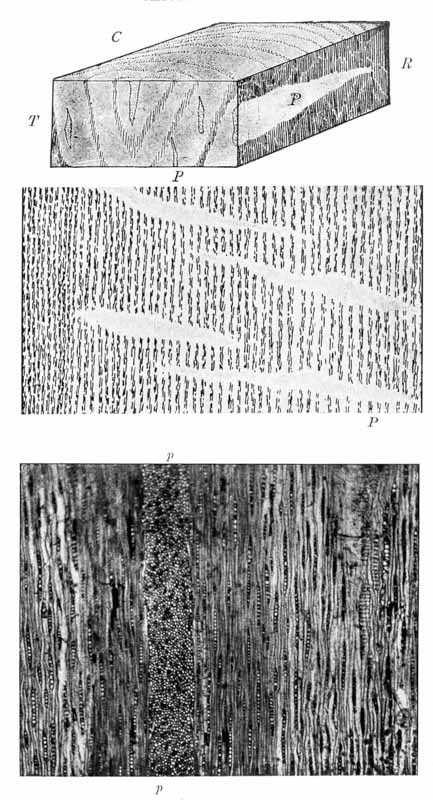
Middle--Actual appearances of pith ray, PP.
Bottom--Microscopic enlargement of a tangential section of White Oak showing large pith ray, pp.
PLATE 4. EXOGENOUS STRUCTURE IN WOOD. (CROSS-SECTIONS, ENLARGED.)
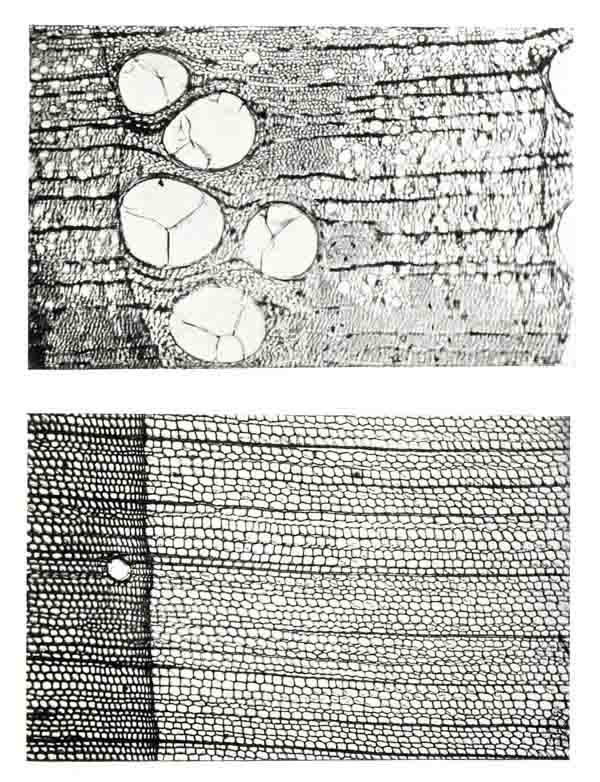
Top--Two yearly layers of White Oak. The larger pores were formed in spring, the smaller ones in summer. The small circles are ends of fibres. A knife pressed upon this surface would crush or cut into the cells. The mass would not split or separate evenly.
Bottom--Two yearly layers of White Pine. The space in the outer or darker one is a resin-duct; the circles are ends of fibres (tracheids); pith rays are noticeable. A knife pressed upon this surface would find easy passage. The mass would separate easily.
Logs are sometimes sawn into quarters and then into pieces crossing and exposing the yearly rings. (See Fig. 4.) These "quarter-sawn" surfaces are structurally stronger and better, but are, by reason of waste or small pieces, more costly than others. The pith-rays of some woods, such as oaks, are very prominent when split as they are in "quarter-sawing," and the appearance of such woods is consequently improved.[10]

Fig. 4.
Exogenous trees are divided into broad-leaved trees and needle-leaved conifers. The broad, flat leaves of trees such as oaks and chestnuts gave rise to the former term, while the narrow resinous leaves of the pine and hemlock gave rise to the latter. The woods of the former group are usually referred to as hard woods, although some of them are very soft; those of the latter group are referred to as soft woods, although some of them are very hard. Most, but not all, of the broadleaf trees are deciduous, that is, they change their foliage every year; and most, but not all, of the needleleaf trees are evergreen, that is, the foliage is persistent. Needleleaf trees are also known as conifers, that is, cone-bearers.
It is usual to associate the terms broadleaf, deciduous, and hard wood; and likewise the terms needleleaf, conifer, evergreen, and soft wood. While generally correct, this is, as seen, not always so. A better division is into broadleaf trees or woods, and needleleaf conifers. [p010]
BROADLEAF WOODS.
The trees affording these woods are found in natural forests and under cultivation in nearly every portion of the globe. The histories of some of them extend back to very remote periods. Their woods were the principal ones in construction until the advent of American soft woods. The oaks, elms, maples, and other so-called hard woods are of this group.
Broadleaf woods are characterized by complex fibre conditions, absence of resins, and greater weights.[11] They are composed of several kinds of cells and fibres, arranged without the regularity so noticeable in the conifers. Cross-sections exhibit numerous, often easily visible pores, arranged in zones or scattered throughout the rings (see plate 2). Pith-rays are numerous and more or less conspicuous, save in softer hard woods such as poplar. Woods are difficult to work in proportion as they are complicated in structure. The numerous members of the group vary from one another and present an extensive range of properties. Trees do not usually afford large pieces. Woods for cabinet work, implements, and other fine purposes are from this group. The total requirement is less than for needleleaf woods.
The leaves of broadleaf trees are easily distinguished from the resinous, usually evergreen ones of the conifers. Most of them are deciduous, that is, shed every season, although some are persistent, that is, "evergreen." "Broadleaf," "deciduous," and "hardwood" trees are the same. [p011]
FOOTNOTES
PLATE 5. WHITE OAK (Quercus alba).
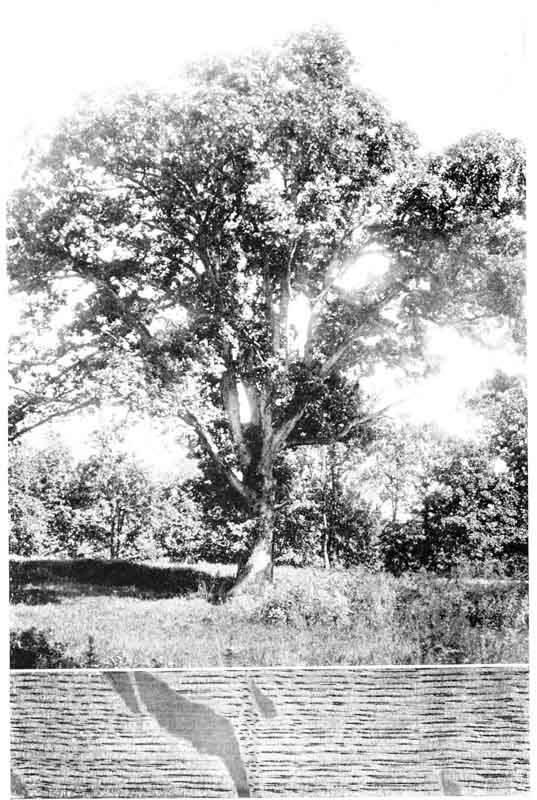
OAK. (Quercus.)
The oaks are found on all of the continents of the northern hemisphere, as well as at high altitudes just south of the equator. Their woods stand pre-eminent among those of the broadleaf series and have been highly prized from early periods. Formerly relied upon for all purposes of house and naval architecture, they did not give way to the so-called "soft woods" for houses, and to iron for vessels, until comparatively recent periods. They were supplanted for the former purposes upon the opening of the soft-wood forests of North America and of the Baltic, and for vessels subsequent to the conclusions of the American Civil War.
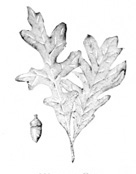
White Oak (Quercus alba).
The historical importance of oak is founded upon the reputation of the English Oak as derived from two trees, Quercus robur var. pedunculata and Quercus robur var. sessiliflora, usually taken as sub-species of Quercus robur.[12] It is said that these trees once formed large forests over Northern and Central Europe. Live-oak has always been highly esteemed, but is now very scarce. It is one of the hardest, heaviest, and most durable of constructive woods and was once largely employed in ship-building. The wood of the White Oak (Quercus alba) is at present preferred for most purposes for which oak is now employed, and is one of the most valuable of the American hard woods.
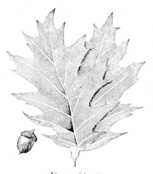
Red Oak (Quercus rubra).
Oak is tough, durable, easily obtained, liable to warp and check in seasoning, often hard to nail without splitting, susceptible of high polish, and not greatly liable to attack by insects. It contains gallic acid, causing peculiar taste and odor and attacking iron, the solutions staining the wood. Experiments[13] indicate that iron fastenings are shortly protected by an insoluble scale of resulting salt, and that the wood, although [p012] darkened, remains practically uninjured. The later oaken vessels were iron-fastened,[14] and cabinet-makers now employ that metal in joining oak. The barks of all species are also so charged with acid as to be used in the tanning of leather. The several kinds of oak are commercially divisible into three general groups, white oak, red or black oak, and live oak.[15] The principal species affording woods under each head are as follows:
White Oak. White Oak (Q. alba). Cow Oak (Q. michauxii). Chestnut Oak (Q. prinus). Post Oak (Q. minor). Bur Oak (Q. macrocarpa). Pacific Post Oak (Q. garryanna).
Red or Black Oak. Red Oak (Q. rubra). Pin Oak (Q. palustris). Spanish Oak (Q. digitata). Yellow or Black Oak (Q. velutina).
Live Oak. Live Oak (Q. virginiana). California Live Oak (Q. agrifolia). Live Oak (Q. chrysolepis)
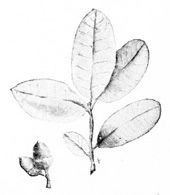
Live Oak (Quercus virginiana).
Oak trees are characterized by oblong, thin-shelled kernels, protruding from hard scaly cups and called acorns. The foliage is sometimes deciduous and sometimes evergreen. Most oaks require many years to reach maturity, but are then long-lived. Fifty of the nearly three hundred known species of oak are natives of the United States and Canada; all but four become trees under favorable conditions. Quercus is from two Celtic words, quer, signifying fine, and cuex, a tree. [p013]
FOOTNOTES
White Oak. Quercus alba Linn.
Nomenclature.
White Oak (general).
Stave Oak (Ark.).
Locality.
Widespread, north-central and eastern United States.
Features of Tree.
Seventy-five to one hundred feet in height. Three to six feet in diameter, fine shape and appearance. Grayish-white bark. Comparatively sweet ovoid oblong acorns in rough shallow cups. Rounded lobes or projections to leaves.
Color, Grain, or Appearance of Wood.
Heartwood brown with sapwood lighter. Annual layers well marked.
Medullary rays broad and prominent.
Structural Qualities of Wood.
Tough, strong, heavy, hard, liable to check unless seasoned with care. Durable in contact with the soil. Receives a high polish.
Representative Uses of Wood.
Ship-building, construction, cooperage, cabinet-making, railway ties, fuel, etc. Bark is rich in tannin.
Weight of Seasoned Wood in Pounds per Cubic Foot.
50 (U. S. Forestry Div.).[16]
46.
Modulus of Elasticity.
2,090,000 (average of 218 tests by U. S. Forestry Div.).[16]
1,380,000.
Modulus of Rupture.
13,100 (average of 218 tests by U. S. Forestry Div.).[16]
12,800.
Remarks.
A tree of the first economic importance. The most widely employed of all American oaks. Name refers to appearance of bark. The supply diminishing because of value of timber, also the sweetness of nuts cause them to be eaten by animals. [p014]
FOOTNOTE
Cow Oak. Quercus michauxii Nutt.
Nomenclature. (Sudworth.)
Cow Oak (local and common name).
Basket Oak (Ala., Miss., La., Tex., Ark.).
Swamp White Oak (Del., Ala.).
Swamp Chestnut Oak (Fla.).
Locality.
Southeastern United States, Delaware and Florida, westward along Gulf to Texas. Also southern Indiana and Illinois to Gulf. Best on rich bottoms in Arkansas and Louisiana.
Features of Tree.
Seventy-five to one hundred feet in height. Three to six feet in diameter, rough, light-gray bark with loose scaly ridges.
Color, Appearance, or Grain of Wood.
Heartwood light brown, light buff sapwood, conspicuous medullary rays, close-grained.
Structural Qualities of Wood.
Hard, heavy, very strong, tough, durable, easily split.
Representative Uses of Wood.
Construction, agricultural implements, wheel stock.
Weight of Seasoned Wood in Pounds per Cubic Foot.
46 (U. S. Forestry Div.).[17]
50.
Modulus of Elasticity.
1,610,000 (average of 256 tests by U. S. Forestry Div.).[17]
1,370,000.
Modulus of Rupture.
11,500 (average of 256 tests by U. S. Forestry Div.).[17]
15,800.
Remarks.
The principal white oak of Southern States; edible acorns devoured by cattle, whence its name. [p015]
FOOTNOTE
Chestnut Oak. Quercus prinus Linn.
Nomenclature. (Sudworth.)
Chestnut Oak (local and common name).
Rock Oak (N. Y., Del., Pa.).
Rock Chestnut Oak (Mass., R. I., Pa., Del., Ala.).
Tanbark Oak (N. C.).
Swamp Chestnut Oak (N. C).
Mountain Oak (Ala.).
Locality.
Maine to Georgia, westward intermittently to Kentucky and Alabama. Best development in southern Alleghany Mountain region.
Features of Tree.
Seventy-five to eighty feet in height, three or four feet in diameter. Leaves resemble those of chestnut.
Color, Appearance, or Grain of Wood.
Heartwood dark brown, sapwood lighter, close-grained, medullary rays conspicuous.
Structural Qualities of Wood.
Heavy, tough, hard, strong, and durable in contact with soil.
Representative Uses of Wood.
Largely used for railway ties. Bark rich in tannin.
Weight of Seasoned Wood in Pounds per Cubic Foot.
46.
Modulus of Elasticity.
1,780,000.
Modulus of Rupture.
14,600.
Remarks.
Prinus is a Greek name applied to a species of oak. [p016]
Post Oak. Quercus minor Sargent, Quercus obtusiloba Michx.
Nomenclature. (Sudworth.)
Post Oak (local and common name).
Iron Oak (Del., Miss., Neb.).
Box White Oak (R. I.).
Chêne étoilé (Quebec).
Overcup Oak (Fla.).
White Oak (Ky., Ind.).
Box Oak (Md.).
Brash Oak (Md.).
Locality.
East of Rocky Mountains—Massachusetts to northern Florida, westward intermittently to Nebraska and Gulf States.
Features of Tree.
Fifty to seventy feet in height, two to three feet in diameter. Low shrub in Florida. Blunt lobes or projections to leaves. Leaves clustered at ends of branches. Fine tree with rounded top.
Color, Appearance, or Grain of Wood.
Heartwood light or dark brown with lighter sapwood. Close-grained, annual rings well marked. Numerous and conspicuous medullary rays.
Structural Qualities of Wood.
Heavy, hard, strong, checks badly in drying. Durable in contact with soil.
Representative Uses of Wood.
Largely used, particularly in Southwest, for fencing, railway ties, and fuel; also for cooperage, construction, etc.
Weight of Seasoned Wood in Pounds per Cubic Foot.
50 (U. S. Forestry Div.).[18]
52.
Modulus of Elasticity.
2,030,000 (average of 49 tests by U. S. Forestry Div.).[18]
1,180,000.
Modulus of Rupture.
12,300 (average of 49 tests by U. S. Forestry Div.).[18]
12,900.
Remarks.
Most common and widely distributed oak in Gulf States west of the Mississippi River. Obtusiloba, the Latin for blunt-lobed, refers to the shapes of the leaves. Wood seldom commercially distinguished from white oak. [p017]
FOOTNOTE
Bur Oak. Quercus macrocarpa Michx.
Nomenclature. (Sudworth.)
Bur Oak (local and common name).
Overcup Oak (R. I., Del., Pa., Miss., La., Ill., Minn.).
Mossycup White Oak (Minn.).
Mossycup Oak (Mass., Pa., Del., Miss., La., Tex., Ark., Ill., Iowa, Neb., Kan.).
Scrub Oak (Neb., Minn.).
Overcup White Oak (Vt.).
Locality.
New Brunswick, New England, westward intermittently to Montana and Texas.
Features of Tree.
Seventy to one hundred and thirty feet in height, five to seven feet in diameter. Deep opposite depressions to leaves. Mossy, fringed border at top of acorn-cup. Corky wings on young branches.
Color, Appearance, or Grain of Wood.
Heartwood rich brown, sapwood lighter, close-grained, broad conspicuous medullary rays.
Structural Qualities of Wood.
Heavy, hard, strong, tough, very durable in contact with ground.
Representative Uses of Wood.
Similar to those of Quercus alba.
Weight of Seasoned Wood in Pounds per Cubic Foot.
46.00.
Modulus of Elasticity.
1,320,000.
Modulus of Rupture.
13,900.
Remarks.
Extends farthest west and northwest of any other Eastern oak. Especially recommended for prairie planting. [p018]
White Oak. Quercus garryana Douglas.
Nomenclature. (Sudworth.)
White Oak (Cal., Oreg.).
Pacific Post Oak (Oreg.).
Western White Oak (Oreg.).
Oregon White Oak (Cal.).
California Post Oak.
Locality.
Pacific coast, British Columbia into California.
Features of Tree.
Sixty to ninety feet high, one and one half to two and one half feet in diameter. A small shrub at high elevations.
Color, Appearance, or Grain of Wood.
Heartwood light brown or yellow. Sapwood lighter, often nearly white. Compact structure. Distinctly marked annual rings. Medullary rays often conspicuous.
Structural Qualities of Wood.
Heavy, strong, hard, tough.
Representative Uses of Wood.
Ship-building, carriages, furniture, indoor decoration, fuel.
Weight of Seasoned Wood in Pounds per Cubic Foot.
46.
Modulus of Elasticity.
1,150,000.
Modulus of Rupture.
12,400.
Remarks.
Locally important. The best substitute for Eastern White Oak produced on Pacific coast. [p019]
Red Oak. Quercus rubra Linn.
Nomenclature. (Sudworth.)
Red Oak (local and common name).
Black Oak (Vt., Conn., N. Y., Wis., Ia., Neb., So. Dak., Ont.).
Spanish Oak (Pa., N. C.).
Locality.
East of Rocky Mountains, Nova Scotia to Georgia, westward intermittently to Nebraska and Kansas, best in Massachusetts.
Features of Tree.
Ninety to one hundred feet in height. Three to six feet and over in diameter, brownish-gray bark smooth on branches. Leaves have sharp-pointed lobes, very large acorns in flat shallow cups. A fine complete tree.
Color, Appearance, or Grain of Wood.
Heartwood light brown or red, sapwood darker, coarse-grained, well-marked annual rings, medullary rays few but broad.
Structural Qualities of Wood.
Heavy, hard, strong, inclined to check in drying, acid, inferior to white oak.
Representative Uses of Wood.
Works of secondary importance, clapboards, cooperage, fuel.
Weight of Seasoned Wood in Pounds per Cubic Foot.
45 (U. S. Forestry Div.).[19]
40.
Modulus of Elasticity.
1,970,000 (average of 57 tests by U. S. Forestry Div.).[19]
1,600,000.
Modulus of Rupture.
11,400 (average of 57 tests by U. S. Forestry Div.).[19]
140,000.
Remarks.
Grows more rapidly than other oaks. Bark used in tanning. [p020]
FOOTNOTE
Pin Oak. Quercus palustris Muenchh.
Nomenclature. (Sudworth.)
Pin Oak (local and common name).
Swamp Spanish Oak (Ark., Kan.).
Water Oak (R. I., Ill.).
Swamp Oak (Pa., Ohio, Kans.).
Water Spanish Oak (Ark.).
Locality.
Minnesota to Kansas, eastward intermittently to Massachusetts and Virginia.
Features of Tree.
Fifty to eighty feet in height, two to four feet in diameter. Full-rounded or pyramidal top, smooth thin bark, numerous small pin-like branches.
Color, Appearance, or Grain of Wood.
Heartwood variegated light brown, sapwood nearly white, coarse-grained, medullary rays numerous and conspicuous.
Structural Qualities of Wood.
Heavy, hard, strong, checks badly in seasoning.
Representative Uses of Wood.
Shingles, clapboards, construction, interior finish, cooperage.
Weight of Seasoned Wood in Pounds per Cubic Foot.
43.
Modulus of Elasticity.
1,500,000.
Modulus of Rupture.
15,400.
Remarks.
Palustris, the Latin for swampy, refers to favorite location of tree. The numerous slender secondary branches suggesting pins cause tree to be easily recognized, particularly in winter. [p021]
Spanish Oak. Quercus digitata Sudworth, Quercus falcata Michx.
Nomenclature. (Sudworth.)
Spanish Oak (local and common name).
Red Oak (N. C., Va., Ga., Fla., Ala., Miss., La., Ind.).
Spanish Oak (La.).
Locality.
New Jersey and Florida, westward intermittently to Illinois and Texas.
Features of Tree.
Thirty to seventy feet in height, two and one half to four feet in diameter. Variable foliage. Globular to oblong acorns.
Color, Appearance, or Grain of Wood.
Heartwood light red, sapwood lighter, coarse-grained, annual layers strongly marked, medullary rays few but conspicuous.
Structural Qualities of Wood.
Hard, heavy, strong, not durable, checks badly in drying.
Representative Uses of Wood.
Somewhat used for cooperage, construction, etc. Bark very rich in tannin.
Weight of Seasoned Wood in Pounds per Cubic Foot.
43.
Modulus of Elasticity.
1,900,000.
Modulus of Rupture.
16,900.
Remarks.
Dry barren soils. Grows rapidly. [p022]
Black Oak, Yellow Oak. Quercus velutina Lam. Quercus tinctoria Barti.
Nomenclature. (Sudworth.)
Black Oak, Yellow Oak (local and common names).
Yellow Bark, Yellow-bark Oak (R. I., Minn.).
Dyer's Oak (Tex.).
Tanbark Oak (Ill.).
Spotted Oak (Mo.).
Quercitron Oak (Del., S. C., La., Kans., Minn.).
Locality.
East of longitude 96 degrees, Maine and Florida, westward intermittently to Minnesota and Texas. Best in North Atlantic States.
Features of Tree.
Ninety to one hundred and thirty feet in height, three to five feet in diameter. Dark gray to black bark, yellow inner bark. Acorns have bitter yellow kernels. Foliage turns handsomely in autumn.
Color, Appearance, or Grain of Wood.
Heartwood light reddish brown, sapwood lighter, coarse grain, annual layers strongly marked, thin medullary rays.
Structural Qualities of Wood.
Heavy, hard, strong, liable to check in drying, not tough.
Representative Uses of Wood.
Cooperage, construction, furniture, and decoration.
Weight of Seasoned Wood in Pounds per Cubic Foot.
45 (U. S. Forestry Div.).[20]
44.
Modulus of Elasticity.
1,740,000 (average of 40 tests by U. S. Forestry Div.).[20]
1,470,000.
Modulus of Rupture.
10,800 (average of 40 tests by U. S. Forestry Div.).[20]
14,800.
Remarks.
Yellow inner bark affords yellow dye. [p023]
FOOTNOTE
Live Oak. Quercus virginiana Mill. Quercus virens Ait.
Nomenclature. (Sudworth.)
Live Oak (Va., N. C., S. C., Ga., Fla., Miss., Ala., Tex., La., Calif.).
Chêne Vert (La.).
Locality.
Southern States—coast from Virginia to Florida, westward to Texas and Lower California, southern Mexico, Central America, and Cuba. Best in south Atlantic States.
Features of Tree.
Fifty to sixty feet high, diameter three to six feet. General resemblance to apple-tree. Evergreen foliage.
Color, Appearance, or Grain of Wood.
Heartwood light brown or yellow, sapwood nearly white, close-grained, compact structure, pronounced medullary ray, annual layers often hardly distinguishable.
Structural Qualities of Wood.
Heavy, strong, tough, hard, difficult to work, splits easily. Receives high polish, very durable.
Representative Uses of Wood.
Ship-building.
Weight of Seasoned Wood in Pounds per Cubic Foot.
59.
Modulus of Elasticity.
1,600,000.
Modulus of Rupture.
14,000.
Remarks.
Trunk and branches furnish small straight pieces, but principally knees, crooked or compass timbers. Virens refers to evergreen foliage. Splits so easily that it is better fastened with bolts or trenails than spikes. Now scarce, grows rapidly. [p024]
California Live Oak. Quercus agrifolia Nee.
Nomenclature. (Sudworth.)
Coast Live Oak (Cal.).
California Live Oak (Cal.).
Encena (Cal.).
Evergreen Oak (Cal.).
Locality.
California.
Features of Tree.
Forty to seventy-five and occasionally more feet in height, three to six feet in diameter. Evergreen foliage, leaves spiked like those of holly. Shape resembles that of apple tree.
Color, Appearance, or Grain of Wood.
Heartwood creamy white, but darkens on exposure. Compact structure, annual layers hardly distinguishable.
Structural Qualities of Wood.
Heavy, hard, but brittle.
Representative Uses of Wood.
Fuel.
Weight of Seasoned Wood in Pounds per Cubic Foot.
51.
Modulus of Elasticity.
1,350,000.
Modulus of Rupture.
13,200.
Remarks.
Agrifolia is from the Latin acer, sharp, and folium, leaf, alluding to the spinous toothed leaves. [p025]
Live Oak. Quercus chrysolepis Liebm.
Nomenclature. (Sudworth.)
Live Oak (Cal., Oreg.).
Canyon Live Oak, Black Live Oak, Golden-cup Oak (Cal.).
Canyon Oak, Iron Oak, Maul Oak, Valparaiso Oak (Cal.).
Locality.
West of Rocky Mountains, canyons, and high elevations.
Features of Tree.
Fifty to eighty feet in height, three to six feet in diameter. Often low shrub. Impressive appearance. Evergreen foliage.
Color, Appearance, or Grain of Wood.
Heartwood light brown, sapwood lighter, small pores in wide bands parallel to conspicuous medullary rays. Close-grained.
Structural Qualities of Wood.
Hard, heavy, strong, tough, difficult to work.
Representative Uses of Wood.
Implements, wagons, tool-handles.
Weight of Seasoned Wood in Pounds per Cubic Foot.
52.
Modulus of Elasticity.
1,700,000.
Modulus of Rupture.
18,000.
Remarks.
Said to be the most valuable of the California oaks. Grows at elevations of 2000 to 5000 feet. Highland Oak (Quercus wislizeni) is an evergreen and a Pacific Coast variety. [p026]
English Oak. Quercus robur var. pedunculata.
Nomenclature.
English Oak.
British Oak.
Common Oak.
Locality.
Widespread throughout northern and central Europe.
Features of Tree.
Seventy to one hundred feet in height, eight to ten feet in diameter. Crooked branches, stalkless leaves, long-stalked acorns.
Color, Appearance, or Grain of Wood.
Heartwood light brown, darker spots frequent, sapwood lighter. Compact structure.
Structural Qualities of Wood.
Hard, tough, strong, durable, difficult to work, liable to warp in seasoning.
Representative Uses of Wood.
Ship-building, beams, cabinet-work, formerly carpentry.
Weight of Seasoned Wood in Pounds per Cubic Foot.
51 (Laslett).
Modulus of Elasticity.
1,170,000 (Thurston).
Modulus of Rupture.
10,000 (Thurston).
Remarks.
The English, Chestnut, Durmast, or Red Oak, Q. robur var. sessiliflora, distinguished by long leaf stalks and short acorn stalks, affords practically similar but lower-rated wood. The two varieties supply the British Oak of commerce. Dantzic, Rigi, and some other European oaks take names from port of shipment. Rubrus is red, but robur is a noun meaning strength; the adjective robustus means "oaken" or vigorous. [p027]
PLATE 6. WHITE ASH (Fraxinus americana).
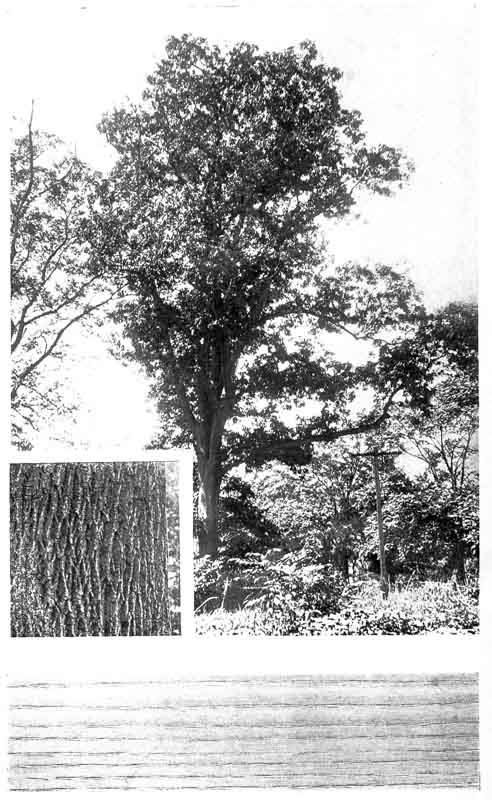
ASH. (Fraxinus.)
Ash is widely distributed over the temperate regions of the northern hemisphere, and occurs in the tropics, on the island of Cuba. The tree has occupied a position second only to that of oak. Our Teutonic forefathers relied upon its wood for boats and weapons. Their ancient faith connects it with the creation of the original man. It is often associated with oak in country proverbs.[21] Europeans regard the trees for ornamental purposes, but Americans value them for wood.
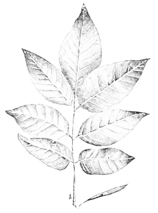
White Ash (Fraxinus americana).
Ash and oak woods resemble one another in that there are bands of open pores in both woods, but the pith-rays of the ash are thinner and scarcely discernible. Ash is coarser, less attractive, easier to work, tough, elastic, and somewhat lighter than oak. It seasons well, but does not last when exposed to the weather. Lumbermen separate the woods into white and black ash, the former including the lighter-colored and more desirable pieces. This commercial division is also a botanical one in the North, where the only species of any note are the white ash and black ash (F. americana and F. nigra). The Southern green ash (F. lanceolata) is usually classed as white ash. The trees that grow up after the cutting of the virgin forest afford tougher, more pliable, but not necessarily stronger pieces, known as "second-growth" ash. Although not relied upon for out-of-door construction, ash is one of the most important of the cheaper cabinet woods and is used in stairs, furniture, and similar works. [p028]
One half of the thirty known species of the genus Fraxinus inhabit North America. [p029]
FOOTNOTES
The name ash is also applied to several species of the genus Pyrus or Sorbus, to which the apple, pear, quince, and some other trees belong. "Mountain Ash" is either Pyrus americana or Pyrus sambucifolia. Both species, with their bright red berries, are to be classed as shrubs rather than trees; their light, soft, weak, close-grained woods having no economic importance, save perhaps for fuel. The series is partially as follows:
Pyrus malus (Common apple).
Pyrus coronaria (American crab-apple).
Pyrus communis (Common pear).
Pyrus vulgaris (Common quince).
Pyrus americana (Mountain ash).
Pyrus sambucifolia (Mountain ash).
Pyrus ancuparia (Rowan tree, European Mountain ash).
The Toothache Trees, Xanthoxylum americana and Xanthoxylum clava-herculis (Linn.), are known as ash and prickly ash. The gopher wood, Cladrastis tinctoria, is yellow ash. These woods are not important.
White Ash. Fraxinus americana Linn.
Nomenclature. (Sudworth.)
White Ash (local and common name).
Ash (Ark., Ia., Wis., Ill., Mo., Minn.).
Cane Ash (Ala., Miss., La.).
American Ash (Ia.).
Locality.
Nova Scotia to Florida, westward intermittently to Minnesota and Texas. Greatest development in the Ohio River basin.
Features of Tree.
Forty-five to ninety feet in height, occasionally higher. Three to four feet in diameter. Usually smooth leaves, have whitish under surfaces. Gray furrowed bark, long-winged seed.
Color, Appearance, or Grain of Wood.
Heartwood reddish brown, usually mottled; sapwood much lighter or nearly white. Coarse-grained, compact structure. Layers clearly marked by large open ducts. Medullary rays obscure.
Structural Qualities of Wood.
Heavy, hard, strong, elastic, becoming brittle with age, not durable in contact with soil.
Representative Uses of Wood.
Agricultural implements, carriages, handles, oars, interior and cheap cabinet-work.
Weight of Seasoned Wood in Pounds per Cubic Foot.
39 (U. S. Forestry Div.).[22]
40.
Modulus of Elasticity.
1,640,000 (average of 87 tests by U. S. Forestry Div.).[22]
1,440,000.
Modulus of Rupture.
10,800 (average of 87 tests by U. S. Forestry Div.).[22]
12,200.
Remarks.
Economically valuable. Rapid growers, preferring low, rather moist soil. Not apt to form in forests, but found mingled with other varieties. Large trees sometimes have large heart-cracks. [p030]
FOOTNOTE
Red Ash. Fraxinus pennsylvanica Marsh. Fraxinus pubescens Lam.
Nomenclature. (Sudworth.)
Red Ash (local and common name).
River Ash (R. I., Ont.).
Brown Ash (Mo.).
Black Ash (N. J.).
Ash (Nebr.).
Locality.
New Brunswick to Florida, westward intermittently to Dakota and Alabama. Best developed in North Atlantic States.
Features of Tree.
A small tree, rarely over forty-five feet high, one and one-half feet in diameter. Downy-covered young twigs and leaves.
Color, Appearance, or Grain of Wood.
Heartwood rich brown, sapwood light brown streaked with yellow, coarse-grained compact structure.
Structural Qualities of Wood.
Heavy, hard, strong, brittle.
Representative Uses of Wood.
Agricultural implements, handles, boats, oars, paper-pulp.
Weight of Seasoned Wood in Pounds per Cubic Foot.
38.
Modulus of Elasticity.
1,154,000.
Modulus of Rupture.
12,300.
Remarks.
Grows on borders of streams and swamps in low ground. Often confused with and substituted for the more valuable white ash. Pubescens is in allusion to the downy covering of the new twigs (those of white ash usually smooth). Pennsylvanica refers to locality in which it is well developed. [p031]
Blue Ash. Fraxinus quadrangulata Michx.
Nomenclature. (Sudworth.)
Blue Ash (Mich., Ill., Ky., Mo., Ala.).
Locality.
Central States, Mississippi Valley, Michigan, and southward, cultivated in Pennsylvania. Best in low Wabash Valley.
Features of Tree.
Fifty to seventy-five feet in height, occasionally higher, one to two feet in diameter. Slender. Blue properties in inner bark, smooth square twigs.
Color, Appearance, or Grain of Wood.
Heartwood light yellow, streaked with brown, sapwood lighter, close-grained, compact structure satiny.
Structural Qualities of Wood.
Hard, heavy, brittle, not strong, most durable of ash woods.
Representative Uses of Wood.
Largely used in floorings, carriage-building, pitchfork-and other tool-handles.
Weight of Seasoned Wood in Pounds per Cubic Foot.
44.
Modulus of Elasticity.
1,100,000.
Modulus of Rupture.
11,500.
Remarks.
Has no superior among ash woods. Blue Ash pitchfork-handles are very fine. Prefers limestone formations. Inner bark colors water blue, whence name. [p032]
Black Ash. Fraxinus nigra Marsh. Fraxinus sambucifolia Lam.
Nomenclature. (Sudworth.)
Black Ash (local and common name).
Water Ash (W. Va., Tenn., Ind.).
Swamp Ash (Vt., R. I., N. Y.).
Brown Ash (N. H., Tenn.).
Hoop Ash (Vt., N. Y., Del., Ohio, Ill., Ind.).
Locality.
Northern and Northeastern States—Newfoundland to Virginia, westward intermittently to Manitoba and Arkansas.
Features of Tree.
Seventy to eighty feet in height, one to one and one-half feet in diameter. Leaves resemble those of Elder. A thin tree. Excrescences or knobs frequent on trunk. Dark, almost black, winter buds.
Color, Appearance, or Grain of Wood.
Heartwood dark brown, sapwood light brown, often nearly white, coarse-grained, compact structure, medullary rays numerous and thin.
Structural Qualities of Wood.
Separates easily in layers, rather soft and heavy, tough, elastic, not strong or durable when exposed.
Representative Uses of Wood.
Largely used for interior finish, fencing, barrel-hoops, cabinet-making, splint baskets, chair-bottoms.
Weight of Seasoned Wood in Pounds per Cubic Foot.
39.
Modulus of Elasticity.
1,230,000.
Modulus of Rupture.
11,400.
Remarks.
Excrescences known as burls; their distorted grain causes them to be prized for veneers. The most northerly of ash-trees; one of the most slender of trees. [p033]
Green Ash. Fraxinus lanceolata Borkh. Fraxinus viridis Michx. f.
Nomenclature. (Sudworth.)
Green Ash (local and common name).
Blue Ash (Ark., Iowa).
White Ash (Kans., Neb.).
Ash (Ark., Iowa).
Swamp Ash (Fla., Ala., Tex.).
Water Ash (Iowa).
Locality.
East of Rocky Mountains. Vermont and northern Florida intermittently to Utah and Arizona.
Features of Tree.
Forty to fifty feet in height, one to two feet in diameter. Bright green upper and lower surfaces of smooth leaves.
Color, Appearance, or Grain of Wood.
Heartwood brownish, sapwood lighter, rather coarse-grained, compact structure.
Structural Qualities.
Hard, heavy, strong, brittle.
Representative Uses.
Similar to those of White Ash.
Weight of Seasoned Wood in Pounds per Cubic Foot.
39 (U. S. Forestry Div.).[23]
44.
Modulus of Elasticity.
2,050,000 (average of 10 tests by U. S. Forestry Div.).[23]
1,280,000.
Modulus of Rupture.
11,600 (average of 10 tests by U. S. Forestry Div.).[23]
12,700.
Remarks.
Sometimes considered a variety of Red Ash. [p034]
FOOTNOTE
Oregon Ash. Fraxinus Oregona Nutt.
Nomenclature.
Oregon Ash (Calif., Wash., Oregon).
Locality.
Pacific coast, Washington to California. Best developed in bottom lands, southwestern Oregon.
Features of Tree.
Fifty to occasionally seventy-five feet in height, one to one and one-half feet in diameter. Dark grayish-brown, bark exfoliates in thin scales.
Color, Appearance, or Grain of Wood.
Heartwood brown, sap wood lighter, coarse-grained, compact structure, numerous thin medullary rays.
Structural Qualities of Wood.
Rather light, hard, not strong.
Representative Uses of Wood.
Manufacture of furniture, carriage-frames, cooperage, and fuel.
Weight of Seasoned Wood in Pounds per Cubic Foot.
35.
Modulus of Elasticity.
1,200,000.
Modulus of Rupture.
9400.
Remarks.
One of the valuable deciduous trees of the Pacific coast. Thrives only on moist soils and in moist climates. [p035]
PLATE 7. ELM (Ulmus americana).]
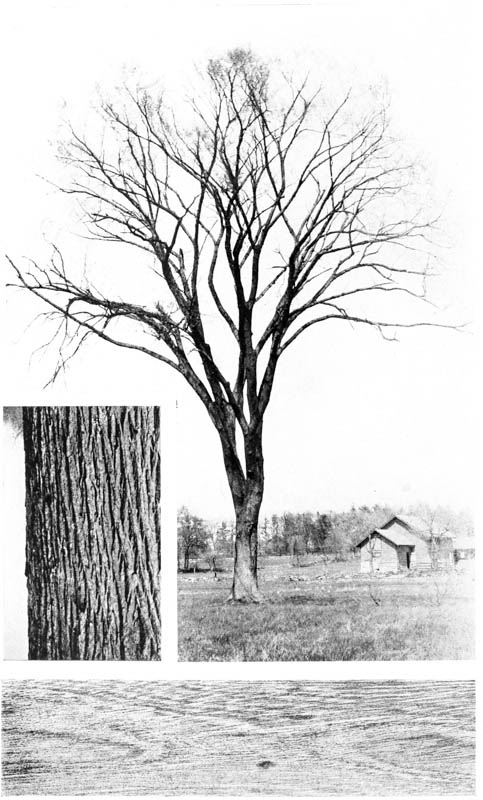
ELM. (Ulmus.)
The different species of elm are distributed over the cold and temperate portions of the northern hemisphere, save western United States and Canada. A high degree of perfection is attained in eastern North America, where trees are greatly prized for their form and appearance.
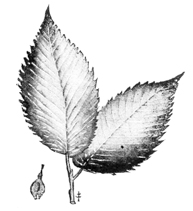
ELM (Ulmus americana).
The foliage of the elm is concentrated at the top, and the absence of lower branches causes it to be a good tree to plant near houses or along streets. Much of the wood is tough, fibrous, durable, strong, hard, heavy, and, because it is so often cross-grained, difficult to split and work. The large pores of the spring wood arranged in one or several rows mark the annual deposit, while the minute pores of the summer wood arranged in concentric wavy lines are so peculiar as to distinguish this wood from all others. The tall, straight trunks afford pieces of considerable size. Elm piles sustain constant and severe shocks for long intervals. The grain arrangement of elm is often very beautiful, so that it is increasingly used for decoration. It is more commonly employed in the construction of cars, wagons, boats, agricultural implements, machinery, and furniture.
The shape of the trees is so marked as to cause them to be easily noted. Fifteen or sixteen species have been recognized. Five are known to exist in the eastern American forests, and all of them furnish good wood of commercial importance. Ulmus was the ancient name of the elm. [p036]
FOOTNOTE
Geo. B. Emerson's "Trees and Shrubs of Massachusetts."
White Elm. Ulmus americana Linn.
Nomenclature. (Sudworth.)
White Elm (local and common name).
Water Elm (Miss., Tex., Ark., Mo., Ill., Ia., Mich., Minn., Neb.).
Elm (Mass., R. I., Conn., N. J., Pa., N. C., S. C., Ia., Wis.).
American Elm (Vt., Mass., R. I., N. Y., Del., Pa., N. C., Miss., Tex., Ill., Ohio, Kans., Neb., Mich., Minn.).
Locality.
East of Rocky Mountains, Newfoundland to Florida, westward intermittently to Dakota, Nebraska, and Texas.
Features of Tree.
Ninety to one hundred feet in height, three to seven feet in diameter. Characteristic and beautiful form, smooth buds; leaves, smaller than those of Slippery-elm, are rough only when rubbed one way.
Color, Appearance, or Grain of Wood.
Heartwood light brown, sapwood yellowish white, rather coarse-grained, annual rings clearly marked.
Structural Qualities of Wood.
Strong, tough, fibrous, difficult to split.
Representative Uses of Wood.
Flooring, wheel-stock, cooperage, ship-building, flumes, piles.
Weight of Seasoned Wood in Pounds per Cubic Foot.
34 (U. S. Forestry Division.)[24]
40.
Modulus of Elasticity.
1,540,000 (average of 18 tests by U. S. Forestry Div.).[24]
1,060,000.
Modulus of Rupture.
10,300 (average of 18 tests by U. S. Forestry Div.).[24]
12,100.
Remarks.
The concentration of foliage at top, together with the form of the tree, renders it valuable in landscape work. It does not cause dense shade. Elm and silver-maple trees are among the first to show life in spring. Discarded brownish scales then cover ground in vicinity. [p037]
FOOTNOTE
Cork Elm. Ulmus racemosa Thomas.
Nomenclature. (Sudworth.)
Cork Elm (local and common name).
Hickory Elm (Mo., Ill., Ind., Ia.).
Rock Elm (R. I., W. Va., Ky., Mo., Ill., Wis., Ia., Mich., Nebr.).
White Elm (Ont.).
Cliff Elm (Wis.).
Locality.
Quebec and Vermont, westward intermittently to Nebraska and Tennessee. Best developed in southern Ontario and Michigan.
Features of Tree.
Seventy to ninety feet in height, two to three feet in diameter. Thick, corky, irregular projections give bark a shaggy appearance and mark the species.
Color, Appearance, or Grain of Wood.
Heartwood light brown, often tinged with red; sapwood yellowish or greenish white. Compact structure, fibres interlaced.
Structural Qualities of Wood.
Heavy, hard, very strong, tough, difficult to split, susceptible of a beautiful polish, elastic.
Representative Uses of Wood.
Heavy agricultural implements, wheel-stocks, railway ties, sills, bridge-timbers, axe-helves, etc.
Weight of Seasoned Wood in Pounds per Cubic Foot.
45.
Modulus of Elasticity.
2,550,000.
Modulus of Rupture.
15,100.
Remarks.
Cork Elm is the best of the elm woods. [p038]
Slippery Elm, Red Elm. Ulmus pubescens Walt. Ulmus fulva Michx.
Nomenclature. (Sudworth.)
Slippery Elm, Red Elm (local and common name).
Rock Elm (Tenn.).
Redwooded Elm (Tenn.).
Moose Elm (occasional).
Locality.
Ontario and Florida, westward intermittently to Nebraska and Texas. Best developed in Western States.
Features of Tree.
Forty-five to sixty feet in height, one to two feet in diameter. Characteristic shape, mucilaginous inner bark. Buds hairy. Leaves, larger than American Elm, are rough when rubbed either way.
Color, Appearance, or Grain of Wood.
Heartwood dark brown or red, sapwood lighter, compact structure, annual layers marked by rows of large open ducts. Heartwood greatly preponderates.
Structural Qualities of Wood.
Heavy, hard, strong, and durable in contact with soil.
Representative Uses of Wood.
Largely used for fence-posts, rails, railway ties, sills, sleigh-runners, and wheel-stocks. Mucilaginous bark, employed in medicine.
Weight of Seasoned Wood in Pounds per Cubic Foot.
43.
Modulus of Elasticity.
1,300,000.
Modulus of Rupture.
12,300.
Remarks.
Mucilaginous inner bark renders this species unmistakable. This bark is used in medicine. [p039]
Wing Elm, Winged Elm. Ulmus alata Michx.
Nomenclature.
Wing Elm, Winged Elm (local and common names).
Wahoo, Whahoo (W. Va., N. C., S. C., La., Tex., Ky., Mo.).
Cork Elm, Corky Elm (Fla., S.C., Tex.).
Mountain Elm, Red Elm (Fla., Ark.).
Elm, Witch Elm (W. Va.).
Water Elm (Ala.).
Small-leaved Elm (N. C.).
Wahoo Elm (Mo.).
Locality.
Southern United States, Virginia and Florida westward intermittently to southern Illinois and Texas.
Features of Tree.
Forty feet or more in height, one to two feet in diameter. Corky "wings" on branches.
Color, Appearance, or Grain of Wood.
Color brownish, sapwood lighter, close-grained, compact structure.
Structural Qualities of Wood.
Hard, heavy, tough.
Weight of Seasoned Wood in Pounds per Cubic Foot.
46.
Modulus of Elasticity.
740,000.
Modulus of Rupture.
10,200.
Remarks.
[Blank Line] [p040]
MAPLE. (Acer.)
The maples grow on all of the continents of the northern hemisphere. Nearly one half of the known species belong in China, Japan, and the Orient. The principal European species (Acer pseudo-platanus) is the European sycamore.[25] The hard or sugar maple (Acer saccharum) is one of the principal deciduous trees of North America.
Maple wood[26] is characterized by its appearance and by its fine compact texture. The first quality is so marked that selected pieces take rank among the most beautiful of cabinet woods; the last is so pronounced as to fit it for carvings and even for type. "Birdseye," "blister," and "curly" maples are not from different species, but are the results of fibre distortions, possible in some form in any tree of any species, but peculiarly liable to occur in the maple; birdseye and blister effects for the most part in the hard maples, curly effects in the hard, but generally in the softer, species. The distortions do not occur in all trees, and it is seldom possible to tell whether the woods are thus figured until after the trees have been cut. Maple wood shrinks moderately, stands well in protected places, is strong, tough, but not durable when exposed. Pores are not arranged in circles, but are scattered irregularly throughout the layers. Maple is used for ceiling, flooring, panelling, car and ship construction, shoe-lasts, shoe-pegs, furniture, school supplies, implements, and machinery. Sugar is principally, although not exclusively, present in the sap of the sugar maple.[27] The softer species are sometimes [p041] tapped, and sugar is also present in the sap of other trees, such as the butternut and birch. A sugar maple will, on an average, produce about twenty-five gallons of sap, containing a total of about six pounds of sugar, in a season.
PLATE 8. SUGAR MAPLE (Acer saccharum).
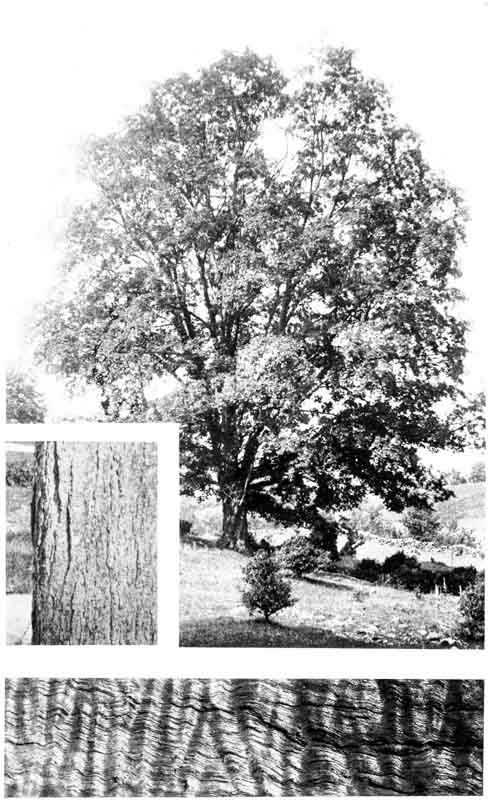
Bottom--"Curly" Maple Wood (dissection).
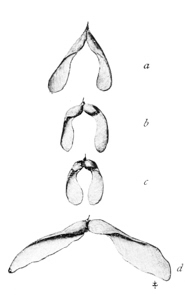
a, Box Elder. b, Hard or Sugar Maple. c, Soft or Red Maple. d, Soft or Silver Maple.
The Boxelder (Acer negundo) is a true maple, remarkable in that it is widely distributed from Canada to Mexico and from the Atlantic to the Rocky Mountains, on low bottom lands, and at elevations of five thousand and six thousand feet.[28] The trees are beautiful and, like other maples are valued for ornamental purposes. The soft, light wood is not particularly noted, although occasionally used for woodenware, interior finish, and paper-pulp. Small quantities of sugar are present in the sap of this tree.
The maples may be told by their leaves of characteristic shape, but chiefly by their two-seeded fruit or "keys," the two wings of which spread differently in different species. The leaves of some species change in autumn from green to red and other brilliant colors. Those of other species change to yellow without trace of red. Sixty to seventy species have been distinguished, nine of which occur in North America. [p042]
FOOTNOTES
Sugar Maple, Hard Maple. Acer saccharum Marsh. Acer saccharinum Wang.
Nomenclature. (Sudworth.)
Sugar Maple, Hard Maple (local and common names).
Black Maple (Fla., Ky., N. C.).
Sugar Tree (frequent).
Rock Maple (Me., Vt., N. H., Conn., Mass., R. I., N. Y., Tenn., Ill., Mich., Ia., Kans., Wis., Minn.).
Locality.
Best development Maine to Minnesota; range extends southward to Florida and Texas.
Features of Tree.
Seventy to one hundred feet and more in height, one and one-half to four feet in diameter. The fruit or "maple-key" with wings less than right angles ripen in early autumn; one seed-cavity is usually empty. Foliage turns to brilliant reds and other colors later. Large impressive tree.
Color, Appearance, or Grain of Wood.
Heartwood brownish, sapwood lighter, close-grained, compact structure, occasional "curly," "blister," or "birdseye" effects.
Structural Qualities of Wood.
Tough, heavy, hard, strong, susceptible of good polish, wears evenly, not durable when exposed.
Representative Uses of Wood.
Furniture, shoe-lasts, piano-actions, wooden type for showbills, pegs, interior finish, flooring, ship-keels, vehicles, fuel, veneers, rails, etc.
Weight of Seasoned Wood in Pounds per Cubic Foot.
43.
Modulus of Elasticity.
2,070,000.
Modulus of Rupture.
16,300.
Remarks.
Birdseye, blister, and to a less extent curly and landscape effects pronounced in this species. Saccharum refers to sugar manufactured from the sap. Hard maple is because of hardness of wood. [p043]
Silver Maple, Soft Maple. Acer saccharinum Linn. Acer dasycarpum Ehr.
Nomenclature. (Sudworth.)
Silver Maple, Soft Maple (local and common names).
Swamp Maple (W. Va., Md.).
Water Maple (Pa., W. Va.).
River Maple (Me., N. H., R. I., W. Va., Minn.).
White Maple (Me., Vt., R. I., N. Y., N. J., Pa., W. Va., N. C, S. C., Ga., Fla., Ala., Miss., La., Ky., Mo., Ill., Ind., Kans., Nebr., Minn.).
Locality.
New Brunswick to Florida, westward intermittently to Dakota and Indian Territory. Best development in lower Ohio River basin.
Features of Tree.
Forty to ninety feet in height, occasionally higher. Three to five feet in diameter. Fine shape, sometimes suggests elm. Fruit or "maple-key" with long, stiff, more than right-angled wings ripens in early summer. Leaves whitish beneath, turn showing yellow, but little or no red, in autumn.
Color, Appearance, or Grain of Wood.
Heartwood reddish brown, sapwood ivory-white, fine grain, compact structure. Fibres sometimes twisted, waved, or curly.
Structural Qualities of Wood.
Light, brittle, easily worked, moderately strong; receives high polish. Not durable when exposed.
Representative Uses of Wood.
Woodenware, turned work, interior decoration, flooring, fuel.
Weight of Seasoned Wood in Pounds per Cubic Foot.
32.
Modulus of Elasticity.
1,570,000.
Modulus of Rupture.
14,400.
Remarks.
Waved, spiral, or curly figure pronounced in this species, very real resemblance to lights and shadows on planed surfaces. Small quantities of sugar present in sap, occasionally utilized. [p044]
Red Maple, Swamp Maple. Acer rubrum Linn.
Nomenclature. (Sudworth.)
Red Maple, Swamp Maple (local and common names).
Soft Maple (Vt., Mass., N. Y., Va., Miss., Mo., Kans., Neb., Minn.).
Water Maple (Miss., La., Tex., Ky., Mo.).
White Maple (Me., N. H.).
Red Flower (N. Y.).
Locality.
New Brunswick and Florida, westward intermittently to Dakota and Texas. Wide range.
Features of Tree.
Sixty to eighty feet and more in height, two and one-half to four feet in diameter. Red twigs and flowers in early spring.
Color, Appearance, or Grain of Wood.
Heartwood brown tinged with red, sapwood lighter, close-grained, compact structure. Red blossoms, twigs, and stems. Leaves turn scarlet in autumn.
Structural Qualities of Wood.
Easily worked, heavy, hard, not strong, elastic, qualities between those of silver and sugar maple.
Representative Uses of Wood.
Largely used in cabinet-making, turnery, woodenware, gun-stocks, etc.
Weight of Seasoned Wood in Pounds per Cubic Foot.
38.
Modulus of Elasticity.
1,340,000.
Modulus of Rupture.
15,000.
Remarks.
Occasionally shows "curly" figure. Trees are occasionally tapped and small quantities of sugar are obtained from the sap. [p045]
Oregon Maple. Acer macrophyllum Pursh.
Nomenclature. (Sudworth.)
Oregon Maple (Oreg., Wash.).
White Maple (Oreg., Wash.).
Maple (Calif.).
Broad-leaved Maple (Central Calif., Willamette Valley, Oreg.).
Locality.
Alaska to California. Best in rich bottom lands of southern Oregon.
Features of Tree.
Seventy to one hundred feet in height, three to five feet in diameter. Beautiful appearance.
Color, Appearance, or Grain of Wood.
Reddish brown, sapwood whitish, close-grained, compact structure, occasionally figured.
Structural Qualities.
Light, hard, strong; receives polish.
Representative Uses of Wood.
Locally used for tool-handles, turned work, and furniture.
Weight of Seasoned Wood in Pounds per Cubic Foot.
30.
Modulus of Elasticity.
1,100,000.
Modulus of Rupture.
9720.
Remarks.
Ornamental tree has been introduced into Europe. Said to be one of the most valuable Pacific coast broadleaf woods. [p046]
Boxelder, Ash-leaved Maple. Acer negundo Linn. Negundo aceroides Moench.
Nomenclature. (Sudworth.)
Boxelder, Ash-leaved Maple (local and common name).
Red River Maple, Water Ash (Dak.).
Cut-leaved Maple (Colo.).
Stinking Ash (S. C).
Negundo Maple (Ill.).
Three-leaved Maple (Fla.).
Black Ash (Tenn.).
Sugar Ash (Fla.).
Locality.
Atlantic Ocean westward intermittently to Rocky Mountains, Mexico.
Features of Tree.
Forty to seventy feet in height, one and one-half to three feet in diameter. Wings to keys are straight or incurved. Leaves sparingly and coarsely toothed, show yellow but little or no red in autumn.
Color, Appearance, or Grain of Wood.
Thin heartwood, cream-white; sapwood similar; close-grained, compact structure.
Structural Qualities of Wood.
Light, not strong, soft.
Representative Uses of Wood.
Woodenware, cooperage, etc., paper-pulp (largely), occasionally interior finish.
Weight of Seasoned Wood in Pounds per Cubic Foot.
26.
Modulus of Elasticity.
82,000.
Modulus of Rupture.
7500.
Remarks.
A rapid grower. Withstands severe climatic changes. A good tree to plant in naturally treeless sections. Sugar is sometimes obtained from the sap of this species. The "Boxelder" is a true maple. [p047]
PLATE 9. WALNUT (Juglans).
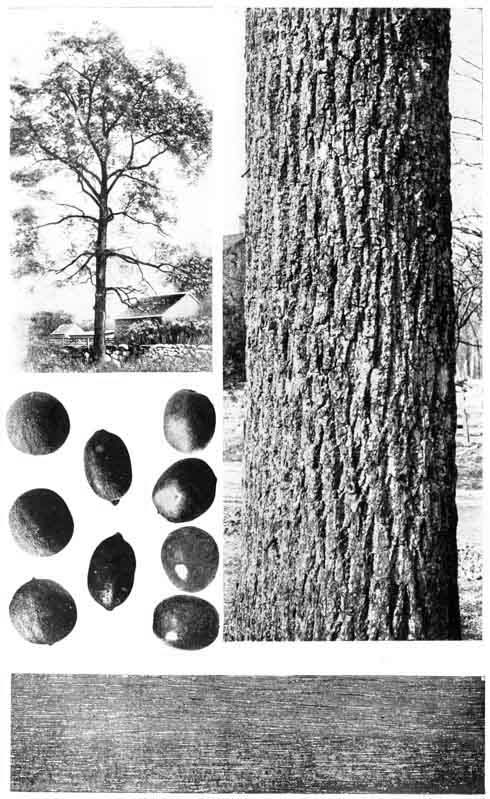
Black Walnut Tree (Juglans nigra). Black Walnut Trunk (Juglans nigra).
Black, White, and English Walnuts. Black Walnut Wood (Juglans nigra).
WALNUT. (Juglans.)
The English or Royal Walnut (Juglans regia), a native of Persia, was the only available species of this genus until the introduction of the nearly similar Black Walnut of North America.[29] As oak gave way first to soft woods for construction, so it gave way first to walnut for cabinet purposes. The wood soon became very fashionable, and exorbitant prices were paid for it. Walnut was extremely popular in the United States until about 1880, when oak began to resume its place as the popular cabinet wood. The nuts of the English or Persian walnut are better than those of the American species, but the wood of the latter is superior.
The use of walnut wood for gun-stocks began in Europe, the demands early becoming so great that, until the general peace following the battle of Waterloo, the greater part of the French product was diverted for that purpose, while prices rose in England so that six hundred pounds sterling is reported to have been paid for a single tree. In spite of the innumerable woods that have since been introduced, this one is yet regarded as best for gun-stocks.[30] Walnut is a firm, hard, chocolate-colored wood, with pores not arranged in rings but scattered somewhat irregularly. The sombre, although rich, color has been objected to for some positions. Large excrescences or "burrs" are common on foreign trees, particularly those near the Black Sea and in Italy. The grain in such growths is beautifully irregular, and the wood, known as "burl," is prized for veneers. Trees are very scarce, and walnut is now seldom seen save in cabinet work or gun-stocks. The related White Walnut or Butternut (Juglans cinerea) affords a less-prized and [p048] lighter-tinted wood. The nuts of the walnuts are a source of profit.
Black walnut trees seldom form forests by themselves, but occur generally in mixed growth. They grow quickly, but the heartwood for which the tree is valued begins to form only when the tree is at a considerable age, so that a number of years must elapse before a tree can produce wood of the desired quality. Trees one hundred years old furnish the best quality of wood.
Walnut trees may be known by their nuts, the husks or pods of which adhere unbroken, instead of loosening, completely divide into four sections, as with the hickories. Juglans is from Jovis, signifying Jove's, and glans, signifying acorn. This nut, not the fruit of the oak, was the acorn of the ancients.[31] [p049]
FOOTNOTES
Black Walnut. Juglans nigra Linn.
Nomenclature. (Sudworth.)
Black Walnut (local and common name).
Walnut (N. Y., Del., W. Va., Fla., Ky., Mo., Ohio, Ind., Ia.).
Locality.
Ontario and Florida, westward intermittently to Nebraska and Texas.
Features of Tree.
Ninety to one hundred and twenty-five feet in height, three to eight feet in diameter. A tall handsome tree with rough brownish, almost black, bark. Large, rough-shelled nuts.
Color, Appearance, or Grain of Wood.
Heartwood dark, rich, chocolate-brown. Thin sapwood much lighter, rather coarse-grained.
Structural Qualities of Wood.
Heavy, hard, strong, easily worked, durable, susceptible to high polish.
Representative Uses of Wood.
Cabinet-making, gun-stocks, also formerly furniture and decoration.
Weight of Seasoned Wood in Pounds per Cubic Foot.
38.
Modulus of Elasticity.
1,550,000.
Modulus of Rupture.
12,100.
Remarks.
[p050]
FOOTNOTE
The English, Royal, or Persian Walnut (Juglans regia) affords nearly similar wood. Widely distributed over Europe. Italian trees furnish best, French next, and English least desirable, paler and coarser wood. Occasional trees in Eastern United States, as New York; very plentiful in California.
Butternut, White Walnut. Juglans cinerea Linn.
Nomenclature.
Butternut, White Walnut (local and common names).
Oil Nut (Me., N. H., S. C.).
Walnut (Minn.).
White Mahogany.
Locality.
New Brunswick to Georgia, westward to Dakota and Arkansas. Best in Ohio River basin.
Features of Tree.
Medium size, sometimes seventy-five feet or over in height, two to four feet in diameter. Branches widespread; large-sized oblong edible nuts.
Color, Appearance, or Grain of Wood.
Heartwood light gray-brown, darkening with exposure; sapwood nearly white, coarse-grained compact structure, attractive.
Structural Qualities of Wood.
Light, soft, not strong, easily worked. Susceptible of high polish.
Representative Uses of Wood.
Interior finish, cabinet-work. Inner bark furnishes yellow dye.
Weight of Seasoned Wood in Pounds per Cubic Foot.
25.
Modulus of Elasticity.
1,150,000.
Modulus of Rupture.
8400.
Remarks.
The sap contains sugar and is occasionally mixed with maple-sap in the manufacturing of "maple" sugar. [p051]
PLATE 10. HICKORY (Hicoria ovata).
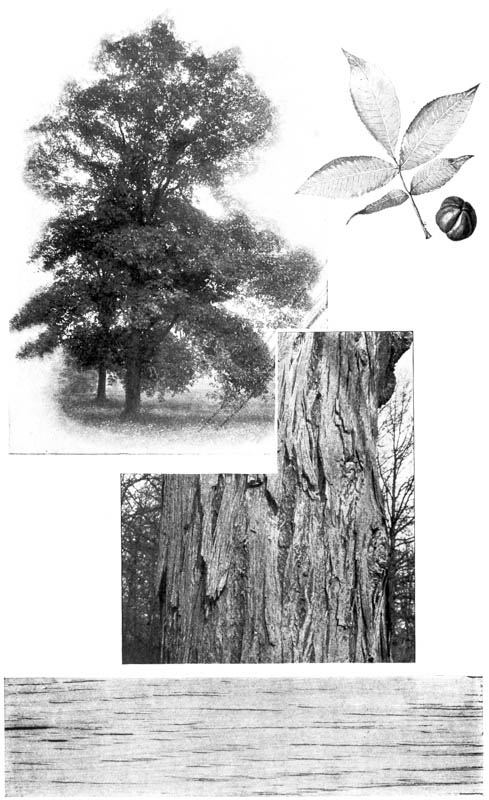
HICKORY. (Hicoria or Carya.)
The Hickories occur only in the eastern part of North America. They produce woods in which the qualities of toughness, elasticity, and resilience are unusually pronounced, and since these qualities are greatest in the sapwood, hickories are peculiar in that the sapwood is more valuable than the heart. Second-growth wood is much prized, since, being younger, it contains more of the pliable sapwood.[32]
Hickory is not durable when exposed and is more or less subject to attack by boring-insects. It is used for implements, machinery, carriages, and the like; hickory axe-helves have no superiors. The nuts of the shagbark or white hickory are a source of considerable profit. The pecan (Hicoria pecan) affords wood so inferior as to be little used in construction, although it makes an excellent fuel. Pecans are planted in many of the Southern States because of the nuts, for which a considerable demand exists.
The Hickories are known by their nuts, the husks or pods of which loosen completely from the nut in four pieces, instead of adhering unbroken as in the case of the walnuts. The nine species are American trees, eight of them being natives of the United States. Carya was the Greek name of the common walnut. Hickory is said to be derived from the Indian powcohicora, a liquor once obtained from the nuts of the hickory. [p052]
FOOTNOTE
Shagbark Hickory, Shellbark Hickory. Hicoria ovata Mill. Carya alba Nutt.
Nomenclature. (Sudworth.)
Shellbark or Shellbark Hickory (local and common name).
Scalybark Hickory (W. Va., S. C., Ala.).
Shellbark (R. I., N. Y., Pa., N. C.).
Shagbark (R. I., Ohio).
Hickory (Vt., Ohio).
Upland Hickory (Ill.).
White Hickory (Ia., Ark.).
Walnut (Vt., N. Y.).
Sweet Walnut (Vt.).
Shagbark Walnut (Vt.).
Locality.
Maine to Florida, westward intermittently to Minnesota and Texas. Wide range, best in Ohio valley.
Features of Tree.
Seventy-five to ninety feet in height, occasionally higher; two and one-half to three feet in diameter. Shaggy bark, thin-shelled edible nuts.
Color, Appearance, or Grain of Wood.
Heartwood light brown, sapwood ivory- or cream-colored. Close-grained, compact structure. Annual rings clearly marked. Medullary rays numerous but thin.
Structural Qualities of Wood.
Very heavy, very hard, strong, exceptionally tough and flexible, not durable when exposed.
Representative Uses of Wood.
Largely used for agricultural implements, wheels, and runners, axe-handles, baskets, fuel.
Weight of Seasoned Wood in Pounds per Cubic Foot.
51 (U. S. Forestry Div.).[33]
52.
Modulus of Elasticity.
2,390,000 (average of 137 tests by U. S. Forestry Div.).[33]
1,900,000.
Modulus of Rupture.
16,000 (average of 137 tests by U. S. Forestry Div.).[33]
17,000.
Remarks.
The nuts form an important article of commerce. "Shagbark" refers to the shaggy appearance of the bark. [p053]
FOOTNOTE
Pignut (Hickory). Hicoria glabra Mill. Carya porcina Nutt.
Nomenclature. (Sudworth.)
Pignut (local and common name).
Black Hickory (Miss., La., Ark., Mo., Ind., Ia.).
Brown Hickory (Del., Miss., Tex., Tenn., Minn.).
Bitternut (Ark., Ill., Ia., Wis.).
White Hickory (N. H., Ia.).
Broom Hickory (Mo.).
Hardshell (W. Va.).
Red Hickory (Del.).
Switchbud Hickory (Ala.).
Locality.
Ontario to Florida, westward intermittently to southern Nebraska and eastern Texas.
Features of Tree.
Seventy-five to one hundred feet in height, occasionally higher; Two to four feet in diameter. Rather smooth bark. Large thick-shelled nuts, kernels often astringent or bitter.
Color, Appearance, or Grain of Wood.
Heartwood light and dark brown, thick sapwood, lighter, nearly white. Close-grained.
Structural Qualities of Wood.
Heavy, hard, flexible, tough, strong.
Representative Uses of Wood.
Similar to those of shagbark hickory.
Weight of Seasoned Wood in Pounds per Cubic Foot.
56 (U. S. Forestry Div.).[34]
51.
Modulus of Elasticity.
2,730,000 (average of 30 tests by U. S. Forestry Div.).[34]
1,460,000.
Modulus of Rupture.
18,700 (average of 30 tests by U. S. Forestry Div.).[34]
14,800.
Remarks.
Nuts are devoured by pigs, whence the name porcina. [p054]
FOOTNOTE
Mocker Nut (Hickory). Hicoria alba Linn. Carya tomentosa Nutt.
Nomenclature. (Sudworth.)
Mocker Nut, Whiteheart Hickory (local and common names).
Bullnut (N. Y., Fla., Miss., Tex., Mo., Ohio., Ill., Minn.).
Black Hickory (Tex., Miss., La., Mo.).
Hickory (Ala., Tex., Pa., S. C., Neb.).
Big-bud, Red Hickory (Fla.).
Common Hickory (N. C.).
White Hickory (Pa., S. C.).
Hickory Nut (Ky., W. Va.).
Hog Nut (Del.).
Hard bark Hickory (Ill.).
Locality.
Ontario to Florida, westward intermittently to Missouri and Texas. Wide range.
Features of Tree.
Seventy-five to one hundred feet in height, two and one-half to three and one-half feet in diameter. A tall slender tree with rough, but not shaggy, bark. Thick shell, edible nut.
Color, Appearance, or Grain of Wood.
Heartwood rich dark brown, thick sapwood nearly white, close-grained.
Structural Qualities of Wood.
Very heavy, hard, tough, strong, and flexible.
Representative Uses of Wood.
Similar to those of shellbark hickory.
Weight of Seasoned Wood in Pounds per Cubic Foot.
53 (U. S. Forestry Div.).[35]
51.
Modulus of Elasticity.
2,320,000 (average of 75 tests by U. S. Forestry Div.).[35]
1,630,000.
Modulus of Rupture.
15,200 (average of 75 tests by U. S. Forestry Div.).[35]
16,000.
Remarks.
The most generally distributed species of the genus in the South. Mocker nut or moker nut is said (Britton) to be from a Dutch word meaning hammer, or else (Keeler) from disappointing quality of nuts. [p055]
FOOTNOTE
Pecan, (Hickory). Hicoria pecan Marsh. Carya olivæformis Nutt.
Nomenclature. (Sudworth.)
Pecan (local and common name).
Pecan Nut, Pecan-tree, Pecanier (La.).
Locality.
Valley of Mississippi, southward to Louisiana, Texas, and Mexico.
Features of Tree.
Ninety to one hundred feet in height, sometimes higher. Two and one-half to five feet in diameter. A tall tree, smooth-shelled oblong edible nuts.
Color, Appearance, or Grain of Wood.
Heartwood light brown, tinged with red, sapwood lighter brown. Close-grained and compact, medullary rays numerous but thin.
Structural Qualities of Wood.
Heavy, hard, not strong, brittle.
Representative Uses of Wood.
Fuel, seldom used in construction.
Weight of Seasoned Wood in Pounds per Cubic Foot.
49 (U. S. Forestry Div.).[36]
44.
Modulus of Elasticity.
2,530,000 (average of 37 tests by U. S. Forestry Div.).[36]
940,000.
Modulus of Rupture.
15,300 (average of 37 tests by U. S. Forestry Div.).[36]
8,200.
Remarks.
Grows on borders of streams in low rich soil. Largest and most important tree of western Texas. The sweet edible nuts form an important article of commerce. [p056]
FOOTNOTE
CHESTNUT, CHINQUAPIN. (Castanea.)
The chestnut is found in the temperature regions of central and southern Europe, northern Africa, China, Japan, and eastern North America. The wood is valued in construction, and the much-prized nuts are regarded as a food rather than a confection. European chestnut wood was once high in favor, although examination of structures in which it was supposed to have been used indicates that in some instances oak had been mistaken for it and had been employed in its place.
The North American chestnut affords a weak, brittle, but easily worked and very durable wood, such as is admirably adapted for beams, ties, and sills, where lightness and durability rather than much transverse strength are required. Trees in Europe have attained to great size and age. Micheaux mentions one thirty feet in circumference six feet from the ground and said to have been standing for a thousand years. The famous Mt. Etna chestnut[37] is reported to have measured two hundred and four feet in circumference. Large trunks are apt to be hollow, affording brittle, useless wood. The botanical relation between the American and European chestnuts is not distinct. Some consider the former a distinct species, others a variety only. The name "Chinquapin" applies to two distinct botanical species, one, the Castanea pumila, closely related to the common chestnut; the other, Castanopsis chrysophylla, belonging to the same family (Cupuliferæ), but to quite another genus. Both afford woods resembling, but heavier than, chestnut.
PLATE 11. CHESTNUT (Castanea dentata).
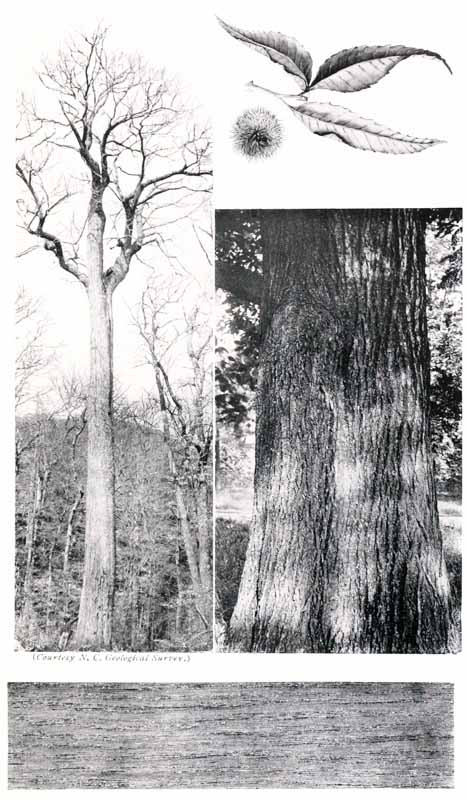
Top-Left--(Courtesy N. C. Geological Survey.)
The chestnut may be known by its large prickly burr, [p057] containing from one to three thin-shelled, triangular, wedge-shaped nuts. Both chinquapins have prickly burrs containing one, or sometimes two, sweet edible nuts. Three of the four known species of the genus Castanea grow in North America, one the common chestnut (Castanea vulgaris); another the Chinquapin (Castanea pumila); the third a plant never attaining to the size of a tree. The Chinquapin (Castanopsis chrysophylla) is the only North American representative of a genus including twenty-five species. Keeler says that Castanea is from a town of that name in Thessaly, or from another town of that name in Pontus. [p058]
FOOTNOTE
Chestnut. Castanea dentata (Marsh) Borkh. Castanea vesca var. americana Michx. Castanea vulgaris var. americana A. de C.
Nomenclature.
Chestnut (local and common name).
Locality.
New England, New York to Georgia, Alabama, Mississippi, Kentucky, Missouri, Michigan. Best on western slope of Alleghany Mountains.
Features of Tree.
Seventy-five to one hundred feet in height, five to twelve feet in diameter. Fine characteristic shape, not easily distinguished from Red Oak in winter. Blossoms in midsummer. Prickly burrs contain three thin-shelled nuts.
Color, Appearance, or Grain of Wood.
Heartwood brown, sapwood lighter, coarse-grained.
Structural Qualities of Wood.
Light, soft, not strong, liable to check and warp in drying. Easily split. Very durable in exposed positions.
Representative Uses of Wood.
Cabinet-making, railway ties, posts, fencing, sills.
Weight of Seasoned Wood in Pounds per Cubic Foot.
28.
Modulus of Elasticity.
1,200,000.
Modulus of Rupture.
9800.
Remarks.
The nuts of the foreign species (C. vesca) as well as those of the domestic species are much prized. The former are larger and the latter sweeter. One of the latest trees to blossom. [p059]
Chinquapin. Castanea pumila (Linn.) Mill.
Nomenclature. (Sudworth.)
Chinquapin (Del., N. J., Pa., Va., W. Va., N. C., S. C., Ga., Ala., Fla., Miss., La., Tex., Ark., Ohio, Ky., Mo., Mich.).
Locality.
Pennsylvania to Florida, Mississippi, Louisiana, Texas, Arkansas, Ohio, Kentucky, Missouri, Michigan.
Features of Tree.
A small tree, sometimes forty-five feet in height, one to two feet or over in diameter. Sometimes reduced to low shrub. Small prickly burr with single small chestnut-colored nut.
Color, Appearance, or Grain of Wood.
Heartwood dark brown, sapwood hardly distinguishable. Coarse-grained, annual layers marked by rows of open ducts.
Structural Qualities of Wood.
Rather heavy, hard, strong. Durable in exposed positions. Liable to check in drying.
Representative Uses of Wood.
Posts, rails, railway ties, etc.
Weight of Seasoned Wood in Pounds per Cubic Foot.
36.
Modulus of Elasticity.
1,620,000.
Modulus of Rupture.
14,000.
Remarks.
[p060]
FOOTNOTE
The Chinquapin Castanopsis chrysophylla, is a tree with characteristics between oak and chestnut. Its wood is nearly similar to that of the Chinquapin Castanea pumila, and is sometimes used for implements.
BEECH.(Fagus.) IRONWOOD.(Carpinus, Ostrya, etc.)
Beech is well known on the eastern continent. The common beech (Fagus atropunicea) is the only American representative. Eastern species have figured in literature since the time of Virgil. The northern nations early wrote upon thin tablets of beechwood, and boc, bok, and buche, the northern names for beech, finally gave origin to the word book.[38] American Indians believed that the beech was proof against lightning.
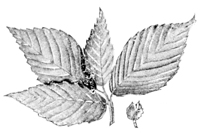
Beech (Fagus atropunicea).
Beechwood is hard, heavy, strong, not durable when exposed, and somewhat subject to attack by insects. European engineers employ it to a considerable extent in construction, but it is seldom used in America save for indoor finish, furniture, handles, flooring, and the like. The small edible nuts, known as beech-mast, are pressed abroad for a fixed oil, resembling and used in place of that from the olive. They are seldom gathered in this country, but are devoured by animals. Beech-trees have smooth, light-colored bark, and are very attractive in their winter appearance. They may be recognized earlier in the season by their small prickly burrs, each containing two triangular, sharp-edged nuts. There are fifteen or more species known to belong to this genus. Fagus is from phago, to eat, and refers to the nut.
PLATE 12. BEECH (Fagus).
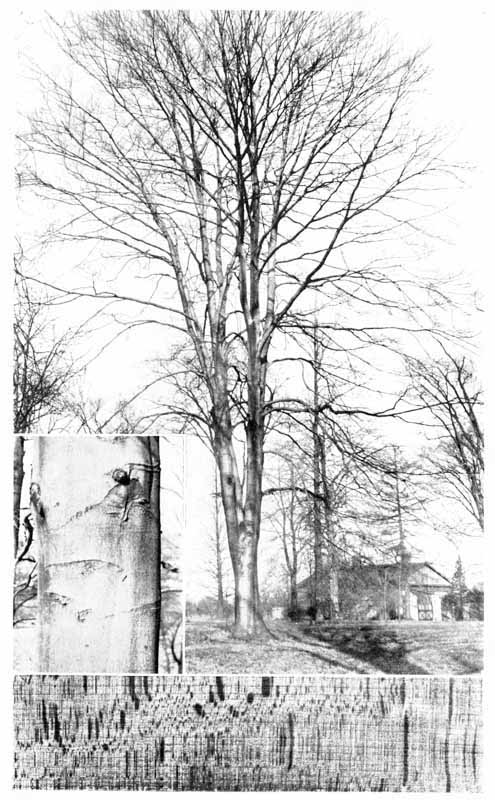
The name Ironwood has been applied to Blue Beech (Carpinus caroliniana), to the Hornbeam (Ostrya virginiana), and to at least eight other North American species affording unusually hard and heavy woods, such as are used for handles [p061] and implements.[39] Trunks of trees affording these woods are generally small and the weight of the woods is so great as to prevent their use in construction. [p062]
FOOTNOTES
† Keeler notes experiments made to prove resistance on part of beechwood.
Beech. Fagus atropunicea (Marsh.) Sudworth. Fagus ferruginea Ait.
Nomenclature. (Sudworth.)
Beech (local and common name).
Red Beech (Me., Vt., Ky., Ohio.).
White Beech (Me., Ohio., Mich.).
Ridge Beech (Ark.).
Locality.
Nova Scotia to Florida, westward intermittently to Wisconsin and Texas.
Features of Tree.
Sixty to eighty feet, occasionally higher; two to four feet in diameter. Small rough burr contains two thin-shelled nuts.
Color, Appearance, or Grain of Wood.
Heartwood reddish, variable shades, sapwood white. Rather close-grained, conspicuous medullary rays.
Structural Qualities of Wood.
Hard, strong, tough, not durable when exposed. Takes fine polish. Liable to check during seasoning.
Representative Uses of Wood.
Shoe-lasts, plane-stocks, ship-building, handles, and fuel. Carpentry (abroad), wagon-making, etc.
Weight of Seasoned Wood in Pounds per Cubic Foot.
42.
Modulus of Elasticity.
1,720,000.
Modulus of Rupture.
16,300.
Remarks.
The nuts are seldom gathered in the United States, nor is the wood there often utilized in carpentry. This is sometimes divided commercially into Red and White Beech, according to color of wood. Such division has no botanical basis. [p063]
Ironwood, Blue Beech. Carpinus caroliniana Walt.
Nomenclature. (Sudworth.)
Ironwood, Blue Beech (local and common name).
Water Beech (R. I., N. Y., Pa., Del., W. Va., Ohio, Ill., Ind., Mich., Minn., Nebr., Kans.).
Hornbeam (Me., N. H., Mass., R. I., Conn., N. Y., N. J., Pa., Del., N. C., S. C., Ala., Tex., Ky., Ill., Kans., Minn.).
Locality.
Quebec to Florida, westward intermittently to Nebraska and Texas.
Features of Tree.
Thirty to fifty feet in height. Six inches to occasionally two feet in diameter. A small tree, dark bluish-gray; bark resembles that of beech save in color.
Color, Appearance, or Grain of Wood.
Heartwood light brown, thick sapwood nearly white, close-grained.
Structural Qualities of Wood.
Very hard, tough, strong, heavy, very stiff, inclined to check during seasoning, not durable when exposed.
Representative Uses of Wood.
Levers, tool-handles, etc.
Weight of Seasoned Wood in Pounds per Cubic Foot.
45.
Modulus of Elasticity.
1,630,000.
Modulus of Rupture.
16,300.
Remarks.
Prized by wheelwrights in Europe. Resemblance of bluish bark to light-gray bark of beech gave rise to name. [p064]
Ironwood, Hop Hornbeam. Ostrya virginiana Willd.
Nomenclature. (Sudworth.)
Ironwood, Hop Hornbeam (local and common names).
Leverwood (Vt., Mass., R. I., N. Y., Pa., Kans.).
Hornbeam (R. I., N. Y., Fla., S. C., La.).
Hardhack (Vt.).
Locality.
Nova Scotia to Florida, westward intermittently to Dakota and Texas.
Features of Tree.
Thirty to forty feet in height, one foot or less in diameter. The bark exhibits long vertical rows of small squares. Small fruit resembles hops. Leaves resemble those of birch.
Color, Appearance, or Grain of Wood.
Heartwood reddish brown, sometimes white, sapwood lighter or white. Close-grained, compact structure.
Structural Qualities of Wood.
Very strong, hard, heavy, tough, durable when exposed.
Representative Uses of Wood.
Posts, levers, tool-handles, axe-helves, mill-cogs, wedges.
Weight of Seasoned Wood in Pounds per Cubic Foot.
51.
Modulus of Elasticity.
1,950,000.
Modulus of Rupture.
16,000.
Remarks.
Trees over twelve inches in diameter are often hollow. [p065]
PLATE 13. SYCAMORE (Platanus occidentalis).
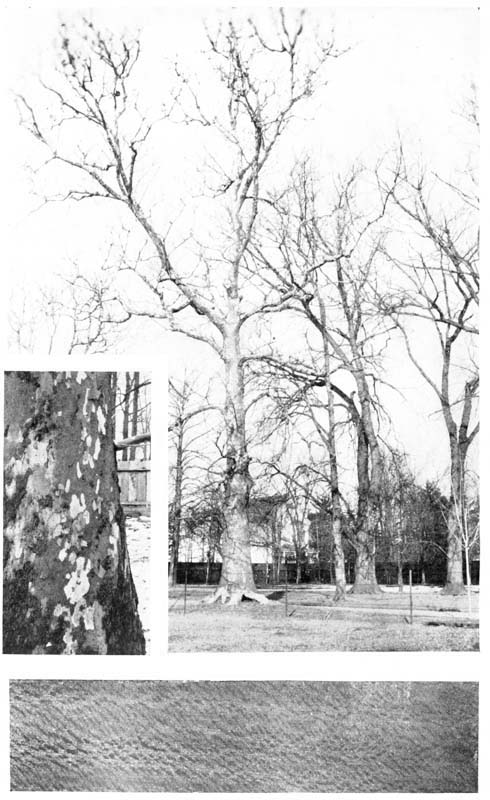
Quartered Sycamore Wood.
SYCAMORE. (Platanus.)
The name Sycamore applies to a maple (Acer pseudo-platanus) in Europe, to a fig-tree (Ficus sycomorus) in the Orient,[40] and to the buttonball or plane tree (Platanus) in North America. Of the plane trees (Platanus) the common or Oriental plane (Platanus orientalis) is a native of Europe; the plane, buttonball, or sycamore tree (Platanus occidentalis) is a native and common tree in eastern North America; and the California plane, buttonball, or sycamore (Platanus racemosa) is a native of western North America.
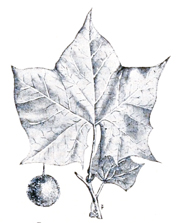
Sycamore (Platanus occidentalis).
The sycamore stands for curiosity, because of its Biblical association with Zaccheus. Many European sycamores were planted by religious persons during the middle ages because of the belief that they were the trees thus referred to in the Bible.
The woods afforded by the American sycamores have unusually complicated, cross-grained, but beautiful structures, difficult to work, but standing well and valued for cabinet work and small articles. American trees are often very large.
American buttonball or sycamore trees are distinguished by rough balls which remain hanging on long stems throughout the winter. The bark also is shed to an unusual extent; flakes of the outer cover drop away, exposing smooth inner surfaces so white as to appear as if painted. Six or seven species are included in the genus; three occur in North America. Platanus is from platus, signifying broad, and refers to the shape of the leaves. [p066]
FOOTNOTE
Sycamore. Buttonwood. Buttonball-tree. Platanus occidentalis Linn.
Nomenclature. (Sudworth.)
Sycamore, Buttonwood, Buttonball Tree (local and common names).
Buttonball (R. I., N. Y., Pa., Fla.).
Plane Tree (R. I., Del., S. C., Kans., Nebr., Ia.).
Water Beech (Del.).
Platane cotonier, Bois puant (La.).
Locality.
Maine to Florida, westward intermittently to Nebraska and Texas. Best in bottom lands of Ohio and Mississippi River basins.
Features of Tree.
Ninety to over one hundred feet in height, six to sometimes twelve feet in diameter. Inner bark exposed in white patches. Large rough balls or fruit.
Color, Appearance, or Grain of Wood.
Heartwood reddish brown, sapwood lighter, close-grained, compact structures, satiny conspicuous medullary rays. Attractive when quartered.
Structural Qualities of Wood.
Heavy, hard, difficult to work, not strong, stands well when not exposed.
Representative Uses of Wood.
Tobacco-boxes, ox-yokes, butcher-blocks, cabinet-work.
Weight of Seasoned Wood in Pounds per Cubic Foot.
35.
Modulus of Elasticity.
1,220,000.
Modulus of Rupture.
9000.
Remarks.
Some specimens rank among the largest of American deciduous trees. These are usually hollow. The remarkably rigid bark does not stretch to accommodate the growth and is thus discarded to an unusual degree. [p067]
California Sycamore. Platanus racemosa Nutt.
Nomenclature.
Sycamore, Buttonwood, Buttonball Tree, Buttonball (California).
Locality.
California.
Features of Tree.
Seventy-five to one hundred feet in height, occasionally higher; three to four feet in diameter. The bark exfoliates in irregular patches.
Color, Appearance, or Grain of Wood.
Heartwood light reddish brown, sapwood lighter, close-grained, compact structure, medullary rays numerous and conspicuous. Beautiful when quartered.
Structural Qualities of Wood.
Brittle, very difficult to split and to season. Qualities similar to those of P. occidentalis.
Representative Uses of Wood.
Decoration, furniture, similar to P. occidentalis.
Weight of Seasoned Wood in Pounds per Cubic Foot.
30.
Modulus of Elasticity.
800,000.
Modulus of Rupture.
7900.
Remarks.
Hough mentions[41] a tree twenty-nine feet seven inches in circumference. [p068]
FOOTNOTE
BIRCH. (Betula.)
The birches grow in Europe, Asia, and North America, their ranges on the latter continent extending far into the north.[42] Their history is remote and probably began with attention to the bark rather than to the wood.
Birch-bark is smooth, pliable, water-tight, and by reason of its resinous oils so durable that it often remains intact long after the wood inside of fallen trees has disappeared. It is separable into thin layers and was early employed as a writing material.[43] Houses have been covered by it and it has been used for cordage, utensils, "damp courses," and even rude clothing. The American Indians employed it for canoes, tents, troughs, and buckets. The wood is hard, heavy, strong, fine-grained, and beautiful. It shrinks in seasoning, works easily, stands well when not exposed. It is used for spools, woodenware, and other small articles, as well as for interior finish and cabinet work. Figured birch is one of the most beautiful of American cabinet woods.[44] Birch is often stained so as to imitate cherry and mahogany; the best imitations of the latter wood are of birch. Birch is commercially divided, according to the quantity of heartwood present, into white birch and red birch. The wood is "white" when the amount is small, and as heartwood increases with age the same tree might at one time afford white and at another red wood.
Birch trees may be known by their more or less laminated bark with its peculiar long horizontal lenticles or dashes. The [p069] leaves of the several birches differ but little, but the decided colors exhibited by their barks give names and serve to distinguish the species. Nine of the twenty-four known species of birch occur in North America; six are trees and the others low shrubs. Betula is said to be derived from bitumen. [p070]
FOOTNOTE
PLATE 14. BIRCH (Betula).
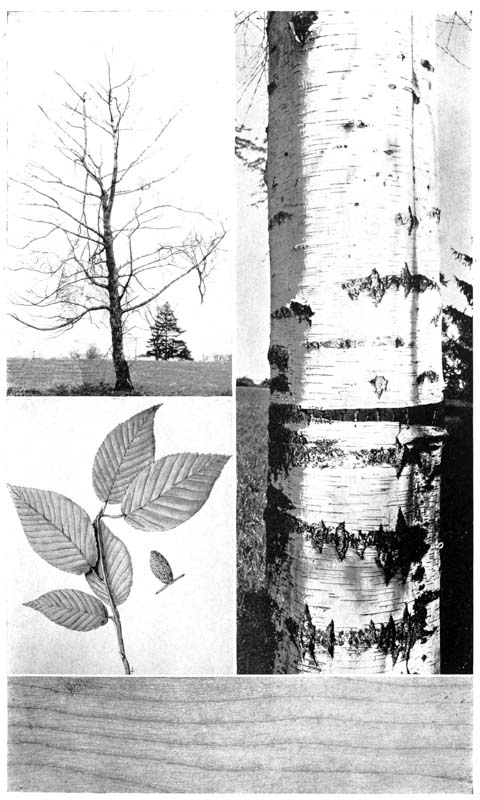
Yellow Birch Tree (Betula lutea). White Birch Bark (Betula populifolia).
Yellow Birch Foliage (Betula lutea). Birch Wood.
White Birch. Betula populifolia Marsh.
Nomenclature. (Sudworth.)
White Birch (local and common name).
Gray Birch (Me., R. I., Mass.).
Oldfield Birch, Poverty Birch (Me.).
Poplar-leaved Birch, Small White Birch (Vt.).
Locality.
Atlantic coast, Canada to Delaware.
Features of Tree.
Twenty to forty feet in height, about one foot in diameter. Durable, laminated, smooth, white bark on large branches and on trunk, save near ground; is not very easily detached from tree. Tremulous leaves.
Color, Grain, or Appearance of Wood.
Heartwood light brown, sapwood lighter, close-grained.
Structural Qualities of Wood.
Soft, light, not strong or durable.
Representative Uses of Wood.
Clothes-pins, shoe-pegs, tooth-picks, paper-pulp.
Weight of Seasoned Wood in Pounds per Cubic Foot.
35.
Modulus of Elasticity.
1,036,000.
Modulus of Rupture.
11,000.
Remarks.
The white bark is distinct from that of the paper birch in that it does not cover the whole trunk and in that it remains more perfectly intact. [p071]
Paper Birch, White Birch. Betula papyrifera Marsh.
Nomenclature. (Sudworth.)
Paper Birch, White Birch (local and common names).
Silver Birch (Minn.).
Large White Birch (Vt.).
Boleau (Quebec).
Canoe Birch (Me., Vt., N. H., R. I., Mass., N. Y., Pa., Wis., Mich., Minn.).
Locality.
Northern United States, northward into Canada, valley of the Yukon in Alaska.
Features of Tree.
Fifty to seventy feet in height, one and one-half to two and one-half feet in diameter. Smooth white exterior bark on large limbs and trunks away from ground. Brown or orange inner surfaces of bark. Splits freely into thin paper-like layers.
Color, Grain, or Appearance of Wood.
Heartwood brown tinged with red, sapwood nearly white. Very close-grained, compact structure.
Structural Qualities of Wood.
Strong, hard, tough, not durable.
Representative Uses of Wood.
Spools, shoe-lasts, pegs, paper-pulp, fuel, bark used in canoes.
Weight of Seasoned Wood in Pounds per Cubic Foot.
37.
Modulus of Elasticity.
1,850,000.
Modulus of Rupture.
15,000.
Remarks.
Starch is said to be manufactured from inner bark by Northern Indians. Reaches higher latitude than any American deciduous tree. Forms forests. The name White Birch is because of the color of the bark. [p072]
Red Birch. Betula nigra Linn.
Nomenclature. (Sudworth.)
Red Birch (local and common name).
Black Birch (Fla., Tenn., Tex.).
River Birch (Mass., R. I., N. J., Del., Pa., W. Va., Ala., Miss., Tex., Mo., Ill., Wis., Ohio).
Birch (N. C., S. C, Miss., La.).
Water Birch (W. Va., Kans.).
Blue Birch (Ark.).
Locality.
Massachusetts to Florida, westward intermittently to Minnesota and Texas. Best development in south Atlantic and lower Mississippi valley regions.
Features of Tree.
Thirty to eighty feet in height, one to three feet in diameter, sometimes larger. Dark red brown scaly bark on trunk. Red to silvery-white bark on branches. Bark separates in thin paper-like scales curling outward.
Color, Appearance, or Grain of Wood.
Heartwood light brown, sapwood yellowish white. Close-grained, compact structure.
Structural Qualities of Wood.
Light, rather hard and strong.
Representative Uses of Wood.
Furniture, woodenware, shoe-lasts, ox-yokes. Inferior cask-hoops from branches.
Weight of Seasoned Wood in Pounds per Cubic Foot.
35.
Modulus of Elasticity.
1,580,000.
Modulus of Rupture.
13,100.
Remarks.
Dark brown bark, whence name Red Birch. Prefers moist bottoms, whence name River Birch. [p073]
Yellow Birch. Betula lutea Michx. f.
Nomenclature. (Sudworth.)
Yellow Birch (local and common name).
Gray Birch (Vt., R. I., Pa., Mich., Minn.).
Swamp Birch (Minn.).
Silver Birch (N. H.).
Merisier, Merisier Rouge (Quebec).
Locality.
Newfoundland to North Carolina, westward intermittently to Minnesota and Texas. Best developed north of the Great Lakes.
Features of Tree.
Sixty to eighty feet or more in height, two to four feet in diameter. A medium-sized tree. Bark on trunk silvery gray to silvery yellow, branches green to lustrous or dull brown. Bark exfoliates, causing a rough, ragged appearance.
Color, Appearance, or Grain of Wood.
Heartwood light reddish brown, sapwood nearly white, close-grained, compact structure, satiny.
Structural Qualities of Wood.
Heavy, very strong, and hard, tough, susceptible of high polish. Qualities suggest those of maple. Not durable when exposed.
Representative Uses of Wood.
Furniture, buttons, tassel-moulds, pill-boxes, spools, and wheel-hubs.
Weight of Seasoned Wood in Pounds per Cubic Foot.
40.
Modulus of Elasticity.
2,290,000.
Modulus of Rupture.
17,700.
Remarks.
Occasional trees have thin outer bark ruptured, and exhibit inner bark of almost metallic yellow. Lutea, signifying yellow, alludes to color of bark. Inner bark has pungent, pleasant flavor. [p074]
Sweet Birch, Cherry Birch. Betula lenta Linn.
Nomenclature. (Sudworth.)
Sweet Birch, Cherry Birch (many localities).
Black Birch (N. H., Vt., Mass., R. I., Conn., N. Y., N. J., Pa., W. Va., Ga., Ill., Ind., Mich., Ohio).
Mahogany Birch (N. C., S. C.).
River Birch (Minn.).
Mountain Mahogany (S. C.).
Locality.
Newfoundland intermittently to Illinois, southward intermittently along Alleghanies to Kentucky, Tennessee, and Florida.
Features of Tree.
Fifty to eighty feet in height, three to four feet in diameter, dark reddish-brown bark, resembling that of cherry; does not separate into layers as paper-birch. Leaves, bark, and twigs sweet, spicy, and aromatic.
Color, Appearance, or Grain of Wood.
Heartwood dark brown tinged with red, sapwood light brown or yellow, close-grained, compact structure.
Structural Qualities of Wood.
Heavy, very strong, hard, receives stains and high satin-like polish.
Representative Uses of Wood.
Woodenware, furniture, ship-building (Canada), fuel.
Weight of Seasoned Wood in Pounds per Cubic Foot.
47.
Modulus of Elasticity.
2,010,000.
Modulus of Rupture.
17,000.
Remarks.
A common tree in Northern States. Wood often stained so as to resemble cherry and mahogany. Essences suggest wintergreen, contain much salicylic acid, and are used in medicine. The name "cherry" is because bark resembles that of cherry. "Sweet" is because of essences. [p075]
PLATE 15. LOCUST (Robinia, Gleditsia).
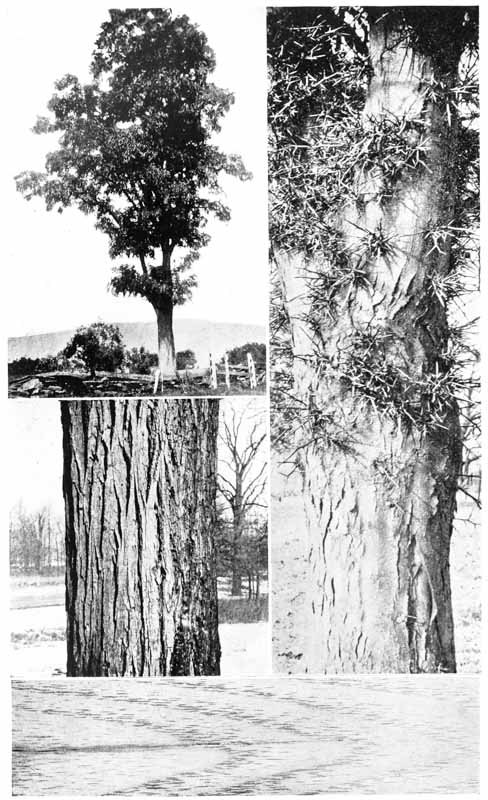
Black Locust Tree and Bark (Robinia pseudacacia.)
Honey Locust (Gleditsia triacanthos).
Locust Wood.
LOCUST, MESQUITE. (Robinia, Gleditsia, Prosopis.)
The name Locust applies to species of three distinct genera, all of which belong to the family Leguminosæ. The black locust (Robinia pseudacacia), the honey locust (Gleditsia triacanthos), and the Mesquite or honey locust (Prosopis juliflora) are principal representatives of their respective kinds. The first-named genus is North American, the other two have species on both continents.
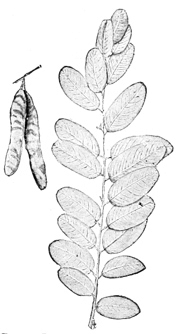
BLACK LOCUST (Robinia pseudacacia).
Black locust wood is tough, durable, unequalled for torsional strength and resilience, and is in every way in the first rank of American woods. It is fitted not only for exposed constructions, but for finer articles; hubs, pins, bolts, and trenails having no superiors. Trees develop rapidly when young, heart wood forming as early as the third year. Later growth and ultimate commercial value in the United States are much affected by insect borers, which practically limit the usefulness of the species. The black locust may be known by its clusters of large pea-blossom-shaped flowers, its bean-shaped pods, three to six inches in length, and by the prickles on the bark. The genus has six species, four of which are natives of the United States.[45] Robinia is from Robin, the name of an early French botanist. [p076] The black locust has been extensively introduced into Europe, both for ornamentation and for wood.[46]
The wood of the honey locust resembles that of the black locust, but is seldom used or appreciated save for fencing and similarly unimportant purposes. Trees grow rapidly and are not subject to the attacks of insects, so that they frequently attain to normal proportions. The flowers are much smaller than those of the black locust, but the pods are several times as long (twelve to eighteen inches). These often curl in drying and are thus rolled to some distance by the wind. Thorns or spines are present on some individuals and are often from three to six inches in length. The foliage resembles but is more delicate than that of the black locust. There is at least one other American species. Gleditsia is from Gleditsch, the name of a botanist.
Mesquite, also called honey locust, affords wood that is hard, heavy, and almost indestructible in exposed positions. The tree grows in the desert where vegetation would often seem to be impossible. The roots are developed to great size by their search for water, and are gathered and burned in the absence of other fuel. The trunks are small, but afford posts and ties. There are pods filled with rich edible pulp. Sixteen or more species belong to this genus, prosopis, of which one other, the screw-pod mesquite (Prosopis odorata), is found in the United States. [p077]
FOOTNOTES
Locust, Black Locust, Yellow Locust. Robinia pseudacacia Linn.
Nomenclature. (Sudworth.)
Locust, Black Locust, Yellow Locust (local and common names).
False Acacia (S. C., Ala., Tex., Minn.).
Pea-flower Locust, Post Locust (Md.).
Red Locust, Green Locust (Tenn.).
Honey Locust (Minn.).
White Locust (R. I., N. Y., Tenn.).
Acacia (La.).
Locality.
Southern Alleghany region, widely cultivated in United States east of Rocky Mountains.
Features of Tree.
Fifty to seventy feet in height, two to three feet or over in diameter. Leaves curl or close at night. Long spikes or briers on young branches.
Color, Appearance, or Grain of Wood.
Heartwood brownish, thin sapwood, light-greenish yellow. Close-grained and compact. Annual layers clearly marked.
Structural Qualities of Wood.
Heavy, very hard, strong, and durable under extreme conditions of wet and dry.
Representative Uses of Wood.
Long wooden bolts or pins called treenails. Posts, ties, construction, turnery, ship-ribs, ornamentations, fuel.
Weight of Seasoned Wood in Pounds per Cubic Foot.
45.
Modulus of Elasticity.
1,830,000.
Modulus of Rupture.
18,100.
Remarks.
Often a low shrub. Extensively planted, particularly in West, but subject to attack by borers. One of the most valuable of American timber trees. Heartwood is formed very early in this species. Pseudacacia means false acacia or imitation of acacia. [p078]
Honey Locust. Gleditsia triacanthos Linn.
Nomenclature. (Sudworth.)
Honey Locust (local and common name).
Thorn or Thorny Locust Tree or Acacia (N. Y., N. J., Ind., Tenn., La.).
Three-thorned Acacia (Mass., R. I., La., Tex., Neb., Mich.).
Black Locust (Miss., Tex., Ark., Kans., Neb.).
Honey or Honeyshucks (R. I., N. J., Va., Fla., Iowa).
Honeyshucks Locust (Ky.).
Sweet Locust (S. C., La., Kans., Nebr.).
Piquant Amourette (La.).
Confederate Pintree (Fla.).
Locust (Nebr.).
Locality.
Pennsylvania to Florida, westward intermittently to Nebraska and Texas. Best in lower Ohio River basin.
Features of Tree.
Seventy to ninety feet or more in height, two to four feet in diameter. Frequent long thorns.[47] Light thin foliage. Brown pods contain sweet pulp.
Color, Appearance, or Grain of Wood.
Heartwood bright brown or red, sapwood yellowish, annual layers strongly marked, coarse-grained, medullary rays conspicuous.
Structural Qualities of Wood.
Heavy, hard, strong, very durable in contact with soil.
Representative Uses of Wood.
Fence-posts, rails, wagon-hubs, rough construction, etc.
Weight of Seasoned Wood in Pounds per Cubic Foot.
42.
Modulus of Elasticity.
1,540,000.
Modulus of Rupture.
13,100.
Remarks.
Widely cultivated for landscape effect. Young trees used for forming hedges. [p079]
FOOTNOTE
Mesquite. Prosopis juliflora (Swartz) de C.
Nomenclature. (Sudworth.)
Mesquite (Tex., N. M., Ariz., Cal.).
Algaroba (Tex., N. M., Ariz., Cal.).
Honey Pod or Honey Locust (Tex., N. M.).
Ironwood (Tex.).
Locality.
Texas, west to San Bernardino Mountains, California. Also Colorado, Utah, and Nevada and northern Mexico.
Features of Tree.
Forty to fifty feet in height, one to two feet in diameter. Sometimes low shrub. Roots often very large. Pods with sweet pulp.
Color, Appearance, or Grain of Wood.
Heartwood rich dark brown, often red. Sapwood clear yellow. Close-grained, compact structure, distinct medullary rays.
Structural Qualities of Wood.
Weak, difficult to work, heavy, hard, very durable.
Representative Uses of Wood.
Posts, fencing, ties, house-beams, fuel, charcoal.
Weight of Seasoned Wood in Pounds per Cubic Foot.
47.
Modulus of Elasticity.
820,000.
Modulus of Rupture.
6800.
Remarks.
A locally important tree. Trees sometimes stunted by fires have numerous roots. Large roots used for fuel. [p080]
FOOTNOTE
Holsinger, "Forestry and Irrigation." Vol. VIII, No. 11, p. 447.
WHITEWOOD OR TULIP-TREE WOOD (Liriodendron.), POPLAR OR COTTONWOOD (Populus.), CUCUMBER-TREE WOOD (Magnolia.), BASSWOOD (Tilia.).
These trees are not related, but are all noted for woods with soft, fine qualities, such as fit them for carvings, woodenware, and paper-pulp. No one of the woods is durable when exposed, and all are used for boxes because they nail without splitting. The names are commercially interchangeable.
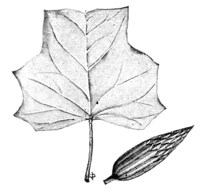
Whitewood (Liriodendron tulipifera).
The whitewood or tulip tree (Liriodendron tulipifera) is a native of America and an acclimated tree in Europe. It is the sole surviving species of its genus. The wood is soft, stiff, clean, fine, straight-grained, and obtainable in large-sized pieces. Much whitewood is made into lumber, the wood standing among those of the broadleaf series as white pine does among the conifers. Whitewood is particularly suitable for carvings. In spite of its name it is largely greenish yellow. It is often divided commercially, according to color, into "white poplar" and "yellow poplar." Trunks often attain to a very large size. Matthews mentions a specimen[48] thirty-three feet in circumference. The species may be known by its large tulip-shaped flower. Liriodendron is from two Greek words meaning lily and tree.
PLATE 16. WHITEWOOD OR TULIP TREE (Liriodendron tulipifera).
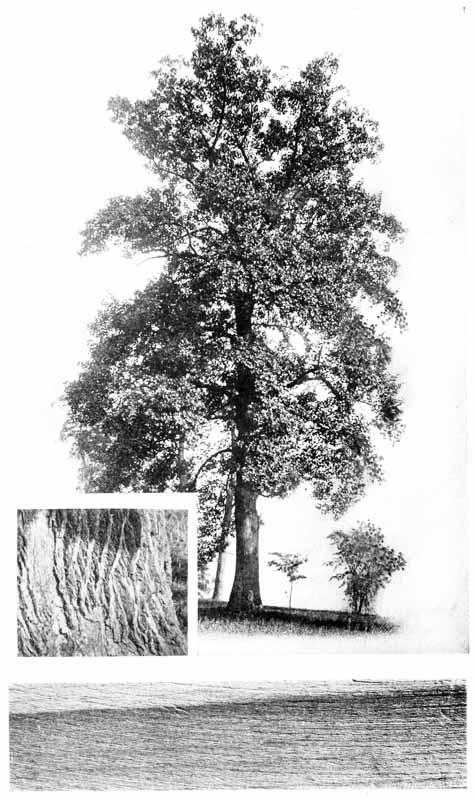
The poplars, sometimes called cottonwoods because of their seeds covered with a cotton-like down, are represented on both continents. The wood was made into shields by the [p081] ancients, because it was light and tough and would indent without breaking. The wood is often substituted for whitewood, but is less desirable, although valuable as a basis for paper-pulp. The trees may be known by the long drooping catkins that appear early in the spring before the leaves, and that are followed by white downy seeds that soon escape to whiten the surrounding ground. The poplars are noted for foliage more or less constantly in agitation. This peculiarity, so pronounced in the aspen (Populus tremuloides), is due to the very long petioles or leaf-stems. The cottonwoods abound in many otherwise arid regions of American Western deserts.
The cucumber trees are of the magnolia family and grow in many of the Eastern States. The wood resembles and is probably often mistaken for whitewood, for which it is a fair substitute. The trees may be known by their fruit, which resembles vegetable cucumbers. Magnolia is from Magnol, a botanist of the seventeenth century.
Basswood is a name applied to trees known in Europe and America as limes, lime trees, lind, linden, tiel, tiel trees, bass, and basswood trees. The trees and their wood were early esteemed, the first for their shade and appearance, and the last for their working qualities, which resemble, but are inferior to, whitewood.[49] The trees are characterized by their dense foliage and clusters of small cream-colored fragrant flowers, so attractive to bees as to have originated the further name bee-tree. Tilia arises from the ancient name for these trees. [p082]
FOOTNOTES
Tulip Tree, Whitewood, Yellow Poplar. Liriodendron tulipifera Linn.
Nomenclature. (Sudworth.)
Tulip Tree, Whitewood, Yellow Poplar (local and common names).
Poplar (R. I., Del., N. C., S. C., Fla., Ohio).
Tulip Poplar (Del., Pa., S. C., Ill.).
Hickory Poplar (Va., W. Va., N. C.).
Blue Poplar (Del., W. Va.).
Popple (R. I.).
Cucumber Tree (N. Y.).
Canoewood (Tenn.).
Locality.
New England to Florida, westward intermittently to Michigan and Mississippi.
Features of Tree.
Ninety to one hundred and fifty feet in height, six to twelve feet in diameter. Tulip-shaped flowers in spring. Greenish cones dry and remain after leaves have fallen.
Color, Appearance, or Grain of Wood.
Heartwood light yellow or greenish brown, thin sapwood, nearly white. Close, straight-grained, compact structure, free from knots.
Structural Qualities of Wood.
Light, soft, moderately strong, brittle, easily worked, durable. Hard to split, shrinks little, resembles white pine, stands well.
Representative Uses of Wood.
Lumber, interior finish, shingles, boat-building, pumps, woodenware, shelves, the bottoms of drawers.
Weight of Seasoned Wood in Pounds per Cubic Foot.
26.
Modulus of Elasticity.
1,300,000.
Modulus of Rupture.
9300.
Remarks.
Very large trees formerly common. Indians hollowed logs into boats. "Some large enough to carry twenty or thirty persons" (Hough), whence name canoewood. Tulipifera, signifying turbans and to bear, refers to flowers. One of the largest as well as most useful of American deciduous trees. [p083]
Poplar, Largetooth Aspen. Populus grandidentata Michx.
Nomenclature. (Sudworth.)
Poplar, Largetooth Aspen (local and common names).
Largetooth Poplar (N. C.).
Large Poplar (Tenn.).
White Poplar (Mass.).
Popple (Me.).
Large American Aspen (Ala.).
Locality.
Nova Scotia and Delaware, westward intermittently to Minnesota, Alleghany Mountains to Kentucky and Tennessee.
Features of Tree.
Sixty to eighty feet high, two feet or more in diameter. Irregular points or teeth on margins of leaves. Smooth gray bark.
Color, Appearance, or Grain of Wood.
Heartwood brownish, sapwood nearly white, close-grained, compact structure.
Structural Qualities of Wood.
Soft, light, weak.
Representative Uses of Wood.
Paper-pulp and occasionally woodenware.
Weight of Seasoned Wood in Pounds per Cubic Foot.
28.
Modulus of Elasticity.
1,360,000.
Modulus of Rupture.
10,200.
Remarks.
The several "poplars" are much prized for paper-pulp. The quaking aspen (P. tremuloides) has long leaf-stalks flattened vertically to the leaf-surface, so that leaves tremble in slight winds. [p084]
Cottonwood. Populus deltoides Marsh. Populus monilifera Ait.
Nomenclature. (Sudworth.)
Cottonwood (local and common name).
Carolina Poplar (Pa., Miss., La., N. M., Ind., Ohio).
Yellow Cottonwood (Ark., Ia., Neb.).
Big Cottonwood (Miss., Neb.).
Whitewood (Ia.).
Cotton Tree (N. Y.).
Necklace Poplar (Tex., Col.).
Broadleaved Cottonwood (Colo.).
Locality.
Canada to Florida, westward intermittently to Rocky Mountains.
Features of Tree.
Seventy-five to one hundred feet in height, four to five feet in diameter, occasionally much larger. Long catkins distribute cotton-like fibres.
Color, Appearance, or Grain of Wood.
Thin heartwood, dark brown, sapwood nearly white, close-grained, compact structure.
Structural Qualities of Wood.
Light, soft, weak, liable to warp, difficult to season.
Representative Uses of Wood.
Greatly valued in manufacture of paper-pulp, also packing-boxes, fence-boards, fuel.
Weight of Seasoned Wood in Pounds per Cubic Foot.
24.
Modulus of Elasticity.
1,400,000.
Modulus of Rupture.
10,900.
Remarks.
Monilifera is from the Latin monolinum, a necklace, and fero, to bear, and refers to the long necklace or catkin. [p085]
Black Cottonwood. Populus trichocarpa Torr. and Gr.
Nomenclature. (Sudworth.)
Black Cottonwood (Oreg., Cal.).
Balsam Cottonwood, Balm (Oreg.).
Cottonwood (Oreg., Cal.).
Balm Cottonwood (Cal.).
Locality.
Pacific coast region, Alaska to California.
Features of Tree.
A large tree sometimes one hundred and fifty feet in height and four to six feet in diameter.
Color, Appearance, or Grain of Wood.
Heartwood light dull brown, sapwood nearly white, compact structure.
Structural Qualities of Wood.
Light, soft, weak.
Representative Uses of Wood.
Staves, woodenware (local).
Weight of Seasoned Wood in Pounds per Cubic Foot.
23.
Modulus of Elasticity.
1,580,000.
Modulus of Rupture.
8400.
Remarks.
Largest deciduous tree of Puget Sound district (Sargent). [p086]
Cucumber Tree. Magnolia acuminata Linn.
Nomenclature. (Sudworth.)
Cucumber Tree (R. I., Mass., N. Y., Pa., N. C., S. C., Ala., Miss., La., Ark., Ky., W. Va., Ohio, Ind., Ill.).
Mountain Magnolia (Miss., Ky.).
Black Lin, Cucumber (W. Va.).
Magnolia (Ark.).
Locality.
New York to Illinois, southward through Kentucky and Tennessee to Gulf (intermittently).
Features of Tree.
Fifty to occasionally one hundred feet in height, two to four feet in diameter. A large, handsome, symmetrical tree, with cones resembling cucumbers.
Color, Appearance, or Grain of Wood.
Heartwood brownish yellow, sapwood nearly white, close-grained, compact structure. Satiny, thin medullary rays.
Structural Qualities of Wood.
Light, soft, not strong, durable. Qualities similar to whitewood.
Representative Uses of Wood.
Cabinet-making, cheap furniture, flooring, pump-logs, troughs, crates, packing-boxes. Used similarly to L. tulipifera.
Weight of Seasoned Wood in Pounds per Cubic Foot.
29.
Modulus of Elasticity.
1,310,000.
Modulus of Rupture.
9500.
Remarks.
Wood resembles and is often sold for tulip-tree wood. [p087]
Basswood, Linn, Linden. Tilia americana Linn.
Nomenclature. (Sudworth.)
Basswood, Linn, Linden, American Linden (local and common names).
Limetree (R. I., N. C., S. C., Ala., Minn., La., Ill.).
Black or Smooth-leaved Limetree (Tenn.).
Whitewood (Vt., W. Va., Ark., Minn.).
Yellow Basswood, Lein (Ind.).
Beetree (Vt., W. Va., Wis.).
White Lind (W. Va.).
Wickup (Mass.).
Locality.
New Brunswick to Georgia, westward intermittently to Nebraska and Texas. Wide range.
Features of Tree.
Sixty to ninety feet in height, two to four feet in diameter, occasionally larger. Large smooth leaves.
Color, Appearance, or Grain of Wood.
Heartwood light or reddish brown, thick sapwood nearly similar, very straight and close-grained, compact structure.
Structural Qualities of Wood.
Light, soft, easily worked, tough, not strong nor durable.
Representative Uses of Wood.
Sides and backs of drawers, bodies of carriages, woodenware, paper-pulp.
Weight of Seasoned Wood in Pounds per Cubic Foot.
28.
Modulus of Elasticity.
1,190,000.
Modulus of Rupture.
8300.
Remarks.
Basswood refers to the inner bark or "bast," sometimes utilized for cordage. The flowers attract bees, whence the name bee-tree. White Basswood, (Tilia heterophylla,) is not distinguished commercially. [p088]
WILLOW. (Salix.)
The willows are very widely distributed over both continents, and their history extends back over a very considerable period. Pliny states that Britons used to make voyages in boats of willow. The willow mentioned in the Bible was the Salix babylónica, or weeping willow, later acclimated in this country.
The principal experience with the tough, light, workable, elastic wood has been in Europe. The ancients used it for shields, because it was one of the woods that would indent without breaking. Lazlett states that it is used for cart-linings because it will not splinter when struck by stones. It has been used for lap-boards, cricket-bats, keels, paddles, and water-wheels. It resists heat and friction and is therefore used for lining friction-brakes. Willow charcoal ignites readily and is highly esteemed in the manufacture of the finer kinds of gunpowder. The bark is used in tanning. The little branches have long been associated with baskets and woven work. American trees are seldom cut up into lumber, but are valued for shade and appearance, and are often planted along the banks of streams to prevent erosion.
Willows grow very rapidly and have a characteristic and attractive appearance. They usually prefer low moist places. There are so many hybrids and peculiar species as to render classification in all cases difficult.[50] Black willow is the native species, oftenest attaining to tree size in North America. The White, Crack, Bedford, and Goat Willows (Salix alba, S. fragilis, S. russeliana, and S. caprea) are said to afford good wood. Salix is said to be from the Celtic sal, meaning near, and lis, water. Salicylic acid is abundantly present in the bark of some species. [p089]
FOOTNOTE
PLATE 17. BLACK WILLOW (Salix nigra).
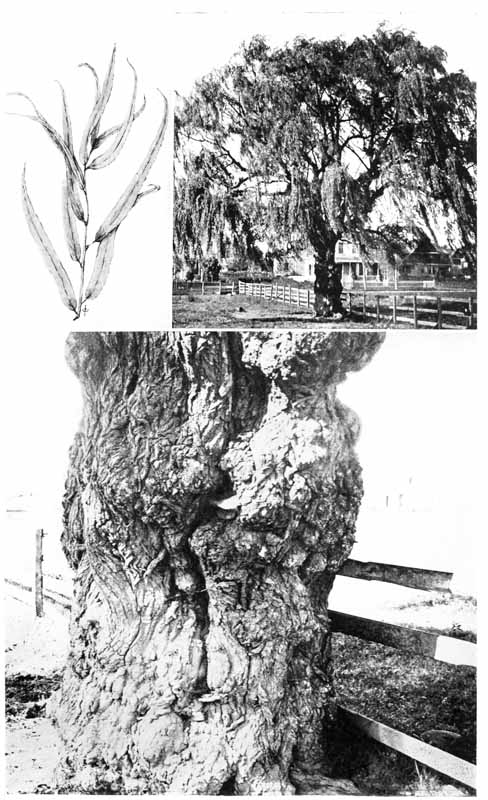
Black Willow. Salix nigra Marsh.
Nomenclature. (Sudworth.)
Black Willow (local and common name).
Swamp Willow (N. C., S. C.).
Willow (N. Y., Pa., N. C., S. C., Miss., Tex., Cal., Ky., Mo., Neb.).
Locality.
New Brunswick to Florida, westward intermittently to Dakota, Arizona, and California, Mexico.
Features of Tree.
Forty to fifty feet in height, two to four feet in diameter. Long narrow leaf, characteristic appearance.
Color, Appearance, or Grain of Wood.
Heartwood brown, sapwood nearly white, close-grained.
Structural Qualities of Wood.
Soft, light, weak, checks badly in drying, readily worked. Dents without splitting.
Representative Uses of Wood.
Lap-boards, basket-making, fuel, charcoal.
Weight of Seasoned Wood in Pounds per Cubic Foot.
27.
Modulus of Elasticity.
550,000.
Modulus of Rupture.
6000.
Remarks.
Prefers borders of rivers and bottom lands. Many varieties of willow grow in the United States. No one is used to any extent in construction. [p090]
CATALPA. (Catalpa.)
Many kinds of wood that were formerly plentiful are now much less so. Attention is being turned to trees that give best results under artificial conditions. Catalpa, formerly but little known, now bids fair to become of some importance in this connection.
The catalpa grows rapidly and produces a coarse, brittle, weak, but durable and desirable, lumber, well fitted to meet the requirements of railways and other branches of construction where the annual consumption is the largest. Fifty thousand catalpa trees have recently been planted by a Western railway at a cost of one cent apiece. Catalpas at Hutchison, Kansas, were large enough to cut for posts at the end of six years.[51] A sample tie recently removed from a Western railway was found to be perfect after fifteen years of service. Mr. John Brown[52] mentions specimens sixteen inches in diameter seventeen years after planting. The species Catalpa speciosa is said to be much the more desirable in that it is hardy and reaches a tall upright form.
The catalpa may be known by its showy flowers, suggesting those of the horse chestnut. These are succeeded by long pods filled with many-winged seeds and often used by children as cigars. [p091]