EXOGENOUS TREES. (Dicotyledons.) (continued 3)
Reading edition
The common redwood is a large and perfect tree and supplies a wood suggesting good red cedar. This soft, light, clean, reddish-brown, durable wood works and stands well, is not easily inflamed, and is obtainable in large-sized pieces for use in large constructions. Coffins and shingles are made of it, also large quantities of wooden water-pipe employed for irrigation purposes. The average wood is seen in cheaper forms of indoor finish, while occasional pieces, in which the grain is distorted, are classed as curly redwood and used for costlier decorations.
Big or Mammoth trees have been measured up to three hundred and twenty feet in height and thirty-five feet in diameter (Sargent). They are thus the largest of American trees and the most massive, although not the tallest, of all trees. Specimens twenty-five feet in diameter have been estimated as thirty-six hundred years old, and it is thought that under favorable conditions trees can survive for five thousand years, or even longer. The oldest trees are sound throughout. The almost incombustible bark is nearly two feet in thickness; the wood is brittle, but otherwise resembles ordinary redwood. It should be noted that large exceptional trees are all known, and that most of them have names such as the "Pride of the Forest," the "Grizzly Giant," and the "U. S. Grant." These, with younger trees, are grouped in [p181] the Mariposa, Calavaras, and other groves. Many sawmills are unfortunately engaged on the trees of this species.
PLATE 35. REDWOOD (Sequoia).
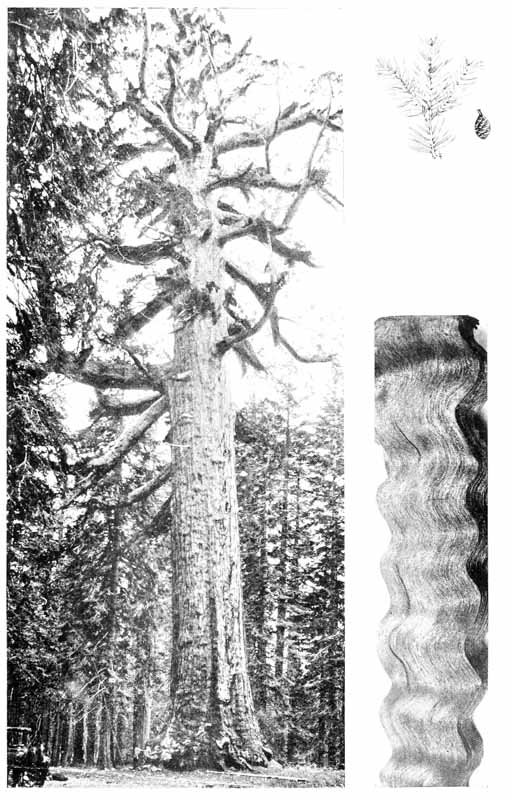
Giant Redwood Tree (S. washingtoniana). (Courtesy Doubleday, Page & Co.) Redwood Foliage (Sequoia sempervirens).
"Curly" Redwood Wood (dissection).
Redwood trees may be known by their size, locality, and fine, dull, evergreen foliage. The name Sequoia is that of an Indian chief. [p182]
FOOTNOTE
References: "The Big Trees of California," U. S. Forestry Division Bulletin No. 28. Also Mr. Jas. Horsburgh, Jr., Southern Pacific Railway.
Redwood. Sequoia sempervirens Endl.
Nomenclature. (Sudworth.)
Redwood (local and common name).
Sequoia, California Redwood, Coast Redwood (local).
Locality.
Central and North Pacific coast region.
Features of Tree.
Two hundred to three hundred feet in height, sometimes higher, six to eight and sometimes twenty feet in diameter. Straight, symmetrical trunk. Low branches rare.
Color, Appearance, or Grain of Wood.
Thick heartwood red, changing to reddish brown when seasoned; Thin sapwood nearly white. Coarse, straight grain, compact structure, very thick bark.
Structural Qualities of Wood.
Light, not strong, soft, very durable, not resinous, easily worked. Does not burn easily, receives polish.
Representative Uses of Wood.
Timber, shingles, flumes, fence-posts, coffins, railway ties, water-pipes, interior decoration. Bark made into souvenirs.
Weight of Seasoned Wood in Pounds per Cubic Foot.
26 (census figure, see page 6).
Modulus of Elasticity.
790,000 (average of 8 Humboldt specimens).[106]
1,140,000 (average of 7 Humboldt specimens).[106]
960,000 (census figure, see page 6).
Modulus of Rupture.
4920 (average of 9 Humboldt specimens).[106]
7138 (average of 7 Mendocino specimens).[106]
8400 (census figure, see page 6).
Remarks.
Pacific coast chief construction wood. Curled or distorted grain adds value for cabinet purposes. [p183]
The Big or Mammoth Tree or Giant Redwood (S. washingtoniana Sudworth and S. gigantea) is the largest tree known. The wood resembling that of S. sempervirens is used locally, see U. S. Forestry Bul. No. 28.
FOOTNOTE
PLATE 36. ENDOGENOUS STRUCTURE IN WOOD.
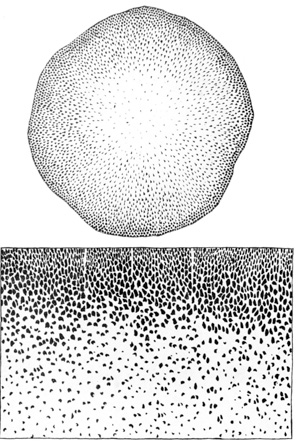
A section through a Palm Tree.
A cross-section of Palm wood. (Natural size.)