EXOGENOUS TREES. (Dicotyledons.) (continued 2)
Reading edition
FOOTNOTES
Kansas Agricultural College Experiment Station, Bulletin 108.
PLATE 18. CATALPA (Catalpa).
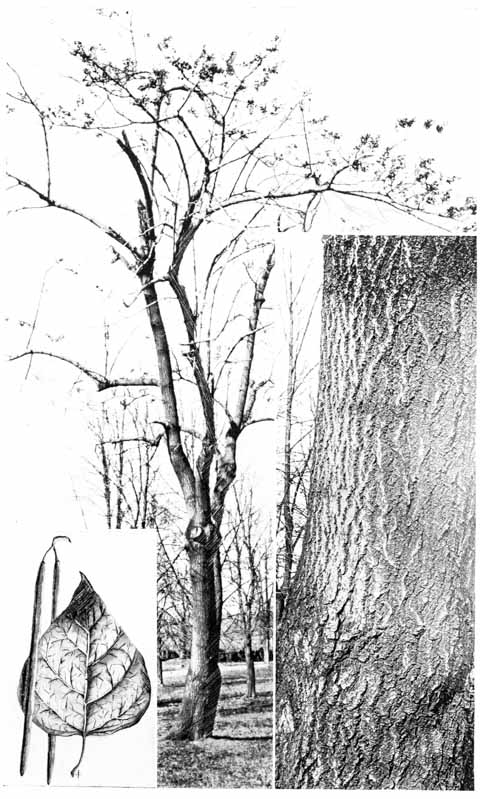
Catalpa, Hardy Catalpa. Catalpa speciosa Warder.
Nomenclature. (Sudworth.)
Catalpa (R. I., N. Y., La., Ill., Ind., Mo., Wis., Ia., Neb., Minn.).
Hardy Catalpa (Ill., Ia., Kan., Mich.).
Western Catalpa (Pa., Ohio, Kans., Neb., Ill.).
Cigar Tree (Mo., Ia.).
Indian Bean, Shawneewood (Ind.).
Bois Puant (La.).
Locality.
Central Mississippi valley, naturalized in many localities.
Features of Tree.
Forty to sixty feet or more in height, three to six feet in diameter; well-formed trunks. Large, white, faintly mottled flower, long pod or bean.
Color, Appearance, or Grain of Wood.
Thick heartwood brown, thin sapwood lighter, nearly white, coarse-grained, compact structure, annual layers clearly marked.
Structural Qualities of Wood.
Light, soft, not strong, durable in contact with soil.
Representative Uses of Wood.
Railway ties, fence-posts, rails, adapted for cabinet-work and interior finish.
Weight of Seasoned Wood in Pounds per Cubic Foot.
25.
Modulus of Elasticity.
1,160,000.
Modulus of Rupture.
9000.
Remarks.
Hardier and better formed trunks than afforded by C. catalpa. A rapid grower; sprouts vigorously from stumps. A valuable tree, promising to become better known. Foliage subject to attack by insects. [p092]
FOOTNOTE
John P. Brown (The Forester, October, 1900).
Catalpa. Catalpa Catalpa (Linn.) Karst. Catalpa bignonioides Walt.
Nomenclature. (Sudworth.)
Catalpa (local and common name).
Indian Cigar Tree (Pa.).
Smoking Bean (R. I.).
Cigar Tree (R. I., N. J., Pa., W. Va., Mo., Ill., Wis., Ia.).
Indian Bean (Mass., R. I., N. Y., N. J., Pa., N. C., Ill.).
Catawba, Catawba Tree (Del., W. Va., Ala., Fla., Kans.).
Bean Tree (N. J., Del., Pa., Va., La., Neb.).
Locality.
Naturalized in many localities east of Rocky Mountains.
Features of Tree.
Thirty to fifty feet in height, one to two or more feet in diameter. Trunks not well formed. A low, wide tree, large heart-shaped leaves, characteristic flower. Long slender pod or bean.
Color, Appearance, or Grain of Wood.
Thick heartwood is light pink brown; thin sapwood is nearly white. Coarse-grained, compact.
Structural Qualities of Wood.
Light, soft, not strong, durable in contact with soil.
Representative Uses of Wood.
Fence-posts, railway ties, etc.
Weight of Seasoned Wood in Pounds per Cubic Foot.
27.
Modulus of Elasticity.
960,000.
Modulus of Rupture.
8300.
Remarks.
Grows rapidly. Pods remain on tree after leaves fall. Sometimes used as cigars by children. Wood is less desirable than C. speciosa. [p093]
PLATE 19. SASSAFRAS (Sassafras officinale).
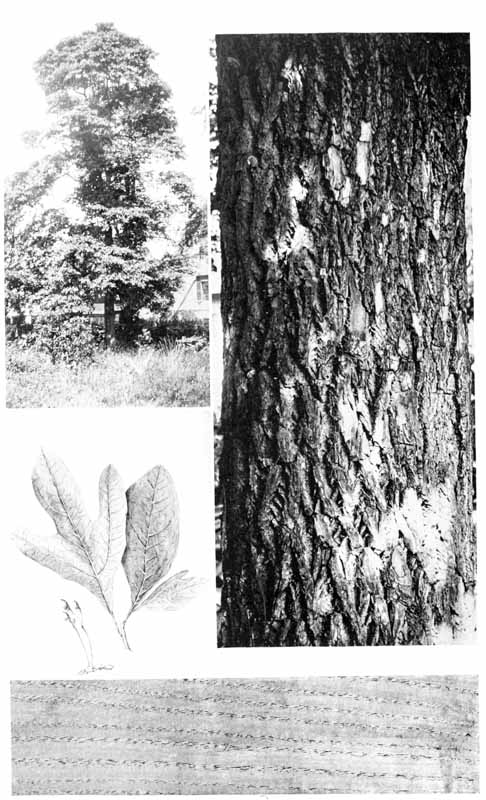
SASSAFRAS. (Sassafras.) MULBERRY. (Morus.)
The sassafras was one of the first American trees to be described in Europe,[53] where many fictitious properties were early credited to its aromatic essences. The wood is not distinguished by unusual qualities, but trees are cut for lumber as encountered with other and more valuable species in the forest. The mucilaginous leaves are of three separate shapes. Some have lobes on both sides of the central surface, others have one lobe at one side so as to resemble mittens, while yet others on the same branch have simple oval shapes. The dark-blue berries on bright-red stems are so eagerly devoured by birds as to be seldom seen. The characteristic flavor is most pronounced in the bark of the root.
The Red, White, and Black Mulberries are named from the color of their fruits. The former, which is the American species, has wood resembling that of the sassafras, only in that it is not distinguished by unusual qualities. Its leaves, like that of the sassafras, are of several shapes on the same tree. The very sweet fruit resembles blackberries in form. The leaves used in silkworm-culture are from the Russian mulberry, a cross between the white mulberry and black mulberry (M. alba and M. nigra).[54] [p094]
FOOTNOTES
Sassafras. Sassafras officinale Nees and Eberm. Sassafras sassafras (Linn.) Karst.
Nomenclature. (Sudworth.)
Sassafras (local and common name).
Saxifrax, Sasifrax Tree (Fla., Tenn.).
Sassafac, Sassafrac (W. Va., Del.).
Gumbo file (La., negro).
Locality.
Vermont to Florida, westward intermittently to Michigan and Texas.
Features of Tree.
Thirty to fifty feet in height, one to three feet in diameter, sometimes larger, often low shrub, characteristic odor and leaves.
Color, Appearance, or Grain of Wood.
Thick heartwood, delicate brown, thin sapwood yellowish white, coarse-grained, annual rings clearly marked.
Structural Qualities of Wood.
Light, soft, not strong, brittle, checks in drying, very durable in contact with soil. Slightly aromatic.
Representative Uses of Wood.
Pails, buckets, ox-yokes, fence-posts, and rails.
Weight of Seasoned Wood in Pounds per Cubic Foot.
31.
Modulus of Elasticity.
730,000.
Modulus of Rupture.
8500.
Remarks.
Leaves and shoots mucilaginous. Bark of root rich in highly aromatic essences. Sassafras often forms thickets. [p095]
Red Mulberry, Mulberry. Morus rubra Linn.
Nomenclature. (Sudworth.)
Red Mulberry, Mulberry (local and common name).
Black Mulberry (N. J., Pa., W. Va.).
Virginia Mulberry Tree (Tenn.).
Murier Sauvage (La.).
Locality.
Massachusetts to Florida, westward intermittently to Nebraska and Texas. Best in lower Ohio and Mississippi River basins.
Features of Tree.
Fifty to sixty feet in height, two and one half to three feet in diameter. Sweet edible fruit. Dark brown broken bark, smooth gray branches.
Color, Appearance, or Grain of Wood.
Thick heartwood, light orange yellow, thin sapwood whitish, coarse-grained, compact structure, annual layers clearly marked.
Structural Qualities of Wood.
Light, soft, not strong, very durable in contact with soil, receives good polish.
Representative Uses of Wood.
Local ship-building, agricultural implements, fencing, cooperage.
Weight of Seasoned Wood in Pounds per Cubic Foot.
36.
Modulus of Elasticity.
11,700,000.
Modulus of Rupture.
11,000.
Remarks.
An ornamental tree. The leaves of this species are not adapted to silkworm culture. [p096]
BUCKEYE. HORSE CHESTNUT. (Æsculus.)
The buckeye and horse chestnut are species of the same genus. The common horse chestnut (Æsculus hippocastanum) was once thought to have been a native of Asia, but it is now quite certain that it originated on the mountains of northern Greece. Trees have been cultivated in Europe for at least three centuries and are now extensively grown over the United States. The name buckeye is generally applied to such species as are natives of North America.
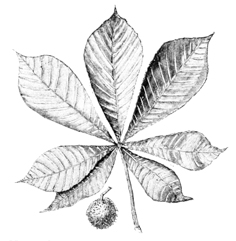
Horse Chestnut (Æsculus hippocastanum).
The woods resemble one another in that they are soft, straight-grained, easily worked, and decay rapidly when exposed. They are employed to some extent in woodenware, artificial limbs, and paper-making. The trees may be known by their round prickly pods, containing smooth chestnut-colored bitter nuts. The leaves of the buckeye are arranged in groups of five, while those of the horse chestnut are in groups of seven. The horse chestnut produces showy spotted flowers. There are thirteen species of this genus, eight of which are North American. The name "horse chestnut" may refer ironically to the coarse nuts, or may arise from the fact that they are occasionally eaten by cattle, or from a horseshoe marking seen on young twigs. Hippocastanum is from hippos, a horse, and castanea, a chestnut. The name buckeye refers to the appearance of the brown nut through the paler husk partly separated when ripe, suggesting the eye of the common deer. [p097]
PLATE 20. HORSE CHESTNUT (Æsculus hippocastanum).
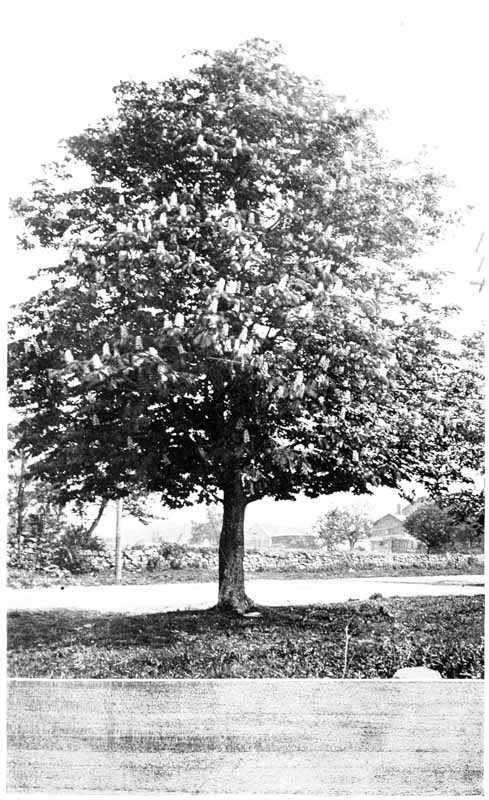
Ohio Buckeye, Fetid Buckeye. Æsculus glabra Willd.
Nomenclature. (Sudworth.)
Buckeye, Ohio Buckeye (local and common names).
Fetid Buckeye (W. Va.).
Stinking Buckeye (Ala., Ark.).
American Horse Chestnut (Pa.).
Locality.
Ohio River basin to Alabama, portions of Iowa, Kansas, and Indian Territory.
Features of Tree.
Twenty-five to forty-five feet in height. One to one and one-half feet in diameter. Yellowish-white flower, succeeded by round prickly pod or fruit.
Color, Appearance, or Grain of Wood.
Heartwood white, sapwood a little darker, close-grained, frequent dark lines of decay.
Structural Qualities of Wood.
Weak, light, soft, hard to split.
Representative Uses of Wood.
Artificial limbs, woodenware, paper-pulp, rarely lumber.
Weight of Seasoned Wood in Pounds per Cubic Foot.
28.
Modulus of Elasticity.
910,000.
Modulus of Rupture.
7000.
Remarks.
FOOTNOTE
The nearly similar horse chestnut (A. hippocastanum) is forty to fifty feet or more in height and two to four feet in diameter. The light, weak wood is seldom used. The name horse may be applied to the coarse nuts ironically, or may refer to their occasional use by cattle, or a horseshoe marking seen on young twigs. [p098]
Buckeye, Sweet Buckeye. Æsculus octandra Marsh. Æsculus flava Ait.
Nomenclature. (Sudworth.)
Buckeye (N. C., S. C., Ala., Miss., La., Tex., Ky.).
Sweet Buckeye (W. Va., Miss., Tex., Mo., Ind.).
Yellow Buckeye (S. C., Ala.).
Large Buckeye, Big Buckeye (Tex., Tenn.).
Locality.
Alleghany Mountains, Pennsylvania to Georgia, westward intermittently to Iowa and Texas.
Features of Tree.
Forty to seventy feet in height, one to three feet in diameter, sometimes low shrub. Large mahogany-colored seed.
Color, Appearance, and Grain of Wood.
Heartwood, creamy white, sapwood similar, compact structure, close-grained, difficult to split.
Representative Uses of Wood.
Similar to those of Ohio Buckeye (A. glabra).
Weight of Seasoned Wood in Pounds per Cubic Foot.
26.64.
Modulus of Elasticity.
Modulus of Rupture.
Remarks.
[p099]
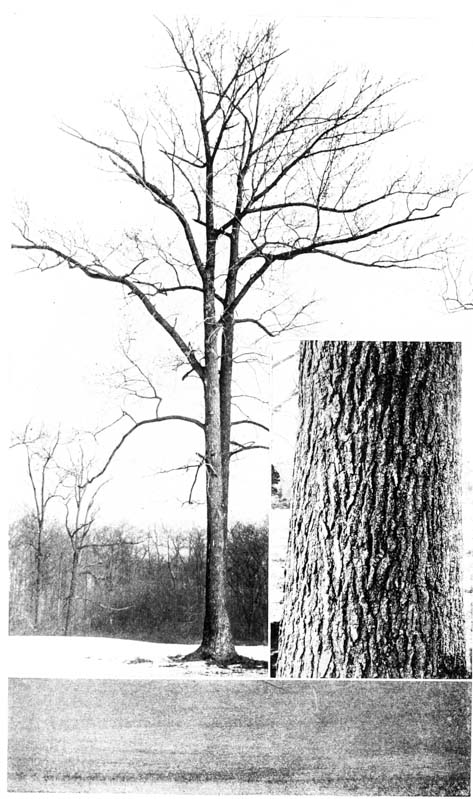
PLATE 21. SWEET GUM (Liquidambar styraciflua).
GUM. (Liquidambar, Nyssa.)
This name is applied to two unrelated American trees—the Sweet or Red Gum (Liquidambar styraciflua), a member of the witch-hazel family, and the Sour or Black Gum (Nyssa sylvatica), which is one of the dogwoods.
The woods afforded by these two trees are also distinct from one another, although both are referred to by the one name, gum. The softer Sweet Gum figures in carpentry. Selected pieces so resemble black walnut as to be cut into veneers and made up into furniture. Sour Gum is harder, it splits with difficulty, and is fitted for small work and implements, such as wagon-hubs and tool-handles. Both woods are close-and often cross-grained, besides being strong, heavy, tough, and difficult to season.
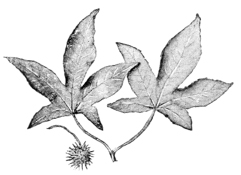
Sweet Gum (Liquidambar styraciflua).
The Sweet Gum tree is characterized by rough, round balls, resembling those of the sycamore, by pointed star-like leaves, suggesting those of the sugar maple, and by corky ridges on the bark of younger branches. These latter cause the bark to resemble alligator-skin and give rise to the name alligator-wood. Liquidambar refers to gums excreted by the tree and sometimes used in medicine. The Sour Gum bears ovoid bluish-black sour drupes, or fruit containing single roughened seeds. The thick oval leaves are dark green above and dull or hairy below. The foliage of both species becomes brilliant in autumn. [p100]
Sweet Gum. Liquidambar styraciflua Linn.
Nomenclature. (Sudworth.)
Sweet Gum (local and common name).
Liquidambar (R. I., N. Y., Del., N. J., Pa., La., Tex., Ohio, Ill.).
Red Gum (Va., Ala., Miss., Tex., La.).
Gum, Gum Tree (Va., S. C., La.).
Alligatorwood, Blisted (N. J.).
Locality.
Connecticut to Florida, westward intermittently to Illinois and Texas, Mexico. Greatest development in basin of Mississippi River.
Features of Tree.
Eighty to one hundred feet or more in height, three to five feet in diameter. Tall straight trunk, corky ridges frequent on branches. Star-shaped leaves turn to brilliant scarlet in autumn, round balls on long stems.
Color, Appearance, or Grain of Wood.
Heartwood rich brown suggesting black walnut, sapwood nearly white, close-grained, compact structure.
Structural Qualities of Wood.
Heavy, rather soft, strong, stiff, not durable when exposed,[55] shrinks and warps badly in seasoning, receives high polish.
Representative Uses of Wood.
Veneers, cabinet-work, substitute for black walnut, shingles, clapboards, paving-blocks, wooden plates.
Weight of Seasoned Wood in Pounds per Cubic Foot.
37 (U. S. Forestry Div.).[56]
36.
Modulus of Elasticity.
1,700,000 (average of 118 tests by U. S. Forestry Div.).[56]
1,220,000.
Modulus of Rupture.
9500 (average of 118 tests by U. S. Forestry Div.).[56]
9200.
Remarks.
Wood sometimes commercially known as satin walnut and sometimes as star-leaved gum. Large specimens often have hollow butts. [p101]
FOOTNOTES
Sour Gum, Black Gum, Tupelo. Nyssa sylvatica Marsh.
Nomenclature. (Sudworth.)
Sour Gum, Black Gum, Tupelo (local and common names).
Pepperidge (Vt., Mass., R. I., N. Y., N. J., S. C., Tenn., Mich., Ohio, Ontario).
Wild Pear Tree, Yellow Gum Tree (Tenn.).
Gum (Md.).
Stinkwood (W. Va.).
Tupelo Gum (Fla.).
Locality.
Maine to Florida, westward intermittently to Michigan and Texas.
Features of Tree.
Forty-five to one hundred feet high, one and six inches to occasionally four feet in diameter. Ovoid, bluish-black, sour fruit, with seed. Horizontal branches, short spur-like lateral branchlets.
Color, Appearance, or Grain of Wood.
Heartwood light brown or yellow, often nearly white, sapwood hardly distinguishable, fine grain.
Structural Qualities of Wood.
Heavy, not hard, fibres interlaced, therefore hard to work, strong, tough, checks unless carefully seasoned, not durable in contact with soil.
Representative Uses of Wood.
Wagon-hubs, rollers, ox-yokes, bowls, and woodenware.
Weight of Seasoned Wood in Pounds per Cubic Foot.
39.
Modulus of Elasticity.
1,160,000.
Modulus of Rupture.
11,800.
Remarks.
Limited usefulness because difficult to work. Larger specimen in South. Large trees often hollow at butts and sometimes higher. [p102]
Cotton Gum, Tupelo Gum, Large Tupelo. Nyssa aquatica Linn.
Nomenclature. (Sudworth.)
Cotton Gum, Tupelo Gum, Large Tupelo (local and common names).
Sour Gum (Ark., Mo.).
Tupelo, Swamp Tupelo (N. C., S. C., La.).
Olivetree, Wild Olivetree (Miss., La.).
Locality.
Virginia and Kentucky, southward.
Features of Tree.
Sixty to eighty feet high, two to three feet in diameter. Blue oblong fruit one inch or more in length.
Color, Appearance, or Grain of Wood.
Heartwood light brown, often nearly white, sapwood nearly the same.
Structural Qualities of Wood.
Light, not strong, soft, compact, difficult to work.
Representative Uses of Wood.
Turnery, woodenware, roots used as net-floats instead of corks.
Weight of Seasoned Wood in Pounds per Cubic Foot.
32.
Modulus of Elasticity.
730,000.
Modulus of Rupture.
9300.
Remarks.
Butts of large trees are usually hollow. Parts above are usually sound. [p103]
PLATE 22. HOLLY, BOXWOOD, LIGNUMVITÆ (Ilex, Buxus, etc.).
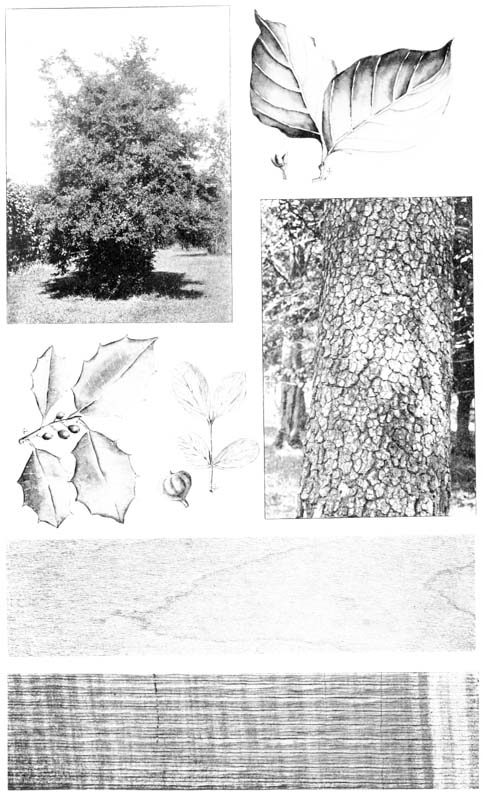
Box Tree (Buxus sempervirens). Dogwood Foliage (Cornus florida).
Holly Foliage (Ilex opaca). Lignumvitæ Foliage (G. sanctum). Dogwood Bark (Cornus florida).
Dogwood Wood.
Lignumvitæ Wood.
HOLLY (Ilex.). BOXWOOD (Buxus, Cornus, etc.). LIGNUM VITÆ (Guajacum.).
The woods afforded by these trees are all demanded in small and very perfect pieces to fill needs for which no others appear to be perfectly fitted. The holly (Ilex) grows in Europe and America, where the brilliant evergreen foliage and red berries have long been associated with the Christmas season. The name holly is probably a subversion of "Holy."[57] The true boxwood (Buxus sempervirens) attains to some size in Europe and Asia, but remains a small shrub in America, where it is seldom if ever cut for wood, but is placed as a decoration along the borders of walks and gardens. The wood called "boxwood" in America is not therefore derived from the "box." The Lignumvitæs grow in Florida, the West Indies, and on the northern coast of South America.
Holly-wood is noted for its fine, even grain, but chiefly for its smooth, ivory-white color, fitting it for the white of inlaid work, for carvings and other decorations where white color and fine qualities are required. The principal European source is the Ilex aquifolium, while in America it is the Ilex opaca. Boxwood is, as stated, the name applied to several woods, all noted for their fine compact structure, rendering them suitable for very fine carvings such as are required in wood-engraving. The Eastern product as cut from the true box is so highly prized as to be sold by the pound. American boxwood is chiefly derived from the Flowering Dogwood, the Mexican Persimmon, and the Rose Bay. In Australia several species of Eucalyptus are said to be used. Lignumvitæ is noted for great strength and hardness. Layers of fibres alternately cross one another so that the wood may be said to crumble rather than split. It has no superior for implements that must be [p104] fine, true, and strong, such as the sheaves of pulleys and handles of tools. The supply is obtained from two species (Guajacum sanctum and Guajacum officinale).
Holly may be known by its foliage and berries. Box (Buxus) has small, smooth, ovate, dark, evergreen leaves joining the stem so as to be opposite one another. The Dogwood is known by its flowers; the Lignum-vitæ is a low gnarled tree. [p105]
FOOTNOTE
Holly, American Holly. Ilex opaca Ait.
Nomenclature. (Sudworth.)
Holly, American Holly (local and common names).
White Holly (Va.).
Locality.
Massachusetts to Florida, westward intermittently to Indiana and Texas.
Features of Tree.
Occasionally fifty feet in height and three feet in diameter, frequently much smaller, particularly in North. Foliage is evergreen. Bright red berries remain until spring.
Color, Appearance, or Grain of Wood.
Heartwood cream-white, darkening or spotting on exposure. Sapwood similar or lighter. Very close-grained, compact structure.
Structural Qualities of Wood.
Tough, moderately hard and heavy, easily worked.
Representative Uses of Wood.
Inlaid work, carvings, scrollwork, turnery, moderately for furniture and decoration.
Weight of Seasoned Wood in Pounds per Cubic Foot.
36.
Modulus of Elasticity.
910,000.
Modulus of Rupture.
9700.
Remarks.
The wood resembles ivory. [p106]
Dogwood, Flowering Dogwood. Cornus florida Linn.
Nomenclature. (Sudworth.)
Dogwood, Flowering Dogwood (local and common names).
Boxwood (Conn., R. I., N. Y., Miss., Mich., Ky., Ind., Ont.).
False Box-dogwood (Ky.).
New England Boxwood (Tenn.).
Cornel, Flowering Cornel (Tex., R. I.).
Locality.
New England to Florida, westward intermittently to Minnesota and Texas, Sierra Madra Mountains, Mexico.
Features of Tree.
Twenty-five to thirty-five feet in height, one foot or more in diameter. Often low shrub, large white flowers precede foliage, red berry in fall. Rough blackish bark.
Color, Appearance, or Grain of Wood.
Heartwood rich brown, changing to green and red. Sapwood lighter, close-grained.
Structural Qualities of Wood.
Heavy, strong, tough, hard, receives high polish.
Representative Uses of Wood.
Wood-carving, engraving, bearings of machinery, turnery.
Weight of Seasoned Wood in Pounds per Cubic Foot.
50.
Modulus of Elasticity.
1,160,000.
Modulus of Rupture.
12,800.
Remarks.
The Mexican or Black Persimmon and the Great Laurel (Rhododendron maximum) afford substitutes. Yellowwood (Schaefferia frutescens) is also known as boxwood. The names Dogwood and Poison Dogwood are often applied to the sumach. Cornus signifies horn and refers to hardness of wood. [p107]
Lignumvitæ. Guajacum sanctum.
Nomenclature. (Sudworth.)
Lignumvitæ (Fla.).
Ironwood (Fla.).
Locality.
Semitropical Florida, Bahamas, San Domingo, Cuba, Puerto Rico.
Features of Tree.
Twenty-five feet high, one foot in diameter, a low gnarled tree.
Color, Appearance, or Grain of Wood.
Heartwood rich yellow-brown in younger specimens and almost black in older ones. Sapwood light yellow. Close-grained, compact structure.
Structural Qualities of Wood.
Very heavy and exceedingly hard, strong, hard to work, brittle. Lubricated by water.
Representative Uses of Wood.
Sheaves of ship-blocks, rollers, pulleys, tool-handles. Bearings for journals rotating in water.
Weight of Seasoned Wood in Pounds per Cubic Foot.
71.
Modulus of Elasticity.
1,220,000.
Modulus of Rupture.
11,100.
Remarks.
Two other species, Guajacum officinale and Guajacum arborium, afford similar woods not commercially distinguished from the above. [p108]
LAUREL. (Magnolia, Rhododendron, Arbutus, etc.)
The name Laurel applies locally or botanically to a number of American plants, several of which attain to the dignity of trees.
The Big Laurel or Magnolia (M. grandiflora) is an ornamental tree of the highest rank, extensively planted in parks and gardens of American cities as far north as Washington, and also grown in Europe. The wood is suitable for interior finish and is also used for fuel. The California Laurel (Umbellularia californica) and the Madroña or Madroña Laurel (Arbutus menziesii) are Pacific coast species of beautiful appearance, the strong, heavy, hard woods of which are of economic importance. Professor Sargent considers[58] that the former is the most valuable interior or cabinet wood produced by the forests of the Pacific coast. The wood of the Madroña has little or no place in construction, but its charcoal is used in the manufacture of gunpowder. The wood of the Great Laurel or Rose Bay (Rhododendron maximum) has been used as boxwood. The gnarled roots of the Mountain Laurel or calico bush (Kalmia latifolia) are used for rustic hanging-baskets, seats, and the like.
All of the kinds here noted have evergreen foliage. [p109]
FOOTNOTE
California Laurel, Mountain Laurel. Umbellularia californica Nutt.
Nomenclature. (Sudworth.)
California Laurel, Mountain Laurel (Cal., Nev.).
California Bay Tree, Spice Tree (Cal., Nev., Oreg.).
Laurel, Bay-tree, Oreodaphne (Cal.).
Myrtle-tree, Cajeput, California Olive (Oreg.).
Californian Sassafras.
Locality.
California and Oregon.
Features of Tree.
Seventy-five to one hundred feet in height, three to five feet in diameter. Evergreen foliage, beautiful appearance.
Color, Appearance, or Grain of Wood.
Heartwood light rich brown, sapwood lighter brown. Close-grained, compact structure.
Structural Qualities of Wood.
Heavy, hard, strong, receives beautiful polish.
Representative Uses of Wood.
Ship-building, cabinet-work, cleats, crosstrees.
Weight of Seasoned Wood in Pounds per Cubic Foot.
40.
Modulus of Elasticity.
1,510,000.
Modulus of Rupture.
11,400.
Remarks.
A valuable Pacific coast cabinet wood. [p110]
Madroña, Madroña Laurel. Arbutus menziesii Pursh.
Nomenclature. (Sudworth.)
Madroña, Madroña Laurel (Cal., Oreg.).
Laurel, Laurelwood, Madrone.
Madrone-tree, Manzanita (Oreg., Cal.).
Madrove (Cal.).
Locality.
Pacific coast from British Columbia to southern California.
Features of Tree.
Fifty to seventy-five feet in height, occasionally higher. Two to four feet in diameter. Straight well-formed trunk. Evergreen foliage. A shrub in the South.
Color, Appearance, or Grain of Wood.
Thick heartwood reddish, thin sapwood slightly pink. Close-grained; numerous and conspicuous medullary rays.
Structural Qualities of Wood.
Heavy, hard, strong, checks badly in seasoning.
Representative Uses of Wood.
Largely for gunpowder, charcoal, also furniture.
Weight of Seasoned Wood in Pounds per Cubic Foot.
43.
Modulus of Elasticity.
1,190,000.
Modulus of Rupture.
12,000.
Remarks.
A beautiful ornamental tree. [p111]
PLATE 23. PERSIMMON, OSAGE ORANGE, CHERRY (Diospyros), (Maclura), (Prunus).
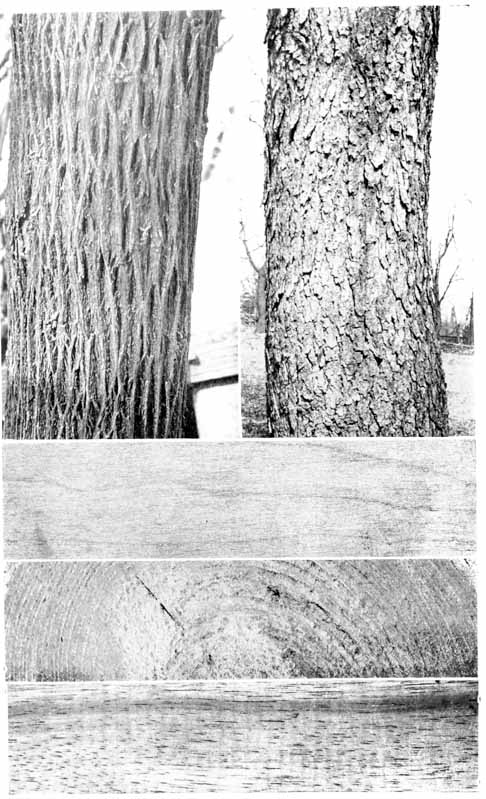
Osage Orange Trunk (M. aurantiaca). Wild Black Cherry Trunk (P. scrotina).
Cherry Wood.
Osage Orange Wood.
Persimmon Wood.
PERSIMMON (Diospyros.). OSAGE ORANGE (Maclura.). CHERRY (Prunus.).
The Persimmon (Diospyros virginiana) grows in many of the central and southern United States and affords a hard, tough wood, resembling fine-grain hickory, that is used for implements and other small work. The plum-like fruit is remarkably astringent when green, but is sweet, rich, and palatable when ripe. The persimmon is a member of the ebony family (Ebenaceæ), and the extremely close-grained heartwood is almost black. The ebony of commerce is derived from tropical species of this genus.
The Osage Orange or Bois D'Arc (Maclura aurantiaca) is found in the Gulf and neighboring States, and has been cultivated in the North. The wood is unusually hard and strong, and is of a yellow color, which, however, darkens with age. It is in many ways a unique and serviceable product, widely utilized locally in the South, but almost unknown in the North, and nowhere sufficiently appreciated. The aborigines made bows and arrows of it, whence the name Bois D'Arc. The tree affords a useless fruit somewhat resembling the common orange in appearance.
The widely distributed Wild Cherry or Wild Black Cherry (Prunus serotina) supplies the cherry wood of commerce. This wood is strong, hard, fine-grained, red-colored, and one of the most popular decorative woods of the American forests. Sweet or Cherry Birch (Betula lenta) is often stained so as to imitate it, while it of itself is stained so as to resemble mahogany. The wood of the cultivated cherry is not used in the United States. The wild cherry bears purplish-black fruit somewhat larger than peas, sweetly bitter when ripe. The bark is also bitter. It should be noted of these woods that the thin heart of the persimmon is black, that of the Bois d'Arc is yellow, and that of the cherry is red. Each receives a high polish. [p112]
Persimmon. Diospyros virginiana Linn.
Nomenclature. (Sudworth.)
Persimmon (local and common name).
Date Plum (N. J., Tenn.).
Simmon, Possumwood (Fla.).
Plaqueminier (La.).
Locality.
Connecticut to Florida, westward intermittently to Missouri and Texas.
Features of Tree.
Occasionally seventy feet in height, one to two feet in diameter. Soft plum-like fruit, astringent when green, sweet when ripe.
Color, Appearance, or Grain of Wood.
Heartwood dark-brown or black, sapwood light-brown, often with darker spots. Very thin heartwood. Very close-grained, compact structure. Medullary rays conspicuous. Resembles hickory.
Structural Qualities of Wood.
Hard, heavy, strong.
Representative Uses of Wood.
Plane-stocks, shoe-lasts, etc. Prized for shuttles.
Weight of Seasoned Wood in Pounds per Cubic Foot.
49.
Modulus of Elasticity.
1,110,000.
Modulus of Rupture.
12,400.
Remarks.
The astringency of unripe fruit is due to tannic acid. The dried and roasted seeds have been used for coffee.[59] Heartwood is not greatly developed in trees under one hundred years of age. [p113]
FOOTNOTE
Osage Orange. Maclura aurantiaca Nutt. Toxylon pomiferum Raf.
Nomenclature. (Sudworth.)
Osage Orange (local and common name).
Bois D'Arc (La., Tex., Mo.).
Bodark, Bodock (Kans.).
Yellow-wood, Osage Apple Tree (Tenn.).
Hedge, Hedge-plant, Osage (Ill., Ia., Neb.).
Mock Orange (La.).
Bow-wood (Ala.).
Locality.
Southern Arkansas, Indian Territory, and Texas. Cultivated elsewhere, as in Massachusetts, Pennsylvania, and Michigan.
Features of Tree.
Twenty to fifty feet in height, rarely beyond one and one-half feet in diameter. Fruit resembles orange. Long thorns.
Color, Appearance, or Grain of Wood.
Heartwood bright orange, turns brown on exposure. Sapwood light yellow, close-grained, annual rings clearly marked.
Structural Qualities of Wood.
Hard, heavy, very strong, flexible, durable in contact with soil. Receives beautiful polish. Shrinks in seasoning.
Representative Uses of Wood.
Fence-posts, piles, telegraph poles, railway ties, paving-blocks, occasionally indoor decoration.
Weight of Seasoned Wood in Pounds per Cubic Foot.
48.
Modulus of Elasticity.
1,300,000.
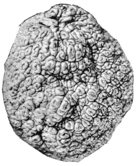
Osage Orange.
Modulus of Rupture.
16,000.
Remarks.
Indians used wood for bows, thus the name Bois D'Arc, corrupted into Bow Dark or Bodark. A valuable wood not enough appreciated. Often planted as hedges. The fruit is useless. [p114]
Wild Black Cherry, Wild Cherry. Prunus serotina Ehrh.
Nomenclature. (Sudworth.)
Wild Black Cherry, Wild Cherry (local and common names).
Black Cherry (Me., N. H., Vt., R. I., N. Y., Miss., Ky., Mich., Wis., Ind., Neb.).
Rum Cherry (N. H., Mass., R. I., Miss., Neb.).
Whiskey Cherry (Minn.).
Choke Cherry (Mo., Wis., Ia.).
Locality.
Eastern to Central United States.
Features of Tree.
Forty to eighty feet in height. Two to three or more feet in diameter. Bitter bark, pea-sized fruit.
Color, Appearance, or Grain of Wood.
Heartwood reddish brown, sapwood yellow, fine straight grain, compact structure.
Structural Qualities of Wood.
Light, hard, strong, easily worked.
Representative Uses of Wood.
Cabinet-work, interior finish.
Weight of Seasoned Wood in Pounds per Cubic Foot.
36.
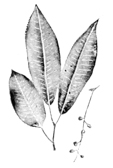
Wild Black Cherry (Prunus serotina).
Modulus of Elasticity.
1,200,000.
Modulus of Rupture.
11,700.
Remarks.
The bitter bark contains medicinal properties valued in bronchitis and other troubles. The fruit, agreeable when ripe, is also used in medicines and cordials. [p115]
PLATE 24. TEAK AND GREENHEART (Tectona, Nectandra, etc.).
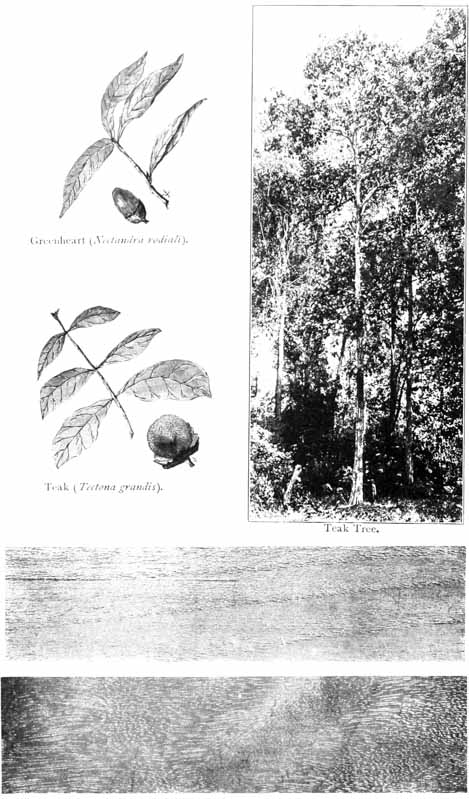
Greenheart (Nectandra rodiali). Teak Tree.
Teak (Tectona grandis).
Teakwood.
Lignumvitæ Wood.
TEAK (Tectona.). GREENHEART (Nectandra.).
There are two Teaks; the principal one (Tectona grandis), a native of Asia, has been called the "Oak" of the Indian forests, the other (Oldfieldia africana) is an African tree.[60] The Greenheart (Nectandra rodiali) is of the laurel family and grows in South America. The woods, although foreign, are of such nature as to have widely established reputations, and each has at some time been used in construction.
Teak suggests oak, save that it is lighter and has a more uniform structure. It is very durable, and an oily secretion repels insects and preserves iron fastenings. During the supremacy of wooden vessels it was regarded as one of the best ship-building woods in existence. The grain fits it for carvings, and it is now known in North America chiefly because of this fact. Indian teak is the wood usually referred to.
Greenheart was early placed among the first class of ship-building woods by Lloyd's Register, and is yet taken to Europe to some extent for dock-and ship-building and for implements, but is seldom found and but little known in the United States. It is strong, hard, durable, and extremely heavy, the latter quality being so pronounced as to limit its field of usefulness. [p116]
FOOTNOTE
Teak. Tectona grandis.
Nomenclature.
Teak.
Indian Oak.
Teek.
Sagwan.
Locality.
India, Burma, Siam, Ceylon.
Features of Tree.
Eighty to one hundred feet in height, three to four feet in diameter, sometimes larger. Straight trunk, large drooping deciduous leaves.
Color, Appearance, or Grain of Wood.
Variable, brownish-yellow, straight, even-grained.
Structural Qualities of Wood.
Moderately hard, strong, easily worked, stands well, oily, fragrant, resists termites, preserves iron.
Representative Uses of Wood.
Furniture, ship-building, timbers, backing for armor-plates.
Weight of Seasoned Wood in Pounds per Cubic Foot.
50 (Laslett).
Modulus of Elasticity.
1,338,000 (Lazlett).
2,100,000 (Thurston).
Modulus of Rupture.
15,000 (Thurston).
Remarks.
The oil is thought to preserve iron and repel termites. Burma, Malabar, Rangoon, and other teaks take names from districts producing them. The distinct African teak (Oldfieldia africana) affords wood sometimes marketed as African mahogany and sometimes as African oak. (Forestry methods, see "Burma Teak Forests," Sir Dietrich Brandis, "Garden and Forest," Vol. IX, "Forestry and Irrigation," Vol. IX, No. 3, p. 139.) [p117]
Greenheart. Nectandra rodiali.
Nomenclature.
Greenheart (local and common name).
Locality.
British Guiana and adjacent portions of South America and the West Indies.
Features of Tree.
Twenty-five to sometimes seventy feet in height, two to four feet in diameter. A straight tree.
Color, Appearance, or Grain of Wood.
Heartwood dark green to chestnut or nearly black, sapwood similar. Clean, straight, compact structure, free from knots. Numerous pores, annual layers hardly distinguishable.
Structural Qualities of Wood.
Exceptionally heavy, strong, and durable, tough, hard, elastic, receives high polish, breaks suddenly.
Representative Uses of Wood.
Ship-keels, frames, rollers, turnery, also beams, planks, and piles (Europe). In America tops of fishing-rods and very occasionally veneers.
Weight of Seasoned Wood in Pounds per Cubic Foot.
72 (Lazlett).
Modulus of Elasticity.
1,090,000 (Lazlett).
Modulus of Rupture.
10,000 (Thurston).
Remarks.
Excessive weight unfits it for many purposes. Placed in first class of ship-building woods by Lloyd's Register. Formerly supposed to repel teredo. Generally exported through Demerara to England. [p118]
MAHOGANY. (Swietenia, Khaya, Soymida, Cedrela, etc.)
There are three principal mahogany trees: the Central American or true mahogany (Swietenia mahogani), the African mahogany (Khaya senegalensis), and the Indian mahogany (Soymida febrifuga). There are also minor species called mahoganies.[61] American mahogany was originally divided by dealers into Spanish and Honduras wood, the former from the then Spanish-American possessions. A considerable supply now comes from Mexico, taking name from port of shipment; as, Frontera, Laguna, Santa Ana, Tecolutla, Minatitlan, and Tonala, desirability being much in the order named. The African field is the latest and probably most important, very large quantities of its wood being distributed through English markets.
PLATE 25. MAHOGANY (Swietenia mahagoni).
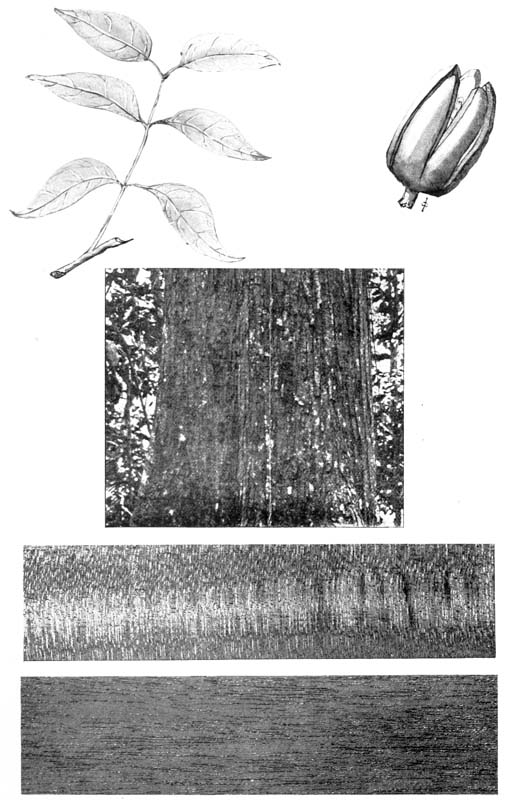
Two Specimens of Wood.
Mahogany, placed among the second class of ship-building woods by Lloyd's Register, was once used to some extent in place of oak in naval architecture, but is now so greatly valued for decoration as to be employed for little else, save occasionally the hulls of small pleasure craft. The decorative value is due to a combination of beauty, working qualities, and durability. Beauty is influenced by both grain and warm red color. The latter is generally light, and although it subsequently darkens, in most cases, to a characteristic and rich reddish-brown, is usually induced immediately by stains. The grain is not only beautiful of itself, but is such as to receive those stains and finishing processes thus demanded. Different localities produce woods varying in tint and grain. Individual [p119] trees also differ in desirability. No two are alike. Beautiful grain effects are often obtained in "crotches" or junctions between trunk and branch, and such pieces bring high prices. Mahogany is generally used as a veneer. Layers are glued either to some central piece or "core" or else to one another. The layers are arranged so as to cross one another's grain, and results are usually thought to be more desirable than those obtained from solid wood. Few woods glue better, and few shrink or distort less when in place.
"Spanish Cedar" (Cedrela odorata) is a broadleaf wood, and not a conifer as is usually supposed. It is nearly related to, and usually found and cut with, true mahogany. Lindley[62] divides Cedrelecæ into two sub-orders: Swieteniæ, including the true mahoganies, and Cedrelæ, with nine genera and twenty-five species distributed over tropical Asia and America.
Prima vera or white mahogany belongs to Bignoniaceæ, which also includes the catalpas. [p120]
FOOTNOTES
Mahogany. Swietenia mahogani Jacq.
Nomenclature.
Mahogany (local and common name).
Spanish Mahogany (Cuba, San Domingo, West Indies).
Mexican Mahogany (Frontera, Laguna, Santa Anna, and other Mexican ports).
Honduras Mahogany (Honduras).
Baywood, Madeira, Redwood.
Locality.
Florida Keys, Bahamas, West Indies, Mexico, Central America, Peru.
Features of Tree.
Florida specimens forty-five feet in height and two or more feet in diameter. Foreign trees larger.
Color, Appearance, or Grain of Wood.
Light, rich reddish brown. Thin sapwood yellow. Smooth, fine uniform texture, inconspicuous rings, conspicuous pores, sometimes filled with white substance.
Structural Qualities of Wood.
Strong, brittle, durable, holds glue, takes stains and high polish, small distortion in seasoning, stands well.
Representative Uses of Wood.
Cabinet-work, veneers; formerly ship-building.
Weight of Seasoned Wood in Pounds per Cubic Foot.
45.
Modulus of Elasticity.
1,510,000.
Modulus of Rupture.
14,000.
Remarks.
Desirability varies with locality. Spanish mahogany ranks first, and harder Mexican woods next. Mahogany is usually stained. African mahogany is now successfully rivaling the American product. [p121]
White Mahogany. Prima vera. Tabeuia Donnell-Smithii (Rose).
Nomenclature.
White Mahogany, Prima vera (local and common names).
Locality.
Mexico and Central America.
Features of Tree.
Fifty to seventy-five feet in height, two to four feet in diameter. Tall, slender, a beautiful tree. Numerous golden-yellow flowers precede the leaves.
Color, Appearance, or Grain of Wood.
Cream-white. Beautiful, fine grain, resembles mahogany.
Structural Qualities of Wood.
Works and stands well.
Representative Uses of Wood.
Cabinet-work, fine furniture, veneers.
Weight of Seasoned Wood in Pounds per Cubic Foot.
Modulus of Elasticity.
Modulus of Rupture.
Remarks.
Many twelve-foot logs imported through San Francisco and west. Higher-priced than Red Mahogany. Named after discoverer. The wood of the Butternut or White Walnut is sometimes sold as White Mahogany.
FOOTNOTE
See Botanical Gazette, Vol. XVII, 1892, p. 418; Contribution U. S. National Herbarium, p. 346, Vol. I, No. 9, U. S. Dept. Agriculture, Division of Botany. [p122]
Spanish Cedar, Mexican Cedar. Cedrela odorata Linn.
Nomenclature.
Spanish Cedar, Mexican Cedar, Cuban Cedar (local and common names).
Locality.
Mexico, Cuba, West Indies.
Features of Tree.
Fifty to eighty feet in height, two to five feet in diameter. Pale-yellow flowers. Pods resemble pecan-nuts. Tree suggests English walnut (J. regia).
Color, Appearance, or Grain of Wood.
Brownish red, straight, even, compact grain.
Structural Qualities of Wood.
Soft, fragrant, porous, durable. Resembles cedar woods derived from coniferous trees (page 167); also resembles mahogany.
Representative Uses of Wood.
Cigar-boxes, boats, fine cabinet-work. May be used in place of mahogany. The figured Australian Red Cedar (C. australis) is locally used for furniture, joinery, carriages, ceilings, door-frames, etc.
Weight of Seasoned Wood in Pounds per Cubic Foot.
Modulus of Elasticity.
Modulus of Rupture.
Remarks.
Used for cigar-boxes, because its porous structure assists cigars to season, and its odor improves their flavor. The Cuban supply is practically exhausted. Mexico is now the chief American source. Trees grow rapidly. [p123]
FOOTNOTE
The Toon Cedar (Cedrela toona Roxburgh) of the Orient is the same as the Red Cedar (Cedrela australis F. v. M.) of Australia. The Cedar (Cedrela odorata Blanco) is thought to be distinct Philippine species.
"Forestry and Irrigation," p. 173, Vol. VIII, No. 4; Writings Dr. Gifford; Correspondence Wm. E. Uptegrove & Brother, and others.
PLATE 26. EUCALYPTUS (Eucalyptus).
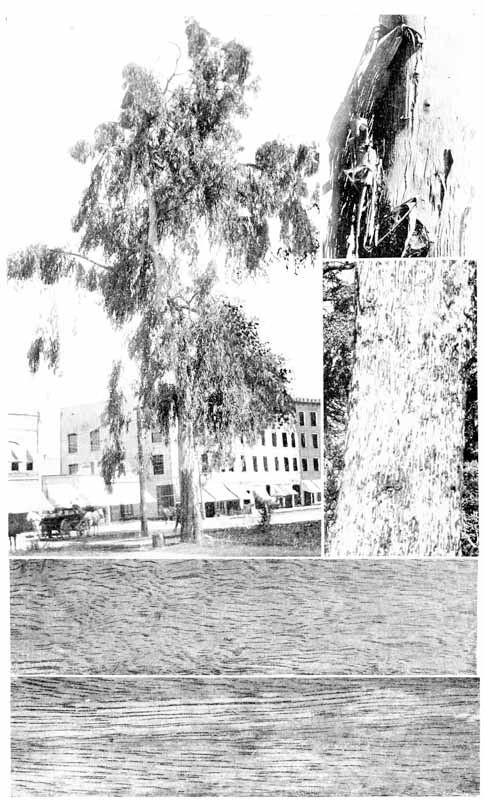
Blue Gum Tree (E. globulus) California. Blue Gum Bark (E. globulus) California.
Jarrah Trunk, (E. marginata) Australia.
Jarrah Wood (E. marginata).
Karri Wood (E. diversicolor).
EUCALYPTUS. (Eucalyptus.)
These trees, locally known as Stringy-barks, Iron-barks, and Gum-trees, are natives of Australia and the neighboring islands. Some of the nearly four hundred species have been widely transplanted, although none have thus far succeeded in this country outside of Florida and California.[63] The Blue Gum (E. globulus) is the species commonly referred to when Eucalyptus is mentioned in North America.
The Eucalypts are noted for their great size, rapid growth, tough, durable wood, and alleged effect upon health. Size is illustrated by the species Eucalyptus amygdalina, specimens of which have reached a height of four hundred and eighty feet and are thus the tallest, although not the largest, trees known to man. Growth is shown by specimens of the Eucalyptus gunnii, which have grown in excess of two feet a month during the first year.[64] The working qualities of Jarrah, Karri, and Tuart woods (E. marginata, E. diversicolor, and E. gomphocephala) are such as to cause them to take high rank in local construction. The first two have been preferred beyond all other species for paving the streets of London and of Paris. Some improvement in health is said to have followed the introduction of the Blue Gum (Eucalyptus globulus) in malarial districts, such as those around Rome. It is not certain whether these results are due to the presence of essences in the foliage, although medicinal properties are ascribed to them and they are used in the preparation of listerine and similar compounds, or [p124] whether they are due to the fact that the leaves evaporate unusual quantities of water drawn by the roots from the soil.[65]
The trees are characterized by leathery evergreen foliage of many shades, such as blue, gray, and green. The leaves of young and old trees differ widely in some species. Those of young blue gums are bright blue, oval, and stalkless, while leaves of older trees have stems, are dark green and sickle-shaped. The characteristic odor is the only point in common between the foliage of the old and young of this species. There are, as stated, nearly four hundred species. [p125]
FOOTNOTES
Works of Baron von Müller; Report J. Ednie-Brown, Forest Commissioner, Western Australia; Correspondence M. Francis Chapman, Esq., London; The Forester, Jan. 1900; Abbot Kinney, U. S. Forestry Bulletin No. 11.
McClatchie, U. S. Forestry Bulletin No. 35.
Jarrah. Eucalyptus marginata.
Nomenclature.
Jarrah (local and common name).
Mahogany Gum (Australia).
Locality.
Western coast of Australia.
Features of Tree.
Ninety to one hundred or more feet in height, two to five feet in diameter. Fifty or more feet to lowest branch. Dull, sombre appearance. Branches concentrated at top.
Color, Appearance, or Grain of Wood.
Reddish, resembles mahogany, also Kauri wood.
Structural Qualities of Wood.
Heavy, non-absorbent, somewhat oily, durable in contact with the soil, receives good polish. Characteristic odor, wears thin evenly, not easily inflammable. Said to repel teredo and termite.
Representative Uses of Wood.
Marine work, exposed positions, ship-building, bridge timbers, street-paving (London and Paris).
Weight of Seasoned Wood in Pounds per Cubic Foot.
65 (Ednie-Brown).[66]
Modulus of Elasticity.
2,080,000 (Ednie-Brown).[66]
Modulus of Rupture.
8900 (Ednie-Brown).[66]
Remarks.
Chief timber tree of southwestern Australia. Preferred by Australian ship-builders. Often confused with Karri.[67] Specimen forty years old two feet in diameter. Müller calls it the least inflammable of woods. Marginata refers to thick-edged leaves. [p126]
FOOTNOTES
Karri. Eucalyptus diversicolor.
Nomenclature.
Karri (many localities).
White Gum (Australia).
Locality.
Australia, New Zealand.
Features of Tree.
Two to three hundred and fifty feet in height, four to eighteen feet in diameter. A straight graceful tree, lower branches often one hundred and fifty feet from ground. Smooth yellow white bark.
Color, Appearance, or Grain of Wood.
Reddish brown, fibres interlaced, compact structure.
Structural Qualities of Wood.
Hard, heavy, tough and elastic, non-absorbent, durable, difficult to work, wears evenly, characteristic odor.
Representative Uses of Wood.
Construction, railway ties, piles, marine work, pavements (London and Paris).
Weight of Seasoned Wood in Pounds per Cubic Foot.
63 (Ednie-Brown).[68]
Modulus of Elasticity.
2,890,000 (Ednie-Brown).[68]
Modulus of Rupture.
8000 (Ednie-Brown).[68]
Remarks.
Once named Eucalyptus colossea because of great size. Rich in essential oils. Grows rapidly, one specimen thirty-five years old, having reached a height of one hundred and thirty-five feet. Distinct from Kauri Pine (D. australis) of New Zealand. Diversicolor refers to leaves the upper and lower sides of which differ in color. [p127]
FOOTNOTE
Tuart. Eucalyptus gomphocephala.
Nomenclature.
Tuart (local and common name).
Tewart (Australia).
Tooart (Australia).
White Gum (Australia).
Locality.
Australia.
Features of Tree.
One hundred to one hundred and fifty feet in height, four to six feet in diameter. Lower branches forty or more feet from ground. Bright, cheerful appearance, straight trunk, gray-white bark.
Color, Appearance, or Grain of Wood.
Heartwood light yellow, compact appearance, fibres interlaced.
Structural Qualities of Wood.
Very hard, heavy, strong, tough, rigid, durable, seasons well. Difficult to split or work.
Representative Uses of Wood.
Keels, buffers, stern-posts, frames, wheel-hubs, shafts.
Weight of Seasoned Wood in Pounds per Cubic Foot.
67 (Ednie-Brown).[69]
Modulus of Elasticity.
2,300,000 (Ednie-Brown).[69]
Modulus of Rupture.
9300 (Ednie-Brown).[69]
Remarks.
Highly prized locally. One of the strongest of woods. Gomphocephala refers to peculiarities in lid of calyx-tube. [p128]
FOOTNOTE
Blue Gum, Fever Tree. Eucalyptus globulus.
Nomenclature.
Blue Gum (local and common name).
Fever Tree (Australia).
Balluck (Australia).
Locality.
Native of Australia acclimated in southern California and elsewhere throughout the world.
Features of Tree.
Two hundred to sometimes three hundred or more feet in height. Three to six feet in diameter. Loose, shaggy, exfoliating bark.[70] Leaves sometimes twelve inches in length. Color varies with age. Characteristic odor.
Color, Appearance, or Grain of Wood.
Straw color. Sapwood lighter. Indistinct annual rings. Fibres interlaced.
Structural Qualities of Wood.
Hard, heavy, durable, difficult to split.
Representative Uses of Wood.
Rollers, paving-blocks, ship-building, fuel.
Weight of Seasoned Wood in Pounds per Cubic Foot.
43 to 69 (Mueller).
57 to 69 (Lazlett).
Modulus of Elasticity.
Modulus of Rupture.
Remarks.
The Eucalyptus of California. The species planted in malarial districts. Sanitary powers due to evaporation from large leaves or presence of essential oils, which are thought to have medicinal qualities. Grows very rapidly. [p129]
FOOTNOTE
PLATE 27. PINE (Pinus).
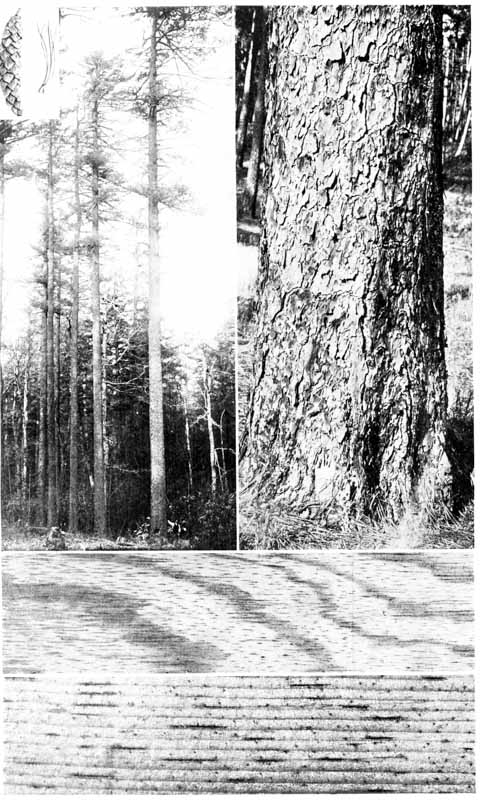
White Pine Foliage (P. strobus). Hard Pine Trunk (P. palustris). (Photograph by Edward J. Davison.)
White Pine Tree (P. strobus). (Courtesy N. C. Geol. Survey.)
Hard Pine Wood (P. palustris).
Soft or Sugar Pine Wood (P. lambertiana).
NEEDLELEAF WOODS.
The trees affording these woods cover large areas in the natural forests of the Northern Hemisphere. They exist, but to an unimportant extent, in the South. Cedar, larch, and cypress figure in ancient history, but woods generally were not employed until recent times.[71] Pine, spruce, hemlock, and other so-called soft woods are of this group.
Needle-leaved woods are characterized by uniform fibre-conditions, presence of resins, and lighter weights. The vertical structure consists of simple, similar, elongated tubes or cells, tapering and finally closing at their ends, known as tracheids. These are arranged with more or less regularity, and woods are correspondingly easy to work. Pith-rays are scarcely visible, and sections do not show pores. Cavities known as resin-ducts, and which are not real vessels but rather simple intercellular spaces, secrete resins so important in making these woods durable and elastic. Trees afford large, straight pieces. Woods are used in carpentry and heavy constructions. The total requirement greatly exceeds that for hard woods.
The resinous, usually evergreen, leaves and the cones are sufficient to identify these trees. Needleleaf, softwood, conifer, and evergreen trees are the same. [p130]
FOOTNOTE
PINE. (Pinus.)
These trees were not regarded seriously until about the latter half of the eighteenth century. Their woods are now the principal ones in carpentry and construction, and are more used than any others. They are to the soft woods what the oaks are to the hard woods, and they stand at present with reference to all woods much as iron does to all metals. Pine is prized because of a combination of strength, elasticity, light weight, working qualities, and availability, such as fits it for those constructions requiring the largest quantities of wood.
The pines have smooth, straight, solid trunks, usually destitute of branches for many feet from the ground. There are needle-shaped, more or less cylindrical, evergreen leaves from one to many inches in length, gathered in clusters of two, three, or five, their number and the fact that they are thus clustered being important bases of classification. There are also cones of woody overlapping scales. They reproduce with difficulty,[72] and mature so slowly that ultimate survival of modern conditions must probably be as cultivated trees.
Thirty-nine of the seventy known species of pine are found in the United States. These with their woods are separated into two groups known as hard and soft pines. The Dantzic or Northern pine (Pinus silvestris) is the principal European species. [p131]
FOOTNOTE
SOFT PINE.
Soft pine is soft, clean, light, uniform, easily worked, not strong, free from knots and resins, and obtainable in large and perfect pieces. The wood is whitish and the yearly rings are not pronounced. The supply is divided, as obtained from the white pine on the one hand, and from the sugar-pine and all other species on the other.
White pine (Pinus strobus) grows in the north, central, and eastern United States and was formerly the important tree of North America. It emphasized the forest industries of Maine and of Michigan, and methods connected with harvesting it have influenced logging practices in many fields. It was long the only softwood seriously considered by Northern lumbermen. Thirty per cent of the sawn timber and lumber used in this country in 1899 was drawn from this species.[73] White pine is diminishing so rapidly as to be already practically unobtainable in many places.
The Sugar Pine (Pinus lambertiana) of the Western States is a tree growing at high elevations and is so large as to take rank with the redwoods and other of the world's greatest trees. Some material is derived from the Western white pine (Pinus flexilis) and one or more minor species. Sugar pine resembles, but is not as desirable as, white pine. The sweetish exudations from this tree are sometimes used in medicine. [p132]
FOOTNOTE
"White Pine Timber Supplies." U. S. S. Doc. 55-1, Vol. IV.
HARD PINE.
Hard pine differs from soft pine in that it is hard, resinous, heavy, harder to work, and very strong. It also is obtainable in large pieces. The orange-yellow wood is more or less figured. The annual deposits are pronounced and are separated into two sharply divided rings. The supply is chiefly derived from the longleaf, shortleaf, Cuban, and loblolly pines of the South Atlantic States.
The longleaf pine (Pinus palustris) is distinctly the most important of its group. The wood is ideal for heavy constructions. Beams, docks, trestles, and frames of cars are formed of it. The trees afford the greater bulk of turpentine, tar, and resin, or "naval stores," produced in this country.[74] Cuban, shortleaf, and loblolly pine woods (P. heterophylla, P. echinata, and P. tæda) are nearly similar. Longleaf and Cuban pines are seldom separated, while shortleaf and loblolly pines are also mixed. Longleaf pine usually affords finer structure and more heartwood than Cuban pine. Strength and weight averages of both woods are in excess of those of shortleaf and loblolly pines. No method of invariably telling these four woods apart has as yet been determined. (Roth.) Any or all of them are practically liable to be delivered in response to a demand for Southern pine. Johnson considers shortleaf pine as good as longleaf pine of equal weight, and suggests environment as a means of identification.
Palustris, signifying "swampy," is misleading, since long leaf pine prefers dry, sandy soil and tracts known as "pine barrens." Mitis refers to the soft, delicate foliage of shortleaf pine. Tæda signifies "torch." The trees may be told by differences in their leaves and cones. [p133]
Names. Leaves. Cones.
Number in Cluster. Length, in. Diameter (open), in. Length, in.
Longleaf (P. palustris) 3 10 to 15 4 to 5 6 to 10
Cuban (P. heterophylla) 2 or 3 8 to 12 3 to 5 4 to 7
Shortleaf (P. echinata) 2 or 3 2 to 5 1 to 2 2
Loblolly (P. tæda) 3 5 to 10 2 to 3 3 to 4
A confusion exists in the naming of the pines. American white pine is known as yellow or Weymouth pine in Europe, and all American hard pines are there often known as pitch pines. The European, Dantzic, or Northern pine has also many names, principally depending on port of shipment. Georgia, Southern, Yellow, Hard, and even Pitch pine, are interchangeable names in this country. The species palustris has thirty local names. [p134]
FOOTNOTE
White Pine. Pinus strobus Linn.
Nomenclature. (Sudworth.)
White Pine (local and common name).
Weymouth Pine (Mass., S. C.).
Soft Pine (Pa.).
Northern Pine (N. C.).
Spruce Pine (Tenn.).
Pumpkin Pine.
Locality.
North-central and northeastern United States, northward into Canada, southward to Illinois, and along the Alleghanies into Georgia, intermittently.
Features of Tree.
Seventy-five to one hundred and fifty feet in height. Three to six feet in diameter, sometimes larger. Erect impressive form. Tufts of five soft, slender, evergreen leaves in long sheath. Cones four to six inches long, one inch thick, slightly curved.
Color, Appearance, or Grain of Wood.
Heartwood cream-white, sapwood nearly white. Close, straight grain. Compact structure. Comparatively free from knots and resin.
Structural Qualities of Wood.
Soft, uniform, seasons well, easy to work, nails without splitting, fairly durable. Lightest and weakest of eastern United States pines. Shrinks less than other pines.
Representative Uses of Wood.
Carpentry, construction, matches, spars, boxes, numerous uses.
Weight of Seasoned Wood in Pounds per Cubic Foot.
24 (U. S. Forestry Div.).[75]
24.
Modulus of Elasticity.
1,390,000 (average of 130 tests by U. S. Forestry Div.).[75]
1,210,000.
Modulus of Rupture.
7900 (average of 120 tests by U. S. Forestry Div.).[75]
8900.
Remarks.
Formerly the chief lumber tree of the United States. The supply is rapidly diminishing. [p135]
FOOTNOTES
"The White Pine." Spaulding. U. S Forestry Bul. No. 22.
"White Pine" a Study. Mr. Gifford Pinchot. (Century Co.)
"White Pine Timber Supplies." U. S. Doc. 40 Senate, 55-1, Vol. IV.
White Pine. Pinus flexilis James.
Nomenclature. (Sudworth.)
White Pine (Cal., Nev., Utah, Col., N. M.).
Pine (Utah, Mont.).
Bull Pine (Col.).
Western and Rocky Mountain White Pine (Cal.).
Locality.
Rocky Mountains, Montana to Mexico.
Features of Tree.
Forty to fifty feet in height, one to three feet in diameter. Tufts of five rather short, rigid leaves in sheaths.
Color, Appearance, or Grain of Wood.
Heartwood light, clear yellow, turning red from exposure. Sapwood nearly white. Close-grained, compact structure, numerous and conspicuous medullary rays.
Structural Qualities of Wood.
Light, soft.
Representative Uses of Wood.
Construction.
Weight of Seasoned Wood in Pounds per Cubic Foot.
27.
Modulus of Elasticity.
960,000.
Modulus of Rupture.
8800.
Remarks.
This tree forms mountain forests of considerable extent. Valued locally. [p136]
Sugar Pine. Pinus lambertiana Dougl.
Nomenclature. (Sudworth.)
Sugar Pine (local and common name).
Big Pine, Shade Pine (Cal.).
Little or Great Sugar Pine.
Gigantic Pine.
White Pine.
Locality.
Oregon and California. Best at high altitudes (above 4000 feet), central and northern California.
Features of Tree.
One hundred to occasionally three hundred feet in height, fifteen to sometimes twenty feet in diameter. Cones ten to eighteen inches in length, edible seeds. Sweetish exudations. A great tree.
Color, Appearance, or Grain of Wood.
Heartwood pinkish brown, sapwood cream-white. Coarse, straight-grained, compact structure.
Structural Qualities of Wood.
Light, soft, easily worked, resembles white pine (Pinus strobus).
Representative Uses of Wood.
Carpentry, interior finish, doors, blinds, sashes, etc.
Weight of Seasoned Wood in Pounds per Cubic Foot.
22.
Modulus of Elasticity.
1,120,000.
Modulus of Rupture.
8400.
Remarks.
Grows at as high elevations as five thousand feet or more above tide-water. Forms extensive forests with Balsam Fir (Abies concolor). [p137]
White Pine. Pinus monticola Dougl.
Nomenclature. (Sudworth.)
White Pine (Cal., Nev., Oreg.).
Mountain Pine, Finger Cone Pine (Cal.).
Little Sugar Pine, Soft Pine (Cal.).
Western White Pine.
Mountain Weymouth Pine.
Locality.
Montana, Idaho, Pacific States, and British Columbia.
Features of Tree.
Eighty to one hundred feet in height. Two to three feet in diameter, sometimes larger. Foliage resembles, but is denser than, white pine. Long smooth cones.
Color, Appearance, or Grain of Wood.
Heartwood light brown or red, sapwood nearly white. Straight-grained, compact, suggests white pine (Pinus strobus).
Structural Qualities of Wood.
Light, soft, not strong.
Representative Uses of Wood.
Lumber.
Weight of Seasoned Wood in Pounds per Cubic Foot.
24.
Modulus of Elasticity.
1,350,000.
Modulus of Rupture.
8600.
Remarks.
Found at elevations of seven thousand to ten thousand feet. Common and locally used in northern Idaho. [p138]
Georgia Pine, Hard Pine, Yellow Pine, Longleaf Pine. Pinus palustris Mill.
Nomenclature. (Sudworth.)
Turpentine Pine.
Rosemary Pine.
N. Carolina Pitch Pine.
Southern Pine.
Longleaved Yellow Pine.
Longleaved Pitch Pine.
Long Straw Pine.
Pitch Pine.
Fat Pine.
Heart Pine.
Brown Pine.
Florida Yellow Pine.
Florida Pine.
Florida Longleaved Pine.
Southern Pitch Pine.
Southern Hard Pine.
Southern Heart Pine.
Southern Yellow Pine.
Georgia Pitch Pine.
Georgia Longleaved Pine.
Georgia Heart Pine.
Georgia Yellow Pine.
Texas Yellow Pine.
Texas Longleaved Pine.
Locality.
South Atlantic and Gulf States, Virginia to Alabama, intermittently.
Features of Tree.
Fifty to ninety feet or more in height, one to three feet in diameter. Tufts of three leaves, ten to fifteen inches long, in long sheath.
Color, Appearance, or Grain of Wood.
Heartwood orange, sapwood lighter. Coarse-grained, compact structure, conspicuous medullary rays.
Structural Qualities of Wood.
Hard, heavy, tough, strong, elastic, durable, resinous.
Representative Uses of Wood.
Heavy constructions, ship-building, cars, docks, beams, ties, flooring, house-trim, many uses.
Weight of Seasoned Wood in Pounds per Cubic Foot.
38 (U. S. Division of Forestry).[76]
43.
Modulus of Elasticity.
2,070,000 (average of 1230 tests by U. S. Forestry Div.).[76]
2,110,000.
Modulus of Rupture.
12,600 (average of 1160 tests by U. S. Forestry Div.).[76]
16,300.
Remarks.
Finer and has less sapwood than Cuban pine. One of the best woods for car-building. Principal lumber tree of the Southeast. [p139]
FOOTNOTES
"Southern Pine." U. S. Forestry Circular No. 12. (Dr. B. E. Fernow, Chief.)
"Timber Pines of Southern States." U. S. Forestry Bul. No. 13. (Dr. B. E. Fernow, Chief.)
Cuban Pine. Pinus heterophylla Sudw.
Nomenclature. (Sudworth.)
Cuban Pine, Slash Pine (local and common names).
Pitch Pine, She Pine, She Pitch Pine (Ga., Fla.).
Swamp Pine (Fla., Miss.).
Bastard Pine, Meadow Pine, Spruce Pine.
Locality.
Coast region, South Carolina to Florida and Louisiana.
Features of Tree.
Fifty to eighty feet in height, one to two feet in diameter.
Color, Appearance, or Grain of Wood.
Resembles longleaf pine.
Representative Uses of Wood.
Similar to those of longleaf pine, from which it is seldom separated.
Weight of Seasoned Wood in Pounds per Cubic Foot.
39 (U. S. Forestry Div.).[77]
Modulus of Elasticity.
2,370,000 (average of 410 tests by U. S. Div. of Forestry).[77]
Modulus of Rupture.
13,600 (average of 410 tests by U. S. Div. of Forestry).[77]
Remarks.
Resembles and is marked longleaf pine (Pinus palustris). [p140]
FOOTNOTES
"Southern Pine." U. S. Forestry Circular No. 12. (Dr. B. E. Fernow, Chief.)
"Timber Pines of Southern States." U. S. Forestry Bul. No. 13. (Dr. B. E. Fernow, Chief.)
Shortleaf Pine, Yellow Pine. Pinus echinata Mill. Pinus mitis Michx.
Nomenclature. (Sudworth.)
Common Yellow Pine, Hard Pine.
Spruce Pine (Del., Miss., Ark.).
Bull Pine (Va.).
Shortshat Pine (Del.).
Pitch Pine (Mo.).
Poor Pine (Fla.).
Shortleaved Yellow Pine (N. C.).
Rosemary Pine (N. C.).
Virginia Yellow Pine.
North Carolina Yellow Pine.
North Carolina Pine.
Carolina Pine.
Slash Pine.
Old Field Pine.
Locality.
Connecticut to Florida, westward intermittently to Kansas and Texas.
Features of Tree.
Sixty to sometimes ninety feet in height, two to sometimes four feet in diameter. A large erect tree; small cones have minute weak prickles. Leaves usually in twos from long sheaths.
Color, Appearance, or Grain of Wood.
Resembles longleaf pine.
Structural Qualities of Wood.
Variable, usually hard, tough, strong, durable, resinous, lighter than longleaf pine.
Representative Uses of Wood.
Lumber, construction, similar to longleaf pine.
Weight of Seasoned Wood in Pounds per Cubic Foot.
32 (U. S. Forestry Div.).[78]
30.
Modulus of Elasticity.
1,680,000 (average of 330 tests by U. S. Forestry Div.).[78]
1,950,000.
Modulus of Rupture.
10,100 (average of 330 tests by U. S. Forestry Div.).[78]
14,700.
Remarks.
Affords considerable pitch and turpentine, and is the principal species of Northern Arkansas, Kansas, and Missouri. [p141]
FOOTNOTES
"Southern Pine." Mohr U. S. Forestry Circular No. 12.
"Timber Pines of Southern States." U. S. Forestry Bul. No. 13. (Dr. B. E. Fernow, Chief.)
Loblolly Pine. Pinus tæda Linn.
Nomenclature. (Sudworth.)
Old Field Pine.
Torch Pine.
Rosemary Pine.
Slash Pine.
Longshat Pine.
Longshucks.
Black Slash Pine.
Frankincense Pine.
Shortleaf Pine.
Bull Pine.
Virginia Pine.
Sap Pine.
Meadow Pine.
Cornstalk Pine (Va.).
Black Pine.
Foxtail Pine.
Indian Pine.
Spruce Pine.
Bastard Pine.
Yellow Pine.
Swamp Pine.
Longstraw Pine.
Locality.
Delaware to Florida and westward intermittently to Texas.
Features of Tree.
Fifty to one hundred feet or more in height, two to sometimes four feet in thickness. Leaves in twos and threes. Scales or cones have short straight spines. A large tree.
Color, Appearance, or Grain of Wood.
Resembles longleaf pine.
Structural Qualities of Wood.
Resembles longleaf pine.
Representative Uses of Wood.
Resembles longleaf pine.
Weight of Seasoned Wood in Pounds per Cubic Foot.
33 (U. S. Forestry Div.).[79]
33.
Modulus of Elasticity.
2,050,000 (average of 660 tests by U. S. Forestry Div.).[79]
1,600,000.
Modulus of Rupture.
11,300 (average of 650 tests by U. S. Forestry Div.).[79]
12,500.
Remarks.
Grows naturally on deforested land, whence the name of Old Field Pine. [p142]
FOOTNOTES
"Southern Pine." U. S. Forestry Circular No. 12. (Dr. B. E. Fernow, Chief.)
"Timber Pines of Southern States." U. S. Forestry Bul. No. 13. (Dr. B. E. Fernow, Chief.)
Bull Pine, Yellow Pine, Western Yellow Pine. Pinus ponderosa Laws.
Nomenclature. (Sudworth.)
Big Pine.
Longleaved Pine.
Red Pine.
Pitch Pine.
Southern Yellow Pine.
Heavy-wooded Pine.
Western Pitch Pine.
Heavy Pine (Calif.).
Foothills Yellow Pine.
Montana Black Pine.
Locality.
Rocky Mountains, westward intermittently to Pacific Ocean.
Features of Tree.
One hundred to sometimes three hundred feet in height, six to sometimes twelve feet in diameter. Thick, deeply furrowed bark. Leaves in tufts of threes.
Color, Appearance, or Grain of Wood.
Thin heartwood is light red, sapwood nearly white. Rather coarse grain, compact structure.
Structural Qualities of Wood.
Variable, heavy, hard, strong, brittle, not durable.
Representative Uses of Wood.
Lumber, railway ties, mine timbers, fuel, etc.
Weight of Seasoned Wood in Pounds per Cubic Foot.
29.
Modulus of Elasticity.
1,260,000.
Modulus of Rupture.
10,200.
Remarks.
Ponderosa, signifying "heavy," refers to great size. [p143]
Norway Pine, Red Pine. Pinus resinosa Ait.
Nomenclature. (Sudworth.)
Norway Pine, Red Pine (local and common names).
Hard Pine (Wis.).
Canadian Red Pine (Eng.).
Locality.
Southern Canada, northern United States from Maine to Minnesota, Pennsylvania.
Features of Tree.
Sixty to ninety feet in height, one to three feet in diameter. Reddish blossoms and bark on branchlets. Leaves in twos from long sheaths. A tall, straight tree.
Color, Appearance, or Grain of Wood.
Thin heartwood light red, sapwood yellow to white. Numerous pronounced medullary rays.
Structural Qualities of Wood.
Light, hard, elastic, not durable, resinous.
Representative Uses of Wood.
Piles, telegraph poles, masts, flooring, and wainscoting.
Weight of Seasoned Wood in Pounds per Cubic Foot.
31 (U. S. Forestry Div.).[80]
30.
Modulus of Elasticity.
1,620,000 (average of 100 tests by U. S. Forestry Division).[80]
1,600,000.
Modulus of Rupture.
9,100 (average of 95 tests by U. S. Forestry Div.).[80]
12,500.
Remarks.
Sometimes commercially handled with white pine. Unimportant as regards turpentine and resin, in spite of specific name, which signifies resinous. Long sheaths enable children to make chains of leaves. [p144]
FOOTNOTE
Pitch Pine. Pinus rigida Mill.
Nomenclature. (Sudworth.)
Pitch Pine (local and common name).
Longleaved Pine, Longschat Pine (Del.).
Hard Pine (Mass.).
Yellow Pine (Pa.).
Black Pine (N. C.).
Black Norway Pine.
Rigid Pine, Sap Pine.
Locality.
Atlantic coast, Canada to Georgia, Kentucky.
Features of Tree.
Forty to sometimes eighty feet in height, one to sometimes three feet in diameter. Rigid flattened leaves in threes from short sheaths.
Color, Appearance, or Grain of Wood.
Heartwood light brown or red, thick sapwood yellow to nearly white. Coarse conspicuous grain, compact structure, very resinous.
Structural Qualities of Wood.
Light, soft, not strong, brittle.
Representative Uses of Wood.
Coarse lumber, fuel, charcoal.
Weight of Seasoned Wood in Pounds per Cubic Foot.
32.
Modulus of Elasticity.
820,000.
Modulus of Rupture.
10,500.
Remarks.
Rigida refers to rigid leaves. The name "Pitch Pine" is sometimes applied to all of the Southern pines. The name is yet more widely applied in foreign markets. Sometimes called Fat Pine. [p145]
Northern Pine, Scotch Pine, Dantzic Pine. Pinus sylvestris Linn.
Nomenclature.
Dantzic Fir (from place of shipment).
Rigi Fir (from place of shipment).
Memel Fir (from place of shipment).
Stettin Fir (from place of shipment).
Swedish Fir.
Scots or Scottish Fir.
Northern Fir.
Redwood, Yellowwood.
Deal (Local).
Locality.
Widespread in Europe, as Scotland, Germany, and Russia; also Asia. Naturalized in United States.
Features of Tree.
Fifty to one hundred feet in height, two to five feet in diameter; sometimes larger.
Color, Appearance, or Grain of Wood.
Heartwood reddish white to yellowish white, sapwood similar. Even straight grain (varies with locality).
Structural Qualities of Wood.
Moderately light, hard, tough, and elastic, easily worked (varies with locality).
Representative Uses of Wood.
Carpentry, construction, planks, beams, masts, heavy timber.
Weight of Seasoned Wood in Pounds per Cubic Foot.
34 (Lazlett[81]) (varies with locality).
Modulus of Elasticity.
1,680,000 (Lazlett) (varies with locality).
1,800,000 (Thurston).
Modulus of Rupture.
7000 (Thurston) (varies with locality).
Remarks.
Principal soft wood of Europe. Widely distributed; local peculiarities once thought to denote different species. Fields tributary to Dantzic and Rigi afford best wood. Wood "equal to Dantzic Fir" sometimes specified. [p146]
FOOTNOTE
KAURI PINE. (Dammara.)
This New Zealand tree affords one of the best substitutes for northern pine. Although not true pine, it belongs to the same family as the pine and other conifers. The light, strong, durable, elastic wood is obtainable in large-sized pieces suitable for masts.
The species is universally noted for its resin, which possesses the quality of uniting more perfectly than others with linseed oil.[82] Kauri gum is thus one of the most valuable constituents of good varnish.[83] The best gum occurs as a fossil, and is collected by digging over areas known to be fruitful but from which trees have long since disappeared. The pieces, varying in size from small pebbles to lumps as large as eggs, are scraped and otherwise cleansed by natives in the fields.[84] [p147]
FOOTNOTES
Correspondence Professor Alvah H. Sabin, New York City; Messrs. Pratt & Lambert, New York City.
PLATE 28. KAURI PINE (Dammara australis).
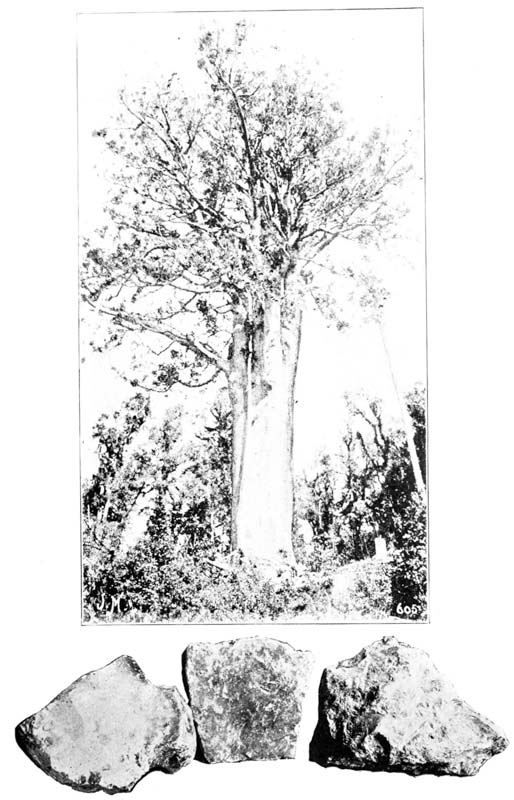
Top--From R. Ingham Clark, by courtesy of Messrs. Pratt & Lambert.
Bottom--Fragments of Gum one-quarter natural size. "Fossil gum" at right and centre.
Kauri Pine. Dammara australis.
Nomenclature.
Kauri Pine (local and general).
Cowdie Pine (New Zealand and many localities).
Locality.
New Zealand.
Features of Tree.
Ninety to one hundred feet in height, three to four feet in diameter, occasional specimens much larger. Small leaves resembling those of box. A tall handsome tree.
Color, Appearance, or Grain of Wood.
Heartwood straw-colored, fine, close, straight grain.
Structural Qualities of Wood.
Moderately hard, light, elastic, strong, seasons well, works readily, receives high polish.
Representative Uses of Wood.
Carpentry, masts.
Weight of Seasoned Wood in Pounds per Cubic Foot.
33 (Lazlett[85]) (varies with locality).
Modulus of Elasticity.
1,810,000 (Lazlett).
Modulus of Rupture.
Remarks.
The species is widely known by reason of its gum. [p148]
FOOTNOTE
SPRUCE. (Picea.)
The spruces form forests in Europe and North America. The black spruce (P. nigra) and the white spruce (P. alba) predominate in eastern United States, while the white spruce (P. engelmanni) is important in the West. The Norway spruce, or white fir (P. excelsa), is the chief European species. American trees prefer Northern ranges characterized by short summers and long winters.
The soft, light, clean woods resemble and are probably the best substitute for soft pine. They are apt to warp and twist in seasoning and so are not good for posts and trusses. Spruce is the principal wood in New England for studding and floor-joists. The product is divided commercially and according to appearance, but irrespective of species, into white and black spruce. These terms depend sometimes, at least, on the wide and narrow rings of the black spruce (P. nigra). It should be remembered that spruce and fir woods are often confused with one another, and that there are trees, as the Douglas spruce and Kauri pine or spruce, that are called, but are not, true spruces. European spruce is often locally known as white deal.
Spruce trees have single, sharp-pointed, short leaves, pointing everywhere, and keeled above and below so as to appear four-sided; the cones hang down. Spruce may be distinguished from the pines, firs, and hemlocks by the fact that pine leaves are longer and in clusters, that hemlock leaves are flat, blunt, and two-ranked, and that fir cones point upward. The genus picea has twelve species, five of which are North American. The resins of the black and red spruce are used as confections. [p149]
PLATE 29. BLACK SPRUCE (Picea nigra).
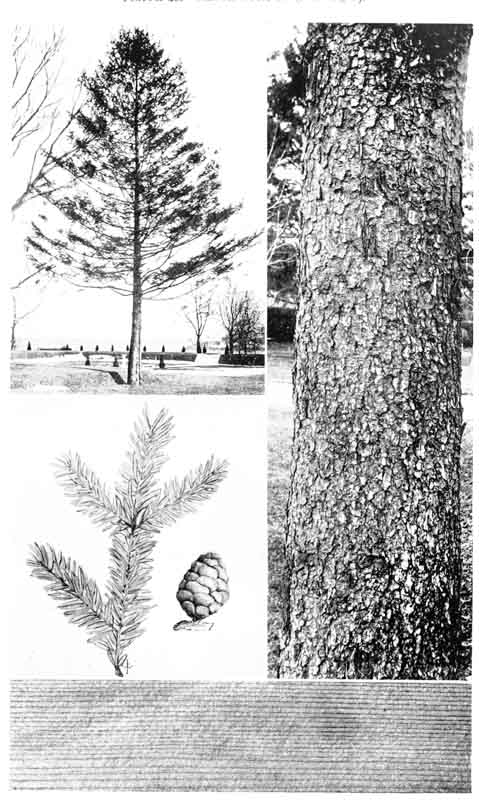
The following table sets forth the primary distinctions between the spruces and the pines, firs, and hemlocks:
Names. Arrangement of Leaves. Shape of Leaves. Cones.
Pines (Pinus) In tufts or clusters. Comparatively long. (see TN)
Spruce (Picea) Single, scattered, point in all directions. Short, sharp ends, keeled above and below. Somewhat four-sided. Hang down, 1 to 6 inches long.
Fir (Abies) Single, scattered, appear somewhat as in two ranks. Short, blunt ends, flat. Stand erect, 2 to 4 inches long.
Hemlock (Tsuga) Single, scattered, appear as in two ranks. Short, blunt ends, flat. Hang down, 3/4 to 1 inch long.
[p150]
Black Spruce. Picea nigra Link. Picea mariana Mill.
Nomenclature. (Sudworth.)
Spruce (Vt.), Yew Pine, Spruce Pine (W. Va.).
Double Spruce (Me., Vt., Minn.).
Blue Spruce (Wis.).
White Spruce (W. Va.).
He Balsam (Del., N. C.).
Water Spruce (Me.).
Locality.
Pennsylvania to Minnesota, Alleghany Mountains to North Carolina. Best in Canada.
Features of Tree.
Forty to eighty feet in height, one to two feet in diameter. Conical shape with straight trunk. Dark foliage. Cones remain for several years, being thus distinct from white spruce.
Color, Appearance, or Grain of Wood.
Heartwood reddish, nearly white; sapwood lighter. Straight grain, compact structure.
Structural Qualities of Wood.
Light, soft, not strong, elastic, resonant.
Representative Uses of Wood.
Lumber, flooring, carpentry, ship-building, piles, posts, railway ties, paddles, oars, "sounding-boards," paper-pulp.
Weight of Seasoned Wood in Pounds per Cubic Foot.
28.
Modulus of Elasticity.
1,560,000.
Modulus of Rupture.
10,600.
Remarks.
A substitute for soft pine. Resin is used as a confection. [p151]
FOOTNOTE
It is often difficult to distinguish between black and white spruce trees. The foliage of the former is darker as a whole, and there are differences in shape and persistence of cones. The names double spruce and single spruce are without evident foundation. Woods exhibit similar qualities and are classed together by lumbermen. Red Spruce (Picea rubens) resembles, and is sometimes considered a variety of, black spruce.
White Spruce. Picea alba Link. Picea canadensis Mill.
Nomenclature. (Sudworth.)
Single Spruce (Me., Vt., Minn.).
Bog Spruce, Cat Spruce (N. Eng.).
Skunk Spruce (Wis., New Eng.).
Spruce, Double Spruce (Vt.).
Pine (Hudson Bay).
Locality.
Northern United States, Canada to Labrador and Alaska.
Features of Tree.
Fifty to one hundred feet in height, one to two feet in diameter, occasionally larger. Compact, symmetrical, conical shape. Foliage lighter than black spruce. Cones fall sooner than those of black spruce. Whitish resin.
Color, Appearance, or Grain of Wood.
Heartwood light yellow, sapwood similar. Straight-grained, numerous prominent medullary rays. Compact structure.
Structural Qualities of Wood.
Light, soft, not strong (similar to Black Spruce).
Representative Uses of Wood.
Lumber, flooring, carpentry, etc. (similar to Black Spruce).
Weight of Seasoned Wood in Pounds per Cubic Foot.
25.
Modulus of Elasticity.
1,450,000.
Modulus of Rupture.
10,600.
Remarks.
Notable as resident of high latitudes. Chief tree of arctic forests. Wood, used similarly to black spruce, is substituted for white pine. [p152]
White Spruce. Picea engelmanni Engelm.
Nomenclature. (Sudworth.)
White Spruce (Ore., Col., Utah, Idaho).
Balsam, Engelmann's Spruce (Utah).
White Pine (Idaho), Mountain Spruce (Mont.).
Locality.
Rocky Mountain region, Montana to Mexico, Washington, Oregon, and British Columbia (high elevations).
Features of Tree.
Frequently seventy-five to one hundred feet in height and sometimes higher, two to three feet in diameter, sometimes low shrub.
Color, Appearance, or Grain of Wood.
Heartwood pale reddish yellow, sapwood similar. Close, straight grain, compact structure, conspicuous medullary rays.
Structural Qualities of Wood.
Light, soft, not strong.
Representative Uses of Wood.
Lumber, charcoal, fuel. Bark rich in tannin, sometimes used for tanning.
Weight of Seasoned Wood in Pounds per Cubic Foot.
21.
Modulus of Elasticity.
1,140,000.
Modulus of Rupture.
8100.
Remarks.
Notable as resident of high altitudes, extensive forests occurring at eight to ten thousand feet above sea-level. A valuable tree of the central and southern Rocky Mountain region. [p153]
Sitka Spruce. Picea sitchensis Trautv. and Mayer.
Nomenclature. (Sudworth.)
Sitka Spruce (local and common name).
Tideland Spruce (Cal., Oreg., Wash.).
Menzies Spruce.
Western Spruce.
Great Tideland Spruce.
Locality.
Pacific coast region, Alaska to central California. Extends inland about fifty miles; prefers low elevations.
Features of Tree.
One hundred and fifty feet or more in height, three feet or more in diameter. Flat-pointed pyramidal needles, oval cylindrical cones, thick scaly reddish-brown bark.
Color, Appearance, or Grain of Wood.
Heartwood light reddish brown, sapwood nearly white. Coarse-grained, satiny.
Structural Qualities of Wood.
Light, soft, not strong.
Representative Uses of Wood.
Construction, interior finish, fencing, boat-building, cooperage.
Weight of Seasoned Wood in Pounds per Cubic Foot.
2626.
Modulus of Elasticity.
Modulus of Rupture.
10,400.
Remarks.
A giant among spruces. Forms an extensive coast-belt forest. [p154]
DOUGLAS SPRUCE. (Pseudotsuga.)
The Douglas or Red Pine, Spruce, or Fir, of the Pacific coast is neither true pine, spruce, nor fir, but a sort of bastard hemlock. The name "pseudotsuga" is from pseudo, or false, and tsuga, or hemlock. The trees are among the greatest known. The wood resembles larch or hard pine in properties, appearance, and applications. Trees have been successfully planted in the Adirondacks. The species was earlier classed as Pinus taxifolia and as Abies taxifolia. [p155]
PLATE 30. DOUGLAS SPRUCE (Pseudotsuga taxifolia).
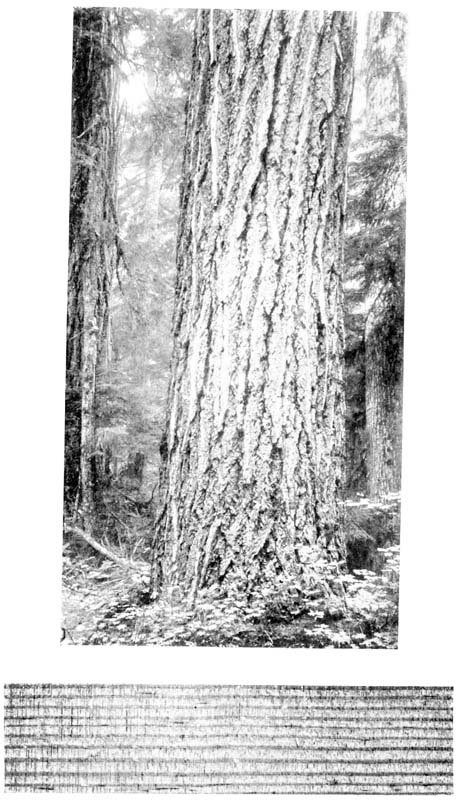
Douglas Spruce, Douglas Fir. Pseudotsuga taxifolia Lam. Pseudotsuga Douglasii Carr.
Nomenclature. (Sudworth.)
Oregon Pine (Cal., Wash., Oreg.).
Red Fir, Yellow Fir (Oreg., Wash., Idaho, Utah, Mont., Col.).
Douglas Tree, Cork-barked Douglas Spruce.
Spruce, Fir (Mont.).
Red Pine (Utah, Idaho, Col.).
Puget Sound Pine (Wash.).
Locality.
Pacific coast region, Mexico to British Columbia. Best in western Oregon and Washington.
Features of Tree.
One hundred and seventy-five to sometimes three hundred feet in height, three to five and sometimes ten feet in diameter. Older bark rough-gray, often looking as though braided.
Color, Appearance, or Grain of Wood.
Heartwood light red to yellow, sapwood nearly white.
Structural Qualities of Wood.
Variable, usually hard, strong, difficult to work, durable.
Representative Uses of Wood.
Heavy construction, dimension timbers, railway ties, piles, fuel.
Weight of Seasoned Wood in Pounds per Cubic Foot.
32 (U. S. Forestry Div.).[86]
36 (average of 20 specimens by Soulé).[87]
32.
Modulus of Elasticity.
1,680,000 (average of 41 tests by U. S. Forestry Div.).[86]
1,862,000 (average of 21 specimens by Soulé).[87]
1,824,000.
Modulus of Rupture.
7,900 (average of 41 tests by U. S. Forestry Div.).[86]
9,334 (average of 21 specimens by Soulé).[87]
12,500.
Remarks.
Used similarly to hard pine. Lumbermen divide into red and yellow woods, the former dark and coarse, the latter fine, lighter, and more desirable. These distinctions probably due to age. One of the world's greatest trees. [p156]
FOOTNOTE
FIR. (Abies.)
Several of the fir-trees of the western United States attain to very great size. The silver fir (Abies grandis) and the white fir (Abies concolor) supply much wood in the section in which they grow. The balsam fir (Abies balsamea) of the Eastern States is of some commercial importance.
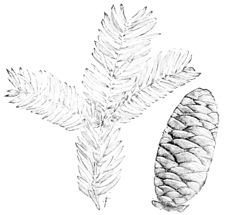
Balsam Fir (Abies balsamea).
Fir wood resembles spruce in appearance and in structural qualities. It may be told from spruce as well as from pine and larch by the fact that fir has no resin-ducts. The balsam fir is distinguishable by clear liquid resin which appears in blisters in the bark. The coarse, weak wood is cleaner than the bark would indicate. Spruce and fir woods are often confused in the United States, while pine, spruce, and fir are similarly confounded in Europe.
Fir trees have flat, scattered, evergreen leaves, and cones that stand erect (see footnote under spruce). [p157]
Balsam Fir, Common Balsam Fir. Abies balsamea Mill.
Nomenclature. (Sudworth.)
Balsam (Vt., N. H., N. Y.).
Fir Tree (Vt.).
Balm of Gilead (Del.).
Canada Balsam (N. C.).
Balm of Gilead Fir (N. Y., Pa.).
Blister Pine, Fir Pine (W. Va.).
Single Spruce, Silver Pine (Hudson Bay).
Locality.
Minnesota to Virginia, northward intermittently into Canada.
Features of Tree.
Fifty to seventy feet in height, one to two feet in diameter. Sometimes low shrub. Blisters in smooth bark contain thick balsam. Erect cones.
Color, Appearance, or Grain of Wood.
Heartwood white to brownish, sapwood lighter. Coarse-grained, compact structure, satiny.
Structural Qualities of Wood.
Soft, light, not durable or strong, resinous, easily split.
Representative Uses of Wood.
Occasionally used as inferior lumber.
Weight of Seasoned Wood in Pounds per Cubic Foot.
23.
Modulus of Elasticity.
1,160,000.
Modulus of Rupture.
7300.
Remarks.
Scattered throughout Northern pineries. Cut when of sufficient size and sold with pine or spruce. Cultivated in gardens. Exudations known as Canada Balsam used in medicine. The poplar (P. balsamifera) is also called Balm of Gilead. [p158]
Great Silver Fir, White Fir. Abies grandis Lindl.
Nomenclature. (Sudworth.)
Silver Fir (Mont., Idaho).
Oregon White Fir, Western White Fir (Cal.).
Yellow Fir (Mont., Idaho).
Lowland Fir.
Locality.
Vancouver region, northwestern United States. Best in west Washington and Oregon.
Features of Tree.
Two hundred to sometimes three hundred feet in height, two to five feet in diameter. Leaves deep green above, silvery below, usually curved. A handsome tree.
Color, Appearance, or Grain of Wood.
Heartwood light brown, sapwood lighter. Coarse-grained, compact structure.
Structural Qualities of Wood.
Light, soft, not strong.
Representative Uses of Wood.
Lumber, interior finish, packing-cases, cooperage.
Weight of Seasoned Wood in Pounds per Cubic Foot.
22.
Modulus of Elasticity.
1,360,000.
Modulus of Rupture.
7000.
Remarks.
Forms important part of local mountain forests and furnishes much lumber locally. [p159]
White Fir, Balsam Fir. Abies concolor Parry.
Nomenclature. (Sudworth).
Silver Fir, Balsam (Cal.).
California White Fir (Cal.).
Black Gum, Bastard Pine (Utah).
White Balsam (Utah).
Balsam Tree (Idaho).
Colorado White Fir, Concolor White Fir.
Locality.
Rocky Mountains and coast ranges, high elevations.
Features of Tree.
Seventy to one hundred and fifty feet in height, three to five feet in diameter. Pale green or silvery foliage. Bark blisters filled with clear pitch.
Color, Appearance, or Grain of Wood.
Heartwood light brown to nearly white, sapwood same or darker. Coarse-grained, compact structure.
Structural Qualities of Wood.
Light, soft, not strong, without odor.
Representative Uses of Wood.
Butter-tubs, packing-boxes, lumber.
Weight of Seasoned Wood in Pounds per Cubic Foot.
22.
Modulus of Elasticity.
1,290,000.
Modulus of Rupture.
9900.
Remarks.
Not always distinguished from the species Abies grandis. [p160]
Red Fir. Abies magnifica Murr.
Nomenclature. (Sudworth.)
California Red Fir, California Red-bark Fir (Cal.).
Magnificent Fir, Golden Fir (Cal.).
Shasta Fir (Cal.).
Locality.
California, vicinity of Mount Shasta.
Features of Tree.
One hundred to two hundred and fifty feet in height, six to ten feet in diameter. Large erect cones. Beautiful form.
Color, Appearance, or Grain of Wood.
Heartwood reddish, sapwood distinguishable. Rather close-grained, compact structure.
Structural Qualities of Wood.
Light, soft, not strong, durable when exposed, liable to injury in seasoning.
Representative Uses of Wood.
Construction, sills, lumber, fuel.
Weight of Seasoned Wood in Pounds per Cubic Foot.
29.
Modulus of Elasticity.
940,000.
Modulus of Rupture.
9900.
Remarks.
Magnifica or magnificent refers to appearance and size of tree. [p161]
Red Fir, Noble Fir. Abies nobilis Lindl.
Nomenclature. (Sudworth.)
Noble Silver Fir, Noble Red Fir.
Larch (Oreg.).
Bigtree, Feather-cone, Red Fir (Cal.).
Locality.
Northwestern United States. Cultivated in East.
Features of Tree.
One to two hundred feet in height, six to nine feet in diameter. Leaves curved. Large, beautiful tree.
Color, Appearance, or Grain of Wood.
Heartwood reddish brown, sapwood darker. Rather close-grained, compact structure.
Structural Qualities of Wood.
Light, hard, strong, elastic.
Representative Uses of Wood.
Fitted for house-trimmings.
Weight of Seasoned Wood in Pounds per Cubic Foot.
28.
Modulus of Elasticity.
1,800,000.
Modulus of Rupture.
22,200.
Remarks.
Grows at high elevations (3000 and 4000 feet). With other fir forms extensive forests. Sold as larch. [p162]
FOOTNOTE
Peters, "Forestry and Irrigation," Vol. VIII, No. 9 (Sept. 1902), pp. 362, 366.
HEMLOCK. (Tsuga.)
The hemlocks are distributed over northern United States from Maine to Michigan, in the Rocky Mountains, and on the Pacific coast. They generally mingle with broad-leaved and other needle-leaved species, but occasionally form pure forests by themselves.
The wood is coarse, often crossed-grained, perishable, brittle, liable to wind-shakes, hard to work, and apt to warp and splinter. It holds nails firmly and is used for coarse lumber, dimension pieces, paper-pulp, and latterly for cheap finish. It should not be relied upon to receive shocks. The bark is used in tanning.
Hemlock trees may be known by their blunt, flat, evergreen leaves, appearing two-ranked and whitened beneath (see foot-note under Spruce). Red inner bark. [p163]
PLATE 31. HEMLOCK (Tsuga).
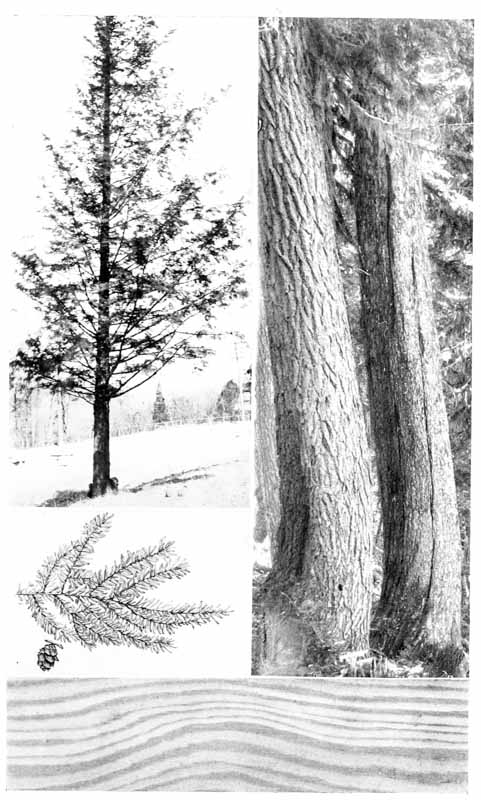
Hemlock Tree (Tsuga canadensis). Western Hemlock Tree (T. heterophylla). (6500 feet above sea-level.)
Hemlock Foliage (Tsuga canadensis).
Hemlock Wood (Tsuga canadensis).
Hemlock. Tsuga canadensis.
Nomenclature. (Sudworth.)
Hemlock (local and common name).
Spruce (Pa., W. Va.).
Hemlock Spruce (Vt., R. I., N. Y., Pa., N. J., W. Va., N. C., S. C.).
Spruce Pine (Pa., Del., Va., N. C., Ga.).
Locality.
Eastern and central Canada, southward to North Carolina and Tennessee.
Features of Tree.
Sixty to eighty or more feet in height, two or three feet in diameter. Short leaves, green above and white beneath. Straight trunk, beautiful appearance.
Color, Appearance, or Grain of Wood.
Heartwood reddish brown, sapwood distinguishable. Coarse, pronounced, usually crooked grain.
Structural Qualities of Wood.
Light, soft, not strong or durable, brittle, difficult to work, retains nails firmly, splintery.
Representative Uses of Wood.
Coarse lumber, joists, rafters, plank walks, laths, railway ties.
Weight of Seasoned Wood in Pounds per Cubic Foot.
26.
Modulus of Elasticity.
1,270,000.
Modulus of Rupture.
10,400.
Remarks.
Canadensis refers to Canada, the locality where tree excels. [p164]
FOOTNOTES
The Southern or Carolina Hemlock (T. caroliniana) resembles Hemlock. The Western Hemlock (T. heterophylla, Alaska to California) attains height of 180 feet, diameter of 9 feet, and is said to afford heavier and better wood. This tree is known by the following names (Sudworth):
Western Hemlock, Hemlock Spruce (Cal.).
Hemlock (Oreg., Idaho, Wash.).
Alaska Pine (Northwestern Lumberman).
Prince Albert's Fir, Western Hemlock Fir, California Hemlock Spruce (England).
"The Western Hemlock." Allen, U. S. Forestry Bureau Bulletin No. 33.
LARCH. TAMARACK. (Larix.)
Larch was well known in the older time, and was prized in Europe and the Orient. The two principal American species are also called tamarack and hackmatack. The Eastern larch or tamarack (L. americana) prefers peculiar low, wet areas known as tamarack swamps. The Western tree (L. occidentalis) resembles the European species and prefers dry places.
Larch wood has always been regarded as very durable. It is noted by Pliny and other ancient authors.[88] Vitruvius mentions a bridge that, having burned, was replaced by one of larch, because that wood would not burn as readily.[89] The foundation-piles of Venice are said to be of larch.[90] It should be remembered that the identities of ancient woods are not always beyond question. American larch resembles, if it does not equal, true foreign wood. The trees are tall and straight, but so slender as to be seldom cut into lumber, almost the entire supply being demanded for posts, ties, and poles. The exceedingly durable wood resembles spruce in structure, and hard pine in weight and appearance.
Larch trees are marked by the fact that their foliage is deciduous. The little leaves, gathered in tufts or bundles, are of a bright pea-green when fresh in the springtime. The appearance of tamarack trees when divested of foliage in the winter is very gloomy. [p165]
FOOTNOTES
PLATE 32. LARCH (Larix).
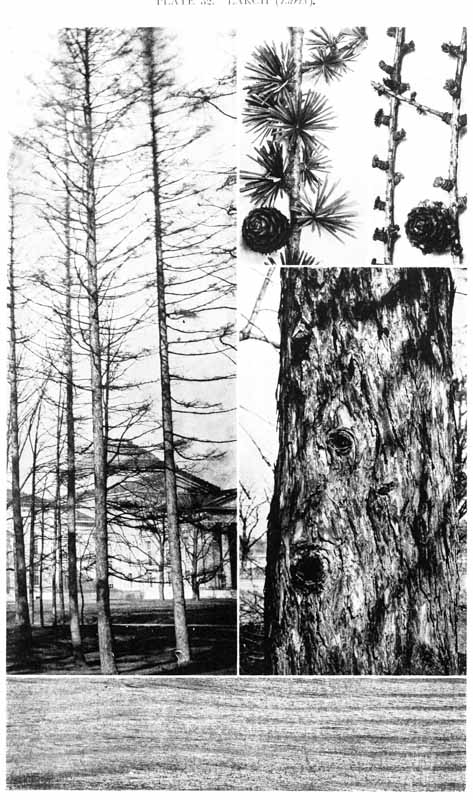
Larch Trees in Winter.
Tamarack, Larch. Larix americana Michx. Larix laricina (Du Roi) Koch.
Nomenclature. (Sudworth.)
Tamarack, Larch, American Larch (local and common names).
Hackmatack (Me., N. H., Mass., R. I., Del., Ill., Mich.).
Black Larch, Red Larch (Minn., Mich.).
Juniper (Me., Canada).
Locality.
Northern United States and southern Canada, east from Great Lakes.
Features of Tree.
Seventy to ninety feet high, one to three feet in diameter. Short pea-green deciduous leaves in tufts. A slender tree, winter aspect gloomy.
Color, Appearance, or Grain of Wood.
Heartwood light brown, sapwood nearly white. Coarse conspicuous grain, compact structure, annual layers pronounced.
Structural Qualities of Wood.
Heavy, hard, very strong, durable, resembles spruce.
Representative Uses of Wood.
Railway ties, fence-posts, sills, ship timbers, telegraph poles, flagstaffs, etc.
Weight of Seasoned Wood in Pounds per Cubic Foot.
38.
Modulus of Elasticity.
1,790,000.
Modulus of Rupture.
12,800.
Remarks.
Practically all (tall thin) trunks required for railway ties, posts, masts, etc. Seldom cut into lumber in consequence. Grows in light swamps often extensive and known as tamarack swamp. (Trans. Am. Inst. Mining Engineers, Vol. XXIX, page 157). [p166]
Tamarack Larch. Larix occidentalis.
Nomenclature. (Sudworth.)
Tamarack, Larch (local and common names).
Hackmatack (Idaho, Wash.).
Western Larch, Great Western Larch, Red American Larch.
Western Tamarack (Cal.).
Locality.
Washington and Oregon, intermittently to Montana.
Features of Tree.
Ninety to one hundred and twenty-five feet high, two and one-half to four feet in diameter. A large tree.
Color, Appearance, or Grain of Wood.
Heartwood light red, thin sapwood lighter. Coarse-grained, compact structure, annual rings pronounced.
Structural Qualities of Wood.
Hard, heavy, strong, durable.
Representative Uses of Wood.
Posts, railway ties, fuel, limited quantity of lumber, similar to L. americana.
Weight of Seasoned Wood in Pounds per Cubic Foot.
46.
Modulus of Elasticity.
2,300,000.
Modulus of Rupture.
17,400.
Remarks.
A valuable tree of the Columbian basin. Differs from L. americana in that it grows on dry ground, often at high elevations. [p167]
PLATE 33. CEDAR (Cedrus, Thuya, etc.).
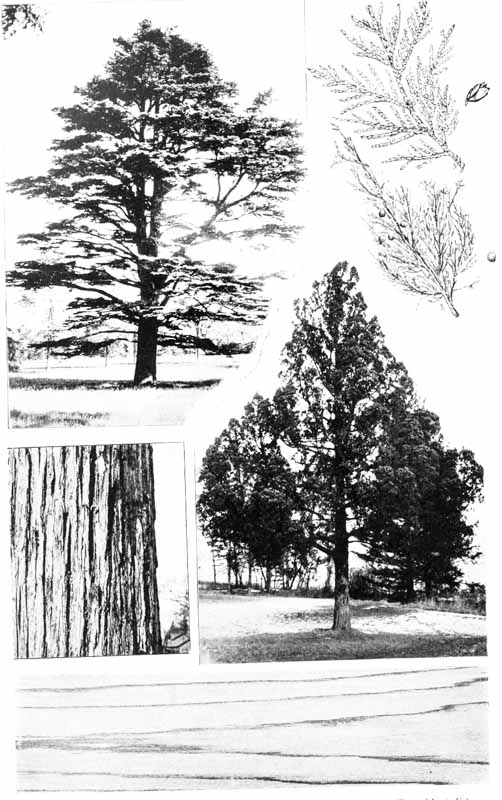
Cedar of Lebanon (Cedrus libani). Foliage of White Cedar (T. occidentalis).
Red Cedar Bark (Juniperus virginiana). Foliage of Red Cedar (J. virginiana).
White Cedar Wood (Thuya occidentalis). Tree of Red Cedar (J. virginiana).
CEDAR. (Cedrus, Thuya, Chamæcyparis, Libocedrus, Juniperus.)
Cedar was a name first applied to the true or Lebanon cedars (Cedrus) of the Eastern continent, but later to certain Arborvitæs (Thuya), Junipers (Juniperus), and Cypresses (Chamæcyparis), and other trees (see "Spanish Cedar," page 122) from which durable, fine-grained, more or less fragrant woods, known as cedar, are obtained. Cedar was highly prized by the ancients, who employed it in costly constructions, such as the temples of Solomon and of Diana at Ephesus.[91] [92] Woods known as cedar are divided into so-called Red and White Cedars.
Red Cedar is very fine-grained, soft, light, durable, fragrant, and of a pinkish-red color. Much wood is derived from the Red Cedars, Juniperus virginiana, Juniperus scopulorum, and Juniperus barbadensis, of the Eastern, Western, and Southern States respectively. Although seen in construction, red cedar is chiefly used in chests, closets, lead-pencils, and cigar-boxes. One hundred and twenty-five thousand trees (125,000)[93] are annually required for lead-pencils alone. The waste is often converted into shavings and used instead of camphor to protect woolens. The demand is greater than the supply. Trees are easily grown on almost any soil. Trees and wood are subject to fungus diseases which apparently cease after trees have been felled; the wood is then durable.[94]
White Cedar is best defined as all cedar that is not "red cedar," [p168] and is obtained from several valuable trees.[95] The arborvitæs (T. occidentalis) vary in size from large bushes used in hedging and ornamentation to small-sized trees gathered for wood. They are most vigorous on cold, wet areas known as cedar swamps.[96] The giant arborvitæ (T. gigantea), noted for its great girth, and the yellow and Lawson Cypresses, are important Pacific coast species. The incense cedar, while much subject to fungus trouble, is also prized.[97] White cedar wood is durable, plentiful, and employed in exposed positions as ties and shingles.
Arborvitæs (Thuya) have very small overlapping leaves that form flat rods or fan-like sprays. The cones are oblong, less than one-half inch in length, and all of their six or eight scales separate or open when ripe. The cypresses (Chamæcyparis) exhibit similar foliage, but their tiny cones are simple, roughened, close, or solid globules. The Junipers (Juniperus) often, but not always, bear bluish-black berries powdered with a whitish-blue bloom. The true cedars (Cedrus) differ from the others in that they have simple needle leaves, an inch, more or less, in length, together with cones erect and several inches in length. The Deodar or cedar of India is of this genus. The principal American red and white cedars are as follows:
Red Cedar. Red Cedar (Juniperus virginiana). Red Cedar (Juniperus scopulorum). Red Cedar (Juniperus barbadensis).
Spanish Cedar. (See page 99.)
White Cedar. Arborvitæ (Thuya occidentalis). Canoe Cedar (Thuya gigantea). White Cedar (Chamæcyparis thyoides). Port Orford Cedar (Chamæcyparis lawsoniana). Yellow Cedar (Chamæcyparis nutkaensis). Incense Cedar (Libodecrus decurrens).
[p169]
FOOTNOTES
Red Cedar. Juniperus virginiana Linn.
Nomenclature. (Sudworth.)
Red Cedar (local and common name).
Cedar (Conn., Pa., N. J., S. C., Ky., Ill., Ia., Ohio).
Pencil Cedar, Cendre (La.).
Savin (Mass., R. I., N. Y., Pa., Minn.).
Juniper, Red Juniper, Juniper Bush (local).
Locality.
Atlantic coast, Canada to Florida, westward intermittently to Mississippi River in the North, and Colorado River in the South.
Features of Tree.
Fifty to eighty feet in height, two to three feet in diameter. Sometimes low shrubs. Dark-green foliage, loose ragged outer bark.
Color, Appearance, or Grain of Wood.
Heartwood dull red, thin sapwood nearly white. Close, even grain, compact structure, annual layers easily distinguishable.
Structural Qualities of Wood.
Light, soft, weak, brittle, easily worked, durable, fragrant.
Representative Uses of Wood.
Ties, sills, posts, interior finish, pencil-cases, chests, cigar-boxes.
Weight of Seasoned Wood in Pounds per Cubic Foot.
30
Modulus of Elasticity.
950,000.
Modulus of Rupture.
10,500.
Remarks.
Fragrance of wood utilized as insecticide. The Western Red Cedar (J. scopulorum) and the Southern Red Cedar (J. barbadensis) afford similar wood. [p170]
Juniper. Juniperus occidentalis Hook.
Nomenclature. (Sudworth.)
Juniper (Oreg., Cal., Col., Utah, Nev., Mont., Idaho, N. M.).
Cedar, Yellow Cedar, Western Cedar (Idaho, Col., Mont.).
Western Red Cedar, Western Juniper (local).
Locality.
California, Washington, and Oregon.
Features of Tree.
Twenty-five to fifty feet in height, two to four feet in diameter, often smaller. Long straight trunk in West.
Color, Appearance, or Grain of Wood.
Heartwood reddish-brown, sapwood nearly white. Very close-grained, compact structure.
Structural Qualities of Wood.
Light, soft, durable, receives high polish.
Representative Uses of Wood.
Fencing, railway ties, posts, and fuel.
Weight of Seasoned Wood in Pounds per Cubic Foot.
35.
Modulus of Elasticity.
Modulus of Rupture.
Remarks.
Rarely found below an altitude of 6000 feet. Fruit said to be eaten by Indians. [p171]
White Cedar, Arborvitæ. Thuya occidentalis Linn.
Nomenclature. (Sudworth.)
White Cedar, Arborvitæ (local and common names).
Cedar (Me., Vt., N. Y.).
Atlantic Red Cedar (Cal.).
Vitæ (Del.).
Locality.
Northern States eastward from Manitoba and Michigan. Northward, also occasionally southward, as in mountain region of North Carolina and eastern Tennessee.
Features of Tree.
Thirty to sixty feet high, one to three feet or more in diameter, often smaller. Bruised leaves emit characteristic pungent odor, rapidly tapering trunk.
Color, Appearance, or Grain of Wood.
Heartwood light brown, darkening with exposure, thin sapwood, nearly white. Even, rather fine grain, compact structure.
Structural Qualities of Wood.
Soft, light, weak, brittle, durable, inflammable. Permits spikes to work loose.
Representative Uses of Wood.
Railway ties, telegraph poles, posts, fencing, shingles, and boats.
Weight of Seasoned Wood in Pounds per Cubic Foot.
19.
Modulus of Elasticity.
750,000.
Modulus of Rupture.
7200.
Remarks.
Trunks so shaped as to be seldom sawn for lumber. Often used for telegraph or other poles, or else thin upper ends are used for posts, and lower section flattened into ties. [p172]
Canoe Cedar, Arborvitæ. Giant Arborvitæ. Thuya plicata Don. Thuya gigantea Nutt.
Nomenclature. (Sudworth.)
Canoe Cedar, Giant Arborvitæ (local and common names).
Red Cedar, Giant Red Cedar, Pacific Red Cedar (Wash., Oreg., Cal., Idaho).
Cedar, Giant Cedar, Western Cedar (Oreg., Cal.).
Shinglewood (Idaho).
Locality.
Coast region, California to Alaska, Idaho to Montana.
Features of Tree.
One hundred to two hundred feet in height, two to eleven feet in diameter. Four-sided leaves closely overlapping in sprays.
Color, Appearance, or Grain of Wood.
Heartwood dull reddish brown, thin sapwood nearly white. Coarse-grained, compact structure, annual layers distinct.
Structural Qualities of Wood.
Soft, weak, light, brittle, easily worked, very durable.
Representative Uses of Wood.
Shingles, fencing, cooperage, interior finish, canoes (coast Indians).
Weight of Seasoned Wood in Pounds per Cubic Foot.
23.
Modulus of Elasticity.
1,460,000.
Modulus of Rupture.
10,600.
Remarks.
Large trees are often hollow at the bottom. [p173]
White Cedar. Chamæcyparis thyoides L.
Nomenclature. (Sudworth.)
White Cedar (local and common name).
Post Cedar, Swamp Cedar (Del.).
Juniper (Ala., N. C., Va.).
Locality.
Maine to Florida, Gulf coast to Mississippi, best in Virginia and North Carolina.
Features of Tree.
Sixty to eighty feet in height, three to four feet in diameter. Shaggy rugged bark. A graceful tree.
Color, Appearance, or Grain of Wood.
Heartwood pinkish to darker brown, sapwood lighter. Close-grained, compact structure, conspicuous layers.
Structural Qualities of Wood.
Very light, soft, not strong, extremely durable in exposed positions, fragrant, easily worked.
Representative Uses of Wood.
Boats, railway ties, fencing, poles, posts, shingles.
Weight of Seasoned Wood in Pounds per Cubic Foot.
23 (U. S. Forestry Div.).
20.
Modulus of Elasticity.
910,000 (average of 87 tests by U. S. Forestry Div.).
570,000.
Modulus of Rupture.
6310 (average of 87 tests by U. S. Forestry Div.).
6400.
Remarks.
Grows chiefly in swamps. "White cedar posts" last many years. Thyoides is from Thuya meaning arborvitæ and eidos, the Greek for "resemblance." [p174]
Port Orford Cedar, Lawson Cypress. Chamæcyparis lawsoniana Murr.
Nomenclature. (Sudworth.)
White Cedar, Oregon Cedar (Oreg., Cal.).
Ginger Pine (Cal.).
Locality.
Pacific coast, California and Oregon.
Features of Tree.
One hundred to sometimes two hundred feet in height, four to twelve (?) feet in diameter. Leaves overlapping in sprays, very small cones one-fourth inch in diameter.
Color, Appearance, or Grain of Wood.
Heartwood yellowish white, sapwood similar. Very close-grained.
Structural Qualities of Wood.
Light, hard, strong, durable, easily worked, fragrant, resinous.
Representative Uses of Wood.
Lumber, flooring, interior finish, ties, posts, matches, ship-building.
Weight of Seasoned Wood in Pounds per Cubic Foot.
28.
Modulus of Elasticity.
1,730,000.
Modulus of Rupture.
12,600.
Remarks.
Resin employed as insecticide. [p175]
Yellow Cedar, Yellow Cypress, Sitka Cypress. Chamæcyparis nootkatensis (Lamb) Spach. Chamæcyparis nutkaënsis Spach.
Nomenclature. (Sudworth.)
Nootka Cypress, Nootka Sound Cypress (local).
Alaska Cypress, Alaska Ground Cypress (local).
Locality.
Oregon to Alaska.
Features of Tree.
One hundred feet or more in height, three to five feet or more in diameter. Sharp-pointed, overlapping leaves, small globular cones.
Color, Appearance, or Grain of Wood.
Heartwood clear light yellow, thin sapwood nearly white. Close-grained, compact structure.
Structural Qualities of Wood.
Light, not strong, brittle, hard, durable in contact with soil, easily worked, receives high polish, fragrant.
Representative Uses of Wood.
Ship-building, furniture, interior finish.
Weight of Seasoned Wood in Pounds per Cubic Foot.
29.
Modulus of Elasticity.
1,460,000.
Modulus of Rupture.
11,000.
Remarks.
Valuable Alaska timber tree. Commercially not distinguished from Pacific Arborvitæ. [p176]
Incense Cedar, White Cedar. Libocedrus decurrens Torr.
Nomenclature. (Sudworth.)
Post Cedar, California Post Cedar (local).
Bastard Cedar, Red Cedar, California White Cedar (local).
Juniper (Nevada).
Locality.
California and Oregon.
Features of Tree.
Ninety to one hundred and twenty-five feet in height, occasionally higher, three to six feet in diameter.
Color, Appearance, or Grain of Wood.
Heartwood brownish, sapwood lighter. Close-grained, compact structure. Heartwood often pitted. Fragrant.
Structural Qualities of Wood.
Light, brittle, soft, durable.
Representative Uses of Wood.
Flumes, shingles, interior finish.
Weight of Seasoned Wood in Pounds per Cubic Foot.
25.
Modulus of Elasticity.
1,200,000.
Modulus of Rupture.
960,000.
Remarks.
Subject to attack by fungus, causing the large oval pits in the heartwood. Disease ceases upon the felling of trees. (von Schrenk Contribution No. 14 Shaw School Botany, St. Louis.) [p177]
PLATE 34. CYPRESS (Cupressus, Taxodium).
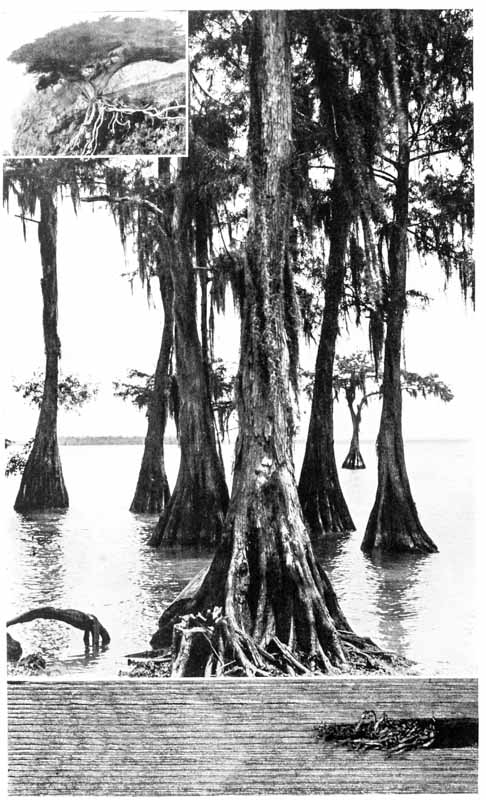
Monterey Cypress (Cupressus macrocarpa). (Courtesy Doubleday, Page & Co.)
Cypress (Taxodium distichum). (Photograph by Edward J. Davison.)
"Peggy" Cypress Wood.
CYPRESS. (Cupressus and Taxodium.)
The name cypress has been chiefly applied to trees of the genera Chamæcyparis, Cupressus, and Taxodium. Most species of the genus Chamæcyparis are now called cedars (see page 167). The Cupressus, while true cypresses and important in Europe, have no significance in America. The single species of the genus Taxodium is not a cypress, but supplies the "cypress" wood of American commerce. It is perhaps best to confine the name cypress to the true cypress (Cupressus) and to the commercial cypress (Taxodium).
The true cypress (Cupressus) was once important in the East, and is thought by some to have given the gopher wood of which the Ark was built.[98] Pliny mentions cypress doors good after four hundred years, and a statue good after six hundred years. Herodotus and other ancient authors[99] speak of it. Authorities in the middle ages thought that it would never decay. The cypress gates of the early St. Peter's, removed after one thousand years of service, were found to be in perfect condition.[100] Cypress was much prized for mummy-cases. Living trees long figured as funeral emblems, and are yet planted over graves in Italy and Turkey.[101] The common or evergreen cypress is the chief European species. The eight or nine American representatives are of little note save as they are sometimes used for hedges and ornamentation. The Monterey and Gowan cypresses (Cupressus macrocarpa and Cupressus goveniana) are thus employed. There are small evergreen scale-like leaves. [p178]
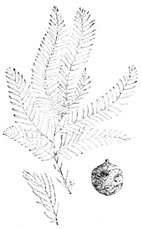
Bald Cypress (Taxodium distichum).
The American or Bald Cypress (Taxodium distichum) is a tree of considerable importance. It grows in the South Atlantic and Gulf States, on submerged lands or in deep swamps where unusual logging methods are necessitated. The seasoned wood resembles white cedar in that it is soft, light, and very durable. It has been called by many names. Pieces were once called black or white cypress according as they sank or floated. All dark pieces are now called black cypress. The tinted woods of some localities are called red or yellow cypress. The name bald cypress was caused by the leafless appearance of the trees in winter. The living trees are subject to a peculiar fungous disease, causing numerous cavities in the wood. These so resemble perforations made by small pegs that the wood is termed "peggy." The trouble ceases as the trees are cut, and the wood is then as durable as that from perfect trees. About one third of the standing supply is thus affected.[102] The roots frequently project upward above the surface in what are known as cypress knees. The single species of this genus may easily be recognized by its deciduous foliage; the little leaves are separated and are not in tufts as with the tamaracks. [p179]
FOOTNOTES
Cypress, Bald Cypress. Taxodium distichum Rich.
Nomenclature. (Sudworth.)
White Cypress (N. C., S. C., Fla., Miss.).
Black Cypress (N. C., S. C., Ala., Tex.).
Red Cypress (Ga., Miss., La., Tex.).
Swamp Cypress (La.).
Deciduous Cypress (Del., Ill., Tex.).
Southern Cypress (Ala.).
Locality.
South Atlantic and Gulf States, Maryland through Florida to Texas, Mississippi Valley from southern Illinois to the Gulf. Occasional in North, as New York. Forms forests in swamps and barrens.[103]
Features of Tree.
Seventy to one hundred and fifty feet in height, four to ten feet in diameter. Knees on roots often hollow in old age. Flat deciduous leaves.
Color, Appearance, or Grain of Wood.
Heartwood brownish, sapwood nearly white. Close, straight grain. Frequently pitted by disease.
Structural Qualities of Wood.
Light, soft, not strong, durable. Green wood often very heavy.
Representative Uses of Wood.
Carpentry, construction, cooperage, railway ties.
Weight of Seasoned Wood in Pounds per Cubic Foot.
29 (U. S. Forestry Div.).[104]
28.
Modulus of Elasticity.
1,290,000 (average of 655 tests by U. S. Forestry Div.).[104]
1,460,000.
Modulus of Rupture.
7900 (average of 655 tests by U. S. Forestry Div.).[104]
9600.
Remarks.
Wood commercially divided into "white" and "black" cypress because of differences in age and environment. Fungus disease pits much wood, but stops with felling of trees.[105] [p180]
FOOTNOTES
REDWOOD. (Sequoia.)
These trees grow only in California. There are two species: the common redwood (S. sempervirens), noted for its lumber, and the big or mammoth tree (S. washingtoniana), so remarkable for its great size. Geological evidence indicates that the genus was once represented by many species on both hemispheres, but that all disappeared during the glacial period save the two here noted.