Chapter XV · THE CULTURE OF THE CIVILIZED TRIBES.1 (continued 2)
Reading edition
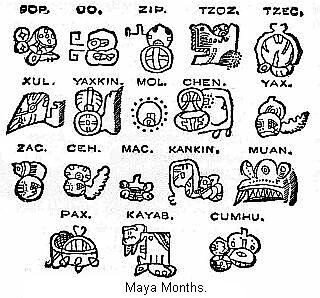
As soon as the people commenced to take any observation at all, they would perceive that it took just about eighteen of these periods of twenty days to make a year. So the next step appears to have been the division of the year into eighteen months. These months received each a name, and were of course designated by a hieroglyphic. The names of the Mexican months seem to have been determined by some of the feasts happening therein. There is great diversity among the early writers both as to the names of these months, and the order in which they occur, as well as by the hieroglyphics by which they are represented.68 It does not seem worth while to give their names and meaning. We give a plate showing the name, order in which they occur, and hieroglyphic symbol of the Maya months. In point of fact, the months were very little used, as we shall soon see it was not necessary to name the month to designate the day; but of that hereafter.
But it would not take these people very long to discover that they had not hit on the length of a year. Eighteen months, of twenty days each, make only three hundred and sixty days; so the next step would be to add on five days to their former year. As these days do not make a month, they were called the nameless days. They were considered as being unlucky—no important undertaking could be commenced on one of them. The child born therein was to be pitied. But we will see that the expression, “nameless days” was hardly the case among the Mayas, though it was among the Mexicans.
Perhaps this will be as good a place as any to inquire whether they had exact knowledge of the length of the year. As every one knows, the length of the year is three hundred and sixty-five and one quarter days, or very nearly; and for this reason we add an extra day to every fourth year. We would not expect to find this knowledge among tribes no farther advanced than we have found these to be. If, as our scholars suspect, the Maya be the one from which the others were derived, they would be apt to possess this knowledge, if known. Perez, however, could find no trace of it among them.69 Many authors have asserted that the Mexicans knew all about it. Some say they added a day every four years; others, that they waited fifty-two years, and then added thirteen days; and some, even, give them credit for still closer knowledge, and say they added twelve and one-half days every fifty-two years.70 Prof. Valentine, who has made their calendar system a special study, concludes that they knew nothing at all about the matter.71
The beginning of the year is variously stated. Among the Mexicans it seems that, while the authors differ very much, all but one places it on some day between the second day of February and the tenth of April. As their word for year means “new green,” it is probable they placed its commencement about the time new grass appeared. The Mayas are said to have placed the commencement of the year about the sixteenth of July. As this happens to be just about the time that the sun is directly overhead in Yucatan, it has been surmised that the natives took astronomical observations, and tried to have their year commence at that time. But it must be manifest that, if they did not possess a knowledge of the true length of the year, and so make allowance for the leap-year, in the course of a very few years they would have to revise this date.
Refer once more to the Maya table of days. Suppose the first day of the year to commence with the day Kan. As there are twenty days in a month, we see that the second month would also commence with Kan. In like manner, Kan would be the first day of every month of that year. When the eighteen months were past, there would still remain the five days to complete the year. Now, although they were said to be nameless days, the Mayas gave them names. The first day was Kan, the second day Chichan, the third day Quimij, the fourth day Manik, the fifth day Lamat. The regular order of days we see. They were now ready to commence a new year.
The next day in the list is Muluc. This becomes the first day of the first month of the new year. But, being the first day of the first month, it was the first day of every month of that year. At the end of the eighteen months of that year, the five days would have to be named in their order again, which would carry us down to Gix, the first day of the first month of the third year. It would also be the first day of every month of that year. Similarly we see that Cavac would be the first day of every month of the fourth year. The fifth year would commence again with Kan. So we see that four of these twenty days became of more importance than the others. The years were named after them. The year in which the month commenced with Kan was also called Kan. The same way with the other days. So the name of the year was either Kan, Muluc, Gix, or Cavac. These four days were called “carriers of the year;” because they not only gave the name to the year, but because the name of the year was also the name of the first day of every month of that year.
The foregoing will help us to understand the Mexican method. Let us refer now to the list of Mexican days. The first day of the first month was Cipac. For the same reason as above set forth, this would be the first day of every month of the year. The five extra days either were not named at all, or at any rate they were not counted off in the table of days. The consequence was that Cipac was the first day of every month; for we have just seen that it was the first day of every month of the first year. At the end of the eighteen months the five nameless days would come in; but, as they did not form part of a month, were not named. The first day of the first month of the next year would be named as if they had not occurred.72 But, when they came to name the years, we find they proceeded on exactly the same principle as the Mayas. Thus four of the twenty days, occurring just five days apart, were taken to name the years. These days were Tecpatl, Calli, Tochtli, and Acatl.73
Mr. Bandelier, who made the valuable suggestion in regard to the origin of the names of the days, has also suggested that, inasmuch as there are four of the days more prominent than the others, they may signify four original gentes, from which the others have come. It seem to us, however, when we notice they are just five days apart, that the system pursued by the Mayas in naming their years explains the whole matter.
Before we mention the longer periods of time in use among them we must refer to another mode of reckoning time, and trace the influence of this second method on the one already named. The method already explained seems to have been a perfectly natural one—the second method is founded on superstition. A large part of the duties of the priests, we remember, was to determine lucky and unlucky days, and in soothsaying. For this purpose they made a peculiar division of time, which we will now try and explain.
For some cause or other, thirteen was a number continually recurring in their calendar. We can perceive no reason why it should have been chosen. It has been suggested that it was just about the time from the appearance of a new moon to its full. Be that as it may, the number of days thirteen comes very near to what we would call a week. Among the Mexicans, and probably among the Mayas, these thirteen days were divided into lucky, unlucky, and indifferent days, and were supposed to be under the guidance of different gods. The priests had regularly painted lists of them, with the deities which governed them. These lists were used in fortune telling.
We must now inquire as to how they kept track of the years. The Mayas named their next longer period of time an ahau. There is some dispute as to what number of years it meant. Most of the early writers decide that it was twenty years;74 but Perez, whose work we have already referred to, contends that it was twenty-four years. And this conclusion seems to be confirmed by a careful study of some of their old manuscripts.75 Thirteen of these ahaus embraced their longest period of time, known as an ahau-katun. It had a length of either two hundred and sixty or three hundred and twelve years, according as we reckon either twenty or twenty-four years to an ahau. It may be that the length of an ahau varied among the different tribes of the Mayas.
The Mexicans also had this week of thirteen days. Twenty of these weeks, or two hundred and sixty days, formed that part of the year they called the moon-reckoning; the remainder of the year was the sun-reckoning. Their longer period of time was also based on this number. A period of thirteen years they called a tlapilli; four of these constituted a cycle equal to fifty-two years. The end of this cycle was anxiously awaited by the Mexicans. They supposed the world was to come to an end on one of these occasions. As the time drew near, the furniture was broken, the household gods were thrown into the water, the houses were cleaned, and finally, all the fires were extinguished. As the last day of the cycle drew to a close, the priests formed a procession, and set out for a mountain about six miles from Mexico. There an altar was built. At midnight a captive, the bravest and finest of their prisoners, was laid on it. A piece of wood was laid on his breast, and on this fire was built by twirling a stick. As soon as fire was produced, the prisoner was killed as a sacrifice. The production of new fire was proof that the gods had granted them a new period of fifty-two years.
To understand how the years in this cycle were arranged and numbered, we must refer once more to the Mayas, for though they did not use the cycle themselves, yet they give us a hint as to how it was obtained, and afford one more reason why we should think the Mayas were the originators of this calendar system. We give a table showing the arrangement of the days of the year among the Mayas. We will take the year Kan—that is, we remember, when Kan was the first day of every month. We would naturally think they would describe a day by giving the name of the day and the month—as, the day Kan, of the month Xul, or the first day of the month Xul—but instead of so doing, they made use of the period of thirteen days.
For instance, we see, by looking at the table, that the day ten Kan can not be any other day during the year than the day above mentioned; so that, for all purposes, it is sufficient to give the day and its number in the week. We notice, however, that the last five columns of figures for week days of thirteen are just the same as the first five. But this did not confuse any, for the last five columns of days belong to the “sun-reckoning,” the others to the moon-reckoning. And though the number of the day in the week was the same, yet a different deity ruled over them than in the corresponding days of the first five columns. We can not affirm that we know this to be true of the Mayas. Such, however, we know to be the case among the Mexicans.76
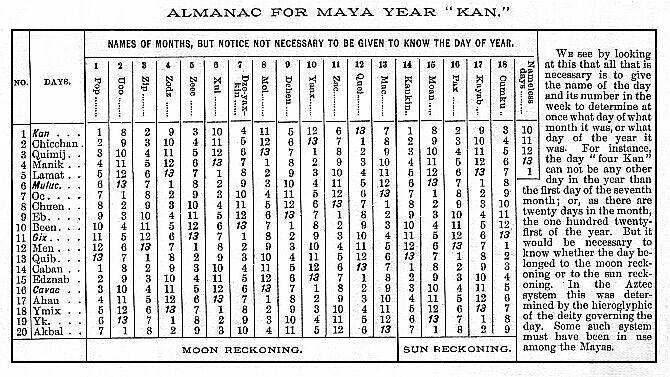
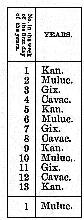
Now we notice in this almanac that the last day of the year Kan, is number one of the week. As the count goes right along, the first day of the next year, Muluc, must be number two. If we would make an almanac for that year, we would find the first day of the third year would be number three of the week. If we were to continue this, we would find that the first days of the years, would range from one to thirteen. This table shows the number in the week of the first day of the first fourteen years. The first day of the fourteenth year would be number one of the week again, but this time one Muluc, and not Kan. If we would continue our researches, we would quickly discover that fifty-two years would go by before we would have a year Kan in which the first day of the year would be number one again.
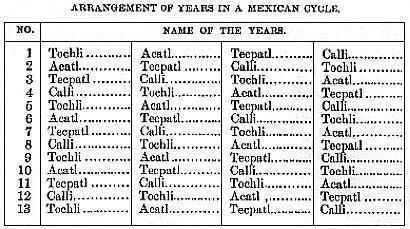
We think the above explains the origin of the Mexican cycle of fifty-two years. The Mayas either never had this cycle, or had abandoned its use.77 The Mexicans however, used this period of time, and they numbered their years in it in such a way that we can not explain it, unless we suppose they derived it in some such a way as just set forth. We give a table showing the order of the years in a cycle, and also notice that all that was needed was the number and name of the year to show at once what year of the cycle it was. The year seven Calli, for instance, could never be any other year than the twentieth of the cycle.78

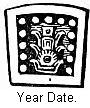
To express the dates, they of course painted the hieroglyphic of the day, and dots for the number of days. This cut, for instance, expresses the day-date “seven Acatl.” They generally wrote the dots in sets of five. Seven was sometimes expressed in the above manner. When they wished to express a year-date, they made a little frame and painted in the hieroglyphics of the year, and dots for the number. This date here expressed is their thirteen Acatl, which, by the above table, is seen to be the twenty-sixth year of the cycle.
We have already dwelt too long on this part of the subject. Glancing back over the ground, we see there is nothing implying astronomical knowledge, more than we would expect to find among a rude people. We find there are several particulars of the Mexican system which we could not understand, except by reference to the Maya system. It would bother us to explain why they should choose the days Tochli, Acatl, Tecpatl, and Calli, to be the names of their years, if we did not know how the Mayas proceeded. We would be at a loss to explain why they choose the number of fifty-two years for the cycle, and arranged their years in it as they did, if we had not learned the secret from the construction of the Mayas’ almanac. From this comparison, we should say the Mexican calendar was the simpler of the two. As the Mayas had twenty days in the month, and, for priestly use, weeks of thirteen days, so they took twenty years, which, as they imagined, were supported by four other years, as a pedestal for their next longer period, the ahau; and for apparently no other reason than that they had weeks of thirteen days, they took thirteen of these ahuas for their longest period of time. They did not use the cycle of fifty-two years, but they numbered their years in such a way that, in effect, they were possessed of it. The Mexican did away with all but the cycle of fifty-two years.
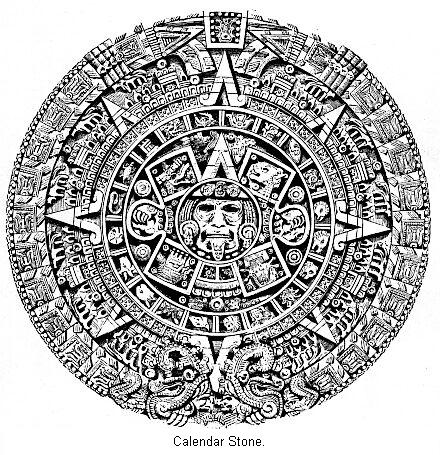
No account of the calendar system of the Mexicans would be complete without reference to the so-called calendar stone. The stone, the face of which is sculptured as represented in this cut, was dug up from the square in front of the cathedral of the City of Mexico, where it had been buried in 1557. When the temple was destroyed, this stone still remained entire. Finally the authorities, fearing it attracted too much attention from the natives, ordered it buried. It was brought to light again in 1790, but its early history was completely forgotten. The astronomer Gama pronounced it a calendar stone, and his interpretation of the characters engraved on it have been the foundation for the idea that the Mexicans had considerable knowledge of astronomy.79 Prof. Valentine and others have, however, shown that it was simply a sacrificial stone, which the artist had decorated in a peculiar manner. This stone is considered by some to be so important that we will condense Prof. Valentine’s description of it as being the best at hand. Not all of out scholars accept it, however. The central figure is the face of the sun-god. It is decorated in a truly savage style. It has ear-rings, neck-chain, lip-pendant, feathers, etc. The artist’s design has been to surround this central figure with all the symbols of time. We notice on each side of the sun a small circle or oval with hieroglyphics resembling claws. In Mexican traditions these represent two ancient astrologers who were supposed to have invented the calendar. According to Nahua traditions of the world, there had been four ages of the world; at the end of each age, the world was destroyed. Right above and below the ovals with the claws, we see four squares containing hieroglyphics.
Each of these squares refers to one of the destructions of the world. The upper right hand square contains the head of a tiger. This represents the first destruction of the world, which was by tigers. The four dots seen, in this square do not refer to a date as they generally do; it is a sacred number, and constantly reappears in all hieroglyphics referring to feasts of the sun. To the left of this square, crowded between it and the pointer, can be seen the hieroglyphic of the day Tecpatl. The little dot is one, so this day one tecpatl probably refers to the day in which the feast in reference to this destruction was celebrated. The second age was terminated by a hurricane. The upper left hand square containing the hieroglyphic for wind refers to this destruction. Between this square and the pointer is crowded in the hieroglyphic of one Calli, referring to the feast in memory of this destruction. The third destruction of the world was by rain, the lower left hand square containing the hieroglyphic of rain. Below, not very distinctly, is the date of this feast, one quiahuitl. The last destruction was by water, represented by the lower right hand square. The date of this feast as represented below is seven Ozomatl.80
Passing out of this central zone we notice the hieroglyphics for the days of the month arranged in a circle. The A shaped ray from the head of the sun indicates where we are to commence to read; and we notice they must be read from right to left. Resting on this circle of day, we notice four great pointers not unlike a large capital A. They are supposed to refer to sunrise, noon, sunset, and midnight. Next in order after the days we notice a circle of little squares, each containing five dots. Making allowance for the space covered by the legs of the pointers just mentioned, there are found to be two hundred and sixty of these days; they, therefore, refer to the days of the moon reckoning. We notice four smaller pointers not quite so elaborate as those already referred to, resting in this circle. They probably refer to smaller divisions of the days. The next circle contains a row of glyphs not unlike kernels of corn. One hundred and five are represented on this circle; they refer to the days of the sun reckoning.

Resting on this circle of days are small towers; they, like the smaller pointers, refer to divisions of the day. Adjoining each of these little towers is a figure; this cut represents one of them. We notice they form a circle extending clear around the stone. The meaning of this circle is gathered from other painted records. It represents a rain storm; four drops are seen falling to the ground. The ground is cultivated, as shown by the three ridges; a grain of corn is represented lying on the ground. This band on the stone is in honor of the rain-god.

There remains only to explain the outer row or band. At the bottom is a rude representation of two heads with helmets. The meaning of these figures is unknown. From each of these figures extend in a semicircle a row of figures of this shape, ending with pointers at the top, between which is a year-date. Near the points on each side is what might be described as four bundles tied together. Each of the small figures just described is the representation of a cycle of fifty-two years.
The date on the top is the year date, Thirteen Acatl. This is an easily determinable date. From Mexican paintings, we know the conquest of Mexico occurred in the year Three Calli. From this tracing their years back by the table given earlier (Arrangement of Years in a Mexican Cycle), we would find that the first Thirteen Acatl we meet was in the year 1479. This is exactly the date when, according to tradition, the great temple was finished, and this stone dedicated by bloody sacrifices. If we count the number of signs for cycles, we find that there are just twelve on each side, twenty-four in all. As the artist could easily have made this number more or less, the probabilities are that it means something. The most plausible explanation is, that in the year 1479, they had traditions of twenty-four cycles. But this number of cycles is equivalent to twelve hundred and forty-eight years, which would carry us back to about the year 231, A.D., which date we must bear in mind; not that we think there is any scientific value to it, but for its bearing on other matter at the close of the chapter.81
We come now to consider the subject of their picture writings. The germ of writing is found in the rude attempts to assist the memory to recall past events. Some of the northern Indian tribes resorted for this purpose to belts of wampum. When a new sachem was to be invested with office among the Iroquois, the historical wampum belts were produced; an old man taking them in hand, and walking back and forth, proceeded to “read” from them the principles of the confederacy. In this case, particular events were connected with particular strings of wampum.82 Pictorial representation would be the next stage. At first the aim of the artist would be to make his drawings as perfect as possible. A desire to save labor would soon lead them to use only the lines necessary to show what was meant. This seems to be about the stage of picture writing, reached by some Indian tribes, who have left here and there specimens carved on rocks.
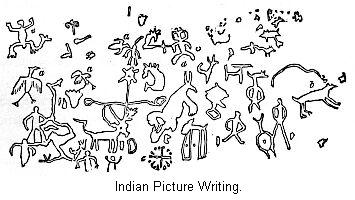
This cut is a specimen of such writing from the cañon of the San Juan in Arizona. Although quite impossible to read it, there is no doubt but what it expressed a meaning at the time it was engraved.

From this stage of development would naturally arise symbolical paintings. Thus “footsteps” might signify the idea of going. A comma-shaped figure, issuing from a person’s mouth, would stand for speech. The next step is what we might call rebus-writing, where not the thing itself was meant but the sound. Thus this cut represents Chapultepec—meaning grasshopper-hill, or locust mount. It is evident, here, the pictures of the objects represent the name. They, probably, did not use this principle farther than to represent the proper names of persons and things before the coming of the Spaniards.
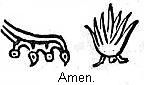
Some think that, in addition to the above, the Mexicans used, to a very limited extent, a true phonetic writing—one in which the figures refer not to the thought, but to the sound of the thought.83 Others are not ready to concede that point. They could not have been further along than the threshold of the discovery, at all events. The Spanish missionaries were very desirous of teaching the Indians the Pater-noster, the Ave-Maria, and the Credo. Either the Indians themselves, or the priests (probably the latter), hit on the device of using painted symbols for the words and syllables of the church prayers and formulas. Thus in this manner was painted the word Amen. The first sign is the conventional figure for water, in Mexican “atl,” which stood for A. For the second syllable they put the picture of a maguey plant, in Mexican “metl.” The whole, then, was “atl-metl,” which was as near as they could express the word amen. We must observe, that this was after the conquest.84
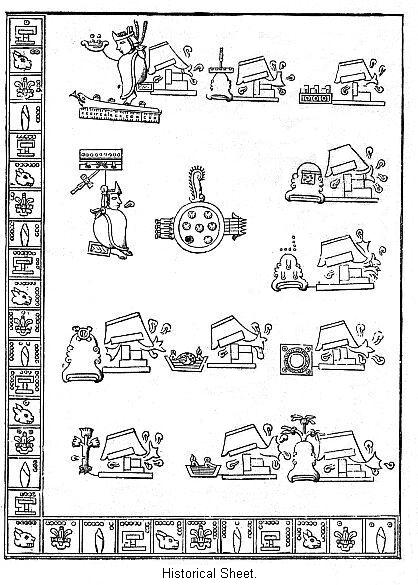
The plate opposite is one of the paintings of the Mendoza collection. This collection, we must remember, was made after the conquest, simply to gratify the curiosity of the King of Spain. The matter treated of is the events connected with time when Motecuma the fifth “chief-of-men” held office. Around the edge we see the hieroglyphics of the years. We notice he was chief-of-men from the year one calli to two tecpatl. About the only thing recorded of him is the different pueblos he conquered. In all he subdued thirty-three; but only eleven are shown in this plate. The pueblos are indicated by a house toppling over—flames issuing from under the roof. The other little hieroglyphics are the names of the pueblos. The last one in the second transverse line from the bottom is the hieroglyphic of Chalco, which we thus learn was reduced to tribute under this chief. All the events indicated in this cut took place before the discovery of America.85
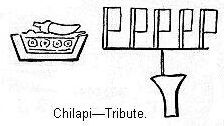
A second part of this codex has reference to the tribute received from various tribes. In this cut the left-hand figure is the hieroglyphic of the town of Chilapi, and is an excellent representation of their rebus-writing we have just referred to. It is a tub of water, on which floats a red-pepper pod. The Mexican word for this last is chilli, for water it is “atl.”. The word “pa” means above. For the full word we have “chilli-atl-pa.” Contracted, it becomes chilapi. The figure to the right is the tribute. The five flags denotes one hundred. Below is represented a copper ax-blade—from which we infer that the Pueblo of Chilapi had to furnish a tribute of one hundred copper axes.
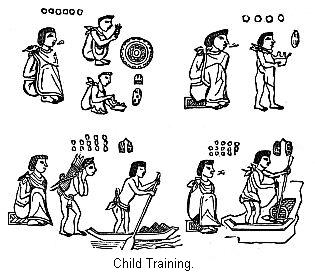
A third part of this same collection refers to the Mexican customs. In this cut we have represented the training of a boy at the different ages of four, six, thirteen and fourteen years of age. The little round marks number the years of his age. The little elliptical-shaped figures show the number of tortullas the child is allowed at a meal. The boy is trained to carry and make various things, to row a boat, and to fish.
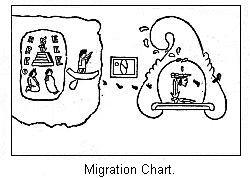
The most interesting of Mexican picture-writings is the record of their wanderings. This was formerly supposed to represent their migrations from Asia—but is now known to refer only to their wanderings in the Valley of Mexico. De Lafield, in his “Antiquities of America,” gives a full representation of this picture-writing. Bancroft’s “Native Races,” Vol. II, pp. 548-49, give a very good reduced copy. We will not attempt to reproduce it all. This cut represents the beginning of it. A man is seen crossing a stream in a boat. The figure behind him may mean an island, on which are represented some pueblos and human figures. On the opposite bank of the stream, to which the footsteps lead, is the hieroglyphic of Culhuacan, “the curved mountain.” The year date of this movement is “one tecpatl.” The character within that of Culhuacan is Huitzilopochtli, their national god. The flakes issuing from his mouth signify that he is guiding them. The principal figures about this map are the hieroglyphic names of various places where they stopped, and the time spent at each place.
The Mayas seem to have been further advanced in the art of writing than their Nahua neighbors. Specimens of their hieroglyphic writings have been given in the preceding chapter. The hopes of our scholars were greatly raised when, in 1863, the announcement was made that there had been discovered, in Madrid, a Maya alphabet, which, it was expected, would unlock the mysterious tablets just mentioned.
The alphabet thus discovered is represented in the next cut. It will be seen that some of the letters have a number of different forms. This discovery was hailed as of the greatest importance, and a number of scholars at once set about to decipher the tablets. They were speedily undeceived. The alphabet is, practically, of no help whatever. Prof. Valentine even goes so far as to declare that this alphabet was not of native origin.
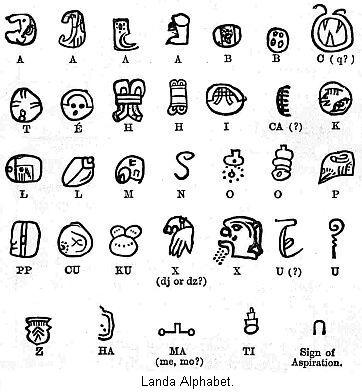

He thinks that Bishop Landa, who is the authority for this alphabet, and who was Bishop of Yucatan from 1549 to 1579, being anxious to assist the natives in learning the new faith, set about the manufacture of an alphabet for them. This he did by having the natives paint some native object which came the nearest to the sound of our alphabet. Thus, for instance, this symbol there are excellent reasons for supposing represents the sun, or the word “day.” The Maya word for this is te. We find that this is the symbol that Landa employs for the letter T, only, in his drawing, the central dot has fallen into the lower dashes. Nearly all the other letters can be traced to a similar source.86 But the professor’s reasoning does not satisfy all. He is believed to be right in a number of his identifications; but still the characters might have been used in a phonetic way.87
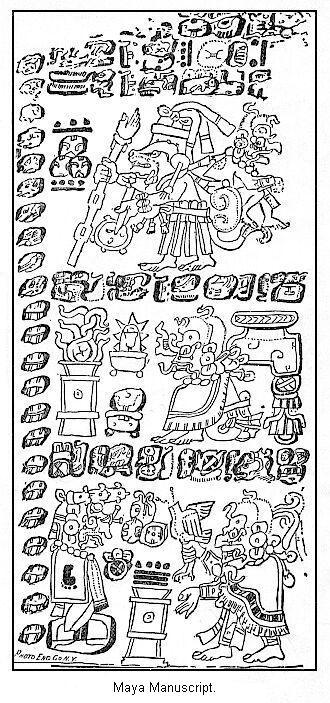
There is no doubt but that the Mayas had a different system than that in use among the Nahua people. The knowledge how to use it was, probably, confined to the priests; and, furthermore, the system was, doubtless, a mixed one. A few phonetic characters might have been used; but they also used picture-writing. The plate above is a sample of the manuscripts they left behind. It is in the nature of a religious almanac, and refers to the feasts celebrated at the end of a year. The line of characters on the left hand are the days characters Eb and Been. In the lower division, a priest offers a headless fowl to the idol on the left. In the middle division, the priest is burning incense to drive away the evil-spirit. In the upper division, the assistant, with the idol on his back, is on his march through the village. As yet, we know but very little about the tables. We know the hieroglyphics of days and of months.
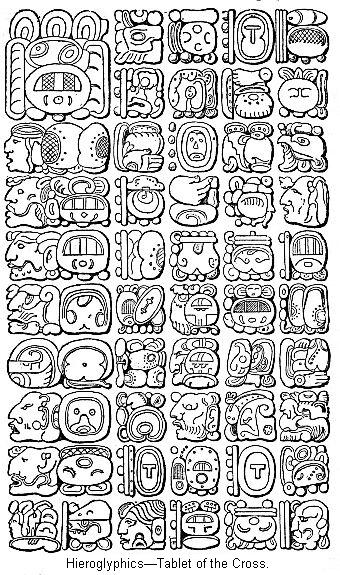
Examining the tablets in the Temple of the Cross, at Palenque, represented below, we notice a large glyph, at the commencement of the tablet, something like a capital letter. This, Mr. Valentine thinks, represents the censers which stood in the temples before the idols, in which fire was constantly kept.88 Running through the tablets we notice glyphs, in front of which are either little dots, or one or more bars with little dots in front of them. These are day-dates. The dots count one—the little upright bars, five. The probabilities are that this tablet is a sort of list of feast-days in honor of the gods represented by the central tablet.
As we have made a considerable effort to acquaint ourselves with the social organization and customs of the various tribes, and have spent some time in learning the details of their calendar system, and their advance in the art of writing, it will not be out of place to inquire as to their history—to determine, if possible, some of the dates to be given for the arrival of the tribes, and some of the important points of their prehistoric life. Whatever difficulties we have experienced in acquiring a knowledge of their customs will be greatly increased now. Their architecture, social organization, and general enlightenment could be perceived by the conquering Spaniards, and our information in regard to the same should have been full and complete. We have seen, however, how meager it is. The only light thrown on these disputed points is the result of the labors of modern scholars. When we were made acquainted with some of the first principles of Indian society, we could read with profit the accounts of the early writers.
But, when we come to ask for dates in their history, we are almost entirely at sea. The traditions, in this respect, are almost worthless. So, all that we shall attempt to do, is to present some of the thoughts of our scholars as to the probable connection of the civilized tribes with each other, and what value is to be given to the few dates at our command. We will begin, first, with the Maya tribes. This includes those tribes that speak the Maya language, and its dialects. It was in their territory that the most striking ruins were found. They include the tribes of Yucatan, Guatemala, Chiapas, and Tobasco. Then there comes a break; but they were also settled on both banks of the River Panuco. Many theories have been advanced as to the origin of the Mayas. As yet, the question is not solved.
Not a few have supposed them to be the same as the Mound Builders of the United States. Dr. Brinton has pointed out that the language of the Natchez Indians contains some words of the Maya.89 A Mexican scholar, Señor Orozco-y-Berra, thinks it probable that the Mayas once occupied the Atlantic sea-board of the United States; that they passed from the peninsula of Florida to Cuba, and thence to the other Caribbean Islands, and so to Yucatan. He states that the traditions of the Mayas uphold this view.90 But others are not ready to admit it. We have found a number of points of resemblance between the Mayas and the Nahuas. Differences we would, of course, expect to find; but still the points of resemblance are sufficiently strong to indicate either that the tribes were once subject to the same influence, from whence they derived their culture, or else that they are descended from the same stock. We have reverted to the worship of Quetzalcohuatl, and shown how the Quichés, under the name of Gucumatz, worshiped a similar deity. We have also referred to the great similarity of the calendar system.
From the limited space at our command, it is not possible to refer to the traditions of the Maya tribes. We will refer to but one manuscript bearing on this question; but this is, probably, the most important one. This manuscript was written by a native with the Spanish letter, but in the Maya language. It was written not far from the time of the conquest of Yucatan by the Spaniards, and the account is, doubtless, as full a one, from the native stand-point, as can be given. The period of time used by the author is Ahau, which we have seen is either twenty, or twenty-four years.
Carefully going over this manuscript, Prof. Valentine arrives at the following conclusions: About the Year 137, A.D., the Mayas started from some place they called Tulla, or Tullapan, on their migration. Where this place was we do not know. The traditions of all the civilized nations refer to this place as a starting-point. It was a “land of abundance.” It may be that this was but some fabled place, such as almost all primitive people have traditions of.91 About the year 231, A.D., they arrived on the coast of Central America, and spread themselves over a large part of it. This same manuscript speaks of the “discovery” of Chichen-Itza, 522, A.D. The date of the founding of Uxmal is given as about the year 1000, A.D. From 1000 to 1200, A.D., was the golden era of the Mayas in Yucatan.
The tribes at Uxmal, Mayapan, and Chichen-Itza formed a confederacy of which Mayapan seems to have been the head. About the year 1200, inter-tribal war broke out. It seems to have been caused by the arrival of Nahua tribes, who established themselves in Mayapan. They were finally expelled, but they left the Mayas in such a state of exhaustion that they could not present a united front against the Spaniards. Such are the conclusions of Prof. Valentine. He estimates the length of an Ahau at twenty years, and it does seem that the author of the manuscript used that number of years.92
Of the other branch of the civilized tribes we know but very little. The historical picture writings of the Mendoza collection, a collection compiled, remember, after the conquest, and, therefore, representing the traditions then current among the Mexicans, takes us back to 1325, A.D., to the first settlement in the Pueblo of Mexico. Sahagun, a Franciscan monk, who went to Mexico as early as the year 1529, and remained there until his death in 1590, wrote a very voluminous account of the Mexicans, their customs and history, and as he was in Mexico at the time when their traditions were still fresh in the minds of the natives, his account is probably as good as any. He obtained his information in a very credible manner. He gathered together some old Indians, well acquainted with the traditional history of their country. They are supposed to have “refreshed” their memory by inspecting a number of picture writings, which have since disappeared.
It is manifest that this history is valuable, just in proportion as the traditions are valuable. He makes one statement that Prof. Valentine has dwelt upon with great ability. He states that numberless years ago the first settlers came in ships and landed at a northern port, which, from that cause, was called Pauntla. This is supposed to be the Panuco River. After they had settled here, a large part of them, including their leaders and the priests, went off south; Sahagun says as far as Guatemala. The party left behind organized themselves into an independent body. They reconstructed from memory the calendar; they increased and became powerful, until pushing over the mountain, they built the pyramid of Cholula, and finally reached the city of Teotihuacan, where they built a central sanctuary. For some reason they abandoned their homes, all except the Otomies, and wandered off across the plains, and high, cold, desert places, that they might discover new lands.93
No dates are mentioned for these occurrences, and we are not aware that this tradition is mentioned by other writers. We recall that from the mouth of the Panuco River southward, we found evidence of considerable population in olden times. We also recall that in this section are the ruined pyramids of Tuzpan and Papantla. Prof. Valentine is inclined to think that this date is referred to on the calendar stone; that is, 231 A.D. Just twenty-four cycles elapsed from this time to the date of the dedication of the calendar stone in 1479.
He also thinks that the Maya traditions refer to this same occurrence. One more reference to this same mysterious date is contained in the traditions of the Tezcucan tribe. According to the traditions, the beginning of things were in the year 245 A.D. According to this view, then, the ancestors of both Nahua and Maya people appeared on the gulf coast about 231 A.D.; in the same place where a Maya-speaking tribe are found to-day. From here those who developed the Maya culture went to the south and south-west; those who developed the Nahua went to the west and north-west.
We do not profess to be a judge as to the value of this tradition. Our scholars will, probably, at no distant day, come to more definite conclusions in the matter. Prof. Short thinks the strangers who at this early time made their appearance on the gulf shore were colonies of Mound Builders from the Mississippi Valley.94 We think it best to be very cautious about coming to any such conclusions. We must not forget that back of the twelfth century is nothing but vague traditions. Mr. Bandelier tells us that “nothing positive can be gathered, except that even during the earliest times Mexico was settled or overrun by sedentary, as well as by nomadic tribes that both acknowledged a common origin.”95 The savage tribes have the general name of Chichimecas, but by right this term ought to be applied to the sedentary tribes as well; however, the word Toltec stands for these sedentary tribes. We have all read about the great Toltec Empire in Mexico. This is a ridiculous use of words. There was no tribe or nation of people of the name of Toltecs.96 All these prehistoric aborigines were probably Chichimecas; but by Toltecs we refer to the sedentary tribes, the skillful workers among them. If we are to judge any thing of traditions, the original home of these people were somewhere to the north of Mexico.
There was doubtless the usual state of inter-tribal warfare, but after a prolonged period the sedentary tribes—the Toltecs—were exterminated or expelled. Their successors were utter savages, coming from the north also. We doubt very much whether any date can be given for this event, but traditions assign it to about the year 1064. Prof. Valentine thinks he finds a reference to it in the calendar of stone. If we will notice, in the outer band near the top are four little bundles, or knots, in all, eight. We are told that each of these bundles refers to a cycle of fifty-two years, or in all four hundred and sixteen years. The date of the inauguration of the stone is 1479. If we subtract the number of years just mentioned, we have the date 1063. Whether this is simply a coincidence, or was really intended to refer to that event, we can not say.
Considerable speculations have been indulged in as to where the Toltecs went when driven out of Mexico. Some have supposed they went to Yucatan, and that to them we are to look for the builders of the ruined cities. This is the view of a very late explorer, M. Charney.97 Some have supposed we yet see certain traces of their presence in Guatemala, where they helped to build up a great Quexche “monarchy.”98 But we know very little about it. It is not probable that more than a feeble remnant of them escaped with their lives.
From the same mysterious regions from where had issued the aboriginal Chichimecas and Toltec people, there subsequently came still other bands of sedentary Indians, who finally came to settle around the lakes of Anahuac. These settlers all spoke closely related dialects of the same language as their predecessors, the Toltecs. Finally the Aztecs appeared on the scene, coming from the same mysterious land of the “Seven Caves.” According to their historical picture-writings, they founded the Pueblo of Mexico in 1325. It is somewhat singular that no record of this event appears on the calendar stone. If the artist was ingenious enough, as Prof. Valentine thinks he was, to represent the dispersion of the Toltecs in the eleventh century, he surely would have found some way to refer to such an important event as the founding of their Pueblo. From this date the Mexicans steadily rose in power, until they finally became the leading power of the valley.99
REFERENCES
The manuscript of this chapter was submitted to A. F. Bandelier for criticism. The part bearing on religion was subsequently rewritten. Absence from the country prevented his examining it.
Mr. Bandelier is the author of three essays on the culture of the ancient Mexicans. These are published in Volume II of “Peabody Museum Reports.” We wish to make a general reference to these essays. They are invaluable to the student. Every position is sustained by numerous quotations from the early writers. In order to save constant references to them, we will here state that, unless other authorities are given for striking statements as to the culture of the Mexicans, their social organizations, etc., it is understood that our authority is found in these essays.
In Mexican, “Tlaca-tecuhtli.”
Bancroft’s “Native Races,” Vol. II, p. 572.
“Contribution to North American Ethnology,” Vol. IV, p. 229.
Morgan’s “Contributions to N.A. Ethnology,” p. 256.
Bancroft’s “Native Races,” Vol. II, p. 576.
“Who over heard of an imperfectly developed race decorating so profusely and so delicately their ordinary abodes, in a manner usually reserved for temples and palaces?” S. F. Haven, in Proceedings of Am. Antiq. Society, April, 1880, p. 57.
Morgan’s “Contribution to N.A. Ethnology,” Vol. IV, p. 186.
Cortez saw “trinkets made of gold and silver, of lead, bronze, copper, and tin.” They were on the confines of a true Bronze Age. Proceedings of Am. Antiq. Society, April, 1879, p. 81.
“History of the Conquest of Mexico.”
Bancroft’s “Native Races,” Vol. II.
“History of America,” 1818, Vol. III, book viii, p. 9.
Wilson’s “Conquest of Mexico.”
Morgan’s “Ancient Society,” p. 91.
But, on this point, see “Peabody Reports,” Vol. II, p. 685 —note, p. 282.
Morgan’s “Ancient Society,” p. 197.
Ibid., p. 205.
“Ancient Society,” p. 118.
Morgan’s “Ancient Society,” p. 147.
We refer again to Mr. Bandelier’s articles. A careful reading of them will convince any one that the picture of Mexican Government as set forth in Mr. Bancroft’s “Native Races,” Vol. II, is very erroneous. Mr. Bancroft’s views are, however, those of many writers.
“Ancient Society,” p. 528.
Morgan’s “Ancient Society,” p. 537.
Bancroft’s “Native Races,” Vol. II, p. 435.
It is needless to remark that these results are greatly at variance with those generally held, as will be seen by consulting Mr. Bancroft’s “Native Races,” Vol. II, Chap. xiv. Mr. Bancroft, however, simply gathers together what other writers have stated on this subject. We follow, in this matter, the conclusions of an acknowledged leader in this field, Mr. Bandelier, who has fully worked out Mr. Morgan’s views, advanced in “Ancient Society.”
Morgan’s “Ancient Society,” p. 193.
Bancroft’s “Native Races,” Vol. II, p. 95.
Morgan’s “Ancient Society,” p. 194.
Bancroft’s “Native Races,” Vol. II, p. 94.
Morgan’s “Ancient Society,” p. 195.
Bancroft’s “Native Races,” Vol. I, p. 344.
Valentine, in Proceedings of American Antiquarian Society, April, 1879.
Gallatin: “American Ethnological Society’s Transactions,” Vol. I, p. 119.
Valentine: Proceedings American Antiq. Soc., October, 1880, p. 75.
Bancroft’s “Native Races,” Vol. II, p. 381. Proceedings American Antiquarian Society, April, 1879, p. 110.
Bancroft’s “Native Races,” Vol. II, p. 193.
“Fifth Annual Report Archæological Institute of America,” p. 83.
Bancroft’s “Native Races,” Vol. II, p. 389.
Bancroft’s “Native Races,” Vol. II, p. 325.
Valentine: Proceedings Am. Antiq. Society, April, 1879, p. 90.
Ibid., p. 111.
North American Review, Oct. 1880, p. 310.
See “Copper Age in Wisconsin,” in Proceedings American Antiquarian Society, No. 69, p. 57.
Bancroft’s “Native Races,” Vol. II, p. 483.
Proceedings Am. Antiq. Society, Oct., 1881, P. 66. (Valentine.)
Proceedings Am. Antiq. Society, Oct., 1881, p. 66. (Valentine.)
Bancroft’s “Native Races,” Vol. II, p. 489.
Bancroft’s “Native Races,” Vol. III, pp. 182-199. In this connection, see also Bandolier: “An Archæological Tour in Mexico,” p. 185, note 2. It seems that none of the early writers speak of such a belief. The idea of one single God is first found in the writings of Ixtilxochitl.
Brinton’s “Myths of the New World,” p. 45.
Tezcatlipoca, the tutelar deity of Tezcuco; Huitzilopochtli, the tutelar deity of Mexico; Camaxtli, the tutelar deity of Tlaxcala; Quetzalcohuatl, the tutelar deity of Cholula.
Bandelier: “An Archæological Tour in Mexico,” p. 188.
This subject is fully treated of in Brinton’s “Myths of the New World.”
“Among the Indians it is very easy to become deified. The development of the Montezuma myth among the Pueblo Indians of New Mexico is an instance.” (Bandelier.)
Brinton’s “Myths of the New World.”
Bandelier: “An Archæological Tour in Mexico.” pp. 168-213.
Bancroft’s “Native Races,” Vol. III, p. 298, note 9.
“American Antiquarian,” January, 1883, p. 78.
“An Archæological Tour in Mexico,” p. 67.
“Peabody Museum Reports,” Vol. II, p. 600. Dr. Brinton in “Myths of the New World,” p. 281, gives some instances that might be thought to show the contrary. But even in those extracts we notice the parties had to deserve the office, and that in no case was it confined to certain persons.
Bancroft: “Native Races,” Vol. III, p. 335.
Bancroft: “Native Races,” Vol. II, p. 500.
Mr. Bandelier remarks that the numbers from five to ten should be macuil-pa-oc-ce, etc. We give the same table as both Mr. Gallatin and Mr Bancroft.
For authorities on this subject see Gallatin in “American Ethnological Society’s Transactions,” Vol. I, p, 49; Bancroft’s “Native Races,” Vol. II, p. 497; Valentine, in Am. Antiq. Soc. Proceedings, Oct., 1880, p. 61.
Perez “Chronology of Yucatan,” in Stephens’s “Yucatan,” Vol. I, p. 435.
See Valentine: “The Katunes of Maya History,” in Proceedings Am. Antiq. Soc., October, 1879, p. 114.
We refer to the division of five days, not to the thirteen day period, of which we will soon speak.
Bandelier: “Peabody Museum Reports,” Vol. II, p. 579. Note 29.
Mr. Bancroft, “Native Races,” p. 508, gives a table showing the variation of authors in this respect. Gallatin “American Ethnological Society’s Transactions,” Vol. I, p. 66, says, “the published hieroglyphics are dissimilar in many respects.”
Stephens’s “Yucatan,” Vol. I, p. 438.
Bancroft’s “Native Races,” Vol. II, p. 513, note 15.
Proceedings Am. Antiq. Society, April, 1878, p. 99.
Gallatin: “American Ethnological Soc. Trans.,” Vol. I, p. 71.
See Valentine, in Proceedings American Antiq. Society, April, 1878, p. 106. Gallatin, who is also good authority, gives the order different, viz., Tochtli, Acatl, Tecpatl, Calli.
Valentine: Proceedings Am. Antiq. Soc., Oct., 1879, p. 84, et seq.
Thomas: “A study of the Manuscript Troano,” in “Contributions to North American Ethnology,” Vol. V, p. 29.
According to the teachings of the Mexican priests nine deities governed the days. They had painted lists of these weeks, and the deities governing each.
Valentine: Proceedings Am. Antiq. Soc., Oct., 1879, p. 85.
In this table we have followed Mr. Gallatin. According to Prof. Valentine, the order of the years is different. This, however, is immaterial to an understanding of the system.
Gallatin: “Am. Eth. Soc. Transactions,” Vol. I, p. 94, et seq.
Thus says Prof. Valentine. The cast of this stone in the Smithsonian Institution gives the date eight, instead of seven Ozomatl.
For information on the Calendar Stone, consult, “American Ethnological Society’s Transactions,” Vol. I, p. 94, et seq.; Bancroft’s “Native Races,” Vol. II, chap. xvi, and p. 755, et seq.; Valentine: American Antiquarian Society’s Proceedings, April, 1878, p. 92, et seq.; Short’s “North Americans of Antiquity,” p. 419, et seq.
Morgan’s “Ancient Society,” p. 143.
Brinton: “Introduction to the Study of the Manuscript Troano.”
Valentine: Proceedings of American Antiquarian Society, April, 1880.
Gallatin: “American Ethnological Society’s Transactions,” Vol. I, p. 131.
Valentine: Amer. Antiq. Society’s Transactions, April, 1880, pp. 59-91.
Brinton’s “Introduction to Study of manuscript Troans,” p. xxvi.
American Antiquarian Society, April, 1881, p. 294.
“Myths of the New World.” The doctor now thinks his statement just referred to, too strong. There is, indeed, a resemblance, as he pointed out; but it is not strong enough to found any theories on.
Short’s “North Americans of Antiquity,” p. 474.
Brinton’s “Myths of the New World.”
This historical manuscript represents the traditions of the Maya people shortly after the conquest. It is very likely its author had before him picture records of what he wrote. Such records have since disappeared. The manuscript itself, the interpretation of it, and Perez’s remarks are found in Stephen’s “Yucatan,” Vol. II, Appendix. The same in Bancroft’s “Native Races,” Vol. V, p. 628. The fullest and most complete discussion is by Prof. Valentine in Proceedings Am. Antiq. Soc., October, 1879, p. 80, et seq. Whether there is any thing worthy of the name of history is doubtful.
Proceedings Am. Antiq. Society, Oct., 1882.
“North Americans of Antiquity,” p. 578.
“Peabody Museum Reports,” Vol. II, p. 387.
Valentine: Proceedings Am. Antiq. Society, October, 1882, p. 209.
North American Review, from Sept., 1880, to 1883.
Short’s “North Americans of Antiquity,” p. 218.
This historical notice is a mere outline. Such, however, is all we wished to give. Those who wish for more details can not do better than to refer to Mr. Bancroft’s fifth volume on the “Native Races.” We do not believe, however, that any thing definite is known of the early periods of which some writers give such glowing descriptions. When they talk about the doings of monarchs, the rise and fall of dynasties, and royal governors, we must remember the majority of the descriptive matter is mere nonsense, consequently our faith in the dates given can not be very great.