Chapter X · THE MOUND BUILDERS.1 (continued 2)
Reading edition
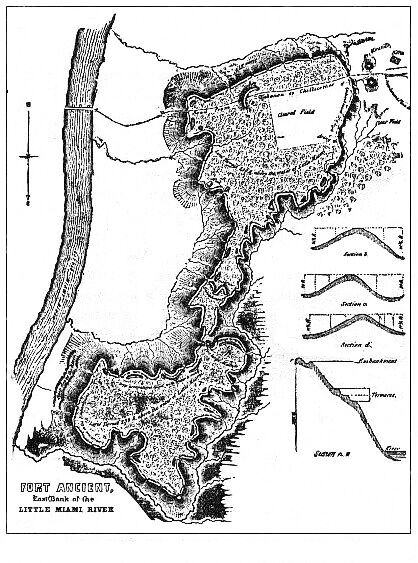
This wall is, of course, the highest in just those places where the sides of the hill are less steep than usual. In some places it still has a height of twenty feet. We notice the wall has numerous breaks in it. Some of these are where it crosses the ravines, leading down the sides of the hill. In a few cases the embankment may still be traced to within a few feet of a rivulet. Considerable discussion has ensued as to the origin and use of these numerous gateways. Mr. Squier thinks that these openings were occupied by timber work in the nature of blockhouses which have long since decayed. Others, however, think that the wall was originally entire except in a few instances, and that the breaks now apparent were formed by natural causes, such as water gathering in pools, and musk-rats burrowing through the walls, and we are told that such an opening was seen forming in the year 1847.72 No regular ditch exists inside the wall, the material apparently being obtained from numerous dug holes.
It will be seen that the works could be naturally divided into two parts, connected by the isthmus. More than one observer has pointed out the resemblance in general outline of this work to a map of North and South America, but of course the resemblance, if any, is entirely accidental. Mr. Peet has called attention to the resemblance which the walls of the lower inclosure bear to two serpents, their heads being the mounds, which are separated from the body by the opening which resembles a ring around the neck. Their bodies are the walls, which, as they bend in and out, and rise and fall, much resembles, he thinks, two massive green serpents rolling along the summit of this high hill. If any such resemblance occurs, we think it purely accidental. In relation to the wall across the isthmus, it has been thought to have been the means of defending one part of the work should an enemy gain entrance to the other. It has also been supposed that at first the fort was only built to the cross wall on the isthmus, and afterwards the rest of the inclosure was added to the work.
The total length of the embankment is about five miles, the area enclosed about one hundred acres. For most of this distance the grading of the walls resembles the heavy grading of a railroad track. Only one who has personally examined the walls can realize the amount of labor they represent for a people destitute of metallic tools, beasts of burden, and other facilities to construct it.
Now, what was the object of this work? We think it was not simply a fort, but rather a fortified village. That it must have required the work of a numerous body of people, is undoubted, and if they lived elsewhere, where are the works denoting such a fact? We would further suggest that, if this was the seat of a tribe, each of the two divisions might have been the location of a phratry of the tribe, by a phratry, meaning the subdivision of a tribe. We would call especial attention to the two mounds seen just outside of the walls at the upper end. From these mounds two low parallel walls extended in a north-easterly direction some thirteen hundred and fifty feet, their distant ends joining around a small mound. As this mound was not well situated for signal purposes, inasmuch as it did not command a very extensive view, and as the embankments would afford very little protection, unless provided with palisades, it seems as if the most satisfactory explanation we have is that it was in the nature of a religious work.
Mr. Hosea thinks he has found satisfactory evidence that between these walls there was a paved street, as he discovered in one place, about two feet below the present surface, a pavement of flat stones.73 From this, as a hint, he eloquently says: “Imagination was not slow to conjure up the scene which was once doubtless familiar to the dwellers at Fort Ancient. A train of worshipers, led by priests clad in their sacred robes, and bearing aloft the holy utensils, pass in the early morning, ere yet the mists have risen in the valley below, along the gently swelling ridge on which the ancient roadway lies. They near the mound, and a solemn stillness succeeds their chanting songs; the priests ascend the hill of sacrifice and prepare the sacred fire. Now the first beams of the rising sun shoot up athwart the ruddy sky, gilding the topmost boughs of the trees. The holy flame is kindled, a curling wreath of smoke arises to greet the coming god; the tremulous bush which was upon all nature breaks into vocal joy, and songs of gladness bursts from the throats of the waiting multitude as the glorious luminary arises in majesty and beams upon his adoring people. A promise of renewed life and happiness. Vain promise, since even his rays can not penetrate the utter darkness which for ages has settled over this people.” Thus imagination suggests, and enthusiasm paints a scene, but, from positive knowledge, we can neither affirm nor deny its truth.
Most of the works of the Mound Builders are noticeable for their solidity and massiveness. We see this illustrated in the great walls of Fort Ancient. Some of our scholars think this is a distinguishing feature of the Mound Builders’ work.74 It seems to us that it is difficult to make this a distinguishing feature, as we have no means of knowing how much “massiveness” is required in a work to entitle it to be considered a work of the Mound Builders. Should this distinction be established, however, we have to notice that while in the western part of the State of Ohio the Mound Builders’ inclosures are more often of the defensive sort, the type changes to the eastward, where, as in the Scioto Valley, we find the so-called sacred inclosures in larger numbers. In the State of Ohio, then, there were at least two well defined types of works by the Mound Builders. But if we split the Mound Builders up into tribes, where shall we draw the line between them and our later Indians?
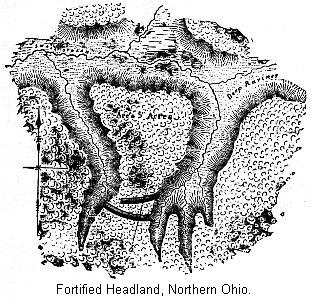
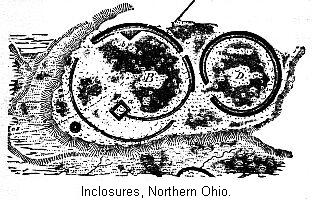
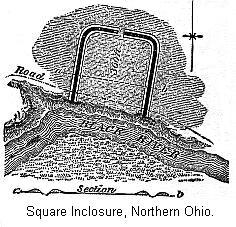
Scattered through Ohio, but especially abundant in the northern part of the State, is a class of works which has excited considerable comment. This cut illustrates a work of this kind. It was located near where Cleveland now stands. The defense consists mainly in the location. The wall seems to have been rather of a secondary affair. The hill was too steep to admit approach to it except from the rear, where the double wall was placed. With both of these works a ditch was dug outside the wall. These works did not always consist simply of fortified headlands. This cut is of a portion of the works formerly existing near Norwalk, Ohio. The circular work, D, is shaped much like the sacred inclosures, though not on so large a scale. In the larger work, at B, we notice a truncated mound. The ditch is on the outside of the circles. This cut is of a work formerly on the banks of the Black River. Here we have a square inclosure, defended by two embankments and a ditch.
This class of works was formerly common not only in Ohio and Western New York, but they were also to be observed in other sections of the country. They existed alike in the valley of the two Miami Rivers, and in that of the Scioto. They were also found throughout the South. Even Wisconsin, the home of the effigy Mound Builders, is not destitute of this class of remains. The peculiar interest attaching to them arises from the fact that in some places, at least, we have good reason to assign their construction to Indian tribes. Those of Western New York were very thoroughly studied by Mr. Squier. When he commenced his investigations, he was under the impression that he was dealing with the remains of a people very similar, at least, to those who built the massive works in the Ohio Valley and elsewhere, but he was led to the conviction that they were the works of the Iroquois Indians, and as further proof that such was the case, we are told that since the palisades that once inclosed places known to be villages of the Iroquois have disappeared, there is no difference to be observed between the appearance of the ruins of such a village site and any of the earthworks in Western New York. But we have just stated that the remains last mentioned are identical with those found in Northern Ohio, and indeed over a wide extent of country. The conclusion seems to be, then, that one large class of works in many points resembling Mound Builders’ works, found widely distributed throughout the Mississippi Valley, were really the works of Indians.75 But we are approaching a subject we do not wish to discuss just yet. We simply point out that not all the remains of prehistoric people in the Mississippi Valley are referable to the Mound Builders.
We have tried to point out the more important works that are ascribed to them. It must of necessity occur in a work of this nature that the review should be very brief, yet we have touched on the different classes of their works. But before leaving this part of our field we must mention some anomalous works, and refer to others which, if they can be relied on as works of the same people, certainly imply a great advance on their part.
Our next cut is named by Mr. Pidgeon the “Sacrificial Pentagon.” Writing in 1850, he states, “This remarkable group . . . has probably elicited more numerous conjectures as to its original use than any other earth-work yet discovered in the valley of the Mississippi. . . . It is situated on the west highlands of the Kickapoo River, in Wisconsin.”76 Mr. Pidgeon claims to have discovered two of these pentagons. We are not aware that any one else has verified these discoveries, and it is difficult to decide what value to give to his writings. He claims to have made extensive researches around the head-waters of the Mississippi as early as 1840, and there to have met an aged Indian—the last of his tribe—who gave him many traditions as to the mounds in that locality. Most of our scholars think his writings of no account, whatever, and yet Mr. Conant says, “He seems to have been a thoroughly conscientious and careful observer, faithfully noting what he saw and beard.”77
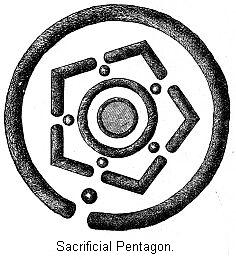
We will briefly describe a few of the earth-works he mentions, notice their singular form, and give an outline of the traditions in regard to them, leaving the reader to draw his own conclusions. Of this work the outer circle is said to have been twelve hundred feet in circumference, the walls being from three to five feet in height; width on the ground from twelve to sixteen feet. The walls of the pentagon were from four to six feet high. The inner circle was of very slight elevation. The central mound was thirty-six feet in diameter. This singular arrangement of circle, pentagon, and mounds, is traditionally represented to have been a sacred national altar—the most holy one known to tradition—and no foot, save that of a priest, might pass within the sacred walls of the pentagon after its completion. The sacrifice offered on this altar was that of human life. Twice each year the offering was made.78
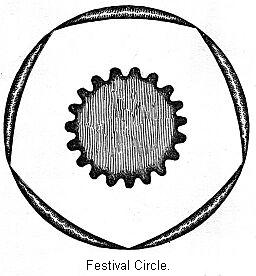
The work represented in the figure at left is stated to have been in the near neighborhood of the former, and to have been intimately connected with it. Mr. Pidgeon claims to have found five of these circles and two pentagons. So far as we know, he is the only authority for their occurrence, no one else having been so fortunate as to have found them. This is surely a singular work, and we can not fail to recognize in it a representation of the sun and the moon. In excavating in the central mound, we are assured that small pieces Of mica were found abundantly mixed with the soil. “Had the surface-soil been removed with care, and the stratum beneath been washed by a few heavy showers of rain, so thoroughly studded was it with small particles of mica, that under the sun’s rays it certainly would have presented no unapt symbolic representation of that luminary.”79
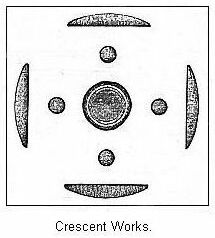
Our next figure is another singular arrangement of crescent-shaped works and mounds. Lapham says that crescent-shaped works are found in Wisconsin. Pidgeon says that crescent works are found in Illinois, but works arranged as shown in this wood-cut he found in but four places in Wisconsin. Could we verify this author’s statements, this illustration and the preceding one would be very good evidence of the prevalence of sun-worship among the effigy Mound Builders of Wisconsin. This would be nothing singular, since the Indian race almost universally reverenced the sun.80
The figure below represents a group of works which, we are told, were of a class formerly abundant in Missouri and Iowa. The embankments are stated to be of varying heights, but all of the same length. They do not quite meet, but a mound defends the opening. Sometimes a square is so represented, and sometimes but two walls.
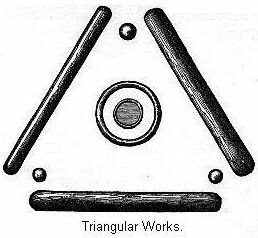
A singular statement is made in reference to a nice proportion said to be observed between the heights of the embankments and walls. In this case, for instance, the heights of the embankments are, three, four, and five feet; the sum of these, twelve feet, was the exact height of the central mound. Furthermore, the square of the sum of the heights of three embankments gives us one hundred and forty-four feet, which is the length of the embankments. We are gravely assured that this same nice proportion is always observed in works of this kind. The embankments being always of equal length, but of varying heights, still the sum of these heights, whether three or four sides, being always equal to the height of the central mound.81 We do not know of any specimen of this class of works now existing. If this early explorer’s account be reliable, then we have in works of this class very good evidence that some of their inclosures were in the nature of sacred inclosures. The trouble is to verify Mr. Pidgeon’s account. There is a good deal that is strange and marvelous in reference to the Mound Builders, and we must use judgment as to what is told us, unless we are sure there is no mistake, or unless the reports are vouched for by many observers.
We wish to call attention to some singular works in Missouri, which would imply that the Mound Builders were possessed of no little engineering skill. We have every indication that near New Madrid was a very extensive settlement. The works consist of inclosures, large and small mounds in great numbers, and countless residence sites. One of fifty acres was noticed, which had evidently been inclosed by earthen walls. In some places in the forest, where this wall had been preserved, its height was found to be from three to five feet, and its base width fifteen feet.82 But the suggestive features about these works are noticed along the edge of the swamp near which they stood. This swamp in 1811 was a lake, with a clear, sandy bottom. It is not at all doubted but that it was at one time the bed of the Mississippi River, and probably this town stood on its banks. The river is now some eighteen miles away. It must suddenly have changed its course, leaving behind it a lake, which, in course of time, became a swamp.
But along the shores of this ancient lake, in front of the inclosure, small tongues of land have been carried out into the water, from fifteen to thirty feet in length, by ten, or fifteen in width, with open spaces between, which, small as they are, forcibly remind one of the wharfs of a seaport town. The cypress trees grew very thickly in all the little bays thus formed, and the irregular, yet methodical, outlines of the forest, winding in and out close to the shore of these tongues of land, is so marked as to remove all doubt as to their artificial origin.83 The suggestion is made in view of these wharfs, that the Mound Builders must have had some sort of boats to navigate the waters of the lake.
And the singular part is, that right in this neighborhood are many evidences of a system of canals. A glance at the map will show that the portion of Missouri around New Madrid, and to the south of it, is dotted with swampy lakes and sluggish bayous. The evidence is to the effect that the ancient inhabitants connected these bayous and lakes with artificial canals, so as to form quite an extended system of inland water-ways. Right east of the town of Gayoso, we are told that a canal had been dug that now connects the Mississippi with a lake called Big Lake. A bayou running into this lake was joined by a canal with Cushion Lake.
From this last lake, by means of bayous and lakes, a clear course could be pursued for some miles north, where finally another canal was cut to join with the Mississippi a few miles below New Madrid. The entire length of this water way was some seventy miles, but we are not told how much of it was artificial, neither are the dimensions given. Prof. Swallow speaks of a canal “fifty feet wide, and twelve feet, deep.” Whether this was one of this series or not, we do not know.84 This is indeed a singular piece of work. It would be more satisfactory if we had more definite information in regard to the same.
With our present knowledge of the state of society among the Mound Builders, as made evident by the remains of their implements and ornaments, we are not justified in believing this part of a system of internal navigation. We have already seen that further south they sometimes surrounded their village sites with a wide and deep moat or ditch, as was observed around the inclosure containing the great mound on the Etowah. We are inclined to believe that a more careful survey would greatly modify the accounts we have of these canals, if it did not, in fact, show that they were the works of nature. According to a writer in the American Antiquarian,85 the whole lower part of the Mississippi Valley was abundantly supplied with canals, irrigating ditches, and evidences of a high intelligence. He speaks of observing the presence of an extensive canal a little north of the section we have described. He asserts they were dug to convey the surplus waters of the Mississippi in times of flood to the White and St. Francis Rivers, thus preventing disastrous overflows. It is needless to caution the reader against such conclusions. Our information in regard to those canals is far too limited to support the views advanced.
This finishes our examination of the works of the Mound Builders. Except in the case of the more massive works, they have become obliterated, but here and there are left traces of the former presence of these now vanished people. The antiquary muses over the remains of their inclosures, their fortified places, their effigies and mounds. By the combined efforts of scholars in many departments, we may yet hope that the darkness now enshrouding this race may be dissipated, but at present our positive knowledge is very limited indeed. It is as if we were asked to reconstruct a picture which had faded in the lapse of time so that only traces here and there are visible. Here, perhaps, a hand is seen; there a piece of foliage; in one place something we think representing water, in another a patch of sky, or a mountain peak. Until a key is found which shall show us how to connect these scattered parts, our efforts are useless, since many pictures could be formed, but we have no surety we are right. So we may form mental conceptions of the Mound Builders, but they are almost as varied as the individual explorers. Science may yet discover the key which will enable us to form a clear mental conception of the race which flourished here many years ago, and left their crumbling memorials to excite the curiosity of a later people.
We must now turn our attention to another branch of inquiry and learn what we can of the culture of the Mound Builders. This is to be determined by an investigation of the remains of their implements, weapons, and ornaments. When we know the skill with which they manufactured these articles, and gain an insight into some of their probable customs, we shall know where to place them in the scale of civilization. What we have learned of their works has already convinced us that we are dealing with a people considerably above the scale of Savagery. The nice proportion between the parts, the exact circles and coincident angles show considerable advance in mechanical skill. The character of the works indicates that the people had permanent places of abode, and were not subject to the vicissitudes of a hunter’s state of life for subsistence. This implies that we are dealing with a people living in village communities, practising agriculture and many other arts, and therefore entitled to rank in the middle status of Barbarism corresponding to the Neolithic inhabitants of Europe.86 We will now see how far this conclusion is sustained by an examination of the remains of the handiwork of the people.
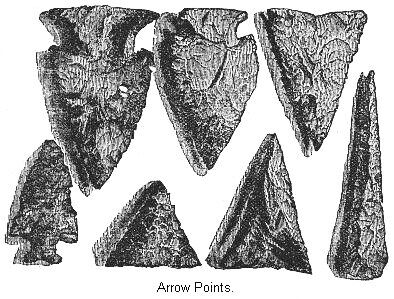
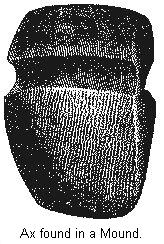
Implements of stone are of course abundant. But men, when in the culture of the Stone Age, having a common material to work upon, and under the pressure of common needs, have everywhere provided similar forms. For this reason it is hard to find distinctive points of difference between implements of stone of Mound Builders’ work and a series of similar implements the work of Indians. We are assured, however, that when examining a series of each, those of the Mound Builders display a superior finish.87 The preceding wood-cut represents a collection of arrow-points found in the mounds, but they are not particularly so distinguishable from specimens found on the surface. Great numbers of arrow-points are occasionally found on altars. Here we have a view of one of the stone axes fashioned by the hands that heaped the mounds. It is certainly a very fine specimen.
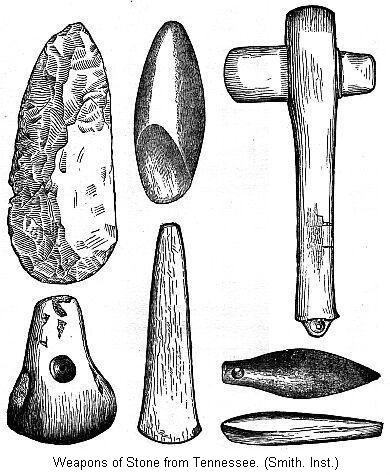
The Mound Builders must have had all the varieties of stone implements common to people in their stage of culture, such as axes, fleshers, and chisels. They also must have possessed mortars and pestles for grinding corn, and some implements did duty as hoes and spades. We represent in a group a collection of weapons and implements from the mounds and stone graves of Tennessee. All these articles are finely finished. One of the axes has a hole bored through it. One of them is further provided with a stone handle, and is characterized as being the “most beautiful and perfect stone implement ever exhumed from the aboriginal remains within the limits of the United States.”
People in the culture of the Stone Age make but very rare use of metal, as metals are to them simply varieties of stone, much less useful for their purpose than the different kinds of flints, except for ornaments. From the altar mounds, near Cincinnati, were taken ornaments of silver, copper, iron and traces of gold, all of which had been worked into their present shape by simply hammering. The iron, it should be remarked, was meteoric iron, which can be hammered as easily as native copper. We have already remarked that about the only native iron is obtained from such sources. Copper was utilized for a great variety of purposes.
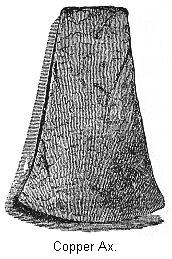
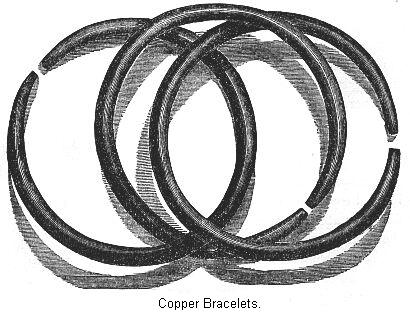
We give a cut of a copper ax found in one of the Ohio mounds. Copper axes have lately been found quite frequently in mounds near Davenport, Iowa, and in most cases before being deposited in the mounds, they had been wrapped in cloth. Copper ornaments are a more common find. Bracelets, beads, and ear ornaments are numerous. Our next cut represents some very fine bracelets found in a mound near Chillicothe, Ohio, Copper tools and weapons have been found quite frequently on the surface, but we are not sure in this case whether they are not the work of recent Indians. The early explorers noticed the presence of copper ornaments among the Indians. “When Henry Hudson discovered, in 1609, the magnificent river that bears his name, he noticed among the Indians of that region pipes and ornaments of copper.” The account says: “They had red copper tobacco pipes, and other things of copper they did wear about their necks.”88 De Soto also noticed among the Southern Indians axes of copper. Other accounts could be quoted showing that the Indians were well acquainted with copper.89 The fact is, in this matter also, it is impossible to draw a dividing line between relics of the Mound Building tribes and the Indians. However, the Mound Builders were certainly acquainted with copper, but to their minds it was only a singular stone, one that they could hammer, into a desired shape.
Where did they obtain their copper? We are all aware that in this country great supplies of pure copper exist near the southern shore of Lake Superior, and there is a peculiarity about the copper found there, that is, the presence of small pieces of silver with the copper. This is a very singular mixture, and we are not aware of its occurrence elsewhere. It would trouble the best chemists to explain it. From this fact we are enabled to identify articles of copper derived from that source, and to that region we can trace the copper from which are formed most of the copper implements and ornaments found in this country. It is also noticeable that the nearer we get to this region the more numerous are the finds of articles of copper. More are reported from Wisconsin than the rest of the United States put together.
This leads us to a very interesting subject. In 1848 Mr. S. O. Knapp, agent of the Minnesota Mining Company on the northern peninsula of Michigan, discovered that the modern miners were but following in the footsteps of some ancient people who had mined for copper there some time now far past. The general conclusion is that these old miners were Mound Builders, but here the evidence of their presence is not found in the existence of mounds and earthworks, but of pits and excavations, which, by the slow accumulation of years, had become filled to near the surface with débris of various kinds. Many had noticed these little pits and depressions without suspecting they had aught to do with the presence of man. The hollows made by large trees, overturned by the wind, frequently left as well marked depressions as these excavations.
We have abundant proof that these old miners were practical workmen. They evidently did not neglect the most trifling indication of metals. They made thorough research and discovered the principal lodes. Our present day miners have long since learned to regard the presence of these ancient pits as excellent guides in this matter. With modern appliances they penetrate far beyond the power of the old workmen. At the Waterbury mine there is in the face of the vertical bluff an artificial opening, which is twenty-five feet wide, fifteen feet high, and twelve feet deep. The materials thrown out in digging had accumulated in front, and on this forest trees common to that region were growing of full size. Some of the blocks of stone which were removed from this recess would probably weigh two or three tons, and must have required the use of levers to move them. Beneath the surface rubbish was discovered the remains of a cedar trough, by which the water from the mines was conducted away. Wooden bowls were found, which were probably used to dip the water from the mine into this trough.
Near the bottom of the pit, shovels, made of cedar, were found, shaped much like a canoe paddle, but showing by their wear that they were used as shovels. Although they appeared solid while in water, yet, on drying, they shrunk up, and were with difficulty preserved. A birch tree, two feet in diameter, was observed growing directly over one of these shovels. No marks of metallic tools were observed anywhere about this large pit.
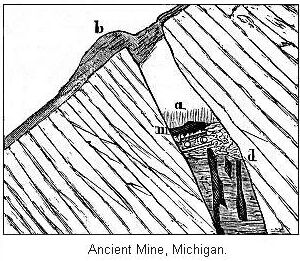
In this case they constructed a sort of a cave, but in many cases they mined open to the air, that is, they simply dug trenches or pits. A row of these ancient pits, now slight depressions, indicate a vein. What they seem to have especially sought after was lumps of copper that they could easily manage and fashion by hammering. They had not discovered the art of melting. When they found an unusually large piece, they broke off what they could by vigorous hammering. In one case they found a mass weighing about six tons of pure copper. They made an attempt to master this piece. By means of wedges they had got it upon a cob-work of round logs or skids, six or eight inches in diameter, but the mass was finally abandoned for some unknown reason after breaking off such pieces as they could until the upper surface was smooth. This mass rested on the framework of logs while the years came and went, until, after the lapse of unknown time, the white men once more opened the old mine.
On the rubbish in front of this mine was standing the stump of a pine tree ten feet in circumference. These ancient mines are found not only on the main-land, but on the islands off the coast as well. The only helps they seem to have employed was fire, traces of which are found everywhere, and stone mauls and axes. The mauls consist of oblong water-worn bowlders of hard tough rock, nature having done every thing in fashioning them except to form the groove, which was chiseled out around the middle. Some copper implements were also found.
Col. Whittlesey, from whose writings we have drawn the foregoing, concludes that these mines were worked by the Mound Builders. As he finds no traces of graves or houses, or other evidence of a protracted stay, he thinks they were worked only through the Summer season of the year by bands of workmen from the south.
As to what caused the abandonment of the works we do not know. It might have been an impulse of their race hurrying them on to some distant migration; or, more probably, pressed by foes from without, they were compelled to abandon their ancient homes. Whatever the cause was, nature resumed her sway. Forest trees crept up to and grew around the mouths of the deserted mines. Col. Whittlesey concludes from the group of trees growing on the top of the rubbish heap that at least five hundred years passed away before the white man came from the south to resume the work of his ancient predecessor.90
It is not, however, proven that the Mound Builders were the sole workers of these ancient mines. It is known that the Indians mined for flint. Some of the excavations for this purpose, in what is known as Flint Ridge, in Muskingum County, Ohio, are as marked as the traces of ancient mining in Michigan. Similar appearances are recorded in Missouri. As copper was in demand among the Indians, and as it is probable that they obtained much of it from the North, they may have continued to work the ancient copper mines until comparatively recent times. Mr. Lapham believes that the progenitors of the Indian tribes found dwelling in the regions near these mines, carried on mining operations there. Dr. Rau thinks it probable that small bands of various Northern tribes made periodical excursions to the locality, returning to their homes when they had supplied themselves with sufficient quantities of the much-desired metal. The fact that many of the modern Indian tribes knew nothing about these mines is not of much weight, when we reflect how easily a barbarian people forget events, even those of a striking nature.
We are apt to judge the culture of a people by the skill they display in works of arts. The article on which the Mound Builder lavished most of his skill was the pipe. This would show that with them, as with the modern Indians, the use of the pipe was largely interwoven with their civil and religious observances. In making war and in concluding peace, it probably played a very important part. “To know the whole history of tobacco, of the custom of smoking, and of the origin of the pipe, would be to solve many of the most interesting problems of American ethnology.”91
The general decoration consisted in carving the bowl of the pipe into the shape of some animal or bird. In some instances we have carved representations of the human head. Such as these are of particular interest and value, as they are probably faithful representations of the features of the Mound Builders. This is a fine specimen found in one of the altar mounds in Ohio. The method of wearing the hair is worthy of notice. The holes placed in a row encircling the forehead and coming down as low as the ears, were once filled with pearls. In some they still remained when found, though they had been burned in the fire. The lines upon the face obviously imitate the custom of tattooing the countenance.
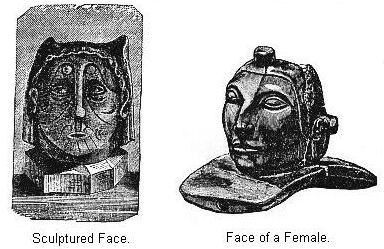
Scholars have called attention to the fact that Humboldt discovered in Mexico a small statue which he supposed represented an Aztec priestess. This statue had sculptured upon its forehead a row of pearls, worn in the same manner as is represented in this pipe. This is another pipe of great interest, and is supposed to represent the head of a woman. The countenance is expressive, the eyes prominent, and the lips full and rounded. We must notice again the headdress. While the faces are of Indian type, the method of wearing the hair is different from that of the typical Indian of the North.
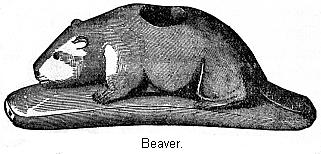
The animal forms into which the pipe-bowls are carved, are also full of interest. This is not so much on account of animal forms themselves as the insight we gain as to the artistic skill of the people who fashioned the pipes, and in various ways learn of bits of customs and manners peculiar to them. Here we have figured a pipe, the bowl of which is carved to represent a beaver. No one need hesitate as to the animal which the carver had in mind. It is represented in a characteristic attitude, and has the broad, flat tail of its species. It must have required no little skill and patient labor to work a rough stone into this finished pipe, especially when we remember that the maker had no edged tools with which to work.
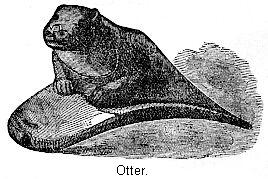
We can not always determine the animal which the artist had in mind. In this illustration we have figured such a pipe. Considerable discussion has arisen as to the animal represented. Some cases of this nature have been thought to show either migration from a distant country on the part of the maker or else an extended system of trade.
Squier and Davis, who first figured it, supposed it to represent a manatee, or sea-cow. This animal is essentially a tropical species, the only known place where it was found in the United States being Florida. From the presence of this carved specimen, found a thousand miles to the north, some interesting queries, as the origin of the mound-building tribes, and the state of life among them, were raised. It is almost certain, however, that the animal intended to be represented was the otter.92
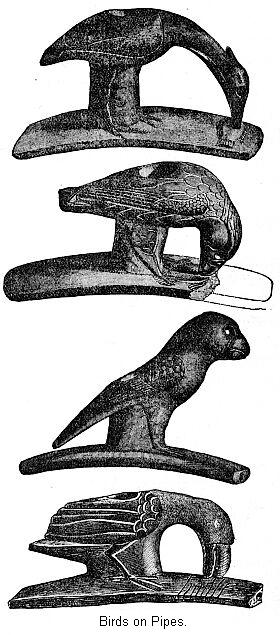
The most general form of sculpture was that of birds, and we find specimens of almost all the common varieties. In this group we recognize the tufted heron striking a fish; the eagle, or hawk, tearing a smaller bird; the swallow, apparently just ready to fly; and in the last figure, one that has given rise to a good deal of discussion. Some think from the circumstance of its having a very large bill, toes pointing behind as well as before, that it represents a toucan, which, if true, would make it a most interesting specimen. But cautious scholars conclude that the “figure is not of sufficient distinctness to identify the original that was before the artist’s mind.” And therefore it is not wise to make this specimen the subject of a far-reaching speculation.93
It may be of interest to inquire whether the Indians made pipes as tastefully ornamented as those we have described. We should notice that all the pipes here described are from one very limited locality in Ohio, and that is the valley of the Scioto, the same section of country where were found the great inclosures of a mathematical shape. We have no reason for supposing that the Mound Builders generally throughout the Mississippi Valley had this artistic skill. We have seen nowhere any thing to show a superiority for them in this respect. Whatever conclusion can be drawn from those pipes, applies only to the tribe in the Scioto Valley. It is believed they do constitute a peculiar class by themselves. As works of art, there are but few aboriginal relics of North American origin their equal.94
We would also refer to the fact that most of these specimens were obtained from one altar-mound.95 We do not know what ceremonies were performed around this altar, but if it were a place of burial or cremation, they might have been the obsequies of some distinguished maker of pipes. That such a person would be the recipient of honor, is not singular, for “the manufacture of stone pipes, necessarily a painful and tedious labor, may have formed a branch of aboriginal industry, and the skillful pipe carver probably occupied among the former Indians a rank equal to that of the experienced sculptor in our times.” Among the Ojibway Indians, we are told, are persons who possess peculiar skill in the carving of pipes, and make it their profession, or at least the means of gaining, in part, their livelihood. One “inlaid his pipes very tastefully with figures of stars, and flowers of black and white stones. But his work proceeded very slowly, and he sold his pipes at high prices.”96 So we see how cautious we must be about drawing inferences from this peculiar class of pipes found in one limited locality.
The knowledge of how to manufacture pottery is justly regarded as a turning point in the advance of primitive man along the weary road that brings him at last to civilization. At this point he ceases to be a savage, and enters the confines of Barbarism.97 The skill shown in using this knowledge is one of the many things we have to take into consideration in determining the rank of a people in the scale of enlightenment. The Mound Builders were evidently quite well along in the potter’s art; and as they have left behind them many examples of their work, we must try and acquaint ourselves with some of the more important varieties.
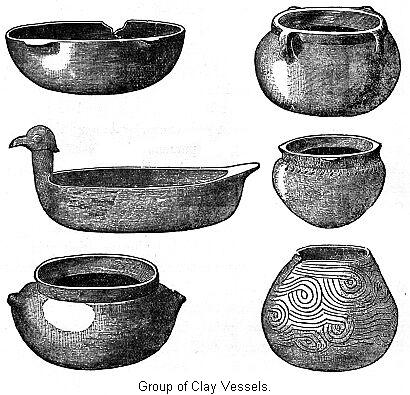
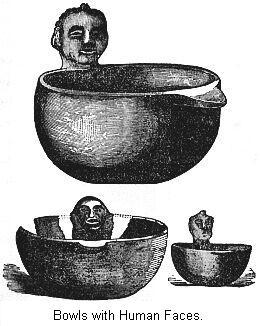
This illustration is of a group of clay vessels of the bowl pattern, found in mounds in different parts of the Mississippi Valley. In one of these we see a good example of the style of ornamentation by means of incised lines. In the duck-headed vessel we have a representation of a class of vessels common in Missouri and Tennessee. Not unfrequently one or both of the handles of vessels of this class is in the form of a human head instead of that of an animal. Our next illustrations represent a group of such specimens. Judging from the skill with which they imitated animals, it is not unreasonable to believe that in these faces we have rude likenesses of the people who made them.
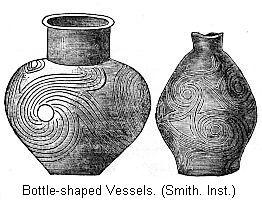
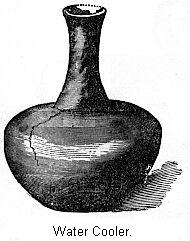
The two bottle-shaped vessels here figured, are from mounds in Louisiana. As will be noticed, the ornamentation is quite artistic. The ware is of a good quality, and they are good examples of the Mound Builders’ art. The form with the long neck is perhaps a water-cooler. When filled with water, and allowed to stand, some of the water passes through the pores, and evaporating, keeps the surface of the vessel cool.
They also made some vessels of large size to serve for cooking purposes. On some of the larger vessels the imprint of woven weeds and willows of a basket on the outer surface leads to the belief that such vessels were formed or moulded within baskets. Many large pots and urns, however, were made without this aid. Some large urns were used for burial purposes. In a Michigan mound an urn about three feet in height had been so used. It was standing upright, and into it the whole skeleton of a man had been compressed, and a closely-fitting lid covered the top.98 Very large, shallow vessels were used to manufacture salt—that is, they were filled from some salt-spring, and then the water was evaporated, leaving the salt. In localities near salt-springs, thick fragments of rude earthenware have been found that must have come from vessels as large as barrels.
In the next group we have representations of a singular class of vessels. In some cases the mouth and neck of the vessel is shaped in imitation of animals. In the smallest one we recognize the head of a man, with an opening in the back of the head. Many vessels of this form are known, and a great many different animal heads are represented. The fish-shaped vessel is a curious one. The one figured evidently represents a sun-fish. The long vase or jug is in the shape of a child’s leg, with an opening in the heel.
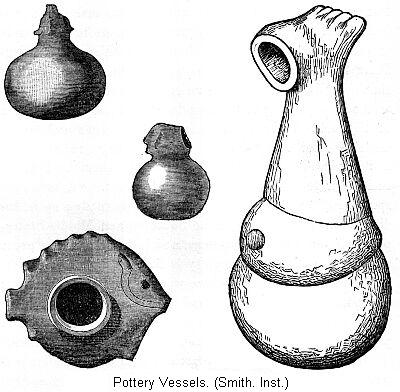
Some very beautiful vessels of the character of those we have figured, have been found in Missouri. One enthusiastic explorer says, “Perhaps we have very few modern artists who could equal those ancient pottery makers in taste, skill, curious design, and wonderful imitation of nature. Birds, beasts, fishes, even the shells on the river shore, have an exact counterpart in their domestic utensils.” “While digging in one of these pottery mounds in Missouri, we unearthed a large tortoise. We thought it was alive, and seizing it, to cast it into the woods for its liberty, we were suddenly surprised to find our tortoise was an earthen vessel in that shape. In the same mound we uncovered a huge shell—the single valve of a unio. Closer inspection revealed that it was a perfect earthen vessel. Following these came a perfect fish, exhibiting, to our astonishment, the scales, fins, and peculiarities of that species of fish in detail.”99
We must leave this interesting part of our subject. An entire volume would scarcely do justice to it, but for the sake of comparison, we must inquire as to the state of this art among the Indian tribes. It seems that before the arrival of the whites, the Indian tribes throughout North America, with few exceptions, were apt potters. The whites, however, soon supplied them with superior utensils of metal, so, that the majority of the Eastern tribes soon lost the knowledge of the art. It lingered longer among the tribes of the South, and of the interior, and even to this day the Pueblo tribes of New Mexico and Arizona make an excellent article of pottery. Early travelers wrote in high terms of the skill of the Southern Indians in this matter. Du-Pratz thought so highly of the work of the Natchez Indians that he had them make him an entire dinner set.
Catlin, speaking of the Mandan Indians, says the women of that tribe made great quantities of dishes and bowls, modeled after many forms. He says they are so strong and serviceable that they cook food in them by hanging them over the fire, as we would an iron pot. “I have seen specimens,” he continues, “which have been dug up in Indian mounds and tombs in the Southern and Middle States, placed in our Eastern museums, and looked upon as a great wonder, when here this novelty is at once done away with, and the whole mystery: where women can be seen handling and using them by hundreds, and they can be seen every day in the summer, also, moulding into many fanciful forms, and passing them through the kilns, where they are hardened.”
Dr. Rau, speaking of the artistic skill of the Indian potters, as shown by numerous remains gathered in Illinois, does not hesitate to assert, after personal examination of Mound Builders’ pottery, that the Indian relics were in every respect equal to those specimens exhumed from the mounds of the Mississippi Valley.100 Lapham, speaking of fragments of Mound Builders’ pottery in Wisconsin, says, “They agree in every respect with fragments found about the old Indian villages.”
The culture of a people is also determined by their knowledge of agriculture. The savage depends entirely upon hunting and fishing for subsistence. A knowledge of horticulture, of domestic animals, and of agriculture, even though rude, are each and all potent factors in advancing man in culture. So we must inquire as to the traces of agricultural knowledge observable among the remains of the Mound Builders. Some writers speak in quite glowing terms of the enormous crops they must have raised for their populous cities. The fact is, that while it is doubtless true that they practiced agriculture, yet we have no reason to suppose it was any thing more than a rude tillage, such as was practiced among the village Indian tribes. This is evident from the tools with which they worked.
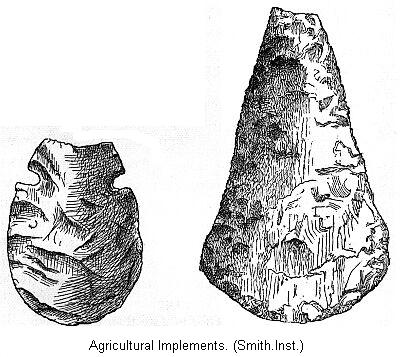
In a few cases copper tools have been recovered which may have served for digging in the ground, but in most cases their art furnished them nothing higher than spades, shovels, picks, and hoes made of stone, horn, bone, and probably wood. In this cut are specimens of such agricultural tools. These were doubtless furnished with handles of wood. The notched one was perhaps provided with a handle at right angles to it, so as to constitute a hoe. That we are right in regarding these implements as agricultural tools, is shown not only by their large size, but also by the traces of wear discovered on them. We must admit, however, that agriculture carried on with such tools as these, must have been in a comparatively rude state.
In this connection we must refer to the garden beds noticed in some places. We read that in Western Michigan the so-called garden beds are a distinguishing feature of the ancient occupation, often covering many acres in a place, in a great variety of forms, both regular and grotesque.101 These seem from the above account to be very similar to the garden beds of Wisconsin. Dr. Lapham tells us that in the latter State they consist of low, broad, parallel ridges, as if corn had been planted in drills.
The average four feet in width, and the depth of the walk between them is six inches. Traces of this kind of cultivation are found in various parts of the State. We are also referred to the presence of garden mounds in Missouri, but in this case the low mounds are of the same mysterious class that Prof. Forshey says occur by millions in the South-west, and may not be the work of man. Just what the connection is between the garden beds and the Mound Builders is hard to determine. Mr. Lapham thinks that those in Wisconsin were certainly later in date than the mounds. He observed that they were frequently constructed right across the works of the Mound Builders. This would seem to imply that the makers were not one and the same people.
As to the government and religion of the Mound Builders, all is conjecture. On both of these points a great deal has been assumed, but when we try to find out the grounds on which these theories rest we quickly see how little real foundation there is for any knowledge on this subject. If we are right in our views as to the effigy mounds of Wisconsin, then a sort of animal worship prevailed. Whether the great inclosures in the Scioto Valley were of a religious nature or not is very doubtful. The great serpent mound was probably an object of worship. The assertion is quite frequently made that the Mound Builders were sun worshipers, which may be correct, but we must observe that we have no proofs of it in the works they have left. We judge it to be true only because sun-worship was probably a part of the religion of a large proportion of the Indian race, and because we find special proofs of its existence among some of the Southern Indians who are supposed to be closely related to the Mound Builders.
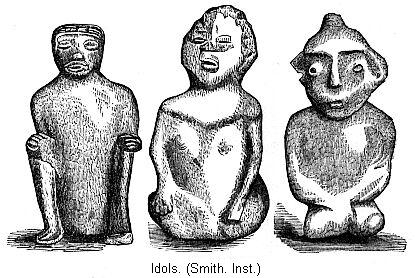
As we approach the South, we meet with what are supposed to be rude and uncouth idols, but they have not been found under such circumstances as to make it positive that they belonged to the Mound Builders. In this illustration we have two idols, considered to be genuine relics of the stone-grave people of Tennessee. The first one is an Aztec idol found at Cholula, and introduced here simply for comparison. What position these idols held in connection with the religion of the race, we are not prepared to say.
Similar remarks might be made as to the system of government. A number of writers, taking into account the immense labor involved in constructing some of the works, have insisted that the people must have lived under a despotic form of government, one in which the state had unlimited power over the lives and fortunes of its subjects.102
There is no real foundation for such views, and we think they are misleading. No one doubts but that the Mound Builders were living in a tribal state of society. If so, they doubtless had the usual subdivisions of a tribe. This point we remember afforded us some insight into the meaning of the effigy mounds of Wisconsin.
This would imply the government by the council, and while the rulers may have been hereditary, the officers of the tribe were probably elective, and could be deposed for cause. We do not mean to assert that this is an exact picture of the state of government of the Mound Builders, because our knowledge on this point is not sufficient to make such a positive statement, but it is far more likely to be true than the picture of a despotic government, ruling from some capital seat a large extent of country, holding a court with barbaric pomp and circumstances such as some writers would have us believe.
We hope our readers have not been wearied by this somewhat extended investigation of the Mound Builders. Every storm that beats upon their works tends to level them. The demands of our modern life are fast obliterating the remaining monuments and, indeed, it is now only those which are situated in favorable localities, or are massive in construction, that are left for our inspection. But these nearly obliterated records of the past are of more than passing interest to us as monuments of the prehistoric times of our own country. We wander over these ruins and find much to interest us, much to excite our curiosity. The purposes of many are utterly unknown. Some, by their great proportions, awaken in us feelings of admiration for the perseverance and energy of their builders. But when we investigate the objects of stone, of clay, and of copper this people left behind them, we notice how hard it is to draw a dividing line between them and the Indians.
In fact, there is no good reason for separating them from the Indian race as a whole. We do not mean to say that they were not, in many respects, different from the tribes found in the same section of the country by the early explorers, though, we ought, perhaps, to confine this remark to the central portion of the country occupied by these ancient remains. But the American of to-day differs from the American of early Colonial times. The miserable natives of Southern California were Indians, but very different indeed from the ambitious, warlike Iroquois, who displayed so much statesmanship in the formation of their celebrated league. In another chapter we shall discuss this part of our subject, as well as the question of the antiquity of the ruins.
REFERENCES
(1) The manuscript of this chapter was submitted to Prof. F. W. Putnam, curator of the Peabody Museum of Archæology and Ethnology, Harvard University, for criticism.
(2) Conant’s “Footprints of Vanished Races,” p. 122.
(3) Force: “Some Considerations on the Mound Builders,” p. 64; “Am. Antiquarian,” March, 1884, pp. 93-4; “10th Annual Report, Peabody Museum,” p. 11.
(4) Short’s “North Americans of Antiquity”, p. 28.
(5) Squier and Davis’s “Ancient Monuments,” p. 105.
(6) Foster’s “Prehistoric Paces,” p. 148.
(7) Squier’s “Aboriginal Monuments of New York,” Smithsonia Contribution No. 11, p. 83.
(8) Squier’s “Aboriginal Monuments of New York,” Smithsonia Contribution No. 11, p. 87.
(9) Foster’s “Prehistoric Races,” p. 121.
(10) “They are numbered by millions.” Ibid.
(11) Prof. Forshey could frame no satisfactory hypothesis of their origin. Ibid, p. 122.
(12) “Native Races,” Vol. IV, pp. 739 and 740.
(13) Smithsonian Rep., 1870, p. 406.
(14) Narrative of U.S. exploring expedition during the years 1838-42, Vol. IV, p. 334.
(15) Prof. Gibbs in Frank Leslie’s Monthly, August, 1883.
(16) “Ancient Monuments,” p. 139.
(17) Jones’s “Explorations in Tennessee,” p. 15.
(18) “Ancient Monuments,” p. 143. Explorers for Bureau of Ethnology so report it in the South. Prof. Putnam, who has certainly had great experience, says he has always found the layers to be horizontal.
(19) “Sixteenth Annual Report Peabody Museum,” p, 171. An ornament shaped to resemble the head of a wood-pecker, made of gold, derived from some Spanish source, was found in a mound in Florida. This particular mound must have been erected after the discovery of America. (“Smithsonian Report,” 1877, p. 298, et seq.)
(20) “Sixteenth and Seventeenth Report Peabody Museum.” These ornaments were made of hammered iron. This is the first time that native iron has been found in the mounds. (Putnam.)
(21) “Prehistoric Races,” p. 178.
(22) J. E. Stevens’s Paper, read before the Muscatine Academy of Science, Dec., 1878.
(23) That this was at any rate sometimes the case See “Ancient Monuments,” p. 159.
(24) “Peabody Museum Reports,” Vol. II, p. 58.
(25) Jones’s “Explorations in Tennessee,” p. 15. See also “First An. Rep. Bureau of Ethnology,” p. 198.
(26) “Ancient Monuments,” p. 169. See also note on same page for another account of a larger number of skeletons.
(27) Short’s “North Americans of Antiquity,” App. A.
(28) James’s “Popular Science,” File 1883, p. 445.
(29) “Ancient Monuments,” p. 173.
(30) “Ancient Monuments,” p. 74.
(31) “Views of Louisiana.”
(32) This cut represents the mound as it probably was before the outlines were destroyed by cultivation. It is based on a model prepared by Dr. Patrick for the Peabody Museum.
(33) “Peabody Museum Report,” Vol. II, p.473. As this may include some of the wash from the mound, perhaps it would be better to give the real area of the base as over twelve acres.
(34) That is, if we follow the plan.
(35) “Prehistoric Races,” p. 107.
(36) “Ancient Monuments,” p. 174.
(37) Pickett’s “History of Alabama,” Vol. I., p. 301.
(38) Carr’s “Mounds of the Mississippi Valley,” pp. 91, 92; note, 103.
(39) “Ancient Monuments,” p. 117. Note.—For the statement made in this text we are under obligation to Prof. Thomas, of the Bureau of Ethnology, who, in answer to a letter of inquiry, kindly furnished the information.
(40) “Am. Antiquarian,” March, 1884, p. 99.
(41) It may be that no mounds were built for signaling purposes alone. The work of erecting mounds was so great that it is quite likely they were always erected for some other purpose, and used only secondarily for signal purposes. Such is shown to be the case with many of the signal mounds in Ohio. Such is the opinion of Mr. MacLean, who has made extensive researches.
(42) Force’s “Some Consideration of the Mound Builders,” p. 65.
(43) Similar effigy mounds have been recently observed in Minnesota, but they have not yet been described. (Putnam.)
(44) Peet’s American Antiquarian, May, 1884, p. 184.
(45) Peet’s American Antiquarian, January, 1884. We are indebted to the writings of Mr. Peet in this periodical for the months of January, May, and July, 1884, for many interesting facts in reference to the effigy mounds. He has studied them more than any other person, and his conclusions are consequently of great value.
(46) Peet’s “Emblematic Mounds and Totem System of the Indian Tribes.”
(47) “Ancient Monuments,” p. 40.
(48) American Antiquarian, January, 1883.
(49) Putnam, in “Proceedings of American Antiquarian Society,” 1884.
(50) Peet’s “Emblematic Mounds and Totem System of the Indian Tribes.”
(51) Abbott’s “Primitive Industry,” p. 383.
(52) Peet’s “Military Architecture of the Emblematic Mound Builders.”
(53) “Smithsonian Report,” 1877, p. 278, et seq.
(54) “Ancient Monuments,” p. 97; American Antiquarian, January, 1883, p. 77.
(55) This information is communicated by Mr. L. N. Tower, a gentleman in the employ of C. “&” N. W. E. R., at Tracy, Minn., who, at the request of the writer visited this locality, made measurements, etc.
(56) American Antiquarian, November, 1884, p. 403.
(57) The dimensions of this figure vary. Mr. MacLean’s survey makes the entire length of the serpent part eleven hundred and sixteen feet; the distance between the extended jaws, one hundred feet. The oval figure is one hundred and thirteen feet long by fifty feet wide. The frog or head portion is fifty-five feet. Mr. Squier says, “The entire length, if extended, would be not less than one thousand feet.” Mr. Putnam’s measurements make it fourteen hundred and fifteen feet. The writer would state that he visited this effigy in the summer of 1884. Though there but a very short time, and not prepared to make careful measurements, he did notice some points in which the illustrations, previously given, are certainly wrong. The oval is not at the very extremity of the cliff. The little projections generally called ears of the serpent are not at right angles to the body, but incline backwards. The convolutions of the serpent’s body bend back and forth quite across the surface of the ridge.
(58) Schmuckers.
(59) “Ancient Monuments,” p. 47.
(60) Foster’s “Prehistoric Races,” p. 175.
(61) “Contributions North American Ethnology,” Vol. IV, p. 210. A cut of this “restored” pueblo is there given.
(62) See discussion of this subject in “Proceedings of Am. Antiq. Society,” Oct., 1883.
(63) “Peabody Museum Reports,” Vol. II, p. 205.
(64) “Ancient Monuments,” p. 47.
(65) Peet: “The Mound Builders.”
(66) “Ancient Monuments,” p. 53.
(67) Force: “Some Considerations on the Mound Builders,” p. 64.
(68) “Archæologia Americana,” Vol. I, p. 129.
(69) For words at Newark, consult “Ancient Monuments,” p. 67, et seq. “American Antiquarian,” July, 1882.
(70) “Ancient Monuments,” p. 74.
(71) “Ancient Monuments,” p. 88.
(72) Mr. Putnam visited the work a few years since, and came to the conclusion that the larger and old openings were part of the original design, and that they were places where it was easier to put up log structures than earthen walls. Just such openings occur in the massive stone wall around Fort Hill, in Highland County. A few of the openings at Fort Ancient he thinks are unquestionably of recent origin, in order to drain the holes inside the embankments.
(73) Cincinnati Quart. Journal Science, 1874, p. 294.
(74) Peet: “The Mound Builders.”
(75) Peet’s “Mound Builders:” “If the reader will compare some of these last cuts with that of the fortified camp at Cissbury, Eng., p. 183, he will see how similar this last work is to those just mentioned. Perhaps the real lesson to be learned is that rude people, whether Indians, Mound Builders, or Celts, resorted to about the same method of defense.”
(76) “Antiquarian Research,” p. 89.
(77) Conant’s “Footprints of Vanished Races,” p. 15, et seq. Mr. Conant refers to Mr. Pidgeon’s work in such a way as to give the impression that he was convinced of the genuineness of his account.
(78) “Traditions of Decodah,” p. 89, et seq.
(79) “Antiquarian Research,” p. 190.
(80) “The American Indian, so far as known, without the exception of a single tribe, worshiped the sun.” Carr’s “Mounds of the Mississippi Valley,” p. 56.
(81) Conant’s “Footprints of Vanished Races,” p. 60.
(82) Ibid., p. 32. If the explorers are really satisfied this was a walled town, it ought to throw some light on the inclosures in the Ohio Valley.
(83) Conant’s “Footprints of Vanished Races,” p. 35.
(84) Conant’s “Footprints of Vanished Races,” p. 77.
(85) Vol. III, p. 290, et seq.
(86) Morgan’s “Ancient Society,” p. 11.
(87) “Ancient Monuments,” p. 210; also Peet: “The Mound Builders.” “Their relics are marked by a peculiar finish.”
(88) Rau’s “Anthropological Research.”
(89) “Proceedings Am. Antiq. Society,” April, 1877, p. 61.
(90) “Smithsonian Contribution to Knowledge,” Vol. XIII.
(91) Abbott’s “Primitive Industry,” p. 315.
(92) “Annual Report of Bureau of Ethnology,” 1880-1, p. 123, et seq.
(93) In the “Annual Report of Bureau of Ethnology,” for 1880-1, Mr. Henshaw has very fully discussed these mound-pipes, and shown that Messrs. Squier and Davis wore mistaken in a number of their identifications of the animal forms. He concludes there “are no representations of birds or animals not indigenous to the Mississippi Valley.”
(94) The recent discoveries by Putnam and Metz, in the Altar-mounds in the Little Miami Valley, have brought to light many interesting and important sculptures in stone and terra-cotta, which, as works of art, are in some respects superior to those from the Scioto Valley, but as they have not yet been figured, we can only refer to them here in this brief note.
(95) “Number Eight,” Mound City, near Chillicothe, Ohio. “Ancient Monuments,” p. 152.
(96) Rau: “Anthropological Subjects,” p. 130.
(97) Morgan’s “Ancient Society,” p. 12.
(98) American Antiquarian, 1879, p. 64.
(99) McAdams: American Antiquarian, 1880, p. 140.
(100) “Smithsonian Report,” 1866. We have gathered these points for comparison from Dr. Rau’s article in that report.
(101) Bella Hubbard, American Antiquarian, 1876, p. 219.
(102) Foster’s “Prehistoric Races,” p. 346.