THE POETS' LINCOLN
Reading edition
top
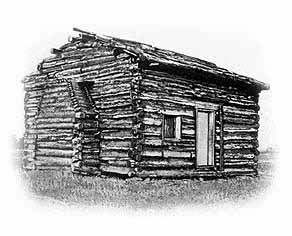
THE LOG CABIN Birthplace of Lincoln, near Hodgensville, Kentucky
Abraham Lincoln was born on the 12th day of February, 1809, on the Big South Fork of Nolin Creek, in what was then known as Hardin, but is now known as La Rue County, Kentucky, about three miles from Hodgensville.
The above illustration represents the cabin in which he was born, as described by his former neighbors.
Out of that old hut came the mighty man of destiny, the matchless man of the Nineteenth Century. The world has no parallel for that transition from the cabin to the White House.
top
Julia Ward [Howe] was born in New York City, May 27, 1819. At an early age she wrote plays and poems. In 1843 Miss Ward married Dr. Samuel Gridley Howe. In 1861, while on a visit to the camp near Washington, with Governor John A. Andrew and other friends, Mrs. Howe wrote to the air of "John Brown's Body" the "Battle Hymn of the Republic" which has become so popular. She also published several books of poems. She espoused the Woman-Suffrage movement in 1869, and devoted much of her time to the cause. She died in 1910.
This poem was written by Mrs. Howe in her ninetieth year and read by her in Symphony Hall, Boston, on the centenary of the martyred President's birthday, February 12, 1909.
LINCOLN
Through the dim pageant of the years A wondrous tracery appears: A cabin of the western wild Shelters in sleep a new born child. Nor nurse nor parent dear can know The way those infant feet must go, And yet a nation's help and hope Are sealed within that horoscope. Beyond is toil for daily bread, And thought to noble issues led. And courage, arming for the morn For whose behest this man was born. A man of homely, rustic ways, Yet he achieves the forum's praise And soon earth's highest meed has won, The seat and sway of Washington. top No throne of honors and delights, Distrustful days and sleepless nights, To struggle, suffer and aspire, Like Israel, led by cloud and fire. A treacherous shot, a sob of rest, A martyr's palm upon his breast, A welcome from the glorious seat Where blameless souls of heroes meet. And thrilling, through unmeasured days, A song of gratitude and praise, A cry that all the earth shall heed, To God, who gave him for our need.
THE GREAT OAK
Some men are born, while others seem to grow From out the soil, like towering trees that spread Their strong, broad limbs in shelter overhead When tempest storms, protecting all below. Lincoln, Great Oak of a Nation's life, Rose from the soil, with all its virgin power Emplanted in him for the fateful hour, When he might save a Nation in its strife. —Bennett Chapple.
top
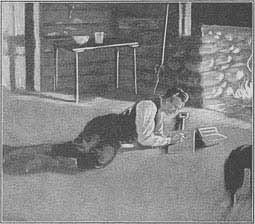
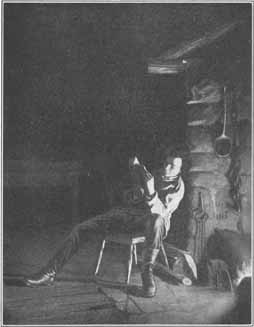
LINCOLN BY THE CABIN FIRE "Lying down was Lincoln's favorite attitude while reading or studying. This remained a habit with him throughout life."—Henry C. Whitney in his "Life of Lincoln."
top
Noah Davis, born in Haverhill, New Hampshire, September 10, 1818. He was educated at Albion, New York, and in the Seminary at Lima, studied law, and was admitted to the bar in 1841. Appointed in March, 1857, a justice of the New York Supreme Court. He served in Congress from March 4, 1869, till July 20, 1870, when he resigned, having been appointed by President Grant, U. S. Attorney for the Southern District of New York. He resigned that office on Dec. 31, 1872, being elected justice of the New York State Supreme Court. In 1874, he became presiding justice. In January, 1887, he was retired from the bench and resumed practice. He died in New York in 1902.
LINCOLN
Almost a hundred years ago, in a lonely hut, Of the dark and bloody ground of wild Kentucky, A child was born to poverty and toil, Save in the sweet prophecy of mother's love None dreamed of future fame for him! 'Mid deep privation and in rugged toil, He grew unschooled to vigorous youth, His teaching was an ancient spelling book, The Holy Writ, "The Pilgrim's Progress," Old "Æsop's Fables" and the "Life of Washington"; And out of these, stretched by the hearthstone flame For lack of other light, he garnered lore That filled his soul with faith in God. The prophet's fire, the psalmist's music deep, The pilgrims' zeal throughout his steadfast march, The love of fellow man as taught by Christ, And all the patriot faith and truth top Marked the Father of our Land! And there, in all his after life, in thought And speech and act, resonant concords were in his great soul. And, God's elect, he calmly rose to awful power, Restored his mighty land to smiling peace, Then, with the martyr blood of his own life, Baptized the millions of the free. Henceforth, the ages hold his name high writ And deep on their eternal rolls.
top
Rev. George W. Crofts was born at Leroy, Illinois, April 9, 1842. He was educated at the Illinois State University at Springfield, graduating in the class of 1864. He was ordained to the ministry in 1865. He preached at Sandwich, Illinois; Council Bluffs, Iowa; Beatrice, Nebraska, and West Point. He died at West Point, May 16, 1909.
THE BIRTH OF LINCOLN
No choir celestial sang at Lincoln's birth, No transient star illumined the midnight sky In honor of some ancient prophecy, No augury was given from heaven or earth. He blossomed like a flower of wondrous worth, A rare, sweet flower of heaven that ne'er should die, Altho' the vase in which it grew should lie Most rudely rent amid the darkling dearth. There, in that humble cabin, separate From everything the world regarded great, Where wealth had never pressed its greedy feet, Where honor, pomp or fame found no retreat; E'en there was born beneath the eye of God The noblest man His footstool ever trod.
top
Mendelssohn Darwin Lincoln
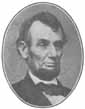
MENDELSSOHN DARWIN LINCOLN
February 12, 1809
Clarence E. Carr, born in Enfield, New Hampshire, January 31, 1853. Received his early education from the common schools and academies of the State, later from Dartmouth College, from which he graduated in 1875.
Practiced law, was also a manufacturer and farmer. Was president of the New Hampshire Unitarian Conference, director and vice-president of the American Unitarian Association, bank trustee, president of the United Life and Accident Insurance Company of Concord, New Hampshire, and occasionally a wanderer in the Elysian Fields of the Muses.
The Three Birthday Anniversaries is the subject of a highly appreciative article on the subject of Mendelssohn, Darwin and Lincoln, by President Samuel A. Eliot of the American Unitarian Association, in the Christian Register of February 4, 1909. The central thought therein is thus expressed very beautifully by Mr. Carr.
top
Three lives this day unto the world were given Into whose souls God breathed the air of heaven,— The first He taught the music of the spheres, The next, of worlds, the story of the years; And, loving, wise, and just beyond our dream, The third a pilot made upon the New World's stream. Their work is done, but ere they crossed "the portal," One, Song; One, Truth; One, Freedom; Made Immortal!
top
James Phinney Baxter, born at Gorham Maine, March 23, 1831. Academic education; President of Savings Bank; Mayor of Portland, six terms, 1893-97—1904-5. Organized Associated Charities and was its first President; built and donated to the City of Portland its public library in 1888, and to Gorham in 1907; also conveyed to Gorham his family mansion for use as a Museum. President Portland Public Library, Baxter Library (Gorham), Portland Benevolent Society, Overseer of Bowdoin College, President Maine Historical Society since 1890, Northeast Historical Society since 1899. Author: The Trelawney Papers, 1884; The British Invasion From the North, 1887; Sir Ferdinando Gorges and His Province of Maine, 1890; The Pioneers of New France in New England, 1894; edited ten volumes of Documentary History of Maine, etc.
THE NATAL DAY OF LINCOLN
Son of the Western World! whose heritage Was the vast prairie and the boundless sky; Whose callow thoughts with wings untrammeled sought Free scope for growth denied to Ease and Power, Naught couldst thou know of place or precedent, For Freedom's ichor with thy mother's milk Coursing thy veins, would render thee immune To Fashion's dictate, or prescriptive creed, Leaving thy soul unhindered to expand Like Samuel's in Jehovah's tutelage. Hail to thy Natal day! Like all great souls with vision unobscured Thou wert by Pride unswayed, and so didst tread The gray and sombre way by Duty marked; Seeking the springs of Wisdom, unallured top By shallower sources which the witless tempt. Afar o'er arid plains didst thou behold An empty sky, and mountains desolate Barring thy way to fairer scenes beyond; But faith was thine, and patience measureless, Making thee equal to thy destiny. Hail to thy Natal day! It summons to our vision all thy life, Of strenuous toil; the cabin low and rude; The meagre fare; the blazing logs whose glow Illumed the pages of inspired bards, Shakespeare and Bunyan; prophets, priests and seers; The darkling forest where thy ringing axe Chimed with the music of the waterfall; The eager flood bearing thy rugged raft Swift footed through an ever changing world Unknown to thee save in remembered dreams. Hail to thy Natal day! We see thee in the mart where Selfishness For Fame ephemeral strives, and sordid gain; Thy ill-requited toil till thou hadst earned The right to raise thy potent voice within A nation's forum, facing all the world; And then, achievement such as few have known, A mighty people placing in thy hand A sceptre swaying half a continent, Making thee peer of kings and potentates; Aye, greater than them all, whate'er their power. Hail to thy Natal day! But, lo! the martial camp; the bivouac; The rude entrenchment;—the grim fortalice; The tented field;—the flaming battle line, And thy great soul amidst it all unmoved top By petty aims, leading with flawless faith Thy people to a promised land of peace; And, then, when thou hadst reached the goal of hope, And the world stood amazed, the heavy crown Of martyrdom was pressed upon thy brow And thy immortal course was consummate. Hail to thy Natal day! In all great souls God sows with generous hand The seed of martyrdom, for 'twas decreed In Eden, that alone by sacrifice Should sons of men the crown immortal win; And thou, who didst the shining heights attain Of unsurpassed achievement, didst but pay The impartial toll of souls like thine required. And we, who on the narrow marge of Time Standing wondering, shed no tears, but raise to thee The pæans to a martyred hero due, Hail to thy Natal day.
top
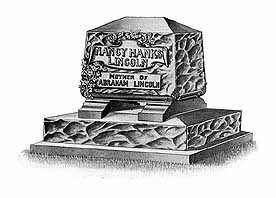
MONUMENT TO THE MOTHER OF LINCOLN
Nancy Hanks Lincoln died October 5, 1818, aged thirty-five years. The design of this monument is by Thompson Stickle, and it was constructed by J. S. Culver of Springfield, Illinois, and dedicated October 2, 1902.
In the construction of the monument in Spencer County, Indiana, Mr. Culver used as much of the granite as possible from the National Lincoln Monument before it was reconstructed.
The face of this block is handsomely hand-carved. As the Scroll of Time unrolls, it reveals the name of "Nancy Hanks Lincoln." The ivy represents affection and the branch of oak nobility.
The public celebration of the centenary of Lincoln's birth was held in the town of North Adams, Massachusetts, February 12, 1909.
Ex-Senator Thomas F. Cassidy, in his address, said: "One hundred years ago today, in Hardin County, Kentucky, there was ushered into being the child, Abraham Lincoln.
"As God selected Mary, the humble girl of Judea, to be the mother of the Saviour of mankind and she gave birth to Him in the stable at Bethlehem, so it top was ordained that in the lowly log cabin of the Kentucky wilderness, Nancy Hanks should receive into the protection of her sheltering arms the child who was destined to be the Saviour of the Republic."
Harriet Monroe, born at Chicago, Illinois, December, 23, 1860. Graduated Visitation Academy, Georgetown, District Columbia, 1879. In December, 1889, was appointed to write text for cantata for opening of Chicago Auditorium in March, 1891. Was requested by Committee on Ceremonies of Chicago Exposition to write a poem for the dedication; her Columbia Ode was read and sung at the dedicatory ceremonies on the 400th anniversary of the discovery of America, October 21, 1892. Author of Valerie, and other poems, 1892; The Columbia Ode, 1893; John Wellborn, Poet, A Memoir, 1896; The Passing Show—Modern Plays in Verse, 1903, etc.
NANCY HANKS
Prairie Child, Brief as dew, What winds of wonder Nourished you? Rolling plain Of billowy green, Fair horizons, Blue, serene. Lofty skies The slow clouds climb, Where burning stars Beat out the time. top These, and the dreams Of fathers bold, Baffled longings Hopes untold. Gave to you A heart of fire, Love like waters, Brave desire. Ah, when youth's rapture Went out in pain, And all seemed over, Was all in vain? O soul obscure, Whose wings life bound, And soft death folded Under the ground. Wilding lady, Still and true, Who gave us Lincoln And never knew: To you at last Our praise, our tears, Love and a song Through the nation's years. Mother of Lincoln, Our tears, our praise; A battle-flag And the victor's bays!
top
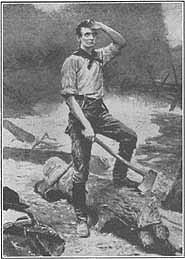
THE RAIL SPLITTER From the "Footprints of Abraham Lincoln"
top
LINCOLN THE LABORER
From an Horatian Ode by Richard Henry Stoddard
A laboring man with horny hands, Who swung the axe, who tilled the lands, Who shrank from nothing new, But did as poor men do. One of the people. Born to be Their curious epitome, To share, yet rise above, Their shifting hate and love. Common his mind, it seemed so then, His thoughts the thoughts of other men, Plain were his words, and poor— But now they will endure. No hasty fool of stubborn will, But prudent, cautious, still— Who, since his work was good, Would do it as he could. No hero, this, of Roman mold— Nor like our stately sires of old. Perhaps he was not great— But he preserved the state. O, honest face, which all men knew, O, tender heart, but known to few— O, wonder of the age, Cut off by tragic rage.
top
"THE BOY LINCOLN" By Eastman Johnson
top
James Whitcomb Riley was born in Greenfield, Indiana, about 1852. He was engaged in various pursuits until 1875, when he began to contribute verses of poetry to local papers in the Western district which gained wide popularity for him. His published works in dialect and his serious poems have also proved very popular.
A PEACEFUL LIFE
(LINCOLN)
A peaceful life;—just toil and rest— All his desire;— To read the books he liked the best Beside the cabin fire. God's word and man's;—to peer sometimes Above the page, in smoldering gleams, And catch, like far heroic rhymes, The onmarch of his dreams. A peaceful life;—to hear the low Of pastured herds, Or woodman's axe that, blow on blow, Fell sweet as rhythmic words. And yet there stirred within his breast A faithful pulse, that, like a roll Of drums, made high above his rest A tumult in his soul. A peaceful life!—They hailed him even As One was hailed Whose open palms were nailed toward Heaven When prayers nor aught availed. And lo, he paid the selfsame price To lull a nation's awful strife And will us, through the sacrifice Of self, his peaceful life.
top
William Wilberforce Newton, born in Alleghany, Pennsylvania, March, 1836. Was graduated at Franklin and Marshall College in 1853. Studied law, and was admitted to the bar in 1867. He served as Captain and Assistant Adjutant General of U. S. Volunteers in 1861-5; was Editor of the Philadelphia Press and President of the "Press" Publishing Co., from 1867 till 1878. He is the author of Vignettes of Travel and has been largely engaged in railway building in Mexico.
LEADER OF HIS PEOPLE
Saw you in his boyhood days O'er Kentucky's prairies; Bending to the settler's ways Yon poor youth whom now we praise— Romance like the fairies? Hero! Hero! Sent from God! Leader of his people. Saw you in the days of youth By the candle's flaring: Lincoln searching for the truth, Splitting rails to gain, forsooth, Knowledge for the daring? Hero! Hero! Sent from God! Leader of his people. Saw you in his manhood's prime Like a star resplendent, Him we praise with measured rhyme Waiting for the coming time With a faith transcendent? Hero! Hero! Sent from God! Leader of his people. top Saw you in the hour of strife When fierce war was raging, Him who gave the slaves a life Full and rich with freedom rife, All his powers engaging? Hero! Hero! Sent from God! Leader of his people. Saw you when the war was done (Such is Lincoln's story) Him whose strength the strife had won Sinking like the setting sun Crowned with human glory? Hero! Hero! Sent from God! Leader of his people. Saw you in our country's roll Midst her saints and sages, Lincoln's name upon the scroll— Standing at the topmost goal On the nation's pages? Hero! Hero! Sent from God! Leader of his people. Hero! Yes! We know thy fame; It will live forever! Thou to us art still the same; Great the glory of thy name, Great thy strong endeavor! Hero! Hero! Sent from God! Leader of his people.
top
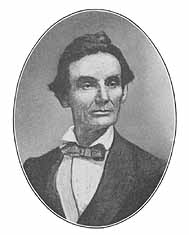
LINCOLN THE LAWYER From an Ambrotype, taken in 1856
“The charm which invested the life on the Eighth Circuit in the mind and fancy of Mr. Lincoln yet lingered there, even in the most responsible and glorious days of his administration; over and over again has the great President stolen an hour … from his life of anxious care to live over again those bygone exhilarating and halcyon days … with Sweet or me."—Henry C. Whitney in his Life of Lincoln.
top
Wilbur Hazelton Smith was born in the town of Mansfield, New York, March 28, 1860. His early education was obtained from the district school and he began teaching at the age of sixteen. After completing an academic course he went to Cornell University from which he was graduated with the degree of A.B. in 1885.
He at once became a teacher and after a few years started the first Current Topic paper in the state, The Educator. Later he edited a teachers' paper, The World's Review. Perhaps he is best known as publisher of the Regents' Review Books used in nearly every school in the United States. His death occurred October 19, 1913.
LINCOLN
Unlearned in the cant and quip of schools, Uncouth, if only city ways refine; Ungodly, if 'tis creeds that make divine; In station poor, as judged by human rules, And yet a giant towering o'er them all; Clean, strong in mind, just, merciful, sublime; The noblest product of the age and time, Invoked of God in answer to men's call. O simple world, and will you ever learn, Schools can but guide, they cannot mind create? 'Neath roughest rock the choicest treasures wait; In meanest forms we priceless gems discern; Nor time, nor age, condition, rank nor birth, Can hide the truly noble of the earth.
top
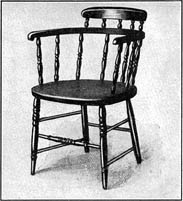
LINCOLN'S OFFICE CHAIR
This chair was used by Mr. Lincoln in his law office at Springfield, Illinois, where, before leaving for the City of Washington after his election as President, he wrote his Inaugural Address and formed his Cabinet, frequently conferring with his twenty-year law partner, William H. Herndon, on such matters, and adopting changes as suggested if he considered them advisable. It was presented to O. H. Oldroyd while living in the Lincoln Homestead, Springfield, by Mr. Herndon, March 18, 1886.
top
James Riley was born in the hamlet of Tang, one mile from the town of Ballymahon, County Longford, Ireland, and two miles from Lissoy, County Westmeath, the home of Oliver Goldsmith—on the road between the two—August 15, 1848. Published Poems, 1888; Songs of Two Peoples, 1898, and Christy of Rathglin, a novel, in 1907. His poem The American Flag, has been rated often as the best poem written to our banner. Four lines on the loss of the Titanic brought from Captain Rostron words in which he said: "With such praise one feels on a higher plane, and must keep so, to be worthy of continuance."
LINCOLN IN HIS OFFICE CHAIR
High-browed, rugged, and swarthy; A picture of pain and care; A lawyer sat with his greatest brief, High in his office chair. His Country was to him client! Futurity his ward! And he must plead 'fore Fate's high court, With prayer, and pen, and sword. Elected, by his people! His heart and theirs, one beat! He sees the storm-clouds gather; The waves dash at his feet! Gloom upon land and water! The Flag no more in the sun! Lights from the South-line flickering, And—dying—one—by one! top November's winds wild shrieking! Night—closed, on a Union rent! And still the lawyer sat dreaming Of its once bright firmament. Then, '61! Dark! Silent! Only the calling word Of Anderson at Sumter The lawyer, writing, heard. Writing the Message that ever Shall live in the hearts of men; With cannon to cannon fronting, The lawyer held the pen. Only thinking of Country And the work that must be done; Nature made in roughest mold Her favored, fated son. He wrote while the world was waiting Great Freedom's final test. Should, or should not Democracy Be planted in the West? Should Liberty at last survive And man look straight on man? Law, in its round, its strength and might Be timed unto sense and plan? He, in his chair there sitting, Had all these things for thought. Now, the Vote unrecognized, Must battles wild be fought? top Alone the Chair is standing, To remind the Land of the time When the Slaver's heart, all passion, He planned, and pursued his crime! As he rushed Disunion's order, On, on from State to State! And the Pen talked loud down the Message, And bided the Land to wait.
top
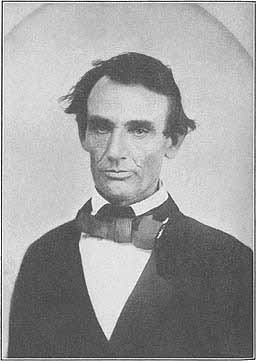
LINCOLN AS CANDIDATE FOR UNITED STATES SENATOR Photograph from an Ambrotype, by Gilmer, Illinois, 1858
top
Elizabeth Porter Gould, born June 8, 1848, died July 28, 1906. Essayist, lecturer and author; an early inspirer of woman's clubs and the pioneer of the Current Events and Topics classes in Boston and vicinity; an officer in several educational societies and honorary member of the Webster Historical Society, Castilian Club and other clubs where she had read many historical papers of great research and given many practical suggestions. Among her published works are Gems From Walt Whitman, Anne Gilchrist and Walt Whitman, Ezekial Cheever, Schoolmaster, John Adams and Daniel Webster as Schoolmasters, A Pioneer Doctor, One's Self I Sing and The Brownings and America. She had great energy and force of character, and a capacity for friendship which was a source of great happiness to her and endeared her to all.
THE VOICE OF LINCOLN
In life's great symphony, Above the seeming discord and the pain, A master-voice is ever singing, singing, The plan of God to men. In young America's song, As threatening tumult pierced the tensioned air, The voice of Lincoln over all was singing The love of brother-man. And still his voice is heard; 'Twill pierce the din of strife and mystery, Till master-voices cease their singing, singing, In life's great symphony.
top
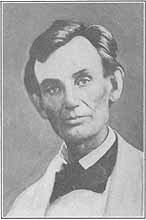
LINCOLN AT THE TIME OF DEBATE WITH DOUGLAS From an Ambrotype taken at Beardstown, Ill., 1858
His friends advised Lincoln to press his opponent on the Dred Scott decision (of the United States Supreme Court permitting slavery in the Territories), as Douglas would accept it, but argue for nullifying it by anti-slavery legislation in the territorial assemblies, and this would satisfy the people of Illinois, and elect him Senator. "All right," said Lincoln, "then that kills him in 1860. I am gunning for larger game."
top
Elizabeth Stuart Phelps was born in Andover, Massachusetts, on August 13, 1844. Educated at Andover. Her literary career began at the age of thirteen with contributions to the newspapers. The earlier years of her life were devoted to Christian labors among the poor families in Andover, but failing health finally prevented her from carrying on her labors along that line, and kept her within her study, but her sympathy was always enlisted in the reformatory questions of the day. The Gates Ajar proved very popular, as did also her many juvenile books. She wrote this poem for the Lincoln Memorial Album in 1882. She died January 29, 1911.
THE THOUGHTS OF LINCOLN
The angels of your thoughts are climbing still The shining ladder of his fame, And have not reached the top, nor ever will, While this low life pronounces his high name. But yonder, where they dream, or dare, or do, The "good" or "great" beyond our reach, To talk of him must make old language new In heavenly, as it did in human, speech.
top
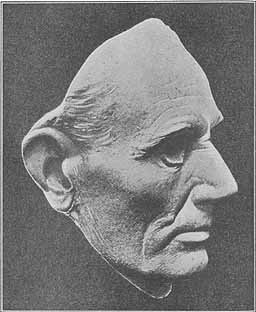
THE LINCOLN LIFE-MASK By Leonard W. Volk
Mr. Lincoln was engaged in trying a case in the United States Court at Chicago, Illinois, in April, 1860, and Leonard W. Volk, the sculptor, called upon him and said: "I would like to have you sit to me for your bust." "I will, Mr. Volk," replied Lincoln. This was the first time that Lincoln sat to an artist for the reproduction of his physique in this manner. Previous to this he had posed only for daguerreotypes or for photographs.
top
Richard Watson Gilder was born in Bordentown, New Jersey, February 8, 1844, and was educated at his father's school. He enlisted in Landis' Philadelphia Battery for the emergency call in the campaign of 1863, when the Confederate forces invaded Pennsylvania. Later he was editor of a number of magazines and upon the death of J. G. Holland he was made associate editor of the Century. At the age of twenty-six he had attained high literary standing. His poems are published in five volumes. He rendered valuable service in tenement-house reform over the country. He died on the 18th day of November, 1909.
ON THE LIFE-MASK OF ABRAHAM LINCOLN
This bronze doth keep the very form and mold Of our great martyr's face. Yes, this is he: That brow all wisdom, all benignity; That human, humorous mouth; those cheeks that hold Like some harsh landscape all the summer's gold; That spirit fit for sorrow, as the sea For storms to beat on; the lone agony Those silent, patient lips too well foretold. Yes, this is he who ruled a world of men As might some prophet of the elder day— Brooding above the tempest and the fray With deep-eyed thought and more than mortal ken. A power was his beyond the touch of art Or armed strength—his pure and mighty heart.
top
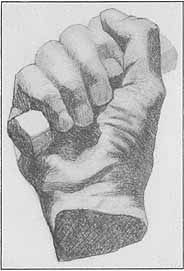
THE HAND OF LINCOLN
The Saturday after the nomination of Mr. Lincoln for President of the United States, the Committee appointed to inform him of the said nomination arrived in Springfield and performed this duty in the evening at his home.
The cast of his hand was made the next morning by Mr. Leonard W. Volk. While the sculptor was making the cast of his left hand, Lincoln called his attention to a scar on his thumb. "You have heard me called the 'rail-splitter' haven't you?" he said, "Well, I used to split rails when I was a young man, and one day, while sharpening a wedge on a log, the axe glanced and nearly took off my thumb."
top
Edmund Clarence Stedman was born in Hartford, Connecticut, on the 8th of October, 1833. He entered Yale College at the age of sixteen and distinguished himself in Greek and English Composition. He was the editor of several papers in Connecticut and in 1856 removed to New York City—a larger field for his literary abilities. He was a contributor to Vanity Fair, Putnam's Monthly, Harper's Magazine and other periodicals. His poems: The Diamond Wedding, How Old John Brown Took Harper's Ferry, The Ballad of Lager-Bier, gave him some reputation. He was war-correspondent for the World during the early campaigns of the Army of the Potomac from the Headquarters of General Irwin McDowell and General B. McClellan. He died in 1908.
THE HAND OF LINCOLN
Look on this cast, and know the hand That bore a nation in its hold; From this mute witness understand What Lincoln was—how large of mold. The man who sped the woodman's team, And deepest sunk the plowman's share, And pushed the laden raft astream, Of fate before him unaware. This was the hand that knew to swing The axe—since thus would Freedom train Her son—and made the forest ring, And drove the wedge and toiled amain. Firm hand that loftier office took, A conscious leader's will obeyed, And, when men sought his word and look, With steadfast might the gathering swayed. top No courtier's, toying with a sword, Nor minstrel's, laid across a lute; Chiefs, uplifted to the Lord When all the kings of earth are mute! The hand of Anak, sinewed strong, The fingers that on greatness clutch, Yet lo! the marks their lines along Of one who strove and suffered much. For here in mottled cord and vein I trace the varying chart of years, I know the troubled heart, the strain, The weight of Atlas—and the tears. Again I see the patient brow That palm erewhile was wont to press; And now 'tis furrowed deep, and now Made smooth with hope and tenderness. For something of a formless grace This molded outline plays about; A pitying flame, beyond our trace, Breathes like a spirit, in and out— The love that casts an aureole Round one who, longer to endure, Called mirth to cease his ceaseless dole, Yet kept his nobler purpose sure. Lo, as I gaze, the statured man, Built up from yon large hand, appears; A type that nature wills to plan But once in all a people's years. What better than this voiceless cast To tell of such a one as he, Since through its living semblance passed The thought that bade a race be free?
top
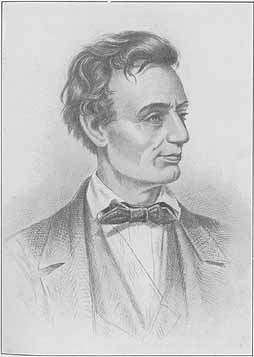
HON. ABRAHAM LINCOLN, REPUBLICAN CANDIDATE FOR THE PRESIDENCY, 1860 Painted by Hicks; lithograph by L. Grozelier; published by W. Schaus, New York, 1860; printed by J. H. Bufford, Boston
top
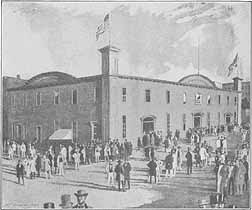
THE "WIGWAM" Convention Hall, at Chicago, 1860, in which Lincoln was nominated
The Republicans of Chicago had erected a huge temporary building for the use of the Convention. The "Wigwam," as it was called, covered a space of 600 feet by 180, and the height was between 50 and 60 feet. The building would hold about 10,000 persons, and was divided into platform, ground-floor and gallery. The stage upon which the delegates and members of the press were seated, held about 1,800 persons; the ground-floor and galleries, about 8,000. A large gallery was reserved for ladies, which was filled every day to overflowing. The Convention met on June 16, 1860.
top
Edmund Clarence Stedman is the author of this poem, and it was published in the Press and Tribune of Chicago, and in Weekly Illinois State Journal, June 13, 1860. It was sung to the air of the "Star Spangled Banner" throughout the campaign.
HONEST ABE OF THE WEST
O Hark! from the pine-crested hills of old Maine, Where the splendor first falls from the wings of the morning, And away in the West, over river and plain, Rings out the grand anthem of Liberty's warning! From green-rolling prairie it swells to the sea, For the people have risen, victorious and free, They have chosen their leaders, and bravest and best Of them all is Old Abe, Honest Abe of the West! The spirit that fought for the patriots of old Has swept through the land and aroused us forever; In the pure air of heaven a standard unfold Fit to marshal us on to the sacred endeavor! Proudly the banner of freemen we bear; Noble the hopes that encircle it there! And where battle is thickest we follow the crest Of gallant Old Abe, Honest Abe of the West! There's a triumph in urging a glorious cause, Though the hosts of the foe for a while may be stronger, Pushing on for just rules and holier laws, Till their lessening columns oppose us no longer. But ours the loud pæan of men who have passed Through the struggles of years, and are victors at last; So forward the flag! Leave to Heaven the rest, And trust in Old Abe, Honest Abe of the West!
top
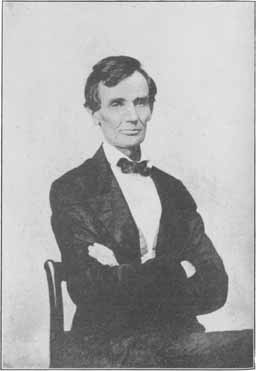
LINCOLN AS CANDIDATE FOR PRESIDENT From an Ambrotype taken at Springfield, Illinois, August 13, 1860
top
William Henry Burleigh, born at Woodstock, Connecticut, February 2, 1812. In early manhood became an advocate of reforms then unpopular, and an acceptable lecturer on behalf of temperance and the anti-slavery cause. He removed to Pittsburgh in 1837, where he published the Christian Witness, and afterwards the Temperance Banner. As a writer, speaker, editor, poet, reformer, friend and associate, it was the universal testimony of those who knew him best and esteemed him most truly, that he stood in the forefront of his generation. His poetry, animated by deep love of nature and a profound desire to uphold truth and justice, gives him a place with our first minor poets.
PRESIDENTIAL CAMPAIGN, 1860
Up again for the conflict! Our banner fling out, And rally around it with song and with shout! Stout of heart, firm of hand, should the gallant boys be, Who bear to the battle the Flag of the Free! Like our fathers, when Liberty called to the strife, They should pledge to her cause fortune, honor, and life! And follow wherever she beckons them on, Till Freedom results in a victory won! They came from the hillside, they came from the glen— From the streets thronged with traffic and surging with men, From loom and from ledger, from workshop and farm, The fearless of heart, and the mighty of arm. As the mountain-born torrents exultingly leap When their ice-fetters melt, to the breast of the deep; As the winds of the prairie, the waves of the sea, They are coming—are coming—the Sons of the Free! top Our Leader is one who, with conquerless will, Has climbed from the base to the brow of the hill; Undaunted in peril, unwavering in strife, He has fought a good fight in the Battle of Life, And we trust as one who—come woe or come weal, Is as firm as the rock and as true as the steel. Right loyal and brave, with no stain on his breast, Then, hurrah, boys, for honest "Old Abe of the West!"
top
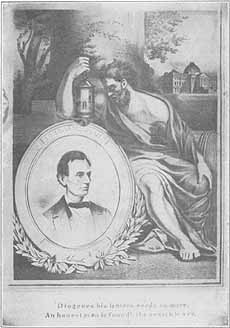
"HONEST ABE" A Campaign Cartoon of 1860
top
Madison Cawein was born at Louisville, Kentucky, on the 23rd of March, 1865. Was educated in the city and country schools about Louisville and New Albany, Indiana. Graduated from the Male High School, Louisville, in 1886, and the following year published his first volume, called Blooms of the Berry. Since then he published some thirty-odd volumes of prose and poetry, both in the United States and England. He died in 1915.
LINCOLN, 1809—FEBRUARY 12, 1909
Read for the first time at the Lincoln centenary celebration, Temple Adath Israel, Louisville, Ky.
Yea, this is he, whose name is synonym Of all that's noble, though but lowly born; Who took command upon a stormy morn When few had hope. Although uncouth of limb, Homely of face and gaunt, but never grim, Beautiful he was with that which none may scorn— With love of God and man and things forlorn, And freedom mighty as the soul in him. Large at the helm of state he leans and looms With the grave, kindly look of those who die Doing their duty. Stanch, unswervingly Onward he steers beneath portentous glooms, And overwhelming thunders of the sky, Till, safe in port, he sees a people free. Safe from the storm; the harbor-lights of Peace Before his eyes; the burden of dark fears Cast from him like a cloak; and in his ears The heart-beat music of a great release; Captain and pilot, back upon the seas, Whose wrath he'd weathered, back he looks with tears, top Seeing no shadow of the Death that nears, Stealthy and sure, with sudden agonies. So let him stand, brother to every man, Ready for toil or battle; he who held A Nation's destinies within his hand; Type of our greatness; first American, By whom the hearts of all men are compelled, And with whose name Freedom unites our land. He needs no praise of us, who wrought so well, Who has the Master's praise; who at his post Stood to the last. Yet, now, from coast to coast, Let memory of him peal like some great bell, Of him as woodsman, workman, let it tell! Of him as lawyer, statesman, without boast! And for what qualities we love him most, And recollections that no time can quell. He needs no praise of us, yet let us praise, Albeit his simple soul we may offend, That liked not praise, being most diffident; Still let us praise him, praise him in such ways As his were, and in words that shall transcend Marble, and outlast any monument.
top
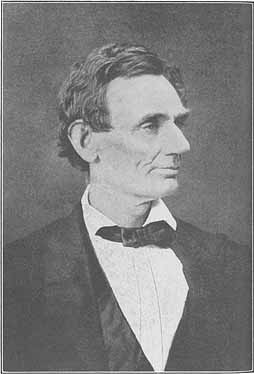
LINCOLN AS CANDIDATE FOR PRESIDENT Photograph by Hesler, Chicago, Illinois, 1860
top
Isaac Bassett Choate, born at South Otis Field, Maine, July 12, 1833. Bachelor of Arts, Bowdoin College, 1862. Author of Wild Birds and Flowers, 1895; Wells of English, 1892; Obeyed the Camel Driver, 1899; Apollo's Guest, 1907.
By special invitation from the faculty of the Alumni Association of said College he read the following poem at their annual banquet held on the centenary of Lincoln's birth, 1909:
THE MATCHLESS LINCOLN
From out the ranks of common men he rose— Himself of common elements, yet fine— As in a wood of different species grows Above all other trees the lordly pine, Upon whose branches rest the winter snows, Upon whose head warm beams of summer shine; His was the heart to feel the people's woes And his the hand to hold the builder's line; Strong, patient, wise and great, Born ruler of the State. Among a mountain group one sovereign peak Will tower aloft unto commanding height As if more distant view abroad to seek— First one to hail, last one to speed the light; Those granite sides will snows of winter streak E'en in the summer with their purest white;— Silent, serene, that summit yet will speak Of loftiest grandeur to the enraptured sight; So Lincoln's greatness shone Supreme, unmatched, alone.
top
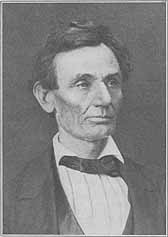
LINCOLN AS CANDIDATE FOR PRESIDENT Photograph, Springfield, Ill., 1860
top
Charlotte Becker was born and has always lived in Buffalo, New York. She was educated in private schools and in Europe, and has written poems for Harper's Magazine, The Metropolitan, The American, Life, etc., besides a number of songs which have been set to music by Amy Woodfords-Finden, C. B. Hawley, Whitney Coombs and others.
LINCOLN
Gaunt, rough-hewn face, that bore the furrowed signs Of days of conflict, nights of agony, And still could soften to the gentler lines Of one whose tenderness and truth went free Beyond the pale of any small confines To understand and help humanity. Wise, steadfast mind, that grasped a people's need, Counting nor pain nor sacrifice too great To keep the noble purpose of his creed Strong against all buffeting of Fate, Though no least solace sprang of work or deed For him, since triumph came at last—too late. Brave, weary heart, that beat uncomforted Beneath its heavy load of grief and care; That tears of blood for every battle shed, Yet called on mirth to help his comrades bear The waiting hours of anguish, and that sped With loyal haste each breath of balm to share. Only his people's griefs were his; no part Had he within their joy; nor his the toll To know the love that made rebellion start, Spurred hosts unnumbered to a higher goal; That his great soul should cleanse a nation's heart, His martyred heart awake a nation's soul.
top
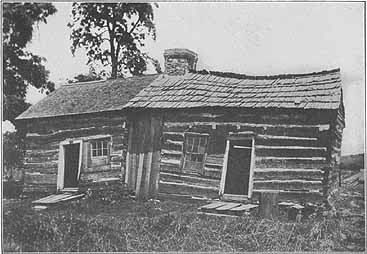
CABIN OF LINCOLN'S PARENTS on Goose-Nest Prairie, Illinois
top
The last home of the parents of Lincoln. Built by his father, Thomas, in 1831, near Farmington, Coles Co., Ill. The father died here in 1851 and the step-mother, Sarah Bush Lincoln, in 1869. After Lincoln was elected President in 1860, and before leaving for Washington to be inaugurated, he visited his mother in this cabin for the last time. As he was leaving her, she made a prediction of his tragic death. With arms about his neck, with tears streaming down her cheeks, she declared it was the last time she would ever see him alive, and it proved to be so.
Lincoln once said, "I was told that I never would make a lawyer if I did not understand what 'demonstrate' means. I left my situation in Springfield, went to my father's house, and stayed there till I could give any proposition in the six books of Euclid at sight. I there found out what demonstrate means."
top
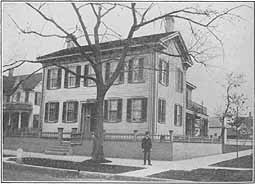
LINCOLN HOMESTEAD, SPRINGFIELD, ILLINOIS
top
On Monday, February 11, 1861, Mr. Lincoln and family in company with a party left Springfield, Illinois, for Washington, D. C. A light rain mixed with snow was falling at the time which made the occasion a somewhat gloomy one. Mr. Lincoln appeared on the rear platform of the car where he bade farewell to his neighbors in the following address:
"My friends, no one not in my position can appreciate the sadness I feel at this parting. To this people I owe all that I am. Here I have lived more than a quarter of a century. Here my children were born, and here one of them lies buried.
"I know not how soon I shall see you again. A duty devolves upon me which is greater, perhaps, than that which has devolved upon any other man since the days of Washington. He never would have succeeded except for the aid of divine Providence, upon which he at all times relied.
"I feel that I cannot succeed without the same divine aid which sustained him; and on the same Almighty Being I place my reliance for support, and I hope you, my friends, will pray that I may receive the divine assistance, without which I cannot succeed, but with which success is certain. Again, I bid you an affectionate farewell."
Mr. Lincoln thought that there is a time to joke and pray; and if, as his detractors affirm, he joked all the way to Washington, if he did not pray also (as we believe he did, and fervently, too) he at least desired the prayers of others, as the circumstances recorded in the following poem will show. It is from the pen of a lady of Philadelphia, Mrs. Anna Bache.
top
LINCOLN AT SPRINGFIELD, 1861
“My friends,—elected by your choice, From the long-cherished home I go, Endeared by Heaven-permitted joys, Sacred by Heaven-permitted woe, I go, to take the helm of State, While loud the waves of faction roar, And by His aid, supremely great, Upon whose will all tempests wait, I hope to steer the bark to shore. Not since the days when Washington To battle led our patriots on, Have clouds so dark above us met, Have dangers dire so close beset. And he had never saved the land By deeds in human wisdom planned, But that with Christian faith he sought Guidance and blessing, where he ought. Like him, I seek for aid divine, His faith, his hope, his trust, are mine. Pray for me, friends, that God may make My judgment clear, my duty plain; For if the Lord no wardship take, The watchmen mount the towers in vain." He ceased; and many a manly breast Panted with strong emotion's swell, And many a lip the sob suppressed, And tears from manly eyelids fell. And hats came off, and heads were bowed, As Lincoln slowly moved away; And then, heart-spoken, from the crowd, In accents earnest, clear, and loud, Came one brief sentence, "We will pray!"
top
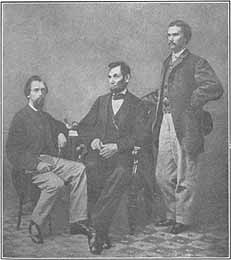
PRESIDENT LINCOLN AND HIS SECRETARIES, JOHN G. NICOLAY AND JOHN HAY Photographed at Springfield, Illinois, in 1861
top
On the 22nd of February, 1861, Washington's birthday, on his journey to Washington, to assume the Presidency, Mr. Lincoln raised a new flag over Independence Hall, then went inside and spoke as follows:—
"I am filled with deep emotion at finding myself standing in this place, where were collected together the wisdom, the patriotism, the devotion to principle from which sprang the institutions under which we live. You have kindly suggested to me that in my hands is the task of restoring peace to our distracted country. I can say in return, sirs, that all the political sentiments I entertain have been drawn, so far as I have been able to draw them, from the sentiments which originated in and were given to the world from this hall. I have never had a feeling, politically, that did not spring from the sentiments embodied in the Declaration of Independence. I have often pondered over the dangers which were incurred by the men who assembled here and framed and adopted that Declaration. I have pondered over the toils that were endured by the officers and soldiers of the army who achieved that independence. I have often inquired of myself what great principle or idea it was that kept this Confederacy so long together. It was not the mere matter of separation of the colonies from the motherland, but that sentiment in the Declaration of Independence which gave liberty, not alone to the people of this country, but hope to all the world, for all future time. It was that which gave promise that in due time the weight would be lifted from the shoulders of all men and that all should have an equal chance. This is the sentiment embodied in the Declaration of Independence.
"Now, my friends, can this country be saved on that basis? If it can, I will consider myself one of the happiest men in the world if I can help to save it. But if this country cannot be saved without giving up that principle, I was about to say I would rather be assassinated on this spot than surrender it."
Four years and two months later, April 22, 1865, his body lay, assassinated, on the very spot where he had made the above remarks, then being taken to Springfield, Illinois, for burial.
top
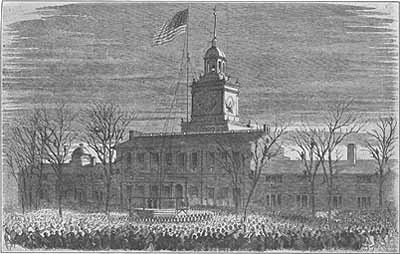
INDEPENDENCE HALL, PHILADELPHIA
top
Henry Wilson Clendenin, born at Schellsburg, Pennsylvania, August 1, 1837; educated in private schools and by tutors. Married Mary E. Morey of Monmouth, Illinois, October 23, 1877; to them were born five children, four of whom survive: George M., manager Illinois State Register; Clarence R., Deputy Internal Revenue Collector, Springfield, Illinois; Harry F., proofreader, Illinois State Register, and Marie, Assistant Instructor Physical Education, State Normal University, Normal, Illinois. He was a private of Company I, Twentieth Pennsylvania Volunteer Infantry, in the Civil War. Began newspaper work on Burlington (Iowa) Hawkeye. Afterwards telegraph editor Peoria Transcript, 1858; telegraph editor Burlington Gazette, 1863, and editor and proprietor, Keokuk Daily Constitution, 1876-1881; since that year was editor and president of the Illinois State Register. Postmaster, Springfield 1886-90. Member Illinois State Historical Society, The Jefferson Association, Grand Army of the Republic and Sons of the American Revolution. Director of Lincoln Library at Springfield, Illinois, for ten years. Member of the First Congregational Church of that city.
This sonnet was written by Mr. Clendenin, in Philadelphia, February 22, 1861, after witnessing Lincoln hoist the flag over Independence Hall.
LINCOLN CALLED TO THE PRESIDENCY
Hark to the sound that speedeth o'er the land! Behold the sword in fratricidal hand! 'Tis duty calls thee, Lincoln, and thy trust Demands that all thy acts be wise and just. No idle task to thee has been assigned, But work that's worthy of a giant mind— And on the issue hangs the nation's fame top As a free people who deserve the name. So, walk thou in the way the fathers trod; Be true to freedom, country, and to God; Then truth will triumph, treason be undone, And thou be hailed the second Washington. The first, the Father of his country—thou, Its Saviour. Bind the laurel on thy brow.
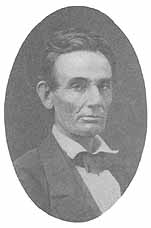
LINCOLN IN 1858 From a photograph by S. M. Fassett of Chicago
top
An act of Congress July 9, 1790, established the District of Columbia as the National Capital, and provided that prior to the first Monday of December, 1800, the Commissioners should have finished a suitable building for the sessions of Congress. The site of the Capitol was included in L'Enfant's plan for the city. The cornerstone was laid September 18, 1793, with Masonic rites, George Washington officiating. The wings of the central building were completed in 1811, and were partially burned by the British, in 1814. The entire central building was finished in 1827. The cornerstone of the extension was laid by President Fillmore, July 4, 1851. The extensions were first occupied by Congress 1857 and 1859. Up to that time the Senate Chamber was the present Supreme Court Room, and the Hall of Representatives was the present National Statuary Hall. The dome was finished during the administration of President Lincoln. The total cost of the Capitol building and grounds was about thirty million dollars. The remains of President Lincoln were escorted from the White House to the Capitol at three o'clock P.M., on the 19th of April, 1865. The number in the procession was estimated at forty thousand, and that many more were spectators along the route. The burial service was conducted by Dr. Gurley. The special train bearing the remains left at 8 A.M., Friday, April 21, for Springfield, Illinois, stopping at Baltimore, Maryland; Harrisburg and Philadelphia, Pennsylvania; Albany and Buffalo, New York; Cleveland and Columbus, Ohio; Indianapolis, Indiana; Chicago, Illinois, reaching Springfield, Illinois, the 3d of May, and was buried the following day. The body lay in state in all of the above cities.
top
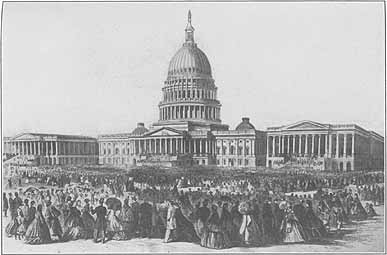
THE CAPITOL The Second Inauguration of Abraham Lincoln as President of the United States, in front of the Capitol, Washington, March 4, 1865
top
Edwin Markham, born at Oregon City, Oregon, April 23, 1852; settled in California in 1857, and worked there during his boyhood, principally as a blacksmith. Worked his way through the San Jose Normal School and Santa Rosa College. Became a writer of stories and verse for papers and magazines, and principal and superintendent of California schools. Was the author of The Man With the Hoe, and Other Poems (1899); The Man With the Hoe, with Notes by the Author (1900); The End of the Century (1899); Lincoln, the Great Commoner (1900); The Mighty Hundred Years; Lincoln and Other Poems (1901); The Shoes of Happiness (1915). His Man With the Hoe was extensively republished and gave him wide fame.
LINCOLN THE MAN OF THE PEOPLE
When the Norn-Mother saw the Whirlwind Hour, Greatening and darkening as it hurried on, She bent the strenuous Heavens and came down To make a man to meet the mortal need. She took the tried clay of the common road— Clay warm yet with the genial heat of Earth, Dashed through it all a strain of prophecy; Then mixed a laughter with the serious stuff. It was a stuff to wear for centuries, A man that matched the mountains, and compelled The stars to look our way and honor us. The color of the ground was in him, the red earth; The tang and odor of the primal things— The rectitude and patience of the rocks; The gladness of the wind that shakes the corn; The courage of the bird that dares the sea; The justice of the rain that loves all leaves; The pity of snow that hides all scars; The loving-kindness of the wayside well;top The tolerance and equity of light That gives as freely to the shrinking weed As to the great oak flaring to the wind— To the grave's low hill as to the Matterhorn That shoulders out the sky. And so he came. From prairie cabin up to Capitol, One fair ideal led our chieftain on. Forevermore he burned to do his deed With the fine stroke and gesture of a king. He built the rail pile as he built the State, Pouring his splendid strength through every blow, The conscience of him testing every stroke, To make his deed the measure of a man. So came the Captain with the mighty heart; And when the step of earthquake shook the house, Wresting the rafters from their ancient hold, He held the ridge-pole up and spiked again The rafters of the Home. He held his place— Held the long purpose like a growing tree— Held on through blame and faltered not at praise, And when he fell, in whirlwind, he went down As when a kingly cedar, green with boughs, Goes down with a great shout upon the hills, And leaves a lonesome place against the sky.
top
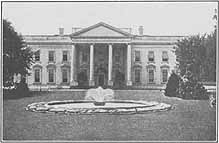
THE WHITE HOUSE
The corner-stone was laid by George Washington on the 13th of October, 1792. The mansion was first occupied by President John Adams in the year 1800, also by every succeeding President. British troops burned it in 1814, in President Madison's term. It was the first public building erected in Washington. It is constructed of Virginia freestone, and is 170 feet in length, 80 feet in depth, and consists of a rustic basement, two stories and an attic.
John Vance Cheney, born Groveland, New York, December 29, 1848. Graduated Temple Hill Academy, Genesee, New York, at seventeen. Assistant principal there two years later. Practiced law, New York, 1875-6; librarian Free Public Library, San Francisco, 1887-94; Newberry Library, Chicago, 1894-1909; author, The Old Doctor, 1881; and a number of poems, 1887-1911.
top
LINCOLN
The hour was on us; where the man? The fateful sands unfaltering ran, And up the way of tears He came into the years. Our pastoral captain. Forth he came, As one that answers to his name; Nor dreamed how high his charge, His work how fair and large, To set the stones back in the wall Lest the divided house should fall, And peace from men depart, Hope and the childlike heart. We looked on him; "'Tis he," we said, "Come crownless and unheralded, The shepherd who will keep The flocks, will fold the sheep." Unknightly, yes: yet 'twas the mien Presaging the immortal scene, Some battles of His wars Who sealeth up the stars. top Not he would take the past between His hands, wipe valor's tablets clean, Commanding greatness wait Till he stands at the gate; Not he would cramp to one small head The awful laurels of the dead, Time's mighty vintage cup, And drink all honor up. No flutter of the banners bold Borne by the lusty sons of old, The haughty conquerors Set forward to their wars; Not his their blare, their pageantries, Their goal, their glory, was not his; Humbly he came to keep The flocks, to fold the sheep. The need comes not without the man; The prescient hours unceasing ran, And up the way of tears He came into the years. Our pastoral captain, skilled to crook The spear into the pruning hook, The simple, kindly man, Lincoln, American.
top
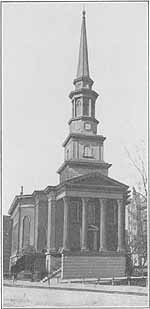
WHERE LINCOLN WORSHIPPED New York Avenue Presbyterian Church, Washington, D. C.
President Lincoln and family attended this church during his Administration. The pew that they occupied is still preserved in its black walnut trimmings, though the rest of the sanctuary has been refurnished.
top
Lyman Whitney Allen, born at St. Louis, November 19, 1854. Bachelor of Arts, Washington University, St. Louis, 1878; later Master of Arts, Princeton Theological, 1878-80; Post-graduate studies at Princeton University; (D.D., University of Wooster, 1897). Ordained Presbyterian Minister, 1882; stated supply Kimmswick, Missouri, 1881-3; DeSoto, Missouri, 1883-5; Pastor-elect Carondelet Church, St. Louis, Missouri, 1885-9; Pastor South Park Church, Newark, New Jersey, since 1889. Director Board of Home Missions, Presbyterian; Chaplain New Jersey Society D. A. R.; Member Society American Authors; New Jersey Society S. A. R. Club, Princeton (New York). Has written many poems and articles, including the New York Herald's $1,000 prize poem which was published in 1895.
Rev. Dr. Lyman Whitney Allen of Newark, New Jersey, had for his guest Chief Justice Wendell Phillips Stafford of the Supreme Court of the District of Columbia. Judge Stafford addressed the Men's Club of Dr. Allen's church one evening, and next day, in company with his host, visited the Lincoln statue on the court-house plaza. On the train that bore him back to Washington that day, Judge Stafford wrote the poem on the Statue. (See page 236).
A few weeks thereafter Dr. Allen visited his friend, the judge, in Washington, and they made a little pilgrimage to the New York Avenue Presbyterian church. In the Lincoln pew Dr. Allen sat and meditated, and on his way back he wrote the verses.
"I had seen the Lincoln statue many times," says Dr. Allen, "but, somehow, I could not get started on the poem I knew could be written around it." And Judge Stafford wrote to his friend in Newark: "I had seen the Lincoln pew a score of times without poetic result, yet you come on a one-day visit and carry away the inspiration needed."
top
LINCOLN'S CHURCH IN WASHINGTON
Within the historic church both eye and soul Perceived it. 'Twas the pew where Lincoln sat— The only Lincoln God hath given to men— Olden among the modern seats of prayer, Dark like the 'sixties, place and past akin. All else has changed, but this remains the same, A sanctuary in a sanctuary. Where Lincoln prayed! What passion had his soul— Mixt faith and anguish melting into prayer Upon the burning altar of God's fane, A nation's altar even as his own. Where Lincoln prayed! Such worshipers as he Make thin ranks down the ages. Wouldst thou know His spirit suppliant? Then must thou feel War's fiery baptism, taste hate's bitter cup, Spend similar sweat of blood vicarious, And sound the cry, "If it be possible!" From stricken heart in new Gethsemane. Who saw him there are gone, as he is gone; The pew remains, with what God gave him there, And all the world through him. So let it be— One of the people's shrines.
top
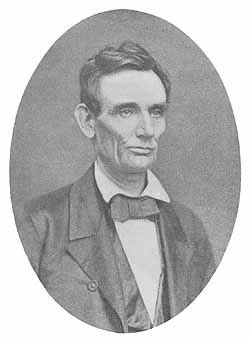
LINCOLN IN 1858 From a photograph in possession of Mr. Stuart Brown of Springfield, Illinois
top
John James Piatt was born in Indiana, March 1, 1835. His earliest schooling was received at Rising Sun, in Indiana. At the age of fourteen he was set to learn the printing business in the office of the Ohio State Journal at Columbus, Ohio, for a brief period, and at the age of eighteen years first began to write verses. His poems were chiefly on themes connected with his native West.
SONNET IN 1862
Stern be the Pilot in the dreadful hour When a great nation, like a ship at sea With the wroth breakers whitening at her lee, Feels her last shudder if her helmsman cower; A godlike manhood be his mighty dower! Such and so gifted, Lincoln, may'st thou be With thy high wisdom's low simplicity And awful tenderness of voted power. From our hot records then thy name shall stand On Time's calm ledger out of passionate days— With the pure debt of gratitude begun, And only paid in never-ending praise— One of the many of a mighty land, Made by God's providence the Anointed One.
top
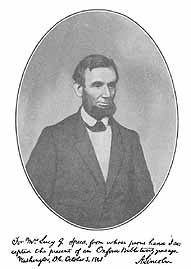
PRESIDENT LINCOLN
Lincoln once said: "When any church will inscribe over its altar, as its sole qualification for membership, the Saviour's condensed statement of the substance of both law and gospel, 'Thou shalt love the Lord thy God with all thy heart and with all thy soul and with all thy mind, and thy neighbor as thyself', that church will I join with all my heart and all my soul."
top
LINCOLN, SOLDIER OF CHRIST
From Macmillan's Magazine, England
Lincoln! When men would name a man Just, unperturbed, magnanimous, Tried in the lowest seat of all, Tried in the chief seat of the house— Lincoln! When men would name a man Who wrought the great work of his age, Who fought, and fought the noblest fight, And marshalled it from stage to stage. Victorious, out of dusk and dark, And into dawn and on till day, Most humble when the pæans rang, Least rigid when the enemy lay Prostrated for his feet to tread— This name of Lincoln will they name, A name revered, a name of scorn, Of scorn to sundry, not to fame. Lincoln; the man who freed the slave; Lincoln, whom never self enticed; Slain Lincoln, worthy found to die A soldier of the captain Christ.
top
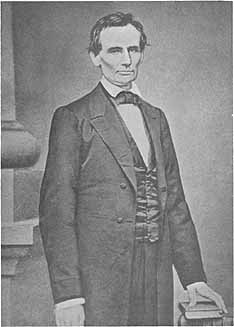
LINCOLN IN 1860 Photographed by Brady at the time of the "Cooper Institute Speech," February, 1860
top
Rev. Hamilton Schuyler was born in Oswego, New York, 1862, and is a son of the late Anthony Schuyler, who was for many years rector of Grace Church, Orange, New Jersey. He belongs to the well-known family of that name, being seventh in descent from Philip Peterse Schuyler, founder of the family, who came to this country from Holland and settled in Albany in 1650. He studied at Oxford University, England, and the General Theological Seminary of New York. Has held positions in Calvary Church, New York; Trinity Church, Newport, Rhode Island, and was for several years dean of the Cathedral at Davenport, Iowa, under the late Bishop Perry. He began his rectorship at Trenton in February, 1900. Has written extensively for journals and periodicals. Among the bound publications which bear his name as author are A Fisher of Men, a biography of the late Churchill Satterlee, priest and missionary, son of the first Bishop of Washington; Studies in English Church History; The Intellectual Crisis Confronting Christianity; and A History of Trinity Church, Trenton. In 1900 his poem, The Incapable, won a prize of two hundred dollars offered by the late Collis P. Huntington through the New York Sun, for the best poems antithetical to Edwin Markham's Man With the Hoe. A volume of Mr. Schuyler's verses, under the title Within the Cloister's Shadow, was published in 1914.
A CHARACTERIZATION OF LINCOLN
From Lincoln Centenary Ode
Tall, ungainly, gaunt of limb, Rudely Nature molded him. Awkward form and homely face, Owing naught to outward grace; Yet, behind the rugged mien Were a mind and soul serene,
top
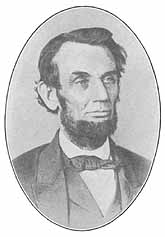
PRESIDENT LINCOLN Photograph by Gardner, Washington
top And in deep-set eyes there shone Genius that was all his own. Humor quaint with pathos blent To his speech attraction lent; Telling phrase and homely quip Falling lightly from his lip. Eloquent of tongue, and clear, Logical, devoid of fear, Making plain whate'er was dense By the light of common sense. Tender as the bravest be, Pitiful in high degree, Wrathful only where offence Led to grievous consequence; Hating sham and empty show; Chivalrous to beaten foe; Ever patient in his ways; Cheerful in the darkest days; Not a demi-god or saint Such as fancy loves to paint, But a truly human man Built on the heroic plan.
top
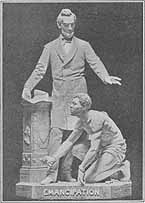
EMANCIPATION GROUP
Moses Kimball, a citizen of Boston, presented to the city a duplicate of the Freedman's Memorial Statue erected in Lincoln Park, Washington, D. C., after a design by Thomas Ball. The group, which stands in Park Square, represents the figure of a slave from whose limbs the broken fetters have fallen, kneeling in gratitude at the feet of Lincoln. The verses which follow were written for the unveiling of the statue, December 9, 1879.
top
John Greenleaf Whittier, born December 17, 1807, in Haverhill, Massachusetts. He lived on a farm until he reached the age of eighteen, working a little at shoemaking and also writing poetry for the Haverhill Gazette. Later he became editor of a number of papers, and his poems in after life were full of patriotism and the love of human freedom, all of which attained a strong hold on the hearts of the people. He would have prevented war, if possible, with honor, but when war came he wrote in support of the Union cause, displaying no bitterness, and when the conflict was over he was most liberal and conciliatory. He was one of the most popular of poets. He died September 7, 1892.
THE EMANCIPATION GROUP
Amidst thy sacred effigies Of old renown give place, O city. Freedom-loved! to his Whose hand unchained a race. Take the worn frame, that rested not Save in a martyr's grave; The care-lined face, that none forgot, Bent to the kneeling slave. Let man be free! The mighty word He spoke was not his own; An impulse from the Highest stirred These chiseled lips alone. The cloudy sign, the fiery guide, Along his pathway ran, And Nature, through his voice, denied The ownership of man. top We rest in peace where these sad eyes Saw peril, strife, and pain; His was the Nation's sacrifice, And ours the priceless gain. O symbol of God's will on earth As it is done above Bear witness to the cost and worth Of justice and of love! Stand in thy place and testify To coming ages long, That truth is stronger than a lie, And righteousness than wrong.
top
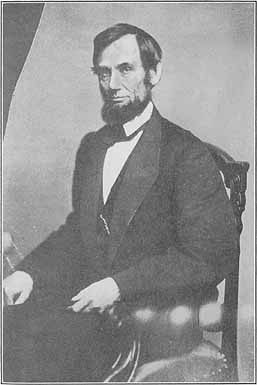
PRESIDENT LINCOLN Photograph by Brady, Washington, D. C., 1863
top
Theron Brown, born at Willimantic, Connecticut, April 29, 1832. Graduated at Hartford Theological Seminary in 1858; Newton Theological Institution, 1859. Ordained in Baptist Ministry, 1859; Pastor South Framingham, Massachusetts, 1859-62; Canton, Massachusetts, 1863-70; on staff Youth's Companion since 1870. Author various juvenile stories; Life Songs (poems), 1894; Nameless Women of the Bible, 1904; The Story of the Hymns and Tunes, 1907; Under the Mulberry Tree (a novel), 1909; The Birds of God, 1911. He died February 14, 1914.
THE LIBERATOR
When, scornful of a nation's rest, The angry horns of Discord blew There came a giant from the West, And found a giant's work to do. He saw, in sorrow—and in wrath— A mighty empire in its strait, Torn like a planet in its path To warring hemisphere of hate. Between the thunder-clouds he stood; He harked to Ruin's battle-drum, And cried in patriot hardihood, "Why do I wait? My hour has come! "Was it my fate, my lot, my woe To be the Ruler of the land, Nor own my oath that long ago I swore upon this heart and hand? "That vow, like barb from bowman's string, Shall pierce sedition's secret plea: top God grant the bloodless blow shall sting Till brother's quarrels cease to be! "Should once the sudden wound provoke New strife in anger's zone The clash may be the penal stroke That makes a new Republic one." He wrote his Message—clear as light, And bolder than a king's command— And when war's whirlwinds spent their might There was no bondman in the land.
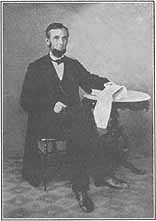
PRESIDENT LINCOLN Photograph by Alexander Gardner, Washington, D. C., January 24, 1863
top
TO PRESIDENT LINCOLN
January 1, 1863
Lincoln, that with thy steadfast truth the sand Of men and time and circumstance dost sway! The slave-cloud dwindles on this golden day, And over all the pestilent southern land, Breathless, the dark expectant millions stand, To watch the northern sun rise on its way, Cleaving the stormy distance—every ray Sword-bright, sword-sharp, in God's invisible hand. Better with this great end, partial defeat, And jibings of the ignorant worldly-wise, Than laud and triumph won with shameful blows. The dead Past lies in its dead winding-sheet; The living Present droops with tearful eyes; But far beyond the awaiting Future glows. Edmund Ollier, in London (Eng.) Morning Star.
top
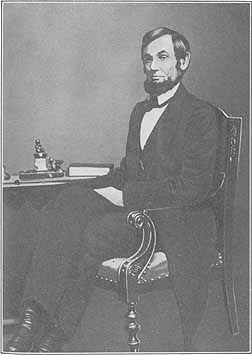
PRESIDENT LINCOLN Photograph by Brady, Washington, D. C.
top
Charles G. Foltz was born at West Winfield, Herkimer County, New York, September 9, 1837. His parents were Benjamin Foltz, a Presbyterian clergyman, and Jane Harwood Foltz. In 1846 the family moved to Cuyahoga County, Ohio. In 1849 to Wisconsin, first to Rock County, then to Walworth County, and in 1854 to Burlington, Racine County, where he has since resided.
ON FREEDOM'S SUMMIT
On freedom's summit, Oh, how grand Stood Lincoln ruler of our land, As he issued the sublime command Let the enslaved be free. Ere long he saw the Bondmen rise; Ere long as Freedmen seize the prize, The precious boon of liberty. A backward glance he cast Into the valley of the past, Amid the shade and gloom Discerning slavery's tomb. Out from the depths his upturned eyes Beheld the fleeing clouds the brighter skies. Upon him shone a glory like the sun, Reflecting "peace toward all, malice toward none." As thus he filled his high exalted place, The brave emancipator of a race, He thought of the fierce struggle and the victory And humbly deemed himself to be Only the instrument of a Divine decree. Rejoicing in the faith of brighter coming days His "fervent prayers" were merged in those of praise. top Like unto psalmists of the olden time His uttered thoughts inspired the nation's song, Throughout the land the chorus rose sublime, The exultant triumph of the right o'er wrong. "Behold, what God the Lord hath wrought," More than we asked, or hoped, or thought. Through the "Red sea" of blood and carnage He brought our nation free of bondage. With Moses sing, yea shout O North; With Miriam answer back O South: That "He hath triumphed gloriously." ..... Oh why the sudden blotting out of light? The cloud of sorrow, dark as Plutonian night, That cast its lengthening shadow o'er the land; Changing to funeral dirge the choral grand. Swift as the typhoon's breath— The harbinger of death— The cruel deed of hate Swept the grand chief away. Unto this day, and ever aye, The nation mourns her martyr's fate.
top
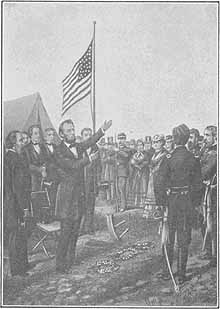
ADDRESS DELIVERED AT THE DEDICATION OF THE CEMETERY AT GETTYSBURG
Four score and seven years ago our fathers brought forth on this continent a new nation, conceived in Liberty, and dedicated to the proposition that all men are created equal.
Now we are engaged in a great civil war, testing whether that nation, or any nation so conceived and so dedicated, can long endure. We are met on a great battlefield of that war. We have come to dedicate top a portion of that field as a final resting place for those who here gave their lives that that nation might live. It is altogether fitting and proper that we should do this.
But, in a larger sense, we cannot dedicate—we cannot consecrate—we cannot hallow—this ground. The brave men, living and dead, who struggled here, have consecrated it, far above our poor power to add or detract. The world will little note, nor long remember what we say here, but it can never forget what they did here. It is for us the living, rather, to be dedicated here to the unfinished work which they who fought here have thus far so nobly advanced. It is rather for us to be here dedicated to the great task remaining before us,—that from these honored dead we take increased devotion to that cause for which they gave their last full measure of devotion—that we here highly resolve that these dead shall not have died in vain—that this nation, under God, shall have a new birth of freedom—and that government of the people, by the people, for the people, shall not perish from the earth.
November 19, 1863.
ABRAHAM LINCOLN.
"Undoubtedly there were many in the audience who fully appreciated the beauty of the President's address, and many of those who read it on the following day perceived its wondrous character; but it is apparent that its full force and grandeur were not generally recognized then, either by its auditors or its readers. Not until the war had ended and the great leader had fallen did the nation realize that this speech had given to Gettysburg another claim to immortality and to American eloquence its highest glory."—From the monograph on the Gettysburg Address, by Maj. William H. Lambert.
top
Bayard Taylor, born in Kennett Square, Chester County, Pennsylvania, on the 11th of January, 1825. Died in Berlin, Germany, on the 19th of December, 1878. His boyhood was passed on a farm near Kennett. He learned to read at four, began to write at an early age, and from his twelfth year wrote poems, novels and historical essays, but mostly poems. In 1837 the family moved to Westchester, and there and at Unionville he had five years of high-school training. His first poem printed was contributed to the Saturday Evening Post, in 1841, and those to the New York Tribune from abroad, written in 1844, were widely read and shortly after his return were collected and published in Views Afoot, or Europe Seen With Knapsack and Staff. With a friend he bought a printing office in 1846, and began to publish the Phoenixville Pioneer, but it was as a poet that he excelled above most other vocations.
GETTYSBURG ODE
After the eyes that looked, the lips that spake Here, from the shadows of impending death, Those words of solemn breath, What voice may fitly break The silence, doubly hallowed, left by him? We can but bow the head, with eyes grown dim, And, as a Nation's litany, repeat The phrase his martyrdom hath made complete, Noble as then, but now more sadly sweet: "Let us, the Living, rather dedicate Ourselves to the unfinished work, which they Thus far advanced so nobly on its way, And saved the periled State! Let us, upon this field where they, the brave, Their last full measure of devotion gave, Highly resolve they have not died in vain!— That, under God, the Nation's later birth top Of freedom, and the people's gain Of their own Sovereignty, shall never wane And perish from the circle of the earth!" From such a perfect text, shall Song aspire To light her faded fire, And into wandering music turn Its virtue, simple, sorrowful, and stern? His voice all elegies anticipated; For, whatsoe'er the strain, We hear that one refrain: "We consecrate ourselves to them, the Consecrated!"
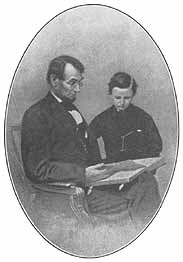
PRESIDENT LINCOLN AND HIS SON THOMAS ("TAD")
top
Benjamin Franklin Taylor, born at Lowville, New York, July 19, 1819. He was for several years connected with the Chicago Evening Journal. He wrote Pictures of Life in Camp and Field (1871); The World on Wheels, etc. (1874); Songs of Yesterday (1877); Between the Gates (1878); Summer Savory, etc. (1879); Dulce Domum (1884); Theophilus Trent, a novel (1887); etc. Among his best known poems are: Isle of the Long Ago, Rhymes of the River, and The Old Village Choir.
LINCOLN'S SECOND INAUGURAL
The following is an excerpt from a Centennial Poem read by B. F. Taylor on Decoration Day (May 30, 1876), on the occasion of the centennial celebration by the Department of the Potomac, Grand Army of the Republic, at Arlington Cemetery, Washington, D. C.
They see the pilgrims to the Springfield tomb— Be proud today, oh, portico of gloom!— Where lies the man in solitary state Who never caused a tear but when he died And set the flags around the world half-mast— The gentle Tribune and so grandly great That e'en the utter avarice of Death That claims the world, and will not be denied, Could only rob him of his mortal breath. How strange the splendor, though the man be past! His noblest inspiration was his last. The statues of the Capitol are there. As when he stood upon the marble stair And said those words so tender, true and just, A royal psalm that took mankind on trust— Those words that will endure and he in them, While May wears flowers upon her broidered hem, And all that marble snows and drifts to dust: "Fondly do we hope, fervently we pray That this mighty scourge of war may speedily pass away: With charity for all, with malice toward none, With firmness in the right As God shall give us light, Let us finish the work already begun, Care for the battle sons, the Nation's wounds to bind, Care for the helpless ones that they will leave behind, Cherish it we will, achieve it if we can, A just and lasting peace, forever unto man!" Amid old Europe's rude and thundering years, When people strove as battle-clouds are driven, One calm white angel of a day appears In every year a gift direct from Heaven, Wherein, from setting sun to setting sun No thought of deed of bitterness was done. "Day of the Truce of God!" Be this day ours, Until perpetual peace flows like a river And hopes as fragrant as these tribute flowers Fill all the land forever and forever!
top
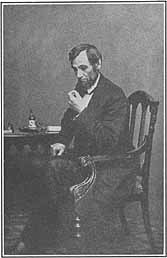
PRESIDENT LINCOLN Photograph by Brady, Washington, D. C.
top
Hermann Hagedorn, born in New York, July 18, 1882. Instructor in English at Harvard in 1909-1911. Wrote several one-act plays which were produced by the Harvard Dramatic Club, and by clubs of other colleges. Author of The Silver Blade (a play in verse), The Woman of Corinth, A Troop of the Guard and other poems.
OH, PATIENT EYES!
Oh, patient eyes! oh, bleeding, mangled heart! Oh, hero, whose wide soul, defying chains, Swept at each army's head, Swept to the charge and bled, Gathering in one too sorrow-laden heart All woes, all pains; The anguish of the trusted hope that wanes, The soldier's wound, the lonely mourner's smart. He knew the noisy horror of the fight, From dawn to dusk and through the hideous night He heard the hiss of bullets, the shrill scream Of the wide-arching shell, Scattering at Gettysburg or by Potomac's stream, Like summer flowers, the pattering rain of death; With every breath, He tasted battle and in every dream, Trailing like mists from gaping walls of hell, He heard the thud of heroes as they fell.
top
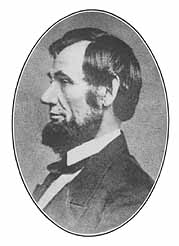
PRESIDENT LINCOLN Photograph by Brady
top
Margaret Elizabeth Sangster, born at New Rochelle, New York, February 22, 1838. Educated privately, chiefly in New York. Became contributor to leading periodicals; also editor of Hearth and Home, 1871-73; Christian at Work, 1873-79; The Christian Intelligencer since 1879; postmistress Harper's Young People, 1882-89; editor Harper's Bazar, 1889-99; staff contributor Christian Herald since 1894; Ladies' Home Journal, 1899-1905; Woman's Home Companion since 1905. Author Poems of the Household; Home Fairies and Heart Flowers; On the Road Home; Easter Bells; Winsome Womanhood; Little Knights and Ladies; Lyrics of Love; When Angels Come to Men; Good Manners for All Occasions; The Story Bible; Fairest Girlhood; From My Youth Up; Happy School Days. She died June 4, 1912.
ABRAHAM LINCOLN
(February 12, 1809-1909)
Child of the boundless prairie, son of the virgin soil, Heir to the bearing of burdens, brother to them that toil; God and Nature together shaped him to lead in the van, In the stress of her wildest weather when the Nation needed a Man. Eyes of a smoldering fire, heart of a lion at bay, Patience to plan for tomorrow, valor to serve for today, Mournful and mirthful and tender, quick as a flash with a jest, Hiding with gibe and great laughter the ache that was dull in his breast. top Met were the Man and the Hour—Man who was strong for the shock— Fierce were the lightnings unleashed; in the midst, he stood fast as a rock. Comrade he was and commander, he who was meant for the time, Iron in council and action, simple, aloof, and sublime. Swift slip the years from their tether, centuries pass like a breath, Only some lives are immortal, challenging darkness and death. Hewn from the stuff of the martyrs, write on the stardust his name, Glowing, untarnished, transcendent, high on the records of Fame. Oh, man of many sorrows, 'twas your blood That flowed at Chickamauga, at Bull Run, Vicksburg, Antietam, and the gory wood And Wilderness of ravenous Deaths that stood Round Richmond like a ghostly garrison: Your blood for those who won, For those who lost, your tears! For you the strife, the fears, For us, the sun! For you the lashing winds and the beating rain in your eyes, For us the ascending stars and the wide, unbounded skies. Oh, man of storms! Patient and kingly soul! Oh, wise physician of a wasted land! A nation felt upon its heart your hand, And lo, your hand hath made the shattered, whole, top With iron clasp your hand hath held the wheel Of the lurching ship, on tempest waves no keel Hath ever sailed. A grim smile held your lips when strong men quailed. You strove alone with chaos and prevailed; You felt the grinding shock and did not reel, And, ah, your hand that cut the battle's path Wide with the devastating plague of wrath, Your bleeding hand, gentle with pity yet, Did not forget To bless, to succor, and to heal.
top
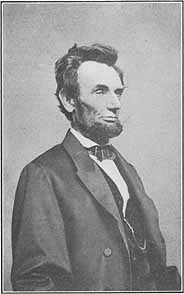
PRESIDENT LINCOLN Photograph by Alexander Gardner, Washington, D. C., 1864
top
Wilbur Dick Nesbit was born at Xenia, Ohio, September 16, 1871. Educated in the public schools at Cedarville, Ohio. Was printer and reporter on various Ohio and Indiana papers until 1898; verse writer and paragrapher Baltimore American, 1899-1902; since that year writer of verse and humor Chicago Evening Post and other newspapers, contributor of stories and poems to magazines and periodicals. Author of Little Henry's Slate, 1903; The Trail to Boyland and Other Poems, 1904; An Alphabet of History, 1905; The Gentleman Ragman, 1906; A Book of Poems, 1906; The Land of Make-Believe and Other Christmas Poems, 1907; A Friend or Two, 1908; The Loving Cup (compilation), 1909; The Old, Old Wish, 1911; My Company of Friends, 1911; If the Heart be Glad, 1911; co-author with Otto Hauerbach of The Girl of My Dreams, a musical comedy, 1910.
THE MAN LINCOLN
Not as the great who grow more great Until from us they are apart— He walks with us in man's estate; We know his was a brother heart. The marching years may render dim The humanness of other men; Today we are akin to him As they who knew him best were then. Wars have been won by mail-clad hands, Realms have been ruled by sword-hedged kings, But he above these others stands As one who loved the common things; The common faith of man was his, The common faith of man he had— For this today his grave face is A face half joyous and half sad. top A man of earth! Of earthy stuff, As honest as the fruitful soil, Gnarled as the friendly trees, and rough As hillsides that had known his toil; Of earthy stuff—let it be told, For earth-born men rise and reveal A courage fair as beaten gold And the enduring strength of steel. So now he dominates our thought. This humble great man holds us thus Because of all he dreamed and wrought; Because he is akin to us. He held his patient trust in truth While God was working out His plan, And they that were his foes, forsooth, Came to pay tribute to the Man. Not as the great who grow more great Until they have a mystic fame— No stroke of fortune nor of fate Gave Lincoln his undying name. A common man, earth-bred, earth-born, One of the breed who work and wait— His was a soul above all scorn. His was a heart above all hate.
top
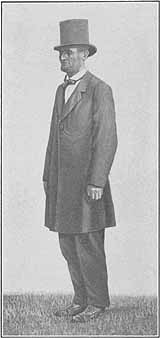
PRESIDENT LINCOLN AT ANTIETAM Photograph taken on the battlefield, September, 1862, with General McClellan and Allen Pinkerton
top
Edwin Arlington Robinson, born at Head Tide, Maine, December 22, 1869. Educated at Gardiner, Maine, and Harvard University, 1891-3. Member National Institute Arts and Letters. Author: The Torrent and The Night Before, 1896; The Children of the Night, 1897, 1905; Captain Craig (poems), The Town Down the River, 1910.
THE MASTER
(LINCOLN)
A flying word from here and there Had sown the name at which we sneered, But soon the name was everywhere, To be reviled and then revered: A presence to be loved and feared, We cannot hide it, or deny That we, the gentlemen who jeered, May be forgotten by and by. He came when days were perilous And hearts of men were sore beguiled; And having made his note of us, He pondered and was reconciled. Was ever master yet so mild As he, and so untamable? We doubted, even when he smiled, Not knowing what he knew so well. He knew that undeceiving fate Would shame us whom he served unsought; He knew that he must wince and wait— The jest of those for whom he fought; He knew devoutly what he thought Of us and of our ridicule; He knew that we must all be taught Like little children in a school.top We gave a glamour to the task That he encountered and saw through, But little of us did he ask, And little did we ever do. And what appears if we review The season when we railed and chaffed? It is the face of one who knew That we were learning while we laughed. The face that in our vision feels Again the venom that we flung, Transfigured to the world reveals The vigilance to which we clung. Shrewd, hallowed, harassed, and among The mysteries that are untold, The face we see was never young Nor could it ever have been old. For he, to whom we had applied Our shopman's test of age and worth, Was elemental when he died, As he was ancient at his birth: The saddest among kings of earth, Bowed with a galling crown, this man Met rancor with a cryptic mirth, Laconic—and Olympian. The love, the grandeur, and the fame Are bounded by the world alone; The calm, the smouldering, and the flame Of awful patience were his own; With him they are forever flown Past all our fond self-shadowings, Wherewith we cumber the Unknown As with inept, Icarian wings.top For we were not as other men: 'Twas ours to soar and his to see. But we are coming down again, And we shall come down pleasantly; Nor shall we longer disagree On what it is to be sublime, But flourish in our perigee And have one Titan at a time.
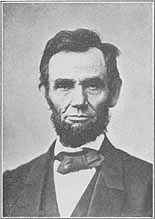
PRESIDENT LINCOLN Photograph by Gardner, Washington, D. C. Taken when Lincoln appointed General U. S. Grant Commander-in-chief of the Army, in 1864
top
LINCOLN
By Harriet Monroe
And, lo! leading a blessed host comes one Who held a warring nation in his heart; Who knew love's agony, but had no part In love's delight; whose mighty task was done Through blood and tears that we might walk in joy, And this day's rapture own no sad alloy. Around him heirs of bliss, whose bright brows wear Palm leaves amid their laurels ever fair. Gaily they come, as though the drum Beat out the call their glad hearts knew so well; Brothers once more, dear as of yore, Who in a noble conflict nobly fell. Their blood washed pure yon banner in the sky, And quenched the brands laid 'neath these arches high— The brave who, having fought, can never die.
top
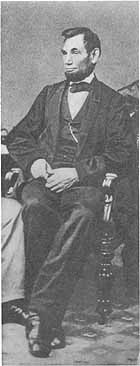
PRESIDENT-ELECT LINCOLN From a photograph taken with his Secretaries, John G. Nicolay and John Hay, Springfield, Illinois, 186
top
Walt Mason, born at Columbus, Ontario, May 4, 1862. Self educated. Came to the United States 1880. Connected with the Atchinson Globe 1885-7, later with Lincoln (Nebraska) State Journal and other papers; editorial paragrapher Evening News, Washington, D. C., 1893; associated with William Allen White on Emporia (Kansas) Gazette since 1907. His rhymes and prose poems are widely copied in America.
THE EYES OF LINCOLN
Sad eyes that were patient and tender, Sad eyes that were steadfast and true, And warm with the unchanging splendor Of courage no ills could subdue! Eyes dark with the dread of the morrow, And woe for the day that was gone, The sleepless companions of sorrow, The watchers that witnessed the dawn. Eyes tired from the clamor and goading And dim from the stress of the years, And hallowed by pain and foreboding And strained by repression of tears. Sad eyes that were wearied and blighted By visions of sieges and wars Now watch o'er a country united From the luminous slopes of the stars!
top
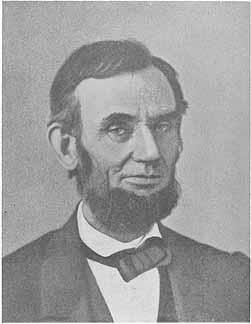
PRESIDENT LINCOLN IN 1862 Photograph by Matthew Brady, Washington, D. C.
top
Arthur Guiterman, author, born of American parentage, at Vienna, Austria, November 20, 1871. Editorial work on Woman's Home Companion, Literary Digest and other magazines since 1891. Author of Betel Nuts, 1907; Guest Book, 1908; Rubiayat, including the Literary Omar, 1909, and Orestes (with Andre Tridon), 1909. Contributor chiefly of ballad, lyric verse and short stories to magazines and newspapers.
HE LEADS US STILL
Dare we despair? Through all the nights and days Of lagging war he kept his courage true. Shall Doubt befog our eyes? A darker haze But proved the faith of him who ever knew That Right must conquer. May we cherish hate For our poor griefs, when never word nor deed Of rancor, malice, spite, of low or great, In his large soul one poison-drop could breed? He leads us still. O'er chasms yet unspanned Our pathway lies; the work is but begun; But we shall do our part and leave our land The mightier for noble battles won. Here Truth must triumph, Honor must prevail; The nation Lincoln died for cannot fail!
top
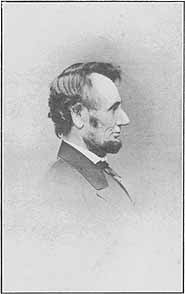
PRESIDENT LINCOLN Photograph by Brady, Washington, D. C., 1864
top
S. Weir Mitchell, born at Philadelphia, Pennsylvania, February 15, 1829. Educated in grammar school, and University of Pennsylvania, but was not graduated because of illness during senior year; Doctor of Medicine, Jefferson Medical College, 1850; LL.D., Harvard, 1886; Edinburgh, 1895; Princeton, 1896; Toronto, 1896; Jefferson Medical College, Philadelphia, 1910. Established practice in Philadelphia. Author of many works on treatment of diseases. Collected Poems, 1896-1909; Youth of Washington, 1904; A Diplomatic Adventure, 1905; The Mind Reader, 1907; A Christmas Venture, 1907; John Sherwood, Ironmaster, 1911.
LINCOLN
Chained by stern duty to the rock of State, His spirit armed in mail of rugged mirth, Ever above, though ever near to earth, Yet felt his heart the cruel tongues that sate Base appetites and, foul with slander, wait Till the keen lightnings bring the awful hour When wounds and suffering shall give them power. Most was he like to Luther, gay and great, Solemn and mirthful, strong of heart and limb. Tender and simple, too; he was so near To all things human that he cast out fear, And, ever simpler, like a little child, Lived in unconscious nearness unto Him Who always on earth's little ones hath smiled.
top
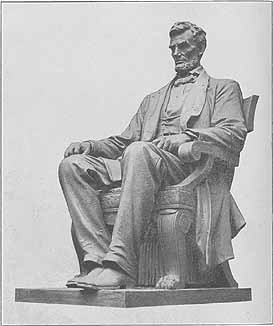
STATUE OF ABRAHAM LINCOLN In the Public Square, Hodgenville, Kentucky. Adolph A. Weinman, Sculptor
George Alfred Townsend was born in Georgetown, Delaware, January 30, 1841. In 1860 he began writing for the press and speaking in public, and in 1860 adopted the profession of journalism. In 1862 he became a war correspondent for the New York World, the Chicago Tribune and other papers, and made an enviable reputation as a descriptive writer. He also published a number of books both of prose and poetry.
top
ABRAHAM LINCOLN
The peaceful valley reaching wide, The wild war stilled on every hand; On Pisgah's top our prophet died, In sight of promised land. Low knelt the foeman's serried fronts, His cannon closed their lips of brass,— The din of arms hushed all at once To let this good man pass. A cheerful heart he wore alway, Though tragic years clashed on the while; Death sat behind him at the play— His last look was a smile. No battle-pike his march imbrued, Unarmed he went midst martial mails, The footsore felt their hopes renewed To hear his homely tales. His single arm crushed wrong and thrall That grand good will we only dreamed, Two races wept around his pall, One saved and one redeemed. The trampled flag he raised again, And healed our eagle's broken wing; The night that scattered armed men Saw scorpions rise to sting.
top
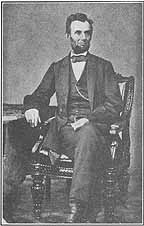
PRESIDENT LINCOLN Photograph by Brady, Washington, D. C., 1864
Paul Lawrence Dunbar, born of negro parents at Dayton, Ohio, June 27, 1872. Was graduated at the Dayton High School in 1891, and since then has devoted himself to literature and journalism. He has written Oak and Ivy (poems); Lyrics of Lowly Life (poems), and The Uncalled (a novel). Since 1898 he has been on the staff of the Librarian of Congress.
top
LINCOLN
Hurt was the Nation with a mighty wound, And all her ways were filled with clam'rous sound. Wailed loud the South with unremitting grief, And wept the North that could not find relief. Then madness joined its harshest tone to strife: A minor note swelled in the song of life Till, stirring with the love that filled his breast, But still, unflinching at the Right's behest Grave Lincoln came, strong-handed, from afar,— The mighty Homer of the lyre of war! 'Twas he who bade the raging tempest cease, Wrenched from his strings the harmony of peace, Muted the strings that made the discord,—Wrong, And gave his spirit up in thund'rous song. Oh, mighty Master of the mighty lyre! Earth heard and trembled at thy strains of fire: Earth learned of thee what Heaven already knew, And wrote thee down among her treasured few!
top
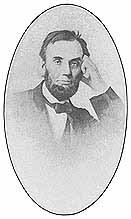
PRESIDENT LINCOLN Photograph by Gardner, Washington, D. C., 1865
Alice Cary was born in Mount Healthy, near Cincinnati, Ohio, April 20, 1820. Her first book of poems, with her sister Phoebe, was published in 1850. Her poems and prose writings were pictures from life and nature, among which were Pictures of Memory, Mulberry Hill, Coming Home and Nobility. She died at her home in New York City, February 12, 1871. This poem is inscribed to the London Punch.
top
ABRAHAM LINCOLN
No glittering chaplet brought from other lands! As in his life, this man, in death, is ours; His own loved prairies o'er his "gaunt, gnarled hands," Have fitly drawn their sheet of summer flowers! What need hath he now of a tardy crown, His name from mocking jest and sneer to save When every plowman turns his furrow down As soft as though it fell upon his grave? He was a man whose like the world again Shall never see, to vex with blame or praise; The landmarks that attest his bright, brief reign, Are battles, not the pomps of gala days! The grandest leader of the grandest war That ever time in history gave a place,— What were the tinsel flattery of a star To such a breast! or what a ribbon's grace! 'Tis to th' man, and th' man's honest worth, The Nation's loyalty in tears upsprings; Through him the soil of labor shines henceforth, High o'er the silken broideries of kings. The mechanism of eternal forms— The shifts that courtiers put their bodies through— Were alien ways to him: his brawny arms Had other work than posturing to do!
top
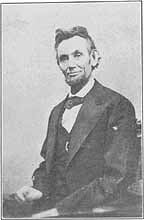
PRESIDENT LINCOLN Photograph by Alexander Gardner, Washington, D. C., 1865
Rose Terry Cooke was born in West Hartford, Connecticut, February 17, 1827. Graduated at Hartford Female Seminary in 1843. She has written many short stories and a number of books of poems.