THE POETS' LINCOLN (continued 2)
Reading edition
top
ABRAHAM LINCOLN
Hundreds there have been, loftier than their kind, Heroes and victors in the world's great wars: Hundreds, exalted as the eternal stars, By the great heart, or keen and mighty mind; There have been sufferers, maimed and halt and blind, Who bore their woes in such triumphant calm That God hath crowned them with the martyr's palm; And there were those who fought through fire to find Their Master's face, and were by fire refined. But who like thee, oh Sire! hath ever stood Steadfast for truth and right, when lies and wrong Rolled their dark waters, turbulent and strong; Who bore reviling, baseness, tears and blood Poured out like water, till thine own was spent, Then reaped Earth's sole reward—a grave and monument!
top
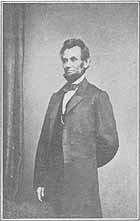
PRESIDENT LINCOLN Photograph by Brady, Washington, D. C., 1865
Frederick Lucian Hosmer, born at Framingham, Massachusetts, October 16, 1840. Graduated at Harvard in 1869. Ordained in Unitarian Ministry at Northboro, Massachusetts, in 1869. Author of The Way of Life, The Thought of God, in Hymns and Poems.
top
LINCOLN
The prairies to the mountains call, The mountains to the sea; From shore to shore a nation keeps Her martyr's memory. Though lowly born, the seal of God Was in that rugged face; Still from the humble Nazareths come The Saviours of the race. With patient heart and vision clear He wrought through trying days— "Malice toward none, with Charity for all," Unswerved by blame or praise. And when the morn of peace broke through The battle's cloud and din, He hailed with joy the promised land, He might now enter in. He seemed as set by God apart, The winepress trod alone; He stands forth an uncrowned king, A people's heart his throne. Land of our loyal love and hope, O Land he died to save, Bow down, renew today thy vows Beside his martyr grave!
top
Charles Monroe Dickinson, born at Lowville, New York, November 15, 1842. Educated at Fairfield (New York), Seminary and Lowville Academy. Admitted to the bar in 1865; practiced law in the State of Pennsylvania, at Binghamton, New York, and in New York City 1865-77, when he abandoned the profession because of broken health. Editor and proprietor of Binghamton Republican, 1878-1911. In 1892, upon his suggestion and initiative the various news organizations were combined into the present Associated Press. Presidential elector, 1896; United States Consul-General to Turkey, 1897-1906; Diplomatic agent to Bulgaria, 1901-1903. While acting in this capacity the American missionary, Ellen M. Stone, was carried off by brigands, but released through his settlement and efforts. Member board to draft regulations for government of American consular service 1906; American Consul-General at-large, 1906-October 1, 1908. Author of History of Dickinson Family, 1885; The Children and Other Verses, 1889; part of political history of State of New York, 1911.
ABRAHAM LINCOLN
If any one hath doubt or fear That this is Freedom's chosen clime— That God hath sown and planted here The richest harvest field of Time— Let him take heart, throw off his fears, As he looks back a hundred years. Cities and fields and wealth untold, With equal rights before the law; And, better than all lands and gold— Such as the old world never saw— Freedom and peace, the right to be, And honor to those who made us free. top Our greatness did not happen so, We owe it not to chance or fate; In furnace heat, by blow on blow, Were forged the things that make us great; And men still live who bore that heat, And felt those deadly hammers beat. Not in the pampered courts of kings, Not in the homes that rich men keep, God calls His Davids with their slings, Or wakes His Samuels from their sleep; But from the homes of toil and need Calls those who serve as well as lead. Such was the hero of our race; Skilled in the school of common things, He felt the sweat on Labor's face, He knew the pinch of want, the sting The bondman felt, and all the wrong The weak had suffered from the strong. God passed the waiting centuries by, And kept him for our time of need— To lead us with his courage high— To make our country free indeed; Then, that he be by none surpassed, God crowned him martyr at the last. Let speech and pen and song proclaim Our grateful praise this natal morn; Time hath preserved no nobler name, And generations yet unborn Shall swell the pride of those who can Claim Lincoln as their countryman.
top
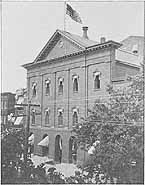
FORD'S THEATRE
The building is a plain brick structure, three stories high, seventy-one feet front and one hundred feet deep. It was originally constructed and occupied as a Baptist Church, but at the beginning of the war was converted into a theatre, though never used for that purpose after the assassination of Lincoln. The government purchased it for one hundred thousand dollars, and it is now used as a branch of the Record and Pension Division of the War Department. President Lincoln was shot by J. Wilkes Booth at 10.20 o'clock P.M. on the evening of April 14, 1865, while seated in his private box in the theatre.
top
SIC SEMPER TYRANNIS!
By Robert Leighton
“Sic semper tyrannis!" the assassin cried, As Lincoln fell. O villain! who than he More lived to set both slave and tyrant free? Or so enrapt with plans of freedom died, That even thy treacherous deed shall glance aside And do the dead man's will by land and sea; Win bloodless battles, and make that to be Which to his living mandate was denied! Peace to that gentle heart! The peace he sought For all mankind, nor for it dies in vain. Rest to the uncrowned king, who, toiling, brought His bleeding country through that dreadful reign; Who, living, earned a world's revering thought, And, dying, leaves his name without a stain. Liverpool, England, May 5, 1865
top
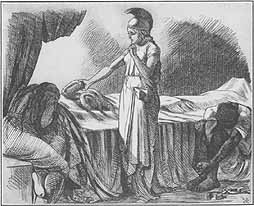
ABRAHAM LINCOLN Foully assassinated, April 14, 1865
Tom Taylor wrote the following poem, which appeared in the London Punch, May 6, 1865. The engraving is a facsimile of the one published in the paper at the head of the poem.
top
ABRAHAM LINCOLN, FOULLY ASSASSINATED
You lay a wreath on murdered Lincoln's bier, You, who with mocking pencil wont to trace, Broad for self-complacent British sneer, His length of shambling limb, his furrowed face, His gaunt, gnarled hands, his unkempt, bristling hair, His garb uncouth, his bearing ill at ease, His lack of all we prize as debonair, Of power or will to shine, of art to please, You, whose smart pen backed up the pencil's laugh, Judging each step, as though the way were plain: Reckless, so it could point its paragraph, Of chief's perplexity, or people's pain. Beside this corpse, that bears for winding sheet The Stars and Stripes, he lived to rear anew, Between the mourners at his head and feet, Say, scurrile-jester, is there room for you? Yes, he had lived to shame me from my sneer, To lame my pencil, and confute my pen— To make me own this hind of princes peer, This rail-splitter a true-born king of men. My shallow judgment I had learnt to rue, Noting how to occasion's height he rose, How his quaint wit made home-truth seem more true, How, iron-like, his temper grew by blows. top How humble, yet how hopeful he could be; How in good fortune and in ill the same; Nor bitter in success, nor boastful he, Thirsty for gold, nor feverish for fame. He went about his work—such work as few Ever had laid on head and heart and hand— As one who knows, where there's a task to do, Man's honest will must Heaven's good grace command. Who trusts the strength will with the burden grow, That God makes instruments to work His will, If but that will we can arrive to know, Nor tamper with the weights of good and ill. So he went forth to battle, on the side That he felt clear was Liberty's and Right's, As in his peasant boyhood he had plied His warfare with rude Nature's thwarting mights— The uncleared forest, the unbroken soil, The iron-bark that turned the lumberer's axe, The rapid, that o'erbears the boatmen's toil, The prairie, hiding the mazed wanderer's tracks, The ambushed Indian, and the prowling bear— Such were the needs that helped his youth to train; Rough culture—but such trees large fruit may bear, If but their stocks be of right girth and grain. So he grew up, a destined work to do, And lived to do it—four long-suffering years; Ill-fate, ill-feeling, ill-report, lived through, And then he heard the hisses change to cheers, top The taunts to tribute, the abuse to praise, And took both with the same unwavering mood; Till, as he came on light from darking days, And seemed to touch the goal from where he stood, A felon hand, between the goal and him, Reached from behind his back, a trigger prest,— And those perplexed and patient eyes were dim, Those gaunt, long-laboring limbs were laid to rest! The words of mercy were upon his lips, Forgiveness in his heart and on his pen, When this vile murderer brought swift eclipse To thoughts of peace on earth, good will to men. The Old World and the New, from sea to sea, Utter one voice of sympathy and shame! Sore heart, so stopped when it at last beat high, Sad life, cut short just as its triumph came. A deed accurst! Strokes have been struck before By the assassin's hand, whereof men doubt If more of horror or disgrace they bore; But thy foul crime, like CAIN'S stands darkly out. Vile hand, that brandest murder on a strife, Whate'er its grounds, stoutly and nobly striven; And with the martyr's crown crownest a life With much to praise, little to be forgiven!
top
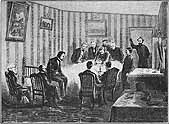
DEATHBED OF LINCOLN
Immediately after the President was shot in Ford's Theatre he was carried across the street to the house of William Petersen and placed on a single bed in a room at the end of the hall. All through that weary night the watchers stood by the bedside. He was unconscious every moment from the time the bullet entered his head until Dr. Robert King Stone, the family physician, announced at twenty-two minutes after seven on the following morning that he had breathed his last (April 15, 1865). Upon this Secretary Edwin M. Stanton, Secretary of War, in a low voice said: "Now He Belongs to the Ages."
top
THE DEATHBED
Silence falls, unbroken save by sobs of strong men In that room, where Lincoln, at the morning hour's chime Passed out into the unknown from the world of human ken. Gone his body and his life work from the world inclosed by time; But in the silence that was falling after breath of broken prayer, Words eternal broke the quiet like a bell toll on the air; Never in the world's wide story, wiser spoke nor Prophet, spoke nor Sages, Than these words that broke the silence: "He belongs now to the Ages!" "To the Ages!" well you spoke it, Stanton of the massive mind! He belongs, the years have shown it, to the world of human kind! Heard his story, where'er hearts throb o'er the world's far spreading way; Heard his story, children listen at the closing of the day; Heard his story, lovers speak it in their hushed and saddened tones As they wander in the twilight, dreaming of their coming homes; Heard his story, statesmen tell it, with a thrill of pride and truth; Heard his story, old men speak it to the country's growing youth. And the years have shown the Prophets, and the years have shown the Sages; Writ in fire these words of wisdom, "He belongs now to the Ages!"
top
ABRAHAM LINCOLN President EDWIN M. STANTON Secretary of War
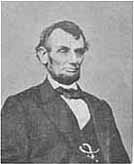
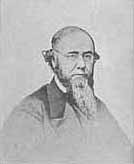
Marion Mills Miller was born at Eaton, Ohio, February 27, 1864. He was graduated from Princeton in 1886, and for several years thereafter was an instructor there in the English department. In 1889 he received the degree of Doctor of Literature from his Alma Mater. Since 1893 he has been engaged in literary and social reform work in New York City. He has published some verse and fiction, but his most notable work has been in the fields of translation and history. He has edited The Classics—Greek and Latin (15 volumes), published in 1909, and Great Debates in American History (14 volumes), published in 1913.
In 1907 he edited the Centenary Edition of The Life and Works of Abraham Lincoln in 10 volumes, logically arranged for ready reference. The Life of Lincoln was published separately in 1908 in two volumes. It is based on a manuscript by Henry C. Whitney, whose name it bears as author, although the second volume, Lincoln, the President, was largely written by Dr. Miller. The late Major William H. Lambert, president top of the Lincoln Fellowship, called it "the best of the shorter biographies of Lincoln." Dr. Miller has also edited The Wisdom of Lincoln (1908), a small book of extracts from Lincoln's speeches and writings. He wrote the following poem, "Lincoln and Stanton," especially for The Poets' Lincoln.
The first reference in it is to the Manny-McCormick case over the patent rights of the reaping machine, in which Lincoln had been at first selected as principal pleader, but was superseded by Edwin M. Stanton. Having thoroughly prepared himself, he offered his assistance to Stanton, but was brusquely repulsed. He was so hurt that he felt like leaving the court room, but decided, in loyalty to his client, to remain, and, leaving his place among counsel, took a seat in the audience. Despite his injured feelings he was filled with admiration for Stanton's able and successful conduct of the case. Lincoln, probably referring to a slur of Stanton reported to him, said that he would have to go back to Illinois and "study more law," since the "college-bred" lawyers were pushing hard the "cornfield" ones.
The second reference is to Stanton's criticism of Lincoln's conservative course during the first months of his Presidency; "that imbecile at the White House," he called him. Stanton as Attorney-General at the close of Buchanan's administration had done effective work in foiling the plans of the Confederacy, and he believed in forceful measures to put down the rebellion in its incipiency.
The third reference is to the virtually enforced resignation of Simon Cameron, Lincoln's first Secretary of War, and Lincoln's choice to succeed him of Stanton, whom he realized to be the best equipped man in the country for the place.
The fourth reference is to Stanton's remark by the bedside of Lincoln as the stricken President ceased breathing: "There lies the greatest leader of men the world ever saw."
top
LINCOLN AND STANTON
Lincoln had cause one man alone to hate: A fellow-lawyer, lacking in all grace, Who cast uncalled-for insult in his face When Lincoln as his colleague, with innate Courtesy, proffered aid. With pride inflate The scornful Stanton waved him to his place, Snapping, "I need no help to try this case"; And "cornfield lawyer" muttered of his mate. And when, as captain of the Union ship, Lincoln drew sail before the gathering storm Till favoring winds the shrouds unfurled should fill, Stanton again curled his contemptuous lip And, with the impatience of a patriot warm, Sneered at the helmsman, "craven imbecile." Laid was the course at length; the sails untried Were spread; the raw crew set at spar and coil. Now round the prow Charybdean waters boil And ever higher surges war's red tide. The mate who should the captain's care divide Has strengthless proved. Where shall, the foe to foil, A man be found able to bear the toil And stand, to steer the ship, by Lincoln's side? Stanton he called! The bitter choice he made For country, not himself. The ship was driven By the great twain through war's abyss, again Into calm seas. Then Lincoln low was laid, And Stanton paid him highest tribute given To mortal: "Mightiest leader among men!"
top
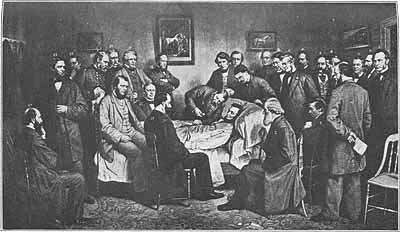
THE DEATH OF LINCOLN
1 President Lincoln. 2 Hon. Gideon Welles, Secretary of the Navy. 3 John Hay, Esq., President's Private Secretary. 4 Hon. E. M. Stanton, Secretary of War. 5 Rev. Dr. Gurley. 6 Gen. Farnsworth, M. C. from Illinois. 7 Governor Ogilsby of Illinois. 8 General Todd. 9 Rufus Andrews, Esq. 10 Hon. W. T. Otto, Assistant Secretary of the Interior. 11 Hon. W. Denison, Postmaster-General. 12 Judge D. K. Carter. 13 Major-General Halleck. 14 Captain Robert Lincoln. 15 Dr. Leale. 16 Hon. Charles Sumner. 17 Dr. Crane, Assistant Surgeon-General. 18 Governor Farwell, of Wisconsin. 19 Hon. J. P. Usher, Secretary of the Interior. 20 Major-General Augur. 21 Major-General Meigs. 22 Maunsel B. Field, Esq. 23 Hon. Schuyler Colfax. 24 Hon. James Speed, Attorney-General. 25 Hon. H. McCullough, Secretary of the Treasury 26 Dr. R. K. Stone. 27 Surgeon-General Barnes.
top
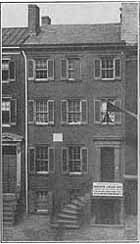
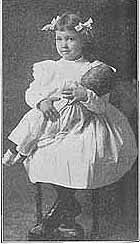
HOUSE IN WHICH LINCOLN DIED Washington, D. C. JOSEPHINE OLDROYD TIEFENTHALER Born July 17, 1896. Died February 20, 1908
top
Robert Mackay and his wife visited this historic house in 1902. They were met at the door and escorted through the various rooms containing the Collection by Little Josephine, and were deeply impressed at the knowledge she exhibited of Lincoln and the Collection, although she was but six years of age. Mr. Mackay was born at Virginia City, Nevada, April 22, 1871. Reporter San Francisco Chronicle, 1886. Worked on newspapers as printer, reporter and editor until 1895, when he traveled extensively over the world for the International News Syndicate; joined staff of the New York World in 1899; managing editor of Success Magazine, 1900-1908. Editor the Delineator, 1908. Joined editorial department of the Frank A. Munsey Company in 1909, contributor of short stories, also other prose and verse.
THE HOUSE WHERE LINCOLN DIED
Above Judea's purple-mantled plain, There hovers still, among the ruins lone, The spirit of the Christ whose dying moan Was heard in heaven, and paid our debt in pain. As subtle perfume lingers with the rose, Even when its petals flutter to the earth, So clings the potent mystery of the birth Of that deep love from which all mercy flows. . . . . Within this house,—this room,—a martyr died, A prophet of a larger liberty,— A liberator setting bondmen free, A full-orbed MAN, above mere mortal pride. top The cloud-rifts opening to celestial glades, Oft glimpse him, and his spirit lingers still, As Christ's sweet influence broods upon the hill Where the red lily with the sunset fades. . . . . A little girl with eyes of heavenly blue, Sings through the old place, ignorant of all; Her angel face, her cheerful, birdlike call Thrilling the heart to life more full, more true.
IN TOKEN OF RESPECT
Translation from Latin verses
From humble parentage and low degree Lincoln ascended to the highest rank; None ever had a harder task than he, It was perfected—him alone we thank. Did the assassin think to kill a name, Or hand his own down to posterity? One will wear the laurel wreath of fame, The other be condemned to infamy. Caesar was killed by Brutus, Yet Rome did not cease to be; Lincoln by Booth, and yet the slaves In all America are free! Rieti, France, May, 1865
top
ENGLAND'S SORROW
From London Fun
The hand of an Assassin, glowing red, Shot like a firebrand through the western sky; And stalwart Abraham Lincoln now is dead! O! felon heart that thus could basely dye The name of southerner with murderous gore! Could such a spirit come from mortal womb? And what possessed it that not heretofore It linked its coward mission with the tomb? Lincoln! thy fame shall sound through many an age, To prove that genius lives in humble birth; Thy name shall sound upon historic page, For 'midst thy faults we all esteemed thy worth. Gone art thou now! no more 'midst angry heat Shall thy calm spirit rule the surging tide, Which rolls where two contending nations meet, To still the passion and to curb the pride. Nations have looked and seen the fate of kings, Protectors, emperors, and such like men; Behold the man whose dirge all Europe sings, Now past the eulogy of mortal pen! He, like a lighthouse, fell athwart the strand; Let curses rest upon the assassin's hand.
top
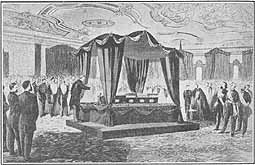
THE FUNERAL OF LINCOLN Ceremonies in the East Room of the White House, April 19, 1865
At ten minutes after twelve o'clock Rev. Charles H. Hall, of the Church of the Epiphany, opened the service by reading from the Episcopal Burial Service for the Dead. Bishop Matthew Simpson of the Methodist Church then offered prayer, and the Rev. Dr. Phineas D. Gurley, pastor of the New York Avenue Presbyterian Church, at which Mr. Lincoln and his family attended, delivered a sermon. The Rev. E. H. Gray, D.D., of the E Street Baptist Church, closed the solemn service with prayer.
top
Phineas Densmore Gurley, born at Hamilton, New York, 1816. Educated at Union College, Schenectady, New York. Taught during vacation, graduated 1837. Studied theology at the Theological Seminary, Princeton, New Jersey. Was licensed to preach in 1840. In 1840 he went to Indianapolis, Indiana, and took charge of a church. In 1849 he removed to Dayton, Ohio, taking charge of a church, and in 1853 moved to Washington, D. C., and took charge of a Presbyterian Church on F Street, afterwards Willard Hall. In 1858 was elected Chaplain of the United States Senate. In July, 1859, the Second Presbyterian Church and the F Street Church united, and were known as the New York Avenue Presbyterian Church, Dr. Gurley becoming its pastor from March, 1861, until his death. President Lincoln was a pew holder and a regular attendant, but was not a member. On one occasion the President remarked, "I like Dr. Gurley, he doesn't preach politics. I get enough of that during the week, and when I go to church I like to hear gospel."
When the President was assassinated Dr. Gurley was sent for and remained with the President until he breathed his last.
As soon as the spirit took its flight, Secretary Stanton turned to Dr. Gurley and said, "Doctor, will you say something?" After a brief pause, Dr. Gurley said, "Let us talk with God," and offered a touching prayer. Dr. Gurley died September 30, 1868.
THE FUNERAL HYMN OF LINCOLN
Rest, noble martyr! rest in peace; Rest with the true and brave, Who, like thee, fell in freedom's cause, The nation's life to save. Thy name shall live while time endures, And men shall say of thee, "He saved his country from its foes, And bade the slave be free." top These deeds shall be thy monument, Better than brass or stone; They leave thy fame in glory's light, Unrival'd and alone. This consecrated spot shall be To freedom ever dear; And freedom's sons of every race Shall weep and worship here. O God! before whom we, in tears, Our fallen chief deplore, Grant that the cause for which he died May live forevermore.
top
Harriet McEwen Kimball, born at Portsmouth, New Hampshire, November, 1834. Educated there; specially known as a religious poet, although she has written much secular verse; chief founder of the Portsmouth Cottage Hospital. Author hymns, Swallow Flights; Blessed Company of All Faithful People; Poems (complete edition), 1889.
REST, REST FOR HIM
Rest, rest for him whose noble work is done; For him who led us gently, unaware, Till we were readier to do and dare For Freedom, and her hundred fields were won. His march is ended where his march began; More sweet his sleep for toil and sacrifice, And that rare wisdom whose beginning lies In fear of God, and charity for man; And sweetest for the tender faith that grew More strong in trial, and through doubt more clear, Seeing in clouds and darkness One appear In whose dread name the Nation's sword he drew. Rest, rest for him; and rest for us today Whose sorrow shook the land from east to west When slain by treason on the Nation's breast Her martyr breathed his steadfast soul away.
top
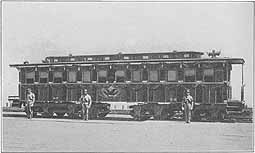
THE FUNERAL CAR
This car bore the remains of the Martyr President to his home in Springfield, Illinois, where they were laid to rest. The funeral train left Washington, D. C., on the 21st of April, 1865, proceeded from that city to Baltimore, Maryland; Harrisburg and Philadelphia, Pennsylvania; New York City, Albany and Buffalo, New York; Cleveland and Columbus, Ohio; Indianapolis, Indiana; Chicago, Illinois; and finally to Springfield, reaching the latter place May 3, where the last sad rites were performed on the succeeding day. The body lay in state in all the above cities, brief stops being also made in many smaller places.
top
Richard Henry Stoddard in the following Horatian Ode made a beautiful analysis of the Martyr President's character, with a magnificent picture of the nation's tribute of mourning for its dead chief:
THE FUNERAL CAR OF LINCOLN
Peace! Let the long procession come, For, hark!—the mournful, muffled drum— The trumpet's wail afar— And, see! the awful car! Peace! let the sad procession go, While cannon boom, and bells toll slow: And go, thou sacred car, Bearing our Woe afar! Go, darkly borne, from State to State, Whose loyal, sorrowing cities wait To honor all they can The dust of that good man! Go, grandly borne, with such a train As greatest kings might die to gain; The Just, the Wise, the Brave Attend thee to the grave! And you the soldiers of our wars, Bronzed veterans, grim with noble scars, Salute him once again, Your late Commander—slain! Yes, let your tears, indignant, fall, And leave your muskets on the wall; Your country needs you now Beside the forge, the plow! top (When Justice shall unsheathe her brand— If Mercy may not stay her hand, Nor would we have it so— She must direct the blow!) So, sweetly, sadly, sternly goes The Fallen to his last repose; Beneath no mighty dome, But in his modest Home! The churchyard where his children rest, The quiet spot that suits him best; There shall his grave be made, And there his bones be laid! And there his countrymen shall come, With memory proud, with pity dumb, And strangers far and near, For many and many a year! For many a year, and many an age, With History on her ample page The virtues shall enroll Of that Paternal Soul.
top
William Cullen Bryant, born in Cummington, Massachusetts, November 3, 1794. Died in New York, June 12, 1878. He wrote verses in his twelfth year to be recited at school. Spent two years at Williams College and at the age of eighteen began the study of law. He depended upon his profession for a number of years, although it was not to his liking. His contributions to the North American Review and his poems published therein gained him an enviable reputation, and reflected great credit upon him.
THE DEATH OF LINCOLN
Oh, slow to smite and swift to spare, Gentle and merciful and just! Who, in the fear of God didst bear The sword of power, a nation's trust. In sorrow by thy bier we stand, Amid the awe that hushes all, And speak the anguish of a land That shook with horror at thy fall. Thy task is done; the bond is free— We bear thee to an honored grave, Whose noblest monument shall be The broken fetters of the slave. Pure was thy life; its bloody close Hath placed thee with the sons of light Among the noble host of those Who perished in the cause of right.
top
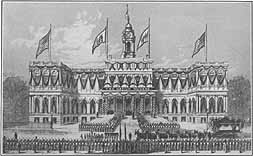
CITY HALL, NEW YORK, N. Y.
At the time of the appearance of the procession at the City Hall at least twenty thousand persons were assembled in the immediate neighborhood. While awaiting the arrival of the procession a number of German singing bands were marched into the open space before the Hall, and arranged on either side of the entrance, preparatory to the singing of a requiem to the dead. The procession entered the Park at about half-past eleven o'clock, and the hearse stopped before the entrance to the Hall. Here the coffin was immediately taken from the hearse and carried up the stairs to the catafalque which had been prepared for its reception, while the singing societies rendered two very appropriate dirges.
The interior of the City Hall had been decorated with much taste. Across the dome a black curtain was drawn, and the rays of light thus conducted fell subdued upon the sad but imposing spectacle.
top
Henry T. Tuckerman, a member of the Committee on Resolutions, wrote the following ode for the funeral obsequies, on the 25th day of April, 1865, at New York City. The Athenaeum Club participated, bearing an appropriate banner, the members wearing distinctive badges of mourning and under the leadership of their Vice-President, Henry E. Pierpont; the President, William T. Blodgett, being at that time absent acting as Chairman of the Citizens Committee:
ODE
Shroud the banner! rear the cross! Consecrate a nation's loss; Gaze on that majestic sleep; Stand beside the bier to weep; Lay the gentle son of toil Proudly in his native soil; Crowned with honor, to his rest Bear the prophet of the West. How cold the brow that yet doth wear The impress of a nation's care; How still the heart, whose every beat Glowed with compassion's sacred heat; Rigid the lips, whose patient smile Duty's stern task would oft beguile; Blood-quenched the pensive eye's soft light; Nerveless the hand so loth to smite; So meek in rule, it leads, though dead, The people as in life it led. O let his wise and guileless sway Win every recreant today, And sorrow's vast and holy wave Blend all our hearts around his grave! top Let the faithful bondmen's tears, Let the traitor's craven fears, And the people's grief and pride, Plead against the parricide! Let us throng to pledge and pray O'er the patriot martyr's clay; Then, with solemn faith in right, That made him victor in the fight, Cling to the path he fearless trod, Still radiant with the smile of God. Shroud the banner! rear the cross! Consecrate a nation's loss; Gaze on that majestic sleep; Stand beside the bier to weep; Lay the gentle son of toil Proudly in his native soil; Crowned with honor, to his rest Bear the prophet of the West.
Lucy Larcom was born in Beverly, Mass., in 1826. At the age of seven years she wrote stories and poems. She spent three years in school, then worked in the cotton mills. Some of her writings attracted the attention of Whittier, from whom she received encouragement. At the age of twenty she went to Illinois and there taught school for some time, and for three years studied in Monticello Female Seminary. She returned to Massachusetts and during the war wrote many patriotic poems.
top
TOLLING
Tolling, tolling, tolling! All the bells of the land! Lo, the patriot martyr Taketh his journey grand! Travels into the ages, Bearing a hope how dear! Into life's unknown vistas, Liberty's great pioneer. Tolling, tolling, tolling! See, they come as a cloud, Hearts of a mighty people, Bearing his pall and shroud; Lifting up, like a banner, Signals of loss and woe; Wonder of breathless nations, Moveth the solemn show. Tolling, tolling, tolling! Was it, O man beloved, Was it thy funeral only Over the land that moved?
top
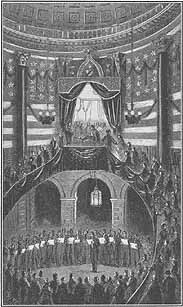
ROTUNDA, CITY HALL, NEW YORK, N. Y.
The remains of President Lincoln lay in state in the City Hall, New York, from noon April 24 to noon April 25, 1865. Visitors were admitted to view the remains, passing through the Hall two abreast. Singing societies sang dirges in the rotunda the night through.
top
Richard Storrs Willis was born in Boston, Massachusetts, February 10, 1819, was graduated at Yale in 1841, and adopted literature as his profession. He has published musical and other poems; has edited the New York Musical World and Once a Week, and contributed also to current literature. He wrote the following:
REQUIEM OF LINCOLN
Now wake the requiem's solemn moan, For him whose patriot task is done! A nation's heart stands still today With horror, o'er his martyred clay! O, God of Peace, repress the ire, Which fills our souls with vengeful fire! Vengeance is Thine—and sovereign might, Alone, can such a crime requite! Farewell, thou good and guileless heart! The manliest tears for thee must start! E'en those at times who blamed thee here, Now deeply sorrow o'er thy bier. O, Jesus, grant him sweet repose, Who, like Thee, seemed to love his foes! Those foes, like Thine, their wrath to spend, Have slain their best, their firmest friend.
top
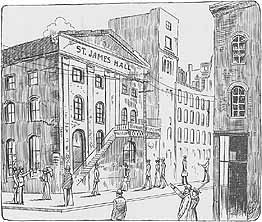
ST. JAMES HALL, BUFFALO, N. Y.
The funeral train bearing the remains of President Lincoln reached Buffalo, New York, on Thursday morning, the 27th of April. The body was taken from the funeral car and borne by soldiers up to St. James' Hall, where it was placed under a crape canopy, extending from the ceiling to the floor. The Buffalo St. Cecilia Society sang with deep pathos the dirge "Rest, Spirit, Rest," the society then placed an elegantly formed harp, made of choice white flowers, at the head of the coffin, as a tribute from them to the honored dead. The public were admitted to view the remains, and the following day the remains reached Cleveland, Ohio.
James Nicoll Johnston was born in Ardee, County Donegal, Ireland. When two years of age the family moved to Cashelmore, Sheephaven Bay, County Donegal. In 1847 they moved to America. He was then between fifteen and sixteen years of age. top In 1848 they settled at Buffalo, New York, which has been his home until the present time.
He has published two editions of Donegal Memories, also two editions of Donegal Memories and Other Poems, and a volume of Buffalo verse collected by him under the title of Poets and Poetry of Buffalo. He assisted in collections of Buffalo local literature, also devoted much time to the production of publications of a philanthropic nature.
REQUIEM
Bear him to his Western home, Whence he came four years ago; Not beneath some Eastern dome, But where Freedom's airs may come, Where the prairie grasses grow, To the friends who loved him so, Take him to his quiet rest; Toll the bell and fire the gun; He who served his Country best, He whom millions loved and bless'd, Now has fame immortal won; Rack of brain and heart is done. Shed thy tears, O April rain, O'er the tomb wherein he sleeps! Wash away the bloody stain! Drape the skies in grief, O rain! Lo! a nation with thee weeps, Grieving o'er her martyred slain. To the people whence he came, Bear him gently back again, Greater his than victor's fame: His is now a sainted name; Never ruler had such gain— Never people had such pain.
top
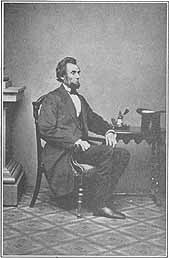
PRESIDENT LINCOLN Photograph taken in 1863 by Brady
Oliver Wendell Holmes, born in Cambridge, Mass., August 29, 1809. To him belongs the credit of saving the frigate Constitution from destruction, by a poem—Aye, Tear the Battered Ensign Down. He died August 7, 1894.
top
SERVICES IN MEMORY OF ABRAHAM LINCOLN
(City of Boston, June 1, 1865)
O Thou of soul and sense and breath, The ever-present Giver, Unto Thy mighty angel, death, All flesh Thou didst deliver; What most we cherish, we resign, For life and death alike are Thine, Who reignest Lord forever! Our hearts lie buried in the dust With him, so true and tender, The patriot's stay, the people's trust, The shield of the offender; Yet every murmuring voice is still, As, bowing to Thy sovereign will, Our best loved we surrender. Dear Lord, with pitying eye behold This martyr generation, Which Thou, through trials manifold, Art showing Thy salvation! O let the blood by murder spilt Wash out Thy stricken children's guilt, And sanctify our Nation! Be Thou Thy orphaned Israel's friend, Forsake Thy people never, In one our broken many blend, That none again may sever! Hear us, O Father, while we raise With trembling lips our song of praise, And bless Thy name forever!
top
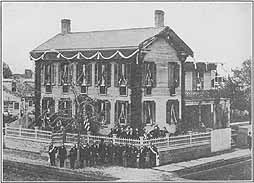
LINCOLN HOMESTEAD, MAY 4, 1865
Photographed by F. W. Ingmire on the day of the funeral, with the members of the National Committee appointed to accompany the remains to Springfield, Illinois.
Members on the pavement: Left (1) Hon. Schuyler Colfax, Speaker of the House; (2) Hon. R. C. Schenck, Ohio; (3) Hon. Lyman Trumbull, Illinois; (4) Hon. Charles E. Phelps, Maryland; (5) Hon. W. H. Wallace, Idaho; (6) Hon. Joseph Baily, Pennsylvania; (7) Hon. James K. Morehead, Pennsylvania; (8) Hon. Sidney Clarke, Kansas; (9) Hon. Samuel Hooper, Massachusetts; (10) Hon. E. B. Washburn, Illinois; (11) Hon. Thomas W. Ferry, Michigan; (12) Hon. Thomas B. Shannon, California; (13) S. G. Ordway, Sergeant-at-Arms of the House.
Members in the yard: Left (1) Hon. Isaac N. Arnold, Illinois; (2) Hon. John B. Henderson, Missouri; (3) Hen. Richard Yates, Illinois; (4) Hon. James W. Nye, Nevada; (5) Hon. Henry S. Lane, Indiana; (6) Hon. George H. Williams, Oregon; (7) Hon. George T. Brown, Sergeant-at-Arms of the Senate; (8) Hon. William A. Newell, New Jersey.
top
William Allen, D.D., born 1784, died 1868. Graduated at Harvard, 1802. President Dartmouth College, 1816-1819, Bowdoin College, 1820-1839. He was the father of American Biography, published various volumes of poems; as a philologist, he contributed many thousands of words and definitions to Webster and Worcester's dictionaries. He was leader of the American delegation to the National Peace Congress at Versailles in 1849.
SPRINGFIELD'S WELCOME TO LINCOLN
Lincoln! thy country's father, hail! We bid thee welcome, but bewail; Welcome unto thy chosen home— Triumphant, glorious, dost thou come. Before the enemy struck the blow That laid thee in a moment low, God gave thy wish: It was to see Our Union safe, our country free. A country where the gospel truth Shall reach the hearts of age and youth, And move unchained, in majesty, A model land of liberty! When Jacob's bones, from Egypt borne, Regained their home, the people mourn; Great mourning then at Ephron's cave, Both Abraham's and Isaac's grave. Far greater is the mourning now; For our land one emblem wide of woe; And where thy coffin car appears Do not the people throng in tears? top Thy triumph of a thousand miles, Like eastern conqueror with his spoils— A million hearts thy captives led, All weeping for their chieftain dead. Thy chariot, moved with eagle speed Without the aid of prancing steed, Has brought thee to that destined tomb; Springfield, thy home, will give thee room. Lincoln, the martyr, welcome home! What lessons blossom on thy tomb! In God's pure truth and law delight; With firm, unwavering soul do right. Be condescending, kind and just; In God's wise counsels put thy trust; Let no proud soul e'er dare rebel, Moved by vile passions sprung from hell. Come, sleep with us in sweet repose, Till we, as Christ from death arose, Still in His glorious image rise To dwell with him beyond the skies.
top
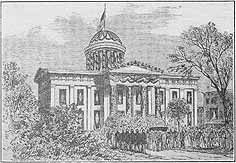
STATE CAPITOL, ILLINOIS, 1865
The body of the President lay in state in the Capitol, Springfield, Illinois—which was very richly draped—from May 3 to May 4, when it was removed to Oak Ridge Cemetery.
Lucy Hamilton Hooper, born in Philadelphia, Pennsylvania, January 20, 1835. In conjunction with Charles G. Leland she edited Our Daily Fare, the daily chronicle of the Philadelphia Sanitary Fair in 1864. She was assistant editor of Lippincott's Magazine from its foundation until she went to Europe in 1870. In 1874 she settled in Paris and since has been correspondent for various journals in this country. She has published Poems, with Translations from the German (Philadelphia, 1864), another volume of Poems (1871); a translation of Le Nabob, by Alphonse Daudet (Boston, 1879); and Under the Tricolor, a novel (Philadelphia, 1880). She died August 31, 1893.
top
LINCOLN
There is a shadow on the sunny air, There is a darkness o'er the April day, We bow our heads beneath this awful cloud So sudden come, and not to pass away. O the wild grief that sweeps across our land From frozen Maine to Californian shore! A people's tears, an orphaned nation's wail, For him the good, the great, who is no more. The noblest brain that ever toiled for man, The kindest heart that ever thrilled a breast, The lofty soul unstained by soil of earth, Sent by a traitor to a martyr's rest. And his last act (O gentle, kindly heart!) The noble prompting of unselfish grace. He would not disappoint the waiting crowd Who came to gaze upon his honored face. O God, thy ways are just, and yet we find This dispensation hard to understand. Why must our Prophet's weary feet be stay'd Upon the borders of the Promised Land? He bore the heat, the burden of the day, The golden eventide he shall not see; He shall not see the old flag wave again Over a land united, saved, and free. He loved his people, and he ever lent To all our griefs a sympathizing ear; Now for the first time in these four sad years The stricken nation wails—he does not hear. top O never wept a land a nobler Chief! Kind heart, strong hand, true soul—yet, while we weep Let us remember, e'en amid our tears, 'Tis God who gives to his beloved sleep. So sleeps he now, the chosen man of God, No more shall care or sorrow wring his breast; The weary one and heavy laden, lies Hushed by the voice of God to endless rest. We need no solemn knell, no tolling bells, No chanted dirge, no vain words sadly said. The saddest knell that ever stirred the air Rang in those words, "Our President is dead!"
top
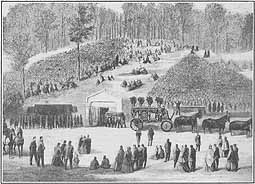
PUBLIC VAULT, OAK RIDGE CEMETERY, SPRINGFIELD, ILL., On the day of Lincoln's funeral
The remains of President Lincoln were deposited in this receiving vault of Oak Ridge Cemetery, Springfield, Illinois, on the 4th of May, 1865, where they remained until December 21, 1865, when they were removed to a temporary vault near the site of the public one. On September 19, 1871, the remains were removed to the monument which had been erected and which stands on the top of the hill in that cemetery back of the public vault. The remains of Mrs. Lincoln, Willie and Thomas (Tad), are also resting there.
top
LET THE PRESIDENT SLEEP
By James M. Stewart
Let the President sleep! all his duty is done, He has lived for our glory, the triumph is won; At the close of the fight, like a warrior brave, He retires from the field to the rest of the grave. Hush the roll of the drum, hush the cannon's loud roar, He will guide us to peace through the battle no more; But new freedom shall dawn from the place of his rest, Where the star has gone down in the beautiful West. Tread lightly, breathe softly, and gratefully bring To the sod that enfolds him the first flowers of spring; They will tenderly treasure the tears that we weep O'er the grave of our chief—let the President sleep. Let the President sleep—tears will hallow the ground, Where we raise o'er his ashes the sheltering mound, And his spirit will sometimes return from above, There to mingle with ours in ineffable love. Peace to thee, noble dead, thou hast battled for right, And hast won high reward from the Father of Light; Peace to thee, martyr-hero, and sweet be thy rest, Where the sunlight fades out in the beautiful West. Tread lightly, breathe softly, and gratefully bring To the sod that enfolds him the first flowers of spring; They will tenderly treasure the tears that we weep O'er the grave of our chief—let the President sleep!
top
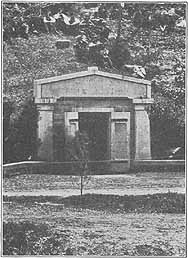
FACADE OF PUBLIC VAULT Oak Ridge Cemetery, Springfield, Illinois, in which the body of Lincoln was placed, May 4, 1865
top
James Mackay, born in New York, April 8, 1872. Author of The Economy of Happiness, The Politics of Utility, and of various lectures on Scientific Ethics, etc.
THE CENOTAPH OF LINCOLN
And so they buried Lincoln? Strange and vain Has any creature thought of Lincoln hid In any vault 'neath any coffin lid, In all the years since that wild spring of pain? 'Tis false—he never in the grave hath lain. You could not bury him although you slid Upon his clay the Cheops Pyramid, Or heaped it with the Rocky Mountain chain. They slew themselves;—they but set Lincoln free. In all the earth his great heart beats as strong, Shall beat while pulses throb to chivalry, And burn with hate of tyranny and wrong. Whoever will may find him, anywhere Save in the tomb. Not there—he is not there.
top
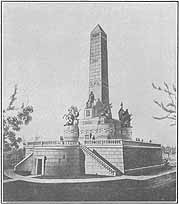
LINCOLN MONUMENT Springfield, Illinois, Larken G. Mead, Architect
A movement was started shortly after the burial of Lincoln to raise funds sufficient to build a monument over his grave. Contributions were made by various States and societies, and about sixty thousand Sunday-school scholars contributed the sum of eighteen thousand dollars. Ground was broken on the 9th of September, 1869, and the monument was dedicated on the 15th of October, 1874, at a total cost of two hundred and thirty thousand dollars.
top
James Judson Lord, born at Berwick, Maine, in 1821. He had the advantage of an excellent early education followed by years of research. During his preparatory studies at Cambridge he met Longfellow, who loaned him books from his own library. For a time he studied art under prominent masters, but his health failing, after a time of forced leisure he went into the mercantile business in Boston, which vocation he afterward followed. In 1851 he went to Illinois; finally, after his marriage, settling in Springfield. There he knew Mr. Lincoln, with whom he was on terms of closest friendship.
The poem submitted by Mr. Lord was selected for reading at the dedication of the National Lincoln Monument in a competition which brought contributions from many leading poets.
He was the author of several dramas, and from time to time contributed poems to leading magazines and newspapers of the country. He died January 3, 1905.
DEDICATION POEM
Read by Richard Edwards, LL.D., President Illinois State Normal University at Bloomington, Illinois
We build not here a temple or a shrine, Nor hero-fane to demigods divine; Nor to the clouds a superstructure rear For man's ambition or for servile fear. Not to the Dust, but to the Deeds alone A grateful people raise th' historic stone; For where a patriot lived, or hero fell, The daisied turf would mark the spot as well. What though the Pyramids, with apex high, Like Alpine peaks cleave Egypt's rainless sky, And cast grim shadows o'er a desert land top Forever blighted by oppression's hand? No patriot zeal their deep foundations laid— No freeman's hand their darken'd chambers made— No public weal inspired the heart with love, To see their summits towering high above. The ruling Pharaoh, proud and gory-stained, With vain ambitions never yet attained;— With brow enclouded as his marble throne, And heart unyielding as the building stone;— Sought with the scourge to make mankind his slaves, And heaven's free sunlight darker than their graves. His but to will, and theirs to yield and feel, Like vermin'd dust beneath his iron heel;— Denies all mercy, and all right offends, Till on his head th' avenging Plague descends. Historic justice bids the nations know That through each land of slaves a Nile of blood shall flow: And Vendome Columns, on a people thrust, Are, by the people, level'd with the dust. Nor stone, nor bronze, can fit memorials yield For deeds of valor on the bloody field, 'Neath war's dark clouds the sturdy volunteer, By freedom taught his country to revere, Bids home and friends a hasty, sad adieu, And treads where dangers all his steps pursue; Finds cold and famine on his dauntless way, And with mute patience brooks the long delay, Or hears the trumpet, or the thrilling drum Peal the long roll that calls: "They come! they come!" Then to the front with battling hosts he flies, And lives to triumph, or for freedom dies. Thund'ring amain along the rocky strand, The Ocean claims her honors with the Land. top Loud on the gale she chimes the wild refrain, Or with low murmur wails her heroes slain! In gory hulks, with splinter'd mast and spar, Rocks on her stormy breast the valiant Tar:— Lash'd to the mast he gives the high command, Or midst the fight, sinks with the Cumberland. Beloved banner of the azure sky, Thy rightful home where'er thy eagles fly; On thy blue field the stars of heav'n descend, And to our day a purer luster lend. O, Righteous God! who guard'st the right alway, And bade Thy peace to come, "and come to stay": And while war's deluge fill'd the land with blood, With bow of promise arch'd the crimson flood,— From fratricidal strife our banner screen, And let it float henceforth in skies serene. Yet cunning art shall here her triumphs bring, And laurel'd bards their choicest anthems sing. Here, honor'd age shall bare its wintery brow, And youth to freedom make a Spartan vow. Here, ripened manhood from its walks profound, Shall come and halt, as if on hallow'd ground. Here shall the urn with fragrant wreaths be drest, By tender hands the flow'ry tributes prest; And wending westward, from oppressions far, Shall pilgrims come, led by our freedom-star; While bending lowly, as o'er friendly pall, The silent tear from ebon cheeks shall fall. Sterile and vain the tributes which we pay— It is the Past that consecrates today The spot where rests one of the noble few Who saw the right, and dared the right to do. top True to himself and to his fellow men, With patient hand he moved the potent pen, Whose inky stream did, like the Red Sea's flow, Such bondage break and such a host o'erthrow! The simple parchment on its fleeting page Bespeaks the import of the better age,— When man, for man, no more shall forge the chain, Nor armies tread the shore, nor navies plow the main. Then shall this boon to human freedom given Be fitly deem'd a sacred gift of heaven;— Though of the earth, it is no less divine,— Founded on truth it will forever shine, Reflecting rays from heaven's unchanging plan— The law of right and brotherhood of man.
Edna Dean Proctor, born in Henniker, New Hampshire, October 10, 1838. She received her early education in Concord and subsequently removed to Brooklyn, New York. She contributed largely to magazine literature and has traveled extensively abroad. Of all her poems By the Shenandoah is probably the most popular.
THE GRAVE OF LINCOLN
Now must the storied Potomac Laurels forever divide; Now to the Sangamon fameless Give of its century's pride. Sangamon, stream of the prairies, Placidly westward that flows, Far in whose city of silence Calm he has sought his repose. Over our Washington's river Sunrise beams rosy and fair; top Sunset on Sangamon fairer,— Father and martyr lies there. Break into blossom, O prairie! Snowy and golden and red; Peers of the Palestine lilies Heap for your Glorious Dead! Roses as fair as of Sharon, Branches as stately as palm, Odors as rich as the spices— Cassia and aloes and balm— Mary the loved and Salome, All with a gracious accord, Ere the first glow of the morning Brought to the tomb of the Lord. Not for thy sheaves nor savannas Crown we thee, proud Illinois! Here in his grave is thy grandeur; Born of his sorrow thy joy. Only the tomb by Mount Zion, Hewn for the Lord, do we hold Dearer than his in thy prairies, Girdled with harvests of gold! Still for the world through the ages Wreathing with glory his brow, He shall be Liberty's Saviour; Freedom's Jerusalem thou!
top
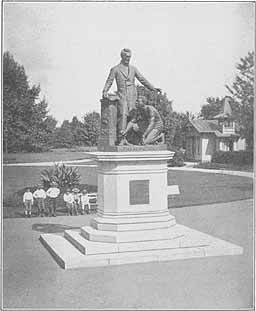
STATUE OF LINCOLN In Lincoln Park, Washington, D. C. Thomas Ball, sculptor.
The first contribution of five dollars for the statue in Lincoln Park, Washington, D. C., was made by a colored woman named Charlotte Scott, of Marietta, Ohio, the morning after the assassination of President Lincoln, and the entire cost of said monument, amounting to $17,000, was paid by subscriptions of colored people. It was unveiled April 14, 1876.
top
James Russell Lowell, born in Cambridge, Massachusetts, February 22, 1819. He received his degree in 1838, at Harvard, and his first production was a class poem which was delivered on that date. He was successor of Professor Longfellow in the chair of Modern Languages at Harvard College. In 1877 he was appointed by President Hayes to the Spanish Mission, from which he was transferred in 1880 to the Court of St. James. A long list of poetical works have been published to his credit. He died August 12, 1891.
COMMEMORATION ODE
Life may be given in many ways, And loyalty to Truth be sealed As bravely in the closet as the field, So bountiful is Fate; But then to stand beside her, When craven churls deride her, To front a lie in arms and not to yield, This shows, methinks, God's plan And measures of a stalwart man, Limbed like the old heroic breeds, Who stand self-poised on manhood's solid earth; Not forced to frame excuses for his birth, Fed from within with all the strength he needs. Such was he, our Martyr-Chief, Whom late the Nation he had led, With ashes on her head, Wept with the passion of an angry grief; Forgive me, if from present things I turn To speak what in my heart will beat and burn, And hang my wreath on his world-honored urn. top Nature, they say, doth dote, And cannot make a man Save on some worn-out plan, Repeating us by rote: For him her Old World molds aside she threw, And, choosing sweet clay from the breast Of the unexhausted West, With stuff untainted shaped a hero new, Wise, steadfast in the strength of God, and true. How beautiful to see Once more a shepherd of mankind indeed, Who loved his charge, but never loved to lead; One whose meek flock the people joyed to be, Not lured by any cheat of birth, But by his clear-grained human worth, And brave old wisdom of sincerity! They knew that outward grace is dust; They could not choose but trust In that sure-footed mind's unfaltering skill, And supple-tempered will That bent like perfect steel to spring again and thrust! His was no lonely mountain-peak of mind, Thrusting to thin air o'er our cloudy bars, A sea-mark now, now lost in vapors blind; Broad prairie rather, genial, level-lined, Fruitful and friendly for all human kind, Yet also nigh to heaven and loved of loftiest stars. Nothing of Europe here, Or, then, of Europe fronting mornward still, Ere any names of Serf or Peer Could Nature's equal scheme deface; Here was a type of the true elder race, And one of Plutarch's men talked with us face to face. top I praise him not; it were too late; And some innative weakness there must be In him who condescends to victory Such as the present gives, and cannot wait, Safe in himself as in a fate. So always firmly he; He knew to bide his time, And can his fame abide, Still patient in his simple faith sublime, Till the wise years decide. Great captains, with their guns and drums, Disturb our judgment for the hour, But at last silence comes; These are all gone, and, standing like a tower, Our children shall behold his fame, The kindly-earnest, brave, foreseeing man, Sagacious, patient, dreading praise, not blame, New birth of our new soil, the first American.
top
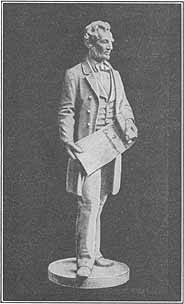
STATUE OF LINCOLN By Leonard W. Volk
top
Richard Henry Stoddard, born in Hingham, Massachusetts, July 2, 1825. His first book, entitled Foot Prints, was published in 1849, and some three years after a more mature collection of poems was published. In later years a number of his books were published, all of which have been received with approbation by the public. Died May 12, 1903.
AN HORATIAN ODE
(To Lincoln)
Not as when some great captain falls In battle, where his country calls, Beyond the struggling lines That push his dread designs To doom, by some stray ball struck dead: Or in the last charge, at the head Of his determined men, Who must be victors then! Nor as when sink the civic great, The safer pillars of the State, Whose calm, mature, wise words Suppress the need of swords! With no such tears as e'er were shed Above the noblest of our dead Do we today deplore The man that is no more. Our sorrow hath a wider scope, Too strange for fear, too vast for hope,— A wonder, blind and dumb, That waits—what is to come! top Not more astonished had we been If madness, that dark night, unseen, Had in our chambers crept, And murdered while we slept! We woke to find a mourning earth— Our Lares shivered on the hearth,— To roof-tree fallen—all That could affright, appall! Such thunderbolts, in other lands, Have smitten the rod from royal hands, But spared, with us, till now, Each laureled Caesar's brow. No Caesar he, whom we lament, A man without a precedent, Sent it would seem, to do His work—and perish too! Not by the weary cares of state, The endless tasks, which will not wait, Which, often done in vain, Must yet be done again; Not in the dark, wild tide of war, Which rose so high, and rolled so far, Sweeping from sea to sea In awful anarchy;— Four fateful years of mortal strife, Which slowly drained the Nation's life, (Yet, for each drop that ran There sprang an armed man!) top Not then;—but when by measures meet— By victory, and by defeat, By courage, patience, skill, The people's fixed "We will!" Had pierced, had crushed rebellion dead— Without a hand, without a head:— At last, when all was well, He fell—O, how he fell! Tyrants have fallen by such as thou, And good hath followed,—may it now! (God lets bad instruments Produce the best events.) But he, the man we mourn today, No tyrant was; so mild a sway In one such weight who bore Was never known before!
From "Poems of Richard Henry Stoddard" Copyright, 1880, by Charles Scribner's Sons.
top
top
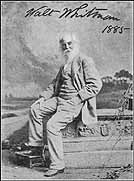
Walt Whitman, born in West Hills, Long Island, New York, May 31, 1819. He was educated in the public schools of Brooklyn and New York City. Learned the printing trade at which he worked during the summer and taught school in winter. He made long pedestrian tours through the United States and even extended his tramps through Canada. His chief work, Leaves of Grass, is a series of poems through which he earned the praise of some and the abuse of others. He visited the army when a brother was wounded and remained afterward as a volunteer nurse. Died 1892.
O CAPTAIN! MY CAPTAIN!
O Captain! my Captain! our fearful trip is done; The ship has weather'd every wrack, the prize we sought is won; The port is near, the bells I hear, the people all exulting, While follow eyes the steady keel, the vessel firm and daring; But O heart! heart! heart! O the bleeding drops of red, Where on the deck my Captain lies, Fallen, cold and dead. O Captain! my Captain! rise up and hear the bells; Rise up—for you the flag is flung—for you the bugle trills; For you bouquets and ribbon'd wreaths—for you the shores a-crowding; For you they call, the swaying mass, their eager faces turning; top Here, Captain! dear Father! This arm beneath your head; It is some dream that on the deck You've fallen cold and dead. My Captain does not answer, his lips are pale and still; My Father does not feel my arm, he has no pulse nor will; The ship is anchor'd safe and sound, its voyage closed and done; From fearful trip, the victor ship, comes in with object won; Exult, O shores, and ring, O bells! But I, with mournful tread, Walk the deck where my Captain lies, Fallen, cold and dead.
top
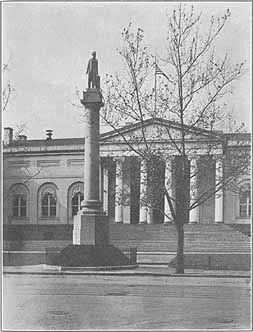
STATUE OF LINCOLN By Lott Flannery, in front of the Court House, Washington Unveiled April 16, 1868
top
Henry de Garrs, of Sheffield, England, wrote these lines on the assassination of Abraham Lincoln in 1865. They were published in England in 1889, and later in America, in the Century.
ON THE ASSASSINATION OF LINCOLN
What dreadful rumor, hurtling o'er the sea, Too monstrous for belief, assails our shore? Men pause and question, Can such foul crime be? Till lingering doubt may cling to hope no more. Not when great Caesar weltered in his gore, Nor since, in time, or circumstance, or place, Hath crime so shook the World's great heart before. O World! O World! of all thy records base, Time wears no fouler scar on his time-smitten face. A king of men, inured to hardy toil, Rose truly royal up the steeps of life, Till Europe's monarchs seemed to dwarf the while Beneath his greatness—great when traitors rife Pierced deep his country's heart with treason-knife; But greatest when victorious he stood, Crowning with mercy freedom's greatest strife. The world saw the new light of godlike good Ere the assassin's hand shed his most precious blood. Lament thy loss, sad sister of the West: Not one, but many nations with thee weep; Cherish thy martyr on thy wounded breast, And lay him with thy Washington to sleep. Earth holds no fitter sepulcher to keep His royal heart—one of thy kings to be Who reign even from the grave; whose scepters sweep top More potent over human destiny Than all ambition's pride and power and majesty. Yet, yet rejoice that thou hadst such a son; The mother of such a man should never sigh; Could longer life a nobler cause have won? Could longest age more gloriously die? Oh! lift thy heart, thy mind, thy soul on high With deep maternal pride, that from thy womb Came such a son to scourge hell's foulest lie Out of life's temple. Watchers by his tomb! He is not there, but risen: that grave is slavery's doom.
POETICAL TRIBUTE TO THE MEMORY OF ABRAHAM LINCOLN
By Emily J. Bugbee
There's a burden of grief on the breezes of Spring, And a song of regret from the bird on its wing; There's a pall on the sunshine and over the flowers, And a shadow of graves on these spirits of ours; For a star hath gone out from the night of our sky, On whose brightness we gazed as the war-cloud roll'd by; So tranquil, and steady, and clear were its beams, That they fell like a vision of peace on our dreams. A heart that we knew had been true to our weal, And a hand that was steadily guiding the wheel; A name never tarnished by falsehood or wrong, That had dwelt in our hearts like a soul-stirring song. top Ah! that pure, noble spirit has gone to its rest, And the true hand lies nerveless and cold on his breast; But the name and the memory—these never will die, But grow brighter and dearer as ages go by. Yet the tears of a Nation fall over the dead, Such tears as a Nation before never shed; For our cherished one fell by a dastardly hand, A martyr to truth and the cause of the land; And a sorrow has surged, like the waves to the shore, When the breath of the tempest is sweeping them o'er, And the heads of the lofty and lowly have bowed, As the shaft of the lightning sped out from the cloud. Not gathered, like Washington, home to his rest, When the sun of his life was far down in the West; But stricken from earth in the midst of his years, With the Canaan in view, of his prayers and his tears. And the people, whose hearts in the wilderness failed, Sometimes, when the star of their promise had paled, Now, stand by his side on the mount of his fame, And yield him their hearts in a grateful acclaim.
top
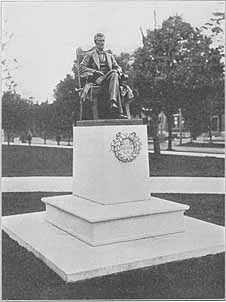
STATUE OF LINCOLN Muskegon, Michigan, Charles Niehaus, sculptor
top
John Nichol, born at Montrose, Forfarshire, Scotland, September 8, 1833. He was a professor of English Literature at the University of Glasgow (1861-1889), and did much to make American books popular in England. His numerous publications include: Leaves (1854), verse; Tables of European History, 200-1876 A.D. (1876); fourth edition (1888); Byron in English Men of Letters series; American Literature, 1520-1880 (1882). He was an ardent advocate of the Northern cause during the Civil War, and visited the United States at the close of the conflict. He died at London, England, October 11, 1894.
LINCOLN, 1865
An end at last! The echoes of the war— The weary war beyond the Western waves— Die in the distance. Freedom's rising star Beacons above a hundred thousand graves; The graves of heroes who have won the fight, Who in the storming of the stubborn town Have rung the marriage peal of might and right, And scaled the cliffs and cast the dragon down. Pæans of armies thrill across the sea, Till Europe answers—"Let the struggle cease. The bloody page is turned; the next may be For ways of pleasantness and paths of peace!" A golden morn—a dawn of better things— The olive-branch—clasping of hands again— A noble lesson read to conquered kings— A sky that tempests had not scoured in vain. This from America we hoped and him Who ruled her "in the spirit of his creed." top Does the hope last when all our eyes are dim, As history records her darkest deed? The pilot of his people through the strife, With his strong purpose turning scorn to praise, E'en at the close of battle reft of life And fair inheritance of quiet days. Defeat and triumph found him calm and just, He showed how clemency should temper power, And, dying, left to future times in trust The memory of his brief victorious hour. O'ermastered by the irony of fate, The last and greatest martyr of his cause; Slain like Achilles at the Scæan gate, He saw the end, and fixed "the purer laws." May these endure and, as his work, attest The glory of his honest heart and hand— The simplest, and the bravest, and the best— The Moses and the Cromwell of his land. Too late the pioneers of modern spite, Awe-stricken by the universal gloom, See his name lustrous in Death's sable night, And offer tardy tribute at his tomb. But we who have been with him all the while, Who knew his worth, and loved him long ago, Rejoice that in the circuit of our isle There is at last no room for Lincoln's foe.
top
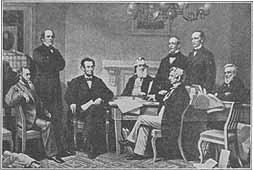
LINCOLN AND CABINET
"The First Reading of the Emancipation Proclamation." Painted by Frank B. Carpenter.
From left to right—Edwin M. Stanton, Secretary of War; Salmon P. Chase, Secretary of the Treasury; President Lincoln; Gideon Welles, Secretary of the Navy; William H. Seward, Secretary of State; J. P. Usher, Secretary of the Interior; Montgomery Blair, Postmaster-General; Edward Bates, Attorney-General
Christopher Pearse Cranch, born in Alexandria, Virginia, March 8, 1813. Graduated at the school of Divinity, Cambridge, Massachusetts, in 1835, but retired from the ministry in 1842 to devote himself to art. He studied in Italy in 1846-8, and lived and painted in 1853-63, and, returning to New York, was elected a member of the National Academy in 1864. He was a graceful writer of both prose and verse.
top
LINCOLN
But yesterday—the exulting nation's shout Swelled on the breeze of victory through our streets, But yesterday—our banners flaunted out Like flowers the south wind woos from their retreats; Flowers of the nation, blue, and white, and red, Waving from balcony, and spire, and mast; Which told us that war's wintry storm had fled, And spring was more than spring to us at last. Today the nation's heart lies crushed and weak; Drooping and draped in black our banners stand. Too stunned to cry revenge, we scarce may speak The grief that chokes all utterance through the land. God is in all. With tears our eyes are dim, Yet strive through darkness to look to Him! No, not in vain he died—not all in vain, Our good, great President! This people's hands Are linked together in one mighty chain Drawn tighter still in triple-woven bands To crush the fiends in human masks, whose might We suffer, oh, too long! No league, nor truce Save men with men! The devils we must fight With fire! God wills it in this deed. This use We draw from the most impious murder done Since Calvary. Rise then, O Countrymen! Scatter these marsh-lights hopes of Union won Through pardoning clemency. Strike, strike again! Draw closer round the foe a girdling flame. We are stabbed whene'er we spare—strike in God's name!
top
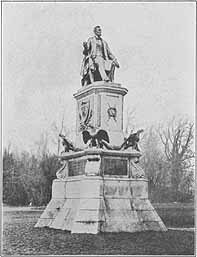
STATUE OF LINCOLN Fairmount Park, Philadelphia, Pennsylvania. Randolph Rogers, sculptor. Unveiled November 26, 1869
George Henry Boker, born in Philadelphia, Pennsylvania, on the 6th day of October, 1823. Graduated at Princeton in 1842, and afterward studied law. In the year 1847, after his return from an extended tour in Europe, he published The Lessons of Life and Other Poems. He also produced a number of plays which were successfully produced upon the stage, both in England and America. During the War of the Rebellion he wrote a number of patriotic lyrics, collected and published in a volume under the title of Poems of the War. He has also written other poems and articles in prose which have received high praise.
In the year 1871 he was appointed by President Grant as our United States Minister to Turkey, but in 1875 was transferred to the more important Mission of Russia.
top
LINCOLN
Crown we our heroes with a holier wreath Than man e'er wore upon this side of death; Mix with their laurels deathless asphodels, And chime their pæans from the sacred bells! Nor in your praises forget the martyred Chief, Fallen for the gospel of your own belief, Who, ere he mounted to the people's throne, Asked for your prayers, and joined in them his own. I knew the man. I see him, as he stands With gifts of mercy in his outstretched hands; A kindly light within his gentle eyes, Sad as the toil in which his heart grew wise; His lips half parted with the constant smile That kindled truth, but foiled the deepest guile; His head bent forward, and his willing ear Divinely patient right and wrong to hear: Great in his goodness, humble in his state, Firm in his purpose, yet not passionate, He led his people with a tender hand, And won by love a sway beyond command. Summoned by lot to mitigate a time Frenzied with rage, unscrupulous with crime, He bore his mission with so meek a heart That Heaven itself took up his people's part; And when he faltered, helped him ere he fell, Eking his efforts out by miracle. No king this man, by grace of God's intent; No, something better, freeman,—President! A nature modeled on a higher plan, Lord of himself, an inborn gentleman!
top
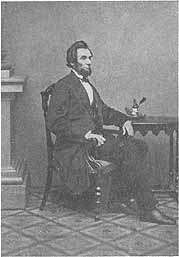
ABRAHAM LINCOLN Photo by Brady, 1864
Phoebe Cary was born near Cincinnati, Ohio, September 24, 1824. Her advantages for education were somewhat better than those of her sister Alice, whose almost inseparable companion she became at an early age. They were quite different, however, in temperament, in person and in mental constitution. Phoebe began to write verse at the age of seventeen years, and one of her earliest poems, Nearer Home, beginning with "One sweetly solemn thought," won her a world-wide reputation. In the joint housekeeping in New York she took from choice (Alice being for many years an invalid) the larger share of duties upon herself, and hence found little opportunity for literary work. top In society, however, she was brilliant, but at all times kindly. She wrote a touching tribute to her sister's memory, published in the Ladies' Repository a few days before her own death, which occurred at Newport, R. I., July 31, 1871. In the volume of Poems of Alice and Phoebe Cary (Philadelphia, 1850) but about one-third were written by Phoebe. Her independently published books are Poems and Parodies (1854), and Poems of Faith, Hope and Love (1868).
ABRAHAM LINCOLN
Our sun hath gone down at the noonday, The heavens are black; And over the morning the shadows Of night-time are back. Stop the proud boasting mouth of the cannon, Hush the mirth and the shout; God is God! and the ways of Jehovah Are past finding out. Lo! the beautiful feet on the mountains, That yesterday stood; The white feet that came with glad tidings Are dabbled in blood. The Nation that firmly was settling The crown on her head, Sits, like Rizpah, in sackcloth and ashes, And watches her dead. Who is dead? who, unmoved by our wailing Is lying so low? O, my Land, stricken dumb in your anguish, Do you feel, do you know? top Once this good man we mourn, overwearied, Worn, anxious, oppressed, Was going out from his audience chamber For a season to rest; Unheeding the thousands who waited To honor and greet, When the cry of a child smote upon him And turned back his feet. "Three days hath a woman been waiting," Said they, "patient and meek." And he answered, "Whatever her errand, Let me hear; let her speak!" So she came, and stood trembling before him And pleaded her cause; Told him all; how her child's erring father Had broken the laws. Humbly spake she: "I mourn for his folly, His weakness, his fall"; Proudly spake she: "he is not a Traitor, And I love him through all!" Then the great man, whose heart had been shaken By a little babe's cry; Answered soft, taking counsel of mercy, "This man shall not die!" Why, he heard from the dungeons, the rice-fields, The dark holds of ships; Every faint, feeble cry which oppression Smothered down on men's lips. top In her furnace, the centuries had welded Their fetter and chain; And like withes, in the hands of his purpose, He snapped them in twain. Who can be what he was to the people; What he was to the State? Shall the ages bring to us another As good and as great? Our hearts with their anguish are broken, Our wet eyes are dim; For us is the loss and the sorrow, The triumph for him! For, ere this, face to face with his Father Our Martyr hath stood; Giving into his hand the white record With its great seal of blood! That the hand which reached out of the darkness Hath taken the whole? Yea, the arm and the head of the people— The heart and the soul! And that heart, o'er whose dread awful silence A nation has wept; Was the truest, and gentlest, and sweetest A man ever kept!
top
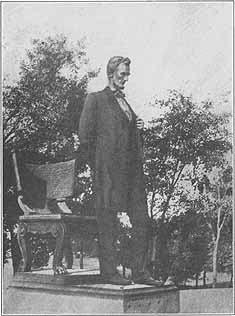
STATUE OF LINCOLN By Augustus Saint Gaudens, in Lincoln Park, Chicago, Illinois
top
On the 22nd of October, 1887, this statue by Saint Gaudens was unveiled, Mr. Eli Bates donating $40,000 for that purpose. There is a vast oval of cut stone, thirty by sixty feet, the interior fashioned to form a classic bench, and the statue stands on a stone pedestal. The sculptor represents him as an orator, just risen from his chair, which is shown behind him, and waiting for the audience to become quiet before beginning his speech. The attitude is that always assumed by Lincoln at the beginning—one hand behind him, and the other grasping the lapel of his coat. He appears the very incarnation of rugged grandeur which held the master mind of this age.
Charles Graham Halpin (Miles O'Reilly) was born near Oldcastle, County of Meath, Ireland, November 20, 1829. Graduated from Trinity College, Dublin, in 1846. He entered the field of journalism as a profession and soon gained a reputation in England. Came to New York in 1852 and secured employment with the Herald, was later connected with other papers. Enlisted in April, 1861, and became lieutenant of Colonel Corcoran's 69th Regiment, rising to the rank of brigadier-general. He died in New York City, August 3, 1868.
top
LINCOLN
He filled the Nation's eyes and heart, An honored, loved, familiar name; So much a brother that his fame Seemed of our lives a common part. His towering figure, sharp and spare, Was with such nervous tension strung, As if on each strained sinew swung The burden of a people's care. His changing face, what pen can draw— Pathetic, kindly, droll or stern; And with a glance so quick to learn The inmost truth of all he saw. Pride found no place to spawn Her fancies in his busy mind. His worth, like health or air, could find No just appraisal till withdrawn. He was his country's—not his own; He had no wish but for the weak, Nor for himself could think or feel, But as a laborer for her throne. Her flag upon the heights of power— Stainless and unassayed to place, To this one end his earnest face Was bent through every burdened hour. ..... But done the battle—won the strife; When torches light his vaulted tomb, Broad gems flash out and crowns illume The clay-cold brow undecked in life. ..... top O, loved and lost! Thy patient toil Had robed our cause in victory's light; Our country stood redeemed and bright, With not a slave on all her soil. 'Mid peals of bells and cannon's bark, And shouting streets with flags abloom, Sped the shrill arrow of thy doom, And, in an instant, all was dark! ..... A martyr to the cause of man, His blood is Freedom's Eucharist, And in the world's great hero list His name shall lead the van. Yes! ranked on Faith's white wings unfurled In Heaven's pure light, of him we say, "He fell on the self-same day A Greater died to save the world."
top
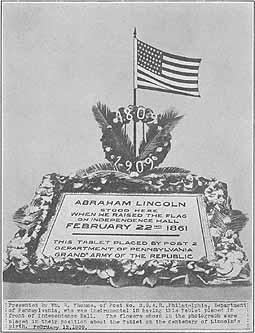
TABLET AT PHILADELPHIA Unveiled February 21, 1903
top
He who seeks the embodiment of the genius of the Union finds it in the apotheosis of the Great Emancipator. There, under the arching skies he stands, erect, serene, resplendent; beneath his feet the broken shackles of a race redeemed; upon his brow the diadem of liberty with law, while around and behind him rise up, as an eternal guard of honor, the great army of the Republic.
In the belief that from the martyr's bier as from the battlefield of right it is but one step to paradise, may we not, on days like this, draw back the veil that separates from our mortal gaze the phantom squadrons as they pass again in grand review before their "Martyr President."—From an address by Hiram F. Stevens, read before the Minnesota Commandery of the Loyal Legion.
THE MARTYR PRESIDENT
In solid platoons of steel, Under heaven's triumphant arch, The long lines break and wheel, And the order is "Forward, March!" The colors ripple o'erhead, The drums roll up to the sky, And with martial time and tread The regiments all pass by— The ranks of the faithful dead Meeting their president's eye. March on, your last brave mile! Salute him, star and lace! Form 'round him, rank and file, And look on the kind, rough face. But the quaint and homely smile Has a glory and a grace It has never known erstwhile, Never in time or space. Close 'round him, hearts of pride! top Press near him, side by side! For he stands there not alone. For the holy right he died, And Christ, the crucified, Waits to welcome his own.
ABRAHAM LINCOLN
Written for the Lincoln Memorial Album, by Eugene J. Hall, 1882.
O honored name, revered and undecaying, Engraven on each heart, O soul sublime! That, like a planet through the heavens straying, Outlives the wreck of time! O rough, strong soul, your noble self-possession Is unforgotten. Still your work remains. You freed from bondage and from vile oppression A race in clanking chains. O furrowed face, beloved by all the nation! O tall gaunt form, to memory fondly dear! O firm, bold hand, our strength and our salvation! O heart that knew no fear! Lincoln, your manhood shall survive forever, Shedding a fadeless halo round your name; Urging men on, with wise and strong endeavor, To bright and honest fame! Through years of care, to rest and joy a stranger, You saw complete the work you had begun, Thoughtless of threats, nor heeding death or danger, You toiled till all was done. top You freed the bondman from his iron master, You broke the strong and cruel chains he wore, You saved the Ship of State from foul disaster And brought her safe to shore. You fell! An anxious nation's hopes seemed blighted, While millions shuddered at your dreadful fall; But God is good! His wondrous hand has righted And reunited all. You fell, but in your death you were victorious; To moulder in the tomb your form has gone, While through the world your great soul grows more glorious As years go gliding on! All hail, great Chieftain! Long will sweetly cluster A thousand memories round your sacred name, Nor time, nor death shall dim the spotless luster That shines upon your fame.
top
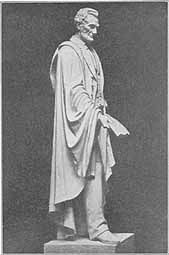
STATUE OF LINCOLN By Vinnie Ream, rotunda of the Capitol, Washington, D. C.
Samuel Francis Smith, clergyman, born in Boston, Massachusetts, October 21, 1808. Attended the Boston Latin School in 1820-5, and was graduated at Harvard in 1829 and at Andover Theological Seminary in 1832. Was ordained to the ministry of the Baptist Church at Waterville, Maine, in 1834, where he occupied pastorates from 1834 until 1842, and at Newton, Massachusetts, 1842 to 1854. Was professor of languages in Waterville College while residing in that city, and there he also received the degree of D.D. in 1854.
top
He has done a large amount of literary work, mainly in the line of hymnology, his most popular composition being our national hymn, My Country, 'Tis of Thee, which was written while he was a theological student, and first sung at a children's celebration in the Park Street Church, Boston, July 4, 1832. The Morning Light is Breaking, was also written at the same place and time. His classmate, Oliver Wendell Holmes, in his reunion poem entitled The Boys, thus refers to him:
"And there's a nice youngster of excellent pith; Fate tried to conceal him by naming him Smith! But he chanted a song for the brave and the free— Just read on his medal, 'My Country, of Thee!'"
The following poem was written expressly for the exercises held on the Nineteenth Anniversary of President Lincoln's death, at his tomb, Springfield, Illinois, April 15, 1884.
THE TOMB OF LINCOLN
Grandeur and glory await around the bed Where sleeps in lowly peace the illustrious dead; He rose a meteor, upon wondering men, But rose in strength, never to set again. A king of men, though born in lowly state, A man sincerely good and nobly great; Tender, but firm; faithful and kind, and true, The Nation's choice, the Nation's Saviour, too; When Liberty and Truth shall reign for evermore, From Oregon to Florida's perpetual May, From Shasta's awful peak to Massachusetts Bay,— Then our children's children, by the cottage door, In the schoolroom, from the pulpit, at the bar, Shall look up to thee as to a beacon star, And deduce the lesson from thy life and death, That the patriot's lofty courage and the Christian's faith top Conquer honors that outweigh ambition's gaudiest prize, Triumph o'er the grave, and open the gates of Paradise. Schooled through life's early hardships to endure, To raise the oppressed, to save and shield the poor; Prudent in counsel, honest in debate, Patient to hear and judge, patient to wait; The calm, the wise, the witty and the proved, Whom millions honored, and whom millions loved; Swayed by no baleful lust of pride or power, The shining pageants of the passing hour, Led by no scheming arts, no selfish aim, Ambitious for no pomp, nor wealth, nor fame, No planning hypocrite, no pliant tool, A high-born patriot, of Heaven's noblest school; Cool and unshaken in the maddest storm, For in the clouds he traced the Almighty's form; Worn with the weary heart and aching head, Worse than the picket, with his ceaseless tread, He kept—as bound by some resistless fate— His broad, strong hand upon the helm of State; Nor turned, in fear, his heart or hope away, Till on the field his tent a ruin lay. His tent, a ruin; but the owner's name Stands on the pinnacle of human fame, Inscribed in lines of light, and nations see, Through him, the people's life and liberty. What high ideas, what noble acts he taught! To make men free in life, and limb, and thought, To rise, to soar, to scorn the oppressor's rod, To live in grander life, to live for God; top To stand for justice, freedom and the right, To dare the conflict, strong in God's own might; The methods taught by Him, by him were tried, And he, to conscience true, a martyr died. As the great sun pursues his heavenly way And fills with life and joy the livelong day, Till, the full journey, in glory dressed, He seeks his crimson couch beneath the west; So, with his labor done, our hero sleeps; Above his tomb a ransomed Nation weeps; And grateful pæans o'er his ashes rise— Dear is his fame—his glory never dies. Bring flowers, fresh flowers, bring plumes with nodding crests, To wreath the tomb where our great hero rests; Bring pipe and tabret, eloquence and song, And sound the loving tribute, loud and long; A Nation bows, and mourns his honored name, A Nation proudly keeps his deathless fame; Let vale and rock, and hill, and land, and sea His memory swell—the anthem of the free.
top
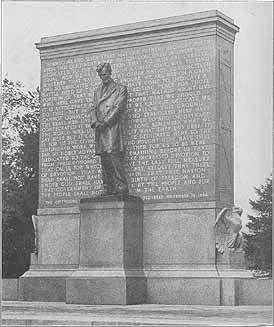
STATUE OF ABRAHAM LINCOLN On the State Capitol Grounds at Lincoln, Nebraska. Unveiled September 2, 1912. Daniel Chester French, sculptor
top
John Townsend Trowbridge, born September 18, 1827, in Ogden, New York. He lived the ordinary life of a country boy, going to school six months in the year till he was fourteen, after which he had to work on the farm in summer. His books had more interest to him than his work, and he managed to learn more out of school than in it. At sixteen he wrote articles in verse and prose for magazines and journals. He was a contributor to the Atlantic Monthly.
During the great rebellion, he wrote several stories of the war: The Drummer Boy, 1863, and The Three Scouts, 1865. On the return of peace he spent some four months in the principal southern States, for the purpose of gaining accurate views of the condition of society there after the war. He published the result of these observations June, 1866, in a volume entitled, The South. A collected edition of his poems was published in 1869, entitled The Vagabonds, and Other Poems.
LINCOLN
Heroic soul, in homely garb half hid, Sincere, sagacious, melancholy, quaint; What he endured, no less than what he did, Has reared his monument, and crowned him saint.
top
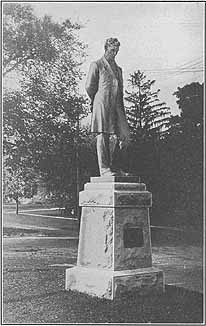
STATUE OF LINCOLN Burlington, Wisconsin. George E. Ganiere, sculptor Unveiled October 13, 1913
top
Kinahan Cornwallis was born in London, England, December 24, 1839. Entered British Colonial Civil Service; two years at Melbourne, Australia. Located in New York in 1860, one of the editors and correspondent of the Herald. Accompanied the Prince of Wales on his American tour. Admitted to the New York bar in 1863; financial editor and general editorial writer of New York Herald, 1860-69. Editor and proprietor of The Knickerbocker Magazine, afterward of The Albion. Since 1886 editor and proprietor Wall Street Daily Investigator, now Wall Street Daily Investor. Author of Howard Plunkett (a novel); an Australian poem, 1857. The New Eldorado, or British Columbia (Travels); Two Journeys to Japan; A Panorama of the New World; Wreck and Ruin, or Modern Society (novel); My Life and Adventures (story), 1859, also of many other histories and novels. Among his poet productions are The Song of America and Columbus, 1892; The Conquest of Mexico and Peru, 1893; The War for the Union, or the Duel Between North and South, 1899.
HOMAGE DUE TO LINCOLN
Well may we all to Lincoln homage pay, For patriotic duty points the way, And tells the story of the debt we owe— A debt of gratitude that all should know; And ne'er will perish that historic tale. To him, the Union's great defender, hail! Through battling years he steered the ship of state, And ever proved a captain just and great. Through storm and tempest, and unnumbered woes, While oft assailed in fury by his foes, He held his course, and triumphed over all, Responding ever to his country's call; And more divine than human seemed the deed When he the slave from hellish bondage freed, top And from the South its human chattels tore. 'Twas his to Man his manhood to restore. That righteous action sealed rebellion's doom, And paved secession's pathway to the tomb. But, lo! when Peace with Union glory, came, And all the country rang with his acclaim— A reunited country, great and strong— A foul assassin marked him for his prey; A bullet sped, and Lincoln dying lay. Alas! Alas! that he should thus have died— His country's leader, and his country's pride! No deed more infamous than this— No fate more cruel and unjust than his— Can in the annals of the world be found. The Nation shuddered in its grief profound, And mourning emblems draped the country o'er Alas! Alas! its leader was no more! But still he lives in his immortal fame, And evermore will Glory gild his name, And keep his memory in eternal view, And o'er his grave unfading garlands strew.
top
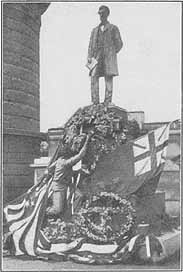
STATUE OF LINCOLN At Edinburgh, Scotland, George E. Bissell, sculptor
It is within an inclosed cemetery, known as the Calton burying ground, which is separated from the Calton Hill by a wide thoroughfare. The statue is the work of an American sculptor, George E. Bissell. It is a fine bronze figure, and rests on a massive granite pedestal. The figure at the base is that of a freed negro holding up a wreath. On one face of the pedestal are Lincoln's words, "To preserve the jewel of liberty in the framework of freedom." The statue is a memorial not alone to Lincoln; the legend on the pedestal tells that this plot of ground was top given by the lord provost and town council of Edinburgh to Wallace Bruce, United States Consul, and dedicated as a burial place for Scottish soldiers of the American Civil War, 1861-65. Cut in the granite are the names and records of Scots who fought to preserve the Union, and who have found their last resting place in this old burying ground at the Scottish capital.
David K. Watson was born near London, Madison County, Ohio, June 18, 1849. Moved to Columbus, Ohio, in 1875, where he now resides. Was Assistant United States District Attorney for the Southern District of Ohio from 1881 to 1885. Elected Attorney-General of Ohio in 1887 and re-elected in 1889. Member of the fifty-fourth Congress. Was member of the Commission to revise the Federal Statutes. Author of History of American Coinage and Watson on the Constitution of the United States.
THE SCOTLAND STATUE
O Scotland! It was a gracious act in thee To build a monument beside the sea To Lincoln, who wrote the word, And slavery's shackles fell From off a race Which ne'er before could tell What freedom was. To Lincoln, whose soul was great enough to know That beings born in likeness of their God Were meant to live as freemen, Not as slaves, and ruled by slavery's rod. To Lincoln, who more than any of his race Uplifted men and women to the place God made for them. To Lincoln, who never saw your land, And in whose veins no Scottish blood had run; top But yet, because of deeds which he had done, His mighty name Had filled the world with fame And taught the people of each land That in God's hand Is held the destiny of races and of man. Immortal patriot! through the mist of years That in the future are to come,— When we who saw thee here are gone,— We view thy heaven-aspiring tomb Illumined by the roseate dawn Of the millennial day, When Peace shall hold her sway, And bring Saturnian eras; when the roar O' the battle's thunder shall be heard no more.
top
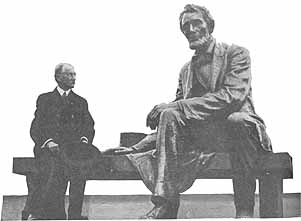
STATUE OF LINCOLN At Newark, N. J. Gutzon Borglum, sculptor
The statue was unveiled May 30, 1911. It is the gift of Amos H. Van Horn, who died December 26, 1908. In his will he set aside $25,000 for a memorial to Abraham Lincoln, to be dedicated in memory of Lincoln Post, No. 11, Department of New Jersey, G. A. R., of which he was a charter member.
Joseph Fulford Folsom, Presbyterian clergyman, miscellaneous writer and local historian, is a native of Bloomfield, New Jersey. He is a direct descendant of John Folsom who arrived at Boston in the Diligent on August 10, 1638, and settled at Hingham, Massachusetts.
Mr. Folsom is the pastor of the Third Presbyterian Church, South, of Newark, New Jersey. He has served two terms as Chaplain General of the Order of the Founders and Patriots of America. Is Librarian top and Recording Secretary of the New Jersey Historical Society. Edited and wrote three chapters of Bloomfield, Old and New, a history of that town published in 1912. Wrote the history of the churches of Newark, including the History of Newark, New Jersey, published in 1913. His poem, The Ballad of Daniel Bray, is found in the Patriotic Poems of New Jersey. He is an occasional writer of poems, and contributes regularly a column of historical matters, signed "The Lorist."
THE UNFINISHED WORK
The crowd was gone, and to the side Of Borglum's Lincoln, deep in awe, I crept. It seem'd a mighty tide Within those aching eyes I saw. "Great heart," I said, "why grieve alway? The battle's ended and the shout Shall ring forever and a day,— Why sorrow yet, or darkly doubt?" "Freedom," I plead, "so nobly won For all mankind, and equal right, Shall with the ages travel on Till time shall cease, and day be night." No answer—then; but up the slope, With broken gait, and hands in clench, A toiler came, bereft of hope, And sank beside him on the bench.
top
CHILDREN ON THE BORGLUM STATUE
Wendell Phillips Stafford, son of Frank and Sarah (Noyes) Stafford, born at Barre, Vermont, May 1, 1861. Educated at Barre Academy and St. Johnsbury Academy. Studied law and attended Boston University Law School, graduating therefrom in 1883. Admitted to the bar in 1883. Practiced law in St. Johnsbury until 1900. Was then appointed to the Supreme Court of Vermont. Appointed to the Supreme Court of the District of Columbia in 1904, which position he still holds.