THE POETS' LINCOLN (continued 3)
Reading edition
Married February 24, 1886, to Miss Florence Sinclair Goss of St. Johnsbury. Has contributed to the Atlantic Monthly and other magazines. Publications: North Flowers (poems), 1902; Dorian Days (poems), 1909; Speeches, 1913.
top
ONE OF OUR PRESIDENTS
(See page 80)
He sits there on the low, rude, backless bench, With his tall hat beside him, and one arm Flung, thus, across his knee. The other hand Rests, flat, palm downward, by him on the seat. So Æsop may have sat; so Lincoln did. For all the sadness in the sunken eyes, For all the kingship in the uncrowned brow, The great form leans so friendly, father-like, It is a call to children. I have watched Eight at a time swarming upon him there, All clinging to him—riding upon his knees, Cuddling between his arms, clasping his neck, Perched on his shoulders, even on his head; And one small, play-stained hand I saw reached up And laid most softly on the kind bronze lips As if it claimed them. These were the children Of foreigners we call them, but not so They call themselves; for when we asked of one, A restless dark-eyed girl, who this man was, She answered straight, "One of our Presidents." "Let all the winds of hell blow in our sails," I thought, "thank God, thank God the ship rides true!"
top
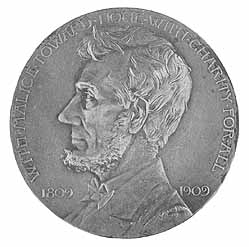
HEAD OF LINCOLN This medal was struck for the Grand Army of the Republic in commemoration of the 100th anniversary of the birth of Abraham Lincoln
top
Frank Dempster Sherman, son of John Dempster and Lucy (McFarland) Sherman, was born May 6, 1860, at Peekskill, New York; educated at home and at Columbia and Howard Universities, and since 1886 connected with Columbia University where he is Professor of Graphics. Author of several volumes of poems which are published by Houghton-Mifflin Company, Boston.
Professor Sherman married, November 16, 1887, Juliet Durand, daughter of Rev. Cyrus Bervic and Sarah Elizabeth (Merserveau) Durand.
He is a member of the National Institute of Arts and Letters.
ON A BRONZE MEDAL OF LINCOLN
This bronze our Lincoln's noble head doth bear, Behold the strength and splendor of that face, So homely-beautiful, with just a trace Of humor lightening its look of care, With bronze indeed his memory doth share, This martyr who found freedom for a Race; Both shall endure beyond the time and place That knew them first, and brighter grow with wear. Happy must be the genius here that wrought These features of the great American Whose fame lends so much glory to our past— Happy to know the inspiration caught From this most human and heroic man Lives here to honor him while Art shall last.
top
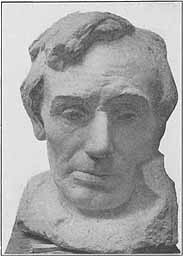
MARBLE HEAD OF LINCOLN In Statuary Hall, Capitol in Washington, Gutzon Borglum, sculptor
top
Ella Wheeler [Wilcox] was born in Johnstown Centre, Wisconsin, in 1845. Was educated at the public schools at Windsor and at the University of Wisconsin. In 1884 she married Robert M. Wilcox. Contributed articles for newspapers at an early age and also wrote and published a number of books of poems.
THE GLORY THAT SLUMBERED IN THE GRANITE ROCK
A granite rock on the mountain side Gazed on the world and was satisfied; It watched the centuries come and go— It welcomed the sunlight, and loved the snow, It grieved when the forest was forced to fall, But smiled when the steeples rose, white and tall, In the valley below it, and thrilled to hear The voice of the great town roaring near. When the mountain stream from its idle play Was caught by the mill-wheel, and borne away And trained to labor, the gray rock mused: "Tree and verdure and stream are used By man, the master, but I remain Friend of the Mountain, and Star, and Plain; Unchanged forever, by God's decree, While passing centuries bow to me!" Then, all unwarned, with a heavy shock Down from the mountain was wrenched the rock. Bruised and battered and broken in heart, He was carried away to a common mart. Wrecked and ruined in peace and pride, "Oh, God is cruel!" the granite cried; top "Comrade of Mountain, of Star the friend— By all deserted—how sad my end!" A dreaming sculptor, in passing by, Gazed on the granite with thoughtful eye; Then, stirred with a purpose supreme and grand, He bade his dream in the rock expand— And lo! from the broken and shapeless mass, That grieved and doubted, it came to pass That a glorious statue, of infinite worth— A statue of Lincoln—adorned the earth.
top
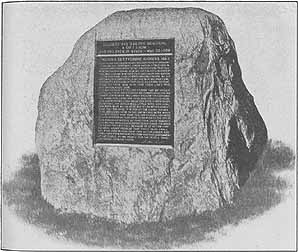
THE LINCOLN BOULDER At Nyack, N. Y.
This boulder had been for two hundred and fifty years a landmark near the Western shore of the Hudson River, opposite Upper Nyack. The school children of Nyack contributed the funds to remove it from its ancient bed and place it in front of the Nyack Carnegie Library, where it now stands and probably will stand for thousands of years to come, a monument to the memory of Abraham Lincoln.
The boulder contains the Gettysburg address and was dedicated June 13, 1908.
top
Louis Bradford Couch, born at East Lee, Massachusetts, October 1, 1851. Son of Bradford Milton and Lucy L. Couch. Educated in the public schools of Northampton, Massachusetts. Began the study of medicine in 1871, graduating with honors from the New York Homeopathic Medical College, March 4, 1874, being awarded the Allen gold medal for the best original investigations in medicine; he was graduated from the New York Ophthalmic Hospital, the same year, as an eye and ear surgeon. Practiced medicine for thirty-nine years at Nyack, New York. Served three years as one of the medical experts on the New York State Board of Health.
THE LINCOLN BOULDER
O Mighty Boulder, wrought by God's own hand, Throughout all future ages thou shalt stand A monument of honor to the brave Who yielded up their lives, their all, to save Our glorious country, and to make it free From bondsmen's tears and lash of slavery. Securely welded to thy rugged breast, Through all the coming ages there shall rest Our Lincoln's tribute to a patriot band, The noblest ever penned by human hand. The storms of centuries may lash and beat The granite face and bronze with hail and sleet; But futile all their fury. In a day The loyal sun will melt them all away. Equal in death our gallant heroes sleep In Southern trench, home grave, or ocean deep; top Equal in glory, fadeless as the light The stars send down upon them through the night. O priceless heritage for us to keep Our heroes' fame immortal while they sleep! . . . . . O God still guide us with thy loving hand, Keep and protect our glorious Fatherland.
top
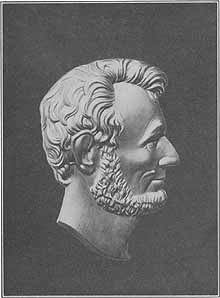
BAS-RELIEF HEAD OF LINCOLN James W. Tuft, Boston
top
James Arthur Edgerton, born at Plantsville, Ohio, January 30, 1869. Graduated at the Normal University, Lebanon, Ohio, in 1887. One year's post-graduate work, Marietta, Ohio, College. Editor county and state papers several years; on editorial staff of Denver News, 1899-1903; American Press Association, New York, 1904; Watson's Magazine, 1905. Editorial writer New York American, 1907; Secretary State Labor Bureau of Nebraska, 1895-9; received party vote for clerk United States House of Representatives. Author, Poems, 1889; A Better Day, 1890; Populist Hand-book for 1894; Populist Hand-book for Nebraska, 1895; Voices of the Morning, 1898; Songs of the People, 1902; Glimpses of the Real, 1903; In the Gardens of God, 1904.
WHEN LINCOLN DIED
When Lincoln died a universal grief Went round the earth. Men loved him in that hour. The North her leader lost, the South her friend; The nation lost its savior, and the slave Lost his deliverer, the most of all. Oh, there was sorrow mid the humble poor When Lincoln died! When Lincoln died a great soul passed from earth, A great white soul, as tender as a child And yet as iron willed as Hercules. In him were strength and gentleness so mixed That each upheld the other. He possessed The patient firmness of a loving heart. In power he out-kinged emperors, and yet His mercy was as boundless as his power. And he was jovial, laughter loving; still His heart was ever torn with suffering. top There was divine compassion in the man, A godlike love and pity for his race. The world saw the full measure of that love When Lincoln died. When Lincoln died a type was lost to men. The earth has had her conquerors and kings And many of the common great. Through all She only had one Lincoln. There is none Like him in all the annals of the past. He was a growth of our new soil, a child Of our new time, a symbol of the race That freedom breeds; was of the lowest rank, And yet he scaled the highest height. Mankind one of its few immortals lost When Lincoln died. When Lincoln died it seemed a providence, For he appeared as one sent for a work Whom, when that work was done, God summoned home. He led a splendid fight for liberty, And when the shackles fell the land was saved; He laid his armor by and sought his rest. A glory sent from heaven covered him When Lincoln died.
top
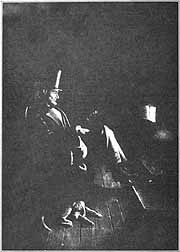
A STUDY OF LINCOLN From painting by Blendon Campbell
top
Amos Russell Wells was born at Glens Falls, New York, December 23, 1862. His mother removed to Yellow Springs, Ohio, when he was four years old, and he received his education at the public school there, afterward studying at Antioch College of that town, a college made illustrious by its first President, Horace Mann, who died there. Graduated in 1883, all by himself, later receiving as Master of Arts, also LL.D. He taught for a year in a country district school, then entered the faculty of his Alma Mater, where he was a tutor for nine years. Was professor of Greek, Geology and Astronomy. He joined the Christian Endeavor Society in 1888, and by it was led to become a member of the Presbyterian Church at Yellow Springs. When but a boy he began to write, and edited numerous journals. Later edited an amateur paper, also a town paper. His first paid contribution was a poem accepted in 1881 by The Christian Union, now The Outlook. Wrote articles often for The Golden Rule, now The Christian Endeavor World, and for the Sunday School Times.
In December, 1891, he went to Boston and became managing editor of The Golden Rule, a position which he still holds. Since then the paper has changed its name and three other papers added—The Junior Christian Endeavor World, Junior Work and Union Work, all edited by Mr. Wells. He is also Editorial Secretary of the United Society of Christian Endeavor and in editorial charge of all its publications.
Mr. Wells' first book, then entitled Golden Rule Meditations, but now The Upward Look, was published in 1893. Since then every year has seen from one to ten additions to his list of productions until they now number fifty-eight volumes in all. He is a director of the Union Rescue Mission and of the Chinese Mission of Boston. Is a member of the American Sunday-School Lesson Committee, an important part of his work being his association with Dr. F. N. Peloubet in writing the well-known Select Notes on the International Sunday-School Lessons.
top
HAD LINCOLN LIVED
Had Lincoln lived, How would his hand, so gentle yet so strong, Have closed the gaping wounds of ancient wrong; How would his merry jests, the way he smiled, Our sundered hearts to union have beguiled; How would the South from his just rule have learned That enemies to neighbors may be turned, And how the North, with his sagacious art, Have learned the power of a trusting heart; What follies had been spared us, and what stain, What seeds of bitterness that still remain, Had Lincoln lived! With Lincoln dead, Ten million men in substitute for one Must do the noble deeds he would have done: Must lift the freedman with discerning care, Nor house him in a castle of the air; Must join the North and South in every good, Fused in co-operating brotherhood; Must banish enmity with his good cheer, And slay with sunshine every rising fear; Like him to dare, and trust, and sacrifice, Ten million lesser Lincolns must arise, With Lincoln dead.
top
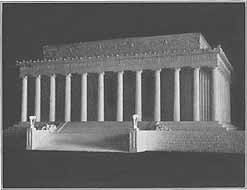
THE LINCOLN MEMORIAL Henry Bacon, Architect
The Lincoln Memorial will be the costliest monument to the memory of one man ever reared by a republic. The Capitol, at one end of the great parkway stretching from Capitol Hill to the Potomac, is a monument to the Government; the Lincoln Memorial, at the other end of that parkway, is a monument to the savior of that Government; and the Washington Monument, standing between, is a monument to its founder. The memorial will stand on a broad terrace 45 feet above grade. The colonnade will be 188 feet long and 118 feet wide, and will contain 36 columns, 44 feet high and 7 feet 5 inches in diameter at the base. Within the interior of the structure will be three halls. In the central hall, which will be 60 feet wide, 70 long, and 60 high, there will be a noble statue of Lincoln, while in the two side halls will be bronze tablets containing the Great Emancipator's second inaugural address and his Gettysburg speech. The George A. Fuller Company of Washington are the builders of the Memorial, which will be completed in 1917.
top
Samuel Green Wheeler Benjamin, born at Argos, Greece, February 13, 1837. Was United States Minister to Persia (1883-1885). Assistant Librarian in the New York State Library. In 1861-1864 sent two companies of cavalry to the war. Served in war hospitals, studied art. Art editor of American Department Magazine of Art, also of the New York Mail. Marine painter and illustrator. Among his numerous works in prose and verse are Art in America, Contemporary Art in Europe (1877); Constantinople (1860); Persia and the Persians (1866); The Choice of Paris (1870), a romance; Sea Spray (1887), a book for yachtsmen, etc.
LET HIS MONUMENT ARISE
Let his monument arise, Pointing upward to the skies, Founded by a nation's heart, Grandly shaped in every part By the master-minds of art, And consecrated by a nation's tears, To teach throughout the after-time, To every tribe, in every clime, That toil for others is sublime.
top