PART II.
Reading edition
SEVILLE.
LETTER XV.
JOURNEY TO SEVILLE. CHARACTER OF THE SPANIARDS. VALLEY OF THE RHONE.
Marseille.
In order to reach the south of Spain, the longest route is that which, passing through France, leads by Bayonne to the centre of the northern frontier of the Peninsula, which it then traverses from end to end. It is not the longest in actual distance; but in regard to time, and to fatigue, and (for all who do not travel by Diligence), by far the longest, with regard to expense. Another route, longer, it is true, in distance, but shorter with respect to all these other considerations, is that by Lyons and Marseille; from either of which places, the journey may be made entirely by steam.
The shortest of all, and in every respect, is that by the Gibraltar mail, which leaves London and Falmouth once a week. This is a quicker journey than that through France, even for an inhabitant of France, supposing him resident at Paris, and to proceed to England viâ le Hâvre. But there is an objection to this route for a tourist. Desirous of visiting foreign scenes, he will find it too essentially an English journey—direct, sure, and horribly business-like and monotonous. You touch, it is true, at Lisbon, where during a few hours, you may escape from the beef and Stilton cheese, if not from the Port wine; and where you may enjoy the view of some fine scenery; but all the rest is straight-forward, desperate paddling night and day; with the additional objection, that being surrounded by English faces, living on English fare, and listening to English voices, the object of the traveller—that of quitting England—is not attained; since he cannot be said to have left that country, until he finds himself quarrelling with his rapacious boatman on the pier of the glittering Cadiz.
Although this arrangement may possess the merit of the magic transition from England to Andalucia, which, it must be allowed, is a great one—many will prefer being disembarked in France; looking forward, since there is a time for all things, to a still more welcome disembarkation on England's white shores, when the recollected vicissitudes of travel shall have disposed them to appreciate more than ever her comforts and civilization, and to be more forgiving to her defects; and, should they not be acquainted with the banks of the Rhone below Lyons, adopting that equally commodious and infinitely more varied course.
In fact, there are few who will not agree with me in pronouncing this the best way, for the tourist, of approaching Spain. It is not every one, who will not consider the gratifications which the inland territory of the Peninsula may offer to his curiosity too dearly purchased by the inconveniences inseparable from the journey. Add to this the superiority of the maritime provinces, with scarcely any exception, in point of climate, civilization, and attractions of every sort. Valencia, Barcelona, Malaga, and Cadiz are more agreeable places of residence, and possess more resources than even Madrid; but their chief advantage is a difference of climate almost incredible, from the limited distance which separates them from the centre of the Peninsula. The Andalucian coast enjoys one of the best climates in the world; while the Castiles, Aragon, and La Mancha can hardly be said to possess the average advantages in that respect; owing to the extremes of cold and heat, which characterize their summer and winter seasons, and which, during autumn and spring, are continually alternating in rapid transition.
Andalucia unites in a greater degree than the other maritime provinces, the advantages which constitute their superiority over the rest of Spain. It does more, for it presents to the stranger a combination of the principal features of interest, which render the Peninsula more especially attractive to the lover of travel. It is, in fact, to Spain what Paris is to France; Moscow and Petersburg to Russia. England, Italy, and Germany are not fit subjects for illustrating the comparison; their characteristic features of attraction and interest being disseminated more generally throughout all their provinces or states. Whoever wishes to find Spain herself, unalloyed, in her own character and costume, and in her best point of view, should disembark in Andalucia.
There, unlike the Castiles, and the still more northern provinces, in which only the earth and air remain Spanish, and those not the best Spanish—where all the picturesque and original qualities that distinguish the population, are fast fading away—the upper classes in their manners and costumes, and the Radicals in their politics, striving to become French—there, on the contrary, all is natural and national in its half-Arab nationality: and certainly nature and nationality have given proof of taste in selecting for their last refuge, the most delicious of regions; where earth and heaven have done their utmost to form an abode, worthy of the most beautiful of the human, as well as the brute creation.
I will not pause to inquire whether the reproach be justly addressed by the other Spaniards, to the inhabitants of this province, of indolence and love of pleasure, and of a disposition to deceitfulness, concealed beneath the gay courtesy of their manners; it would, indeed, be a surprising, a miraculous exception to the universal system of compensations that we recognise as governing the world, had not this people some prominent defect, or were they not exposed to some peculiar element of suffering, to counterbalance in a degree the especial and exclusive gifts heaped upon them. By what other means could their perfect happiness be interfered with? Let us, then, allow them their defects—the necessary shade in so brilliant a picture—defects which, in reducing their felicity to its due level, are easily fathomed, and their consequences guarded against, by sojourners amongst them, in whose eyes their peculiar graces, and the charm of their manner of life, find none the less favour from their being subject to the universal law of humanity. They cannot be better painted in a few words, than by the sketch, drawn by the witty and graceful Lantier, from the inhabitants of Miletus. "Les Milesiens," he says, "sont aimables. Ils emportent, peut-être, sur les Athéniens" (read "Castillans") "par leur politesse, leur aménité, et les agrémens de leur esprit. On leur reproche avec raison cette facilité—cette mollesse de mœurs, qui prend quelquefois l'air de la licence. Tout enchante les sens dans ce séjour fortuné—la pureté de l'air—la beauté des femmes—enfin leur musique—leurs danses, leurs jeux—tout inspire la volupté, et pénêtre l'âme d'une langueur délicieuse. Les Zéphirs ne s'y agitent que pour repandre au loin l'esprit des fleurs et des plantes, et embaumer l'air de leurs suaves odeurs."
This passage is, word for word, so exactly applicable to the Andalucians and their land, that it is difficult to imagine another people to have sat for the portrait, nor to a more talented painter. It is a pity that the author I quote, is a rarity in modern libraries: owing, perhaps, to his descriptions being at times rather warm, or, as his compatriots would say, un peu regence.
In Spain, the country of proverbs, they are very fond of summing up, by the aid of a few epithets, the distinctive character of each province. As bad qualities frequently predominate in these estimates, it is of course usual for the individual, who undertakes the instruction of a foreigner in this department of knowledge, to omit the mention of his own province. After all, the defects attributed to the inhabitants of one portion of a country by those of another, are not to be taken for granted without considerable reservation; allowance must be made for rivalry and jealousies. Almost every country affords examples of these wholesale accusations laid to the charge of particular counties or divisions of territory. Thus the character usually attributed in Spain to the Andalucians, is that of a people lively, gay, of extreme polish and amiability of manners, but false and treacherous. The Galicians are said to be stupid and heavy, but remarkably honest; the Catalonians courageous but quarrelsome, mauvais coucheurs. No doubt in some of these instances, the general impression may be borne out to a certain extent, by some particular class of the denizens of the province alluded to; but such distinctions are rarely perceptible among the educated classes. It is perhaps less easy in Spain than elsewhere, to establish these classifications at all successfully. Contradictions will be met with at every step, calculated to shake their infallibility. To our eye, as foreigners, there are sufficient peculiarities belonging to the nation universally, and respecting which our knowledge is far from being complete, without attempting to classify a greater or smaller list of subdivisions, the appreciation of which would require a prolonged residence in the country.
Spain is looked upon by the greater number of strangers as a land delivered over to depredation, and highly insecure. In fact, it is surprising that such should not be the fate of a country in which instruction is limited, and where, as I myself have witnessed, servants may be known to be in the daily practice of stealing without their dismissal being by any means a necessary result. It is surprising, that in the absence of any strong natural objection to theft, any honesty should exist in the presence of temptation; yet I know no country where there is more, if I may form an opinion from the individuals of whom I have had an opportunity of judging. However, as an instance of the contradictions one meets with, the following event was represented as having taken place in one of the provinces in which I had received the favourable impression above-mentioned.
A ci-devant colonel, just arrived in Madrid, related the fact to me one evening, on which, as chance would have it, I found him at supper. Immediately on my entering the room he commenced complaining of the lack of silver articles of necessity for the table, and accounted for it in the following manner. He had recently arrived with his family from a provincial town, in which he had filled a government situation. Shortly before his departure he had invited all his friends to a leave-taking repast; and after the departure of his guests nearly two dozen articles of plate were missing. "In packing up," I observed, "no doubt some dishonest domestic—" "No, no," he interrupted, "they were all pocketed by my guests."
That the man in office should have conciliated the attachment of all his acquaintances to such a degree, as that all should conceive simultaneously the idea of preserving a souvenir of his person, and that in so delicate and unostentatious a manner,—was not possible. As, therefore, I still retained my impression of the honesty of the lower classes, and as the sufferer appeared to treat the occurrence as one by no means extraordinary, I came to the conclusion, that—either Spanish integrity, unlike that of other nations, must rise in an inverse ratio to men's fortunes and stations; or that the author of the anecdote had been tempted, by the desire of masking the (perhaps unavoidable) deficiencies in his supper service, to have recourse to his inventive talent, at the expense of his absent friends' reputation.
I believe it must be allowed that with respect to the disregard of the rights of proprietorship, of which the lower classes are accused, there are sufficient instances on record to counterbalance, in some degree, my personal experience; but there is this to be urged in favour of that class of culprits, where such are met with, that their mode of operation is far more manly and courageous than that of the depredators of some other climes—by which means they obtain also the full reputation of their misdeeds. There may scarcely be said to be anything mean or degrading in their manner of thieving: and their system is itself a proof that they see no sin in it. They take to the mountains, and declare open war against those whom they consider the unjust monopolizers of wealth.
Instances of this sort are no doubt frequent in Spain; in Toledo they relate that, some years since, the passes of Estremadura were occupied by one of the most formidable and best organized of these bands, under the orders of a female. Various versions were given of this woman's history; but the one most accredited accounted in the following manner for her having adopted the profession of freebooter. A young lady of rank had disappeared from her family residence, leaving no trace by which to guide conjecture as to her fate. It was therefore presumed she had been kidnapped. The event, however, had already long ceased to be a subject of conversation in the district, when three or four years after, a traveller, who had escaped from an attack of banditti, announced the fact of their being commanded by a woman. Although well disguised, her voice, and delicate figure had betrayed her sex. The fact was subsequently confirmed by positive discoveries; and, at length, confiding in the alteration time and her mode of life had produced in her appearance, she ceased to make a mystery of the circumstance, and headed the attacks, mounted usually on a large black horse. Her age and beauty coinciding with the description given of the young countess who had disappeared some years previously, gave rise to the supposition of their identity. The band has been since dispersed, and many of them captured; but their chief has contrived to escape, and it is probable the truth respecting her may never be divulged.
It is said she at times exercised more pitiless cruelties than are usually practised by the male chiefs of the regular banditti; and that, after such acts,—as though conscience-stricken,—she would, by way of compensation, allow parties to pass unmolested.
From such instances as these a portion of the Spanish population must be considered amenable to the charge brought against them; but there are peculiarities of a different stamp, which mark the Spaniards in general, and are more deserving of notice in a summary of the national characteristic qualities. It is impossible, for instance, not to be struck by the intelligence and tact, independent of cultivation, which pervade all classes. Whether the denizens of these southern climes are indebted to the purity of their atmosphere, for this gift of rapid perception, in which they surpass our northern organizations, or to whatever cause they may owe it; the fact leads to involuntary speculation on what might have been the results, in a country so distinguished, besides, by its natural advantages, had the Arab supremacy lasted until our days. At a period when education was generally held in no estimation in Europe, the first care of almost every sovereign of that race was usually directed to the establishment, or improvement, of the public schools, in which the sciences and languages were taught at the royal expense. No town being unprovided with its schools, it is difficult to imagine to what degree of superiority over the rest of Europe the continuation of such a system would have raised a people so gifted as to be capable of supplying, by natural intelligence, the almost universal absence of information and culture.
You continually meet with such instances of uncultivated intelligence as the following. I was occupied in sketching in a retired part of the environs of Madrid, when a ragged, half-naked boy, not more than ten or eleven years of age, and employed in watching sheep, having to pass near me, stopped to examine my work. He remained for nearly a quarter of an hour perfectly still, making no movement except that of his eyes, which continually travelled from the paper to the landscape, and back from that to the paper. At length, going away, he exclaimed, "Que paciencia, Dios mio!"
The following is an example of the absence of cultivation, where it might have been expected to exist. A student leaving the university of Toledo, at the age of twenty-seven, told me he had studied there eleven years, and had that day received his diploma of barrister, which, when sent to Madrid, where it would be backed by the sanction of the minister, would authorise him to practise his profession in any town throughout Spain. In the course of the same conversation, he asked me whether Russia was not situated in the Mediterranean, and whether England did not form a portion of that country.
Tact and good manners are so universal among the lower classes, that a more familiar intercourse than we are accustomed to, can be allowed between persons of different ranks. Those of the highest class are seen, during a journey, dining at the same table with their servants; and on all other occasions entering into conversation with them. This intercourse of good nature and good understanding, universally existing between superiors and inferiors, and which is never known to degenerate into familiarity, would preserve Spain a long time from revolutions of a popular origin—were she left to herself. The Spaniard of the lowest station has as considerable an idea of his personal consequence as a marquis, and maintains with his equals all the forms of high breeding. If you stop to listen to the discussions of a knot of ragged children playing at marbles, you will hear them address each other by the title of Señor.
The urbanity and polish which prevails throughout all classes is genuine, and the result of good-nature. This is proved by their readiness to render all sorts of services as soon as they are acquainted with you, and even before; and that notwithstanding their suspicion and dislike of strangers, a disposition for which they have ample cause. I don't mean to include services which might incur pecuniary outlay; it would be something like requesting the loan of the Highlander's inexpressibles. Although even of this a remarkable instance has fallen under my observation,—the capability existing,—but they will spare no trouble nor time: doubling the value of the obligation by the graceful and earnest manner of rendering it.
Should your reception by a Spaniard be marked by coldness, it is generally to be accounted for by a very excusable feeling. The Spaniard is usually deeply preoccupied by the unfortunate state of his country. This subject of continual reflection operating on a character singularly proud, but which is at the same time marked by a large share of modesty,—qualities by no means incompatible,—occasions him a sensation when in presence of a foreigner nearly approaching to suffering. He feels a profound veneration for the former glories of his land, and admiration of its natural superiority; but he is distrustful of his modern compatriots, of whom he has no great opinion. His anxiety is, therefore, extreme with regard to the judgment which a Frenchman or Englishman may have formed respecting his countrymen and country: and he is not at his ease until satisfied on that point; fearing that the backward state of material civilization may be attributed by them to hopeless defects in the national character, and diminish their respect for his country. He is restored to immediate peace of mind by a delicate compliment, easily introduced, on the ancient grandeur of Spain, or the eternal splendour of her skies and soil, and especially by an expression of disapproval of the influence which foreign governments seem desirous of arrogating to themselves over her political destinies.
Should the stranger delay the application of some such soothing balm, he will not hesitate to provoke it, by ingeniously leading the conversation in the direction he wishes, and then heaping abuse and censure on his compatriots.
The interference of foreign governments in their politics is, in fact, one of the consequences of the present national inferiority, the most galling to their feelings. This is accounted for by the high independence, which is one of the principal features of their character, and is observable in the most insignificant events of their daily life. The practice which prevails in some countries, of meddling each with his (and even her) neighbour's concerns, and of heaping vituperation where a man's conduct or opinions differ from his who speaks, is one of the most repugnant to the Spanish nature. If a Spaniard hears such a conversation, he stares vacantly, as though he comprehended nothing; and the natural expression traceable on not a few countenances and attitudes may be translated, "I don't interfere in your affairs, pray don't trouble yourself about mine."
It is curious to trace this in their favourite sayings, or proverbs (refrans), by which the national peculiarities of character are admirably depicted. Of these no people possess so complete a collection. The following is one which expresses the feeling to which I allude:
El Marques de Santa Cruz hizó
Un palacio en el Viso:
Porque pudó, y porque quisó.
or, translated,
What could induce Sir Santa Cruz to
Build a house the Viso close to?
—He had the money, and he chose to.
I place, in the translation, the edifice close to the Viso, instead of upon it, as in the original text. I doubt whether any apology is necessary for this poetical licence, by which the intention of the proverb undergoes no alteration. It is true, a house may be close to a hill without being erected upon it; but if, as in this instance, it is on the top of the hill, it is most certainly close to it likewise.
The submission of the Spaniards to the despotism of etiquette and custom in trifles, does not (otherwise than apparently) constitute a contradiction to this independence of character. However that may be, the breach of all other laws meets with easier pardon, than that of the laws of custom. This code is made up of an infinity of minute observances, many of which escape the notice of a foreigner, until accustomed by degrees to the manners of those who surround him. He will not, for instance, discover, until he has made himself some few temporary enemies, that no greater insult can be offered to a person of rank, or in authority, than saluting him in a cloak embozado—the extremity thrown over the shoulder.—A similar neglect is not pardoned either by the fair sex. The minutest peculiarities in dress are observed, and if at all discordant with the received mode of the day, incur universal blame. The situation of a stranger is, in fact, at first scarcely agreeable in a country in which the smallest divergence from established customs attracts general attention and criticism. This does not, however, interfere with the ready good-nature and disposition to oblige met with, as I said before, on all occasions.
In some instances the attachment to external forms operates advantageously. Such is that of the picturesque practice prevailing in many of the provinces, of assuming the quality of the Beata. In Toledo, certain peculiarities in the toilette of one of a group of young ladies attracted my curiosity. She was apparently about seventeen; pretty, but by no means remarkably so for a Spaniard, and appeared to be in deep mourning. Whenever, in speaking, a movement of her right hand and arm lifted up her mantilla, a japanned leather sash was exposed to view, of about two inches in width, an end of which hanging from the right side, reached rather lower than the knee. On the right sleeve, half-way between the shoulder and the elbow, was fixed a small silver plate, called an escudo, and a rosary was worn round her neck.
I was informed, on inquiry, that she was una beata; and being still in the dark, my informant related her story. He commenced by the inquiry, whether I had heard of a young man being drowned four months previously in the Tagus. I replied that I had heard of thirty or forty; for he referred to the bathing season, during which, as the river is sown with pits and precipices, and unprovided with humane societies, accidents occur every day. He then named the victim, of whose death I had in fact heard. He was a youth of the age of twenty, and the novio (intended) of the young lady in black. On hearing suddenly, and without preparation, the fatal news, she had been seized with a profuse vomiting of blood, and had continued dangerously ill during several weeks. She was now convalescent, and had made her appearance in society for the first time.
My informant added, on my repeating the inquiry respecting the costume, that it is the custom for a young lady, on recovering from a serious illness, to offer herself to the Virgen de los dolores; the external sign of the vow consisting in the adoption of a dress similar to that worn by the Virgin in the churches. The obligation assumed lasts generally during a year; although some retain the dress for the remainder of their life. Examples are known of this practice among the other sex; in which case the costume is that of a Franciscan friar; but the beato becomes the object of ridicule.
Among the forms of society to which especial importance is attached are the ceremonies and duration of mourning for relations. The friends of the nearest relative,—especially if a lady,—of a person newly deceased, assemble day after day for a considerable time in her house. All are in full dress of deep mourning; and the victim of sorrow and society is expected to maintain a continual outpouring of sighs and tears, while she listens to each consoler in turn. Much importance is attached to the display of the usual appearances of grief, even when the circumstances of the case do not necessarily call for it. Happening to enter a house in which news had been received of the death of a relative, who resided in another part of Spain, I found the lady of the house discussing with a friend the form of her new mourning dress.
Struck by the melancholy expression of her countenance, and the redness of her eyes, I inquired whether any bad news had been received. My question gave rise to a renewed flood of tears; "Yes, yes," was the reply; "I have had terrible news; my poor uncle, who had been afflicted for years with dropsy, died only six days ago." I expressed my sincere regret at so sad an event, while she continued her explanations to the other lady. "I understand," she said, in a voice almost suffocated, "that this sleeve is no longer to be—drawn in; and the—front, according to the last—French—fashion,—is at least an inch—shorter." Taking the opportunity of the first moment of silence, I asked for some further details respecting this beloved uncle. "It was your Señora mother's brother, I believe?" "No, no, the husband of my aunt: and what—do you—think of the—mantilla?" After the reply of the other visitor to the latter question, I continued,—"But your profound regret, on occasion of the loss of so amiable a companion, is natural." "Terrible, sir, yes—my poor uncle!" "Had you seen him shortly before the sad event?" "Alas! no, sir, I never—saw him but—once in my life; and—should not now have recognized him—for I—was then—only five years old."
The Spaniards are not a dinner-giving nation; obedient, as some suppose, to their proverb,—which although the effect, may also operate as a cause,—namely, 'Feasts are given by fools, and partaken of "by wise men." This proverb, however, paints the national character with less fidelity than most others; the parsimonious selfishness it implies is not Spanish. Sufficient reasons exist to account for the rarity of dinner invitations.
Although the English are not responsible for the geniality of climate, which corks up their crystallized souls to be enclosed fog-tight, until released by a symbolical ceremony of the popping of champagne corks,—it is not the less true that dinners are their only introductions to acquaintanceship. Spaniards have corks also, and well worth the trouble of drawing, as well as all the other materiel of conviviality; but they despise it, finding the expansion operated by their sunshine more complete and less laborious. Their sociability no more requires dinner parties than their aloes hedges do steam-pipes. With the exception of their ungovernable passion for cold water, their sobriety is extreme; and this may perhaps unite with a dislike to social ostentation in resisting the exotic fashion of dinners. But bring a good letter of introduction to a Spaniard, and you will find a daily place at a well-supplied table, the frequent occupation of which will give unmistakable pleasure.
In such case you are looked for as a daily visitor; not ceremoniously, but as using the house when in want of a more cheerful home than your posada. Æolus has not yet been appointed here the arbiter of smiles,[9] and your entrance is always the signal for the same animated welcome. The only variation will be a good-natured remonstrance, should your visits have undergone any interruption.
To return to my route. Aware of the inconvenience of Spanish inland travelling, and with Seville for my object, I proceeded to Lyon. Nor had I long to wait for the reward attendant on my choice of route. Getting on board the steam-packet at six o'clock on an autumn morning, I experienced at first some discouragement, from the fog, which I had not reflected was the natural—or rather unnatural—atmosphere of that most discouraging of all places, a prosperous manufacturing town. No sooner, however, had we escaped, by the aid of high-pressure steam, from these deleterious influences, than our way gradually opened before us, rather dimly at first, but more and more clear as the sun attained height: the banks of the Rhone having, during this time, been progressing also in elevation and grandeur, by eight o'clock we were enjoying a rapidly moving panorama of superb scenery.
This day's journey turned out unusually auspicious. Owing to some favourable combination of celestial influences, (although I perceived no one on board likely to have an astrologer in his pay,) no untoward accident—so common on this line—befell us. No stoppages—no running down of barges, nor running foul of bridges—nor bursting of engines. The stream was neither too shallow, nor too full, so that we were preserved both from running aground, and from being run away with. Our boat was the fastest of the six which started at the same time; and one is never ill-disposed by a speed of eighteen miles an hour, although it may be acquired at an imminent risk of explosion.
There is many a day's journey of equal or greater beauty than the descent of the Rhone; but I know of none which operates a more singular effect on the senses. It is that of being transported by a leap from the north to the south of Europe. The Rhone valley, in fine weather, enjoys a southern climate, while all the region to the north of Lyon is marked by the characteristics of the more northern provinces. That town itself, with its smoke, its gloom, and its dirt, maintains itself at the latitude of Manchester; whose excellent money-making inhabitants, if thrown in the way of a party of Lyonnais, would scarcely feel themselves among strangers, so complete would be the similarity of habits and manners. The transition, therefore, to those wafted down the sunny valley of the Rhone, is as theatrical as the scenery itself, but with the agreeable addition of reality. Every surrounding object contributes to the magic of the change. Taking leave of a bare and treeless country, and its consequently rough and ungenial climate, which, in its turn, will necessarily exercise its influence on the character of the population, you find yourself gliding between vine-clad mountains, not black and rugged like those of the Rhine, but soft and rosy, and lighted by a sky, which begins here to assume a southern brilliancy. The influence of the lighter atmosphere first begins to be felt, expanding the organs, and filling the frame with a sensation, unknown to more northern climes, of pleasure derived from mere existence. Then the language you hear on all sides is new and musical; for the crew of the steamer is Provençal, and their patois falls on the ear with something approaching the soft accent of Italy; while their expressive eyes, sunburnt faces, and a certain mixture of animation and languor—the exact counterpart of the phlegmatic industry of the north, complete the scene, with which they are in perfect harmony.
A propos of harmony, when the sailors' dinner hour arrived, they were summoned by an air of Rossini, played on a bugle; the performer—one of their number—having first thrown himself flat on the deck, in the attitude of a Turk about to receive the bastinado, and then raising his chest, by the aid of his two elbows, to the height required for the inflation of the instrument.
Nor is this leap from north to south so purely imaginary, since the boat Sirius, aided by the furious current, actually paddled at the rate of from seventeen to eighteen miles an hour; and we reached Avignon at sunset, about five o'clock. The distance being calculated, allowing for the windings of the river, will verify the rate maintained during the day. Notwithstanding the odious nature of comparisons, I could not help forming that between this river and the Rhine, and giving the preference to the first. The bold though gloomy precipices of the Rhine yield, in point of charm, to the more open expanse of the Rhone valley, and the larger scale of the scenery, especially when the far more brilliant lighting-up is considered. Nor does the Rhone yield to its rival, in regard to the picturesque form and position of its castles and other buildings; while its greater width, and handsome bridges, add an additional feature.
The best scene of the day, and a fit climax for its termination, was the approach to Avignon at sunset,—a superb Claude. A turn of the river placed the castle—an immense mass crowning the city, and presenting an irregular outline—directly between us and the sun, the sky doing away, by its brightness, with all the details of the landscape. The principal objects were, the broad expanse of water, and the mass of deep purple, tracing its dark but soft outline on the blaze of gold at its back. On turning to look in the opposite direction, a scene equally striking presented itself. The mountains between which we had been winding during the last half of the day, are, from this point of view, ranged in an immense semicircle, extending round half the horizon, and at that moment were tinged by the sun with a bright rose colour, while they scarcely appeared at half their actual distance. It looked like the final scene of an aërial ballet, when a semicircle is formed by the rosy sylphs who have figured during the representation.
After the hurly burly of debarkation at Avignon, and forcing our way through the army of luggage porters—a ferocious race, notorious, at this place, for the energy, amounting often to violence, with which they urge the acceptance of their kind offices—the picturesque look of the place, and the necessary hour of waiting for dinner, led me to a scene, which I accepted as a satisfactory greeting on my arrival in the land of the troubadours. A group of half a dozen labourers, returned from their day's work, were lolling in every variety of attitude, on some large stones placed in front of the château. They were singing—and with perfect precision of ensemble—each his part of the chorus. At the conclusion of every morceau, the whole party made the façade of the ancient palace echo with peals of laughter; after which they all talked at once, until they had agreed on the choice of the succeeding air.
The castle of Avignon—ancient residence of the Popes, shelters now a different sort of inmates. It serves for barracks for a regiment of infantry. At this moment the lamplighter had completed his rounds in the interior, and given to each of the innumerable windows an undue importance in the architectural effect of the mass. Such is the irregularity of their distribution over this vast façade—or such it appeared to be then, for I have not seen it by daylight—as to give them the appearance of having been thrown at it by handfuls, and fixed themselves each at its first point of contact with the wall.
Or by way of compensation for the extravagant supposition of so large a hand, we can suppose the edifice diminished, and resembling with its jagged outline, a ragged black cloak, which, having been stretched out, to serve as a mark for rifle-shooters, would admit the light through openings not less symmetrically distributed than these windows.
Between Avignon and Marseille, by the land route, the only spot of interest is Aix. It is a well placed little town; although, in the summer, its position must procure for it rather too much warmth. There are no remains of king Réné's palace; nor could I learn that any souvenir of him was extant, with the exception of a statue, which represents the jovial old king of the trouvères in the character of Bacchus. This figure ornaments a hot fountain, situated at the head of the wide street, planted with trees, by which the town is entered.
LETTER XVI.
VOYAGE TO GIBRALTAR.
Cadiz.
I have just returned from a visit to the signal-tower—the highest look-out in Cadiz; from which is seen a panorama equalled by few in Europe. The Atlantic, and its coast down to Trafalgar Cape—the mountain distances of the Ronda—and Medina Sidonia on its sugar-loaf rock, like an advanced sentinel—all Cadiz, with its hundreds of white Belvideres—and the bright blue bay, decked with glittering white towns, and looking (but with more sparkling glow) like an enormous turquoise set round with pearls. But let not, I entreat you, these magic words—Cadiz—Andalucia—raise your expectations unduly; lest they be disappointed, on rinding that I fail in doing justice to this charming country. With regard to this town, not only would it be a task beyond my powers to paint its bright aspect and to give you a sufficiently glowing description of its pleasures. It is not even my intention to partake of these—being bent on accomplishing my principal object—the exploration of the monuments of Seville. However let us not anticipate. You ought to have had news of me from Gibraltar, where I made a much longer stay than I had intended, owing to an unexpected meeting with an old friend.
The fact is, I put off writing until I should again be in movement, hoping that my letters might thus acquire greater interest. I will resume my journey from France, in which country we parted.
The steam-packets leave Marseille for the south of Spain every tenth day; and I happened to arrive a day or two after one of the departures. Rather than wait eight days, therefore, I agreed for my passage on board a trader bound for Gibraltar; by which arrangement, as the captain assured me that the voyage would only occupy five days, I was to be at my journey's end before the departure of the Phénicien, as the steam-packet was called. The latter, moreover, made no progress excepting during the night, in order to afford the passengers an opportunity of passing each day in some town; and being anxious to arrive at Seville, I should not have liked the delays thus occasioned. I do not, however, recommend the adoption of my plan; for the five days, as it turned out, became twenty-four, and the Phénicien arrived at Cadiz long before I reached Gibraltar.
The captain's prognostic of course supposed a favourable voyage; and I was wrong in reckoning on this, particularly at the time of year, and in the Mediterranean. I was wrong, also, in confiding in my Provençal captain, who, in addition to various other bad qualities, turned out to be the most inept blockhead to whom ever were entrusted lives and cargoes.
My fellow-passengers consisted of a Marseille merchant, who possessed a trading establishment at Gibraltar; a young French officer, on leave of absence to visit his mother, who was Spanish; and a Moorish traveller, proceeding homeward to Tetuan. From certain hints dropped by the merchant, who was well acquainted with the passage, we soon learned the probable character of our captain, as he belonged to a race not very favourably spoken of by those whose goods and persons they were in the habit of conveying; and these predictions being soon partially confirmed by the man's incivility, we began to look upon him as our common enemy. One of the accusations brought against his class was, a disposition to reduce the supply of provisions within undue limits. This, however, we could not lay to his charge, as the adverse winds rendered necessary an extreme prudence in our daily consumption. My principal anxiety arose from want of confidence in the capacity of the man for the performance of his duties as a seaman. This anxiety was grounded on various symptoms sufficiently striking to attract the notice even of a landsman; and more particularly on a scene, during which his presence of mind, if mind he possessed, totally deserted him.
We had passed several days off the Balearic Islands—or rather on and off—for each morning we issued from behind Ivica, and returned at night to take shelter under its cliffs; ours being the only vessel of several performing the same passage restrained by fear from attempting any progress during these nights. The reason of this we learned subsequently. At length, when we did risk an advance, we chose the worst moment of all: the breeze becoming a gale, and almost a head-wind, from having been less unfavourable. Whatever may now have been our anxiety, we could easily discover that the author of our misfortune was a prey to more terror than ourselves.
Against this wind we proceeded, gaining about a hundred yards an hour, during five days; at the end of which it changed slightly, and allowed us to reach the entrance of the channel; that is, we had doubled the Cape de Gata, and were off the south coast of the peninsula, nearly opposite Almeria, and in the direct line of all the vessels entering the Mediterranean; which, as they are sometimes delayed in expectation of a favourable wind for passing the Straits of Gibraltar, were now bearing down in great numbers. At this crisis the gale, which had all along continued to be violent, became once more almost directly adverse, and increased in fury.
Our gallant captain's features always assumed towards evening a more serious expression. A faint tinge of green was observed to replace the yellow of his usual complexion, and he passed the nights on deck, as unapproachable as a hyena—by the way, also a most cowardly animal. At length one day as evening approached, the wind was almost doing its worst, and we went to bed tossed about as if in a walnut-shell—lulled by an incessant roaring, as it were, of parks of Perkin's artillery.
It being essential to keep a good look-out, and to show a light occasionally, in order to avoid being run down—the lantern—unable to live on deck, from the water as well as the wind, which passed through the rigging—was confided to the passengers, with a recommendation, by no means likely to be neglected, to keep it in good trim, and to hand it up with promptitude when called for.
At about twelve o'clock, sure enough, the call was heard, in the somewhat agitated tones of the captain. The passenger, whose business it was, for we took the watch each in his turn—immediately jumped up and handed up the lantern. Thinking this sufficient, we remained as we were; but in less than a minute, it was brought back extinguished, and thrown down into the cabin. Immediately after a general view holloa was audible above the roar of the storm, and the mate's voice was heard at the top of our staircase, begging us to get up as we were going to be run down.
We now lost no time in making our way to the deck; no one speaking a word, but each waiting for his turn to mount. Being furthest from the staircase, or rather ladder, I arrived the last. On reaching the deck, I was met by about a ton of salt water, which appeared to have mistaken me for a wicket, as it came in as solid a mass, and with about the same impulse as a cricket ball. Finding I was not to be dashed back again down stairs, it took the opportunity of half filling the cabin, the door of which I had not thought of shutting. On recovering my breath and reopening my eyes, I discerned, by aid of the white bed-apparel of my fellow passengers, a dim crowd, pressed together at the bow of the vessel, consisting of all the inhabitants of the frail tenement, excepting the steersman and myself. I rushed forward; but finding my voice insufficient to add any effect to the cry which had been set up, to give notice to the crew of the approaching vessel, I made for the side, which I saw, by the position of the group, was threatened with the expected contact; and catching at a rope ladder, placed myself on the top of the bulwarks, resolved on trying a jump as the only chance of escape in case of meeting.
There was now time to examine our situation perfectly well. I looked towards the stern, and could see that the helm was not deserted: but it was of no avail to save us from the danger; since, sailing as near the wind as we could, as far as I understood the subsequent explanation of the sailors, we could not change our direction on a sudden, otherwise than by turning a sort of right-about-face. We went on, therefore, trusting that the other crew would hear the cry, and discover our position in time. The night being extremely dark, and the sea running high, the approaching vessel was scarcely visible to us when first pointed out by the sailors; still less should I have looked forward to its threatening us with any danger; but the eye of experience had not been deceived, and from my perch I was soon able to discover, as each passage over the summit of a wave brought the dark mass against the sky, that its approach was rapid, and directed with unerring precision, so as to cross our course at the fatal moment. She was scudding before the gale, with almost all her sails set, and consequently, on striking our ship, nothing could save us from an instantaneous founder.
At each successive appearance the mass became larger and blacker; but the cry of our crew, in which I now joined, never ceased. At length we were only separated by the ascent of one wave, at the summit of which was balanced the huge bulk of our antagonist, while we were far below the level of her keel—but her steersman had heard the cry; for at the moment when certainly no hope of saving—at least our ship, remained to any of us, we saw the other swerve as she descended—and after approaching to within half her length of our starboard bow, she glided by at the distance of a yard from where I was standing.
I now drew a deep breath before I jumped down on to the deck; after which, beginning to perceive that I was as wet as if we had been run down, I was hastening to the cabin, when my progress was stopped by the captain, who, without perceiving any one, was stamping up and down the centre of the vessel, and actually tearing his hair with both his hands. I paused to observe this tragic performance, which shortly gave place to an indistinct and much interrupted speech, in which, in the intervals left by all the oaths as yet invented in the French and Languedoc tongues, there could be distinguished dark threats of vengeance, addressed to the captain of the large brig, whom he was to discover without fail on his return to Marseille.
All the passengers now descended to the cabin, and having stripped and rolled myself in my cloak turned inside out, I threw myself on my couch. We were now, in spite of recent experience, provided with a fresh lighted lantern, to be produced on the next call. This we took care still to look to, although we hardly expected more than one such chance in one night.
It was past two, and we had scarcely left off discussing our narrow escape, when another rapid and significant demand for the lantern announced a second peril. On this occasion I took my time, for I had reflected on the odds, which were immense, against our being a second time so exactly in any one's way, where there was room for the whole navigation of the world to pass abreast. Nor could I suspect any of my fellow-passengers of being the unlucky Jonas of our misfortunes; although the Moor was looked upon by some of the sailors with a suspicious eye, for not consenting to partake of a leg of chicken, if the animal had been killed and cooked by any other hand than his own, and for the mysterious formalities they accused him of observing in killing his poultry; such as turning his face in a particular direction, and requiring the blood to flow in a particular manner—on failure of which last requisite, he threw the fowl overboard. These things alarmed the sailors, but helped, on the contrary, to encourage me; as I thought the man's being possessed of a conscience and religious scruples, rather, if any thing, an additional safeguard for us.
This time, therefore, I drew on my boots and trowsers; and, wrapped in my cloak, proceeded in company with the Moor, who had taken it as leisurely as myself, to join the party on deck. They had kept the lantern in a safe position until the moment it would have the best chance of taking effect, a proper precaution, as it was likely to be so short-lived. And at the moment I arrived the order was being given to shew it ahead. A sailor took it, and before he could reach the bow of the vessel, a wave broke over him and washed his lantern fairly into the sea. Upon this the captain said not a word, but running to the helm, took it in hand, and turned the ship right round, presenting her stern to the wind, and to the approaching vessel,—which we now soon lost sight of, as we were not a slow sailing craft in a fair wind. Having performed this masterly feat, and given orders that no change should be made in any respect, he went to bed; muttering as he left the deck various indistinct sounds between his teeth. The next morning we had undone nearly all our six day's work, and before evening of the following day, had returned to within sight of Cape St. Martin near Valencia.
It was now a fortnight since we had quitted Marseille, and we were nearly half-way to our place of destination; but Neptune took pity on us, and having given the usual scolding to Eolus, we were allowed to resume our course, although not at as good a rate as we could have wished. The tempest had ceased, and by means of a feeble but fair wind which succeeded, we regained in three days and nights almost all our lost way, and were on the point of doubling the Cape Gata. Here we remained stationary in a dead calm during another three days, after which an almost imperceptible movement in the air in the wished-for direction bore us to within sight of Gibraltar.
This progress along the southern coast lasted three days more, and introduced me to the climate of Andalucia. At the end of November it was still a splendid summer—but with just sufficient air to prevent our suffering from the heat. The blue Mediterranean at length vindicated her fair fame, and proved that one of her smiles had the power of throwing oblivion over all the harm of which she was capable during her moments of fretfulness. As you will easily imagine, I passed these delicious days, and nearly the entire nights on deck. Our view consisted of the magnificent precipices which terminate, at the shore, the Alpuxarras chain of mountains. These are coloured with the various tints peculiar to the ores and marbles of which they are formed; and now showed us all their details, although we never approached within twenty-five miles off shore. The purity of the atmosphere added to their great elevation, gave them the appearance of being only four or five miles distant. The only means of proving the illusion consisted in directing the telescope along the line of apparent demarcation between the sea and the rock, when the positions of the different towns situated on the shore were indicated only by the tops of their towers. Among others, the tower of Malaga Cathedral appeared to rise solitarily from the water, the church and town being hidden by the convexity of the sea's surface.
With the bright blue sea for a foreground, varied by continually passing sails, these superb cliffs formed the second plan of the picture; while over them towered the Granada mountains of the Sierra Nevada, cutting their gigantic outlines of glittering snow out of the dark blue of the sky, at a distance of twenty leagues. The evenings more particularly possessed a charm, difficult to be understood by the thousands of our fellow creatures, unable to kill that fragment of time without the aid of constellations of wax-lights, and sparkling toilettes,—not to mention the bright sparks which conversation sometimes, but not always, sprinkles o'er the scene. Now I do not pretend to speak with disrespect of soirées, nor even of balls or ra-outes, as our neighbours say; Polka forfend I should blaspheme her deity, depreciate her loudly laudable energies, or apostrophize her strangely muscular hamstrings! I only maintain that a night passed at sea, off the southern Spanish coast in fine weather, does not yield to the best of nights.
The observation of the land, of the passing sails, and the management of our own, and the various phenomena of sea and sky, having gradually yielded to sunset and twilight—and these in their turn leaving the vessel to its solitude, conversation became amusing between people of such different origin, habits, and ideas, brought together by chance, drawn nearer to each other by the force of circumstances, and by having partaken of the same buffetings. The Moor would then offer a cup of his coffee, or rather, according to the Oriental custom, a thimbleful of his quintessence of that exquisite berry. Our French ensign was a tolerable musician, and was easily prevailed on to unpack his cornet-à-piston, and to astonish the solitude of the night, and the denizens of the deep, by the execution of the favourite airs of Auber and Halevy. Sometimes a bark too distant to be visible would hail us on hearing these unusual strains; and faint sounds of applause would arrive as if from wandering naiads.
At length one afternoon brought us in sight of Gibraltar. And now, lest we should arrive without further mishap, our precious Provençal took care to give us a parting proof of his incapacity,—which however, thanks to our good fortune, did not bring upon us the annoyance it threatened. The rock of Gibraltar was before us the whole of the following day; but there appeared also in sight, somewhat to its left, and at a much greater distance, a sort of double mountain, apparently divided from the middle upwards by a wedge-formed cleft. The captain replied to all questions by describing this object as consisting of two distinct mountains, which he pronounced to be no others than the two Pillars of Hercules,—promising us that the next morning we should see them separated by the entire width of the Straits.
Far from suspecting the authenticity of this explanation, I innocently inquired what was the large rock (Gibraltar itself) apparently much nearer to us. "Oh!" he replied, "it was some promontory on the coast of Andalucia, the name of which had escaped his memory;" adding that we steered very slightly to the left of the said rock, because the wind having increased, and blowing off shore, we could not make Gibraltar otherwise than by keeping well into the shore, to prevent our being driven towards Africa. All this about the wind was so true, that had we preserved to the last the direction we were then following, we must inevitably have gone to Africa, and added a day and a night to our voyage.
The Marseille merchant, who had made the voyage twenty times, listened to all this; but although very intelligent on most subjects, and more particularly with regard to the qualities and value of silks and quincaillerie, his notions of practical geography had not probably attained any great development, as he appeared perfectly satisfied. I therefore passed the day and retired that night filled with curiosity respecting this remarkable promontory, that had escaped the notice of Arrowsmith and the continental geographers. The following morning, to my extreme astonishment, the double mountain was still as undivided as ever, notwithstanding our having approached so near to the great rock as to distinguish its colour, and the details of its surface. We were still steering so as to leave it behind us.
I now began to suspect something was wrong; and getting hold of the merchant, proceeded to question him closely, recalling to his recollection the captain's explanation of the previous day, and the consequent miraculous union of Gibraltar with the mountain of the monkies, to accomplish which the former must have quitted Europe subsequently to the publication of the last newspapers we had seen at Marseille. His replying that he certainly thought the great rock put him in mind of Gibraltar confirmed my suppositions; and I prevailed upon him to repeat his opinion to the ignoramus, who was peaceably eating his breakfast on the bulwarks of the quarter-deck. We went to him instantly, and on hearing the remark, he merely observed that it was very possible; and leaving his sausage, quietly proceeded to the helm, which he no more quitted until we were in the bay at four in the afternoon. We had only lost about five or six hours by the blunder; but had we continued the same course another half-hour, we could not possibly have made Gibraltar that day.
It was with more than the ordinary excitement of the organ of travelling,—for if phrenology deserves to be called a science, such an organ must exist,—that I approached this great Leviathan of the seas; perhaps, all causes considered, the most remarkable object in Europe. During the approach the interest is absorbing; and the two or three hours employed in passing round the extremity of the rock, and stretching sufficiently far into the Straits, to gain wind and channel for entering the bay, slipped away more rapidly than many a ten minutes I could have called to my recollection. The simultaneous view of Europe and Africa; the eventful positions with which you are surrounded,—Tarifa, Algeciras, and further on Trafalgar; the very depths beneath you too shallow for the recollections which crowd into this limited space; commencing with history so ancient as to have attained the rank of fable,—and heroes long since promoted to demi-gods; and reaching to the passage of the injured Florinda, so quickly responded to by that of Tharig, followed by a hundred Arab fleets. The shipping of all nations continually diverting the attention from these souvenirs; and, crowning all, the stupendous mass of the now impregnable rock.
Amidst all this, I could not drive from my thoughts the simple and patriotic old Spanish historian de Pisa, and the operation to which he attributes the origin of this mountain. From him may be learned all the details respecting this work of Hercules; as to which, as well as to the motives of its fabricator, the poets of antiquity were in the dark. Hercules had been induced, by the high reputation of Spain, of her population, and her various natural advantages, to conduct thither an army for the purpose of taking possession of the country. After having put his project in execution, he remained in Spain, and enjoyed a long and prosperous reign. The victory, which gave him possession of the country, took place at Tarifa; and it was in its commemoration and honour that before he established the seat of government at Toledo, he assembled the conquered population, and compelled them to throw stones into the sea, by which means, in a short time, this monument was completed.
Before we set foot on this imperceptible trophy of a league in length by two thousand feet high the French ensign and myself hailed a steamer as we passed by her in the offing, and found she was bound for Cadiz, and we must go on board the following afternoon. On landing, however, my projects underwent a change, as I told you at the commencement of my letter. There is not much to be seen at Gibraltar that would interest you, except indeed the unique aspect and situation of the place. To military men its details offer much interest. There is a large public garden on the side of the mountain, between the town, which occupies the inmost extremity, and the Governor's house near the entrance of the bay. The batteries constructed in the rock are extremely curious, and calculated to embarrass an enemy whose object should be to dismount them. I thought, however, with deference to those conversant with these subjects, that they were likely to possess an inconvenience—that of exposing to suffocation the gunners employed in the caverns, out of which there does not appear to exist sufficient means of escape for the smoke.
The most amusing sight in Gibraltar is the principal street, filled, as it is, with an infinitely varied population. Here you see, crowded together as in a fair, and distinguished by their various costumes,—the representatives of Europe, Asia, and Africa,—Arabs, Moors, Italians, Turks, Greeks, Russians, English, and Spaniards, Jews, and, occasionally, a holy friar conversing with some Don Basilio, appearing, in his long cylindrical hat, as if blessed with a skull sufficiently hard to have entered the side of a tin chimney-top, precipitated upon it by a gust of wind.
Among all these a successful guess may here and there be risked at the identity of the Andalucian leader of banditti, lounging about in search of useful information. The contrabandistas are likewise in great plenty.
LETTER XVII.
CADIZ. ARRIVAL AT SEVILLE.
Seville.
Cadiz is the last town in Europe I should select for a residence, had I the misfortune to become blind. One ought to be all eyes there. It is the prettiest of towns. After this there is no more to be said, with regard, at least, to its external peculiarities. It possesses no prominent objects of curiosity. There is, it is true, a tradition stating it to have possessed a temple dedicated to Hercules; but this has been washed away by the waves of the ocean, as its rites have been by the influx of succeeding populations. Nothing can be more remote from the ideas of the visitor to Cadiz, than the existence of anything antique; unless it be the inclination to prosecute such researches: the whole place is so bright and modern looking, and pretty in a manner peculiar to itself, and unlike any other town,—since, like everything else in Spain, beauty also has its originality. Nothing can be gayer than the perspective of one of the straight, narrow streets. On either side of the blue ribbon of sky, which separates the summits of its lofty houses, is seen a confusion of balconies, and projecting box-windows,—all placed irregularly—each house possessing only one or two, so as not to interfere with each other's view, and some placed on a lower story, others on a higher; their yellow or green hues relieving the glittering white of the façades. Nor could anything improve the elegant effect of the architectural ornaments, consisting of pilasters, vases, and sculpture beneath the balconies, still less, the animated faces—the prettiest of all Spain, after those of Malaga—whose owners shew a preference to the projecting windows, wherever a drawing-room or boudoir possesses one.
The pavement of these elegant little streets, is not out of keeping with the rest. It would be a sacrilege to introduce a cart or carriage into them. A lady may, and often does, traverse the whole town on foot, on her way to a ball. It is a town built as if for the celebration of a continual carnival. Nor does the charge brought against the Gaditanas, of devotion to pleasure, cause any surprise: were they not, they would be misplaced in Cadiz. Hither should the victim of spleen and melancholy direct his steps. Let him choose the season of the carnival. There is reason to suspect that the advertiser in the Herald had this remedy in view, when he promised a certain cure to "clergymen and noblemen, who suffer from blushing and despondency, delusion, thoughts of self-injury, and groundless fear:" these symptoms being indications of an attack of that northern epidemy, which takes its name from a class of fallen angels of a particular hue.
In Cadiz, in fact, does Carnival—that modern Bacchus of fun, give a loose to his wildest eccentricities—nor may those who are least disposed to do homage to the god escape his all-pervading influence. All laws yield to his, during his three days of Saturnalia. Not the least eccentric of his code is that one, which authorizes the baptism of every passenger in a street with the contents of jugs, bestowed from the fair hands of vigilant angels who soar on the second-floor balconies. The statute enjoins also the expression of gratitude for these favours, conveyed with more or less precision of aim, in the form of hen's eggs—of which there is consequently a scarcity on breakfast-tables on the mornings of these festive days. At eleven o'clock each night, four spacious buildings scarcely suffice for the masquerading population.
But the paddles have been battering for some hours the waters of the Guadalquivir, and we are approaching Seville, a city given to less turbulent propensities—where Pleasure assumes a more timid gait, nor cares to alarm Devotion—a partner with whom she delights, hand in hand, to tread this marble-paved Paradise. The passage between Cadiz and Seville, is composed of two hours of sea, and eight or nine of river. The beautiful bay, and its white towns, with Cadiz itself, looking in the sunshine like a palace of snow rising out of the sea—have no power now to rivet the attention, nor to occupy feelings already glowing with the anticipation of a sail between the banks of the Guadalquivir. A ridge of hidden rocks lengthens the approach, compelling the pilot to describe a large semicircle, before he can make the mouth of the river. This delay is a violent stimulant to one's impatience. At length we have entered the ancient Betis; and leaving behind the active little town of St. Lucar, celebrated for its wines, and for those of the neighbouring Xeres, of which it embarks large quantities—we are gliding between these famous shores.
Great, indeed, is the debt they owe to the stirring events that have immortalized these regions, for they are anything but romantic. Nothing can be less picturesque;—all the flatness of Holland, without the cultivation, and the numerous well-peopled villages, which diminish the monotonous effect. On the right are seen at some distance the wooded hills of Xeres; but for scores of miles, on the opposite side, all is either marsh, or half-inundated pasture, with here and there some thinly-scattered olive trees, and herds of oxen for its sole living occupants. At a few leagues from Seville, the increased frequency of the olive grounds—a few villages and convents, and at length the darker green masses of the orange groves, give rapidly strengthening indications of approaching civilization; and you are landed a short distance below the town, to reach which, it is necessary to traverse the Christina Gardens. The cathedral occupies this southern extremity of the city; and on your way to the inn, you may make an estimate of the length of one side of its immense quadrangular enclosure. Immediately beyond this you are received into the inevitable labyrinth of crooked lanes, peculiar to an Arab town.
The steam trip from Cadiz is so easy a day's journey, that no necessity for repose or refitting interferes with the impatience of those who arrive to explore the external town. You speedily, therefore, sally forth, and thread a few of the mazy streets; but without venturing too far, on account of the evident risk of losing your way. Should you chance to stumble on the Plaza Mayor,—called Plaza de San Francisco,—you are at once rewarded by the view of the ayuntamiento, one of the most elegant edifices in Spain: otherwise the extreme simplicity of the bare, irregular, but monotonous white houses, will create disappointment—you will stare about in the vain search of the magnificence, so much extolled, of this semi-Moorish capital, and discover, that nothing can be plainer, more simple, more ugly, than the exterior of the Seville habitations. At length, however, some open door, or iron grille, placed on a line with an inner court, will operate a sudden change in your ideas, and afford a clue to the mystery. Through this railing, generally of an elegant form, is discovered a delicious vista, in which are visible, fountains, white marble colonnades, pomegranate and sweet lemon-trees, sofas and chairs (if in summer), and two or three steps of a porcelain staircase.
You now first appreciate the utility of the more than plain exteriors of the houses of this town; and you admire an invention, which adds to the already charming objects, composing the interior of these miniature palaces, a beauty still greater than that which they actually possess, lent by the effect of contrast. It is calculated that there are more than eighty thousand white marble pillars in Seville. For this luxury the inhabitants are indebted in a great measure to the Romans, whose town, Italica, seated, in ancient times, on the opposite bank of the river, four miles above Seville, and since entirely buried, furnished the Arab architects with a considerable portion of their decorating materials.
In a future letter I hope to introduce you to the interior of some of these abodes, where we shall discover that their inhabitants prove themselves not unworthy of them, by the perfect taste and conception of civilized life, with which their mode of existence is regulated.
HALL OF AMBASSADORS, ALCAZAR, SEVILLE.
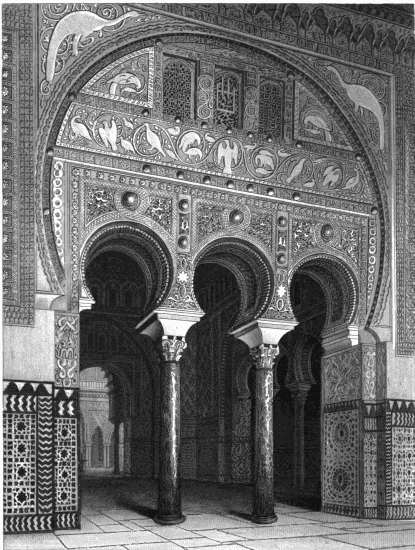
LETTER XVIII.
THE ARABS IN SPAIN. ALCAZAR OF SEVILLE.
Seville.
The chief attraction of this most interesting of the provinces of the Peninsula, consists in the numerous well preserved remains of Arab art. The most sumptuous of their palaces are, it is true, no longer in existence, nor the principal mosques, with the exception of the metropolitan temple of Cordova: but there remain sufficient specimens to shew, that their architecture had attained the highest excellence in two of the principal requisites for excellence in that science—solidity and beauty.
The superiority of the Arabs in this branch of science and taste is so striking, that all other departments of art, as well as the customs and peculiarities of that race, and the events of their dominion in this country, become at once the subjects of interest and inquiry. It is consequently very satisfactory to discover that one can examine almost face to face that people,—probably the most advanced in science and civilization that ever set foot in Europe; so little are the traces of their influence worn away, and so predominant is the portion of it still discernible in the customs, manners, and race of the population of this province, and even to a considerable extent in their language.
There is something so brilliant in the career of the Arab people, as to justify the interest excited by the romantic and picturesque (if the expression may be allowed), points of their character and customs. Their civilization appears to have advanced abreast with their conquests, and with the same prodigious rapidity; supposing, that is, that previously to their issuing from their peninsula, they were as backward as historians state them to have been: a point not sufficiently established. Sallying forth, under the immediate successors of Mahomet, they commenced, in obedience to the injunction of their new faith, a course of conquest unrivalled in rapidity. Their happy physical and mental organization, enabled them to appropriate whatever was superior in the arts and customs of the conquered nations; and whatever they imitated acquired during the process of adaptation, new and more graceful modifications. It has been asserted that they owed their civilization to the Greeks; and, certainly, the first subjected provinces being Greek, their customs could not but receive some impression from the contact; but it is not probable that the Greeks were altogether their instructors in civilization. Had such been the case their language would probably have undergone a change, instead of continuing totally independent of the Greek, and attaining to greater richness. They are known to have possessed poets of eminence before the appearance of Mahomet, consequently before they had any communication with the Greeks; shortly after the commencement of their intercourse with them, they shewed a marked superiority over them in geometry, in astronomy, architecture, and medicine, and it would probably be found, but for the destruction of so many Arab libraries, that they did not yield to them in eloquence and poetic genius.
Established in Spain, they carried the arts of civilization—the useful no less than the elegant, to the highest perfection. They introduced principles of agriculture adapted to the peculiarities of the country. The chief requisite for a country, parched by a cloudless sun, being water—they put in practice a complete system of irrigation, to which the Spaniards are still indebted for the extraordinary fertility of their soil. Many other arts that have since been permitted to dwindle into insignificance, and some altogether to disappear, were bequeathed by them. The Morocco preparation of leather is an instance of these last.
Their high chivalry, added to their moderation after victory, would have divested even war of much of its barbarism, had they had to do with a race less impenetrable, and more susceptible of polish than were the iron legions of their Gothic antagonists. The persevering and repeated acts of treachery practised by these, at last drew their civilized adversaries, forcibly into the commission of acts of a similar nature—it being frequently necessary in self-defence to adopt the same weapons as one's enemy. When firmly settled in Spain, the Arabs no longer appear to have taken the field with a view to conquest. Abderahman the First, Almansor, and other conquerors, returned from their victories to repose in their capital; contenting themselves with founding schools and hospitals to commemorate their successes, without making them instrumental to the increase of their domination. After this time campaigns seem frequently to have been undertaken from motives of emulation, and for the purpose of affording them opportunities for a display of their prowess, and giving vent to their military ardour. They considered an irruption on the hostile territory, or an attack on a town, in the light of a tournament. The Christians, on the contrary, fought with a view to exterminate, and without ever losing sight of their main object—the expulsion of the Arabs and Moors from the Peninsula. It was thus that they ultimately succeeded—a result they probably would not have attained, had the Moorish leaders been actuated by similar views, and displayed less forbearance.
Much of the misapprehension which exists in Europe respecting this race is attributable to the exaggerations of writers; much more to the absence of reflection in readers, and to the almost universal practice of bringing every act related of personages inhabiting remote and half-known climes, to the test of the only customs and manners with which we are familiar, and which we consider, for no other reason, superior to all others—making no allowance for difference of education, climate, tradition, race. An European, subjected to a similar process of criticism, on the part of an inhabitant of the East, would certainly not recognise his own portrait—a new disposition of light bearing upon peculiarities, the existence of which had hitherto been unsuspected by their owner; and he would manifest a surprise as unfeigned, as a Frenchman once expressed in my hearing, on finding himself in a situation almost parallel. Conversing on the subject of a play, acted in Paris, in which an Englishman cut a ridiculous figure—a lady present remarked, that, no doubt, in the London theatres the French were not spared; upon which the Frenchman I allude to—a person possessed of superior intelligence—exclaimed: "How could that be, since there was nothing about a Frenchman that could be laughed at?"
On reading of a reprehensible act attributed to a Mahometan, some will brand Mahometanism in general, and of all times and places, with the commission of the like crimes, placing the event at a distance of a thousand leagues, or of a thousand years from its real place and date: forgetting that power has been abused under all religions; and that we only hear one side of the question with respect to all that relates to the Oriental races—our information only reaching us through the medium of writers of different and hostile faith. It is a singular fact that the popular terror, which so long attached itself to the idea of a Saracen, and which derived its origin from the conquests of the Mahometans, has its equivalent in certain Mahometan countries. In some parts of the empire of Morocco, the idea of a Christian is that of a ruffian of immense stature and terrific features; calculated to inspire the utmost fear in the breasts of all who approach him. Such is their notion of his ferocity, that one of the emperors, Muley Ismael, in order to terrify his refractory subjects into obedience, was in the habit of threatening to have them eaten up by the Christians.
From the inferior value set on human life by the races of the East, we accuse them of barbarity: forgetting, that, owing to the absence of all analogy between our origin, races, and education, we are incompetent to appreciate their feelings, and the motives of their conduct, and have consequently no right to condemn them. If we abstain from taking our neighbour's life, we set also a proportionate value on our own: a native of the East displays, it is true, less veneration for his own species. Deeply impressed with the dogmas of his religion, which form the guide of his every day life, the habit of acting up to the doctrines which he has been taught to believe, diminishes his estimate of the value of temporal life, whether that of others, or his own, which he exposes on occasions on which we should not be inclined to do so. He does not take life for cruelty's sake, nor without provocation. Were he to be furnished with Arabian accounts of the treatment of a London or Paris hackney-coach horse, he would think of the noble and friendly animal which carries him to battle, and turn in disgust from such a page.
The system practised at Constantinople of nailing to his door-post the ear of the culprit detected in the employment of false weights, is, no doubt, very discordant with our customs; but this mode of punishment is said to be attended with such success, as to do away almost entirely with the occasion for it. Were it adopted in some other capitals, it would certainly at first disfigure many a neatly adorned entrance, and give additional occupation to painters; but the result might possibly be a more universal observance of the injunction contained in the eighth commandment. As far as regards the Arabs of Spain, it may be securely affirmed, that, during the course of their triumphs, and long before they had attained their highest civilization, no cruelties were exercised by them, which came near to the barbarity of those practised subsequently by their Christian adversaries on victims of a different creed, when in their power. We may instance the example set by St. Ferdinand, who, it is said, when burning some Moors, piously stirred up the fire himself in the public place of Palencia.
It cannot, however, be denied that cases of cruelty have occurred, and are related in history of the Arabs, although they are rare among those of Spain; but, if cruel, the Arab never added hypocrisy to his cruelty. After having ravaged all Andalucia with fire and famine, St. Ferdinand formed the project of proceeding to Africa the following year, in order to attack the inhabitants of that country. His death interrupted the course of these humane projects. Being dropsical, and feeling his end approaching, he called for his son Alphonso, afterwards his successor, to whom this prince—cut off in the midst of his thirsty longings for blood and slaughter—is related to have given "the counsels, which the sentiments of piety, justice, and love for mankind, with which he was filled, inspired so great a monarch."
As for the degenerate modern tribes, descendants of some of the most civilized of former days, we have witnessed their contest, pro aris et focis, during the last few years, against a sample of the Christians of to-day: the mode of making war is perfectly similar on both sides.
It is a no less curious travers of human nature, from its being an almost universal one—that of which the modern Spaniards afford an example. They apply the term "barbarians" to the descendants of their Moorish compatriots, although they themselves have scarcely advanced a step in civilization since the day that, in the public place of Granada, Ferdinand the Catholic burned one million five thousand Arab books, being all he could collect throughout Spain; showing what tremendous power may be wielded by a single human hand, when applied to the task of undoing. That King, by a single signature, accomplished an act which may be considered as equivalent to retarding, by several centuries, the civilization of a great country,—perhaps, even, to cutting it off from the only opportunity it was destined to possess, during the present ages, of arriving at the summit which the more privileged nations are permitted to attain; while it influenced injuriously the progress of letters, science, and art throughout Europe. But we will no longer allow digressions to delay our visit to the Alcazar, where we shall find visible proof of Arab superiority, at least, in architectural science and invention.
Passing to the east of the cathedral through the large open space, on the left of which is the Archbishop's palace, and on the right the cathedral and exchange, the embattled outer walls of the Alcazar stop the view in front; varied here and there with square towers, and containing in the centre an arched entrance. The present buildings occupy the south-eastern corner of the ancient enclosure of the royal residence, which comprised all the remaining space as far as the banks of the river, passing round the south side of the cathedral, and, in fact, including it in its precincts—an enclosure of about a mile and a half in circumference. An old tower, or scrap of wall, indicates here and there the position of the ancient buildings, the site of which is now occupied by two or three plazuelas, or squares, and several streets communicating between them. The present palace scarcely covers a third of the original extent.
FAÇADE OF THE ALCAZAR, SEVILLE.
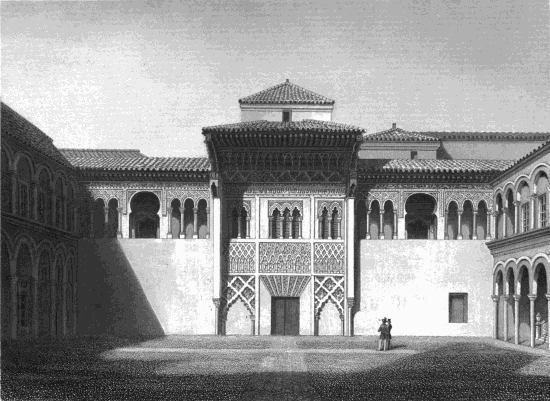
Having passed through the first entrance, you are in a large square, surrounded with buildings without ornament, and used at present as government offices. At the opposite side another archway passes under the buildings, and leads to a second large court. This communicates on the left with one or two others; one of these is rather ornamental, and in the Italian style, surrounded by an arcade supported on double columns, and enclosing a garden sunk considerably below the level of the ground. This court is approached by a covered passage, leading, as already mentioned, from the left side of the second large square, the south side of which—the side opposite to that on which we entered—consists of the façade and portal of the inner palace of all;—the Arab ornamental portion, the residence of the royal person.
At the right-hand extremity of this front is the entrance to the first floor, approached by a staircase, which occupies part of the building on that side of the square, and which contains the apartments of the governor. The staircase is open to the air, and is visible through a light arcade. The centre portal of this façade is ornamented, from the ground to the roof, with rich tracery, varied by a band of blue and white azulejos, and terminating in an advancing roof of carved cedar. Right and left, the rest of the front consists of a plain wall up to the first floor, on which small arcades, of a graceful design, enclose retreating balconies and windows.
Entering through the centre door, a magnificent apartment has been annihilated by two white partitions, rising from the ground to the ceiling, and dividing it into three portions, the centre one forming the passage which leads from the entrance to the principal court. Several of the apartments are thus injured, owing to the palace being occasionally used as a temporary lodging for the court. Passing across the degraded hall, a magnificent embroidered arch—for the carving with which it is covered more resembles embroidery than any other ornament—gives access to the great court.
It is difficult to ascertain what portion of this palace belongs to the residence of the Moorish Kings, as Pedro the Cruel had a considerable portion of it rebuilt by Moorish architects in the same style. The still more recent additions are easily distinguished. One of them, in this part of the edifice, is a gallery, erected by Charles the Fifth, over the arcades of the great court. This gallery one would imagine to have been there placed with a view to demonstrate the superiority of Arab art over every other. It is conceived in the most elegant Italian style, and executed in white marble; but, compared with the fairy arcades which support it, it is clumsiness itself. The court is paved with white marble slabs, and contains in the centre a small basin of the same material, of chaste and simple form, once a fountain. The arcades are supported on pairs of columns, measuring about twelve diameters in height, and of equal diameter throughout. The capitals are in imitation of the Corinthian. The entire walls, over and round the arches, are covered with deep tracery in stucco; the design of which consists of diamond-shaped compartments, formed by lines descending from the cornice, and intersecting each other diagonally. These are indented in small curves, four to each side of the diamond. In each centre is a shell, surrounded by fanciful ornaments. The same design is repeated on the inside of the walls, that is, under the arcade, but only on the outer wall; and this portion of the court is covered with a richly-ornamented ceiling of Alerce, in the manner called artesonado.
On the opposite side of the court to that on which we entered, another semicircular arch, of equal richness, leads to a room extending the whole length of the court, and similar in form to that situated at the entrance, possessing also an ornamental ceiling, but plainer walls. The left and right sides of the court are shorter than the others. In the centre of the left side, a deep alcove is formed in the wall, probably occupied in former times by a sofa or throne: at present it is empty, with the exception, in one corner, of a dusty collection of azulejos fallen from the walls, and exposing to temptation the itching palms of enthusiasts. At the opposite end a large arch, admirably carved, and containing some superb old cedar doors, leads to the Hall of Ambassadors. This apartment is a square of about thirty-three feet, by nearly sixty in height. It is also called the media naranja (half-orange), from the form of its ceiling.
GREAT COURT OF THE ALCAZAR, SEVILLE.
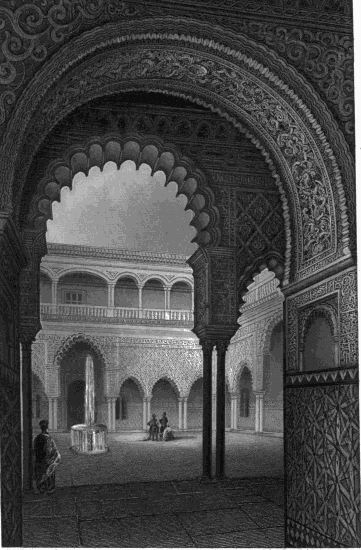
In the centre of each side is an entrance, that from the court consists of the arch just mentioned, forming a semicircle with the extremities prolonged in a parallel direction. Those of the three other sides are each composed of three arches of the horse-shoe form, or three-quarters of a circle, and supported by two columns of rare marbles and jasper surmounted by gilded capitals. The walls are entirely covered with elegant designs, executed in stucco, the effect of which suffers from a series of small arches, running round the upper part of the room, having been deprived of their tracery to make room for the painted heads (more or less resembling) of the kings of Spain, Goths and their successors, excepting the Arabs and Moors. This degradation is, however, forgotten from the moment the eye is directed to the ceiling.
In the Arab architecture, the ornament usually becomes more choice, as it occupies a higher elevation; and the richest and most exquisite labours of the artist are lavished on the ceilings. The designs are complicated geometrical problems, by means of which the decorators of that nation of mathematicians and artists attained to a perfection of ornament unapproached by any other style. From the cornice of this room rise clusters of diminutive gilded semi-cupolas, commencing by a single one, upon which two are supported, and multiplying so rapidly as they rise, some advancing, others retreating, and each resting on a shoulder of one below, that, by the time they reach the edge of the great cupola, they appear to be countless. The ornament of this dome consists of innumerable gilt projecting bands, of about two inches in width; these intersect each other in an infinite profusion of curves, as they stretch over the hemispherical space. The artist, who would make a pencil sketch of this ceiling, should be as deep a geometrician as the architect who designed it.
On quitting the Hall of Ambassadors, we arrive at the best part of the building. Passing through the arcade at the right-hand side, a long narrow apartment is crossed, which opens on a small court called the Court of Dolls (Patio de los Muceñas). No description, no painting can do justice to this exquisite little enclosure. You stand still, gazing round until your delight changes into astonishment at such an effect being produced by immoveable walls and a few columns. A space, of about twenty feet by thirty,—in which ten small pillars, placed at corresponding but unequal distances, enclose a smaller quadrangle, and support, over a series of different sized arches, the upper walls,—has furnished materials to the artist for the attainment of one of the most successful results in architecture. The Alhambra has nothing equal to it. Its two large courts surpass, no doubt, in beauty the principal court of this palace; but, as a whole, this residence, principally from its being in better preservation and containing more, is superior to that of Granada, always excepting the advantage derived from the picturesque site of the latter. The Court of Dolls, at all events, is unrivalled.
COURT OF DOLLS, ALCAZAR, SEVILLE.[10]
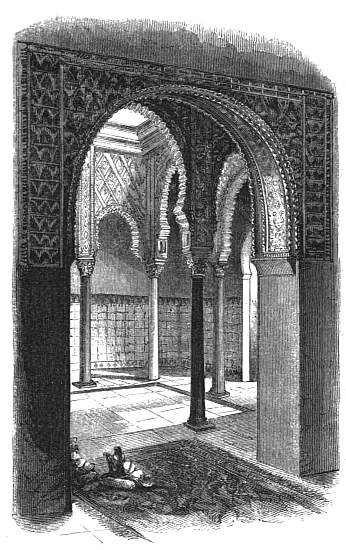
The architect made here a highly judicious use of some of the best gleanings from Italica, consisting of a few antique capitals, which, being separated from their shafts, have been provided with others, neither made for them, nor even fitted to them. The pillars are small, and long for their diameter, with the exception of the four which occupy the angles, which are thicker and all white. The rest are of different coloured marbles, and all are about six feet in height. The capitals are of still smaller proportions; so that at the junction they do not cover the entire top of the shaft. This defect, from what cause it is difficult to explain, appears to add to their beauty.
The capitals are exquisitely beautiful. One in particular, apparently Greek, tinged by antiquity with a slight approach to rose colour, is shaped, as if carelessly, at the will of the sculptor; and derives from its irregularly rounded volutes and uneven leaves, an inconceivable grace. The arches are of various shapes, that is, of three different shapes and dimensions, and whether more care, or better materials were employed in the tracery of the walls in this court, or for whatever other reason, it is in better preservation than the other parts of the palace. It has the appearance of having been newly executed in hard white stone.
Through the Court of Dolls you pass into an inner apartment, to which it is a worthy introduction. This room has been selected in modern times, as being the best in the palace, for the experiment of restoring the ceiling. The operation has been judiciously executed, and produces an admirable effect. The design of this ceiling is the most tasteful of the whole collection. Six or seven stars placed at equal distances from each other, form centres, from which, following the direction of the sides of their acute angles, depart as many lines; that is, two from each point; or, supposing the star to have twelve points—twenty-four from each star: but these lines soon change their directions, and intersecting each other repeatedly, form innumerable small inclosures of an hexagonal shape. The lines are gilt. Each hexagonal compartment rises in relief of about an inch and a half from the surface, and is ornamented with a flower, painted in brilliant colours on a dark ground.
The room is twenty-four feet in height by only sixteen wide, and between sixty and seventy in length. At the two ends, square spaces are separated from the centre portion by a wall, advancing about two feet from each side, and supporting an arch, extending across the entire width. These arches were probably furnished with curtains, which separated at will the two ends from the principal apartment, and converted them into sleeping retreats. Their ornaments are still more choice than those of the centre. With the exception of this room, all the principal apartments, and the two courts, are decorated from the ground upwards to a height of about five feet, with the azulejos, or mosaic of porcelain tiles, the colours of which never lose their brilliancy.
The first floor is probably an addition made entirely subsequently to the time of the Moors. It contains several suites of plain white-washed rooms, and only two ornamental apartments, probably of Don Pedro's time. These are equal to those on the ground floor with respect to the tracery of the walls, unfortunately almost filled with white-wash; but their ceilings are plainer. There is a gallery over the Court of Dolls, of a different sort from the rest, but scarcely inferior in beauty to any part of the edifice. The pillars, balustrades, and ceilings, are of wood.
One of the last mentioned apartments has an advantage over all the rest of the palace, derived from its position. It opens on a terrace looking over the antique gardens,—a view the most charming and original that can be imagined. This room must be supposed to have been the boudoir of Maria Padilla,—the object of the earliest and most durable of Pedro's attachments; whose power over him outlived the influence of all his future liaisons. It is indeed probable that the taste for this residence, and the creation of a large portion of its beauties, are to be attributed to the mistress, rather than to a gloomy and bloodthirsty king, as Pedro is represented to have been, and whose existence was totally unsuited to such a residence. In the Court of Dolls the portion of pavement is pointed out on which his brother Don Fadrique fell, slaughtered, as some say, by Pedro's own hand,—at all events in his presence, and by his order.