PART II. (continued 2)
Reading edition
This monarch, were his palace not sufficient to immortalize him, would have a claim to immortality, as having ordered more executions than all the other monarchs who ever ruled in Spain, added together. It appears to have been a daily necessity for him; but he derived more than ordinary satisfaction when an opportunity could be obtained of ordering an archbishop to the block. The see of Toledo became under him the most perilous post in the kingdom, next to that of his own relatives: but he occasionally extended the privilege to other archbishopricks. It is a relief to meet with a case of almost merited murder in so sanguinary a list. Such may be termed the adventure of an innocent man, who, seeing before him a noose which closes upon everything which approaches it, carefully inserts his neck within the circumference.
This was the case of a monk, who, hearing that Pedro, during one of his campaigns, was encamped in a neighbouring village, proceeded thither, and demanded an audience. His request being immediately granted, no doubt in the expectation of some valuable information respecting the enemy's movements, the holy man commenced an edifying discourse, in which he informed Don Pedro, that the venerabilissimo San Somebody (the saint of his village) had passed a considerable time with him in his dream of the previous night: that his object in thus miraculously waiting upon him was, to request he would go to his Majesty, and tell him, that, owing to the unpardonable disorders of his life, it was determined he should lose the approaching battle. It was the unhappy friar's last sermon; for in less than five minutes he had ceased to exist.
It stands to reason, that, owing to the retired habits of this friar, a certain anecdote had never reached his ear relative to another member of a religious fraternity. At a period that had not long preceded the event just related, the misconduct of this sovereign had drawn down upon him the displeasure of the head of the church.[11] The thunderbolt was already forged beneath the arches of the Vatican; but a serious difficulty presented itself. The culprit was likely to turn upon the hand employed in inflicting the chastisement. At length a young monk, known to a member of the holy synod as a genius of promise, energetic and fertile in resources, was made choice of, who unhesitatingly undertook the mission. He repaired to Seville, and after a few days' delay, employed in combining his plan of operation, he got into a boat, furnished with two stout rowers, and allowing the current to waft him down the Guadalquivir, until he arrived opposite a portion of the bank known to be the daily resort of the King, he approached the shore, and waited his opportunity.
At the accustomed hour the royal cavalcade was seen to approach; when, standing up in the boat, which was not allowed to touch the shore, he made signs that he would speak to the party. The monkish costume commanded respect even from royalty, and Don Pedro reined in his horse. The monk then inquired whether it would gratify his Majesty to listen to the news of certain remarkable occurrences that had taken place in the East, from which part of the world he had just arrived. The King approached, and ordered him to tell his story: upon which he unrolled the fatal document, and with all possible rapidity of enunciation read it from beginning to end.
Before it was concluded, the King had drawn his sword, and spurred his horse to the brink of the water; but at his first movement the boat had pushed off,—the reader still continuing his task,—so that by the time Pedro found himself completely excommunicated, his rage passing all bounds, he had dashed into the water, directing a sabre cut, which only reached the boat's stern. He still, however, spurred furiously on, and compelled his horse to swim a considerable distance; until, the animal becoming exhausted, he only regained the shore after being in serious danger of drowning. It may easily be imagined that the papal messenger, satisfied with his success, avoided the contact of terra firma, until he found himself clear of Pedro's dominions.
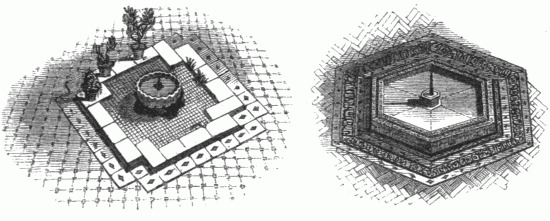
Quitting the room—that of Maria Padilla (according to my conjecture) by the door which leads to the terrace, you look down on a square portion of ground, partitioned off from the rest by walls, against which orange-trees are trained like our wall-fruit trees, only so thickly that no part of the masonry is visible. All the walls in the garden are thus masked by a depth of about eight inches of leaves evenly clipped. In the fruit season the effect is admirable. The small square portions next to the palace thus partitioned off are laid out in flower-beds, separated by walks of mixed brick and porcelain, all of which communicate with fountains in the centres. The fountains, simple and destitute of the usual classical menagerie of marine zoology and gods and goddesses, whose coöperation is so indispensable in most European gardens to the propulsion of each curling thread or gushing mass of the cold element,—derive all their charm from the purity and taste displayed in their design. One of the most beautiful of them consists merely of a raised step, covered with azulejos, enclosing a space of an hexagonal form, in the centre of which the water rises from a small block of corresponding form and materials. The mosaic is continued outside the step, but covers only a narrow space.
FOUNTAINS AT THE ALCAZAR.
The terrace stretches away to the left as far as the extremity of the buildings, the façade of which is hollowed out into a series of semicircular alcoves; there being no doors nor windows, with the exception of the door of the room through which we issued. The alcoves are surrounded with seats, and form so many little apartments, untenable during the summer, as they look to the south, but forming excellent winter habitations. Arrived at the extremity of the palace front, the promenade may be continued at the same elevation down another whole side of the gardens, along a terrace of two stories, which follows the outer enclosure. This terrace is very ornamental. From the ground up to a third of its height, its front is clothed with the orange-tree, in the same manner as the walls already described. Immediately above runs a rustic story of large projecting stones, which serves as a basement for the covered gallery, or lower of the two walks. This gallery is closed on the outside, which is part of the town wall. The front or garden side is composed of a series of rustic arches, alternately larger and smaller, formed of rugged stones, such as are used for grottoes, and of a dark brown colour—partly natural, partly painted.
The arches are supported by marble columns, or rather fragments of columns,—all the mutilated antique trunks rummaged out of Italica. For a shaft of insufficient length a piece is found of the dimensions required to make up the deficiency, and placed on its top without mortar or cement. Some of the capitals are extremely curious. Among them almost every style may be traced, from the Hindoo to the Composite: but no one is entire, nor matched with any part of the column it was originally destined to adorn. Over this gallery is the open terrace, which continues that of the palace side on the same level. The view extends in all directions, including the gardens and the surrounding country; for we are here at the extremity of the town. At the furthest end the edifice widens, and forms an open saloon, surrounded with seats, glittering with the bright hues of the azulejos.
From these terraces you look down on the portion of the garden in which the royal arms are represented, formed with myrtle-hedges. Eagles, lions, castellated towers,—all are accurately delineated. Myrtle-hedges are also used in all parts of the gardens as borders to the walks. It is a charming evening's occupation to wander through the different enclosures of these gardens, which, although not very extensive, are characterised by so much that is uncommon in their plan and ornaments, that the lounger is never weary of them. Nor is the visible portion of their attractions more curious than the hidden sources of amusement and—ablution, by means of which an uninitiated wanderer over these china-paved walks, may be unexpectedly, and more than necessarily refreshed. By means of a handle, concealed—here in the lungs of some bathing Diana in the recesses of her grotto—here in the hollow of a harmless looking stone—an entire line of walk is instantaneously converted into a stage of hydraulics—displaying to the spectator a long line of embroidery, composed of thousands of silver threads sparkling in the sunshine, as issuing from unseen apertures in the pavement they cross each other at a height of a few feet from the ground, forming an endless variety of graceful curves. Almost all the walks are sown with these burladores, as they are termed.
A large portion of the grounds consists of an orange-grove, varied with sweet lemon-trees. The trees are sufficiently near to each other to afford universal shade, without being so thickly planted as to interfere with the good-keeping of the grass, nor with the movement of promenading parties. In the centre of this grove is a beautiful edifice,—a square pavilion entirely faced, within and without, with the azulejos, with the exception only of the roof. Around it is a colonnade of white marble, enclosing a space raised two feet above the ground, and surrounded by a seat of the same mosaic. The interior is occupied by a table, surrounded with seats.
The subterranean baths, called the baths of Maria Padilla, are entered from the palace end of the garden. They extend to a considerable distance under the palace, and must during the summer heats, have been a delightfully cool retreat.
This alcazar is probably the best specimen of a Moorish residence remaining in Europe. The Alhambra would, no doubt, have surpassed it, but for the preference accorded by the Emperor, Charles the Fifth, to its situation over that of Seville: owing to which he contented himself with building a gallery over the principal court at the latter; while at Granada, he destroyed a large portion of the old buildings, which he replaced by an entire Italian palace. At present the ornamented apartments of the Seville palace are more numerous, and in better preservation than those of the Alhambra.
Both, however, would have been thrown into the shade, had any proportionate traces existed of the palace of Abderahman the Third, in the environs of Cordova. Unfortunately nothing of this remains but the description. It is among the few Arab manuscripts which escaped the colossal auto-da-fé of Ferdinand and Isabella, and would appear too extravagant to merit belief, but for the known minuteness and accuracy of the Arab writers, proved by their descriptions of the palaces and other edifices which remain to afford the test of comparison.
The immense wealth lavished by these princes, must also be taken into consideration, and especially by the Caliphs of Cordova, who possessed a far more extended sway than belonged to the subsequent dynasties of Seville and Granada. According to a custom prevalent at their court, rich presents were offered to the sovereign on various occasions. Among others, governors of provinces, on their nomination, seldom neglected this practical demonstration of gratitude. This practice is to this day observed at the court of the Turkish Sultan, and serves to swell the treasury in no small degree. Abderahman the Third, having granted a government to the brother of his favourite, Ahmed ben Sayd, the two brothers joined purses, and offered a present made up of the following articles—accompanied by delicate and ingenious compliments in verse, for the composition of which they employed the most popular poet of the day:—Four hundred pounds weight of pure gold; forty thousand sequins in ingots of silver; four hundred pounds of aloes; five hundred ounces of amber; three hundred ounces of camphor; thirty pieces of tissue of gold and silk; a hundred and ten fine furs of Khorasan; forty-eight caparisons of gold and silk, woven at Bagdad; four thousand pounds of silk in balls; thirty Persian carpets; eight hundred suits of armour; a thousand shields; a hundred thousand arrows; fifteen Arabian, and a hundred Spanish horses, with their trappings and equipments; sixty young slaves—forty male, and twenty female.
The palace near Cordova, erected by this sovereign, was called Azarah (the Flower) after the name of his favourite mistress. Its materials consisted entirely of marble and cedar wood; and it contained four thousand three hundred columns. It was sufficiently spacious to lodge the whole court, besides a guard of cavalry. The gardens, as was usual with the Arabs, formed the part of the residence on which were lavished the greatest treasures of wealth, and the choicest inventions of taste. The fountains were endless in number and variety. On one of the most picturesque spots was situated an edifice called the Caliph's Pavilion. It consisted of a circular gallery of white marble columns with gilded capitals; in the centre rose a fountain of quicksilver, imitating all the movements of water, and glittering in the sun with a brightness too dazzling for the eye to support. Several of the saloons of this palace were ornamented with fountains. In one, which bore the name of the Caliph's Saloon, a fountain of jasper contained in the centre a golden swan of beautiful workmanship—and over it hung from the ceiling a pearl, which had been sent from Constantinople as a present from the Greek Emperor to Abderahman. The mosque of this palace surpassed in riches, although not in size, the Aljama of Cordova.
These were monuments worthy to have kings and caliphs for architects, for such they had. There is no doubt that the palace of Azahrah was planned and designed by the Caliph himself; and the founder of that dynasty, Abderahman the First, not only designed the magnificent mosque of Cordova, but presided daily over the progress of its erection. Possessed, as these sovereigns were, as well as all the well-born portion of their nation, of a highly cultivated education, the intervals of leisure, left them by war, were rarely thrown away in idleness. Abderahman the First was a poet, besides being a mathematician, an architect, and the first soldier of his time. Some of his writings have been preserved, and are among the Arab works collected and translated by Condé into Spanish. The following stanzas, addressed to a palm-tree, must be, as is always the case, still more beautiful in the original, although charming in the Spanish. The monarch of the Western Empire, after having vanquished his enemies, and pacified his dominions,—beloved by his subjects and by all who approached him, and possessed of the resources of science to occupy his mind, was nevertheless unhappy. He preferred his home in Asia to the splendours of an imperial throne in such a land as Andalucia. He caused a young palm-tree to be brought from Syria, and planted in a garden formed by him in the environs of Cordova; and it was his delight to sit in a tower constructed in the garden, and gaze at his tree.
It was to this tree he addressed the lines thus translated:—
Tu tambien, insigne palma,
Eres aqui forastera.
De Algarbe las dulces auras
Tu pompa halagan y besan.
En fecundo suelo arraigas,
Y al cielo tu cima elevas,
Tristes lagrimas lloraras,
Si qual io sentir pudieras.
Tu no sientes contratiempos
Como io de suerte aviesa:
A mi de pena y dolor
Continuas lluvias me annegan.
Con mis lagrimas regue
Las palmas que el Forat riega,
Pero las palmas y el rio
Se olvidan de mis penas.
Cuando mios infaustos hados,
Y de Al. Abas la fiereza
Mi forzaron de dexar
Del alma las dulces prendas;
A ti de mi patria amada
Ningun recuerda ti queda;
Pero io, triste, no puedo
Dexar de llorar por ella.
It is probable that on the occasion of the surrender of Cordova to Ferdinand the Third, the Moors destroyed their palace of Azarah, since they were desirous of acting in a similar manner at Seville, with regard to Geber's Tower. Perhaps from disgust at the idea that a monument, the beauty and grandeur of which had inspired them with a sort of affection, would be, being gazed at, trodden, and possibly disfigured, (as it turned out) by those whom they looked upon as barbarians, and who would not appreciate its perfection, they attempted to introduce a clause into the conditions of the surrender of Seville, stipulating the destruction of the tower.
By way of testifying to the accuracy of the opinion they had formed of their adversaries, Saint Ferdinand was on the point of agreeing to the clause: when his son, afterwards his successor, Alonso el Sabio, perhaps the only Christian present, who felt sufficient interest in a square mass of masonry, to care how the question was decided, energetically interfered, affirming that a single brick displaced, should be paid with the lives of the whole population.
This most perfect scientific monument left by the Arabs, for the possession of which, after the architect, Europe is indebted to Alonso the Tenth, we will presently examine, together with the cathedral, which was afterwards erected, so as to include it in his plan.
LETTER XIX
CATHEDRAL OF SEVILLE.
Seville.
We have visited the most beautiful edifice in Seville; we are now approaching the most magnificent. The native writers, participating somewhat in the character attributed to the inhabitants of their province, sometimes called the Gascony of Spain, declare this cathedral to be the grandest in the world. This is going too far; setting aside St. Peter's, and the Santa Maria del Fiore, the style of which renders the comparison more difficult, the Duomo of Milan, of which this building appears to be an imitation, must be allowed to be superior to it, externally at least, if not internally. Had they ranked it as the finest church out of Italy, they would not have been much in error, for such it probably is.
No one in approaching, excepting from the west, would imagine it to be a Gothic edifice. You perceive an immense quadrangular enclosure, filled apparently with cupolas, towers, pinnacles of all sorts and styles, but less of the Gothic than any other. These belong to the numerous accessory buildings, subsequently annexed to the church; such as sacristies, chapels, chapter-hall, each subsequent erection having been designed in a different style. The cathedral is inaccessible on the south side, that which we first reach in coming from the Alcazar. It is enclosed here within a long Italian façade of about thirty to forty feet elevation, ornamented by a row of Ionic pilasters, supporting an elegant frieze and balustrade. We therefore ascend the raised pavement, which, bounded by a series of antique shafts of columns, surrounds the whole enclosure; and having passed down the greater part of the east end, find a small portal close to the Giralda, which admits to the church through the court of orange-trees. Before we enter, we will look round on this view, which possesses more of the Moorish character, than that which awaits us in the interior. Some idea of the general plan of these buildings will be necessary, in order that you may perfectly understand our present point of view.
I mentioned above, that the general enclosure formed a square. This square, the sides of which face the four points of the compass, is divided by a straight line into two unequal parts, one being about a third wider than the other. The direction of the line is east and west; to the south of it is the cathedral, to the north, the Moorish court of orange-trees. The Arab Tower, now called the Giralda, stands in the north-east angle of the cathedral, and the small door, through which we have just entered, in the south-eastern angle of the court, is close by it.
The court is surrounded by buildings; for besides the church on its south side, a chapel called the Sagrario, runs down the entire western end. The east side and half the north are occupied by arcades, which support the library, the gift of the son of Columbus to the cathedral; and the remaining half side by a sacristy. The buildings of the east and north sides lean against the old embattled wall on the outside. The chapel of the Sagrario to the west is in the Italian style. Avenues of orange-trees, and a marble fountain of a simple but choice design, are the only objects which occupy the open space. Throughout it reigns an eternal gloom, maintained by the frowning buttresses and pinnacles of the cathedral, which overhang it from the south.
A small doorway, near to that by which we entered the court, gives access to the cathedral at all hours. On entering an almost more than twilight would confuse the surrounding objects, did it immediately succeed the sunshine of Andalucia; and were not the transition rendered gradual to the eye by the deep shades of the orange court. As you advance towards the centre nave, this darkness aids in producing the effect of immensity, which is the next idea that presents itself. In fact the enormous elevation and width of the edifice is such as at first to overpower the imagination, and to deprive you of the faculty of appreciating its dimensions. It produces a novel species of giddiness arising from looking upwards.
INTERIOR OF THE CATHEDRAL, SEVILLE.
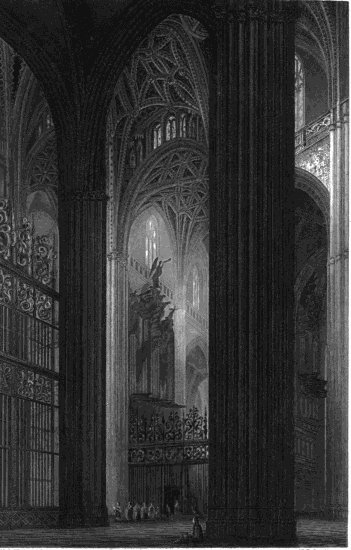
To arrive at the intersection of the principal nave and transept, you traverse two side naves, both about eighty-five feet in height, and spacious in proportion. The centre nave is a hundred and thirty-two feet, but rises at the quadrangle, forming its intersection with the transept about twenty feet higher. The ceiling here, and over the four surrounding intercolumniations, is ornamented with a groining of admirable richness. That of the centre quadrangle is here and there tinged with crimson and orange tints, proceeding from some diminutive windows placed between the lower and upper ceilings.
After having sufficiently examined the upper view, the eye wanders over the immense vacuum of the transept, and rests at length on the bronze railings which, on the east, separate you from the high-altar, and on the west from the choir. These are superb.
That of the Capilla Mayor rises to an elevation of sixty feet, and is throughout of the most elaborate workmanship. It is the work of a Dominican monk, who also executed the two pulpits. The choir forms, as usual, a sort of saloon, which occupies the centre of the church, that is, in this instance, two of the five intercolumniations which reach from the transept to the western portal. Passing round it, in the direction of the western doors, where the view is more open, the plan and style of the building are more easily distinguished. They are remarkably simple. The area is a quadrangle of three hundred and ninety-eight feet by two hundred and ninety-one, and is divided into five naves by four rows of pillars, all of about sixty feet elevation. The width of the centre nave and transept is fifty-nine feet, and the whole is surrounded by chapels. The distance between the pillars, of which there are only eight in each row, has the effect of generalizing the view of the whole edifice, and imparting to it a grandeur which is not obtained in the cathedral of Toledo, of almost equal dimensions; while the smaller and less gaudily coloured windows shed a more religious ray, and are preferable to those of Toledo, which, magnificent in themselves, attract an undue share of the observation, instead of blending into one perfect composition of architectural harmony.
Immediately above the arches of the principal nave and transept, at a height of about ninety feet, runs a balustrade, the design of which consists of a series of pointed arches. Above it are the windows, reaching nearly to the ceiling. They are painted in rather dark tints, and afford no more than a sort of demi-jour, which at the east end decreases to twilight. Rather more light is admitted towards the western extremity, from some windows of plain glass, in the lateral chapels, without which the pictures they contain could not be viewed; but from this end the high-altar is scarcely discernible. The simple grandeur of this view loses nothing by the absence of all ornamental detail: the portion most ornamented is the pavement, composed of a mosaic of the richest marbles. About half-way between the portals and the choir, are inserted two or three large slabs, bearing inscriptions; one of them is to the memory of Christopher Columbus; another to his son. There are no other details to draw the attention until we visit the chapels, in which all the treasures of art are dispersed. A few pictures are scattered here and there around the eastern part of the building; all of them are good. A large one of Zurbaran, in the north transept, is a master-piece. It represents St. Jerome, surrounded by an assembly of monks.
At the west end of the northernmost nave, the first door opens to a vast church, called the chapel of the Sagrario, already alluded to as forming the western boundary of the orange-court. It is nearly two hundred feet in length; in the Italian style; the orders Doric and Ionic, but loaded with heavy sculpture in the worst taste. After this a series of chapels, of a style analogous to the body of the edifice, succeed each other, commencing with that of San Antonio, and continuing all round the church. Several of them contain beautiful details of ornament, and handsome tombs. That of the Kings should be mentioned as an exception, with regard to the architecture, since its style is the plateresco. It contains the tombs of Alonzo the Tenth, and his Queen Beatrix, with several others. The most beautiful of these chapels is that of Nuestra Señora la Antigua, situated on the south side, below the transept. It forms a square of about thirty feet, and rises to an elevation of upwards of eighty. The walls are divided into stories and compartments, and covered, as is also the ceiling, with admirable frescos by Martinez and Rovera. At a side door leading to the sacristy, are two beautiful columns of verde antico. The high-altar is composed of jasper, from quarries which existed at the distance of a few leagues from Seville. The statues are by Pedro Cornejo; and there are handsome tombs let into the lower part of the walls. Four antique chandeliers, one in each corner, are designed with uncommon grace and originality. From the summit of a short column rises a silver stem, from different parts of which spring flat rods of the same metal, so slight as to bend with the smallest weight: they are of various lengths, and at the extremity of each waves an elegantly formed lamp. Each of these clusters assumes a pyramidal form, and produces a charming effect when lighted up on days of ceremony,—from their harmonizing with the rest of the decorations of the chapel, no less than from the elegance of their form.
Some of the chapels of this side, and east of the transept, communicate with other buildings, erected subsequently to the principal edifice, and consequently not comprised in its plan, nor analogous to its style. Thus, after passing through the chapel called Del Mariscal, situated at the south-east of the apse, you enter an anteroom, which leads to the chapter-hall. The anteroom is an apartment of handsome proportions, covered, in the intervals of a row of Ionic pilasters, with a series of pieces of sculpture in white marble. The hall itself is magnificent. It is an oval of fifty-seven feet in length, entirely hung with crimson velvet enriched with gold embroidery. Another of the side chapels leads to the smaller sacristy. I call it smaller because it is not so large as that which adjoins the orange-court; but it is the principal of the two. It is a superb saloon, upwards of seventy feet in length by about sixty wide, ornamented with a profusion of rich sculpture. The architect was Juan de Herrera.
From the floor to a height of about four feet, a spacious wardrobe, composed of large mahogany drawers, runs down the two longer sides of the room. These contain probably the richest collection that exists of gold and silver embroidered velvets and silks,—brocades—lace—scarfs and mantles ornamented with precious stones: all these are the ornaments belonging to altars and pulpits; robes, trains, and vestures of different sorts, worn on occasions of ceremony by the principal dignitaries. The cathedral of Seville is said to surpass all others in these ornaments.
In this sacristy are contained likewise the treasure of gold and silver vessels, and basins; innumerable crosses, reliquaries, chalices, boxes, and candlesticks; and, in an upright mahogany case of about twenty feet elevation, lined with white silk, the front of which opens like a door, stands the Custodia—a silver ornament about sixteen feet high, including its base. On the day of the Corpus Christi, the Host is placed in this Custodia, and carried in procession through Seville. The silver of which it is composed weighs seven hundred weight. But it must not be supposed from this circumstance that the ornament has a heavy appearance. It is a tapering edifice containing four stories, ornamented by as many orders of architecture. The general form is circular, diminishing up to the summit, which supports a single statue. Each story rests on twenty-four columns, most of which are fluted, and all, together with their capitals, remarkable for their delicacy of finish. Among these are numerous statues of saints, in whose costumes precious stones are introduced. In that of the statue of Faith, which stands in the centre of the lower story, are some of immense value. This ornament was the work of Juan de Arfe, the Cellini of Spain.
But the pictures are the richest treasure of this apartment. It is an epitome of the Cathedral, which may be called a gallery—one of the richest that exists—of the paintings of Spanish schools: consequently, according to the opinion of many—one of the best of all galleries. The pictures are not in great numbers, but they are well adapted to their situation, being the largest in dimension, and among the most prominent in value and merit, that have been produced by their respective painters.
By the greater portion of spectators, the Spanish artists, of what may be called the golden age of painting, will always be preferred to the Italian; because their manner of treating their subject, appeals rather to the passions than to the understanding. It is the same quality which renders the Venetian school more popular than the other schools of Italy; and the Italian music more attractive than the German—Rossini than Spohr or Beethoven. I do not mean that the preference will be the result of choice, in an individual who appreciates the two styles perfectly; but that the difference I allude to renders the works of the greatest masters of Italy less easily understood.
With all the intelligence and taste necessary for the appreciation of a picture of Raffaelle, many will have had a hundred opportunities of studying such a picture, and will nevertheless have passed it by, scarcely noticed; merely, because on the first occasion of seeing it, they have not immediately caught the idea of the artist, nor entered sufficiently into his feelings to trace the sparks of his inspiration scattered over the canvass. How many are there too careless to return to the charge, and thus to acquire the cultivation necessary to enable them to judge of such works, who the moment a Murillo, or a Zurbaran meets their view, will gaze on it with delight, for the simple reason, that it is calculated to strike the intelligence the least cultivated.
The Spanish artists usually endeavoured to produce an exact imitation of material nature; while the Italians aimed at, and attained higher results. The object of the Spaniards being less difficult of attainment, the perfection with which they imitated nature passes conception. To that they devoted all the energies of their genius; while you may search in vain in the best productions of Italy, not excepting the school of Venice, the one that most resembles the Spanish,—for anything approaching their success in that respect. By way of an example, in the Spasimo of Raffaelle, we trace the operations of the mind, as they pierce through every feature of every countenance, and the attitude of every limb throughout the grouping of that great master-piece of expression; from the brutal impatience of the one, and the involuntary compassion of the other executioner, up to the intensity of maternal suffering in the Virgin, and the indescribable combination of heaven and earth, which beams through the unequalled head of the Christ; but there is no deception to the eye. No one would mistake any of the figures for reality; nor exclaim that it steps from the canvass; nor does any one wish for such an effect, or perceive any such deficiency.
What, on the contrary, was the exclamation of Murillo before Campana's Descent from the Cross? This master-piece of Pedro de Campana is seen at the head of the sacristy of the cathedral. It was so favourite a picture with Murillo, that he used to pass much of his time every day, seated before it. On one occasion, his presence being required on an affair of importance, which he had forgotten, his friends found him at his usual post before the Descent; when, pointing to the figure of the Christ, he replied to their remonstrances, "I am only waiting until they have taken him down."
Although Murillo admired this perfect representation of material nature, his own works are exceptions, in fact almost the only exceptions, to this peculiarity of the Spanish masters. He partakes, indeed, of the qualities of both schools in an eminent degree. In intellectual expression and delineation of the operations of the mind, he is superior to all his countrymen, but inferior to the first Italian painters. In the material imitation of nature, he is superior to the greater number of the Italians, but inferior to the other principal Spanish artists. There is, at Madrid, a Christ on the Cross, of his, in which he has attempted this effect—an effort he ought rather to have despised. The picture contains no other object than the figure, and the cross of admirably imitated wood, on a simple black, or rather dark brown background, representing complete darkness. After sitting a short time before it, you certainly feel a sort of uncomfortable sensation, caused by the growing reality of the pale and tormented carcass; but it is not to be compared to the Descent of Campana. There the whole group is to the life, and no darkness called in to aid the effect. The drooping body is exposed to a powerful light, and hangs its leaden weight on the arms of those who support it, with a reality perfectly startling.
This picture is placed in the centre of the upper end of the sacristy, as being considered the best of those therein contained: but it is not without rivals. The few paintings placed here are first rate; particularly the portraits of the two archbishops of Seville, San Leandro, and San Isidore—two of Murillo's most exquisite productions. Some of the greatest compositions of this painter are contained in the chapels we have passed in review, where they serve for altar-pieces, each filling an entire side of a chapel. Of these large pictures, I think the best on the side we are visiting is the Saint Francis. The Saint is represented kneeling to a vision of the Virgin. It may certainly be ranked among Murillo's best efforts in the style he employed, when treating these celestial subjects, and which has been called his vaporous manner. To speak correctly, two of his three manners are employed in this picture, since the Saint is an instance of that called his warm manner.
On the opposite or north side of the cathedral, in the first chapel after passing the door of the Sagrario, is the San Antonio. This is probably the greatest work of Murillo in the two styles just mentioned, and certainly the most magnificent picture contained in the cathedral. On the lower foreground is the Saint, in adoration before the Christ, who appears in the centre, surrounded by the Heavenly Host.
No one but Murillo could ever have thus embodied his conception of a supernatural vision. On sitting down before this canvass, from which, as it extends across the whole chapel, no other object can draw off the attention, you speedily yield to the irresistible power of abstraction, and are lost in an ecstacy, nearly resembling that which the artist has sought to represent in the countenance and attitude of his Saint. The eye wanders in a sort of trance through the glorious assemblage of Heaven. The whole scene looks real: but it is only on taking time to study the details that you discover the prodigies of talent displayed in the drawing and finishing of this picture. An angel, suspended in front of the lower portion of the group, more especially attracts the attention. One leg is extended towards the spectator, the foreshortening of which is a marvel of execution.
Over the San Antonio, as it does not reach to the ceiling, there is a smaller picture, representing the Baptism of Christ, also by Murillo. In a chapel at the south-west angle of the church, there are several fine paintings by Luis de Vargas, one of the founders of the school of Seville.
In the choir, the collection of books for the chanting services is worth seeing. Of these immense folios, enclosed in massive covers, bound with a profusion of wrought metal mostly silver—may be counted upwards of a hundred. They are filled with paintings, infinite in minuteness and beauty. For the performances of the daily services and all duties, ordinary and extraordinary, within this edifice, more than eight hundred persons are employed. Five hundred masses are recited each day at the different altars: all of which taking place during the early part of the day, an idea may be formed of the business which goes on. Of the six or seven organs, I have heard three playing at the same time in different parts of the church; but so widely separated, as by no means to interfere with each other's harmony. One of them was one of the two great organs which face each other over the choir. These two play a duet once a year, on the day of the Corpus. The effect they produce is not so powerful as that produced at Toledo, but far more beautiful. At Toledo the two which correspond to these, are assisted on that occasion by a third, as powerful as both the others united, placed over the portal of the south transept, at an elevation of about seventy feet from the ground.
Among the ceremonies of the cathedral of Seville is one sufficiently unique to be deserving of notice. El baile de los seis (dance of the six), is performed by eight youths—probably by six originally—every evening during the feast of the Conception. It takes place in front of the high-altar, on which her statue is placed on that occasion. The service is one of especial solemnity; and, as such, accompanied, unfortunately as on all such occasions, by an orchestra of violins, to the exclusion of the organs. The singing commences at four o'clock in the afternoon, in the choir, and continues until half-past six, when all move in procession through the great railing, across the transept, and ascend the flight of steps which lead to the Capilla Mayor. Here they take their seats according to rank, on benches placed in rows from east to west, fronting a space which is left open down the centre, in front of the altar. The orchestra occupies a corner near the railing; and on the two front benches are seated—four facing four—the eight youths, dressed in the ancient Spanish costume, all sky blue silk and white muslin, and holding each his hat, also light blue, with a flowing white feather.
The chorus now recommences, but speedily drops; when the orchestra sounds a beautiful air in the waltz measure. This is played once by the instruments alone, and joined the second time by the voices of the eight boys, or youths of the age of sixteen to eighteen; who, after having accompanied a short time, start to their legs, and continue in the same strain. At the next reprise they all, as if by word of command, place their hats on their heads, and one or two minutes after, the chant still continuing, advance, and meet in the centre, then return each to his place; advance a second time, and turn round each other, using the waltz step.
After singing and dancing for about a quarter of an hour, the voices are exchanged for the sounds of castagnettes, which they have held all this time in their hands, and the measure becomes more animated; and thus they terminate the performance. The same ceremony is repeated each night of the seven; only varying the air of the waltz, of which they have two.
This ceremony, now belonging exclusively to the cathedral of Seville, was originally performed in some other cathedrals; but has been gradually laid aside in all the others, having been found to occasion irreverent behaviour among a portion of the spectators. It was originally introduced among the observances in honour of the anniversary of the Conception, as a natural manifestation of joy; and such a genuine Spanish bolero would have been: but the slow time of the music, and the measured movements, adopted for the purpose of suiting the performance to the solemnity of the place, have changed the nature of the dance, and deprived it of everything approaching to cheerfulness.
LETTER XX.
SPANISH BEGGARS. HAIRDRESSING. THE GIRALDA. CASA DE PILATOS. MONASTERIES. ITALICA.
Seville.
Mendicity is one of the Curiosities—and not the least picturesque one—of this antique country. There should be a Mendicity Society for its preservation, together with other legacies of the middle ages. An entertaining book might be filled with its annals and anecdotes.
Nowhere, I should think, can beggary be a more lucrative calling. The convents having been the inexhaustible providence of these tribes, on their suppression the well-born and bred Spaniards consider the charge to have devolved upon them, in the absence of all possible legislation on the subject: and few, especially of the fair sex, turn a deaf ear to the mute eloquence of the open hand. Even a stranger, if possessed of an ear, resists with difficulty the graceful appeal of the well trained proficient: Noble caballero, un ochavito por Dios.—A blind girl made no request; but exclaimed—"Oh that the Virgin of Carmen may preserve your sight!"
The mendicants are classified, and assume every form of external humanity. Being in the coach-office near the Plaza del Duque, a tall well-dressed man, dangling a dark kid glove, entered, and, walking up to the book-keeper, after having carefully closed the door, made some communication to him in a low voice. The other replied in a similar tone, and they parted with mutual bows. I was puzzled on the man's turning to me and observing that the beggars were very annoying in Seville; but still certain my conjecture could not but be erroneous, I said "you don't mean to say that your acquaintance"—"Oh, no acquaintance; I never saw him before: he only came to beg."
This species of cavallero pauper should by no means be encouraged; he is not of the picturesque sort. Nowhere do the wretches look their character better than at Seville; as all admirers of Murillo can testify, without consulting any other nature than his canvass. But these consider they confer a sort of obligation on the individual they condescend to apply to. Nothing can exceed their astonishment and indignation when refused. Their great highway is the superb polished mosaic marble of the Cathedral; where they divide the authority with the embroidered dignitaries of the choir. It is useless to hope for an instant's leisure for the contemplation of this unique temple, until you have disposed of its entire population of ragged despots.
A sort of chivalrous etiquette is observed, in virtue of which a female chorus is the first to form your escort from pillar to pillar. These dismissed, you are delivered over to the barefooted Murillos. There are two modes of escape. The rich man should go in with his two hands filled with coin, and distribute to all, even to many who will return for a second contribution before he has done. But if economical, you may attain the same end, and more permanently, by sacrificing four or five days to walking up and down the nave, without looking at anything, but simply undergoing the persecution of the mob. After the fourth visit you will be left in peace.
These counsels I am competent to give you from dreadful experience; more dreadful from my having pursued a middle course. To one barefooted and rotten-scalped embryo brigand I only gave a two-quarto piece (halfpenny) about equal in real consequence to twopence in England. If you have ever seen, in the era of mail coaches, the look of quiet surprise on the countenance of the well-fed charioteer, who, having, after the sixth or seventh stage, opened the door, and muttered from behind his cache-nez the usual "coachman, gen'lemen" received a long-searched-for deprecatory sixpence from some careful knight with a false shirt-collar—you have noticed the self-same look, which was leisurely transferred by the urchin from the piece of copper in the open palm to my face, and back to the piece of copper.
Instead, however, of restoring it to me, his indignation seemed to inspire him with a sudden resolution. He rushed to a kneeling Señorita a few paces distant, and interrupting her devotions by a pull at the side of her mantilla, he showed the coin in the open hand, while with the other he pointed to the culprit. If he meditated revenge, he should have made another choice, instead of deranging a garment, from the folds of which a real Andalucian mouth and pair of eyes, turning full on me, aimed a smile which, I need not inform you, was not dear at two quartos.
Could such a smile have been natural, and the expression of mere curiosity, or was it intended for a death-wound, dealt for another's vengeance? and did the velvet language of those eyes signify a horrible "Pallas te hoc vulnere," in favour of the ragamuffin I had offended? At all events, the incident lost him a more munificent remuneration, by driving me from the spot, and expelling from my head, a project previously formed, of inviting him to my fonda to be sketched.
With regard to the oft and still recurring subject of Spanish beauty, you are hereby warned against giving ear to what may be said by tourists, who, by way of taking a new view of an old subject, simply give the lie to their predecessors. It is true, that in the central provinces, the genuine characteristic Moro-Iberian beauty is rare, and that there is little of any other sort to replace it; but this is not the case with Andalucia, where you may arrive fresh from the perusal of the warm effusions of the most smitten of poets, and find the Houris of real flesh and blood, by no means overrated.
One of their peculiar perfections extends to all parts of the Peninsula. This is the hair; everywhere your eye lights upon some passing specimen of these unrivalled masses of braided jet; at which not unfrequently natives of the same sex turn with an exclamation—Que pelo tan hermoso!
I surprised the other day a village matron, whose toilette, it being a holiday afternoon, was in progress in no more secluded a tocador than the middle of the road. The rustic lady's-maid (whether the practice be more or less fashionable I know not) had placed on a stool, within reach of her right hand as she stood behind her seated mistress, a jug of fresh water. This did she lift, just as I approached, up to her mouth, into which she received as large a portion of its contents as could be there accommodated; while with her left hand she grasped the extremity of a mass of silken hair, black as the raven's wing, and an ell in length. Both hands now, stroking down the mass, spread it out so as to present a horizontal surface of as large an extent as possible, when, suddenly, from the inflated cheeks of the abigail, re-issued with a loud sound the now tepid liquid, and bathed the entire surface, which it seemed to render, if possible, still more glossy than before. The rest of the duty of the hands appeared to consist in repeatedly separating and replacing the handfuls, until the same proceeding was reacted.
The entrance to the Giralda is outside the cathedral. Before we make the ascent, we will walk to the extremity of the Moorish enclosure of the orange-court, along the raised pavement which surrounds the whole. At the angle there is an antique shaft of granite, higher than the rest of those placed at equal distances along the edge of the pavement. From that point the proportions of the tower are seen to advantage, while you are at the same time sufficiently near to observe the details of the carving, and of the windows, with their delicately formed columns of rare marbles; and to lose in a great measure the effect of the subsequent additions, which surmount and disfigure the work of Geber.
The Arabian part of the building is a square of about forty-five feet, and measures in elevation four times its width. The ornaments are not exactly alike on all the four sides. On the north side (our present view) the tracery commences at a height of eighty feet, up to which point the wall of brick is perfectly plain and smooth, with only the interruption of two windows, placed one above the other in the centre. The ornament, from its commencement to the summit, is divided into two lofty stories, surmounted by a third, of half the height of one of the others. The two first are divided vertically into three parts by narrow stripes of the plain wall. The centre portions contain two windows in each story, one over the other, making, with the two in the lower portion, six altogether, which are at equal distances from each other. The form of these windows is varied, and in all uncommonly elegant; some are double, with a marble column supporting their two arches, and all are ornamented round the arches with beautiful tracery, and furnished with marble balconies. At one of the balconies, the Muezzin, in Mahometan times was accustomed to present himself at each of the hours appointed for prayer, and to pronounce the sentences ordained by that religion for calling the people. The half-story at the summit is ornamented with a row of arches, supported by pilasters.
On the top of the tower were seen originally, four gilded balls of different sizes, one over the other, diminishing upwards; the iron bar on which they were fixed, was struck by lightning, and gave way, leaving the balls to roll over; since which period they were never restored to their place.
The additional buildings were not erected until the seventeenth century. They are not in themselves inelegant, with the exception of the portion immediately rising from the old tower, and containing the bells. This portion is of the same width as the tower, and appears to weigh it down with its heavy effect; on the summit of the whole, at about three hundred feet from the ground, is a colossal statue of bronze, representing Faith, holding in one hand a shield, and in the other an olive-branch. By means of the shield, the statue obeys the movements of the wind, and thus gives the name of Giralda (weather-cock) to the tower.
An interior tower, rather more than twenty feet square, runs up the whole height of the Moorish portion of the building; between which and the external walls an easy ascent is contrived on an inclined plane. The necessity of introducing light throughout the ascent accounts for the different elevation of the windows and ornaments of the different sides; but the architect has so managed this difficulty, that no bad effect is produced in the external view. At the lower part of the tower the ascent is sufficiently wide to admit of the passage of two men on horseback abreast; but it becomes narrower as it approaches the summit. Queen Christina is said to have been drawn up in a small carriage. The walls, both of the inner and outer tower, increase in thickness as they rise, and as the ascending plane decreases in width: a plan which appears opposed to the principle usually adopted by modern architects.
It is known that Geber was the architect of the Giralda, but no certainty exists respecting its date. The Spanish antiquarian Don Rodrigo Caro supposes it to have been erected during the reign of Benabet Almucamus, King of Seville, shortly before the appearance in Spain of the Almoravides; but this is no more than a conjecture, founded on the supposed wealth of that King, who possessed larger states than his successors, and who paid no tribute to the sovereigns of Castile.
Immediately over the highest story of the Moorish tower is the belfry. The bells are suspended on the centre of revolving beams, which traverse the open arches of the four faces of the tower. They are consequently in full view, as they throw their somersets and send forth their lively clatter on a dia de fiesta.
Their effect is very original, and as unlike as possible to the monotonous and melancholy cadence of an English peal. None of them are deep-toned nor solemn, but all high and sharp: so that being let loose in merry disorder, and without tune, they somehow appear to harmonize with the brilliant skies, just as the descending ding-dong in England suits the gloom of the northern heavens. Leave Seville, and never shall their tones steal on your memory without your being transported into a blaze of bright sunshine.
In Spain the houses of the grandees are not called palaces, as those of the same rank in Italy are usually termed. There is not even an intermediate term, such as mansion,—still less the hall—abbey, or castle. They have the last, but only applied in cases in which it is correctly and legitimately applicable. The Arab expression alcazar, composed of the article al and cazar, is so like the Spanish la casa (the house), that, not having at hand a professor of Arabic to consult, I will risk the assertion that it bore the same meaning; notwithstanding the opinion of several French writers who translate it château. Chenier, author of the history of Morocco, derives it from the word Caissar, which he considers synonymous with Cæsar: but this derivation appears to admit of much doubt, as the word would signify the Emperor, instead of his residence. Supposing it to signify the house, it must no doubt have meant the principal, or royal house. At present the two words are admitted into the Spanish language as one, which is applied indiscriminately to royal town-residences, whether castles or not, as well as the term palacio. But a private residence of whatever extent is modestly termed a house.
In this instance, as in many others, the proud contempt of high-sounding phraseology is common to Spain and England, where some of the most palace-like habitations are called Wentworth House, Hatfield House, Burleigh House: the very porters' lodges being sometimes such edifices as would claim the title of château in some other countries. But this same haughty modesty is rather individual than collective, and does not prevail as applied to towns and cities. In public acts and addresses, and even in the most homely precautionary warnings placarded at the corners of streets or promenades, the form used is,—"The constitutional Alcalde of this heroic and very invincible town of Madrid, or Seville, forbids, or orders, &c.;" and still more splendid epithets are found for the nation in general.
I don't know whether it has occurred to you that this progressive dereliction of consistency is universal in human nature, although it assumes a variety of forms. In the present instance modesty commences at home, as they say charity should.
By the way, if charity should commence at home, together with the other affections of the heart, such as patriotism, then did the first Brutus make a mistake. If, on the contrary, his merit was great in sacrificing his son to his nation, it follows, that, in causing his entire nation to be butchered the first time they were guilty of any encroachment on the rights of the rest of the world, his glory would have increased in the ratio of one to some millions.
He either acted on a principle of justice, or preferred the applause of his compatriots to the affection of his son. If, therefore, an opportunity was ever afforded him of doing the world the above-mentioned act of justice at the expense of his countrymen, and he abstained from it,—it being impossible to suppose a Roman republican capable of a dereliction of principle—it is clear that he preferred the applause of his nation to that of the rest of the world; and all becomes a question of taste. But what, you exclaim, has the first or any other Brutus to do with Pilate's house, the description of which is preceded by this long introduction? And was not his murder of his son benevolence itself, compared to the infliction of these digressions on your patience?
The Casa de Palatos is a palace belonging to the Duke of Medina Cœli. One of his ancestors is said to have built it in exact imitation of Pontius Pilate's palace in Jerusalem, and to have obtained possession of a large quantity of the ornaments and portable furniture belonging to the ancient building, which, on the completion of his edifice at Seville, he established, each object in the place corresponding to that which it originally occupied.
A lofty wall, filling the side of the small square, called the Plaza de Pilatos, and surmounted by a balustrade, forms the outer enclosure of the palace. You enter through a large plain arched doorway, and pass through a court, containing the porter's house, and other out-buildings devoid of ornament. A small door on the left leads from this enclosure to the principal court. Here you might imagine yourself still in the Alcazar. The ornament is in the same style; only the arcades are inferior in lightness and beauty. It contains, however, a fountain very superior to that of the principal court of the Alcazar.
At the four angles are colossal statues of white marble, representing deities of the Grecian mythology. They are antique, and of Roman origin. Under the arcades a series of busts of the Roman emperors, are placed round the walls; the greater part of them are also antique. On one side of this court is the chapel, very small, and entirely covered with Arabesque ornament. At one side is placed erect against the wall a black cross, said to be a facsimile imitation of that actually carried by our Saviour, which occupied a similar situation in the palace at Jerusalem. Its length is about seven feet, and the thickness of the wood about four inches by two. Opposite to the cross is a Madonna by Raffaelle. As no light enters the chapel, excepting through a small door, and that placed under the arcades, and the picture is hung at a considerable height, it can only be examined by the aid of a ladder, which is kept near it, and then only very imperfectly. At the time the chapel was habitually used, it probably contained candles always burning.
The great staircase is very ornamental and leads to several handsome suites of rooms. There is a colonnade on one side of the garden, under which lies a valuable collection of antique busts, columns, capitals, and fragments of all sorts, "in most admired disorder." The proprietor never visits this residence, and every part of it is in a very neglected state.
Seville lays claim to no less a founder than Hercules. A magnificent temple dedicated to him is said to have existed on the spot at present occupied by the parish church of San Nicholas. Near it a statue of the demigod has been discovered, together with six columns, four of which are sunk so deeply in the earth that they cannot be brought to light. The other two are placed on lofty pedestals, and adorn the largest of the promenades of Seville, that called the Alameda. One of them is surmounted by the statue mentioned above, and the other by one of Julius Cæsar. Venus is also stated to have shared with Hercules the devotions of the Sevillanos. The existence of her worship in ancient times is placed beyond a doubt by the well authenticated martyrdom of Saints Justa and Rufina, condemned for refusing to do honour to the rites of that goddess, and to figure in her processions.
These two martyrs to the Christian faith have pursued, on various subsequent occasions, a conduct calculated to afford a degree of advantage to an adversary, should he presume to accuse them of renegade propensities. They have manifested themselves determined protectors of the Arab tower, on every occasion of its being threatened with danger. Numerous instances are on record; the most remarkable of which, is one that has given rise to much controversy, and employed in more recent times the researches of learned men. The tradition states, that, during an earthquake, which took place in the year 1504, and of which a vivid description may be found at the end of a book, called the Regla Vieja, which exists in the archives of the cathedral—the two virgins were seen to support the tower and prevent it from falling, surrounding it with their arms, one on each side. It is also related that, on the occasion of a previous earthquake, that of the year 1396, voices were heard in the air, articulated by demons, crying, "Throw it down, throw it down;" and that others replied, "No, we cannot, for those villanous saints, Justa and Rufina, are guarding it." For these reasons it is usual, in paintings representing the Giralda, to place the figures of the two virgin Saints supporting it, one on either side; and a small model thus supported by images of the two martyrs, executed in wood, is carried in the principal religious processions. In all these representations, the figures stand rather taller than the tower.
The hospital of La Caridad is one of the principal attractions to strangers at Seville; for in its chapel is contained the picture, which passes for the master-piece of Murillo. The chapel is narrow and lofty, and the picture placed as near as possible to the ceiling. A sight of it can only be obtained at an angle of about twenty degrees. But the aching of the neck is unheeded during the examination of this superb picture. It is called Las Aguas, the Waters. Moses has just struck the rock, and stands in a simple and dignified attitude. In the complete contentment of his countenance there may be traced a mingled expression of pity and gratitude, as he looks on the scene which follows his action. The artist has given proof of consummate talent in the choice and treatment of his subject; which afforded him a variety of grouping, of expression, and of attitude, of which few were capable of taking better advantage.
This picture is a specimen of his natural style, and its success is considered, and I think justly, superior to that of any other of his works. The imitation of material nature is here carried to as great perfection as in many of his paintings; while at the same time nothing can surpass the poetry of the composition, nor the exquisitely harmonious grouping of the men and animals. In this last quality, Murillo is certainly unequalled. He seems also in this instance, to have reached the utmost limits of art in the expression of the countenances, throughout the different groups, whether employed in offering silent thanksgivings, or entirely absorbed in the eager effort to obtain for their parched lips a draught of the bright liquid. In the feeling displayed in these instances, and so well represented, there is, it is true, nothing elevated, but still it is feeling; and its materiality is amply made amends for, by the chief personage of the scene, in whose countenance nothing but the sublime can be traced.
Had Murillo not painted this picture and the Saint Elizabeth of Hungary, Spanish art must have contented itself with the second rank, and Raphael would have continued without a rival. These pictures occasion regret that such genius should have employed itself during a long period, on works of a different sort. The San Antonio and a few others, were no doubt productions worthy of the painter of the Aguas, and a hundred or two others are magnificent paintings; but the time employed on some of these, and on a still greater number of less prominent merit, would have been more profitably devoted to the production of two or three which might have ranked with these giant creations of his talent.
In viewing either of these compositions, the other speedily becomes present to the imagination, and forces you to draw a comparison between them. They have a sort of affinity in their subject as well as in their style. The sufferers of the St. Elizabeth, occupied with their torments and their gratitude, answer to those of the Aguas, engrossed also with almost parallel feelings. The Moses, tranquil and erect in the midst of the action which surrounds him, is the exact pendant of the majestic figure and compassionate countenance of the youthful princess, exercising her saintly charities. These pictures ought to be companions in the same gallery, were it possible for two such works to find their way into one and the same apartment. But that would be a consummation as hopeless as finding St. Peter's and the Duomo of Milan in the same town; Naples and Seville in one province, a London and a Paris in one country, an Ariosto and a Byron in the same language. It has more than once occurred to me, since I have seen these two pictures, that were Raphael's Spasimo and Transfiguration placed on one side of a room, and these two on the other, and the choice offered me which pair I would possess, I should never be able to come to a decision.
Another large picture by Murillo, the multiplying of the Loaves in the Desert, is suspended opposite the Aguas, and at the same elevation. On attempting to examine it, you are forcibly reminded by certain acute sensations in the region of the neck, of the unnatural position it has so long maintained, and you leave this picture, together with two others, placed near the entrance of the chapel, for a subsequent visit.
In the church of the Faubourg Triana, on the right hand after passing the bridge, are some excellent pictures, particularly a Conception by Murillo. The multitude of paintings left by this artist is incredible, when to all those scattered through Spain, France, and England, are added those preserved in this his native town. Almost all the good houses in Seville contain collections of pictures; and all the collections have their Murillos. There are no fewer than sixteen in the gallery of the Canon, Don Manuel Cepero; but this is the largest of the private collections, and the best, as it ought to be, since it is contained in Murillo's house. It is the residence occupied by him during the latter part of his life, and in which he died. Its dimensions and distribution are handsome. At the back of it there is a garden of limited extent, but in which not an inch of space is thrown away. Where there remains no room for choice flowers and orange trees, the walls are painted to prolong the illusion. The Canon possesses also several good paintings by Italian masters. I counted likewise four Rembrandts, and two of Rubens. Among the other private collections, that of the Alcalde Don Pedro Garcia is one of the richest; it contains a Santa Barbara of Cano, an exquisite picture. A Saint Joseph by Murillo, in the collection of the French Consul (a native of Seville) is admirable.
In most of the churches there is sufficient of this sort of attraction to make them worth a visit. In the convents nothing is left; in fact they no longer exist as convents. There may be one or two remaining in Seville, but I did not hear of them. The monastery of Jeronimites, and the Chartreuse—both situated in the environs—were the most considerable religious establishments of Seville. They are converted, one into a school, and the other into a porcelain manufactory. This last, the Chartreuse, contains in its church and refectory, plentiful traces of its former magnificence. An Englishman has purchased the monastery with three or four acres of ground, containing the immediate dependencies; and he is occupied with the labours which necessarily precede its appearance in its new character, replacing the butteries, kitchens, storehouses, and cells, by rows of pudding-shaped baking-houses.
He has, however, spared the chapel, which is to continue in its former state. All the stalls, the altar, and other immoveable furniture, remain as he found them. The pictures and statues had of course been previously removed. The woodwork is inimitable—the best I have seen in Spain; it would be impossible in painting to represent with more delicacy, the very texture of the drapery, the very veins of the hands, and hair of the beards—of figures of a quarter the natural dimensions. You are filled with astonishment, that the infinite patience necessary for this mechanical labour should have accompanied the genius which conceived and executed the incomparable figures and heads. The refectory, of which the ceiling is the principal ornament, is to be the great show-room for the display of the china. The fortunate manufacturer inhabits, with his family, the prior's residence—one of the most elegant habitations in the world: surrounding a court, which contains of course its white marble fountain and colonnades: and he is in treaty for the purchase of the orange-grove, the park of the monastery. This pleasure-ground is ornamented here and there with Kiosks, from which are obtained views of Seville, and the intervening Guadalquivir.
On the confiscation of this monastery, several magnificent pictures disappeared, a few of which have since been placed in the cathedral. Two alabaster monuments, belonging to the family of Medina Cæli, were also removed; they are placed in a church at present under repair. They are erect, and fit into the wall; measuring about forty feet in height. Their upper portion is adorned with several well-executed small statues.
The other convent—that dedicated to S. Geronimo, is situated on the opposite side of the river, about a mile higher up. It is not so beautiful as the Cartuja, but on a grander scale. The principal court is magnificent; it is surrounded with upper and lower arcades, respectively of the Ionic and Doric orders: the apartments and church are of corresponding extent; but have either been deprived of their ornaments, or were originally but sparingly decorated. A ci-devant governor of Seville—a general officer, very distinguished as a linguist, has turned schoolmaster, and taken up his abode here. The day of my visit happened to be the general's birthday, and a scene of much festivity presented itself. The schoolmaster's successor in his former post at Seville, had arrived, attended by the band of a cavalry regiment; and the great court having been converted into a ball-room, the marble arcades were made to ring with the thrilling cadences of the hautbois and clarionette—by way of a fitting afterpiece to the tragic chants of former days.
The relatives and friends of the students were present, so that the youthful dancers were well-provided with partners. The performances were French quadrilles, English hornpipes, German waltzes, Russian mazurkas, and Spanish fandangos. I had arrived too late for the first part of the entertainment, which consisted of a bull-fight, for which a temporary arena had been enclosed. The bulls were what are called novillos—that is, scarcely more than calves; as the full-grown animals would have been more than a match for their juvenile antagonists.
The ruins of the Roman city of Italica, to which I have already alluded, are situated four miles from Seville in ascending the river—and on the opposite bank. The whole town is underground, with the exception of a few houses in the part in which excavations have been made, and of the amphitheatre which occupies an eminence. No notice was taken in modern times of the existence of this buried town, until towards the end of the last century, when the remains of the amphitheatre, the only portion of the ruins which were visible, drew the attention of travellers: and the authorities of Seville received orders to commence excavating. The search yielded a large quantity of valuable remains; a temple was discovered, in the neighbourhood of which were found several statues and capitals of columns. A choice was made of the objects in the best state of preservation, which were forwarded to Madrid in order to form a museum. Large quantities of coins were also sent, and collections of household utensils, and ornaments. The Arabs, who did not consider these Roman relics worthy objects of antiquarian research, nevertheless had either discovered and laid open a large portion of the town, or were themselves its destroyers. From it they extracted the large quantities of marble columns and slabs with which Seville is filled. The mutilated statues, together with several funereal monuments, found in later times, and not considered deserving of the journey to Madrid, have been deposited in a large room in the Alcazar of Seville, where they are now exhibited.
No record exists of the foundation of Italica. Its annals are traced to the time of Scipio Africanus, who, on the completion of his conquest of Spain, and the final expulsion of the Carthaginians, finding himself embarrassed by the number of wounded and sick among his troops, established them in this town under the protection of a garrison. He gave to the town its name of Italica,[12] its previous name being Sancius: the real situation of Italica has been the subject of much controversy. Like the Grecian cities, which claimed each to be the birthplace of Homer, several of the towns in the neighbourhood of Seville are candidates for the honour of being representatives of the ancient Italica; but ample proof exists of the identity of these ruins with that city.[13] The Historia general, written by Alonso el Sabio, book 1., chap, XV., speaks of Italica as a place of much importance in ancient times, in allusion to the invasion of a people called the Almunizes. He adds, in the antiquated Spanish of his time, "Las nuevas fueron por todas las tierras de como aquellas gentes avian ganado a España, e todos los de las islas quel oyeron crecieron les corazones por fazer otro tal, e ayuntaron muy grandes navios, e vinieronse para España, e entraron por cuatro partes. Los que entraron por Cadiz vinieron Guadalquibir arriba, e llegaron a Italica e los de la villa salieron e lidiaron con ellos, e los de fuera entraron con ellos de vuelta por medio de la villa, e mataron los a todos, e ganaron la villa." It is not clear what invasion is here alluded to.
The town of Italica was one of the six or seven in these provinces which possessed the title of municipia; a superior one to that of colonia, from its involving the privilege of retaining its ancient laws and customs, while on the colonies those of Rome were imposed. It was among the cities which sheltered some of the earliest converts to Christianity. Its first bishop was the martyr Saint Geruncio, put to death in prison. The prison, being considered sanctified, from its containing the saint's remains, became subsequently the resort of pious votaries from all parts of the province. In the Mozarabic ritual there is a hymn for the day of this saint, one of the stanzas of which fixes the epoque of his life and martyrdom, at that of the apostles.[14]
The centurion Cornelius, mentioned in the Acts of the Apostles, as converted by the preaching of St. Peter, was, it is said, a native of this city, and commanded a cohort raised in his native place.
The date of the destruction of Italica, is as uncertain as that of its origin. The fact of its existence during almost the entire period of the Gothic dominion, is established, by the presence of its bishops being recorded at the different councils. It is conjectured that its destruction was the work of the Arabs, who were no sooner in possession of Seville, than they considered it imprudent to allow so large a town to be in the hands of enemies in their immediate neighbourhood. This supposition of Spanish antiquaries seems hazarded without sufficient reflection; since, in the first place, had the occupants of Italica occasioned the Arabs any uneasiness, nothing was easier than to occupy the place themselves; and secondly, the ruins bear strong symptoms of having been reduced to their present state by some convulsion of nature, rather than by human agency: not to mention the coins discovered in large quantities, which would not have been neglected by human destroyers. It is not likely that the destruction of so considerable a place by the conquerors of the province, at the time they were too few to defend it, would have been overlooked by their historians—who make no allusion to the event.
The present appearance is that of a green undulating hill, which no one would imagine to be composed of the remains of streets, palaces, temples, and market-places. The upper portion only of the amphitheatre remains above-ground. Its form is slightly oval, nearly approaching to a circle. The greatest diameter is three hundred and twenty-five feet. It has twenty rows of seats, half of which are buried; each seat is two feet and a half in depth, and two in height. Part of the Podium remains; and enough of the entrance, to distinguish that it consisted of three large arches. It was constructed with Roman solidity. Nothing less than an earthquake could have toppled over the masses of masonry, which appear in their confusion like solid rocks. A very small portion of the ruins has been explored: and part of that, for want of being sufficiently cleared out, is again buried in earth, and the work is discontinued. The objects now above-ground, consist of five or six tessalated floors, two of which have been considered of sufficient value to be walled in, and locked up, but without being roofed.
These ruins are well worth a visit, although the road to them from Seville, bears terrible symptoms of having been constructed before Macadam's day; perhaps even before that of the Scipios.
At the distance of a few hundred yards from the nearest portion of the ruined town is situated the village of Santi-ponce, in which is the convent of S. Isidoro, of the order of St. Jerome. The church contains the tombs of Don Alonzo Perez de Guzman, surnamed the Good, and of his wife Doña Maria Alonzo Coronel, founders of the ducal house of Medina Sidonia. This family obtained from Ferdinand the Fourth, a grant of Santi-ponce and old Seville (Italica), with the district, and temporal and spiritual jurisdiction. Don Sancho had already rewarded the services and tried fidelity of Perez de Guzman by presenting him with the town of Medina Sidonia. An anecdote is told of him worthy of a Roman republican. Being governor of Tarifa under Sancho the Fourth, he had to defend the town against the Infant, Don Juan, who had revolted against his brother. This prince, learning that a child of Guzman was in his power, being at nurse in the environs of the town, sent for it; and, presenting himself before the walls, declared to the governor that he would kill the child, if the town were not immediately surrendered. Guzman replied by drawing his sword, and throwing it down to the prince, who had the barbarity to order the infant to be murdered before his father's eyes.
LETTER XXI.
PRIVATE HOUSES, AND LOCAL CUSTOMS IN SEVILLE.
Seville.
The greater number of private houses are situated in an interminable labyrinth of winding streets, between the Calle de la Sierpe, and Plaza de San Francisco and the city wall, which connects the Aqueduct of Carmona with the Alcazar. It is the South-eastern half of the city. To the west of the Calle de la Sierpe there are also a few streets containing private residences, but they are not in so large a proportion. Some of the most elegant are, however, on this side; which being less Moorish and more modern, is less chary of its attractions, and allows a part of its decoration to enliven the external façades; while its spacious doorways frequently open to the view of the passer-by a gay perspective of gardens and courts.
The sunny balcony, crowded with a crimson forest of cactuses, is not more attractive to the sight, than the more mysterious vista beneath it, of retreating colonnades, mingled with orange and pomegranate trees, through which the murmur of the fountain is scarcely audible. Few cities present more charms to the wanderer than one in which the houses offer a combination so luxurious as is met with in the greater number of those of Seville. The cool summer rooms opening into the court, in which the drawing-room furniture is arranged on all sides of a fountain, plentifully supplied from the aqueduct of Carmona: and, on the upper floor, the winter apartments, chosen from their being better lighted, for the deposit of a collection of pictures and these almost always excellent,—and opening to the gallery; to which, during this season, the furniture having been removed from below, is placed, together with the work frames and portable musical instruments, on the side exposed to the sun. One sees these houses and their amiable and happy-looking inhabitants, and imagines there is no life to be compared to it. Yet the experiment may be made, and fail to answer the expectations of the stranger, who, confident in his discovery of the road to happiness, may have pitched his tent in the midst of these bewitching regions.
Can it be fatality—or is it essential in human nature, to find ever the least felicity there, where it looks for the greatest? The experiment, I say, was made. An Englishman, possessing every advantage of taste, talent, and wealth, took up his residence here, resolved to devote the remainder of his days to the peaceable enjoyments of a literary and social life. Thanks to his literary propensities, we are enabled to judge of the result of the trial. In a book published by the person to whom I allude, we find that no one could be less satisfied with his lot. Seville and the Sevillanos meet with no mercy at his hands, and must, if we may judge by his dislike of them, have rendered his life a burden.
This, however, is a single example, and insufficient to deter others from the attempt. It may be that this individual had not entered fully into the spirit of Andalucian existence. Every detail of life being here adapted to the place and its customs and climate, no custom can be erred against with impunity—that is, without the forfeit of some corresponding advantage.
Seville presents two so different aspects during the two opposite seasons of the year, that to be well understood it should be visited at both. During the winter, the existence does not materially differ from that of the inhabitants of most other European towns; excepting that the intercourse of society is subjected to less formality. Cards of invitation are rarely made use of; and you are not, consequently, exposed to the annoyance of seeing and hearing your house invaded by a dense crowd, on a night you have appointed a month before, without any possibility of foreseeing whether you would be disposed or not on that particular night to undergo such a toil. These crowds are, I believe, unheard of in Seville; but those who are pleased in each other's society, know where to find each other; and without waiting for invitations, small circles are formed every evening, from which all crushing, fatigue, and intense dressing are excluded.
The winter is also a more advantageous season for the stranger, who would be totally debarred by the summer heats from the activity necessary for the satisfaction of his curiosity, in visiting the objects of interest contained in and around Seville. On the other hand, the summer season offers to his contemplation the successful attainment of a mode of existence suited to the burning climate; a problem found to be solved but in few instances. The first and most essential arrangement appears to be the turning night into day, and vice versâ, as far as regards society and all locomotion. No one leaves his house until long after sunset, and visiting commences some hours later. The morning being consequently the time for repose, and the breakfast hour nevertheless remaining the same all the year round, the siesta is very essential, and is judiciously placed between the dinner, which terminates at four, and the hour for movement—nine, when the Sevillano, refreshed by three or four hours sleep, and a fresh toilette, is infinitely better disposed for the evening's amusements than the denizen of more northern climes, who rises at that or a later hour from the chief repast of the day, and is put en train by the less natural and less durable stimulants of the table.
This mode of life presents other numerous advantages. A very prominent one is the inviolable division of time between society and solitude. We suppose the hour for rising eight,—immediately after the chocolate,—that of breakfast eleven. The intervening hours are solitary, and are frequently divided between the pillow and the toilette; while they are sometimes devoted to more useful occupations, and added to by earlier risers. From the family meeting at breakfast until the dinner hour, three, the time may be employed in business, reading, in fact, in every one's habitual pursuits. No intrusion is to be feared. No accursed idler lounges in to interrupt with his compliments, or gossip, your letter to your lawyer, or, if you are a lawyer yourself, that to your client; nor is the conscience of scrupulous porters burdened with the mendacious "not at home."
These hours are sacred, and guaranteed by the very air, which renders the streets impassable, but leaves the cool court protected from the sun's ray by the toldo, (canvas awning spread at a level with the roof, and which is reefed up at night like a sail,) and refreshed by its ever-murmuring fountain and cool marble pavement, to the peaceable enjoyment of its owners. The female portion of the family are thus enabled to devote themselves to household occupations, or to their favourite employments, without having to undergo, until the second getting up in the evening, the fever of a complete toilette, which would, during the day, be insupportable. The time thus devoted to society, is amply sufficient; as it may be prolonged, as each party feels inclined, from an hour or two after sunset, until the returning rays drive all back to their cool retreat.
The night of the festival of St. John is, in Seville, sacred, from remote time, to amusement and festivity. During the five or six hours of darkness accorded by the Midsummer sun, the banks of the Guadalquivir echo the gay melodious laugh, which enlivens the animated buzz of the crowd; and the morning ray gilds the upper windows of the deserted houses before their doors are opened to the supper-craving population. The rite practised on this occasion is marked by a simplicity altogether antique. The youth of Seville, that is the masculine portion, have provided themselves with small boxes, containing a sort of sugar-plum of exquisite flavour. One of these is held between the finger and thumb of the cavallero, from the moment he sets foot on the promenade. On the approach of a party of ladies he endeavours to distinguish, as far off as the gloom permits, the features or dress of an already selected object of preference; or, if still free to make a selection, some countenance possessed of sufficient attraction to determine his choice. On discovering the owner of either of these requisites, he watches a favourable opportunity, and approaching the lady, offers the bonbon.
The señorita—of course unmarried—thus selected, is obliged to accept the compliment if properly offered, as well as the arm of the cavallero during the rest of the night; and, on arriving at her house, he receives from her parents, or chaperon, as the case may be, an invitation to supper. Should the lady be desirous of avoiding the compliment, of the approach of which she is usually aware, she must exercise her ingenuity in putting obstacles in the way of the attempt. In this effort many are successful, since the peculiar mode of proceeding, obligatory on those who make the offer, affords certain facilities. The condition is not binding on the fair object of the compliment, unless the lips receive the bonbon immediately from the finger and thumb of the cavalier. This is a source of no small amusement to the señoritas at the expense of strangers from other provinces of Spain. Conscious of being the object of preference of some young beginner, or stranger uninitiated in the mysteries of the rite—and who, let it be understood, does not happen to be an object of preference with them—they will afford him every facility of approach, and on receiving the present in the hand, will repulse without mercy the luckless wight, whose retiring steps are accompanied by peals of laughter from all the party.
The month of June is likewise distinguished by the procession of the Corpus Christi. On this occasion all the principal streets are protected from the sun by canvas awnings; and from the windows of every house draperies are suspended, the materials of which are more or less rich according to the means of their respective proprietors. From an early hour of the morning, ushered in by sunshine and the gay orchestra of the Giralda bells, the vast marble pavement of the cathedral begins to disappear beneath the momentarily increasing crowd. Here all classes are mingled; but the most conspicuous are the arrivals from the surrounding villages, distinguished by their more sunburnt complexions and the showy colours of their costume, contrasted with the uniformly dark tints of the attire of the Sevillanos.
Here are seen also in great numbers, accompanied by their relatives, the gay cigarreras, whose acquaintance we shall presently make in the fabrica de tabaco. The instinctive coquetry discernible, no less in the studied reserve of their looks than in the smart step and faultless nicety of costume, indicates how easy would be the transition to the quality of the still more piquant but somewhat less moral maja. The black satin, low-quartered shoe is of a different material; but the snow-white stocking, and dark green skirt the same—and the black-velvet bordered mantilla is the identical one, which was held tight to the chin, when passing, the evening before, under the city walls on the return from the manufactory to the faubourg at the other extremity of Seville.
The procession, headed by a band of music, and accompanied by the dignitaries of the diocese, and civil authorities of the province, bearing cierges, winds through the principal streets, and re-enters the church to the sound of the two magnificent organs, never heard in unison except on this anniversary. The exterior of the principal portal is ornamented on this occasion with a sort of curtain, which is said to contain upwards of three thousand yards of crimson velvet, bordered with gold lace. The columns of the centre nave are also completely attired from top to bottom with coverings of the same material. The value of the velvet employed, is stated at nearly ten thousand pounds.
Christmas-day is also solemnized at Seville, with much zeal; but the manner of doing it honour presents more of novelty than splendour. At the early hour of seven the parish churches are completely filled. The organ pours forth, from that time until the termination of the service, an uninterrupted succession of airs, called seguidillas, from the dance to which they are adapted. On the gallery, which adjoins the organ-loft of each church, are established five or six muscular youths, selected for their untiring activity. They are provided each with a tambourine, and their duty consists in drawing from it as much, and as varied sound as it will render without coming to pieces. With this view they enter upon the amiable contest, and try, during three or four hours, which of their number, employing hands, knees, feet, and elbows in succession, can produce the most racking intonations. On the pavement immediately below, there is generally a group, composed of the friends of the performers, as may be discerned from the smiles of intelligence directed upwards and downwards. Some of these appear, from the animated signs of approbation and encouragement, with which they reward each more than usually violent concussion, to be backers of favourite heroes. During all this time one or two priests are engaged before the altar in the performance of a series of noiseless ceremonies; and the pavement of the body of the church is pressed by the knees of a dense crowd of devotees.
The propensity to robbery and assassination, attributed by several tourists to the population of this country, has been much exaggerated. The imagination of the stranger is usually so worked upon by these accounts, as to induce him never to set foot outside the walls of whatever city he inhabits, without being well armed. As far as regards the environs of Seville, this precaution is superfluous. They may be traversed in all directions, at all events within walking distance, or to the extent of a moderate ride, without risk. Far from exercising violence, the peasants never fail, in passing, to greet the stranger with a respectful salutation. But I cannot be guarantee for other towns or environs which I have not visited. It is certain that equal security does not exist nearer the coast, on the frequented roads which communicate between San Lucar, Xeres, and Cadiz; nor in the opposite direction, throughout the mountain passes of the Sierra Morena. But this state of things is far from being universal.