PART I. (continued 2)
Reading edition
We have now reached the centre of these provinces, the destinies of which have offered to Europe so singular an example of political vicissitude. It is an attractive occupation, in studying the history of this country, to watch the progress of the state, the ancient capital of which we have just visited,—a province which, from being probably the rudest and poorest of the whole Peninsula, became the most influential, the wealthiest, the focus of power, as it is geographically the centre of Spain,—and to witness its constantly progressive advance, as it gradually drew within the range of its influence all the surrounding states; exemplifying the dogged perseverance of the Spanish character, which, notwithstanding repeated defeat, undermined the Arab power by imperceptible advances, and eventually ridded the Peninsula of its long-established lords. It is interesting to thread the intricate narrative of intermarriages, treaties, wars, alliances, and successions, interspersed with deeds of heroic chivalry and of blackest treachery, composing the annals of the different northern states of Spain; until at length, the Christian domination having been borne onward by successive advantages nearly to the extreme southern shores of the Peninsula, a marriage unites the two principal kingdoms, and leads to the subjection of all Spain, as at present, under one monarch.
It is still more attractive to repair subsequently to the country itself; and from this central, pyramidal summit—elevated by the hand of Nature to a higher level than the rest of the Peninsula; its bare and rugged surface exposed to all the less genial influences of the elements, and crowned by its modern capital, looking down in all directions, like a feudal castle on the fairer and more fertile regions subject to its dominion, and for the protection of which it is there proudly situated,—to take a survey of this extraordinary country, view the localities immortalized by the eventful passages of its history, and muse on its still varying destinies.
Madrid has in fact already experienced threatening symptoms of the insecurity of this feudal tenure, as it were, in virtue of which it enjoys the supreme rank. Having no claim to superiority derived from its commerce, the fertility of its territory, the facility of its means of communication and intercourse with the other parts of the kingdom or with foreign states,—nothing, in fact, but its commanding and central position, and the comparatively recent choice made of it by the sovereigns for a residence; it has seen itself rivalled, and at length surpassed in wealth and enterprize, by Barcelona, and its right to be continued as the seat of government questioned and attacked. Its fall is probably imminent, should some remedy not be applied before the intermittent revolutionary fever, which has taken possession of the country, makes further advances, or puts on chronic symptoms; but its fate will be shared by the power to which it owes its creation. No residence in Europe bears a prouder and more monarchical aspect than Madrid, nor is better suited for the abode of the feudal pomp and etiquette of the most magnificent—in its day—of European courts: but riding and country sports have crossed the Channel, and are endeavouring to take root in France; fresco-painting has invaded England; in Sicily marble porticoes have been painted to imitate red bricks; and a Constitutional monarchy is being erected in Spain. Spaniards are not imitators, and cannot change their nature, although red bricks should become the materials of Italian palazzi, Frenchmen ride after fox-hounds, and Englishmen be metamorphosed to Michael Angelos. The Alcazar of Madrid, commanding from its windows thirty miles of royal domains, including the Escorial and several other royal residences, is not destined to become the abode of a monarch paid to receive directions from a loquacious and corrupt house of deputies,—the utmost result to be obtained from forcing on states a form of government unsuited to their character. If the Spanish reigning family, after having settled their quarrel with regard to the succession, (if ever they do so,) are compelled to accept a (so-called) Constitutional form of government, with their knowledge of the impossibility of its successful operation, they will probably endeavour, in imitation of the highly gifted sovereign of their neighbours, to stifle it, and to administrate in spite of it; until, either wanting the talent and energy necessary for the maintenance of this false position, or their subjects, as may be expected, getting impatient at finding themselves mystified, a total overthrow will terminate the experiment.
I am aware of the criticism to which this opinion would be exposed in many quarters; I already hear the contemptuous upbraidings, similar to those with which the "exquisite," exulting in an unexceptionable wardrobe, lashes the culprit whose shoulders are guilty of a coat of the previous year's fashion. We are told that the tendency of minds, the progress of intellect, the spirit of the age,—all which, translated into plain language, mean (if they mean anything) the fashion,—require that nations should provide themselves each with a new Liberal government; claiming, in consideration of the fashionable vogue and the expensive nature of the article, its introduction (unlike other British manufactures) duty-free. But it ought first to be established, whether these larger interests of humanity are amenable to the sceptre of so capricious a ruler as the fashion. It appears to me, that nations should be allowed to adapt their government to their respective characters, dispositions, habits of life, and traditions. All these are more dependant than is supposed by those who possess not the habit of reflection, on the race, the position, the soil and climate each has received from nature, which, by the influence they have exercised on their habits and dispositions, have fitted them each for a form of constitution equally appropriate to no other people; since no two nations are similarly circumstanced, not only in all these respects, but even in any one of them.
What could be more Liberal than the monarchy of Spain up to the accession of the Bourbon dynasty? the kings never reigning but by the consent of their subjects, and on the condition of unvarying respect for their privileges; but never, when once seated on the throne, checked and embarrassed in carrying through the measures necessary for the administration of the state. The monarch was a responsible but a free monarch until these days, when an attempt is being made to deprive him both of freedom of action and responsibility—almost of utility, and to render him a tool in the hands of a constantly varying succession of needy advocates or military parvenus, whom the chances of civil war or the gift of declamation have placed in the way of disputing the ministerial salaries, without having been able to furnish either their hearts with the patriotism, or their heads with the capacity, requisite for the useful and upright administration of the empire. In Spain, the advocates of continual change, in most cases in which personal interest is not their moving spring, hope to arrive ultimately at a republic. Now, no one more than myself admires the theories of Constitutional governments, of universal political power and of republicanism: the last system would be the best of all, were it only for the equality it is to establish. But how are men to be equalised by the manufacturers of a government? How are the ignorant and uneducated to be furnished with legislative capacity, or the poor or unprincipled armed against the seductions of bribery? It is not, unfortunately, in any one's power to accomplish these requisite preliminary operations; without the performance of which, these plausible theories will ever lose their credit when brought to the test of experiment. How is a republic to be durable without the previous solution of the problem of the equalisation of human capacities? In some countries it may be almost attained for a time; in others, never put in motion for an instant. No one more than myself abhors tyranny and despotism; but, after hearing and reading all the charges laid at the door of Absolutism during the last quarter of a century, I am at a loss to account for the still greater evils and defects, existing in Constitutional states, having been overlooked in the comparison. The subject is far less free in France than in the absolute states of Germany: and other appropriate comparisons might be made which would bring us still nearer home. I would ask the advocates for putting in practice a republican form of government, and by way of comparing the two extremes, whether all the harm the Emperors of Russia have ever done, or are likely to do until the end of the world,—according to whatever sect the date of that event be calculated,—will not knock under to one week of the exploits of the French republicans of the last century? And if we carry on the observation to the consequences of that revolution, until we arrive at the decimation of that fine country under the military despotism which was necessarily its offspring, we shall not find my argument weakened.
I entreat your pardon for this political digression, which I am as happy to terminate as yourself. I will only add, that, should the period be arrived for the Spanish empire to undergo the lot of all human things—decline and dissolution, it has no right to complain, having had its day; but, should that moment be still distant, let us hope to see that country, so highly favoured by Nature, once more prosperous under the institutions which raised her to the highest level of power and prosperity.
Meanwhile, the elements of discord still exist in a simmering state close to the brim of the cauldron, and a mere spark will suffice at any moment to make them bubble over. The inhabitants of Madrid are in hourly expectation of this spark; and not without reason, if the on-dits which circulate there, and reach to the neighbouring towns, are deserving of credit. Queen Christina, on her road from Paris to resume virtually, if not nominally, the government, conceived the imprudent idea of taking Rome in her way. It is said that she confessed to the Pope, who, in the solemn exercise of his authority as representative of the Deity, declared to her that Spain would never regain tranquillity until the possessions of the clergy should be restored to them.
Whatever else may have passed during the interview is not stated; but a deep impression was produced on the conscience of the Queen, to which is attributed the change in her appearance evident to those who may happen to have seen her a few months since in Paris. This short space of time has produced on her features the effect of years. She has lost her embonpoint, and acquired in its place paleness and wrinkles. She is firmly resolved to carry out the views of the Pope. Here, therefore, is the difficulty. The leading members of her party are among those who have profited largely by the change of proprietorship which these vast possessions have undergone: being the framers or abettors of the decree, they were placed among the nearest for the scramble. In the emptiness of the national treasury, they consider these acquisitions their sole reward for the trouble of conducting the revolution, and are prepared to defend them like tigers.
When, therefore, Queen Christina proposed her plan[4] to Narvaez, she met with a flat refusal. He replied, that such a decree would deluge the country with blood. The following day he was advised to give in his resignation. This he refused to do, and another interview took place. The Queen-mother insisted on his acceptance of the embassy to France. He replied, that he certainly would obey her Majesty's commands; but that, in that case, she would not be surprised if he published the act of her marriage with Muños, which was in his power.[5] This would compel Christina to refund all the income she has received as widow of Ferdinand the Seventh. The interview ended angrily; and, doubtless, recalled to Christina's recollection the still higher presumption of the man, who owed to her the exalted situation from which, on a former occasion, he levelled his attack on her authority. I am not answerable for the authenticity of these generally received reports; but they prove the unsettled state of things, when the determined disposition of the two opposite parties, and the nearly equal balance of their force, are taken into consideration.
I was scarcely housed at Madrid, having only quitted the hotel the previous day, when the news reached me of the death of one of the fair and accomplished young Countesses—the companions of my journey from Bayonne to Burgos. You would scarcely believe possible the regret this intelligence occasioned me,—more particularly from the peculiar circumstances of the occurrence. Her father had recently arrived from France, and the house was filled for the celebration of her birthday; but she herself was forbidden to join the dinner-party, being scarcely recovered from a severe attack of small-pox. The father's weakness could not deny her admission at dessert, and an ice. The following day she was dead.
Acquaintances made on the high road advance far more rapidly than those formed in the usual formal intercourse of society. I can account in no other way for the tinge of melancholy thrown over the commencement of my sojourn at Madrid by this event,—befalling a person whose society I had only enjoyed during three days, and whom I scarcely expected to see again.
The modern capital of Spain is an elegant and brilliant city, and a very agreeable residence; but for the admirer of the picturesque, or the tourist in search of historical souvenirs, it contains few objects of attraction. The picture-gallery is, however, a splendid exception; and, being the best in the world, compensates, as you may easily suppose, for the deficiency peculiar to Madrid in monuments of architectural interest.
To put an end to the surprise you will experience at the enumeration of such a profusion of chefs d'œuvre of the great masters as is here found, it is necessary to lose sight of the present political situation of Spain, and to transport ourselves to the age of painting. At that time Spain was the most powerful, and especially the most opulent empire in Europe. Almost all Italy belonged to her; a large portion actually owning allegiance to her sceptre, and the remainder being subject to her paramount influence. The familiarity which existed between Charles the Fifth and Titian is well known; as is likewise the anecdote of the pencil, picked up and presented by the Emperor to the artist, who had dropped it.
The same taste for, and patronage of, painting, continued through the successive reigns, until the period when painting itself died a natural death; and anecdotes similar to that of Charles the Fifth are related of Philip the Fourth and Velasquez. All the works of art thus collected, and distributed through the different palaces, have been recently brought together, and placed in an edifice, some time since commenced, and as yet not entirely completed. Titian was the most favoured of all the Italian painters, not only with respect to his familiar intercourse with the Emperor, but also in a professional point of view. The Museo contains no less than forty of his best productions. Nor is it surprising that the taste of the monarch, being formed by his masterpieces, should extend its preference to the rest of the Venetian school in a greater degree than to the remaining Italian schools. There are, however, ten pictures by Raffaelle, including the Spasimo, considered by many to be his greatest work.
A cause similar to that above named enables us to account for the riches assembled in the Dutch and Flemish rooms, among which may be counted more than two hundred pictures of Teniers alone. I should observe, that I am not answerable for this last calculation; being indebted for my information to the director, and distinguished artist, Don Jose Madrazo. There is no catalogue yet drawn up. Rubens has a suite of rooms almost entirely to himself, besides his just portion of the walls of the gallery. The Vandykes and Rembrandts are in great profusion. With regard to the Spanish schools, it may be taken for granted that they are as well represented as those of the foreign, although partially subject, nations. The works of Velasquez are the most numerous; which is accounted for by his situation of painter to the Court, under Philip the Fourth. There are sixty of his paintings.
ITALIAN GALLERY AT THE MUSEO, MADRID.
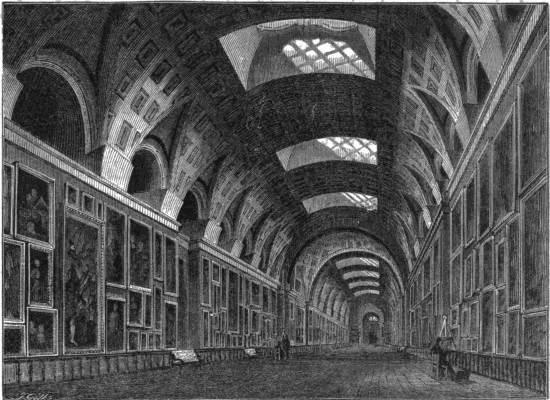
The Murillos are almost as numerous, and in his best style: but Seville has retained the cream of the genius of her most talented offspring; and even at Madrid, in the collection of the Academy, there is a Murillo—the Saint Elizabeth—superior to any of those in the great gallery. It is much to be wished that some artist, gifted with the pen of a Joshua Reynolds, or even of a Mengs (author of a notice on a small portion of these paintings), could be found, who would undertake a complete critical review of this superb gallery. All I presume to say on the subject is, were the journey ten times longer and more difficult, the view of the Madrid Museo would not be too dearly purchased.
Before I left Madrid, I went to the palace, to see the traces of the conspiracy of the 7th October, remaining on the doors of the Queen's apartments. You will recollect that the revolt of October 1842 was that in favour of Christina, when the three officers, Concha, Leon, and Pezuela, with a battalion, attacked the palace in the night, for the purpose of carrying off the Queen and her sister. On the failure of the attempt, owing to its having been prematurely put in execution, the Brigadier Leon was shot, and the two others escaped.
It appears that the execution of this officer, unlike the greater number of these occurrences, caused a strong sensation in Madrid, owing to the sympathy excited by his popular character, and the impression that he was the victim of jealousy in the mind of the Regent. The fine speech, however, attributed to him by some of the newspapers, was not pronounced by him. His words were very few, and he uttered them in a loud and clear tone, before giving the word of command to his executioners. This, and his receiving the fire without turning his back, were the only incidents worthy of remark.
One of the two sentries stationed at the door of the Queen's anteroom when I arrived, happened to have played a conspicuous part on the eventful night. The Queen was defended by the guard of hallebardiers, which always mounts guard in the interior of the palace. This sentinel informed me that he was on guard that night, on the top step of the staircase, when Leon, followed by a few officers, was seen to come up. Beyond him and his fellow-sentry there were only two more, who were posted at the door of the Queen's anteroom, adjoining her sleeping apartment. This door faces the whole length of the corridor, with which, at a distance of about twenty yards, the top of the staircase communicates. In order to shield himself from the fire of the two sentinels at the Queen's door, Leon grasped my informant by the ribs right and left, and, raising him from the ground, carried him, like a mummy, to the corridor; and there, turning sharp to the left, up to the two sentries, whom he summoned to give him admittance in the name of the absent Christina.
On the soldiers' refusal, he gave orders to his battalion to advance, and a pitched battle took place, which was not ultimately decided until daybreak—seven hours after. The terror of the little princesses, during this night, may be imagined. Two bullets penetrated into the bed-room; and the holes made by about twenty more in the doors of some of the state apartments communicating with the corridor, are still preserved as souvenirs of the event. The palace contains some well-painted ceilings by Mengs, and is worthy of its reputation of one of the finest residences in Europe. The staircase is superb. It was here that Napoleon, entering the palace on the occasion of his visit to Madrid, to install Joseph Buonaparte in his kingdom, stopped on the first landing; and, placing his hand on one of the white marble lions which crouch on the balustrades, turned to Joseph, and exclaimed, "Mon frère, vous serez mieux logé que moi."
There is no road from Madrid to Toledo. On the occasions of religious festivities, which are attended by the court, the journey is performed by way of Aranjuez, from which place a sort of road conducts to the ancient capital of Spain. There is, however, for those who object to add so much to the actual distance, a track, known, in all its sinuosities, throughout its depths and its shallows, around its bays, promontories, islands, and peninsulas—to the driver of the diligence, and to the mounted bearer of the mail; both of whom travel on the same days of the week, in order to furnish reciprocal aid, in case of damage to either. A twenty-four hours' fall of rain renders this track impassable by the usual conveyance; a very unusual sort of carriage is consequently kept in reserve for these occasions, and, as the period of my journey happened to coincide with an uncommonly aqueous disposition of the Castilian skies, I was fortunately enabled to witness the less every day, and more eventful transit, to which this arrangement gave rise.
Accordingly at four o'clock on an April morning—an hour later than is the custom on the road from France to Madrid—I ascended the steps of a carriage, selected for its lightness, which to those who know anything of Continental coach-building, conveys a sufficient idea of its probable solidity. There was not yet sufficient daylight to take a view of this fabric; but I saw, by the aid of a lantern, my luggage lifted into a sort of loose net, composed of straw-ropes, and suspended between the hind wheels in precisely such juxtaposition, as to make the portmanteaus, bags, &c. bear the same topographic relation to the vehicle, as the truffles do to a turkey, or the stuffing to a duck. There was much grumbling about the quantity of my luggage, and some hints thrown out, relative to the additional perils, suspended over our heads, or rather, under our seats, in consequence of the coincidence of the unusual weight, with the bad state of the road, as they termed it, and the acknowledged caducity of the carriage. I really was, in fact, the only one to blame; for I could not discover, besides my things, more than two small valises belonging to all the other six passengers together.
At length we set off, and at a distance of four miles from Madrid, as day began to break, we broke down.
The break-down was neither violent nor dangerous, and was occasioned by the crash of a hind wheel, while our pace did not exceed a walk: but it was productive of some amusement, owing to the position, near the corner of the vehicle which took the greatest fancy to terra firma, of a not over heroic limb of the Castilian law, who had endeavoured to be facetious ever since our departure, and whose countenance now exhibited the most grotesque symptoms of real terror. Never, I am convinced, will those moments be forgotten by that individual, whose vivacity deserted him for the remainder of the journey; and whose attitude and expression, as his extended arms failed to recover his centre of gravity exchanged for the supine, folded-up posture, unavoidable by the occupant at the lowest corner of a broken-down vehicle,—while his thoughts wandered to his absent offspring, whose fond smiles awaited him in Toledo, but to whom perhaps he was not allowed to bid an eternal adieu—will live likewise in the memory of his fellow-travellers.
This dénouement of the adventures of the first carriage rendered a long halt necessary; during which, the postilion returned to Madrid on a mule, and brought us out a second. This proceeding occupied four hours, during which some entered a neighbouring venta, others remained on the road, seated on heaps of stones, and all breakfasted on what provisions they had brought with them, or could procure at the said venta. The sight of the vehicle that now approached, would have been cheaply bought at the price of twenty up-sets. Don Quixote would have charged it, had such an apparition suddenly presented itself to his view. It was called a phaeton, but bore no sort of resemblance to the open carriage known in England by that name. Its form was remarkable by its length being out of all proportion to its width,—so much so as to require three widely-separated windows on each side. These were irregularly placed, instead of being alike on the two sides, for the door appeared to have been forgotten until after the completion of the fabric, and to have taken subsequently the place of a window; which window—pursuant to a praiseworthy sense of justice—was provided for at the expense of a portion of deal board, and some uniformity.
The machine possessed, nevertheless, allowing for its rather exaggerated length, somewhat of the form of an ancient landau; but the roof describing a semicircle, gave it the appearance of having been placed upside down by mistake, in lowering it on to the wheels. Then, with regard to these wheels, they certainly had nothing very extraordinary about their appearance, when motionless; but, on being subjected to a forward or backward impulse, they assumed, respectively, and independently of each other, such a zigzag movement, as would belong to a rotatory, locomotive pendulum, should the progress of mechanics ever attain to so complicated a discovery. Indeed, the machine, in general, appeared desirous of avoiding the monotony attendant on a straight-forward movement; the body of the monster, from the groans, sighs, screams, and other various sounds which accompanied its heaving, pitching, and rolling exertions, appearing to belong to some unwieldy and agonised mammoth and to move by its own laborious efforts, instead of being indebted for its progress to the half-dozen quadrupeds hooked to its front projections.
The track along which this interesting production of mechanical art now conveyed us, bore much resemblance to a river, in the accidents of its course. Thus we were reminded at frequent intervals, by the suddenly increased speed of our progress, that we were descending a rapid: at other times the motion was so vertical, as to announce the passage down a cataract. These incidents were not objectionable to me, as they interrupted the monotony of the walking pace, to which we were condemned; although one or two passengers of rather burly proportions, seemed not much to enjoy their repetition. However this might be, assuredly we were none of us sorry to find ourselves at eight o'clock that evening safely housed at Toledo.
LETTER VIII.
PICTURESQUE POSITION OF TOLEDO. FLORINDA.
Toledo.
Every traveller—I don't mean every one who habitually assists in wearing out roads, whether of stone or iron—nor who travels for business, nor who seeks to escape from himself—meaning from ennui, (a vain attempt, by the way, if Horace is to be depended on; since, even should he travel on horseback, the most exhilarating sort of locomotion, ennui will contrive to mount and ride pillion)—but every one who deserves the name of traveller, who travels for travelling sake, for the pleasure of travelling, knows the intensity of the feeling which impels his right hand, as he proceeds to open the window-shutter of his bed-room, on the morning subsequent to his nocturnal arrival in a new town.
The windows of the Posada del Miradero at Toledo are so placed as by no means to diminish the interest of this operation. The shutter being opened, I found myself looking from a perpendicular elevation of several hundred feet, on one of the prettiest views you can imagine. The town was at my back, and the road by which we had arrived, was cut in the side of the precipice beneath me. In following that direction, the first object at all prominent was the gate leading to Madrid—a cluster of half Arab embattled towers and walls, standing somewhat to the left at the bottom of the descent. These gave issue to the track mentioned in my journey, and which could now be traced straight in front, to a considerable distance.
The ground rises slightly beyond the gates of the town, and preserves a moderate elevation all across the view, retreating right and left, so as to offer the convex side of the arc of an immense circle. This formation gives to the view a valley, extending on either side, shut in on the left by mountains at a distance of four miles; while to the east it extends as far as the eye can reach,—some mountains, scarcely perceptible, crossing it at the horizon. The Tagus advances down the eastern valley from Aranjuez; which château is in view at the distance of twenty-eight miles, and approaching with innumerable zigzags to the foot of the town, suddenly forms a curve, and, dashing into the rocks, passes round the back of the city, issues again into the western valley, and, after another sharp turn to the left, resumes the same direction as before. All this tract of country owes to the waters of the Tagus a richness of vegetation, and a bright freshness nowhere surpassed. So much for the distant view.
To judge of the nearer appearance of the town, I crossed the bridge of Alcantara, placed at the entrance of the eastern valley, and leading to Aranjuez. The situation may be described in a few words. Toledo stands on an eminence nearly circular in its general form. It is a mass of jagged rock, almost perpendicular on all its sides. The river flows rather more than half round it, descending from the east, and passing round its southern side. The left or south bank is of the same precipitous formation; but, instead of presenting that peculiarity during only a short distance, it continues so both above and below the town; while on the opposite side the only high ground is the solitary mass of rock selected, whether with a view to defence or to inconvenience, for the position of this ancient city. The Tagus is crossed by two bridges, one at each extremity of the semi-circle described by it round the half of the town. These bridges are both highly picturesque, from their form no less than their situation. They are raised upon arches of a height so disproportionate to their width, as to appear like aqueducts; and are provided at each extremity with towers, all, with one exception, Moorish in their style. The lower bridge (lower by position, for it is the higher of the two in actual elevation) bears the name of San Martin, and is traversed by the road to Estremadura; the other leads to Aranjuez, and is the puente de Alcantara. We are now standing on this last, having passed under the Arab archway of its tower.
Its width is just sufficient for the passage of two vehicles abreast, and it is covered with flag-paving. The river flows sixty feet below. At the back of the tower which faces you, at the opposite end of the bridge, rises a rock, almost isolated from the rest of the cliff, and on its top the half-ruined towers and walls of a Moorish castle. On the left hand extends the valley, through which the river approaches in a broad mass. The road to Aranjuez follows the same direction, after having first disappeared round the base of the rock just mentioned, and is bordered with rose-trees, and occasional groups of limes, which separate it from the portions set apart for pedestrians. On the right hand the river (still looking from the bridge) is suddenly pressed in between precipices, becomes narrow, and at the distance of a few hundred yards, forms a noisy cascade.
VIEW OF TOLEDO
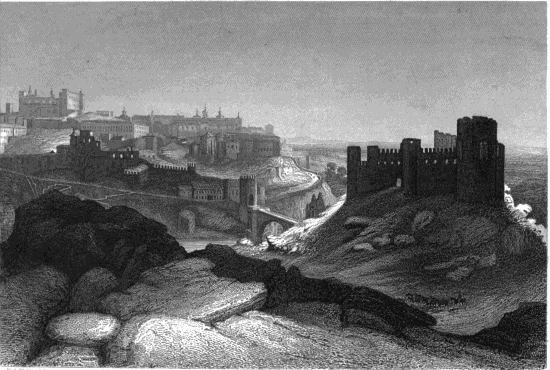
Still looking in that direction, the left bank—a rocky precipice, as I mentioned before—curves round and soon hurries it out of sight. The lower part of the opposite or town bank is ornamented, close to the cascade, with a picturesque ruin, on which you look down from your position. This consists of three stories of arches, standing partly in the water. Above and behind them rise a few larger buildings, almost perpendicularly over each other, and the summit is crowned with the colossal quadrangular mass of the Alcazar.
The ruinous arches just mentioned, are the remains of a building erected by a speculator, who had conceived a plan for raising water to the Alcazar by means of wheels, furnished with jars, according to the custom of this part of Spain. The arrangement is simple; the jars, being attached round a perpendicular wheel, successively fill with water, as each arrives at the bottom, and empty themselves, on reaching the summit, into any receptacle placed so as to receive their contents. The speculator, having to operate on a colossal scale, intended probably to super-pose wheel over wheel, and to establish reservoirs at different elevations, as it would scarcely be possible to work a wheel of such dimensions as to carry jars to the height required (more than three hundred feet), even though furnished with ropes, which are made to turn round the wheel and descend below it.
Crossing the bridge, the road quits the river, or rather is left for a certain space by it, until it meets it at the distance of a mile. This road is a favourite promenade of the inhabitants, and deservedly so. On each side, for the distance of a mile, it is bordered by hedges of magnificent rose-trees. These hedges are double on both sides, enclosing walks for the promenaders on foot. Behind those on the outside, the colours are varied by the pale green of the olive-tree; and over them occasional clusters of lime-trees, mingled with the acacia and laburnum, furnish shade, in case of an excess of sunshine. This promenade, flanked on one side by the hills, and on the other, by the highly cultivated plain, in parts of which the Tagus is seen occasionally to peep through its wooded banks, is most delicious during the rose season. I should especially recommend the visitor of Toledo to repair to it during the first hour after sunrise, when thronged with birds, which are here almost tame, and fill the air with their music; and also in the evening, when frequented by the mantilla-hooded fair of the city.
There is, however, notwithstanding the beauty and gay appearance of this profusion of roses, a singular effect produced by their situation. Usually seen surrounded by other flowers or by well-kept grass or earth, they do not look quite themselves on the side on which they rest their bushy foundations on a dusty road, covered with deep ruts. The fish out of water forms a hackneyed, not to say a dried up, comparison; but we can compare the rather pallid and unnatural appearance of these plants to that of a bevy of ladies, who, tired of the monotony of a ball-room in Grosvenor Place, should resolve, precisely at the crisis when candle-light is more than ever required for their rather suffering complexions, to compel their partners to lead them, at sunrise, a galopade down Tattersall's yard. The roses, thus misplaced, are nevertheless roses, and cease not to be fair, in spite of their unusual entourage, and to contribute to the beauty and novelty of this picturesque promenade.
Amongst the variety of harmless weaknesses by which human imagination, and consequently human locomotion are influenced, I look upon one of the most irresistible (if such an epithet be applicable to a weakness) to be that fractional component part of the cravings of antiquarianism, which urges some persons in the search after, and rewards their labours on the discovery of, the locality supposed to be the birthscene of some great historical event, however insignificant in other respects, or even however loathsome its actual state may be to the outward senses. Thus, when, in Normandy, the worthy and probably waggish majordomo of the crumbling old castle of Falaise, directs your attention to the window from which Duke Robert caught the first glance of the ankle of William the Conqueror's mother,—as she pursued her professional labours, and polluted with her soapsuds the silver brook a quarter of a mile below him,—and suddenly yielded his soul to its irresistible beauty: notwithstanding the impossibility of the thing, many, and I confess myself one, are too delighted with the window, and the rivulet, and the majordomo, and the—God knows what!—perhaps with the very impossibility—to allow themselves a moment's sceptical or sarcastic feeling on the subject.
I should mention that my visit to Falaise happening to take place shortly after the passage of the King of the French on a tour through his western provinces, the aforesaid cicerone pointed out a highly suspicious-looking inscription, being the initials of the monarch, carefully engraved in the stone; which he informed me had been cut by Louis Philippe, on the occasion of his visit at midnight to the room of Duke Robert; but of which I took the liberty of suspecting himself of being the sculptor, during some idle moment,—fond as he probably was of contemplating the innocently expressive countenances of his satisfied visitors.
Actuated by the feeling I have attempted to describe, one of my first inquiries at Toledo related to the well-known story of Florinda and her bath, so fatal to the Gothic sway in Spain. I was immediately directed to the spot, on which is seen a square tower, pierced by arched openings through its two opposite sides, and on a third side by a similar but smaller aperture. The four walls alone remain, and the whole is uncovered. This symmetrical-looking edifice, well built and composed of large stones, measures about sixteen feet square, and from forty to fifty in elevation, and stands on the edge of the river, on the town side, about a hundred yards below the western bridge—that called after Saint Martin—at the precise point at which the river quits the town, and its north bank ceases to be precipitous.
The extreme point of the termination of the high ground is immediately over the building, and is covered with the ruins of King Roderick's palace, the outer walls of which descend to the water, and are terminated by a small roundtower within a few yards of the quadrangular edifice. The edifice is called the Baño de la Cava, meaning Florinda's bath, although the native popular tradition, losing sight of the events of the history, has metamorphosed the heroine of the spot into a Moorish princess.
In fact, the rocky precipice terminates at this spot,—the last piece of rock forming part of the foundation of the square tower, immediately beyond which is a gently descending sand-bank most convenient and tempting to bathers. This circumstance, added to the situation of Roderick's residence, immediately above the scene, was delightfully corroborative of the tradition; and proved sufficiently, had all investigation ceased there, the identity of the spot with the scene of the anecdote. Owing to an excess of curiosity a new discovery threw a doubt over the whole affair.
FLORINDA'S BATH.
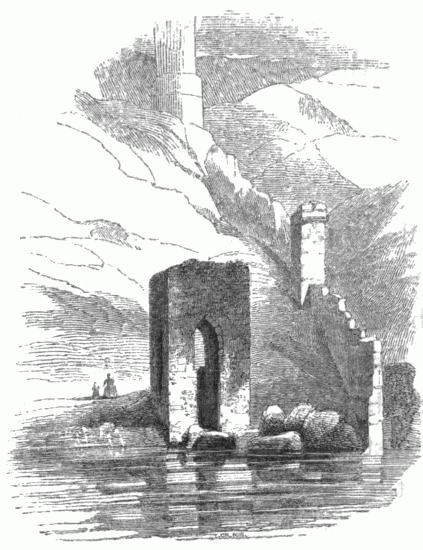
A bridge is too public a thoroughfare to allow of bathing to be practised in its immediate neighbourhood: and, in fact, the erection of the neighbouring one of St. Martin is of much later date than the events of the history in question. Fatal curiosity, however, led me to the back of the building,—the very bath of Florinda,—where it was impossible not to discover, even to conviction, that it, the square tower itself, had formerly been the entrance of a bridge. This is proved by the ruins of two piers, which appear above the water,—one near to the shore on which I was standing, the other near to the opposite bank, and both forming a line with the square tower on looking through its two opposite arches. The tower possesses other peculiarities which, compared with those belonging to the bridges actually in existence, fully confirm the supposition.
Now, although the tradition has christened the spot Baño de la Cava, which expression is translated "bath of the prostitute," it is certain that Florinda was the daughter of Count Julian, governor of the Spanish possessions in Africa, and a personage of sufficient rank and influence to obtain a hearing at the court of the Arab Caliph, or at all events of his viceroy in Africa, and to conceive the idea of calling a foreign army to execute his private vengeance. It is therefore extremely improbable that the daughter of such a person should have been seen to measure and compare the proportions of her legs with those of her companions in the immediate vicinity of a bridge, necessarily the most frequented of thoroughfares.
I confess I left the spot filled with disappointment. In vain I reflected that after all the fact is fact—that the sensual Roderick may certainly have spied from behind a window-lattice the frolics of some ladies at their bath; and that, wherever his espionage took place, he may for that purpose have intentionally procured himself a place of concealment, and have formed the resolution of possessing one of them. In fact, it was a matter of indifference to me whether the circumstance had occurred or not, provided I should ascertain its whereabouts, supposing it real, instead of merely discovering the spot on which it did not take place.
Having thus convicted the generally received tradition of deceit,—at least, in one of its parts,—it became an object to discover some other version of the story, which might tally in a more satisfactory manner with present existing proofs. The Arab historians deny the invasion to have been brought about by any such occurrence; but Mariana, copied by more recent writers, has either discovered or compiled a very plausible story, clear in its details, only erroneous in respect of the heroine's name, which he makes out to be Cava. From this version the bath is entirely excluded.
According to the custom in Gothic Spain, the sons of the nobles received their education in the royal palace, and on attaining the age of manhood, they formed an escort round the sovereign on all expeditions, whether to the field or the chase. Their daughters were likewise entrusted to the care of royalty, and attended the person of the Queen, after having completed their education and instruction in the accomplishments suited to their sex, under her superintendence. When these noble damsels could number sufficient summers, their hands were bestowed according to the royal selection.
Among the attendants of Queen Egilona, was a daughter of Count Julian, possessed of extreme beauty. Florinda, while playing with her companions in a garden, situated on the banks of the Tagus, and overlooked by a tower, which contained a portion of Don Rodrigo's apartments, exposed to view, more than accorded either with etiquette or with her intention, the symmetry of her form. King Rodrigo, who, favoured by the concealment of a window-blind, had been watching the whole scene, became suddenly enamoured of her, and resolved to obtain a return of his passion; but, after finding every effort useless, and his object unattainable, he at length employed violence.
Every circumstance of this story is corroborated, as far as is possible in the present time, by the position of the localities, the known customs of the period, and the character of King Roderick. But the historian Mariana, to show the minuteness and triumph of research, on which he has founded his relation, quotes the young lady's own version of the affair; in fact, no less interesting a document than her letter to her father, then in Africa, disclosing the insult offered to the family. The following is the translation of this portentous dispatch. A billet-doux pregnant with greater events never issued from the boudoir of beauty and innocence.
"Would to Heaven, my lord and father!—Would to Heaven the earth had closed over me, before it fell to my lot to write these lines, and with such grievous news to cause you sadness and perpetual regret! How many are the tears that flow while I am writing, these blots and erasures are witnesses. And yet if I do not immediately, I shall cause a suspicion that not only the body has been polluted, but the soul likewise blotted and stained with perpetual infamy. Would I could foresee a term to our misery!—Who but yourself shall find a remedy for our misfortunes? Shall we delay, until time brings to light that which is now a secret, and the affront we have received entail on us a shame more intolerable than death itself? I blush to write that which I am bound to divulge. O wretched and miserable fate! In a word, your daughter—your blood, that of the kingly line of the Goths, has suffered from King Rodrigo,—to whose care, alas! she was entrusted like the sheep to the wolf,—a most wicked and cruel affront. It is for you, if you are worthy the name of a man, to cause the sweet draught of our ruin to become a deadly poison to his life; nor to leave unpunished the mockery and insult he has cast on our line and on our house."
Don Julian, who, as some say, was of royal descent, and a relative, not far removed, of Roderick—was possessed of qualities no less marked by daring than artifice. His plans well digested, he committed his government in Africa to the charge of a deputy, and repaired to the court at Toledo. There he made it his business to advance in credit and favour until the moment should arrive for action. His first step was, by means of false alarms of attacks meditated on the northern frontier, to get rid of the principal part of the disposable forces in that direction. Meanwhile he caused a letter from his Countess, who remained in Africa, to be forwarded to the King, in which, on the plea of serious illness, she urgently entreats the royal permission for the departure of Florinda to Ceuta. It is related that the profligate Rodrigo consented to the journey with so much the better grace, that possession had divested the attractions of his victim of all further hold of his passions, already under the dominion of new allurements.
There is a gate at Malaga, giving issue towards the sea-shore, which bears to this day the name of Gate of the Cava: through it she is said to have passed on embarking for Africa.
With regard to the name "la Cava" given to the gate and to the bath, I am disposed to prefer the popular notion to the assertion of Mariana, that it was her name. It is a natural supposition that the anecdote of the affair of Toledo, spread among the Arabs, who, for centuries after this period, were the depositaries of the annals and traditions of the Peninsula,—should have become tinted with a colour derived from their customs and ideas. Now it would be difficult to persuade an Arab that the circumstances of the story in question could befall a virtuous female, surrounded with the thousand precautions peculiar to an oriental court. If we add to this the contemptuous tone assumed by them towards those of the hostile creed—a tone that must have suited in an especial degree with their way of thinking on the subject of female deportment among the Christians, which they look upon as totally devoid of delicacy and reserve—the epithet applied to Florinda is easily accounted for. But to return to the story.
It only now remained for Don Julian to determine the Caliph's viceroy in Africa in favour of the invasion. Repairing to his court, he obtained an audience, in which he painted to the Prince, in such eloquent terms, the natural and artificial wealth of the Spanish peninsula, the facility of the enterprise, owing to the absence of the principal part of the disposable hostile force, and the unpopularity of King Rodrigo, that an expedition was immediately ordered; which, although at first prudently limited to a small troop under Tharig, led to the conquest, in a few campaigns, of the whole Peninsula.
Mingled with the ruins of Roderick's palace are seen at present those of the monastery of Saint Augustin, subsequently erected on the same site: but on the side facing the river, the ancient wall and turrets, almost confounded with the rock, on which they were built, have outlived the more recent erections, or perhaps have not been interfered with by them. Immediately beyond the portion of these walls, beneath which is seen the Baño de la Cava, they turn, together with the brink of the precipice, abruptly to the north, forming a right angle with the river bank: this part faces the western vega or valley, and looks down on the site of the ancient palace gardens, which occupied the first low ground. They extended as far as the chapel of Santa Leocadia. The ground is now traversed by the road to the celebrated sword-blade manufactory, situated on the bank of the river, half a mile lower down. With the exception of the inmates of that establishment, the only human beings who frequent the spot are the votaries on their way to the shrine of Santa Leocadia, and the convicts of a neighbouring Presidio in search of water from the river.
LETTER IX.
CATHEDRAL OF TOLEDO.
Toledo.
Every successive æra of civilization, with the concomitant religion on which it has been founded, and from which it has taken its peculiar mould, has, after maintaining its ground with more or less lustre, and throughout a greater or smaller duration, arrived at its inevitable period of decline and overthrow.
In ceasing, however, to live, and to fill society far and wide with its enlightening influence,—in exchanging its erect attitude for the prostrate one consequent on its fall,—seldom has a creed, which has long held possession of the most enlightened intellects of our race for the time being, undergone an entire extinction, so as to disappear altogether from the face of the earth, and leave no trace of its existence. The influence of the soil, formation, and climate of the region, in the bosom of which such civilization has had its birth, on the dispositions and faculties of the race which has become its depositary, has always set its peculiar mark on its monuments, whether civil, military, or religious, but especially the last; which monuments, surviving the reign of the power to which they owe their existence, prolong and sanctify its memory, while they stand, erect and silent, over its grave; and furnish valuable information and benefit to those future generations sufficiently enlightened to consult them.
If this theory of successions and vicissitudes be consonant (which probably no one will deny) with the march of events on the surface of this our planet, then do the circumstances of the present situation invest, as far as regards Spain, those relics of human genius and human enthusiasm, the venerable temples of her declining faith, with an interest beyond that which they have possessed at any period since their foundation. It is impossible to have paid any attention to the events of the last few years, without having received the conviction that the reign of Christianity is here fast approaching,—not the commencement, but the termination of its decline. Spaniards will never do things by halves; and will probably prefer the entire overthrow of ancient customs to the system pursued in France, of propping up, by government enactments and salaries, a tottering edifice of external forms, long since divested of its foundation of public belief.
To speak correctly, the decline of religious supremacy in Spain is by no means recent. It was coeval with that of the arts, and of the political grandeur of the country. The gradual cessation of the vast gifts and endowments for the erection of the religious establishments was a symptom of devotional enthusiasm having passed its zenith. Had not this occurred nearly three centuries back, Madrid would not have wanted a Cathedral. Nothing could ever have tended more directly to compromise the durability of Christianity in Spain, than the final expulsion or extermination of the Moors and Jews. Had Torquemada and a few others possessed heads as clear and calculating as their hearts were resolute and inexorable—a knowledge of human nature as profound as their ambition of divine honours was exalted, they would have taken care not entirely to deprive the Church of food for its passions and energies. They would not have devoured all their heretics at a single meal, but would have exercised more ménagement and less voracity. They would have foreseen that by burning a few hundred Jews and Arabs less each year, nourishment would remain to animate the declamations of preachers, and the energies of the faithful; without which the fatal effects of sloth and indifference must inevitably take root in the imaginations, and eventually undermine their lofty fabric.
The decline was, however, so gradual as to exercise no perceptible influence on the general conduct of the population, by whom forms were still observed, churches filled, and acts of devotion unceasingly accomplished. A variety of causes (into a description of which it is not my object, nor would it be your wish, that I should enter, but of which one of the most influential has been the importation of foreign ideas—as well through natural channels, as by special and interested exertions) has precipitated the dénouement of this long-commenced revolution; and that with so headlong a rapidity, that, in that Spain which surpassed all other nations in bigoted attachment to religious rites, the confiscation of all the possessions of the Church, under a promise (not to be performed) of salaries for a certain number of ecclesiastics, insufficient for the continuation of the ancient ceremonies, is received by the population with indifference! The Cathedral of Toledo, deprived of the greater number of its functionaries,—including its archbishop and fifty-six of its sixty canons, and no longer possessing, out of an income of hundreds of thousands sterling, a treasure sufficient for providing brooms and sweepers for its pavement,—will, in perhaps not much more than another year, if the predictions of the inhabitants be verified, be finally closed to public worship.
The same interest, therefore, which surrounded the Arab monuments three centuries since, and the Roman edifices of Spain in the fifth century, attaches itself now to the Christian temples; which, at this crisis, offer themselves to the tourist in the sad but attractive gloom of approaching death; since depriving them of the pomp and observances which filled their tall arcades with animation, is equivalent to separating a soul from a body. He will explore them and examine their ceremonies with all the eagerness and perseverance of a last opportunity,—he will wander untired through the mysterious twilight of their arched recesses, and muse on the riches lavished around him to so little purpose, and on the hopes of those who entrusted their memories to the guardianship of so frail and transient a depositary. The tones of their giant though melodious voices, as, sent from a thousand brazen throats, they roll through the vaulted space the dirge of their approaching fate, will fill him with sadness; and the ray that streams upon him from each crimson and blue rosace will fix itself on his memory, kindling around it an inextinguishable warmth, as though he had witnessed the smile of a departing saint.
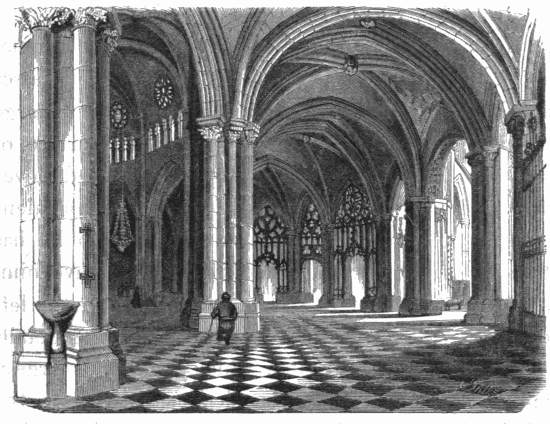
I had read of Toledo being in possession of the finest church in Spain,—and that in the book of a tourist, whose visit to this town follows immediately that to Seville. Begging pardon of the clever and entertaining writer to whom I allude, the Cathedral of Toledo strikes me as far from being the finest in Spain; nor would it be the finest in France, nor in England, nor in other countries that might be enumerated, could it be transported to either. It is large; but in this respect it yields to that of Seville. What its other claims to pre-eminence may be, it is difficult to discover. It is true that its interior presents a specimen of the simple and grand pointed style of its period. This being put in execution on a large scale, would render it an imposing and a beautiful edifice, but for a subsequent addition, which, to render justice to the architect, he certainly never could have contemplated. The noble pillars, towering to a height of sixty feet, have been clothed, together with their capitals, in a magnificent coat of whitewash! Without having witnessed such a desecration in this or some similar edifice, it is impossible to conceive the deadening effect it produces on the feeling of admiration such a building ought to excite. An inscription in distinct and large characters, over the southernmost of the three western doors, after recording the conquest of Granada by the Catholic Kings, as Ferdinand and Isabella are here termed, the expulsion of the Jews, and the completion of the Cathedral, brands with this act of barbarism one Don Francisco Fernandez de Cuença, obrero mayor (almost a Dean) of the Cathedral in the year 1493.
There is, however, a moment of each day when the tall arcades vindicate their outraged majesty. "La nuit tous les chats sont gris," says the proverb. I therefore proceeded at the approach of twilight (all access at a later hour being prohibited) to see whether its application would extend to this church. This is, in fact, the hour, just before the closing of the doors, at which it should be visited. Darkness has assumed his empire within these walls long before the stirring labyrinth without has had warning of his approach. No colours nor gildings (the latter being rather injudiciously distributed) are visible—nothing but a superb range of beautifully painted windows; and the columns only trace their dim outline a little less black against the deep gloom of the rest of the building. At this hour, could it last, it would be impossible to tire of wandering through this forest of magnificent stems, of which the branches are only seen to spring, and immediately lose themselves beneath the glories of the coloured transparencies rendered doubly brilliant by their contrast with the gloom of all below them. The principal merit, in fact, of this edifice, consists in its windows. That of the purity of its general style deserves also to be allowed; but with some reserve in the appreciation of the accessory points of the design. It depended, for instance, on the judgment of the architect, to diminish or to increase the number of columns which separate the different naves, and by their unnecessary abundance he has impaired the grandeur of the general effect.
The interior dimensions are as follows:—Length, including a moderately sized chapel at the eastern extremity, three hundred and fifty English feet; width, throughout, one hundred and seventy-four feet; height of the principal nave and transept, about one hundred and twenty feet. The width is divided into five naves; those at the outside rising to about two-thirds of the height of the two next adjoining; and these to about half that of the centre nave. An entire side of a chapel opening out of the southernmost nave, is ornamented in the Arab style—having been executed by a Moorish artist at the same period as the rest; and not (as might be conjectured) having belonged to the mosque, which occupied the same site previously to the erection of the present cathedral. This small chapel would be a beautiful specimen of the Arab ornament in stucco, but for several coats of whitewash it has received. An arched recess occupies the centre, and is called the Tomb of the Alguazil. A handsome doorway in the same style is seen in the anteroom of the Chapter-saloon.
APSE OF THE CATHEDRAL, TOLEDO.
Facing the entrance to the centre or extreme eastern chapel, that of San Ildefonzo, the back of the high altar, or, as it is vulgarly called, the Trascoro, is—not adorned, would it were possible not to say disfigured, by an immense mass of sculpture called the Transparente. It is not easy to imagine the reason of this altar-piece having received its name, for it is not more transparent than any other mountain—never was witnessed so lamentable a mis-application of riches and labour! Some of the marble was brought from Carrara; the rest is not of a very good white, and being thus exposed to an unfavourable contrast, adds to the displeasing effect of the unwieldy forms which enter into the composition of this huge blunder of art—this pile of masses on masses of ugliness. At the sight of a large spherical form rising abruptly from the surface of some shaft of a pillar, you step back, and discover that it forms part of the posteriors of a corpulent cherub, as large as the column itself, which he has thus unmercifully annihilated, in order to save himself the trouble of passing a few inches to the left or right. But it is needless to notice the details of this piece of sculpture, which being the largest, and occupying the most conspicuous position in the whole church, forcibly attracts the attention which, but for that circumstance, one would rather bestow in another direction.
It is a relief to take one's station on the shining mahogany benches adjoining the wall of the opposite chapel of San Ildefonzo; and to contemplate its chaste style and graceful proportions, and the handsome tombs which occupy its octagonally divided walls. The piece of sculpture in marble, placed over the principal altar, is undeserving of its conspicuous situation. It represents the Vision of San Ildefonzo, to which we shall shortly have occasion to direct our attention.
The adjoining chapel, as we proceed towards the northernmost nave, that of Santiago, or more generally called after its founder, Don Alvaro de Luna, is still finer. It is larger and loftier, and of a more ornamental design. It presents five sides of an octagon: the three remaining sides turning inwards to suit the form of the apse. This Alvaro de Luna, the Lord Essex of Juan the Second, having by the high favour he enjoyed in the intimacy of the monarch, given umbrage to the courtiers, was put to death by the King, who gave credit to the charges falsely brought against him. Don Juan, however, who did not long survive his friend, had justice done to his remains. Being found innocent by a posthumous trial at Valladolid, his body was conveyed with great pomp to Toledo, and placed in the centre of his chapel. The tomb of his Countess stands close to his own; and in the niches of the surrounding walls, those of his most distinguished relatives, one of whom, on the right of the altar, is represented in complete armour, with a turban on his head. The treasures bestowed on this favourite, flowed plentifully into the Cathedral of Toledo. Besides his chapel, the finest of all—the elaborately executed enclosure of the sanctuary, is one of his gifts: his arms are there recognised, frequently recurring among the various designs of the external tracery.
A narrow passage, leading from the apse between the chapel of Don Alvaro, and the entrance to the sacristy, communicates with the chapel of the kings. After passing through a simply designed anteroom of more recent date, the eye reposes with pleasure on a small interior in the pointed style of the latest period—of proportions, perhaps, not the less graceful from their being rather narrow for the length. Two richly ornamented arches, stretching across the interior, divide it into three parts, in the first of which is seen a gallery containing an elaborately wrought gilded confessional. The walls of the two other divisions are divided into six parts; the chapel having been constructed and endowed by Juan the First, for the reception of six monuments: those of himself and his Queen Isabella; those of his father Henry the Second, (natural son of Alonzo the Eleventh, and who dethroned and killed with his own hand his half-brother, Pedro the cruel,) and Doña Juana his wife; and those of Henry the Third, and Doña Catalina his wife.
Returning to the interior of the apse, and continuing in the direction of the north side, another small passage and anteroom lead to the principal sacristy, which communicates with the next chapel, called the Sagrario, and composed of three apartments. The great sacristy contains some good paintings, particularly the ceiling by Giordano—a modern tomb of the late archbishop, Cardinal de Bourbon, and a series of narrow doors, within which are recesses. The first of these contains the crown and bracelets of the Virgin of the Sagrario: in four others are preserved magnificent ornaments of silver, representing emblematically the four quarters of the globe. Each quarter is personified by a figure invested with the attributes which characterize the region she represents, seated on a large silver globe, on the front of which is traced the quarter represented. The globe is supported by figures of animals. In the last of these recesses is seen the sword of Alonzo the Sixth, who won Toledo from the Moors. It is small, and unornamented, except by a hilt of embossed silver, on which the arms are repeated four times. In the smaller sacristy within are several good pictures, but not so remarkable as to prevent their being eclipsed by the splendid robe of the Virgin of the neighbouring Sagrario, here exhibited, extended flat on a semicircular board, such being the form of the garment.
No one knows the value of this treasure. During the Peninsular War, the archbishop, in order to spare the French Generals too great a temptation, conveyed it, together with whatever else deserved the precaution, to Cadiz. It is embroidered almost entirely with pearls on a tissue of silver; but none of the silver is visible without separating the pearls, diamonds, &c., with the fingers. Most of the larger pearls possess the irregular sort of beaten shape often observed in the best specimens. Some are enormous. Numbers of diamonds, rubies, and other stones are admitted in the upper part, to vary and enliven the effect of the different designs of the embroidery. In another case is extended the front-piece, worn together with the robe, which is open in front. The robe sits nearly in the fashion of a lady's cloak, but perfectly stiff, and widening as it descends, so much as to make the figure assume the appearance of a triangle, of which the base is longer than the two other sides. The opening in front corresponds with the outline of the two sides, being wider below than above, although not in as great a degree. This opening is occupied by the front-piece, which is much smaller than the robe, but still more valuable, being principally worked in brilliants. It contains also every variety of precious stones, introduced as their colours may happen to accord with the design.
In addition to these is shown the dress of the Bambino, similar in materials to the two others; but the pearls and diamonds more equally distributed.
But the marvel of this costume is the crown. This ornament adds to the splendour of its materials, the most exquisite and elaborate workmanship. It would require hours to appreciate the labour and taste displayed in all its details. Marshal Soult, could he but see it, would order masses for the soul of the prelate who spared him such a temptation. The diamonds, especially those which compose a cross surmounting the centre, are of the purest water, and of immense size. But in the midst of the dazzling and harmonious intricacy of this gem of all colours, there is a centre of attraction, which took my fancy more than the rest. Immediately under the centre ball, an immense spherical emerald, which supports the diamond cross, is a small bird suspended on a hook within the crown. All the parts of this bird are composed of white enamel, except the body, around which the wings, legs, neck, and head, are attached, and which consists of a pearl of an oval form, about the size of a sparrow's egg. The movement of the statue during a procession, keeps the bird (hanging from its hook) in constant agitation, and produces the effect of a living bird enclosed in a cage of precious stones.[6]
A pair of bracelets, possessing no less magnificence than the crown, but rather too heavy and bulky to be graceful, are suspended in the same recess, and worn on the same occasions.
It should not be forgotten, as a proof of the judgment shown in the choice of ornaments, which, as far as regards the front, consist principally of diamonds, that the complexion of the Virgin of the Sagrario, is more than dark—in fact, quite black.[7] The innermost of the three apartments forming the chapel of the Sagrario is called the Ochavo, and is the deposit of a collection of relics of all kinds. It is an octagon, surmounted at an elevation of more than double its diameter by a dome ornamented with excellent painting. The walls are faced with the best Spanish marbles. Each of the eight sides contains an open recess reaching to the first cornice—an elevation of about twenty-five feet; and in these recesses are contained all the valuable relics belonging to the cathedral;—a rich display of silver statues, reliquaries, coffins, chests, and crosses of gold and silver, some containing jewels of great value. A silver statue of Saint Ferdinand wearing a golden crown is among the objects most worthy of remark; also a cross containing a portion of the true cross, presented to the cathedral by St. Louis. This and several other relics, such as a phial containing the Virgin's milk, a portion of our Saviour's purple garment, &c., were presented to the cathedral by St. Louis on his return from the east, and are here preserved, together with the letter in his own hand-writing, which accompanied them.
The Virgin of the Sagrario receives by far the greatest share of devotion brought to the numerous shrines of this vast temple, even greater than that offered at the high altar. More masses are performed at her altar than at all the others added together. The aisles facing her antechapel are constantly filled with a crowd of kneeling votaries. She stands in the second enclosure, turning her back to the Ochavo. An iron railing separates her apartment from the first chapel, which is usually open to the aisles. She stands consequently in full view, magnificently robed in a fac simile imitation of her pearl dress, the original being only worn on one or two occasions during the year.
The interior of the Capilla Mayor, is ornamented with several rows of statues, and some handsome funereal monuments, forming together a sort of transparent wall of sculpture on each of its sides. In the midst of a series of mitred archbishops, and coroneted princes, the figure of a peasant occupies one of the most conspicuous positions. It stands on the left side, as you face the High Altar, and about twenty feet from the pavement. This statue represents a celebrated historical personage. Alonzo the Eighth, when penetrating across the Sierra Morena into Andalucia, in search of the Moorish army under the King of Morocco, Mahomed ben Jacob, was in danger of losing the fruit of his exertions, in bringing together the forces of the Kings of Aragon and Navarre, together with numerous other confederates. He had led the combined army into a defile, in which he would have had to receive the attack of the Moor at an insuperable disadvantage. The hostile forces occupied a height called the Puerto del Miradal.
It was at the moment that retreat was the subject of deliberation, that a peasant presented himself, and offered to guide the army out of the pass. Having assured himself of the man's sincerity, Alonzo put himself under his conduct, and was led to the summit of the mountain, where he found himself on the border of an immense plain. This decided the great victory of las Navas de Tolosa gained over the Moors on the 16th of July, 1212. Alonzo ordered a statue of the peasant to be placed in this cathedral. He is represented in a costume not unlike that of an ancient Roman rustic, a sort of tunic reaching to the knees, and his face is covered with a profuse beard.
The interior of the choir is the work of Felipe de Borgoña, and Berruguete; the latter having been employed, after the death of Felipe de Borgoña, in 1548, in continuing the sculptures. The entire south side was left for him to complete; after which he added a group in marble, representing the Transfiguration, placed rather injudiciously, since it out-tops the screen or back of the choir; thus presenting to the view of those who enter from the western or grand entrance, and who are more likely to have come with the intention of viewing the ornaments, than the canons who are seated in the choir—the back of the subject, or rather, forms which represent no subject whatever. There is a Virgin on a pedestal in the centre of the eastern end of the choir, turning her back to the bronze railing which separates it from the transept. This statue has occupied its present position ever since the erection of the cathedral; and it is probable would long since have quitted it, but for a still greater inconvenience consequent on its removal. The attempt was recently made, when a mass of water issued with much violence from beneath the pedestal, and putting to flight the canons who were assembled to preside at the operation, instantly inundated the whole church. The virgin occupies probably the site of the fountain which must have been the centre of the court, at the period of the existence of the mosque. However that may be, the spot is the exact centre of the present edifice.
At the two eastern angles of the quadrangle, formed by the intersection of the transept and principal nave, close to the railing of the capilla mayor are two pulpits of bronze, excellently wrought; supported on short pillars of rare marbles.
INTERIOR OF THE CATHEDRAL, TOLEDO.
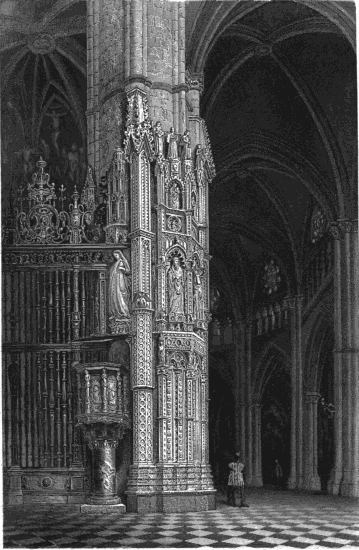
A tall pyramidal Gothic edifice[8] of gilded and painted wood, rising to the full height of the ceiling, stands in front of a column of the second nave from the north side. All its sides are open, and furnished with bronze railings, through which is seen an altar, raised on three or four steps. In the centre of the altar is inserted a marble slab—a highly prized relic, being the stone on which the Virgin placed her foot on the occasion of her appearing in the cathedral in propriâ personâ to the Archbishop San Ildefonzo. This peculiar favour bestowed on the saint—and a robe with which she invested him with her own hands, were bestowed, according to the historian Mariana, in recompense of his zeal in opposing the doctrine of the two Frenchmen, Pelagio and Helvidio, whose writings and preachings tended to shake the belief in the virginity of the Saviour's mother. The occurrence is thus described:
"The night immediately preceding the feast of the Annunciation, the archbishop entered the church, surrounded by several of the clergy. As they entered, the cathedral appeared filled with a brilliant light. Those who accompanied the saint, overcome with terror, turned and fled. Remaining alone, he advanced to the foot of the high altar, and fell on his knees; when, on the chair from which it was his custom to deliver his exhortations to the people,—clothed in more than human majesty—appeared the mother of Christ, who addressed him in the following words:—'This gift, brought from Heaven, shall be the reward of the virginity which thou hast preserved in thy body, joined with purity of mind, and ardour of faith; and for having defended our virginity.'
"Having thus spoken, she placed on him, with her own hands, a robe, which she commanded him to wear on the celebration of her festivals, and those of her Son."
The representations of this scene, from which is derived the claim of superior sanctity assumed by this cathedral, are multiplied both in marble and on canvas in all parts of the edifice, as well as in almost all the churches of Toledo. In most cases, the execution of them has been intrusted to unskilful hands. The best specimen is that executed in marble over the small altar I have just noticed. It is remarkable for the graceful and good-humoured expression of the Virgin, and the easy, almost merry, demeanour of her celestial attendants.
The marble box which contains the Host is let into the altar-piece, of which it appears to form a part of the surface, only projecting slightly as its sides are convex. Turning on a pivot, it presents four different fronts, each representing, in well executed relief, a different scene in the Virgin's life.
LETTER X.
CAFÉS. WEDDING CEREMONY. CATHEDRAL CONTINUED. ALCAZAR HOSPITAL OF SANTA CRUZ. CONVENT OF LA CONCEPTION. MYSTERIOUS CAVERN. CONVENT OF SANTA FE, OR OF SANTIAGO. SONS-IN-LAW OF THE CID.
Toledo.
One of the first contrasts between this and other countries, which forces itself on the observation, is the amalgamation of the different classes of society in public places of resort. The grandee is far too sure of his personal importance and consideration, to entertain any fear of its being diminished by contact with those of inferior rank; and the peasant is far too proud to importune his superiors by any indiscreet efforts at familiarity.
At Burgos I found the Gefe politico, or governor of the province, sipping his lemonade in the evening at the café; his elbow brushing the back of a mayoral of a diligence, and surrounded by an assemblage of all classes of the male inhabitants of the town. These cafés are curious establishments; they are divided into two classes—the Café, properly so called, and the Botilleria—in which tea and coffee are not usually called for, but all the other refreshments of the café; such as helados (frozen beverages of all sorts), sorbetes (ices), liqueurs, wines, etc. These latter are the resort, in some towns, of both sexes, and indeed the cafés also in a less degree. But the etiquette in these things differs in the different provinces.
At Madrid, where foreign customs first penetrate, ladies are rarely seen in these resorts; by which they are considerable losers. No doubt, were the attractions of French cafés sufficiently powerful, your sex would not have withered them, by their disdain, into the uncivilized dens which they are. You are not of course invited by the billiard tables, or by the allurements of black coffee and cognac; but were the waiters to set before you a tumbler of frozen lemonade after a July evening's dusty walk, you would speedily bring such habits into fashion.
Much as the refreshments of Spanish cafés have been celebrated, their fame is surpassed by the reality. It is only when you have panted through a southern summer's day, and breathed an atmosphere of fire, that you are disposed to receive the illustration of the full sense of the word refreshment; and it is then they hand you a brobdignag goblet, brim full of frozen orange-water or lemonade, or snow-white orgeat—which, from the imperceptible inroads made by the teaspoon on its closing-up surface, appears likely to last you the whole night. These and other similar luxuries, including the ices, at which those of a Grange or Tortoni would melt with jealousy, are plentiful in second and third-rate towns, and rank among the necessaries of life, rather than as objects of indulgence. They are of course cheap, or it would not answer.
The poor apply to the distributors of iced barley-water, who carry about a sort of cask, strapped between their shoulders, and containing ice in the centre, to maintain the frigidity of the beverage. By lowering and advancing the left shoulder, the vendor pours the contents of the cask through a small neck or pipe into the glasses, which he carries in a flat basket with cellaret partitions. A tumbler of this costs a halfpenny; its imbibing occupies two or three minutes, and assuages for hours the sufferings of the thirstiest palate.
At Madrid, the cafés have each its political colour; except that called del Principe, after the adjoining theatre. In this, politics are less characterised, literature having here taken up her quarters. It is probable that she is a less profitable customer, being habitually less thirsty. Accordingly, on putting your head into the door, you see a saloon far more brilliantly lighted up than the others; but the peripatetic doctrines seem to prevail. Few persons are seated at the tables; and instead of the more profitable wear and tear of broken glasses, the proprietor probably finds substituted a thankless annual item for worn out floors. In the same street there is a club; but this is an exotic importation and on the exclusive plan, not quite of London, but of the Paris cercles.
In the cafés of Toledo, on the days of fiesta, the fair sex predominates, especially in summer. The great resort is, however, the Zocodover, from nine to ten in the evening. This little irregularly formed plaza is crowded like an assembly-room, and possesses its rows of trees, although a respectable oak would almost fill it.
A soirée has occasionally been known to be given in Toledo, but it is an occurrence of much rarity, and mostly occasioned by some unusual event,—the arrival of a public singer, or, still more unusual, a newly made fortune. The other evening I was admitted to one, the pretext for which was a wedding. This ceremony takes place at the residence of the bride, and although a subsequent formality is necessary in the Church, its delay does not defer the validity of the union, nor its consummation. The wedding-day arrived, the families and friends of both parties assemble at eight in the evening.
The bride was distinguishable by a white veil or mantilla in the middle seat of a sofa, between her mother and sister, who rose to receive the guests. A narrow table had been dressed up into a temporary altar, and furnished with a crucifix and candles. All the party being arrived, a priest left his chair, and entered an adjoining room to robe; on his reappearance the company rose and flocked round the bride and bridegroom, who stood together before the priest, doing penance each with a long wax-light in the right hand, held in a muslin handkerchief.
The ceremony lasts about ten minutes without any change of posture. The priest departs to unrobe; the miserable bride and blushing bridegroom receive felicitations; and all resume their seats, and look at each other.
Presently chocolate was handed round, and an attempt at conversational murmur commenced, afterwards ices. And now the minister took a formal leave of the company, after complimenting the bride. Two or three other holy men, obedient to the signal, carried out their interminable hats before them: when a sudden revolution broke out. At the closing of the door on the hindmost ecclesiastic the bridegroom rushed to the altar, and grasping with one hand the crucifix, and with the other two of the candlesticks, ran to the apartment that had assumed the character of vestry, and deposited them there, followed by officious friends bearing the remaining articles, until every awe-compelling symbol had disappeared. One or two guitars were extracted from their hiding-places under sofas, and sent forth careless but lively preludes. The men stood up and circulated; the women talked and laughed; a quadrille was speedily formed, and concluded; waltzing followed, and forfeits, and whatever you like, and—"the arrangements were on a scale of costly magnificence, and the festivities were prolonged, &c."
But these events are rare in Toledo. The every-day amusements consist in an infamous theatre, and the promenade; this is only on Saints' days; but these are almost every day. On six or seven occasions in the year, these promenades are absolute events, and much looked forward to. It is necessary to inquire which is the promenade patronised by the saint of the great day, whoever he is, and take your place in the tide, for no one absents himself.
Dresses for these celebrations are things pre-meditated; and the effect produced, and all the little events and rencontres of the day form for each belle, thrilling subjects of retrospection. Mantillas may be trimmed, and innocent plots woven for these occasions, without danger of disappointment by clouds or storms; and instead of the Virgin being implored that the sun may shine, who never disappoints them, she is sometimes requested to inspire some ruse for a momentary escape from his too searching effulgence.
Here may fair foreigners feast their eyes on fawn-coloured majos, whose every step (although no more exalted beings than butchers, postilions, horsedealers, and such like) would be envied by Antinous and Apollo. I should advise no veils, nor winkings, nor blinkings on these occasions, but eyes wide open—for never more (the Pyrenees once repassed) will their orbits expand to the forms and costumes of blackguards half so beautiful.
But these are subjects slightly unsuited to the interior of the cathedral, of our presence in which we are evidently forgetful. The Mozarabic Chapel, founded by Cardinal Ximenes de Cisneros, is situated under the southern tower, and contains a Virgin and Child executed in Mosaic, and a curious old fresco painting, representing the battle of Oran, at which the Cardinal was victorious over the Arabs. This chapel is set apart for the performance of the Mozarabic ritual, still retained by a portion of the population of Toledo, and the exercise of which was continued in several churches, until the closing of some of them at the recent revolution.
The Arab conquerors of Spain exercised towards the religion of the country, the most complete and liberal tolerance. All who preferred remaining in the conquered towns to flight and exile, were allowed to retain a sufficient number of places of worship for the free exercise of their religion. On the subsequent introduction of the Italian missal, those who retained the ancient gothic forms were called Mozarabes (mixti Arabes, according to some, from their service being the same as that in use during the co-existence together of the two creeds). A more probable origin is attributed to the expression by some antiquaries, who derive it from Muza, the name of the Moorish general. The mass of the Christians who had taken refuge in the Asturias, applied the term to their brethren, who preferred accepting from the Arabs what they considered a degrading tolerance. The following singular mode of decision was adopted for the purpose of settling the question between the two missals.
The King, Alonzo the Sixth, the Archbishop Don Bernardo, and the court, were among the advocates of the new missal, which, being adopted in Rome, they were very desirous of establishing on the occasion of the restoration of the Christian supremacy at Toledo. The mass of the people were attached to their ancient forms. It was resolved that the question should be decided by an appeal to a sort of neutral power; and Mars was selected, probably on account of his being a person disinterested in the affair. A champion was chosen by each party, and a day appointed for settling the difference by single combat. Accordingly, the court, the clergy, and the people being assembled, the representatives of the two missals took their station, lance in rest, and on the appointed signal spurred to the encounter. The ancient missal was approved of by the warlike god; but the King and his party were dissatisfied with the result, and resolved on another trial. A large fire was lighted in the principal plaza, and the two missals were thrown into it.
Again the ancient forms conquered, the rival parchment having caught the flame and being drawn out in a blaze. The populace now commenced a cry of triumph; but, to their great disappointment, the King, in his quality of umpire, pronounced a judgment which he might as easily have put in execution before the trials: namely, that considering that the Roman Missal, although on fire, was not consumed, they were both equally agreeable to the deity—they should therefore both be preserved, and that some of the more ancient churches should continue the exercise of the Mozarabic service, while the Roman ritual should be established in the metropolitan temple, and in the greater number of the parishes.
Before we leave the cathedral, the cloister claims our attention. It is a spacious and handsome quadrangle, inclosing a garden. The eastern wall is adorned with excellent frescos of comparatively modern date, and all bearing the same signature—Francisco Bayeu. There are seven subjects on that side, being the number of intervals corresponding with the arcades, and three more continuing down another side. The best are two, taken from the history of Saint Casilda; and three from that of San Eugenio, first archbishop of Toledo, martyrised in France. The arcades on the east side are shut in by large pieces of sail-cloth, in order to protect the paintings against the sun's rays.
The library of manuscripts belonging to this cathedral is distinguished rather by the quality than the quantity of its contents. It is approached by a staircase communicating with the cloister, and is a handsome room. It contains a copy of the Talmud on the papyrus leaves, and in the Coptic dialect. The following are also among its treasures: The Book of Esther in Hebrew, on a single piece of parchment; two bibles of the seventh century, one of which belonged to St. Isidore; the missal used by Charles the Fifth in the monastery of Yuste; the poems of Dante, manuscript of the poet's time, with illustrations; the laws of Alonso the Tenth (surnamed the wise), and a volume of his poetical works, with the music opposite those intended to be sung: two ancient Chinese volumes, one on botany, the other on natural history, both illustrated.
The next edifice I visited was the Alcazar, the largest and most conspicuous building in Toledo. I expected to find there some Arab and Roman remains, having so read in more than one tour. It was not until some time after my visit that I obtained the information that the Moorish palace occupied a different site. The present comparatively modern building is principally of two epochs. On the east is the original portion erected by Alonzo the Sixth. The entire north and south fronts are probably additions of Philip the Second. The whole partakes of a divided character between castle and palace: it is not remarkable for any architectural merit, possessing neither beauty as a palace, nor solidity as a fortress; and having been occupied as a military position during the war of the succession, and more recently in that of independence, its being already a ruin, before its modern appearance would seem to legitimize such a state, causes no surprise. But its position is superb. Occupying the most elevated point of the town, it far exceeds the whole by the immense height of its walls, and commands an admirable view of the surrounding country. The only object deserving notice in this ruin is a colossal staircase, which occupies an entire side of the court,—a length of about two hundred and fifty feet,—and is ornamented by a light and elegant colonnade. This edifice ceased to be a palace on the final establishment of the court at Madrid, and after some time became the manufactory whence issued the famous silk and velvet brocades, the fabrication of which has now ceased, but with which Toledo formerly supplied the wardrobes of the court, and the well-garnished sacristies of Spain's wealthiest cathedrals.
Descending from the Alcazar through the Plaza de Zocodover, and thence towards the bridge of Alcantara, a few yards from the Plaza bring us in view of the façade of the Hospital of Santa Cruz, or "de los niños expositos,"—foundling hospital. The institution owes its origin to the Archbishop, Don Pedro Gonzalez de Mendoza, called the Great Cardinal of Spain. Although death prevented his witnessing the execution of his project, his fortune, administered by his next relatives and executors,—the Queen Isabella, and the Duke of Infantado,—was employed in the erection of the buildings, and in the endowment of the establishment. The plans and conditions were not even drawn up until after the Cardinal's death; and they were never entirely put in execution. The church consists of one nave, of a length out of all proportion to its width and elevation. It was to have been crossed by another of the same proportions, with the exception of the elevation, which was to have been eighty feet in both. This combined with the length—about three hundred and fifty feet, as is seen in the existing nave,—would have rendered the edifice one of the most extraordinary in existence. The altar was to have stood in the centre of the intersection of the two naves. As it is, the long bare interior looks as though it had been destined for a picture gallery or library, but rather for the latter from the low-coved roof of cedar, and from the inadequate distribution of light. To the left of the altar is seen a portrait of the founder; and on the opposite side, about a hundred feet further down the nave, a large Adoration,—a superior painting, especially with regard to the colouring: the author unknown.
There are two large courts surrounded by arcades: one of them is a model of lightness and beauty, and contains in one of its angles an admirably ornamented staircase. The architect of the Santa Cruz was Enrique Egas, who also built the celebrated hospital of the same name at Valladolid. He designed the whole according to the style then introduced, after the pointed style had been abandoned, and which in Spain received vulgarly the appellation of Plateresco, from the ornaments resembling the embossing of a silversmith. It is also confounded with the Renacimiento. The Plateresco style, from the too great liberty it afforded the architect, of setting aside the classic models, and following his own inventions, has produced in Spain, more than in any other country, (from there being at that period more wealth devoted to the construction of public monuments there than elsewhere,) the evil effects resulting from ill-guided and unrestrained powers of imagination. Fortunately, however, a few architects existed whose more correct taste kept them within some bounds; and who, in deserting the old models, replaced them by a style, if less pure, yet by no means inelegant. The architect Egas appears to have partaken of both natures at different moments; for, while his court above-mentioned is a specimen of consummate grace and good taste, the entrance front of the building is one of the bad examples of the style of the period.
The establishment covers a large space, about half the extent occupied by the double palace of the Arab kings of Toledo. The remainder of the site contains two convents,—that of Santiago, and that of the Conception. The hospital was conducted formerly on a scale proportionate to the extent of its accommodation; but it is now no more than a reminiscence; the revenues having probably been incorporated in the recent registrations of national property. The number of inmates at present enjoying the benefits of the foundation amounts to fourteen only.