Front matter (continued 4)
Reading edition
‘Then what must such vile Plunderers expect When they upon their Actions do reflect; Who barely have three Kingdoms quite undone From aged Father to the Infant Son? From many Eyes they’ve drawn a briny Flood, But Tears to ruined People do no Good.’
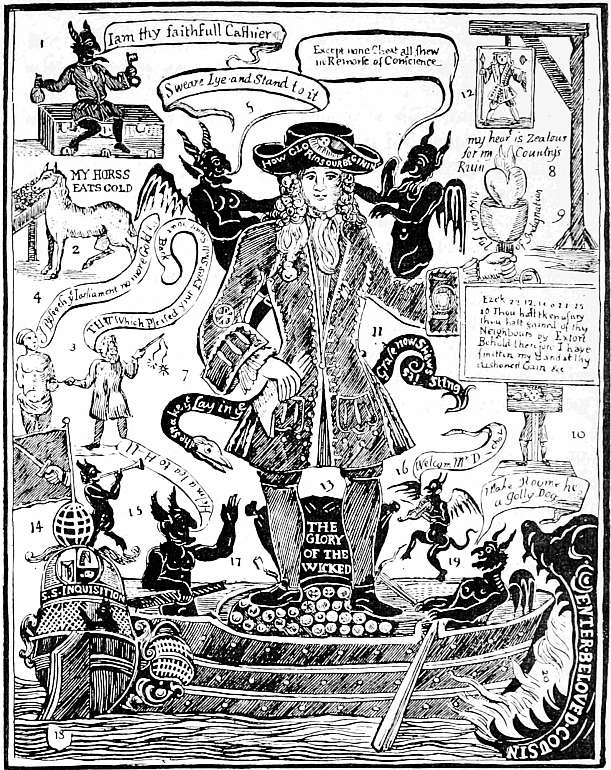
SOUTH SEA BUBBLE CARICATURE. FROM THE ‘WEEKLY JOURNAL AND BRITISH GAZETTEER,’ 1721.
‘1. The Cashire of the South Sea Company 2. The Horse of an Accomptant to the South Sea Company 3. The Correspondent of the Author of the London Journal 4. A Stock Jobber, or Exchange Broker, whipt by the Common Hangman 5. Belzebub prompting a Director of the South Sea 6. Satan prompting the same Director in t’other Ear 7. The Worm of Conscience fastens on the above said Director 8. The Cup of Indignation 9. A Director’s Sacrifice, which is a Villanous Heart 10. A Director in the Pillory 11. The Superscription over the pillory’d Director paraphras’d from the prophet Ezekiel. Chap. XXII. Ver. 12, 13, and Chap. XXIII. Ver. 25, 26, 27 12. A Director decyphered by the Knave of Diamonds Hanged 13. A Director wafting to Hell with the tide 14. Lucifers Row-Barge for first rate passengers 15. Moloch sounds his trumpet for Joy of meeting with a good Fare 16. Belial playing on the Violin to the Director 17. Mammon takes a trip at Helm for him 18. The South Sea 19. Lucifer rowing his own Barge 20. The Entrance into Hell, represented by the Mouth of the Leviathan, or great Whale, belching flames of sulphurous fire.’
There was a total eclipse of the sun in 1724, which appears to have excited much attention, and several notices of it occur in the newspapers. Parker’s London News gives a long account, with a woodcut, which I have copied. This paper was published three times a-week—on Mondays, Wednesdays, and Fridays. In the number for Monday, May 4th, 1724, is the woodcut referred to, together with the following explanation:—
‘Of the Eclipse of the Sun which will happen in the Afternoon on Monday, the 11th of this inst. May 1724.
‘The Sun, the glorious Lamp of the Universe, being a large round Body of Light, is fixt in the Centre of the Creation; so that all parts thereof might be partakers of his vivifying Rays, which otherwise would be shut up in perpetual Darkness.
‘The Earth is a dark round Ball, which turneth round on its own Axis, from West to East, once in twenty-four Hours Time, causing thereby Day and Night, also at the same Time, the Earth with the Moon, going round in its Orbit in 365 Days and some Hours, constituting thereby the true Length of our Year.
‘The Moon is likewise a round dark Ball, void of Light, and circumvolveth the Earth once a Month; so that whenever she passeth in her Orbit, in a direct line between the Sun and Earth, she Eclipses the Earth not the Sun, by depriving us of a Sight thereof; And whenever the Earth happens to be between the Sun and Moon, at such times the Earth obstructs the Light of the Sun from the Moon, and then the Moon is Eclipsed by the dark Body of the Earth.
‘Now to prevent any Consternation, which People, through Ignorance may fall under, by means of that great Eclipse which is now approaching; at which time it will be so dark, that the stars, (if the Air be clear) will be seen; and the Planets Mars, Venus, and the seldom to be seen Mercury, will appear a little above the Sun, towards the South; also Venus a little higher to the Left of Mercury, and Mars in the S.S.W. Parts of the Heavens; The several Appearances of this Eclipse will be according to the Types before inserted.
‘The beginning of this Eclipse, according to the nicest Computation of the most Judicious, will happen at 39 Minutes past 5 in the Afternoon when the Limb of the Moon will just touch the Sun’s Limb, as it is represented by the Uppermost Figure to the Right Hand. At 44 Minutes after 5 it will be enter’d the disk, and so much darkened as the 2d Scheme on the Right Hand shews. At 48 Minutes past 5 as the 3d denotes. At 53 Minutes past 5 as the 4th shews. At 58 Minutes after 5, as the 5th represents. At 3 Minutes past 6, as in the 6th Scheme. At 7 Minutes after 6, as in the 7th. At 12 Minutes past 6, as is shewn by the 8th Figure. At 17 Minutes past 6, as the 10th Figure shews. At 26 Minutes past 6, as the next succeeding Scheme denotes, beginning always to number from the Right Hand. At 31 Minutes after 6, so much of the Sun’s Body will be darkened, as the 12th represents: and at 36 past 6, will be the greatest darkness, when only a small thread of Light will be seen at London, on the upper part of the Sun as the 13th Scheme informs; but to all the Southern parts of the Kingdom, it will be totally darkened.
‘After this the Sun will begin to shew its Light, which will appear first on the lower part of that Glorious Body, towards the Right Hand; and the darkness will gradually lessen, as the several Figures represent, till the Sun’s Body be perfectly clear of the Shadow, which will be at 27 Minutes past 7 a-clock that Afternoon.’
This description is reprinted, together with the woodcut, in the same paper for May 8th, and to it is added the following:—‘Directions for the better viewing the Eclipse that will happen on Monday next’—‘Take a Piece of Common window Glass and hold it over a Candle, so that the Flame of the Candle may make it black, through which look upon the Sun, and you will behold the Eclipse without Danger to the Eyes.’
Or thus
Take a Piece of thick writing Paper, and prick a hole in it with a fine Needle, through which the Eclipse may be seen.’
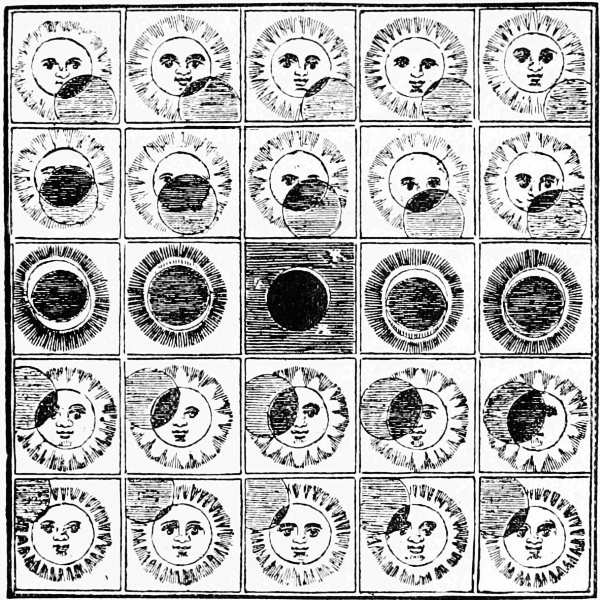
ECLIPSE OF THE SUN. FROM ‘PARKER’S LONDON NEWS,’ 1724.
The same paper (May 8th, 1724) contains some advertisements about the eclipse, which seems to have been for the moment the absorbing topic, and was apparently made the vehicle for advertising the shops of different tradesmen. The notices were published ostensibly ‘to lessen the consternation of ignorant people,’ but it is evident the advertisers had an eye to business. ‘An exact curious Draft’ was to be ‘given gratis at Mr. Garway’s original shop, the Sign of the Practical Scheme at the Royal Exchange Gate, on Cornhill Side. Up one pair of Stairs at the Sign of the celebrated Anodyne Necklace for Childrens’ Teeth, next the Rose Tavern without Temple Bar. At Mr. Gregg’s Bookseller, next to Northumberland House, at Charing Cross; and at R. Bradshaw’s the author’s Servant, at his House, next to the King’s Head, in Crown Street, right against Sutton Street End, just by Soho Square. Note, it will not be given to any Boy or Girl.’
The cut and description are again reprinted in the number for May 11th, where, amongst other items of news, is the following:—‘His Royal Highness went last Monday to Richmond, as did also the Right Hon. the Lord Chancellor, Judge Fortescue, and other persons of note; some of the Judges went to Hampton Court, and other gentlemen of Learning and Curiosity to more distant places, to make their Observations, as ’tis said, upon the great Eclipse of the Sun that happen’d in the Evening, and exactly answered the Calculations made of it by our Astronomers.’ In the number for May 18th are accounts of how the eclipse was observed in the country. It is stated:—‘We are advised from the Isle of Wight that the Eclipse on the 11th instant, which was Total, and caused very great Consternation there lasted about a Minute and a half; but that the chief sufferers thereby were the gentry of that Island, who by the great concourse of Strangers to their Houses, had but very little French Claret left upon their hands; But the comfort is, they have frequent opportunities of running some more.’
Parker’s London News blended amusement with instruction. The following items of news occur in the same number that contains the account of the eclipse, and show how our forefathers were entertained by the newspapers 160 years ago:—‘The Papers of the week, from the highest to the lowest rank have killed one Sir Nicholas Raymond in the Isle of Wight; but as no such knight ever inhabited therein, we can impute it to nothing but want of home news.’
‘Last Saturday Night, two Servant Maids at a Snuff Warehouse, at Mile End took so much Snuff, that they quarrell’d, and one of them stabbed the other in so many places with an Iron Scuer, that ‘twas thought she could not live. The other therefore, was instantly apprehended and committed.’
‘Last week an Apothecary was attacked by two Highwaymen, between Winchester and Southampton, who robbed him of his money, and finding two Vials of Purging Potions in his Pocket, that he was carrying to a Patient, they were so inhuman as to force him to swallow ‘em himself.’
‘Last Sunday Night, Sir Basil Firebrass, noted for his humanity to young Vintners, whom he first set up, and afterwards upon Default of payment took execution against ‘em, departed this life.’
The Weekly Journal or British Gazetteer for May 9th, 1724, contains an account and illustration of the same eclipse that is described in Parker’s London News. The illustration is a diagram, and is called, ‘A Representation of a Solar Eclipse. The Time of the Beginning, Middle, and End of the Eclipse and the continuance of Darkness, together with its Appearance at London and Bristol.’
The celebrated Grub Street Journal now comes upon the scene; and we find it not only surpassing its contemporaries in wit and satire, but it also comes out as an illustrated paper. In No. 43, for Oct. 29th, 1730, a whole page is occupied with woodcuts of the arms of the City Companies, which are reprinted about the time of Lord Mayor’s Day in succeeding years. In No. 48 there is a very well-executed copperplate portrait, presumably of the Lord Mayor of London. As it is printed on the same page with type (involving two printings), and the journal was sold for twopence, it shows some enterprise for the year 1730. On the front page of No. 95, for Oct. 28th, 1731, there are very rude woodcuts of the Lord Mayor’s procession, surrounded by the arms of the City Companies before referred to. No. 147 has a curious copperplate at the head of an article entitled, ‘The Art and Mystery of Printing Emblematically Displayed.’ The engraving represents human figures with animals’ heads at work in a printing-office. An ass is setting up the types, a pig is using the inking-balls, a horse is acting as pressman, a sheep is arranging the printed sheets, while a two-faced man and a many-horned devil are watching them all. This, like the portrait of the Lord Mayor, is printed on the same page with the type, with no printing at the back of the engraving. The article is a satirical conversation between certain printers’ devils, and is continued in the next number, where the engraving is also reproduced. The Grub Street Journal is the first example I have met with of a newspaper employing the expensive process of copperplate engraving for illustrations, and printing the plate in the body of its pages. It was probably thought to be too costly, for we find the conductors recurring to the almost extinct art of wood-engraving. In the number for Oct. 25th, 1733, there is a coarsely executed woodcut heading a satirical allegory, entitled, The Art of Trimming Emblematically Displayed.
The Daily Post of March 29th, 1740, is interesting as being an early example of a daily paper attempting to illustrate current events. The Daily Post consisted of a single leaf, with the page divided into three columns. In the number referred to there is a long account of Admiral Vernon’s attack on Porto Bello, illustrated with a woodcut, which the writer says will give the reader a clearer idea of the position of the town, castle, and ships engaged. The narrative is introduced by the editor in these words:—‘The following is a letter from a gentleman on board the Burford at Porto Bello to his friend at Newcastle, which, as it contains a more particular account of Admiral Vernon’s glorious achievement at that place than any yet published here, we thought we could not in justice to the Bravery of our English Officers and Sailors, refuse it a Place in our Paper.’
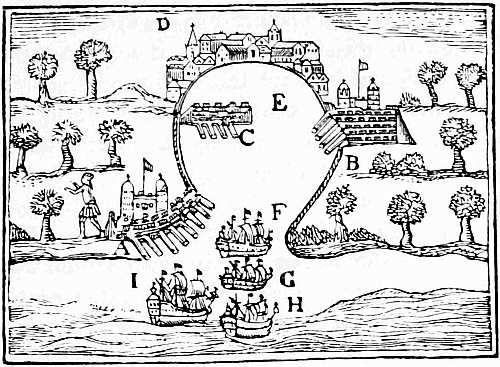
ADMIRAL VERNON’S ATTACK ON PORTO BELLO. FROM THE ‘DAILY POST,’ 1740.
A. The Iron Castle on the North side of the Mouth of the Harbour with 100 Guns.
B. The Castle Gloria, with 120 Guns, on the South side of the Harbour, and a Mile from the Iron Castle.
C. The Fort of Hieronymo, with 20 Guns.
D. The Town of Porto Bello lying along the Extremity of the Harbour.
E. The station of the Spanish Ships.
F. The Hampton-Courts place of Action, Commodore Brown.
G. The Norwich’s ditto, Cap. Herbert.
H. The Worcester’s ditto, Cap. Main.
I. The Admiral’s Ship, the Burford.
‘On the afternoon of the 21st about two o’clock we came up with Porto Bello Harbour, where the Spaniards had hoisted upon the Iron Castle the Flag of Defiance; and, as we were told by themselves afterwards, they wished earnestly for our attempting to come in, as believing they could sink us all immediately, but said they feared we were only making a second Bastimento Expedition, and would not give them the pleasure of engaging us.’ Then follows a long and circumstantial account of the conflict. ‘Notwithstanding they had discharged very few Guns for some Minutes before we came up; yet as if they had resolved to summon up all their Courage against the Flag, they welcomed us with a terrible Volley, which being at so short a Distance, took Place with almost every Shot. One struck away the Stern of our Barge; another broke a large Gun upon our upper Deck; a third went thro’ our Foretop-Mast; and a fourth, passing thro’ the Arning within two Inches of our Main-Mast, broke down the barricado of our Quarter-Deck, very near the Admiral, and killed three Men in a Moment, wounding five others which stood by them. This look’d as if we should have bloody work, but was far from discouraging our brave Fellows.’ The Spaniards being driven from their guns, the English landed:—‘One man set himself close under an Embossier, whilst another climbed upon his Shoulders and enter’d under the Mouth of a great Gun. This so dismay’d the Spaniards that they threw down their Arms and fled to the Top of the Castle; from whence scaling backwards we could see them run into the woods by hundreds and fly for their lives.’ The place being taken, the writer gives a minute account of the damage done and the booty taken. He says:—‘We have also had the good luck to find about 10,000 Dollars belonging to the King of Spain, which I had the Pleasure of being present at the searching for, when we found it in the Customhouse,’ &c.
The writer of the above account signs himself Wm. Richardson, and gives the explanations to the letters on the woodcut, a facsimile of which is engraved.
To account for the enthusiasm with which Admiral Vernon’s victory at Porto Bello was received we must remember that the nation had previously been wrought up to a high state of fever about Spain, and the declaration of war had been received in the most jubilant manner. We can therefore understand that the conductors of the Daily Post, infected by the popular fervour, would gladly seize the opportunity of producing in their pages the drawing and description by an eye-witness of this naval victory. This early example of illustrated news, though it has nothing pictorial about it, is extremely interesting, showing as it does the tendency of newspapers, in times of excitement, to call on the artist’s pencil to aid the writer’s pen. It was in reference to this war that Walpole said, when the bells were ringing joyfully, ‘They may ring the bells now, but they will soon be wringing their hands.’
To the preceding example of a daily paper attempting to illustrate current events I will add an instance of a penny paper doing a similar thing at about the same period. The Penny London Post, or, The Morning Advertiser, was a paper published three times a-week, and in the number for Jan. 9th, 1748-9, there is given ‘A view of the Public Fireworks to be exhibited on occasion of the General Peace concluded at Aix La Chapelle the 7th Day of October 1748.’ The engraving is little more than a diagram, and accompanies a description of the arrangements made for the occasion, amongst which there was to be a band of a hundred musicians to play before the fireworks began, ‘the Musick for which,’ says the Penny London Post, ‘is to be composed by Mr. Handel.’
We are accustomed to think of the immortal author of Tom Jones as a novelist only. Henry Fielding was, however, also a journalist, a pamphleteer, and a justice of the peace for Middlesex and Westminster. Amidst his other labours he found time to edit the Jacobite’s Journal, a paper started to support the House of Hanover after the Rebellion of 1745. It was a sheet of four pages, published every Saturday, and the first twelve numbers were adorned with a woodcut heading which has been attributed to Hogarth. This heading was discontinued after the twelfth number, and in number 13 there is an elaborate article, replete with sarcastic humour, explaining the reasons for its discontinuance. The Jacobite’s Journal purported to be edited by ‘John Trott-Plaid, Esq.,’ and was essentially satirical in its tone. In the second number there is the following reference to the engraved heading:—
‘As my Wife appears in her Plaid on Ass-back behind me at the Head of this Paper, it will not I hope be imagined that I have brought her abroad only to take the Air, without assigning to her any share in this undertaking.
‘The Mystery of Jacobitism doth not, like that of Free Masonry, exclude the Female World; for tho’ all Jacobites are not, as some wicked Whigs have represented us, old women, yet women we have in great Numbers among us, who are as learned in the knowledge of our Mysteries, and as active in the celebration of our Rites, as any of the Male Species; and many of these are so far from deserving the name of old, that their age scarce yet entitles them to the name of women.’
As I before stated, the heading is left out after the twelfth number. Whether it had sufficiently served its purpose as a caricature of the Jacobite party, and was no longer needed, or whether it really took up too much room, as stated by the editor, its discontinuance was made the occasion of publishing a leading article, part of which I am tempted to transcribe as an excellent specimen of Fielding’s satire.
‘There is scarcely anything more provoking than to be totally misunderstood, and by that means to have our compliments received as Affronts, and our Panegyrick converted into Satire.
‘It cannot therefore be wondered at, if I am not well pleased with that gross misunderstanding of the Emblematical Frontispiece so long prefixed to my Paper, which hath generally prevailed, and which, among other good Reasons, hath at length induced me to displace it for the future. By this Error of the Public, a Contrivance of mine (the expense of much laborious thinking) to do Honour to the Jacobite Party, hath been represented as the Means of vilifying and degrading it.
‘But, seriously, could the Art of Man have carried the Glory of Jacobitism higher than it was carried in this print, where a Jacobite of either Sex was seen cloathed in Mystery, and riding on one of the most honourable Beasts in the Universe, while Popery servilely attends, leading it by the Halter, and France and the Republican Party are dragged after Heels. Is not here depictured that notable and mysterious Union of French Interest, Popery, Jacobitism, and Republicanism; by a Coalition of all which Parties this Nation is to be redeemed from the deplorable State of Slavery, under which it at present labours?
‘It would be endless to enumerate all the Mistakes and ridiculous Conceits entertained on this occasion. Some have imagined we intended to insinuate that the Protestant Jacobites were led by the Nose by Popery, and spurr’d on by France and the Republicans; whereas nothing can be more certain in Fact, than that Popery and France, and the Republicans, have ever been the mere Dupes and Fools of the said Jacobites.
‘Many have endeavoured to discover Resemblances to real Persons in the figures there exhibited. By the Popish Priest, it hath been said we design to represent the old Chevalier; and by the Figures on the Ass, the young Chevalier his Son and the famous Jenny Cameron.
‘Others have found out Likenesses of less Importance, and several Squires and Country Gentlewomen of Staffordshire and other Counties, who never travel beyond the limits of a Fox chace, have been supposed to ride, once a week, Post all over the Kingdom in this Paper.
‘But the most egregious Errors have been committed in Misconstructions concerning the Ass. Several ingenious and witty Printers of News Papers have very facetiously taken occasion to call the Author himself an Ass; supposing probably, that as Scripture informs us an Ass once spoke, so certain Descendants of the same Family might write, which Faith, perhaps something within their own Experience, might sufficiently encourage them to receive.
‘To mention no more of these absurd Conjectures, I must here inform my Reader, that by the Body of the Ass we intend to figure the whole Body of Jacobitical doctrine.
‘Now as there was no Symbol among the Antients, of which the Emblematical Meaning was so plain and easy to be discovered, our Party could never have so universally mistaken it, had it not been for that want of Learning among us, which I lamented in my last Paper. Hence being misled by those erroneous opinions, which the Moderns have propagated to the great disadvantage of Asses, the Jacobites have been unwilling to discover any Resemblance between themselves and an Animal which the wise Antients saw in so respectable a Light, and which the ignorance of latter Ages hath highly dishonoured by odious Comparisons with certain Individuals of the Human Species.
‘Thus Homer is well known to have liken’d one of his principal Heroes to this noble Animal; which was in such Esteem among the antient Jews, that he was not only an object of their Devotion, but they are said to have preserved his Figure in massy Gold in the Temple of Jerusalem.
‘If the Transfiguration of Midas in the Metamorphosis doth but little Honour to the Ears of our Symbol, the Story of Lotis which the same Poet tells in his Fastorum, is greatly in praise of his Braying, by which the Chastity of that Nymph was rescued from the wicked Designs of her insidious Lover.
‘In such esteem hath this noble Beast been held among the Learned, that I have seen a Book composed in his Favour and entitled Laus Asini: not to mention the celebrated performance of Apuleius to which he hath given the Name of the Golden Ass.
‘Instead therefore of being displeased with the Emblem, our Party have great Reason to be vain on this Occasion, nor do I think there can be a greater Comparison than of a Protestant Jacobite to an Ass, or one more to the Honour of the former.
‘First, what can so well answer to that noble and invincible obstinacy, which I have more than once celebrated in our Party, as the intractable and unalterable Nature of this Animal, which gave rise to an antient Proverb alluded to by Horace in his Satires:—
‘“—— Your Art As well may teach an Ass to scour the Plain And bend obedient to the forming Rein.”
‘And again in his Epistles:—
‘“Democritus would think the writers told To a deaf Ass their story ——”
‘Which may most strictly be applied to all those writers, who have endeavoured to convince the Jacobites by argument.
‘Again what can give us a more adequate Idea of that Firmness, with which we have supported all the ill-usage of the worst of Sovereigns without Resentment, than the laudable Indifference which an Ass hath for the same; whom you may beat, whip, kick, and spur as long as you are pleased, he still trudges on without altering his Pace.
‘To omit many other obvious Resemblances, such as Braying, &c, the famous story of the Countryman and the Ass, briefly touched upon by Horace in the Epistle addressed to his own Book, is so perfect a Picture of Jacobitism, that I have been inclined to think as the Antients are known to have inveloped all their Mysteries in Fable and Allegory, that no less than Jacobitism itself was intended to be couched under this story: “A certain Countryman observing an Ass making towards a Precipice, ran to him, and catching hold of his Tail, endeavoured with all his Might to withhold him from Destruction; but the more the Countryman attempted to preserve him, the more obstinately the Ass contended against his kind Preserver, and the more eagerly was bent upon accomplishing his fatal Purpose. The Countryman at last, wearied out with his Endeavours to save an obstinate Beast against his own will, and having probably received some Thanks from his Heels for his intended kindness, instead of pulling any longer, gave the Ass a Push, and tumbled him headlong down the Precipice which he had been so industriously pursuing.”
‘I make no doubt but many of our good Enemies the Whigs, who have well imitated this Countryman in the former part of his Behaviour, would imitate him likewise in the latter, was it not that they cannot precipitate us without tumbling down themselves at the same time.
‘These are the Mysteries, then, which have been couched under my Frontispiece, and which, tho’ their meaning must now appear to have been so plain, have nevertheless stood exposed so long at the Head of this Journal, without having been, as I can find, understood by any.
‘Perhaps I shall be asked, why I have now displaced them, since, after so large and full an Explanation, they cannot fail of being highly agreeable to that Party for whose use chiefly this Paper is calculated; and who would, for the future, worship my Ass with the same Veneration with which the Jews of old did theirs.
‘Now, tho’ the Indignation which I have exprest in the Beginning of this Essay at the many gross and absurd Misconceptions which have been vented by the Public, would alone very well justify the Discontinuance of my Emblem so much abused, there are, to say the Truth, two other Reasons which have had a stronger Weight with me in producing this Determination. The former of these is, that the Ass and his Retinue do indeed take up too much room, and must oblige us either to suppress Part of our Lucubrations, or some of those material articles of News which we weekly transcribe from others; or lastly those pieces of Intelligence called Advertisements, which tho’ not always most entertaining to our Reader, do afford very agreeable Entertainment to ourselves.
‘A second and a very strong Motive with us, is to lend all the Assistance in our Power to a very worthy and willing, tho’ weak Brother, the learned and facetious Novelist, Mr. Carte; whose great Romance, tho’ in our Court of Criticism, where we shall always act impartially, we have been obliged like other Judges, to condemn, contrary to our own Inclinations, to be grubb’d, we shall always privately esteem as a work calculated solely for the use of our Party. As we have therefore, to our great Concern, received very credible Information that the said work begins already to be considered only as a Heap of Waste Paper, we have thought proper to lend our Frontispiece to our good Brother, in order that it may be prefixed to the future Volumes of that great Work advising him to omit the words London Evening Post, and to insert English History in their stead. This will not fail of greatly recommending his Performance to our Party, who never willingly read anything but what an Ass may at least be supposed to have bray’d.
‘I could wish, moreover, that the learned Novelist would take our Advice in another Instance, and for the future deal forth his excellent work in weekly Portions or Numbers; I do not mean in such a Form as the real History of England is now publishing by Mr. Waller; but in the same manner with those true and delectable Histories of Argalus and Parthenia, Guy, Earl of Warwick, the Seven Champions, &c., in which Form, at the price of 1d. each, when embellished by our Frontispiece, I make no doubt of assuring him as universal a Sale as the inimitable Adventures of Robinson Crusoe formerly had throughout this Kingdom.’
The ‘Mr. Carte’ to whom Fielding proposed to lend his ‘Frontispiece’ was Thomas Carte, the historian, who had just brought out the first volume of his History of England, in which he showed such decided Jacobite predilections that his work was ruined in consequence. He professed to be acquainted with the case of a person who had been cured of the King’s Evil by the Pretender, then an exile in France, and this so disgusted many of the subscribers to his book that they withdrew their names and abandoned the author and his work together. He, however, brought out two more volumes, and a fourth was published after his death. It was probably in allusion to this story of the Pretender curing the King’s Evil that Fielding speaks of Carte as ‘the learned and facetious novelist;’ and doubtless the ‘great Romance’ referred to was intended for his history of England. Fielding and Carte both died in the same year, 1754.
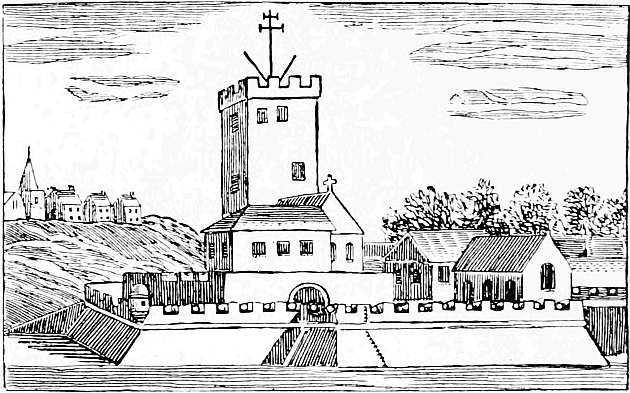
PERSPECTIVE VIEW OF FORT FOURAS, AS IT APPEARED IN THE SHIPS FROM THE CHARENTE, FROM ‘OWEN’S WEEKLY CHRONICLE,’ 1758.
During the next ten years I have found no illustrations in the newspapers of that period. In 1758 there was a newspaper published entitled Owen’s Weekly Chronicle, or Universal Journal, a sheet of eight pages, size of the Athenæum, price two-pence halfpenny. About this time the English Government, in carrying on the war against France, despatched several expeditions to the French coast, none of which redounded much to the credit of the British arms. One of these expeditions was against Rochfort, and it turned out a failure, which caused much dissatisfaction. Owen’s Weekly Chronicle for June 3, 1758, published a long article on the subject, illustrated with a woodcut view of Fort Fouras. The writer concludes, with true newspaper vehemence, in the following words:—‘Where is the glory of the British name? Where are the terrors that used to accompany our fleets and armies? Let it not be said the treasures of the country are poured forth in vain by an united and willing people; that our enemies are become invulnerable; and every blow our Ministers meditate impracticable. The Duke of Marlborough and Lord George Sackville are gone with Lord Anson and Sir Edward Hawke upon the present grand expedition; and we hope their courage and experience will revive the sinking honour of their country; and show that France is both vulnerable and impotent when the power of Britain is properly exerted.’ Unfortunately, the sinking honour of the country was not much revived by the ‘grand expedition’ here referred to; for, after an ineffectual attempt on St. Maloes, the Duke of Marlborough embarked in such haste that he left his tea-spoons behind him: and these were afterwards sent home in a cartel-ship by the Duke d’Aiguillon in polite contempt. I have copied the woodcut above referred to, which is entitled, ‘A Perspective view of Fort Fouras as it appeared in the ships from the Charente,’ and the following description is given of it:—‘Fouras was the tower of an old parish church, which, soon after the foundation of Rochefort, in 1688, Louis XIV. purchased of the proprietors to make a Tour de Garde, for repeating signals from the Isles of Oleron and Aix up to Rochefort, which is one of its present uses. A fort and garrison being established in the isle of Aix, Fouras was found to be the nearest and most secure communication in all weathers with that island; so that in process of time barracks and lodgments were built therein, and it was fortified to the sea by a strait curtain.’
For the view of Fort Fouras Owen’s Weekly Chronicle must have been indebted to some one on board one of the British ships. Naval and military officers in all parts of the world are among the most valued correspondents of the modern illustrated newspaper; and it is interesting to notice that so long ago as the taking of Porto Bello and the attack on Rochefort there were men engaged in those expeditions whose spirit and intelligence prompted them to supply the newspapers of the day with sketches and information. The view of Fort Fouras is the earliest attempt I have seen in a newspaper to give a pictorial representation of a place in connexion with news.
Wood-engraving was the only cheap method of illustration within the reach of newspapers, but the art barely existed at this time. The few woodcuts published in newspapers were not only coarsely and rudely executed, but sometimes the efforts of the illustrator did not get beyond a rough plan or map, and even this, as I have before remarked, was not always engraved. In further confirmation of this statement I may refer to Lloyd’s Evening Post of April 17, 1765, where one of the pages is taken up with a plan representing the trial of a Peer in Westminster Hall. This is done entirely with lines, type, and printer’s ornaments. Although there is no account given of this trial in Lloyd’s Evening Post, the plan must have referred to the case of Lord Byron, who was tried in Westminster Hall for the murder of Mr. Chaworth, April 16 and 17, 1765.
In the winter of 1764-5 a strange wild beast was said to have appeared in France, devouring women and children, and spreading dismay and terror through the whole of Languedoc. What this ferocious creature was, or whence it came, no one knew; but the fear inspired by its presence was universal. The district which it specially haunted procured for it the name of the Wild Beast of the Gévaudan, by which designation it became famous not only in the South of France but throughout the country, and even in foreign lands. The earliest account of this ferocious monster appeared in the official journal of Paris in the following words:—
‘A very strange wild beast has lately appeared in the neighbourhood of Langagne and the forest of Mercoire which has occasioned great commotion. It has already devoured twenty persons, chiefly children, and particularly young girls, and scarcely a day passes without some accident. The terror he occasions prevents the woodcutters from working in the forests; so that wood has become dear. Those who have seen him say he is much higher than a wolf, low before, and his feet are armed with talons. His hair is reddish, his head large, and the muzzle of it is shaped like that of a greyhound; his ears are small and straight; his breast is wide, and of a grey colour; his back streaked with black; and his mouth, which is large, is provided with a set of teeth so very sharp that they have taken off several heads as clean as a razor could have done. He is of amazing swiftness; but, when he aims at his prey, he crouches so close to the ground, that he hardly appears to be bigger than a large fox; and at the distance of some one or two toises, he rises upon his hind legs and springs upon his prey, seizing it by the neck or throat. He is afraid of oxen, which he runs away from. The consternation is dreadful throughout the district where he commits his ravages, and public prayers are offered up on the occasion. The Marquis de Marangis has sent out four hundred peasants to destroy this fierce beast; but they have not been able to do it.’
In spite of the efforts made to capture or destroy it the wild beast of the Gévaudan continued its ravages. In a letter from Meude, dated December 21, 1764, it is stated, ‘The wild beast, which hath ravaged several provinces, has been for some time in ours. He was seen a few days ago near St. Flour, ten leagues from hence, and he is now in our neighbourhood. The day before yesterday he devoured a little girl who looked after cattle. A detachment of dragoons has been out six weeks after him. The province has offered a thousand crowns to any person who will kill him.’ On the 8th of February, 1765, the following statement was sent from Montpellier:—‘On the 12th ultimo the wild beast attacked seven children, five boys and two girls, none of whom exceeded eleven years of age. The beast flew at one of the boys; but the three eldest of them by beating him with stakes, the ends of which were iron, obliged him to retire, after having bitten off a part of the boy’s cheek, which he ate before them. He then seized another of the children; but they pursued him into a marsh which was close by, where he sunk in up to his belly. By continually beating him, they rescued their companion; who, though he was under his paw for some time, received only a wound in his arm, and a scratch in the face. A man at last coming up, the creature was put to flight. He afterwards devoured a boy at Mazel, and, on the 21st, flew on a girl, who, however, escaped with some dangerous wounds. The next day he attacked a woman, and bit off her head. Captain Duhamel, of the dragoons, is in pursuit of him, and has caused several of his men to dress themselves in women’s apparel, and to accompany the children that keep cattle.’
The eyes of all France being fixed upon the doings of this wild beast, the attention of Louis the Fifteenth himself was called to the bravery of the boys in the preceding account. ‘The King having been informed of the bravery with which the young Portefaix attacked the beast on the 12th of January last, at the head of his companions, and being willing to reward such gallant behaviour, has given him a recompense of four hundred livres, and has ordered three hundred to be distributed among his companions.’
The Government also offered a reward for the destruction of the wild beast. The following placard was fixed up in all the cities and towns of Languedoc:—‘By the King and the Intendant of the province of Languedoc. Notice is given to all persons, that His Majesty, being justly affected by the situation of his subjects now exposed to the ravages of the wild beast which for four months past has infested Vivarais and Gévaudan, and being desirous to stop the progress of such a calamity, has determined to promise a reward of six thousand livres to any person or persons who shall kill this animal. Such as are willing to undertake the pursuit of him may previously apply to the Sieur de la Fout, sub-deputy to the Intendant of Meudes, who will give them the necessary instructions agreeably to what has been presented by the ministry on the part of his Majesty.’
A letter from Paris dated the 18th of February, 1765, gives the following circumstantial description of the wild beast:—
‘You know how I acquainted you, some months ago, that Monsieur Bardelle, his son and I, designed going by the Diligence, and opening the New Year at our old friend Monsieur Dura’s chateau, near Babres, in Languedoc. We spent the time very agreeably, our host and his family having done all in their power to make us welcome. The party broke up and took leave the first of this month, amongst whom was Monsieur Lefevre, a counsellor, and two young ladies, who were engaged to pass a week at Monsieur de Sante’s, the curé of Vaistour, about three days’ journey distant from the chateau of Monsieur Dura. The company went away in a berlingo and four, and the footman Michel, on a saddle-horse; the carriage, after the manner here, being drawn by four post-horses, with two postilions, the berlingo having no coach box. The first night the party lay at Guimpe, and set out next morning at nine, to bait half way between that and Roteux, being four posts, and a mountainous barren country, as all the Gévaudan is. The parish of Guimpe had been greatly alarmed by the frequent appearance of, and the horrid destruction made by, the fiery animal that has so long been the terror of the Gévaudan, and is now so formidable that the inhabitants and travellers are in very great apprehension. The bailiff of Guimpe acquainted the party that this animal had been often lurking about the chaussée that week, and that it would be proper to take an escort of armed men, which would protect the carriage; but the gentlemen declined it, and took the ladies under their protection, and set out, on the 2nd of February, very cheerfully. When they had made about two leagues, they observed at a distance a post-chaise, and a man on horseback, coming down the hill of Credi, and whipping the horses very much; and at the descent unfortunately the wheel-horse fell down, and the postilion was thrown off; whereupon the horseman who followed the chaise, advanced to take up the boy, in which moment, when he had got down, we perceived the wild beast so often described make a jump towards the horses, and on the footman’s raising his right hand to draw a cutlass and strike the creature, it pricked up its ears, stood on its hind feet, and, showing its teeth full of froth, turned round and gave the fellow a most violent blow with the swing of its tail. The man’s face was all over blood; and then the monster, seeing the gentleman in the chaise present a blunderbuss at its neck, crept on its forehead to the chaise-step, keeping its head almost under its forelegs, and getting close to the door, reared upright, vaulted into the inside, broke through the other side-glass, and ran at a great rate to the adjoining wood. The blunderbuss missed fire, or it is possible this had been the last day this brute-disturber had moved. The stench left in the carriage was past description, and no cure of burning frankincense, nor any other method removed, but rather increased the stink, so that it was sold for two louis; and though burned to ashes, the cinders were obliged, by order of a commissary, to be buried without the town walls. We came up very well in time; for the beast would doubtless have destroyed some one, had it not espied three of us advancing with guns. It certainly jumped through the chaise to get away from us.’
These accounts appear to have been received with some incredulity abroad. In the same number of Lloyd’s Evening Post that contains the plan of Lord Byron’s trial there occurs the following passage about this curious wild beast: ‘One of the Dutch Gazetteers by Monday’s mail says:—“The accounts of the wild beast seen in the Gévaudan are of such a nature that it is hardly possible to give any credit thereto, and yet most of them have appeared in the Paris Gazette, a paper whose authors, known to be men of letters, are too judicious to be suspected of credulity, too prudent, too well informed of what passes at the Court of the King their master, one should think, to attribute to his Most Christian Majesty a reward for an action which never had any existence—an action which was only a fable.”’ This is, no doubt, an allusion to the reward of 400 livres bestowed upon the boys who beat off the ferocious monster.
While the interest and excitement about this terrible wild beast was at the highest, the St. James’s Chronicle published an engraving and description of it. The St. James’s Chronicle; or the British Evening Post, was a folio of four pages, published three times a-week, price twopence-halfpenny. In the number for June 6, 1765, there is printed the following description and woodcut:—
‘For the St. James’s Chronicle.
‘Of this beast, which has already devoured upwards of seventy Persons and spread Terrour and Desolation throughout the whole Gévaudan, the Sieur de la Chaumette, who lately wounded it, has given us the following Description. It is larger than a Calf of a year old, strongly made before, and turned like a Grayhound behind. His Nose is long and pointed, his Ears upright and smaller than a wolf’s, his Mouth of a most enormous size, and always wide open; a Streak of Black runs from his Shoulders to the Beginning of his Tail. His Paws are very large and strong; the Hair on his Back and Mane thick, bristly, and erect; his Tail long and terminating in a Bush, like that of a Lion; his Eyes small, fierce, and fiery. From this description it appears that he is neither a Wolf, Tiger, nor Hyena, but probably a Mongrel, generated between the two last, and forming, as it were, a new Species. All the accounts lately received agree in assuring that there are several of them.’
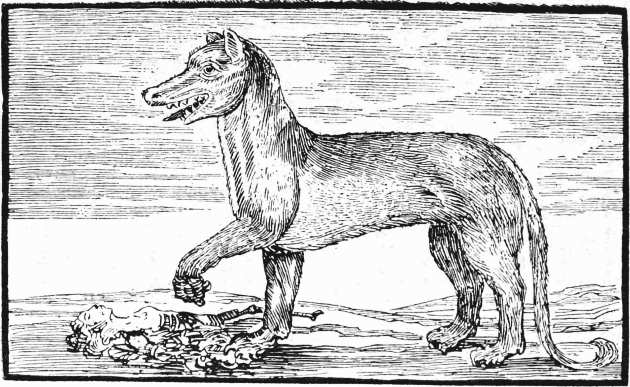
STRANGE WILD BEAST SEEN IN FRANCE. FROM THE ‘ST. JAMES’S CHRONICLE,’ 1765.
The St. James’s Chronicle does not state from whence the portrait was obtained. A representation of the wild beast of the Gévaudan was sent in April, 1765, to the Intendant of Alençon, and a description of that picture corresponds with the woodcut in the St. James’s Chronicle, so that the latter was probably a copy of the former.
About three months after the publication of the woodcut and description in the St. James’s Chronicle, the career of this much dreaded animal was brought to a close. On Sept. 20th, 1765, it was encountered in the wood of Pommières by a certain Monsieur Beauterme, a gentleman of a distant province and noted as a successful hunter. He had come into the district on purpose to seek out this notorious wild beast, and having found it, shot it in the eye at the distance of about fifty paces. The animal, however, though wounded, showed fight, and was rushing on Monsieur Beauterme with great fury, when he was finally dispatched by a gamekeeper named Reinhard.
Several inhabitants of the Gévaudan who had been attacked by the beast declared it to be the same which had caused such consternation in the country, and Monsieur Beauterme set out with the body to Versailles in order to present it to the King. The animal was found to be thirty-two inches high, and five feet seven and a half inches long including the tail. The surgeon who dissected the body said it was more of a hyena than a wolf, its teeth being forty in number, whereas wolves have but twenty-six. The muscles of the neck were very strong; its sides so formed that it could bend its head to its tail; its eyes sparkled so with fire that it was hardly possible to bear its look. Its tail was very large, broad, and thick, and bristled with black hair, and its feet armed with claws extremely strong and singular.
In Paris it was thought that this mysterious animal was a cross between a tiger and a lioness, and had been brought into France to be shown as a curiosity. It is not unlikely that it had escaped from some travelling show, and was probably a hyena. The imagination of the country people would easily transform it into any shape suggested by their terrors. That such fancies easily begin and rapidly grow was proved in the case of Captain Sir Allan Young’s pet Esquimaux dog, which was either stolen or wandered from the Arctic ship Pandora as she lay in Southampton harbour after returning from the Polar regions. Quite a panic arose in that part of Hampshire where this most valuable and harmless animal was wandering about, and every sort of story was circulated of the ravages and dangers the country was exposed to. The people began to think that besides their sheep and pigs their children were in danger. Some said it was a gigantic black fox, others that it was a Canadian wolf. Expeditions were organized to attack it, and after being chased for some miles by people on horseback, it was ultimately shot and exhibited at sixpence a head in Winchester market-place. There could be no doubt about the dog’s identity, for Sir Allan Young afterwards got back his skin.
Before concluding my sketch of illustrated journalism in the eighteenth century I must refer to a class of publication that possessed many of the characteristics of the newspaper, without exactly belonging to that category. This kind of journal is represented by the Gentleman’s Magazine; but, although Edward Cave considered himself the inventor of the magazine form of publication, the Gentleman’s Magazine was not the first journal of the kind. Nearly forty years before it came into existence a monthly publication was started in London with the following title:—‘The Gentleman’s Journal; or, the Monthly Miscellany. By way of Letter to a Gentleman in the country, consisting of News, History, Philosophy, Poetry, Music, Translations, &c. January, 169½.’ Its projector and editor was a refugee Frenchman, one Peter Anthony Motteux, and the design appears to have met with considerable success, but it did not last more than four years.
In the second number of the Gentleman’s Journal appeared the following:—‘The author desires to be excused for not answering the many ingenious letters that have been sent to him that he may have the more time to apply himself to this journal; he judges that he answers them enough when he follows the advice they give him, or inserts what is sent to him, which he will always be very careful to do. But such things as any way reflect upon particular persons, or are either against religion or good manners, he cannot insert. He will take care to settle correspondence both abroad and at home, to inform his readers of all that may be most worthy their knowledge; and if anything offers itself that deserves to be engraved, he will get it done. But it being impossible he should know by himself a thousand things which the publick would gladly know, such persons as have anything to communicate may be pleased to send it to him, at the Black Boy Coffee House in Ave Maria Lane, not forgetting to discharge the postage.’
It would appear by the above that Peter Anthony Motteux had a vague perception that engravings might increase the attractions of his journal; but it does not seem that much came in his way that ‘deserved to be engraved.’ I have found only two small woodcuts in the Gentleman’s Journal. They both occur in the volume for 1694. One is a representation of snow crystals, and the other is a diagram of a mock sun.
Motteux tells us that his journal was patronised by the Queen, and was much favoured by the ladies generally. He had amongst his contributors Dryden, Matthew Prior, Sedley, and Tom Durfey. Charles Wesley, brother of the famous John, sent serious verses, as did also Tate, of ‘Tate and Brady’ celebrity. All these contributions were introduced into a long letter, which, as the title indicates, was the shape in which the Gentleman’s Journal was written, and in this respect it was modelled upon the early manuscript newsletters.
Peter Anthony Motteux, the editor of the first English magazine, was also the author of several songs, plays, and prologues, and he also published a translation of Don Quixote. He kept a large East India warehouse in Leadenhall Street, and afterwards obtained a situation in the Post Office. He was found dead on the morning of his fifty-eighth birthday, in a low drinking-house in Butchers’ Row, near Temple Bar, and had either been murdered or had lost his life in a drunken frolic. The London Gazette of the succeeding week contained the offer of a reward of fifty pounds for the discovery of the murderer, and the King’s pardon to any but the actual criminal; but the mystery was never cleared up, and the bones of the clever exiled Frenchman lie unavenged and forgotten in the vaults of St. Andrew Undershaft, Leadenhall Street, celebrated amongst City churches as the burial-place of John Stowe.1
Edward Cave, the early patron and friend of Dr. Johnson, projected and brought out the Gentleman’s Magazine in 1731. It was printed at St. John’s Gate, Clerkenwell, a view of which place embellished its title-page.
The full title was, ‘The Gentleman’s Magazine, or Monthly Intelligencer, containing Essays, Controversial, Humorous, and Satirical; Religious, Moral, and Political; collected chiefly from the Publick Papers. Select Pieces of Poetry. A Succinct Account of the most remarkable Transactions and Events, Foreign and Domestick. Births, Marriages, Deaths, Promotions, and Bankrupts. The Prices of Goods and Stocks, and Bill of Mortality. A Register of Books. Observations on Gardening.’ It will thus be seen that the Magazine possessed many of the characteristics of a newspaper. On the front page of the earlier numbers were printed the names of the various newspapers from which it derived its information. It was some time before illustrations began to appear. The most important subjects were engraved on copper, and rough woodcuts were sprinkled here and there among the type. Sometimes the most incongruous subjects were engraved on the same plate, such as the section of a man-of-war and the figure of a locust. There was occasionally an illustration of news, as in the volume for 1746, where there is a map of the country round Carlisle, showing the route of the Scottish rebels; and in the same volume there is a portrait of Lord Lovat. The frontispiece to this volume is a portrait of the Duke of Cumberland, with the motto Ecce Homo. Portraits, plans, and bird’s-eye views are of frequent occurrence. In the volume for 1747 is a very elaborate bird’s-eye view of the city of Genoa, illustrating an account of an insurrection there. The same volume contains a view of Mount Vesuvius, with a description of the last great eruption. In the volume for 1748 are views of Amsterdam, the Mansion House, London, Greenwich Hospital, the Foundling Hospital, &c. The volume for 1749 contains an engraving of the fireworks on the occasion of the Peace, and views of Blenheim House and Covent Garden. In the volume for 1750 there is a woodcut with ‘J. Cave sc.’ in the corner. This was probably a son or some other relative of the proprietor, who was either in training as an engraver, or was trying his hand merely as an amateur. His name does not appear again, and I have never met with it elsewhere in connexion with the art of wood-engraving.
In the number for November, 1750, there occurs the following amongst the list of deaths:—‘Mr. Edward Bright, at Malden in Essex, aged 30; he was supposed to be the largest man living, or perhaps that ever lived in this island. He weighed 42 stone and a half, horseman’s weight; and not being very tall, his body was of an astonishing bulk, and his legs were as big as a middling man’s body. He was an active man till a year or two before his death, when his corpulency so overpowered his strength that his life was a burthen, and his death a deliverance. His coffin was three feet six inches over the shoulders, six feet seven inches long, and three feet deep; a way was cut thro’ the wall and staircase, to let the corpse down into the shop; it was drawn upon a carriage to the church, and let down into the vault by the help of a slider and pulleys.’ In the number for the following February there is a woodcut of Mr. Bright, and the reader is referred back to the November number for the above description. This seems to show that the Gentleman’s Magazine did not consider it of vital importance, in illustrating news, to follow very close upon the heels of events. I have copied this engraving as a specimen of the woodcut illustrations of the Magazine.
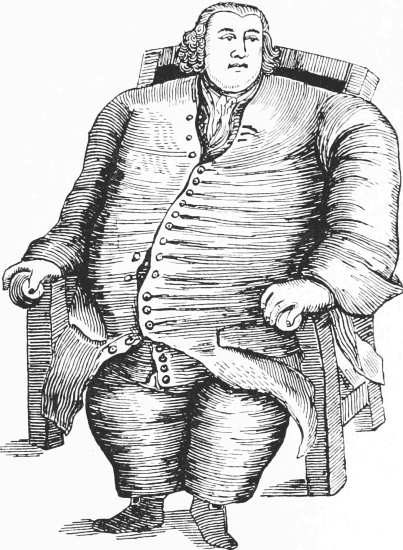
EDWARD BRIGHT. WEIGHT 42½ STONE. FROM THE ‘GENTLEMAN’S MAGAZINE’ FOR FEBRUARY, 1751.
The Gentleman’s Magazine attracted the notice and admiration of Dr. Johnson before he came to London as a literary adventurer. He afterwards became a regular contributor to its pages, and for many years it was his principal source of income. His first contribution was a complimentary Latin poem addressed to Sylvanus Urban, and when Cave died Johnson wrote an account of him in the magazine. Dr. Johnson told Boswell ‘that when he first saw St. John’s Gate, the place where that deservedly popular miscellany was originally printed, he “beheld it with reverence.”’
Edward Cave was born at Newton, in Warwickshire, Feb. 29th, 1691; he died Jan. 10th, 1754. ‘He was peculiarly fortunate,’ says Boswell, ‘in being recorded by Johnson; who of the narrow life of a printer and publisher, without any digressions or adventitious circumstances, has made an interesting and agreeable narrative.’
The Gentleman’s Magazine still exists, but retains nothing of its original character beyond the name.
Within a year the success of the Gentleman’s Magazine brought into being the London Magazine, and, in 1739, the Scots Magazine, published in Edinburgh. In the second volume of the latter, under date March, 1740, there is a larger version of the woodcut of the taking of Porto Bello, already described. The account also is given, quoted, however, from the London Evening Post, and not from the Daily Post, where the woodcut appeared. Maps, plans, and views of places occasionally occur in other volumes of the Scots Magazine. In vol. iii. there is a plan of the harbour, city, and forts of Cartagena, and the number for July, 1743, contains a plan of the battle of Dettingen.
1 New Quarterly Magazine, January, 1878.

CHAPTER VII.
Revival of Wood-engraving by Thomas Bewick—The Observer started, 1791—The Times an Illustrated Paper—Illustrations of News in the Observer—St. Helena and Napoleon Bonaparte—Abraham Thornton and the ‘Assize of Battle’—Mr. William Clement and Illustrated Journalism—The Cato Street Conspiracy—Trial of Queen Caroline—The House of Commons in 1821—Coronation of George IV.—Royal Visits to Ireland and Scotland—Murder of Mr. Weare—Illustrations of the Murder in the Morning Chronicle, the Observer, and the Englishman—Bell’s Life in London—Prize-Fight at Warwick—Liston as ‘Paul Pry’—‘Gallery of Comicalities,’ &c.—Pierce Egan’s Life in London—Death of the Duke of York—Death of Mr. Canning—Opening of Hammersmith Bridge, 1827—Mr. Gurney’s Steam Coach—The Thames Tunnel—The Murder in the Red Barn—The Siamese Twins—Death of George IV.—Opening of New London Bridge, 1831—Coronation of William IV. and Queen Adelaide—Fieschi’s Infernal Machine—Funeral of William IV.—Queen Victoria’s First Visit to the City—Coronation and Marriage of the Queen—Christening of the Prince of Wales—The Weekly Chronicle—The Greenacre Murder—Mr. Cocking and his Parachute—The Courtney Riots at Canterbury—Burning of the Tower of London, 1841—The Sunday Times—Burning of the Houses of Parliament, 1834—The Champion—The Weekly Herald—The Magnet—Removing the Body of Napoleon I.—The Penny Magazine—Charles Knight—Humorous Journalism of the Victorian Era.
There appears to have been little or nothing done in the way of illustrated journalism during the remaining years of the eighteenth century. It was during this period that Thomas Bewick revived the almost extinct art of wood-engraving, and about the time he brought out the first of his illustrated natural history books a weekly newspaper was started in London which afterwards became the pioneer of modern illustrated journalism. This was the Observer, the first number of which came out on Sunday, Dec. 4th, 1791. It is the oldest of our existing weekly newspapers, and is one of the rare instances of a Sunday paper becoming established.1 Many years had to elapse before wood-engraving began to be used as a means of popular illustration; but when some of Bewick’s numerous pupils began to diffuse the fruits of their master’s teaching the Observer was the first newspaper that availed itself of the restored art. Before this, however, there were symptoms of the reawakening of a dormant idea. In looking back to the early years of the present century it is curious and interesting to notice that the Times was occasionally an illustrated paper. The battle of Trafalgar and the death of Nelson stirred the national heart to such a degree that the Times of that day was induced to introduce into its pages engravings of Nelson’s coffin and funeral car, when the hero’s remains were carried to St. Paul’s. In the number for Jan. 10th, 1806, there is an account of the State funeral, which is illustrated with the above-named woodcuts. They are very rudely executed, and plainly show that the influence of Bewick’s labours had not yet penetrated into the region of journalism. Annexed is a copy of what the Times of 1806 presented to the public in response to the intense interest felt by the whole of the British nation about Nelson’s death and funeral. It is a noteworthy example of renewed effort in the direction of illustrated news at a time when insufficient means of production clogged the spirit of enterprise. Like the Swedish Intelligencer of 1632, the Times did not hesitate to point out its shortcomings in the following notice at the foot of the engraving:—‘The only difference in the appearance of the Funeral Car from the engraving is, that, contrary to what was at first intended, neither the pall nor coronet appeared on the coffin. The first was thrown in the stern of the Car, in order to give the public a complete view of the coffin; and the coronet was carried in a mourning-coach. We had not time to make the alteration.’
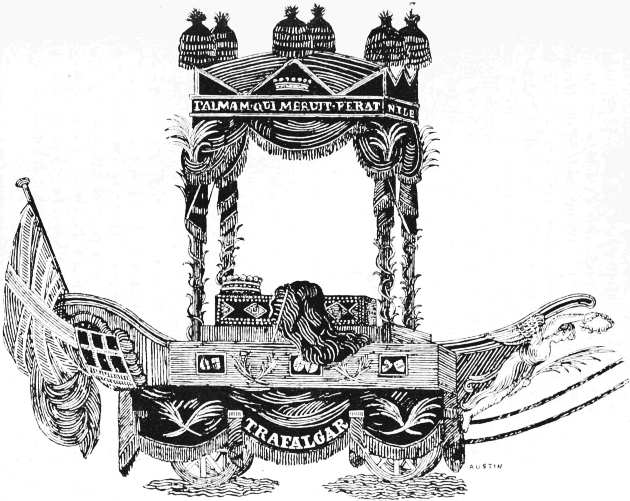
NELSON’S FUNERAL CAR. FROM THE ‘TIMES,’ JAN. 10, 1806.
To the above engraving the following description was appended:—‘The Car, modelled at the ends in imitation of the hull of the Victory. Its head towards the horses, was ornamented with a figure of Fame. The stern carved and painted in the naval style, with the word “Victory” in yellow raised letters on the lanthorn over the poop. The coffin placed on the quarterdeck with its head towards the stern, with the English Jack pendent over the poop lowered half-staff. There was an awning over the whole, consisting of an elegant canopy supported by four pillars, in the form of palm-trees, as we have already mentioned, and partly covered with black velvet. The corners and sides were decorated with black ostrich feathers, and festooned with black velvet, richly fringed, immediately above which, in the front, was inscribed in gold the word “Nile” at one end; on one side the following motto, “Hoste devicto, requievit;” behind was the word “Trafalgar;” and on the other side the motto “Palmam qui meruit ferat,” as in the engraving. The carriage was drawn by six led horses, in elegant furniture.’
In 1817 the Times also illustrated the projects of Robert Owen, who laboured long and ardently to promote the doctrines of Socialism. In the number for Aug. 9th, 1817, there is a large woodcut called Robert Owen’s agricultural and manufacturing villages of Unity and Mutual Cooperation. In those days a page of the Times was not so valuable as it is now, or probably the enthusiastic Socialist would not have found it so easy to enlist that journal in helping to propagate his doctrines. In 1834 Owen made in London another attempt to put in practice the principles he had so long advocated. He died in 1858, aged ninety.
I have mentioned that the Observer was the first newspaper that availed itself of the revived art of wood-engraving; but it had previously essayed the then difficult task of illustrating the news of the day by the more costly means of engraving on copper. The island of St. Helena having been selected as the place of residence of Napoleon Bonaparte, the Observer of Oct. 29th, 1815, published a large copperplate view of the island, with a descriptive account. The plate is printed on the same page with the letterpress, so that there must have been two printings to produce this specimen of illustrated news. Three years later the Observer produced another copperplate example of news illustration, also printed on the letterpress page. This was a portrait of Abraham Thornton, whose remarkable case attracted much public attention. He was tried for the murder of a young woman, Mary Ashford, with whom he was known to be acquainted, and in whose company he was seen shortly before her death. He was, however, acquitted, the jury probably believing it to be a case of suicide. The brother of the girl then appealed, and Thornton claimed his right to defend himself by wager of battle. This claim was allowed, after long arguments before the judges. It was found, much to the surprise of the general public, that by the law of England a man in an appeal of murder might demand the combat, thereby to make proof of his guilt or innocence. In the present case the girl’s brother refused the challenge, and Thornton escaped. This was the last appeal to the ‘Assize of Battle’ in this country; and the attention of the Legislature being drawn to the obsolete statute, it was repealed by 59 Geo. III., 1819. It was during the progress of the arguments in this case, and while the public interest was very great, that the Observer published the portrait of the accused.
After this the Observer became remarkable for its illustrations of news. Mr. William Clement, the proprietor, was a man who early saw the attractiveness of illustrated journalism. I am not aware when he first became associated with the Observer; but under his management frequent illustrations of news were given in that paper. In 1820 Bell’s Life in London was started, and very soon Mr. Clement became the proprietor of that paper also. In 1821 he purchased the Morning Chronicle, which, however, turned out a bad speculation. Having invested a very large sum of money in the latter paper, Mr. Clement spared no effort to make it profitable, and the Observer was neglected. It suffered in consequence, and fell in circulation. Frequently the illustrations of news that were printed in the Observer were published the day previously in the Chronicle. They were also occasionally printed in Bell’s Life and the Englishman, a fourth paper belonging to Mr. Clement. All four papers were carried on together; but it is the Observer that stands out as the prominent representative of illustrated journalism at this period. Other journals came into existence which took up the idea of illustrating the news of the day; among them the Sunday Times, started by Daniel Whittle Harvey in 1822, when he was member for Colchester. Another paper which for a time rivalled, if it did not excel, the Observer in the frequency of its news illustrations was the Weekly Chronicle. It flourished a few years before the birth of the Illustrated London News, but has long been extinct. Mr. Clement sold the Morning Chronicle in 1834, and soon restored the Observer to its old position. The Morning Chronicle started in 1769 and expired in 1864. The Englishman has long been defunct, but I am not acquainted with the date of its disappearance. There was a paper called the Englishman in 1714, and the name was again revived by the late Dr. Kenealy.
The Observer and Bell’s Life were both published at the same office for many years, but their companionship was terminated in 1877, when they left the office in the Strand where they had so long lived amicably together, the great sporting journal migrating to Catherine Street, and the Observer seeking a new home in the Strand further west.
One or two other newspapers occasionally published engravings during the few years immediately preceding the Illustrated London News, and of them I will speak in the proper place. The most prominent, however, were the Observer, Bell’s Life in London, and the Weekly Chronicle, and to these three I propose first to direct attention as being the main supporters of the pictorial spirit until it culminated in the Illustrated London News. It was during the ten years preceding 1842 that the founder of that journal noticed the growing inclination of the people for illustrated news, and it was chiefly in the pages of the Observer and the Weekly Chronicle that he thought he saw the growth of a hitherto uncultivated germ.
In 1820 all England was startled by the discovery of a mysterious plot of some political desperadoes who planned the assassination of the Ministers of the Crown and the overthrow of the Government. This came to be known as the Cato Street Conspiracy, the place of meeting of the conspirators being in Cato Street, Marylebone. The extravagance of the Prince Regent, the high price of bread, and the heavy taxation, had brought about a feeling of discontent among the lower orders which, unhappily, was greatly increased by the Spa Fields riots, and the collision between the soldiers and the people in Lancashire, at what was called the massacre of Peterloo. Thistlewood, the leader of the conspirators, had already been tried for treasonable practices, but acquitted. He had also been in trouble for his connexion with the Spa Fields riots. The sanguinary plan of the conspirators was to murder the Cabinet Ministers while they were all assembled at dinner at Lord Harrowby’s house in Grosvenor Square. They were to seize certain pieces of cannon, take the Bank of England, destroy the telegraph to Woolwich, set fire to different parts of London, and then establish a provisional government at the Mansion House, sending emissaries to the outports to prevent the escape of obnoxious persons. They reckoned on large numbers of the discontented joining them as soon as they had destroyed the tyrants and oppressors of the people, as they termed the Ministers. They had provided pikes, pistols, sabres, knives, blunderbusses, and hand-grenades; and one of the gang, a butcher, had furnished himself with a heavy butcher’s knife, to cut off the heads of ‘Castlereagh and the rest as he came at them.’ Adams, one of their number, turned informer, and the conspirators were surprised by the police at their meeting-place in Cato Street. After a conflict in which one of the police-officers was killed, several of the gang were secured, and others were taken soon afterwards. Thistlewood, the leader, escaped in the first rush, but was captured next day.
The place where the seizure was made is described as a hayloft over a deserted stable with a step-ladder leading from the stable to the loft above, with two apertures in the floor of the loft, opening on the racks in the stable below; opening from the loft were two small inner rooms. On the evening of the 23rd of February, 1820, the conspirators were assembled in this stable, where they were arming themselves for the bloody work they had planned, when the police, aided by a party of the Coldstream Guards under Lieut. Fitzclarence, broke in upon them. Police-officers Ruthven, Ellice, and Smithers, were the first to mount the ladder, and enter the loft.
‘There were about five-and-twenty men in the room, eating bread and cheese, and drinking porter, or selecting arms from a long carpenter’s bench which stood close by the wall. Just at that juncture, Thistlewood, hearing a noise, and some one calling, “Hallo! Show a light!” took a candle, and looked down the stairs to see who was coming, and, on seeing that there was a surprise, he put the candle back on the bench, seized a sword, and with three or four others retreated stealthily to the further of the inner rooms—the one that had a window looking out into Cato Street. At that moment one of the men seized below called out to warn his comrades, “Look out there above!”
‘At the same time, two of the constables, at first almost unnoticed, appeared at the top of the ladder, and presenting their pistols, said, “Hallo, is anybody in the room? Here’s a pretty nest of you!”
‘Then another of the patrol cried, “We are officers; seize their arms.”
‘And a third, “Gentlemen, we have got a warrant to apprehend you all, and as such we hope you will go peaceably.”
‘Just then Smithers, distrusting further parley, and believing, in his staunch way, in promptitude, before the conspirators could discover the scantiness of the assailing numbers, or could muster courage to use their arms, cried, “Let me come forward,” and pushed towards the door of the inner room, where Thistlewood stood thrusting with a very long sword. The leader of the conspirators instantly rushed forward, and struck Smithers through his right side. The constable threw up his hands, his head fell back, he staggered against Ruthven, cried, “O my God, I am done!” and fell dead near the opening of the stairs. Ellice held up his staff at Thistlewood, and threatened to fire with the pistol in his right hand, unless he instantly surrendered. The lights were immediately dashed out, and a voice cried in the darkness, “Kill the —— at once! Throw them down-stairs! Kill them!”
‘Then there were twenty or thirty pistol-shots fired, and a tremendous headlong rush was made at the stairs, driving the Bow Street men backwards; the conspirators leaping down into the manger through the holes in the floor, or by the window, others firing at the officers on the stairs, or up through the manger, all making for the archway in John Street.’2
It would appear the conspirators were closely watched for some time before they were arrested. Indeed, it was suspected that Government emissaries were employed to foment the conspiracy in order that a terrible example might be made for the benefit of the disaffected. However this may have been, the plot excited the most intense interest among all classes. Thistlewood and the other prisoners were tried at the Old Bailey, April 17th, 1820, and found guilty of high treason. Six were transported for life, the other five, including Thistlewood, were hung on May 1st, and their heads severed from their bodies—the quartering, the usual doom of traitors, having been graciously forgiven.
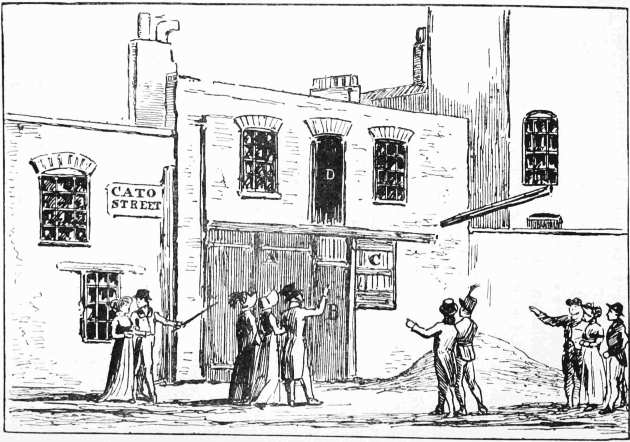
A. Door to the cart-house. B. Door by which the officers entered. C. Stable window. D. Loft-door. STABLE WHERE THE CATO STREET CONSPIRATORS MET. FROM THE ‘OBSERVER,’ MARCH 5TH, 1820.
The Observer for March 5th, 1820, published some illustrations of the Cato Street Conspiracy. One is an exterior view of the stable in Cato Street where the conspirators met, which is copied on the opposite page.
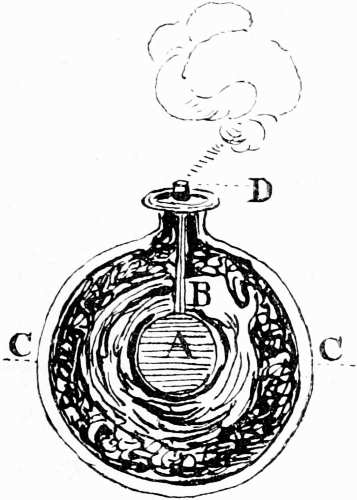
SECTION OF GRENADE PREPARED BY THE CATO STREET CONSPIRATORS. FROM THE ‘OBSERVER,’ MARCH 5TH, 1820.
A. Cylindrical tin Box containing gunpowder. B. Pitched tow. C. Bullets, old nails, Spikes, &c. D. Tin Tube a Fuze filled with damp powder.
There was also an interior view of the hayloft, together with sections of some of the grenades, daggers, &c., large quantities of which were found in the loft.
These cuts, which are roughly done, were reprinted in the Observer for March 12th, and two new ones were added, ‘Interior view of the Hayloft at the moment when Smithers received his Death Wound,’ and a view of the interior of the stable. They are all interesting as examples of illustrated news at a time when the means of producing such things were extremely limited.
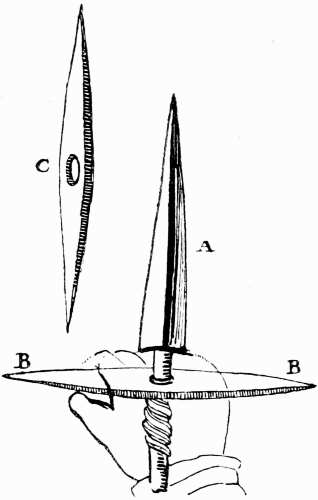
DAGGER PREPARED BY THE CATO STREET CONSPIRATORS. FROM THE ‘OBSERVER,’ MARCH 5TH, 1820.
A. Dagger made out of a bayonet to use singly or on top of a pike handle. B. Dagger with hole in the middle to receive dagger A. when screwed on, to be used right and left. C. Section of the transverse dagger B.
Mr. Clement, the proprietor of the Observer, gave a remarkable proof of his enterprising spirit when the Cato Street conspirators were tried. At that time newspapers were prohibited under a penalty of 500l. from publishing reports of cases in the courts of law before they were concluded. Mr. Clement, seeing the universal interest excited by the trial, determined to publish a report without waiting for the verdict. He accordingly sent reporters to the court, and published the whole in the Observer before the verdict was given. This was a contempt of court for which he expected to have to pay, and, though the penalty was duly inflicted, it was never exacted. The éclat attending this proceeding was of immense value to the Observer, and the sale of that number was so great that the proprietor could easily have paid the penalty of 500l., and he would still have been a gainer.3
The Prince of Wales (afterwards George IV.), whose unhappy marriage with Caroline of Brunswick produced so much scandal and excitement in this country, had long been separated from his wife, who was residing abroad at the time her husband became King. Her Majesty announced her intention of returning to England; and though the King’s Ministers endeavoured to dissuade her from her purpose, she persisted in her resolution, and on June 6th, 1820, she landed at Dover. Her journey through London was one long triumph, thousands of people escorting her to her temporary residence, and giving her the warmest possible welcome, for they looked upon her as an ill-used and persecuted woman. The question of omitting her name from the Liturgy had been debated in Parliament, and afterwards a ‘Bill of Pains and Penalties’ was brought in, which was in effect placing the Queen upon her trial. Contemporary newspapers show what intense excitement filled the public mind upon this subject, and how the nation ranged itself on the side of the King or Queen—by far the greater number being for the latter. Nothing was talked of but the ‘Queen’s trial,’ and the wrongs and indignities that had been heaped upon the head of an innocent woman.
On Aug. 16th, the married ladies of the metropolis presented Her Majesty with an address, and three days after the trial commenced, the defence being conducted by Mr. Brougham and Mr. Denman. When the Queen attended the House of Lords large crowds accompanied her through the streets, and manifested by their cries their sympathy for her cause. The Bill of Pains and Penalties was carried on a second reading by a majority of twenty-eight, but it sank on the third reading to a majority of nine, and was finally abandoned owing to the threatening attitude of the populace. Great rejoicings ensued, London was illuminated for three nights, and on Nov. 29th the Queen went in state to St. Paul’s. On this occasion William Hone, who had distinguished himself as one of the Queen’s champions, displayed a transparency at his house on Ludgate Hill, which was painted by George Cruikshank, and is engraved in Hone’s collected pamphlets.
The Observer, having to some extent laid itself out for ‘illustrated news,’ the occasion of so much interest and excitement as the Queen’s trial was not likely to pass unnoticed. Accordingly, we find in the number for Sept. 17th, 1820, a large woodcut, entitled, ‘A Faithful Representation of the Interior of the House of Lords as prepared for the Trial of Her Most Gracious Majesty Queen Caroline.’ This was published at the time the excitement was at the highest, and no doubt the eager public properly appreciated the enterprise of the conductors of the paper.
In 1821 the House of Commons contained many notable politicians and eminent men who afterwards became leaders and champions among the ranks of Whig and Tory. Amongst the most prominent were Canning, Brougham, Peel, and Palmerston. The question of Reform was becoming more and more pressing, and the House of Commons as then constituted was tottering to its fall. The conductors of the Observer, ever on the look-out for what would interest their readers, published on Jan. 21st, 1821, two views of the interior of the House of Commons, one looking towards the Speaker’s Chair, the other looking from it. In one the House is empty, but in the other most of the leading politicians of the day are introduced. The figures, however, are on too small a scale to be likenesses of the persons intended, but the reader is assisted by references showing the places occupied by the most prominent members of the House.
The national excitement about Queen Caroline’s trial was dying out when the first gentleman in Europe prepared for his coronation. On this occasion the Observer gave the lieges appropriate pictures of the august ceremony. The best draughtsmen and engravers on wood, then very few in number, were employed to prepare views of Westminster Abbey and Westminster Hall during the coronation ceremony and the banquet which followed. The Observer of July 22nd, 1821, contains four engravings, which, considering the limited artistic means at command, are by no means discreditable to the management of the paper. On this occasion a double number was published, the price of which was fourteen pence, and the publisher evidently thought it was very cheap. He announced that he would keep the number on sale for ten days after publication, so that no one might be disappointed in getting a copy. All these engravings of the coronation of George IV. were done on what was then considered a large scale, though none of them exceed a half-page of the present illustrated newspapers, and were finished as regards light and shade, according to the best ability of the artist.
The coronation number of the Observer produced a great sensation, and it had a very large sale. Nothing like it had ever been done before, and the public eagerly paid the double price for the sake of the engravings. Fourpence was paid for stamp duty on each sheet, amounting on the whole to 2000l. paid to Government for stamp duty, exclusive of paper duty. The number consisted of two sheets, each of which had a sale of 60,000 copies. This was a very good stroke of business, and Mr. Clement had fair reason to congratulate himself on his successful enterprise. It prompted him to further efforts; but, unfortunately, he had not the wisdom to confine his energies to one channel, and what he gained by one speculation he lost by another. It was at this time he purchased the Morning Chronicle for 42,000l.; but, as I have before stated, this turned out a disastrous investment, and also injured for a time the otherwise successful Observer.
Soon after his coronation George IV. visited Ireland, and while on his way received the melancholy intelligence of the death of his consort, the unfortunate Queen Caroline, which, however, did not prevent His Majesty from continuing his journey. The Observer of Sept. 2nd, 1821, published ‘A correct View of his Majesty King George the Fourth landing from the Lightening Steam Packet, Capt. Skinner, on the Pier of the Harbour of Howth, on Sunday, the Twelvth of August, 1821.’ In describing this event the Observer spoke of it as the opening of a new era for Ireland, and of the highest importance both in an historical and political point of view.
In the following year the King went to Scotland; but, though the Observer published long and elaborate descriptions of His Majesty’s visit, the occasion was not deemed worthy of illustration. The opportunity, however, must have been far richer than the visit to Ireland in affording subjects for sketches. It would have been curious to see what a contemporary ‘special artist’ would have made of Sir Walter Scott; and posterity would have been glad to have had handed down to it the ‘varra effigies’ of George IV. and Alderman Curtis in the kilt!
In 1823 the city of Cadiz, in Spain, was invested by the French, who took possession of the place on Oct. 3rd in that year. The Observer, in its issue of Oct. 5th, printed a plan and view of Cadiz, the plan first appearing in the Morning Chronicle of the day before. The view of Cadiz is well engraved, in the manner of that day, by W. Hughes. The plan is also well done, and very complete.
Towards the end of 1823 a murder, unparalleled in the history of crime, excited immense public interest, and the Observer at once took up the case, and described and illustrated it with a particularity and minuteness of detail that must have satisfied the most ardent sensationalist. The incidents of this remarkable crime have been long forgotten; but I will give an outline of the story in connexion with the engravings published on the occasion by the Observer.
Mr. William Weare was an attorney in Lyon’s Inn, who added to his legal practice the business of a bill-discounter, and enlivened the dulness of both pursuits by indulging occasionally in the excitement of gambling. He counted amongst his friends one Mr. John Thurtell, a notorious betting-man; and it was to keep an appointment with this friend that he left his chambers in Lyon’s Inn on Friday, Oct. 24th, 1823. The two friends had agreed to go on a short shooting excursion to a lonely cottage on the St. Albans road, about fourteen miles from London. Thurtell was respectably connected, but had an evil reputation, he and his brother being then in hiding to avoid a charge of arson. Two other men were concerned in the murder, Hunt, a public singer, of doubtful character, and Probert, a spirit merchant, a fraudulent bankrupt, who lived at the cottage to which Thurtell and his friend were going. In the gambling transactions between Thurtell and Weare the former conceived himself to have been cheated of 300l., and in revenge he determined to murder Weare, and by robbing him recoup himself as far as possible for his losses. The crime was coolly premeditated, and Hunt appears to have been an accessory before the fact, having arranged to meet Thurtell on the road, and to assist in despatching the victim. For this purpose the shooting excursion to Probert’s cottage was planned, but, owing to a mistake of Hunt’s, he did not join Thurtell as agreed, and the latter committed the murder alone.
Thurtell and Weare were seen driving in a gig towards Edgeware about five o’clock in the evening on Oct. 24th, and they afterwards called at the ‘White Hart,’ Edgeware, for refreshment. After they were gone Probert and Hunt, also driving in a gig, called at the same inn, where they had some brandy and water, and afterwards drove away.
Gill’s Hill Cottage, the place where Probert lived, was about two miles from Elstree, and was approached by a narrow road called Gill’s Hill Lane. Some country people passing in the neighbourhood of this lane about eight o’clock in the evening heard a shot fired and deep groans as if some one was injured. They also heard voices and the wheels of a cart or gig moving. Near nine o’clock Thurtell arrived at the cottage alone, and giving the horse and gig to the servant, went out to meet Probert and Hunt, with whom he soon afterwards returned.
Hunt being a stranger, was formally introduced to Mrs. Probert and a Miss Noyes who was staying at the house. The whole party supped together, and spent the evening in jollity. Hunt sang several songs, and Thurtell produced a gold hunting-watch which afterwards proved to be Weare’s, and, taking off the chain, offered it to Probert for his wife, but he declining it, Thurtell put it round the lady’s neck himself. It was after midnight before the ladies retired, and the sleeping accommodation being limited it was arranged that Thurtell should sleep on some chairs and Hunt was to occupy the sofa. A drawing of the sofa forms one of the illustrations in the Observer, and proves how thoroughly every circumstance of the horrid tale was followed up and exhibited to the public. All this time the body of the murdered Weare was lying behind a hedge in the lane.
Mrs. Probert’s suspicions had been aroused by several strange circumstances. A vague and horrid alarm took possession of her, and when she retired to bed she stole to the head of the stairs and listened to the talk that was going on below in the parlour. She heard her husband and his two visitors apparently dividing money, burning papers, and making mysterious plans to conceal something dreadful that had been done. Then the parlour door was opened, and the frightened woman stole back to her room. She heard two of the men go to the stable and bring out the horse. Afterwards, hearing a noise in the garden, she looked out of the window, and it being a moonlight night, she saw a man dragging something large and heavy along the garden walk towards the fishpond. Then followed a hollow sound as if something had been thrown into the pond.
That night, when Probert went to bed, he found his wife sitting up and crying. She questioned him about the mysterious sounds she had heard, but he told her that he and his companions had only been out trying to net some game. In the morning she renewed her inquiries, but he only replied, ‘Don’t torment me; you make my life miserable.’ He seemed in low spirits, and went moping round the garden and about the pond. Going into the kitchen Mrs. Probert observed the gig cushion drying at the kitchen fire, although there had been no rain the night before, and the cook was surprised to see in the stable a wet, ripped-up sack hanging on a nail.
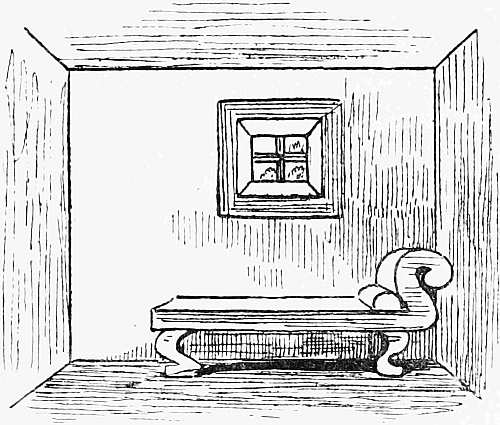
THE COUCH ON WHICH HUNT SLEPT AT GILL’S HILL COTTAGE. FROM THE ‘OBSERVER,’ NOV. 10, 1823.
Early on Saturday morning two labouring men were busy in Gill’s Hill Lane repairing the road, when two gentlemen passed them on foot. At the bend of the lane they stooped down and appeared to be looking for something among the dead leaves and brambles. Coming back they had some conversation with the road-menders, and afterwards passed on up the lane towards the cottage. A short time afterwards one of the labourers found at the spot where the gentlemen had been looking an open penknife covered with blood, and a little further on a pistol with hair sticking to it, and also bloody. These articles the man gave to his master the same morning when he came round to inspect their work. About noon they saw the two gentlemen from Probert’s drive away in a gig. They both looked hard at the spot where the knife and pistol had been found, but said nothing.
Mr. Nicholls, the road surveyor, to whom the knife and pistol had been handed by the man who found them, went to the magistrates at Watford and told how and where the articles had been found. The magistrates at once sent information to Bow Street, and two of their number immediately went to Gill’s Hill Lane, where they discovered spots and gouts of blood on the bank and under the leaves, and there was a gap in the hedge where a body seemed to have been dragged through. The field was also much trampled. They at once came to the conclusion that a murder had been committed, and took instant measures to trace the guilty parties. The police seized Probert and Thomas Thurtell at Gill’s Hill, and searched the house and premises. John Thurtell was apprehended at the ‘Coach and Horses,’ in Conduit Street. Marks of blood were found on different articles of clothing belonging to him. At Hunt’s lodgings various articles belonging to Weare had been found. Weare being missing it was suspected he had met with foul play at the hands of these men. A billiard-table keeper in Spring Gardens proved that Mr. Weare had called upon him about three o’clock on Friday, October 24th, and told him he was then on his way to join Thurtell in the Edgeware Road, as they were going down to Hertfordshire for a few days’ shooting. Thurtell, on being questioned, admitted he knew Mr. Weare, but said he had not seen him for eight days.
It appeared by the disclosures afterwards made by Thurtell’s two confederates that Thurtell had shot Weare while they were riding in the gig down Gill’s Hill Lane, leading to the cottage where Probert lived. Weare jumped out of the gig, crying he would pay Thurtell all he owed him if he would only spare his life. Thurtell jumped out of the gig and ran after him. He got Weare down and cut his throat with a penknife, and then struck him on the head with a pistol. He then dragged the body through the hedge and left it there. The same night Thurtell and Hunt went out from Probert’s cottage to bring the body away, but they found it too heavy. Probert and Thurtell then went and brought the body on the horse, and put it in the fishpond with stones in the sack to keep it down. They afterwards removed the body from the fishpond and sunk it in a deep pond by the side of the Elstree road.
The cold-blooded indifference of the perpetrators of this atrocious crime was most extraordinary. The murder was committed on Friday night, and on Saturday Thurtell and Hunt returned to London and dined with Thomas Thurtell and Mr. Noyes, Probert’s brother-in-law, at the ‘Coach and Horses,’ in Conduit Street. They were very jovial, and next day (Sunday) the whole party met again at Proberts’ house in Gill’s Hill Lane, when the afternoon was spent in playing at cards. On Sunday night Thurtell and Hunt went to dig a grave to bury the body, but the dogs were barking, and they were afraid some one was about. On Monday, while Hunt engaged Mrs. Probert in conversation, Thurtell and Probert got the body out of the fishpond, and cut off the clothes. Then they all three carried it to the garden-gate and put it into the gig. A grave half dug was found in Probert’s garden, but the soil was hard, and it is supposed that Thurtell and Hunt were afraid of the noise pickaxes would make.
Hunt, to save his own neck from the halter, confessed that he knew where the body was, and went with four men in a hackney coach to a bridge on the Elstree Road, near which was a deep pond by the side of the road. In this pond the body of Weare was found tied in a sack, with stones to keep it down.