Front matter (continued 3)
Reading edition
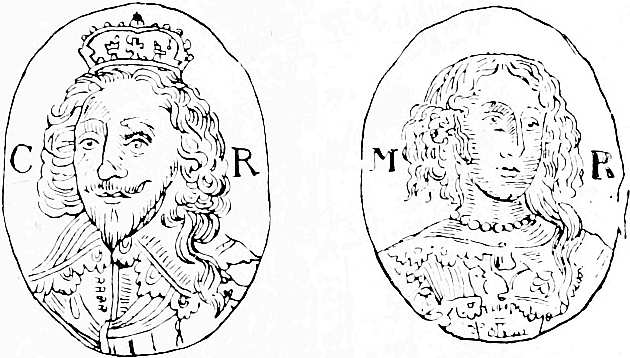
CHARLES I. AND HIS QUEEN, FROM ‘MERCURIUS CIVICUS,’ 1643.
On the front page of Number 8 of the Mercurius Civicus are small portraits of Charles I. and his Queen, engraved on wood. Over the woodcut is a sort of table of contents, thus:—‘The King and Queen conjoyned, the Kentish news related, our Forces are united, A publique Fast appointed.’ On the preceding page is given a facsimile of the cut of the King and Queen.
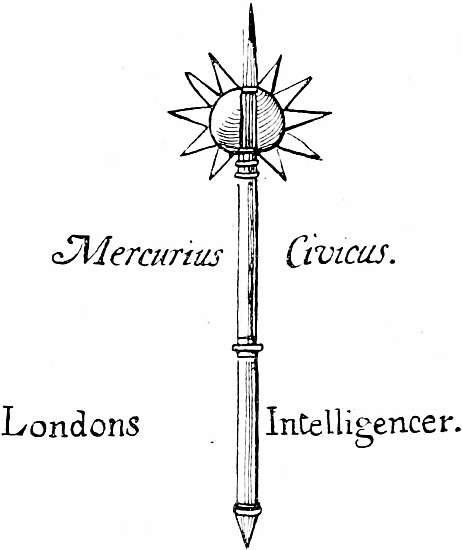
WEAPON CALLED A ROUNDHEAD, FROM ‘MERCURIUS CIVICUS,’ 1643.
Similar portraits occur in other numbers, as well as several ornamental letters; but there is in Number 11 a very interesting illustration of the news of the hour. It is a woodcut of a weapon said to be intended for use against the Roundheads, and the following account is given of it:—‘In the Danish Ship lately taken by the Earle of Warwicke, near Newcastle, were found Armes compleat for 5000 foot and for 500 horse, 500 barrels of Gunpowder, Great store of Match and Lead, beside a thousand of those weapons which the Papists call Round-heads, for that with them they intended to bring the Round-heads into subjection. Many such weapons were long since found in divers Papists’ houses in Lancashire; it is a weapon with an ovall or round top, stuck full of iron spikes. The forme whereof for better satisfaction is here set downe.’ Then follows a representation of the weapon, of which a facsimile is given on the opposite page. The same cut is reprinted in other numbers.
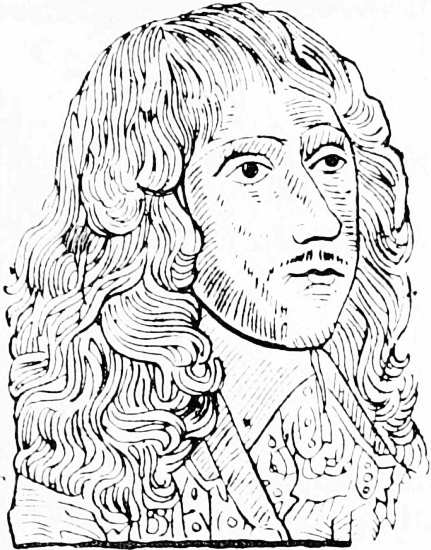
PORTRAIT OF PRINCE RUPERT, FROM ‘MERCURIUS CIVICUS,’ 1644.
In another number it is related that ‘the Manchestrians have lately taken from severall Papists in that County many desperate weapons which they call Round-heads.’ No. 22 has a portrait of a Cavalier in hat and feather, intended probably for Prince Maurice, as there is in the body of the number an allusion to a report of his death. In No. 42 there is a portrait of Prince Rupert and the following summary on the title-page:—‘Prince Rupert’s forces routed near Stratford-on-Avon. Generall King’s Army dispersed by the Scots. Himselfe wounded and fled to Yorke. Banbury Castle besieged by Colonell Cromwell.’ I give a copy of Prince Rupert’s portrait, which is made to do duty for the Marquis of Newcastle in another number. This practice of making the same woodcut pass for the portraits of different individuals savours somewhat of impudence on the part of the editor, and shows a cool reliance on the good nature or the obtuseness of his readers.
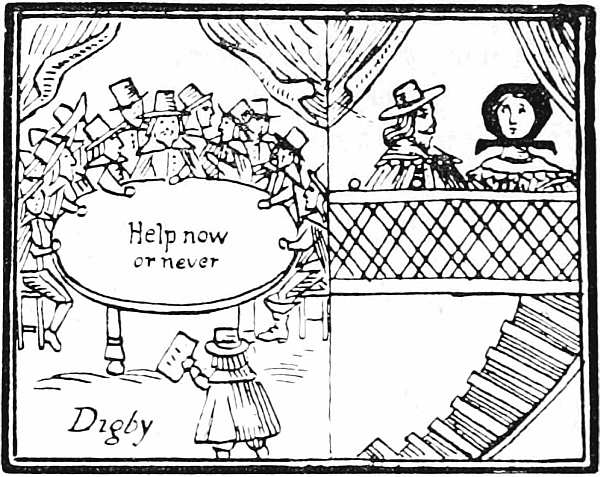
THE OXFORD JUNTA IN COUNCIL, FROM ‘MERCURIUS CIVICUS,’ 1644.
In the number of the Mercurius Civicus for April 11, 1644, there is a curious woodcut representing the ‘Oxford Junta in Council,’ with the following paragraph referring to it:—‘The news from his Excellencies generall Roundezvous at Ailsbury on Good-Fryday next, will no doubt cause the Oxonian Papists to whip themselves before the time, and to make the Oxford Junto to recall their late votes.’ The lady and gentleman in the balcony were probably intended for the King and Queen. There is more variety in this number of Mercurius Civicus than in any I have seen. In the war news there is the taking of Waltam House, in Hampshire; the taking of numerous men and horses at Christ-church, in Dorsetshire; then comes a paragraph stating that ‘On Munday last, April 8, there were ten men and two women executed at Tyburne for the severall offences for which they were condemned the last weeke at the Sessions in the Old Bayley.’ Mention is made of a fight between the Scots Army and the Marquis of Newcastle’s forces near Hilton; the gathering of the King’s forces in the neighbourhood of Marlborough, and an announcement that the Parliament intend to draw all their forces together, and, if possible, by fighting a decisive action ‘to put a speedy end to these miserable distractions.’ The trial of Archbishop Laud was at this time going on, and reference is made to his appearance before the House of Peers. Two Welshmen were taken into custody for talking in Welsh, while they were crossing the river from Westminster to Southwark, about firing the city in several places, they not knowing that the waterman understood their language. It is stated that a solemn day of thanksgiving had been observed in London for the victory obtained over Sir Ralph Hopton’s forces, and an ordinance was read in the churches exhorting the citizens to contribute all their strength to bring the contest to a final issue. There is also some account of recent fires in the city, which are attributed to the treachery of Cavaliers and Malignants. ‘But,’ says the writer, ‘which way soever these sad accidents are brought to passe, they may afford the whole City this caution: that if the firing of some few houses be so dreadful and fearfull, as I am sure this appeared to those that beheld them, notwithstanding they had all means convenient to quench them, and the multitude being industrious to set their hands to the worke: O how terrible would it be to see your houses set on fire by the enemy, and the cruell souldiers, instead of bringing buckets of water, should stand with their drawne swords threatening the death of those that should offer to quench the flame? Poore Ireland can give ample testimony of this.’ From Yorkshire there is news that Fairfax had taken Cawood Castle; from Banbury that the Royalist garrison was withdrawn from that place, and ‘that the Carriers of Banbury and Southam were robbed the last weeke neere Tossiter in Northamptonshire by divers of the Cavaliers Forces.’ In the number for April 25, 1644, there is a figure of the King armed with a sword, and with this inscription:—‘Fire and sword again menaced by his Majesty.’ During the first years of the Civil War the newspapers contained many portraits of the King, some of which were carefully engraved on copper.
It is noticeable that the Mercurius Civicus and other papers published during the Civil War were in the habit of including on their title-pages a summary of the contents of the number. Sometimes it was put in the form of rhyme, as—
‘Tewkesbury is taken Yorke walls are well shaken.’
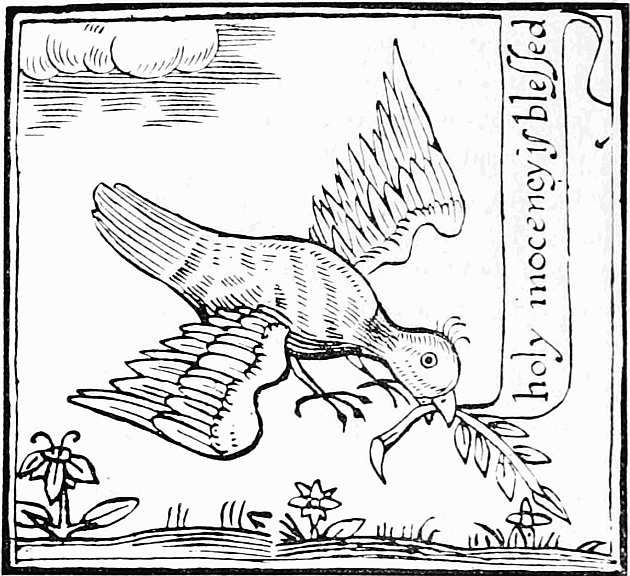
HEADING TO THE ‘SCOTTISH DOVE,’ 1644.
The Scottish Dove frequently indulged in these rhyming summaries. On the title-page of Number 39 for July 13, 1644, the following lines are printed:—
‘Rupert and Newcastle wholly Routed Rupert and Newcastle’s jarres undoubted; Newcastle fled to Sea, Rupert to the King, Give God the Glory heavenly praises sing. A day of thankes the parliament hath set, Lord Gray with some of Hasting’s troops hath met. From Oswestree Middleton the siege did raise And Barnstaples defence, doth Essex praise; The Queen Pendennis Castle liketh best. The King uncertain where to take his rest.’
The Scottish Dove was a small quarto numbered and paged consecutively like the Mercurius Civicus. On the front page of every number was printed a woodcut of a dove bearing an olive-branch in its mouth, and at the side of the woodcut was usually printed the rhyming summary. I annex a facsimile of this heading.
Many of the journals of this period showed their hankering after illustrations by occasionally indulging in an initial letter, if they could do nothing more. The animosities of party often caused them to forget their original purpose of spreading true intelligence, and they were quite as ready to apply the lash to each other as to chastise public wrongdoers or ‘correct false reports.’ At this time first appeared the familiar newspaper heading of the man on horseback blowing a horn. It was on the front page of the Flying Post, the first number of which was published on May 10, 1644. The full title was ‘The Flying Post, conveying Weekly Packets to all Forraigne Nations, of the Proceedings of both Houses of Parliament and the Armies in Great Brittain,’ and it was ‘published for the cleere satisfaction of all Forraigners and others who desire Certain, and Weekly Information.’ The introduction is as follows:—
‘Gentlemen,—The too many errours committed of late time, by the irregularitie of the Presse (which since by the wisdome of the Parliament, is in a great measure suppressed), which did run Weekly in severall channels to the greatest part of Europe in great dishonour to our English Nation; Have enforced this my Flying Post never to make stay, till it had intimated the same unto you, and fully vindicated this my Native Kingdome, by publishing a certain Weekly Intelligence of all Proceedings of our honourable Parliament and unhappy wars of this Kingdome; wherein (though a well wisher to his Excellencie the Earle of Essex, and the Proceedings of Parliament) I shall write with the greatest indifference, truth, and modestie, as shall satisfie the impartiallest that reades me; attributing to the Enemy no otherwise than Truth will warrant it, be it to their honour or shame according to their demerit. Therefore give me leave to beg your credence beyond Sea and elsewhere, as you find me.’
The Flying Post gives intelligence from York, then besieged by the Scots; from Hull, Newark, and Mansfield; some notes of the proceedings in Parliament, respecting which the journalist says cautiously:—‘As for our proceedings in Parliament, I shall be very cautious and tender in divulging them.’ It was ‘Published according to order,’ and printed at London for Bernard Alsop, 1644.
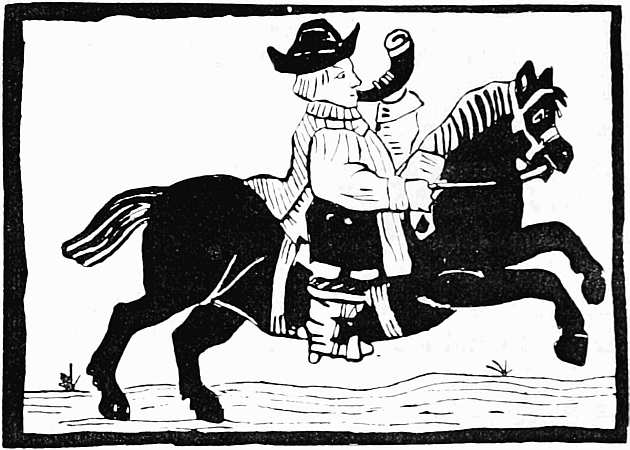
HEADING TO THE ‘KINGDOMES WEEKLY POST,’ 1644.
The Klngdomes Weekly Post had the same heading, which is here copied.
In a tract entitled ‘Strange true and lamentable news from Exeter and other parts of the Western Countreys’ there is a woodcut of a woman on her knees praying for mercy. The pamphlet relates the cruelties inflicted by the Cavaliers on the inhabitants of Exeter, Bristol, and other towns. Prince Maurice is charged with breaking the articles of agreement made with the city of Exeter, and both he and Prince Rupert are likened to ‘Tigers or Savage Beares.’ It is stated that in the city of Exeter ‘the rude Souldiers would not forbeare upon the least discontent given to them to draw their Rapiers upon the Citizens, and wound them, but especially when they are in their cups, they swagger, roare, sweare, and domineere, plundering, pillaging, or doing any other kind of wrong; to break shops and houses they count as nothing, taking away Boots, Shoes, Stockings, Hats, or any other commodities they can lay their hands on, and no Justice dares to resist them, and by this means the City is in such a miserable condition that they are even terrified to the death.’ At Cirencester, having entered the town by force, they slew all the men who opposed them, took the unresisting inhabitants prisoners, and pillaged the town. At Bristol ‘They went into some Cellars, where was plenty of wine and beere, drank what their gormandising guts would hold, and let the rest run about the house, with many other antique tricks that they used, which I cannot omit to speak of; moreover, they breake the Covenant which was made in every respect the very first hour that they entered the city, and fell to plundering, pillaging, robbing, stealing, cutting and slashing, as if they had never been brought up to any other practice.’
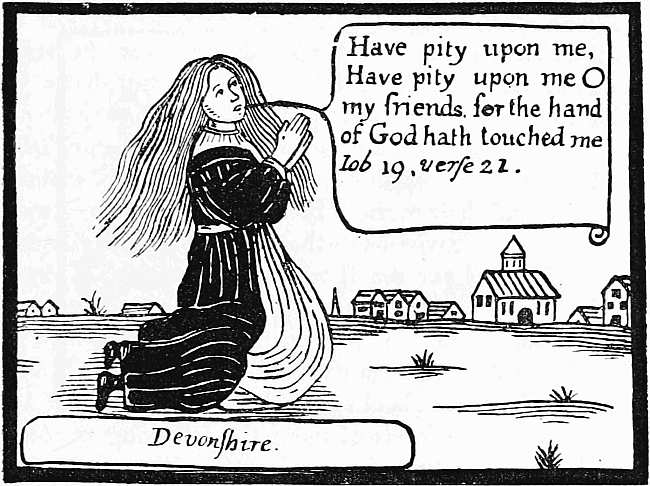
STRANGE NEWS FROM EXETER, 1643.
In an account of the defence of Plymouth against the Royalists there is a very elaborate map showing the fortifications of the town, ‘with the workes and approaches of the enemy at the last siege.’ The account of the siege is very long, but the following passage may be quoted:—‘One remarkable passage of God’s providence to us we must with all thankfulnesse remember and acknowledge, that after the Towne had been a long time strictly beseiged and no fresh victuall either flesh or fish could be had, whereby the poore people were grievously punished, there came in an infinite multitude of Pilchards into the Harbour, within the Barbican, which the people took up with great ease in baskets, which did not only refresh them for the present, but a great deal more were taken, preserved, and salted; whereby the poore got much money; such a passage hath not happened before.
‘We cannot forget the humanity of the good women of Plymouth, and their courage in bringing out strong waters, and all sorts of provisions in the midst of all our skirmishes for refreshing of our souldiers, though many shot through the cloathes.’
I have already made the remark that the military atrocities of recent times were equalled, if not exceeded, during the Civil War in England and Ireland. In a tract of 1644, containing various items of news, the following woodcut is given as an illustration of recent events. The same woodcut is found in another tract entitled ‘Terrible and bloody Newes from the disloyall Army in the North:’—‘The proceedings of the Scots and Irish appears more visible and inhumane than formerly; their actions are tyrannical, their ways most insufferable, and executeth nothing but blood thirstinesse and cruelty tending only to utter ruin and desolation; they have burned down divers stately buildings in these parts, executed some of my Lord Wharton’s tenants, and threatens others, which causeth the Country to rise and joyn with Lieu. Gen. Cromwell, insomuch that there will be a sudden engagement.’
The sect called the ‘Levellers’ is thus alluded to in the same tract:—‘Colonel Martin’s approach with his Levellers in these parts hath alarmed the Country and put themselves into a posture to receive them, and for preservation of their ancient rights and liberties against their new design of levelling, who by their strange, politick, and subtill delusions have wrought into the hearts of divers people to ingage with them, especially among those who are of a desperate fortune, and mean condition, the basest and vilest of men resorting to them. They rob and plunder exceedingly wheresoever they come, saying they will levell all sorts of people, even from the highest to the lowest, and that he that hath the most shall be equall with him that hath the least.’
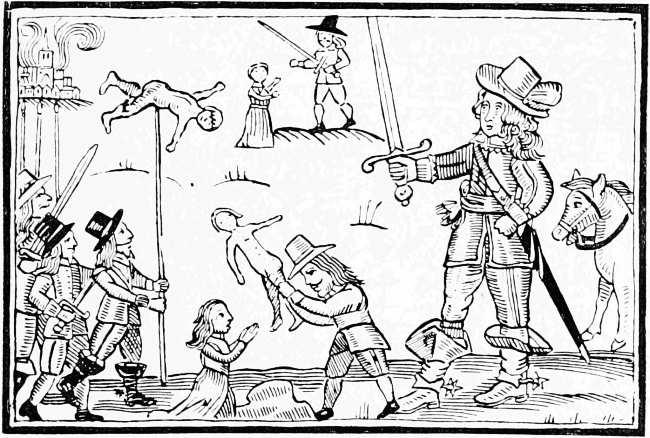
CRUELTIES OF THE CAVALIERS, 1644.
In a pamphlet relating to the events of Charles I.’s reign there are some of the etchings previously noticed, together with nine others illustrating the history of the same period. They are:—1. The Court of High Commission and Star Chamber. 2. The Execution on Tower Hill of Sir Alexander Carew, Sir John Hotham, Captain Hotham, and the Archbishop of Canterbury. 3. The King’s Escape from Oxford. 4. The Execution of the Duke of Hamilton, Earl of Cambridge, Earl of Holland, and Arthur Lord Capel. 5. The Coronation of Charles II. in Scotland, 1650. 6. A Meeting of Cavaliers. 7. A Seapiece illustrating Charles II.’s Escape from England after the Battle of Worcester. 8. Reading the Act of General Pardon and Oblivion, 1651. 9. The House of Commons in Session. The full title of the pamphlet is as follows:—‘A Brief Review of the most material Parliamentary Proceedings of this present Parliament, and their Armies, in their civil and Martial Affairs, which Parliament began the third of November, 1640, and the remarkable Transactions are continued untill the Act of Oblivion February 24, 1652. Published as a Breviary, leading all along successively, as they fell out in their several years. So that if any man will be informed of any remarkable passage, he may turne to the year and so see in some measure in what Moneth thereof it was accomplished. And for information of such as are altogether ignorant of the rise and progress of these times, which things are brought to pass that former ages have not heard of and after ages will admire. A work worthy to be kept in Record, and communicated to Posterity. London: Printed for Tho. Jenner at the South Entrance of the Royal Exchange.’ From the above I have copied the etching of the escape of Charles I. from Oxford.
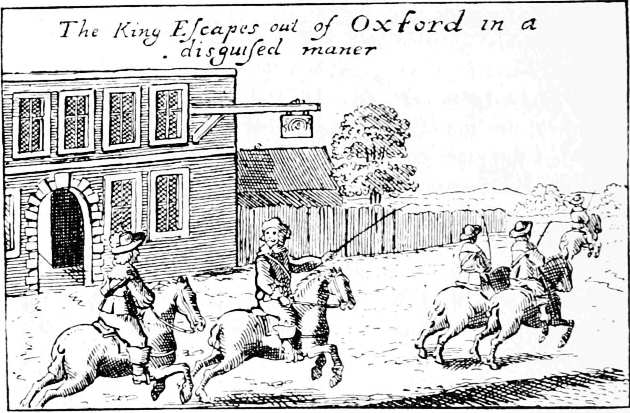
ESCAPE OF CHARLES I. FROM OXFORD, 1646.
It is stated by Hume that when the King escaped from Oxford he was accompanied by two persons only—Dr. Hudson and Mr. Ashburnham—and that he rode before a portmanteau and called himself Ashburnham’s servant. The engraving scarcely corresponds with this account; but the scene represented is evidently outside the city of Oxford, and other persons may then have joined the King’s party.
The city of Oxford surrendered to the Parliament on June 24, 1646, the King having signed a warrant for the surrender fourteen days previously. This event is recorded in a pamphlet entitled ‘Good Newes from Oxford of the Treaty for the Surrender thereof, and how they are packing up to march away on Thursday next, June 18, 1646.’ The ‘march away,’ however, was not accomplished till the 24th. Amongst those who left the place were Prince Rupert and Prince Maurice, and the King’s second son, James, the young Duke of York. The illustration to this pamphlet has no relation to the event, and was used on other occasions.
The funeral of the Earl of Essex, the Parliamentary General, who died in 1646, was made the occasion of a great display of pomp and ceremonial magnificence, which was duly chronicled and illustrated by the journalists of the time. ‘The true manner and forme of the proceeding to the Funerall of Devereux, Earl of Essex,’ contains, besides a copperplate portrait of the Earl, numerous woodcuts of banners, and the funeral canopy. Several illustrated broadsides relating to this event were also published. In looking over the old newspapers we are frequently reminded of the truth of the saying that ‘history repeats itself.’ The Duke of Wellington’s funeral in 1852 was a repetition, on a much more splendid scale, of the funeral of the Earl of Essex in 1646, with such differences as arose from the taste and circumstances of the time. Portraits of the Earl of Essex are of frequent occurrence in the pamphlets of this period.
In the pamphlet containing the escape of the King from Oxford there is an etching of the burning of the Book of Sports on the site of Cheapside Cross, which is thus described:—‘10 of May the Booke of Sportes upon the Lords Day was burned by the Hangman in the place where the Crosse stoode and at Exchange.’ There is also in the same pamphlet a representation of breaking the Great Seal:—‘The Great Seale broken before the Lords and Commons, on Tuesday, the 11 of August, 1646.’ Some authorities say the Great Seal was not broken till January, 1649, new style.
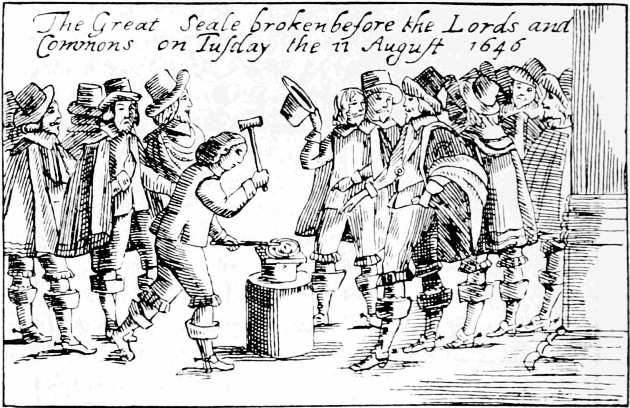
THE GREAT SEAL BROKEN, 1646.
Sir Thomas Fairfax succeeded the Earl of Essex as commander of the Parliamentary army, and had Oliver Cromwell for his Lieutenant-General. Though a Presbyterian, he suffered himself to become the tool of the Independent party, and followed the councils of Cromwell until the Army had become master both of the Parliament and of the kingdom. All that related to a person of so much importance must have had uncommon interest for the popular mind, and accordingly we find Sir Thomas Fairfax and his military council form the subject of an engraving in a pamphlet of 1647. It is entitled ‘The manner of His Excellency Sir Thomas Fairfax and the officers of his Army sitting in Council.’ In this engraving it will be seen that Fairfax, though farthest removed from the spectator, is made the largest figure in the picture, apparently for the purpose of giving him proper importance. Note also the huge pens, and the mysterious way in which the foreground figures appear to grow out of the benches instead of sitting on them.
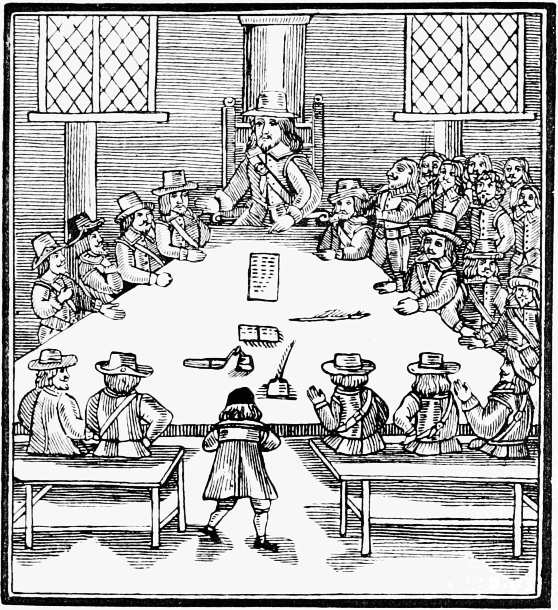
SIR THOMAS FAIRFAX AND HIS MILITARY COUNCIL, 1647.
Though Cromwell was at this time the real director of the army, and ere long became its acknowledged head, I have met with no representation of him in the illustrated news of the period. The art of ‘interviewing’ had not then been developed, and the ‘Special Artist’ did not exist. The most enterprising correspondent would probably have hesitated to intrude upon that stern and resolute leader of a revolutionary army, if he had no better excuse than to describe how he looked and what he said. Fancy the Special Artist of the Mercurius Civicus, for instance, sending in his card to Oliver Cromwell with a polite request that the General would give him five minutes of his valuable time for the purpose of making a sketch for the next number of his journal! And fancy how the uncomely countenance of the ci-devant brewer would redden at the request, and how, probably, the unlucky artist would be consigned to the custody of the sentinel at the door!
There is not much said about naval matters in the newspaper chronicles of the Civil War. The earliest account of a sea-fight that I have met with occurs in a pamphlet published in 1647. It is illustrated with a woodcut representing ships of war in action—which woodcut, by-the-by, afterwards appears in other pamphlets. The narrative is in the form of a letter, dated at sea, off Dover, May 4th, 1647; and, as the pamphlet is dated May 10th, we have another example of the extreme eagerness of the news-writers to supply the public with early intelligence. The combatants were not at war, and the fight appears to have arisen out of a mere question of naval etiquette. The following account is given of the transaction:—
‘A full Relation of a late Sea-Fight, betwixt the Parliament Ships and the Queene of Sweathlands, upon the Coast of England, neere Portsmouth, May 1.
‘Sir,
‘On the 2 of this instant moneth, being the Lords day, our Commander in chiefe of the Sea Forces, received a packet from a small Frigat, that came from the Rear-Admirall who had been in Fight the day before with five of the Queen of Swethlands ships, which they conveyed, being all laden with salt from Tubey in Portingale.
‘The reason of the fight was, the Swedish ships wore flags, viz., Admirall, Vice-Admirall, and Rear-Admirall, which they refused to take in, or to low their top-sales (although commanded by Cap. Owen, Capt. of the Parliaments Reare-Admiral so to do) whereupon the said Capt. Owen gave them a broadside, insomuch that divers shots past betweene them, and great execution done upon the Switzers, scouring their upper decks with small shot severall times. Captain Owen lost not above 8 men, besides some few wounded, the fight continued sixe hours, til night began to aproach, where the Swedish Fleet tooke their opportunity, and got away. But so soon as Vice-Admirall Batten1 heard of it, he set saile with the St. Andrew, Garland, Convertine, and Mary-Rose, and stood over for the coast of France in the night; and in the morning about 8 of the clock, being the 3 of May near Bulloign, he came up with the Admiral of the Swedes ship whose names was Martin Tysin, the ship was called the Leopard and had 32 guns; the Vice-Admiral Daniel Johnson, a lusty stout ship, called the Angel Raphael, and had 24 guns; the Rear-Admiral the Neptune, Moris Cook Captain, with 18 guns; the other two ships of 22 guns apiece, one being called the Anne-Free, the other the Neptune.
‘The Captaines of all these ships, hee commanded aboard, and asked them what they had done with his Rear-Admiral; they at first denied that they saw him, but he pressing it so hard upon them, at length confessed, that they had been in fight with him, and that the reason was, because they would not take in their flags, being so commanded by their Queen, and had instructions to that purpose, which he caused them to send for, and took copies of them, which appeared to be true in a high manner.
‘And they further told our Commander Vice-Admiral Batten, that they would rather die in honour, than to go home and be hanged, for disobeying their commissions; a brave resolution, and I could wish it were imprinted in the hearts of all our commanders; they further told him, that if these flaggs were then abroad, they would die before they made one shot at him, though he shot never so many at them, yet would not take them in, and indeed were very respective to him. But they did much blame the Rear-Admiral, for that all the shot he made was at their Vice-Admiral and Rear-Admiral, and not at their Admiral, whom he ought first to have commanded, the others being subordinate to his commands; and although he was 4 or 5 hours by the Admirals side never shot gun at him, but sent his Boat 3 times aboard. Our Vice-Admiral demanded of them, where the Rear-Admiral left them, they told him off Beachey which to him did seem strange, that he should begin a quarrell and not follow them, till he came neer where the Vice-Admiral was, having sent a Frigot to him, to give him intelligence, and might undoubtedly expect his relief.
‘All Munday was spent in taking of Examinations, and Copies of Commissions; the Swedish Commanders being detained aboard by our Vice-Admiral as prisoners, but used with great civilitie.
‘At length a Councell of Warre was called by our Commander in chiefe with his Captaines, the result whereof was, that the Swedes Vice-Admiral, who had been the man which was most active was with his ship to be carried into the Downes, till the pleasure of the Parliament be further known which was done accordingly, and the next day we arrived in the Downes, being the 4. instant; the rest of the Swedes in regard of their shortness of Victuall, and having charge of the Convoy, were left to their own dispose, and this was performed without shooting so much as a Musket; but truly, if the Queene of Swethland leave not out that peremptory command in her instructions, not to strike to any of our Commanders, enjoyned to keep the Sovereignty of the Seas, and to expect homage from all, even to sinking, or burning, this must in time breed ill-bloud between the two Kingdomes, which might be wisht might be prevented, by a letter from our Parliament to the Queen of Swethland. Thus have I given you a perfect Relation of the whole proceedings. Sir, I have not else at present, but to let you know, I am your most humble servant and kinsman, ‘R. B.
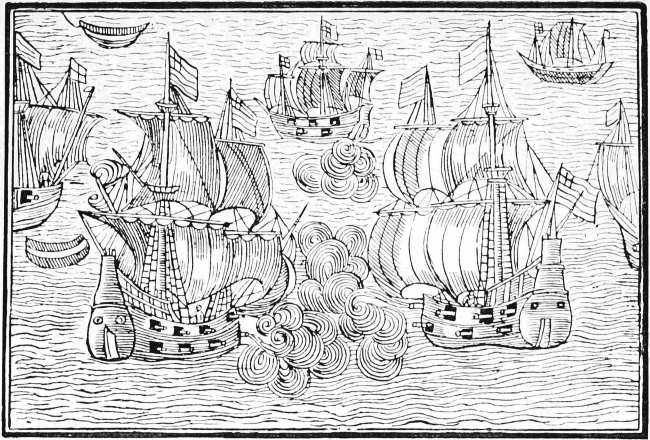
NAVAL BATTLE, 1647.
‘Dated at Sea off Dover the 4. of May 1647.’
Another piece of illustrated news bearing upon naval affairs is entitled, ‘News from the Royall Navie, Colchester, and Portsmouth, declaring the proceedings and intentions of the Prince of Wales, &c.’
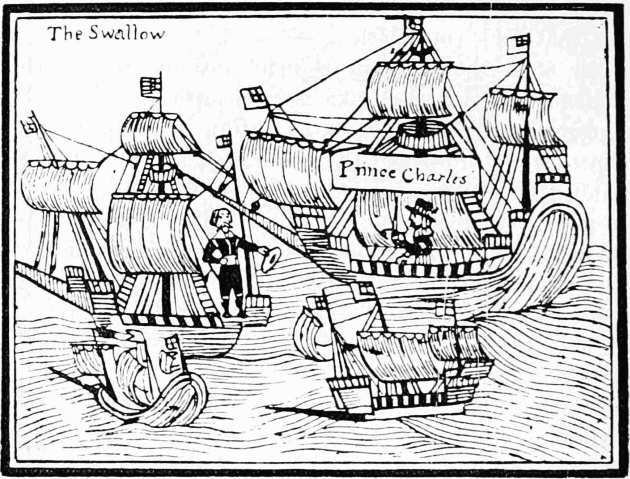
THE PRINCE OF WALES’S SQUADRON, 1648.
‘We have received intelligence from the Brill in Holland, that his Highness the Prince of Wales since his arrival there hath embarked himself in a great Vessell for England, the Earl of Newcastle, the Lord Gerhard, the Lord Culpepper, and divers others Lords and Gentlemen, being now floating upon the Neptune Seas towards the North of England, accompanying of his Royall person; we hear that they intend to land about Berwick, or else on the South side of the Holy-Island, and to march in the Van of the English Army. It is likewise said that divers Scottish Lords hath been with his Highnesse, and have treated with his Councell declaring the grounds and reasons of their engagement with England, and their resolution to redeem their dread Sovereign from imprisonment, to re-invest His Royall Person, and to make both him and His Posterity happy, and so Peace and Unity may flourish throughout all His Majesties Realms and Dominions. Severall urgent invitations were also presented to his Highness for his speedy and personal appearance in the North of England. The like to the Duke of York for his hastening with the Royal Navie towards the Downs, which unexpectedly is now come to pass; for we hear that the Prince with a great number of Royalists are sayled from the Brill in Holland towards the North of England, and that the Duke is come upon the Downs with a great and numerous Fleet, consisting of about 10 of the Kings great ships, and 30 Flemings, but they have not meddled on either side as yet; six of the Dukes ships, on Saturday last strook sayle before the town and Castle of Deal, and by their churlish tokens they sent us made it appear what they were, for they shot very neer 100 great Pieces at us, which killed 8 or nine of our men.’
This account is illustrated with the woodcut on the opposite page.
Some of the rough woodcuts to be found in many of the Civil War tracts would be unworthy of notice, did they not show the constant efforts that were made to illustrate the news of the hour. Such is the illustration to a tract entitled, ‘A true Relation of the late Great Mutiny which was in the City of Norwich April 24, 1648.’ This gives an account of the explosion of ninety-eight barrels of gunpowder, whereby 200 mutineers were slain, and the woodcut is intended to show the effects of the explosion.
Bloody Newes from the Scottish Army contains a woodcut representing two men on horseback charging each other. The description gives an account of the advance of the Scottish army on the English near Penrith, intending to surprise the latter; ‘but by the vigilance of our scouts they were discovered.’ After a ‘furious conflict gallantly maintained on both sides, we gained ground, and beat them out of the field. This action happened upon Sunday morning last about 2 of the clock in the morning.’
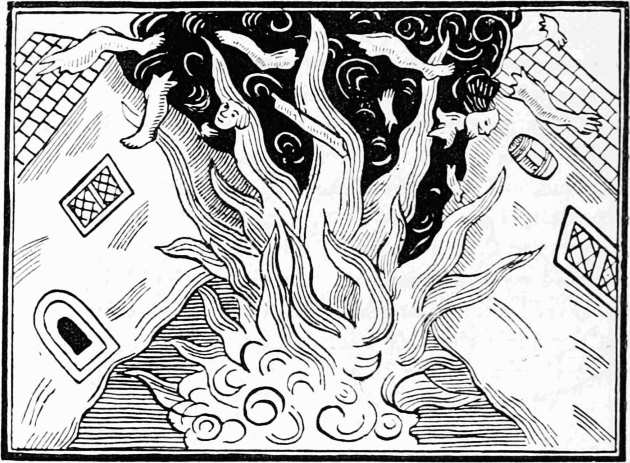
EXPLOSION AT NORWICH, 1648.
During the last struggles between the Parliamentarians and the Royalists, the latter, under Lord Goring, were driven into Colchester by Fairfax, and there besieged for more than two months. There are several pamphlets detailing incidents of this siege, one or two of which are illustrated. One of them is in the form of a letter to the writer’s brother, and it has a quaint woodcut of ‘Colchester Leaguer.’
Another tract, dated July 27, 1648, is entitled ‘A great Fight at Colchester upon Tuesday night last, being the 25 of this instant July, and the advancing of General Lucas and his forces to the very Guards of the Parliamenteers, with the particulars of the Fight, and the number that were killed and taken prisoners on both sides, and the springing of a Mine to blow up part of the Leaguer. Likewise a letter from Colchester concerning the marching of an Army to London. And Message from Prince Charles to Gen. Lucas. And a bloudy Fight at Deal Castle in Kent. London. Printed for R. Woodus, and are to be sold at the Royall Exchange in Cornhill, 1648. The letter describing this fight contains so much curious matter that it is worth transcribing entire:—
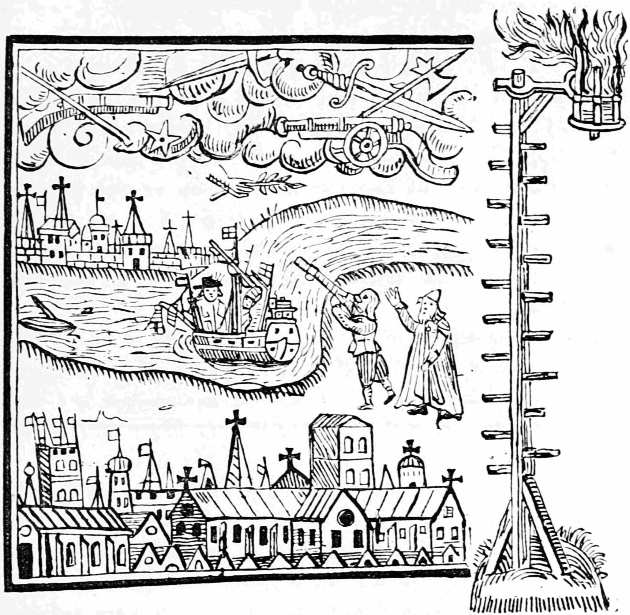
COLCHESTER LEAGUER, 1648.
‘Sir, we have received information from Yarmouth, Harwich, and other places, that there is great fear of the Prince of Wales landing in those parts with a very considerable Army, and that he is resolved to advance towards Colchester, to raise the siege, and to let those Birds at liberty, which he esteems to be the only instruments to advance his Father’s Cause. We hear that the L. Gerrard is designed Lieutenant Generall of the new Eastern Army, and the Lord Culpepper Major Generall, and that his Highnesse will repose no trust in either of the Princes Rupert or Maurice, or any other Foreign Personage whatsoever. This morning a Corporall of a troop of horse deserted the Colchestrian service, and humbly submitted himself to the Lord Generall, who upon examination touching their numbers and victualling said that the last Muster Rolls made mention of above 6000 Horse and Foot, and for victualling, they had plenty of Rye and bread-corn, but for flesh-meat they had none at all left, being constrained to kill Horses to satisfie their hungry appetites, which causeth many of the young Soldiers to desert their hard commons.
‘He further said, that at the last Muster upon Munday last the E. of Norwich and Sir Charles Lucas rode to the head of each Regiment, and read a paper to the Soldiery (which they said was a Message from the Prince of Wales) intimating that his Highnesse were resolved immediately to land his Forces about Yarmouth, and from thence to march downe to Colchester to raise the siege, and set them at liberty, and that if they could but hold out till Satterday, he doubted not of the day, and should take it as an acceptable service from them.
‘But I conceive the truth of this to be as palpable falsehood as the late report of the Royalists in these parts, who would not stick to say, that Colchester was relieved by the ship called the Swallow, and that they shot in above 500 Holland cheeses out of Mortar pieces &c.
‘Some who are come out of the Town reports that the enemy within are springing a Mine, and doth intend to blow up the Lord Lucas his house (in our possession) which doth very much annoy them; their great Ordnance plaid very hard this morning, and did some execution, ours answered them again from the Great Mount, and plaid upon them for the space of one hour.
‘They are in very great streights for provision, and have eaten horse-flesh these six or seven dayes, but as resolute as formerly.
‘A party came out to cut Barley which was repulsed without losse, two only wounded of the party; some horse grazing under the City walls were snapt by some of Col. Whalleyes Forces, some shot, 38 taken, no way serviceable at present, unlesse good keeping recover them.
‘On Satterday last the Lord Generall gave Order that several Papers should be shot into the town out of Arrows, offering the private Souldiers quarter, and passes to go home, if they will deliver up Goring, Capel, Lucas, Loughborough, Farre, &c.
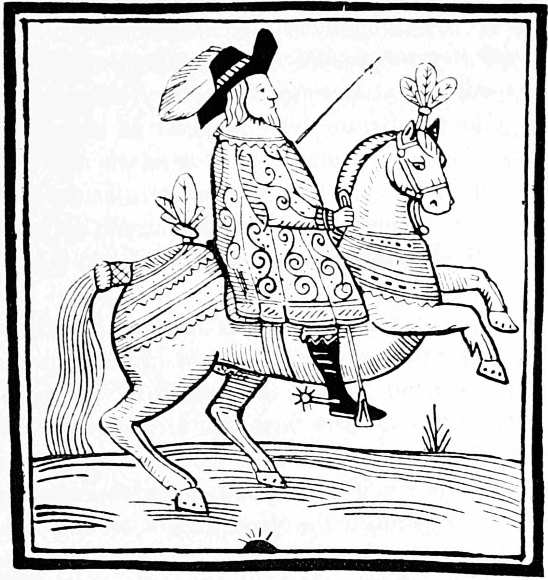
GENERAL LUCAS AT THE SIEGE OF COLCHESTER, 1648.
‘This morning betwixt three and four of the clock, we received some tokens from the besieged, a party of them sallied out, and advanced up a narrow Lane neer to one of our Guards, thinking to surprise them unawares; but an Eagle ey’d Centinel discovering them, presented her bill, and fired; whereupon the rest of the Guardians received an allarm and immediately man’d the Line, the Colchestrians advanced and charged with great fury, this action was disputed by both parties with great courage and resolution, the enemy fell on without mercy, and fought it with much violence, but our Forces bodying, they retreat, our men pursues with great execution, killed about 20. and took as many prisoners, with the losse of 12. men; the like dispute hapned the last night; we expect every hour when we shall have Orders to fall on, the work will be difficult, and the storming dangerous, the town being disadvantageous for such a Military action.
‘Colchester Leaguer July 26. at 8. in the morning.’
This tract is illustrated with a portrait of General Lucas on horseback, which is copied on the previous page.
Colchester surrendered to the Parliament on Aug. 27, 1648, when Fairfax determined to make an example of Sir Charles Lucas. This unexpected severity was attributed to Ireton, who had been set by Cromwell to watch Fairfax. There was a strong protest made against the intended execution, but it nevertheless took place. Lucas was shot, together with Sir George Lisle. The former suffered first, and he himself gave the order to the soldiers to fire, with as much coolness as if he had been a mere spectator. It is said that Lisle ran and kissed the dead body of his friend, and then presented himself to a like fate. Thinking that the firing party was too far off, he called to them to come nearer; one of the soldiers replied, ‘I’ll warrant you, Sir, we’ll hit you.’ ‘Friends,’ said the gallant Royalist, smiling, ‘I have been nearer you when you have missed me.’
Other tracts describe the proceedings of the Prince of Wales in his attempts to retrieve his father’s fortunes. One of them has a portrait of the Prince, and contains a message sent by him to the Mayor of Yarmouth concerning the landing of his forces there for the relief of Colchester. Another is adorned with a very elaborate title-page, and describes ‘The Resolution of the Prince of Wales, concerning the landing of his Army in the Isle of Loving-Land, within the County of Suffolk, and his Propositions to all Englishmen concerning his Engagement for King, City, and Kingdom, against the Army, and to fight for their Liberties, Freedom, and Privileges. Likewise, the further proceedings of the Royal Navie, under his Highness the D. of York, and the Declaration of the Seamen in the Isle of Wight and Portsmouth, concerning the Kings Majesty and the Fleet Royall, 1648.’
The contest between the Royalists and the Parliament was now drawing to a close. The King was a prisoner in Carisbrooke Castle, and while he lay there he continued to occupy the pens of the pamphleteers and journalists. One writer addressed an exhortation to the nobility, clergy, and civil magistrates, in favour of the imprisoned Monarch; and he adorned his work with the above representation of the King in prison, which afterwards appeared in other pamphlets.
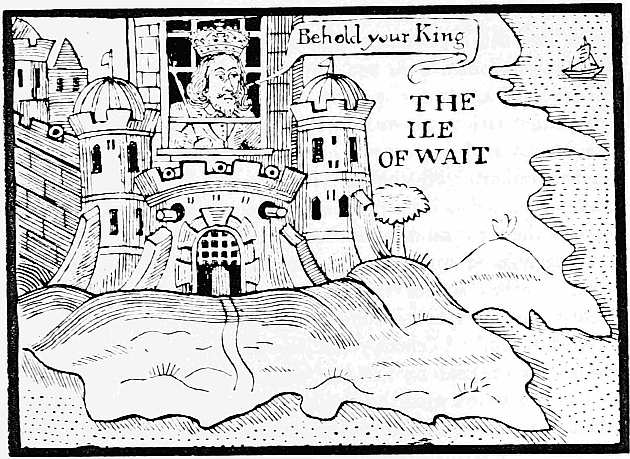
CHARLES I. IN CARISBROOKE CASTLE, 1648.
It is remarkable that such important events as the trial and execution of Charles I. should not have tempted the newspapers of the day to illustrate subjects of so much interest. It may have been that such a terrible termination of the Civil War in some degree paralysed men’s energies, and drove all thoughts of trading on such an event from their minds. I have met with two very rough woodcuts professing to represent the execution. One is contained in the Confession of Richard Brandon, the Hangman, and the other forms half of a woodcut frontispiece to a broadside describing the execution of the Regicides, which I shall refer to in its proper place. The Confession of Richard Brandon was published in 1649, the same year in which the King was executed, and purports to be a death-bed statement concerning that event. There were two Brandons, Gregory and Richard, father and son. The former beheaded Lord Strafford, and was believed by Charles II. to have been the executioner of his father. According to Sir Nathaniel Wraxall, George Selwyn, ‘that insatiable amateur of executions,’ told the story of King Charles’s execution from information which he professed to have obtained from the Duchess of Portsmouth, who, he said, always asserted, on the authority of Charles II., that the King, his father, was not beheaded by either Colonel Joyce or Colonel Pride, as was then commonly believed, but that the real name of the executioner was Gregory Brandon; that this man had worn a black crape stretched over his face, and had no sooner taken off the King’s head than he was put into a boat at Whitehall Stairs, together with the block, the black cloth that covered it, the axe, and every other article that had been stained with the Royal blood. Being conveyed to the Tower, all the implements used in the decapitation had been immediately reduced to ashes. A purse containing one hundred broad pieces of gold was then delivered to Brandon, and he was dismissed. He survived the transaction many years, but divulged it a short time before he died. ‘This account,’ Wraxall adds, ‘as coming from the Duchess of Portsmouth, challenges great respect.’2 Popular belief, however, at the time pointed to Richard Brandon, son of the above-named Gregory Brandon, whose confession, published immediately after his death, I here quote:—
‘The Confession of Richard Brandon the Hangman (upon his Death bed).
‘The Confession of the Hangman concerning his beheading his late Majesty the King of Great Brittaine (upon his Death bed) who was buried on Thursday night last, in White Chappell Church-yard, with the manner thereof.
‘Upon Wednesday last (being the 20 of this instant June, 1649) Richard Brandon, the late Executioner and Hangman, who beheaded his late Majesty, King of Great Brittaine, departed this life. But during the time of his sicknesse his conscience was much troubled, and exceedingly perplexed in mind, yet little shew of repentance, for remission of his sins, and by past transgressions, which had so much power and influence upon him, that he seemed to live in them and they in him. And upon Sunday last, a young man of his acquaintance going in to visit him, fell into discourse, asked him how he did, and whether he was not troubled in conscience, for cutting off of the King’s head?
‘He replied by reason that (upon the time of his tryal, and at the denouncing of Sentence against him) he had taken a vow and protestation, wishing God to perish him body and soul, if ever he appeared on the scaffold to do the act or lift up his hand against him.
‘Further acknowledging, That he was no sooner entered upon the scaffold, but immediately he fell a trembling, and hath ever since continued in the like agony.
‘He likewise confessed that he had 30 pounds for his pains, all paid him in half-crowns, within an hour after the blow was given, and that he had an orange stuck full of cloves, and a handkircher out of the King’s pocket, so soon as he was carried off from the scaffold; for which orange he was proffered 20 shillings by a gentleman in Whitehall, but refused the same, and afterwards sold it for ten S. in Rosemary-lane.
‘About 6 of the clock at night he returned home to his wife living in Rosemary Lane, and gave her the money, saying, That it was the deerest money that ever he earned in his life, for it would cost him his life. Which prophetical words were soon made manifest; for it appeared that ever since he hath been in a most sad condition, and upon the Almightie’s first scourging of him with the Rod of meeknesse, and the friendly admonition of divers friends, for the calling of him to repentance, yet he persisted on in his vicious Vices, and would not hearken thereunto, but lay raging and swearing, and still pointing at one thing or another, which he conceived to appear visible before him.
‘About three dayes before he died he lay speechlesse, uttering many a sigh and heavy groan and so in a most desperate manner departed from his bed of sorrow. For the buriall whereof great store of wines were sent in by the sheriff of the City of London, and a great multitude of people stood wayting to see the Corps carried to the Church-yard, some crying out Hang him Rogue, bury him in the Dung-hill; others pressing upon him saying, They would quarter him, for executing of the King; insomuch, that the Church Wardens and Masters of the Parish were fain to come for the suppressing of them, and (with great difficulty) he was at last carried to White-Chappell Church-yard, having (as it is said) a bunch of Rosemary at each end of the coffin, on the top thereof, with a Rope tyed crosse from one end to the other.
‘And a merry conceited Cook, living at the sign of the Crown, having a black Fan (worth the value of 30 shillings) took a resolution to rent the same in pieces, and to every feather tied a piece of packthread dy’d in black ink, and gave them to divers persons, who (in derision) for a while, wore them in their hats.
‘Thus have I given thee an exact account and perfect relation of the life and death of Richard Brandon, to the end, that the World may be convinced of those calumnious speeches and erroneous suggestions which are dayly spit from the mouth of envy, against divers persons of great worth and eminency, by casting an odium upon them for the executing of the King; it being now made manifest that the aforesaid Executioner was the only man that gave the fatal blows, and his man that wayted upon him was a Ragman, living in Rosemary Lane.’
Subjoined is a copy of the cut on the title-page of this tract.
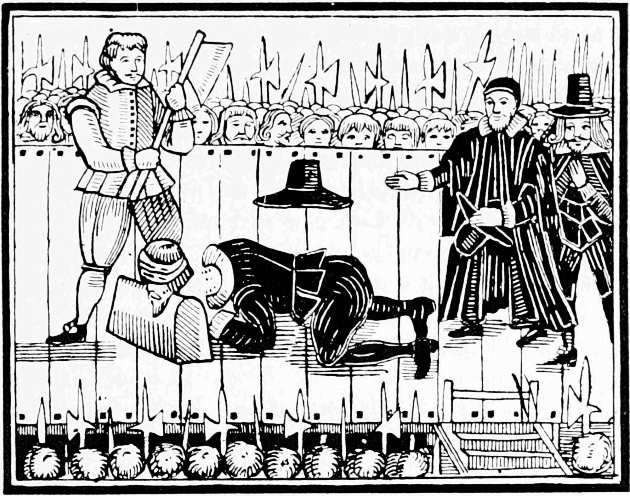
EXECUTION OF CHARLES I., 1649.
The death of Richard Brandon is entered in the register of St. Mary’s, Whitechapel, under date June 21, 1649. To the entry is appended a note, evidently of about the same date, to the effect that ‘this R. Brandon is supposed to have cut off the head of Charles the First.’ The ‘calumnious speeches and erroneous suggestions’ had indicated several persons as having struck the fatal blow on that dismal morning in January. Amongst them, besides those already named, were ‘Squire Dun,’ William Walker, Hugh Peters, Lord Stair, and William Hewlett. The last-named person was actually tried for the crime at the Restoration. The evidence against him went to show that ‘his voice was heard upon the scaffold, and his Breeches were seen under his Frock, that he confest he was to have £100 and preferment in Ireland to doe it; that being asked whether he cut off the King’s head or no, he said what he had done he would not be ashamed of; and if it were to doe again he would doe it; more to the same purpose was witnessed by several witnesses, and by one, who being sworn, said that the Common-Hangman profest he did not doe it.’ This sort of evidence was not fit to hang a dog; and, though Hewlett was found guilty and sentenced to death, the sentence was never carried into effect—a proof that public opinion must have been too strong even for the hardihood of those who had foredoomed Hewlett to the gallows. The Government had evidently determined to fix the treason on this man with the sanguinary idea that some person ought to be made to expiate the deed, even though that person might be innocent. The prevalent belief, however, was that it was the common executioner who had been employed; and it is highly improbable that a mere amateur would have been permitted to officiate on such an important occasion.
Although I have met with no native contemporary production representing the execution, other than the rude woodcuts before mentioned, there is in the British Museum a collection of broadsides relating to the period of the Civil War, one of which has a large and well-executed copperplate engraving representing the execution of Charles I. It was published at Frankfort, and the descriptive text is in German. The view of Whitehall is correctly given, and the engraving looks like a genuine representation of the event.
1 There is an Admiral Batten often mentioned by Pepys. If this is the same man who was an active commander under the Parliament he must have trimmed his sails well to hold a place in the Navy office under Charles II.
2 Old and New London. By Edward Walford.

CHAPTER V.
Decrease of Newspapers after the Civil War—Mercurius Democritus—The Faithful Post—The Politique Post—Broadsides for the People—The Hollow Tree at Hampstead—Prodigious Monster taken in Spain—The Restoration—Trial of the Regicides—Execution of the Regicides—Licenser of the Press appointed—Popular Taste for the Supernatural—Apparition in the Air in Holland—Revival of Mercurius Civicus—Murder of Archbishop Sharpe—The Loyal Protestant—Frost Fair on the Thames—Monmouth’s Rebellion—The Bloody Assizes—Funeral of Queen Mary, Consort of William III.—Increase of Newspapers after the Revolution.
When the Civil War was over the newspapers it had called into existence disappeared. The printing-press was, of course, not idle during the rule of Cromwell, but its productions were narrowly watched, and there is reason to suppose the newspapers were to a great extent under the influence of the party in power. Examples of illustrated journalism during this period are rare. We have ‘A terrible and bloudy Fight at Sea’ between Blake and Van Tromp, and ‘A great and wonderful Victory’ obtained by the English in the West Indies, each illustrated with a woodcut that had done duty in the pamphlets of the Civil War. A rough representation of an owl seated at a table writing in a book heads a tract ridiculing Lilly, the astrologer; while ‘Black Monday, or a full and exact description of the great and terrible Eclipse of the Sun,’ is adorned with a representation of ‘the true Figure of the Eclipse.’ The grim and unsocial character of the times is set forth in ‘The Vindication of Christmas,’ a pamphlet illustrated with a woodcut representing Old Christmas welcomed on one hand and forbidden on the other. After a pitiful lament for the misery of the times, Christmas sets out on a pilgrimage to London, where he enters a fair house that had once been an Alderman’s, but is now inhabited by a sour-tempered miser. Here he meets with such a cold reception that he is fain to take himself off, ‘and wandering into the country up and down from house to house, found small comfort in any.’
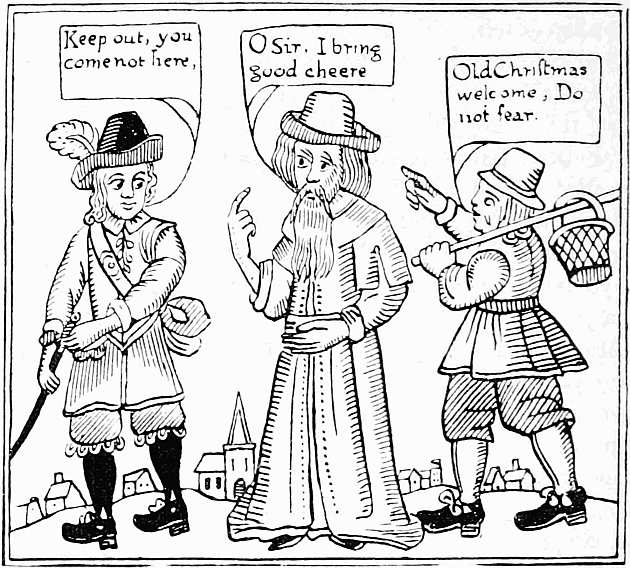
THE VINDICATION OF CHRISTMAS, 1653.
I have spoken of Mercurius Democritus as being the Punch of the seventeenth century. It is singular that such a publication as this should have existed under a Puritanical Government. The humour is so exceedingly broad that it is difficult to understand how it could be circulated at a time when the rulers of the land professed a stern and rigid morality. Unlike the modern Punch, who is refined and courteous even when he is most severe, Mercurius Democritus could seldom be facetious without being coarse and even indecent. In the same number that contains the cut of the Smithfield ghost, referred to in Chapter III., occur the following jests, which are comparatively mild specimens of the humour of Mercurius Democritus:—‘The last Monday a Herd of Swine being driven through Long Lane 600 Jews were suddenly converted by them; some think it was for fear those Rumford Cattell should serve them as they served the Devill in the country of the Gergesens when they carried him headlong into the sea.’
‘A Mad Country Parson coming riding up to London between Islington and the Red Bull met with a small-coale man, very black, with his sack of small coale at his back. The pitiful Parson minding to put a jeer on the small-coale man, made a sudden stop with his Horse, saying with a loud voyce, that those that rid after him might partake of the jest, Fellow, fellow (quoth he) I prithee tell ‘s some news from Hell, I see thou hast a whole sack full at thy back. Truly quoth the small-coale man, I can tell you but very little news from Hell, only the Devill wants a Chaplaine, and you ride but a little faster you may perchance have the place.’
Much of the news printed continued to be circulated by means of pamphlets and broadsides, but some regular newspapers were also published. An illustrated example of the latter occurs in the Faithful Post of 1653. The full title of the number for April 8, 1653, is ‘The Faithful Post Impartially communicating the Proceedings of the Parliaments forces in England, Scotland, and Ireland, comprising the sum of Intelligence from the English and Dutch Fleets; with the Affairs and Designs now on foot in France, Denmark, Sweden, Holland, and all other parts of Europe.’ It has a woodcut portrait of Admiral Van Gallen, and contains the following news from Amsterdam relating thereto:—
‘Wednesday, April 6.
‘From Amsterdam thus; Van Gallen Admiral of the Dutch Fleet in the Streights, has a golden chair sent him for his little great gallantry in the last service. And the Commons forsooth adore him extremely; insomuch that many of the Bores have erected his Statue and Portraiture, and hung it up as a memorial in the most eminent places of their Low country Fabrics, according to the figure following; with two silver keys in his hands; which, say they, are to unlock the Treasury of their enemy. Pure Youths.’ (Here follows the portrait.)
‘And as we are informed, hath a golden Leg delicately set forth by Mr. Painter, in lieu of that shot off in the fight.’
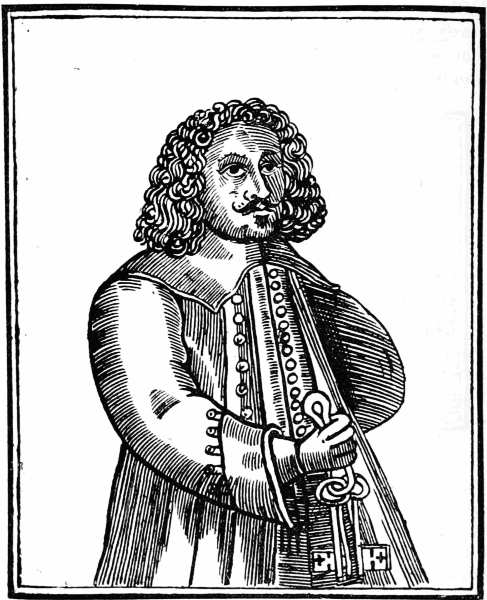
PORTRAIT OF ADMIRAL VAN GALLEN. FROM THE ‘FAITHFUL POST,’ 1653.
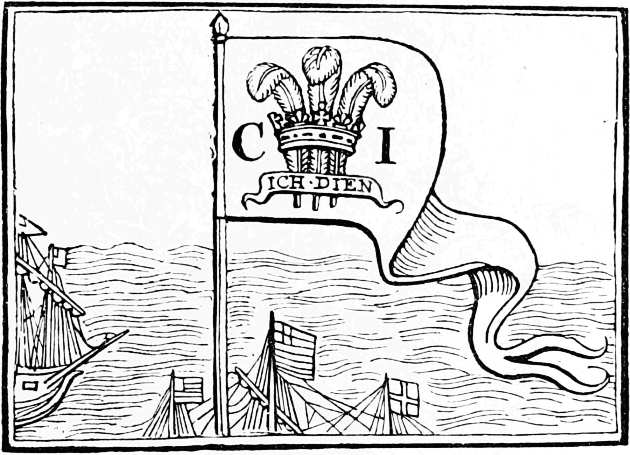
FLAG OF COL. CHARLES JAMES. FROM THE ‘POLITIQUE POST,’ 1653.
In the foregoing Faithful Post there is a good deal of news about the English and Dutch fleets; and in the news from Lubeck it is reported that the English have printed a ‘picture of Admiral Van Tromp represented with a man opening his breast to find his heart; but, searching, it was found in the Calf of his Leg, whereas, saith the Dutch Print, they know very well that Tromp behaved himself most gallantly, and like a man of courage.’ In another number of the Faithful Post is an illustration of a comet or ‘Blazing Star’ seen in Germany. The foregoing portrait of Admiral Van Gallen, and the blazing star, together with a map showing the effects of a great storm and flood in Holland, are printed in the Politique Post for January 4, 1653; but there is no reference made to the engraving of Van Gallen; and the blazing star is described as having been seen at Pembroke, in Wales. In the same number of the Politique Post is a woodcut of the flag of Colonel Charles James, which is thus alluded to:—‘By the last Post and intelligence from the Navie, we have received very certain and credible intelligence, that Colonel Charles James having received a commission from the King of Scots, is launched forth into the deep with the Brest men of war who has now struck sail upon the Coast of Brittain, and there set up his Flag on the Poop of the Patrick, called the Vice-Ambral as here represented in the ensueing Figure.’
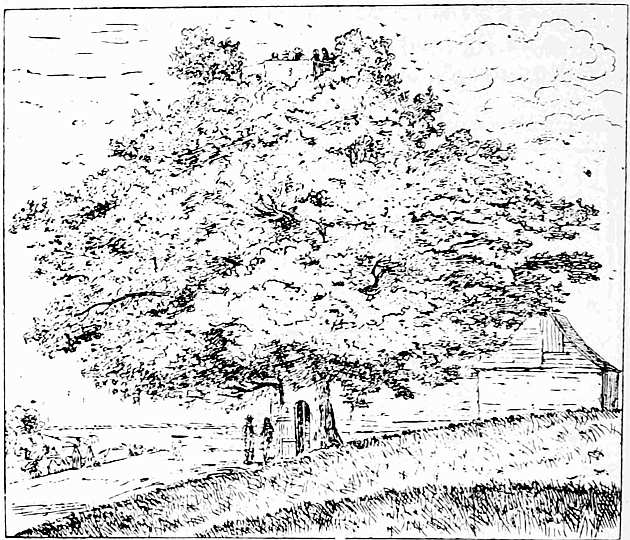
THE HOLLOW TREE AT HAMPSTEAD, 1654.
In 1654 there was a remarkable tree at Hampstead, which was visited as a curiosity. It was called ‘The Hollow Tree,’ and was probably the central attraction of a place of entertainment. In a broadside of 1654 there is an etching of it by Hollar, with descriptive and other verses. There was a door in the trunk of the tree, and a turret on the top, the ascent to which was in the hollow of the tree. The turret was large enough to seat six, ‘and round about roome for fourteene more.’ The following is a specimen of the verses accompanying Hollar’s etching:—
‘The Salutation.
‘Welcome, before! welcome all you that follow! Our heart is sound although our Tree be hollow, Yet know nor age, nor weaknesse did distresse Its willing bulk into this hollownesse: But a desire markt out for noble ends, To finde more room to entertain fast friends, And in the compasse of itself to try Laws of true Mirth and Hospitality. In such a Hollow, Musick dwells; thus love Laies forth itself, yet ne’er doth bankrupt prove. And having read the riddle doth impart Things sometimes hollow have the soundest heart.’
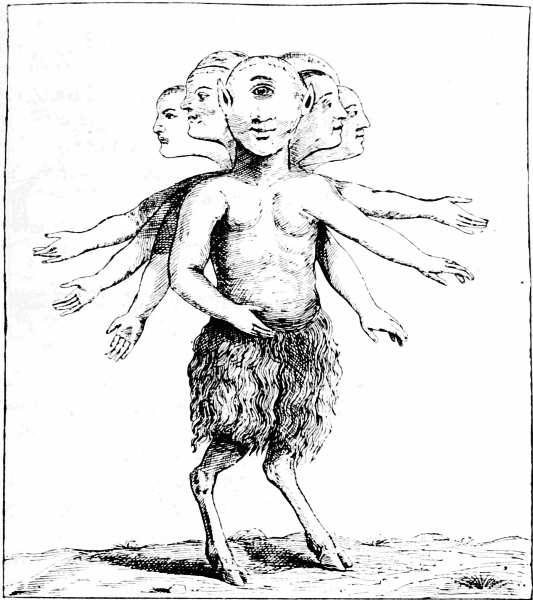
PRODIGIOUS MONSTER TAKEN IN THE MOUNTAINS OF ZARDANA IN SPAIN, 1655.
This broadside was an agreeable change from the prodigies and monstrosities with which the public were so liberally supplied. A specimen of the latter was published in 1655, which must have tried the faith of even the most credulous. It is described as ‘The True Portraiture of a prodigious Monster, taken in the Mountains of Zardana; the following Description whereof was sent to Madrid October 20, 1654, and from thence to Don Olonza de Cardines, Ambassador for the King of Spain now resident in London. Its stature was like that of a strong well set man, with 7 heads, the chief of them looking forward, with one eye in its front; the other heads have each two eyes in their natural situation, the ears of an Ass; with its principal head it eates, drinks, and cryes with an extraordinary and terrible voice; the other heads are also moved to and fro; it hath seven Arms and Hands of a Man, very strong in each of them; from the middle downward it is like a Satyr, with Goats feet, and cloven,’ &c. This broadside has a very well-executed copperplate engraving of the monster; and another sheet of the same date has a woodcut copy of the same engraving, together with a long account in verse ‘to the tune of Summer Time,’ and the following additional particulars: ‘The News of this Satyrical Monster being noysed abroad throughout all Spain, France, and Italy, made a desperate fear, and general distemper amongst all the Popish Prelates, Cardinals, Jesuites, Monks, and Fryers; yea, the very Pope himself trembled to hear this strange Report. There is a Prophesie in the 13 of the Revelation, of a great Red-Dragon and a Beast with seven heads that should arise out of the Sea, that should continue 42 moneths, which was to come to pass before the great and terrible day of judgement; which by the appearing of these strange Monsters is neer at hand now.’
At the Restoration several broadsides of news were published containing engravings. There is one giving an account of the coronation of Charles II., which is illustrated with a copperplate engraving of the King seated on his throne, robed and crowned, with the following complimentary lines:—
‘The Second Charles, Heire of the Royal Martyr Who for Religion and his Subjects Charter Spent the best Blood, that unjust Sword ere dy’de Since the rude Souldier pierced our Saviours side. Who such a Father had’st, and such a Son; Redeem thy people and assume thy own, Ascend thy Ancestors Imperial seat Of Charles the Good, thou second Charles the Great, That adds the worth; this lustre to the Crown, Whose solid Glorious weighed Usurpers down. Such Majesty as never was profan’d While Tyrants rul’d ‘twas only Charles that reigned.’
Another broadside of the same date (1660) is entitled ‘A Looking-Glass for Traytors, being the manner of the Tryall of those Barbarous Wretches at Justice-Hall in the Old-Baily, who contrived and compassed the Death of his late Sacred Majesty King Charles the First, of ever blessed memory; with an Account of their Severall Araignments, Conviction, Condemnation, and Execution.’ This sheet is also illustrated with a copperplate engraving, representing the Old Bailey Court at the trial of the Regicides, which is interesting if it truly represents the appearance of the court at that time. Numerous letters of reference are given under the engraving to explain its different parts, and a short summary is given of the trial: ‘His Majesty (in pursuance of an Act of Parliament which had left the persons following to be tried according to Law, for being the principal Actors in the said Tragedy of his Father’s death) issued out a special Commission of Oyer and terminer to the Judges and other Commissioners for that purpose; and accordingly Wednesday the 10th of October they met at the Sessions house in the Old-Baily, and the same morning the following persons were ordered to be brought from the Tower to Newgate, and a way was made from the Press-yard backwards to the Sessions house, privately to convey them to and again, to keep them from the pressing of the people.’ Then follows a list of twenty-eight persons, including Major-General Harrison and Hugh Peters, ‘all which being brought to the Bar, were indicted and arraigned to the following effect:—
‘That they not having the fear of God before their eyes, but being led by the instigation of the Divel had maliciously, traiterously, and advisedly imagined, consulted, contrived, and compassed the death of his late Majesty Charles the first of ever blessed memory, and that they had aided, procured, abetted, assisted, and comforted a certain person with a vizard upon his face, and a frock upon his body for that purpose.
‘Major-General Harrison in his Pleadings carried himself so confidently to the Court as if he thought himself Careless and Unconcerned in the businesse, and seemed to justify not only the Power under which he Acted but also the Act itself, saying that Kings had formerly been privately Assassinated and Murthered, but what they had done was in the face of the Sun and in the fear of the Lord; whereat the Court was much troubled to see that he should make God the Author of that Horrid Murther.’
Harrison was found guilty at once, and sentenced to be hanged, drawn, and quartered. The like fate awaited Hugh Peters. The sort of evidence that was brought against the prisoners is exemplified in this broadside, where it is stated that ‘Mr. Hugh Peters stood strangly amazed and could say nothing for himselfe against that Jury of witnesses that appeared against him; as that he said, England could not be settled till 150 were taken away which he said were L L L viz. the Lords, the Levites, and the Lawyers; that he was often conspiring privately with Oliver Cromwell the King’s death, that he could even reverence the High Court of Justice, it lookt so like the judgement of the world which should be at the last day by the Saints; with many other blasphemies too large to enumerate.’
Amongst the prisoners arraigned on this occasion was the William Hewlett already referred to. In the other cases the jury promptly found the prisoners guilty without leaving the court; but it was a proof of the weakness of the evidence in Hewlett’s case that ‘they did withdraw themselves, and after a little consultation they found him guilty, and accordingly sentence was pronounced against him.’ This sentence, however, as before stated, was never carried into effect.
The engraving of this historical trial at the Old Bailey is too crowded to admit of reproduction here. Other broadsides relating to the trial of the regicides were published at the time, but they are more of the nature of caricatures than illustrations of news.
It is well known that General Harrison, Hugh Peters, and others were executed with all the barbarous circumstances indicated in the words of their sentence. Peters was made to sit upon the scaffold, exposed to the jibes and jeers of the mob, and compelled to witness the mutilation of his fellow-victims. The executions were continued day after day both at Charing-cross and at Tyburn, and were stopped at last, not for lack of victims, or disinclination for more slaughter on the part of the authorities, but from a dread of the effect such bloodthirsty proceedings might have on the minds of the people. The horrors of such a scene, of course, attracted the sensational news-writer of the day; and a broadside of the time gives us a picture and description of the executions, coupled with a representation of the execution of Charles I. This broadside was evidently intended to exhibit at one view the commission of a great crime and its just punishment. The engraving shows on one side the execution of the King and on the other the punishment of the regicides. The description of the latter is preceded by an account of the trial and death of Charles. The title runs thus: ‘A true and perfect Relation of the Grand Traytors Execution, as at severall times they were Drawn, Hanged, and Quartered at Charing-Crosse, and at Tiburne. Together with their severall Speeches and Confessions which every one of them made at the time of their Execution. London, printed for William Gilbertson, 1660.’
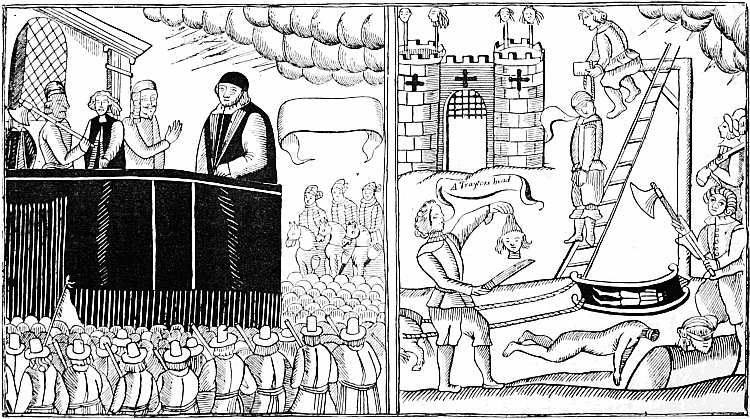
EXECUTION OF THE REGICIDES, 1660.
The following account is given of the execution of Major-General Harrison: ‘The next day being Saturday Major-Gen. Harrison was drawn upon a Hurdle from Newgate to the Round, or railed Place near Charing-Crosse, where a Gibbet was set upon which he was Hanged. Many of his acquaintance did seem to triumph to see him die so Confidently; whiles numbers of true Christians did grieve in earnest to see him die so impenitently. We have been told that when he took his leave of his wife, he comforted her, and told her that he would come again in three days; but we hear nothing as yet of his Resurrection.’ In describing the execution of Hugh Peters, it is said, ‘He came to the Ladder unwillingly, and by degrees was drawn up higher and higher. Certainly he had many Executioners within him; he leaned upon the Ladder being unwilling to part from it, but being turned off, the spectators gave a great shout, as they did when his Head was cut off, and held up aloft on the point of a Spear. The very souldiers themselves whom heretofore he did animate to slaughter, and a thorough execution of their Enemies were now ashamed of him, and upon the point of their Spears showed that guilty head which made them guilty of so much blood.’
Pepys, in his Diary, says, under date October 13, 1660:—‘I went out to Charing Cross, to see Major-General Harrison hanged, drawn, and quartered; which was done there, he looking as cheerful as any man could do in that condition. He was presently cut down, and his head and heart shown to the people, at which there were great shouts of joy. It is said, that he said that he was sure to come shortly at the right hand of Christ to judge them that now had judged him; and that his wife do expect his coming again. Thus it was my chance to see the King beheaded at White Hall, and to see the first blood shed in revenge for the King at Charing Cross.’
It will be seen by the copy made from this woodcut that the design is of the rudest possible description, and must have been the work of a common ballad illustrator, whose fee was probably on a par with his ability. He evidently thought that, in such a scene as the execution of Charles I., the Church should be paramount, for he has made Bishop Juxon a much more prominent figure than the King.
The reign of the ‘Merry Monarch,’ though not the most creditable period in English History, would have supplied abundant materials for the journalist if there had been any newspapers. The Great Plague, the Fire of London, the sea-fights with the Dutch, were splendid opportunities for the pencil of the ‘special artist’ or the pen of ‘our own correspondent.’ A law had been passed prohibiting the publication of newspapers without being duly licensed. Sir John Birkenhead was appointed Licenser of the Press, and he was succeeded by Sir Roger L’Estrange. There was scarcely anything that could be called a newspaper except the London Gazette, and it only contained such news as the Government thought proper to make public, and it was never illustrated. The little that was done in the way of pictorial journalism was of a satirical or humorous character, or had reference to foreign affairs, and was either published in the form of broadsides or was put before the public in such a questionable shape that it was difficult to tell whether it was truth or fiction. As soon as the people were released from the domination of Puritanism a reaction set in, and the humours of Mercurius Democritus were supplemented by the still broader fancies of Mercurius Fumigolus. Occasional entertainment of a more serious character was supplied, such as ‘A True and Perfect Relation of the Happy Successe and Victory obtained against the Turks of Argiers at Bugia.’ The popular taste for the mysterious and supernatural was touched by ‘A true and perfect Relation, of a strange and wonderful Apparition in the Air, the Fourteenth of August, near Goeree in Holland.’ This was an illustrated broadside containing the following account:—‘On the fourteenth of August this year 1664, towards the evening near Goeree in Holland, there was seen by many Spectators an Apparition upon the Ocean of two several Fleets of Ships engaged in a Fight, which lasted for the space of about half an hour, and then vanished. Afterwards there appeared two Lyons, who with great fury and violence, assaulted each other three several times, neither of them prevailing against the other, till at length both of them wearied with their continual striving, did, as it were, give over for breath, when on a sudden a third Lyon of a very great and huge stature appeared and falling first upon the one, and then on the other, destroyed them both. They being vanished, there appeared a King, with a Crown upon his head, and he so plainly and visibly discerned as that the spectators did discover the very Buttons on his Coat. After all was vanished, the said Spectators continueing there, and walking too and fro upon the sands, the Ocean, so far as they could see, seemed to be Blood. On the next morning, the same Apparition, in all its Circumstances, was seen again, and the truth thereof attested upon Oath, before the Magistrates of Goeree, by the said Spectators; so that there is no doubt made of the truth thereof. And this happening in this juncture of time, begets some strange apprehensions; for that about six Months before Van Trump was slain in the former Wars with England, there was seen near the same place, an Apparition of several Ships in the Air, as it were fighting with each other.’
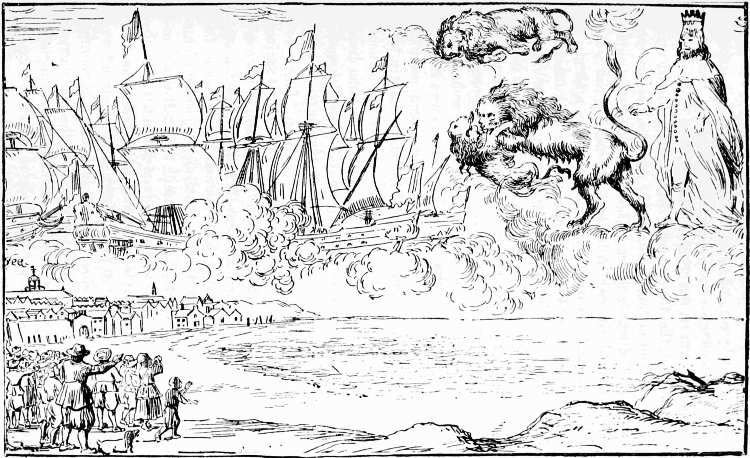
APPARITION IN THE AIR AT GOEREE IN HOLLAND, 1664.
This broadside was printed at London, ‘by Thomas Leach in Shooe Lane in the Year 1664. With Allowance October 13, 1664. Roger L’Estrange.’ The illustration is an etching, very well and freely executed.
Amongst other things which appear to have been revived at the Restoration was the Mercurius Civicus. In Dr. Burney’s collections in the British Museum there is preserved a copy of Number 4 of Mercurius Civicus, dated May 1, 1660. On the title-page it is stated to be ‘published by order of the Lord Mayor and Court of Aldermen;’ but it is not illustrated, as was its predecessor of the time of the Civil War.
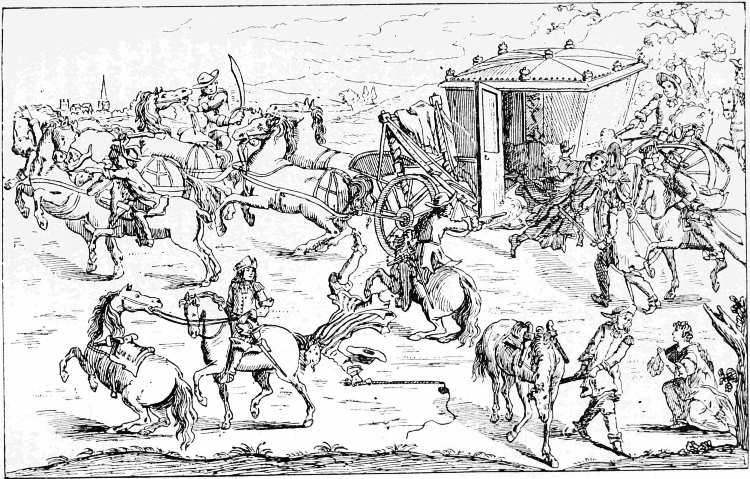
THE MURDER OF ARCHBISHOP SHARP, 1679.
One of the most atrocious deeds of the time, and one that had a powerful effect upon public feeling, was the murder of Archbishop Sharp in 1679. This prelate was held to have betrayed the Presbyterians at the time of the Restoration, and was hated accordingly. This hatred had been manifested by an attempt on his life in the streets of Edinburgh in the year 1668; but on that occasion the Archbishop escaped, and another person was wounded. On May 3, 1679, Archbishop Sharp was returning in his coach to St. Andrews from Kennaway, where he had passed the night, when, at a place called Magus Moor, he was set upon by nine men, who murdered him with pitiless barbarity in the presence of his daughter, who accompanied him. This dreadful event was commemorated in a broadside entitled ‘The Manner of the Barbarous Murther of James, late Lord Archbishop of St. Andrews, Primate and Metropolitan of all Scotland and one of his Majesties most Honourable Privy Council of that kingdom, May 3, 1679.’ A copperplate engraving represents the murder, and some verses are printed underneath. I have copied the engraving on this broadside, which forms part of the Luttrell collection in the British Museum.
In 1681 there existed a newspaper entitled The Loyal Protestant and True Domestic Intelligencer. In the number for April 2, 1681, there is printed the following curious news from Rome:—
‘Rome, March 6. There did appear here about the middle of Dec. last, a strange and wonderful Comet near the Ecliptick in the sign of Libra, and in the body of the Virgin. At the same time a Prodigious Egge was laid by a Young Pullet (which had never laid before) with a perfect Comet in it, and as many stars, and in the same form as the enclosed figure shows. All the great ones of Rome have seen it, even the Queen and the Pope. What you see in the enclosed Paper is within the Egge most clearly exprest, and not upon the Shell. The Roman Wits are now very busy in guessing at what this Comet and Egge may portend.’
This account of the egg is printed on the front page of The Loyal Protestant, in the midst of Court news from Oxford, municipal news from Leicester, news from Edinburgh, &c, and is illustrated with a woodcut, which I have copied. A further description is appended to the representation of the egg:—‘The true form of a Prodigious Egg brought forth at Rome the 11th of Dec. last in the year 1680 in which the Commet here printed does continue to appear.’
‘The aforesaid 11th of Dec. about 8 of the Clock in the morning, a Hen Chicken, with a great Noise, crying extraordinarily, that never had laid an Egge before this day, brought forth an Egge of an extraordinary greatness, with all these several Forms as you see here exprest, to the great amazement of all those that have seen it. This is an exact draught of the Egge as it was printed in Italy. But all persons are left to their own choice whether they will believe either this or any of our own late home-bred Miracles or visions.’
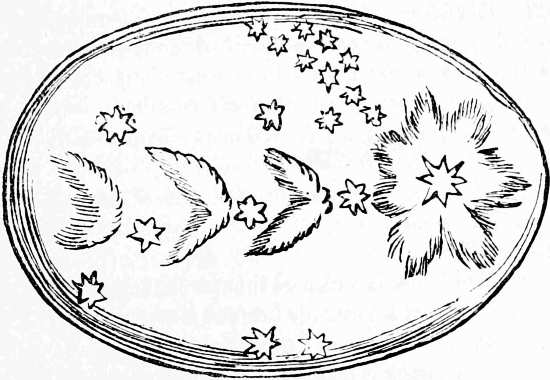
EXTRAORDINARY EGG LAID AT ROME. FROM THE ‘LOYAL PROTESTANT AND TRUE DOMESTIC INTELLIGENCER,’ 1681.
Supernatural occurrences and uncommon events, even when traceable to natural causes, have always had great attractions for both the ignorant and the educated. We therefore find the talents of the old newsmen were most frequently exercised on mysterious appearances in the air, floods, fires, and frosts, earthquakes and upheavings of the sea. Having already quoted examples dealing with some of these subjects, I now come to two broadsides which describe and illustrate the great frost of 1683-4, when the river Thames was covered with ice eleven inches thick, the forest trees, and even the oaks, in England were split by the frost, most of the hollies were killed, and nearly all the birds perished. According to the testimony of an eye-witness, ‘The people kept trades on the Thames as in a fair, till February 4, 1684. About forty coaches daily plied on the Thames as on drye land.’ The broadsides under notice give representations of the fair held on the Thames, and describe it in doggerel verse. The one containing the engraving I have copied is entitled ‘Great Britain’s Wonder; London’s Admiration. Being a True Representation of a Prodigious Frost, which began about the beginning of December, 1683, and continued till the Fourth Day of February following. And held on with such violence, that Men and Beasts, Coaches and Carts, went as frequently thereon as Boats were wont to pass before. There was also a street of Booths built from the Temple to Southwark, where were sold all sorts of Goods imaginable—namely Cloaths, Plate, Earthen Ware; Meat, Drink, Brandy, Tobacco, and a Hundred sorts of other Commodities not here inserted. It being the wonder of this present Age, and a great consternation to all the Spectators.’ The description opens thus:—
‘Behold the Wonder of this present Age A Famous River now become a stage. Question not what I now declare to you, The Thames is now both Fair and Market too. And many Thousands dayley do resort, There to behold the Pastime and the Sport Early and late, used by young and old, And valued not the fierceness of the Cold.’
The illustration is a roughly executed woodcut, and represents a street of booths opposite the Temple, looking towards the Middlesex shore. On one side are men skating, sliding, riding on sledges, and playing at football; whilst bull-baiting, skittle-playing, &c, go on on the other side. Coaches are driven across the ice, boats are dragged as sledges, and an ox is roasted whole in one corner.
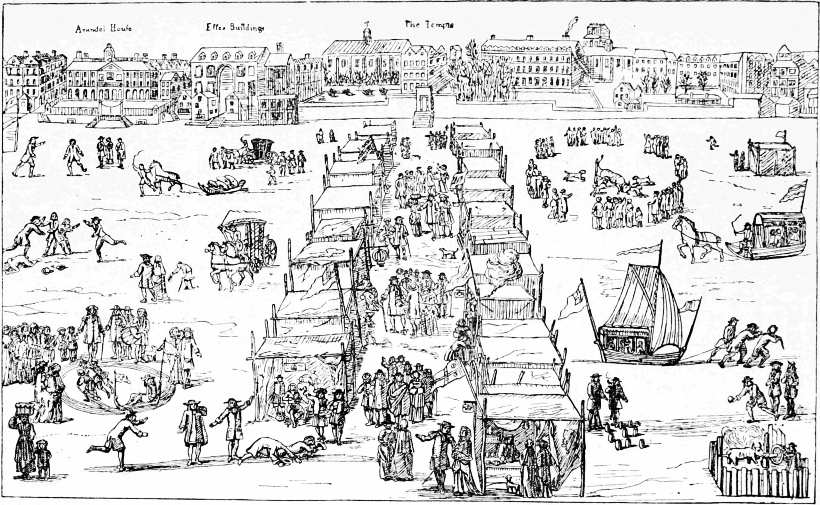
FROST FAIR ON THE THAMES, 1683.
The other broadside has a woodcut of the same scene, but taken from a different point, and looking down the river, with London Bridge, the Tower, Monument, &c, in the distance. In addition to a description of Frost Fair, there is an account of all the great frosts from the time of William the Conqueror.
Some curious particulars of this great frost are recorded by contemporary writers. Evelyn describes the whole scene, and says that he crossed the river on the ice on foot upon the 9th, in order to dine with the Archbishop of Canterbury at Lambeth; and again in his coach, from Lambeth to the horse-ferry at Millbank, upon Feb. 5th, when ‘it began to thaw, but froze again.’ Hackney-coaches plied between Somerset House and the Temple to Southwark. There was a printing-press set up in one of the booths, ‘where the people and ladys tooke a fancy to having their names printed, and the day and year set down, when printed on the Thames. This humour took so universally that ‘twas estimated the printer gained about £5 a day for printing a line onely at sixpence a name, besides what he got by ballads, &c.’ A specimen of this printing has been preserved. It was executed for Charles II., who visited Frost Fair accompanied by several members of his family. It contains, besides the names of the King and Queen, those of the Duke of York, Mary his Duchess, Princess Anne (afterwards Queen Anne), and Prince George of Denmark, her husband. The last name on the list is ‘Hans in Kelder,’ which literally means ‘Jack in the Cellar,’ and is supposed to have been suggested by the humour of the King in allusion to the interesting situation of the Princess Anne; and we can fancy the swarthy face of the ‘Merry Monarch’ smiling in the frosty air as this congenial joke was perpetrated.
In the Luttrell collection of broadsides there is one with a large woodcut representing the battle of Sedgemoor and other incidents of Monmouth’s rebellion. The letterpress is in wretched verse, and is entitled, ‘A Description of the late Rebellion in the West. A Heroic Poem.’ The unfortunate issue of Monmouth’s rising excited the sympathy of the common people, to whom he was endeared by his many amiable qualities and his handsome person. Though this broadside was evidently written in the interest of the Government it was likely to have a ready sale, and it was sought to increase the interest by pictorial representation. The engraving, which is on an unusually large scale, is very rough, like all the woodcuts of the period.
The slaughter at Sedgemoor and the execution of the Duke of Monmouth were partly forgotten in the greater horror excited by the unsparing severity of Judge Jefferies in condemning to death hundreds of persons who were charged with being concerned in the rebellion. I have met with one illustrated tract relating to the ‘Bloody Assize.’ It is inserted at the end of the volume of the London Gazette for 1685, and has apparently been added by Dr. Burney, the collector, as bearing upon the events of the time. It forms no part of the London Gazette, though bound up with it. There is a rough woodcut on the title-page containing eleven portraits, and the title is as follows:—
‘The Protestant Martyrs; or the Bloody Assizes, giving an account of the Lives, Tryals, and Dying Speeches, of all those eminent Protestants that suffered in the West of England by the sentence of that bloody and cruel Judge Jefferies; being in all 251 persons, besides what were hanged and destroyed in cold blood. Containing also the Life and Death of James Duke of Monmouth; His Birth and Education; His Actions both at Home and Abroad; His Unfortunate Adventure in the West; His Letter to King James; His Sentence, Execution and Dying-words upon the Scaffold; with a true Copy of the Paper he left behind him. And many other curious Remarks worth the Readers Observation. London, Printed by F. Bradford; at the Bible in Fetter Lane.’
At the end of the pamphlet is printed this curious sentence:—‘This Bloody Tragedy in the West being over our Protestant Judge returns for London; soon after which Alderman Cornish felt the Anger of Somebody behind the Curtain.’
Alderman Cornish was afterwards executed at the corner of King Street, Cheapside, for alleged participation in the Rye House Plot.
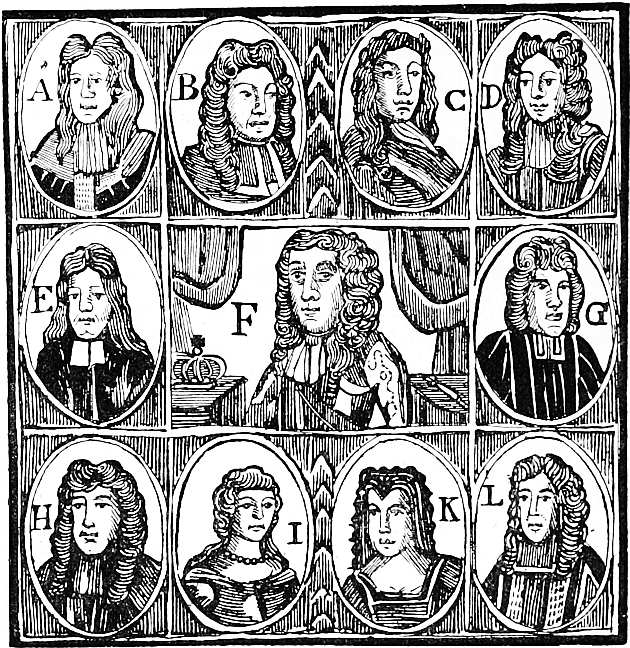
MARTYRS OF THE BLOODY ASSIZES, 1685.
This fragment of contemporary history shows that if there were no regular newspapers to supply the people with illustrated news they obtained it in the shape of cheap fly-sheets and broadsides—the form in which it was supplied to them before newspapers began.
Macaulay describes the unlicensed press at this period as being worked in holes and corners, and producing large quantities of pamphlets which were a direct infraction of the law subjecting the press to a censorship. ‘There had long lurked in the garrets of London a class of printers who worked steadily at their calling with precautions resembling those employed by coiners and forgers. Women were on the watch to give the alarm by their screams if an officer appeared near the workshop. The press was immediately pushed into a closet behind the bed; the types were flung into the coal-hole, and covered with cinders; the compositor disappeared through a trap-door in the roof, and made off over the tiles of the neighbouring houses. In these dens were manufactured treasonable works of all classes and sizes, from halfpenny broadsides of doggerel verse up to massy quartos filled with Hebrew quotations.’1 The pamphlet I have just quoted probably issued from a press of this kind; but he must have been a bold printer who dared to put his name and address to a work wherein Jefferies was openly referred to as ‘that bloody and cruel Judge Jefferies.’
Large broadsides continued to be the favourite form of illustrated journalism for some time after this. One gives a ‘true and perfect relation’ of a great earthquake which happened at Port Royal, in Jamaica, on Tuesday, June 7th, 1692, and is illustrated with a large woodcut. On the death of Queen Mary, the consort of William III., an illustrated broadside was published, plentifully garnished with skulls and cross-bones, entitled, ‘Great Britain’s Lamentation; or the Funeral Obsequies of that most incomparable Protestant Princess, Mary, of ever Blessed Memory, Queen of England, Scotland, France, and Ireland, who departed this life the 28th of December, at Kensington, 1694, in the Thirty-second Year of her Age. She Reigned Five Years, Eight Months, and Seventeen Days. And was conducted from Whitehall to Westminster Abbey, in an open Chariot of State, on black cloath, by the Nobility, Judges, and Gentry of the Land, on Tuesday, the 5th of March, 1694-5.’ The large woodcut shows the funeral procession, and I have copied that part of it containing the funeral car, with the body of the deceased queen resting under a canopy.
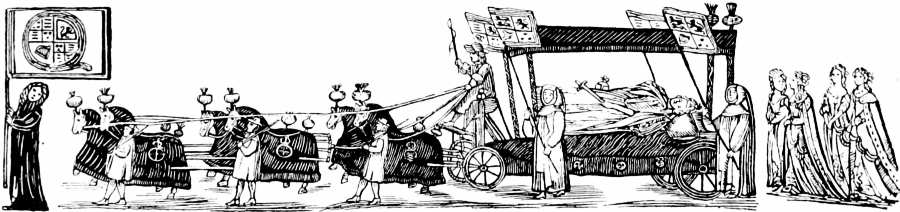
FUNERAL OF QUEEN MARY, 1695.
In a few years after the Revolution newspapers began to increase rapidly. The censorship of the press ceased in 1695, and was immediately followed by the appearance of great numbers of periodical papers. At first they were small in size, were wretchedly printed on the commonest paper, and each number contained only a small quantity of matter. The art of wood-engraving, the readiest and least expensive method of illustration, was now in the lowest possible condition; and the newspapers at the end of the seventeenth century contain scarcely any illustrations, except, perhaps, a heading of a rudely executed figure of a man blowing a horn, flanked by a ship or a castle, and numerous small woodcuts to advertisements.
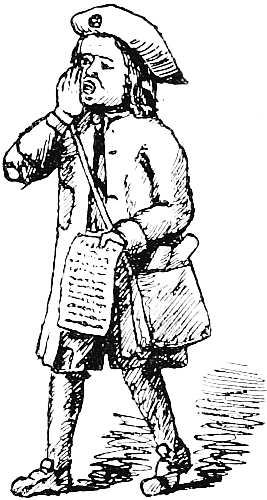
1 History of England.
CHAPTER VI.
Constant Attempts at Illustrated News—Increase of Caricatures—The Postman, 1704—Fiery Apparition in the Air, seen in London—Caricature against the Jacobites—The South-Sea Bubble—Eclipse of the Sun, 1724—The Grub Street Journal an Illustrated Paper—The Daily Post—Admiral Vernon’s Attack on Porto Bello—The Penny London Post—Henry Fielding and the Jacobite’s Journal—Owen’s Weekly Chronicle—Lloyd’s Evening Post, and the Trial of Lord Byron for the Murder of Mr. Chaworth—The St. James’s Chronicle—Illustrated Account of a Strange Wild Beast seen in France—The Gentleman’s Journal of Anthony Motteux—The Gentleman’s Magazine of Edward Cave—The London Magazine—The Scot’s Magazine.
In glancing at the early newspapers it is apparent that the idea, in some shape, of illustrating the news of the day was never quite absent from the minds of newspaper conductors. Sometimes it took the form of a rude map of the country where some war was going on, or the plan of some city which was being besieged. In the London Post for July 25, 1701, is a map of the seat of war in Italy, which is reprinted in other numbers, and the Daily Courant, for Sept. 8, 1709, contains a large plan of Mons. In the absence of other means, even printers’ lines were used to represent a plan of some place, or an event of unusual interest. Such an attempt at illustrated news was made in the Dublin Journal for May 14, 1746, where there is a plan, set up in type and printers’ lines, of the battle of Culloden; and in the number for March 28, 1747, there is a similar plan of the trial of Lord Lovat. This is doubly interesting as being Irish. Engraving on copper, though it involved the expense of a double printing, was sometimes resorted to for the purpose of enlivening the pages of the early newspapers, and we have seen that it was also employed in broadsides. There was so much enterprise that even penny papers sometimes introduced engravings into their pages.
About the beginning of the eighteenth century caricatures began to increase in England. Religious animosities and political intrigues, always keen incentives to satire, had opened a wide field to the caricaturist in the years which followed the Revolution. But religious bigotry and party spirit, strong as they were at this period, were exceeded by the social follies which came afterwards. The trial of Dr. Sacheverell occasioned the publication of numerous songs, squibs, and caricatures; but the South-Sea Bubble surpassed it as a fruitful source of lampoons and pictorial satire. The spirit of ridicule was fed by the political intrigues, the follies and the vices of the Georgian era, and reached its highest development in the days of George III. Amongst other early channels for circulation we find caricatures making their appearance in newspapers, and as we proceed I shall give one or two examples from the illustrated journalism of this period.
On March 14, 1704, The Postman, one of the papers that was started on the expiration of the censorship (and which Macaulay says was one of the best conducted and most prosperous), published what was called a Postscript for the purpose of making its readers acquainted with a prodigy seen in Spain in the air so far back as the year 1536. It is illustrated with a woodcut representing two men fighting in the air; and the following account is given of it:—‘The success of the expedition of K. Charles III. being now the subject of all Publick Discourses, the Reader, we hope, will excuse the following Postscript, which must be confest to be of an extraordinary nature, as containing some things hardly to be parallelled. All the states of Christendom being concerned some way or other in this great quarrell, it is not to be wondered at if the discovery of a Prodigy, which seems to foretell the decision of it, has made so much noise at Rome, and that we insert it in this place. The French Faction grew intolerably insolent upon account of the storms which have so long retarded the Portuguese expedition, and represented these cross accidents as a manifest declaration that God did not approve the same; and this way of arguing, though never so rash and impertinent in itself, prevailed over the generality of the people, in a City which is the Centre of superstition. The Partizans of the House of Austria were very much dejected and had little to say, when they happily discovered in the Library of the Vatican a Book printed at Bazil in the year 1557 written by Conradus Lycosthenes, wherein they found an argument to confute all the reasons alledged by their adversaries, and a sure Presage in their opinion of the success of K. Charles III. This made a great noise at Rome, and his Grace the Duke of Shrewsbury sent an account thereof. The Book perhaps is not so scarce as they thought at Rome; and the learned Doctor Hans Sloane having one in his Library, and having been so obliging as to give me leave to transcribe that passage, I present it here to the reader, leaving it to everyone to make his own observations. The Book is thus Intituled: “Prodigiorum Ostentorum Chronicon, &c., per Conradum Lycosthenem, Rubeaquensem. Printed in Folio at Bazil per Henricum Petri 1557,” and amongst the infinite number of Prodigies he relates in his collection, which extends from the beginning of the world to his time, he has the following, page 558 (here follows the description on each side of the woodcut in Latin and English). ‘In a certain place of Spain on the 7th of Feby, 1536, 2 hours after the setting of the sun as Fincelius relates it after others, were seen in the Air, which was rainy and cloudy, two Young Men in Armour, fighting with Swords, one of them having in his left hand a Shield or round Buckler, adorned with an Eagle, with this inscription, I SHALL REIGN, and the other having on a long Target with these words, I HAVE REIGNED. They fought a Duel, and he who had the Eagle on his Buckler beat down his enemy and was conqueror.’ The whole affair refers to the war of the Spanish Succession between the partisans of Louis XIV. and the House of Bourbon, and the House of Austria, and is made to foretell the downfall of the former. As the Bourbons did eventually obtain the Crown of Spain, this interpretation of the supposed prodigy may be referred to the same class as the prophecies of Old Moore’s Almanack. I have copied the engraving, which is the only illustration I have found in The Postman.
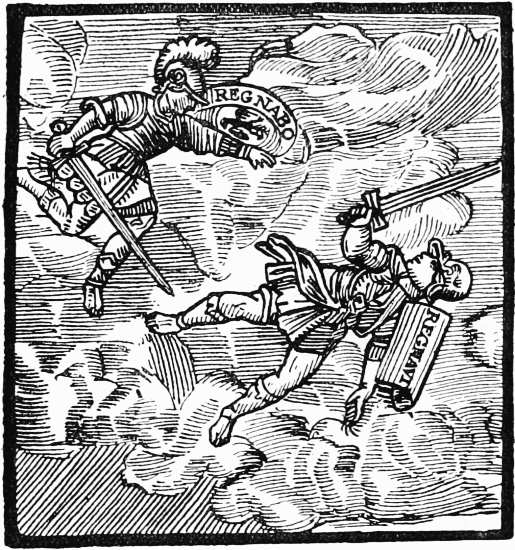
PRODIGY SEEN IN SPAIN. FROM THE ‘POSTMAN,’ 1704.
We have already noticed that no class of marvels were so attractive to the early news-writers as apparitions in the air. Another example of this is found in a pamphlet, published in 1710, entitled ‘The Age of Wonders: or, A further and particular Description of the remarkable, and Fiery Apparition that was seen in the Air, on Thursday in the Morning, being May the 11th, 1710.’ It is illustrated with a rough woodcut, and has the following description:—
.... ‘As for the strange Appearances which were seen on the 11th of May in the Morning, I suppose there is by this time few that do not give Credit to the same, since so many creditable People in several parts of the Town have apparently testified the same, and are ready still to do it upon enquirey, as in Clare Market, Cheapside, Tower-hill, and other places; it was likewise seen by several Market Folks then upon the Water, who have since agreed in Truth thereof, most of which relate in the following manner:—
‘On Wednesday Night, or rather Thursday Morning last, much about the Hour of two a Clock, several People, who were then abroad, especially the Watchman about Tower Street, Clare Market, Cheapside, and Westminster, plainly and visibly saw this strange Comet, it seem’d a very great Star, at the end of which was a long tail, or streak of Fire, very wonderful and surprizing to behold. It did not continue fix’d, but pass’d along with the Scud, or two black Clouds, being carried by a brisk wind that then blew.
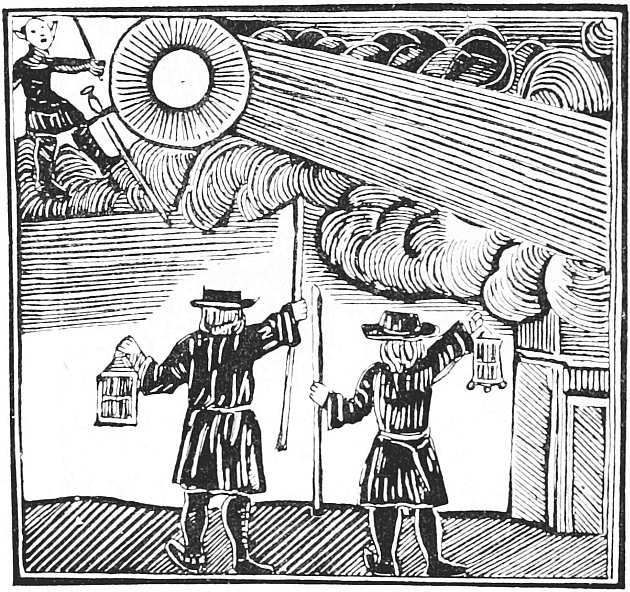
FIERY APPARITION IN THE AIR, SEEN IN LONDON, 1710.
‘After which follow’d the likeness of a Man in a Cloud of Fire, with a Sword in his hand, which mov’d with the Clouds as the other did, but they saw it for near a quarter of an Hour together, to their very great surprize, and related the same the next Morning, which they are ready now to affirm if any are so curious to go and Enquire, particularly John Smith, near Tower-street, Abraham Wilsley, on Tower-hill, John Miller, near Clare Market, John Williams, in Cheapside, George Mules and Rebeccah Sampson upon the Water, and Mr. Lomax, Watchman of St. Anns, with many others too tedious to insert.’
Amongst the many newspapers that had sprung into existence the following so far improved upon their small and dingy predecessors as to be adorned with pictorial headings:—The Post Boy, 1720; the Weekly Journal, 1720; the London Journal, 1720; the Weekly Journal, or Saturday’s Post, 1721; Applebee’s Weekly Journal, 1721; Read’s Journal, or British Gazetteer, 1718-31. The last named appeared for many years as the Weekly Journal, or British Gazetteer; but the Weekly Journal was a favourite title, and was borne by so many other papers that after a time the publisher altered the title of his paper to Read’s Journal; or British Gazetteer, and gave it an engraved heading. Read was a man of enterprise, and surpassed his contemporaries in endeavouring to make his journal attractive by means of illustrations. In his paper for Nov. 1, 1718, there is a caricature engraved on wood. It is levelled against the Jacobites, and is called ‘An Hieroglyphick,’ and is introduced to the reader with the following rhymes:—
‘Will Fools and Knaves their own Misfortune see And ponder on the Tories villany Behold this Hieroglyphick, and admire What Loyalty do’s in true Souls inspire! Whate’er the Figures mean we shan’t declare, Because the Jacobites will curse and swear; But if our Readers will this piece explain, Their Explanation we shall not disdain.’
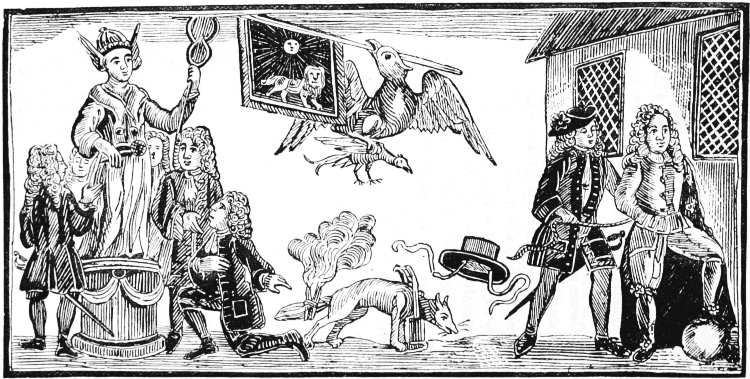
CARICATURE AGAINST THE JACOBITES. FROM ‘READ’S WEEKLY JOURNAL,’ 1718.
Nobody appears to have responded to the invitation conveyed in the verses, for in the succeeding numbers of the paper there is no attempt to explain the ‘hieroglyphick.’ A copy of this early newspaper caricature is given on the opposite page.
In the same journal for May 20, 1721, there is a large woodcut entitled ‘Lucifers Row-Barge,’ which I have also copied. It is a caricature on the South-Sea Bubble, and appears, from what follows, to have been first published in the previous week: ‘The Call for this Journal (last week) being very extraordinary, upon account of the delineation of Lucifer’s Row-Barge in it, we are desired by several of our Correspondents both in City and Country, to present them with it in this week’s paper, with an Explanation of every Representation in the aforesaid Cut, adapted to Figures; with which Request we have comply’d, as supposing it will be acceptable not only to them with such a Design, but likewise pleasing to all our Readers in General.’ The different parts of the engraving are described under the illustration on the following page.
Each of these divisions of the subject is further described in verse. In concocting this satire the author has allowed some symptoms of journalistic jealousy to appear by dragging in the correspondent of the London Journal (which was a rival paper), and describing him as the common hangman. The feeling about the South-Sea Bubble must have been very strong to have made this caricature acceptable. It was intended to satirise Mr. Knight, the cashier of the South-Sea Company, who fled the country when it became too hot for him. The verses which accompany the engraving, though by no means models of poetic elegance, might be commended to the attention of some directors of our own day:—