Volume 1 — Introductory material (continued 7)
George Burnham Ives translation
"Dear child, as you are so afraid of reproaches, I will keep your secret," said Magnani, "and I will not venture to make the slightest comment."
"On the contrary, I beg you to comment as severely as you please, Magnani. It will not humiliate me from you. I am not presumptuous enough to think that you like me, and I know that my childish faults will not cause you the slightest distress. It is because I know how dearly my father and Princess Agatha love me that I dread so to grieve them. But you can say whatever you please to me, for you will simply laugh at my foolishness."
"So you think me very indifferent, do you?" said Magnani, upon whom this story of the monk had had a singularly disquieting and disturbing effect.
Then, surprised at the question that had escaped him, he rose and went on tiptoe to listen at Michel's door. He thought that he could hear the regular breathing of a sleeping person. The Piccinino had in fact succeeded finally in allaying the tumult of his thoughts, and Michel, overcome by weariness, was dozing in his chair, with his head resting on his hands.
Magnani returned to Mila; but he dared not sit beside her again. "And I too," he thought, ashamed, and as it were, afraid of himself, "I am a monk consumed by my imagination and excited by enforced continence. This child is too lovely, too pure, too trustful, to live thus the untrammelled neglected life of girls of our station; no one can look at her without emotion, whether he be a monk doomed to celibacy or a man hopelessly in love with another woman. I would like to have my hands on that vile monk and break his neck; and yet I too quiver at the thought that this unsuspecting maiden is in this room, alone with me, in the silence of night, ready to seek shelter in my arms at the slightest alarm!"
XXXI WITCHCRAFT
Magnani tried to divert his thoughts by talking of the princess with Mila. The innocent girl lured him into it, and he accepted that subject of conversation as a preservative. It will be seen that a strange revolution had taken place in two days in the young man's mental condition, since he had already reached the point of looking upon his love for Agatha as a duty, or as what the doctors call a depurative.
If he had been certain that the princess loved Michel, of which fact he was persuaded at times, with a feeling of utter stupefaction, he would have been almost entirely cured of his own mad passion. For he had given it so exalted a place in his thoughts that, as he had lost hope, so he had almost reached the point where he desired nothing. His passion had become a sort of pious habit, so ideal that it no longer touched the earth, and that by returning it, Agatha might have destroyed it instantly. Assume that she loved any man on earth, even the man who cherished so exalted an adoration for her, and she became in his eyes simply a woman, whose influence he could combat. That was the result of five years' suffering without the slightest presumption, and without a moment's intermission. In a heart of such strength and purity, the utmost order had prevailed amid the effervescence of a passion which resembled a beginning of madness; and it was precisely that circumstance which might be Magnani's salvation. Efforts to deaden his pain would have served only to excite him more, and after indulging in vulgar pleasures, he would have returned to his chimera with more suffering and more weakness; whereas by abandoning himself without resistance, without desire for repose, and without terror, to a martyrdom which might be everlasting, he had allowed the flame to become concentrated in one spot, where it burned dully, not fanned from without, and deprived of any fresh sustenance.
Thus Magnani had reached that critical moment when a man must be cured or die, without any transition. He did not appreciate it, but it certainly was a fact, for his senses were awaking from a long period of numbness, and Agatha, far from contributing to the awakening, was the only woman to whom he would have blushed to attribute in his thoughts the perturbation that he felt.
Little by little, he leaned toward the girl in order not to lose a single one of her words, and he ended by sitting down beside her, and asking her why it had occurred to her to talk of him with Princess Agatha.
"Why, it is very simple," replied Mila; "she led me to do it by asking me which of the young mechanics of my acquaintance Michel had been most intimate with since he had arrived in the island; and as I hesitated between you and one or two of father's apprentices who assisted Michel, and whom he seemed to like, the princess herself said:
"'Perhaps you are not sure, Mila, but I would be willing to wager that it is a certain Magnani, who works for me, and of whom I think very highly. During the ball they sat in my garden together, and I was very near them—just behind the myrtle bush. I had gone there to rest, and was almost in hiding, in order to escape for an instant the torture of such a long performance. I overheard their conversation, which interested and touched me to the last degree. Your brother has a noble mind, Mila, but your neighbor Magnani has a great heart. They talked of art and work, of ambition and duty, of happiness and virtue. I admired the artist's ideas, but I fell in love with the artisan's sentiments. For your young brother's sake, I hope that Magnani will always be his best friend, the confidant of all his thoughts, and his adviser in the delicate emergencies of his life. You can advise him to that effect from me, if he happens to mention me to you; and if you tell either of them that I listened to the sincere outpouring of their thoughts, you will not fail to tell them also that I was a discreet listener, for there came a time when Magnani seemed on the point of disclosing to Michelangelo some personal matter which I did not choose to overhear. I retired hastily at the first word,'—Is all that accurate, Magnani? Do you remember the subject of your conversation with Michel in the garden of the Casino?"
"Yes, yes," sighed Magnani, "it is all true; indeed, I noticed when the princess retired, although it would never have occurred to me that it was she who was listening to us."
"At all events, you ought to be proud of it, Magnani, and very glad of it, since what you said made her feel so much friendship and esteem for you. I even thought that I could see that she preferred your way of thinking to my brother's, and that she looked upon you as the wiser and better of the two, although she says that she has felt the same motherly interest in the welfare of both of you from that moment. Couldn't you repeat to me all the beautiful words which the princess so enjoyed hearing? I should be very glad to have the benefit of them, for I am a poor little girl, with whom Michel himself hardly deigns to talk seriously."
"My dear Mila," said Magnani, taking her hand, "honor to the man whom you consider worthy to form your heart and your mind! But, even if I could remember all that Michel and I said to each other in that garden, I should not presume to think that it would benefit you in any way. Aren't you better than either of us? And as for wit, which of us can have more than you?"
"Oh! now you are laughing at me! Princess Agatha has more than all three of us together, nor do I think that even my father has any more than she has. Ah! if you knew her as well as I do, Magnani! Such a head and heart! such charm! such kindness! I could pass my whole life listening to her; and, if my father and she would allow it, I would like to be her servant, although obedience is not my leading characteristic."
Magnani was silent for a few moments. He could not succeed in disentangling his thoughts in his excitement. Hitherto Agatha had seemed to him so far above all praise that he was indignant and hurt when anyone ventured to say that she was lovely, charitable and sweet. He preferred to listen to those who said that she was ugly and mad, when they did not know her and had never seen her. They at all events said nothing about her in which there was the slightest sense, whereas the others praised her too feebly, and annoyed Magnani beyond words by their inability to comprehend her. But on Mila's lips Agatha lost nothing of the idea he had formed of her. Only Mila seemed to him pure enough to utter her name without profaning it, and because she shared his adoration, she was almost equal to his idol in his eyes.
"Dear Mila," he said at last, still holding her hand, which he had forgotten to give back to her, "to love and to understand as you do indicates a great mind. But what did you say about me to the princess? Ought I not to ask you?"
Mila blessed the darkness, which concealed her blushes, and she grew bolder as a timid woman gradually becomes intoxicated by the assured impunity of a masquerade.
"I am really afraid that it will be indiscreet in me to repeat it to you," she said, "and I should not dare to do it!"
"So you said unkind things about me, did you, naughty Mila?"
"No; for Princess Agatha had said so much good of you that it would have been impossible for me to think any evil of you. I cannot look at anything except through her eyes. But I let out something which Michel told me in confidence."
"Really? I don't know what you mean."
Mila noticed that Magnani's hand trembled. She ventured to strike a decisive blow.
"Well," she said, in an artless, almost indifferent tone, "I told the princess that you were really very kind, very pleasant and very learned; but that one had either to know you very well, or else guess at you in order to find it out!"
"Because ——?"
"Because you were in love, and that made you so melancholy that you lived almost entirely alone, buried in meditation."
Magnani trembled.
"It was Michel who told you that!" he said, in a changed tone that made Mila's heart bleed. "And doubtless he betrayed my confidence to the end," he added; "he told you the name——"
"Oh! Michel is incapable of betraying anybody's confidence," she replied, struggling to maintain her courage at the level of the crisis she had provoked; "and I, Magnani, am incapable of leading my brother on to such a base thing. Besides, why should I be at all interested, I should like to know?"
"Of course, it must be a matter of entire indifference to you," replied Magnani, completely crushed.
"Indifference is not the word," she said; "I have much esteem and friendship for you, Magnani, and I pray for your happiness. But I am interested in my own happiness, too, so that I have no time to be idle and pry into other people's secrets."
"Your happiness! At your age, Mila, happiness is love; so you are in love, too, are you?"
"In love? why not? Do you consider me too young to think about such things?"
"Ah! my dear child, you are at the age when one should think about such things, for at my age love is despair."
"Why, is your love not returned? I was not mistaken in thinking that you are unhappy?"
"No, my love is not returned," he replied, dejectedly, "and never will be; I have never even dreamed that it would."
A more romantic and more experienced woman than Mila might have looked upon that admission as a definitive obstacle to all hope; but her ideas of life were more simple and more logical: "If he has no hope, he will recover," she thought.
"I pity you deeply," she said to Magnani, "for it is such great happiness to feel that one is loved, and it must be so ghastly to love all by oneself!"
"You will never know such a misfortune," Magnani replied; "and the man you love should be the most grateful and the proudest of men!"
"I am satisfied with him," she said, gratified to feel that jealousy was beginning to make itself felt in the young man's perturbed heart; "but listen, Magnani! there is a noise in my brother's room."
Magnani ran to the other door; but, while he was making vain efforts to distinguish the nature of the noises Mila had heard, she heard other noises in the yard. She looked through the blind, and, beckoning to Magnani, pointed out to him Michel's mysterious guest, who was gliding toward the street so lightly and adroitly, that unless one had a delicate ear and keen eye and was on the alert, expecting to see him, it would have been impossible to detect his movements.
Even Michel had not been roused from the light doze into which he had fallen.
Mila was still very ill at ease, although Magnani urged her to take some rest, promising that he would remain in the yard or in the gallery, and that Michel should not leave the house without him. As soon as Magnani had left her, she fell upon a chair and drew her table noisily along the floor, so that she might hear Michel wake and move about in his turn.
The young man soon entered her room, after noticing with amazement that the Piccinino's light body had left little more impression on his bed than if he had been a spectre. He found little Mila still up, and reproved her for her wilful sleeplessness. But she explained her reasons for anxiety; and, without mentioning Magnani, for the princess had enjoined upon her not to let Michel know of his presence, she told him of the Piccinino's strange and impudent visit to her room. She also told him something of her experience with the monk, and made him promise that he would not leave her during the morning, and that, if he were summoned by the princess later in the day, he would not go out without letting her know, because she was determined to seek shelter with some friend and not remain alone in the house.
Michel readily agreed. He was utterly unable to understand the bandit's conduct on that occasion. But we can imagine that such an audacious performance, taken in connection with the impertinence of the pretended monk, left him in a decidedly uncomfortable frame of mind.
When he returned to his chamber, after barricading the door of the gallery with his own hands in order to protect his sister against any fresh attack, he looked about for the cyclamen upon which he had gazed so sorrowfully as he sat beside his table. But the cyclamen had disappeared. The Piccinino had noticed that the princess, as on the evening of the ball, had a bouquet of cyclamen in her hand or close at hand, and that she seemed to have contracted the habit of playing with that bouquet even more than with her fan, the inseparable companion of all the women of the South. He had also noticed that Michel treasured one of those flowers, and that he had drawn it toward his face several times, then hastily pushed it away, during the first agitated moments of his vigil. He had divined the mysterious charm attached to that plant, and before leaving the room he had maliciously taken it from the glass upon which Michel's inert hand still rested. He threw the little flower into the sheath of his dagger, saying to himself: "If I stab anyone to-day, perhaps this memento of the lady of my thoughts will remain in the wound."
Michel tried to follow the Piccinino's example, that is to say, to recover his lucidity of thought by enjoying an hour or two of real sleep. He had insisted that Mila should go to bed, and, in order to make surer that she was adequately guarded, he left the door open between their rooms. He slept heavily, as young men of his age do, but his sleep was disturbed by confused and distressing dreams, an inevitable consequence of his present position. When he woke, shortly after daylight, he tried to collect his thoughts, and first of all he looked to see if he had not dreamed of the abstraction of the precious cyclamen.
His surprise was unbounded when he saw that the glass, empty when he fell asleep, was filled with freshly gathered cyclamens.
"Mila," he said, seeing that his sister was already up and dressed, "you have cheerful and poetic ideas, I see, despite our anxieties and dangers. These flowers are almost as lovely as you; but they can never replace the one I have lost."
"You imagined," she said, "that I had taken it or tipped over the glass after your extraordinary friend went away; you almost scolded me, and you refused to remember that I had never so much as thought of putting my foot inside your mysterious chamber! Now, you accuse me of replacing it with others, which is no less absurd; for where could I have got them? Am I not barricaded on the gallery side? Haven't you my key under your pillow? Unless, indeed, these pretty little flowers grow on my pillow, which is possible—in a dream."
"Mila, you persist in jesting on all subjects and at all seasons. You may have had this bouquet last night. Weren't you at Villa Palmarosa in the afternoon?"
"For heaven's sake, don't these flowers grow anywhere but in Princess Agatha's boudoir? I understand now why you are so fond of them. Where, pray, did you pick the one that you looked for so long this morning, instead of going straight to bed?"
"I picked it in my hair, little one, and I believe that my brains left my head with it."
"Ah! very good; now I understand why you talk nonsense."
Michel could find out nothing more. Mila was as calm and smiling when she woke as she had been disturbed and fearful when she fell asleep. He obtained nothing from her but quips of the sort in which she was proficient, always possessed of some metaphorical meaning, and instinct with a sort of childish charm.
She asked him for the key of her room, and while he was dressing, lost in thought, she attended to her household duties with her usual activity and lightness of heart. She flew about the corridors and stairways, singing like the morning lark. Michel, as melancholy as the winter sun on the ice-fields at the pole, heard the floors creaking under her agile feet, heard her merry laugh as she received her father's kiss on the floor below, heard her ascend the stairs to her room, like a well-aimed arrow, then go down again to the fountain to fill the graceful earthen jugs, which are made at Siacca, after Moorish models, and are commonly used by the people of those regions; heard her salute the neighbors with kindly pleasantries, and play with the half naked children who were already beginning to roll about on the flagstones in the yard.
Pier-Angelo was also dressing, more rapidly and in more cheerful mood than Michel. Like Mila, he sang, but in a deeper and more martial voice, as he shook his brown, red-lined jacket. He was interrupted at times by a lingering remnant of drowsiness, and yawned over the words of his ballads, then finished the refrain triumphantly. That was his way of waking, and he never sang better, in his own ears, than when his voice failed him.
"Happy heedlessness of truly popular natures!" said Michel to himself, as he leaned on his window-sill, half-dressed. "One would say that nothing unusual was taking place in my family, that we were not surrounded by enemies and snares; that my sister slept as usual last night, that she knows nothing of love without hope, of the danger of being beautiful and poor in view of the schemes of vicious minds, and of the other danger that she may be deprived at any moment of her natural protectors. My father, who must know everything, acts as if he suspected nothing. In this wretched climate everything is forgotten or takes on an entirely different aspect in the twinkling of an eye. The volcano, tyranny, persecution—nothing interrupts the songs and laughter. At noon, overwhelmed by the heat, they all sleep and seem like corpses. The cool evening air revives them like vigorous plants. Terror and rashness, grief and joy, succeed one another with them like the waves on the shore. Let one of the chords of the heart be relaxed, and twenty others wake to new life, just as the taking of a flower from a glass of water causes a whole bouquet to appear there! I alone, amid these incomprehensible transformations, am always on the alert, but always serious; my thoughts are always lucid, but always gloomy. Ah! would that I had remained the child of my caste and the man of my native land!"
XXXII THE ESCALADE
The group of houses of which Michel's formed a part was shabby and ugly in reality, but exceedingly picturesque. Built upon blocks of lava, and in part constructed of the same lava, those rough structures bore traces of the last earthquakes which had overturned them. The lower floors, which were bolted to the solid rock, retained an unmistakable flavor of antiquity; and the upper portions, erected in haste after the disaster, or already shaken by later shocks, even now had a decrepit look: huge cracks, roofs with a threatening pitch, and dangerous staircases, the rails of which were all awry. Wild vines inextricably tangled about the ragged protuberances of cornices and awnings, prickly aloes, crushing by their weight the old terra-cotta urns, and encroaching with their rough branches upon the little terraces which hovered in the most insane way upon the highest points of those tumble-down buildings; white linen, or garments of gaudy hue hanging from all the windows, or flying about like banners on lines stretched from house to house: all this formed a strange, bold picture. One could see children playing and women working almost among the clouds, on narrow platforms surrounded by pigeons and swallows, and barely protected, away up there in space, by a few black, worm-eaten rails, which it seemed that the first gust of wind would blow away. The slightest change of level in that volcanic soil, the slightest convulsion in that gorgeous but ill-omened landscape, and the torpid or reckless occupants of those houses would be engulfed in a raging hell, or swept away as the leaves are by the tempest.
But danger acts upon men's minds in proportion to its distance. In the midst of actual security, the idea of a catastrophe presents itself under terror-inspiring colors. When one is born, breathes and lives in the midst of actual danger, under a never-ceasing threat, the imagination becomes deadened, fear loses its keen edge, and there ensues a strange repose of mind which resembles torpor rather than courage.
Although the picture we have described possessed a genuine poetic charm, in its very shabbiness and its disorder, Michel had not yet detected it. He had passed his childhood at Rome, in houses more solidly constructed at all events and of a neater aspect, if not more sumptuous, and his thoughts always aspired to the splendor of palaces. His father's abode, that hovel in which Pier-Angelo had lived ever since his childhood, and to which he had returned with so much love in his heart, seemed to young Michel nothing more than a pestiferous den which he would have been glad to see return to the lava from which it had come forth. In vain did Mila, in marked contrast to her neighbors, keep their little quarters almost fastidiously neat and clean. In vain was their staircase embellished with the loveliest flowers. In vain did the bright morning sun draw broad lines of gold athwart the shadows of the black lava and upon the heavy arches of the recessed portions of the building. Michel thought of nothing but the grotto of the naiad, the marble fountains of the Palmarosa palace, and the porch where Agatha had appeared to him like a goddess in the doorway of her temple.
At last, after bestowing one regretful thought upon his recent chimera, he was ashamed of his dejection. "I came to this country, when my father hadn't sent for me," he said to himself, "and my uncle the monk convinced me that I must submit to the drawbacks of my position and accept its duties. I subjected myself to a most severe test when I turned my back upon Rome and the hope of glory to become an obscure workingman in Sicily. The test would have been too mild and too short if, at the outset, being loved or admired at first sight by a great and noble lady, I had had only to stoop and pick up laurel crowns and piastres. Instead of that, I must be a good son and a good brother, and, moreover, a stout-hearted man, to defend at need the honor of my family. I am well assured that the signora's esteem and my own, perhaps, can be had only at that price. Very well, I will accept my destiny cheerfully, and learn to endure without regret what my nearest and dearest endure so courageously. I will be a man in advance of my years, and lay aside the overpetted personality of my youth. If I have anything to blush for, it is for having been a spoiled child so long, and for having failed to see that it would soon be my duty to assist and protect those who devoted themselves to me so unselfishly."
This determination restored peace to his heart. His father's songs and little Mila's seemed to him the sweetest of melodies.
"Yes, yes," he said to himself, "sing on, happy birds of the South, pure as the sky that looked down upon your birth! This merriment is the indication of a perfectly clear conscience, and laughter well befits you, who have never had an idea of evil! Ah! my old father's dear old ballads, which have allayed the anxieties of his life and lessened the fatigue of his labor—I should listen to them with respect instead of smiling at their simplicity! And my young sister's merry laughter I should welcome with affectionate delight as a proof of her courage and her innocence! Away with my selfish dreams and my unfeeling curiosity! I will go through the storm with you, and will enjoy as you do a burst of sunlight between two clouds. My careworn brow is an insult to your candor—black ingratitude for your kindness. I propose to be your staff in distress, your comrade in toil, and your boon companion in joy!
"Sweet and melancholy flowers," he added, stooping fondly over the bouquet of cyclamen, "whatever hand plucked you, whatever the sentiment of which you are a pledge, my breath, aflame with evil desires, shall sully you no more. If I sometimes lay bare my heart, as you do, I pray that it may be as pure as your calices; and if it bleeds, as you seem to bleed, I pray that virtue may exhale from its wounds, even as fragrance exhales from your bosom."
Immediately after forming these excellent resolutions, made more seductive by this vein of poetic imagery, young Michel completed his toilet without further dallying, and made haste to join his father, who was already at work mixing colors to patch the paint at Villa Palmarosa in many places where it had been marred by the chandeliers and decorations of the ball.
"Here," said the goodman, handing him a large purse of Tunisian silk, filled with gold pieces; "here is the pay for your beautiful ceiling."
"It is too much by half," said Michel, examining the beautifully embroidered and shaded purse with much more interest than its contents. "Our debt to the princess is not yet discharged, and I propose that it shall be this very day."
"It is, my child."
"Then it must have been paid out of your wages, not out of mine. For if I know how to estimate the contents of a purse, there is more here than I propose to accept. Father, I do not propose that you shall work for me. No, I swear by your gray hairs that you shall never work for your son again, for it is his turn to work for you. Nor do I intend to accept alms from Princess Agatha; I have had enough of such patronage and generosity."
"You know me well enough," replied Pier-Angelo, with a smile, "to believe that, far from interfering with your pride and your dutiful sentiments, I shall always encourage them. Take my advice, therefore, and accept this money. It is honestly yours; it costs me nothing, and the person who gives it to you is at liberty to place what estimate she pleases on the merits of your work. That is the difference that there will always be between you and your father, Michel. An artist has no fixed price. A single day of inspiration may make him rich. Whereas, a deal of hard work is not enough to raise us mechanics out of the slough of poverty. But God, in His mercy, has given us compensations. The artist conceives and brings forth his works with much pain. The mechanic performs his task with laughter and a song. I am so accustomed to that, that I wouldn't exchange my trade for yours."
"Let me at least derive from mine such pleasure as it is capable of affording me," said Michel. "Take this purse, father, and let nothing ever be taken from it for my use. It is my sister's marriage portion; it is the interest on the money she lent me when I was at Rome; and if I never earn enough to make her richer, let her at least have the benefit of my day of success. O father!" he cried, seeing that Pier-Angelo was unwilling to accept his sacrifice, "do not refuse me; you will break my heart! Your blind affection has almost corrupted my nature. Help me to cease to be the selfish creature that you would have made me. Encourage my good impulses, instead of robbing me of their fruit. It comes only too late."
"True, my boy, I ought to do it," said Pier-Angelo, deeply touched; "but consider that this is no mere commonplace sacrifice of money that you propose to make. If it were simply a matter of depriving yourself of some little pleasure, it would be of little consequence, and I should not hesitate. But your artistic future, the cultivation of your intellect, the very essence of your life, are contained in this little silk net! It means a year of study in Rome! And who knows when you will be able to earn as much more? Perhaps the princess won't give any more balls. The other nobles are neither so rich nor so generous as she. Such opportunities are not often met with, and are very likely not to happen twice in a lifetime. I am growing old; I may fall from my ladder to-morrow and cripple myself; then how would you resume the life of an artist? Aren't you at all alarmed at the idea that, for the pleasure of giving your sister a marriage portion, you run the risk of becoming a mechanic again, and remaining a mechanic all your life?"
"So be it!" exclaimed Michel; "that no longer frightens me, father. I have reflected. It seems to me that there is as much honor and pleasure in being a mechanic as in being rich and proud. I love Sicily! Is it not my native land? I do not propose to leave my sister again. She needs a protector until she is married, and I propose that she shall be able to make her choice deliberately. You are old, you say! you may be crippled to-morrow! Well then! who would take care of you, pray,—who would support you, who would comfort you,—if I were away? Would it be possible for my sister to do it when she has a family of her own? A son-in-law? but why should I leave it for another to fulfill my duties? Why should he steal my honor and my glory? for this is wherein I choose to establish them henceforth, and my chimeras have given place to reality. Tell me, father, am not I, too, in a cheerful mood this morning? Would you like me to sing a second to the old ballad you were singing just now? Do I seem to you to have the despairing look of a man who is sacrificing himself? Do you not love me, I pray to know, that you refuse to be my employer?"
"Very well!" replied Pier-Angelo, gazing at him with glistening eyes, and with a trembling of the hands that indicated extraordinary emotion. "You are a man of heart! and I shall never regret what I have done for you!"
As he spoke, Pier-Angelo removed his cap, uncovering his bald head, and stood erect in the attitude, at once proud and respectful, of an old soldier before his young officer. It was the first time in his life that he had adopted the more formal mode of address with Michel,[7] and that change, which might have seemed to denote coldness and dissatisfaction in other fathers, assumed in his mouth a peculiarly affectionate and majestic meaning. It seemed to the young painter that he had been hailed as a man by his father at last, and that that form of address—that uncovered head and those few calm and serious words—rewarded and honored him more abundantly than the most eloquent academic eulogy.
While they worked together, Mila busied herself preparing their breakfast. She went back and forth from one room to another, but passed more frequently than was absolutely necessary along the gallery of which we have spoken. She had a secret reason for this. Magnani's chamber, which, to tell the truth, was only a wretched garret with a window in which there was no glass—the warm climate making that luxury unnecessary for people in good health—was at the corner of the house nearest to the gallery, and by leaning over the rail one could talk with a person who happened to be sitting at the window of that modest apartment. Magnani was not in his room; he only passed the night there, and at daylight went to his work elsewhere, or worked out-of-doors on the gallery opposite the one on which Mila often sat at her work. From there she could watch him without looking at him, for hours at a time, and not lose a single one of his movements, although she did not seem to lift her eyes from her work.
But on this morning she walked back and forth to no purpose. He was not on the gallery, although he had promised her, as well as the princess, not to go away from home. Had he allowed himself to be overcome by sleep, after two sleepless nights? That was hardly consistent with what she knew of his stoical determination and of his inexhaustible strength. Doubtless he was breakfasting with his parents. But Mila, who had stopped more than once to listen to the tumultuous voices of the Magnani family, could not distinguish the grave, manly tones which she knew so well.
She looked at the window of his garret. The room was dark and empty as usual. Magnani had no luxurious habits as Michel had, and he had always crushed within himself any craving for refinement in his surroundings. Whereas Pier-Angelo and his daughter, in anticipation of the cardinal's death and the young painter's arrival, had made ready for that beloved child a neat, clean, airy attic chamber, furnished with the best that they could spare from their own furniture, Magnani slept on a rug thrown on the floor by his window, to make the most of the little air which could find its way in through that loophole, recessed as it was between two walls. The only embellishment which he had introduced consisted of a box which he had placed on the outer edge of that yawning aperture, and in which he had sown a few pretty convolvuli which formed a frame of fresh flowers for the window.
He watered them every day; but during the last forty-eight hours he had been so engrossed that he had forgotten them; the pretty white bells had closed and drooped languidly upon their half-withered leaves.
Mila, carrying one of her earthen jugs perched lightly on her head, an enormous braid of hair thrice twisted acting as a cushion, noticed that her neighbor's convolvuli were dying of thirst; that would have afforded a pretext for speaking to him if he had been anywhere about; but there was nobody in that retired and sheltered corner. Mila tried, by stretching her arm over the rail, to reach the poor plants and give them a few drops of water. But her arm was too short, and the jug did not reach the box. Children cannot bear the impossible, and when they have undertaken a thing they go on with it at the peril of their lives. How many times have we climbed upon a window to reach a swallow's nest, and counted with the tips of our fingers the little warm eggs on their bed of down!
Little Mila spied a stout branch of grapevine which hung along the wall like a bell-rope and was twisted about the rail of the gallery. To climb over the rail and cling to the vine did not seem to her very difficult. In this way she reached the window. But, as she raised her lovely arm to water the convolvuli, a strong hand seized her slender wrist, and a brown face, wearing a smile that displayed two rows of large white teeth, stooped toward hers.
Magnani, not wishing to sleep, nor, on the other hand, to seem to be watching what was taking place in the house, as Agatha had ordered, had lain down on his rug to rest his weary limbs. But his mind and his eyes were wide open, and, at every risk, he had seized that stealthy arm whose shadow passed across his face.
"Let me go, Magnani," said the girl, more deeply moved by the meeting than by the risk she might be incurring; "you will throw me down! this vine is giving way under me."
"Throw you down, my dear child!" replied the young man, passing a powerful arm about her waist. "Unless this arm is cut off, and then the other, you shall never fall!"
"Never? that is saying a good deal, for I love to climb, and you won't always be with me."
"Happy the man who will be with you always and everywhere, sweet little Mila! But what are you doing here with the birds?"
"I saw from my window that this lovely plant was thirsty. See how its pretty head droops and how its leaves are falling. I thought that you were not here, and I was going to give the poor roots something to drink. Here is the jug. You can bring it back to me by and by. I am going back to my work."
"Already, Mila?"
"Especially as I am very uncomfortable perched up here. I have had enough of it. Let me go, so that I can return the way I came."
"No, no, it is too dangerous. The vine is bending, and my arms aren't long enough to hold you till you reach the gallery. Let me lift you in here, Mila, and then you can go out through my chamber."
"I can't do that, Magnani; the neighbors would say unkind things of me, if they saw me go into your room either by the window or by the door."
"Very well, stay there, hold on tight; I will come out through the window and help you to go back."
But it was too late: the vine suddenly gave way; Mila shrieked, and if Magnani had not grasped her with both hands and seated her on the edge of the window, crushing his dear convolvuli a little in the act, she would have fallen.
"Now," he said, "my imprudent young lady, you cannot go out any other way than through my room. Come in quickly, for I hear steps under the gallery, and no one has seen you yet."
He drew her hastily into his poor room, and she walked to the door as swiftly as she had come in through the window; but the door was ajar, and as she looked out she saw that the door of the cobbler's room on the same landing was wide open, and that the cobbler himself, the most evil-tongued of all the neighbors, was sitting there, singing over his work, so that it was impossible to go out without exposing herself to his unpleasant witticisms.
XXXIII THE RING
"There!" said the girl, closing the door with a touch of vexation, "the evil spirit has a grudge against me! Just because I took it into my head to water a poor flower, I am in danger of being torn to pieces by evil tongues and scolded by my father—and above all by Michel, who is such a tease with me!"
"Dear child," said Magnani, "people would not dare to speak of you as they speak of others; you are so different from all the other girls in our suburb! Everybody loves you and respects you as no one of them will ever be loved and respected. Besides, as it is on my account—or rather on account of my poor flowers—that you have run this risk, you need not have the slightest fear. Woe to the man who dares to speak ill of you!"
"All the same, I shall never dare to pass that horrible cobbler."
"You are quite right. It is his breakfast time. His wife has called him twice already. He will go directly. Wait here a few seconds, perhaps a minute—especially as I should like to say a word to you, Mila."
"What have you to say to me, pray?" she replied, taking a chair which he offered her, and which was the only one in the room. She was trembling with violent inward excitement, but she affected a careless air which her position seemed to impose upon her. It was not that she was afraid of Magnani; she knew him too well to fear that he would take advantage of the tête-à-tête; but she feared, more than ever before, that he would guess the secret of her heart.
"I don't know just what I have to say to you," rejoined Magnani. "It seemed to me that it would be for you to say something to me."
"I!" cried proud little Mila, rising. "I have nothing to say to you, I give you my word, Signor Magnani!"
And she was about to leave the room, preferring the gossip of the neighborhood to the danger of being found out by the man she loved, when Magnani, surprised by her movement, and observing her sudden flush, began to suspect the truth.
"Dear Mila," he said, placing himself in front of the door, "one moment's patience, I beg you. Do not let people see you, and do not be angry with me if I detain you a moment. The consequences of a pure accident may be very serious to a man who is determined to kill or be killed to defend the honor of a woman."
"In that case, do not speak so loud," said Mila, struck by Magnani's expression; "for that miserable cobbler may overhear us. I know," she continued, allowing him to lead her back to her chair, "that you are brave and generous, and that you would do for me what you would do for your own sister. But I am not anxious that that should happen, for you are not my brother, and you cannot justify me by fighting my battles. People would say all the more evil of me, or else we should be compelled to marry, which would not suit either of us."
Magnani gazed into Mila's black eyes, and, seeing how proud they were, he speedily renounced the presumptuous idea that had caused him both fear and pleasure as it flashed through his mind.
"I understand perfectly well that you do not love me, my dear Mila," he said with a sad smile. "I am not lovable, and it would be the most melancholy thing on earth, after being compromised by me, to pass your life with such an unsociable being."
"That is not what I meant to say," replied the crafty maiden. "I have much esteem and friendship for you; I have no reason for concealing that fact from you; but I have an inclination for another. That is why I am so distressed and tremble so at being shut up in this room with you."
"If that is so, Mila," said Magnani, bolting his door and closing the window-shutter so hastily that he nearly consummated the ruin of his convolvulus, "let us take all necessary precautions to prevent anyone knowing that you are here. I swear to you that you shall go out without anybody suspecting it, though I have to put all the neighbors out of the way by force—though I have to stand guard until night."
Magnani tried to be playful, and imagined that he was very much relieved to find that he was not called upon to defend himself against Mila's love; but it saddened him to hear the girl declare her affection for another, and his candid face expressed, despite his efforts, a painful disappointment. Had she not previously confessed it to him during their long vigil, and had she not by that confidence invested him in a certain sense with the duties of a brother? He was determined to execute worthily that sacred mission; but how did it happen that a moment before it had startled him to see her in anger, and why had his heart, nourished so long upon an insane and bitter passion, felt suddenly revivified and rejuvenated by the unexpected presence of this child who had entered through his window like a sunbeam?
Mila was stealthily watching him. She saw that she had struck home. "O untamed heart," she said to herself, with silent but intense joy, "I have you now; you shall not escape me."
"My dear neighbor," said the artful minx, "pray do not be offended at what I have just told you, and do not look upon it as an affront to your merit. I know that any other than myself would be flattered to be compromised by you, with the hope of becoming your wife; but I am neither a liar nor a flirt. I am in love, and, as I have confidence in you, I tell you of it. I know that it cannot cause you any pain, since you have given up all thought of marriage, and since you detest all women, except a single one who is not myself."
Magnani made no reply. The cobbler was still singing. "It is my fate," thought Magnani, "not to be loved by any woman and never to be cured of my love."
Mila, inspired by that species of divination which love gives to women, even to those who have had no experience and have read but little, said to herself—and justly—that Magnani, being stimulated in his passion by suffering and absence of hope, would be alarmed and repelled at the idea of love being offered to him unasked—a too-ready, alluring love; consequently she represented herself as invulnerable and protected against him by another attachment. In that way she lured him by making him suffer, and that was, in truth, the only way in which he could be lured. By changing the form of his torture, she paved the way for his cure.
"Mila," he said to her at last, pointing to a heavy ring of chased gold which he wore on his finger, and which she had already noticed, "can you tell me the source of this beautiful present?"
"That?" she said, looking at the ring with feigned astonishment. "It is impossible for me to tell you anything about it. But I no longer hear your neighbor; farewell. By the way, Magnani, you look very tired. You were resting when I came in; you would do well to rest a little more. None of us are in any danger at this moment. I am not, because my father and brother are about the house. They are not, because it is broad daylight and the house is full of people. Sleep, my dear neighbor. If it is only for an hour, that will give you strength to go on with your rôle of guardian of the family."
"No, no, Mila. I shall not sleep, and, indeed, I have no desire to; for, say what you will, there are some strange, inexplicable things still going on in this house. I confess that I lost myself a moment, just as day was breaking. You were asleep; you were locked into your room; the man in the cloak had gone. I had sat down under your gallery, saying to myself that the first step that shook it would wake me instantly if I should happen to fall asleep. And thereupon I did actually fall asleep. For five minutes perhaps, not more, for it was not perceptibly lighter when I woke again. Well! when I opened my eyes, I fancied that I saw a corner of a dress or a black veil, which flitted by me and disappeared like a flash. I made a vague, fruitless effort to seize that vision with the hand that lay half open on the bench at my side. But in my hand, or beside it—I don't know which—was an object which I dropped at my feet, and instantly picked up again: it was this ring. Have you any idea to whom it belongs?"
"Such a fine ring cannot belong to anyone in the house," Mila replied; "but I think I know it."
"And I know it, too," said Magnani; "it belongs to Princess Agatha. For five years I have seen it on her finger, and it was there the day she came into my mother's room."
"It is a ring that came to her from her own mother, she told me so! But how does it happen to be on your hand to-day?"
"I relied upon you to explain that prodigy to me, Mila; that is what I wanted to ask you."
"Upon me? Why upon me?"
"You are the only one in this house in whom the princess is sufficiently interested to have given her so handsome a present."
"And if she had given it to me," she said, in a superb and mocking tone, "do you suppose that I would have deprived myself of it in your favor, Signor Magnani?"
"No, surely not; you should not and would not have done it; but you might have passed along the gallery and dropped it, for I was just under the rail."
"No, I did not! Besides, didn't you see a black dress beside you? Am I dressed in black?"
"I thought, however, that you might have gone down into the yard during that moment that I was asleep, and that, to punish me or to make sport of me, you played that joke on me. If that is the case, Mila, you must agree that the punishment was too light, and you ought to have poured water on my face instead of keeping it for my flowers. But take your ring, I don't want to keep it any longer. It wouldn't be a suitable thing for me to wear, and I should be afraid of losing it."
"I swear to you that that ring was never given to me, that I did not go into the yard while you were asleep; and I will not take what belongs to you."
"As it is impossible that Princess Agatha should have come here this morning——"
"Oh! to be sure, that is impossible!" said Mila, with mischievous gravity.
"And yet she did come here!" said Magnani, thinking that he could read the truth in her gleaming eyes. "Yes, yes, Mila, she came here this morning! You are impregnated with the perfume that her clothes exhale; either you touched her cape, or she kissed you, not more than an hour ago."
"Great heaven!" thought the girl, "how well he knows everything that has any connection with Princess Agatha! how shrewdly he guesses, when she is in question! Suppose it were she with whom he is in love? Well! God grant that it may be, for she will help me to cure him; she loves me so dearly!"
"You don't answer me, Mila," continued Magnani. "Since you are found out, confess."
"I do not even know what you said," she replied; "I was thinking about something else—about going away!"
"I will help you; but first I will beg you to put this ring on your finger so that you may return it to Princess Agatha; for she surely lost it when she passed me."
"And supposing that she did come here, which is absurd, my dear neighbor, why should she not have made you this present?"
"Because she must know me well enough to be sure that I would not accept it."
"You are proud!"
"Very proud, you have said it, my dear Mila! It is not in the power of any person to put a material price on the devotion which my heart gives joyfully. I can conceive that a great nobleman may present a gold chain or a diamond to the artist who has delighted him for an hour by his genius, but I could never understand why he should want to pay the man of the people from whom he feels justified in asking a proof of affection. Moreover, that would not be the case here. In notifying me that your brother was in some danger, Princess Agatha simply pointed out to me a duty, which I should have performed as zealously if anyone else had given me the same warning. It seems to me that I am sufficiently her friend and your father's, and I might also venture to say yours, to be ready to stand guard, to fight, and to go to prison for one of you, without being hired to do so by anyone. Don't you believe it, Mila?"
"I do believe it, my friend," she replied; "but I believe also that you misinterpret this gift altogether, if it is a gift. Princess Agatha knows better than you or I that friendship is not to be bought with money and jewels. But she probably feels, as you and I do, that when friendly hearts unite to aid one another, esteem and sympathy increase in proportion to the zeal which each one displays. In many cases a ring is a pledge of friendship, not payment for service rendered; for you have rendered the princess a service by protecting us, that is certain; although I do not know how it comes about, her cause is bound up with ours, and our enemies are hers. If you reflect on what I have told you, you will realize that this ring has a sentimental value in the princess's eyes, not a material value, as you say; for it is a trinket not especially valuable in itself."
"You told me that it came to her from her mother, did you not?" said Magnani, deeply moved.
"And you yourself noticed that she always wore it! If I were in your place, and were sure that that ring had been given to me, I would never part with it. I would not wear it on my finger, where it would attract too much attention from envious creatures, but on my heart, where it would be like a blessed relic."
"In that case, my dear Mila," said Magnani, touched by the extreme delicacy with which the girl tried to allay the bitterness of his heart, and to make him accept her rival's gift with pleasure, "in that case, take this ring back to her, and if she really meant to give it to me, if she insists upon my keeping it, I will keep it."
"And you will wear it on your heart as I told you?" asked Mila, looking him through and through with courageous but anxious eyes. "Remember," she added, vehemently, "that it is the pledge of a patron saint; that the woman whom you love, whoever she may be, cannot deserve that you should sacrifice it to her, and that it would be far better to throw it into the sea than to profane it by an act of ingratitude!"
Magnani was dazzled by the flame that flashed from Mila's great black eyes. Did she guess the truth? Perhaps! but if she simply relied upon Magnani's gratitude for the woman who had saved his mother, she was no less noble and generous in seeking to procure for him the pleasure of believing in that good fairy's friendship. He began to feel infected by the chaste and deep-rooted ardor which she carried concealed in her heart, and that proud and passionate heart revealed itself against its will, amid its efforts to subdue itself or to keep quiet.
An impulsive outburst of gratitude and tenderness brought Magnani to his knees at the girl's feet.
"Mila," he said, "I know that Princess Agatha is a saint, and I do not know whether my heart is worthy to receive a relic from her. But I do know that there is but a single other heart in the world to which I would be willing to entrust it; so never fear; no woman, except you, will ever seem to me pure enough to wear this ring. Put it on your finger now, in order to give it back to the princess or to keep it for me."
Mila, when she had returned to her room, had a moment's dizziness, as if she were going to faint. Her heart throbbed wildly with mingled feelings of consternation and delirious joy. At last she heard her father, who was impatient for his breakfast, crying:
"Well, little one, we are hungry, and thirsty above all! for it's hot already and the paints make your throat dry."
Mila hastened to wait upon them; but when she placed her jug on the table at which they were breakfasting, she noticed that it was empty. Michel offered to go and refill it, after making fun of her absent-mindedness. Sensitive to the reproof, and making it a point of honor to be her old father's only servant, Mila snatched the jug from him and ran lightly to the fountain.
This fountain was a beautifully clear spring which gushed from the very heart of the lava, in a soft of cliff behind the house. It not infrequently happens in those regions overrun by lava, that springs become choked up by volcanic matter and disappear, to appear again after the lapse of several years. The people dig in search of the former bed. They find that the water has broken out a passage under the cold fires of the volcano, and, as soon as it is given an opportunity, it rushes to the surface, as pure and healthful as before. The one which bathed the base of Pier-Angelo's house bubbled up at the bottom of a deep excavation that had been made in the rock, to which a picturesque staircase led. It formed a little basin for the laundresses, and a quantity of white linen, hung upon all the walls of the grotto, kept it constantly dark and cool there. Pretty Mila, as she tripped up and down that steep staircase ten times a day, with her jug upon her head, was a most perfect model for those classical figures which the painters of the last century inevitably placed in all their Italian landscapes; and in truth what more natural accessory, what more charming local color could one give to those pictures than the faces and costumes, the
XXXIV AT THE FOUNTAIN
When Mila descended the staircase cut in the rock, she saw a man sitting on the edge of the spring, but was not alarmed. Her heart was all full of love and hope, and the recollection of the dangers that threatened her was powerless to affect her. Even when she reached the brink of the spring, this man, whose back was turned to her, and whose head and body were enveloped in the long hooded cape which the common people wear,[8] did not arouse her suspicions; but when he turned and asked her in a soft voice if she would permit him to drink from her jug, she started; for it seemed to her that she recognized the voice, and she noticed that there was no one in sight, either above or below the fountain; that not a child was playing on the staircase as usual, in fact, that she was alone with this stranger, whose voice terrified her.
She pretended not to have heard him, hastily filled her jug, and prepared to go up again. But the stranger, reclining on the stones, either to bar her way or perhaps to rest more comfortably, said to her in the same caressing tone:
"Rebecca, will you refuse a drop of water to Jacob, the friend and servant of the family?"
"I do not know you," replied Mila, trying to assume a calm and indifferent tone. "Can you not put your lips to the cascade? You can drink from it much better than from a jug."
The stranger calmly passed his arms around Mila's legs, and compelled her to lean on his shoulder to avoid falling.
"Let me go," she said, terrified and angry, "or I will call for help. I have no time to jest with you, and I am not one of those who dally with every strange man they see. Let me go, I tell you, or I will shriek."
"Mila," said the unknown, throwing back his hood, "I am no stranger to you, although it is not long since we became acquainted. We have relations together which it is not in your power to break off, and which it is your duty not to refuse to recognize. The life, fortune, and honor of those who are dearest to you on earth rest on my zeal and my loyalty. I have something to say to you; give me your jug, so that if anyone is watching it will not seem unnatural that you should have stopped here a moment with me."
On recognizing the mysterious guest of the previous night, Mila was subjugated as it were by a sort of dread not unmingled with respect. For we must tell the whole truth: Mila was a woman, and the Piccinino's beauty, his youth, his expression and his soft voice did not fail to exert a secret influence upon her sensitive and slightly romantic instincts.
"My lord," she said to him, for it was impossible not to take him for a nobleman in disguise, "I will obey you; but do not detain me by force, and speak more quickly, for this situation is not without danger to us both."
She handed him her jug, from which he drank without haste; for, meanwhile, he held the girl's lovely bare arm in his hand and gazed upon its beautiful shape, pressing it at the same time to force her to tip the jug gradually, as he quenched his real or pretended thirst.
"Now, Mila," he said, covering his face, which he had left uncovered for her to admire, "listen to me! The monk who frightened you yesterday will come here again as soon as your father and brother have gone out: they are to dine to-day with the Marquis della Serra. Do not try to keep them at home on any account; if they should stay at home, if they should see the monk, if they should try to drive him away, it would be the signal for some disaster which I could not prevent. If you are prudent and devoted to your family, you will even spare the monk the danger of showing himself in your house. You will come here as if to wash; I know that, before going into the house, he will prowl about here and will try to surprise you outside of your yard, for he is afraid of the neighbors. Do not be afraid of him; he is a coward, and he will never attempt to use violence with you in broad daylight, or when he is in any danger of being discovered. He will talk to you again of his ignoble desires. Cut the conversation short; but pretend that you have changed your mind. Tell him to go away because you are watched; but make an appointment with him for twenty o'clock[9] at a place which I will indicate, and whither you must go alone, an hour earlier. I will be there. You will run no risk therefore. I will take charge of the monk, and you will never hear of him again. You will be delivered from a detestable persecutor, Princess Agatha will no longer be in danger of being dishonored by shocking calumnies; your father will no longer have the threat of imprisonment hanging over him, and your brother Michel that of the assassin's dagger."
"Great God! great God!" said Mila, panting with fear and surprise, "this monk is so ill-disposed toward us and able to injure us so! Is he Abbé Ninfo?"
"Speak lower, girl, and do not let that accursed name reach the ears that surround you to-day. Be calm; seem to know nothing and to be doing nothing. If you say a word of all this to anybody, no matter who it may be, you will be prevented from saving those whom you love. You will be told to distrust me, because your own prudence and strength of will are distrusted. Who knows if I shall not be taken for your enemy? I am not afraid of anyone, but I am afraid that my friends will destroy themselves by their indecision. You alone can save them, Mila! Will you do it?"
"Yes, I will," she said; "but what will become of me if you are deceiving me? if you do not keep the appointment?"
"Why, don't you know who I am?"
"No, I do not know; no one was willing to tell me."
"Look at me, then; venture to examine me carefully, and you will know me better from my face than all those people do who have spoken to you about me."
He put aside his hood, and was able to give to his handsome face so reassuring and affectionate and gentle an expression, that the simple-hearted Mila yielded to its dangerous influence.
"It seems to me," she said, with a blush, "that you are kind and honest; if the devil is in you, he has put on the mask of an angel."
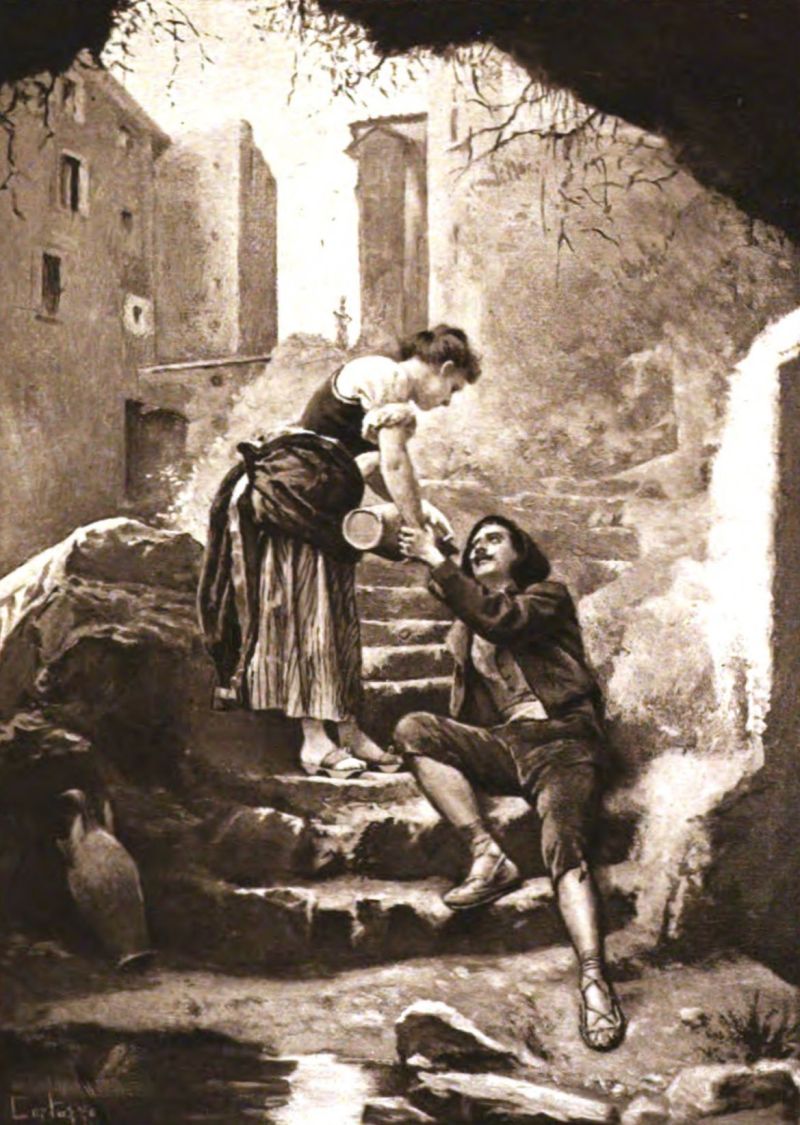
MILA SURPRISED AT THE FOUNTAIN.
She handed him her jug, from which he drank without haste; for, meanwhile, he held the girl's lovely bare arm in his hand and gazed upon its beautiful shape, pressing it at the same time to force her to tip the jug gradually, as he quenched his real or pretended thirst.
The Piccinino closed his hood to conceal the sensuous gratification afforded him by that artless confession from the loveliest lips in the world.
"Very well," he replied, "follow your instinct. Obey only the promptings of your heart; let me tell you, moreover, that your uncle at Bel Passo brought me up as his son, that your dear Princess Agatha has placed her fortune and her honor in my hands, and that, if she were not a woman, that is to say a bit of a prude, she would have made this most essential appointment with Abbé Ninfo."
"But I am a woman too," said Mila, "and I am afraid. Why is this appointment so essential?"
"Don't you know that I am to kidnap Abbé Ninfo? How can I seize him in the streets of Catania, or at the gates of Villa Ficarazzi? Must I not lure him out of his den, and lead him into a trap? His evil fate ordained that he should fall insanely in love with you."
"Oh! don't use the word love in connection with such a man; it makes me shudder. And you want me to make a pretence of encouraging him! I shall die of shame and disgust."
"Farewell, Mila," said the bandit, pretending to rise. "I see that you are a woman like other women, after all, a weak, vain creature, who thinks only of saving herself, utterly heedless of the calumnies and blows that may fall upon the heads which should be most sacred to her!"
"No, no, I am not like that!" she replied proudly. "I will sacrifice my life in this experiment; as for my honor, I shall find a way to die before it is stained."
"Good, good, my brave girl! Now you are talking as Fra Angelo's niece should talk. You see that I am perfectly undisturbed on your account, however, because I know that you are in no danger."
"But are not you in danger, my lord? If you fall, who will protect me against this monk?"
"A dagger thrust—not in your beautiful bosom, my poor angel, as you threaten, but in the throat of a vile beast, who is not worthy to die by a woman's hand, and who will never expose himself to that risk."
"Where must I agree to meet him?"
"At Nicolosi, at the house of Carmelo Tomabene, farmer, who, you will tell him, is your friend and kinsman. You will add that he is absent, that you have the keys of his house, and that there is a large sheltered garden which he can enter, unseen by anyone, by going down through the ravine of the Destatore's Cross. Can you remember all that?"
"Perfectly; and will he go?"
"He will go without any doubt, and without a suspicion that this Carmelo Tomabene is on very intimate terms with a certain Piccinino, who is said to be a leader of bandits, and to whom, only yesterday, he offered a princely fortune on condition that he would kidnap your brother and at need murder him."
"Blessed Madonna, protect me! The Piccinino! I have heard of him; he is a terrible man. Will he be there with you? I should die of fright if I saw him!"
"And yet," said the bandit, overjoyed to find that Mila knew so little of what was going on, "I will wager that, like all the girls in the neighborhood, you are dying with the longing to see him."
"I should rather like to see him, because they say he is so ugly! But I should want to be sure that he did not see me!"
"Never fear; there will be nobody but myself at the farmer's house in Nicolosi. Tell me, are you afraid of me too, child that you are? Have I a very dreadful, very wicked look?"
"No, indeed you have not! But why must I keep the appointment? Won't it be enough if I send the abbé—I mean the monk?"
"He is suspicious, like all criminals; he will never go into Carmelo Tomabene's garden unless he sees you walking there all alone. By going there an hour in advance of the time fixed, you run no risk of meeting him on the road; at all events, go by the Bel Passo road, which you probably know better than the other. Have you ever been to Nicolosi?"
"Never, my lord; is it a very long way?"
"Too far for your little feet, Mila; but you can cling to a mule's back, can't you?"
"Oh! yes, I think so."
"You will find a perfectly safe, gentle beast behind Villa Palmarosa. A child will bring it to you, with a white rose for countersign. Drop the reins on the trusty creature's neck, and have no fear, but let him go as fast as he will. In less than an hour he will bring you to my gate, without once missing the way or taking a false step, however horrible the road he selects may seem to you. You won't be afraid, Mila?"
"And suppose I should meet the abbé?"
"Lash your beast, and don't be afraid that anyone will overtake you."
"But if I am to go by way of Bel Passo, you will surely allow my uncle to escort me?"
"No, your uncle has business elsewhere for the same good cause; but, if you notify him, he will insist upon accompanying you. If he sees you, he will follow you, and our whole undertaking will have come to naught. I have no time to tell you more. I think that I hear some one calling you. You hesitate; does that mean that you refuse?"
"I am not hesitating; I will go! My lord, do you believe in God?"
This abrupt and ingenuous question made the Piccinino turn pale and smile at the same time.
"Why do you ask me that?" he said, pulling his hood over his face.
"Ah! you know why?" said she. "God hears and sees everything. He punishes falsehood and assists innocence!"
Again they heard Pier-Angelo's voice, calling his daughter.
"Go," said the Piccinino, supporting her with his hands, to assist her to mount the staircase quickly; "remember, if a single word escapes you, we are lost."
"You too?"
"I too!"
"That would be a pity," thought Mila, turning at the top of the staircase to cast a last glance at the comely stranger, of whom it was impossible not to make a hero and a friend of the first order, and whom, in her joyous imagination, she placed beside Agatha. He had such a soft voice and such a sweet smile! His tone was so noble, his authoritative air so convincing! "I will be brave and discreet," she said. "I am only a little girl, and yet I am the one who is to save everybody's life!" In all times, alas! the sparrow has yielded to the fascination of the vulture.
In all this the Piccinino gave way to an inborn passion for increasing the difficulties of an adventure to his profit, or simply for amusement. To be sure, he had no better way of enticing Abbé Ninfo to his house than by offering a bait to his lust. But he might well have chosen some other woman than the innocent Mila to play, with the aid of some slight resemblance or of a similar costume, the part of the person who was to appear in his garden. The abbé was sometimes insultingly suspicious, because he was a horrible coward; but, blinded by ridiculous presumption, and impelled by lecherous impatience, he would have fallen into the trap. A little violence, a man stationed behind the gate, would have sufficed to place him in the bandit's hands. There were many other ruses to which the Piccinino was accustomed to resort, and which might have succeeded as well; for the abbé, with all his scheming, his inquisitiveness, his incessant espionage, his impudent falsehoods and his shameless persistence, was a villain of the lowest order, and the stupidest and least adroit man on earth. People are too much afraid of knaves as a general rule; they do not know that the majority of them are fools. Abbé Ninfo would not have had to take half the trouble to do twice the harm, if he had had ever so little intelligence and real penetration.
For instance, we have seen that he was always beside the truth in his discoveries. He had assumed innumerable disguises and invented a thousand time-worn methods of watching what was taking place at Villa Palmarosa; and he was thoroughly persuaded that Michel was the princess's lover. He was a hundred leagues from suspecting the nature of the tie between them. He might easily have deceived Doctor Recuperati, whose unswerving uprightness lacked foresight and intelligence; and yet, desiring to steal the will from him, he had delayed from day to day, and had never succeeded in gaining his confidence in the slightest degree. It was impossible for him to play for five minutes the rôle of a well-meaning man, his face bore so unmistakably the stamp of unalloyed and unbounded baseness.
His vices embarrassed him, as he himself admitted, even proclaimed, when he was intoxicated. Dissolute, avaricious, and so intemperate that he fuddled his brain when lucidity was most essential to him, he had conducted a difficult intrigue to a successful end. The cardinal had for a long time made use of him as a police agent for whom no task was too vile, and he had never valued him except as a tool of the lowest order. In his days of cynical wit, the prelate had branded him with an epithet which we shall not attempt to translate, and from which he had never been able to rise.
Thus he had had no share in the family affairs and secrets of State which had filled the life of Monsignor Hieronymo. The contempt which he inspired in his master had survived his loss of memory, and the aged prelate, paralyzed and almost in his dotage, was not even afraid of him, and recovered the power of speech with him only to call him by the degrading sobriquet which he had previously bestowed on him.
Another proof of the abbé's idiocy was his cherished conviction that he could seduce all the women who aroused his desires.
"With a little money and a lot of lies," he would say, "with threats, compliments and promises, a man can obtain the proudest or the humblest of them."
Consequently he flattered himself that he could obtain a share of Agatha's fortune by effecting the removal of the man whom he presumed to be her lover. He was capable of but one thing, of placing Michel at the muzzle of a bandit's gun, and shouting fire! in a moment of disappointed vanity and greed; he would not have dared to kill him himself, just as he would not have dared to do violence to Mila, if she had threatened him with nothing more than a pair of scissors.
But, abject wretch that he was, he had a certain power for evil; it did not spring from him, the villainy of other men had invested him with it. The Neapolitan police lent him its dastardly and odious assistance when he requested it. He had caused many innocent victims to be exiled, ruined, or cast into dungeons, and he might very well have seized Michel without having recourse to the brigands of the mountain. But he wished to be able to surrender him, at need, for a heavy ransom, and he wished to have the terms of ransom discussed by avowed brigands, whose interest it would be not to betray him. His whole rôle consisted in seeking out the bravi and saying to them: "I have discovered a love intrigue which is worth something. Do the job, and we will divide the profits."
But herein again he had been gulled. A shrewd bravo, who worked in the city under the Piccinino's direction, and who would not have presumed to do anything without consulting him, had deceived the abbé by inviting him to a rendezvous at which he had not seen the real Piccinino, who was present, however, behind a partition. The Piccinino had thereupon threatened to break the head of the first of the two accomplices who should say a word or take a step without orders from him, and they knew that he was a man to keep his word. Indeed, the young adventurer governed his band with such extraordinary skill, with a mixture of gentleness and despotism so well blended, that his father had not been so loved and dreaded as he was, although, to be sure, he had acted upon a larger scale and his enterprises had been more extensive. He could be perfectly at ease, therefore; his secrets would not have been revealed under torture, and he was able to gratify the caprice which he frequently had, of carrying out entirely alone, without a confidant and without assistance, an undertaking in which he had no need of using main force, but only of craft and strategy.
That is why the Piccinino, sure of the success of his plan, which was of the simplest, chose to blend with it, on his own account, poetic, strange, and romantic incidents, or real passions, according to his whim. His vivid imagination and his cold nature involved him constantly in contradictory enterprises, from which he was always able to extricate himself, thanks to his great intelligence and his self-control. He had always sailed his craft so skilfully that, outside of his accomplices and the very small number of his intimate friends, no one could have proved that the famous captain, Piccinino, natural son of the Destatore, and the placid villager Carmelo Tomabene were one and the same man. The latter also was supposed to be a son of Castro-Reale; but there were so many others in the mountains who prided themselves upon that perilous origin!
XXXV THE COAT OF ARMS
Thus the one really formidable enemy of the Lavoratori family, had he chosen to assume that character, was the Piccinino; but Mila had no suspicion of it, and Fra Angelo relied upon that element of heroism which formed, if we may so express it, half of his ward's character. The worthy monk was not free from anxiety, none the less; he had hoped that he would soon see him again, and have an opportunity to make sure of his disposition in the matter: but he had waited and sought in vain. He was beginning to wonder if he had not turned the wolf into the sheepfold, and if it were not a great mistake to act in concert with men who were capable of doing what one would not be willing to do oneself.
He went to Villa Palmarosa at the usual hour for the daily siesta, and found Agatha preparing to enjoy the delights of that moment of repose so essential to Southern peoples.
"Set your mind at rest, my dear padre," she said, "my anxiety vanished with the daylight. At dawn I was so far from confident concerning your ward's purposes, that I went myself to make sure that he had not murdered Michel during the night. But the child was sleeping quietly and the Piccinino had already gone."
"You went yourself to investigate, signora? What will the people in the suburb say of such a proceeding?"
"They will never know anything about it, I trust. I was alone and on foot, entirely covered by an old-fashioned mazzaro[10] and, if I met any persons who know me, they certainly did not recognize me. However, my good padre, I no longer have any serious fears. The abbé knows nothing."
"You are sure of it?"
"I am perfectly sure, and the cardinal is as incapable of remembering anything whatsoever, as the doctor represented him to be. Nevertheless, the abbé has evil projects on hand. Would you believe that he supposes Michel to be my lover?"
"And the Piccinino believed it?" said the monk, in dismay.
"He believes it no longer," replied Agatha. "I received a note from him this morning in which he gives me his word that I can be perfectly at ease; that the abbé will be in his power in the course of the day, and that until then he will find a way to keep him so busy that we shall hear nothing from him. So I breathe freely, and have only one subject of anxiety; that is, to know how I am to escape the intimacy of Captain Piccinino hereafter, for he threatens to become too attentive. But we will talk of that later; sufficient unto the day is the evil thereof; and if, after all, it should become necessary for me to tell him the truth—You do not think him the man to abuse it, do you?"
"I know that he is the man to pretend that he proposes to take advantage of and abuse every opportunity; but have the courage to treat him always as a paragon of sincerity and generosity, and you will see that he will try to live up to the character, and will do it, in spite of the devil."
The princess and the Capuchin talked together for a long while, and mutually informed each other of all that they knew. After which, Fra Angelo went down to Catania to cancel Magnani's orders, to make another appointment with him to meet Agatha, and to take his place as escort to Michel and his father to the Marquis della Serra's palace; for, in spite of everything, Fra Angelo did not like the idea of their being alone in the country, so long as he himself had not seen the Destatore's son.
We will follow these three members of the Lavoratori family to the marquis's villa, leaving Mila in anxious expectation of the monk's visit, while Magnani, working on the gallery opposite her room, was far from suspecting that, after asking his assistance, she was watching for an opportunity to steal out of sight. She had promised her father to go and dine with her friend Nenna, as soon as she had washed and ironed a veil which she said that she must have to wear. Everything happened as her unknown friend had predicted. She saw the monk at the fountain, and had no need to feign a most intense fear of being taken by surprise, for she asked herself in dire distress what Magnani would think of her if, after what she had told him, he should see her voluntarily talking with that miserable wretch.
To avoid the necessity of speaking to him and looking at his disgusting face, she tossed him a written paper which he read with the utmost delight; then he went away, throwing her kisses which made her quiver with disgust and indignation.
At that moment her father, brother, and uncle, having no shadow of suspicion of the perils to which the poor child was about to expose herself for them, entered the Della Serra palace. That sumptuous dwelling, more modern than that of Palmarosa, from which it was separated only by their respective great parks and a narrow valley covered with gardens and grass, was filled with artistic objects, statues, urns, and magnificent paintings, which the marquis had collected with the enthusiasm of an earnest and enlightened connoisseur. He came forward in person to meet the Angelos, shook hands with them cordially, and, pending the dinner-hour, took them all over his noble residence, showing to them and explaining courteously, and with no less wit than good sense, the masterpieces of art with which it was embellished. Pier-Angelo, although a simple decorator, had excellent taste, and a due appreciation of the beautiful in art. He was peculiarly susceptible to the charm of all those marvellous things with which he was already familiar, and his artless yet profound reflections enlivened the most serious conversation instead of lowering its tone. Michel was a little embarrassed at first in the marquis's presence; but as he soon discovered that his father's natural and unconstrained manner seemed to a man of sense like the marquis in unexceptionable taste and most becoming, he felt more at ease; and finally, when he found himself sitting at a table laden with silver plate, decorated as handsomely and with as great an abundance of flowers as for the entertainment of the most illustrious guests, he forgot his prejudices, and talked as freely and interestingly as if he had been the marquis's own son or nephew.
A single thing disturbed him strangely during the dinner: the expression and attitude which he attributed to the marquis's servants; I say which he attributed, because he dared not look at them. He had dined many a time at the tables of the rich when he was in Rome, especially after his father returned to Catania, and he no longer had a family to keep him at home and prevent his seeking the society of the fashionable youth of the city. So that he did not fear any affront for himself; but, as it was the first time that he and his father had been invited to dine abroad with a patrician, he suffered torments at the idea that the lackeys might shrug their shoulders and pass the dishes rudely to the excellent old man.
In truth those lackeys might well have had a feeling of anger and contempt, having seen Pier-Angelo on his ladder so many times in that same palace, and treated him as their equal.
Nevertheless, whether because the marquis had prepared them by a word or two of kindly and straightforward explanation calculated to flatter and soothe the sensitive self-love of men of that class, or because Pier-Angelo was so great a favorite with all who knew him that even footmen laid aside their customary pride in his favor, they served him with much deference. Michel observed it at last, when his father, turning to an old servant who was filling his glass, said to him with a smile:
"Many thanks, old fellow; you wait on me like a friend. I'll do as much for you when I have the chance."
Michel flushed and glanced at the marquis, who smiled with a touched and gratified air. The old servant also smiled at Pier-Angelo with a friendly glance.
After the dessert was removed, the marquis was informed that Master Barbagallo, the princess's majordomo, was waiting in one of the rooms of the palace to show him a picture. They found him in conference with Fra Angelo, whose sobriety and restless activity made him impatient of a long sitting at table, and who had asked leave to walk about the grounds immediately after the first course.
At first, the marquis went alone to Barbagallo, to ask if he had any private message for him from the princess; and when they had exchanged in an undertone a few words which seemed to be of no importance, to judge by their faces, the marquis returned to Michel and said, putting his arm through his:
"Perhaps it will afford you some pleasure to see my family portraits, which are in a separate gallery, and which I had forgotten to show you. Don't be alarmed at the multitude of ancestors assembled under my roof. You can look them over at a glance, and I will call your attention particularly only to those which are the work of some great master. However, it is an interesting collection of costumes, which a historical painter might consult with advantage. But, before going in, let us cast a glance at this one which Master Barbagallo has brought to us, having just disinterred it in the lofts of Villa Palmarosa.—My dear child," he added, in a low voice, "pray bestow a greeting on the poor majordomo, who is outdoing himself in reverences, being ashamed, doubtless, of his behavior to you at the princess's ball."
Michel at last noticed the majordomo's advances, and replied to them without resentment. Since he had become reconciled to his position and to himself, he felt that he was cured of his over-sensitiveness, and believed, with his father, that no impertinence can reach the man who possesses his own esteem.
"This which I present to your excellency," said the majordomo to the marquis, "is a very much dilapidated Palmarosa; but, although the inscription had almost disappeared, I have succeeded in deciphering it, and here it is on a bit of paper."
"What!" said the marquis, with a smile, "you succeeded in reading that this swashbuckler was a captain in the reign of King Manfred, and that he accompanied John of Procida to Constantinople? That is wonderful. For myself, I read the original inscription with the eyes of faith!"
"You can be perfectly sure that I am not mistaken," replied Barbagallo. "I knew this gallant captain well, and I have been trying for a long time to find his portrait."
Pier-Angelo roared with laughter.
"Ah! so you lived in those days!" he said; "I knew that you were older than I am, Master Barbagallo, but I didn't suppose that you saw our Sicilian Vespers!"
"Would that I had not seen it!" exclaimed Fra Angelo, with a sigh.
"I must explain Master Barbagallo's learning, and the interest he takes in my family gallery," said the marquis to Michel. "He has passed his life in this labor of patience, and no one is so familiar as he with Sicilian genealogies. My family was connected by marriage in the past with the Princess of Palmarosa's, and even more closely with the family of Castro-Reale, of which you have doubtless heard."
"I heard a great deal about it yesterday," replied Michel, with a smile.
"Very good; when I became the last heir of that family, after the death of the famous prince known as the Destatore, all that came to me by that succession—to which I gave very little thought, I promise you—was a collection of ancestors which I did not even care to unpack, but which Master Barbagallo, being enamored of curios of that sort, took pains to clean and classify, and to hang in their proper order in the gallery you are about to inspect. There were already in that gallery, in addition to my own direct ancestors, a goodly number of ancestors of the Palmarosa line, and Princess Agatha, who cares nothing for collections of the sort, sent me hers, saying that it would be better to collect them in a single place. That gave Master Barbagallo a very long and difficult task, which he executed with honor to himself. Come, all of you, for I have many characters to present to Michel, and it may be that he will need his father's and uncle's assistance to hold his own against so many dead men."
"I retire, in order not to impose my presence upon your lordships," said Master Barbagallo, after accompanying them to the gallery to deposit his Sicilian captain; "I will return some other time to put my picture in place; unless the signor marquis desires that I should give Master Michelangelo Lavoratori, whose very humble servant I am to-day and always, the history of the originals of these portraits."