Volume 1 — Introductory material (continued 4)
George Burnham Ives translation
"A single other fact will serve to exhibit Prince Dionigi's disposition. About fifteen or sixteen years ago, I think—it is all very vague in my boyish memories,—a young mountaineer in his service, being maddened beyond endurance by the harshness of his language, ventured, they say, to shrug his shoulders as he held the stirrup for the prince to dismount from his horse. He was a worthy, honest fellow, but proud and of violent temper. The prince struck him a vicious blow. Thereafter they hated each other intensely, and the groom—his name was Ercolano—left the Palmarosa palace, saying that he knew the great secret of the family and that he would soon have his revenge. What was that secret? He had no time to reveal it, and no one ever knew what he had to reveal; for they found Ercolano the next morning on the seashore, murdered, with a dagger bearing the Palmarosa arms in his breast. His relations dared not demand justice, they were poor!"
Magnani had reached this point when the white figure they had seen wandering about the terrace crossed the flower-garden once more and went inside. Michel shuddered from head to foot.
"I don't know why your story has such an effect upon me," he said. "I seem to feel the cold blade of that dagger in my breast. That woman terrifies me. A strange superstition is creeping into my mind. A person cannot have a murderer's blood in her veins without having either a wicked heart or an unhinged mind. Give me a chance to breathe, Magnani, before you finish your story."
"The painful emotion that you feel, the dark thoughts that come to your mind," rejoined Magnani, "all fell to my lot at sight of Dionigi's portrait; but I passed on and through another door; the staircase leading to the casino was before me, and I found myself in the princess's oratory, where I set down the prie-Dieu and looked about me. No one there! I had no excuse for going farther; the mistress of that depressing mansion had evidently gone out. So I must needs retire without seeing her, lose the benefit of my audacity, and perhaps never again have the courage or the opportunity.
"It occurred to me to make a noise to attract her attention, in case she were in the adjoining room; for I was certainly in her apartments, I could not doubt it. I took my hammer and struck the gilt nails of the prie-Dieu, as if I were putting the finishing touch to it.
"My stratagem succeeded.—'Who is there? who is making such a noise?' said a faint voice, with a pure and distinct enunciation which left no doubt in my mind of the identity of that voice with that of the mysterious visitor whose accents had not ceased to echo in my heart like an ineffably sweet melody.
"I walked toward a velvet portière and raised it with the determination born of a last hope. I saw a woman reclining on a couch, in a bedroom sumptuously furnished in antique style: it was the princess; I had roused her from her siesta.
"My appearance terrified her beyond words; she leaped into the middle of the room as if she would fly. Her lovely face, whose gentle and somewhat languid serenity I had been able to contemplate with admiration for a second, was distorted by childish, incredible terror.
"I hastened to retrace the steps I had taken.—'I beg your excellency not to be frightened,' I said: 'I am only a poor upholsterer's apprentice, an awkward lout, ashamed of my mistake. I thought that your highness was out, and I was working here——'
"'Go away!' she exclaimed, 'go away!'
"And with a gesture in which there was more bewilderment and dismay than sternness and anger, she pointed to the door.
"I attempted to go, but I seemed to be rooted to the floor as in a dream. Suddenly I saw the princess, who had risen with extraordinary vehemence, turn as pale as a lovely lily; her breathing ceased; her head fell back; her arms dropped at her sides. She would have fallen to the floor had I not rushed to her and caught her in my arms.
"She had lost consciousness. I placed her on her couch, I was so bewildered that it did not occur to me to call for help. Indeed what would have been the use of ringing? Everybody was asleep or attending to his special duty in that house, where silence and solitude alone seemed to be absolute masters. May God forgive me! Twenty times since then I have been tempted to enter her service as a footman!
"Oh! Michel, it would be impossible for me to tell you to-day what took place within me during the two or three minutes that that woman lay stretched out like a dead woman before my eyes, with her lips as white and dry as pure wax, her eyes half-open, but strange and expressionless, her dark hair falling over her brow on which the cold perspiration stood in beads, and all that exquisite, refined beauty, above all comparison in my thought. It was not the intoxicating flame of a gross animal passion that was kindled in my plebeian blood. It was adoration, as pure and timid and refined and mysterious as the being who inspired it. I felt an irresistible longing to prostrate myself at the feet of a dead and gone martyr, for I thought that she was dead, and it seemed as if my soul were ready to leave the earth with hers.
"I dared not touch her; I did not know what to do to restore her. I had no voice with which to call for help. I was motionless in my perplexity, as one is when struggling violently in a horrible dream. At last a phial fell under my hand, I know not how. She recovered consciousness little by little, looked at me without seeing me, not understanding or seeking to understand who I could be. At last she raised herself on her elbow and seemed to be collecting her thoughts.
"'Who are you, my friend?' she said, seeing me on my knees by her side, 'and what do you want? You seem to feel very sorrowful.'
"'Ah! yes, your highness, God is my witness that I am very unhappy to have frightened you so.'
"'You did not frighten me,' she said, with an evident embarrassment which astonished me. 'Did I cry out?—Ah! yes,' she continued, with a shudder, yielding once more to an impulse of distrust or alarm.—'I was asleep; you came in; you frightened me. I do not like to be surprised in that way. But did I say anything unkind to you, that you weep?'
"'No, your highness,' I replied; 'you fainted, and I would rather have died than have caused you this discomfort.'
"'Am I alone here, pray?' she cried in a tone of distress that tore my heart. 'Can anybody who pleases enter my apartments and insult me?'—She rose and ran to her bell-rope. She seemed desperate—beside herself. Her words and her excitement had affected me so painfully that it did not occur to me to fly. And yet, if she had rung—if anyone had come—I should have been treated like a criminal. But she stopped, and the expression of her face told me the truth at once concerning her disposition.
"It was a blending of unhealthy suspicion and sympathetic kindliness. She had been so wretchedly unhappy in her early youth—so everyone said! At all events, she could not have been ignorant of her father's execrable character. She may have witnessed some murder in her childhood. Who knows what scenes of violence and terror have been enacted behind the thick walls of that dumb mansion? It was by no means impossible that she might have acquired therefrom some mental malady of which I had just witnessed an outbreak; and yet what angelic sweetness her glance expressed when she dropped the bell-cord, apparently overcome by my humble attitude and the grief by which I was overwhelmed!
"'You came in here by chance, did you not?' she said. 'You did not know that it is a whim of mine not to like new faces; or, if you did know it, you had the courage to disregard my orders, because you have had some misfortune which I can lighten? I have seen you somewhere; I have a vague remembrance of your features. Your name is——?'
"'Antonio Magnani, your highness. My father works here sometimes.'
"'I know him; he has some little means. Is he sick? Has he run in debt?'
"'No, signora,' I replied, 'I do not ask alms, although you are the only person on earth from whom I could accept alms without blushing. I have long wished to see you; not to beg from you, but to bless you. You saved my mother; you encouraged me. You leaned over her pillow; you restored my hope and her life. That is certain; of course you do not remember it, but I shall never forget it. May God reward you for what you did for us! That is all I wanted to say to your highness; and now I will go away, begging you not to blame anyone, for the fault is entirely mine.'
"'I will not tell anyone that you came into my house in spite of my orders,' she said. 'Your employer and your father would reprove you for it. Nor do you say that you saw me in such a fright. People would say that I am mad, as they say now, I believe, and I do not much like to have people talk about me. As for your thanks, I do not deserve them. You are mistaken; I never did anything for you, my child.'
"'Oh! I am not mistaken, your highness; I should have known you among a thousand. The heart has instincts deeper and truer than the senses. You do not wish your benefactions to be discovered, so I do not speak of them. I do not intend to thank you for paying the doctor; no, you are rich, and it is easy for you to give. But you are not obliged to love and pity those whom you help. And yet you pitied me when you saw me weeping at the door of the house where my mother lay dying, and you loved my mother when you leaned over her bed of pain.'
"'But I tell you again, my child, that I do not know your mother.'
"'That is possible; but you knew that she was sick. You wished to see her, and charity was in your very glance—how ardent at that moment!—since your glance, your voice, your touch, your breath, cured her as by a miracle. My mother was conscious of it; she remembers it; she thinks that it was an angel who appeared to her; she addresses her prayers to you because she thinks that you are in Heaven. But I was sure that I should find you on earth, and should have an opportunity to thank you.'
"Princess Agatha's cold and impassive face relaxed as if involuntarily. It lighted up for an instant with a warm glow of sympathy, and I saw that treasures of kindliness were contending in that suffering heart against a painful misanthropical propensity.—'Well,' she said, with a divine smile, 'I see, at all events, that you are a good son and adore your mother. God grant that I may in truth have brought her good fortune! but I believe that God alone deserves thanks. Thank Him and worship Him, my child; He alone understands and can relieve certain sorrows, for men cannot do much for one another. How old are you?'
"I was twenty at that time. She listened to my reply, and said, looking at me as if she had not yet noticed my features: 'True, you are older than I thought. You can come and work here when you choose. I am accustomed to your face now, and it will not startle me again; but another time do not wake me suddenly by hammering in my ears in that way, for I am always depressed and nervous when I wake. That is my disease!'
"While she was speaking, and while she looked after me as I walked toward the door, her eyes expressed this thought: 'I do not offer you my assistance in life, but I will keep my eye on you, as I do on so many others, and I will find ways to serve you without your knowledge; and I will take measures to avoid having to listen to your thanks again.'
"Yes, Michel, that is what was said by that face, at once angelic and cold, maternal and unfeeling; a terrible enigma, which I have never been able to solve, and which I am less able to solve to-day than ever."
XVII THE CYCLAMEN
Magnani ceased to speak, and it did not occur to Michel to question him. But at last the young painter, coming to himself, asked his friend for the rest of his story.
"My story is at an end," replied Magnani. "Ever since that day I have been admitted to the palace as a workman. I have often seen the princess, but I have never spoken to her."
"How does it happen, then, that you love her? for you do not know her? you do not know her real opinions?"
"I thought that I had guessed them. But, during this last week, when she has seemed inclined to emerge suddenly from her tomb, throw open her house, and take part in social life; especially to-day, when she has been going about and conversing familiarly with people of our station, with kindly words and cordial invitations—for I overheard the conversation that you had with her and the Marquis della Serra on the main staircase; I was close at hand,—I no longer know what to think of her. Yes, even recently I thought that I had fathomed her character. Twice a year, in spring and autumn, I have come here with other workmen, I have seen her pass from time to time, walking slowly, with an absent-minded, melancholy, yet perfectly tranquil air. If she sometimes seemed downcast and distressed, the serenity of her glance was not disturbed. She always bowed to us collectively with greater courtesy than persons of her rank ordinarily show to us. Sometimes she would exchange with the master upholsterer or my father a few pleasant words, equally free from pride and from warmth. She seemed to feel an instinctive respect for their years. I was the only young workman admitted to her house, but she never seemed to pay the slightest attention to me. She did not avoid my glances, but met them without seeing them.
"At certain times, however, I noticed that she saw many more things than she seemed to see; and that people who complained, even when she did not seem to hear them, obtained justice or help at once, without knowing whose was the mysterious hand put forth over them. You see, she conceals her boundless charity as other people conceal their shameful selfishness. And you ask me how it happens that I love her! Her virtue arouses my admiration, and the dumb despair which seems to be crushing her inspires in my heart profound and affectionate compassion. To admire and to pity—is not that to adore? The pagans, who have left so many magnificent ruins on our soil, sacrificed to their gods, all radiant with strength and glory and beauty; but they did not love them; and we Christians have felt the light of faith pass from our minds into our hearts, because God was shown to us in the guise of a bleeding, tear-bedewed Christ. Ah! yes, I do love that woman, who has paled, like a flower of the woods, beneath the terrible shadow of paternal tyranny. I do not know the story of her infancy, but I divine the misery of her girlhood. They say that, when she was fourteen, her father, being unable to force her to marry in accordance with the views dictated by his pride and ambition, to which he proposed to sacrifice her, confined her for a long time in a secluded room of yonder palace, and that she suffered there from hunger, thirst, heat, neglect, and despair. Nothing definite has ever been known about it. Another version of the story also gained currency; it was said that she was in a convent; but the terror-stricken air of her servants said plainly enough that her disappearance was a part of some unjust and unnatural punishment.
"When Dionigi died, his heiress reappeared in the palace, with an old aunt who was little better than he, but who allowed her to breathe a little more freely. They say that at that time again she had several brilliant offers of marriage, but that she obstinately refused, thereby much angering the princess, her aunt. Her death put an end at last to her niece's persecutions, and at the age of twenty she found herself alone and free in the house of her fathers. But it was evidently too late for her to rouse from the state of prostration to which so much sorrow had brought her. She had lost the strength and the desire to be happy. She was torpid, a little inclined to be morose, and seemingly incapable of inviting the affection of others. She gained the affection, however, of some persons of her own rank, and it is certain that the Marquis della Serra, whom she refused to marry when he entered the lists several years ago, has never ceased to love her ardently. Everybody says so, and I know it; I will tell you how.
"Although I pride myself, without undue boasting, on being a good workman, I confess that when I am in the palace, I am, in spite of myself, the slowest of the slow. I am excited and perturbed. The ring of the hammers irritates my nerves, as if I were a silly girl; I am overcome by the heat at the slightest exertion with my arms. Every moment of the time I either have a feeling that I am going to faint, or am tempted to creep into dark corners, crouch there out of sight, and allow myself to be left behind. I surprise myself listening, prowling, spying. I no longer dare to go into the princess's oratory or her bedroom alone. Oh! no; although I know the road perfectly well. My respect is stronger now than my insane and restless passion! But if I can breathe the perfume that escapes through the chinks of the door of her boudoir; if I can hear, even at a distance, the sound of her light footsteps, which I know so well—then I am content, I am drunk with joy.
"Thus I have heard, I dare not say involuntarily—for if chance placed me within earshot, my will was not strong enough to prevent me from listening,—more than one interview between the princess and the marquis. How often have I been consumed by frantic jealousy? but I have acquired certain knowledge that he is only her friend, a loyal, respectful, submissive friend.
"One day, among others, they had a conversation, every word of which, I believe, is engraved with fatal distinctness on my memory.
"The princess was saying when I entered the adjoining room:
"'Oh! why question me so persistently? You know, my friend, that I am absurdly impressionable; that the thought of the past freezes my blood, and that, if I could make up my mind to speak of it—I believe, yes, I believe that I should go mad!'
"'Very well, very well,' he cried, 'let us not speak of it, let us be content with our tranquil friendship. Look at that lovely sky and those sweet cyclamens, which seem to smile in your hands.'
"'These flowers do not smile,' she replied, 'you do not understand their language, and I can tell you why I love them. It is because they are in my eyes the emblem of my life and the image of my heart. See how curiously limp they are; they are pure and fresh and fragrant; but is there not something unhealthy and decrepit in the inversion and unnatural upturning of their petals?'
"'It is true,' said the marquis, 'they have a sort of dishevelled look; they grow as a general rule on windswept peaks. One would say that they were trying to fly away from their stalks as if there were nothing to hold them, and that nature had provided them with wings like butterflies.'
"'And yet they do not fly away,' continued the princess; 'they are firmly attached to their stalks. Although apparently fragile, there are no hardier plants, and the most violent winds never strip them of their petals. While the rose succumbs to a hot day, and strews the burning earth with its leaves, the cyclamen is obstinate, and lives many days and nights in retirement, and, as it were, shrunken into itself: it is a flower that has no youth. You probably have never seen it just as it is opening. I have patiently watched that mysterious process; when the bud opens, the petals are rolled tightly together and separate with an effort. The first one that frees itself stretches out like a bird's wing, then throws itself backward and resumes its twisted position. Another follows, and the flower, almost before it is open, is already tremulous and wrinkled, as if it were about to die of old age. That is its way of living, and it lives a long while so. Ah! it is a melancholy flower, and that is why I carry it everywhere.'
"'No, no, it does not resemble you,' said the marquis, 'for its uncovered breast exhales its fragrance freely to all the winds of heaven, whereas your heart is mysteriously closed, even to the most discreet and least exacting affection!'
"They were interrupted; but I knew enough. Ever since that day, I too have loved the cyclamen, and I always cultivate it in my little garden; but I dare not pluck the flowers and smell them. Their odor makes me ill and drives me mad!"
"It is the same with me," said Michel. "Yes, it is a dangerous odor! But I no longer hear the carriages, Magnani. Doubtless the palace will soon be closed. I must go and join my father, for he must be tired out, whatever he may say, and he may need my help."
They walked in the direction of the ball-room. It was deserted; Visconti and his fellow-servants were extinguishing the candles which were still carrying on the struggle against the daylight.
"Why this fête after all?" said Magnani, as he glanced about that immense hall, whose height seemed to be doubled by the darkness overhead, while the bluish rays of dawn crept sadly into the lower portions through the open doors. "The princess might have helped the poor in other ways, and I cannot yet understand why she submitted to make this public demonstration of charity when she had always done good so mysteriously hitherto. What miraculous change has taken place in our reserved benefactress's existence? Instead of rejoicing at it, I, although I would give my life for her, am hurt by it, and cannot think of it without bitterness. I loved her as she was; I cannot understand her when she is cured, consoled, and effusive. Is everybody to know her and to love her now? People will no longer say that she is mad, that she once committed a crime, that she is concealing a horrible secret, that she is ransoming her soul by pious works, although she detests mankind! Madman that I am! I am afraid of being cured myself, and I am jealous of the happiness that she may have recovered! Tell me, Michel, do you suppose that she has made up her mind to love the Marquis della Serra, and that she will invite the court, the city, and the country, to celebrate her betrothal magnificently under her own roof? She gave a royal fête to-day; perhaps she will give a popular fête to-morrow. She is making her peace with everybody; great and small will make merry at her wedding! Ah! there will be dancing there! what fun for us, eh? and how kind the princess is!"
Michel remarked his companion's bitterness and irony; but although he was conscious of a thrill of strange emotion at the idea of Agatha's marriage to the marquis, he put all the more restraint upon himself. He, too, had been struck to the heart, but the shock was too recent for him to dare, or to deign, to give the name of love to his feeling. Magnani's madness served as a warning to him. He pitied him, but there seemed to him to be in that young man's abnormal position something humiliating to which he did not choose to subject himself.
"Come to your senses, my friend," he said. "Such a beautiful fête, at night, has a tendency to excite one, especially when one is only a spectator. But here comes the sun above the horizon, and it should dispel all phantoms and all visions. I feel as if I had just waked from a fantastic dream. Listen! The birds are singing outside; there is nothing here but dust and smoke. I am very sure that your madness is not so absorbing every hour of your life as you fancy at this moment of excitement and unreserve. I will wager that when you have slept two hours you will return to your work feeling like a different man. For my part, I already feel the salutary effect of real life, and I promise you that the next time we see the spectre pass close to us, I will not try to dispute her glance with you."
"Her glance!" cried Magnani, bitterly, "her glance! Ah! you remind me of the glance she bestowed upon you, before the ball opened, the first time she saw your face. My God! what an expression! If it had fallen upon me, just once in my life, I would have killed myself instantly, in order not to live any more upon certainty and cold reason, after such an illusion, such delirious joy. And you, Michel, felt the consuming fire that she communicated to you. You were scorched by it for an instant, and, but for my mockery, you would still gloat over it with rapture. But what does it matter to me now? I see clearly that she has lost her mind; that she has deprived her solitary sorrow of its sanctity; that she loves someone, you or the marquis—what matter which? Why this special display of friendship for your father, whom she hardly knew a year ago? My father has worked for her ever since she was born, and she barely knows his name. Does she propose to cap the climax of her eccentric life by an act of downright insanity? Does she propose to atone for her father's tyranny and unpopularity by marrying a child of the people—a mere boy?"
"You are the one who is mad," said Michel, disturbed and almost angry. "Go and get a breath of fresh air, Magnani, and don't involve me in the vagaries that your excitement suggests to you. Signora Agatha is sleeping peacefully at this moment, remembering neither your name nor mine. If she honored me with a kindly glance, it was because she loves painting and is pleased with my work.—Look, my friend," added the young artist, pointing to the figures of his fresco, upon which a rosy beam of the morning sun shone through the open windows. "There are the only intoxicating realities of my life. Let the lovely princess marry the Marquis della Serra. I shall be very glad; he is a courteous gentleman, and I like his face. I, when I choose, will paint a more perfect and less problematical divinity than the pale-cheeked Agatha."
"You, wretched boy? Never!" exclaimed Magnani, indignantly.
"I agree that she is beautiful," rejoined Michel, with a smile. "I have scrutinized her, and I have profited by that scrutiny. I have obtained from her all that I should never ask her for, the spectacle of her grace and her charms, to reproduce them and idealize them at my pleasure."
"I have always been told that artists had hearts of ice," said Magnani, staring at Michel in blank amazement. "You have seen the storm which drives me wild, and you remain cold—you laugh at me! Ah! I blush to think that I have betrayed my madness to you, and I am going away to hide my head!"
Magnani disappeared, frantic with excitement, and Michel was left alone in the almost deserted ball-room. Visconti was extinguishing the last candles, and Pier-Angelo, before taking his leave, was assisting to restore order temporarily in that structure which was to be entirely removed before evening.
Michel also assisted, but languidly. His own reflections having cooled his excitement, he felt utterly exhausted, mentally and physically.
Magnani's abrupt outbreak disturbed him. He reproached himself because, after undergoing in silence the rebound of the young mechanic's agitation, he had not succeeded better in sympathizing with his trouble, but had allowed him to go away uncomforted. On the other hand, he could not avoid a slight feeling of irritation. It seemed to him that Magnani had carried his effusiveness too far in seeking to convince him that he, Michel, was the object of a sudden passion on the part of the princess. It was so absurd, so improbable, that Michel, who was more self-possessed, more of a man of the world at eighteen than Magnani could ever be, shrugged his shoulders pityingly.
And yet, self-esteem is such a persistent and impertinent adviser that Michel now and again heard a voice within him saying: "Magnani has guessed aright. Jealousy gives him a keenness of vision which you yourself have not. Agatha loves you; she took fire at first sight. And why should she not love you?"
Michel was intoxicated and abashed at once by these flushes of vanity which rose to his cheeks. He was in haste to return home and recover his tranquillity altogether with sleep. And yet he desired to wait for his father, who was still at work, zealous and indefatigable, attending to a thousand minute details, a thousand apparently unnecessary precautions.
"Patience!" said the excellent Pier-Angelo. "I shall have finished in a minute; but I want our dear princess to be able to sleep in peace, and I don't propose that anybody shall come here and make a racket before to-night. Above all things, I don't propose to leave a single candle lighted in any corner. Now is the time when there is most danger of fire! Look! that idiot of a Visconti has left the lamp in the grotto burning; I can see it from here. Go and put it out, Michel, and take care not to spill oil on the couch."
Michel went into the grotto of the naiad; but, before extinguishing the lamp, he could not resist the temptation to gaze for a moment at the beautiful statue, the lovely foliage with which he had decorated it, and the couch whereon he had seen Agatha as in a dream. "How young she looked and how lovely she was!" he thought; "and how that man who loves her gazed at her, with an adoration which betrayed itself in spite of him, and which infected the most immaterial portion of my heart! I noticed others during the ball who stared at her with an insolence born of desire, which made my whole being quiver with indignation! All these great nobles love her, each in his own way, and she loves no one of them!"
And Agatha's glance passed through his memory like a lightning-flash, its dazzling brilliancy putting to flight all reason, all fear of ridicule, all self-distrust.
While musing thus, he had extinguished the lamp, and had sunk upon the cushions of the divan, expecting that his father would call him and that he might enjoy one last moment of comfort before leaving that fascinating grotto.
But fatigue overpowered him. He could contend no longer against the chimeras of his imagination. Half-reclining comfortably on the couch, and alone for the first time in twenty-four hours, he rapidly lost consciousness. For one moment he dreamed with his eyes open. The next moment he was sleeping soundly.
XVIII THE MONKS
How many minutes,—or was it seconds only?—passed while Michel was overpowered by that irresistible lassitude, he had no idea. The power of the imagination, when transported into the domain of dreams, travels so fast and surmounts so many obstacles at a single bound, that time is an inadequate measure of it, especially in the first sleep.
Michel had a strange dream. A woman softly entered the grotto, walked to where he sat, leaned over him and gazed at him for a long time; he felt her fragrant breath caress his brow, he fancied that he felt also the fire of her glance fastened passionately upon him. But he could not see her, for it was dark in the grotto, and, moreover, it was impossible for him to raise his heavy eyelids; but it was Agatha; Michel's heart, inflamed by that woman's presence, told him so plainly enough.
At last, as he tried to rouse himself in order to speak to her, she placed her cool, soft lips on his forehead and imprinted a kiss thereon, so long, but so light, that he could not summon the strength to reply to it, overcome as he was by joy, and at the same time by the fear that it was only a dream.
"But it is a dream, alas! it is nothing but a dream," he said to himself, still sleeping; and yet the fear of waking caused him to wake. So it is that, in sleep, the instinctive, frantic desire to prolong the illusion causes it to vanish more quickly.
But what a strange and persistent dream! Michel, with his eyes open, sitting half erect, supported by his trembling arm, saw and heard that woman fly. The curtain at the entrance of the grotto being lowered, he could distinguish only an indistinct figure; he felt the touch of a silk dress; the curtain opened and closed again so quickly that it seemed to him that the phantom passed through without touching it.
He started to follow her; but all his blood rushed back to his heart so violently that he could not stand erect, but was compelled to fall back on the divan, and it was a full minute before he was able to rush to the blue velvet portière that separated him from the ball-room.
He drew it aside with a convulsive gesture and found himself face to face with his father, who said, with a jocose and placid air:
"So it seems that we have been having a nap, eh, my boy? Now, everything is in order; let us go home and see if little Mila is awake."
"Mila?" cried Michel, "is Mila here, father?"
"It may well be that she isn't far away," replied the old man. "I'll bet that she hasn't closed her eyes all night; she was so anxious to come to see the ball! But I forbade her to leave the house before daylight."
"It is daylight now," said Michel, "and Mila is probably here! Tell me, father, did some woman, my sister, perhaps, just come into the grotto?"
"Did you dream it? I saw no one. To be sure, my eyes weren't looking in that direction all the time, and I saw some striped skirts prowling about outside, which meant that some curious creatures had stolen into the garden. Can Mila have come in while my back was turned?"
"Why, this very instant, father, just as you came to the opening, someone went out, a woman; I am certain of it!"
"You are talking at random now, for I saw nothing but my shadow on the curtain. Come, you need a good nap, let us go home. They are just closing the last door. If your sister is here we shall find her."
Michel was about to follow his father; but as he was turning away he saw something glistening in the grotto and was led to cast a last glance inside. Was it a spark that had fallen on the carpet, near the couch? He stooped: it was a piece of jewelry, which he picked up and examined by daylight. It was the gold locket, surrounded with diamonds and bearing the princess's crest, which she had given Mila. He opened it to make sure that it was the same. He recognized a lock of his own hair inside.
"I knew that Mila came into the grotto," he said to his father, as they walked toward the garden; "she gave me a kiss which woke me."
"She evidently must have gone in there," rejoined Pier-Angelo, indifferently; "but I didn't see her."
At that instant Mila emerged from a clump of magnolias, and came forward, laughing and capering, to meet her father, whom she kissed affectionately, as she did Michel.
"It is high time for you to come home and rest," she said; "I came to tell you that your breakfast is waiting. I was so impatient to see you! Are you terribly tired, father, dear?"
"Not at all," the good man replied, "I am used to these things, and a sleepless night is all pleasure when you sup till morning. Your breakfast will go begging, Mila; but your brother here is asleep on his legs. Come, children; let us be off; see, they are closing the garden gates now."
But, instead of continuing to close the gates, the servants suddenly threw them wide open again, and Michel saw a procession of monks file in, monks of divers orders, all carrying wallets and purses; they were the begging brothers of all the mendicant orders, which have numerous establishments in Catania and its neighborhood. They were making their usual round and had come to collect for their respective communities the broken meat left from the fête. Some two score of them passed slowly through the gate; most of them had asses to carry away the avails of their quest. There was something so surprising and comical in their obsequious manner and their solemn bearing when they entered the gardens, escorted by their asses,—strange guests at a ball—that Michel, diverted from his emotion, had much ado to keep from laughing.
But no sooner were they fairly inside the gates than they broke ranks, and, shaking off their consequential, discreet manner, began to run toward the ball-room, each striving to outstrip his neighbors, beating their asses to make them move faster, hurrying, jostling, and freely exhibiting their greed and their jealousy. They overran the ball-room, almost breaking down the fragile doors, and attempted to ascend the main staircase of the peristyle, or to force their way into the kitchens. But the butler and his officers, being prepared for the assault, and knowing their ways, had carefully barricaded all the issues; they brought forth the fragments destined for the monks, and distributed them as impartially as possible. There were dishes of meat, remnants of pastry, pitchers of wine, and even pieces of glass and porcelain which had been broken during the fête, and which the good monks put together with great care and mended most skilfully, for the adornment of their own sideboards, or to sell to collectors. They quarrelled over the booty with little decency, reviled the servants for not giving them all that they were entitled to, for treating one better than another, for failing in respect for the patron saints of their convents. They even threatened them with the infirmities which those saints were supposed to be especially skilful in curing when the afflicted person had acquired their good-will.
"Bah! what a miserable ham you have given me!" cried one. "You are already deaf in one ear; you can depend upon it that before long you will not be able to hear the thunder with the other."
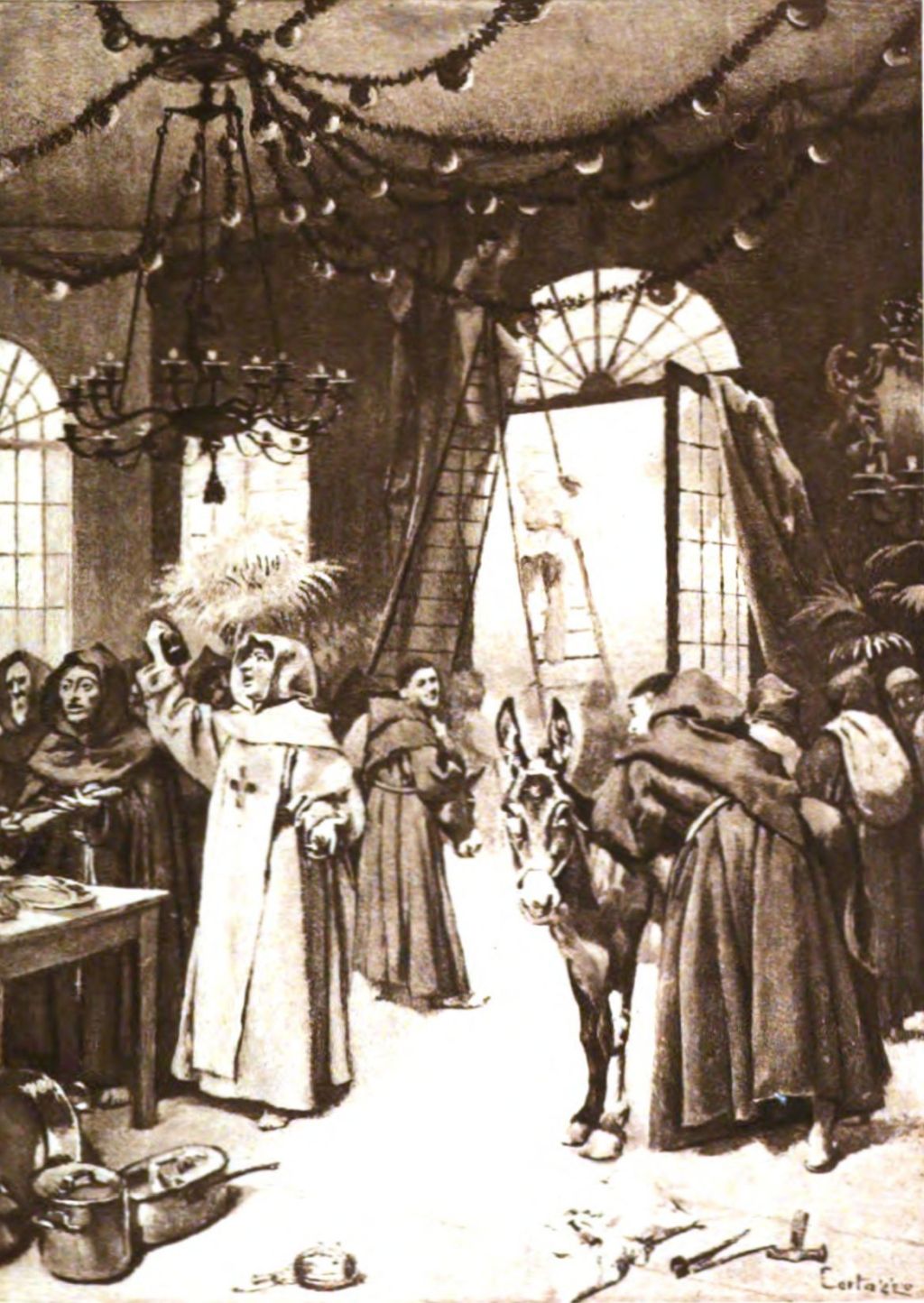
AFTER THE FÊTE.
"Here's a bottle half empty!" cried another. "No prayers will be said for you under our roof, and you'll never be cured of the stone, if you take that terrible disease."
"Here's a bottle half empty!" cried another. "No prayers will be said for you under our roof, and you'll never be cured of the stone, if you take that terrible disease."
Others plied their trade gayly, with jests that made the distributors laugh, and they showed so much wit and good-nature that the servants secretly slipped the best pieces into their wallets.
At Rome Michel had seen dandified Capuchins, redolent with perfume under their frocks, and displaying their sandals, with poetic gravity, in close proximity to the Holy Father's consecrated slipper. The poverty-stricken Sicilian monks seemed to him very indecent, very laughable, and ever so little cynical, when they swooped down upon the crumbs of that feast like a flock of greedy crows and chattering magpies. He was attracted, however, by the high-spirited and intelligent faces of some of them. It was the Sicilian common people again, in the sack-cloth of the cloister—a noble race which bends beneath the yoke but cannot be broken.
The young artist had returned to the ball-room to look on at this curious spectacle, and he watched its various incidents with the attention of a painter who turns everything to his own profit. He noticed especially one of the monks, whose hood was pulled down to the end of his beard, and who did not beg. He kept apart from the others, and walked about the room as if he were more interested in the place where the fête had been given than in the possible benefit he might derive from it. Michel tried several times to see his features, and to judge therefrom whether the intelligent mind of an artist or the regrets of a man of the world were concealed beneath that monkish garb. He saw him stealthily put aside his hood but once, and then he was impressed by his repulsive ugliness. At the same instant the monk turned his eyes upon him with an expression of malevolent curiosity; and instantly looked away as if he feared to be surprised staring at other people.
"I have seen that ugly face somewhere," said Michel to his sister, who was standing by his side.
"Do you call that a face?" replied the girl. "I saw nothing but a goat's beard, the eyes of an owl, and a nose that looked like an old crushed fig. You won't paint his portrait, I hope?"
"You said just now, Mila, that you knew several of these monks from having seen them begging in our suburb; have you ever met that fellow?"
"I don't think so; but, if you are anxious to find out his name, it will be very easy, for here is a brother who will tell me."
And the girl ran to meet a monk who was the last to arrive, without a wallet, and without an ass, but with a little purse simply. He was a tall, handsome man, of uncertain age; his beard was still as black as ebony, although his crown of hair was beginning to turn gray. The keenness of his black eyes, the noble contour of his aquiline nose, and the smile that played about his red lips, indicated robust health, conjoined with an amiable and decided character. He had neither the unhealthy thinness nor the absurd obesity of most of his brethren. His chestnut-colored frock was neat and clean, and he wore it with a majestic air. He won Michel's confidence at the first glance; but it angered the young man to see Mila almost throw her arms about the Capuchin's neck, and take his beard in her two little hands, laughing and pretending that she proposed to kiss him whether he would or not.
"Come, come, little one, softly, softly," said the monk, pushing her away with fatherly gentleness. "No matter if I am your uncle, a monk musn't be kissed."
Thereupon, Michel bethought him of the Capuchin Paolo-Angelo, of whom his father had so often spoken to him, and whom he had never seen. Fra Angelo was Pier-Angelo's brother in affection not less than by birth. He was the youngest of Michel's uncles. His intellect and the dignity of his character made him the pride of the family, and as soon as Pier-Angelo saw him, he ran to Michel to introduce him.
"Brother," said the old decorator, pressing the Capuchin's hand warmly, "give my son your blessing; I should have brought him to your convent to ask it before this if we had not been employed here a little beyond our strength."
"My child," said Fra Angelo to his nephew, "I give you the blessing of a kinsman and a friend; I am happy to see you, and your face pleases me."
"I can say the same," replied Michel, putting his hand in his uncle's.
But, to manifest his affection, the good monk, who had the muscles of an athlete, squeezed his fingers so hard that the young man thought for a moment that the bones were broken. He did not wish to let it appear that that caress was a little too rough; but the perspiration stood out on his forehead, and he said to himself with a smile, that a man of the build of his uncle, the Capuchin, was better adapted to demand alms than to beg.
But, as strength and gentleness almost always go hand in hand, Fra Angelo approached the distributor of alms with a self-restraint and reserve as marked as the eagerness and persistence of his fellows. He saluted him with a smile, opened his purse without deigning to put out his hand, and closed it without looking to see what had been put in it, muttering a very laconic sentence of thanks; after which he returned to his brother and nephew, refusing to burden himself with provisions of any sort.
"In that case," said a very pious footman, "you have not enough money!"
"Do you think so?" rejoined the monk. "I have no idea. However little it may be, the convent must needs be satisfied with it."
"Do you wish me to go and demand more for you, my brother? If you will promise to pray for me every day this week, I will make them give you more."
"Oh! don't take that trouble," replied the dignified Capuchin, with a smile; "I will pray for you gratis, and my prayers will be worth all the more. Your mistress, Princess Agatha, gives enough in charity, and I come to her house only in obedience to my orders."
"Uncle," said little Mila, in an undertone, "there is a brother of your order yonder, whose face puzzles my father and brother. They think that he looks like somebody else."
"Somebody else? Whom do you mean?"
"Look at him," said Pier-Angelo. "Michel is right, he has a bad face. You must know him. He is standing all alone, over there under the musicians' platform."
"So far as his figure and his carriage are concerned, I don't recognize him as any brother of our convent. And yet he wears the frock of a Capuchin. But why does he interest you?"
"Because it seems to us," said Pier, lowering his voice, "that he resembles Abbé Ninfo."
"In that case, off with you," said Fra Angelo, hastily. "I will go and speak to him, and I will soon find out who he is and what he is here for."
"Yes, yes, let us go," said Pier-Angelo. "Go first, children. I will follow you."
Michel put his sister's arm through his, and they were soon on the way to Catania.
"It seems that this Abbé Ninfo wishes us ill," said Mila to her brother, "and has the power to injure us. Do you know why, Michel?"
"Not very well; but I am suspicious of a man who disguises himself, apparently for the purpose of spying. Whether we are concerned or somebody else, mystery conceals evil projects."
"Psha!" said the heedless Mila, after a moment's silence, "perhaps he is only a monk, like the rest. He stood apart and lurked in corners, as some of them often do after the crowd has passed, on days of processions or feast-days, to see if they can't find some jewel that somebody has lost. Then they pick it up without a word and carry it to their convent, to be surrendered to its owner in consideration of a round sum for one or two masses, or to be used in unearthing some love secret; for these good fathers are very inquisitive, as a general rule!"
"You don't love the monks, do you, Mila? You are only half a Sicilian?"
"That depends. I love my uncle and those who are like him."
"By the way," said Michel, reminded by the words lost jewel of the adventure which the Capuchins had driven from his mind; "you had been in the ball-room, hadn't you, a moment before I met you in the garden?"
"No," she replied; "if you had not taken me in with you to watch the monks beg, I never should have dreamed of going in. Why do you ask me that? I saw the ball-room all finished before the fête. What do I care to see an empty room where no one is dancing? It was the ball, the dancing, the dresses, that I wanted to see! But you wouldn't take me even as far as the door last night!"
"Why not tell me the truth when the matter is of no importance? There is nothing out of the way, my dear little sister, in your having come to the naiad's grotto to wake me just now."
"Father says that you are asleep on your legs, Michel, and I see that he is quite right. I will take my oath that since yesterday morning, when I brought you the leaves you asked me to pick, I have not been inside the grotto."
"Ah! Mila, this is too much. You used not to tell falsehoods, and I am sorry to see that you have that wretched habit now."
"Hush, brother, you insult me," said Mila, proudly withdrawing her arm. "I have never lied, and I shall not begin to-day, just to please you."
"Little sister," rejoined Michel, walking after her and quickening his pace to keep up with her, for she was hurrying on ahead, hurt and grieved, "will you please show me the locket Princess Agatha gave you?"
"No, Master Michelangelo," retorted the girl, "you are not worthy to look at it. In the days when I cut a lock of your hair to wear upon my heart, you were not unkind as you have become since."
"If I were in your place," said Michel, ironically, "I would take the locket from my bosom and throw it in the face of the unkind brother who teases me so!"
"Here! take it!" said Mila, pulling the locket from her bosom, and handing it to Michel with an angry gesture; "you can take back your hair, I don't care for it any longer. But return me the locket; I care for that because it was given me by somebody kinder than you."
"Two lockets just alike!" said Michel to himself, placing them side by side in his hand; "is this the sequel of my vision?"
XIX YOUTHFUL LOVES
Michel dared not ask his sister for the explanation of such a prodigy. He ran and shut himself up in his little room, and, seating himself upon his bed, instead of going to sleep, he opened and compared those two precisely similar trinkets and their contents. They were absolutely indistinguishable, as were the two locks of hair; so that, after Michel had examined and handled them a long while, he no longer knew which belonged to his sister. Thereupon he recalled a remark of hers, which had made little impression upon him, although it had seemed somewhat strange to him for an instant. Mila declared that the lock of hair she had entrusted to the princess had diminished by one half in the jeweller's hands.
It was not possible to explain that curious fact. The princess did not know Michel, she had never seen him; he had not returned to Catania when she had taken Mila's scapulary and exchanged it for this beautiful locket. It is difficult to believe that a woman can fall in love with a man simply at sight of a lock of his hair. Michel cudgeled his brains to no purpose. He could think of no explanation save this, which was far from satisfactory to his intense curiosity: perhaps the princess had at some time been attached to someone whose hair was of precisely the same shade and texture as Michel's. She wore it in a locket. Observing Mila's fervent adoration of that relic of her brother, she had ordered a locket just like her own, and had given it to her.
But how impossible are the probabilities of life to a mind of eighteen years! Michel thought it much more probable that he had been loved unseen; and when he was overcome by sleep, the two lockets were still in his half-open hand.
When he awoke about noon, he found only one of them; the other had probably fallen among the bedclothes. He pulled his bed to pieces and turned it upside down; passed an hour searching in all the cracks of his floor, and all the folds of his clothes, which lay on a chair by his pillow. One of the two talismans had disappeared.
"This is a trick of Signorina Mila," he thought. His door closed with a latch only, and the girl was singing over her work in the room adjoining.
"Ah! you are up at last!" she said with a pout, when he appeared in her presence. "That is very lucky! Now will you kindly return my locket?"
"I should say, my dear, that you came and took it while I was asleep."
"Why, you have it in your hand!" she cried, seizing his hand unexpectedly. "Come, open your fingers, or I will prick them with my needle."
"I will do it," he said, "but this locket isn't yours. You have already taken the one that belongs to you."
"Really!" said Mila, snatching the trinket from her brother's hand, for he made little resistance, but watched her closely; "this is not mine? Do you think I can be mistaken?"
"In that case you have the other, Mila."
"What other? Have you one also? I don't know anything about that; but this is mine. Here is the princess's crest. It is my property; it is my souvenir. Take back your hair. If we are at odds, I am willing you should; but this locket shall never leave me again."
And she replaced it in her bosom, by no means resolved to take out the hair, for which she cared more than she chose to admit in her childish wrath.
Michel returned to his room. The other locket must be there. There was so much candor and confidence in Mila's expression and her words! But he found nothing, and so he determined to search his sister's room as soon as she had gone out. Meanwhile, he tried to make peace with her. He coaxed and cajoled her, and, vowing that all that had happened was only a jest on his part, reproached her with being proud and sensitive.
Mila consented to make peace and to kiss her brother; but she continued to be somewhat downcast, and her lovely cheeks were tinged with a less delicate flush than usual.
"You chose a bad time to tease me," she said. "There are days when one does not feel in the mood to endure raillery, and I thought that you were teasing me on purpose to make sport of my disappointment."
"Your disappointment, Mila!" cried Michel, pressing her to his heart with a smile. "Have you been disappointed? Because you didn't see the ball last night, I suppose? Oh! you are a very unfortunate little girl, and no mistake!"
"In the first place, Michel, I am not a little girl. I shall soon be fifteen, and I am old enough to have disappointments. As for the ball, I cared very little about it; and now that it's over, I don't think about it at all."
"What is this great sorrow, then? Do you want a new dress?"
"No."
"Your nightingale isn't dead?"
"Don't you hear him singing?"
"Perhaps our neighbor Magnani's big tom-cat has eaten up your turtle-dove?"
"I would like to see him try it! I tell you that I don't bother my head about Signor Magnani or his cat."
The tone in which she uttered Magnani's name made Michel prick up his ears, and, upon glancing at his little sister's face, he saw that she had her eyes fixed, not upon her work—although her head was bent—but upon a wooden gallery where Magnani usually worked, opposite Mila's chamber. At that moment Magnani was walking along his gallery. He did not look at Mila's window, and Mila did not look at her work.
"Mila, my darling child," said Michel, taking both her hands and kissing them, "do you see that young man with the absent-minded air?"
"Well," Mila replied, as the blood came and went in her cheeks, "what about him?"
"I want to tell you, my child, that if your heart is ever inclined to love, you must not think of that young man."
"What nonsense!" said the girl, shaking her head and trying hard to laugh. "He is the last man of whom I should ever think, I tell you that!"
"Then you will be exceedingly wise," rejoined Michel, "for Magnani's heart is not free; he has long been in love with another woman."
"That doesn't concern me, and is of no possible interest to me," said Mila; and, bending over her work, she turned her wheel swiftly. But Michel was pained to see two great tears fall upon her skein of silk.
Michel's heart was very tender. He understood the feeling of shame by which his young sister was overwhelmed, and which added a fresh pang to those from which he himself was suffering. He saw the superhuman efforts that the poor child made to stifle her sobs and overcome her confusion. He felt that that was not the moment to humiliate her more by insisting upon an explanation.
So he pretended to see nothing; and, thinking that he would reason with her when she was more self-possessed, he left the room where she was working.
But he was so excited himself that he could not stay in his own room. He made one last, fruitless search, and, abandoning the hope of finding the vanished talisman,—hoping that it would appear when he was not thinking about it, as often happens in the case of lost articles,—he determined to go and see Magnani and make peace with him; for they had parted in anger, and Michel, unable to avoid a secret feeling of pride in the thought that the princess was madly in love with him, felt that his generous solicitude for his unfortunate rival redoubled.
He crossed the yard and entered Magnani's father's workroom on the ground floor. But he looked in vain for Antonio in his room. His old mother told him that he had gone out a moment before; but could not tell him in what direction he had gone. Michel thereupon strolled into the country, half thinking of overtaking him, half absorbed by his own musings.
Meanwhile Magnani, impelled by the same feelings of loyalty and regard, had determined to go and see Michel. His modest dwelling had a second exit, and the one that he took led less directly, through a dark and narrow passage at the rear of the other two houses, to the poor, old-fashioned house which Pier-Angelo occupied with his children.
Thus the two young men did not meet. Magnani went upstairs and looked into a large, bare, dilapidated room, where he saw Pier-Angelo stretched out on his cot-bed, in a deep sleep which the emotions of love and youth no longer disturbed.
Thereupon Magnani climbed the staircase, or rather the ladder leading to the attics, and entered Michel's chamber, which adjoined Mila's.
Michel's door was open; Magnani went in, and, finding no one there, was about to go out again, when the cyclamen, which Michel had carefully placed in an old Venetian glass of curious workmanship, caught his eye. Unquestionably Magnani was the soul of probity, the incarnation of scrupulous honor; and yet it is not certain that, if he had dreamed that that flower had fallen from the princess's bouquet, he would not have stolen it. But it did not occur to him; he concluded simply that Michel, like himself, had a passion for the cyclamen.
Suddenly Magnani was roused from his contemplation by a sound which startled him. Somebody was weeping in the adjoining room. He heard sobs, stifled but heart-rending, behind the partition, not far from the door between the two rooms. Magnani was well aware that Mila lived on that floor. He had often nodded to her smilingly from his gallery, when he saw her, blooming with youth and beauty, at her window. But, as she had made no impression on his heart, and as he had never spoken to her except as to a child, he did not consider at that moment the exact location of her attic, nor indeed did he think of her at all. To be sure there was nothing masculine in her manner of weeping, but in Michel's voice there were some tones so youthful and so soft that it might well be he who was mourning so. Magnani thought only of his young comrade, and, full of solicitude for him, hastily opened the door and entered Mila's room.
At sight of him the girl uttered a loud shriek and fled to the farthest corner of her room, hiding her face.
"Mila, my dear little neighbor," cried honest Magnani, standing respectfully near the door, "forgive me, do not be afraid of me; I made a mistake, I heard someone weeping as if his heart would break, and I thought it was your brother. I didn't stop to think, but rushed in here, in my anxiety—but, great heaven, my dear child, why are you weeping so?"
"I am not weeping," replied Mila, stealthily wiping her eyes, and pretending to look for something in an old chest of drawers against the wall; "you are entirely mistaken. I thank you, Signor Magnani; but leave me, you ought not to come into my room like this."
"True, true, I know it, I am going away, Mila; and yet I don't dare to leave you thus, you are too much overcome, I can see. I am afraid you are sick. Let me go and wake your father, so that he can come and comfort you."
"No, no! do not think of it! I don't want you to wake him!"
"But, my dear ——"
"No, I tell you, Magnani; you would make me much worse if you should cause my father that trouble."
"But what is the matter, Mila? Your father has not been scolding you, has he? You never deserve to be scolded! And he is so kind, so gentle, he loves you so dearly!"
"Oh! no, indeed, he never said a word to me except words of love and kindness. You see that you are dreaming, Magnani; I have no sorrow, I was not weeping."
"Why, I can see from here that your face is swollen and your eyes red, my dear girl. What heart-breaking grief can one have at your age, lovely, and beloved by all, as you are?"
"Don't laugh at me, I beg you," said Mila, proudly. But she turned pale, and trying to sit down calmly, fell sobbing upon her chair.
Magnani had so little suspicion that he could possibly be anything more than a friend in her eyes, and his feeling for her was so placid that he no longer thought of leaving her. He approached her without any other emotion than affectionate interest, sat down at her feet on a cushion of plaited straw, and, taking her hand in his, questioned her with an assumption of something like paternal authority.
Poor Mila was so perturbed that she had not the strength to repel him. It was the first time that he had ever spoken to her so near and with such evident affection. Oh! how happy she would have been but for the fatal words that Michel had said to her! But those words were still ringing in her ears, and Mila was too proud to allow her secret to be suspected. She made a mighty effort, and answered with a smile that her trouble was a matter of little importance, and was due simply to a little quarrel she had had with her brother.
"Michel quarrel with you, my poor angel?" said Magnani, watching her carefully; "is it possible? Oh! no! you are mistaken. Michel loves you more than all the world, and he is quite right. If you had quarreled, he would be here, as I am, at your feet, and much more eloquent than I to comfort you; for he is your brother, and I am only your friend. But, however that may be, I am going to find him; I will scold him roundly, if he is in the wrong. But it will be enough for him to see you cast down and changed as you are, to make him much unhappier than you."
"Magnani," said Mila, detaining him as he rose, "I forbid you to go and find Michel. That would be giving too much importance to a piece of childish folly. Pay no more attention to it, and do not speak of it to him or to my father. I assure you that I have already forgotten it, and that my brother and I will be entirely reconciled to-night."
"If it is only a childish quarrel," said Magnani, sitting down beside her, "why, your susceptibilities are altogether too keen, my dear Mila. I have sisters too, and when I was not so sensible as I am now, when I was Michel's age, I used to tease them a little. But they didn't cry; they paid back my mischief with interest, and I always came out second best."
"That was because they had spirit, and apparently I haven't enough to defend myself," replied Mila, sadly.
"You have a great deal of spirit, Mila, I have noticed that; you are not Pier-Angelo's daughter and Michel's sister for nothing, and you have a better education than the other young women of your station. But you have more heart than spirit, since you can defend yourself only with your tears!"
Magnani's praise comforted and pained the girl at the same time. She was flattered to find that, while not seeming to pay any heed to her, he had observed her closely enough to be able to do her justice. But the tranquil kindliness of his manner told her plainly enough that Michel had not deceived her.
XX BEL PASSO AND MAL PASSO
Suddenly Mila formed a firm resolution; for, as Magnani had truly said, she was superior to most of the young girls of her class in education, and Pier-Angelo had cultivated in her mind ideas as noble as his own. She had, in addition, a tincture of youthful enthusiasm, blended with the habit of courage and self-sacrifice, which her good taste and ingenuousness led her to conceal beneath apparent heedlessness. It is the acme of stoicism to be able to sacrifice oneself with a smile on one's face, and with no outward indication of suffering.
"My dear Magnani," she said, rising with her accustomed serenity of expression, "I thank you for your friendly interest in me; you have done me good, and I feel perfectly calm. Let me work now, for I didn't do my day's work in the night, as you did; I must do my stint and earn my wages. Go away, so that people may not say that I am lazy, and that I waste my time chattering with the neighbors."
"Good-bye, Mila," replied the young man. "I pray God to restore your peace of mind to-day, and to make you happy all the days of your life."
"Thanks, Magnani," said Mila, offering him her hand. "I rely upon your friendship from this day."
The air of noble resolution with which that girl, so crushed by grief a moment before, offered him her hand, and the tone in which she pronounced the word friendship, like an heroic farewell to all her illusions, were not understood by Magnani; and yet there was in that gesture and that tone something that moved him deeply, although he could not guess the cause. Mila was transformed before him in the twinkling of an eye; she no longer seemed a charming child, she was serious and beautiful as a woman.
He took that little hand in his hard and powerful one, which did not hesitate to seal the friendly compact by a fraternal grasp, but which trembled suddenly at the touch of a hand as soft and dainty as a princess's; for Mila was very careful of her person, and knew how to be at once industrious and refined in her occupations.
Magnani fancied that he held Agatha's hand, which, by a strange caprice of fortune, he had touched once in his life. He felt a sudden wave of emotion, and drew Pier-Angelo's daughter to his heart as if to give her a brotherly kiss. He dared not do it; but she offered her forehead innocently, saying to herself that it would be the first and the last, and that she would cherish its memory as the symbol of an everlasting farewell to all her hopes.
Magnani had been living for five years under a self-imposed law of absolute chastity. It was as if he had taken an oath to imitate Agatha's exceptionally austere mode of life, and, engrossed by a fixed idea, had determined to waste away by slow degrees, knowing naught of love or marriage. He had never kissed a woman, not even his sisters, since he had carried in his heart that chimera of a hopeless passion. It may be that he had made a vow to that effect in some moment of painful agitation. But he forgot that grim vow when he felt young Mila's lovely dark head resting trustfully against his breast. He gazed at her for an instant, and those limpid black eyes, in which there was an expression of grief and courage which he could not understand, cast him into a sort of delirium of surprise and passion. His lips did not touch Mila's brow; they turned away trembling from her bright red lips, and rested upon her soft brown neck, perhaps a second or two longer than was absolutely necessary to cement a bond of fraternity.
Mila turned pale, her eyes closed, and a sorrowful sigh escaped from her broken heart. Magnani, shocked beyond measure, placed her upon a chair and fled, overwhelmed with dismay, astonishment, and, perhaps, remorse.
Mila, being left alone, was very near fainting; she staggered to the door and bolted it; then she knelt on the floor beside her bed, hid her face in her hands, and remained there absorbed by her suffering. But she had ceased to weep, and grief gave place to an excitement instinct with strenuous and ardent aspirations. Pier-Angelo's optimism, that faith in destiny which is a sort of superstition in stout hearts, awoke within her. She rose, rearranged her hair, looked in her mirror, and said aloud, as she resumed her work:
"I don't know why, nor when, nor how, but he shall love me; I have a right to desire it, I do desire it, and God will assist me!"
When Michel returned, he found her tranquil and lovely, gazing intently at a copy of the Virgin of the Chair, which he had made for her with much care, and which she had hung, not in her alcove, but above her mirror. He congratulated himself that he had allowed her to give way freely to her first outburst of grief, and that she had recovered her strength of will in her solitary meditation. He almost reached her side before she heard him; but she saw his face in the glass as he leaned over her to kiss her on the neck.
"Kiss me there," she said, offering him her cheek, "but never on my neck!"
"Why that prohibition for your brother, little madcap?"
"It is a whim of mine," she said. "You are beginning to have a beard and I don't want you to scratch my skin."
"Ah! you flatter me exceedingly," laughed Michel; "that fear does too much honor to my budding moustache! I had no idea that it could frighten anybody as yet! But do you care less for the smoothness of your cheek than of your pretty neck, little Mila? Is that because you have just been admiring this beautiful Madonna's neck?"
"Perhaps so!" she said. "It is very beautiful, really, and I would like to resemble that face in every feature."
"I should judge that you were making the attempt before your mirror. These are very profane ideas to indulge in before that holy image!"
"No, Michel," replied Mila, gravely. "There is nothing profane in my conception of her beauty. I have never understood it as I have to-day, and I fancied that no one had ever been able to create so beautiful a face as Princess Agatha's. But I see now that Raphael went farther. He gave his Madonna more strength of character, if not more tranquillity. That divine face is intensely alive; it has a great deal of will; it is sure of itself. She is the most virtuous, but, also, the most loving of women. She seems to say: 'Love me because I love you.'"
"Well, well, Mila, where did you find that?" cried Michel, looking at his sister in surprise. "I fancied I was dreaming as I listened to you!"
The conversation of the two children was interrupted by the arrival of their father. He came to suggest to Michel that they should go and demolish the ball-room. All the workmen who had taken part in building it had agreed to meet at three o'clock in the afternoon, to rid the palace of that temporary structure.
"I know," said Pier-Angelo, "that the princess is anxious to preserve your frescoes on canvas, and I want you to help me roll them up and carry them safely to one of the galleries of the palace."
Michel followed his father, but they were no sooner outside the city than the old man stopped.
"My boy," he said, "I am going to the villa alone, for I must talk a moment with the princess about that infernal abbé, who disguises himself as a monk to spy upon something or somebody in her house. Do you walk about two miles to the northwest, following the path that begins here, and turning neither to right nor left. In an hour you will reach the Capuchin convent of Bel Passo, where your uncle Fra Angelo told me that he would wait for you till sunset. He has satisfied himself that the suspicious monk whom we pointed out to him was no other than Ninfo, and, without deigning to inform me what he supposes his designs to be, he told me that he wished to have a serious talk with you. I suspect that your uncle knows more than we do about the cardinal's condition and the abbé's plans; but he is a man of sense and foresight. He has probably made inquiries during the morning, and I shall be very glad to have his opinion."
Michel followed the path, and, after an hour's walk through the most beautiful country that the mind can conceive, he reached the gate of his uncle's convent.
This convent was situated on a hill above a small village in the cultivated district, gay with flowers and dotted with country houses, which lies at the foot of Ætna. The building was sheltered by the great trunks of venerable trees, and the garden, exposed to the African sun, commanded a magnificent view bounded by the sea.
This romantic spot, strewn with formidable masses of lava, bore two names which had been given it in turn, and which, in view of the uncertainty as to which it was more likely to retain, were bestowed upon it indifferently at the time of which we write. The location being superb, the soil fertile, and the climate mild and agreeable, it had been called on general principles Bel Passo. Then had come the terrible eruptions of Ætna and Monte-Rosso, which had overwhelmed and ruined it; whereupon it had been christened Mal Passo. Then, as time passed on, the village and convent were rebuilt, the lava broken up, cultivation resumed, and they gradually reverted to the original complimentary name. But these two contrasting designations were still confused in the memories and the customs of the people. The old men, who had seen their country in its primitive splendor, said Bel Passo, as did the children, who had seen it only after it had emerged from chaos, and had been restored to life, as it were. But the men who had seen the spectacle of the catastrophe and experienced its disastrous results in their early years—who had had no other cradle than toil and terror, and were just beginning to obtain some result from their labors—called it Mal Passo more frequently than Bel Passo.
For a very long time that gorge had changed its name thus, twice or thrice in a century, according to circumstances; an example of the heedless courage of the human race, which builds its nest beside the broken branch, and continues to love and beautify and sing the praises of the domain which it has with difficulty reconquered from the tempests of yesterday.
However, this spot afforded equal justification for both of the names which disputed possession of it. It was an epitome of all the horrors and all the charms of nature. Where the river of fire had poured its destructive waves, the ridges of lava, the gray wastes of slag, the ruins of the former soil, upturned, flooded or baked, recalled the evil days, when the population was reduced to begging, and wives and mothers were in mourning; Niobe changed to stone at the sight of her murdered children. But near at hand old fig-trees, reanimated by the passage of the flame, had put forth new branches, and strewed with their succulent fruit the new grass and the worn-out soil, newly steeped in the most generous juices.
Everything that did not lie directly in the path of the molten lava—everything that was saved by an inequality of the ground—had benefited by the destruction that had passed so near. So it is with mankind, and death everywhere makes room for life. Michel noticed that, in some places, one of two twin trees had disappeared as if carried away by a cannon-ball, and displayed its charred stump beside the proud trunk which seemed to tower triumphantly over its ruins.
He found his uncle occupied in breaking away the rock to enlarge a bed planted with flourishing vegetables. The garden had been dug out of solid lava. The paths were covered with mosaics of enamelled porcelain, and the beds of vegetables and flowers, cut from the very heart of the rock, and made of earth brought from elsewhere, resembled gigantic boxes buried to the edges. To make the resemblance more striking, between the beds and the porcelain paths they had left the black lava, as it were a border of box or thyme, and at each corner of the beds it had been fashioned into a ball, the sacramental ornament of our orange-tree boxes.
It will be seen, therefore, that nothing could be neater or more ugly, more symmetrical or more depressing, in a word, more monastical than that garden, an object of pride and affection to the good monks. But the beauty of the flowers, the splendor of the bunches of grapes which enveloped heavy pillars of lava, the soft murmur of the fountain, which sent forth a thousand silvery threads to refresh each plant in its rocky cell, and above all, the view from that terrace with its southern exposure, afforded ample compensation for the melancholy effect of such hard and patient toil.
Fra Angelo, armed with an iron sledge hammer, had removed his frock in order to be more free in his movements. Clad only in a short brown jacket, he displayed the mighty muscles of his hairy arms in the sunlight, and at every blow that he dealt the rocky mass, shivering it into fragments, he gave a sort of savage grunt. But, when he saw the young artist, he drew himself up and showed a mild and serene countenance.
"You come just in time, young man," he said. "I was thinking about you, and I have many questions to ask you."
"I thought, uncle, that you had, on the contrary, many things to tell me."
"Yes, doubtless I should have, if I knew what sort of man you are; but, except for the tie of relationship that unites us, you are a stranger to me; and, whatever your father may say, blinded perhaps by his affection, I do not know whether you are really a man. What do you think of the position in which you find yourself?"
"To avoid my having to answer your questions by asking others, you would do well, perhaps, my dear uncle, to put them clearly in the first instance. When I know what my position is, I shall be able to tell you what I think of it."
"Then you know nothing of the secrets in which you are concerned?" said the Capuchin, examining Michel with a stern and searching gaze; "you have not even a suspicion of them? You have never guessed anything? Nobody has ever told you anything?"
"I know that my father was involved in a political conspiracy long ago, about the time of my birth, I think. But at that time I was quite unable to decide whether he was in the right or in the wrong. Since then he has never explained his position to me in that respect."
"He lacks confidence in you, then, or you take little interest in his welfare?"
"I have questioned him at times; he has always answered evasively. I have never drawn therefrom, as you do, uncle, the conclusion that he distrusted me; that would have seemed impossible to me; but I have always thought that, having really had a hand in the business, he was bound by oaths, as is the case in all secret societies. So I should have thought that I failed in the respect I owe him, if I had questioned him farther."
"That is well said; but does it not conceal a profound indifference touching the affairs of your native country, and a selfish disregard of the sacred cause of its liberty?"
Michel was a little embarrassed by this question, so concisely put.
"Come," continued Fra Angelo, "answer without fear, I am only asking for the truth."
"Very well, I will answer you, uncle," said Michel, meeting the monk's cold glance, which distressed him in spite of himself, for he would have liked to have the regard of that man, whose face, voice, and bearing commanded his respect and sympathy. "I will tell you what I think, since you wish to know it, and also what I am, at the risk of losing your good-will. Convince me that the cause of liberty, so far as Italy and Sicily are concerned, is really the cause of the men who are deprived of liberty, and you will see that I will devote myself to it, I do not say with enthusiasm, but with frantic zeal. But alas! hitherto I have always seen men sacrifice themselves simply to change masters, while the noble and wealthy classes used them for their own profit, in the name of this or that idea. That is why, while I am not indifferent to the spectacle of the misery and oppression of my fellow-countrymen, I have never chosen to conspire under the auspices and for the benefit of the patricians, who are so eager in inciting us to conspire."
"O mankind! O mankind! everyone for himself will always be your motto!" cried the Capuchin, springing to his feet as if beside himself with indignation; then, resuming his seat with a strange and bitter laugh, he added, looking at Michel with an ironical expression: "Signor prince, excellenza, you are pleased to make sport of us, I judge!"
XXI FRA ANGELO
The Capuchin's strange outbreak caused Michel the most profound embarrassment; but, being determined to maintain his independence and sincerity, he affected a tranquillity which he did not feel.
"Why do you call me prince and excellenza, my dear uncle?" he said, forcing himself to smile; "is it because I spoke like a patrician?"
"Precisely; every one for himself, I tell you!" replied Fra Angelo, resuming his melancholy gravity. "If that is the spirit of the age which you have been studying at Rome, if that is the new philosophy upon which the young men in other lands are fed, we have not seen the end of our misfortunes, and we can continue to tell our beads in silence. Alas! alas! here is a fine state of affairs! the children of our people will not stir for fear of saving their former masters with them, and the patricians will not dare to lift a finger for fear of being devoured by their former slaves! God save the mark! Meanwhile, the foreign tyranny laughs and grows fat upon our spoils; our mothers and sisters ask alms or prostitute themselves; our brothers and our friends die on dung-heaps or on the gallows! It is a noble spectacle, and I am amazed, Michelangelo, that you came from Rome, where you had before your eyes naught but the splendors of the Holy See and the masterpieces of art, to contemplate our poor Sicily, with her population of beggars, her ruined nobles, her lazy or brutalized monks! Why did you not take a pleasure trip to Naples? you would have seen wealthier nobles there and a more opulent government, made so by the taxes which are causing us to die of starvation; a more tranquil people, who worry but little over the fate of their neighbors. 'What do we care for Sicily? it is a conquered country and its people are not our brothers.'—That is what they say at Naples. Go to Palermo, where they will tell you that Catania is not to be pitied and can save itself unassisted, with its silk worms. Go to Messina, where they will tell you that Messina is no part of Sicily, and that they have no use for its bad counsels and its evil spirit. Go to France; the newspapers there say every day that pious, cowardly peoples like us deserve their fate. Go to Ireland; they will tell you that they want no help from the heretics of France. Go everywhere, and everywhere you will find yourself well abreast of the ideas of your time; for people will say to you everywhere what you just said: 'Everyone for himself!'"
Fra Angelo's words, his tone and his countenance made a deep impression upon Michel, and he was honest enough to confess it to himself at once. The artistic chord was struck, and what would have seemed to him in any other man mere sophistry and declamation, seemed simple and mighty in the mouth of that monk.
"My father," he said with ingenuous candor, "it may be that you are right to scold me as you do. I have no idea at all; and yet I might offer, in defence of my scepticism, many arguments which come and go in my mind as I listen to you. It does not seem to me that I am as wicked and as contemptible as you think. But with you I am much more eager to improve myself than to defend myself. Please go on."
"Yes, yes, I understand," rejoined Fra Angelo, proudly. "You are a painter, and you are studying me; that is all. This language seems strange to you in the mouth of a monk, and you are thinking of nothing but the picture you will paint of St. John preaching in the wilderness!"
"Do not laugh at me, I entreat you, uncle; you do not need to do it to show me that you have more wit and learning than I. You chose to question me; I told you my thought honestly. I hate oppression, whether it appears in the shape of the past or the present. I should not like to be the mere instrument of another man's passions and to sacrifice my future as an artist to the reconstruction of the fortunes and honors of a few great families who are naturally ungrateful and instinctively despotic. I believe that a revolution in such a country as ours would have no other result. I feel that I am man enough to take a gun to defend my father's life and my sister's honor. But, when it comes to joining some mysterious society, whose members act with their eyes closed, and see neither the hand that guides them nor the goal toward which they are proceeding—unless you can prove to me forcibly and convincingly that it is my duty—I will not do it, though you were to curse me, my dear uncle, or to make sport of me, which is much worse."
"What makes you think that I want you to join anything of that sort?" said Fra Angelo, with a shrug. "I admire your distrustful nature. I like to see that your first feeling with regard to your father's brother is the fear of being tricked by him. I wanted to know you, young man, and I am very much cast down by what I know of you."
"What do you know of me, pray?" cried Michel, testily. "Come, try me in proper form, and let me know what my crimes are."
"Your whole crime consists in not being the man you should be," replied Fra Angelo; "and that is very unfortunate for us."
"I understand no better."
"I know that you cannot understand what I am thinking at this moment! otherwise you would not have spoken so before me."
"In heaven's name, explain yourself," said Michel, unable to endure these attacks any longer. "It seems to me that we are fighting a duel in the darkness. I cannot parry your blows, and I apparently strike you when I am trying to defend myself. With what do you reproach me, or what do you ask of me? If I am a man of my time and of my class, is it my fault? I have just stepped foot for the first time on this island devoted to the worship of the past. I am not an atheist, but I am not pious. I do not believe in the superiority of certain classes, nor in the necessary inferiority of my own. I do not feel that I am the born servant of the old patricians, the old prejudices, and the old institutions of my native land. I place myself on a level with the haughtiest and most venerated heads, in order to pass judgment on them, so that I may know whether I should bend my head before true merit, or protect myself against unwarranted prestige. That is the whole of it, uncle, I give you my word. Now you know me. I admire what is noble, great and sincere before God. My heart is susceptible of affection and my mind prostrates itself before virtue. I love art, and I am ambitious of renown, I agree; but I love serious art and seek pure renown. I will not sacrifice any one of my duties to them; but I will not accept false duties, and I will spurn false principles. Am I a miserable wretch for that? and must I, in order to have the honor of being a true Sicilian, become a monk in your convent, or a brigand on the mountain?"
Michel's spirited outburst did not displease the Capuchin. He listened to it with interest, and his face softened. But the young man's last words produced the effect of an electric shock upon him. He leaped up from his bench, and seizing Michel's arm with that herculean strength of which he had given him a specimen in the morning, exclaimed: "What is that metaphor? What are you talking about?"
But, observing Michel's air of stupefaction at this new outbreak, he began to laugh: "Well, even if you do know it—even if your father has told you—what does it matter? Other people know it, and I am none the worse off. Well, my child, you have unconsciously used a very powerful illustration; it was what one might call the marrow of the truth. All men are not made to be fed upon it; there are milder and more digestible truths which suffice for the majority. But to those who desire to be absolutely logical in their opinions and their acts, what seems to you a paradox is the merest commonplace. You look at me in amazement? I tell you that you did, without knowing it, speak like an oracle when you said that, in order to have the honor of being a true Sicilian, one must be a monk in my convent, or a brigand on the mountain. I should prefer that you would be one or the other, rather than a cosmopolitan artist as you aspire to be. Listen to a story, and try to understand it:
"There was once in Sicily a poor devil, but blessed with a vivid imagination and a certain amount of courage, who, being unable to endure the disasters by which his country was overwhelmed, took his gun one fine morning and went into the mountains, resolved to lose his own life, or to destroy one by one as many of the enemy as possible, pending the day when he could fall upon them in a body with the outlaws whom he joined. They formed a large and select band. Their leader was a noble, the last descendant of one of the greatest families of the country—Prince Cæsar de Castro-Reale. Remember that name. You may never have heard it, but a time will come when it will have more interest for you.
"In the woods and mountains the prince had taken the name of Destatore,[1] by which name he was known, loved, and feared for ten years, nobody suspecting that he was the young and brilliant nobleman who had run through his fortune at Palermo, and led a most dissipated life with his friends and mistresses.