Volume 1 — Introductory material (continued 3)
George Burnham Ives translation
But the princess was not alone, for she was talking; and Michel soon discovered that she was tête-à-tête with a man. That was certainly a reason to impel him to withdraw, but it was difficult to do so. To preserve the mysterious obscurity of the grotto and exclude the brilliant light of the ball-room, the entrance had been masked by a heavy blue velvet curtain, which our inquisitive hero, by the merest chance, had drawn aside a little way when he entered, without attracting the attention of the two persons who were talking there. The entrance to the grotto being only half as wide as the grotto itself, formed a frame, not of artificial rocks, as would have been the case with us, in our imitations of rococo, but of genuine blocks of lava, vitrified, and of divers shades of color, curious and valuable specimens collected long before in the very crater of the volcano to be set like jewels in the masonry. This beautiful door-frame protruded far enough into the grotto to conceal Michel, who was able to see because of its uneven surface. But, in order to go out, he must raise the curtain again, and he could hardly hope that both the princess and her companion would be sufficiently engrossed not to notice him.
Michel thought of all this too late to avert the consequences of his imprudence. It was too late for him to go out naturally, as he had entered. Moreover he was nailed to his place by the most intense curiosity and anxiety. Doubtless that man was the princess's lover.
He was a man of about thirty-five years, tall, and with a grave, sweet face, wonderfully handsome and regular. In his manner, as he sat facing Agatha at a distance, which indicated something betwixt respect and intimacy, there was nothing to criticise; but when Michel had recovered his presence of mind sufficiently to listen to the words that fell upon his ears, he fancied that he could detect an indication of mutual affection in this observation of the princess:
"Thank heaven it has not yet occurred to anyone to raise the curtain and discover this delightful retreat; although I might naturally take some pride in bringing my guests here,—for it is beautifully decorated to-night,—I would like to pass the night here all alone, or with you, marquis, while the fête and the dancing and the tumult run their course behind the curtain."
The marquis replied, in a tone which did not indicate a presumptuous man:
"You should have had the grotto closed altogether by a door to which you alone had a key, and have transformed it into a private salon, whither you could come from time to time to obtain some repose from the heat, the glare and the compliments. You are not accustomed to society now, and you were over-confident of your strength. You will be terribly tired to-morrow."
"I am already; but it was not the crowd and the noise that broke me down so in an instant."
"I understand that, my dear friend," said the marquis, pressing Agatha's hand fraternally in his. "Try to think of something else, at least for a few hours, so that your preoccupation may not be manifest; for you cannot escape people's eyes, and, outside of this grotto, you have not left yourself a single corner of your whole palace where you can take refuge without running the gauntlet of obsequious salutations, inquisitive glances—"
"And trite remarks with which I am already sated," added the princess, struggling to smile. "How can anyone be fond of society, marquis? Can you understand it?"
"I can understand it in the case of people who are satisfied with themselves, and who think that it is always an advantage to exhibit themselves."
"To my mind, the ball is delightful thus, at a distance, when we cannot see it or be seen. There is something piquant—almost poetic—in the buzzing, this distant music that we hear, and in the idea that people are being amused or bored outside, and that we are not compelled to take any part in it."
"But it is reported to-day that you are about to become reconciled to society, and that this magnificent fête, which you are giving for love of good works, will incline you to give or to see others. In short, they say that you are going to change all your habits and reappear in the world, like a star too long eclipsed."
"And why do people say such an extraordinary thing?"
"Ah! in order to answer that question, I should have to constitute myself the echo of all the laudations to which you refused to listen; and I am not in the habit of telling you even the truth when it bears a resemblance to insipid compliments."
"I do you that justice, and I authorize you to-night to repeat all that you have heard."
"Very well! People say that you are still lovelier than all those women who take pains to appear lovely; that you outshine the most brilliant and most admired women by a certain charm peculiar to yourself, and by an air of noble simplicity which wins all hearts. They are beginning anew to be surprised that you live in solitude, and—must I tell everything?"
"Yes, absolutely everything."
"They say—I heard it with my own ears as I brushed against people who had no idea that I was so near: 'What strange whim prevents her marrying the Marquis della Serra?'"
"Go on, go on, marquis; say on; have no fear. They say, doubtless, that I am the more ill-advised in that you are my lover?"
"No, signora, they do not say that," replied the marquis, in a chivalrous tone; "and they will not say it, so long as I have a tongue to deny it, and an arm to avenge your honor."
"Dear and generous friend!" exclaimed the princess, offering him her hand; "you take that too seriously. I will wager that everybody believes and says that we love each other."
"They may believe and say that I love you, for that is the truth; and the truth always comes out sooner or later. That is why people know also that you do not love me."
"Noble heart! But, now less than ever—— To-morrow I will talk to you more freely on this subject than I have ever done. I will tell you everything. This is neither a fitting time nor place. I must return to the ball, where it is probable that my long absence causes surprise."
"Are you sufficiently rested and calm?"
"Yes; now I can resume my mask of impassibility."
"Ah! it costs you little to assume it, terrible woman!" cried the marquis, rising and pressing convulsively to his breast the arm that she had passed through his. "You are as invulnerable in the depths of your heart as you are on the surface."
"Do not say that, marquis," said the princess, detaining him and looking at him with a clear penetrating glance that sent a thrill through Michel's whole being. "At this solemn moment of my life, that is a stab of which you do not realize the depth. To-morrow, for the first time in the twelve years that we have known without comprehending each other, you will comprehend me perfectly! Come," she added, shaking her lovely head, as if to banish serious thoughts, "let us go and dance! But first let us say good-night to the naiad, so lovely in this light, and to this charming grotto, which will soon be desecrated by the indifferent multitude."
"Was it old Pier-Angelo who decorated it so beautifully?" inquired the marquis, turning toward the naiad.
"No," replied the princess, "it was he!"
And hurrying from the room, as if impelled by a courageous resolution, she suddenly drew the curtain aside and threw it upon Michel, who, by unhoped-for good-fortune, was thus doubly concealed when she passed very near him.
As soon as the disquietude due to his own situation as an interloper was dispelled, he entered the grotto, and finding that he was quite alone there, he sank upon the divan, beside the place the princess had occupied. All that he had heard had agitated him strangely; but all the reflections in which he might have indulged were overshadowed by the last words that extraordinary woman had uttered.
Those words might have been an enigma to an absolutely humble and innocent young man: "No, it was not Pier-Angelo; it was he!" What a mysterious reply, or what extraordinary abstraction! But to Michel it was not abstraction: that he did not relate to Pier-Angelo, but to himself. To the princess, therefore, he was a person whom it was not necessary to call by name, and she spoke of him in that concise and emphatic way to a man who was in love with her.
That inexplicable sentence, and the reticence which had preceded it, her refusal to admit that she loved the marquis, that solemn moment of her life to which she had referred, that terrible shock which she said that she had had during the evening, that important confidential communication which she was to make the next day—did all of these relate to Michel?
When he remembered the inexplicable glance she had bestowed upon him when she saw him for the first time before the opening of the ball, he was tempted to give way to the most insane presumptions. It is true that, while she was talking with the marquis, there had been a moment when her dreamy eyes had shone with no less extraordinary brilliancy; but it seemed to Michel that their expression was not the same as when they had looked into his. Glance for glance, he preferred the one that had fallen to him.
Who could describe the marvellous and gorgeous romances which that rash youth's brain developed during the next quarter of an hour? They were all built upon the same foundation, the unheard-of genius of a young artist who was ignorant of his own powers, and who had suddenly revealed them in a brilliant and extensive piece of decorative work. The lovely princess for whom that masterly work was undertaken had come often, by stealth, to observe its progress, and during the week that the artist had spent in the enchanted palace, taking his siesta and eating at certain hours, in certain mysterious rooms, this invisible fairy had come to gaze upon him, sometimes from behind a curtain, sometimes from a rose-window in the wall. She had been smitten with love for his person or with admiration for his talents—at any rate with an infatuation of some sort for him; and that sentiment was so intense that she could not summon the necessary self-possession to manifest it by words. Her glance had revealed everything to him in spite of herself; and how should he, trembling and bewildered as he was, find a way to tell her that he had understood her?
He had reached that point when the Marquis della Serra, the princess's adorer, suddenly reappeared before him and surprised him holding in his hands the fan the princess had left on the divan, and gazing at it without seeing it.
"I beg your pardon, my dear child," said the marquis, saluting him with charming courtesy, "but I am compelled to deprive you of that object, for which a lady has sent me. But if the Chinese pictures on this fan interest you, I can place at your disposal a collection of interesting vases and images from which you will be at liberty to choose."
"You are much too kind, signor marquis," replied Michel, offended by an air of benevolence in which he fancied that he could detect an impertinent assumption of superiority; "the fan does not interest me, and Chinese painting is not to my taste."
The marquis perceived Michel's irritation, and rejoined with a smile:
"Presumably you have seen only coarse specimens of the art of that people; but there are colored drawings, which, despite the elementary simplicity of the process, are worthy to be compared with the Etruscan vases in purity of outline and delightful artlessness of subjects. I shall be happy to show you those that I own. It is a small pleasure which I should be glad to afford you, but which would by no means pay my debt to you, for I have taken very great pleasure in looking at your paintings."
The marquis's tone was so sincere, and his face wore such an unmistakable expression of kindliness, that Michel, attacked on his weak side, could not refrain from saying ingenuously what he felt.
"I fear," he said, "that your lordship desires to encourage me by more indulgence than I deserve; for I cannot suppose that you would stoop to make sport of a young artist at the outset of his career."
"God forbid, my young friend!" replied the marquis, holding out his hand with an irresistibly cordial air. "I know your father too well and esteem him too highly not to be predisposed in your favor; that much I must admit; but I can say to you in all sincerity that your paintings disclose genius and give promise of talent. You see, I do not flatter you; there are still great faults in your work, due to inexperience or to overheated imagination: but there is a stamp of grandeur and originality of conception which can neither be acquired nor lost. Work, work, my young Michelangelo, and you will deserve the noble name you bear."
"Are others of your opinion, signor marquis?" queried Michel, strongly tempted to introduce the princess's name in the conversation.
"I think that everybody shares my opinion. Your defects are criticised indulgently, your good qualities warmly praised; people are not surprised at your brilliant performance when they learn that you are from Catania and the son of Pier-Angelo Lavoratori, an excellent workman, full of fire and spirit. We are loyal compatriots hereabout, Michelangelo! We rejoice at the triumphs won by a child of the country, and everyone generously claims a share in them. We esteem so highly those who are born on our beloved soil, that we forget all distinctions of rank, and nobles and peasants, artists and artisans, mutually overlook their ancient prejudices and unite their prayers in a fervent desire for national unity."
"Oho!" thought Michel, "the marquis is talking politics to me! I don't know his opinions. Perhaps, if he has guessed the princess's feelings, he proposes to try to ruin me! I will not trust him.—Will your lordship tell me," he said aloud, "if the Princess of Palmarosa has deigned to look at my paintings, and if she is not altogether dissatisfied with my work?"
"The princess is enchanted, do not doubt it, my dear fellow," replied the marquis, with extraordinary warmth; "and if she knew that you were here she would come and tell you so herself. But she is too much engaged at this moment for you to obtain speech of her. To-morrow, I doubt not, she will give you the praise that you deserve, and you will lose nothing by waiting. By the way," he said, turning again as he was about to leave the grotto, "will you come and see my Chinese paintings, and some other pictures not altogether without merit? I shall be delighted to see you often. My country house is close at hand."
Michel bowed, as if to thank him and accept his invitation; but, although he could not help being flattered by the marquis's gracious manner toward him, he was depressed, crushed as it were. Evidently the marquis was not jealous of him. He was not even disturbed.
XII MAGNANI
Nothing is so mortifying as to have believed, though it were only for a single hour, in the reality of a romantic, intoxicating adventure, and to discover that you have simply been dreaming an absurd dream. Each new reflection in which our young artist indulged cooled his brain and led him back to the dismal field of probabilities. Upon what foundation had he built so many castles in Spain? Upon a glance which he had doubtless misinterpreted, and upon a remark which he must have misunderstood. All the convincing arguments which offered a flat contradiction to his extravagant conceit stood like a mountain in his path, and he felt that he was falling back from heaven to earth.
"I am very foolish," he said to himself, "to give all my thoughts to a problematical pair of eyes and to unintelligible words from a woman whom I do not know, and whom consequently I do not love, when I have far more important matters on hand. I must go and see if this marquis did not deceive me, and if everybody really considers that my paintings show genius in default of science. And yet," he continued, as he left the grotto, "there is something that savors of mystery at the bottom of all this, none the less. How does this marquis know me, when I never saw him? How does it happen that he accosted me without hesitation, with such familiarity, and called me by my Christian name, as if we were old friends? To be sure, he may have been at some window, or in a church, or on the public square on the day I walked through the city with my father; or when I was looking at the aërial gardens of the Semiramis who employs me, he may have been in one of those boudoirs, apparently so tightly closed, whose windows look in that direction, and where he is allowed, doubtless, to go and sigh hopelessly for her lovely capricious eyes."
Michel walked through the crowd, and attracted no one's attention. His features were not known, although his name had been on many lips, and people talked freely of his work in his very ears.
"That is promising," said some.
"He still has much to learn," said others.
"There is much imagination and good taste; it pleases the eye and interests the mind."
"True, but some of the arms are too long, and the legs too short; the foreshortening shows extreme ignorance; the figures are making impossible gestures."
"Agreed, but graceful, none the less. I tell you that this boy, for they say he is a mere child, will go a long way."
"He is a child of our city."
"Indeed! well, he will go around it and no farther," retorted a Neapolitan.
From first to last Michelangelo Lavoratori heard more kindly praise than bitter criticism; but he felt many thorns while plucking many roses, and he realized that success is a sweetmeat in which there is a plentiful supply of gall. He was depressed at first; then, folding his arms across his breast, and contemplating his work, without listening farther to the opinion of others, he took account of its merits and defects with an impartiality which triumphed over his self-love.
"They are all right," he said. "It promises, but pays nothing in advance. I have already made up my mind to destroy these canvases when I store them in the storerooms of the palace, and I will do better hereafter. I have made an experiment upon myself, which I do not regret, although I am not very well satisfied with it; but I shall know how to profit by it, and whether this undertaking is favorable to my fortunes or not, it shall be to my talent."
Having recovered all his lucidity of thought, and reflecting that he was not one of those patrons who assisted the poor by purchasing a card of admission, Michel determined to abstain from watching the fête and to walk about alone in some quiet corner of the palace until he felt absolutely calm and disposed to go home and to bed. His reason had returned, but the fatigue of the preceding days had left a touch of feverish excitement in his blood and in his nerves. He bent his steps toward the Casino, whence he could go out upon the natural terraces of the mountain.
The whole of that magnificent abode was illuminated and adorned with flowers; the public were allowed free access to every part; but, after once making the tour of the upper floors, the crowd ceased to go thither. The bulk of the spectacle, the dancing, music, bustle, youth and love, were below, in the great temporary ball-room. No one remained in the upper galleries, on the graceful staircases, or in the vast apartments, save an occasional majestic or mysterious group of solemn personages discussing affairs of state, or great coquettes collecting and detaining by their refined conversation certain chosen men around their chairs.
Toward midnight all those who had not a direct interest in the affair, or were not enjoying themselves, took their leave, and, the concourse becoming less numerous, the fête was more enjoyable and more beautiful to the eye.
Michel reached the princess's aërial garden by a small secret staircase. At that elevation the breeze was very cool, and he felt exceedingly refreshed and comfortable as he sat on the top step of that staircase, near a fragrant flower-bed. The garden was deserted. Through the silver gauze curtains he could see the interior of the princess's apartments, also deserted. But Michel was not long alone; Magnani joined him.
Magnani was one of the handsomest young men among the mechanics of the city. He was industrious, intelligent, high-spirited, and honest. Michel did not attempt to combat the friendly feeling he inspired, and in his company forgot the embarrassment and distrust which he had felt from the beginning with all the workmen with whom his father's position had compelled him to associate. He suffered, poor boy, after years of leisure, to be thrown with young men who were inclined to be a little rough and noisy, who reproached him for looking down on them, and whom he made vain efforts to look upon as his equals.
He confessed everything to Magnani, whom he saw to be the most intelligent of them all, and in whose hearty outspokenness there was nothing offensive or tyrannical. He confided to him all the ambitions, all the weaknesses, all the intoxicating emotions, all the sufferings, in a word, all the little secrets of his young heart. Magnani understood him, excused him and talked sensibly to him.
"You are not wrong in my eyes, Michel," he said; "inequality of rank is the law of society; everyone wishes to rise, no one wishes to descend. If it were otherwise the people would remain in the brute stage. But the people aspire to grow, thank God! and they do grow, whatever may be done to prevent them. I myself strive to succeed, to possess something, to reach a point where I shall not always have to obey, in a word, to be free! But whatever happiness I may attain, it seems to me that I ought not to forget the point from which I started. Unjust chance compels many men to remain in poverty who deserve as well as I, perhaps much better, to escape from it. That is why I shall never despise those whom I leave behind me, and shall not cease to love them with all my heart and aid them with all my power.
"I know that you shun your brothers in rank without despising them, without hating them; you do not enjoy yourself with them, and yet you would do them a favor on occasion; but beware! there is a touch of ill-advised pride in this sort of patronizing affection, and, although the day may come when it will be all right, remember that at the present time it may well seem misplaced. You have more intelligence and more knowledge of life than most of us, I agree; but is that a very real superiority? Will not any poor devil who happens to have more wisdom, virtue, or courage than you be entitled to consider himself your equal at least, even if his speech is abrupt and his language vulgar?
"It will happen more than once in your career as an artist that you will have to endure patiently the impertinence of the rich; indeed, if I am not mistaken, an artist's life is likely to be a constant struggle to shelter his individual merit from the contempt of the imaginary merit attached to birth, power, and wealth. However, you are aiming for that social level, without fear or shame; you accept the challenge in advance, you propose to measure strength with the bitter vanity of the great; how does it happen, pray, that that seems less offensive and less unpleasant than the harmless familiarity of the humble? I could more readily excuse the affront of an ignorant man than that of a coxcomb, and I should feel more at ease amid the fisticuffs of my companions, than when exposed to the graceful witticisms of my alleged superiors.
"Is it ennui that drives you away from us? Is it because we have few ideas and little skill in expressing them? But perhaps we have something else which would interest you if you understood it. The simplicity which characterizes us has its noble side, which should arouse respect and emotion in those who have lost it. Is it the faults or the vices that are found among us that make you sick at heart? But are the upper classes exempt from these same vices, which it pains me to see, and which I am constantly on my guard against? Because they conceal them better, or because in them debauchery of the mind colors and quickens that of the body, does it follow that their vices are more estimable? In vain do they, the fortunate ones of the age, cover their tracks; their sins, their crimes become known to us, and often, almost always in fact, they seek their confederates or their victims among us.
"Go on, Michel, work, hope, rise, but let it not be at the expense of the spirit of justice and kindness; for in that case, although you might grow in the opinion of some, you would descend proportionately in the esteem of the majority."
"All that you say is true and wise," Michel replied, "but is the conclusion well drawn? Ought I to pursue the career of art, and at the same time associate exclusively, or at least by preference, with these mechanics among whom fate willed that I should be born? If you reflect, you will see that that is inconsistent, that the great works of art are in the hands of the rich, that they alone own, purchase, and order pictures, statues, urns, carvings, and engravings. To be employed by them, one must needs live with them and as they live; otherwise oblivion, obscurity and poverty are the lot of genius. Our ancestors, the noble artists of the Renaissance and the Middle Ages, were artists and artisans at once. Their position was well-defined, and was more or less brilliant according to their talent. To-day all is changed. Artists are more numerous and the rich are less powerful and magnificent. Taste has become corrupted, the Mæcenases are no longer connoisseurs. Fewer palaces are built; for one great collection that is formed, thirty are sold piecemeal to pay debts, or because the heirs of the great families prefer cash to monuments of genius. It is no longer enough, therefore, to be a man of superior talent in order to find employment and honor in one's profession. Chance, and, even more frequently, intrigue, cause some to float, while others, who it may be are of far greater worth, are submerged.
"However, I do not trust to chance, and my pride refuses to stoop to intrigue. What shall I do, then? Shall I wait until some collector's eye is attracted by a decorative figure, broadly conceived, on sized canvas, and he is so impressed by it that he comes next day to the wineshop to hunt me up and order a picture? Such good fortune may occur once in a hundred times; but even then, on the day when it occurs to me, I shall owe my bread to the patronage of the rich man, who is beginning to be interested in me. Sooner or later I must bow before him and beg him to recommend me to others. Would it not be better for me, at the earliest possible moment, as soon as I am sure of myself, to quit the ladder and the apron, to assume the external aspect of a man who does not beg, and to present myself, with my head erect, among the rich? If I go out of the wineshop arm-in-arm with the merry knights of the saw and trowel, it is evident that I cannot enter the palace as a guest, but as a paid workman; and at this moment, if I should venture to accost one of these lovely women and ask her to dance, I should be spat upon and turned out of doors within a quarter of an hour. The time must come, however, when they will make overtures to me, and when my talent will be a title capable of contending on equal terms with that of duke or marquis for the triumphs of this world. But only on condition that my habits and my manners bear the stamp and seal of aristocracy. I must be what they call a man of good breeding; otherwise it would avail me nothing to be a man of genius; no one would believe it.
"I shall not make my way as an artist, therefore, except by destroying the artisan in me. I must succeed in becoming the free possessor of my own works, and in selling them as an owner does, instead of executing them like a day-laborer. Well! for that I must have reputation, and in these days reputation does not go about looking for an artist in his garret; he is obliged to acquire it himself by his own exertions, consorting with those who award it, demanding it as a right and not imploring it as alms. Tell me, Magnani, how I am to escape this dilemma! And yet it pains me terribly, I assure you, to think that I must in some sense deny the race of my fathers, and that I must submit to be accused of idiocy and impudence by men whose brother and friend I feel that I am. You see that I must go away from a country where my father's popularity would make this separation more offensive to others and more painful to myself than elsewhere. I came here to perform a duty—to expiate my heedlessness at Rome; but when my task is done, I must return thither, and from there travel the world over, in the disguise, perhaps premature, of a free man. If I do not do it, farewell to my whole future; I may as well renounce it to-day."
"Yes! yes! I understand," said Magnani; "you must set yourself free at any price. The journeyman's work is slavery; the work of an artist is the title of manhood. You are right, Michel; it is your right, consequently your duty and your destiny. But how dismal and cruel the destiny of an intelligent man is! One must cast off his family, leave his native land, act a sort of comedy to induce strangers to accept him as one of themselves, assume a mask in order to receive the laurel wreath, take up arms against the poor who condemn him and the rich who are loath to receive him! Why, it is horrible! it is enough to disgust one with glory! In God's name, what is glory that one should purchase it at that price?"
"Glory, as it is commonly understood, is nothing at all, I agree," replied Michel, warmly, "if it is nothing more than the trifling noise a man may make in the world. Shame to him who denies his blood and sacrifices his affections to gratify his vanity! But glory, according to my conception, is not that! It is the manifestation and development of the genius one bears within oneself. In default of enlightened judges, warm admirers, stern critics, and even jealous detractors—in default of opportunity to enjoy all the advantages, to receive all the counsels, to undergo all the persecution which follow in the wake of renown—genius withers and dies in discouragement, apathy, doubt or ignorance of itself. Thanks to all the triumphs, all the struggles, all the wounds which await us in a lofty career, we acquire the power to make the most glorious use of our capabilities, and to leave a deep, ineffaceable, forever fruitful trace in the world of thought. Ah! he who truly loves his art desires glory for his works, not in order that his name may live, but that his art may not die. And what would it matter to me that I had not the art of my patron saint Michelangelo, if I should leave to posterity an anonymous work worthy to be compared to the Last Judgment! To make oneself talked about is more often a source of martyrdom than of intoxicating pleasure. The serious-minded artist seeks that martyrdom and endures it patiently. He knows that it is the harsh condition of his success; and his success, not in being applauded and understood by all, but in producing and leaving behind him something in which he himself has faith. But what is the matter, Magnani? You are sad, and you are not listening to me."
XIII AGATHA
"Yes, I am listening to you, Michel, I am listening attentively," Magnani replied, "and I am sad because I feel the force of your reasoning. You are not the first person with whom I have talked of these matters. I have known more than one young mechanic who aspired to drop his trade, to become a merchant, lawyer, priest or artist; and it is true enough that the number of these deserters increases every year. Whoever feels that he possesses intelligence instantly becomes conscious of ambition; and hitherto I have fought such tendencies vigorously in others and in myself. My parents, who are proud and obstinate like the prudent, hard-working old people that they are, taught me, as a religious precept, to remain true to family traditions—to the customs of my rank; and my heart approved of that strict and simple code of morals. That is why I have resolved not to seek success outside of my trade, though I sometimes have to crush my own impulses. That is why I have always roughly trampled upon the self-love of my young comrades as soon as I saw it sprouting; that is why my first words of sympathy and regard for you were warnings and reproaches. It seems to me now that, until I had you to deal with, I was in the right, because the others were really vain, and their vanity tended to make them selfish and ungrateful. So that I felt fully justified in rebuking them, laughing at them and preaching to them by turns. But with you I feel that I am weak, because you are stronger than I in theory. You depict art in such grand and beautiful colors, you feel so strongly the noble character of your mission, that I dare not oppose you any longer. It seems to me that you have a right to break down every obstacle in order to succeed, even your heart, as I broke mine in order to remain obscure. And yet my conscience is not satisfied with this solution. It does not seem to me to be a solution. Come, Michel, you are more learned than I; tell me which of us is wrong before God!"
"My friend, I believe that we are both right," replied Michel. "I believe that at this moment we represent between us what is taking place, contradictorily but simultaneously, in the minds of the common people in all civilized nations. You plead for sentiment. Your paternal feeling is holy and sacred. It is opposed to my idea; but my idea is grand and true; it is as sacred in its passion for combat, as your sentiment in its theory of renunciation and silence. You are following your duty, I am enforcing my right. Bear with me, Magnani, for I respect you, and each of our ideals is incomplete until it is completed by the other."
"Yes, you speak of abstract ideas," rejoined Magnani, thoughtfully, "and I think that I understand you; but in the concrete the question is not solved. The society of the present day is struggling between two reefs, resignation and resistance. Through love for my class I choose to suffer and protest with it. From the same motive, perhaps, you choose to fight and triumph in its name. These two methods of action seem to exclude and condemn each other. Before the divine tribunal which will prevail, sentiment or idea? You say, both. But on earth, where men are not governed by divine laws, how can we possibly make those two extremes harmonize? I seek in vain a means."
"But why seek it?" said Michel; "it does not exist on earth at this moment. The people may free themselves and make themselves famous as a whole by glorious battles, by good morals, by civic virtues, but each individual of the people has his individual destiny; the destiny of the man who feels that he was born to touch hearts is to live on fraternal terms with the simple; of him who feels that his calling is to enlighten men's minds, to seek light, though it be in solitude, though it be among the enemies of his race. The great masters of art worked, from a material standpoint, for wealth, but, from a moral standpoint, for all mankind; for the poorest of the poor can obtain from their works a revelation and appreciation of the beautiful. Let every man follow his inspiration therefore, and bow to the mysterious designs of Providence with respect to him! My father loves to sing rollicking ballads in taverns; he electrifies his companions with them; the stories that he tells sitting on a bench at a street corner, his cheery humor, and his ardor in singing or in the common toil inspire all those who see and hear him. Heaven has endowed him with the power of acting directly, by the simplest means, on the vital fibres of his brethren, zeal in labor, expansiveness in the hours of rest. For my part, I have a liking for solitary temples, sumptuous, dark old palaces, venerable masterpieces, studious reverie, the refined enjoyments of art. The society of patricians has no terrors for me. I consider them too degenerate to be feared; their names have for me a poesy which makes of them mere figures, ghosts, if you choose, and I love to walk smiling among those ghosts who do not frighten me. I love the dead; I live with the past; and from the past I acquire my idea of the future; but I confess that I have but little notion of the present, that the precise moment of my existence has no existence for me, because I am always delving in the past, and pushing all realities forward. In that way I transform them and idealize them. You see that I should not reach the same ends as my father and you, even if I used the same means. It is not in me to do it."
"Michel," said Magnani, striking his forehead, "you have won! I must absolve you and spare you my remonstrances henceforth! But I am suffering, I am suffering terribly! Your words cause me very great pain!"
"How so, my dear Magnani?"
"That is my secret, and yet I tell it to you without betraying its sanctity. Can you possibly suppose that I have not some legitimate ambition, some secret, deep-rooted desire to set myself free from the servitude in which I live? Don't you know that all men have at the bottom of their hearts the desire to be happy? And do you suppose that the consciousness of a joyless duty causes me to wallow in delight?
"Listen and judge of my martyrdom. I have loved madly for five years a woman whose rank in society places her as far above me as heaven is above the earth. Having always considered it impossible that she should ever bestow so much as a compassionate glance upon me, I cultivated a sort of gloomy satisfaction in my suffering, my poverty, my forced nullity among my fellowmen. With a bitter feeling at my heart, I determined not to imitate those who are determined to succeed and who expose themselves to the risk of being scoffed at from above and from below. If I were one of them, I thought, perhaps the day would come when I might gallantly raise to my lips the hand of her whom I adore. But as soon as I opened my mouth to reveal the mystery of my passion, I should undoubtedly be spurned, laughed at, trampled under foot; I prefer to remain lost in the dust of my trade, and never to carry my insane presumption so far as her feet. I prefer that she should continue to believe it impossible that I could ever dream of aspiring to her. At all events, while I wear the livery of the mechanic, she will respect the suffering of which she knows nothing; she will not intensify it by discovering it, by blushing because she inspired it, by deeming it necessary to protect herself from it. Now, she passes me as she passes anything which is of no consequence to her, but which she does not consider that she has the right to spurn and crush. She bows to me, smiles at me, and speaks to me as to a being of a different nature from her own: that instinct is not manifest, but it is in her; I feel it and I understand it. At all events, she does not think of humiliating me, she would not do it; and the less reason I have for priding myself upon the possibility of pleasing her, the less do I fear that she will insult me by her pity. All this would change if I were a painter or a poet, if I could present her with her portrait done by my trembling hand, or with a sonnet indited by me in her honor; she would smile differently, she would speak differently. There would be reserve, mockery, or compassion in her kindness, according as I should have succeeded or failed in my artistic efforts. Oh! how far that would remove me from her, how much lower it would leave me than I now am! I prefer to be the mechanic who renders her a service by selling her the use of his arms, rather than the beginner in art to be patronized as a weakling or pitied as a madman!"
"I approve what you have done," said Michel, who had become pensive in his turn. "I like your pride, and I think that it would be a good example to follow even in my position and with the projects which I entertain, if I were tempted to seek love beyond certain obstacles, which, though absurd, are enormous!"
"Oh! it is very different with you, Michel. The obstacles which would exist between you and a great lady to-day will quickly be surmounted, and, as you yourself have said, the day will come when those women will make advances to you. Those words, which escaped from your heart, seemed to me presumptuous and absurd at first. Now that I understand you they seem perfectly natural and legitimate to me. Yes, you will win the favor of women of the most exalted rank, because you are in the bloom of youth, because your beauty is of a refined and somewhat effeminate type, which gives you a resemblance to the men who are born to a life of idleness; because you are accustomed to fashionable society, because you have the instinct of good manners and seem perfectly at home in the clothes you wear; for all these things, added to genius and success, are essential to induce proud women to overlook the artist's plebeian origin. Yes, you will be able to appear a man in their eyes, while I should disguise myself to no purpose; I should never be anything but a mechanic, and my rough shell would show in spite of me. It is too late for me to begin: I am twenty-six years old! But I thrill with strange emotion when I think that, five years ago, when I was still as pliable as wax, if someone had encouraged and ennobled in my eyes the instincts that were springing to life within me, if someone had spoken to me as you have just done, I might have followed a course not unlike yours, and have started upon a soul-stirring career! My mind was open to the sentiment of the beautiful; I could sing like the nightingale, without understanding my own notes, but with the power of untaught inspiration. I could read, understand, and remember many books; I understood nature, too; I could read in the sky and in the broad expanse of the sea, in the verdure of the forests and the blue-capped mountains. It seems to me that I might have been a musician, or a poet, or a landscape painter. And love was already speaking to my heart; already she had appeared to me from whom I cannot detach my thoughts. What a stimulus for me if I had surrendered to my violent temptations!—But I forced them all back into my heart, fearing to be false to my kindred and friends, fearing to degrade myself in their eyes and my own by seeking to rise. I have inured myself to work; my hands have become callous, and my mind as well. My chest has increased in size, it is true, and my heart has kept pace with it, like a polypus which feeds upon me and absorbs all my vitality; but my brow has retreated, I am sure of it; my imagination has collapsed; poesy is dead within me; I have nothing left except the reasoning power, loyalty, resolution, and self-sacrifice—that is to say, suffering! Ah! Michel, spread your wings and leave this land of sorrows! fly, like a bird, to the domes of palaces and temples, and from that height look down upon this wretched people, grovelling and groaning at your feet. Pity me at least, love me if you can, and never do anything which can lower you in your own eyes."
Magnani was deeply moved; but suddenly his emotion changed its nature; he started, hastily turned his head and put his hand on the branches of a dense clump of rose myrtle, which masked a dark recess in the wall behind him. That curtain of verdure, which he put aside with a convulsive movement, concealed the entrance to a secret passage, which, as it presumably led only to the servants' quarters, was not open to the princess's guests. Michel, surprised at Magnani's movement, glanced into the passage, which was dimly lighted by a dying lamp, the farther end being in total darkness. It seemed to him that he saw a white figure gliding through the shadows, but it was so vague that it was hardly perceptible, and it might have been an illusion caused by the sudden introduction of a brighter light when the bushes were put aside. He was about to enter; but Magnani detained him, saying:
"We have no right to watch what takes place in the reserved portions of this sanctuary. My first curious movement was made without reflection; I thought that I heard a light step close beside me, and—I was dreaming, doubtless!—I fancied that I saw this bush move. But it was an illusion due to the fear that seized upon me at the thought that I was on the point of letting my secret pass my lips. I must leave you, Michel; these outpourings of the heart are dangerous, they upset me; I feel that I must withdraw into myself and give my reason time to allay the tempests raised in my breast by your words and your example."
Magnani hurried away, and Michel returned to the ball. The confession of his young companion, that he was beset by an insane love for a great lady, had reawakened in him an emotion which he thought that he had conquered. He hovered about the dancers, trying to divert his thoughts, for he felt that his folly was as dangerous for the moment as Magnani's. Many years must pass before he could consider that his genius had placed him on the level of the most exalted social ranks; so that he derived an agonizing sort of amusement from watching the youngest of the dancers and dreamily seeking among them one whom he might some day gaze upon with eyes inflamed with love and presumption. Probably he did not discover her, for he transferred his fancy from one to another, and, as one risks nothing by being hard to please in that variety of castles in Spain, he continued to seek, and to discuss with himself the comparative merits of those youthful beauties.
But in the midst of these aberrations of his brain he suddenly saw the Princess of Palmarosa pass. He had been careful hitherto to remain at some distance from the dancing groups, and to keep well out of sight behind the benches of the amphitheatre; now he involuntarily approached; and, although the crowd was not dense enough to justify or conceal his presence, he walked on until he was almost in the front row, among persons each nobler and richer than his neighbor. This time his instinctive pride did not warn him of the perils of his situation. An invincible magnet drew him on and detained him: the princess was dancing.
Doubtless it was for form's sake, to satisfy the proprieties, or from good nature, for she simply walked, and did not seem to take the slightest pleasure in it. But she walked better than the others danced, and, without a thought of striving to be graceful, she displayed every variety of grace. That woman really possessed an extraordinary charm which penetrated like a subtle perfume, and finally dominated or effaced everything about her. One would have said that she was a queen in the midst of her court, in some kingdom where moral and physical perfection reigned.
It was the chastity of the celestial virgins with their omnipotent serenity—a pallor in nowise extreme or sickly—which denoted the absence of intense emotions. People said that the secret of that mysterious life was either systematic abstinence from excitement or extraordinary indifference. And yet her appearance was not that of a lifeless statue. Kindness of heart lent animation to her somewhat absent-minded glance and gave an indescribable sweetness to her faint smile.
In the glare of those countless lights she appeared to Michel an entirely different woman from her he had seen in the grotto an hour earlier, when the peculiar light or his own imagination had made her appear a little terrifying to him. Now her indifference was calm rather than depressed, habitual rather than forced. She had recovered just enough animation to vanquish the heart and leave the passions undisturbed.
XIV BARBAGALLO
If Michel could have removed his eyes from the object of his contemplation, he would have seen his father playing a flageolet in the orchestra a few steps away. Pier-Angelo had a passion for art in any form in which he could assimilate it. He loved and understood music, and played several instruments by instinct in almost perfect tone and time. Having attended to several details of the fête which had been placed under his supervision, and having nothing more to do, he had been unable to resist the desire to mingle with the musicians, who knew him well, and who took pleasure in his gayety, his attractive, kindly face, and the enthusiasm with which he produced from time to time a shrill ritornello on his instrument. When the minstrel whose place he had taken returned from the buffet, Pier-Angelo seized upon the vacant cymbals, and, toward the end of the quadrille, was sawing with great delight the heavy strings of the bass-viol.
He was enchanted above all things to play for the princess, who, having espied his bald head on the platform among the orchestra, bestowed upon him from a distance a smile and an imperceptible friendly nod which the old man stored away in his heart. Michelangelo would have considered perhaps that his father gave his time too lavishly to the service of his dear patroness, and did not maintain strictly enough his dignity as an artisan. But at that moment Michel, who believed that he had forgotten or been cured of the effect of Princess Agatha's glance, had fallen so completely under its influence that he cared for nothing but to encounter it again.
His only fine clothes, which a lingering remnant of ineradicable aristocratic feeling had led him to bring through the gorges of Ætna in a travelling-bag slung over his shoulder, were of fashionable cut and in good taste. His face, too, was so handsome and so noble that there certainly was nothing to which exception could be taken in his person or in his dress. And yet his presence in the circle immediately surrounding the princess had, for some moments past, offended the eyes of Master Barbagallo, the majordomo of the palace.
That individual, ordinarily the mildest and most humane of men, had nevertheless his antipathies and his spasms of comical indignation. He had recognized Michel's talent; but the young man's impatient air when he ventured to address some trivial remark to him, and the small respect he had seemed to entertain for his authority, had caused the majordomo to look upon the painter with distrust and something like aversion. According to his ideas—and he had made a special study of titles and heraldry—nobody was noble but the nobles, and he looked upon all other classes of society with silent but unconquerable disdain. He was shocked and offended, therefore, to see the haughty palace of his masters thrown open to what he called a mob—tradesmen, lawyers, Jewesses, suspicious travellers, students, petty officers; in a word, to anyone who chose to pay a gold-piece for the privilege of dancing in the princess's quadrille. This subscription fête was a new invention, imported from abroad, and it overturned all his notions of decorum.
The retirement in which the princess had always lived had assisted this worthy majordomo to retain all his illusions and all his prejudices touching the excellence of castes. That is why he became more and more distressed, restless and morose as the night advanced. He had seen the princess promise a contra-dance to a young lawyer who had had the audacity to invite her; and when he saw Michelangelo Lavoratori gazing at her at such close quarters with enraptured eyes, he wondered if that dauber of canvas would not also enter the lists to dance with her.
"The world has turned upside down in twenty years, I see," he said to himself; "if such a ball as this had been given here in Prince Dionigi's time, things would have been managed differently. Each class would have kept apart from the rest; they would have formed different groups, and no group would have mingled with its superiors or inferiors. But here all ranks are jumbled together; it's a bazar—an infernal revel!—But, by the way," it occurred to him, "what is that little painter doing here? He didn't pay any money; he has not even the right which anyone can buy to-day, alas! at the door of the noble Palmarosa palace. He is only admitted here as a workman. If he chooses to play the tambourine beside his old father, or look after the lamps, let him stand back from where he is now. I will take down his conceit a peg, and it won't do him any good to play at being a great painter. I'll send him back to his sizing. It's a little lesson that I owe him, as his old madman of a father spoils him and doesn't know how to manage him."
Armed with this noble resolution, Messire Barbagallo, who dared not approach the princess's circle himself, tried to attract Michel's attention from a distance by making innumerable signs, of which the young man remained utterly unconscious. Thereupon the majordomo, seeing that the contra-dance was nearly at an end, and that the princess could not fail to see young Lavoratori, who had planted himself so audaciously in her path, determined to accomplish his purpose by a coup d'état. He glided among the spectators like a hunting-dog in a field of grain, and, gently passing his arm through the young man's, he tried to lead him aside without any noise or disturbance.
At that moment Michel had met the glance from the princess which he had been seeking and awaiting so long.
That glance had thrilled him like an electric shock, veiled though it was by instinctive prudence; and when he felt some one grasp his arm, without deigning to turn his head to ascertain with whom he had to do, he repelled with an energetic dig of the elbow the indiscreet hand that had touched him.
"What are you doing here, Master Michel?" said the indignant majordomo in his ear.
"What business is it of yours?" he replied, turning his back and shrugging his shoulders.
"You ought not to be here," replied Barbagallo, on the point of losing patience, but restraining himself sufficiently to speak in a low tone.
"It is all right for you to be here, I suppose!" replied Michel, glaring at him with eyes inflamed with wrath, hoping to get rid of him by intimidation.
But Barbagallo had a certain courage of his own; he would have submitted to be spat upon rather than fail in the smallest degree in what he conceived to be his duty.
"I am doing my duty," he said; "go and do yours. I am sorry to disturb you; but everyone must keep in his place. Oh! don't be insolent! Where is your card of admission? You haven't one, I know. If you are allowed to see the fête, it is only on condition that you look after the buffet or the lights, like your father; let us see, what were you told to do? Go and find the butler, and he will tell you what to do; and if he doesn't need you, go away, instead of staring ladies out of countenance."
Master Barbagallo continued to speak so low that nobody could hear him save Michel; but his wrathful eyes and his convulsive gestures were eloquent enough, and people were already beginning to look at them. Michel had fully determined to retire, for he knew that he had no way of resisting the order. The idea of striking an old man was most distasteful to him, and yet never before had the blood of the common people itched more fiercely in the hollow of his hand. He would have yielded smilingly to an impertinence couched in polite phraseology; but, not knowing what to do to rescue his dignity from that absurd attack, he felt as if he should die of rage and shame.
Barbagallo was already threatening, under his breath, to call for help to overcome his resistance. The persons who were nearest them glanced with an expression of satirical surprise at this strange young man at odds with the majordomo of the palace. The ladies gathered up their skirts and drew back into the crowd, to be farther away from him. They thought that he might be a pickpocket who had found his way into the ball-room, or some insolent intriguer who was about to cause a scandal.
But just as poor Michel was on the point of swooning with wrath and shame, for the blood was already roaring in his ears, and his legs were giving way, a faint cry, not two yards away, drove all the blood back to his heart. It seemed to him that he had heard that cry before, a cry of grief, surprise and affection, all in one, in the midst of his sleep on the evening of his arrival at the palace. Obeying an instinctive impulse of confidence and hope, which he could not explain to himself, he turned in the direction of that friendly voice and darted forward at random, as if to seek refuge on the breast from which it issued. Suddenly he found himself close beside the princess, with his hand in hers, which pressed it tremblingly but warmly. That movement and that expression of their mutual emotion were as rapid as the lightning flash. The amazed spectators opened a passage for the princess, who walked across the hall, leaning upon Michel, leaving her partner in the middle of his final bow, the majordomo in utter dismay, wishing that he could sink through the floor, and the spectators laughing at the good man's discomfiture, and concluding that Michel was some young foreigner of distinction recently arrived at Catania, to whom the princess made haste to atone, with graceful tact and without useless words, for her majordomo's blunder.
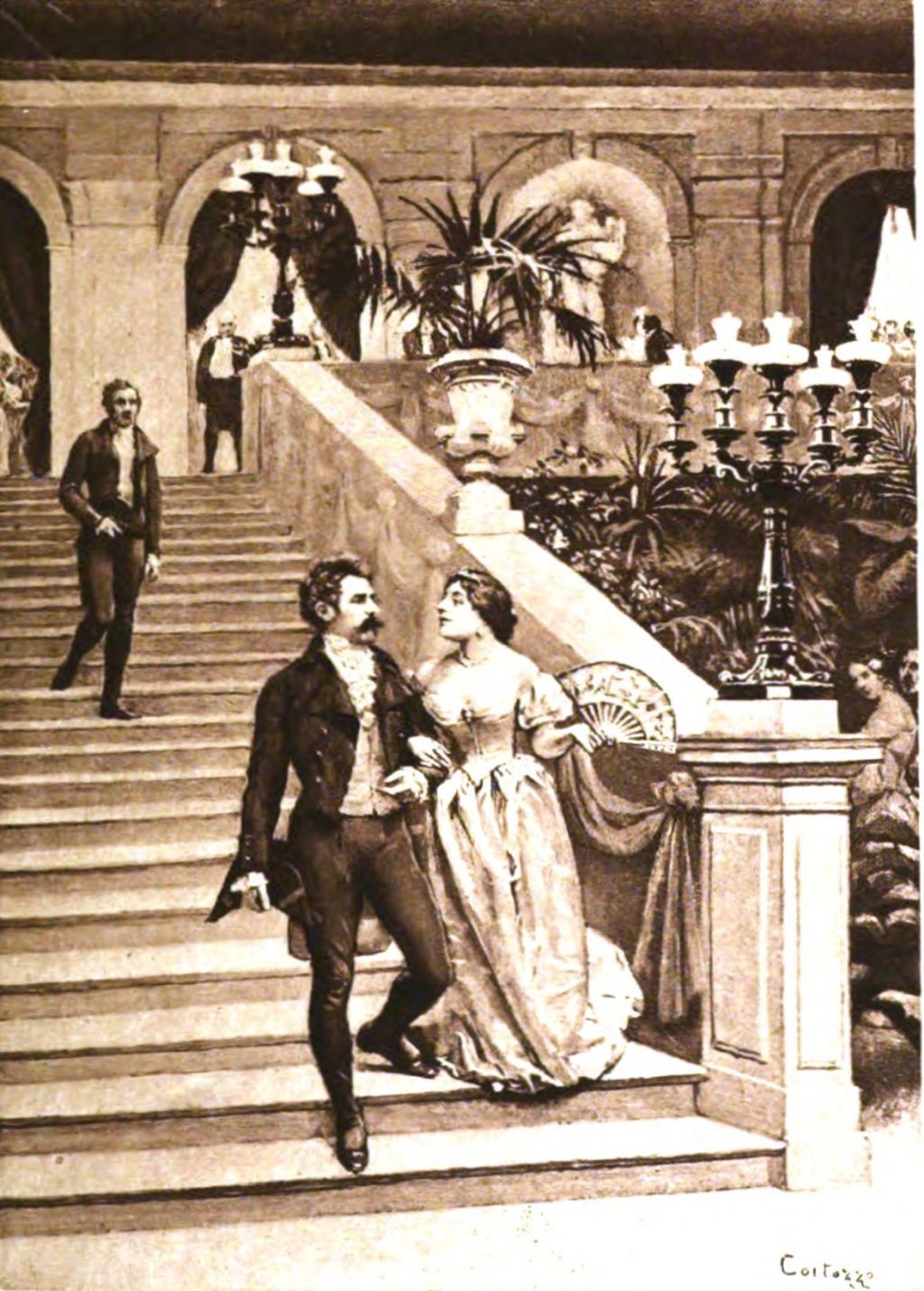
THE BALL AT THE PALMAROSA PALACE.
When Signora Agatha reached the foot of the great staircase, where there were few people, she had recovered her tranquillity; but Michel was trembling more than ever.
When Signora Agatha reached the foot of the great staircase, where there were few people, she had recovered her tranquillity; but Michel was trembling more than ever.
"Doubtless she is going to show me the door herself," he thought, "without allowing anyone to divine her purpose. She is too great and too kind not to rescue me from the insults of her servants and the contempt of her guests; but the advice she is going to give me will be none the less deadly. This probably means the ruin of all my future prospects, and the wreck of the life I have dreamed of will lie here on the threshold of her palace."
"Michelangelo Lavoratori," said the princess, putting her bouquet to her face to deaden the sound of her voice, which might have reached some ear on the alert with curiosity, "I have discovered to-day that you are a genuine artist, and that a noble career lies open before you. A few more years of earnest work, and you may become a master. Then the world will receive you, as you deserve to be received to-day, for the man who has nothing more than well-founded hopes of his personal glory is at least the equal of those who have only the memory of the glory of their ancestors. But tell me if you are in haste to make your appearance in this society which you have seen to-night, and whose spirit you can already divine? If you wish it, I have but to say a word, to raise my hand. All the connoisseurs here noticed your figures, and asked me your name, your age, and your antecedents. I have only to present you to my friends, to declare that you are an artist, and from this day you will be so considered, and practically emancipated from your present social position. Your father's humble profession, far from injuring you, will be an added source of interest; for the world is always surprised to see a poor man born with genius, as if artistic genius had not always sprung from the common people, and as if our caste were still fruitful in superior men. Answer me, Michel; do you wish to sup to-night at my table, by my side, or do you prefer to sup in the buttery, beside your father?"
This last question was put so concisely that Michel thought that he could read his sentence in it. "This is either a delicately administered but most severe lesson that I am receiving," he thought, "or else it is a test. I will come forth pure!"—And at once recovering his wits, which had been violently agitated a moment before, he replied proudly:
"Signora, most fortunate are they who sit at your side and whom you treat as friends! But the first time that I sup with persons in aristocratic society, it will be at my own table, with my father sitting opposite me. That is equivalent to saying that it will never happen, or that, in any event, many years still separate me from glory and wealth. Meanwhile, I will sup with my father in the buttery of your palace, to prove to you that I am not proud and that I accept your invitation."
"Your reply gratifies me," said the princess; "continue to be a man of spirit, Michel, and destiny will smile upon you; remember that I predict it!"
As she spoke, she looked him in the face, for she had dropped his arm and was about to leave him. Michel was dazzled by the flames that gushed from her eyes, usually so soft and dreamy, but animated for him alone—that was certain now—with an irresistible affection. And yet he was not disturbed by it as before. Either it was a different expression, or he had misunderstood it at first. What he had taken for passion was affection, rather, and the desire which had swept over him like a flood changed to a sort of enthusiastic adoration, as chaste as she who inspired it.
"But listen," added the princess, motioning to the Marquis della Serra, who passed at that moment, to give her his arm, and thus admitting him to a share in the conversation: "although there is nothing humiliating to a sagacious mind in eating in the buttery, and although there is nothing intensely exhilarating in supping in the salon, I desire that you should do neither. I have reasons for that which are entirely personal to you, and which your father must have explained to you. You have already attracted attention to-day by your work. Avoid showing yourself freely for a few days more, but without concealing yourself with an affectation of mystery, which course would have its dangers. I could have wished that you had not come to this fête. You should have understood why I did not order a card of admission to be given to you; and your father tried to remove any desire that you might have to be present by telling you that, if you remained, you would be charged with some duty which would not suit you. Why did you come? Tell me frankly: are you very fond of spectacles like this? You must have seen as beautiful ones at Rome?"
"No, signora, I have never seen any that were beautiful at all, for you were not present."
"He wishes to make me believe," said the princess, with a smile of the utmost amiability, addressing the marquis, "that he came to the ball on my account. Do you believe it, marquis?"
"I am sure of it," replied the marquis, pressing Michel's hand affectionately. "Let us see, Master Michelangelo, when are you coming to see my pictures and dine with me?"
"He also declares," said the princess, hastily, "that he will never dine with people of our sort without his father."
"Why this exaggerated timidity, pray?" said the marquis, fixing his eyes upon Michel's with an expression of penetrating intelligence, in which a touch of severity was mingled with kindliness; "can it be that Michel is afraid that you or I would make him blush because he is not yet as respectable as his father? You are young, my boy, and no one can expect to find in you the virtues for which the noble-hearted Pier-Angelo is admired and loved; but your intelligence and your excellent sentiments are enough to justify you in going anywhere with confidence, without being compelled to efface yourself in your father's shadow. However, have no fear; your father has already promised to come to dine with me the day after to-morrow. Will it be convenient for you to accompany him on that day?"
Michel having accepted, struggling the while to conceal his confusion and surprise beneath an affected ease of manner, the marquis added:
"Now allow me to tell you that we shall dine together on the sly: your father was accused of conspiracy long ago; I am an object of suspicion to the government; we still have enemies who may accuse us again of conspiring."
"Well, good-night, Michelangelo, we shall meet again soon," said the princess, observing Michel's bewilderment; "be charitable enough to believe that we know how to appreciate real merit, and that we did not wait for yours to be revealed before discovering your father's. Your father has been our friend for many years, and if he does not eat at my table every day, it is because I fear to expose him to persecution by his enemies by making him conspicuous."
Michel was perturbed and out of countenance, although he would not for anything in the world have given the impression that he was dazzled by the sudden favors of fortune; but at heart he felt humiliated rather than overjoyed by the affectionate lesson he had received. "For it was a lesson," he said to himself, when the princess and the marquis, being accosted by other guests, had walked away, after bidding him good-night with a friendly nod; "these wise and philosophical grandees gave me to understand clearly enough that their affability is a mark of homage bestowed upon my father rather than myself. I am invited on his account, not he on mine; so that it is not my merit which procures me these marks of distinction, but my father's virtuous qualities. O God! forgive me for the proud thoughts that led me to desire to enter upon my career apart from him! I was mad, I was wicked; I have received a most useful lesson from these great nobles, upon whom I sought to impose respect for my origin, and who have, or pretend to have, a more heartfelt respect for it than I have myself."
But the young artist's wounded pride soon recovered from this blow. "I have it!" he cried, after musing a few moments. "These people are deep in politics. They are still conspiring. Probably they did not even take the trouble to look at my paintings, or else they know nothing about art. They pet and flatter my father, who is one of their tools, and they are trying to gain possession of me, too. Ah well! if they wish to arouse Sicilian patriotism in my bosom, let them go about it in a different way and not attempt to exploit my youth without advantage to my reputation! I see their object; but they shall learn to know me. I am willing to be the victim of a noble cause, but not the dupe of other people's ambition."
XV ROMANTIC LOVE
"But," said Michel to himself, "are the patricians all alike in this island? Does the age of gold still flourish in Catania, and do the servants alone retain the pride of prejudice?"
The majordomo had just passed and saluted him with a depressed and crestfallen air. Doubtless he had been reprimanded, or expected to be.
Michel was passing through the dressing-room, resolved to go home, when he saw Pier-Angelo holding the wadded great-coat of an old noble in a light wig, who was feeling about for the arm-holes, shaking as with palsy. Michel blushed at that sight, and quickened his pace. In his opinion, his father was much too good-natured, and the man who allowed himself to be waited upon thus gave an explicit contradiction to the conjectures in which he had just been indulging concerning the noble-hearted generosity of the great.
But he did not escape the humiliation he shunned. "Ah!" cried Pier-Angelo, "there he is, monsignor! Look, you were asking me if he was a handsome boy; look at him!"
"Ah! upon my word, the rascal is well turned, and no mistake!" said the old noble, standing in front of Michel, and eying him from head to foot, as he wrapped his coat about him. "I am much pleased with your decorative work, my boy; I noticed it particularly. I was just telling your father, whom I have known a long while, that you will deserve to succeed him some day in his trade; and if you don't go about town too much, you'll never land in the gutter. At all events, if you ever do get there, it will be your own fault. Call my carriage for me. Be quick; there is quite a cool wind to-night, and it's a bad thing when one has just been in such a suffocating crowd."
"A thousand pardons, your excellency," rejoined Michel, frantic with rage. "I am afraid of the wind myself."
"What does he say?" the old man asked Pier-Angelo.
"He says that your excellency's carriage is at the door," replied Pier, struggling hard to keep from roaring with laughter.
"Very good; I will hire him by the day, with you, when I have work for you."
"Oh! father!" cried Michel, as soon as the old nobleman had gone, "how can you laugh? That impertinent man treats you like a footman, and you accept such treatment with a smile!"
"It makes you angry," said Pier, "but why? I am laughing at your anger and not at the goodman's lack of ceremony. Didn't I promise to help the people of the house in every way? I happen to be here; he asks me for his great-coat; he is old, infirm, foolish—three reasons why I should take pity on him. And why should I despise him, pray?"
"Because he despises you!"
"According to your ideas, but not according to his conception of the things of this world. He is an old devotee, formerly a great rake. In the old days he seduced the daughters of the common people; to-day he bestows alms on the poor mothers. God will forgive him for his early sins, beyond any doubt. Why should I be more straitlaced than the good Lord! I tell you that the differences which social customs create among men are neither so important nor so real as you think, my child. They are all disappearing little by little, and if those who are inordinately sensitive would be a little less stiff, all those barriers would soon be nothing but empty words. For my part I laugh at those who consider themselves so much better than I am, and I never lose my temper. It is not in any man's power to humiliate me, so long as I am at peace with my conscience."
"Do you know, father, that you are invited to dine with the Marquis della Serra on the day after to-morrow?"
"Yes, that is understood," replied Pier-Angelo, coolly. "I accepted this invitation because he is not tiresome like most of the great nobles. Ah! what a price some of them would have to pay me to induce me to pass a couple of hours with them! But the marquis is a man of intellect. Do you mean to go there with me? Don't accept unless you choose, Michel; do you understand? You must not stand on ceremony with any one if you wish to retain your openness of heart."
There was evidently a wide difference between Pier-Angelo's idea of the honor conferred upon him by such an invitation and the idea that Michel had conjured up of his triumphal entrance into society. Intoxicated at first by what had seemed to him to be love on the part of the princess; then bewildered by the amiability of the marquis, which tended to diminish the force of the portent, but did not explain it; and, lastly, irritated by the insolence of the man in the great-coat, he did not know which way to turn. His theories concerning the victories of talent fell to the ground before the heedless simplicity of his father, who accepted everything—homage and disdain—with placid gratitude or satirical amusement.
At the doors of the palace Michel met Magnani, who was also going away. But, after walking a few steps, the two young men, revived by the morning air, determined, instead of going to bed, to skirt the hill and watch the rising of the sun, which was just beginning to whiten the sides of Ætna. They paused on a small hill, about the half height of Ætna itself, and seated themselves on a picturesque spot, having at their right the Villa Palmarosa, still gleaming with light and echoing with the strains of the orchestra; on their left the towering cone of the volcano, with the vast slopes forming an amphitheatre of verdure, rocks and snow to the summit. It was a strange and superb spectacle. Everything was ill-defined in that boundless expanse, and the piedimonta could hardly be distinguished from the upper belt, called nemorosa or silvosa. But while the dawn, reflected in the sea, suffused the lower portion of the picture with a pale, vague light, the bold, jagged edges and immaculate snow of the peak were sharply outlined against the transparent atmosphere of the night, which was still a deep blue and studded with stars about the giant's head.
The sublime tranquillity, the imposing serenity of the towering peaks, presented a marked contrast to the commotion all about the palace. The music, the shouts of the servants, the rumbling of the carriages, seemed, in the presence of placid, silent Ætna, a satirical epitome of human life as compared with the mysterious abyss of eternity. As the light grew stronger the peaks became less distinct, and the gorgeous streamer of reddish smoke that had cut the deep blue sky became blue itself, and wound upward like an azure serpent against an opal background.
Then the picture changed, and the contrast was reversed. The commotion and noise rapidly subsided about the palace, and the horrors of the volcano became visible; the formidable inequalities of its surface, its yawning chasms, and all the marks of desolation it had left upon the soil from its crater to its base, even beyond the point from which Michel and Magnani were gazing at it, even to the very seashore, where Catania lies, imprisoned by countless blocks of lava as black as ebony. That awe-inspiring marvel of nature seemed to be defied and insulted by the joyous airs which the orchestra was playing, softly now, and by the fast-dying illuminations which crowned the main façade of the palace. Now and again the music and the candles seemed to make an effort to revive. Evidently some indefatigable dancers compelled the musicians to shake off their torpor. Perhaps the burnt-out candles set fire to their collars of pink paper. One would have said, watching that brilliant and echoing structure, that the heedless gayety of youth was struggling against the prostration of sleep or the languor of sensual desire, while the undying scourge of that sublime country sent its blazing smoke into the air, a menace of destruction which could not always be defied with impunity.
Michelangelo Lavoratori was absorbed by the spectacle of the volcano, Magnani's eyes were fixed more frequently on the villa. Suddenly he uttered an exclamation, and his young friend, following the direction of his glance, saw a white figure which seemed to be floating in space. It was a woman walking slowly on the high terrace of the palace.
"She, too," cried Magnani, involuntarily, "is watching the sun rise over the mountain. She, too, is musing, and, it may be, sighing!"
"Who?" queried Michel, whose mind had hardened itself somewhat to eject its own chimera. "Are your eyes sharp enough to see from here whether it is Princess Agatha or her maid who is taking the air on the terrace?"
Magnani hid his face in his hands and made no answer.
"Come, my friend," said Michel, obeying a sudden inspiration, "be frank with me. The great lady with whom you are in love is the Princess Agatha?"
"Well, why should I not admit it?" rejoined the young mechanic, in a profoundly sorrowful tone; "it may be that I shall soon repent of having confided to a child whom I hardly know a secret which I have never allowed those who should be my best friends to suspect. There must be some fateful reason for this longing to unbosom myself which has suddenly drawn me toward you. Perhaps it is the late hour, the fatigue, the excitement caused by the music and lights and perfumes; I do not know. Perhaps, rather, it is because I feel that you are the only person here who is capable of understanding me, and that you are mad enough yourself not to be too severe upon my madness. Well, yes, I love her! I fear her, I hate her, and I adore her all at once—that woman who is unlike all other women, whom no one knows, and whom I do not know myself."
"I certainly shall not laugh at you, Magnani; I pity you, I understand you and I love you, because I think that I can detect a certain similarity between you and me. I, too, am excited by the perfumes, the intense brilliancy of that ball, and the noisy dance-music, in which my imagination detects such an undertone of gloom and melancholy through its false liveliness. I, too, feel over-excited and a little mad at this moment. I fancy that there is some deep mystery in our sympathetic feeling for each other."
"Because we both love her!" cried Magnani, beside himself. "Why, Michel, I guessed it from the first glance you bestowed upon her; you, too, love her! But you are loved by her, or will be, and she will never love me!"
"Loved, I shall be loved, or am already! What are you saying, Magnani? you are raving!"
"Listen to me; I must tell you how this disease took possession of me, and perhaps you will understand what is taking place in yourself. Five years ago my mother was ill. The doctor who attended her, for charity's sake, had almost given her up; her case seemed hopeless. I was sitting with my face in my hands, weeping bitterly, at the gate of our little garden, which opens on a street which is almost always deserted, and which ends in the fields on the outskirts of the town. A woman wrapped in a cloak passed the gate and stopped: 'Young man,' she said, 'why do you grieve so? what can I do to lighten your sorrow?'—It was almost dark and her face was hidden; I could not see her features, and her voice, which was extremely sweet, was unfamiliar to me. But her pronunciation and her manner convinced me that she did not belong to our class.
"'Signora,' I replied, rising, 'my poor mother is dying. I ought to be with her, but, as she is fully conscious and I have reached the end of my courage, I came outside to weep, so that she should not hear me. I am going back to her, for it is cowardly to weep like this.'
"'Yes,' she said, 'we must have enough courage to lend some to those who are struggling in the death agony. Go back to your mother; but tell me first if all hope is lost? has she no doctor?'
"'The doctor has not been to-day, and I understand that he can do nothing more.'
"She asked me the doctor's name and my mother's, and when I answered, she said: 'What! has she grown so much worse during the night? he told me last evening that he still hoped to save her.'
"These words, which she involuntarily let fall did not lead me to think that it was the Princess of Palmarosa who was speaking to me. I did not then know what many people do not know to-day, that that charitable woman paid several doctors to attend the poor of the city, the suburbs, and the country; that, without ever appearing in person, unwilling to receive the reward of her good works in the esteem and gratitude of others, she gave the most assiduous and careful attention to all the details of our hardships and our necessities.
"I was too much engrossed by my grief to pay the same attention to her words that I afterwards paid to them. I left her; but when I entered my poor invalid's room, I saw that the veiled lady had followed me. She approached my mother's bed without speaking, took her hand and held it a long time, leaned over her, looked into her eyes, listened to her breathing, and finally said in my ear: 'Young man, your mother is not so ill as you think. She still has some strength and vitality. The doctor did wrong to give up hope. I will send him to you and I am sure that he will save her.'
"'Who is this woman?' my mother asked in a feeble voice; 'I do not recognize you, my dear, but I recognize everybody else here.'
"'I am a neighbor of yours,' replied the princess, 'and I came to tell you that the doctor is coming soon.'
"She went out, and my father at once exclaimed: 'That woman is the Princess Agatha! I recognized her perfectly.'
"We could not believe my father; we supposed that he was mistaken, but we did not have time to discuss the question much. Mother said that she felt better, and the doctor soon arrived, ordered other remedies, and left us, saying that she was saved.
"And so she was; and since then she has always insisted that the veiled lady she saw at her death-bed was her patron saint, who had appeared to her just as she was praying to her, and that the breath of that blessed spirit had restored her life as by a miracle. We cannot disabuse my dear mother's mind of that pious and poetic idea, and my brothers and sisters, who were children then, share it with her. The doctor always pretended that he didn't know what we meant when we talked about a woman in a black mazzaro, who had just entered the house and gone out again, saying that he was coming, and that my mother was saved.
"They say that the princess requires absolute secrecy from all those whom she employs in her good works, and indeed they go so far as to say that her modesty in that respect amounts to a mania. Her secret was kept for many years; but the truth always comes out at last, and now many know that she is the hidden providence of the unfortunate. But see the injustice and absurdity of human judgments! Some of our people declare that she once committed a crime, and made a vow to atone for it; that her noble and saintly life is a self-imposed, terrible penance; that in her heart she hates all mankind so bitterly that she will never exchange a sympathetic word with those whom she assists; but that the fear of everlasting punishment impels her to devote her life to works of charity. Isn't it horrible to form such judgments? And yet that is what I have heard said, in a very low tone, it is true, by old women who have called to see my mother in the evening, and it is sometimes repeated by younger people, who are impressed by these extraordinary conjectures. For my own part, I was fully convinced that I had not seen a phantom, and although my father, fearing lest he might lose the princess's good-will if he betrayed her incognito, dared not repeat that it was she who had appeared to us, he said it at first so naturally and so confidently that I could not doubt it.
"As soon as my mother was convalescent, I went and offered to pay the doctor for his services; but he refused my money, as did the druggist. They replied to my questions according to the lesson that had been taught them, that a secret association of wealthy and devout people paid them for their trouble and outlay."
XVI CONCLUSION OF MAGNANI'S STORY
"My brain began to work," said Magnani, continuing his narrative. "As the grief that had overwhelmed me gave place to joy, the romantic portion of my adventure recurred to my memory. The slightest details stood out distinctly and assumed an intoxicating charm. That woman's soft voice, her graceful figure, her noble carriage, her white hand, were constantly in my mind. A ring which she wore, of a curious shape, had attracted my attention when she felt my poor mother's pulse.
"I had never entered the Palmarosa palace. It is not open to strangers or to inquisitive natives, like most of the ancient abodes of our patricians. The princess has lived in retirement there, hidden from the world, so to speak, ever since her father's death, receiving very few visitors, going out only at night, and that very rarely. I had to watch for an opportunity to see her near at hand, for I was determined to see her with the eyes which I had for her alone thenceforth. I had never desired before that time to see her features, and she had shown them so seldom in ten years that the people of the suburb had forgotten them. When she rode out the shades were lowered, and when she went to church her head was completely enveloped in her black mantilla. Indeed, it was commonly said among us that she had once been very beautiful, but that she had had a scrofulous eruption on her face which made her so frightful that she preferred not to show herself.
"All this was simply vague rumor, for my father and other mechanics whom she employed laughed at these stories, and declared that she was the same as always. But my youthful brain was affected, none the less, by these contradictory reports, and my desire to see that woman was blended with an indefinable dread which prepared me by slow degrees for the madness of falling in love with her.
"One fact in particular added to my ardent longing. My father, who went often to the palace, as a simple journeyman, to assist the master upholsterer to hang and drape curtains and the like, refused to take me there with him, although I was accustomed to go everywhere else with him. He had often put me off with excuses which I accepted without examining them; but when my longing to find my way into that sanctuary became overpowering, he was compelled to admit that the princess did not like to see young people in her house, and that the master upholsterer carefully excluded them when he went there with his workmen. This extraordinary restriction served only to inflame my desire. One morning I resolutely took my hammer and my apron and entered the Palmarosa palace, carrying a prie-Dieu covered with velvet, which my father had just finished in his employer's workshop. I knew that it was made for Signora Agatha; I consulted nobody, but took possession of it and started.
"That was five years ago, Michel! The palace which you see at this moment, so resplendent, with its doors wide open, and filled with people, was just the same a month ago as it was at the time of which I am telling you, just the same as it had then been during the five years that had passed since she was left an orphan and mistress of her own life, and as it probably will be again to-morrow. It was a tomb in which she seemed to have buried herself alive. All the treasures to-day spread out for everyone to see were buried in darkness under layers of dust, like relics of the dead in a tomb. Two or three servants, dismal and silent, walked noiselessly through the long galleries closed to the sunlight and the outer air. On all sides thick curtains hanging before the windows, doors which refused to swing on their rusty hinges, an air of solemn neglect, statues standing erect in the shadow like ghosts, family portraits that followed you with their eyes with a distrustful air. I was frightened, and yet I walked on. The house was not so jealously guarded as I expected. It had invisible sentinels in its reputation for inhospitable gloom and the dread of its loneliness. I carried thither the insane audacity of my twenty years, the ill-fated rashness of a heart enamored in anticipation, and rushing headlong to its destruction.
"By a chance which seemed like fatality, I was not questioned by anyone. The few servants of that dismal abode did not see me, or did not think of preventing me from proceeding, relying, perhaps, upon some Cerberus nearer to the person of their mistress, whose duty it was to guard the door of her apartments, and who, by some miracle, happened not to be there.
"Instinct or destiny guided me. I passed through several rooms, I put aside heavy, dust-covered portières; I passed through one more open door and found myself in a very richly furnished room, where a full-length portrait of a man occupied a panel of the wall directly opposite me. I stopped. That portrait sent a shudder through my veins. I recognized it from my father's description of the original, whose character was then a much more common subject of anecdote and gossip among our people than the peculiarities of the princess. It was the portrait of Dionigi Palmarosa, Princess Agatha's father, and I must tell you something of that terrible man, Michel; for it may be that you have not as yet heard his name in this country, where nobody mentions it except in fear and trembling. Indeed, I see that I should have mentioned him to you before, for the hatred and terror which his memory inspires would have explained to you in some measure the distrust, and even malevolence with which his daughter, despite all her virtues, is regarded by some persons of our station in life.
"Prince Dionigi was a fierce, despotic, cruel and overbearing man. The pride of birth made him almost insane, and every indication of spirit or of resistance on the part of his inferiors was punished with incredible arrogance and severity. Vindictive to excess, he had, it was said, killed his wife's lover with his own hand, and worried her to death, poor creature, in a sort of captivity. He was bitterly detested by his equals, and still more bitterly by the poor, whom he assisted, however, on occasion, with lordly liberality, but in such a humiliating way that one felt degraded by his benefactions.
"Now you will understand better the small degree of sympathy which his daughter has acquired. It seems to me that the constraint in which she passed her early youth, under the iron rule of such a detestable father, may well explain her reserved disposition, and what I may call the premature withering or repression of her heart. Doubtless she is afraid of reawakening antipathies connected with the name she bears, by entering into relations with other people; and if she avoids intercourse with her fellow men, it is for reasons which should arouse the compassion and deep interest of fair-minded persons.