Volume 47 — CHAPTER VIII
Reading edition
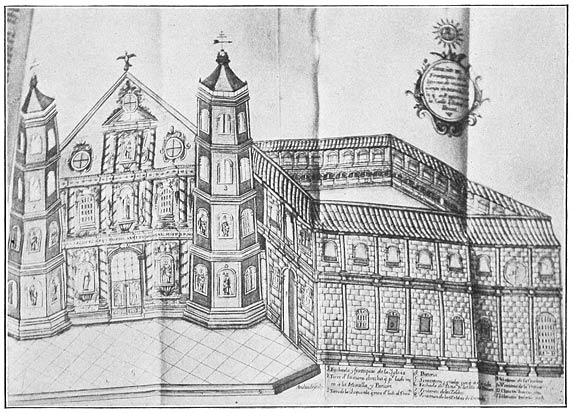
Church of San Juan de Dios, Manila, in Religiosa hospitalidad, by Juan M. Maldonado de Puga (Granada, 1742)
[From copy in collection of Eduardo Navarro, O.S.A., at Colegio de Filipinas, Valladolid]
CHAPTERS IX–XII
[These chapters are devoted to a history and description of the church and convent erected in 1727, an account of the solemn functions annually celebrated therein, instances of miraculous intervention by the Virgin, etc. The church was dedicated on May 10, 1732, with festivities and solemn ceremonies which lasted during eight days. On the last day an oration was delivered by the Dominican Fray Juan de Arrechedera, who is styled by our writer “the Tullius of Manila.” The church measured one hundred and fifty feet in length, and forty-two in breadth; Maldonado describes it, both within and without, with much detail, and presents a large illustration of the exterior of the edifice, which is herewith reproduced on a smaller scale. Among the notable donors to the adornment and furnishing are Don Buenaventura Morales, a physician in Manila; Don Juan Monroy, court secretary of the Audiencia; General Antonio Gonzalez Quijano; Don Joseph Antonio Nuño de Villavicencio, a regidor of Manila; General Miguel de Allanegui, secretary of the government; Doctor Joseph Correa Villareal, an advocate of the Audiencia; and General Joseph de Morales.]
[In chapter xi occurs a curious digression in the midst of the descriptions of the solemn functions solemnized in the hospital church; enumeration of the instances of miraculous aid afforded by the Virgin to her devotees gives occasion for an account of the system of weights used by the Chinese traders in the islands, and the change made from these to the Castilian system. General Joseph Antonio Nuño de Villavicencio “also relates that commission had been given to him to abolish the use of a certain make of steelyards [pesadores] customary with the Chinese and other foreigners, with which commerce had been carried on in this city from the earliest times; and to establish [a system of] weights and measures modeled on the Castilian, according to the provisions of the laws of both kingdoms. He recognized that the serious nature of this charge demanded the most extraordinary exertions, or else that the hindrances should be removed which had hindered it from being effective on occasions when, at various times, the [same] attempt had been made. But, being also stimulated by his own reputation, in order not to be conquered by the difficulty without a previous investigation, and being incited to close application by his interest in a transaction as much to the service of his Majesty as to the general welfare of the commonwealth, he proceeded to the consideration of the importance of this business (the serious inconveniences of which might defeat his efforts), and of the risk incurred for his reputation if, after he had accepted the commission, he could not fulfil it; and the more he thought about it, the less did he unravel the tangle. At last, in his anxiety he found no recourse more certain of success than to offer himself to the divine favor [as expressed] in that sovereign object, the holy image [of the Virgin]; and in this confidence he carried on the enterprise, heedless of any risk, and succeeded in his object, to the satisfaction of the many who before were disparaging it as chimerical, or who regarded it as impracticable. He gained the approbation of the royal Audiencia so thoroughly that it conferred upon him new powers for [introducing] the same arrangement in all the provinces of its jurisdiction in these islands, where the same injurious effect was experienced; and he executed this commission with exactness, sending [to all places] carefully regulated models and instructions for making it effective.” Maldonado then goes on to describe the mode of weight formerly in vogue among the Chinese traders, as well as the Castilian system, thus:]
Form of the Chinese balances
Difficulties which arose in regard to the introduction of new weights
This fact being established, from it follows the reason of the difficulty, which is the subject (and to this end the considerations) on which argument arises. In order to suppress the use of the said dachens, it was necessary to have in reserve other weighing instruments, with which the commerce, both wholesale and retail, could be regulated. In order to establish the Castilian weights, there must be specimens of the original standards which had to be followed, according to the royal decrees, to which weights must be conformed; and a factory must be established for the number of instruments which the new order of things would require. There was an absolute lack of everything; and therefore it was necessary either to permit the use of the dachens, or to make a general prohibition of commerce in the commodities for which the said balances served. To adopt any expedient less onerous was not allowed in the commission; that the former [i.e., the use of the Chinese weights] should be continued was the very thing which he [i.e., General Villavicencio] was ordered to prevent; to deny trade to the people would be ridiculous and ineffectual. The custom was as old as the Spanish occupancy of the country; the serious danger of disturbances, [if he undertook] to regulate steelyards by guess, without observing the exactness [required by] the laws, was a new difficulty; delay [would be ir]remediable, and the general injury irreparable! Let the most discreet person, then, infer from these circumstances whether the undertaking was an arduous one, whether the least [in]advertence would be conspicuous, and [what were] the risks to his reputation for good judgment; and whether recourse to sovereign aid would be urgent for his success....
Castilian weight
The standard of weight kept in the repository
Remarkable agreement of weights
[In chapter xii are enumerated the distinguished persons who have been buried in the new hospital church since its erection. Among these were five infant children (1728–36) of Villavicencio, the regidor who had so liberally aided the institution; at two of these funerals disputes arose over the rights of certain officials to precedence as pallbearers. Another benefactor, General Allanegui, was buried in the church (April, 1736); and three years later General Don Gregório Padilla y Escalante, who lived in the village of Binondo. A sad tragedy is hinted at in the record, although it is mentioned chiefly in connection with ecclesiastical quarrels over parish dues and the disputed right of interring the poor corpse. On January 26, 1736, a Spanish girl of about fifteen years was brought to the hospital; she had been found stretched on the ground near the door of the seminary church of Santa Isabel, bruised and senseless, and died in about an hour, without recovering consciousness. No one knew who she was; but her body was placed near the door of the hospital church, to see if any person would recognize it. Several identified it as that of Doña Josepha de Leon, a pupil in the said seminary, who in a temporary insanity had flung herself from the roof of that building to the street below.]