Volume 47 — SURVEY OF THE FILIPINAS ISLANDS
Reading edition
[Part I]
BRIEF DESCRIPTION OF THE CITY OF MANILA
Up to this time the secular government has been in charge of forty governors, twenty-three of them proprietary, and seventeen ad interim. The ecclesiastical government likewise has had one bishop and thirteen archbishops. Both these numbers are carefully estimated from the list of [those who have held] both dignities.
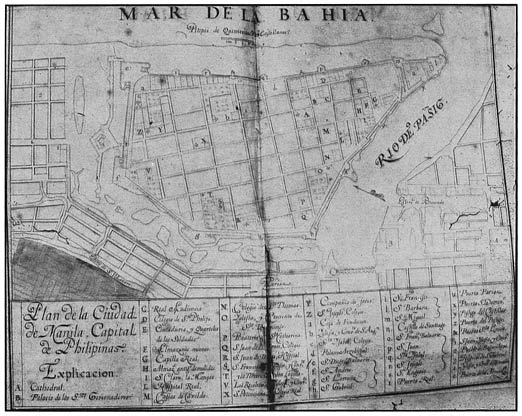
Plan of Manila, ca. 1742
[Photographic facsimile from original MS. in Museo-Biblioteca de Ultramar, Madrid]
The fortifications with which this town is girt about are everywhere of irregular shape, in accordance with the surface of the ground. Its walls, although of masonry, are not regarded as inferior—if one considers the good quality of the stone, which is easy to work on account of being soft—to those of mud or brick. On the other hand, I am persuaded that an injustice would be done to our walls if one should deny them the advantage of the former kind and the solidity of the latter, in view of their great resistance; for in the course of more than a century since their construction, some slight decay has been noticed only occasionally, and in places here and there little sheltered from the salt winds; and this is remedied, or the wall is preserved, by applying a thin coat of lime, an idea which has come as the result of experience. Its circuit appears to be 12,498 Castilian feet, both its extremities closing in with the castle of Santiago, which, on account of its position, occupies in Manila the place of the citadel.
The bastions in its circuit are twelve, all furnished with terreplein; nine are small, and the others large, of the regular size. In one of these last, named “San Andres,” there is a powder-magazine, bomb-proof, which the present governor caused to be constructed; an incentive to building this was the little shelter afforded by a mere shed in former times, and the exposed condition of its contents to the shots of a besieger; these risks that were feared have ceased at sight of the present fortification. There are two sentry-towers incorporated with the said wall, and besides this there are a ravelin and a crown-work. All this is a very respectable aggregate, as contributing to the greatest defense of the city; the situation of each of these defenses will be described in the proper place.
The gates of this city are six, two main entrances and four posterns. Of these Santa Lucia and Palacio, which look toward the west, allow passage to the shore—as also on the north side Santo Domingo and Almacenes give passage to the river. The main gates are distinguished by the names Real and Parian. The latter is situated in the middle of the curtain which faces the northeast between the San Lorenzo and San Gabriel bastions; and inside of it is its guard-station, capacious enough to lodge a company of men. Corresponding to the empty space below, in the upper part it has a spacious sentry-tower, furnished with some cannons, which, by favor of its sides defends the collateral bulwarks—a fortification which, it may be supposed, was placed here in order to make up for the defect of the extraordinary length of this curtain.
The outer works of this are thus composed: a crown-work, which masks the gate; a fausse-braye [falsabraga], which extends from the flank of the bastion San Gabriel, until it almost reaches the said gate, there leaving room for a little bridge for communication with the crown-work already mentioned; a ditch, of which we shall treat further on; its covered way, parapet, and palisade, with its esplanade, the whole regularly surrounded, so far as the narrowness of the place permits; and at its foot a quagmire, which serves as an outer ditch. At the end of this, and along its outer margin, extending toward the south, there is a grand highway, which at its beginning is joined with another but small road, which lies between the outer ditch and the river; and both of these connect with a little bridge, next to a small fort which was erected for the guards stationed at the large bridge which, close by, crosses the river.
The ditch of the half-curtain (of which mention was reserved for this place, in order to avoid confusion) is formed by the waters which overflow from the river at the rise of the tides. It starts from the angle defended by the bastion San Gabriel, and extends until it is very near the Parian gate, with a counterscarp—which there leaves it, bending toward the crown-work, and thus is left almost isolated, with a small arm. This, a little farther, adds all its waters, as if on deposit, to the outer ditch already mentioned. Not thus the main ditch; for this, overflowing the right side according to the amount of water which it receives [from the river], continues its course along the margin of the grand highway, more or less closely according to its curves, until, coming close to the walls, it ends its course round about them, close to the bastion San Diego. At this place art has imposed restraints on it, having in mind, no doubt, the frequent inundations to which that vicinity would be exposed if (as was easy for it) this ditch should come to unite its waters with the sea. From this measure of prudence resulted two benefits of special importance, in which both the fortified post and the public are directly interested—the former, on account of the advantage which it enjoys (as may be seen in the plan) in the fact that the ditch serves it as a moat on the eastern and southern sides; and the latter, because it is utilized for the great number of vessels which, aided by the rising tide, come up to the Puerta Real to discharge their lading.
This is one of the two principal gates already mentioned. It is located on the southern side of this town, in the curtain which defends the bastions San Diego and San Andres, although nearer to the latter; and it much resembles the gate of the Parian (although built in different style) in its convenience and its fortifications—for it has, like the former, a guard-station and watchtower, similarly arranged and equipped. It is only noted that this curtain, peculiar among all, is the only one which is furnished with terreplein; for this reason some cannons (which defense the others lack) have been placed in it.
Its other exterior works, arranged according to their order, are reduced to a bridge that can be raised, a moat with its counterscarp faced with stone [revestido], and at a little distance a ravelin in condition for defense—notwithstanding which, on account of masking the gate it is not found in front of the half of the curtain which was its proper place. Although this gate had the remaining features of covered way, parapet, palisade, and esplanade, they were entirely in ruins at the time when this government began—which induced us to plan them anew, in modern style, and of much better quality than were the old ones.
All the curtains which face the western and northern part of this fortress are, without question, the weakest part of its defenses; but on the supposition (which is believed to be a remote contingency) that European armies may move to attack it in earnest—and it may be regarded as an enormous undertaking by our enemies here, who are most laughable on account of their lack of discipline and of forts—the natural defenses are apparently even more than sufficient. For it has on the west the waters of the bay for a moat, and on the north a river that is broad and deep; and with this all fears may be laid aside.
There is also maintained in this city, at the expense of the royal treasury (as being a necessity), a foundry for artillery, grenades, and cannon balls of all calibers; and an iron-furnace, where men are continually forging, according to the occasion, many hand-weapons and some firearms. The metals for these are transported from countries beyond the sea. Besides these, a scant half-legua to the south, is the powder-factory, which is enclosed by a triangular redoubt of stone and mortar, with seven mounted iron cannons, and fortified by three demi-bastions. This factory supplies gunpowder to Manila and the forts dependent on it; to the ships of his Majesty which sail annually to the port of Acapulco and the Marianas Islands; to the armadas which, when any danger from enemies arises, are made ready on the opposite shore; and to the public festivals. More than enough to cover the expense is received from those who wish to buy it, to whom it is furnished for their money. The ingredients of its composition are produced in the country, except the saltpetre, which is brought from foreign countries.
Artillery, mounted and dismounted, of this fort, with whatever is necessary for handling it
Bronze cannons Caliber Iron cannons Caliber
1 3 2 2
1 4 13 4
1 5 6 5
2 8 10 6
1 9 11 8
1 14 4 10
1 16 4 12
15 8 4 14
7 20 5 18
3 22 4 20
2 24 2 30
6 25
2 stone-mortars, for moat-guards 90
43 bronze cannons 65 iron cannons
Military supplies kept in reserve, independent of those used in actual service
20,370 iron cannon-balls, as reserve for the said artillery.
18 bronze stone-mortars, with their chambers.
5 iron esmerils.
4 iron pinzotes.
458 match-lock arquebuses.
409 flint-lock guns and [hand-] cannons, with bayonets.
34 pairs of pistols.
20 blunderbusses, bronze and iron.
2,267 short swords, cutlasses, and broadswords.
1,097 iron grenades.
50,342 lead bullets, of suitable size.
800 arrobas of gunpowder, kept in reserve.
The fighting men who serve in the said royal camp of Manila comprise nine companies of Spanish infantry. The first is under command of the captain-general; the second, of the master-of-camp; the third, of the sargento-mayor; and the rest, under six captains who are appointed by this government. Each company has its alférez, its sergeant, and also its minor posts of page, standard-bearer, fifer and drummer; and, in all, there are six hundred and seventy-five soldiers. There are also a captain and thirteen halberdiers, the personal guard of the governor and captain-general; two paid adjutants, and seven supernumeraries; one deputy-commander of artillery, with his head gunner, and thirty-six artillerists. There is a military engineer, and an overseer of the royal works; and there are masters and a suitable number of workmen for casting artillery, operating forges, and making gunpowder. There are also, to serve as workmen in the said shops, a company of Pampango infantry, with their captain, alférez, sergeant, standard-bearer, and two hundred and forty-three regular soldiers—more or less, according to circumstances.
The wages and rations of the said soldiers are paid monthly, excepting the captain-general, who receives his pay every four months and at the rate of 8,000 pesos (each of 450 maravedis of silver) a year. The amount each one receives is stated thus:
Officers: The master-of-camp, 137 pesos, 6 tomins; the sargento-mayor, 30 p.; the six captains, each 15 p.; the captain of the guard, 24 p.; the deputy commander of artillery, 25 p.; the military engineer, 25 p.; the overseer of works, 20 p.; two paid adjutants, each 8 p.; the seven supernumeraries, each 6 p.; the alferezes, each 4 p.; the sergeants, each 3 p.; the head gunner of the artillery, 8 p.; the Pampango captain, 4 p., 4 t.; his alférez, and his sergeant, each 2 p., 4 t.
Soldiers: The Spanish soldiers, each 2 pesos; the halberdiers, each 3 p.; the artillerists, each 2 p.; the drum-major, 3 p.; the pages, standard-bearers, one fifer, and the other drummer, each 2 p.; the Pampango soldiers, each 1 p., 2 t., and some of them have extra pay; one Pampango standard-bearer, with [blank] p., 6 tomins.
To all the above are furnished respectively a ration of rice, excepting the captain of the guard, the engineer, and the overseer of works—for which purpose are used 7,4543½ fanegas of rice a year—and the wages amount annually to 34,139 pesos, 3 tomins; the latter are paid from the royal treasury of Manila, which, as it has to meet the other charges which are imposed on the amount of the royal revenues, has not, it is acknowledged, funds adequate for this purpose, as will be made manifest in the proper place.
THE CASTLE OF SANTIAGO
It has a circuit of 2,030 feet; its shape is almost triangular. Its fortifications on the southern side, which faces the city, include a curtain with terreplein, flanked by two demi-bastions; it has a fausse-braye, and a ditch which communicates with the river. On the northern side, toward the entrance of the ditch, in place of a bastion is raised a cavalier with three faces or batteries; one of these fronts the sea (the anchorage included), another the said entrance, and the third the river itself. This last side of the cavalier joins a large tower of the same height as the walls; and through the tower there is a descent to a semi-circular platform or battery, at the level of the water, with which the aforesaid triangular figure of this castle is completed. Through these sides the fort has the necessary communication with the city, through its principal gate, which faces that way; with the river, and with the shore or beach of the sea, by a postern gate which furnishes passage to it. All the above will be better understood by referring to the proper plan folio [blank in MS.] where also will be found, placed in their order, the guard-stations, the barracks of the troops who garrison it, and the quarters of the warden and his subalterns. The reduced size of the plan has not allowed room for showing other buildings distinctly, such as the chapel, various storehouses (among these the powder-magazine, which is bomb-proof), the dungeons, the reservoirs of water, etc.
Artillery mounted and dismounted, with the necessary articles for its handling
Bronze cannons Caliber Iron cannons Caliber
4 2 1 3
2 4 1 4
1 6 1 5
3 8 1 6
1 10 2 16
3 16 2 25
8 18 4 32
3 20
4 25
29 bronze cannons 12 iron cannons
Reserve supplies
1,534 iron cannon-balls, kept in reserve for the said artillery.
1 bronze mortar, carrying a 300-libra ball.
95 muskets.
85 match-lock arquebuses.
3,414 balls for these guns.
161 grenades.
80 bar-shots.
80 lanterns (a contrivance for [using] fire and stone).
148 Turkish swords, pikes, broad daggers, hand-spikes, lances, and gun-forks.
200 arrobas of gunpowder, kept in reserve.
The troops in the regular garrison of the said castle are composed of one company of Spanish infantry, commanded by the warden (who is appointed by his Majesty), with a lieutenant-commander, an orderly aide-de-camp, an alférez, a sergeant, and five minor posts—those of page, standard-bearer, fifer, and two drummers. It has sixty regular soldiers, one head gunner, and twelve artillerymen. The fort has also, as workmen in the shops, Pampango soldiers in a company of infantry, with their captain, alférez, sergeant, the three minor posts of standard-bearer, fifer, and drummer, and ninety regular soldiers, three of them receiving extra pay.
The wages and rations of the said troops are paid monthly, in the form which is shown in the following schedule:
Officers: The warden, 66 pesos, 5 tomins; his lieutenant, 15 p.; the aide-de-camp, 5 p., 6 t.; the alférez, 4 p.; the sergeant, 3 p.; the head gunner, 4 p.; the Pampango captain, 6 p.; the alférez and the sergeant, each 2 p., 4 t.
Soldiers: The sixty Spanish soldiers, each 2 pesos; the twelve artillerymen, each 2 p.; the page, the standard-bearer, the fifer, and the drummers, each 2 p.; the Pampango soldiers, and the men in the minor posts, each 1 p., 2 t.
These wages amount in the year to 4,595 pesos in cash; and the rice, of which rations are issued to all, to 1,219½ fanegas. All this expense is met from the royal treasury and storehouses of Manila; the exact statement regarding it will be found at the end.
DESCRIPTION OF CAVITE
In sight of Manila, and south-southeast of it, at a distance of three leguas by way of the waters of the bay, and six short leguas by land—in 14° 31′ of north latitude, and 158° 38′ of east longitude—is the port of Cavite, which is formed by a tongue of land, curved from east to west; it is 5,100 feet long, and 1,200 feet broad. It is the ordinary anchorage for the ships of his Majesty and of private persons, as well as for the pataches belonging to the commerce of the various Oriental peoples, who come here to carry it on every year, at regular times.
Its population is composed of the soldiers who garrison its castle, and those of other posts; the sea-faring men who serve in the vessels of the [Acapulco] trade-route, and in various other vessels, in the royal service; and the men who compose the force of the navy-yard, for the repair and the building of ships. Among so many, the citizens of most prominence are the pilots, boatswains, and other officers of the ships and the Ribera. The entire government—political, military, and social—is in the hands of a warden and chief magistrate, who is not responsible to any one except the captain-general.
Its principal fortification consists of the fort San Phelipe, the shape of which is an irregular quadrilateral; it is situated toward the point of the Ribera, at a distance from it of about 1,100 feet. It has four bastions with orillons, in old style; its western curtain, in which is its gate, has a fausse-braye; and its southern curtain, on the shore of the Ribera, has a barbette battery of twenty mounted cannons. A similar account of the two remaining curtains is omitted, because in them there is nothing new for notice. The circuit of the fort is 1,410 feet; and within it are located, in due order, lodgings sufficient for the soldiers in its garrison, an armory, a powder-magazine, a water reservoir, and other offices necessary to the service.
On the western side, which is contiguous with the village of San Roque, this fort is also fortified by a curtain 540 feet long, which, with the two large towers which flank it, occupies the entire width of the tongue of land, and, with a revetted moat, leaves Cavite almost isolated; it would be feasible to make it entirely so by the union of the two bodies of seawater—with experience of fatal results, if the double defense of a counterscarp were not interposed. This curtain has, as a mask to its gate, a half-star work with its own gate, which is the one that people call Puerta Vaga; and these two entrances furnish, for the said town and Manila, the only passage by land that is found in this port.
To this fortification is added another, and of no less importance, the necessity of which was made evident by warnings; and the plan of its structure was thought out by experience. For, having noted in less than fifty years the repeated ravages caused in this port, on the north side, by the violence of the sea when driven by the north winds—which indicated its entire destruction in the future—the superior government decided to construct a stable barrier, by which the so great damage that was feared might be prevented. This was carried out by the engineer then in charge, by constructing in the water a barrier of stone and mortar, large enough to be able to resist such attacks, and of height equal to that of the highest tides, on a foundation of pile-work and beams. This work extended from the point of the Ribera, on the side which was endangered, until it reached the northern tower of the curtain which is mentioned in the preceding paragraph—that is, the entire length of Cavite. Upon this breakwater he raised a parapet with its banquette, in which were formed the bastions, demi-bastions, flanks and curtains, as this line gave opportunity, and in the plan of Cavite they are indicated; but all these works were at the level of the water. For its greater permanency, command was given to cast into the water outside, at the foot of the pile-work, a number of stone-heaps; since these are always multiplying themselves, an evident benefit has resulted.
The arms and supplies for the maintenance of these forts are those which here are scheduled.
Artillery, mounted and dismounted, in the port of Cavite, with all that is necessary for its handling
Bronze cannons Caliber Iron cannons Caliber
10 1 6 1
1 2 43 2
1 3 9 3
1 4 21 4
2 6 46 6
26 8 25 8
4 10 35 10
15 12 15 12
4 14 8 14
1 16 1 16
19 18 41 18
10 25 1 20
7 30
2 35
2 40
1 stone-mortar, of 300 libras.
109 bronze cannons. 257 iron cannons.
Military supplies kept in reserve, independent of those used in actual service
The fighting men of the said port of Cavité and its fortress (who are in one body, just as the above-mentioned supplies are considered collectively) comprise three companies of Spanish infantry—one commanded by the warden, another by the sargento-mayor, and another by a captain—with 180 soldiers in all, with their leading officers and minor posts. There is also a captain of artillery, with twenty-four artillerymen; the deputy of the castellan; three orderlies; two carpenters for the gun-carriages of the artillery; and one military notary. There is, besides, a company of Pampango infantry with its master-of-camp, sargento-mayor, and other officers, with two hundred and twenty regular soldiers, one hundred and twenty of whom are assigned to work as sawyers. All the officers and soldiers, both Spaniards and Pampangos (except the warden and the notary) receive a suitable ration of rice and their pay in cash monthly. The wages amount to 11,500 pesos, and the rations to 3,084 fanegas of rice. These are furnished from the royal treasury and the storehouses in Manila, according to the list here set down.
Officers: The warden, 100 pesos; the sargento-mayor, 25 p.; one captain of Spanish infantry, 15 p.; the alferezes, each 4 p.; the sergeants, each 3 p.; one captain of artillery, 15 p.; the deputy of the castellan, 15 p.; three orderlies, each 6 p.; one military notary, 8 p.; the Pampango master-of-camp, 10 p.; the sargento-mayor of that people, 6 p., 4 t.; the alférez, sergeant, and adjutant of the said nation, each 2 p., 4 t.
Soldiers: The Spanish soldiers, each 2 pesos; the pages, standard-bearers, drummers, and fifer, each 2 p.; the artillerymen, each 2 p.; two carpenters for the artillery, each 2 p.; minor posts in the Pampango company—standard-bearer, fifer, and drummer—each [blank] p., 6 t.; 220 Pampango soldiers, each 1 p., 2 t. Of the Pampangos the following receive extra pay, with the title of sawyers: three each, 4 p.; another, 2 p., 4 t.; another, 2 p.; and eighteen others, each 1 p., 4 t.
The place which is now called “Ribera of Cavité” includes all the ground from the point of Cavité to Fort San Phelipe. All this is enclosed, with two gates, [which are] at the angles flanked by the bastions—that of the powder-magazine on the northern side, and by that of Cháchara [i.e., “Chit-chat”] on the southern side. Although these passages had formerly been open, it was considered best to shut them off thus, in order to check the frequent thefts that were committed of nails and other furnishings at times when ships were being repaired or built; but in doing so a narrow strip was left, in order to furnish a path for the work-people from the Ribera, thus forming the barbette battery; and this strip has preserved the principal curtain of the fort from the continual former lashings of the waves of the sea.
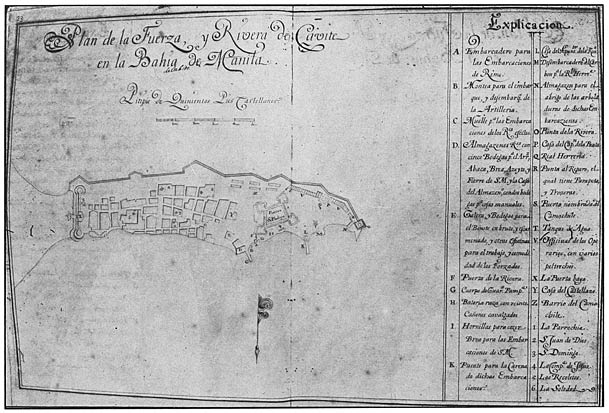
Plan of Cavite and its fortifications, (ca. 1742)
[Photographic facsimile from original MS. in Museo-Biblioteca de Ultramar, Madrid]
On this Ribera is located the shipyard, where the galleons, pataches, galleys, and galliots of his Majesty are constructed into ships; also here is the bridge which is used for careening the said ships, and others that belong to private persons. It also includes the royal iron-works, where are forged the iron tools and instruments, of all kinds and sizes, that are necessary for the said construction; and the workshops of the various artisans who are daily at work on this Ribera. There are separate storehouses for the masts, anchors, cables, rigging, and other kinds of cordage; for cannon, and for gun-carriages; and generally for all the military supplies and nautical equipments, with the dwelling-houses of their principal officers. All this was built by the present government, and with so good management that in a short time, and without confusion, everything necessary for this purpose was constructed, repaired, or equipped. Other royal buildings which are not included in the Ribera are indicated on the chart of this port, for which reason I omit notice of each.
All this arrangement for the navy-yard of the Ribera, although it is planned for the benefit of all vessels, whether native or foreign, is chiefly designed for those of his Catholic Majesty, and more especially for the galleons which annually make the voyage to Nueva España; these are built, equipped, and supplied in this port and Ribera. A sufficiently detailed account of these will be given in the following lists.
Ribera of Cavité
All the aforesaid people in the navy-yard on the Ribera of Cavité receive yearly 49,948 p., 3 t., 8 granos, in which is included the value of 26,174 cavans, 11 gantas of rice, which is consumed in the rations given to each person; but from this are excluded the father chaplain, the sawyers, and the calkers. This amount, in summary form, is the same which the royal officials now certify, omitting the details of each item on account of the great prolixity which would be caused by stating the various assignments of pay which correspond to the various offices and work, and reserving the full statement for the annual report with which the royal officials fulfil their duty.
Preparation of the ships: Since the chief employ of the navy-yard at the Ribera at Cavité is the building and equipment of his Majesty’s ships, and, specifically, those which are annually despatched to Nueva España with the merchandise that is allowed to that commerce and for the royal situado—in which construction is expended the amount from the royal treasury already mentioned—to it also belong the expenses of the entire outfit for the ships, the pay of the naval and military officers, great and small, the men for the crews, and the provision of necessary supplies. As regards expense caused by these things, it is included in the certification of the royal officials in their general statement of purchases; this brief relation refers the reader to that account, avoiding the annoyance of so long a schedule, and here is given only the list of the men assigned to this employ—the computation being now made from the two pataches, the flagship and the almiranta, which in the year 1736 were manned in this form:
Officers of the ships: The commander of the flagship (“Nuestra Señora de Cabdalonga”) with salary of 4,125 pesos; the captain of the almiranta (“Nuestra Señora del Pilar”) 2,750 p.; the chaplains of the two pataches, each 75 p., 150 p.; two chief pilots, each 300 p., 600 p.; two assistant pilots, each 150 p., 300 p.; two mates, each 150 p., 300 p.; two head gunners, each 150 p., 300 p.; two boatswains, each 150 p., 300 p.; two carpenters, each 150 p., 300 p.; two calkers, each 150 p., 300 p.; two divers, each 150 p., 300 p.; two notaries, each 100 p., 200 p.; two storekeepers, each 100 p., 200 p.; two surgeons, each 100 p., 200 p.; two stewards, each 100 p., 200 p.; two water-guards, each 100 p., 200 p.; two additional pilots, each 150 p., 300 p. Total, 11,025 pesos.
The men of the crews: 64 artillerymen, each 100 p., amount to 6,400 p.; 160 mariners in the crews of the said pataches, at the rate of 75 p. each, 12,000 p.; 72 Spanish common seamen in the said crews, at the rate of 50 p. each, 3,600 p.; 120 deck-hands in the said crews at 25 p., 3,000 p.; extra pay issued to the royal official timekeeper, who made these payments, 25 p. Total, 25,025 pesos.
Adding together these amounts for pay of officers and crews, the total is 36,050 pesos.
DESCRIPTION OF FORT SAN PEDRO IN THE CITY OF SANTISSIMO NOMBRE DE JESUS, IN ZEBÛ
The shape of this fort is triangular, with three bastions having straight flanks; it is 1,248 feet in circuit. Its curtains are of unequal length, and in that one which fronts the city, toward the northwest, is the gate of the fort. This is masked by an outer work of stakes, of square shape, with its gate to the city; and a palisade extends the whole length of the curtain, in the form of a fausse-braye.
This fort contains the necessary buildings, as they are indicated on its plan; it has also arms and soldiers, as herewith stated.
Arms and supplies
13 pieces of bronze artillery, caliber 2 and 4.
18 iron cannons, caliber 1, 2, 4, 5, 6, 10, and 14.
2 bronze mortars, with iron pivots.
6 bronze stone-mortars.
12 chambers.
50 pinzotes.
250 arquebuses and muskets.
1,826 iron balls for the artillery.
14,055 lead balls for the muskets, arquebuses, and pinzotes.
294 grenades.
500 arrobas of gunpowder, with small-arms and hand weapons, are kept in reserve, as is certified by the royal officials.
All the above, with the clothing [for the soldiers], and the replenishment of arms and gunpowder, is provided from the capital, Manila, in accordance with the orders of this government.
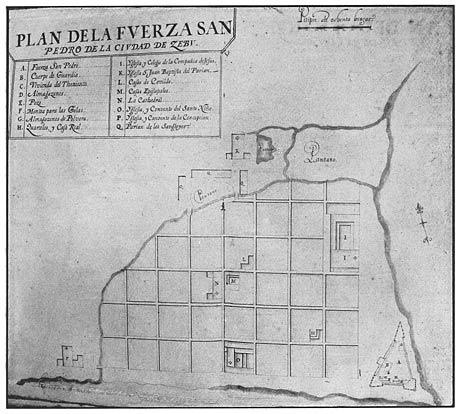
Cebú and its fortifications, ca. 1742
[Photographic facsimile from original MS. in Museo-Biblioteca de Ultramar, Madrid]
The military force
A captain of Spanish infantry, who is the alcalde-mayor, with monthly pay of 25 pesos; an alférez of the said company, with 3 p.; a sergeant, 2 p.; an orderly, 4 p.; a lieutenant of the fort, 4 p.; 57 regular soldiers, each 1 p.; 4 minor posts—page, fifer, drummer, and standard-bearer, each 1 p.; 6 artillerymen, each 1 p.; a captain of the Pampango company, 4 p.; his alférez, 1 p., 4 t.; the sergeant, 1 p.; twenty [Pampango] soldiers, and three minor posts—page, drummer, and standard-bearer—each 4 t.; one position as overseer of the iron-forge, 3 p.; two others, as shoremaster and overseer of buildings, 2 p.; another as pilot, 1 p. Each one of the said persons receives a monthly allowance of half a fanega (which is one cavan) of rice.
The maintenance of this military post amounts to 1,584 pesos and 624 fanegas of rice every year; this expense is paid out of the proceeds of the tributes and other revenues which are collected on his Majesty’s account in the said province of Zebû.
DESCRIPTION OF FORT NUESTRA SEÑORA DEL PILAR AT SAMBOANGAN
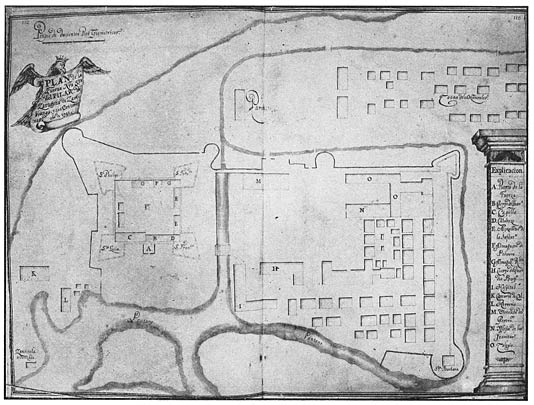
Plan of fort at Zamboanga, 1742
[Photographic facsimile from original MS. in Museo-Biblioteca de Ultramar, Madrid]
This fort is constructed of stone and mortar, with a terreplein, at the entrance of the town, on the sea-shore; the beach surrounds it on the eastern and southern sides, along which it has also, externally, a palisade. On the western side, where the gate is, it has a marsh for a moat; and on the northern side, which faces the dwellings, it has an artificial moat.
Its shape is that of a rectangle, with four full bastions—three with straight flanks, and one with an orillon; it has a circuit of 820 feet, and in it are enclosed the necessary buildings, as the plan shows.
The town has its own special fortifications; for on the eastern side it has a long curtain of palisades, in the midst of which there is a semicircular platform, which defends it. On the northern side there is a long curtain of stone and mortar, flanked at the east by a bastion with orillon, called Santa Cathalina; and at the west by a cavalier of rectangular shape, called Santa Barbara. This curtain has its palisade, which ends on the western side of this town, at some distance from the said cavalier; and the rest of this said side has some marshes for defense. The said wall and curtain of this town is surrounded by a canal, full of water, ten or twelve feet wide; and it connects with the said marshes.
The arms, supplies, and soldiers with which this military post is maintained and defended are stated in the following lists:
Arms and supplies of this post
24 bronze cannons, of caliber 1, 2, 3, 4, and 12.
1 bronze culverin, caliber 4.
1 mortar of the same, caliber 18.
45 iron cannons, calibers 1, 3, 4, 6, 8, 10, 12, and 18.
17 stone-mortars of the same [material], calibers 3 and 4.
58 chambers.
8 blunderbusses, 5 of bronze and 3 of iron.
11 pinzotes.
253 guns, muskets, and arquebuses.
698 grenades, loaded and unloaded.
1 pair of pistols.
2 short carbines [terzerolas].
8,407 lead and iron balls, suitable for the artillery.
39,104 lead balls, for the arquebuses, guns, and muskets.
500 arrobas of gunpowder, as regular supply.
Other weapons, for hand use, minor supplies, and all the rest that is necessary for handling [the artillery], are enumerated in a separate certified statement by the royal officials.
Military force in the post of Samboangan
One captain of the first company of the Spanish infantry, a post which is held by the governor of this town, with a monthly salary of 50 pesos; its alférez, 4 p.; its sergeant, 3 p.; an aide-de-camp, 6 p.; 74 Spanish soldiers, each 2 p.; three minor posts—page, standard-bearer, and drummer—each 2 p. The captain of the second Spanish company, 15 p.; its alférez, 4 p.; its sergeant, 3 p.; 68 soldiers, and three minor posts—page, drummer, and standard-bearer—each 2 p. The captain of the third Spanish company, who commands the armada, 15 p.; its alférez, 4 p.; its sergeant, 3 p.; 58 soldiers, and 3 minor posts—page, standard-bearer, and drummer—each 2 p. A head gunner for the artillery, 4 p.; a lieutenant and paymaster for this post, 15 p.; a surgeon, 5 p.; a notary for this post, 3 p.; 2 amanuenses, hired by the day, each 3 p., 6 t.; 2 chaplains for the infantry, by the year, each 100 p. A captain of the company of Pampango infantry, with monthly pay of 4 p., 4 t.; its alférez, 2 p., 4 t.; its sergeant, 2 p., 4 t.; 100 Pampango soldiers, each 1 p., 2 t.; 2 minor posts—page, and standard-bearer—each 6 t. One master armorer, 3 p.; 2 skilled tilers, each 2 p., 4 t.; 15 supernumerary seamen, paid at various rates, by the month, [blank]. All these people receive a suitable ration of rice.
Coastguard galleys at Samboangan
At this post are maintained, as a measure of precaution by this superior government since the past year of 1730, two coastguard galleys (a flagship and an almiranta), with [a crew of] 96 impressed men [forzados], and with all the supplies necessary for their outfit; care is also taken to repair and fortify them. They have been kept up as an armament necessary at this time for checking the insolence of the neighboring Moros, who attack the villages of the territory under the royal crown. In regard to the maintenance of these galleys, and the amount of supplies and the number of soldiers and sailors [required for them], although all this is found included in the expenditures of the royal treasury as actual expenses it must be borne in mind that they are not perpetual, but accidental and extraordinary, according to the movements of our enemies. For this reason, these items of expense are sometimes included and sometimes omitted in the statements of accounts, according to the differences of time and occasion.
Galliots at Samboangan
More permanent at this post are the two galliots which are, by act of the general council of the treasury, maintained there since the year 1729, as necessary in those seas, so rough and so infested with enemies, for transporting from the province of Ogtong and the storehouses of Yloylo the rice and other provisions which are needed in this post [of Samboangan]. The amount needed for the pay of these seamen is sent from the royal treasury of Manila.
The entire maintenance of this post of Samboangan amounts each year to 12,592 pesos, 2 tomins, and 7,108 cavans (which are 3,554 fanegas) of rice, according to the last balancing of the accounts. To meet this expense, a situade is sent from the royal treasury of Manila, the number of pesos corresponding to the amount of the fixed charges, and to that of the accidental expenses when there are any. The clothing, gun-powder, supplies for replenishing the storehouses, cordage and sails, other supplies for vessels, supplies for the hospital and other offices of that post—all these are provided from the royal storehouses of Manila; while from those of Yloylo is sent the rice for the rations, with other foodstuffs, in which that province abounds.
In order to meet the said expenses, there is set aside the value of the ganta of clean rice which was offered, contributed as a gift, by every whole tribute (of two persons) in the provinces subject to the royal crown—those of Balayan, Mindoro, Caraga, Marivelez, Calamianes, and Cavite being exempted from this contribution—the amount of which is regularly more than 3,500 pesos a year. For the said expenses is also applied the value of the wine monopoly, which, at the rate of the last sale to the highest bidder, produces 25,000 pesos annually. To this is added the amount of the pay, rations, and supplies of the officers and soldiers who, at the time when this post was reëstablished, were detailed to serve in it, from those of Cavite, Yloylo, and Zebû.