Volume 44 — JESUIT MISSIONS IN THE SEVENTEENTH CENTURY
Reading edition
From this arises the fact that the confessional of Manila is, in my opinion, the most difficult in all the world; for, as it is impossible to confess all these people in their own tongues, it is necessary to confess them in Spanish; and each nationality has made its own vocabulary of the Spanish language, with which those people have intercourse [with us], conduct their affairs, and make themselves understood; and without it Ours can understand them only with great difficulty, and almost by divination. A Sangley, an Armenian, and a Malabar will be heard talking together in Spanish, and our people do not understand them, as they so distort the word and the accent. The Indians have another Spanish language of their own; and the Cafres have one still more peculiar, to which must be added that they eat half of the words. No one save he who has had this experience can state the labors which it costs to confess them; and even when the fault is understood in general, to seek for a specific account of the circumstances is to enter a labyrinth without a clue. For they do not understand our orderly mode of speech, and therefore when they are questioned they say “yes” or “no” as it occurs to them, without rightly understanding what is asked from them—so that in a short time they will utter twenty contradictions. It is therefore necessary to accommodate oneself to their language, and learn their vocabulary. Another of the very serious difficulties is the little capacity of these people to distinguish and explain numbers, incidents, and circumstances; add to this the unbridled licentiousness of some, in accordance with the freedom and opportunities [for vice] in this land, the continual backsliding, and the few indications of fixed purpose. In others, who are capable and explain their meaning well, is found a complication of perplexities—with a thousand reflections, and bargains, and frauds, and oaths all joined together; and faults that are extraordinary and of new kinds, which keep even the most learned man continually studying them. The heat of the country, and the stench or foul odor of the Indians and the negroes, unite in great part to make a hardship of the ministry, which in these islands is the most difficult; and on this account I regard it as being very meritorious. The annual confessions last from the beginning of Lent until Corpus Christi. In our college of Manila the church is open from daylight until eleven o’clock, and from two o’clock until nightfall; and always some fathers are present to hear confessions—for this is done not only by the active ministers, but by the instructors, when their scholastic duties give them opportunity; and I have known some fathers who remain to hear confessions during seven, eight, or more hours a day.
It makes them bear all these annoyances patiently, and even sweetens these, to see how many souls are kept pure by the grace of God, in the midst of so many temptations, like the bramble in the midst of the fire without being burned. There are many who are striving for perfection, who frequent the sacraments, who maintain prayer and spiritual reading, and who give much in alms and perform other works of charity. And it is cause for the greatest consolation to see, at the solemn festivals of the Virgin and other important feasts, the confessional surrounded by Indians, Cafres, and negroes, men and women, great and small, who are awaiting their turns with incredible patience, kept there through the grace of God, against every impulse of their natural dispositions and their slothfulness. And at the season of Lent it is heart-breaking to see the confessor, when he rises from his seat, surrounded by more than a hundred persons of all colors, who go away disconsolate because they have not obtained an opportunity to make their confessions; and in this manner they go and come for eight or ten days, or a fortnight, or even more, with unspeakable patience, but with such eagerness that when the confessor rises they go following him throughout the house, calling to him to hear their confessions. This is done even by boys of seven to twelve years, and hardly with violence can they be made to leave the father, and they continue to call after him; and some remain in the passages, on their knees, asking for confession, so great is the number of the penitents—to which that of the confessors does not correspond by far, nor does their assiduity, even if there were enough of them. The Society is not content with aiding those who come to seek relief in our church, and attending the year round all the sick, of various languages, who summon them to hear confession; but its laborers go forth—as it were, gospel hunters—to search for penitents. They assist almost all who are executed in the city; every week they go to the jails and hospitals; in Lent they hear confessions in all the prisons, and at the foundry, those of the galley-slaves. And in the course of the year they hear confessions in the college of Santa Ysabel—in which there are more than a hundred students, who are receiving the most admirable education—and in the seminary of Santa Potenciana, the students frequenting the sacraments often; and, in fine, they go on a perpetual round in pursuit of the impious.
The Society also busies itself in the conversion and reconciliation of certain heretics, who are wont to come from the East (as has been observed in recent years), and in catechising and baptizing the Moros or the heathens who sometimes reach the islands—either driven from their route, or called by God in other ways; and He draws them to himself, so that they obtain holy baptism, as has been seen in late years in some persons from the Palaos and Carolina islands, and from Siao. Another of the means of which the Society avails itself for the good of souls is, to print and distribute free many spiritual books in various languages, which are most efficacious although mute preachers. These, removing from men their erroneous ideas by clear exposition [of the truth], and leaving them without the cloak of their own fantastic notions, persuade them, without being wearisome, to abandon vice or error; and then they embrace virtue and the Christian mode of life. In Lent, as being an acceptable time and especially opportune for the harvest, the dikes are opened, in order that the waters of the word of God may flow more abundantly. On Tuesdays there is preaching to the Spaniards, and these sermons usually have the efficacy of a mission, although not given under that name. On Thursdays there is explanation of the doctrine, and preaching, in Tagálog, to the Indians; the attendance is very great, since many come, not only from the numerous suburbs of Manila, but even from the more distant villages. On Saturdays some good example of the Virgin is related, with a moral exhortation; the Spaniards who are members of fraternities attend these, and afterward visit the altars. On Sundays there is preaching to the Cafres, blacks, creoles, and Malabars—who through a sense of propriety are called Morenos, although they are dark-skinned. The sermon is in Spanish, and the greatest difficulty of the preacher is to adapt his language to the understanding of the audience. Various poor Spaniards also attend these sermons, as well as other people, of various shades of color, of both sexes.
Every Sunday certain fathers are sent to preach at the fort or castle, to the soldiers and the other men who live there. The Christian doctrine is chanted through the streets, and in the procession walk the boys of the school; it ends at the royal chapel, where some part of the catechism is explained, and a moral sermon is preached to the soldiers who live in their quarters in order to mount guard. The doctrine is explained at the Puerta Real and at the Puerta del Parián, and there is preaching in the guard-room—where there is a large attendance, not only of soldiers, but of the many people who, on entering or going out from the gates, stop to hear the word of God. Another father goes to the royal foundry, in which the galley-slaves live, where there is such a variety of people—mestizos, Indians of various dialects, Cafres, negroes of different kinds, and Sangleys or Chinese—that exceptional ability and patience are necessary in order to make them understand. Other fathers go to the college of Santa Isabel and the seminary of Santa Potenciana, where they give addresses and exhortations to the students of the former, and the women secluded in the latter. Others go to the prisons of both the ecclesiastical and secular jurisdictions, in order that the prisoners may obtain the spiritual food of the doctrine. On Mondays, Wednesdays, and Fridays there is in our church a Miserere, with the discipline [i.e., scourging]; a spiritual book is read to those who are present, and at least once a week an exhortation is addressed to them.
Such is, in general, the distribution of work for our college at Manila in Lent, and therein are engaged nearly all the men in the college, whether priests or students; and in times when there is a scarcity of workers I have seen some helping at two or three posts, and not only ministers and instructors thus occupied, but even the superiors, and men of seventy years old, to the great edification of the community. At Lent is seen in Manila that which occurred at the destruction of Jericho, where, when the priests sounded around the city the trumpets of the jubilee, the walls immediately gave way and fell to the ground. Thus in Manila do the Jesuits surround the walls, calling to every class of people with the trumpets of the jubilee and offering pardon; and at the sound, through the grace and mercy of the Highest, the lofty walls of lawlessness, vice, and crime, fall in ruins. And even the presence of the ark is not lacking to this marvelous success, for it is not to be doubted that the Blessed Virgin, most merciful mother of sinners, aids us with her intercession. [Our author here relates various instances of miraculous aid from heaven, and other edifying cases.]
The mission of Bondoc gained such repute in the island of Marinduque, distant more than forty leguas from Manila, that its minister, who was a zealous cleric, wrote to the father rector at Manila asking him very humbly and urgently to send there a mission, from which he was expecting abundant fruit. So earnest were the entreaties of this fervent minister that a mission was sent to the said island; it had the results which were expected, and afterward the Society was commissioned with its administration. In nearly all the ministries of secular priests the Society was carrying on continual missions, at the petition of the ministers or at the instance of the bishops.... The Society was held in honor not only by the bishop of Camarines, but equally by his illustrious Lordship Don Fray Miguel Garzia Serrano, a son of the great Augustine and most worthy archbishop of Manila. That most zealous father Lorenzo Masonio preached to the negroes who are in this city and outside its walls, according to the custom of this province, which distributes the bread of the gospel doctrine to all classes of people and all nations. And that holy prelate deigned to go to our church, and, taking a wand in his hand, as the Jesuits are accustomed to do, he walked through the aisle of the church, asked questions, and explained the Christian doctrine to the slaves and negroes. The community experienced the greatest edification at seeing their pastor so worthily occupied in instructing his sheep, not heeding the outer color of their bodies, but looking only at their precious souls—for in the presence of God there is no distinction of persons.
[Fol. 27:] In Marinduque Ours labored very fervently to reduce the Christians to a Christian and civilized mode of life; and among them was abolished an abuse which was deeply rooted in that island—which was, that creditors employed their debtors almost as if they were slaves, without the debtor’s service ever diminishing his debt. The wild Indians were reduced to settlement; among them were some persons who for thirty years had not received the sacraments of penance and communion. In the Pintados Islands there was now much longing for and attendance upon these holy sacraments, when their necessity and advantage had been explained to the natives.
[Fol. 29:] His illustrious Lordship Don Fray Miguel Garzia Serrano had so much affection for the Society, and so high an opinion of the zeal of its ministers, that he decided to entrust to it the parish of the port of Cavite. This, one may say, is a parish of all the nations, on account of the many peoples who resort to that port from the four quarters of the world; it was especially so then, when its commerce was more opulent, flourishing, and extensive [than now]. It did not seem expedient to the Society to accept this parish; but, in order to show their gratitude for the favor, and to coöperate by their labors with the zeal of that active prelate, they took upon themselves for several months the administration of that port, in which they gathered the fruit corresponding to the necessity—which, with so great a concourse of different peoples there, and the freedom from restraint which exists in this country, was very great. The metropolitan was well satisfied, and very grateful; and he insisted until the Society made itself responsible for the administration of one of the three visitas which the said parish has. This was a village on the shore of the river of Cavite, which on account of being older than the settlement at the port is called Cavite el Viejo [i.e., Old Cavite]; it afterward was located on the shore of the bay, about a legua from the said port—which, in order to distinguish it from this village, is called Cavite la Punta [i.e., Cavite on the Point], because it is on the point of the hook formed by the land; from this is derived the name Cavite, which means “a hook.” The ministry [at Old Cavite] was then small, but difficult to administer, on account of the people being scattered, and far more because of the corruption of morals; for, lacking the presence of the pastor, and the wolves of the nations who come here from all parts for trade, being so near, it might better be called a herd of goats than a flock of sheep—this village being, as it were, the public brothel [lupanar] of that port; and there was hardly a house where this sort of commerce was not established. This was a matter which at the beginning gave the ministers much to do, but with invincible firmness they continued to correct this lawless licentiousness; and by explaining the doctrine, preaching, and aiding the people with the sacraments, they made Christians in morals those who before only seemed to be such in outward appearance and name. Ours continued to reclaim these people to the Christian life, and today this village is one of the most Christian and best instructed communities in all the islands; it has a beautiful and very capacious church of stone, dedicated to St. Mary Magdalen, and a handsome house [for the minister]. There are in this village, besides the Tagálogs (who are the natives), some Sangleys and many mestizos, who live in Binacayan, which is a sort of ward of the village.
[Fol. 31 b:] Ardently did the apostle of the Indias desire to go over to China for its conversion; but he died, like another Moses, in sight of the land which his desires promised to him. Since then, without looking for them, thousands of heathen Chinese have settled in these islands. As soon as the Society came to these shores, Ours applied themselves, in the best manner that they could, to the conversion and instruction of those people—and even more in recent times, on account of the Society possessing near Manila some agricultural lands, which the Chinese (or Sangleys, as they are commonly called) began to cultivate. Ours were unwilling to lose the opportunity of converting them to our holy faith, so various persons were actually baptized; and, to render this result more permanent, a minister was stationed there, belonging to this field, who catechised them, preached in their own language, baptized them, and administered the sacraments—with permission from the vice-patron, Don Juan Niño de Tabora, and from the archbishop, Don Fray Miguel Garzia Serrano—and it is called the village of Santa Cruz. Their language is very difficult; the words are all monosyllables, and the same word, according to its various intonations, has many and various significations; on this account not only patience and close study, but a correct ear, are required for learning this language. Don Juan Niño de Tabora was the godfather of the first Sangley who was baptized; the most distinguished persons in the city attended the ceremony; and this very solemn pomp had much influence on the Chinese (who are very material), so that, having formed a high idea of the Catholic religion, many of them embraced it. Some were baptized a little while before they died, leaving behind many tokens of their eternal felicity, through the concurrence of circumstances which were apparently directed by a very special providence.
In Marinduque Father Domingo de Peñalver had just induced some hamlets of wild Indians to settle down; he traveled through the bed of the river, getting his clothing wet, stumbling frequently over the stones, and often falling in the water. He went to take shelter in a hut, where there were so many and so fierce mosquitoes, that he remained awake all night, without being able to rid himself of the insects, notwithstanding all his efforts. He reached a hill so inaccessible that it was necessary that some Indians, going ahead and ascending by grasping the roots [of trees], should draw them all up the ascent with bejucos. There he set up a shed, where, preaching to them morning and afternoon, he prepared them for confession, and persuaded them to go down and settle in one place, as actually they did, to live as Christians. For lack of laborers, the Society resigned the district of Bondoc and several visitas, although Ours went there at various times on missionary trips. The people of Hingoso called upon Father Peñalver to assist them, because many in their village were sick, and the cura was at Manila; the father went there, gave the sacraments to the sick, and preached to the rest twice a day in the church. Three times a week they repaired to the church for the discipline, and he offered for them the act of contrition, and almost all the people in the village confessed. Afterward, at the urgent request of the archbishop of Manila, Father Peñalver went to Mindoro, to see if he could reconcile those Indians and their cura, which the archbishop had not been able to secure by various means; the said father went there, and preached various sermons, with so much earnestness and efficacy (on account of his proficiency in the Tagálog language) that in a short time they were reconciled together, the causes of the dispute bring entirely forgotten. This mission lasted two months; he preached twice every day, and heard some two thousand five hundred confessions; at this the illustrious prelate (who was Don Fray Miguel Garzia Serrano) was greatly pleased, and thoroughly confirmed in the extraordinary esteem which he deigned to show the Society.... One of the greatest hardships and dangers experienced by the ministers of Bisayas (or Pintados), in which are the greater part of our ministries, is that they are journeying on the water all their lives; for, as the villages are many and the ministers few, one father regularly takes care of two villages, and sometimes of three or four; and as these are in different islands, he is continually moving from one to another, for their administration. I have known some fathers who formerly had six or seven visitas, and spent nearly all the year traveling from one to another. Nevertheless, so paternal and benignant is the providence of God that it is not known that any minister in Bisayas has been drowned—which, considering the many hurricanes, tempests, storms, currents, and other dangers in which every year many perish and are drowned, seems a continual miracle. To this it must be added that at various times vessels have capsized in the midst of the sea, and the fathers have fallen into the water; but God succored them by means of the Indians, who are excellent swimmers, or by other special methods of His paternal providence.
At San Miguel, one of those attacked by the pest told the father who was hearing his dying confession that he had seen near him two figures in the guise of ministers of justice, who seized people; and that when he had received absolution they went away from him, leaving behind a pestilential odor. The father published this information throughout the village, commanding the people to prepare themselves for confession on the following day, under the patronage of the Blessed Mary and St. Michael. A novenary was offered, and the litanies recited; and in the church the discipline was taken, with other prayers and penances, by which the Lord was moved to have especial mercy on this village—as God showed to a devout soul, in the figure of a ship which sailed through the air, the pilot of which was the common enemy; but he could not enter San Miguel, since there were powers greater than he, who prevented him. Also there were seen in the neighborhood of Manila malign spirits, in the appearance of horrible phantoms, who struck with death those who only looked at them. In the face of a danger so near, many amended their lives, and were converted to God in earnest, making a good confession. Then was seen the charity with which the poor Indians, despising the danger to their own lives, assisted the sick. Among others were two pious married persons, who devoted themselves entirely to aiding the sick, never leaving their bedsides until they either died or recovered; and God most mercifully chose to bring them out unscathed from so continual dangers. With the same kindness He chose to reward Brother Antonio de Miranda, who had charge of the infirmary in our college at Manila, who, on account of his well-known charity and solicitude in caring for the sick, had been commissioned by the father provincial, Juan de Bueras, to devote himself to the care of the sick Indians. But the poison of the pest infected him, so violent being the attack that hardly had he time to receive the sacraments; and he died at Manila on October 15, 1628.... He was a native of Ponferrada, and of a very well known family; he was an exemplary religious, and had been ten years in the Society.
[Fol. 44 b:] In the years 1628 and 1629, at the request of the bishops and of some Indians the Society was placed in charge of various villages of converts. Don Juan Niño de Tabora gave us the chaplaincy of the garrison of Spanish soldiers which is at Iloylo in the island of Panay, and the instruction of the natives and the people from other nations who are gathered there. Also were given to us Ilog in the island of Negros, and Dapitan in Mindanao—of which afterward more special mention will be made.
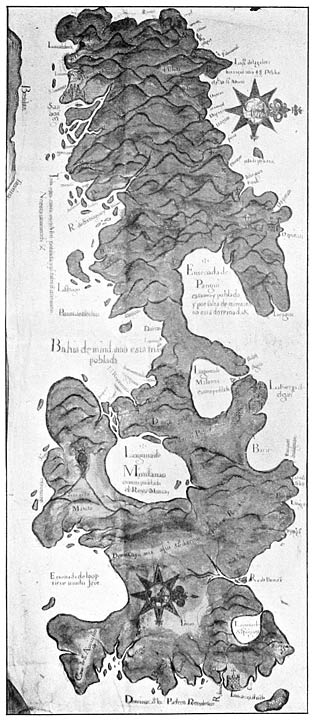
Map of Mindanao, showing settlements and districts occupied by Jesuits and Recollects
[From MS. (dated 1683) in Archivo general de Indias, Sevilla]
[Fol. 50:] In this time [about 1630] the Christian faith made great advances in Maragondong, Silang, and Antipolo, bringing many Cimarrons (or wild Indians) from their lurking-places. A very fruitful mission was carried on in Mindoro, and on the northern coast of Mindanao; and Father Pedro Gutierrez went along those rivers, converting the Subanos. In Ilog, in the island of Negros, the fathers labored much in removing an inhuman practice of those barbarians, which was, to abandon entirely the old people, as being useless and only a burden on them; and these poor wretches were going about through the mountains, without knowing where to go, since even their own children drove them away. The fathers gave them shelter, fed them, and instructed them in order to baptize them; and there they converted many heathens.
[Fol. 52:] In the year 1631 the cura of Mindoro, who was a secular priest, gave up that ministry to the Society, and Ours began to minister in that island, making one resilience of this and one of the island of Marinduque, and the superior lived at Nauhan in Mindoro; and they began to preach, and to convert the Manguianes, the heathen Indians of that island.
In the year 1631 was begun the residence of Dapitan, in the great island of Mindanao. The first Jesuit who preached in that island was the apostle of the Indias, St. Francis Xavier, as appears from the bull for his canonization. Ruy Lopez de Villalobos came to these islands with his ships, sent by the viceroy of Nueva España, and gave them the name of Philipinas in honor of Phelipe II; and, driven by storms, he went to Amboyno, where the saint then was, in whose care Villalobos died. At the news of these islands thus obtained by the holy apostle, he came to them. The circumstance that this island was consecrated by the labors of that great apostle has always and very rightly commended it to the Society; and Ours have always and persistently endeavored to occupy themselves in converting the Mindanaos; and Father Valerio de Ledesma and others had begun to form missions on the river of Butuan. In the year 1596 the cabildo of Manila, in sede vacante—in whose charge was then the spiritual government of all the islands, as there was no division into bishoprics—gave possession of Mindanao to the Society in due form; and in 1597 this was confirmed by the vice-patron, Don Francisco Tello, the governor of these islands. Possession of it was taken by Father Juan del Campo, who, going as chaplain of the army, accompanied the adelantado, Estevan Rodriguez de Figueroa, when he set out for the conquest of that kingdom.
[Fol. 63 b:] In the islands of Pintados those first laborers made such haste that by this time [1633] there remained no heathens to convert, and they labored perseveringly in ministering to the Christians, with abundant results and consolation.... In the island of Negros and that of Mindanao, which but a short time before had been given up to the Society, the fathers were occupied in catechising and baptizing the heathens and especially in the island of Mindoro, where besides the Christian convents, were the heathen Manguianes, who lived in the mountains, and, according to estimate, numbered more than six thousand souls. These people wandered through the mountains and woods there like wild deer, and went about entirely naked, wearing only a breech-clout [bahaque] for the sake of decency; they had no house, hearth, or fixed habitation; and they slept where night overtook them, in a cave or in the trunk of some tree. They gathered their food on the trees or in the fields, since it was reduced to wild fruits and roots; and as their greatest treat they ate rice boiled in water. Their furnishings were some bows and arrows, or javelins for hunting, and a jar for cooking rice; and he who secured a knife, or any iron instrument, thought that he had a Potosi. They acknowledged no deity, and when they had any good fortune the entire barangay (or family connection) killed and ate a carabao, or buffalo; and what was left they sacrificed to the souls of their ancestors. In order to convert these heathens, a beginning was made by the reformation and instruction of the Christians; and by frequent preaching they gradually established the usage of confession with some frequency, and many received the Eucharist—a matter in which there was more difficulty then than now. Many came down from the mountains, and brought their children to be instructed; various persons were baptized, and even some, who, although they had the name of Christians, had never received the rite of baptism. After the fathers preached to the Christians regarding honesty in their confessions, the result was quickly seen in many general confessions, which were made with such eagerness that the crowds resorting to the church lasted more than two months.
[Fol. 69:] In Maragondong various trips were made into the mountains [by Ours], and although many were reclaimed to a Christian mode of living, yet, as the mountains are so difficult of access and so close by, those people returned to their lurking-places very easily, and it was with difficulty that they were again brought into a village—so that the number of Indians was greatly diminished, not only in Maragondong, but in Looc, which was a visita of the former place, and contained very rugged mountains. In order to encourage the Indians thus settled to make raids on the Cimarrons and wild Indians and punish them, Don Juan Cerezo de Salamanca, the governor ad interim, granted that those wild Indians should for a certain time remain the slaves of him who should bring them out of the hills; and by this means they succeeded in bringing out many from their caverns and hiding-places. Some of these were seventy or eighty years old, of whom many died as soon as they were instructed and baptized. Once the raiders came across an old woman about a hundred years old, near the cave in which those people performed their abominable sacrifices; she was alone, flung down on the ground, naked, and of so horrible aspect that she made it evident, even in external appearance, that she was a slave of the devil. Moved by Christian pity, those who were making the raid carried her to the village, where it was with difficulty that the father could catechise her, on account of her age and her stupidity. He finally catechised and baptized her, and she soon died; so that it seems as if it were a mercy of God that she thus waited for baptism, in order that her soul might not be lost—and the same with the other souls, their lives apparently being preserved in order that they might be saved through the agency of baptism. Blessed be His mercy forever! In Ilog, in the island of Negros, several heathens of those mountains were converted to the faith. An Indian woman was there, so obstinate in her blindness and so open in her hatred to holy baptism that, in order to free herself from the importunities of the minister, she feigned to be deaf and mute. Some of her relatives notified the father to come to baptize her. The father went to her, and began to catechise her, but she, keeping up the deceit, pretended that she did not hear him, and he could not draw a word from her. The father cried out to God for the conversion of that soul, and, at the same time, he continued his efforts to catechise her, suspecting that perhaps she was counterfeiting deafness. God heard his prayers, and, after several days, the first word which that woman uttered was a request for baptism—to the surprise of all who knew what horror of it she had felt. The father catechised and baptized her, and this change was recognized as caused by the right hand of the Highest; for she who formerly was like a wild deer, living alone in the thickets, after this could not go away from the church, and continued to exercise many pious acts until she rested in the Lord.
[Fol. 74 b:] In the year 1596 Father Juan del Campo and Brother Gaspar Gomez went with the adelantado Estevan Rodriguez de Figueroa, who set out for the conquest of this island [Mindanao]. After the death of Father Juan del Campo, Father Juan de San Lucar went to assist that army, performing the functions of its chaplain, and also of vicar for the ecclesiastical judge. Fathers Valerio de Ledesma and Manuel Martinez preached to the Butuans, and afterward they were followed, although with some interruptions, by others, who announced the gospel to the Hadgaguanes—a people untamed and ferocious—to the Manobos, and to other neighboring peoples. Afterward this ministry was abandoned, on account of the lack of laborers for so great a harvest as God was sending us. Secular priests held it for some time, and finally it was given to the discalced Augustinian [i.e., Recollect] religious, who are ministering in that coast, and in Caraga as far as Linao—an inland region, where there is a small fort and a garrison. When Father Francisco Vicente was ministering in Butuan the cazique [meaning the headman] of Linao went to invite him to go to his village; and even the blacks visited him, and gave him hopes for their submission. Thus all those peoples desired the Society, as set aside for the preaching in that island—which work was assigned to the Society by the ecclesiastical judge in the year 1596, and confirmed to them in 1597 by the governor Don Francisco Tello, as vice-patron. And when some controversy afterward occurred over [the region of] Lake Malanao, sentence was given in favor of the Society by Governors Don Juan Niño de Tabora and Don Sebastian Hurtado de Corcuera, as Father Combés states in book iii of his History of Mindanao. These decisions were finally confirmed by Don Fernando Valdès Tamon, in the year 1737.
In the year 1607 Father Pasqual de Acuña, going thither with an armada of the Spaniards, began to preach with great results to the heathens of the hill of Dapitan, where he baptized more than two hundred. He also administered the sacraments to some Christians who were there, who with Pagbuaya, a chief of Bohol, had taken refuge in that place. Afterward, Father Juan Lopez went to supply the Subanos of Dapitan with more regular ministrations. He was succeeded by Father Fabricio Sarsali, and he by Father Francisco Otazo and others, as a dependency of Zebu or of Bohol—until, in the year 1629, his illustrious Lordship the bishop of Zebu, Don Fray Pedro de Arze, governor of the archbishopric of Manila, again assigned this mission to the Society; and in 1631 the residence of Dapitan was founded, its first rector being the venerable Father Pedro Gutierrez; and in those times the Christian faith was already far advanced, and was extending through the region adjoining that place, and making great progress.
[Fol. 92:] The island of Basilan, or Taguima, is three or four leguas south of Samboangan, east from Borney, and almost northeast from Joló. It is a fertile and abounding land, and on this account they call it the storehouse or garden of Samboangan. Its people are Moros and heathens, and almost always they follow the commands received from Joló. The Basilans, who inhabit the principal villages, are of the Lutaya people; those who dwell in the mountains are called Sameacas. Three chiefs had made themselves lords of the island, Ondol, Boto, and Quindinga; and they formed the greatest hindrance to the reduction of that people, who, as barbarians, have for an inviolable law the will of their headmen, [which they follow] heedlessly—that being most just, therefore, which has most following. Nevertheless, the brave constancy of Father Francisco Angel was not dismayed at such difficulties, or at the many perils of death which continually threatened him; and his zeal enabled him to secure the baptism of several persons, and to rescue from the captivity of Mahoma more than three hundred Christians, whom he quickly sent to Samboangan. Moreover, the fervor of the father being aided by the blessing of God, he saw, with unspeakable consolation to his soul, the three chiefs who were lords of the island baptized, with almost all the inhabitants of the villages in it; and in the course of time the Sameacas, or mountain-dwellers, were reduced—in this way mocking the strong opposition which was made by the panditas, who are their priests and doctors. [Here follows an account of the conquest of Joló in 1638, and of affairs there and in Mindanao, in which the Jesuits (especially Alexandro Lopez) took a prominent part; these matters have already been sufficiently recounted in VOLS. XXVIII and XXIX].
[Fol. 116 b:] In Sibuguey Father Francisco Luzon was preaching, a truly apostolic man, who spent his life coming and going in the most arduous ministries of the islands. The Sibugueys are heathens, of a gentler disposition and more docile to the reception of the gospel than are the Mahometans; therefore this mission aroused great hopes. One Ash Wednesday Father Luzon went to the fort, and he was received by a Lutao of gigantic stature who gave him his hand. The father shook hands with him, supposing that that was all for which he stopped him; but the Lutao trickily let himself be carried on, and with his weight dragged the father into the water, with the assurance that he could not be in danger, on account of his dexterity in swimming. The father went under, because he could not swim, and the captain and the soldiers hastened from the fort to his aid—but so late that there was quite enough time for him to be drowned, on account of having sunk so deep in the water; they pulled him out, half dead, and the first thing that he did was to secure pardon for the Lutao. He gained a little strength and went to the fort; he gave ashes to the Spaniards, and preached with as much fervor as if that hardship had not befallen him. The principal of Sibuguey was Datan, and, to make sure of him, the Spaniards had carried away as a hostage his daughter Paloma; and love for her caused her parents to leave Sibuguey and go to Samboangan to live, to have the company of their daughter. Father Alexandro Lopez went to minister at Sibuguey, and he saw that without the authority of Datan he could do almost nothing among the Sibugueys; this obliged him to go to Samboangan to get him, and he succeeded [in persuading them] to give him the girl. The father went up toward the source of the river, and found several hamlets of peaceable people, and a lake with five hundred people residing about it; and their chief, Sumogog, received him as a friend, and all listened readily to the things of God. He went so far that he could see the mountains of Dapitan, which are so near that place that a messenger went [to Dapitan] and returned in three days. These fair hopes were frustrated by the absence of Datan, who went with all his family to Mindanao; and on Ascension day in 1644 that new church disappeared, no one being left save a boy named Marcelo. Afterward the Moros put the fort in such danger, having killed some men, that it was necessary to dismantle it and withdraw the garrison.
[Fol. 123:] [The Society of Jesus throughout the world celebrates the centennial anniversary of its foundation; the official order for this does not reach Manila in time, so the Jesuits there observe the proper anniversary (September 27, 1640) with solemn religious functions, besides spending a week in practicing the “spiritual exercises” and various works of charity. “On one day of the octave all the members of the Society went to the prisons, and carried to the prisoners an abundant and delicious repast. The same was done in the hospitals, to which they carried many sweetmeats to regale the sick; they made the beds, swept the halls, and carried the chamber-vessels to the river to clean them; and afterward they sprinkled the halls with scented water. Throughout the octave abundance of food was furnished at the porter’s lodge to the beggars; and a free table was set for the poor Spaniards, who were served with food in abundance and neatness. It was a duty, and a very proper manner of celebrating the [virtues of the] men who have rendered the Society illustrious, to imitate them in humility, devotion, and charity.”]
[Fol. 123 b:] In the Pintados Islands and other ministries Ours labored fervently in ministering to the Christians and converting the infidels. Nor was the zeal of the Society content with laboring in its own harvest-field; it had the courage to go to the ministers of the secular priests to conduct missions. Two fathers went on a mission to Mindoro and Luban, and when they were near the village their caracoa was attacked by three joangas of Borneans and Camucones. The caracoa, in order to escape from the enemies, ran ashore; and the fathers, leaving there all that they possessed—books, missal, and the clothing that they were carrying to distribute as alms to the poor Indians—took to the woods, through which they made their way to Naujan. On the road it frequently rained, and they had no change of clothing, nor any food save some buds of the wild palm-tree; they suffered weariness, hunger, and thirst, and to slake this last they drank the water which they found in the pools there. After twenty days of this so toilsome journeying they reached the chief town [of the island], their feet covered with wounds, themselves faint and worn out with hunger, and half dead from fatigue; but they were joyful and contented, because God was giving them this opportunity to suffer for love of Him. One of the fathers went back to Marinduque, where he found other troubles, no less grievous than those which had gone before; for the Camucones had robbed the church, ravaged the grain-fields, captured some Indians, and caused the rest to flee to the hills. The father felt deep compassion for them, and at the cost of much toil he again assembled the Indians and brought them back to their villages.
Soon after they had embarked, a sort of wind blew which made nearly all those who were coming in the ship fall ill; and from this sickness died five Jesuits, and thirty-three laymen; and in the flagship six religious of St. Dominic and seventy [other] persons. These sick persons gave sufficient occasion for the charity of Ours, who assisted them by administering the sacraments and caring for their souls; and they even busied themselves in relieving the sick, so far as was possible, with delicacies and personal attentions. This occupation was an excellent preparation in order that the sermons and exhortations that the ministers uttered might produce the desired result—that a great reform in morals and much attendance on the sacraments might be secured. [After perils and hardships by sea, and in the overland passage from Lampon to Manila, they reach that city. “It was a very numerous mission band, who accomplished much work; and there were some of them who spent fifty and even more than sixty years in Philipinas, which is a very extraordinary thing.” Five of them had died on the voyage: fathers Francisco Casela, a native of Naples, aged thirty years; Francois Boursin, a native of Arras, aged thirty-four; Georg Kocart, from Neuburg, aged twenty-eight; Gonzalo Cisneros, an Aragonese (?), aged twenty-eight; and Dominic Vaybel (probably for Waibl), a native of Constance, of the same age.] In the college of Zebu the Society labored with apostolic zeal; for, although regularly there was no one in it besides the father rector and another priest, they maintained preaching and confession, and attended to the spiritual welfare of the Spaniards, Indians, mestizos, and other people who gathered there; and God gave His blessing to our pious desires and labors. Many Indians attended the sermons that were preached in that church, even when the sermons were in Spanish.
[Fol. 152 b:] Our military forces, being set free from the nearer enemies, were employed against those more distant. Accordingly, the commander of our armada, Pedro Duran de Monforte, directed his course to the great island of Borney, where he burned many villages on that coast, and carried away forty captives; and he succeeded in making this voyage known [to navigators], and in observing the shoals, monsoons, and other difficulties. With this experience he again set out, on January 11, 1649, with fourteen vessels, his people being partly Indian adventurers from Pintados, partly Lutaos; and Father Francisco Lado accompanied him. He touched at Lacaylacay; went on to Onsan, the limit of the former expedition; and went to the island of Bangui. Everywhere he found abundance of rice, swine, and goats. He plundered and destroyed several villages; burned more than three hundred vessels, among them the armed fleet which they held ready that year to infest these islands—which on account of this exploit remained for the time free from their fury and barbarity. He brought back more than two hundred captives, and ransomed some Christians. All this was done in a short time and with ease, because these affairs were undertaken with proper seriousness. As a result of this, when the governor of Samboangan, Rafael Omen, died, Pedro Duran de Monforte was appointed in his place; and the latter imitated his predecessor in his zeal for religion, in his Christian mode of life, in disinterestedness, and in an affable and mild bearing, for which he was beloved by all, while his government was peaceful and prosperous. With the opportunity afforded by these armadas, the Jesuits (who went as chaplains) began to announce the gospel in the great island of Borney, than which there is no larger island in the world. So prosperous were those beginnings that they succeeded in having seven hundred islanders baptized. Two chiefs of the neighboring islands offered vassalage to the king of Spain, and asked for gospel ministers, as Father Colin testifies; and this mission finally gave hopes that a numerous and extensive Christian church would be founded which would compensate for the losses in Japon and the Orient; but, lacking the protection of the Spanish military forces, this so beautiful hope faded away almost at its flowering. Deplorable and repeated experiences persuade us that in these latter times the Christian missions are maintained and increased only when in the shelter of Catholic arms; sad witnesses to this are Japon, India, and now China. If in these islands and America our kings did not protect religion, I believe that those regions would now be as heathen as in their former times. Experience teaches this, and the rest I regard as speculation—although the powerful arm of the Highest easily overcomes the greatest impossibilities.
[Fol. 155 b:] The testimony of the venerable Father Mastrili, and the voluntary choice of so many distinguished Jesuits and martyrs who embraced these missions with the greatest eagerness, are sufficient recommendation for them. With just reason they can be esteemed, as being among the most laborious and difficult which the Society maintains anywhere in the world. This title is deserved by the missions of Philipinas, and among them those to Mindanao and the Subanos are some of the most difficult. No one accuses this statement of being exaggerated, and still less of being arrogant, before he has examined it minutely; and then he cannot find more moderate terms [than the above] in order not to fall short of the truth. Whatever dangers, inconveniences, and privations are experienced on land are also experienced on the sea, with an [additional] sort of circumstances which renders them more grievous, and besides this there are the hardships natural and peculiar to that element; and even that which on land is chosen for convenience and relief costs on the sea inconvenience and trouble—as, for instance, sleeping, eating, and taking exercise. Every boat is a prison without chains, but more closely shut than the narrowest jail; it is a broad coffin, in which the living suffer the discomforts of death. Whoever sets foot in a boat resolutely confronts all the elements, which conspire in arms to terrify and destroy him. The water upon which he journeys, the air by which he sails, the fire by which he lives, the land which he so anxiously seeks—all are declared enemies of the traveler. The sea is, by antonomasia, the theater for [all] perils; and no one who has not been tossed upon its foaming waves can speak with justice of its dangers, just as the blind man cannot dispute about colors. A heart of steel or of diamond, say the ancients, he must have had who first boldly launched himself upon the [waters of the] gulfs, so many perils did they conceive of an element which has as many treacheries as waves. Therefore, as nearly all the missions of this province are established along the seas, on which our missionaries go about, continually on the move, these are the (or among the) most difficult, arduous and perilous that exist on the whole round globe. To this sacrifice charity gladly constrained us. Let to all this be added the nature of the country, in which earthquakes, baguios, hurricanes, storms of thunder and lightning, and tempests often occur. The winds are violent and hurtful, the season hot; the rainy season gloomy, dark and persistent; the wet soil producing many disgusting insects that are troublesome and vexatious. The care for the temporal welfare of the people—seeing that they pay their tributes to the king, and that they plant their fields in time—is an employment that is troublesome, tedious, and necessary. Nor is it a less task to take care for the provisioning of the [missionary’s] own house, without having in this respect the aid which the apostles had; because the minister must rather care for his own house and for that of others, a charge which charity lays upon us. Charitas omnia sustinet [i.e., “Charity endures all things”].
Each missionary in Bisayas (or Pintados) has the care of two to five thousand souls, and even more. These commonly are divided among two or three villages, quite far apart; and throughout the year the minister is sailing from one to another, to preach to them and aid them. Among the Subanos there are not so many people [in each mission], but their little villages are more numerous. Formerly each minister had ten or twelve villages of Subanos, [each] divided on as many rivers, in the form of hamlets. There were houses round about the church or pavilion [camarin], and the rest [of the people] lived scattered in the hills, forests, and thickets. I have seen some native huts [buhios] on the peaks of the mountains, [so far away] that they could hardly be reached in half an hour from the river. Others I saw placed among the branches of the trees, in the same manner as nests. Their houses regularly are very high, with a bamboo for a ladder, which they remove at night. All this they do in order to hide themselves and be free from the frequent invasions of the Moros; and from the stratagems and treacheries of their own countrymen, who are inclined to vengeance and perfidy. Among these people we live. The rivers are full of ferocious and blood-thirsty crocodiles, which kill many persons. When I was in Dapitan there was one of these beasts in the river of Iraya, so sanguinary and fierce that no one dared to pass that river by night, on account of the ravages that it committed—leaping into the boats, and taking people out of them. In the books of those villages, I read with horror and pity: “On such a day was buried the head of N., which was all that was found, because the crocodile had torn him to pieces.” The bars of the rivers are dangerous, and with the freshets and the waves some channels are easily closed and others opened, to the great risk of those who are sailing. The seas are rough, and so restless that the continual lashing of the waves on the shores, rocks, and reefs makes a sound which causes fear even in those who live inland. On that coast are headlands so difficult to double that sometimes the caracoas spend twenty or thirty days in voyages which in favorable weather require half an hour. As a result, the ministers live in great loneliness, without being able to communicate with one another—save that, when the monsoons blow, in order to make one’s confession a voyage is necessary; and therefore this consolation is attained by some but few times in the year. If a fatal accident occurs to one, it is not possible to assist him with the holy sacraments—which is the greatest affliction that can be endured in the hour of death; and their only recourse is to place themselves in the hands of that Lord for whom they expose themselves to these sufferings. Even greater are the fatigues endured by the soul in the frequent occasions which disturb its patience. The feeling of indifference which is native to the country tends to undermine gradually the wall of poverty, weaken the spirit of obedience, and cool the most fervent spiritual ardor and strictness of observance. Even the blood which animates us and gives us life is mutinous, and stirs up the passions against their own master; and, aided by the noxious air of the country, the extreme solitude, and the common enemy, wages a war that is cruel, obstinate, bloody, and so pertinacious that it does not yield until the last breath of life....
To this must be added the continual dread of invasions by the Moros, of whose barbarous and inhuman cruelty alone the missionaries are assured, fleeing to the mountains amid thorns, woods, miry places, and precipices. On the coast from Yligan to Samboangan, I saw with great sorrow various churches and villages that had been burned. The ministers saw themselves in the greatest danger of being captured or slain, and in their flight they suffered unspeakable hardships. Nor are dangers wanting among even the Indians themselves; they were very near putting to death by treachery Father Joseph Lamberti at Hagna, and Father Gaspar de Morales at Ynabangan, in the year 1746. For others they have laid ambushes, others have been wounded, and even some have been injured by witchcraft—so that in all directions there is danger.
[Fol. 183 b:] In the conversion of Basilan, fervent were the labors of Father Francisco Angel and Father Nicolas Deñe; and both suffered great dangers to their lives and liberty. They were succeeded by Father Francisco Lado, who by his persistence in enduring innumerable fatigues subdued the entire island; went through all of it, on foot, alone, and without escort; made his way through its thickets, forests, mountains, and hamlets; and did this in such peace that he could build a very neat church and substantial house—for he was much loved by the Lutaos; and he had, with the aid of the governors of Samboangan, cleared the island from all the panditas, and from mischievous and suspicious persons, who might disturb the people with evil doctrines or with immoral practices. Only one remained there, who by his malice was disturbing even the peaceful natives; this was Tabaco, who had incited to rebellion the Sameacas, who are the natives of the island. [This man is finally slain by a daring young Spanish officer, Alonso Tenorio; see our Vol. XXXVIII, pp. 134–136.]
With similar success the religion of Jesus Christ was published along the coast which extends toward the kingdom of Mindanao. Father Pedro Tellez zealously traveled through those shores, where he formed several villages, erected more than sixteen churches, and established Christian living; and he made his abode in Tungavan. Notable aid was given to this enterprise by Don Antonio Ampi, the lord of the river, who always promoted the Christian religion with extraordinary constancy—although he had in Jolo a brother named Libot, a renegade and a cruel pirate—and he gave to the college at Samboangan some fertile and productive lands. At the cost of toils and privations, Father Tellez reduced the barbarous Subanos to rational and Christian customs, drawing them out of their caves and huts, and from under the cruel tyrannical yoke of the demon—who made apparent the great resentment that was roused in him by the loss of those his long-time slaves; for at various times the horrible howls that he uttered were heard at Curuan. For ministration on the coast of La Caldera and Siocon, which was left deserted by the death of Father Juan del Campo, the father provincial Francisco de Roa assigned Father Francisco Combés, who gladly went to instruct the Subanos. Most earnestly he applied himself to bringing those wild and timid creatures into closer social relations, and in doing this he was able to forward their instruction in the mysteries of the faith; and gradually they became accustomed to a more rational and Christian mode of life. On the river of Sibuco there was an Indian named Ondol; this man and his brother, worse than Moors, were married to several wives; and Ondol was so cruel that he slew whomsoever he chose, without further cause than his own whim. He tried to kill Father Adolfo de Pedrosa, greatly applauded the killing of Father Juan del Campo, and threatened that he would kill Father Combés; but the latter pretended to take no notice of it, and was cautious, and concealed his intentions; and Ondol went on confidently, so that, when he least thought of such a thing, he found himself a prisoner, and was sent to Samboangan where he was received by the Spaniards and by the fathers with great pleasure at seeing removed from the midst [of the mission] so great an obstacle to the Christian faith. His brothel continued to stir up the people, and an armed fleet was sent against him, but without any result; for the noise [of their coming] warned him so that he could avoid the blow, among woods, hills, miry places, and thickets. The escort of the father [i.e., Combés] continued to make arrests, with cunning devices, until they seized fifteen of this man’s relatives; and the father sent them to Samboangan. Love for his kindred brought that wild man to the church, to ask mercy from the father. He was admitted to favor, and all the past forgotten, with one condition: that he and all his people, since they were Lutaos, must live under the artillery of the fort, and serve in the [Spanish] armada. With this arrangement that coast remained peaceable, for the insurgents of Siocon had also been seized by craft. Father Combés went to that place, and encountered very heavy seas, not only at entering but on leaving that village; and arguing [from this] that God was not allowing them to go until they interred the bones of the companions of Father Campo, they all lauded on the shore, and searched for the bodies among the thorny thickets. Having interred all of them together, and said a mass for them, the Spaniards placed a cross over the sepulcher; and immediately the weather became calm, so that the caracoas were able to set out. At that time Father Combés carried away a hermit, who, clothed as a woman, strictly observed the law of nature, and professed celibacy. He was called “the Labia of Malandi;” and he was converted to the religion of Christ, in which he lived as a faithful servant.
In La Caldera was introduced the devotion to the blessed souls in purgatory, and suffrages for the deceased, which never had been publicly performed among any Subanos. To render this service more solemn, the musicians were carried thither from Samboangan; and this, joined with the father’s exhortations, introduced in their hearts pious solicitude for their dead—so well begun that, in the midst of their native poverty and the dulness of their minds, they carried with them many candles, with rice and other offerings. From that place this holy devotion was gradually communicated through all those villages, following the example of La Caldera—which then was the principal village, in which the minister resided; and to it were annexed Bocot, Malandi, and Baldasan. Besides the above-mentioned cases, others occurred with which the Lord consoled the ministers, in recompense for the misery, hardships, and forlorn condition of those arduous and remote missions.
On the first day of March, 1654, the archbishop made publication of these favors conferred by the pontiff; and all the people prepared with great fervor to obtain them—so universally that the many confessors of the clergy and the religious orders were hardly sufficient for the numbers who resorted to them; and it was estimated that within the city more than forty thousand persons made their confessions. The result was very excellent, for many confessions were made anew that had been for many years faultily made—either to conceal sins, or for lack of sorrow for them—and of their own accord. Many general confessions were made, and the grace of God was made apparent in the excellent results which were experienced. Restitution was made of honors and property, inveterate hatreds were uprooted, immoral associations of many years’ standing were broken up, and occasions for continual stumbling were removed. On the twenty-second day a solemn mass was sung in the cathedral, the blessed sacrament was exposed, and the archbishop preached with the fervor that the case demanded. At twelve o’clock the bells began to ring for prayers in all the churches, the sound of the bells being a fresh awakener of consciences. In the afternoon the archbishop went to the main plaza, where a stage had been erected, of sufficient size, almost, for a court from above; on it was an altar, with a crucifix for devotion, under a canopy. On this stage sat the archbishop, with the ecclesiastical cabildo; and the royal Audiencia were there with their president, the governor and captain-general, also the regidors and the holy religious orders; while there was an innumerable assembly from every sort of nation and people, for whom there was not room in the plaza or in the streets, or on the roofs. The archbishop put on his pontifical robes, and, when the psalms were sung and the usual prayers offered, he publicly uttered the blessing on the land and all its inhabitants in the name of the supreme pontiff; and afterward the Te Deum was intoned, and the chimes were rung by all the bells.
[Our author here relates the beginning of the rebuilding of the cathedral (which had been destroyed in the earthquakes of 1645), and the solemn religious functions which accompany the laying of its cornerstone in 1654; and the formal adoption of St. Francis Xavier as the patron saint of the islands (1653), by action of the secular cabildo of Manila, who bind themselves “to attend the vespers and the feasts of that saint’s day in a body, as the municipal council, and to furnish the wax necessary for the feast.” He is also chosen as patron saint of all the voyages made to, from, or among the islands. This action is followed by that of the ecclesiastical cabildo (1654) and the archbishop. That saint is chosen because he had preached in Ternate and Mindanao, which belonged to the jurisdiction of the Philippines; in imitation of India, where also he was the patron saint, and where his favor had been experienced by navigators; and “because the glorious saint had shown himself, especially in recent years in this region, very propitious to the voyages of our ships,” of which various examples are cited.]
[Fol. 231 b:] The archbishop had seen in the publication of the jubilee the persistence with which the Jesuits labored in the confessional; and desiring to finish gathering in the harvest which the broad field of these environs promised him, if the proper cultivation were applied, in the year 1655 he asked Father Miguel Solana, the provincial of this province, that the “jubilee of the missions” might be published. This was done in the following Lenten season, with so felicitous results that more than twenty thousand certificates of confession were counted which had been issued in our college at Manila. The zeal of the archbishop aided greatly [in this result], for he took part in the procession in which the mission was published, and preached one day in our church.... Extraordinary was the fruit which he gathered that Lent; and confessions were made [for a period] of sixty or eighty years. [Here are related various cases of conversion and edification, in some of which demons appear to the faithful. Governor Diego Faxardo sends workmen to Camboja to build a galleon there, and asks for Jesuits to go with them as chaplains, and to labor for the introduction of the Christian faith into that kingdom; two are sent, one of whom is Father Francisco Mesina, who was then ministering to the Chinese at Santa Cruz. These men build a fine galleon, but it is lost in a storm on the way to Manila; moreover, the galleon “Nuestra Señora del Rosario,” in which they had sailed to Camboja, “one of the strongest which had been built in these islands,” was wrecked on the shoals of the Me-Khong (or Cambodia) River, before the Spaniards could establish themselves on its shores. These accidents cause the idea of building ships in Camboja to be abandoned.] Although the temporal government of Ternate belonged to the crown of Castilla, and to this government of Philipinas, its spiritual affairs were cared for by the bishop of Malaca; and when that city was conquered by the Dutch, Ternate remained in the care of only one Jesuit and one secular priest for many years. Don Sabiniano Manrique brought to Manila the father and the Portuguese priest, and in their place two fathers from this province were sent, whom the archbishop of Manila constituted his provisors and vicars-general. These fathers preached with great fervor and corresponding results; for many Christians improved their mode of life, and some Moors and heretics of that country, giving up their errors, embraced the true religion. Among all these the ones who excelled in fervor were two young girls, about fourteen years old, who, abandoning their parents (who professed the Moorish faith), came to Ours to be made Christians—with so dauntless resolution that, although their parents followed them in order to take them back to their own village, they could not persuade them to return; and God bestowed such efficacy upon the utterances of these girls that even their parents, illumined by the light of the Highest, determined to follow the same religious faith. Various results of the mercy of God were seen in some persons who, a short time after receiving grace in baptism, ascended to enjoy their reward in glory.
In Siao the king was Don Bentura Pinto de Morales, who, grieving that his island should lack gospel ministers, despatched an embassy to Don Sabiniano Manrique, laying before him the extreme necessity of that island and kingdom, and entreating that he would send thither religious to preach the holy gospel; the zealous governor [accordingly] asked the father provincial, Miguel de Solana, to send two fathers to relieve that need. They were immediately sent, and began their work on so good a footing that in a short time they commenced to gather the fruit that they desired; and, not content to labor with the old Christians, they added to the flock of Christ a great multitude of souls, so that in a few months nearly all the islanders were asking for baptism. The city of Macan had sent to Manila a nobleman named Don Diego Furtado de Mendoza, to regulate the commerce [between the two cities]; and Don Diego Faxardo, perhaps for [well-grounded] suspicions, ordered that he be arrested. But afterward Don Sabiniano sent this envoy back to Macan; and in November of the year 1653 he sent a vessel, and in it Father Magino Sola with the title of ambassador, to establish friendly relations between this and that city, and with other commissions; and they arrived at Macan about March, 1654.
In these times [of which we are writing] many Subanos had come down to Dapitan from some neighboring mountains, and were brought into the fold of Christ. Afterward a chief from Dicayo came down with his people, and was followed by others, from other hamlets; the ministers were greatly consoled at seeing the fruit that was gathered in that district of heathens. At the same time some Moros from the lake of Malanao settled at Yligan, in order to be instructed and to live as Christians in that village; and God deigned to work some marvels, so that they might properly appreciate the Catholic religion. [Some of these are related; then follows a long account of the schemes and perfidious acts of Corralat, and of the murder (December 13, 1655) by his nephew Balatamay of the Jesuits Alexandro Lopez and Juan de Montiel, and the Spanish officer Claudio de Ribera, who were going to Corralat as envoys from Governor Manrique de Lara. All these occurrences have received due attention in previous volumes.]
A mission was conducted in the mountains of Santa Inez of Lanating, a visita of Antipolo. One of the missionaries was the same Father Diego Luis de San Vitores, and in seven days he gathered a very abundant harvest; for in that short time twenty-four thousand heathens, Aetas or Cimarrons, were baptized, and many others were prepared for the rite, who received baptism afterward. [The author describes several of these conversions; he also cites various entries of especial interest from “the books of the old mission of Santa Ines, which I have before me;” many of these are of baptisms made by Father San Vitores. “This mission was cared for by a devout Indian named Don Juan Estevan, who afterward was a donado, and in the absence of the minister instructed and baptized them—as did the Canacopoles, whom St. Xavier chose in India.”]
In the year 1669 there was a church and visita in Bosoboso; in 1672 there was a church in Paynaan; and in 1678 was established the church of San Isidro. These two [latter] villages lasted until recent years, when they were included in Bosoboso. Excursions were made into the mountains, and many Aetas, Christian and heathen, were brought out from their hamlets; and with charity and kindness efforts were made to settle them in the said visitas, wherein, in due time, a permanent minister was stationed. It appears from the books of the said visitas and villages that many adults were baptized—of twenty, thirty, forty, and fifty years, and even more; this was a task of the utmost difficulty for the ministers, in drawing those people out of their lairs, and even more in maintaining them in a social and Christian mode of life, on account of their natural inclination to go wandering through the woods and mountains. In the year 1699 the zealous archbishop Don Diego Camacho came to this mission, and baptized several of them—among others, four heathen adults—as appears from the books of Paynaan.
In the year 1665, on the nineteenth of July, there was a violent earthquake in Manila, in which nine persons died; and it inflicted considerable damage in the wing of our college. At this the zealous archbishop arranged that a mission should be held in Manila and Cavite; and through the preaching and example of those engaged therein great results were obtained. In October of the same year, Father Diego Luis de San Vitores and some companions went to the island of Mindoro, then in charge of secular priests. On sea and on land they suffered great fatigues and hunger, heat and storms, toils and dangers; but all this they regarded as [time and strength] well spent, when they saw how the liberal hand of God was rewarding them with the consolation of beholding with their own eyes the fruit of their labors—not only in the old Christians, who had reformed their morals; but in the infidel Manguianes, many of whom were converted to [our] religion. They experienced a thousand tokens of the providence and kindness of God. Although there were several languages in the island, they easily gained a knowledge of what was necessary for instructing the natives, preaching to them, hearing their confessions, and settling their affairs. Sometimes a contrary wind obliged them to put back, directed by the hand of God, in order to relieve the necessity which demanded their coöperation in those hamlets. Sometimes the rivers overflowed their banks, and they found it necessary to travel to places in which they found sufficient occasion for the exercise of their charity. Many conversions of special interest were obtained, of both Christians and heathens; and remarkable among all of them was that of a Manguian woman, a heathen, married to a Christian man. She was baptized, and named Maria; and afterward they called her “the Samaritan,” on account of the many persons whom she brought to the knowledge of Christ, the ministers availing themselves of her aid for the conversion of many persons, not only heathens but Christians, with most happy results. Her husband was a Christian by baptism, but worse than a heathen in his life; he would not even accept the rosary of the blessed Virgin, and it was necessary for his wife to put it about his neck by force; and it had so much efficacy that from that time he undertook to be a Christian in his acts, as he was one by name. The fathers erected three churches for the converted Manguianes: the church of our Lady, near Bongabon; that of San Ignacio, near Pola; and that of San Xavier, on the coast of Naojan. Another was built, named for the holy Christ of Burgos, for the old Christians who were roaming about through the mountains.
[The rest of Murillo Velarde’s Historia is mainly occupied with the history of the Spanish conquest of the Marianas Islands, and the missions of the Jesuit order therein; also with the Pardo controversy and various other matters which have been already treated in this series, besides the lives of Jesuits in the Philippines—which here, as throughout our series, we have presented only in very brief and condensed form; but which in these religious histories are often exceedingly detailed and prolix. We present a few more extracts from our writer, showing the distinctive occupations, methods, and achievements of the Jesuit missionaries there, and events affecting those missions.]
[Fol. 350 b:] In the year 1696 the very religious province of St. Augustine surrendered the village of San Matheo to the Society, in virtue of a certain exchange; we gladly accepted it, in order to bring in the Aetas who are in the mountains of that region, to live as a Christian community in the village; for, Christians and heathens being mingled in those woods and little hamlets, there was little difference between them in their customs. Here I will bring together the facts pertaining to this ministry, since it is matter belonging to this history for the connection of events. In the year 1699, the convent of San Agustin in Manila made claim to a ranch in this district, on the ground that Governor Santiago de Vera had granted to the said convent two limekilns for the erection of its building. The Indians, on account of the crude notions which they form of things, began to call the limekilns “the ranch;” and this blunder was so prevalent that in some grants which the governors made afterward in that territory they say that the lands “border upon the ranch of San Agustin.” In the said year an investigation was made, and all that could be drawn from the declarations of the Indians was this confused notion of a “ranch,” which they had heard from their elders, without being able to specify boundaries, or locations, or landmarks. And as there was no other title or grant than this very uncertain information, the judge of land [claims], Don Juan de Ozaeta, auditor of the royal Audiencia, rejecting their claim for lack of authentic documents, was unable to grant to that convent the ranch which it demanded.
In the year 1713 the minister of that village was Father Juan Echazabal, whose scrupulous conscience, added to his natural disposition, made him so inexorable a guardian of the injunction to hear mass that in this point he very seldom excused [an offender] from penance. So active was his zeal that he spared neither labor nor diligence to secure the attendance of the Indians at the holy sacrifice of the mass, at the sermons, and at the other church functions; and he cheerfully endured the inconvenience of waiting for them a long time, in order that their natural slothfulness might not have this excuse. His persistence secured considerable results, notwithstanding that wild grapevines were not lacking even in the midst of so much cultivation. But what assiduity does not the obstinate perversity of men frustrate? An insolent Indian, Captain Pambila, at various times provoked the forbearance of the minister by his shameless conduct; for, purposely staying away from mass, and glorying in this wrong-doing, he boasted among his friends that the father would not dare to rebuke him. The minister endeavored by various means to bring him to reason, but all his efforts proved unsuccessful; and the audacity of this Indian kept continually increasing, continually launching him into new transgressions on top of the old ones—and scandal arising, because some persons were following in his footsteps and others were inclined to do so. In order to check the evil consequences of this, Father Echazabal gave information of the whole matter to the governor, Conde de Lizarraga, who sent thither Captain Don Lorenzo de Yturriaga with twelve soldiers. But Pambila was by this time so bold that when they went to arrest him he went out to meet them with his cutlass, and dealt a blow at the captain; the latter parried the blow, and firing a pistol, killed the bold man. At this occurrence the malcontents were greatly disquieted, and had recourse to the vice-patron, asking that he remove Father Echazabal from that ministry; and they even made the further demand that it be restored to the Augustinian fathers. In order to push their claim, they revived the old [one of the] “ranch”—this time in clearer language, for they indicated locations and boundaries. But, as all these were arbitrary, the measures [of distance] did not correspond [to the facts]; for while it was one site for a ranch that they claimed, there were three or four such sites that were included in the places that they had arbitrarily marked out. Nevertheless, this claim was promoted, so that the convent of San Agustin obtained a favorable decision from the royal Audiencia. But Father Echazabal opposed this, together with the greater part of the people of the village, as did also Father Agustin Soler, procurator of the college of San Ignacio at Manila, on account of the damage that would ensue to them respectively. The Audiencia, having examined their arguments, reversed its decision—although, through shame at so speedy a reversal, the auditors set down in the decree that possession should be given to the convent of San Pablo [of that] in which there was no dispute. This sentence on review ended the controversy, and matters remained as they were before. To pacify the Indians, the superiors removed Father Echazabal from that place, and everything was quiet for the time—although after many years the old [question of the] “ranch” was revived, with greater energy, as we shall see in due time. Let us proceed to more pleasing matters.
In the year 1705, Father Juan Echazabal began to promote, in the village of San Matheo, the devotion to our Lady of Aranzazu; and the devotion to and adoration of that Lady steadily increased, with the encouragement of the Vizcayans, and especially of Don Juan Antonio Cortes. This incited the minister to undertake the building of a stone church, in order to provide a more suitable abode for the blessed sacrament and for the sovereign Queen. Through the persistence and energy of the father and the contributions of the faithful, a beautiful, substantial, and spacious church was completed, with its transept and handsome gilded reredos. The new church was dedicated in the year 1716, the minister being Father Juan Pedro Confalonier. There was a very large concourse of people, and the devotees of the blessed Virgin of Aranzazu made extraordinary demonstrations of joy and devotion in celebrating her feast; and great was the satisfaction of those who with their contributions had aided [to provide] the costly building and adorn it with ornaments and rich furnishings of silver—especially the illustrious benefactor of that church and village, General Don Juan Antonio Cortes. And the Society, with the pleasure of dedicating to God and to His blessed mother this new temple, forgot the great sorrows that they suffered at that time from various defamatory libels, in which malignity repeated what had so many times been condemned, and was anew condemned, as calumny—their author being, most deservedly but impiously, his own executioner, at seeing that the arrows discharged by audacity against the Society were changed into crowns of triumph.