Volume 44 — THE GOVERNMENT AND DEATH OF BUSTAMANTE
Reading edition
[A brief summary of the events antecedent to and connected with the government of Bustamante is here presented, obtained from the very detailed and prolix account in Concepción’s Historia de Philipinas, ix, pp. 183–424.]
[The Conde de Lizarraga, who began to govern the islands in August, 1709, dies at Manila on February 4, 1715; and the vacancy in his office is, as usual, temporarily filled by the Audiencia, Auditor José Torralba assuming charge of military affairs. In the Tournon affair of 1704, the senior auditor, José Antonio Pabon, had not resisted Tournon’s unwarranted assumption of authority, and had therefore inclined the displeasure of the home government, being deprived of his office and fined. He thereupon petitioned for a reversal of this sentence, and restitution to his office and salary, which was granted by a royal decree of April 15, 1713; this document arrives at Manila during Torralba’s rule, who declines, on various pretexts, to reinstate Pabon, and even attempts to obtain evidence damaging to his official character. Pabon therefore is obliged to take refuge in the Augustinian convent at Manila, and remains there until the arrival of Bustamante; the latter brings suit against Torralba to compel him to obey the royal decree in favor of Pabon, and to pay all moneys due to the auditor. Torralba had also instituted proceedings against another auditor, Gregorio Manuel de Villa, and two officers, Santos Perez Tagle and Luis Antonio de Tagle, on the charge of their having aided and abetted the Castilian Recollect religious in their revolt against their superiors in the order. (After the dissensions between the religious orders and Archbishop Camacho, resulting from his attempt to enforce episcopal visitation of the regular curas, the despatch of missionaries to the islands is greatly diminished, partly on account of those dissensions, partly because the “seas are infested with English and Dutch squadrons.” All the orders therefore suffer from a scarcity of laborers; but the Recollects are fortunately reënforced by a mission band, conducted by Fray Joseph de Santa Gertrudis, of fifty-seven religious, “among them the flower of the province of Castilla.” Later, in the distribution of the ministries and offices of the order in the islands, strife arises; the older members of the province—mostly from Aragón, with some from Valencia and Cataluña—secure all the best offices, as against the Castilians. When the provincial chapter meets, the latter present their claims, but are rebuffed; thereupon they convene a chapter of their own, in the convent at Bagumbayan, and elect a provincial and other officers. This throws all the business of the order into confusion, and Governor Lizarraga persuades the two parties to refer the controversy to the head of the order in Europe and to abide by his decision, which finally recognizes as legal the chapter held at Manila. Various difficulties arise in attempting to enforce this decision, but Lizarraga, who favors the Castilians, induces the provincial to leave them with their students at Bagumbayan. After the governor’s death, Torralba aids the provincial by sending troops and bombarding that convent, to bring back the recalcitrants to Manila.) Torralba, having arrested Villa and the Tagles, keeps them in rigorous confinement, and hinders their appeal to the Council of the Indias; both sides send to Madrid statements of their respective claims. By royal decrees of August 18, 1718, all of Torralba’s proceedings against them, as well as against Auditor Pabon, are declared null and void, and they are restored to their respective offices. Bustamante assumes the governorship on August 9, 1717; his first proceeding is to investigate the condition of the royal treasury, which he finds in bad condition, with large sums due to it and unpaid by the citizens. He takes severe measures to compel the payment of these debts to the government—among them, laying an embargo on the cargo of the galleon which comes this year from Acapulco, in which large amounts of goods and money have been brought illegally, to avoid payment of duties. A complete investigation of the ownership and registration of this wealth is ordered, the governor placing it in the charge of Andres Fernandez de Arquiju and Esteban Hizguiño. As a consequence of the governor’s energetic measures, within the first six months of his government the sum of 220,671 pesos is placed in the royal treasury, besides the situado for that year, which amounts to 74,482 pesos; and the balance of accounts on February 1, 1718, shows that the treasury actually contains 293,444 pesos, besides jewels and other valuables deposited for debts to the crown. Concepción gives the principal items of revenue and expense at that time. An embargo is also laid on the silver which comes in the galleon of 1718, but little advantage therefrom results to the treasury. This financial investigation also shows that Torralba, during his government, and the royal officials had mismanaged the royal revenues, shown great carelessness in the bookkeeping, accounts, and allowed funds to disappear without any satisfactory accounting; Bustamante therefore imprisons them all, and seizes their goods.]
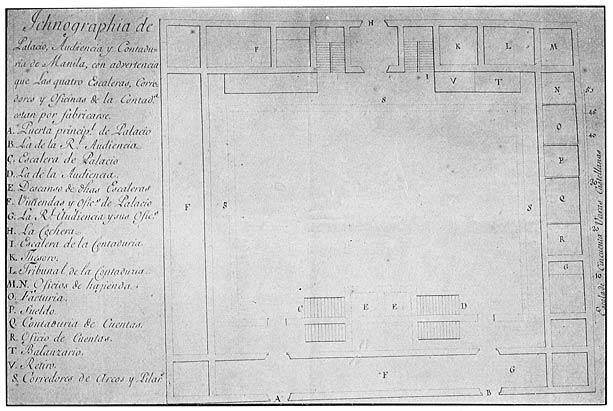
Plan of the palace, Audiencia hall, and exchequer of Manila
[Photographic facsimile from original MS. in Archivo general de Indias, Sevilla]
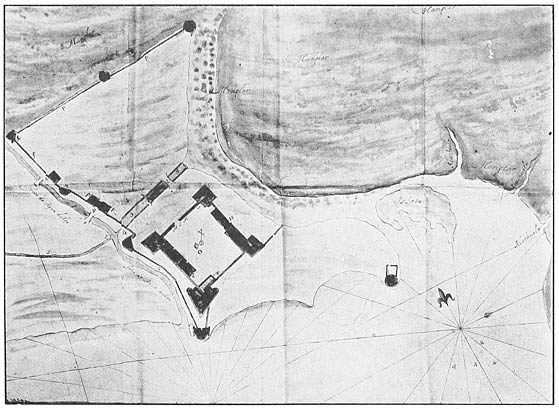
Plan of fortifications at Zamboanga, 1719
[Photographic facsimile of original MS. map in Archivo general de Indias, Sevilla]
Letter from Diego de Otazo, S.J.
I will not omit sending a relation to Madrid, on this occasion when letters are sent from Manila to that court, of the tumultuous changes [here], of which your Reverence probably knows—if perchance (even though my influence be little and my authority less) my letter, when communicated to the father confessors of his Majesty and Highness, may contribute to the greater glory of God, and the welfare of these islands and of the souls who are converted in them, and those who may yet be converted when this community is established in tranquillity and order; it is this alone which I regard as the only object for which I can and ought to strive, since this alone has brought me to these islands.
Father Procurator: Don Fernando Bustillos y Bustamante (whom may God have forgiven) began his government of these islands with so much violence that, as he carried it to the extreme, this very thing deprived him of life. Blinded by the two mighty passions, greed and pride, and exercising the absolute power that the government of these islands confers on him, and taking advantage of the great distance from his sovereign master, [the result was that] all the citizens had to follow him and comply with his purposes, which were directed to his own interests, and measured only by his own desires. The dungeons of the jails and castles came to be filled with those persons who opposed or might oppose him; and the churches and convents were full of those who had sought refuge there, dreading lest they too might be imprisoned. The few Spaniards (and they were very few) who were outside went about—let us say, by way of explanation—with one foot on the street and the other in the church; and with the fear that if they lay down at night in their homes they would awake in a dungeon.
The archbishop, impelled by his conscience, undertook to employ some means—advising the governor like a father, and with the utmost possible circumspection, and after having consulted others—to see if he could check what was already dreaded; but, when he gave the governor his first paternal warning, the latter had become entirely blind, and determined to expel from Manila his illustrious Lordship, the superiors and professors in the religious orders, and the secular priests in the cathedral who had high positions and learning.
This fatal controversy began to find expression on the ninth or tenth of October, his illustrious Lordship desiring the governor to cease his intimacy with [quitarle de su lado] the auditor whom he held a prisoner [i.e., Torralba]—with whom, while thus a prisoner, he was drawing up, at his own pleasure, and without any possibility of objection, the royal decrees which he judged necessary to his purpose. The archbishop sent the doctoral canon of the church and another prebend in order that, after the canonical warnings, they might notify [the auditor] of the excommunication which he had incurred by complying with so exceedingly illegal a proceeding. What occurred there when the doctoral canon carried this message I am unable to say; but the result was that they treated the canon and the other prebend badly, confining them as prisoners, and this was the answer that the archbishop received; the fact itself is known, but nothing else.
At daybreak on the eleventh his illustrious Lordship, in much anxiety, sent out to summon to his palace the superiors of the religious orders and other learned ecclesiastical persons, in order to hold counsel with them; but hardly had they assembled with him when they found that the archiepiscopal palace was besieged by armed soldiers, who had orders not to allow any one to depart, or any others to enter. One of the officers, entering the apartments of his illustrious Lordship, informed him that he must immediately go with him, by order of the king, the royal assembly, etc.; and thus, surrounded by soldiers, they carried the prelate to the fort on the plaza. In the same way they proceeded with the rest, his lambs, and, separating them from their shepherd and from one another, led them away and confined them in different divisions of the prison and the house of the Audiencia.
The interdict was published, and the bells began to toll, which disquieted all the people—religious, ecclesiastics, and laymen. Those who had taken refuge in the sacred buildings thought that they were ruined, and those outside felt deprived of the asylum of the church. This disturbance lasted from eight to twelve o’clock; at the latter hour the turbulent crowd proceeded, without order or concert, to the palace of the governor, and entered it without opposition from either the outposts or the soldiers of the guard. Shouting, “Long live the Faith and the Church!” they rushed upstairs, and at that same hour fell upon the governor with weapons, until he fell on the floor with wounds, and demanding confession, and they left him for dead. Then his eldest son arriving—who had been going about the city arresting the priests, and busy with other orders of that sort—the mob killed him also, which occasioned the death of a poor Indian. All these events occurred in about a quarter of an hour, so that by a quarter past twelve even the boys were in the plaza, celebrating the event [cantando la victoria]; the misfortunes [of the people] were at an end.
At the news of the tumult the father minister [of the Jesuit residence] sent several fathers from the house, that they might help to pacify the minds of the people and be ready to hear confessions, according to what necessity demanded; among those assigned to this duty I was one. On the way I met several persons, who told me that the governor was already lying dead; and as one who had gone out only to assist those on whom misfortune might have fallen—which, it was thought, would include many, as is usually the case in such tumults—I hastened my steps to the palace. Finally I found him whom they had considered as dead; he was lying in an apartment, the blood dripping from his wounds, and surrounded with people; and at his side was a religious who had attended him in order to give him absolution. I asked the latter what [had occurred], and whether in his opinion that poor man was in full possession of his senses; he answered that he did not know, but that he had absolved him sub conditione [i.e., conditionally]. When the religious asked me to try to find out in what state he was, I began to say to the dying man what the Lord inspired in me, in order to prepare him for being again absolved—which was done several times by the religious, with full absolution, and without any condition; for such were the tokens [of penitence] afforded by the expression of his face, and his sobs and sighs, and even tears, and his pressing to his lips the crucifix which I placed at his mouth, and so tightly did he press my hand when I asked him to, that he spoke to me more clearly thus than if he had answered with cries.
It was my opinion that he could speak; and, availing myself of an opportunity when I saw the people about him somewhat removed [from his side], I made no little exertion to secure an utterance from him. I spoke close to his ear, in a low voice; and he, recognizing my intention, answered me, saying: “Alas! my father, all this is little compared with what I deserve for my sins, which I confess are infinite; and this which is happening to me is the kindness of God. I do not complain of any one, and I will kiss the feet of every one. I only ask your Grace that you will not leave me until I die, and that you will be my companion until death; and that, if it be possible—so that I may die far away from this noise, and be able to pass in quiet the little time that may remain for me to live—they will carry me to the hospital; that of St. John of God would be the best. But in any case, do not leave me, your Grace, for the Virgin’s sake; and care for my soul, that it be not lost.” This was what he said to me, in substance, and even literally, the first time when he was able to speak.
Hardly had he said this to me when the people again came around us, in a clamorous crowd, and I turned to contend with them. I made every possible effort to provide for him what comfort I could, but I could only secure this, that they carried him, with me, to a room farther within the house; and there, now trying to restrain the tumult, and now assisting him, I found him always in the same excellent frame of mind. Sometimes I began to hear his confession, in coherent and detailed form; sometimes the confession would be interrupted because the doors at times were opened—until I could, by the aid of some persons whom I knew to be influenced by the fear of God, keep the doors closed for a time. I spent the time thus until about six o’clock, when he died. In that time extreme unction was given to him; and Doctor Rayo, who held delegate authority from the archbishop, absolved him etiam in foro externo [i.e., “also in the outer court”] from the excommunication. I omitted no effort in order that he might use well the time for the benefit of his salvation, regarding which I can state two things. [Here follow long pious reflections, which may be left to the reader’s imagination.] Finally, God punished him there for the violence which he had employed with others—not allowing them even the comfort and consolation of communication with their confessors, as some desired; and it was not permitted to them except only to make them comply with the [requirements of the] Church; for when he desired to prepare himself at leisure, and to pass quietly the time which remained to him, with the confessor who was aiding him there, there was no way of securing this. On this account it is my opinion that God chose to punish him in this life in order to pardon him in the other one. This is my opinion; oh, that it might agree with that which God has! for then the salvation of this poor man would be certain.
It has seemed best to me, Father Procurator, to relate this in order that it may be known that this man, however much people undertake to say against him (much of which will be false), met a Christian and Catholic death. And I say further that, although his passions hurried him on to do such outrageous and reckless things, they never separated him from the [Christian] faith or the Catholic religion; and therefore, whatever your Reverence can do to prevent those in Madrid from believing what will be reported in this matter, do it, for God’s sake—in regard to the former [i.e., Bustamante’s Christian death], acquainting the father confessors with these facts. Moreover, it is not right that such things [as are said against him] should have influence, when the only result will be infamy for him and for the six or seven children whom he has left behind.
On the other hand, it would seem to me desirable that his Majesty command that in the residencia which will be taken of this poor man’s government there be no discussion of his personal character, or of his proceedings which have not been injurious to others; and that those which are such be considered only in so far as is necessary to satisfy, so far as is possible, the injured party—or even, putting all this aside, that action be taken only in regard to the goods which at the time of his death might be found to be in his name, secretly and through the agency of others, like those which he has in the ship and patache which this year went to Nueva España. These are going in the name of other persons, but on his account, and amount to a great deal—so much, that if in Mejico the just, prompt, and honest measures were taken to have these goods sold at the ordinary fair, like the rest, and if the proceeds were safely deposited, and his Majesty and the judge of his residencia here were notified of the amount thus realized, I believe that with this alone the king, the bondsmen, and the private persons who should prove themselves to be his legitimate creditors could satisfy their claims against him. [Add to this] the goods that may be found in his house, and those which may be on his account from the coastwise commerce, in order that, when these are converted into money, their just value may be distributed equitably, according to the plan which is prescribed in matters of restitution when there are many creditors.
This precaution will be very necessary in order to prevent many difficulties which must follow from other charges [against him], some being involved in others; and from these will result no greater gain than disturbances in the community, mutual hatreds, the rise of many falsehoods founded in malice, endless delay in ascertaining the truth, relics of quarrels left for the future, the disappearance and destruction of the aforesaid goods of the deceased which can be obtained, and finally the destruction of the wealth of some persons without any benefit to others. This is what I feel in Domino, having considered matters coram ipso [i.e., “in His presence”], and near at hand. Therefore, my fathers, there is nothing more expedient for the service of the two Majesties and of souls than the measure of burying in oblivion [hecharle tierra] all the rest concerning him, especially the suits that he brought against others—since he cannot have authority distinct from that which he must assume on account of his office, as representing the king, and it was not for himself that he demanded justice against the subjects whom he prosecuted, for the good man proceeded against all who opposed him, as seditious traitors—and this it is necessary to lay aside, for it is an intricate affair and will become more so.
Also [I recommend] the approval of what was done in the formation of the government and Audiencia that were organized after the fatal event; for it did not seem that anything else could be done, either as a matter of policy or in conscience, or that would be more agreeable to the wishes of the king, in such circumstances, to do what was right and prudent, without being declared presumptuous.
And who doubts, after reflecting on the event and its antecedent circumstances (and, when one considers what human nature is, it seems as if the event were the natural result of those circumstances)—or, to speak more correctly, on the especial providence of God, and His justice—that also it would be most expedient for the tranquillity of this colony to bury in oblivion likewise the tumult and what occurred in it; and that attention be paid only to taking such measures as will be proper to prevent, so far as that shall be possible, the occurrence of such troubles in the future—or at least not to leave the future so exposed to peril from them?
But what [a task] will that be? Oh, holy God! there is no doubt that it is very difficult. For, as the principal root of these tumultuous excesses and quarrels—inextricable entanglements, which it is impossible to clear up from Filipinas—[is the enormous distance] at which the islands are from the court of their sovereign (who is the one who must supply suitable and timely measures), and this it is impossible to get rid of; it consequently seems also impossible that these regions can ever be protected from difficulties of this sort. The only thing, then, that seems possible is, that these be prevented by a method which will in some way supply the nearness of the sovereign which is necessary for preventing check, in order that they may not occur with such them in time; or that will establish some sort of facility.
But what can this be? I suppose that the politicians will plan the matter much better; but I say in the Lord that I do not find any more convenient way than to establish at this very time an ordinance which, with the royal authority, shall serve to prevent in time the principal difficulties, those which bring on the rest.
Here, my father, the governor takes away and establishes, gives, commands, unmakes and makes, more despotically than does the king himself; and more, in himself he would join in one the royal and the pontifical authority. Royal decrees are not sufficient; for either he hides them, or he does not fulfil them as he ought. The Audiencia does not serve [as a check] on him, for he suppresses and he establishes it, when and how he pleases; nor do other bodies, whether chapters or [religious] communities, whether military or civil; for he does the same thing [with them]. And never do there lack pretexts for doing thus, even though such bodies are appointed by the king; and with the pretext that account of the matter has already been rendered to Madrid, what he has begun remains permanently done, or else he proceeds to change it, as seems good to him.
Assuming this, [it would be best] to maintain here a council, which would be stable and permanent, and to whom, as being supreme, all the decrees and despatches of the king should come addressed, the council distributing these as might be required. No failure in the entire fulfilment of the despatches and decrees of the king should be allowed, save with the agreement of this council; and the governor should not be authorized to appoint or remove officials, or hinder them in the performance of their duties, whether civil or military; they should be appointed by the king, as now are the chief and principal ones, the auditors and fiscal. For the citizens there should be six or eight perpetual regidors, from whom should be elected, according to custom, their alcaldes-in-ordinary. [The king should also appoint] the royal officials who belong to the royal treasury; and, of military officers, the two wardens of the castle in this city and that at Cavite de la Punta, the master-of-camp of the Manila garrison, the sargento-mayor of the plaza, and the lieutenant-general or the general of the artillery. Even if the cause were, in the opinion of the governor, so pressing and evident that he demanded the arrest or suspension of any one of these whom I have mentioned, without waiting for the decision from Madrid, he should not do so without giving account to the said council, or without its consent; and if the case were so urgent that it should be necessary to arrest any one of those persons before giving account to the said council, such account should be furnished immediately afterward—by the governor, or, if he cannot do it, by the fiscal of his Majesty; and, if neither of them do it, the president of the said council, when he learns of the facts (in whatever manner he may obtain such knowledge), shall demand that he be given the motive and cause for the decision reached with the official who is imprisoned or banished, or deprived of the exercise of his office, in order that his council, when informed of the case, may take action. If the decision of the council is contrary to the resolution made by the governor, the official shall continue in the exercise of his functions until the final decision shall come from Madrid. And if perchance the governor disobey this rule, and do not render account of the motive and cause which has influenced him to take that course with the officer whom he is treating as a criminal, the president of the council, with its advice, is authorized to replace, and shall do so, the said official in the exercise of his office. In this particular, all the other officials of the king, and his soldiers, must obey this president, and not the governor, under such penalties as his Majesty shall see fit to impose upon them.
Item: If any one of these persons appointed by the king fail to act, by either death or any other accident, another person shall not be appointed in his place by the governor alone, but he shall do so jointly with the auditors and military officers above mentioned, if the ad interim appointment is to a military post; and if it is municipal, the electors shall be the governor, the auditors, and the other regidors. If the appointment is that of a royal treasury official, [he shall be chosen] by the remaining members of that body, with the governor and the auditors—among whom I include, for all the elections, the fiscal of his Majesty—and the person who receives the most votes shall be chosen; and in case the votes are divided among two or more, the lot shall decide. He who is thus elected shall remain as a substitute in the vacant post until the king shall appoint a proprietary incumbent, and shall possess the same privileges as the others have, besides that of continuing under the protection of the said royal council.
And because the chief mate [capitan maestre] of the galleon is the one who has charge of the royal mails, it would seem desirable, in order to make sure that this official conducts himself with entire fidelity in surrendering them to the said council, that he who is chosen for that post shall [not] be selected altogether by the governor, but must be approved by the council, as protector of the royal decrees and officials of Filipinas, which is the sole employment that the said council will have. Thus that official, once he is chosen and approved, must remain under the protection and jurisdiction of the said council until he has fulfilled his commission.
And because this council will remain entirely free from the possibility of being disturbed by the governor, and because the most scandalous controversies which have occurred in these islands have proceeded from the abuse of the royal prerogatives, the governor with the Audiencia seeking by force to deprive the archbishop and the ecclesiastical judges of the secular revenues—for sometimes they overstep the bounds in the essential part, and in other cases exceed the limits immoderately in their mode of procedure—it would be expedient and even necessary for his Majesty to forbid them to do so, and deprive them of authority to enforce that. They should be allowed only to ask for it, and, having given information of it to his Majesty, await his royal decision in order that that may be accomplished, in reality and in the mode of procedure, which always will be just and reasonable, and carried out to the letter, as his Majesty shall ordain for the service of God and for his own.
In this manner my poor mind has planned, having considered these matters in the Lord, in order that some means may be employed to make up for the distance [from Madrid], and to place some check on the despotic sway which, on account of the distance, the governors of these islands possess; for, as I said above, not only do they act more despotically than could the king and the pope if those rulers were at the same time united in one being, but also they are the whole [government] and all the offices, since every one must do and does only what the governor desires, with reference to the offices which the king entrusts to him.
I see that your Reverences will tell me that I am tiring myself uselessly, and that nothing of this concerns me. This may all be true, but I believe that in the presence of God this my labor will have, if not reward, at least excuse, since I have undertaken it With an aim to the welfare of the souls in these islands, and to the progress in them of our holy faith, [objects] which are hindered by misgovernment here.
In regard to the other matters [here], I know that every one is sending in accounts of them, and I am sure that each one will give such information as he feels is true; as for all those who are doing this officially, who shall say that they will not report according to what is right, and with weighty arguments? I, at least, cannot persuade myself to think otherwise; for all the said persons I regard as truthful and God-fearing men. The one with whom I am better acquainted than with any of the others is Don Francisco Fernandez Toribio, an auditor, and now fiscal, and a [university] professor of the Institutes; and I can at once inform you that what he may say can be believed, that it is his own opinion, and that in saying it he will be governed more by reason than by prejudice. He is a man indeed, since he is so good, upright, disinterested, God-fearing, and truly honorable; and although he and others like him would be good for these places, yet they are not good for men of this sort. God preserve your Reverence for many years, as I desire. Manila, November 19, 1719. The humble servant of your Reverence, etc.,
Diego de Otazo
I.H.S.
Letter from the archbishop of Manila
I had given to your Paternity account [of affairs] last year, by way of Mejico, of the wretched condition in which this commonwealth and these islands were, and of the unspeakable grief with which I was living at seeing the lawlessness, tyranny, misgovernment, and insatiable greed of the new governor, Field-Marshal Don Fernando Manuel de Bustillo Bustamante y Rueda; and afterward in the same year, by the Eastern [India] route, I also sent to your Paternity an account of the commotion [here] and the violent death of the said gentleman, who perished on the eleventh day of October in the same year. Nevertheless, as the latter route is so irregular, and it may have happened that the said letter of mine has not reached your hands, it has seemed to me prudent to repeat my last letter, and send it by the galleon which is now sailing for Acapulco, in order that your Paternity may be fully informed about that event (although summarily), on account of what may yet occur.
The said gentleman reached this city on the thirty-first of July in the year 17; and from the outset it seemed, with his disposition—unquiet, changeable, petulant, and with inordinately bad tendencies—that he directed all his efforts to the ruin of these islands. He persecuted the citizens, arresting some, exiling others with pretexts of embassies, conquests, and new expeditions, and causing others to seek refuge for themselves, fearful of his harsh treatment; and he fattened on the wealth of all the people.
To these evil beginnings corresponded like ends; and from so mischievous causes were experienced the effects in the unlooked-for and miserable death which he, with his eldest son, encountered on the eleventh day of October in the past year. At that time the common people rose in rebellion, and, going to his palace, deprived him of life, without his having at his side any person who would defend him, even among his own servants. This is a proof that he was hated by all; and it is notorious confirmation of the truth of this statement that the great precautions which he had taken since the tenth [of that month] for his safety in his own palace availed him nothing; he had provided soldiers, both infantry and cavalry, who, as they affirmed to me, numbered more than three hundred. In the general opinion this success [in killing the governor] was gained by especial permission of His [Divine] Majesty, who by this act of providence, through His lofty and venerable judgments, chose to furnish relief when it could not be looked for so soon from human sources.
This tumult was caused by the arbitrary nature of the governor’s proceedings; for, without conforming to laws, either human or divine, it seems as if he had—according to my judgment before God, in whose presence I speak—no other law than his own will, from which proceeded his despotic decisions, directed to his own advantage and not to the general and public welfare, which ought to have been his chief care.
After six on the morning of October 11, as it was evident to me that the notification had been actually made—by the information which by my order was received; and by a brief letter which they brought me from the said doctoral canon and prebend, in which they assured me of their imprisonment on account of the notification to the single minister of the Audiencia of the monitory decree (which was made ipso voce) warning him that his name would be placed on the list of excommunicates [tablilla]—as also to the eldest son of the governor (who was sargento-mayor of this army) and his adjutant, I gave orders that they he posted as publicly excommunicated, about seven o’clock in the morning.
At that hour the superiors of the holy religious orders, with other prominent religious who were under their direction, assembled at my archiepiscopal palace in order to console me in the trouble that had come upon me from such noisy preparations and violent demonstrations; and while we were discussing these matters, and inferring from these premises the evil consequences which openly were dreaded for the ecclesiastical estate, through the doors of my archiepiscopal palace (which were open) entered military officers, armed, with a great number of soldiers; and, having filled the palace and surrounded it with infantry, the officers came upstairs, with the adjutant who had been publicly excommunicated, until they reached the room where I was with the said superiors and religious. A captain named Don Pedro de Velasco said that he came in behalf of his Majesty, and by order of his governor and captain-general, in order that I might go with him to the royal court; and he would not accept the reply which I gave him in writing, assuring me that he was under penalty of death if he acted differently. Although I did not consider the court to which he summoned me as the royal court, since the single auditor who composed it was execrable, I resolved to go (as I solemnly declared) in consideration of the public tranquillity and the respect due to the royal name of his Majesty. But as soon as I left my palace, the military officers and soldiers surrounded me; and when we reached the door of the governor’s apartments, by which I had to enter, I saw that it was locked. I recognized the deceit and malicious subterfuge by which they had drawn me [from my house]; and I declared this, as well as that I would not go of my own will to any other place than the royal court. I tried to shelter myself in the royal seminary of San Felipe, in order not to be wet by the heavy rain that was falling, but the military officers would not allow me to do this; and therefore I leaned against the lintel of a door that stood open in a private house. The sargento-mayor, who was a son of the governor, apologized for taking part with his father in this deceit, since it was required from him. Don Benito Carrasco, an alcalde-in-ordinary, came to tell me of the order of his Lordship that I must go wherever the military officers and the soldiers carried me. They, seeing my unwillingness, lifted the chair in which I was sitting, and by force carried me to the public street, where my sedan-chair was—which I had to enter, in order to avoid even more disgraceful, scandalous, and sacrilegious acts; and I allowed myself to be carried—surrounded by armed soldiers, as if I were a criminal who had committed atrocious offenses—through the public streets to the fort and castle of Santiago. There they delivered me as a prisoner to the castellan, Don Ygnacio Navamuel, and he received me as such, and kept me in his dwelling-house; nor would the sargento-mayor, who remained in command at my archiepiscopal palace, permit them to bring me the bed and small chest of clothing which the members of my household tried to send me for my personal comfort and cleanliness.
It is impossible, even with the greatest care and attention, to relate this affair with all its circumstances, so marvelous and mysterious were many of them. Likewise, it is impossible to explain the ruined, wasted, and unsettled condition in which everything remains; therefore, I will only say to your Paternity that I ask you to have compassion on me, and that you will earnestly commend me to God our Lord in your prayers, that He may grant me light, and judgment, and strength for the great task in which I am engaged. I remain, as I should, entirely at your Paternity’s orders, continually entreating that His [Divine] Majesty may preserve you for happy years, as I desire. Manila, June 28, 1720.
[Francisco, archbishop of Manila].