Volume 30 / Book 1 — Chapter XXVII
Reading edition
The province takes charge of the missions of the Chinese, and the results which follow
Although the zeal for the good of souls with which the religious came to these regions was universal in its scope, and included all those races who were ignorant of their God and served the devil, they were always most especially influenced by everything that concerned the conversion of the great kingdom of China. This is incomparably greater in population and higher in the character of its people, who have greater intelligence and more civilization. It is therefore the greater grief to see them so blind in what most concerns them, and so devoted to their blindness that of nothing do they take such heed as to close the doors of their souls against the light; for they believe that there is no truth of which they are ignorant, and no race that is further advanced than they. Perhaps this pride and presumption is the cause why the Lord has left them so long in their errors, a suitable punishment for those who, puffed up by the benefits of nature, despise those of grace—imitating in this the Father of Pride, who in this way lost all his good and made himself incapable of regaining it. But since this race, being men, are capable of recognizing their error, there is always hope that by the aid of the Lord they will bethink themselves. The desire of converting them was the greatest and most important motive that the founders of this province had for coming to it; and when they arrived they set about with all their hearts learning the language, without being too much afraid of it. Up to that time, though many had desired to learn it, no one had yet been able to conquer its great difficulty; thus it had been impossible to minister to the Chinese or to teach them in their own language. The Lord favored the friars’ designs, seeing that, although these designs were in so uncommon a matter, they did not spring from presumption but from fervent wishes for the good of those souls, and from perfect confidence that, since the Lord required these people to be baptized, He would provide the language in which they might be ministered to. It was in this faith, without hesitating at any labor, that on the first Epiphany, which was in 1588, father Fray Miguel de Venavides was able to baptize solemnly three Chinese, though he had already baptized many others who asked for baptism at the point of death. This was within six months of the time when the religious set foot on this land. The bishop was greatly delighted, because he had greatly desired and striven for this end, without being able to attain it before, and now saw his desires accomplished. Still, he did not even then assign to them the ministry to the Chinese without having first invited to undertake it each one of the three religious orders that were in the country when our order came; and without having received the response from all of them that they were unable to supply religious to learn that language, and to minister to this race in it. He then, with all this justification, gave to them the said ministry, and granted them a license to build a new church for those who were already Christians, or who should later become such. They received the same license from the governor, Sanctiago de Vera; and in fulfilment of this mandate they took possession of this ministry, and built a new church near the village of Tondo, in another new village called Baybay. The church was dedicated to our Lady of the Purification, and there were assigned to it the excellent colleagues Fray Miguel de Venavides and Fray Juan Cobo, who struggled manfully with the new language, and conquered its difficulties marvelously, although these were so great. They preached and taught in it, not only in the church to the Christians, but also to the rest of them, the heathen, in their Parian—as a large town is called, formed by those who come every year from China to this city of Manila on business. They were greatly pleased and delighted by the marvelous conversion of some Chinese. These conversions were effected not only in the case of those who came with frequency and devotion to hear the sermons and addresses made for this purpose, but even in one case when a man merely heard them repeated by others. The convert spoken of lived in the Parian, where all were heathen; and he understood nothing of what they had heard but that there were religious who taught the law of God in the Chinese language. This man lay sick, and was seized with a great desire to speak with these fathers, wishing to accept the law that they preached. The religious went to see him; and, when he came in, the sick man exhibited such fervent desire to become a Christian that the religious in wonder asked him the reason. [He replied that he had seen in a vision a most beautiful lady, who had told him that he must become a Christian in order to see the glory of heaven. When the father questioned him, he already showed considerable knowledge of the mysteries of the faith. He was baptized immediately, and died soon after. A number of similar cases followed, some Chinese being converted by happy visions, some by dreadful ones.]
Soon after the building of the church already mentioned in the village of Baybay, the religious thought they ought to go nearer the principal town of the Chinese, called the Parian, where there are ordinarily from eight to ten thousand Chinese, and often more than fifteen thousand. Accordingly, half-way between this large town and the city of Manila they built a tiny hut of nipa, which here fills the place taken by straw in Castilla; and from this they went, by day or by night, to take advantage of the opportunities offered for preaching to those who were in good health, and teaching and baptizing those who were sick. Many of the sick were in the greatest poverty, and lacked the necessaries of life; for the Chinese in Manila show each other very little charity, being heathens, and, like all the rest of their nation, extremely avaricious—a quality not very consistent with caring for the sick poor. Thus the religious were obliged to show compassion upon the sick, and to put the poorest ones in their little hut and in their own beds, for they had no others; and, because they could not get bed-clothing, the cloaks of the poor friars served as blankets for the sick. The friars reckoned it a profitable exchange, a most profitable exchange, to give their cloaks of serge or sackcloth for that of charity, which affords a much better and much more honorable covering. Chinese and Spaniards both greatly admired this deed, the more so when they saw religious of such endowments as fathers Fray Miguel de Venavides and Fray Juan Cobo not only putting these poor heathen and strangers in their own beds and cloaks, but serving them in all the low and humble offices required for the sick, applying themselves to all things in their own proper persons—washing their feet and bathing them and caring for them, although their maladies were very disgusting, as they usually are with this race. Thus these people began to feel a very great affection not only for these fathers, but for all of their habit, seeing in them so rare and disinterested a virtue. The food for the sick was taken from that sent to the fathers from the convent of Manila, for in this little hut there was nothing to eat, and no kitchen in which to prepare it. The result was that they had all the more for the poor, for those who lived in the convent of Manila were unwilling to lose the merit of so good a work, and therefore gave up a good part of what they had to eat and sent it to the poor. Since these poor were at first few in number, it was possible to serve them carefully; and when their numbers afterward increased, there likewise increased the piety of many Spaniards and Chinese Christians, who aided with alms to enlarge the lodgings, to buy food and medicines, and to get the other things needed by the sick, so that there was never any lack of these, and it was never necessary to send away anyone that came. On the contrary, the religious went out and looked for people, and at times forced them to come and receive the good that they did to them. Some heathen wished to give contributions to this good work done for their people; but the fathers at that time thought it well not to accept these offers, so that they might make it still more clear that they were giving their services purely for charity. The governor of Manila saw the good results attained by the hospital, and the great need in which it was; and in the name of his Majesty he made it a present of a hundred blankets from the country known as Ylocos, which are large and are made of cotton cloth. These were for the sick to be covered with, and this gift was a very useful one. This was a work which the Lord would not fail to aid, as He has so many times commended to us compassionate treatment of the poor; and as the religious in this case attended to all the needs, spiritual and temporal, of those whom they had in their care. Hence the number of the poor whom they cared for was constantly multiplied, as were the alms which gave the fathers the ability to care for them. Very soon the religious who accepted no income or possessions for their own, and who gave all their attention to seeking for these for the poor—had the courage to build a regular hospital of stone. In fact they drew the foundations around the little hut of nipa that they had between the Parian and the city of Manila, and built a large room accommodating twenty beds. But the inhabitants would not permit them to complete it, for they thought that it would be an injury to the city to have a stone building so near, as, in case of an earthquake (such as happened some years afterward), it might do damage. On this account the friars crossed to the other side of the river which washes the walls of the city, and built a temporary building entirely of wood, but large, with a capacity for eighty beds, which were ordinarily occupied. At the present time it is built with pillars of stone, and accommodates more than one hundred and fifty beds in three large wards. There are many who die in the hospital, and practically all are baptized when they are at the point of death; so there are very few who die in their unbelief, for they are influenced by the great charity with which they are cared for there. They receive all that they require, and even all the food allowed by the physician. Thus their wills are made gentle, and there is fixed in them that pious affection needed by the faith, so that they will make no perverse resistance. Since great care is taken to teach them the Catholic truths, they understand these very well; for they have good minds; and they not only embrace them with great willingness when they are at the point of death and have lost their other purposes and desires, which previously kept them from being baptized, but usually when they leave the hospital, cured of their infirmities, they also leave their errors. Then, after they have been well educated in the faith, they are made Christians. Thus on both accounts this hospital is one of the most illustrious in the world; for if others are illustrious on account of their splendid buildings, their great incomes, the excellent diet they provide, and the neatness with which the sick are cared for, this one, though it has of all these things even more than enough, exceeds all the rest in the fact that practically all those who enter it are heathen, and practically all are baptized. Since this occurs at the point of death, they generally pass from the bed to heaven without being obliged to pass through purgatory—the proper effect of baptism being that it not only pardons all faults, but releases from all penalties. When this hospital was moved from a situation close to Manila, as has been said, to the place which it now occupies, it was named for St. Peter the martyr—whom the religious took as their patron, inasmuch as he was so in matters of faith, for the propagation of which everything carried on in that hospital was and is done. Hence some of them desired to have the first name retained in the newly-built hospital, while others had other ideas. Finally they settled the matter by lot, begging the Lord to give this spiritual patronage to that saint to whom He should please to assign it. For this they put in many lots, among the rest that of the archangel St. Gabriel, which was the first to come out. Some were not satisfied, and for a second time the names of the saints were gathered and whirled round; when one was drawn out for the second time it was the same St. Gabriel. Then, when they tried drawing lots again, as they had done twice before, for a third time the same saint came out, and all were persuaded that the Lord was pleased to have the patronage belong to this holy archangel. So the hospital was named for St. Gabriel and became his house, so that he might arrange with God for the spiritual healing of those who were cared for there—since to him, as one so zealous for salvation, the same Lord had made him His ambassador to the Virgin, to confer with her on the means necessary to the universal salvation of the world. As the hospital increased in size, the number of those cared for likewise increased, its reputation spread, and it was a continual preacher of the truth of our holy faith. For the superior intelligence of the Chinese forced them to the conviction that the virtue of these religious was real, because without any worldly motives they took care with such devotion of the sick of another nation, another faith, and another law, without being under any obligation to them and without expecting from them any pay or reward. If they were truly virtuous, their law must be good; and they would not be able to attempt to deceive the Chinese in a matter of so much importance as their salvation. Accordingly they listened with profit and many were converted, believing that one who lives a good life would tell the truth in his preaching. Not only those who were converted, but all the rest, made these matters the subject of familiar conversation; then, when they went back to their own country, they told about them to those who were there; and by this hospital the order was made famous in China. To this end it was a great assistance that when the sick man first came in, and his sickness gave an opportunity for it, they did not immediately discuss spiritual matters with him, until by experience he saw the truth of what the religious ordinarily said to him, and had learned with what solicitude and care they attended to his health and his diet. Upon this good foundation, and the confidence which they had created among them by such works, they built up, little by little, the preaching of the faith, and the consistency of its mysteries, confuting the errors of his infidelity. Now when all this rests upon a basis of so much beneficence which is not his due, but which he has received out of kindness alone, he is very willing to accept it; and he earnestly begs for baptism, receiving that sacrament with great joy. Sometimes, when some with great obstinacy have resisted the light, the Lord has amazed their ears, and has forced them to be eager for baptism, as happened to one who had a severe disease of the head. He was very perverse, and one day—the day of St. Nicholas the bishop—when he had been asleep for some time and had not spoken, he aroused a little, calling upon them to baptize him, because he wished to become a Christian. When the religious wondered at this, as did all the rest who had seen him a short time before in so contrary a mood, they asked him the reason for the change. He answered that he had seen a venerable old man, whom he described as the saint to whom that day is sacred is represented; the vision had commanded him to be baptized. In another case, one of two sick men was baptized; and the other saw a vision of that man rescued from demons as a result of the baptism. In still another case two impenitent sick persons refused to be baptized. One of them died, and the other saw him in a vision tortured by frightful demons, and prayed to be baptized.] The result is, that few who enter the hospital are not baptized, while all tell of the good done in it for the people of their nation. Years ago, a Chinese heathen came from his own country, and the first thing that he did when he reached this country was to ask for this hospital, of which he had heard so much good in his own land. When they showed it to him, he went straight to it, and told the fathers that in China he had heard how the fathers in this hospital cared for and fed those who were not their kinsmen or their acquaintances; and that the glory of so noble a thing and so pious a work had caused him to come to keep them company and aid them. The religious received him lovingly, and, finding that he had unusual intelligence, they taught him not only what was required for baptism, which he received, but enough for him to teach those of his own nation all they required for baptism. This he did marvelously, and greatly diminished the labor which fell on the religious. He was named Bartholome Tamban; and he lived with the religious many years, being as one of them in prayer, discipline, and their other penances. He frequented often, and with much purity, the holy sacraments of penance and the eucharist. When he had served in the hospital for eighteen years, he married; and he lived a very exemplary life in the state of marriage, heard mass every day with great devotion, and, after coming to the first mass did not leave the church until he had heard all that was said, in the church at his village of Minondoc. In the year 1612 he died, leaving behind him the name not only of a good Christian, but of a very devoted servant of God. The hospital was afterward built with large stone pillars, but, as the number of the sick constantly increased, and as there was not room enough for them in that house, they erected another building, very large and handsome, which was finished in 1625; and both are still used. Since at some times they cannot accommodate the sick because of their number, another one is now being built, still larger and finer. The Lord always supplies it with great abundance, as a house that continually furnishes Him people for heaven—those who, if they had died out of the hospital, would necessarily have died in their unbelief, and would have gone to people hell.
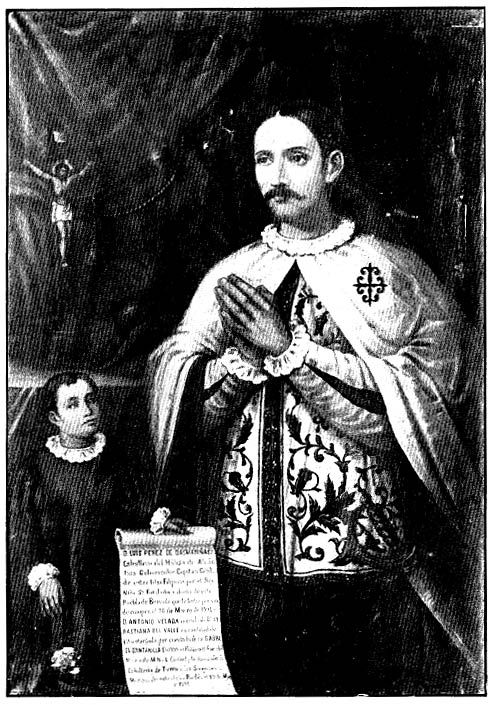
Governor Luis Perez Dasmariñas
[From painting exhibited at St. Louis, 1904, in the Philippine exhibit of the Louisiana Purchase Exposition]